INTRODUCTION
Following the charge the organizers of this special section gave to the contributors, this article presents a site-specific case study and describes four on-floor artifact deposits that the Chan Chich Archaeological Project (CCAP) excavated in monumental architecture contexts at the site of Chan Chich in western Belize. The purpose of this study is to highlight the diversity among similar deposits at the same site by presenting detailed compositional data that other researchers can compare to their own datasets. Excavators at Chan Chich have wrestled with understanding the features’ formation processes since 1997, when initial test excavations encountered the first of these on-floor deposits (Meadows Reference Meadows and Houk1998). Since then, we have often defaulted to the “problematic deposit” label in the field—an homage to the Tikal Project's “problematical deposit” category used to designate “deliberate deposits, both concealed and open, that materially, locationally, even behaviorally” left excavators “exceptionally puzzled” (Coe and Haviland Reference Coe and Haviland1982:49)—to avoid interpreting the deposits prior to carefully analyzing their composition and context (Houk Reference Houk and Houk2000, Reference Houk, Iannone, Houk and Schwake2016). In other words, the difficulty in classifying the deposits comes not from describing them but from interpreting the process(es) resulting in their formations. Temporally, all four of the on-floor deposits appear to be peri-abandonment features—following the definition proffered by Hoggarth and colleagues (Reference Hoggarth, Britt Davis, Awe and Helmke2020)—and, I argue, they are also more appropriately described as abandonment-related features in terms of context. The distinction between the two labels is that the latter represents part of the process of abandonment, rather than simply something occurring around the time of abandonment for other reasons.
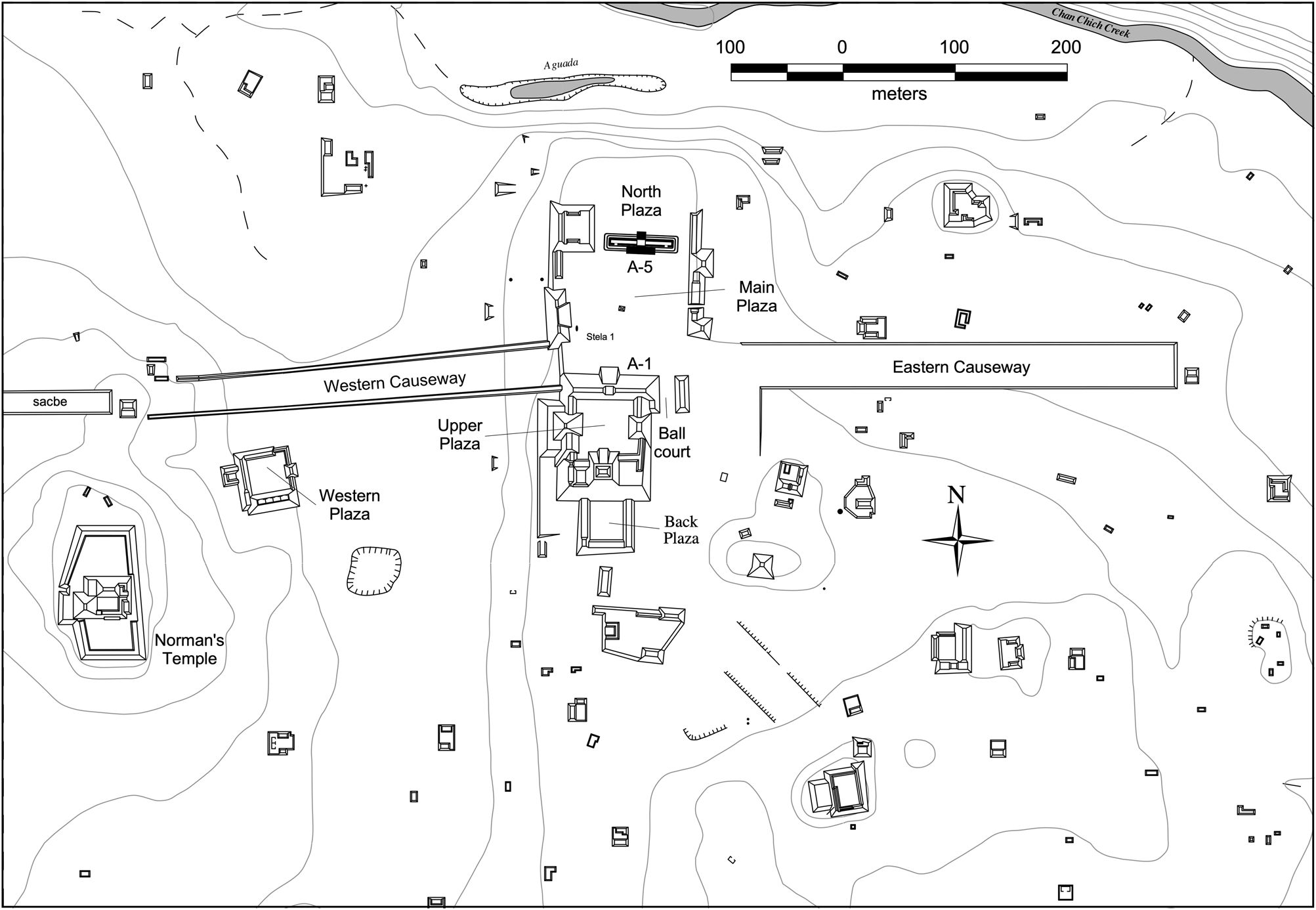
The first features discovered at Chan Chich in the late 1990s included a scatter of artifacts apparently smashed on the steps to a palace in the Western Plaza and two deposits in the Norman's Temple courtyard (Figure 1)—a dense deposit of artifacts piled at the base of a temple-pyramid and an artifact scatter on the steps to a range building (Ford and Rush Reference Ford, Rush and Houk2000; Houk Reference Houk2012, Reference Houk, Iannone, Houk and Schwake2016; Meadows Reference Meadows and Houk1998). More recent excavations have uncovered another on-floor deposit—another example of piled artifacts—in the Norman's Temple courtyard (Booher Reference Booher and Houk2016). As Aimers and colleagues (Reference Aimers, Hoggarth and Awe2020) discuss in the introduction to this special section, archaeologists have applied a wide range of interpretative labels to similar deposits in the Maya lowlands. Harrison-Buck (Reference Harrison-Buck and Harrison-Buck2012:103, 115) has referred to deposits “of smashed and scattered objects in the context of defaced elite residential architecture” as “termination deposits,” while other scholars have described deposits similar to those under consideration here as “desecratory termination rituals” (Stanton et al. Reference Stanton, Brown and Pagliaro2008). As Helmke and colleagues (2017:228) note, “[d]espite the growing literature on the subject, the activities that these features represent have been greatly debated.” This article discusses the four deposits and compares them in terms of context, density of material, and content to highlight similarities and differences.
Map of Chan Chich site-core, showing the locations of groups and structures discussed in this article. Map courtesy of CCAP.

BACKGROUND
Chan Chich is a moderate-size Maya city in the southern part of the Orange Walk District, less than five kilometers from the Guatemalan border (Aimers et al. Reference Aimers, Hoggarth and Awe2020:Figure 1). It is the largest known site in the eastern part of the Three Rivers adaptive region between La Milpa to the north and El Pilar to the south (Houk Reference Houk2015). The CCAP has investigated the site over the course of 13 seasons (1996–1999, 2001, and 2012–2019), with most excavations taking place in and around the site core (Houk Reference Houk and Houk2017).
The epicenter comprises a north-south line of four plazas and associated structures, flanked by the Eastern and Western Causeways, which radiate from the Main Plaza and into the surrounding zone of elite compounds, residential courtyards, workshops, and isolated mounds. Two of the largest, non-royal, elite courtyards at the site are the Norman's Temple complex and the Western Plaza, the two groups containing the on-floor deposits discussed in this article.
In terms of chronology, excavations demonstrate the Maya first occupied Chan Chich around 900 b.c. (Gallareta Cervera et al. Reference Gallareta Cervera, Houk, Palmer, Houk and Novotny2017). The settlement expanded significantly in size during the Late Preclassic period and then again during the Late Classic period, when the site plan took its final form (Houk Reference Houk2015). The last major construction phase in the Upper Plaza appears to have taken place around a.d. 660 to 760, based on radiocarbon dates from sealed contexts. As the deposits discussed in this article indicate, the Maya abandoned Chan Chich during the ninth-century Terminal Classic period, although Postclassic visitors left offerings sporadically centuries after abandonment (Houk et al. Reference Houk, Sullivan and Valdez2008).
TYPES OF ON-FLOOR DEPOSITS AT CHAN CHICH
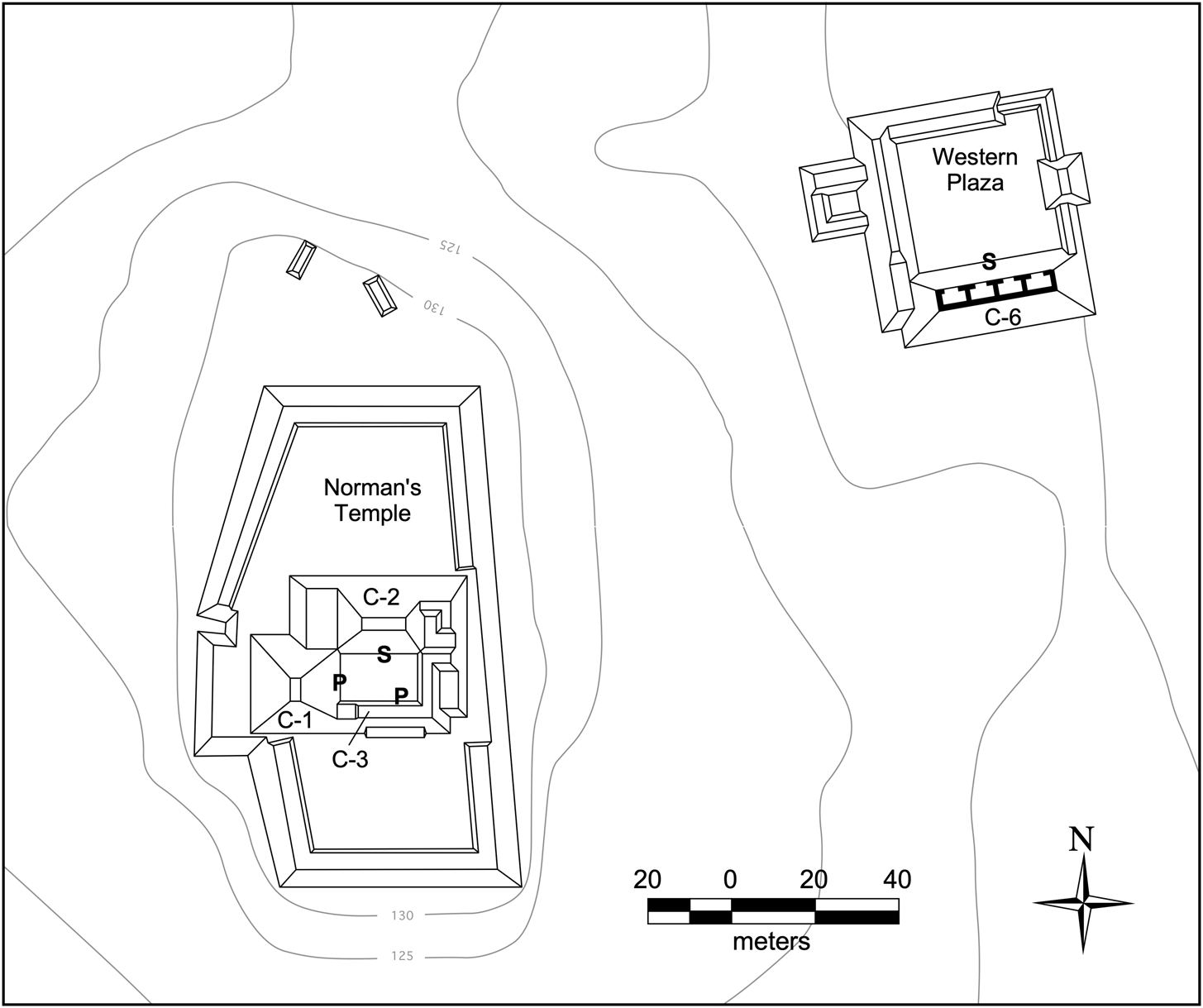
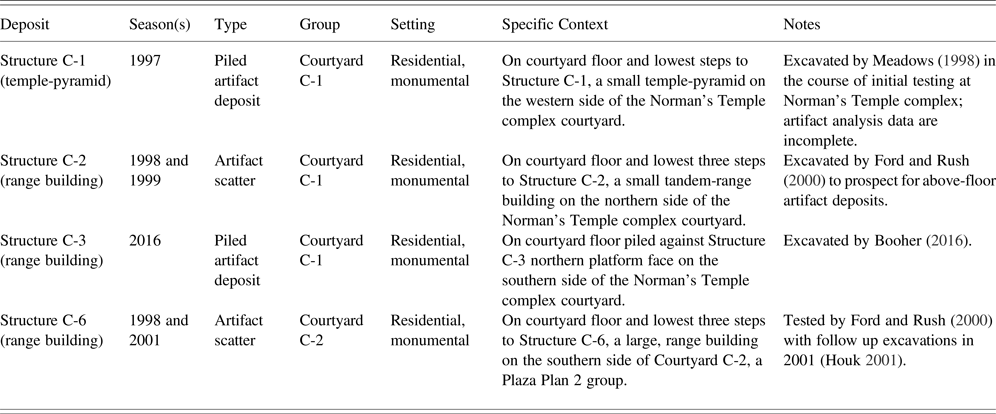
Over the course of 13 seasons of research, the CCAP has documented two types of on-floor deposits in monumental architectural groups, which are presumably elite residential contexts (Figure 2 and Table 1). The first type comprises artifact scatters documented at the Norman's Temple complex at the base of the northern range structure (Structure C-2) and in the Western Plaza at the base of the group's largest structure (Structure C-6). Houk (Reference Houk, Iannone, Houk and Schwake2016) has previously reported on the artifact scatters the CCAP excavated in the late 1990s and 2001, though without the detailed artifact data included here. The second type comprise artifactual material piled together, usually in an ashy matrix. Meadows (Reference Meadows and Houk1998) excavated the first example of this type at the Norman's Temple complex in 1997 at the base of the western temple-pyramid (Structure C-1). Booher (Reference Booher and Houk2016) subsequently encountered a similar deposit at the base of Structure C-3 on the southern side of the same courtyard in 2016. The ceramics from the deposits date all four of them to the Terminal Classic period based primarily on the presence of Fine Orange and/or Imitation Fine Orange sherds.
Map of Norman's Temple complex and the Western Plaza showing locations of artifact scatters (S) and piled artifact deposits (P). Map courtesy of CCAP.

Contexts of abandonment-related, on-floor deposits at Chan Chich.

METHODS OF COMPARISON
Despite differing levels of recording detail and analysis information, sufficient data exist for all but one of the four deposits to compare assemblage composition and artifact density among them. Unfortunately, only an approximate sherd count and brief description exist for the Structure C-1 piled artifact deposit, limiting that feature's comparability.
Examining basic contextual and assemblage-level data provides an initial method of comparing the on-floor deposits to one another. As a second method, I calculated the “richness”—or diversity—of each deposit by comparing the number of different artifact types represented in each deposit to the number of all possible artifact types represented in all of the deposits. While this method produces a numerical richness score, it involves a degree of subjectivity as the artifact categories are analytical constructs used by the CCAP that may or may not reflect cultural significance—for example, the analysis subdivides bifaces and biface fragments, but the distinction may have been meaningless to the people who created the artifact deposits. Across the six deposits, there are 24 different categories of artifacts, including human bone. As discussed below, subdividing those categories into 53 more specific artifact types reveals greater diversity among the deposits.
BRIEF DESCRIPTIONS OF THE DEPOSITS
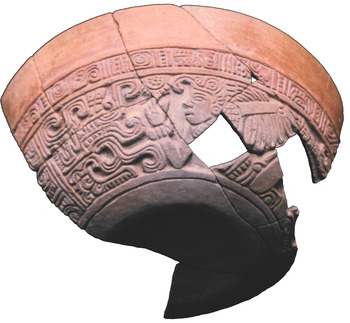
The Norman's Temple complex comprises a small, elevated courtyard in the center of a large, modified hilltop to the west of the Upper Plaza. Structures entirely enclose the courtyard, which measures 18 m east-west by 11 m north-south. This small, elite compound contained three excavated on-floor deposits (Figure 2). Ford and Rush (Reference Ford, Rush and Houk2000:41) placed three contiguous excavation units covering a combined area of 16 m2 at the base of Structure C-2, a tandem-range building on the northern side of the courtyard. The units exposed part of the courtyard's final floor and the lowest three steps to the building in the process of documenting an artifact scatter. Described by Ford and Rush (Reference Ford, Rush and Houk2000:41) as “smashed,” the recovered artifacts included thousands of ceramic sherds, mano and metate fragments, bifaces, obsidian blades, disarticulated human bone, a ceramic whistle fragment, a ceramic figurine fragment, bone and shell artifacts, and approximately 1/3 of a Pabellon Molded-carved bowl, the sherds of which were widely scattered across the 16 m2 excavation area (Figure 3). Excavators found the majority of the artifacts in the deposit sitting directly on the courtyard floor and steps.
Photograph of the partially reconstructed Pabellon Molded-Carved bowl from the Structure C-2 artifact scatter. Vessel diameter is approximately 20 centimeters. Photograph by the author.

Meadows (Reference Meadows and Houk1998:62–63) placed a 1 × 4.5-m unit oriented east-west at the base of Structure C-1 and encountered an ashy matrix with high quantities of artifacts piled on the courtyard floor and lower steps to the small temple-pyramid. He recovered red- and black-slipped wares, including Torro Gouged and Cubeta Incised sherds, Imitation Fine Orange sherds, a fragment of a ceramic figurine, ceramic whistle fragments, a medial thin biface fragment, and lithic debitage (Meadows Reference Meadows and Houk1998:63).
More recently, Booher (Reference Booher and Houk2016) encountered a 30-cm thick, piled artifact deposit in an ashy matrix against the face of the Structure C-3 platform and covering a portion of the courtyard floor. The deposit extended from the base of the platform face 1.12 m north and from the eastern edge of her excavations 2.5 m west. The excavated area contained the western limits of the deposit, but the feature clearly continued beyond the eastern wall of the excavations. Among the abundant artifacts, the deposit contained a ceramic pendant of an Old God's head and a polished stone celt, along with several shell artifacts and a ceramic whistle fragment.
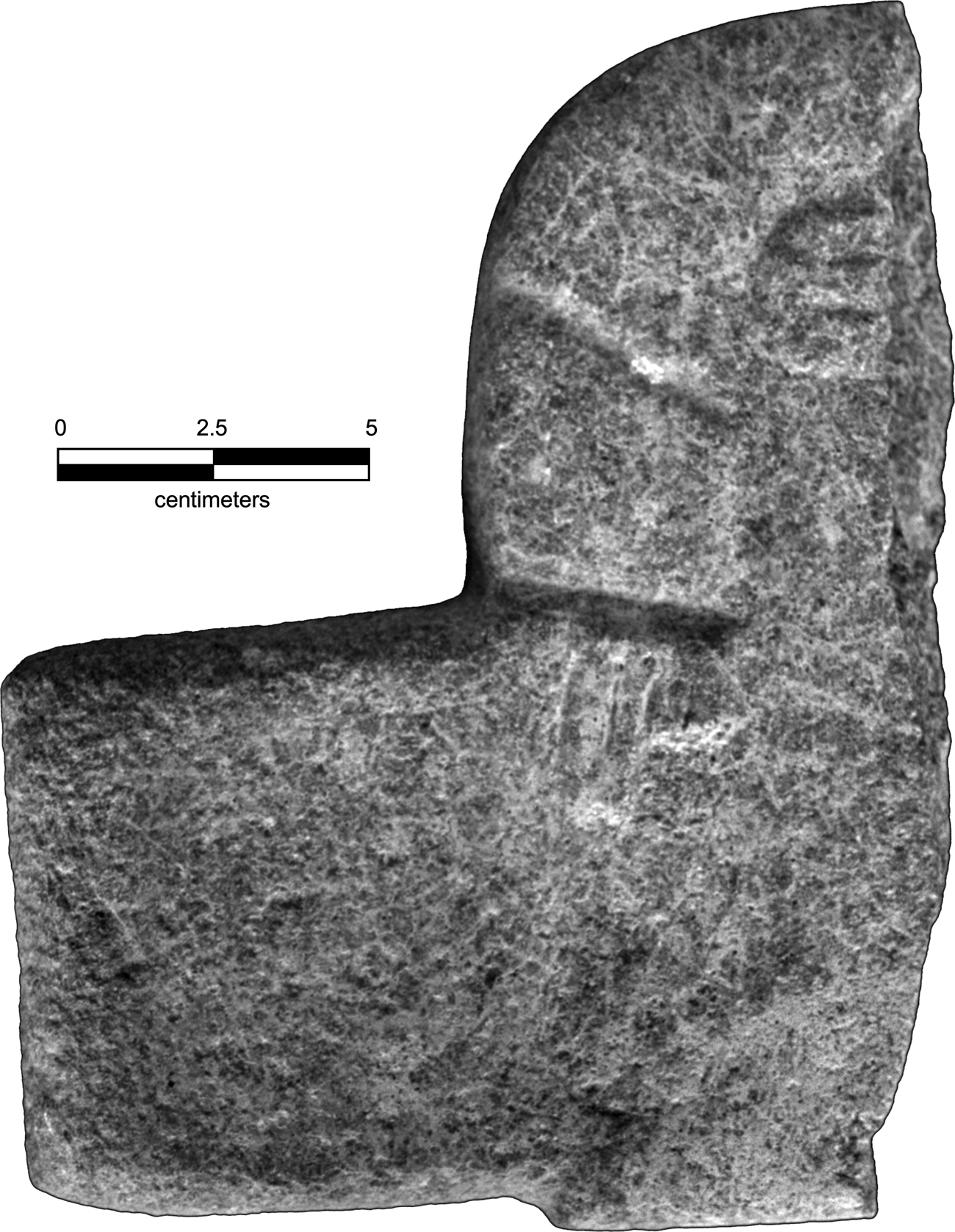
The CCAP excavated a fourth deposit considered here in the Western Plaza, a Plaza Plan 2 group, at the base of the Norman's Temple. The group includes a small, looted temple-pyramid on the east, and range buildings on the north, south, and west. The largest structure in the plaza is Structure C-6, the southern range building, which is approximately 50 meters long and five meters high. Two different teams of excavators exposed approximately 19.81 m2 of area along the structure's centerline comprising portions of the lowest three steps of the building and the courtyard floor at its base. The excavations encountered an artifact scatter with pockets of ashy matrix that included bifaces, abundant ceramics—including some Fine Orange sherds—human bone, an animal canine, and a fragment of a tenoned, polished stone marker, the only one of its kind found so far at Chan Chich (Figure 4).
Photograph of the broken, tenoned stone marker found in the Structure C-6 artifact scatter. Photograph by Mark Billings for the Chan Chich Archaeological Project.

RESULTS OF COMPARISONS
Basic Contextual and Assemblage-Level Data
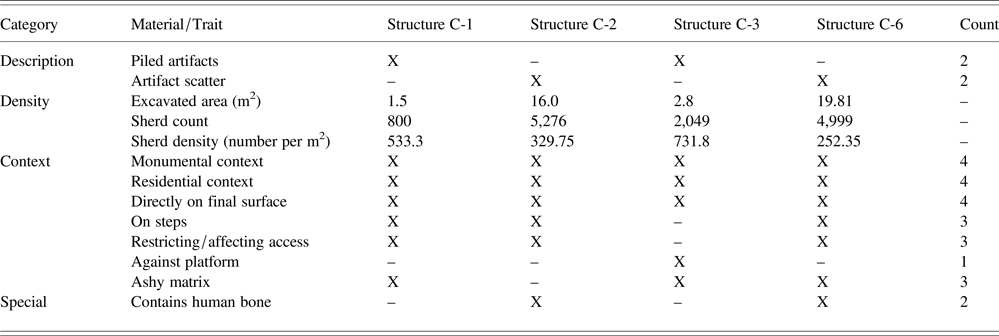
Table 2 presents the results of comparing basic contextual and assemblage-level data. Because ceramic sherds are the most common type of artifact in the on-floor deposits at Chan Chich, I use them to calculate the density of each feature, expressed as the number of sherds per m2 of excavated area. Sherd weight, or a combination of counts and weights, would be a more meaningful measure of density as it would provide detail on average sherd size, but we do not have those data for the deposits in question. The piles of artifacts have much higher densities than the scatters with both having more than 533 sherds per m2, compared to less than 330 sherds per m2 for the scatters. In all cases, excavators reported that the on-floor deposits at Chan Chich sat directly on the final architectural surface, be that steps or a floor. Researchers at other sites have noted thin layers of sediment accumulation between the final architecture and the bottom of some peri-abandonment artifact deposits (Aimers et al. Reference Aimers, Hoggarth and Awe2020; Hoggarth et al. Reference Hoggarth, Britt Davis, Awe and Helmke2020; Inomata Reference Inomata, Iannone, Houk and Schwake2016; Pendergast Reference Pendergast1979), implying the passage of time between the abandonment of the architectural group—or at least the cessation of cleaning activities—and the formation of the artifact deposit. Table 2 also includes information on whether or not each deposit contained human bone. As noted by Harrison-Buck (Reference Harrison-Buck and Harrison-Buck2012:109), the inclusion of human bone is a “key feature of termination deposits that distinguishes them from normal midden or trash deposits.” Both artifact scatters included human bone, but the two piled artifact deposits did not. Three of the four deposits are on stairways, possibly indicating the intentional restricting or blocking of an access way (Harrison-Buck Reference Harrison-Buck and Harrison-Buck2012). Three of the four deposits contained ashy matrices.
Basic contextual and assemblage-level data from abandonment-related, on-floor deposits at Chan Chich.

Artifact Assemblages
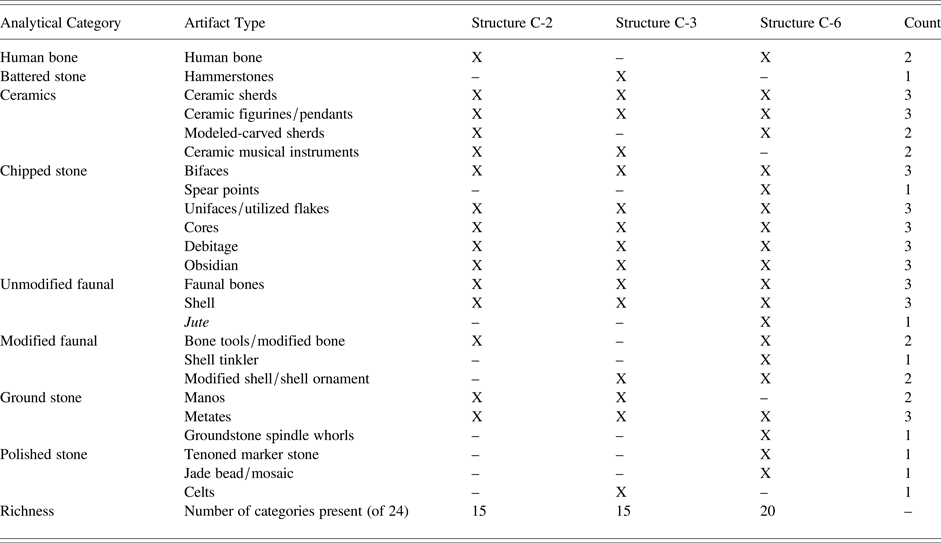
Table 3 presents artifact assemblage data for three of the four on-floor deposits at Chan Chich based on 24 categories of artifacts found in the four deposits described here. A deposit's “richness” reflects the number of different categories present but does not take into consideration the number of artifacts in each category. The Structure C-6 artifact scatter from the Western Plaza has the most diverse artifact assemblage (20 of 24 categories), while the Structure C-2 artifact scatter and the Structure C-3 piled artifact deposit both have 15 of 24 categories represented. In terms of similarities, all three deposits contain ceramic sherds, bifaces, unifaces/utilized flakes, cores, debitage, obsidian, faunal bones, and metates. Most also contain unmodified shell and ceramic figurines/pendants. The Structure C-1 deposit included exotic artifacts such as Fine Orange ceramics and other fine wares, a ceramic figurine, ceramic whistle fragments, a medial thin biface fragment (Meadows Reference Meadows and Houk1998:63), but we do not have artifact counts to include that data in Table 3. Nonetheless, the published description of the deposit suggests it was compositionally similar to the Structure C-3 piled artifact feature.
Presence/absence of simplified artifact categories represented in abandonment-related, on-floor deposits at Chan Chich.

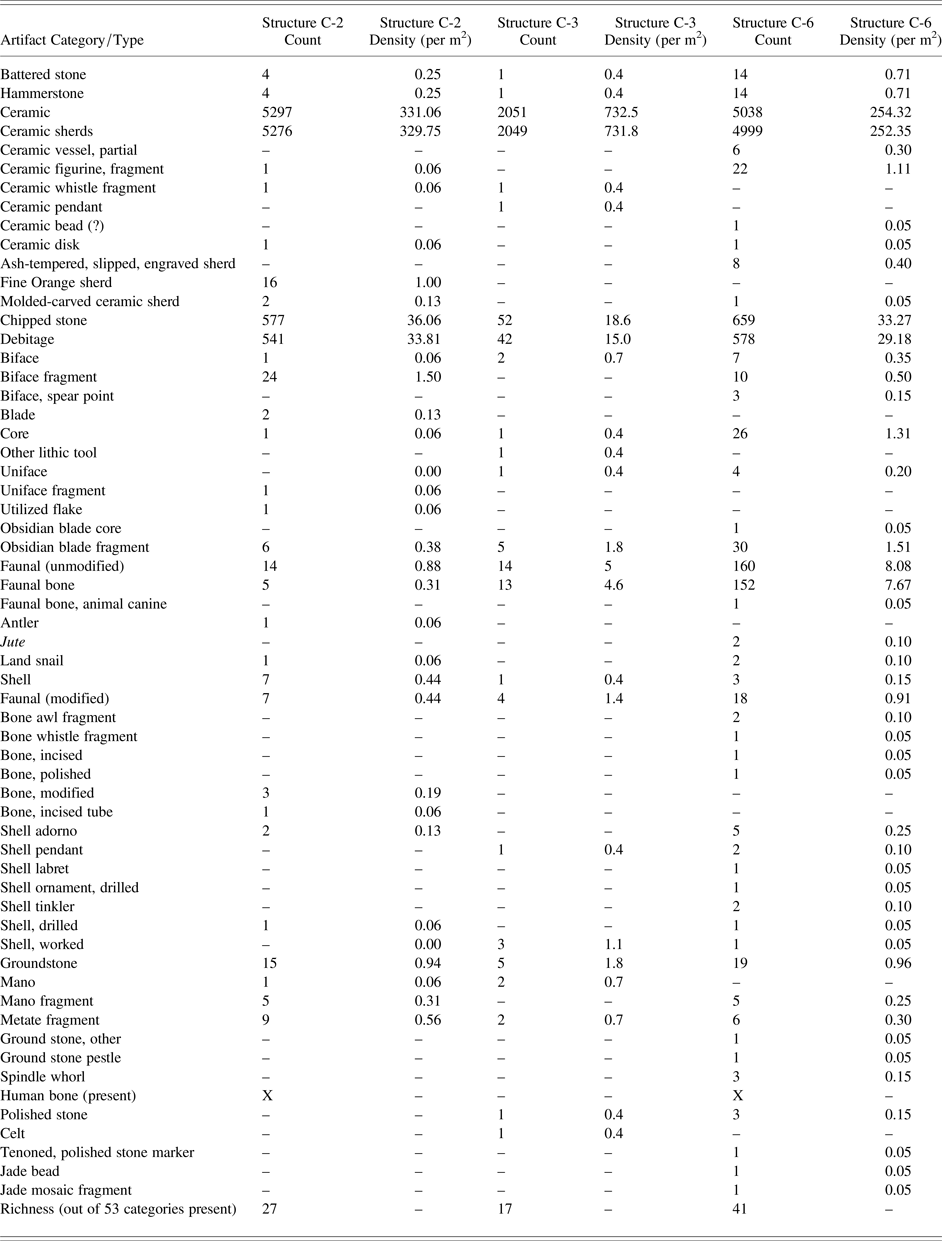
Drilling deeper into the data and comparing more specific artifact subtypes across the deposit reveals greater diversity. Table 4 presents artifact counts and densities for 53 different artifact subtypes used in the CCAP database along with presence or absence information for human bone from three of the four on-floor deposits—I excluded the Structure C-1 deposit because the full data are not available. As was the case when using the broader artifact categories, the Structure C-6 artifact scatter has the most diverse artifact assemblage, containing at least one specimen from 41 of the possible 53 categories, and the Structure C-3 piled artifact deposit has the least diverse artifact assemblage, with only 17 of 53 categories represented.
Detailed artifact categories with densities represented in abandonment-related, on-floor deposits at Chan Chich.

DISCUSSION
The comparison above highlights similarities and differences among the four Chan Chich on-floor deposits from Norman's Temple complex and the Western Plaza and illustrates the diversity such deposits exhibit even in the same small courtyard, a characteristic noted by Hoggarth and colleagues (Reference Hoggarth, Britt Davis, Awe and Helmke2020) among deposits in Plaza B at Baking Pot. In the case of Chan Chich, the following observations about the Chan Chich on-floor deposits highlight potentially significant attributes. (1) Excavators found all four deposits on the final architectural surfaces with no intervening level of sediment, suggesting they were created at a point in time when the occupants of the site still actively cleaned and cared for the Norman's Temple courtyard and Western Plaza or shortly after such maintenance activities ceased. (2) Given their proximity, all three Norman's Temple courtyard deposits likely formed within the same time period, perhaps even as part of the same event, despite their compositional and morphological differences. (3) The Norman's Temple courtyard deposits are not continuous and do not encircle the courtyard. Excavations on the eastern side of the courtyard and at the western end of the southern side of the courtyard in the 1990s did not encounter similar features. (4) Excavations on the summit of Structure C-2 in the Norman's Temple courtyard did not encounter evidence for intentional destruction of the architecture but did document incised graffiti in the poorly preserved plaster in the one partially exposed room. While these graffiti are also a peri-abandonment feature, it is unclear if they are related to the on-floor artifact deposits in the courtyard (Booher and Houk Reference Booher and Houk2017). Similarly, excavators did not find evidence for intentional destruction at Structure C-6 in the Western Plaza. (5) While our original artifact analysis did not look for ceramic refits explicitly, the Pabellon Molded-carved bowl from Structure C-2 in Norman's Temple courtyard provides data on the formation of the deposit. The 10 sherds, which refit into approximately 1/3 of the original bowl, were widely scattered across the 16-m2 excavation area, indicating the vessel was intentionally broken and the sherds scattered. Similarly, at Structure C-6 in the Western Plaza, excavators expanded their excavations to recover additional pieces of the tenoned marker stone—the only example of its kind from the site—but failed to find any, suggesting that artifact had been intentionally broken and its pieces scattered. (6) Although utilitarian ceramics comprise the majority of artifacts in the deposits, all of the deposits include exotic, rare, or unique items, including some that could be considered powerfacts (Iannone et al. Reference Iannone, Houk, Schwake, Iannone, Houk and Schwake2016). (7) Two of the deposits contained human bone. Pagliaro et al. (Reference Pagliaro, Garber, Stanton, Brown and Stanton2003:79–81) suggest that human remains occur in desecratory ritual deposits and may represent disturbed elite burials or perhaps ritually sacrificed elite residents. Navarro-Farr (Reference Navarro-Farr, Iannone, Houk and Schwake2016:254), however, cautions that the inclusion of human bone “does not necessarily suggest a profane act.”
CONCLUSIONS
As the papers in this Special Section demonstrate, archaeologist have employed a wide range of methods and approaches in attempts to ascertain the origin and significance of on-floor deposits like those at Chan Chich. Although an exhaustive review is beyond the scope of this paper, in western Belize contextually or compositionally similar examples are known from Dos Hombres (Houk Reference Houk and Houk2000, Reference Houk, Iannone, Houk and Schwake2016), La Milpa (Houk Reference Houk, Iannone, Houk and Schwake2016; Sullivan et al. Reference Sullivan, Houk, Zaro and Moats2013; Zaro and Houk Reference Zaro and Houk2012), Blue Creek (Clayton et al. Reference Clayton, Driver and Kosakowsky2005; Guderjan Reference Guderjan2004; Guderjan and Hanratty Reference Guderjan, Hanratty, Iannone, Houk and Schwake2016), Aguacate Uno (Koenig Reference Koenig2015), and Baking Pot (Helmke et al. Reference Helmke, Hoggarth, Awe, Bednar and Johnson2017; Hoggarth et al. Reference Hoggarth, Britt Davis, Awe and Helmke2020), among others. Elsewhere in the eastern lowlands, Hammond (Reference Hammond1970:196–199) excavated a deep, midden-like deposit, which contained human bone, piled in the corner of a closed plaza in the core of Lubaantun (Norman Hammond, personal communication 2019); Pendergast (Reference Pendergast1979) reported extensive post-abandonment activity at Altun Ha—some of which may actually be abandonment-related deposits, as noted by Stanton and colleagues (Reference Stanton, Brown and Pagliaro2008); and Lamoureux-St-Hilaire and colleagues (Reference Lamoureux-St-Hilaire, Macrae, McCane, Parker and Iannone2015) report on apparent termination deposits compositionally similar to the Chan Chich on-floor deposits from residential courtyards near Minanha, which date to several centuries after the abandonment of the site center. Farther afield, other scholars have reported on similar deposits at El Palmar, Mexico (Tsukamoto Reference Tsukamoto2017); Aguateca, Guatemala (Inomata Reference Inomata, Iannone, Houk and Schwake2016); La Corona, Guatemala (Lamoureux-St-Hilaire and Snetsinger Reference Lamoureux-St-Hilaire and Snetsinger2020); and Waka’, Guatemala (Navarro-Farr Reference Navarro-Farr, Iannone, Houk and Schwake2016), to name but a few.
Various researchers have developed typologies with material correlates in attempts to classify on-floor deposits into types (Aimers et al. Reference Aimers, Hoggarth and Awe2020:Table 1; Lamoureux-St-Hilaire and Snetsinger Reference Lamoureux-St-Hilaire and Snetsinger2020) and particularly to identify those created by termination rituals (Pagliaro et al. Reference Pagliaro, Garber, Stanton, Brown and Stanton2003:79–80; Stanton et al. Reference Stanton, Brown and Pagliaro2008). The analytical challenge of these features is that they may “represent a wide array of behaviors and attendant meanings,” as Navarro-Farr (Reference Navarro-Farr2009:67–68) observed in her analysis of an extremely large and complicated peri-abandonment deposit at Waka’, and deposits from multiple, diverse events may blanket the same structure (Navarro-Farr Reference Navarro-Farr, Iannone, Houk and Schwake2016) or be found near one another at the same site (Houk Reference Houk, Iannone, Houk and Schwake2016). Thus, the term “special or problematic deposit” remains a useful placeholder classification for deposits such as these until more detailed interpretations are possible but is itself not an indication of form, function, or origin for peri-abandonment deposits.
In summary, the four deposits described here formed while the two elite compounds in question were actively being maintained or shortly after the residents had stopped maintaining them, but, based on the fact that the deposits were never removed, maintenance activities did not occur following the creation of these features. They are, therefore, both peri-abandonment and abandonment-related deposits. Excavations in the Main Plaza at the site, which is the largest public plaza at Chan Chich, have not uncovered peri-abandonment features on the stairs to Structure A-1 or Structure A-5, the only two buildings from which have centerline, stairway excavations. Therefore, despite the fact that our sample size is small, it seems that the target of the abandonment-related features was elite residential architecture, not large public structures. Determining the intent behind the deposits—reverential or desecratory, ritual or profane—and the actors involved is more problematic; the data do not clearly favor one alternative over another. The implication, however, is that following the creation of these deposits, the elite residents of the Norman's Temple complex and the Western Plaza abandoned their homes and never returned. Whether they did so of their own volition is unknowable with the data at hand.
RESUMEN
En Chan Chich, Belice, arqueólogos han encontrado varios depósitos de artefactos del clásico terminal en los complejos residenciales élite cercanos al epicentro del sitio. Chan Chich es una ciudad maya de tamaño moderado localizada en la parte sur del distrito Orange Walk, a menos de 5 km de la frontera con Guatemala. En este artículo se presenta una comparación detallada de cuatro contextos y el contenido de varios depósitos de artefactos con la finalidad de resaltar las similitudes y diferencias entre ellos. Clasificados como depósitos problemáticos en campo, los cuatro ejemplos considerados aquí se formaron directamente sobre pisos o escalones. Estos depósitos incluyen dos grupos de artefactos dispersos, el primero ubicado en el patio del Templo de Norman y el segundo en la Plaza Oeste, así como dos depósitos de artefactos apilados, ambos localizados en el patio del Templo de Norman.
El análisis de los datos contextuales básicos y del ensamblaje nos proporcionan un método inicial para comparar los depósitos entre sí. Como segundo método este estudio calculo la diversidad de cada depósito, esto al comparar el número total de diferentes tipos de artefactos representados en cada depósito con el número total de tipos posibles de artefactos representados en todos los depósitos. A través de estos seis depósitos, calculamos 24 categorías diferentes de artefactos, incluyendo huesos humanos. La subdivisión de esas categorías en 53 tipos de artefactos más específicos reveló una gran diversidad en los depósitos.
Este estudio muestra que los depósitos se formaron en un momento en el que los ocupantes del sitio aún estaban manteniendo los dos grupos residenciales donde se encontraron los depósitos. A pesar de sus diferencias en composición y morfológicas, los tres depósitos del Templo de Norman probablemente se formaron al mismo tiempo. El patrón de dispersión de los tiestos de cerámica que pudieron ser re-encajados sugiere que algunos objetos se rompieron intencionalmente y las piezas posteriormente dispersadas cuando se crearon los depósitos. Mientras que las cerámicas utilitarias constituyen la mayoría de los artefactos en los depósitos, todos los depósitos incluyen artículos exóticos, raros o únicos.
Aunque exhiben variabilidad en su composición, los cuatro depósitos parecen ser resultado de procesos de abandono creados deliberadamente por actores y dirigidos específicamente a la arquitectura residencial élite en vez de a estructuras públicas monumentales en el núcleo del sitio. Determinar la intención detrás de los depósitos (reverencial o de profanación, ritual o profano) y a los actores involucrados es problemático. Sin embargo, la implicación es que tras la creación de estos depósitos, las élites residentes en el Templo de Norman y la Plaza Oeste abandonaron sus hogares y nunca regresaron.
ACKNOWLEDGMENTS
I would like to thank the Institute of Archaeology, Government of Belize for permitting the excavations discussed here, as well as the Bowen family for allowing us to excavate on their property. The Alphawood Foundation generously supported the 2016 excavations at Norman's Temple courtyard. I would like to thank the staff of the Chan Chich Archaeological Project as well as the students and workers who conducted the excavations and analysis of the on-floor deposits described here. I thank Tomás Gallareta Cervera, who translated the summary into Spanish. Finally, Norman Hammond and three anonymous reviewers provided helpful comments that strengthened this article.