In March 2008 the Association of German Machine Builders (Verband Deutscher Maschinen- und Anlagenbauer) complained of the notorious Chinese product piracy: “More than half of German machine builders discover illegal replicas at exhibitions. Three-quarters of these replicas come from China. Unfortunately, China's entry into the WTO in 2001 has not improved the legal protection of intellectual property rights of foreign firms.Footnote 1 The resulting loss to German mechanical engineering is about seven billions euros per year (or about 4 percent of total sales).”Footnote 2 The Association of German Machine Builders did not mention that, a century ago, many of its members relied on counterfeiting strategies to catch up to their British and American competitors. As early as 1897, the periodical American Machinist observed: “In going through the shops of a prominent German machine-tool builder who has been in the United States and got a good many ideas there from, as well bought a good line of the best standard machines from which to copy or vary, in the production of its own line, I notice that every solitary American machine, whether from Providence, New Haven, or Cincinnati, had had the name chipped off and the place painted over.”Footnote 3 Thirty years later, in 1927, the French periodical La Machine Moderne reported: “Information coming from Germany indicates that a number of American machine-tools are being copied now by German manufacturers, some of which are made without the slightest alteration. Most of these machines are actually sold as originals, the name of the American constructor of the original machine being mentioned in the advertising notices, and often even appearing stamped on the machine, with the indication ‘type’ or ‘model.” We can cite a case where a German firm copied a machine designed and built by a well-known American manufacturer, and sold in the United States.”Footnote 4
We claim in this article that imitating and even counterfeiting advanced foreign technology and products are typical strategies of firms located in an economically backward country.Footnote 5 These activities are formally legal when the imitating firms sell only in those markets where the intellectual property rights of the original inventor are not protected—like in Germany before 1877. These activities are clearly illegal when the imitating firms peddle their replicas in places where the original inventor has valid intellectual property rights—like in the case reported by La Machine Moderne.
Ineffective intellectual property rights are a necessary but not sufficient precondition for the occurrence of methodical imitating activities. At least two other preconditions have to be satisfied to motivate a firm from a backward country to engage systematically in imitating superior foreign technology.Footnote 6 First, the potential imitator has to have available the stock and structure of human capital that is requisite to reproduce the foreign innovation. Philippe Aghion supposes that during the imitation phase firms rely primarily on workers with secondary education while for independent innovation workers with tertiary education are needed.Footnote 7 Second, to gain significant market shares, the potential imitator has to be able to undercut the innovator's price due to lower production cost. In 1882, for example, the German machine tool builders offered their replicas of American machine tools in London at a price that was between 25 and 40 percent lower than the one of the American innovators.Footnote 8
In his seminal work, David Landes claims that “this readiness and even eagerness to learn from others […]—industrial espionage is a theme running all through modern European history—was testimony to an already thriving indigenous technology; good innovators make good imitators.”Footnote 9 In our opinion, even more important is the reverse causality: good imitators become good innovators. To elaborate this argument, we subdivide the catching-up process into the two periods, imitation and innovation. During the imitation period, the backward country's domestic firms oppose any strict patent law and use various channels such as reverse engineering, visiting international exhibitions and foreign firms, analyzing patent specifications, or hiring foreign craftsmen and engineers to imitate their superior foreign competitors.Footnote 10 Learning by imitating might enable these firms to develop innovations on their own. If they judge their newly acquired capability to innovate more profitable than their traditional imitating strategy, a period of innovation will follow the period of imitation. As this process of innovating gains momentum, domestic firms might favor tightening domestic patent law. They might even agree to end any discrimination against foreign firms, because that is necessary for having their own intellectual property rights enforced abroad.
In practice, the imitation and innovation phases often overlap. After domestic innovation gets underway, illegal imitation of foreign technology might become less common, and, second, increasing imitation activities between domestic firms might increase the diffusion of knowledge within the backward country. A larger knowledge base would provide more and more domestic firms’ ability to develop innovations. In turn, a higher rate of innovation increases both price and Schumpeterian competition among domestic firms, creating even greater incentives to innovate. In the best of circumstances, domestic firms might even take over the global technological leadership and thereby—like the German machine toolmakers—change from ruthless imitators to campaigners for the worldwide enforcement of intellectual property rights.
Japanese firms in various sectors went through this catching-up process successfully in the second half of the twentieth century; Chinese firms seem to be doing so today. We will concentrate on the development of the German machine tool industry between 1877 and 1932; it was one of the examples that inspired the efforts of other successful cases. In section 2, we present a case study to illustrate how this catching-up process worked at the firm level. The rest of the article focuses on patenting by German and American machine toolmakers. We analyze the chronology of the catching-up process, the German patent practice discriminating against foreign applicants, and the American firms’ responses.
REINECKER'S PATH FROM IMITATION TO INNOVATION
To illustrate the chronological sequence and the channels of knowledge transfer from American to German machine toolmakers, we look more closely at the development of J. E. Reinecker, a firm founded in 1859 in Chemnitz.Footnote 11 This firm began by making parts (rather than whole machines). Its imitation phase began at the World's Fair in Vienna in 1873 where the firm's founder bought a Brown & Sharpe Mfg. Company grinding machine. The firm then copied this American product to start up its own machine tool production.Footnote 12 Interestingly enough, an American correspondent at the World's Fair in Vienna had anticipated that such imitation strategy would arise: “A considerable number of American tools were sold to continental makers, and are probably to be copied at once for the European markets.”Footnote 13 J. E. Reinecker, indeed, learned from this initial experience and relied on imported American machine tools to expand its product range over the following decades. By 1915 the firm had bought more than 100 machine tools from 21 different American manufacturers. Generally, J. E. Reinecker acquired only one, rarely two machine tools of the same type.Footnote 14 In Chemnitz, the process of reverse engineering began by first completely disassembling the imported machine tool. Then, every component was analyzed and recorded with the help of engineering drawings. Then J. E. Reinecker embarked on process of producing replica parts until it could manufacture fully functional copies of the original American machine tool.
J. E. Reinecker did not rely on solely trade fairs and world exhibitions to learn about new machines.Footnote 15 International trade journals and American patent specifications were also important sources of knowledge about foreign innovations.Footnote 16 As it intensified its imitation efforts, personal, often tacit, knowledge became more and more important. That is why, in 1882, the founder's son traveled to the United States. He visited many American plants and even worked there temporarily.Footnote 17 The publication commemorating the 50th anniversary of J. E. Reinecker explicitly stressed that the experience the founder's son gained during his stay abroad had played a major role in its technological progress.Footnote 18 In addition, in 1897 J. E. Reinecker hired an American expert who had presented the innovations of a Philadelphia firm at the Chicago World Exhibition in 1893.Footnote 19 Over time, the firm came to rely on information about innovative machine tools distributed by international resellers among the different (German and foreign) firms they represented.Footnote 20 The world's largest reseller of machine tools, Schuchardt & Schütte in Berlin, for example, informed J. E. Reinecker regularly about the latest technological development in the United States.Footnote 21
Due to this continuous and multifaceted transatlantic knowledge transfer and the subsequent learning by imitating, J. E. Reinecker changed from a pure imitator of American technology to an independent innovator. In 1878 J. E. Reinecker patented its first major innovation that was a machine tool which could be used to grind spiral drills and was inspired by the various grinding machines the firm had acquired from Brown & Sharpe since 1873.Footnote 22 By 1900 J. E. Reinecker had already applied for 37 patents in Germany, five of these were also filed in the United States. Even the American trade press acknowledged the outstanding innovativeness of this German firm. Fred Miller, editor of the American Machinist, described the positive impression he had gained during a visit at the J. E. Reinecker's production facility: “There is in the products of this shop much more original work than is to be found in the work of a large proportion of our own shops, and I am convinced that the net result of the fact that such a concern as this chooses to adopt the underlying principles of our American tool designs and to follow them rather than British ideas is a distinct gain for the American tool builder, even in German trade itself.”Footnote 23
J. E. Reinecker's successful transition from imitator to innovator was short-lived. Indeed World War I dealt a nearly mortal blow to its attempt to join the elite of international toolmakers. The Allied trade embargo of Germany obviously isolated the firm from both international competition and from information about new foreign machine tools. During the war, German machine toolmakers had to stop their producing high-quality machine tools and instead made large numbers of low-quality machines for ammunition and weapons production. There was no point in investing in new R&D projects for cutting-edge machines.Footnote 24 The war also hurt the firm's human capital because many experienced machine toolmakers were drafted and replaced by unskilled workers. Not surprisingly, J. E. Reinecker switched focus and used its new unskilled workers and most of its production capacity to manufacture ammunition instead of complex machinery. Overall, J. E. Reinecker's prewar innovative momentum was broken and the firm fell far behind its American competitors.Footnote 25 J. E. Reinecker's technological stagnation is highlighted by the fact that it was awarded only three patents between the end of the First World War and 1927, which comes to only about 11 percent of the number of patents the firm had received between 1890 and 1913.
After the war, it was not a surprise that J. E. Reinecker reverted to its ancient imitation strategy. In 1926 the Department of Commerce in Washington and the American Embassy in Berlin singled out the aggressive imitation strategies of the former innovator J. E. Reinecker among German product pirates who should be taken to the German patent court. Their reports highlighted that the firm offered an illegal replica of the “three spindle gear rougher” for only two-thirds of the price demanded by its American inventor Gould & Eberhardt. Another case involves the American firm Lees-Bradner Company. By 1925 it had sold 75 units of its “spur gear grinders” in Germany for 2,200 Reichsmarks per unit. In 1925, however, J. E. Reinecker offered a replica at a price of only 1,200 Reichsmarks, and stole the German, British, and French markets from the Lees-Bradner Company.Footnote 26 J. E. Reinecker did not to resume significant innovation until the late 1920s and its first new U. S. patent application was filed in 1932.Footnote 27
J. E. Reinecker's business history suggests that the catching-up process occurred in two consecutive steps. The pre-First World War catching-up process is characterized by an imitation phase until the 1890s and an innovation phase until the outbreak of the war. After a severe technological setback during the First World War the catching-up process resumed. Again, it had to rely on imitation strategies in the 1920s but finally regained its ability to innovate in the early 1930s. This second catching-up process was faster than the first one because the technological gap was smaller and imitation channels of the 1920s were more intense than in the mid-nineteenth century. In the following sections, we shall show that this pattern was general among German machine toolmakers using patent data.
THE PATENT DATA
Our analysis of the patenting activities of the American and German machine tool industries is based on different samples of individual machine tool patents, with each single record including information about the year when the patent was granted (or applied for), as well as the name and location of the firm holding the respective patent. To identify the machine tool patents in the total patent population, we use the fact that the German patent office, starting with the introduction of the German patent law in 1877, assigned every patent to a particular technological class.Footnote 28 Patents covering the technology of the machine tool industry can be found in the patent classes 47 (machine parts), 49 (mechanical metal working), and 67 (grinding and polishing).Footnote 29 As these patent classes also contain innovations that do not belong to the machine tool technology, we identified the relevant patents with the help of the description of the innovation. Every patent that dealt with machining or chipping metal was selected.
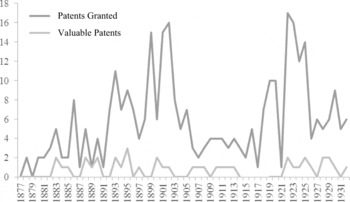
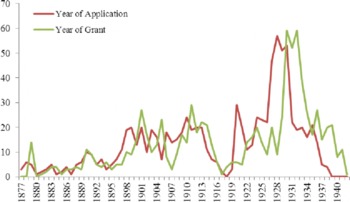
We analyze three different types of patent statistics: Patents applied for are a measure for inventions which were appraised to be new and potentially profitable by the applying firms. Patents granted, in contrast, are a measure for inventions which were judged to be new by the patent office. Valuable (or long-lived) patents cover those innovations which became in fact profitable.Footnote 30 It is important to note that these three types of patents do not necessarily display a parallel development over time. Figure 1 shows, for example, that the machine toolmakers of the industrial district Chemnitz had a rather constant annual number of valuable patents while their number of patents granted was especially high in the 1890s and the 1920s. It would therefore be wrong to infer from the rising number of patents granted a similar boom of valuable patents and therefore of profitable innovativeness.Footnote 31
In this article, we match the Baten-Streb patent database (about 66.700 valuable patents for the period 1877–1932) with Richter's patent data about the patenting activities of American and German machine toolmakers for four different groups of patent holders which vary in the depth of patent information available:Footnote 32 (1) A first data set contains 425 valuable patents granted to one of 479 firms that were a member of the association of German machine toolmakers between 1891 and 1932 or were identified as machine toolmakers in trade journals published between 1870 and 1932; (2) A second data set involves those firms in the industrial district of Chemnitz (the birthplace of the German machine tool industry). For these firms, we have not just their 40 valuable patents, but all 352 patents they received; (3) A third data set includes information on their 688 patents granted in Germany including the application date and 62 valuable German patents granted to one of 408 American firms that were either member of the Association for Manufacturing Technology (or its predecessor, the National Machine Tool Builders Association); or were identified as machine toolmakers in trade journals; (4) A fourth data set involves American machine toolmakers in the Cincinnati industrial district of Cincinnati which was, along with New England and Philadelphia, one of the most important focal points of the American machine tool industry. For those firms, we have their 48 German patents including two valuable ones and their 1,165 American patents.
PATENTS GRANTED AND VALUABLE PATENTS OF THE MACHINE TOOLMAKERS IN CHEMNITZ

VALUABLE PATENTS (VP) OF GERMAN MACHINE TOOLMAKERS

We use these four patent data sets to analyze the details of German machine toolmakers’ catching-up process in the following section.
GERMAN MACHINE TOOLMAKERS’ CATCHING-UP
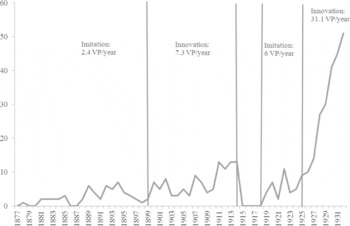
Figure 2 shows that the average annual number of valuable patents received by German machine toolmakers matches the qualitative evidence about the timing of the repeated catching-up process: The first imitation period starts with the Paris World Exhibition in 1867 and ends about 1899 with an average of 2.4 valuable patents per year.Footnote 33 It is followed by the first innovation period (1900 to the outbreak of the First World War) when the number of average valuable patents rises to 7.3 per year. Patenting rates collapse during World War I. A second imitation period runs 1919 to 1925 with 6 valuable patents per year, followed by a second innovation period (1926 to 1932, which is the last year covered by our data) with 31.1 valuable patents per year.
The fact that, during the first imitation period, German machine toolmakers applied for only a few patents that turned out to be worth prolonging for at least ten years suggests that, in the late nineteenth century, the German firms neglected their own R&D projects and relied primarily on imitating foreign products. As the example of J. E. Reinecker demonstrates,Footnote 34 learning by imitating contributed in the longer run to the creation of the R&D capabilities that were needed to develop successful innovations on their own account. The average number of valuable patents per year awarded to the German machine tool industry tripled in the first innovation period in comparison to the preceding first imitation period. However, we should not draw a sharp line between these two periods. The transition from imitating to innovating was gradual in the late nineteenth century.
The absence of valuable German machine tool patents between 1915 and 1918 in Figure 2 does not indicate the total breakdown of innovation in the sector, but is due to the fact that the German patent office did not publish the name of any patent holder during the First World War. Our case study of the machine toolmaker J. E. Reinecker suggests, however, that the German machine toolmakers could not maintain their technological leadership during the war.Footnote 35 Consequently, after the war had ended, many German machine toolmakers went back to their well-known imitation strategies which they had already brought to perfection in the nineteenth century. They concentrated now especially on imitating the new centerless grinding machines which had been developed for the advanced American automobile industry. Any scruples which the German firms might have had against violating of intellectual property rights must have been overcome by the U.S. Office of Alien Property's wartime confiscation of their U.S. patents.Footnote 36 As late as 1926, the American commercial attaché in Berlin declared: “The practice of copying American machinery has therefore extended much more widely since the war than it was even before.”Footnote 37 In any case, their past experience with imitation must have helped German machine toolmakers to resume production at a high rate and to catch-up again in just a half decade. In 1926 the German machine tool industry started to pass through its second innovation period with an unprecedented average number of 31.1 valuable patents per year.
VALUABLE PATENTS OF AMERICAN MACHINE TOOLMAKERS IN GERMANY

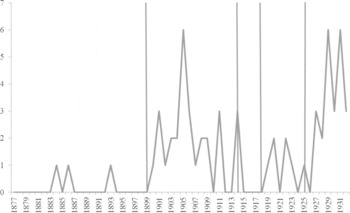
How did the American producers react to German firms’ copies of their machine tools in the late nineteenth and early twentieth centuries? We already know about that there were complaints about German activities both during the first and the second imitation period. It is reasonable to assume that the American innovators fought not just with words, but also tried to protect their intellectual property rights by applying for patents in Germany.Footnote 38 Figure 3 shows that American firms did not garner high number of either standard or valuable German patents during the two imitation periods. In fact, their patenting was high in the two innovation periods.Footnote 39 How can this empirical observation be explained?
There are two necessary conditions for a firm to seek a patent in a foreign country: An innovator will only apply for a patent in a particular foreign market if he expects to sell his products there at a sales volume that justifies the costs that come along with the patenting activities abroad. It must also be the case that the application procedure was not too biased against foreigners. As we shall see, both conditions play an important role in explaining the chronology of American patenting in Germany.
The surprising parallels in foreign (American) and domestic patenting activities suggest that patent propensity might be positively related to the growth of German industries that made use of machine tools. Thus as long as these industries remained small, American firms had little incentive to patent in Germany. The rise in valuable patents up to 1914 might mirror the growth of domestic and foreign machine tool sales in Germany while the decline in patents after the First World War might reflect the depressed conditions of the interwar period. To evaluate this hypothesis, we compare American patenting activities in Germany with German machine tool imports.Footnote 40 We therefore use two time series: first, the nominal value of imported machines of every kind between 1880 and 1913,Footnote 41 and, second, the nominal value of imported machine tools between 1908 and 1932.Footnote 42 The correlation coefficient between the annual number of valuable patents of American machine toolmakers in Germany and German imports of machinery (1880–1913) comes to 0.45, the correlation coefficient between the annual number of valuable patents of American machine toolmakers in Germany and German imports of machine tools (1908–1932) to 0.18.Footnote 43 At least in the pre-First World War period, American firms might have increased their patent activities in Germany in response to growing business opportunities.Footnote 44
GERMAN EXPORTS AND IMPORTS OF MACHINE TOOLS IN TONS, 1900–1933

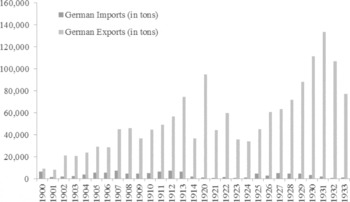
Interestingly enough, it seems that three of the most notorious German imitators of the first imitation period, namely J. E. Reinecker, Pfauter, and Wanderer Works, ceased to market copies of new American machines (stopped their imitation strategies) after they transited to innovation. Indeed by then, these three firms also filed American patents for their new products. The best German firms now had a strong interest in seeing their own patents respected in their American export market, and thus they may have abstained from violating the intellectual property rights of American firms before the First World War. Figure 4 shows that German machine toolmakers increased their exports considerably during both innovation periods. This finding supports our contention that valuable patents are a reliable indicator for innovativeness and therefore also for international competitiveness.Footnote 45
In the light of the increasing success of German firms in the American market, the German government was now also willing to make some concessions to the American patent holders. Section 11 of the 1891 German patent lawFootnote 46 preserved the 1877 rule that a patent could be revoked if the innovation was not manufactured in Germany.Footnote 47 The purpose of this rule was to prevent a foreign patent holder from using his German patent to secure his monopoly without employing domestic labor or stimulating local industry. Since German firms used their American patents in the United States in exactly this way, in 1909 the German government agreed to exempt American firms from that section 11 of the German patent law.Footnote 48
PATENTS GRANTED (WITH APPLICATION DATE) OF AMERICAN MACHINE TOOLMAKERS IN GERMANY

However, as we have already seen, in the early 1920s German firms reverted to copying foreign machines after losing their American patents during the war and falling technically behind. The Americans were well aware of the revitalized imitating activities of German firms in the 1920s. In 1925 American Trade Commissioner Theodor Pilger authored a report in which he listed 64 American machine toolmakers who had been squeezed out of the German and other export markets after their products had been copied by German firms. As Pilger had suggested, American firms applied for German patents to reduce such copying.Footnote 49 Figure 5 shows that American firms filed for an increasing number of patents in Germany after 1920, when German machine toolmakers’ resumed imitating foreign products. However, because Berlin's patent office took about three and a half years to grant a patent to an American machine toolmaker, the number of patents granted increased only in the late 1920s, that is, in the second innovation period. In the decade that followed the First World War, American firms did in fact try to limit product piracy by increasing their German patenting activities but failed because of the patent office's dithering.
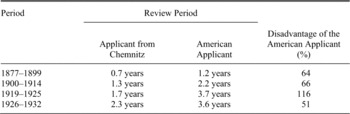
REVIEW PERIOD (TIME SPAN BETWEEN THE APPLICATION AND THE GRANTING) OF PATENTS OF MACHINE TOOLMAKERS FROM THE UNITED STATES AND CHEMNITZ, IN YEARS

Source:
Richter's patent data. A Chow test shows that, between 1919 and 1925, the disadvantage of American applicants with respect to the review period was significantly higher than in the rest of our observation period.
The German patent office's delay in granting patents in the 1920s might have reflected the growing complexity of the innovative machine tools. The patent authorities might also have chosen to delay grants to American firms to give domestic firms as much time as possible to exploit their imitation strategies.Footnote 50 In effect, as Masaaki Kotabe has argued in another case, a country's patent practices discriminate against foreigners if the review period is systematically shorter for domestic applications than for foreign applications.Footnote 51 Table 1 reveals that the German patent authorities took more time to evaluate American patent applications than those of Chemnitz (domestic) inventors. On average, this disadvantage comes to 60 percent. Between 1919 and 1925 however, the review period for American filers was more than twice of domestic applicants. Then the difference in review time decreased again in the late 1920s and fell to an all-time low. In short, the quantitative evidence suggests that the patent office discriminated against foreign firms during the second imitation period.
There is also anecdotic evidence that American firms found it difficult to protect their intellectual property in the 1920s. Some American machine toolmakers needed more than ten years to fight their cases through the German patent court because several German companies joined to oppose their applications.Footnote 52 The problems American manufacturers faced in dealing with the German patent office is illustrated by the experiences of Sol Einstein, head of the design engineering department of the Cincinnati Milling Machine Company: “It was difficult to get a German patent granted due to the opposition from German manufacturers. I therefore was sent to Germany to straighten out the difficulties our attorney experienced. When our opponents found out that I was in Germany to attend a hearing before the patent office, from month to month they postponed the hearings in the hope I would not stay in Germany. Finally after three months of delaying, the hearing was set…. our opponents were willing to withdraw their position if we would grant them a license for using all twelve machines they had built. I insisted, however, on a ruling by the patent office which finally granted the patent with very broad claims.” However, “through the united effort of a large number of German companies, the patent, after four years in existence, was declared invalid.”Footnote 53 It was the German Association of machine toolmakers which coordinated domestic firms’ fight against the American patentees by collecting and encouraging patent appeals.Footnote 54
Figure 5 shows that American firms’ patent applications in Germany collapsed during the Great Depression. This decline continued in the Third Reich when business opportunities for American exporters of machine tools were restricted because National Socialists’ foreign exchange controls reserved the use of scarce foreign currency mainly for the import of raw materials and food stuff.Footnote 55
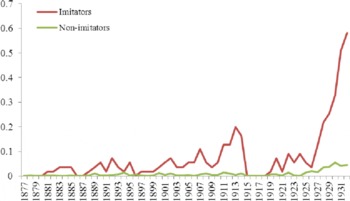
VALUABLE PATENTS PER IMITATING AND NON-IMITATING FIRM

Summing up, the degree of innovativeness of domestic firms significantly influenced the extent of the German patent office's discrimination against foreigners. In the decade before World War I when domestic firms were innovating, the patent authorities allowed American firms to hold patents for innovations not produced within the empire. In the second imitation period, the office forced American firms to face systematically longer review periods. It then changed course again in the second innovation period and brought differences in review times to an all-time low.
To prove our basic contention that learning by imitating fostered innovation we have to show that German imitators came to develop more novel machines than their non-imitator counterparts. To do so, we rely on the list of the 55 most notorious German imitators compiled by the Industrial Machinery Division of the American Department of Commerce and the National Machine Tool Builders Association.Footnote 56 We then calculate the annual number of valuable patents per firm for those on the American's list and for those firms who were members of the German machine tool builders association but did not make the list (see Figure 6). The notorious imitators were far more innovative than the non-imitating firms, especially in the innovation periods. It thus seems that the ability to develop profitable innovations diffused first and foremost among imitating firms. Spending resources on imitation was apparently useful for secure firm's technical long-term technological growth.
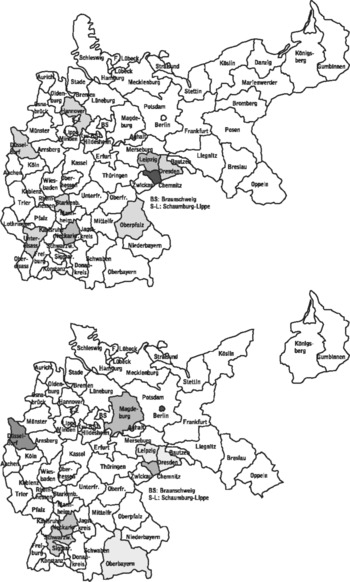
Patenting activities in the German machine tool industry were not only unevenly distributed across firms but they were also clustered in a few administrative districts. Figure 7 shows the core areas of machine tool innovations in the 1890s and the 1920s. The darker the shade, the higher the share of this district in all valuable machine tool patents. In the 1890s (1888–1897) machine toolmakers located in the three administrative districts of Saxony (Chemnitz, Dresden, and Leipzig) dominated patenting activities with a combined share of 46 percent in all valuable machine tool patents. In the 1920s (1918–1927), however, the geographical centers of patenting activities had shifted to Berlin (29 percent) and Magdeburg (12 percent) in the north, Duesseldorf in the west (17 percent) and Neckarkreis (9 percent) and Schwarzwald (8 percent) in the southwest. The combined share of the three administrative districts in Saxony had decreased to 15 percent though Saxony remained one of the major production centers of German machine tool industry.
One explanation for this change follows the hypothesis that the (local) availability of engineers and scientists with tertiary education is an important precondition for firms’ capability to innovate.Footnote 57 While it may not help us much with the original clustering, it can explain Saxony's relative decline in innovativeness because this region's universities did not participate in connecting science to research and development in the field of machine tool building before 1914. The first chair in machine tool building was established at Berlin's technical university in 1904.Footnote 58 The technical universities of Aachen, Braunschweig, Hannover, and Stuttgart also made such appointments before the First World War, whereas Dresden waited until 1923 to appoint a professor and open its first laboratory for machine tool building.Footnote 59 Obviously, these provisions came too late to shift the geographical center of innovativeness back to Saxony.
CORE AREAS OF PATENTING ACTIVITIES (VALUABLE PATENTS) IN THE GERMAN MACHINE TOOL INDUSTRY IN THE 1890S AND THE 1920S

HERFINDAHL INDEX OF THE DISTRIBUTION OF VALUABLE PATENTS AMONG GERMAN MACHINE TOOLMAKERS

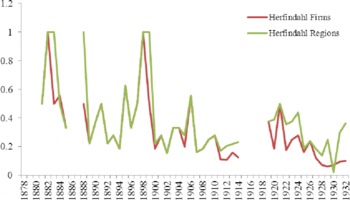
We claimed at the beginning of this article that innovation periods are often also times when knowledge diffuses to more and more domestic firms who can then develop and produce novel machine tools. To evaluate this hypothesis for our historical case we calculated, for every year, Herfindahl indices (H) with respect to the distribution of valuable patents across both German firms and administrative districts. In the following formula, t denotes the year, and VP the number of valuable patents held either by firms i = 1…n or in administrative districts i = 1…n depending on whether the Herfindahl index is computed over firms or districts:

The Herfindahl index equals one in the case of maximum concentration and to 1/n in the case of an equal distribution of valuable patents, thus the smaller it is, the more equal is distribution of valuable patents. When the Herfindahl index decreases, innovation is becoming more diffuse. Figure 8 shows that both the firms’ and the regions’ Herfindahl indices are in fact decreasing during the two innovation periods (1900–1914 and 1926–1932), which implies that an increasing number of German machine toolmakers and German regions developed profitable innovations. Interestingly enough, the Herfindahl indices also fall at the beginning of the first imitation period which might reflect the general growth of the number of firms in the still young machine tool industry. During the intensification of the imitation period at the end of the nineteenth century, however, both Herfindahl indices increase—like in the second imitation period. This indicates the interruption of the former diffusion and might be explained by the fact that many of the German machine toolmakers lacked the resources to engage successfully in the learning by imitating process.
The firms’ and regions’ Herfindahl indices display a nearly time path because the above-average innovativeness of some regions is mostly based on the achievement of a small number of very innovative firms.Footnote 60 Analyzing the patent activities in all German industries, Harald Degner finds that, the 30 most innovative German firms held a majority of all valuable patents (from 1877 to 1900, two-thirds, and, from 1901 to 1932, between 40 and 55 percent).Footnote 61 We find this extraordinary skewness of the distribution of valuable patents also for the subgroup of machine tool builders. The five most innovative firms held 57 percent (1877–1899), 36 percent (1900–1914), 37 percent (1919–1925), and 42 percent (1926–1932) of all valuable patents granted to German machine tool builders in the respective periods.Footnote 62
CONCLUSIONS
In 1880 German machine toolmakers lagged behind their American rivals, to catch up they relied on imitating and counterfeiting the better foreign machines. The same pattern was repeated after World War I set them back. The German administration supported this strategy by creating a patent law that discriminated against foreign patent holders and by prolonging the review period for foreign applicants. Imitation gave way to innovation both at the very end of the nineteenth century and at the very end of the 1920s. Each time as German firms became technically more competitive internationally, the willingness to guarantee foreign intellectual property rights increased. A key reason for this policy change came from German firms who now had to fear retaliatory measures in their export markets when violating foreign property rights within Germany.
The development of the German machine tool industry has many historical and contemporary echoes.Footnote 63 Developing countries may learn from these examples that the strict compliance to the international rules of law with respect to intellectual property rights can slow down the speed of technological and economic progress in their domestic industry.Footnote 64 Advanced countries may understand, first, that they owe their own development to similar imitating strategies in the past, and, second, that there is a good chance that illegal imitation only takes place during a transitional period. It is true that not in every technologically backward country a period of imitation will inevitably lead to a period of innovation. Still, many historical cases support the view that learning by imitation is a very promising way to catch up to advanced foreign industries. It is therefore conceivable that the copying and counterfeiting activities of the Chinese machine builders which have been long tolerated by their government will end as soon as these firms find significant foreign markets for advanced and innovative machinery.