Introduction
The development of heritage languages (HL) for young children is an under-researched but emerging area of early bilingual studies because of its strong social relevance (Cummins, Reference Cummins2001, Reference Cummins2005; Montrul, Reference Montrul2010; Ortega, Reference Ortega2019). For instance, as the Ministry of Education (2013) in Singapore has stated, the promotion of bilingual learning that includes the learning of heritage languages relates to the transmission of ethnic heritage values and the maintenance of cultural and racial identity. The term HL typically refers to “a socio-politically minority language, acquired as a first language during the first years of life, as in sequential bilinguals, or simultaneously with the majority language since birth, as in simultaneous bilinguals” (Montrul, Reference Montrul2018, p. 530). Thus, HL refers to a first language (whether children hear an additional first language or not). However, as Cummins (Reference Cummins2005, p. 586) has proposed, the term HL can furthermore refer to a language that families do not actually use, but have a “heritage connection to the language”. Children growing up in such families may encounter the HL outside the home, as a second language (L2). We use the term HL here to refer to all these possibilities. Multilingual societies tend to use policies to promote HL learning and maintain cultural traditions and values. Despite such endeavours, many of these societies have witnessed the prevalence of English in business, government, schools, and media. Such a societal shift to English language dominance has heightened the drive to maintain HL. To promote children's HL education, one priority would be to identify the major factors that significantly influence HL development. These major factors have been identified in three categories comprising the child- (cognitive, behavioural, affective), family- (SES, parenting practices), and school-level (type and location of preschools, classroom quality, teacher–child interaction quality) factors, in young children's academic skills development (Zhang, Hu, Ren, Huo, & Wang, Reference Zhang, Hu, Ren, Huo, Wang and Liu2019). As they are associated with early bilingual vocabulary development, these factors include relative exposure to the language, family demographics, mode of exposure (source, status, and properties), language community, and linguistic distance between the two languages (Floccia et. al., Reference Floccia, Sambrook, Delle Luche, Kwok, Goslin, White and Plunkett2018; Paradis, Reference Paradis2011, Sun, Yin, Amsah, & O'Brien, Reference Sun, Yin, Amsah and O'Brien2018).
Singapore is a typical multilingual society as described above. Since the 1960s, the English language has been ascribed a higher social status, serving as the language for inter-ethnic communication and access to the world. On the other hand, HLs, commonly referred to as mother tongue languages (i.e., Mandarin, Malay, and Tamil) in Singapore, have been used to pass on cultural knowledge and ethnic identities (Bokhorst-Heng, Reference Bokhorst-Heng and Blommaert1999). Although there are continuous efforts to encourage children to develop English and HLs simultaneously (Ministry of Education, 2013), recent years have witnessed a substantial discrepancy between English and HLs in both the home environment and the learning outcomes (Curdt-Christiansen, Reference Curdt-Christiansen2016; Hornberger & Vaish, Reference Hornberger and Vaish2008; Sun et al., Reference Sun, Yin, Amsah and O'Brien2018). Therefore, HLs in the Singapore context are increasingly more in line with Cummins’ (Reference Cummins2005) HL definition, where children have a heritage connection to the language, but have limited language exposure and usage in general. In this paper, we examine the main predictors of HL development in Singapore by extending the report from Sun et al. (Reference Sun, Yin, Amsah and O'Brien2018) to consider school variables in addition to the home variables and child characteristics that were examined previously. In addition, we re-examine children's vocabulary over time to predict children's vocabulary growth by controlling for their vocabulary in the first year of kindergarten. Previous studies have shown associations between child HL development and child characteristics (e.g., Barbosa, Jiang, & Nicoladis, Reference Barbosa, Jiang and Nicoladis2019), home environment (e.g., Dixon, Zhao, Quiroz, & Shin, Reference Dixon, Zhao, Quiroz and Shin2012; Lewis, Sandilos, Hammer, Sawyer, & Méndez, Reference Lewis, Sandilos, Hammer, Sawyer and Méndez2016), and school factors (e.g., Collins, Reference Collins2014). However, the majority of these studies have only addressed one or two sets of predictors. According to Gathercole (Reference Gathercole, Siiner, Hult and Kupisch2018), each of the contributing factors could be considered a ‘factoid’ that gives us only a glimpse of the full reality of bilingual children's language development. Only by putting together the small pieces of factoids could we avoid a restricted picture of the child's language development. To this end, the current study collectively examines all three factors at once to estimate their relative importance in young bilinguals’ early HL development and to single out the best predictors for future intervention.
We focused on child HL receptive vocabulary, as it is widely recognized to be essential for language comprehension and production. Vocabulary development has been associated with children's later academic achievement (August, Carlo, Dressler, & Snow, Reference August, Carlo, Dressler and Snow2005) and development in other language and literacy domains (e.g., phonological awareness: De Jong, Seveke, & van Veen, Reference De Jong, Seveke and van Veen2000; and reading comprehension: Proctor, Uccelli, Dalton, & Snow, Reference Proctor, Uccelli, Dalton and Snow2009). We targeted children's receptive rather than productive vocabulary because the literature indicated that productive skills would probably be limited during the first two years of formal language instruction (Aarts & Ronde, Reference Aarts and Ronde2006; Unsworth, Persson, Prins, & de Bot, Reference Unsworth, Persson, Prins and de Bot.2015). To date, many studies have been conducted on monolingual children's receptive vocabulary development, but fewer have been done with bilingual children, and even less on their HL receptive vocabulary development in particular (Dixon et al., Reference Dixon, Zhao, Quiroz and Shin2012; Miccio, Tabors, Páez, Hammer, & Wagstaff, Reference Miccio, Tabors, Páez, Hammer, Wagstaff, Cohen, McAlister, Rolstad and MacSwan2005). This issue is the focus of the current study.
Literature review
In this paper, we adopt a holistic view to examine children's vocabulary development in HLs, to include the three sets of predictors (i.e., child characteristics, family, and school) which could be generally classified as internal and external factors. Previous HL studies mainly focus on the development of heritage grammars from the theoretical perspective of generative linguistics (Montrul, Reference Montrul2002; Polinsky, Reference Polinsky1995). There have been only a limited number of studies on other aspects of HL development, such as vocabulary (Ortega, Reference Ortega2019). Therefore, the current study incorporates findings on children's vocabulary development in bilingual and second language studies in this literature review.
Both internal and external factors have been found to influence the rate and route of children's vocabulary development (Paradis, Reference Paradis2011; Sun et al., Reference Sun, Yin, Amsah and O'Brien2018; Unsworth, Hulk, & Marinis, Reference Unsworth, Hulk and Marinis2011). Internal factors refer to variables such as age, gender, children's cognitive maturity, and linguistic distance. External factors include variables such as socioeconomic status (SES), input quantity and quality, and output. This dichotomy is consistent with the central tenet of usage-based theory (e.g., Tomasello, Reference Tomasello2003), which addresses both general cognitive factors and language input properties to explain language learning. Both sets of factors are interdependent. In bilingual settings, their relative weight is likely shaped by the overall language environment (Sun et al., Reference Sun, Yin, Amsah and O'Brien2018). We discuss the interdependence of the internal and external factors in detail, after examining significant predictors established in the literature.
Internal factors
Age at the time of testing
Children's age at the time of testing was reported to be related to children's vocabulary ability in HL. For instance, in Dixon and colleagues’ (Reference Dixon, Zhao, Quiroz and Shin2012) cross-sectional study on 282 Singaporean children's HL vocabulary learning, they found older children consistently performed better than younger children on the Peabody Picture Vocabulary Test, after controlling for a series of home and community factors. This may be attributed to superior cognitive maturation with age, which triggers more efficient use of learning mechanisms (Muñoz, Reference Muñoz and Munoz2006).
Gender
Findings on the relationship of gender to HL vocabulary ability are equivocal. In some studies, girls were found to outperform boys on vocabulary performance (e.g., Eriksson et al., Reference Eriksson, Marschik, Tulviste, Almgren, Perez Pereira and Wehberg2012). One reason could be that girls were more likely than boys to retain their parents’ language (i.e., HL) due to socio-cultural expectations. They might spend more time than boys at home and gain more HL exposure through daily interactions and routines (Portes & Rumbaut, Reference Portes and Rumbaut2001; Portes & Schauffler, Reference Portes and Schauffler1994). However, in other studies, gender did not significantly account for the variance of HL vocabulary performance (e.g., Dixon et al., Reference Dixon, Zhao, Quiroz and Shin2012). The current study will explore the significance of this factor within our sample.
Cognitive skills
Cognitive factors, especially those related to children's non-verbal intelligence and memory, have been considered as confounding factors in bilingual preschoolers’ vocabulary development (Sun, Steinkrauss, Tendeiro, & de Bot, Reference Sun, Steinkrauss, Tendeiro and de Bot2016; Sun et al., Reference Sun, Steinkrauss, Tendeiro and de Bot2016), since these cognitive skills may assist learners to better understand and select strategies for completing tasks (Muñoz, Reference Muñoz2008). Specifically, non-verbal intelligence is assumed to facilitate children's ability to impute structures and reorganize patterns, breaking down the linguistic input analytically (Daller & Ongun, Reference Daller and Ongun2018; Paradis, Reference Paradis2011); while working memory enables children to remember novel sequences of phonological information, promoting their articulation and semantic memory (Barbosa et al., Reference Barbosa, Jiang and Nicoladis2019; Gathercole, Alloway, Willis, & Adams, Reference Gathercole, Alloway, Willis and Adams2006; Gathercole & Baddeley, Reference Gathercole and Baddeley1989). It should be noted that the effect of non-verbal intelligence on bilingual children's HL receptive vocabulary development is inconclusive, as some studies found a significant relationship between the two (e.g., Dutch–Frisian preschooler's Frisian receptive vocabulary; Dijkstra, Kuiken, Jorna, & Klinkenberg, Reference Dijkstra, Kuiken, Jorna and Klinkenberg2016), while others found that they are not significantly associated (e.g., English–Vietnamese bilingual children's Vietnamese receptive vocabulary; Pham & Tipton, Reference Pham and Tipton2018).
Linguistic distance
Aside from age, gender, and cognitive factors, linguistic distance was also found to affect HL competence by Floccia et al. (Reference Floccia, Sambrook, Delle Luche, Kwok, Goslin, White and Plunkett2018). In that paper, 430 bilingual toddlers were assessed on their expressive and receptive vocabulary in British English and their own HLs with the parental Oxford Short Form CDI (Hamilton, Plunkett, & Schafer, Reference Hamilton, Plunkett and Schafer2000). The linguistic distances between English and 13 HLs (including Mandarin and Hindi) were estimated with three indicators: phonological similarity, word order typology (VO/VO-OV/OV), and morphological complexity (isolating/inflecting/ agglutinating languages). After controlling for a series of predictors that potentially affect children's vocabulary acquisition (e.g., length of exposure), the influence of linguistic distance remained statistically significant. Specifically, the extent of phonological similarity between English and HL was significantly associated with children's expressive HL vocabulary, while word order typology and morphological complexity are significantly related to children's receptive HL vocabulary. In the current study, we focus on children's receptive vocabulary development in HL, and examine whether differences in word order typology and morphological complexity across language pairs (Malay–English, Tamil–English, and Mandarin–English) would affect children's HL receptive vocabulary learning in the Singapore context.
External factors (family)
Language input quantity
Home language is vital for increasing the proficiency of an HL, as its exposure may be less available outside the home setting (Dixon et al., Reference Dixon, Zhao, Quiroz and Shin2012; Hammer, Davison, Lawrence, & Miccio, Reference Hammer, Davison, Lawrence and Miccio2009). Input quantity refers to the amount of the target language spoken by core family members to children, and a large variation in input was previously found across families within the same sample as in the present study (Sun et al., Reference Sun, Yin, Amsah and O'Brien2018). The impact of input quantity has been firmly established in the literature: more home language experience contributes to higher language proficiency (De Houwer, Reference De Houwer2007). In a survey conducted with 54 families in the Singaporean context, it was found that higher preference and frequency in using English at home results in lower HL proficiency of children (Saravanan, Reference Saravanan2001). Such a result is in line with previous findings that the amount of time spent with speakers of the target language corresponds proportionately to the number of known words in the said language for a bilingual child (Marchman, Fernald, & Hurtado, Reference Marchman, Fernald and Hurtado2010; Pearson, Fernández, Lewedeg, & Oller, Reference Pearson, Fernández, Lewedeg and Oller1997; Place & Hoff, Reference Place and Hoff2011).
Language input quality
Measures that estimate the richness of the home language environment have been considered influential in promoting bilingual children's HL vocabulary development (Jia & Fuse, Reference Jia and Fuse2007; Sun et al., Reference Sun, Yin, Amsah and O'Brien2018). Input quality is a multi-faceted variable, referring to the authenticity (i.e., amount of native-speaker input) and variety (e.g., book reading, media usage, and different interlocutors) of the home language input. Scheele, Leseman, and Mayo (Reference Scheele, Leseman and Mayo2010) examined the impact of enriching home language activities (e.g., book reading and educational TV watching) on Moroccan–Dutch and Turkish–Dutch bilingual children's vocabulary development and found that input-quality oriented activities could stimulate bilingual children's vocabulary outcomes of the majority language. The presence of older siblings is another source of input variation. Rojas and colleagues (Reference Rojas, Iglesias, Bunta, Goldstein, Goldenberg and Reese2016) followed 224 Spanish-speaking English learners in US kindergartens and found that the presence of older siblings at home predicted children's English skills. They argued that older siblings might have more experience with the majority language and consequently might bring more majority language to home settings. This suggests that older siblings may present a deleterious influence on bilingual children's HL vocabulary learning. We explore this impact in the current study.
Language output at home
Children's language output, which provides an avenue for children to reflect and recognize their language behaviour, has been associated with bilingual children's vocabulary development (Bohman, Bedore, Pena, Mendez-Perez, & Gillam, Reference Bohman, Bedore, Pena, Mendez-Perez and Gillam2010; Paradis, Reference Paradis2011). It is usually estimated with children's onset age of speaking a particular language (i.e., cumulative language output) or their weekly usage in the language with their family members (i.e., current language output). The output hypothesis by Swain (Reference Swain2007) states that speech production stimulates conscious recognition of language limits which allows for reflection of one's own and others’ language behaviour during interactions. In the current study, we use children's onset age of HL speaking to explore the influence of children's language output on their HL vocabulary development.
Family socioeconomic status (SES)
Usually measured through maternal education level, parental occupation, and family income, SES has been considered a significant predictor of bilingual children's vocabulary (Blom, Paradis, & Duncan, Reference Blom, Paradis and Duncan2012; Bohman et al., Reference Bohman, Bedore, Pena, Mendez-Perez and Gillam2010; Hoff & Elledge, Reference Hoff, Elledge, Cohen, McAlister, Rolstad and MacSwan2005). Despite its significance in general, the positive relationship between SES and vocabulary development is more conclusive for bilingual children's majority language than for their HL. For example, mother's educational level was found to be positively related to their children's vocabulary in English but not in Spanish for the 191 bilingual children in Hammer and colleagues’ (Reference Hammer, Komaroff, Rodriguez, Lopez, Scarpino and Goldstein2012) study. This observation is in line with the finding of Dixon and colleagues (Reference Dixon, Zhao, Quiroz and Shin2012) in Singapore, where English is the medium of instruction. As such, more years of maternal education imply greater English proficiency but not necessarily a better HL level for mothers, and this, in turn, may yield little contribution to their children's HL vocabulary acquisition through mother–child interactions.
External factors (school)
Input quantity at preschool
After children reach 30 months of age, their parents’ rates of speaking to them decrease (Wells, Reference Wells, Fletcher and Garman1986), and other speakers such as teachers and peers start to play a more substantial role in their language input (De Houwer, Reference De Houwer, Miller, Bayram, Rothman and Serratrice2018). The total amount of input at school, usually measured by the length of time that children stay at school and the hours of language instruction per week, was found to be related to bilingual children's vocabulary competence (Sun, Steinkrauss, Wieling, & de Bot, Reference Sun, Steinkrauss, Wieling and de Bot2018; Thordardottir, Reference Thordardottir2011; Unsworth et al., Reference Unsworth, Persson, Prins and de Bot.2015). For example, Unsworth and colleagues (Reference Unsworth, Persson, Prins and de Bot.2015) reported that Dutch English-language learners who received more than 60 minutes per week of English instruction scored significantly higher in receptive vocabulary than children with less English instruction. As most Singaporean preschools offer daily 45–60-minute HL classes, we use children's total length of stay at kindergarten to estimate the total amount of HL instruction they received at school for this study.
Input quality at preschool
Language input quality at school pertaining to teacher qualifications (i.e., experience, education, and domain knowledge) has been found to affect bilingual children's vocabulary ability. In a study conducted with 385 preschool children from both native and non-native backgrounds in the Netherlands, teachers’ experience predicted children's Dutch vocabulary scores (Druten-Frietman, Denessen, Gijsel, & Verhoeven, Reference Druten-Frietman, Denessen, Gijsel and Verhoeven2015). Moreover, teachers’ educational level was found to positively relate to teaching quality, which likely resulted in faster growth in receptive vocabulary for children from diverse HL backgrounds in the US (Gerde & Powell, Reference Gerde and Powell2009). Furthermore, teachers’ language proficiency also influences teaching quality in class and eventually affects children's vocabulary attainment (Unsworth et al., Reference Unsworth, Persson, Prins and de Bot.2015).
The relative importance of child characteristic, family factors, and school factors
Exploring these three sets of variables (child, family, and school) simultaneously is considered necessary, because both the internal and external factors described above could potentially explain child receptive vocabulary development, and they are inextricably linked to one another (Bornstein, Haynes, & Painter, Reference Bornstein, Haynes and Painter1998; Bornstein & Leventhal, Reference Bornstein, Leventhal and Lerner2015). The covariation of internal and external factors, therefore, means that both should be considered together: including only one set of variables may result in an overestimation of the chosen predictors. Despite this, very few studies holistically assess these factors, and the studies by Sun et al. (Reference Sun, Yin, Amsah and O'Brien2018) and Ebert et al. (Reference Ebert, Lockl, Weinert, Anders, Kluczniok and Rossbach2013) are among the few exceptions that tried to address the research gap on bilingual preschoolers’ vocabulary development (see also Paradis, Reference Paradis2011, on a slightly larger age range: 4;10 to 7;0).
In previous research by Sun and colleagues (Reference Sun, Yin, Amsah and O'Brien2018) with the sample of Singaporean children followed up here, it was revealed that family factors are more important than child characteristics in predicting children's HL vocabulary learning, and vice versa for children's English vocabulary acquisition. The authors attributed such a difference to the general learning environment, as children were learning their HL in a generally ‘input poor’ setting while learning their English in an ‘input rich’ setting. They argued that, if the total amount of input did not reach a critical mass or threshold, children's internal resources would remain restricted and could not fully express their influence. Ebert et al. (Reference Ebert, Lockl, Weinert, Anders, Kluczniok and Rossbach2013) widened the scope of predictors by including preschool factors (e.g., teachers’ language quality). They traced 547 monolingual and bilingual children in Germany and tested their receptive vocabulary at the ages of three, four, and five years. The results revealed that, for children's German language development (i.e., the dominant language in society), child characteristics, phonological working memory in particular, explained much more variance than family factors, such as home language input and literacy environment. Preschool factors were not found to contribute to vocabulary development. Ebert and colleagues argued from the perspective of individual differences in intrinsic factors, and highlighted the importance of phonological working memory in children's early vocabulary development. They attributed the lack of influence of preschool factors to the general measure of input quality adopted by the study, and called for employing more specific measures of language input provided by preschool teachers and peers in future research.
Ebert et al.'s (Reference Ebert, Lockl, Weinert, Anders, Kluczniok and Rossbach2013) finding might be explained with the arguments proposed by Sun and colleagues (Reference Sun, Yin, Amsah and O'Brien2018). Children learning German as the majority language are developing German receptive vocabulary in an ‘input rich’ setting, where ample exposure is provided at school and in the community even for children from immigrant families. Under these circumstances, children's internal resources (e.g., phonological working memory) might take a full expression in influencing children's language development at an early stage, essentially keeping in line with the ‘critical mass’ hypothesis. In other words, it is only within the ‘input rich’ environment that external factors become less relevant, and individual differences in internal factors become fully realized in their effect on early receptive vocabulary learning.
The current study
Following Ebert and colleagues’ work (Reference Ebert, Lockl, Weinert, Anders, Kluczniok and Rossbach2013), the current study examines the three described sets of individual differences inclusively in a relatively input-poor context of HL learning. By considering children's HL background, we examine which set of predictors is more important overall, and which specific individual factors might promote children's HL vocabulary development. Child variables are operationalized as chronological age (age at K1 – four to five years old), gender, the linguistic distance between English and HL, non-verbal intelligence, and working memory. Children's family factors are operationalized as language input, language output, mother's education, income, number of books at home, media exposure, and number of older siblings. Children's preschool variables include hours of HL instruction per week, the total time spent in kindergarten, and teachers’ experience, degree, and HL proficiency. Two main research questions are addressed:
Question 1. What are the relative contributions of the three sets of predictors (i.e., variables related to child characteristics, family, and school) in predicting variation in children's HL receptive vocabulary?
Hypothesis 1. Since most children have relatively limited language input in HL, the external factors (i.e., family and school-related variables) may play a more important role in predicting children's vocabulary growth than variables related to children's characteristics, as was found for this sample when the children were in K1 with family versus child characteristics (Sun et al., Reference Sun, Yin, Amsah and O'Brien2018). In particular, it is expected that familial variables would be more vital than preschool variables in promoting vocabulary development, because children probably get more cumulative language exposure from home than from preschool at the age of four to five.
Question 2. Which individual variables from the three sets of factors are best at predicting children's HL vocabulary growth?
Hypothesis 2. In line with previous studies that were conducted in Singapore (e.g., Dixon et al., Reference Dixon, Zhao, Quiroz and Shin2012), variables related to children's input quantity and quality (i.e., total exposure at home and school, HL book reading) are expected to be crucial in predicting children's HL vocabulary development.
Method
We utilized data collected as part of the ‘Singapore Kindergarten Impact Project’ (SKIP), a large-scale longitudinal study examining structural and process factors in children's transitions from preschool to primary school settings in Singapore. Children were recruited from preschools that vary in social strata, geographical locations, and types of providers comprising not-for-profit, commercial, government-subsidized, and public preschools. Their development in language, cognition, motor skills, social-emotional wellbeing, and other domains have been assessed. The participants were recruited in K1 (four to five years old), and those bilingual children who have been successfully re-examined for their heritage receptive vocabulary in the second year of kindergarten were followed in the current study (N = 601). Three criteria were adopted for further participant selection. First, children were bilingual language learners (English + one heritage language) and those exposed to more than two languages at home or to an ‘unofficial’ HL (i.e., a language that is not one of the four official languages of Singapore which are taught in the public schools, e.g., Hokkien, Hindi), were excluded. Second, participants had no history of developmental delays or impairment based on parental reports and teacher observations. Last, participants’ heritage language teachers’ self-reports were available. By including these criteria, the sample size was reduced and only those without such concerns are included in the final model analysis (N = 457). Data about the home and school were gathered from parent questionnaires and teacher questionnaires collected at K1. Children's assessment data was collected at K1 and K2.
Participants
In our current study, the sample comprises 457 children: 311 Mandarin-speaking, 61 Malay-speaking, and 85 Tamil-speaking children (age in months at K1: Mean = 57.21, SD = 3.87, range = 49–66; age at K2: Mean = 69.62, SD = 3.74, range = 63–79). Gender is nearly balanced with 238 girls and 219 boys participating from 16 preschools, under the instruction of 63 teachers. All the children in the current study were enrolled in half-day kindergarten, which offers an education-focused program for 3 to 4 hours each day. The medium of instruction at preschool is English, and children learn their HL as a subject. A typical HL class lasts 45 minutes to 60 minutes, and is conducted daily. The contents and instruction are guided by learning goals and strategies in the Nurturing Early Learners’ Mother Tongue Language frameworks published by the Singapore Ministry of Education (2013). Common activities during HL lessons in preschool classrooms include songs, rhymes, shared book reading, and vocabulary learning. In addition, children were provided with opportunities to develop awareness and appreciation of ethnic cultures through listening to stories on traditions and customs.
Design and procedure
Ethics approval was obtained from the Institutional Review Board (IRB) of the authors’ university, and children's participation was ascertained through parental consent forms and children's assent. A series of child measures were administered by trained bilingual research assistants with university degrees in psychology, early childhood education, or other related fields. They were trained in the administration of the measures and in maintaining appropriate interaction with the child participants. Children's preferred language was ascertained from parents through consent forms, and their HL from school records of the language instruction in which they were enrolled. Assessments were conducted in the child's preferred language, which included English for 68.2% of children, Mandarin for 2.7%, Malay for 0.1%, and Tamil for 0.6%. No language preference was indicated for 22.4% of the children, and 6% had more than one preferred language. At the start of the sessions, the research assistants confirmed the child's language preference (including for those with no or multiple preferences as indicated by parents) and conducted the tasks in the language in which the child had indicated preference and understanding. This pattern of preferences is entirely expected in the Singaporean context, where English occupies a special place in families and society, and where the heritage languages are seen to constantly lose ground (Curdt-Christiansen, Reference Curdt-Christiansen2016). The preference for the majority language over the heritage language is also typically found in many other contexts for schools using a majority language for instruction and limited hours for heritage language (e.g., in Sweden; Ganuza & Hedman, Reference Ganuza and Hedman2017).
Parents and teachers completed questionnaires consisting of home and school details when the children were recruited at K1. Questionnaires were given as printed versions, or through a Qualtrics™ Online Survey, according to their preference. An initial parental questionnaire consisted of two sections on the child's early development and home details. A second parental questionnaire comprising five sections with questions on home language, home activities, enrichment activities, child's sleep habits, and parents’ general health. Teachers completed a questionnaire about their educational attainment, language background, school's programme information, teaching practices, and beliefs about children's learning styles. In the present paper, we examined data of children's cognitive abilities, HL receptive vocabulary, HL environment at home, and HL environment at school collected from sources and measures described below.
Measures
Internal factors (child characteristics)
Raven's Colored Progressive Matrices (Raven's CPM; Raven, Raven, & Court, Reference Raven, Raven and Court2008) was administered to assess children's non-verbal intelligence in the current study. It is a reliable and valid measure to assess fluid intelligence without significant influence from factors relating to cultural, linguistic, or educational aspects. Raven's CPM consists of a total of 36 items with 12 items for each of the three sections: A, AB, and B. First, a practice item was administered with extensive and detailed feedback to ensure full comprehension of the assigned task prior to the administration of the test items for Section A. The child's task is to select the missing part of a presented matrix from an array of six options. Each section ended after four consecutive incorrect responses. The Raven's test demonstrated good reliability in the current sample (α = .82).
A Backward Digit Recall (BDR) test was administered to assess young children's working memory (Pickering & Gathercole, Reference Pickering and Gathercole2001). The BDR task commenced by presenting a set of digits (from 1 to 9) with a visual cue (arrow) to introduce the young participants to the concept of counting forwards. Thereafter, the visual cue (arrow) was presented in a reversed manner to introduce children to the concept of counting backwards from 9 to 1. Children then proceeded to the pre-practice phase where they listened to two numbers (e.g., 1, 2) and recalled the numbers in backwards order (e.g., 2, 1). Only children who can identify and recall the numbers backwards proceeded to the practice items. After the practice items, participants were instructed to listen to two pre-recorded digits and to respond by reciting the numbers in reverse order. The BDR task consists of six trials per block (total of 6 blocks) and with an increase in one digit after each block of trials. The task was discontinued after incorrect responses to three test items in a particular block. BDR has been shown to be reliable for young children (α = .83; Gathercole et al., Reference Gathercole, Alloway, Willis and Adams2006).
Following Floccia et al.'s approach (Reference Floccia, Sambrook, Delle Luche, Kwok, Goslin, White and Plunkett2018), metrics of linguistic distance were estimated for each HL. For the measure of word order typology (VO vs. VO/OV vs. OV), Mandarin and Malay were assigned a ‘1’ because both have a VO order like English, while Tamil was assigned a ‘3’ for its OV order. In terms of morphological complexity (Analytical vs. Fusional vs. Agglutinative), Mandarin was assigned a ‘1’ as it is an analytic language similar to English, while Malay and Tamil were assigned a ‘3’ as they are agglutinative languages. Considering both word order and morphological complexity, Mandarin was found to have the shortest linguistic distance from English (‘1’), followed by Malay (‘2’), and Tamil (‘3’).
External factors (family-oriented)
The information on children's language quantity and quality in home settings was retrieved from the parental questionnaire. Parents completed these questionnaires when their children were recruited at K1. The questionnaire consisted of items revised from prior studies to collect information on children's home language exposure (Bedore et al., Reference Bedore, Pena, Summers, Boerger, Resendiz, Greene, Bohman and Gillam2012; Gutiérrez-Clellen & Kreiter, Reference Gutiérrez-Clellen and Kreiter2003; Sénéchal, LeFevre, Thomas, & Daley, Reference Sénéchal, LeFevre, Thomas and Daley1998) and home literacy environment (Burgess, Hecht & Lonigan, Reference Burgess, Hecht and Lonigan2002; Farver, Xu, Eppe, & Lonigan, Reference Farver, Xu, Eppe and Lonigan2006; Phillips & Lonigan, Reference Phillips and Lonigan2009). Detailed information collected includes the extent of English being spoken at home (1. Never, 2. Rarely, 3. Sometimes, 4. Often, 5. Primary), children's age when they started to speak the HL, the number of HL books at home (1. None, 2. 1–10 books, 3. 11–30 books, 4. 31–60 books, 5. 61–90 books, 6. 91–120 books, 7. More), the language and frequency (in percentages) of TV/movie/video programmes children watched at home, and mothers’ educational level (i.e., highest degree obtained). Language input quantity at home was computed reversely based on the item about the extent of English dominance at home. The smaller the number in parents’ ranking on the use of English, the more the HL was estimated to be used at home.
External factors (school-oriented)
Teachers completed questionnaires which provided information on children's HL quantity and quality at school. HL teachers responded to questions on their total years of teaching at the preschool, level of education (i.e., highest degree obtained), number of HL sessions per week, and duration of each HL class. These teachers also self-rated their HL proficiency in understanding, speaking, reading, and writing on a scale of 7, ranging from ‘understand/use only isolated words’ (1) to ‘proficient use of language at the level of an educated native speaker’ (7).
HL receptive vocabulary tests
The Bilingual Language Assessment Battery (BLAB; Lee, Sze, & Rickard-Liow, Reference Lee, Sze and Rickard-Liow2013) was administered to assess children's receptive vocabulary ability. The vocabulary test was conducted twice, one time in the first preschool year (K1) and the other in the second year (K2), with an average of one academic year between assessments. Performance in the first school year was taken as a control variable in the analysis. BLAB is a standardized receptive picture vocabulary task developed in Singapore according to three official HLs (i.e., Chinese, Malay, and Tamil). Previously developed versions of the BLAB in Mandarin and Malay were used, and the items were adapted for the Tamil version for the present study. Children were assessed in their respective HL based on their school records. Three practice items were administered before the commencement of the 80 test trials. Each item had four response options and children were asked to identify the picture that best corresponded to the word they heard. Stimuli were presented on an iPad monitor and via headphones. The BLAB has been reported as a reliable measure of receptive vocabulary proficiency in Singapore within the original norming sample (α's of .75–.77) (Rickard-Liow, Sze, & Lee Reference Rickard-Liow, Sze and Lee2013). The reliability within the current sample has been examined with each heritage language: the Mandarin version α was .75, the Malay version α was .71, and the Tamil version α was .64.
Data analysis
To address our two research questions, we used linear mixed-effects models in R (version 3.4.1; R Core Team, 2017) with the lme4 package (version 1.1.13; Bates, Maechler, Bolker, & Walker, Reference Bates, Maechler, Bolker and Walker2015). Compared to traditional approaches such as ANOVA or simple regression, mixed-effects models are more appropriate to handle datasets with nested structures and missing data, as in the current study (Baayen, Reference Baayen2008, Chapter 7; Jaeger, Reference Jaeger2008). This also allowed us to take into account the random variation associated with teachers and schools. To address the first research question, a model that covered different sources of variables that may influence children's early HL vocabulary learning was established by entering blocks of variables subsequently. To examine the second research question, we fitted a model using stepwise removal of predictors that did not significantly improve the model fit. We assessed the model fit by comparing the Akaike Information Criterion (AIC; Akaike, Reference Akaike1974) of the sets of nested models. After obtaining the best fitting model, we confirmed that the residuals of our model followed a normal distribution.
Results
We conducted a power analysis using the Post-hoc Statistical Power Calculator (Soper, Reference Soper2019). Since our sample size was already known (457 participants), we determined the power for small, medium, and large effects according to the values suggested in the documentation (Champely, 2015). The results indicated only a weak power of a 63.2% chance to detect small effects, but a 100% chance for detecting medium effects and higher. In sum, our study is reliably able to detect medium and large effects.
Descriptive statistics and bivariate correlations
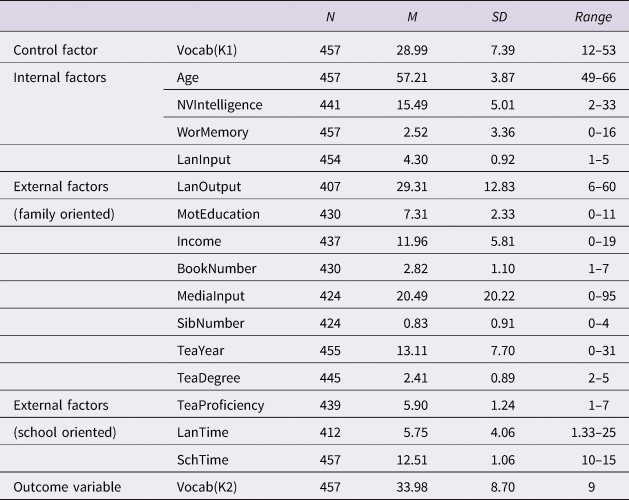
The descriptive statistics of the independent variables (i.e., control, child, family, and preschool) and dependent variables (i.e., receptive vocabulary performance at post-test) are summarized in Table 1. In terms of child factors, children varied substantially in non-verbal intelligence (NVIntelligence: M = 15.49, SD = 5.01) and working memory (WorMemory: M = 2.52, SD = 3.36). For instance, some children managed to recall digits backwards on 16 trials, while some children provided no correct answer at all (note that all assessments were administered in the preferred language that the child understood best, so that their null performance would not result from a lack of understanding the language of the test). For the home language environment, HL exposure was found to be quite limited, with most families using English ‘often’ or ‘primarily’ (LanInput: M = 4.30, SD = 0.92). Children, in general, started to actively speak HL languages at the age of two years and five months (LanOutput: M = 29.31, SD = 12.83). Some children have tried to communicate in HL as early as six months old, while others postponed their HL production to five years of age. Families reported to have, on average, 10 to 30 HL books, and most mothers obtained a bachelor degree (MotEducation: M = 7.31, SD = 2.33). On average, families spent only 20% of their total media time in HL (M = 20.49, SD = 20.22) and most children had one older sibling at home. In terms of school variables, the HL teachers had taught at preschool for 13 years on average (TeaYear: M = 13.11, SD = 7.70), and the majority held a diploma in early education. According to self-ratings, they could use the HL to communicate fluently during interactions (TeaProficiency: M = 5.90, SD = 1.24). Children, in general, took six hours of HL classes per week (LanTime: M = 5.75, SD = 4.06) and had been enrolled at preschool for a year between the two waves of HL tests (SchTime: M = 12.51, SD = 1.06).
Descriptive statistics of the independent factors (control, child, family, preschool) and the dependent factor

Note. Vocab(K1) = HL receptive vocabulary size at the beginning of K1; Age = age at the beginning of K1 in months; NVIntelligence = non-verbal IQ scores as a measure of analytic reasoning; WorMemory = working memory score based on backward digits recall; LanInput = the extent of English dominance at home; LanOutput = the age (in months) since which children have used HL actively; MotEducation = mothers’ highest educational level; BookNumber = number of HL books at home on a 1–7 point scale; MediaInput = the percentage of Media input in HL at home; SibNumber = number of older siblings; TeaYear = teachers’ working experience at preschool in years; TeaDegree = teachers’ highest educational level; TeaProficiency = teachers’ HL level based on their self-rated proficiency in listening, speaking, reading, and writing; LanTime = total HL instructional hours per week; SchTime = months that children spent at preschool between the pretests and posttests; Vocab(K2) = HL receptive vocabulary size based on BLAB tests at the beginning of K2.
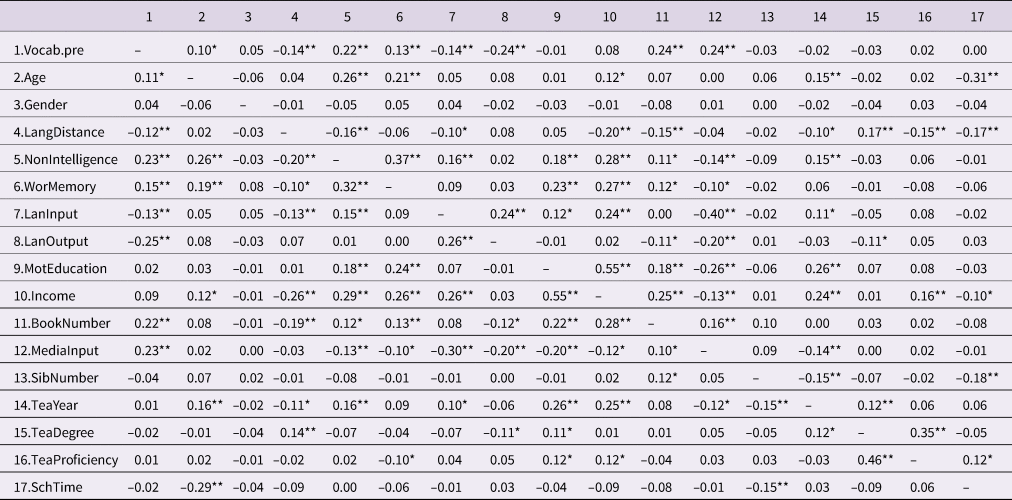
All the variables were examined for skewness to ensure a normal univariate distribution. Those values that fell within the range of ±2 were assumed acceptable (Field, Reference Field2009; Gravetter & Wallnau, Reference Gravetter and Wallnau2014). All the variables met the criteria except weekly instructional hours at school (i.e., ‘LanTime’), therefore, it was excluded from the following analysis. Non-parametric and parametric correlations were computed to check the correlations between the remaining predictors (Table 2). It revealed that these variables were only weakly or moderately correlated; therefore, all the predictors were kept in the mixed effects modeling analysis.
Non-parametric correlations (left bottom half) and parametric correlations (right top half) of the predictors in the model analysis

Notes. * p < .05, ** p < .0.
The contribution of child, family and preschool factors to preschoolers’ development in HL receptive vocabulary
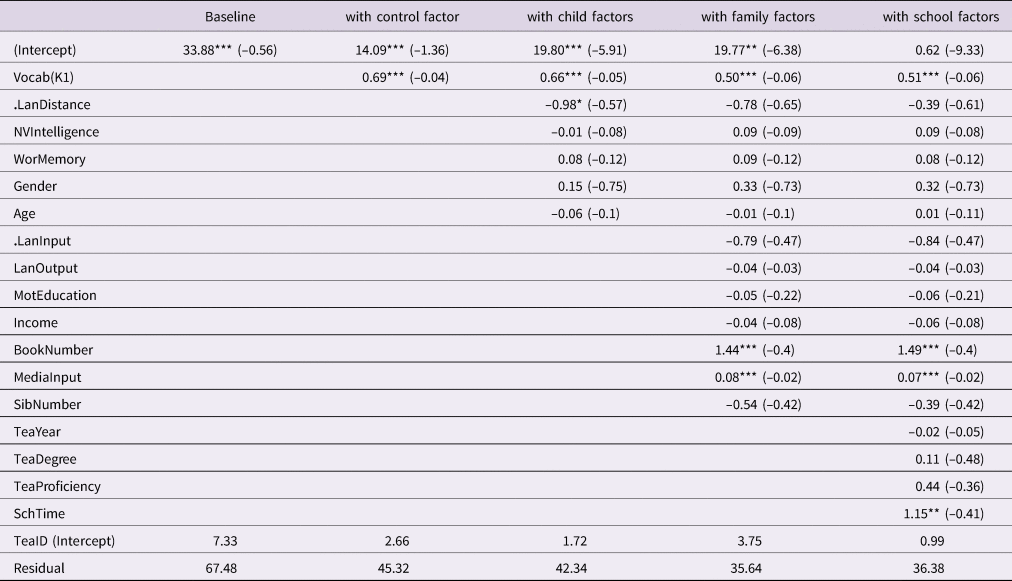
The four groups of predictors were entered into the mixed-effects models in the following order: a control factor (i.e., vocabulary score at K1), child factors (i.e., age, gender, linguistic distance, non-verbal intelligence, and working memory), family factors (i.e., language input, language output, mother's education level, income, the number of HL books, media exposure in HL, and number of older siblings), and preschool factors (i.e., teacher's work experience, educational level, proficiency in HL, and the length of time the child spent at preschool between K1 and K2 testing points). We assessed whether each additional block of predictors was necessary by comparing the AICs of two subsequent models (e.g., AIC differences between Model 1 and Model 2 = M2 – M1). A lower AIC indicates that the more complex model is warranted due to a better fit (offset against the additional complexity). The results (Table 3) revealed that adding child factors to the control model (M1) did not improve the model fit (AIC increased by 2.98) in general; however, linguistic distance was found to be significantly and negatively related to children's HL vocabulary growth when only control and child factors were added in. This means that learning an HL which is similar to the English language in word order and morphology may facilitate HL vocabulary development. However, its significance disappeared when we added environmental factors into the model afterwards. The subsequently added group of family and school variables resulted in better model fits. Family factors improved the model fit by reducing the AIC by 30.56, and preschool factors by a reduction in the AIC of 1.12. Family factors seem to play an important role in preschoolers’ early HL vocabulary development. Due to correlations of the child factors, family variables, and preschool variables, the sequence of entering the three sets of variables was performed in each of the other five possible orders (e.g., preschool factors were entered before individual factors, followed by family factors). The results consistently showed, regardless of the order of entry, that the family factors improved the model fit substantially more than the preschool factors, while the individual factors did not enhance the model fit.
Child, family, and preschool factors in bilingual children's HL vocabulary development

Notes. .p < .1, * p < .05, ** p < .01, *** p < .001.
Individual variables significantly associated with receptive vocabulary at K2
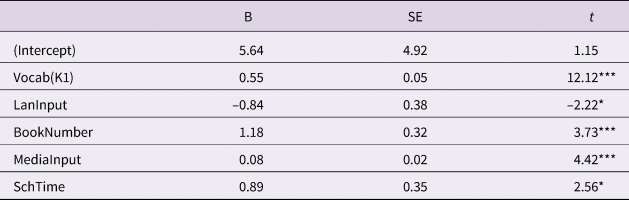
Table 4 reports the parameter estimates from the best-fitting model and shows the significant factors related to children's vocabulary development in the HLs. The entire best-fitting model (including random intercepts for individual teachers) explained 45.62% of the variance of K2 receptive vocabulary size, of which 42.96% was attributable to the fixed-effects only. The interpretation of the model is as follows: Singaporean children's HL receptive vocabulary was significantly predicted by their K1 vocabulary score (B = 0.55, SE = .05, t = 12.12, p < .001), English language input (B = –0.84, SE = .38, t = –2.22, p = .03), the number of HL books at home (B = 1.18, SE = .32, t = 3.73, p < .001), HL media input at home (B = 0.08, SE = .02, t = 4.42, p < .001), and time spent at preschool (B = 0.89, SE = .35, t = 2.56, p = .01). The initial vocabulary score also had a positive effect: the larger the receptive vocabulary children obtained at K1, the better their receptive vocabulary performance was one year later. Family's language input was important to children's vocabulary growth: the more English input that was provided at home (which in turn means less HL exposure), the less the children's HL vocabulary developed over a year. The significant relation has also been observed in HL books: the more HL books a family has, the larger the children's HL receptive vocabulary size. Children's HL media exposure also mattered: the more HL input children received (via TV programmes, audios, movies), the larger their receptive vocabulary sizes. Last but not least, the total time children spent at preschool between the two waves of language tests was positively related to children's language outcome: the longer they stayed in preschool, the better their HL vocabulary.
Fixed-effects part of the best model

Notes. * p < .05, *** p < .001.
Discussion
The current study aimed to demonstrate the relative contributions of child, family, and preschool predictors on children's early HL vocabulary development within a linguistically diverse bilingual sample. Controlling for children's earlier vocabulary scores, the best predictors of heritage language vocabulary outcomes from the three sets of variables were identified with mixed-effects models. Most prior research on bilingual children's HL learning has focused on only one set of predictors and examined these in children with a similar language background from immigrant families (e.g., Hispanic children in the US; but see Dixon et al., Reference Dixon, Zhao, Quiroz and Shin2012; Floccia et al., Reference Floccia, Sambrook, Delle Luche, Kwok, Goslin, White and Plunkett2018; Scheele et al., Reference Scheele, Leseman and Mayo2010). It is important to examine and extend these insights to different populations with diverse linguistic distances. The current study adds to the literature by conjointly exploring the relative impact of nature and nurture on bilingual children's HL development across three HL groups with typologically different languages.
The relative weight of internal and external factors in HL receptive vocabulary
The first research question concerns the heart of this investigation, specifically, the relative importance of three main influences on early HL vocabulary development. Keeping in line with previous studies (e.g., Dixon et al., Reference Dixon, Zhao, Quiroz and Shin2012; Sun et al., Reference Sun, Yin, Amsah and O'Brien2018), we found that family factors play a crucial role in children's HL vocabulary development, at least at the early childhood stage of the preschool years. This also held for preschool factors but to a much smaller degree. Children's internal factors, however, made little contribution to HL vocabulary development. The different contributions of child characteristics and environment to bilingual children's early HL vocabulary development depict a dichotomous picture of the importance of children's nature (i.e., child factors) and nurture (i.e., family and preschool) in early language acquisition; it also revealed the variation in the contribution of home and school.
Internal vs. external (i.e., family and school) factors
Despite previous findings that both internal and external factors promote children's early bilingual vocabulary acquisition (e.g., Unsworth, Reference Unsworth2013), recent studies revealed that they have different degrees of importance depending on the specific input context (Paradis, Reference Paradis2011; Sun et al., Reference Sun, Yin, Amsah and O'Brien2018). Specifically, when children learn a language in an input-rich context characterized by abundant language exposure, children's internal resources (e.g., non-verbal intelligence; linguistic distance) would play a more significant role than environmental resources in vocabulary acquisition. However, when children are placed in an input-poor context characterized by reduced language input, as in the HL learning environment in the current study, environmental resources should be given more weight. In other words, learning contexts play a crucial role in determining the relative weight of internal versus external factors. In the context of Singapore, children are generally learning their HL in an input-poor context, compared to the context of their English language learning. HL is taken as a subject to learn at kindergarten and has been less favoured by parents and peers to use outside the classroom (Dixon et al., Reference Dixon, Zhao, Quiroz and Shin2012; Saravanan, Reference Saravanan2001). The findings of the current study support the hypothesis that family and school factors play a more important role than internal factors. Language learners probably need a requisite amount and sufficient quality of input for internal mechanisms to manifest their importance in establishing form–meaning mappings during vocabulary acquisition. Such a requisite of input could be taken as a threshold to trigger the full expression of the internal mechanisms (e.g., categorization, chunking, and memorization) for language processing (Sun et al., Reference Sun, Yin, Amsah and O'Brien2018) and language transfer (from English to HL in our case). Under input-poor circumstances, the outcome of vocabulary acquisition is probably determined by the quantity and quality of input at the early stage of language development. Our findings reveal a modulation of overall language context on the relationship between internal and external factors in bilingual children's HL vocabulary development, demonstrating the need to look into children's contextual differences when we assess their learning outcomes (Dąbrowska, Reference Dąbrowska2012, Reference Dąbrowska2016).
Family vs. preschool factors
The explanatory power of preschool education was not as strong as that of the family environment, in line with previous findings in general (Ebert et al., Reference Ebert, Lockl, Weinert, Anders, Kluczniok and Rossbach2013; NICHD ECCRN, 2002). According to the report provided by the National Institute of Child Health and Human Development (2002), the effect size for preschool caregiving was only about 22% of the maternal-caregiving effect for children's early language competence. Compared to preschools where most children in the current study stayed for two years, the family provides proximal sources of influence on their language learning continually until they were measured here at the age of four or five. Besides, many children in the study spent far more of their waking hours at home than in the kindergarten classroom (4 hours/day). Therefore, the cumulative influence of the family children's HL vocabulary growth is likely to be greater than that of preschool. The effect of preschool may gradually emerge in the following years, as many studies have found children's early education at preschool to have a lasting impact on children's later language and literacy skills (Dickinson & Porche, Reference Dickinson and Porche2011). Despite such a prediction, it is rather surprising that the teacher-related factors did not affect HL vocabulary development. This might be due to how the teacher variables were measured, i.e., focusing on teachers’ qualifications (e.g., educational level) but not on interactions between children and teachers in the classroom. Some studies found that the latter might be more influential in promoting children's early language growth, as they would exert an immediate impact on children's participation and production (Sun, de Bot, & Steinkrauss, Reference Sun, de Bot and Steinkrauss2015). We will return to this point and provide a detailed discussion in the next section.
To sum up, the first research question was intended to outline the three core aspects that might influence bilingual children's early HL development. The exploration of the relative weight of child, family, and preschool factors enabled us to examine how children's genetically based potentials (e.g., non-verbal intelligence) for effective psychological functioning (i.e., HL vocabulary learning) remain relatively unrealized when the proximal process is weak (i.e., input-poor language setting). The results imply the substantial power of the environment on the realization of individual differences in innate potentials for effective language development at the early stage. In the current study, family and preschool provide children with an immediate environment to develop their HL vocabulary through complex reciprocal interaction and language exposure. Such interaction (direct speech, book reading) and exposure (media input) may advance children's internal attributes to fully exert their influence. To be efficient for vocabulary development, the interaction and exposure should happen on a fairly regular basis, otherwise, the expression of these internal attributes may not be fully extended.
The significant predictors of bilingual children's HL receptive vocabulary
Our findings indicate that family and preschool play an important role in early HL vocabulary development, but which predictors in these two sets are most important? The answer to our second research question might aid parents, educators, and policy-makers to derive practical meaning from the study and to draw conclusions for specific language education plans. According to the best model, the relevant predictors are the language input at home, the number of books in HL at home, the amount of HL media exposure, and the length of time that children spent at kindergarten between the two waves of tests. In the following section, we provide a general discussion regarding these specific predictors and their role according to the broader literature.
Input quantity at home
The extent of English dominance at home, a general measure of cumulative English input quantity, was found to be negatively related to children's HL vocabulary size. This finding confirms the importance of input quantity to bilingual children's HL maintenance found by previous studies (e.g., Dixon et al., Reference Dixon, Zhao, Quiroz and Shin2012, in the context of Singapore; Duursma et al., Reference Duursma, Romero-Contreras, Szuber, Proctor, Snow, August and Calderon2007; Hammer et al., Reference Hammer, Davison, Lawrence and Miccio2009, in the context of the US) that children would have higher HL vocabulary when their parents spoke the HL at home, and lower HL vocabulary when their parents used English at home. Parents who have a respectable command of HL should be encouraged to use their HL with their children as much as possible; however, such a home language policy may not be easy to promote in some contexts. As discussed in the ‘Literature review’, Singaporean parents’ language choice comes out of utility concern, as English is more prevalent in academic work and business than HLs. Since children's HL is taken as a subject to learn at school, parents may expect the school to take over the whole responsibility of such instruction and underestimate their own contribution to their children's early HL development. We would propose that parents be informed of the substantial role they play in their children's early HL development with replicated research findings from Dixon et al.'s (Reference Dixon, Zhao, Quiroz and Shin2012) study and the current study. This might help to change their mindset and practice in HL usage at home. After all, child language develops and organizes itself as an organic system. It requires bottom-up resources, such as frequent interactions with family members, patience, and intellectual commitment in the target language to nourish its growth from the very beginning (Bornstein et al., Reference Bornstein, Haynes and Painter1998).
Input quality at home
Our finding on the importance of the HL media exposure and HL book reading in HL vocabulary development is also in line with previous studies (Dixon et al., Reference Dixon, Zhao, Quiroz and Shin2012; Scheele et al., Reference Scheele, Leseman and Mayo2010; Sun et al., Reference Sun, Yin, Amsah and O'Brien2018; Zhang & Koda, Reference Zhang and Koda2011). In a context where the “broader environment may be English saturated” (Dixon et al., Reference Dixon, Zhao, Quiroz and Shin2012, p.558), the quality of the limited HL exposure would be particularly crucial. Take book reading as an example; it has been found to expose children with complex and diverse semantic and syntactic structures (Montag, Jones, & Smith, Reference Montag, Jones and Smith2015). In the books for preschoolers, there are 16.3 sophisticated words per 1,000 words, five times the amount of sophisticated vocabulary words that are used in conversations (Hayes & Ahrens, Reference Hayes and Ahrens1988; Snow, Reference Snow1983). Early book reading experience also impacts children's later language and literacy skills, as it explains 8% of the variance of children's later language and reading comprehension (Bus, van IJzendoorn, & Pellegrini, Reference Bus, van IJzendoorn and Pellegrini1995), and 12% variance of children's oral language skills (Mol & Bus, Reference Mol and Bus2011). The number of books in HL at home can be seen as a general index of a family's participation in general language and literacy activities. Parents could also be encouraged to make more use of the public library system, increase the frequency of book reading at home, and enhance strategies and sensitivity during reading (Roberts, Jergens, & Burchinal, Reference Roberts, Jergens and Burchinal2005).
Input quantity at school
Concerning preschool education, only the total time children spent at kindergarten between the two waves of testing has been shown to contribute to the development of HL vocabulary. Despite the potential discrepancy between different preschools in HL instruction, it revealed the importance of cumulative experience at preschool in children's early HL vocabulary growth. Compared to teachers’ qualifications (i.e., educational level, teaching experience, and HL proficiency level), the total amount of exposure is more important. At school, children would be exposed to a large amount of academic language (Huttenlocher, Vasilyeva, Cymerman, & Levine, Reference Huttenlocher, Vasilyeva, Cymerman and Levine2002), receive language support via interactions with teachers and peers (Mashburn et al., Reference Mashburn, Pianta, Hamre, Downer, Barbarin and Bryant2008), spend a decent amount of time in meaning-focused activities such as book reading (Connor, Morrison, & Slominski, Reference Connor, Morrison and Slominski2006), or use of language for concept development. All these activities have great potential to speed up children's HL vocabulary development.
Non-significant factors
Linguistic distance between English and HLs was not a significant predictor of children's HL receptive vocabulary in the current study. We attributed the result to the input-poor learning environment of the HL. In Floccia et al.'s (Reference Floccia, Sambrook, Delle Luche, Kwok, Goslin, White and Plunkett2018) study, parents spent approximately half of their time using English in child-directed speech (M = 49.12, speech time proportion in English), while in our study, most families ‘primarily’ or ‘often’ use English language with their children, leaving smaller space to communicate in HL. The insufficient amount of language exposure may limit the opportunities of the transfer effects to occur between two languages with similar word order and morphology. In the current study, we translated children's HL background into linguistic distance from English to HLs, and took it as an internal factor in children's HL vocabulary. The influence of children's HL background might also be explored from the perspective of community value, as has been done in Dixon et al.'s (Reference Dixon, Zhao, Quiroz and Shin2012) study. They found that children who are living in a language community (e.g., Malay) placing a higher value on HL maintenance have shown higher HL vocabulary levels than their peers’ vocabulary skills (i.e., Chinese and Tamil children). Future studies might consider children's HL background as both an internal and an external factor.
Mother's education level is not significantly related to children's vocabulary development. This is in contradiction to some findings (e.g., Hammer, Farkas, & Maczuga, Reference Hammer, Farkas and Maczuga2010) but in line with others (e.g., Dixon et al., Reference Dixon, Zhao, Quiroz and Shin2012; Paradis, Reference Paradis2011). As Paradis argued, when we simultaneously consider several family factors, “perhaps the role of maternal education is modulated by interactions with other factors” (Paradis, Reference Paradis2011, p. 232). Several studies have demonstrated that family's SES, often indicated by mother's education level, has a complex relationship with home language activities (Armon-Lotem, Walters, & Gagarina, Reference Armon-Lotem, Walters and Gagarina2011; Scheele et al., Reference Scheele, Leseman and Mayo2010). In the current study, mothers’ educational level is significantly correlated with book number in HL (r = .22). Besides, in the Singaporean context, in particular, families with higher SES implies that both parents may have full-time jobs, and thus the domestic helpers, who often speak neither English nor the HL, have to take the responsibility of take caring for the child in the daytime. A more detailed study on the home language policy and families’ socioeconomic status is called for in future studies.
Concerning factors related to teachers’ qualifications, none of the three factors included in the current study was significant. Our finding seems to verify what Connor, Son, Hindman, and Morrison (Reference Connor, Son, Hindman and Morrison2005) described: “research regarding the relation between teacher qualifications and child outcomes, historically, has been somewhat equivocal” (p. 344). Highly qualified teachers may be important but would not necessarily ensure high-qualified teaching (Cohen, Raudenbush, & Ball, Reference Cohen, Raudenbush and Ball2003). We may shift attention to the teaching process per se as more and more studies demonstrate its direct influence on children's language development in recent years (Dickinson, Reference Dickinson2011). Both the quantity (e.g., the total number of words) and quality (e.g., commenting and questioning strategies) may influence children's final language outcome (e.g., Sun, Toh, & Steinkrauss, Reference Sun, Toh and Steinkraussin press; Sun et al., Reference Sun, Yussof, Vijayakumar, Lai, O'Brien and Ong2019). As preschool attendance would be a strong supplement to children's limited HL exposure, it will be crucial to explore what type of teachers’ talk would substantially promote children's language growth at preschool. Future studies may take both teachers’ qualifications and quality of teaching into the analysis.
Limitations
There are several limitations to the present study. First of all, despite the substantial implications for educational practice and policy, the findings of the current study should be interpreted with caution, as we examined a brief period over the kindergarten years rather than extended effects, and the analysis was correlational. A longitudinal design would be required to examine the association in the future. Moreover, only receptive vocabulary knowledge has been examined and future studies could include knowledge from various language domains (e.g., expressive vocabulary and receptive grammar) to verify the impact of the language learning context on these linguistic domains. Furthermore, the current study does not explore the specific linguistic characteristics of teachers’ and parents’ input. These language features may be essential in promoting children's HL development (e.g., Huttenlocher et al., Reference Huttenlocher, Vasilyeva, Cymerman and Levine2002). Therefore, future work addressing the relative impact of preschool quantity and quality on children's language development should also include more specific measures of language input, such as lexical complexity and syntactic sophistication, by preschool teachers, peers, and parents. In addition, some other important environmental factors, such as parental language proficiency in HL and children's school experience before K1 (e.g., at nursery school), were not investigated in the current study. A more comprehensive survey or interview might be adopted in future studies to more precisely capture the input quantity and quality at school and at home. In the current design, the overall language input at home was asked from the perspective of English usage, and the future study might consider exploring the usage of both the English and heritage languages. Future studies may also explore the influence of the different languages on internal and external factors, by analyzing and comparing among the language groups (i.e., Chinese, Malay, Tamil) with equal sample sizes. Last, future studies should provide precise figures in terms of the amount of language input at school. Due to skewness, the estimated variable ‘LanTime’ in the current study was excluded in the final analysis, leaving the months that children spent at kindergarten as a rough estimate of exposure to HL instruction. Although all the children in the current study attended the same type of programmes, schools were slightly different in the amount of heritage language instruction per day. The accumulated effects of such exposure might make a difference in children's heritage vocabulary outcomes. The amount of exposure should therefore be measured more precisely than has been done in the current study.
Conclusion
To sum up, the findings of the current study demonstrate the importance of family predictors in HL vocabulary development in the first years of children's preschool life, compared to the impact of child characteristics and preschool factors. Especially, children's HL input, number of books at home, media exposure, and time spent at preschool are related to children's vocabulary size, after controlling children's initial vocabulary performance. These findings have strong implications for promoting children's HL learning, in particular in a multilingual society like Singapore. Parents should be informed about their key role in facilitating HL learning. Speaking the HL at home, exposing children to HL media, and reading HL books more often would seem to promote children's HL development.
Acknowledgements
The first author would like to express her gratitude to Professor Annick De Houwer and Professor Lourdes Ortega for their comments on earlier versions of the paper, and to Professor Mike Cheung for his advice on the statistical analysis. The authors would also like to thank research assistants of the Singapore Kindergarten Impact Project for data collection. This study was funded by Singapore Ministry of Education (MOE) under the Education Research Funding Programme (OER 09/14 RB) and administered by National Institute of Education (NIE), Nanyang Technological University, Singapore. Any opinions, findings, and conclusions or recommendations expressed in this material are those of the author(s) and do not necessarily reflect the views of the Singapore MOE and NIE.