“Simulation is an umbrella term that covers some interesting active-learning strategies—including role playing, simulation exercise and games and computer models—that allow students to practice and apply their learning” (Meyers and Jones 1993, 89; italics in the original). As this quote indicates, educational exercises, simulations give students the chance to apply theory, develop critical skills, and provide a welcome relief from the everyday tasks of reading and preparing for classes. Students “put on the skin” of another person and participate in the learning process. For the social sciences, where there are few absolutes or certainties, students can investigate the major questions of the discipline experientially. Comparison, analysis, and evaluation by students are the natural outcomes of this learning environment (Bain 2004; Meyers and Jones 1993). Simulations have become increasingly popular in the teaching of social sciences and, when done properly, they are effective. Shifting the focus from the teacher to the student provides more immediate feedback to the student than a lecture and exam some time in the future. Students immersed in the “game world” must actively demonstrate their grasp of the subject. As members of teams, students have increased accountability as well as assistance from their peers in learning (Bain 2004; Wheeler 2006). In addition to engaging students, simulations make complex theories clearer. Active participation in the knowledge experience, as opposed to being a passive observer, allows students to experiment and build their own knowledge base. A number of studies have shown that this approach increases comprehension, builds critical thinking skills, and improves retention (Asal 2005; Krain and Lantis 2006).
This method is particularly appropriate for examining the complexities of the international system. Simulations, followed by analytic discussion, encourage students to engage with the issues in a fresh and vibrant manner. The advantage of active methods, such as simulations, over lectures is that students are more likely to delve beneath an issue's surface and are better able to relate theory and practice (Amoore and Langley 2001; Fowler 2005; Krain and Lantis 2006). Topics with multiple motivations or theories at work are particular targets for simulations. Proponents of this method argue (and I believe quite rightly) that the ability to recreate the complexities of political processes in the classroom allows students to examine motivations, constraints, and interactions. Additionally, they promote analytic skills and a deeper understanding of the political system dynamics (Asal and Blake 2006; Krain and Lantis 2006). Passive learning in these areas leaves many students indifferent, resulting in only superficial explorations of the issues. As Shellman and Turan (2006, 20) note, “international relations simulation enhances students' knowledge of international relations theories, concepts, organizations, and processes. It does so by creating an environment where students apply and make use of theories and concepts to achieve their goals.” On the other hand, a role-playing exercise requires students to immerse themselves in the topic and the decision maker's motivations (Kanner 2004). As McKeachie and Svinicki (2006, 226) state, “The chief advantage of games and simulations is that the students are active participants rather than passive observers. Students must make decisions, solve problems, and react to the results of their decisions.” Situations involving negotiations and the allocation of scarce resources are ideal settings in which to use simulations. Assigning roles motivates students to participate in discussions and test their own problem-solving capabilities (Fowler 2005; Lantis, Kuzma, and Boehrer 2000). In this case the simulation was developed for an upper-level political science class on war, peace, and strategy. Most students were juniors and seniors and had already taken at least the introductory course in international relations or international affairs. The majority of them had taken a number of international and comparative politics courses. The course focused on the decision by international actors to use or not use military force in defense of their interests. Therefore, the simulation's purpose was to reinforce theories of conflict and cooperation within an anarchic environment.
One of the first questions in designing a simulation, or any teaching activity, is, “What do I want students to learn?” (Bain 2004; Lantis, Kuzma, and Boehrer 2000). As stated above, although this simulation was designed for a War, Peace, and National Security course, it focuses on questions that are key objectives for most foreign policy, international behavior, or international relations courses:
- Why is force used to solve disputes?
- What constraints (structural, motivational) are there on the use of military force?
- How useful is force in pursuit of national tactical and strategic interests?
In addition to having students participate in traditional discussions and write essays built on these major issues, I wanted students to understand the internal bargaining that occurs as decision makers weigh their options.
War & Peace
Scenario
The simulation centers on seven states—Azteca, Bruder, Calderon, Delan, Erat, Fredonia, and Gulan. Specific backgrounds and resources for each state are listed in the Appendix.1
Despite the fact that the state descriptions provided differences in ethnic homogeneity, historical background, and government type, students tended to ignore all of these differences except that of governmental type. Even Azteca, the non-democratic state in the system, quickly changed government to a constitutional monarchy.
Preparation
Since this was an upper-level class within an international relations field, most students already had a handle on the basics and were able to start the first week of class.
Students
Students were randomly assigned to a state and then given the chance to organize it. The only restriction was that anarchic (leaderless states) were not allowed. Having organized, students were expected to coordinate with other groups directly through the use of diplomacy or public statements. This was simplified by using WebCT's2
WebCT is the course-support technology that was in use at the University of Colorado, Boulder at the time.
Instructor
Instructors in these types of exercises are usually limited to raising questions relating the exercise to lessons and readings from the class (Fowler 2005). However, since most of this exercise was generated by the students, a significant duty for the instructor was computing the results for each round's events (to be discussed later). As it turned out, this was a great deal of work, but was simplified by using a spreadsheet program.
Conduct
There were only a few formal rules of conduct although students quickly developed their own norms, such as good faith negotiations. This allowed for a high level of free play.
Schedule
State activities drove most of the action. Each week of the semester (there were two 75-minute classes a week) constituted a separate round, however this was for administrative purposes as states were continually negotiating.
Beginning Round: Instructor published updated resource levels and updated the class on any news. Announcements were followed by a discussion of the last week's events and how they related to the theories of conflict and cooperation discussed in class.
During the Week: States negotiated treaties and determined their actions for the upcoming week based on changes to the international environment and any internal issues. Examples of these treaties included a nonaggression pact between Gulan and Bruder as well as agreements on a free trade zone between Fredonia and Calderon. States that saw these actions as threats would plan on initiating negotiations as a function of alliance building. In addition to time at the end of class for negotiations, heavy use was made of bulletin boards and the course's internal email system.
Weekend: States deliberated on their responses and posted any announcements on WebCT's bulletin board no later than 6:00 p.m. on Sunday, which constituted the end of each round. Private and secret actions between states (such as establishing an alliance or moving troops to the border) were forwarded directly to the instructor for arbitration. After all actions were submitted, the instructor computed the results and the changes in state resources.
Possible Actions: States chose from a menu of actions that covers most of the activities of states in the international system.
Negotiations: Students quickly realized that even powerful states need friends and guarantees. Unlike in many simulations, negotiations were not risk-free. While a successful treaty could improve the position of a state, a failed negotiation could damage international reputations. Although states could send feelers to judge the acceptance of a possible agreement, no credit was given until they submitted a signed treaty to the instructor. Treaties were not limited to one area and students could (and did) negotiate military alliances, trade agreements, and, in one case, a neutrality agreement.
War: Sometimes the differences between states exceed their leaders' capacity to negotiate. In those cases, military power must be expended. Even if successful, wars cost states and should not be entered into lightly. States were required to submit formal public declarations of intent and resources before going to war. In cases where alliances were in place, military resources were balanced against the whole of the alliance's resources before computing success or failure.
Intelligence Gathering: Although spying was not encouraged, it was recognized as a valid use of state assets. States wanting information about another state's intentions committed $100,000 to an intelligence budget, which gave them one message from the targeted country. Once states realized that this was an element of the simulation, they began to conduct operational security, often filling conversations with nonsense or false information on the chance that the message was the one selected for transmission.
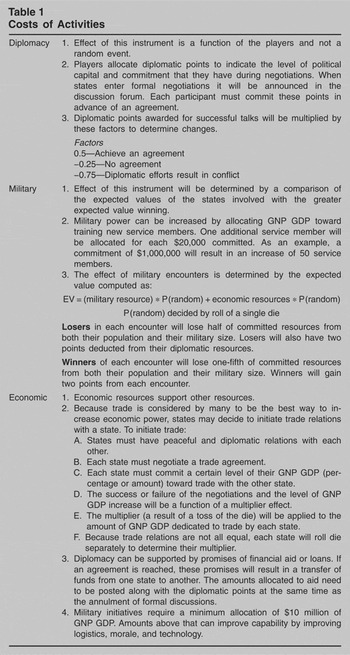
Costs of Activities (See Table 1 for details)
Because there is no such thing as a free lunch, every action required the allocation of resources. The amount of resources allocated could determine the success or failure of the response, although results also were based on the probability of success given a random generator (in this case, a set of die). States had three resources that they could dedicate to their efforts.
- Diplomacy. Unlike other instruments, successful diplomacy was a function of the players and not randomness. States allocated diplomatic points to indicate the level of political capital and commitment that they had during negotiations. Once states entered formal negotiations, they were publicly committed by declaring their points on the WebCT bulletin board.
- Military. Successful use of military power was determined by a
comparison of the expected values of the states involved with
the greater expected value of winning. Military power could be
increased by allocating GNP GDP3toward training new service members; however, this took one round to have an effect.
I would like to thank an anonymous reviewer who suggested that GDP would be a better measure of the economic power of a state.
- Economic. Economic power was both an instrument that supported other resources as well as the focus of state policy for some states. Because many considered trade to be the best way to increase economic power, trade relations could be opened with any state where peaceful relations existed.
Costs of Activities

Grading
Evaluation in any simulation is difficult. It is easy for students and instructors to see simulations as only a change of pace from more traditional classroom activities. To be integrated into the class, the simulation must measure whether students connect it to the course objectives. Grading for the exercise had both an individual and a group component.
Individual Logs
A substantial component of the simulation grade was each student's weekly log of their group's activities. Weekly logs included a short description and analysis of each action taken. These analyses were evaluated based on how well the descriptions of the actions related to specific theories from class readings or discussions. For instance, a student who described an agreement as an example of defensive realism because it was an attempt to bandwagon against a possible hegemonic alliance would be given more credit than one who simply stated that the agreement was settled because of mutual interests. If a student disagreed with the group's decision (which happened on a number of occasions), the reason for dissent was to be included. These logs were collected at least once during the simulation and also at the end. Grades for individual logs were based on application of the theories studied during group activities.
Group Grade
The second component of an individual's grade was each state's ability to formulate and conduct policy. Two submissions were used to judge this.
National Security Strategy (NSS): The first of these submissions was each state's NSS, due at the end of the first round. An NSS is a statement of a state's goals and interests, as well as a method to accomplish them. The suggested outline for the NSS included: (1) statement of national interests and goals; (2) statement of threats to interests; (3) strategy for defending and advancing interests; and (4) specific approaches.
After Action Report: The second submission was an after action report of how well national goals were accomplished. States were told to think of these reports as the “State of the Union” for their national leader. Grades were assigned based on their ability to meet initial goals.
Successful Diplomacy: An additional incentive was offered to overcome any student's status quo bias. The acquisition of more resources is generally considered a goal of most states. Students whose states ended the game having increased their diplomatic points by 25% were awarded an additional two points for the simulation grade. Any state that lost 50% or more of its resources was declared a failed state and subject to colonization by any other state. Colonization of a student's state resulted in a loss of one point from the student's grade (although some students called for stiffer penalties).
Lessons Learned
As stated, the class discussed lessons learned regarding theory and action at the beginning of each week. On the simulation's last day, students were also asked to discuss problems with and possible improvements to the exercise. While the simulation's focus was on its everyday play, students' comments connected it to the application of theories discussed in class. The comments centered on four topics:
Democratic Peace
Students were allowed to choose any type of government, however all states, even ones described as feudal (Azteca), adopted either democracy or constitutional monarchy as their form of government. Despite the presence of a number of self-proclaimed realists, students thought that there was an institutional bias toward interdependence and negotiated settlements. Although conflicts existed, war did not break out nor was it threatened. There are two possible explanations. First, that the cost of war in the simulation was so extreme that no state would risk it. This was not outside the realities for most states and probably acted as a constraint. States that had been successful in gaining without conflict showed an aversion to the risk of war. Second, that having had the idea of democratic peace drilled into them, the students automatically deferred to negotiations. While this demonstrates a limit to students' ability to role play, democratic peace theory was emphasized to show that norms have an important influence in states' behavior. All actors had certain expectations of other states' behavior. It was suggested that a better way to examine democratic peace theory would be to assign states their government type (e.g., military dictatorship, theocracy, etc.).
Anarchic and Chaotic System
The instructor's hands off position ensured that all events were the result of player decisions. The result was that at the mid point of the game, the international system had become bipolar with two great alliance systems (and one nonaligned state). From then until the end of the game there was little or no reason for action; no state wanted to upset the balance of power since a status quo bias set in. These students, who did not remember the Cold War and had all started college after the September 2001 attacks and the Indian Ocean tsunamis, thought that this was an unnatural environment. In their view, leaders needed to be forced out of complacency by arbitrary events whether natural (earthquake) or man made (insurgency). Much as events in Yugoslavia changed the Clinton administration, the addition of these conditions would force states to reevaluate their initial strategies. A possible solution to this would be the introduction of non-state actors, such as a transnational terrorist movement that could act as a “wild card.” These groups could prompt action by states, like al-Qaeda did for the United States, or could be allied to weaker states to wage asymmetric warfare.
Internal Disputes
Besides insurgencies, states undergo power shifts that can change policy and security strategy. As discussed above, stability and the status quo became the norm for all of the states. The lack of challengers meant that there were no domestic pressures on leaders to change their selected courses of action; once established, all but one of the states kept the same leadership. Leaders did not have to worry about accountability to an electorate or a dominant coalition. Since accountability is one of the explanations for democratic peace discussed in class, the absence of contenders had theoretical implications.
The one exception to this condition was a power struggle between a civilian leader who wanted to go to war and a military leader (who happened to be an ROTC cadet) who refused to commit forces. His argument was that the invasion would have been a risky action and the possible gains did not outweigh the possible losses. I am not sure if this was a result of the conservative nature of military culture or an illustration of prospect theory. However, his attempted coup and subsequent relief by the civilian leader (who also had him committed for psychiatric evaluation) provided some relief from the status quo as other states offered assistance to the new regime if there was some promise of future favorable considerations.
Geopolitics
The map used for the simulation consisted of two small islands and a flat continent (see Appendix A). Given class discussions of geopolitics and the effect of geography on strategy, this was seen as too artificial. States had to defend all borders. The transaction cost of trade was almost zero and there was no constraint on the movement of armies. It was suggested that the future map include major rivers as well as a mountain range. However, this involves more than just drawing a new set of lines. Costs for movement over these terrain features would need to be added to cost of conflicts for military operations. While possible, the added value may not be worth the additional computational issues.
Conclusion
Student comments at the end of the simulation reflected the lessons that I had hoped that they would learn. While the goal for all students was the same—i.e., gaining diplomatic, military, and economic points to get a good grade—they found that there were different strategies to achieve this and that military force was only one method, and a costly one. Many stated that in spite of not achieving their military goals, they were successful in improving their position through trade and diplomacy. Others (a minority) credited their success and survival to luck. Most saw parallels between their actions and that of world leaders. The theories we discussed were replicated on a small scale in the classroom. Although we did not conduct a formal pre- and post-test, I found that students' final papers showed a more refined understanding than their preliminary papers. Informal feedback from other instructors indicated that students were taking what they learned in the simulation and applying it in other classes. The students seemed more engaged in the behavioral aspects of international actors than students from other classes that were not involved in the simulation.
Although I have not had the opportunity to teach this course again, this simulation has been used in courses such as foreign policy and international behavior. Minor problems in the costs of state activities were addressed during the simulation and are reflected in Table 1. These fixes were seen as a better reflection of the true relative costs of state activities. When I presented this simulation to my graduate course on teaching, there was interest in its use for medium-sized introductory classes in international relations. I look forward to hearing the results of its use at that level. In that case, there might have to be more instructor intervention as students are not as likely to be familiar with the concepts upon which this simulation is based (e.g., theoretical principles, alliance structures, bargaining theory). However, I do not see this as a major obstacle to the successful use of this simulation.
While it may be impossible to place students in the position of state leaders, this simulation had the advantage of at least introducing the complexity of their decisions. By adding costs to all decisions, students became more constrained and cautious, as many national leaders are (or should be). Having a number of instruments at their disposal, they learned to balance carrots and sticks. They learned that even powerful states can be constrained by the agreements of smaller states. At the same time, they realized that leadership requires agreement from other leaders and that sometimes doing nothing is the best response.
Author Bio
Michael D. Kanner is an adjunct faculty at the University of Colorado, Boulder. He has designed and published a number of simulations for the classroom as well as for the Department of Defense. In addition to his teaching duties, he is the administrative director for the Dialogue on Defense: Briefings by the Secretary of Defense project at the University.
Appendix: Background Information
Map

Descriptions
Azteca
Although highly industrialized, Azteca is a semi-feudal militarized state. An island nation, Azteca was isolated for most of its existence. As a result, it has few ethnic groups and most internal politics focus on factional fighting amongst elites. While one group wants to expand Aztecan influence, another wants to return to the days of the monarchy.
Bruder
Bruder is a constitutional monarchy with a large and powerful middle class. Heavily industrialized, Bruder is aligned with a number of the elites in other countries by marriage and family. With one of the strongest economies in the region, Bruder's leaders see themselves as the future leaders of the region.
Calderon
Calderon has the smallest economy and military of any state on the continent. Although historically a constitutional monarchy, reforms and disinterest amongst the hierarchy has resulted in the state essentially being a democracy.
Delan
Delan is a loose confederation of predominantly agricultural provinces. Only recently unified, Delan has a weak central government and has not developed a national identity. This has caused problems as the northern Delanian provinces have started to industrialize and are seeking autonomy from the south.
Erat
Erat was the largest power on the continent, although this position has been slipping as the costs of maintaining its empire have grown burdensome. Still a monarchy, Erat's royal family is divided on the issue of preserving the empire or splitting into component parts (each ruled by a branch of the family). Many of the provinces also have strong ethnic identities that present a problem for both the state and local governments.
Fredonia
Fredonia has used its geographic position to its advantage. Originally part of Erat, it won its independence and established a representative democracy. Its security guaranteed by its ability to avoid continental wars, it has become prosperous through a blend of industrialization and trade. Until recently, Fredonian leadership was mostly isolationist. However, a new cohort of leaders has a view of Fredonia as a leader amongst the industrial states. Although it has the most ethnically mixed population, internal conflicts are almost nonexistent.
Gulan
Gulan is in an unusual position. One of the oldest states on the continent, it was formerly a major power. Since then, the bureaucratization of its government and labor force has reduced its economy and position as an economic force. With a strong nationalist spirit, Gulan has never accepted the change in the status quo. As such, the Gulan leadership still sees itself as leaders of the region.
Starting Resources

Military Technology
All states are comparably organized and equipped. Weapons are described below:
Small Arms
Rifles are semi-automatic, magazine fed.
Pistols are double action magazine fed auto.
Machine guns are crew served weapons and the same caliber as the rifles.
All members of the military are equipped with one of these weapons.
Tanks
Tanks are fully tracked, diesel powered with both main gun and two machine guns.
Crews are fully enclosed and protected from CBR weapons.
Infantry Vehicle
Each vehicle can carry a complete infantry squad into combat. They are equipped with both anti-tank missiles and larger caliber machine guns.
Artillery
Artillery is available in a number of calibers depending on mission, and 90% of artillery is self-propelled.
None of the artillery carry nuclear weapons.
Aircraft (Bombers, Fighters)
Bombers come in two varieties—tactical (direct support) and strategic (general support).
Tactical support aircraft are smaller and have fewer types of ordnance. Strategic aircraft are large and can carry any ordnance in the state's inventory. None of the aircraft carry nuclear weapons.
Fighters are designed to protect bombers, although 10% are designated for direct support of land operations.
Navy
Most states possess only a shallow water navy designed to protect their coast lines. The only exceptions are the two island states, Azteca and Fredonia. They possess a limited blue water navy consisting primarily of destroyers, convoy escorts, and a half dozen battleships each. Bruder has begun to build its navy; however, it has only produced one battleship with one in the docks.