Introduction
Paranoid ideation, the unfounded belief that others have hostile intentions and want to cause personal harm (Garety & Freeman, Reference Garety and Freeman2013) is a core feature of psychosis, prevalent in over 70% of those presenting with the first episode of psychosis (Coid et al. Reference Coid, Ullrich, Kallis, Keers, Barker and Cowden2013). Paranoid ideation is likely caused by the misinterpretation of internal arousal and states (Freeman et al. Reference Freeman, Dunn, Garety, Bebbington, Slater and Kuipers2005a, Reference Freeman, Garety, Bebbington, Slater, Kuipers and Fowlerb, Reference Freeman, Garety, Bebbington, Smith, Rollinson and Fowlerc) and it has also been observed in people suffering from other mental health disorders like anxiety disorders, particularly social anxiety disorder (Gilbert et al. Reference Gilbert, Boxall, Cheung and Irons2005; Michail & Birchwood, Reference Michail and Birchwood2009), depression (Wigman et al. Reference Wigman, van Nierop, Vollebergh, Lieb, Beesdo-Baum and Wittchen2012; Fusar-Poli et al. Reference Fusar-Poli, Nelson, Valmaggia, Yung and McGuire2014), and dementia (Selbæk et al. Reference Selbæk, Engedal and Bergh2013). However, previous research suggests that paranoid thinking is not a distinct emotional state common to those with mental health difficulties, but that it is exponentially distributed in the population; meaning ‘that many individuals have few paranoid thoughts, and few individuals have many’ (Freeman et al. Reference Freeman, Dunn, Garety, Bebbington, Slater and Kuipers2005a, Reference Freeman, Garety, Bebbington, Slater, Kuipers and Fowlerb, Reference Freeman, Garety, Bebbington, Smith, Rollinson and Fowlerc). Paranoia occurs on a single dimension, with social evaluative concerns on one end of the continuum and persecutory delusions on the other (Freeman et al. Reference Freeman, Dunn, Garety, Bebbington, Slater and Kuipers2005a, Reference Freeman, Garety, Bebbington, Slater, Kuipers and Fowlerb, Reference Freeman, Garety, Bebbington, Smith, Rollinson and Fowlerc). Findings from general population-based studies indicate that as many as 30% of people regularly have paranoid thoughts, and about 5% have experienced persecutory thinking (Johns et al. Reference Johns, Cannon, Singleton, Murray, Farrell and Brugha2004; Freeman et al. Reference Freeman, McManus, Brugha, Meltzer, Jenkins and Bebbington2011; Bebbington et al. Reference Bebbington, McBride, Steel, Kuipers, Radovanovič and Brugha2013); albeit in only in a minority this is persistent enough to prompt help-seeking (Freeman et al. Reference Freeman, McManus, Brugha, Meltzer, Jenkins and Bebbington2011).
Furthermore, there is strong evidence that factors associated with paranoid thinking are the same among clinical and non-clinical populations; for example attachment disruptions (Pickering et al. Reference Pickering, Simpson and Bentall2008), childhood trauma (Reininghaus et al. Reference Reininghaus, Kempton, Valmaggia, Craig, Garety and Onyejiaka2016), particularly bullying (Bentall et al. Reference Bentall, Wickham, Shevlin and Varese2012; Valmaggia et al. Reference Valmaggia, Day, Garety, Freeman, Antley and Slater2015a, Reference Valmaggia, Day, Kroll, Laing, Byrne and Fusar-Polib), and growing up in an urban environment (Freeman et al. Reference Freeman, Waller, Harpur-Lewis, Moore, Garety and Bebbington2015) have all been found to increase the risk for paranoid ideation. Overall, paranoia has been associated with lower physical and psychological well-being, mood, and social inclusion; causing significant levels of distress, disability, and reductions in psychological functioning (Gilbert et al. Reference Gilbert, Boxall, Cheung and Irons2005; Freeman et al. Reference Freeman, McManus, Brugha, Meltzer, Jenkins and Bebbington2011; Freeman & Garety, Reference Freeman and Garety2014).
Perceptions of the self, have long been hypothesised to be one important feature in the development and maintenance of paranoid thinking. For example, early psychoanalytic theories conceptualised paranoia as serving a defensive function (Freud, Reference Freud1911), which was expanded on more recently by Bentall and colleagues (Bentall, Reference Bentall, David and Cutting1994; Bentall Reference Bentall, Kircher and David2003; Udachina et al. Reference Udachina, Bentall, Varese and Rowse2017). They proposed that individuals with paranoia make external, other-blaming causal attributions for negative events; thereby preserving self-esteem and deflecting feelings of low self-worth. According to this theory, individuals with paranoia have positive explicit (observable) self-esteem, but negative implicit (subconscious) self-esteem. Bentall et al. (Reference Bentall, Corcoran, Howard, Blackwood and Kinderman2001) propose that by making external causal attributions, the individual diminishes the discrepancy between perceptions of the ‘real self’ (who the person is) and the ‘ideal self’ (who the person feels they ought to be). Therefore, paranoia serves as a defense of the self, which is implicitly experienced as weak and defective.
In contrast, cognitive models of paranoia propose that severe adverse childhood effects create enduring negative beliefs about the self as vulnerable and the world as being hostile, which, in turn, is related to emotional distress and paranoid ideation (Garety et al. Reference Garety, Kuipers, Fowler, Freeman and Bebbington2001).
Studying the self in relation to paranoia is an area of considerable complexity. Three recent reviews have explored the research in this area more widely (Kesting & Lincoln, Reference Kesting and Lincoln2013; Freeman & Garety, Reference Freeman and Garety2014; Tiernan et al. Reference Tiernan, Tracey and Shannon2014). Freeman & Garety (Reference Freeman and Garety2014) concluded that there is convincing evidence for the association of persecutory delusions and negative self-thoughts, and point out that this finding also fits with the wider literature on associations of negative emotions and positive symptoms of psychosis, as well as with evidence for the social defeat hypothesis of psychosis (Selten & Cantor-Graee, Reference Selten and Cantor-Graee2005; Valmaggia et al. Reference Valmaggia, Day, Garety, Freeman, Antley and Slater2015a, Reference Valmaggia, Day, Kroll, Laing, Byrne and Fusar-Polib).
Tiernan et al. (Reference Tiernan, Tracey and Shannon2014) conducted a narrative review of 18 studies on the relationship of self-concepts and paranoia. Paranoia was consistently associated with more negative self-concepts in cross-sectional studies, but findings were more mixed with regard to discrepancies in self-concept, and the dimensional aspects of self-concept and paranoia; with explicit and implicit self-concepts being more negative in clinical than in non-clinical groups, but with normal or higher self-esteem when persecution was seen as undeserved. These findings mirror those from a systematic review by Kesting & Lincoln (Reference Kesting and Lincoln2013) on self-esteem and persecutory delusions which included 52 studies. The authors also concluded that global explicit self-esteem is lower, and self-schemas are more negative in those with persecutory delusions, and that higher self-esteem was associated with lower perceived deservedness. Therefore, both reviews conclude that there is little support for Bentall et al. (Reference Bentall, Corcoran, Howard, Blackwood and Kinderman2001) ‘paranoia as defence’ theory, and that data to date are more likely to support cognitive models of paranoia.
Interpersonal sensitivity is a personality trait related to low self-esteem and negative self-concepts, which has gained increasing attention in the literature. Interpersonally sensitive individuals place ‘an undue and excessive awareness of, and sensitivity to, the behaviour and feelings of others… particularly to perceived or actual situations of criticism or rejection…’ (Boyce & Parker, Reference Boyce and Parker1989). Therefore, they are highly vigilant to other's expectations of them, fearful of negative evaluation, and will modify their behaviour to minimise the risk of social rejection; to the point of personal avoidance and non-assertive behaviour. The construct of interpersonal sensitivity encompasses: interpersonal awareness, fragile inner self, need for approval, separation anxiety, and timidity (Boyce & Parker, Reference Boyce and Parker1989).
First shown to be both a consequence of, and a vulnerability to depression (Boyce et al. Reference Boyce, Parker, Barnett, Cooney and Smith1991; Wilhelm et al. Reference Wilhelm, Boyce and Brownhill2004), interpersonal sensitivity has been associated with the onset of persecutory delusions in both high risk for psychosis (Masillo et al. Reference Masillo, Day, Laing, Howes, Fusar-Poli and Byrne2012) and general population samples (Freeman et al. Reference Freeman, Garety, Bebbington, Smith, Rollinson and Fowler2005c; Green et al. Reference Green, Freeman, Kuipers, Bebbington, Fowler and Dunn2008). It has been hypothesised that the belief that the self is vulnerable, bothersome, and has to be hidden from others feeds into paranoid experiences via several different routes, for example via the ability to develop and maintain social contacts (Maki et al. Reference Maki, Veijola, Jones, Murray, Koponen and Tienari2005; Gayer-Anderson & Morgan, Reference Gayer-Anderson and Morgan2013), or by using maladaptive coping strategies to resolve interpersonal conflict (Bak et al. Reference Bak, Myin-Germeys, Hanssen, Bijl, Vollebergh and Delespaul2003; Lin et al. Reference Lin, Wigman, Nelson, Vollebergh, Van Os and Baksheev2011). However, other studies have been less clear about the relationship with overall interpersonal sensitivity and paranoia (Valmaggia et al. Reference Valmaggia, Freeman, Green, Garety, Swapp and Antley2007; Freeman et al. Reference Freeman, Gittins, Pugh, Antley, Slater and Dunn2008a, Reference Freeman, Pugh, Antley, Slater, Bebbington and Gittinsb); although they have commonly found associations with at least one of its components (interpersonal awareness, fragile inner self, need for approval, separation anxiety, and timidity).
It is possible that differences in the definition and measurement of paranoia have contributed to the differences in findings. Some studies focused on ascertaining whether paranoia can be ‘triggered’ in a ‘neutral’ situation (e.g. Freeman et al. Reference Freeman, Gittins, Pugh, Antley, Slater and Dunn2008a, Reference Freeman, Pugh, Antley, Slater, Bebbington and Gittinsb); thus, focusing on measuring a ‘state paranoia’ and its correlations with interpersonal sensitivity; whereas other studies investigated associations with a more enduring and stable paranoia-proneness; defined as ‘trait paranoia’ (e.g. Masillo et al. Reference Masillo, Day, Laing, Howes, Fusar-Poli and Byrne2012).
Given that this is a relatively new area of research, to date, there has been no systematic review of the literature exploring whether high levels of interpersonal sensitivity or one of its components are associated with paranoia in both general population and clinical samples. Similarly, no review has explored whether outcomes differ depending on whether ‘state’ or ‘trait’ paranoia was investigated.
The aim of this study was, therefore, to systematically review the evidence on interpersonal sensitivity and paranoia to answer the following questions:
(i) Is there an association between interpersonal sensitivity, including high levels of interpersonal awareness, a fragile inner self, need for approval, separation anxiety, timidity and paranoia in both general population and clinical samples?
(ii) Is the quality of these relationships different depending on whether state or trait paranoia was assessed?
Methods
A review of the literature was performed following PRISMA guidelines (Moher et al. Reference Moher, Stewart and Shekelle2016). The literature review was registered on PROSPERO (registration number: PROSPERO 2016:CRD42016053765) in December 2016.
Literature search
Articles were identified through a literature search in OVID (PsychINFO, MEDLINE) and Web of Science from inception to December 2016.
Inclusion and exclusion criteria
The inclusion criteria were: (1) original studies published up to December 2016; (2) written in English; (3) using clinical samples with a diagnosis of psychosis, schizophrenia, or related symptoms, those at high risk of these mental health difficulties, or general population samples; (4) young adults (>16 years) or adults; (5) measured interpersonal sensitivity or one of its components; and (6) measured paranoia, a related concept, or group differences in interpersonal sensitivity as outcome measure. We excluded studies which solely focused on attachment or self-esteem, were not focused on interpersonal sensitivity as defined by Boyce & Parker (Reference Boyce and Parker1989), review studies, conference abstracts, studies not written in English, and studies using samples of children under the age of 16 years.
Search criteria
We used combinations of the following keywords: (Psychos* OR psychot* OR schizophren* OR paranoi* OR prodrom* OR at risk mental state OR ultra-high risk OR hallucinat* OR voice* OR delusio*) AND (interpersonal sensitivity OR rejection sensitivity OR criticism sensitivity OR timidity OR separation anxiety OR affective sensitivity OR interpersonal awareness OR need for approval OR fragile inner self). Additional references were retrieved by cross-referencing of selected articles, and through hand searches. Disagreement was resolved through discussion relevant to the inclusion and exclusion criteria.
Quality assessment
We used the quality assessment tools developed by the National Heart Lung and Blood Institute of the National Institutes of Health (NHLBI). We decided on these tools because they cover the wide range of study designs that would be included in our review, and are not specific to the area of investigation; making them suitable for assessing studies concerned with mental health outcomes. All tools included items to assess the potential for methodological flaws which could constitute sources of bias (e.g. selection, performance, attrition, and detection), confounding, power and other factors. Study quality was assessed by two raters, and discrepancies resolved through discussion. Reviewers answered ‘yes’, ‘no’, and ‘cannot determine’ for each item, based on guidance documents developed for each tool. Each study received an overall rating of ‘good’, ‘fair’, or ‘poor’. Briefly, ‘good’ studies had strong methodologies, and low risk of bias, ‘fair’ studies had some methodological shortcomings which increased the risk of bias, and ‘poor’ studies had significant methodological flaws which could render results invalid.
Results
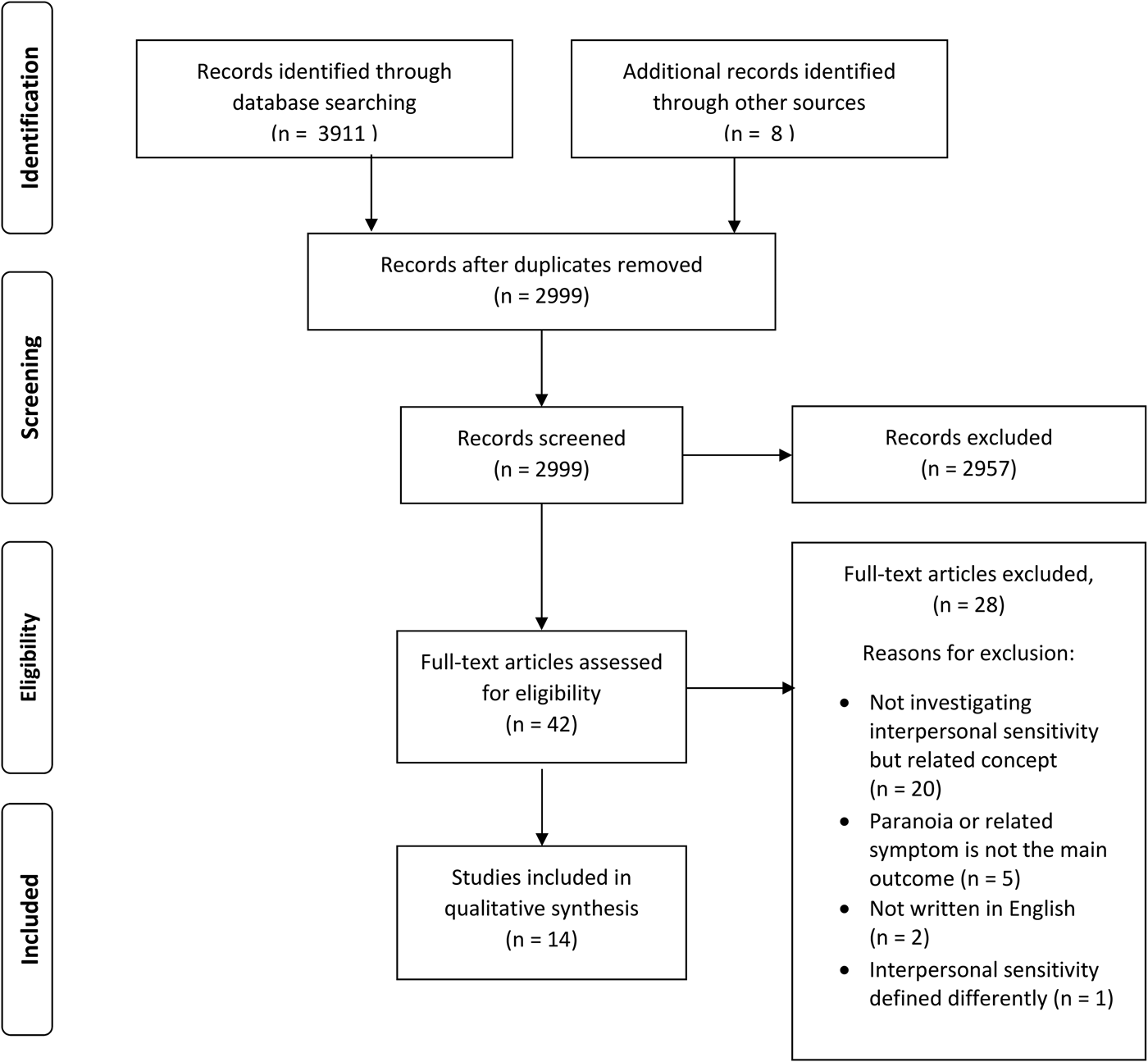
As shown in Fig. 1, initially, n = 3911 hits were identified, and a further eight were identified through hand searches. After removal of duplicates, title, and abstract were screened of n = 2999 studies. Of those, n = 2957 records were excluded (n = 2608 after title review, n = 349 after abstract review). The full text was accessed of n = 42 studies, and n = 28 were excluded. Reasons for exclusion were: investigating self-esteem or other related concepts but not interpersonal sensitivity (n = 20), not using paranoia or a related symptom as main outcome (n = 5), article not written in English (n = 2), interpersonal sensitivity defined as the positive trait of interpersonal awareness, rather than as defined by Boyce & Parker (Reference Boyce and Parker1989) (n = 1).
PRISMA flow diagram.

In total, n = 14 studies were selected for the systematic review. The strength of inter-rater agreement was high, (weighted κ = 0.86) and disagreement was resolved through discussion of studies in relation to the inclusion criteria.
Information extraction
Fourteen studies were included, with the earliest included study published in 1999 (Hodges et al. Reference Hodges, Byrne, Grant and Johnstone1999). Two publications (Freeman et al. Reference Freeman, Gittins, Pugh, Antley, Slater and Dunn2008a, Reference Freeman, Pugh, Antley, Slater, Bebbington and Gittinsb) were linked, with one using a subsample of the other, but because they were investigating different outcomes, they will be listed as two separate studies. Twelve studies were carried out in the UK, one in Italy, and one in Iran.
The total sample size was N = 12, 138 participants. Sample sizes ranged from N = 11 (Bell & Freeman, Reference Bell and Freeman2014) to N = 8576 (Bebbington et al. Reference Bebbington, McBride, Steel, Kuipers, Radovanovič and Brugha2013), with the median sample size of n = 90. Except for the population samples in two studies (Sharifi et al. Reference Sharifi, Bakhshaie, Hatmi, Faghih-Nasiri, Sadeghianmehr and Mirkia2012; Bebbington et al. Reference Bebbington, McBride, Steel, Kuipers, Radovanovič and Brugha2013), all samples were initially self-selected. In two studies, researchers conducted the selection of participants for a second experiment based on participants’ initial paranoia scores (Freeman et al. Reference Freeman, Garety, Bebbington, Smith, Rollinson and Fowler2005c; Green et al. Reference Green, Freeman, Kuipers, Bebbington, Fowler and Dunn2011) to ensure a range of paranoia scores across the sample.
Participant age ranged from 17 to 77 years (mean age: 28.7 years). One study (Bebbington et al. Reference Bebbington, McBride, Steel, Kuipers, Radovanovič and Brugha2013) did not report the mean age, only that the sample was ‘representative of the British population’. All studies had similar proportions of men and women in their samples and most participants were ‘White’. IQ was reported in six studies (Freeman et al. Reference Freeman, Dunn, Garety, Bebbington, Slater and Kuipers2005a, Reference Freeman, Garety, Bebbington, Slater, Kuipers and Fowlerb, Reference Freeman, Garety, Bebbington, Smith, Rollinson and Fowlerc, Reference Freeman, Gittins, Pugh, Antley, Slater and Dunn2008a, Reference Freeman, Pugh, Antley, Slater, Bebbington and Gittinsb, Reference Freeman, Pugh, Vorontsova, Antley and Slater2010; Valmaggia et al. Reference Valmaggia, Freeman, Green, Garety, Swapp and Antley2007), and drug use was reported in only one study (Hodges et al. Reference Hodges, Byrne, Grant and Johnstone1999).
Except for one study (Bell & Freeman, Reference Bell and Freeman2014), which had a pre/post design, all studies were cross-sectional. Nine studies used an experimental design. Data were analysed using t tests, Mann–Whitney-U tests, regression analyses, and ANOVAs. Only three studies adjusted analyses for potential confounding variables (Freeman et al. Reference Freeman, Dunn, Garety, Bebbington, Slater and Kuipers2005a, Reference Freeman, Garety, Bebbington, Slater, Kuipers and Fowlerb, Reference Freeman, Garety, Bebbington, Smith, Rollinson and Fowlerc, Reference Freeman, Gittins, Pugh, Antley, Slater and Dunn2008a, Reference Freeman, Pugh, Antley, Slater, Bebbington and Gittinsb), and one study adjusted analyses for depression only (Masillo et al. Reference Masillo, Day, Laing, Howes, Fusar-Poli and Byrne2012). No study adjusted p values to account for multiple testing.
Assessment of interpersonal sensitivity
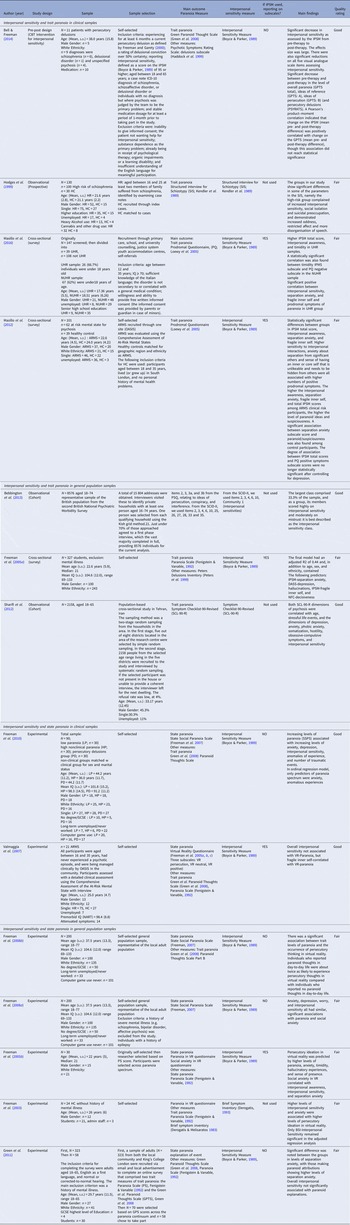
The assessment of interpersonal sensitivity varied across studies (Table 1). However, all used validated measures which included questions thought to tap into the constructs in question with the most frequently used measure being the interpersonal sensitivity measure (IPSM) developed by Boyce & Parker (Reference Boyce and Parker1989).
Summary and quality assessment of included studies

CBT, Cognitive Behavioural Therapy; GCSE, General Certificate of Secondary Education; GPTS, Green Paranoid Thoughts Scale; ICD-10, International Statistical Classification of Diseases and Related Health Problems; IQ, intelligence quotient; HC, healthy control; HR, High Risk; NART, National Adult Reading Test; NUHR, not ultra-high risk; OASIS, outreach and support in South London; PSYRATS, Psychotic Symptoms Rating Scales; s.d., standard deviation; UHR, ultra high risk; VR, virtual reality.
Of the studies using the IPSM (Boyce & Parker, Reference Boyce and Parker1989), six studies (Freeman et al. Reference Freeman, Dunn, Garety, Bebbington, Slater and Kuipers2005a, Reference Freeman, Garety, Bebbington, Slater, Kuipers and Fowlerb; Valmaggia et al. Reference Valmaggia, Freeman, Green, Garety, Swapp and Antley2007; Green et al. Reference Green, Freeman, Kuipers, Bebbington, Fowler and Dunn2011; Masillo et al. Reference Masillo, Day, Laing, Howes, Fusar-Poli and Byrne2012, Reference Masillo, Valmaggia, Saba, Brandizzi, Lindau and Solfanelli2016) also reported results from subscales (interpersonal awareness, need for approval, separation anxiety, timidity, fragile inner self).
Outcomes: trait paranoia, state paranoia, and group differences in interpersonal sensitivity
In 11 studies, paranoia, ideas of reference, or ideas of persecution were the main outcome. In the remaining three studies, group differences in interpersonal sensitivity (Hodges et al. Reference Hodges, Byrne, Grant and Johnstone1999; Masillo et al. Reference Masillo, Day, Laing, Howes, Fusar-Poli and Byrne2012, Reference Masillo, Valmaggia, Saba, Brandizzi, Lindau and Solfanelli2016) were main outcomes.
Interpersonal sensitivity and trait paranoia
Clinical samples
Four studies investigated the interpersonal sensitivity and trait paranoia in clinical samples (Hodges et al. Reference Hodges, Byrne, Grant and Johnstone1999; Masillo et al. Reference Masillo, Day, Laing, Howes, Fusar-Poli and Byrne2012, Reference Masillo, Valmaggia, Saba, Brandizzi, Lindau and Solfanelli2016; Bell & Freeman, Reference Bell and Freeman2014).
Three studies used a case-control design (Hodges et al. Reference Hodges, Byrne, Grant and Johnstone1999; Masillo et al. Reference Masillo, Day, Laing, Howes, Fusar-Poli and Byrne2012, Reference Masillo, Valmaggia, Saba, Brandizzi, Lindau and Solfanelli2016), and the study by Bell & Freeman (Reference Bell and Freeman2014) used a pre-post design. Albeit different definitions of ‘cases’ and ‘controls’, and different measures of trait paranoia were used (Table 1), all three case-control studies reported significantly higher rates of interpersonal sensitivity in cases than in controls. The effect size was reported as r = 0.24 (small) in one study (Masillo et al. Reference Masillo, Valmaggia, Saba, Brandizzi, Lindau and Solfanelli2016). The IPSM subscales interpersonal awareness and separation anxiety were also higher in cases in the study by Masillo et al. (Reference Masillo, Valmaggia, Saba, Brandizzi, Lindau and Solfanelli2016), and interpersonal awareness, separation anxiety, and fragile inner-self were higher in cases in the study by Masillo et al. (Reference Masillo, Day, Laing, Howes, Fusar-Poli and Byrne2012). In addition, Masillo et al. (Reference Masillo, Valmaggia, Saba, Brandizzi, Lindau and Solfanelli2016) reported statistically significant correlations between interpersonal sensitivity and negative prodromal symptoms in both, cases and controls.
Bell & Freeman (Reference Bell and Freeman2014) found significant reductions in interpersonal sensitivity, overall paranoia, ideas of reference, ideas of persecution, and persecutory delusions after an intervention targeting interpersonal sensitivity. The effect sizes were large (Green Paranoid Thoughts Scale total: d = 1.25, Green Paranoid Thoughts Scale reference: d = 1.38, Green Paranoid Thoughts Scale persecution: d = 0.94, PSYRATS: d = 3.26).
General population samples
Three studies investigated the association of interpersonal sensitivity and trait paranoia in general population samples (Freeman et al. Reference Freeman, Dunn, Garety, Bebbington, Slater and Kuipers2005a; Sharifi et al. Reference Sharifi, Bakhshaie, Hatmi, Faghih-Nasiri, Sadeghianmehr and Mirkia2012; Bebbington et al. Reference Bebbington, McBride, Steel, Kuipers, Radovanovič and Brugha2013).
Regardless of the method of assessment of interpersonal sensitivity, or paranoia (Table 1), it was found in all three studies that interpersonal sensitivity was associated with paranoid thinking. Freeman et al. (Reference Freeman, Dunn, Garety, Bebbington, Slater and Kuipers2005a) reported a moderate correlation (r = 0.47) between the IPSM total and the Paranoia Scale (Fenigstein & Vanable, Reference Fenigstein and Vanable1992), and Sharifi et al. (Reference Sharifi, Bakhshaie, Hatmi, Faghih-Nasiri, Sadeghianmehr and Mirkia2012) found a strong correlation between paranoia and interpersonal sensitivity, both assessed by the SCL90-R (Derogatis & Fitzpatrick, Reference Derogatis, Fitzpatrick and Maruish2004). These associations were maintained in adjusted regression analyses using backward elimination. Bebbington et al. (Reference Bebbington, McBride, Steel, Kuipers, Radovanovič and Brugha2013) confirmed the exponential distribution of paranoia in the population. He identified four distinct classes in his study, with the largest class (33.3%) of the sample termed as the ‘interpersonal sensitivity class’; scoring highly on interpersonal sensitivity and moderately on mistrust.
Interpersonal sensitivity and state paranoia
Clinical samples
Two experimental studies (Valmaggia et al. Reference Valmaggia, Freeman, Green, Garety, Swapp and Antley2007; Freeman et al. Reference Freeman, Pugh, Vorontsova, Antley and Slater2010) used a virtual reality environment to explore whether a neutral environment could elicit paranoid interpretations in participants with low paranoia, high non-clinical paranoia, and persecutory delusions (Freeman et al. Reference Freeman, Pugh, Vorontsova, Antley and Slater2010), or those with an at-risk mental state of psychosis (Valmaggia et al. Reference Valmaggia, Freeman, Green, Garety, Swapp and Antley2007).
Both, Valmaggia et al. (Reference Valmaggia, Freeman, Green, Garety, Swapp and Antley2007) and Freeman et al. (Reference Freeman, Pugh, Vorontsova, Antley and Slater2010) used the State Social Paranoia Scale as a main outcome measure to assess paranoia, and the IPSM (Boyce & Parker, Reference Boyce and Parker1989) to assess interpersonal sensitivity. In both studies, samples were self-selected. Freeman et al. (Reference Freeman, Pugh, Vorontsova, Antley and Slater2010) matched the clinical sample with a non-clinical sample on some demographic variables such as gender.
Freeman et al. (Reference Freeman, Pugh, Vorontsova, Antley and Slater2010) reported a linear association between increasing levels of paranoia and interpersonal sensitivity. However, in an ordinal regression analysis which considered all variables investigated together (anxiety, worry, interpersonal sensitivity, depression, the total number of anomalous experiences, beads drawn, and number of traumatic events), only anxiety and number of traumatic events remained significant.
Valmaggia et al. (Reference Valmaggia, Freeman, Green, Garety, Swapp and Antley2007) found that there was no correlation with persecutory ideation and overall IPSM score (r = 0.16, p = 0.504); although the IPSM subscale fragile inner-self was significantly moderately correlated with persecutory ideation (r = 0.46, p = 0.049).
General population samples
Five studies investigated the association of interpersonal sensitivity and paranoia in general population samples using an experimental design (Freeman et al. Reference Freeman, Slater, Bebbington, Garety, Kuipers and Fowler2003, Reference Freeman, Dunn, Garety, Bebbington, Slater and Kuipers2005a, Reference Freeman, Gittins, Pugh, Antley, Slater and Dunn2008a, Reference Freeman, Pugh, Antley, Slater, Bebbington and Gittinsb; Green et al. Reference Green, Freeman, Kuipers, Bebbington, Fowler and Dunn2011). Four studies used virtual reality to investigate associations with paranoia Freeman et al. Reference Freeman, Slater, Bebbington, Garety, Kuipers and Fowler2003, Reference Freeman, Dunn, Garety, Bebbington, Slater and Kuipers2005a, Reference Freeman, Gittins, Pugh, Antley, Slater and Dunn2008a, Reference Freeman, Pugh, Antley, Slater, Bebbington and Gittinsb); whereas Green et al. (Reference Green, Freeman, Kuipers, Bebbington, Fowler and Dunn2011) used a ‘real world scenario’ with stooges.
Paranoia was assessed differently across studies (Table 1). Green et al. (Reference Green, Freeman, Kuipers, Bebbington, Fowler and Dunn2011) reported no significant difference in total IPSM score in those who made paranoid attributions and those who did not but found a significant difference between groups in levels of separation anxiety (U = 131, p = 0.05). In contrast, Freeman et al. (Reference Freeman, Gittins, Pugh, Antley, Slater and Dunn2008a, Reference Freeman, Pugh, Antley, Slater, Bebbington and Gittinsb) found that overall IPSM score was associated with state paranoia. The association found in the latter study was maintained in adjusted analyses, whereas the former study did not adjust analyses for potential confounders. Neither study reported results on any of the subscales. Freeman et al. (Reference Freeman, Slater, Bebbington, Garety, Kuipers and Fowler2003) found that higher levels of BSI-Interpersonal sensitivity were associated with higher levels of perceived persecution in VR. This finding was maintained in adjusted analyses. Freeman et al. (Reference Freeman, Garety, Bebbington, Slater, Kuipers and Fowler2005b) found no significant correlation in IPSM and the VR-persecution score. However, the authors reported that the IPSM subscale timidity was significantly correlated with VR-persecution (r = 0.47, p = 0.009); other subscales were not significantly correlated with VR-persecution.
Discussion
Findings from this systematic review demonstrate a robust association between interpersonal sensitivity and paranoia in clinical and general population samples alike, regardless of method of assessment of both paranoia and interpersonal sensitivity.
Studies in this review were all ‘moderate’ or ‘good’ quality; largely owing to a large number of experimental studies included. Observational studies had large sample sizes and robust methodologies, giving confidence in the finding that paranoia is associated with interpersonal sensitivity. Although this finding was more pronounced in studies of trait paranoia, it nevertheless suggests that interpersonal sensitivity is a construct which warrants further empirical and clinical attention.
It is likely that the discrepancy of findings observed in studies of trait and state paranoia are due to differences in the purpose of the studies, and thus, differences in sampling and measurement. Studies which used state paranoia as an outcome were exclusively experimental, and primarily concerned with establishing the feasibility of using a VR environment to study paranoia, with the state paranoia measure having been developed for this specific purpose. Therefore, questions were fewer and less comprehensive than those investigating trait paranoia. Samples were less likely to be representative of the general population, whereas studies investigating trait paranoia were usually representative or well matched on potential confounders like age, gender, and social economic status. The difference in purpose of the studies investigating state and trait paranoia also raises the question whether these studies were sufficiently powered to detect associations with interpersonal sensitivity or its related constructs in these studies.
Finally, since the primary purpose in studies using state paranoia was not the investigation of interpersonal sensitivity but the feasibility of using a VR environment to investigate paranoia, interpersonal sensitivity was not measured concurrently with state paranoia in any of the studies; making it difficult to ascertain whether any lack of association was due to fluctuations in those variables, or whether state and trait paranoia, albeit highly correlated, measure slightly different underlying constructs which relate differently to interpersonal sensitivity.
Taken together, it is likely that using measures of state paranoia may not be the ideal route to answering the question whether interpersonal sensitivity is associated with paranoia, and using a measure of trait paranoia in future studies may prove more fruitful.
From a theoretical perspective, findings from this review strengthen the hypothesis that feelings of personal vulnerability and exaggerated socially evaluative concerns are central for both, onset and maintenance of paranoid symptoms; in line with Freeman's (Reference Freeman2007) theory that paranoia builds directly on these feelings. Findings from our review therefore support and expand those from two recent systematic reviews on self-esteem and self-concepts more widely (Kesting & Lincoln, Reference Kesting and Lincoln2013; Tiernan et al. Reference Tiernan, Tracey and Shannon2014), which both concluded that there is little empirical support for the idea that paranoia serves to protect self-esteem, as proposed by Bentall et al. (Reference Bentall, Corcoran, Howard, Blackwood and Kinderman2001), but that specific negative schemas about the self significantly contribute to the development of paranoia. Findings from our review suggest that interpersonal sensitivity may be an important mediator in the pathway from negative self-schemas to paranoia, although this hypothesis will need to be tested in future research.
In this context, it will also be interesting to begin to understand better when, and how precisely interpersonal sensitivity develops. There have been suggestions that adverse interpersonal experiences, such as childhood trauma (Fisher et al. Reference Fisher, Appiah-Kusi and Grant2012), bullying victimization (Butler et al. Reference Butler, Doherty and Potter2007), and discrimination (Stowkowy & Addington, Reference Stowkowy and Addington2012) may be significantly implicated in the formation of negative beliefs about the self. However, to date, the mechanisms whereby these experiences then convert to interpersonal sensitivity are not well understood. Although there are emerging longitudinal studies to suggest a unidirectional pathway from negative self-schemas more broadly to paranoia (Fowler et al. Reference Fowler, Hodgekins, Garety, Freeman, Kuipers and Dunn2012; Oliver et al. Reference Oliver, O'Connor, Jose, McLachlan and Peters2012; Jaya et al. Reference Jaya, Ascone and Lincoln2017), the role of interpersonal sensitivity in these pathways has not been investigated. A recent study has shown that interpersonal sensitivity mediated the association between childhood bullying victimisation and paranoia (McDonnell et al. Reference McDonnell, Stahl, Day, McGuire and Valmaggia2018), but because the design was cross-sectional, causality could not be established. Further, longitudinal research will, therefore, be vital to elucidate the role of interpersonal sensitivity in paranoia.
Similarly, it is not yet clear whether interpersonal sensitivity is indeed as stable and resistant to change as suggested in the definition by Boyce & Parker (Reference Boyce and Parker1989). Tentative evidence from the study by Bell & Freeman (Reference Bell and Freeman2014) included in this review suggests that interpersonal sensitivity may be more amenable to intervention than would be expected from an enduring ‘personality trait’. However, since this study was a pilot with significant limitations, such as the lack of a control group and a small, selected sample, it is at this stage not possible to draw firm conclusions about the malleability of interpersonal sensitivity.
The systematic review by Kesting & Lincoln (Reference Kesting and Lincoln2013) noted that there was some support for the hypothesis that fluctuations in self-esteem, rather than self-esteem per se, are important in the development of paranoia. Indeed, findings from our review also point tentatively towards the idea that the perceived fragility of the self, as measured by the IPSM subscale ‘fragile inner self’, possibly reflected in fluctuations in self-esteem, may deserve closer attention when considering the development of paranoia. Although only two studies included in this review reported on this link, since this review was conducted, a further study has been published which found that the IPSM subscale ‘fragile inner self’ was significantly associated with paranoid ideation in a sample of adolescents seeking help for psychological problems (Masillo et al. Reference Masillo, Valmaggia, Saba, Brandizzi, Lo Cascio and Telesforo2017).
It is noteworthy that trying to define perceptions of the self in relation to others, and its association with paranoia is an area of considerable complexity. Whereas previous work has predominantly focused on elucidating the role of self-esteem and self-worth more globally (Kesting & Lincoln, Reference Kesting and Lincoln2013), it appears now timely to begin parsing out more fine-grained concepts that make up the interpersonal difficulties observed in people with psychosis. The IPSM (Boyce & Parker, Reference Boyce and Parker1989) with its subscales of interpersonal awareness, fragile inner self, need for approval, separation anxiety, and timidity may offer a comprehensive measure of interpersonal difficulties for this purpose. Using a validated, established measure across studies and samples would be beneficial to allow for meaningful comparisons; leading to firmer conclusions on the role of interpersonal sensitivity and its related constructs in psychosis. This would also help to identify future clinical targets.
Clinically, findings from this review suggest that it will be important to consider the impact of interpersonal sensitivity on paranoid symptoms, and how this finds expression within interpersonal relationships, including the therapeutic relationship. This may be of importance since there is now evidence to suggest that the therapeutic relationship is a crucial factor in the success of therapeutic intervention for psychosis (Goldsmith et al. Reference Goldsmith, Lewis, Dunn and Bentall2015).
Refining our understanding about how interpersonal sensitivity and its constructs are related to paranoia could help to design specific, targeted interventions to individuals suffering from high interpersonal sensitivity before they show symptoms of psychosis. The use of virtual reality therapeutically could give an opportunity to work on interpersonal experiences under controlled conditions. Indeed, there have been some successful trials of VR for treatment of social anxiety (Anderson et al. Reference Anderson, Rothbaum and Hodges2003; Bouchard et al. Reference Bouchard, Dumoulin, Robillard, Guitard, Klinger and Forget2017). It is conceivable that similar approaches could be developed for interpersonal sensitivity. There is also emerging evidence that compassion-focused approaches could provide a promising route to enhancing specific, dysfunctional aspects of self-esteem in clients with paranoia (Lincoln et al. Reference Lincoln, Hohenhaus and Hartmann2013; Ascone et al. Reference Ascone, Sundag, Schlier and Lincoln2017). To date, there has only been one pilot study of a targeted intervention for interpersonal sensitivity (Bell & Freeman, Reference Bell and Freeman2014), with encouraging results. However, these findings were in a severely impaired clinical sample and will need to be replicated in a larger sample with a broader set of characteristics to begin building the evidence base for targeted prevention of, and early intervention in psychosis.
Limitations of the review
This review has some limitations. We only included published literature which may have introduced some publication bias. Search criteria were fairly narrow which may have precluded inclusion of studies which investigated wider constructs related to interpersonal sensitivity or psychosis. However, as discussed above, two recent reviews have explored the role of self-esteem, and self-concepts in paranoia (Kesting & Lincoln, Reference Kesting and Lincoln2013; Tiernan et al. Reference Tiernan, Tracey and Shannon2014), and therefore we thought it important to hone in on the literature on interpersonal sensitivity, specifically.
Conclusions
This systematic review of 14 studies with a total of 12 138 participants showed a clear association between interpersonal sensitivity (encompassing interpersonal awareness, a fragile inner self, need for approval, separation anxiety, and timidity) and paranoia. Although this research area is considerably complex, and many questions remain, results nevertheless suggest that interpersonal sensitivity a construct which warrants further empirical and clinical attention. Refining our understanding about the specific interpersonal difficulties experienced by individuals with paranoia could help to design specific, targeted interventions to individuals suffering from high interpersonal sensitivity before they show symptoms.
Acknowledgements
We would like to thank Dr Freya Rumball and Angeliki Argyriou for reviewing the studies and rating study quality of included studies.
Conflict of interest
None.