IntroductionFootnote 1
On 14 October 1776, the French naval officer Jean-Vincent Morice concluded a treaty with the Sultan of Kilwa over trade in enslaved individuals along the East African coast. At that time Morice had been sailing in the Indian Ocean for more than twenty years and had begun participating in the East African slave trade through Zanzibari contacts two years previously.Footnote 2 Under the terms of the agreement, Kilwa’s ruler provided “a thousand slaves annually at twenty piastres each and he [J.-V. Morice] shall give the King a present of two piastres for each slave. No other but he shall be allowed to trade for slaves, whether French, Dutch, Portuguese, & c. [etc.], until he shall have received his slaves and has no wish for more.”Footnote 3
The growth in this trade was rapid and its characteristics were as ugly as we have come to expect. In late 1778 there were Portuguese reports of as many as eleven French ships doing business along the southern Tanzanian coast between Kilwa and an emerging port named Mikindani.Footnote 4 These French ships primarily supplied plantations on the Indian Ocean islands of Mauritius and Réunion, but were known to venture as far as the West Indies. It wasn’t unknown for more than one hundred individuals to perish on even one of the shorter voyages.Footnote 5
This late-eighteenth century moment certainly captures the themes of violence and conflict prevalent in Indian Ocean trade at that time. It also reflects some longstanding perceptions of Swahili history. Swahili society has often been described as “mercantile,” with coastal inhabitants occupying a middleman role in Indian Ocean trade, facilitating the export of African resources and, at times, African individuals.Footnote 6 For the case discussed in this paper, the focus on Swahili people selling enslaved individuals to the French at Kilwa and Mikindani, which is said to have recognized a traditional loose authority of Kilwa’s rulers, is indicative of this trope of Swahili middlemen.Footnote 7 While such generalizations highlight some broad trends in Swahili history, they are necessarily limited, particularly when they rely heavily on the historical accounts of foreigners, both European and Arab. I thus propose to balance them with a multiscalar approach drawn from historical archaeology that studies the activities of Swahili individuals within a long-term historical perspective and a more complete regional context.Footnote 8 In this paper I will employ the approach to better understand the involvement in Indian Ocean commerce of the inhabitants of the historic port town of Mikindani, where I conducted field research in 2007 and 2008, using a diachronic and material-based perspective to reexamine Swahili historical narratives.Footnote 9 For the Swahili coast, this approach enables me to demonstrate the diversity of Swahili involvement in Indian Ocean trade over time and across space, as well as to suggest reasons for that diversity, ranging from geographic conditions to social organization, to sometimes fierce economic competition.
Mikindani, a Swahili Port in Southern Tanzania
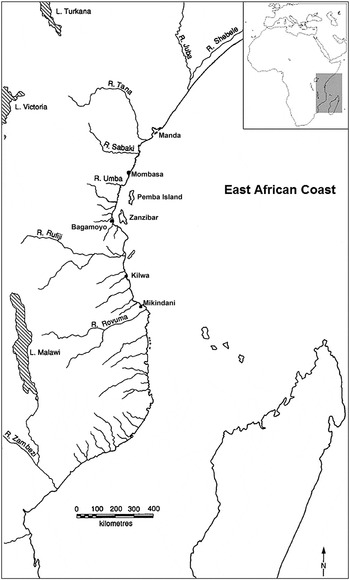
The town of Mikindani lies along the Indian Ocean coast in the Mtwara Region of Tanzania, about fifty kilometers north of the border with Mozambique (Figure 1). The earliest historical accounts of the town come in the later eighteenth century, in connection with French involvement in the slave trade, though several of these early accounts, including one in 1866 from David Livingstone, suggest architectural evidence for a much longer occupation.Footnote 10 Indeed, archaeological research in the wider region around Mikindani has provided evidence of occupation since the last centuries BCE and of intensive settlement since the fifth century.Footnote 11
Map of the East African Coast showing locations mentioned in the text.

Mikindani’s location places it along the Swahili Coast, a cultural region stretching between Somalia and Mozambique. It is located towards the southern end of that coast, about 250 kilometers south of the major Swahili city of Kilwa. The Swahili coastal culture came together in the second half of the first millennium as Iron Age fishing and farming communities gradually became more involved in the social and economic networks of the Indian Ocean, a development catalyzed by the conversion of many peoples on the coast to Islam.Footnote 12 Swahili culture experienced a florescence in the early second millennium, with the growth of stone-built urban centers and the emergence of a shared, cosmopolitan material culture incorporating many Islamic, Middle Eastern elements alongside African ones.Footnote 13 Swahili communities during this period were independent and competitive entities, cultivating personal relationships with Indian Ocean merchants, practicing different varieties of Islam, and linked to the diverse African groups of their respective hinterlands. From the sixteenth century they alternately combatted, worked with, and were subject to colonial powers from Europe and the Middle East, yet Swahili communities have maintained a distinct cultural identity into the present.Footnote 14
Mikindani shared many aspects of this history, but its experience was also unique in several respects, most notably in the near-total degree of its absence from Indian Ocean trade during the Swahili florescence, as will be discussed in greater detail below. Such differences between Mikindani’s history and typical Swahili developments are perhaps most clearly revealed in the material culture recovered from the town and its surrounding region. Local and imported ceramics and other artifacts describe a dynamic history of shifting economic relationships and malleable local identities over the last several hundred years. In conjunction with what historical data are available, these objects enable us to trace the town’s socio-economic history back from its nineteenth century apex and suggest reasons for departures from more typical Swahili narratives. They allow us to better appreciate diversity and difference along the East African coast.
Mikindani in the Nineteenth Century: Historical and Archaeological Evidence
Mikindani grew significantly in the late eighteenth century and was a prosperous port in the nineteenth century, when it was involved in the ivory and gum copal trades as well as the sale of enslaved individuals into the Indian Ocean plantation system.Footnote 15 Its apex was thus relatively late compared to most Swahili towns, but mirrored a number of other port communities such as Bagamoyo and Kilwa Kivinje that similarly took advantage of changing patterns of Indian Ocean trade. However, because it occurred relatively late, the growth and prosperity of Mikindani is also relatively well-known, certainly for a town of its decidedly average size. As mentioned above, the town appears in European documents from the later eighteenth century, it has a recorded nineteenth-century version of its oral tradition, and in the last decade archaeological research has begun to accumulate material culture evidence for the period.Footnote 16
In the late eighteenth century Mikindani began to appear on maps and charts created by Europeans, where it is referred to as Quindarmis. The notes accompanying those documents refer to the existence of a “King’s residence” in the town.Footnote 17 Mikindani was regularly visited throughout the nineteenth century by European naval officers, missionaries, explorers, and officials. Their accounts describe Mikindani’s population as “coast Arabs” – which we should read as Swahili – and clearly point to their involvement in interregional commerce. They speak of the presence of Indian customs officials from the Zanzibar Sultanate, trade in gum copal and orchilla weed, and a likely misidentified “fine castellated building of the old Portuguese.”Footnote 18 They also noted its growing prosperity through the years: while David Livingstone was largely unimpressed by the inhabitants of Mikindani and their economy during his visit in 1866, in 1881 a Captain Foot proclaimed “that Mikindany had prospered immensely since Livingstone visited it.”Footnote 19 It is clear from the documents that this prosperity was built on the backs of enslaved individuals, and that the slave trade in Mikindani persisted even after Great Britain persuaded the Zanzibar Sultanate to ban the trafficking of slaves in the 1870s. If anything, the resulting drop in the price of slaves enabled wealthier, higher status individuals in the region to purchase slaves to work on their own farms and on emerging rubber plantations.
Another important source of historical information for this time period is the Swahili Chronicle of Mikindani. This transcribed oral tradition of the town and its region was collected in the late nineteenth century at the behest of Carl Velten, interpreter at the time for the German governor of East Africa.Footnote 20 It, too, foregrounded the town’s inhabitants’ involvement in Indian Ocean commerce, particularly copal exports and the slave trade, and noted a prominent role for the Zanzibar Sultanate, from whom the local people “learned to do business.”Footnote 21 There are also periodic references to local people emulating the Swahili cultural ideal of urbane gentlemen (waungwana).
The chronicle also highlighted ethnic divisions and tensions in the town, which were only hinted at in the European sources. Interestingly, the founders of the town were recorded as being Makonde, the largest non-Swahili ethnic group in this part of Tanzania. In contrast to almost every other Swahili chronicle, the Makonde had an enduring presence in the history, rather than their swift and permanent replacement by Muslim immigrants.Footnote 22 The relations between the Makonde and Arabs were described as fraught, with conflicts requiring Zanzibari mediation and stories of men of the Arabian Peninsula stealing slaves from local individuals.Footnote 23 This more complicated situation echoes European accounts from the 1880s that stated that Makonde groups in southern Tanzania acknowledged the sovereignty of the Zanzibar sultan, but that his authority was largely ineffective as soon as one moved off the coast, as demonstrated by the persistence of the slave trade.
Archaeological evidence for Mikindani’s nineteenth century apex have also begun to accumulate, largely as a result of fourteen months of survey and excavation I carried out in the region. During that time I excavated thirty-one test units around Mikindani Bay, twenty-four of which were located within Mikindani itself. I also recovered evidence of fifty-five other sites in its surrounding region, representing settlements covering the last two millennia. For the nineteenth century, the most characteristic artifacts of participation in Indian Ocean trade were European refined earthenware ceramics. These vessels were found in number at Mikindani, where they made up as much as 34 percent of the total assemblage in certain parts of town. The bulk of these ceramics bore underglaze polychrome floral decorations on a white background, with blue, green, yellow, and maroon serving as popular colors. In those cases where vessel form could be reconstructed, the vessel was always a large open bowl. These sherds are examples of the European ceramics known to have been imported in large numbers during the nineteenth century.Footnote 24 One recovered sherd was a base with a potter’s mark used during the second half of the nineteenth century by the French factory Opaque du Sarreguemines.Footnote 25 Pottery from this French factory has also been found in nineteenth-century contexts in northern Mozambique, emphasizing the links between this part of the coast and French plantations in the Indian Ocean.Footnote 26 Somewhat earlier involvement in trade by Mikindani’s residents is also suggested by the recovery of sixteen sherds of pearlware, likely produced during the late eighteenth or early nineteenth century in England.
Other classes of material culture also suggest increasing prosperity in the later nineteenth century. The test excavations in Mikindani showed an increase in construction of expensive coral-stone buildings at that time. There were also numerous sherds of imported ceramics from India, distinguished by their thin walls, orange-pink paste, and decorations in red or brown slip. Such ceramics were common on the western coast of India, though the vessels found at Mikindani also could have been local imitations, perhaps made by resident Indian potters.
While this material culture evidence is compelling in its own right, it becomes even more powerful when its patterns of spatial distribution are considered. The distribution of imported ceramics strongly indicates the emergence of Mikindani as a vibrant port city and hub for the regional economy. Comparing the import ratio at Mikindani with that of other settlements in the region shows Mikindani’s regional preeminence.Footnote 27 European and Indian imports were present in much larger numbers and greater proportions at Mikindani, in moderate numbers at larger nearby villages, and in low numbers and proportions at the smallest and most distant sites. These patterns of distribution match expectations from archaeological applications of Central Place Theory and have been suggested to correspond to the stonetown-controlled distribution of imported goods elsewhere along the coast.Footnote 28 The distribution of imported goods also suggests patterns of differentiation within the Mikindani community, with imported goods concentrated near the main Friday mosque.
A Diachronic Perspective on Trade at Mikindani: Archaeological Evidence
While the archaeological and historical data provide a rich view of life at Mikindani in the nineteenth century, this portrait of Mikindani needs to be put into a broader historical context. The structure of economic relations and the decisions made by Mikindani’s inhabitants with regard to Indian Ocean commerce would have been influenced by the town’s deeper history, as well as by external groups and events taking place outside of its immediate surroundings. Our consideration of Mikindani in the nineteenth century, and of its inhabitants’ contacts with Europeans at that time, must not stop with the data gathered at the town for that period alone.
Archaeological evidence enables us to trace the chronology of Mikindani’s residents’ involvement in Indian Ocean commerce, providing a deeper historical perspective. This effort primarily relies on regional settlement patterns and two distinct categories of material culture: imported goods – mostly ceramics and beads – and locally produced ceramics that bear evidence of cultural connections and similarities across space. Consideration of the material culture evidence from Mikindani suggests the existence of four periods of involvement – or lack thereof – in Indian Ocean trade. The first phase, and earliest evidence for participation in trade, covers the second half of the first millennium. The second phase comprises the first half of the second millennium, and is notable for the absence of the vast majority of trade goods common elsewhere on the coast during the Swahili florescence. The third phase runs from the sixteenth to the eighteenth century as Mikindani and its region reintegrate into Indian Ocean commerce. The fourth and final phase covers the late eighteenth and nineteenth centuries and has already been described.
The archaeological data for Mikindani’s participation in Indian Ocean trade during the first phase are Middle Eastern imported ceramics found at several locations in fairly low numbers. There is relatively little evidence for permanent settlement at most locations within the town of Mikindani during this period, as the region’s occupation instead focused on a settlement directly across Mikindani Bay, Pemba, and on several other sites located amidst the region’s best farmland to the northwest. Those communities were able to obtain a few varieties of imported ceramics, notably the blue-green glazed Sasanian Islamic ware that was the most common import to Swahili sites at this time.Footnote 29 The import ratios for these sites were all below two, much lower than those recorded at major first-millennium coastal centers such as Manda but more or less in line with the ratios reported from large villages excavated on Pemba Island and in the Rufiji Delta.Footnote 30 Based on the relatively low levels of imported ceramics, it is unclear whether Mikindani’s inhabitants would have traded directly with non-African merchants or received goods through down-the-line trade. Given the region’s location at the southern end of the Swahili coast, we might reasonably suspect the latter. Ultimately this pattern suggests participation in the Indian Ocean economy, but at a fairly low level.
Still, evidence from other aspects of material culture suggests that the Mikindani region was sharing in the cultural developments that marked the emergence of Swahili culture at this time. Settlement sizes and the total number of settlements in the region expanded in these centuries, and the shoreline was occupied permanently – at Pemba – for the first time. Local potters produced ceramics with typological affinities to common Swahili forms known as Tana/TIW, especially variants of necked vessels thickened between the rim and shoulder for decoration, though with a noted conservatism in the decorative motifs used.Footnote 31 The first-millennium evidence thus suggests that the Mikindani region was home to an expanding population that was in contact with emerging Swahili centers further north along the coast and emulated them to a certain degree, even if they weren’t able to fully share the developing cosmopolitan lifestyle.Footnote 32
The early second millennium at Mikindani presents a decided break from the preceding centuries. In large part this new phase represents a reorientation of Mikindani’s external connections away from the Indian Ocean sphere and towards the interior Rovuma River watershed. Perhaps the most striking aspect of the archaeological record in the Mikindani region during this time is the complete absence of any of the types of imported ceramics that had become increasingly common elsewhere on the Swahili coast. While many thousands of sherds of the locally produced pottery were recovered, not a single sherd of celadon, sgraffiato, black-on-yellow, Islamic monochrome, Chinese stoneware, or any other imported pottery was present. The only imported materials found in the region from these centuries were fourteen drawn glass beads, likely of South Asian origin. Such beads were so common throughout eastern and southern Africa that they cannot be seen as indicators of significant involvement in trade, nor of direct involvement in Indian Ocean commerce. At the same time, the absence of evidence for transoceanic trade does not imply a general economic malaise. On the contrary, the number of settlements in the region continued to grow, and there was a brisk intra-regional trade in subsistence resources.
The evidence from local ceramics help show how the region flourished despite its inhabitants’ pull-back from Indian Ocean trade; they relied on links with interior groups. The ceramics produced in the Mikindani region during the early second millennium were distinct from both the pottery types produced in the region in the preceding centuries and from types being developed further north at other Swahili sites along the coast. They are characterized by thin-walled, well-fired open bowls and necked vessels with flattened, tapered rims and large portions of their exteriors covered in areal stamping or shell-edge impressions. These types are closely related to the Mwamasapa tradition produced in northern Malawi and the Lumbo tradition from northern Mozambique in terms of decoration, vessel form, rim type, production technique, and the multivariate types that combine those characteristics.Footnote 33 The significance of the cultural links to the interior shown by the ceramics may also be reflected in the development of large settlements along major regional waterways that connected the coast and interior.
The archaeological record thus records a shift in cultural and economic connections as Mikindani’s inhabitants oriented themselves away from the Indian Ocean sphere towards the interior. A number of reasons might be suggested to explain why that shift occurred. One important factor would have been the rise of Kilwa as a major economic and political center. That Swahili city both claimed a degree of sovereignty over the southern Tanzanian coast and was known to monopolize access to trade and imported goods even within its own region.Footnote 34 Second, the increasingly marginal economic position that Mikindani occupied in the Indian Ocean was likely exacerbated by growing cultural differences, especially as Mikindani appears to have adopted Islam relatively late. But even as their opportunities to participate in Indian Ocean trade became more limited, Mikindani’s inhabitants may have enjoyed other possibilities for trade along the Rovuma River. The shared cultural features indicated by the local ceramics connected Mikindani with the locations suggested as ancestral homelands of the Makonde in their oral traditions. The origin story recorded by the ethnographer Jorge Dias for the Makonde in Mozambique suggests that they began along the shores of Lake Malawi and then followed the Rovuma coastward, while most Tanzanian versions suggest an origin in an ill-defined region of northern Mozambique referred to as Ndonde before crossing north of the river.Footnote 35 The archaeological record should not be taken as confirmation of these oral traditions, particularly given the variety of movements of Makonde groups through southern Tanzania since the mid-eighteenth century known historically.Footnote 36 Still, when taken together these two datasets do suggest that Mikindani’s inhabitants, facing declining prospects in Indian Ocean commerce, instead forged important cultural and economic links with mobile, expanding, non-Swahili groups in the interior during the early second millennium.
From the sixteenth century, Mikindani’s inhabitants slowly began to reintegrate into the Indian Ocean sphere. They began to acquire imported ceramics including Chinese blue-on-white porcelain and various imitations produced elsewhere. The availability of imports was largely restricted to settlements around Mikindani Bay, which included, for the first time, permanent occupations of most parts of the town of Mikindani. Common forms of locally produced Swahili Ware ceramics, especially red-painted open bowls and those with bands of punctate decoration on the neck, were also recovered from those contexts.Footnote 37 Evidence of ruined mosques also suggests that at least some portion of the regional population had converted to Islam.Footnote 38 All of these characteristics suggest that Mikindani’s inhabitants were once again participating in Indian Ocean networks and sharing in Swahili social, economic, and cultural life. Notably, this development occurred as the power and influence of Kilwa was on the decline.
Still, this reintegration does not imply the kind of clear-cut shift in cultural connections that was witnessed in the early second millennium. There were important continuities in the region’s material culture as well. The contexts that produced Swahili Ware ceramics from this period also yielded local ceramics with affinities to Lumbo and Mwamasapa types. The spatial distribution of these ceramics is telling. Swahili forms were restricted to a few sites around Mikindani Bay, while the types with southern and interior connections could still be found throughout the region at this time. Furthermore, many Swahili forms in the later second millennium were also shared with the Sancul tradition from northern Mozambique, so some of those types may not be as indicative of cultural connections with northern cities as they might appear at first glance.Footnote 39 Instead, we have a clear continuation of the trends in local ceramics that distinguished Mikindani from other Swahili sites in the early second millennium. That fact likely represents efforts to support and maintain the valuable social, cultural, and economic networks connecting the region with non-Swahili groups in the interior. It also may result from continued competition and instability regarding Mikindani’s place in Indian Ocean trade. While the decline of Kilwa opened up new opportunities that hadn’t existed earlier, it also left a vacuum in southern Tanzania that other Swahili centers rushed to fill. Indeed, the power vacuum initiated competition – between Mombasa, Zanzibar, the reconstituted Kilwa polity, and others – that continued into the nineteenth century.Footnote 40 Such competition would have given towns like Mikindani the chance to expand their own participation in coastal trade, but it also left them in a relatively vulnerable position.
Mikindani at Different Spatial Scales
Just as our understanding of Mikindani’s role in nineteenth century trade is enhanced by considering a longer temporal period, so, too, does a wider spatial perspective yield valuable historical insights. Such an approach enables us to understand the economic decisions being made at Mikindani within the broader social and economic networks that influenced them. For the purposes of this discussion, I will focus especially on placing Mikindani within southern Tanzania and within the wider Swahili coast.
Perhaps the most significant developments along the Swahili coast during the late eighteenth and early nineteenth centuries were related to the consolidation of power by the Omani Sultanate. The Omanis had played an active role in the politics of the coast from the mid-seventeenth century, initially allying with various Swahili communities in combatting the Portuguese before eventually pursuing their own colonial aspirations.Footnote 41 Thus in the eighteenth and nineteenth centuries we see the extension of Omani control over a range of Swahili cities, most notably Zanzibar and Mombasa. For southern Tanzania, Kilwa lost its “embattled independence” to the Omani Bu’Saidi Sultanate for the last time in 1785.Footnote 42 At the same time, Omani colonialism was neither uniform nor absolute. After the Bu’Saidi dynasty replaced the Ya’rubi sultanate in Oman, the Mazrui liwali of Mombasa – also an Omani – declared independence from Oman and pursued a separate coastal agenda from there until finally being defeated by the Bu’Saidi in 1837. In the late eighteenth century it would seem that the port town of Sudi, located within twenty kilometers of Mikindani, had closer ties to Mombasa, but most of the evidence for Mikindani suggests an affiliation with the Bu’Saidi seat in Zanzibar. Of course, this very confusion arose by way of the colonial strategy employed by the Omanis, whether Bu’Saidi or Mazrui. That strategy was designed to maintain brisk and profitable Indian Ocean trade and largely left local authority structures in place, eschewing direct control in favor of a program of nominal sovereignty and customs duties.Footnote 43 This pattern seems to have held for the Mikindani region as well, where European commentators noted the inability of the Sultan to project his authority without the “cordial cooperation” of the local people.Footnote 44 Ultimately, when British and German influence increased in the nineteenth century, the Omani sultanate was confronted with the weaknesses of their approach. On the one hand, they were compelled to agree to European demands, but on the other hand they could not fulfill those obligations and risk upsetting their Swahili “subjects.” In particular, the British forced anti-slavery agreements on the Zanzibari sultanate and then became the de facto enforcers of those agreements, previewing the Protectorate arrangement that was to come at the end of the nineteenth century.
However, we should not underestimate the influence that the Omanis had on the coastal economy during this time. Certainly they helped facilitate the slave trade, which was so crucial to Mikindani’s own expansion, prior to the Moresby Treaty of 1822. They also initiated the first successful large-scale exploitative colonial act on the coast, the establishment of clove plantations on Pemba Island and Zanzibar. In so doing they expropriated local individuals and reconceptualized the owner-enslaved relationship, setting a pattern for commercial agriculture that was reproduced elsewhere on the coast, albeit with different crops.Footnote 45 The emergence of rubber plantations in Mikindani’s hinterland seems to have followed much the same model.Footnote 46
Adopting a regional perspective for Mikindani also brings other, non-Swahili communities inhabiting southern Tanzania into focus. The Makonde are especially important, as Makonde individuals are identified as the founders of Mikindani and made up an important portion of its population and that of the wider region. As with the Swahili themselves, it is not clear when Makonde became a recognized and named ethno-linguistic category, and Makonde oral histories do not provide data to help us determine a specific date. During the eighteenth and nineteenth centuries, named Makonde groups undertook a number of migrations, spurred on by drought, famine, slave-raiding, population growth, and Indian Ocean trade opportunities.Footnote 47 Elders among the Makonde describe their origins variously, as being south of the Makonde plateau in Mozambique, or along the coast, or along the Rovuma River, tracking these movements. There are claims that some of the migrations took place long before the eighteenth century.Footnote 48
Yet even after Makonde groups settled along the coast or, more frequently, on the southern Tanzanian plateau to which they gave their name, their socio-political organization supported consistent small-scale movement. New settlements were founded with regularity as matrilines fissioned, and groups moved in search of land and resources. Our clearest descriptions of these practices come from the ethnographic and ethnohistoric record, so we should be cautious about how far we push them back into the past, especially given the absence of archaeological data for much of the region.Footnote 49 Still, because Makonde communities present such a contrast to the Islamic, patriarchal Swahili towns, it is worth considering Makonde norms in a bit more detail.
Makonde settlements, relative to Swahili towns and cities, were small in scale. They balanced a matrilineally organized ritual authority for the descendants of first-comers and founders with a deep ambivalence to authority and a tendency to dissolve through small-scale movements in response to challenges like drought and raiding, to obtain new land to support extensive agricultural patterns of bush fallowing, or for simple ambition.Footnote 50 These characteristics enabled Makonde populations to persist independently despite Portuguese pacification campaigns, slave raids, and the activities of various African war chiefs.Footnote 51 Certainly Mikindani’s inhabitants would have been familiar with these forms of social organization and ideas about authority through the contacts they maintained with interior groups throughout the second millennium. The existence of similar patterns of authority in the Mikindani region, in contrast to more typical Swahili forms, may help explain the absence of cities – no settlement in the Mikindani region was larger than about 10 ha until the emergence of Mikindani in the nineteenth century.Footnote 52 This suggestion must be considered preliminary however until more widespread archaeological excavations to test intra-site relationships can be undertaken.
Revisiting the Nineteenth Century: Lessons Learned by Placing Mikindani in Context
The diachronic, multiscalar approach thus yields significant insights into Mikindani’s history. The approach makes use of various kinds of evidence, and indeed is reliant on the different kinds of insights provided by each. In Mikindani’s case, we are able to contextualize the port-town’s nineteenth-century emergence within a longer history of interregional connections documented in the archaeological record. Such a broad temporal perspective illuminates the effects of intra-coastal competition on the region’s economic activities and also identifies the interior connections that Mikindani’s residents were able to rely upon to navigate the volatile and unsettled landscape disrupted by the expanding slave trade.
Perhaps the most important contribution of this approach though is the attention it draws to Swahili diversity. Archaeologists and historians have increasingly pointed to aspects of internal diversity along the coast over the past two decades.Footnote 53 However, while acknowledging that Swahili settlements were mostly independent political entities, the standard narrative for the coast has continued to focus on aspects of shared culture, especially the idea of the Swahili as mercantile members of the Muslim world.Footnote 54 Along these lines, material culture evidence for participation in a cosmopolitan ideal referenced as waungwana has been emphasized as differentiating the Swahili from non-Swahili Africans. Mikindani’s experience suggests that the ability to achieve this ideal at many Swahili sites would have been restricted by the competition between Swahili cities, just as the emergence of Kilwa contributed to Mikindani’s absence from early second millennium networks and Kilwa’s decline enabled Mikindani to reengage. In such situations other cultural ideals and notions of regional identity had the opportunity to emerge, emphasized materially at Mikindani by the creation of local ceramics with similar features to those in the interior and the long-term persistence of those ceramics. For all of that, these places also helped shape the dynamic coastal economic networks and they contributed to the coastal culture we regard as Swahili; Mikindani’s inhabitants were no less “Swahili” when they eventually emerged in the historical record because of their absence from early second millennium trade or their connections to the interior. Yet at the same time their histories cannot be encapsulated by standard Swahili narratives of mercantilism and middlemen. Mikindani’s experience must be understood with respect to the particular connections it forged with interior communities and the results of its competition with other Swahili towns and cities further north, as well as their competition with one another.
Matthew Pawlowicz (PhD University of Virginia, 2011) is currently an Instructor in the Anthropology Program of the School of World Studies at Virginia Commonwealth University. His research interests include eastern and southern African archaeology of the past two millennia, large-scale systems of cultural and economic exchange in the ancient world, and environmental archaeology. E-mail: mcpawlowicz@vcu.edu