Despite accounting for only a very small percentage of medical procedures performed in the world, Australia was the first country to introduce a formal system of evidence-based medicine (EBM) evaluation for new medical procedures. In April 1998, the Medical Services Advisory Committee (MSAC) was established by the Australian Federal Government and all new medical procedures now have to be evaluated for safety, effectiveness, and cost-effectiveness as a condition of listing on the Medicare Benefits Schedule (MBS). Among other functions, the MBS is a schedule of Item Numbers used by the surgeons to access payment for performing a surgical procedure on a privately insured patient.
Over the first 8 years, a significant number of applications to the MSAC for the funding of new procedures have been given negative recommendations due to insufficient evidence, usually a lack of clinical effectiveness evidence (Reference O'Malley12). There have also been several applications rejected due to a lack of proven cost-effectiveness. This raises an important question: Is it possible to carry out a cost-effectiveness evaluation, based on the available clinical evidence, on a new surgical procedure with results that will satisfy funding gatekeepers such as the MSAC?
In these times of rapidly increasing medical costs, the cost-effectiveness criterion is seen as a means of rationing scarce financial resources of government health departments as well as private health insurers. A proposed new medical procedure is considered to be cost-effective if it is likely to be as effective as, but less costly than, the comparator procedure, or more effective at a cost justified by its increased effectiveness. Because it is rare that a new procedure is less expensive than the current comparator, there is a need for an evaluation that justifies the increased cost of the new procedure in terms of the increased benefits.
LAPAROSCOPIC REMOTELY ASSISTED RADICAL PROSTATECTOMY
A case in point is that of laparoscopic remotely assisted radical prostatectomy (LRARP), introduced at the Epworth Private Hospital in Melbourne, Victoria, Australia, in December 2003. Costello et al. (Reference Costello, Haxhimolla and Crowe2) reported on the clinical efficacy of their first 122 consecutive “telerobotic” radical prostatectomies using the da Vinci Surgical Robotic System carried out between December 2003 and October 2004 at the Epworth Private Hospital. The authors concluded that the robotic system offers the benefits of minimally invasive surgery without the extensive training experience associated with the traditional laparoscopic method.
A review by El-Hakim and Tweari (Reference El-Hakim and Tweari4) had the following to say with regard to surgical technique:
Since the description by Walsh et al. (Reference Walsh, Lepor and Eggleston14) of the anatomic approach of radical retropubic prostatectomy it became apparent that surgical technique does matter in the preservation of both sexual and sphincteric functions. Additionally, surgical technique influences cancer control. It has been shown that the surgical technique is an independent predictor of surgical margin status (Reference Eastham, Kattan and Riedel3), which is positive on average in 28 percent of patients after open radical prostatectomy (range, 0–71) (Reference Wieder and Soloway15). Epstein et al. (Reference Epstein, Partin and Sauvageot5) reported a 10-year progression-free survival of 79.4 percent in men with negative margins versus 54.9 percent in those with positive margins (p < .00001).
Because the robotic system enhances surgeons' technical abilities, it may offer the potential of precise surgical technique, and thus more precise removal of the cancer (negative margins in organ-confined disease), and better preservation of sexual function and urinary control. Robotic surgery also has benefits of minimal pain, little blood loss, better cosmetics, and quicker recovery compared with open surgery. (Reference Menon, Tewari and Baize10)
In August 2006, after almost 2 years of processing, the MSAC made the following decision:
The MSAC has considered the safety, effectiveness and economic issues of laparoscopic remotely assisted radical prostatectomy (LRARP) compared with open radical prostatectomy. This procedure is being utilized under current funding arrangements in the public and private sectors in Australia. MSAC finds the procedure is at least as safe as and possibly safer than open radical prostatectomy. The procedure is likely to be as effective and may have some advantages over open radical prostatectomy. At present, there is uncertainty about the comparative cost effectiveness. MSAC recommends that current funding arrangements for LRARP remain the same at the present time.
The “uncertainty” surrounding the cost-effectiveness of LRARP is a reflection of the “possibly safer” and “may have some advantages” conclusion on clinical effectiveness due to the lack of high-level evidence. In the case of LRARP, the MSAC is at least prepared to fund the procedure, leaving open the way to the collection of additional clinical evidence. Indeed, allowing the clinicians to use the MBS Item Number intended only for the funding of open radical prostatectomies while the MSAC application was being processed allowed the collection of economic data.
A significant question that remained unanswered before the collection of this economic data pertains to the cost-effectiveness of robotic prostatectomy compared with open and laparoscopic radical prostatectomy (Reference Kaul7). Not surprisingly, a comparison of the costs of treatment only concluded that open radical prostatectomy was the most cost-effective technique or, more accurately, the least expensive (Reference Lotan, Cadeddu and Gettman8).
Cost and cost savings is only one side of the cost-effectiveness equation, and it is the “utility” side of the equation that has always been the most difficult to quantify. These utilities are commonly grouped together under the heading of quality of life. The difficulty of measuring the utilities of the introduction and use of new technology creates a challenge even for the most experienced and lateral thinkers among health economists and policy makers. Having established the probability of several benefits, how can these benefits be counted in a cost-effectiveness or cost-utility evaluation?
COST-UTILITY EVALUATION
Calculating the Incremental Costs and Cost Savings of LRARP over Open Radical Prostatectomy
To quantify the cost side of the equation, actual costs from the Epworth Hospital were made available and used. These costs were divided up into the cost of fixed capital cost: cost of maintenance, consumables, disposables, and reduction in length of stay (a negative cost or cost reduction).
Fixed Capital
The estimated schedule of procedures per annum (including non-LRARP procedures) is 200 in year 1, 250 in year 2, 350 in year 3, 400 in year 4, 450 in year 5, and 500 in years 6 and 7. The 200 procedures for year 1 is the total of the 140 procedures quoted in the study by Costello et al. (Reference Costello, Haxhimolla and Crowe2) plus the other procedures that the robotic system was used for over the same period, for example, robotically assisted mitral valve repairs. The maximum of 500 procedures per annum estimate (years 6 and 7) is based on two procedures per day excluding weekends and public holidays and includes all procedures carried out using the robotic system, that is, radical prostatectomies plus other procedures. Using this schedule of procedures, an initial capital cost of $2,945,000 and interest of 7 percent per annum, the average cost of capital per procedure is $1,501.
Maintenance Contract
Using a similar calculation, the amount required on average per procedure to cover the cost of the annual maintenance contract is $809. This annual maintenance contract, including all spares, upgrades, and updates, costs $294,500 per year excluding year 1, which is covered in the purchase cost.
Disposables and Consumables
There is an incremental cost per procedure of $3,023 for the specialized disposables and consumables associated with LRARP compared with open surgery.
Surgeons' fees
In addition to these incremental costs for capital, maintenance, and disposables and consumables, there may be an incremental cost covering an increase in the surgeon's fee (and assistant surgeon's fee). This addition will depend on a decision by the Medicare Services Consultative Committee (MSCC) of whether a new MBS Item Number is allocated to LRARP. For the purpose of this analysis, the existing MBS Item Number 37210 (November 2005 Schedule) is assumed to apply, that is, fee = $1,379.05, benefit 75 percent = $1,034.30.
Bed Days
The major direct financial cost saving generated by this use of LRARP is the reduction in the length of stay. Individual patient data from Epworth for the first 278 LRARP patients, gives both the average and the most common length of stay as being 3 days, with a range from 1 to 12 days. Historical data from the same hospital showed that the average length of stay for an open radical prostatectomy was just over 8 days. This average length of stay is similar to the 7.9 days from the Australian Hospital Statistics Table S9.2 (1).
This gives us a reduction in the average length of stay of approximately 5 days. (Promisingly, the last fifty LRARP patients have had an average length of stay of less than 3 days.)
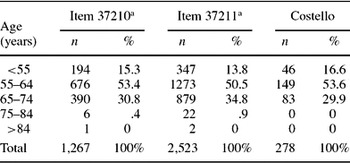
Table 1 gives a comparison of the age groupings in the patient population by Costello et al. (Reference Costello, Haxhimolla and Crowe2) (including those carried out since the published paper) and those taken from the two existing MBS Item Numbers used for open radical prostatectomy. As can be seen in this table, the populations are not significantly different. This finding is important, because there is a direct link between age and length of stay.
Comparison of Age Distribution of Patients: Costello versus Medicare Benefits Schedule

a Source: 2004–05 Australian Government Medicare Australia Statistics. http://www.medicareaustralia.gov.au/statistics/dyn mbs/forms/mbs_tab4.shtml Accessed 16 June 2006.
The cost savings generated by the reduction in length of stay taking into account the intensity of care for the bed days is $4,706.08 for open surgery compared with $1,636.91 for LRARP, a total of $3,069.17. This total is made up of ward costs per episode showing a reduction in nursing and physiotherapy costs ($969.79 to $146.16, respectively) as well as a reduction in disposables and consumables ($317.49 to $208.70, respectively). Additionally, there is a substantial decrease in capital and overhead costs from $3,418.80 for open (based on 8 days) to $1,282.05 for LRARP (based on 3 days).
Summary of Incremental Costs
By adding together the incremental costs of the fixed capital ($1,501.38), the maintenance contract ($809.14), consumables and disposables ($3,023.00) and subtracting the cost saving of the reduction in the length of stay (−$3,069.17), we get a total incremental cost of $2,264.35 for LRARP.
Calculating the Incremental Benefits (Utility) of LRARP over Open Radical Prostatectomy
Having used real Australian cost data to estimate the incremental cost of using LRARP, it is necessary to examine the other side of the equation, the incremental utility gained as a result of the expenditure of this additional $2,264.35. In doing this, there is not only a requirement for data but also for a conversion of these data into utility measured in dollars. The most accepted method is to use quality-adjusted life-years (QALYs). Simply put, a QALY is a year of life in “perfect” health and scores 1 on a visual analogue scale (a scale of 0 to 1).
In a study on evidence from pharmaceutical reimbursement in Australia (1991 to 1996) George et al. (Reference George, Harris and Mitchell6) put the acceptable value of a QALY between $42,000 and $76,000 for the listing of a pharmaceutical on the Pharmaceutical Benefits Schedule (PBS). Because no equivalent study is available for surgical procedures, an assumption is made that these figures would also be acceptable for the listing of new surgical procedures on the MBS.
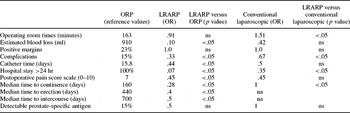
Data were sourced from the November 2005 published study of Menon et al. (Reference Menon, Shrivastava and Tewari9), who prospectively collected baseline demographic data on all patients undergoing surgery for prostate cancer over a 4-year period at the Vattikuti Urology Institute, Henry Ford Health System, Michigan, United States. In this study, a total of 100 men underwent open radical prostatectomy, 50 men had conventional laparoscopic radical prostatectomy, and 500 men had robotic radical prostatectomy. Table 2 is taken from page 103 of this study and gives the odds ratios for the key outcomes.
Odds Ratios for Key Outcomes

ORP, open radical prostatectomy; LRARP, laparoscopic remotely assisted radical prostatectomy; OR, odds ratio; na, not available; ns, not significant. Source: Menon et al. (9).
According to this table, the median time to continence following an open radical prostatectomy is 160 days compared with 45 days (.28 of that time) for LRARP. Similarly, the median time to erection is 440 days compared with 176 days.
In contemplating this surgical procedure, apart from the patient's two predominant concerns, safety of the procedure and its ability to rectify the medical problem, there are also concerns about: (i) the probability and/or duration of incontinence, (ii) the probability and/or duration of erectile dysfunction, and (iii) the time off work.
According to Powell (Reference Powell13), “although not all men who undergo radical prostatectomy will experience urinary incontinence, those who do find that it influences their daily lives, affecting the clothes they wear, their activities, sleep patterns, social relationships, and self-esteem.” In a study by Meyer et al. (Reference Meyer, Gillatt and Lockyer11), erectile dysfunction after radical prostatectomy is quoted as having a “profound effect on Quality of Life.”
Incontinence and Erectile Dysfunction
Based on the data from the study by Menon et al. (Reference Menon, Shrivastava and Tewari9) (Table 2) and the incremental cost of LRARP over open surgery of $2,264.35, the cost for a full 12 months of not being incontinence is $7,169.45 and $3,134.05 for not having erectile dysfunction (Table 3). This calculation assumes that the patient experienced either a reduction in months of incontinence or erectile dysfunction, ignoring those that suffer from both.
Incremental Annual Cost

A very crude method of combining the two would be to allocate a weighting of 1.5 months for every month of incontinence and erectile dysfunction combined and a weighting of 1.0 month for every month of erectile dysfunction alone (because erectile dysfunction lasts longer than incontinence). A full 12 months of living with either incontinence or erectile dysfunction results in a .1 reduction in a QALY. As shown in Table 4, the incremental cost of LRARP calculates out $2,445.74 below even the lower precedent set by the PBAC ($4,200 and $7,600). A quick sensitivity check by reducing the 1.5 and 1.0 weightings down to 1.0 and .75, respectively, calculates out as $3,518.58.
Incremental Annual Cost and Cost per Quality Adjusted Life Year (QALY)

Return to Work
In addition to the decreased duration of incontinence and erectile dysfunction, preliminary data from Epworth indicated that, on average, return to work is 2 weeks earlier. The ages of the 278 Epworth patients ranged from 46 to 74 years, with 195 patients (70 percent) being younger than 65 years old, that is, under the traditional retirement age (Table 1).
According to data from the Australian Bureau of Statistics, Employee Earnings and Hours, the average weekly total earnings for a full time employed male was $997 (August 2004). The participation rate was 72.2 percent. This finding gives an average of $719.83 or $1,439.67 for the 2 weeks of earnings lost.
In valuing the benefits of medical procedures, the impact on the return to work tends to be ignored by the MSAC. However, if the MSAC was presented with the choice between two procedures with identical costs and the only difference being that one procedure required an additional 2 weeks before the patient was fit to return to employment, it would be rational for the MSAC to favor the procedure that reduced the time away from employment.
RESULT OF THE COST-UTILITY EVALUATION
Based on the incremental cost of $2,264.35 for LRARP compared with the open surgery alternative, the cost per QALY is $24,457.43, well below the range accepted by the PBAC of $42,000 and $76,000. Thus, the choice of LRARP over the open procedure alternative is based on rational economics. This figure does not take into account additional benefits such as reduced time away from employment, reduced blood loss, reduced possibility of infection, and reduced scarring.
DISCUSSION
Based on the evidence presented here, it would seem that LRARP is a good example of a new surgical procedure that has positive advantages to the patient reflected by a cost per QALY of $24,457. However, it should be remembered that the financial data used in this analysis were married with clinical data from sources outside Australia. Indeed, the financial data were only available because the surgeons carried out the new procedure using the MBS Item Number for the open procedure. Additionally, the very simplicity of this cost-utility analysis may make some statisticians and epidemiologists feel uncomfortable. There are no “p values” or “confidence intervals” calculated and very little sensitivity analysis performed. Assumptions have been kept to a minimum.
With regard to the data used for the utility, the study by Menon et al. (Reference Menon, Shrivastava and Tewari9) was based on the experience of possibly the most experienced center for robotic surgery in the world and, at the very least, avoids the common problem of comparing new technology in inexperienced hands with old technology in very experienced hands. This study also shows that, with some experience, important variables such as theater time and positive margins are not statistically different between the open surgery method and LRARP (Table 2).
CONCLUSION
To assess the value of the introduction and using new technology in Australia, while awaiting the collection of “solid” Australian clinical evidence, it may be necessary to do a crude up-front evaluation of the probable incremental costs and utilities based on available international data. If the evidence is sufficient to show, on balance, that the new procedure is at least no worse than the existing procedure (in terms of safety and effectiveness), funding could be approved, making it possible for clinical and economic data to be collected for a period of time sufficient to validate the accuracy of the crude up-front evaluation.
POLICY IMPLICATIONS
Robotic surgery techniques, such as remotely assisted radical prostatectomy, appear to be a safe and effective progression from conventional laparoscopic surgery and have the potential to be used for a wide variety of procedures. The introduction of this high-cost health technology creates a challenge for agencies such as the MSAC to develop an efficient process to evaluate the cost-effectiveness of each new procedure. Consideration should also be given to the need for a more consistent approach between the MSAC and other agencies such as the National Institute for Health and Clinical Excellence (NICE) and the Ontario Health Technology Advisory Committee (OHTAC) in evaluating new health technology.
CONTACT INFORMATION
Sue P. O'Malley, MEc (med.intel@bigpond.com), DBA Candidate, Macquarie Graduate School of Management (MGSM), 99 Talavera Road, Macquarie Park, North Ryde, Sydney, New South Wales 2109, Australia; Medical Economist, Medical Intelligence, 13 Cudgee Street, Turramurra, Sydney, New South Wales 2074, Australia
Ernest Jordan, PhD (Ernest.Jordan@mgsm.edu.au), Professor of Management, Macquarie Graduate School of Management (MGSM), 99 Talavera Road, Macquarie Park, North Ryde, Sydney, New South Wales 2109, Australia