Introduction
Several high courts throughout the world have experienced an increase in the rate of dissent over time. In the first half of the 20th century, the US Supreme Court experienced a “mysterious demise of consensual norms” when the rate of dissent increased from 10% to 60% (Walker, Epstein, and Dixon Reference Walker, Epstein and Dixon1988). Scholars have debated whether this is best explained by changes in court leadership and the composition of justices or by increased judicial discretion and changes in agenda (Walker et al. Reference Walker, Epstein and Dixon1988; Corley, Steigerwalt, and Ward Reference Corley, Steigerwalt and Ward2013; Hendershot et al. Reference Hendershot, Hurwitz, Noble Lanier and Pacelle2013).
Although the rise in dissent in the US Supreme Court was extraordinary, similar patterns of dissent have also been observed in other courts. In the Canadian Supreme Court, dissent rates have fluctuated between 10% and 40% as the Court has changed in terms of leadership, composition, and agenda (Ostberg, Wetstein, and Ducat Reference Ostberg, Wetstein and Ducat2004; Songer, Szmer, and Johnson Reference Songer, Szmer and Johnson2011). This has also been found in the High Court of Australia (Smyth Reference Smyth2003, Reference Smyth2004; Smyth and Paresh Reference Smyth and Kumar Paresh2004). In addition, studies have shown that the rate of dissent in the Taiwanese Constitutional Court fluctuated between 20% and 50% during the country’s transition to democracy (Garoupa Reference Garoupa2010b) and that dissent rates in the Chilean Constitutional Tribunal increased from 17% to 44% after reforms that led to a greater influence of partisan actors on the appointment process (Tiede Reference Tiede2016).Footnote 1
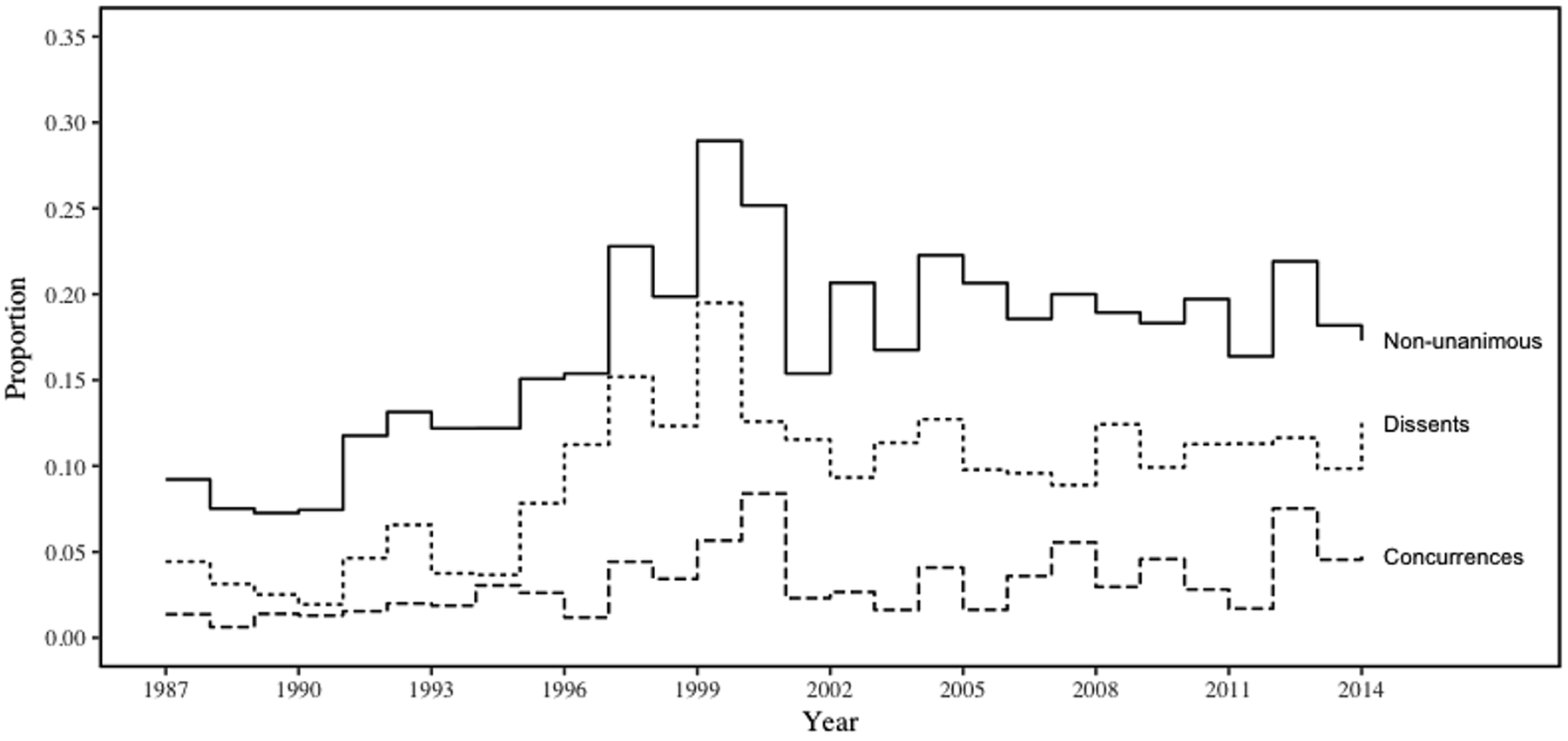
There have not been any studies of rising dissent rates in a European high court. Consequently, this article examines the rising rate of dissent in the relevant and testable European case of the Supreme Court of Norway. In the 1990s, the Court experienced a substantial increase in the rate of dissent from approximately 8% in 1990 to a record high of 29% in 1999. This occurred in a time when the Court experienced quite dramatic changes in court leadership, the composition of justices, discretionary power, and agenda. Overall, these developments bear much resemblance to several of those observed on other high courts experiencing rising levels of dissent, thus making the Norwegian case eminently comparable to the existing literature on the topic.
Using an original data set composed of 5,886 panel decisions by the Court from 1987 to 2014, I show that a change in leadership to the somewhat controversial chief justice Carsten Smith influenced the rise in dissent. However, the rise in dissent was mainly a result of institutional reforms and changes to the agenda during the Smith court, which laid the ground for the Court to pursue its “higher function” of working for the development of the law and the protection of individual rights. These findings should hold relevance for other European supreme courts that in the last 3 decades have become increasingly powerful and influential in the European legal and political systems.
Understanding the “mysterious demise of consensual norms”
Judicial scholars often note that the frequent occurrence of dissents might threaten a court’s collegiality and authority in relation to other political actors and the public (Corley et al. Reference Corley, Steigerwalt and Ward2013). Some argue that dissensual decisions might run a greater risk of implementation problems and of being overruled by the Supreme Court in the future (for an overview, see Hansford and Spriggs [Reference Hansford and Spriggs2006, 61] and Corley et al. [Reference Corley, Steigerwalt and Ward2013]). Others also argue that dissensual decisions can give the perception that the law is shaped by the justices’ personal preferences and that this in turn may challenge the public’s confidence in the judiciary by bringing into question the certainty of the law (see, e.g., Moorhead Reference Moorhead1952; Walker et al. Reference Walker, Epstein and Dixon1988; Wahlbeck, Spriggs, and Maltzman Reference Wahlbeck, Spriggs and Maltzman1999).
Other scholars have a more positive view of dissents. Some argue that dissents preserve the impartiality and independence of the individual judges and keep “the majority accountable for the rationale and consequences of its decision” (Brennan Reference Brennan1985, 430). Dissent may also be an important tool for courts to engage in a dialogue with national courts and political actors over how to best maintain and develop the law (Kelemen Reference Kelemen2013). Former chief justice of the US Supreme Court Charles Evan Hughes (Reference Hughes1936, 68) famously argued that dissents are “an appeal to the brooding spirit of the law, to the intelligence of a future day, when a later decision may possibly correct the error into which the dissenting judge believes the court to have been betrayed.” Understanding the occurrence of dissent is thus important because judges’ disagreements may have significant implications regarding the content and development of a country’s laws.
Broadly speaking, the extant literature on dissent rates in the United States and elsewhere has identified the following three main groups of hypotheses explaining fluctuations in historical rates of dissent: (1) the idiosyncrasies and leadership of the chief justice; (2) changes in the demographic and ideological composition of the court, including changes to the procedures for appointing justices; and (3) the development of stricter docket control followed by the treatment of more principled and contentious legal issues.Footnote 2 In the following sections, I discuss these three distinct groups of working hypotheses before I then gauge their independent effects on the varying rates of dissent in the Supreme Court of Norway.
The Leadership of the Chief Justice
Scholars often argue that dissent rates remained low in the US Supreme Court during most of the 19th and into the 20th century because the justices followed a norm reflecting a belief that unanimity would strengthen the Court’s legitimacy and authority (Walker et al. Reference Walker, Epstein and Dixon1988; Haynie Reference Haynie1992; Epstein, Segal, and Spaeth Reference Epstein, Segal and Spaeth2001). As Epstein et al. (Reference Epstein, Segal and Spaeth2001) showed in their examination of Chief Justice Waite’s (1874–88) docket books of the conference votes, justices commonly used to withhold their disagreements expressed at conference and instead joined the majority opinions. This norm of consensus was upheld until Chief Justice Hughes (1930–41) introduced a less rigid line toward dissents and, finally, until the dissent rate skyrocketed after Harlan Fisk Stone (1941–46) was elevated to chief justice (Walker et al. Reference Walker, Epstein and Dixon1988; Haynie Reference Haynie1992).
There is considerable disagreement over the specific influence Chief Justice Stone had on the declining consensual norms. One group of scholars argues that the level of conflict increased as a result of Stone’s inability to frame cases and to alleviate tensions among his colleagues (Danielski Reference Danielski, Goldman and Lamb1986; Walker et al. Reference Walker, Epstein and Dixon1988). Others posit that Stone deliberately changed the internal institutional dynamics of the Court and facilitated a more “academic” style of deliberation in which conference discussions were expanded, opinion writing and circulation delays became more common, and the justices seized the opportunity to reargue contentious cases (Corley et al. Reference Corley, Steigerwalt and Ward2013). Hendershot et al. (Reference Hendershot, Hurwitz, Noble Lanier and Pacelle2013) furthermore argue that the higher level of conflict was a result of Stone’s initiative in footnote 4 of United States v. Carolene Products (1938), where he argued that while the Court in economic regulation cases should follow judicial restraint, it should exercise greater judicial activism in civil rights and individual liberties cases to protect the interests of political minorities. This “preferred position” doctrine later became a dissent and eventually a majority opinion (Pacelle Reference Pacelle1991; Hendershot et al. Reference Hendershot, Hurwitz, Noble Lanier and Pacelle2013).
Above and beyond the influence of Stone, there is a consensus in the literature that the chief justice may influence the rate of dissents over time (see Cross and Lindquist Reference Cross and Lindquist2006). The chief justice possesses some unique institutional advantages, such as priority in vote order and opinion assignment, which she may utilize in order to set the agenda and establish the level of congenial work environment (Hendershot et al. Reference Hendershot, Hurwitz, Noble Lanier and Pacelle2013). Studies of dissent in the US Supreme Court have found that chiefs tend to use these advantages to promote different consensual norms over time and that the overall rate of dissent has tended to shift correspondingly (see, e.g., Caldeira and Zorn Reference Caldeira and Zorn1998).
Similar studies on changing dissent rates in the Supreme Court of Canada (Ostberg et al. Reference Ostberg, Wetstein and Ducat2004; Songer et al. Reference Songer, Szmer and Johnson2011) and in the High Court of Australia (see, e.g., Smyth Reference Smyth2003; Smyth and Paresh Reference Smyth and Kumar Paresh2004) find that leadership is important in explaining variations in dissent over time. Like many of the studies of the Stone court, however, higher dissent rates are usually attributed to the chiefs’ failing leadership and inability to alleviate tensions among the justices. For example, Ostberg et al. (Reference Ostberg, Wetstein and Ducat2004) argue that the higher rates of dissent in the Canadian Supreme Court under Chief Justice Joseph Antonio Charles Lamer (1990–2000) can in part be explained by Lamer’s inability to alleviate tensions among the justices. The same has been argued for Chief Justices Adrian Knox (1919–30) and John Greig Latham (1935–52) in the Australian High Court, who both were unsuccessful in building consensus despite their efforts to do so (Smyth and Paresh Reference Smyth and Kumar Paresh2004; Smyth Reference Smyth2005).
The Demographic and Political Composition of Collegial Courts
The literature on declining consensual norms in the US Supreme Court often emphasizes that although the rising levels of conflict could partly be attributed to Chief Justice Stone, they should also be attributed to the personalities of the associate justices appointed by President Roosevelt (Danielski Reference Danielski, Goldman and Lamb1986). In particular, the appointment of young, inexperienced, and likely dissent-prone justices during the “Roosevelt court” is believed to have created an atmosphere that encouraged dissent (Walker et al. Reference Walker, Epstein and Dixon1988; Corley et al. Reference Corley, Steigerwalt and Ward2013; Hendershot et al. Reference Hendershot, Hurwitz, Noble Lanier and Pacelle2013).Footnote 3 Another important characteristic of the Roosevelt court was the high representation of former legal academics (Pritchett Reference Pritchett1948/2014). Including Chief Justice Stone, these ivory-tower justices played a role in altering the internal practices in a way that “undermined consensus and entrenched dissensus as successor justices joined their ranks” (Corley et al. Reference Corley, Steigerwalt and Ward2013, 29).
Empirical studies of courts and judges, particularly in North America, often emphasize individual judges’ political preferences as an explanation for judicial dissent. Both the most vocal advocates of the attitudinal model (see, e.g., Segal and Cover Reference Segal and Cover1989; Segal and Spaeth Reference Segal and Spaeth2002) as well as scholars usually associated with strategic or integrated approaches to judicial decision making (see, e.g., Epstein and Knight Reference Epstein and Knight1998; Wahlbeck et al. Reference Wahlbeck, Spriggs and Maltzman1999; Hettinger, Lindquist, and Martinek Reference Hettinger, Lindquist and Martinek2006) have provided support for the assertion that dissent is a function of ideological disagreement. This is also the case for European courts. Recent studies have shown that when justices dissent in the Spanish and Portuguese constitutional courts (Amaral-Garcia, Garoupa, and Grembi Reference Amaral-Garcia, Garoupa and Grembi2009; Hanretty Reference Hanretty2012) and in the German Federal Constitutional Court (Hönnige Reference Hönnige2009), they are influenced by policy preferences similar to their American counterparts.
The influence of ideology in explaining the decline in consensual norms has been less prominent. However, in their analysis of justice-level dissent rates over time, Hendershot et al. (Reference Hendershot, Hurwitz, Noble Lanier and Pacelle2013) show that ideological dispersion among the justices was a significant source of growing dissent. They argue that the alternating presidential appointments of Democratic and Republican justices over time might have helped maintain the historically high levels of dissent following the Roosevelt court. Similar studies of the Supreme Court of Canada also argue that the “greater ideological extremity” on the Lamer court might explain the higher levels of dissent (Songer et al. Reference Songer, Szmer and Johnson2011). The same has been argued for the Knox court and Latham court in Australia (Smyth and Paresh Reference Smyth and Kumar Paresh2004; Smyth Reference Smyth2005). Smyth (Reference Smyth2005) also finds that conservative and liberal appointees tend to dissent more in years when opposition governments are in office.
More broadly, the nature of the political appointments of a court’s members may explain levels of dissent. For example, studies of dissent in state courts in the United States show that elected judges dissent more than their appointed counterparts in order to maintain allegiance to their electorate and to secure reelection (see, e.g., Brace and Hall Reference Brace and Gann Hall1993; Choi, Gulati, and Posner Reference Choi, Gulati and Posner2010). In a study of the Chilean Constitutional Tribunal, Tiede (Reference Tiede2016) shows that overall levels of dissent increased considerably after reforms that led to a greater influence of partisan actors on the appointment process; Tiede also finds that judges who have identifiable partisan associations of any kind are more likely to dissent. A similar pattern has also been found with regard to higher rates of dissent for justices with strong partisan associations in the Spanish Constitutional Court (Garoupa, Gomez-Pomar, and Grembi Reference Garoupa, Gomez-Pomar and Grembi2011).
Increased Docket Control and the Treatment of More Contentious Cases
Changes to the institutional framework may also explain levels of dissent. In the United States, the Judiciary Act of 1925—popularly termed the Judges’ Bill—may have created the most conducive environment toward an increased level of dissent. The bill converted much of the US Supreme Court’s mandatory jurisdiction into discretionary jurisdiction and thus laid the groundwork for the Court to become a powerful institution of American governance (Crowe Reference Crowe2007). Halpern and Vines (Reference Halpern and Vines1977) argue that it was the Court’s greater authority to control its own docket that in turn catalyzed the subsequent rise in levels of dissent. The rationale behind this explanation is that dissent rates remained low in the 19th and early part of the 20th century because the Court was weighed down by a docket composed mostly of cases involving relatively trivial legal matters. After the Judges’ Bill, however, the justices had greater time and opportunity to select and decide more salient cases (Halpern and Vines Reference Halpern and Vines1977; Epstein et al. Reference Epstein, Segal and Spaeth2001; Corley et al. Reference Corley, Steigerwalt and Ward2013).
More generally, we can expect more dissents when courts hear more complex and principled cases (Ulmer Reference Ulmer, Goldman and Lamb1986). In examining the causes for unanimity on the US Supreme Court, Corley et al. (Reference Corley, Steigerwalt and Ward2013) find that salient cases are less likely to result in a unanimous decision. Furthermore, civil rights and liberties cases also tend to be more divisive because of their explicit political dimensions (see, e.g., Songer et al. Reference Songer, Szmer and Johnson2011; Epstein, Landes, and Posner Reference Epstein, Landes and Posner2013). In their analysis of the decline in consensual norms in the US Supreme Court, Hendershot et al. (Reference Hendershot, Hurwitz, Noble Lanier and Pacelle2013) find that the increased attention on civil liberties issues, and the corresponding decline in economic and institutional power cases, contributed to rising levels of dissents on the US Supreme Court. The same has been found in the Supreme Court of Canada, where the increasing number of cases concerning the Canadian Charter of Rights and Freedoms (1982) has generated more conflict among the justices (Ostberg and Wetstein Reference Ostberg and Wetstein2007, 116).
A European case of a “mysterious demise of consensual norms”
More comparative studies of judicial behavior may offer new lessons on factors influencing judicial dissent in high courts over broad time periods. One particularly germane comparative case is found in the European High North. Norway is labeled a “consensual democracy” distinguished by “inclusiveness, bargaining, and compromise” where political actors, “instead of being satisfied with narrow decision-making majorities, … seek to maximize the size of these majorities” (Lijphart Reference Lijphart1999, 2). These characteristics also describe the Supreme Court of Norway, whose overall style of decision making has been portrayed as deliberative and consensus seeking (Sunde Reference Sunde2015).
However, following the institutional prerequisites for the attitudinal model (Segal and Spaeth Reference Segal and Spaeth2002), several features of the Supreme Court of Norway may create an environment conducive to individualistic behavior. Situated at the apex of the Norwegian legal system, today the Supreme Court is a prominent national policy maker with an official mandate to develop the law (Grendstad, Shaffer, and Waltenburg Reference Grendstad, Shaffer and Waltenburg2015; Sunde Reference Sunde2015). Like their US counterparts, the justices are unelected and sit on the bench on terms of good behavior. Since they do not face electoral sanctions, they are free within the boundaries of the cases they decide to consistently behave in accordance with their individual policy preferences (Segal and Spaeth Reference Segal and Spaeth2002).
The Supreme Court has general jurisdiction and has by custom established the right to perform judicial review of legislation and administrative decisions (Sunde Reference Sunde2011; Grendstad et al. Reference Grendstad, Shaffer and Waltenburg2015, 35–36). In fact, Norway was the first country after the United States to develop judicial review in the 1800s (Holmøyvik Reference Holmøyvik2007), although this was first codified and included under section 89 of the constitution in 2015. In addition, as a part of the Scandinavian legal culture, the Court mixes the civil law legal system’s reliance on parliamentary laws and statutes with the common law legal system’s reliance on precedents (Skiple et al. Reference Skiple, Grendstad, Shaffer and Waltenburg2016). Thus, the Norwegian justices have the possibility to take a more active role in the making of law and policy than most of their civil law counterparts (Skiple et al. Reference Skiple, Grendstad, Shaffer and Waltenburg2016).
Historically, the Supreme Court has been quite skeptical toward American-style constitutionalism, rights talk, and judicial activism (Wiklund Reference Wiklund, Keller and Stone Sweet2008; Hirschl Reference Hirschl2011). The high legitimacy of the welfare state in the post–World War II era has tended to limit judicial discretion to the unfolding of the will of the political democracy (Follesdal and Wind Reference Follesdal and Wind2009; Hirschl Reference Hirschl2011). Since the 1970s, however, the Court has taken on a more active constitutional role compared to its Scandinavian counterparts. The emerging pan-European rights regime enforced by the European Court of Human Rights (ECtHR) has increasingly affected constitutional rights jurisprudence in Norway (Hirschl Reference Hirschl2011), also leading to a more active scrutiny and review by the Court (Wiklund Reference Wiklund, Keller and Stone Sweet2008; Bårdsen Reference Bårdsen2014; Kinander Reference Kinander2016).
The Supreme Court is a multimember appellate court composed of 19 associate justices and a chief justice. At the Court, the 20 justices are divided randomly into two rotating and parallel five-justice panels. In rare cases of “special importance,” the justices convene to a Grand Chamber composed of 11 justices. In “extraordinary cases,” the justices assemble in a plenary session composed of 19 justices.Footnote 4 The fact that the Court usually meets in five-justice panels may help explain why the rate of dissent is lower than for its US counterpart, in which nine justices decide all cases. As Epstein et al. (Reference Epstein, Landes and Posner2013, 267) demonstrate in their analysis of dissent in the US courts, “the likelihood of disagreement grows with the size of the panel.” This observation also applies to the Supreme Court of Norway, in which plenary and Grand Chamber decisions produce more dissents (Grendstad et al. Reference Grendstad, Shaffer and Waltenburg2015, 177).
All cases before the Supreme Court are argued orally. Following oral arguments, the justices withdraw to conference to deliberate the case. First, the most senior justice, or the chief justice if she is present, chairs the deliberation and is the first to provide an outline and propose a solution to the case (Sunde Reference Sunde2011; Skiple et al. Reference Skiple, Grendstad, Shaffer and Waltenburg2016). Then, in descending order of seniority, each justice presents his or her views on the case. Opinion writing is organized so that all justices take turns on an equal basis. In case of dissent or concurrences, the chair may reassign opinion writing depending on how the justices form majority or minority factions (Sunde Reference Sunde2011). Unlike the US Supreme Court, the chief votes last in conference and will write an opinion only if she dissents alone.
The Development of Dissenting and Concurring Opinions
In contrast to its US counterpart, the level of dissent is lower in the Supreme Court of Norway and more similar to common-law countries like the United Kingdom and Canada (Songer et al. Reference Songer, Szmer and Johnson2011; Hanretty Reference Hanretty2013). However, the variations in dissent during the last 3 decades have been quite large.
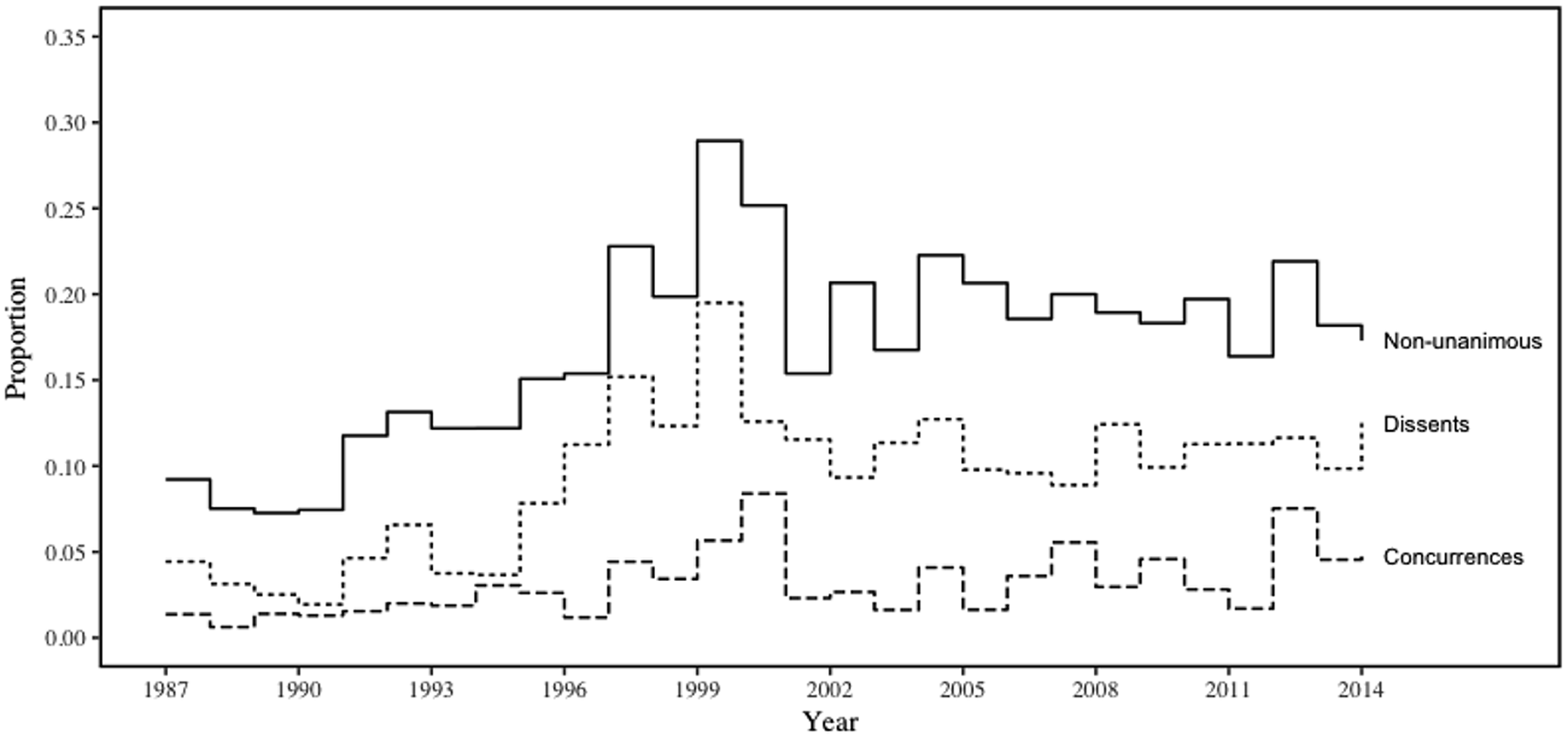
Figure 1 shows the levels of nonunanimous decisions by the Supreme Court of Norway from 1987 to 2014, also separated between dissents and concurrences. Looking at the overall levels of nonunanimity, we can see that the annual proportion of nonunanimous decisions was well below 10% in the late 1980s. Then, in the 1990s, the level of nonunanimous decisions increased to a record high of 29% in 1999 before plateauing at 20% in the early 21st century.
Annual proportion of nonunanimous decisions, decisions with one or more dissents, and decisions with one or more concurrences made by the Supreme Court of Norway, 1987–2014. Source: The Norwegian Supreme Court Database (Grendstad, Shaffer, and Waltenburg Reference Grendstad, Shaffer and Waltenburg2017).
This rapid increase in nonunanimity occurred at a time when the Supreme Court became a more active developer of the law (Sunde Reference Sunde2015). In this decade of transformation, the Norwegian Supreme Court experienced three particular developments that bear much resemblance to those that have taken place on high courts around the world experiencing rising levels of dissent: (1) there was a change in leadership to the incoming and somewhat controversial chief justice Carsten Smith; (2) the overall composition of the bench changed in regard to the justices’ backgrounds, work experience, and nature of appointments; and (3) the Supreme Court underwent a reform that significantly increased the Court’s control over its case docket. In the following sections, I discuss each of these developments and the possible impact they may have had on higher levels of dissent throughout the 1990s and early 21st century.
The Leadership of Chief Justice Carsten Smith
In Carsten Smith’s first year as chief justice in 1991, the proportion of nonunanimous decisions increased by 4.4 percentage points from the year before (from 7.4% to 11.8%), and in the following 8 years the rate of dissent continued to increase until reaching 29% in 1999. Sunde (Reference Sunde2015, 347) observes that a shift in norms took place following Smith’s appointment: “Overnight one went from a regime where dissents were viewed as a necessary evil, to being almost a blessing.”
Smith was the first chief justice in over 100 years to be appointed directly from a university position. He had long been known for advocating the view, to the considerable concern of his fellow lawyers and justices, that the Supreme Court is a political institution and that there should be greater recognition of the fact that the Court has a political function (Smith Reference Smith1975; Grendstad et al. Reference Grendstad, Shaffer and Waltenburg2015, 70). In his academic work, Smith was influenced by American legal realism and argued that the Norwegian Supreme Court to a greater extent should mirror its US counterpart. In particular, he argued that the main task of the Court should be to not only apply the law in specific cases but develop the law and draw up guidelines for the future. Smith was also an explicit proponent of the “preferred position doctrine” initiated by Chief Justice Stone and wanted it to become part of Norwegian constitutional practice (Smith Reference Smith1975).
Smith also had a more positive view of dissents than his predecessors. He argued that dissents play an important role in the writing of clear and rich decisions with a goal to clarify and develop the law and that, since dissents demonstrate that decisions are made from a choice between different values, they are important for keeping alive debates about central legal issues (Smith Reference Smith1975). These views on legal development and dissents were quite controversial in the legal community. When Smith first presented his views in a speech at an annual meeting of Norwegian judges in 1974, he received a lukewarm, if not hostile, response from the audience (Sunde Reference Sunde2015, 40). And although his appointment as chief justice occurred more than 15 years later, he was still met with similar skepticism from several of his colleagues when he arrived at the Court (41, 317).
However, Smith still received support to carry out his program to transform the Court. Under his leadership, the Court went through a reform that significantly increased the justices’ discretion over case selection (the specific influence of this reform will be discussed in a later section). Internally, the Court developed a more informal and “academic” atmosphere. The justices began to address each other by first name during conference. They organized meetings for all 20 justices more frequently, which to a greater extent than before were meant to be an arena for discussion on the internal workings of the Court. Smith also made sure that the justices had more time to write the opinions and that drafts more often were circulated among the justices on the panel, giving them more time and opportunity to meet and discuss opinions—and to contemplate dissents (Sunde Reference Sunde2015, 191).
Sociodemographic and Political Diversity
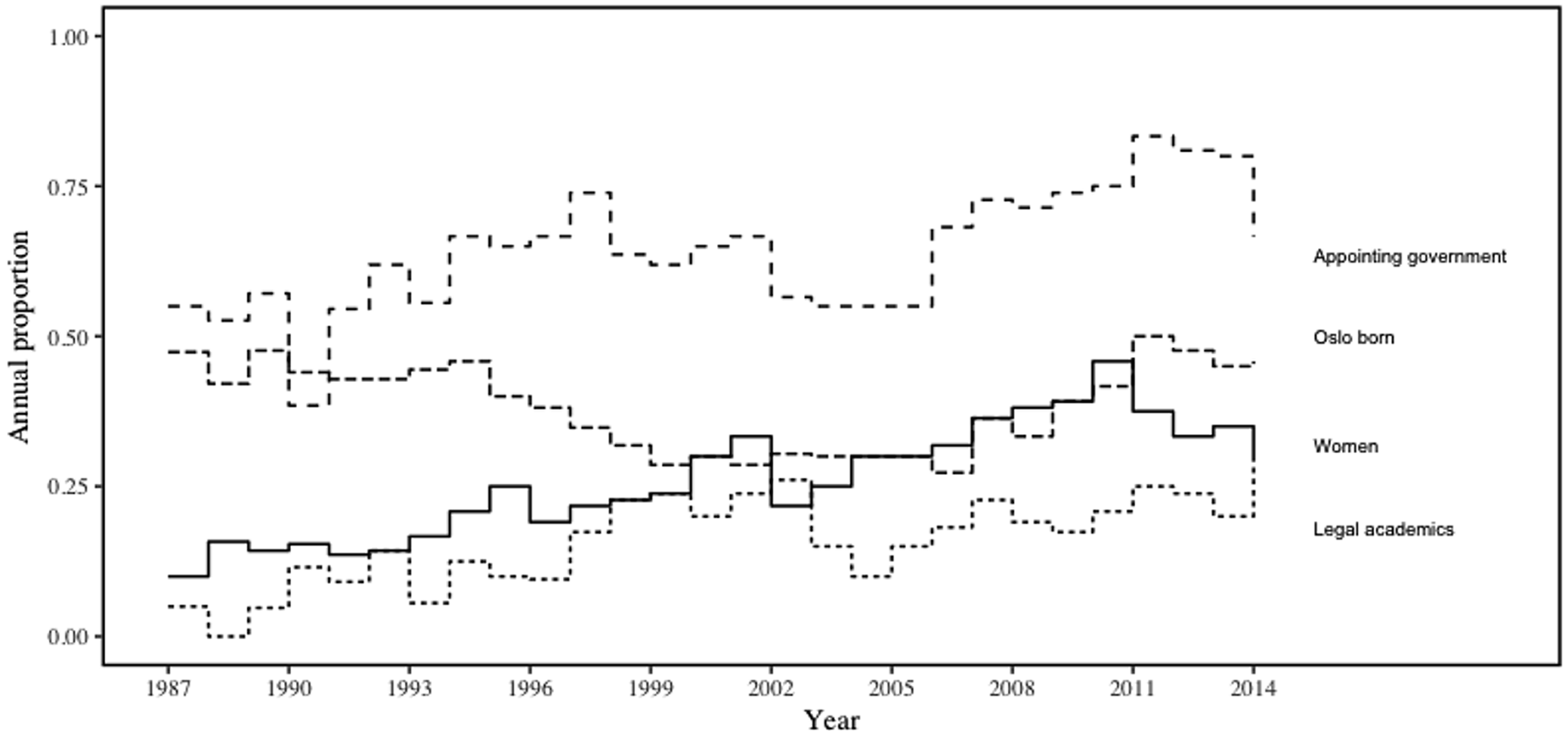
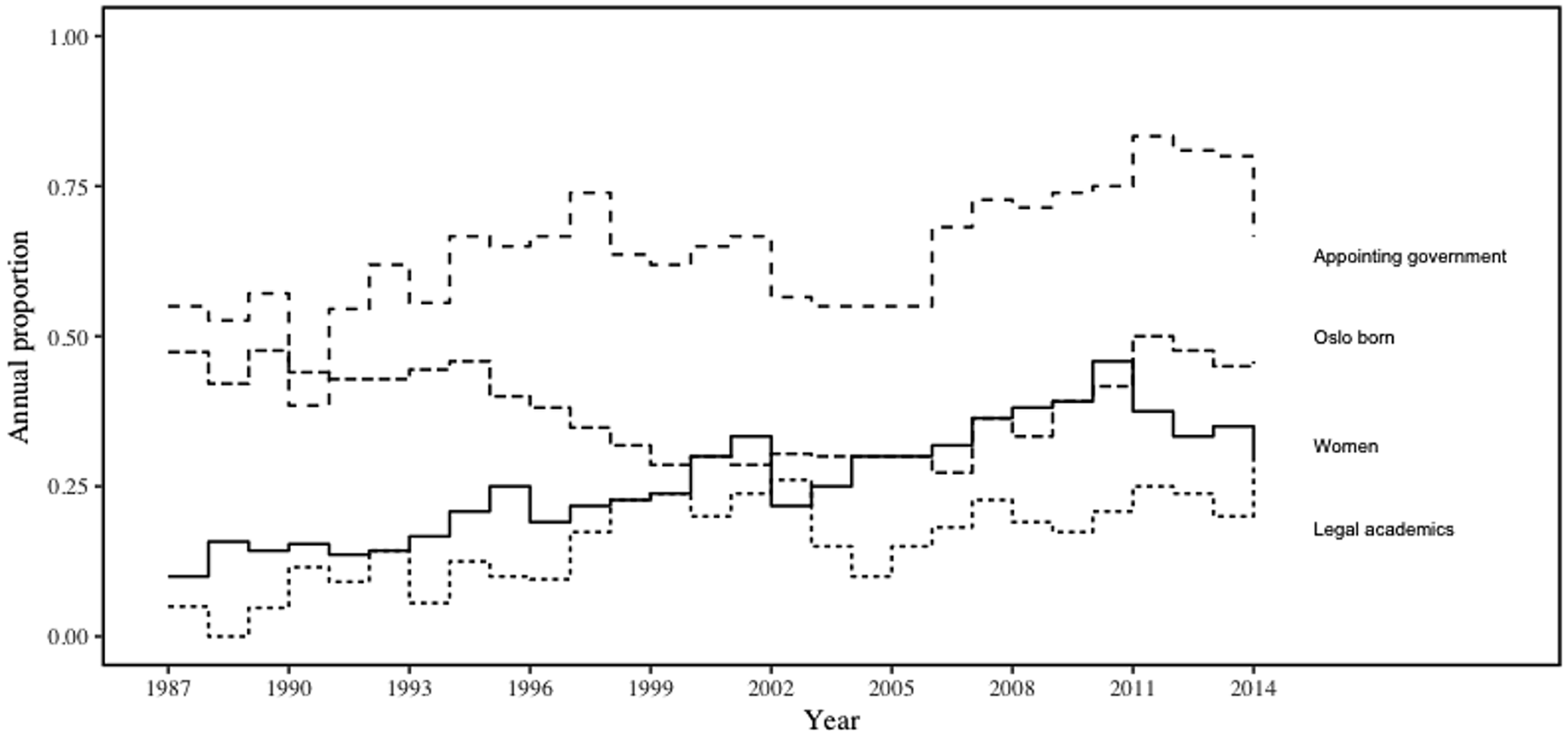
Since the early 1990s, it has been a stated interest from government officials and members of the Supreme Court to recruit fewer justices from government offices or lower courts and to increase the diversity among the 20 justices with regard to the breadth of their backgrounds and experiences. Consequently, in the 1990s and early 21st century, the diversity of the justices increased (Shaffer, Grendstad, and Waltenburg Reference Shaffer, Grendstad and Waltenburg2015). When the rate of dissent was at its highest in the late 1990s, the Court had never before been as diverse in regard to female justices, justices born outside the capital of Oslo, and justices hailing from academia (see fig. 2).
Annual proportion of social democratic appointees, women, legal academics, and justices born in the capital of Oslo on the Supreme Court of Norway, 1987–2014. Source: The Norwegian Supreme Court Database (Grendstad, Shaffer, and Waltenburg Reference Grendstad, Shaffer and Waltenburg2017).
The greater number of legal academics may have had a particularly strong influence on the rise in dissents. Analyzing US courts of appeals, George (Reference George2001) argues that legal academics more than others may value dissent because they are more likely to take an individualistic look at a case, they come from jobs in which opinion writing is a central task and therefore are able to write more opinions with less effort, they are teachers of law and may view opinions as a forum for instructing others as to the meaning of law, and they may more frequently seek to communicate dissents to broader audiences to retain recognition for their scholarship. Another explanation offered by George (Reference George2001) is that legal academics more often use dissents to argue original positions or force the law in new directions. This may also apply to the Supreme Court of Norway, on which several legal academics have been identified as “judicial activists,” often voting to overrule national legislation and looking to international laws and precedents in order to further consolidate Norway’s commitment to human rights (e.g., Kinander Reference Kinander2016; Robberstad Reference Robberstad2016).
The picture is not equally clear when it comes to justices’ policy preferences. The rate of dissent has tended to be higher in periods in which there have been a higher number of social democratic appointees as opposed to non–social democratic (conservative) appointees on the Court. When the rate of dissent was on the rise in the 1990s, the proportion of justices appointed from a social democratic government also rose from 40% to 70% (Grendstad et al. Reference Grendstad, Shaffer and Waltenburg2015, 79). This observation may suggest that the increase of dissent in the 1990s is not necessarily a consequence of increasing political differences. However, while the Norwegian Labor Party had controlled the executive branch almost without interruption from 1945 to 1981, governments alternated more frequently between minority Labor governments and conservative-led center-right governments from 1981 to 1997 (Hirschl Reference Hirschl2011). Accordingly, given that there are generally a quite high number of both social democratic and conservative appointees on the Court, and that conservatively appointed justices in most terms have been in the minority, there is a possibility that the emergence of a more competitive political landscape has also had an influence on the increasing level of conflict on the Supreme Court.
There has also been an important change to the appointment procedure to the Court. Historically, appointments to the Supreme Court of Norway were handled entirely by the Ministry of Justice. But since 2002 an independent Judicial Appointments Board has made recommendations to the minister of justice, who in turn forwards the name of the successful candidate for formal appointment by the king in council (Grendstad et al. Reference Grendstad, Shaffer and Waltenburg2015, 77). Consequently, the selection of justices to the Supreme Court is today far less susceptible to political maneuvering. This change in appointment procedures may help explain why the rising levels of dissent plateaued in the 2000s; provided that nonpartisan justices should be less concerned with exposing ideology through dissents, they might instead be more concerned about the collegiality or legitimacy of the Court, which could be enhanced by means of unanimity (see, e.g., Tiede Reference Tiede2016).
Greater Docket Control and Agenda Transformation
In 1995, the Norwegian Parliament implemented a discretionary reform of the criminal appeals procedures similar to those introduced by the US Judges’ Bill of 1925. In short, the reform replaced a mandatory docket of criminal cases with a discretionary docket in which the Court secured nearly complete control over its caseload. This had two intended consequences. First, by removing a vast amount of mostly trivial criminal cases from the Court’s docket, the reform substantially reduced what had been described as an “almost unbearable workload” (Matningsdal Reference Matningsdal2006, 433). Second, although the plans to reform the docket were set in motion before Smith became chief justice (Sunde Reference Sunde2015, 269), it was a key component of Smith’s goal that the Court should focus on “greater discussion of principles rather than, in Smith’s own words, wasting the energies of bright legal minds on the technical minutia of criminal appeals on a case-by-case basis” (Grendstad et al. Reference Grendstad, Shaffer and Waltenburg2015, 70).
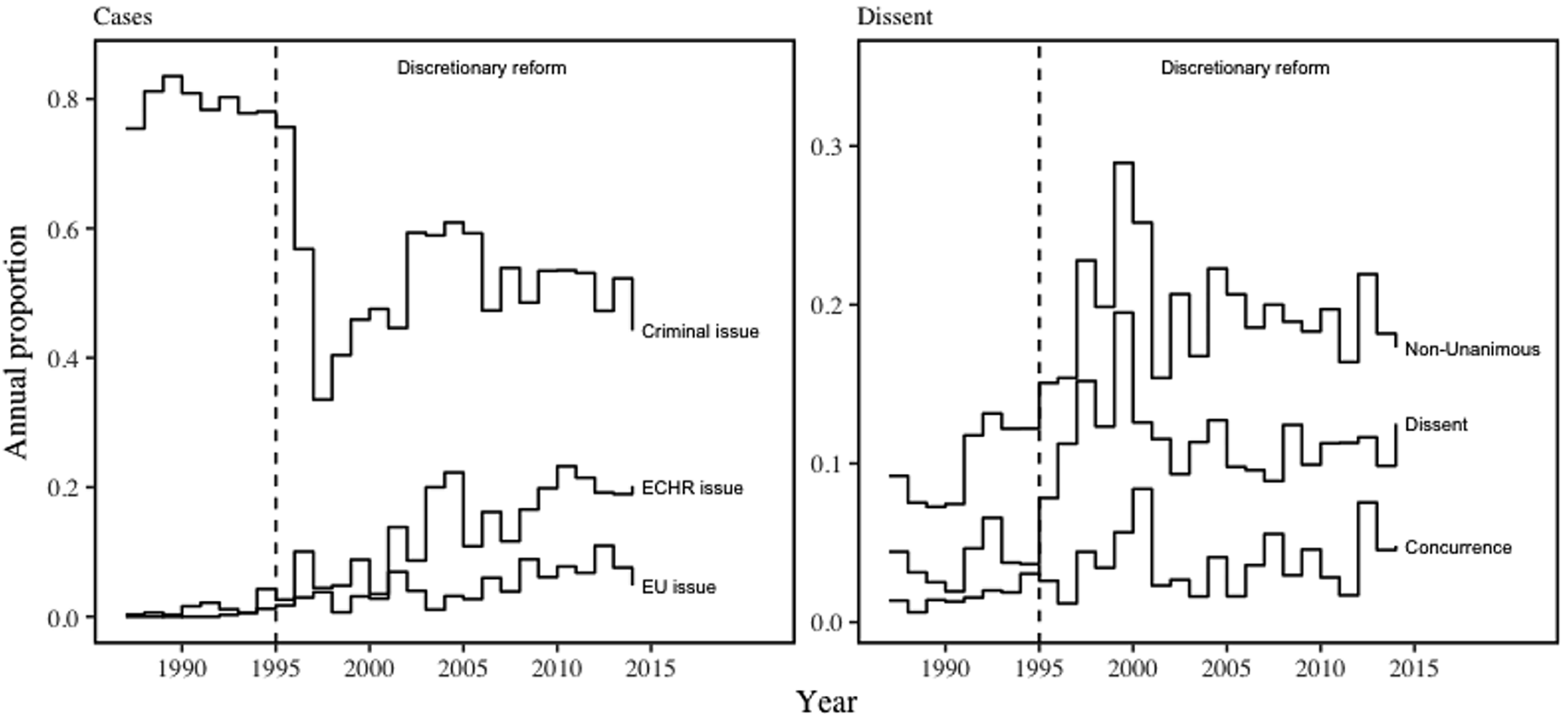
There is a close relationship between the annual number of criminal cases and the level of dissents and concurrences over time. When the annual proportion of criminal cases was at its highest in the late 1980s (see fig. 3, left panel), the proportion of dissents and concurrences was correspondingly low (see fig. 3, right panel). Then, after the dramatic decrease in the proportion of criminal cases following the discretionary reform in 1995, the rate of dissents and concurrences increased sharply. These patterns indicate that when the mandatory criminal cases were kept away from the docket, and the justices themselves could select cases involving more complex and principled legal questions, a new dynamic and influence on the justice’s ability to reach agreement on the Court developed.
Annual proportion of cases involving criminal issues, ECHR issues, or EEA/EU issues (left), and the annual proportion of nonunanimous decisions, decisions with one or more dissenting opinions, and decisions with one or more concurring opinions (right) made by the Supreme Court of Norway, 1987–2014. The vertical dashed lines show the year of the discretionary reform. Source: The Norwegian Supreme Court Database (Grendstad, Shaffer, and Waltenburg Reference Grendstad, Shaffer and Waltenburg2017).
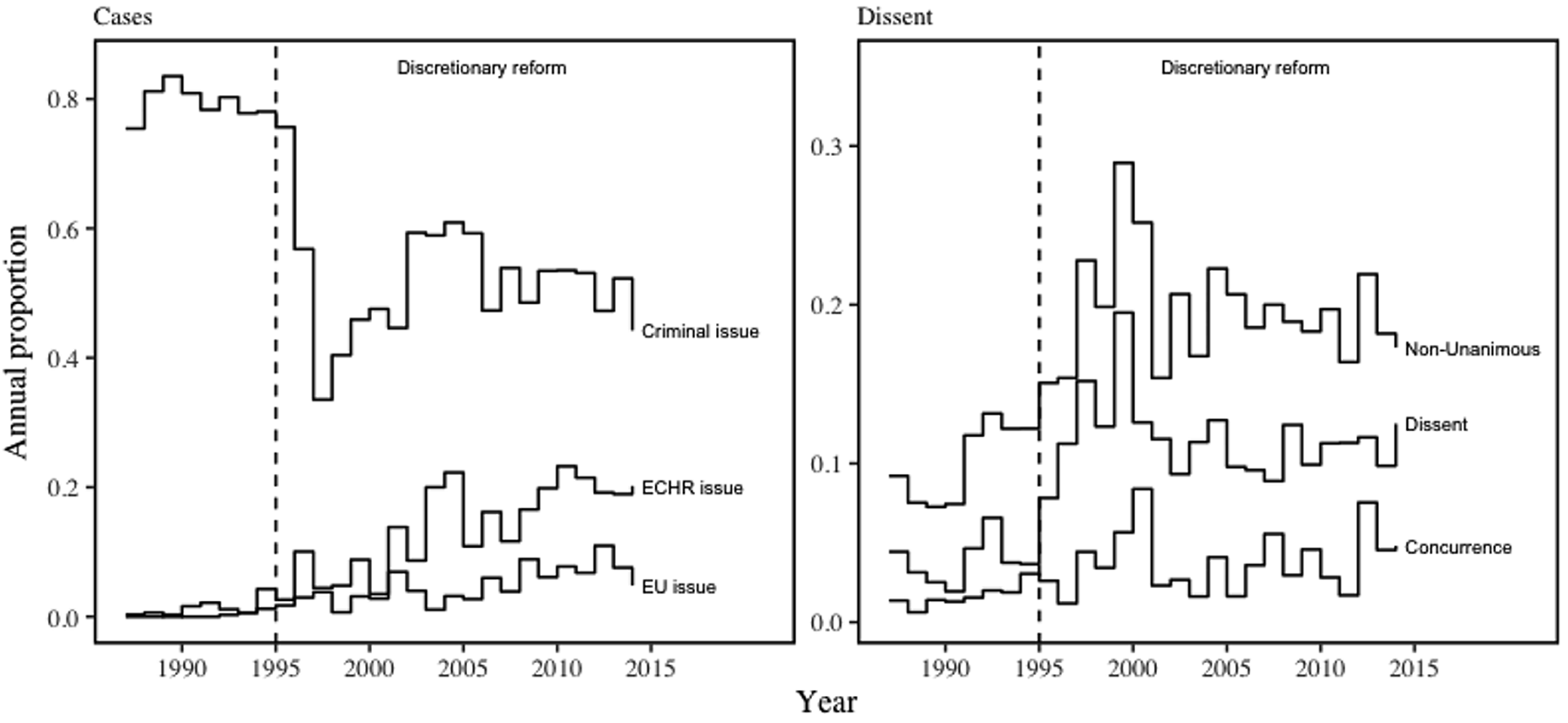
The reform also prepared the Court to deal with the increasing internationalization of Norwegian law (see fig. 3, left panel). It was implemented only a year after Norway became a member of the European Economic Area (EEA) in 1994 and just a few years before the Human Rights Act of 1999, which incorporated the European Convention on Human Rights (ECHR), the UN’s International Covenant on Civil and Political Rights, and the UN’s International Covenant on Economic, Social, and Cultural Rights. These new “Bills of Rights” were assumed to be integrated into Norwegian law and, if in conflict, take precedence over national and domestic legislation (Wiklund Reference Wiklund, Keller and Stone Sweet2008).
Because these bills have contained quite general and vague provisions, they have often raised justifiable doubt among the justices as to how they are to be understood and correctly applied (Wiklund Reference Wiklund, Keller and Stone Sweet2008; Bårdsen Reference Bårdsen2014). Moreover, according to Wiklund (Reference Wiklund, Keller and Stone Sweet2008, 217), the choice between hard-core judicial review of national legislation or a more intense treaty-conform interpretation is “likely to trigger the judges’ fundamental views on legal and political theory.” At the Court, it appears that these particular choices have led to a growing polarization between two groups of justices in which one group is more willing to use its judicial positions more actively to increase the power of the judicial branch in relation to other political actors, while the other group is more willing to defer to Parliament’s authority as a lawmaker (Kinander Reference Kinander2016; Robberstad Reference Robberstad2016).
Data and research design
Previous research on historical dissent rates has usually estimated time-series regression models using aggregate court-level data. A possible implication of relying solely on aggregate data is that the results may suffer from ecological fallacy whereby the macrolevel data mask microlevel relationships that are important to the research question (Epstein et al. Reference Epstein, Segal and Spaeth2001, 366). For example, although the annual rate of dissent increases when a supreme court handles a greater number of civil liberties cases, one cannot necessarily conclude from an analysis of aggregate data that the civil liberties cases produce more dissents. To ascertain such a conclusion, the researcher would need to analyze case-level data. Therefore, in order to examine the direct effects of court leadership, panel composition, discretion, and issue areas on dissent, I analyze case-level dissents in all the 5,886 five-justice-panel cases decided by the Supreme Court of Norway between 1987 and 2014, for which period complete data exist (Grendstad, Shaffer, and Waltenburg Reference Grendstad, Shaffer and Waltenburg2017).Footnote 5
Independent Variable Construction
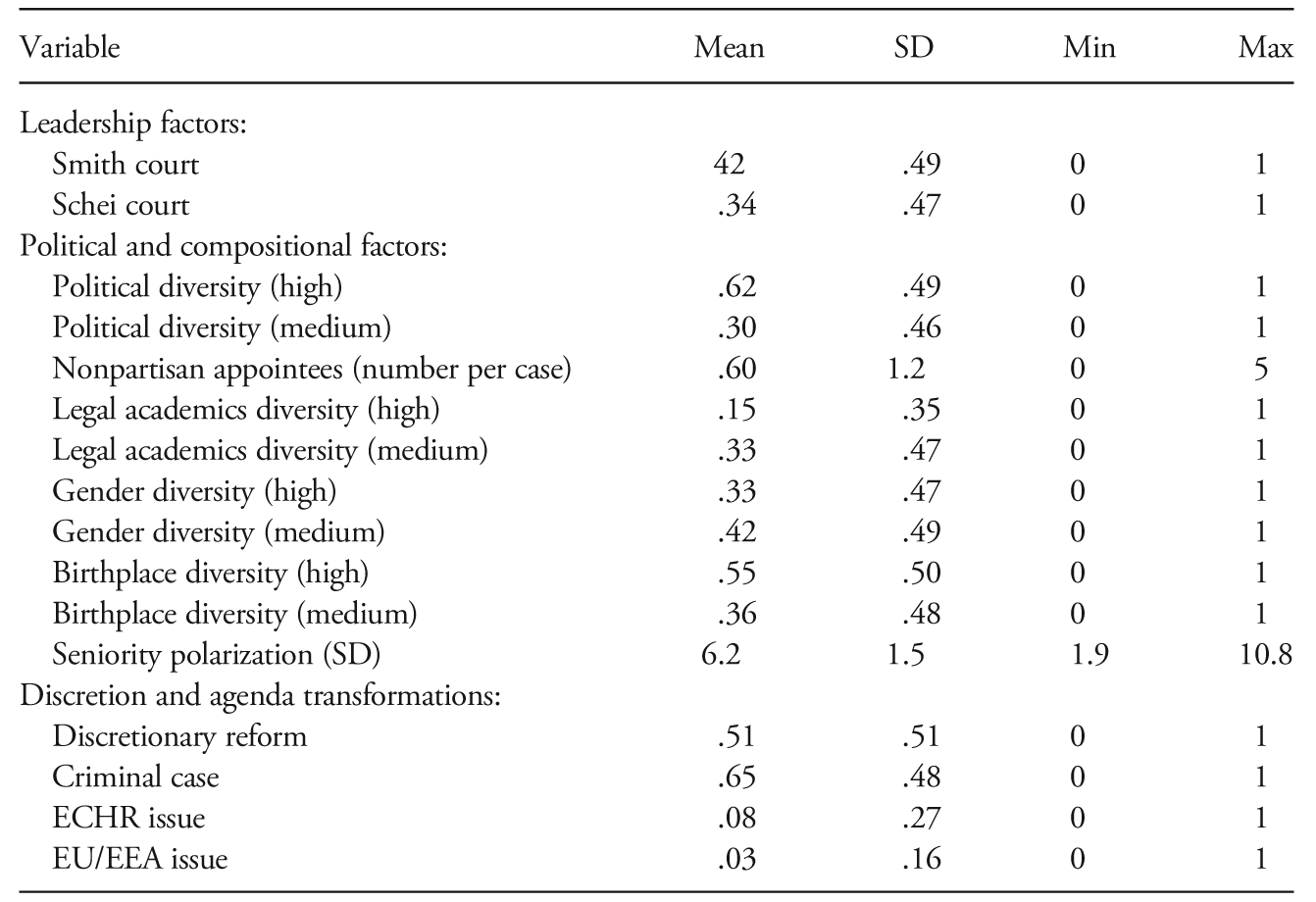
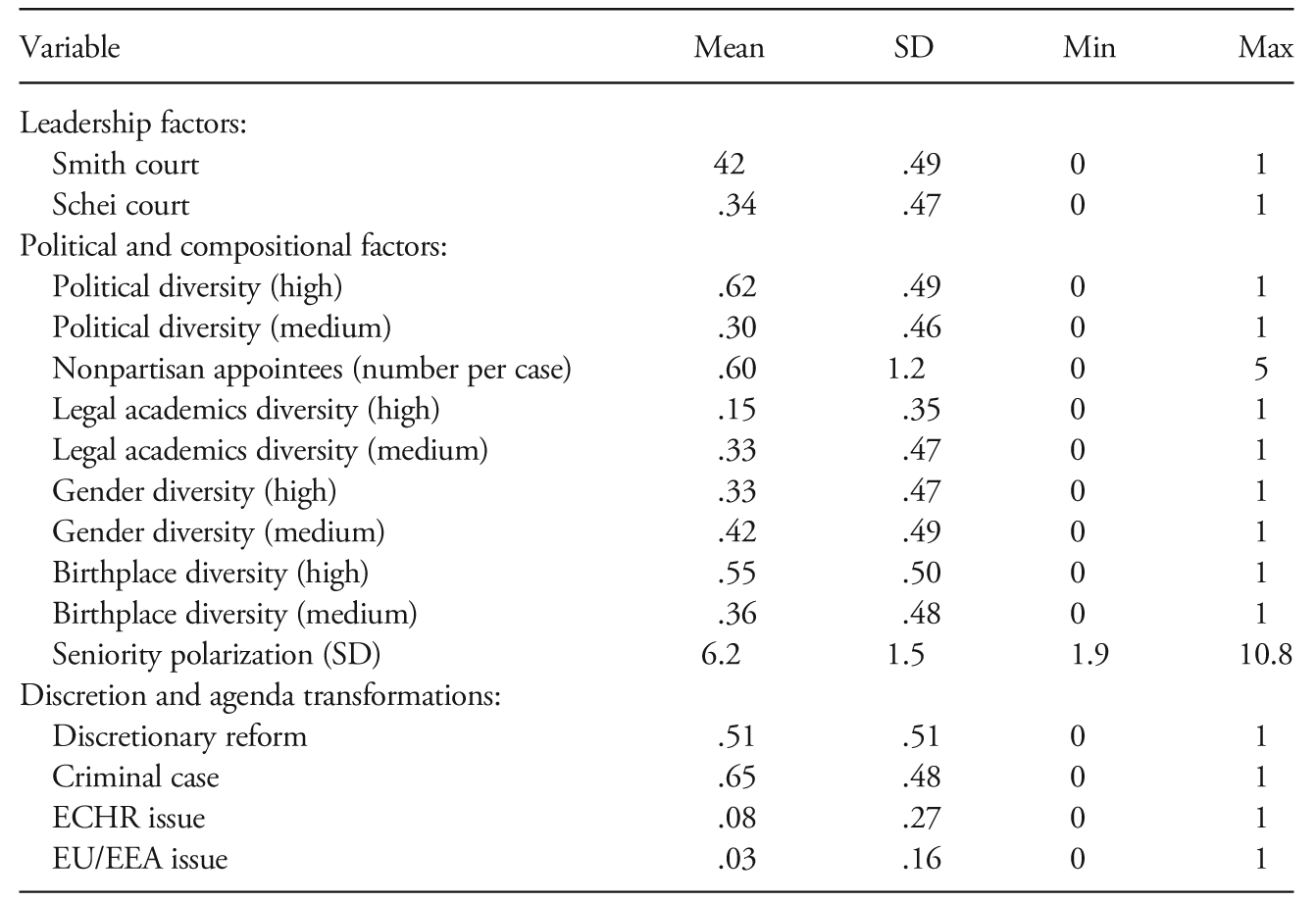
My sets of independent variables in the analysis correspond to the discussion of the hypotheses above. Table 1 presents descriptive statistics for the independent variables.
Descriptive Statistics of the Independent Variables
Source.—The Norwegian Supreme Court Database (Grendstad, Shaffer, and Waltenburg Reference Grendstad, Shaffer and Waltenburg2017).
Note.—Means, standard deviations, and maximum and minimum values, the Supreme Court of Norway, 1987–2014. The Sandene court is the reference category.
To measure court leadership, I include two dichotomous variables for the chief justiceships of Carsten Smith and Tore Schei (2002–16), each coded 1 if that person was the chief justice when the case was decided and 0 if he was not. The reference category is the chief justiceship of Erling Sandene (1984–91).Footnote 6
I measure the level of diversity in policy preferences (social democratic or conservative appointees), legal academics, gender, and birthplace (born in the capital of Oslo or outside Oslo) by using the six possible combinations of justices with the different characteristics that can occur on five-justice panels.Footnote 7 For example, in regard to diversity in social democratic and conservative appointees, the following combination of panels exists: unified social democratic panels (SSSSS), mixed social democratic and conservative panels (SSSSC, SSSCC, SSCCC, SCCCC), and unified conservative panels (CCCCC). Importantly, the cases are randomly assigned to each panel, meaning that the types of cases heard should not vary systematically across panel types. The unified panels are those for which we can assume that all the justices share the same preferences, while the mixed panels are those with the assumed potential dissenters. Furthermore, we might expect that dissents are more likely in high-diversity panels (SSSCC and SSCCC) than in medium-diversity panels (SSSSC and SCCCC), since high-diversity panels are likely more polarized. In the analysis, I include high- and medium-diversity panels, leaving unified panels out for the purpose of comparison.
To measure the change in appointment procedures in 2002, I include a continuous variable measuring the number of nonpartisan justices participating in each panel. The variable is coded from 0 to 5, where 0 means that zero nonpartisan appointees participate in a case, and 5 means that five nonpartisan appointees participate.
To measure polarization in Supreme Court seniority, I include a variable measuring the standard deviation of the mean years of justice experience on a panel. A larger standard deviation means greater polarization in seniority among the justices on a case.
Finally, to test for discretionary power and agenda change, I include separate dichotomous variables measuring whether a case was decided after the 1995 discretionary reform or whether a case involves a criminal, ECHR, or EEA issue.Footnote 8 Since the discretionary reform centered on criminal procedure, I add an interaction term between the discretionary reform and criminal cases.
Separate Regression Analyses of Dissent and Concurrence
Two main forms of disagreement occur at the Supreme Court: dissents on the outcome and concurrences on the reasoning behind the outcome. Here, I distinguish between the two because we can assume that while dissents to a greater extent are direct expressions of political disagreement, concurrences are more often disagreements over the appropriate legal reasoning in order to arrive at a shared outcome (Hettinger et al. Reference Hettinger, Lindquist and Martinek2006; Corley Reference Corley2010). Thus, given the more legalistic function of concurrences, we may, for example, expect that chief justices see concurrences as less threatening to collegial relations than dissenting opinions and may thus be less willing to suppress concurrences (Hettinger et al. Reference Hettinger, Lindquist and Martinek2006).
I examine the correlates of dissents and concurrences in two separate analyses. In each analysis, the dependent variable is coded 1 if the case includes a dissent or 1 if the case includes a concurrence. The dependent variable is coded 0 if the decision was unanimous.Footnote 9 Out of the 5,886 decisions in the data, there are 478 decisions including one or more dissents and 165 decisions including one or more concurrences. Since the two dependent variables are dichotomous, I estimate the models using logistic regression.Footnote 10 To estimate substantive significance, I calculate the percentage change in odds for a one-unit change in each of the independent variables.
Results: Court leadership and agenda change regarding dissent
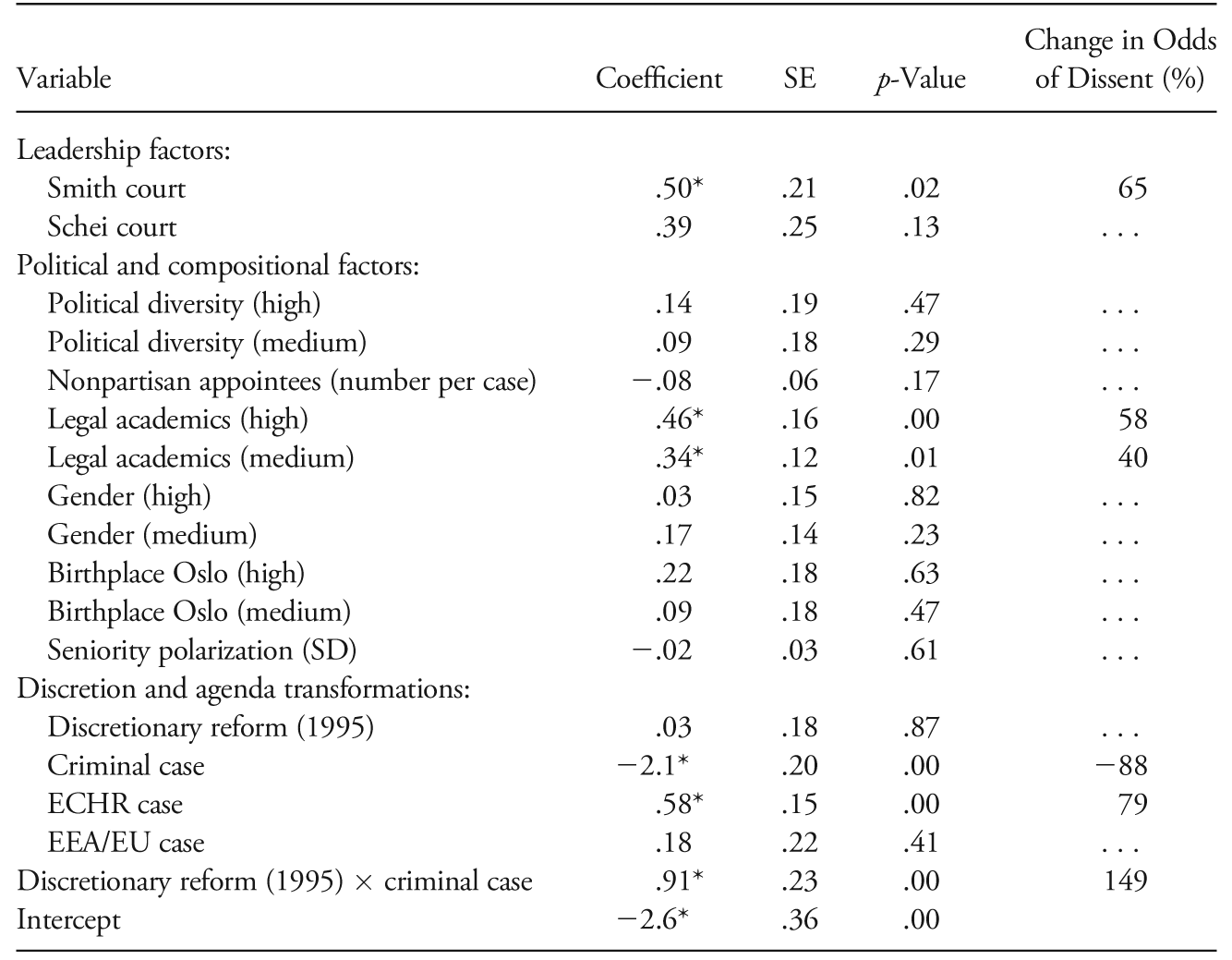
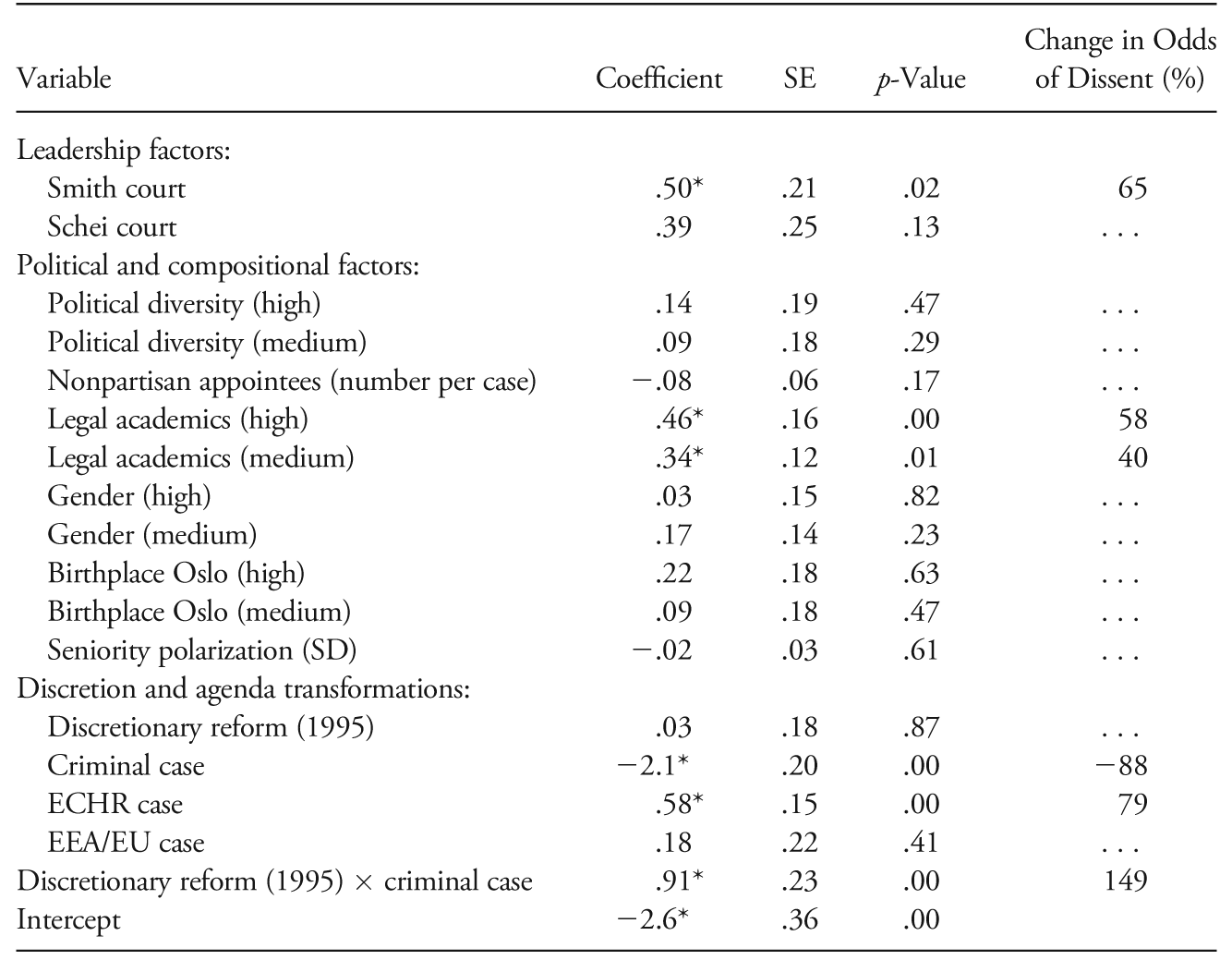
Table 2 shows the correlates of dissent. There is a statistically significant and positive effect of the Smith court (compared to the Sandene court). This is also a substantial effect in the model; the odds of a dissent are 65% greater in cases decided by the Smith court. Crucially, this suggests that the views toward dissents on the Court changed when Smith became chief justice and that the more “academic” style of deliberation and decision making introduced during Smith’s tenure expanded the room for discussion and dissent among the justices.
Influence of Chief Justice and Agenda Transformations on Dissents
Source.—The Norwegian Supreme Court Database (Grendstad, Shaffer, and Waltenburg Reference Grendstad, Shaffer and Waltenburg2017).
Note.—Logistic regression of case-level dissents in the Supreme Court of Norway. Log-odds estimates, standard errors, and the percentage change in odds of a dissent (for the statistically significant effects). The Sandene court is the reference category. Pseudo-R 2 = .12; N = 5,886.
*. p < .05 (two-tailed).
The compositional effects show a positive and statistically significant effect of the legal academics. More specifically, the odds of a dissent increase by 40% if one legal academic is present on a case and by 58% if two or three legal academics are present. This finding is consistent with the hypothesis that legal academics are more prone toward authoring dissents (George Reference George2001; Mestad Reference Mestad, Schei, Skoghøy and Øie2015). As in the Roosevelt court, these ivory-tower justices played a role in altering the internal practices in a way that entrenched a higher level of dissensus (Corley et al. Reference Corley, Steigerwalt and Ward2013).
The variables measuring changes to the Court’s discretionary power and subsequent change in agenda have a statistically significant and substantial effect on dissent in the expected direction. Because of the added interaction term between the discretionary reform and criminal cases, the separate effects of the two variables are interpreted as the effect on dissent when the other is set to zero. Accordingly, the statistically insignificant effect of the discretionary reform shows that the reform did not increase the odds of a dissent in civil cases. In addition, the negative and statistically significant effect of criminal cases shows that the odds of a dissent were about 88% less likely in a criminal case as opposed to a civil case prior to the reform.
Furthermore, looking at the interaction term between the discretionary reform and criminal cases, there is a statistically significant and substantial effect on dissent; the odds of a dissent in criminal cases increased by 149% after the implementation of the reform. Overall, these findings suggest that it was the justices’ expanded power to select the more salient and principled criminal cases after the reform that affected the nature and degree of division on the Court.
Finally, there is a positive and statistically significant effect of ECHR issues. The odds of a dissent increase by 79% when a case involves an ECHR issue, suggesting that the influx of more value-laden conflicts into national jurisprudence, over which justices may disagree on fundamental issues concerning the Court’s role in the broader political system, has significantly influenced the level of conflict between the Supreme Court justices (Wiklund Reference Wiklund, Keller and Stone Sweet2008).
The remaining findings show no compositional significant effects of diversity in policy preferences, the number of nonpartisan appointees, court experience, birthplace, gender, or cases involving EU issues. That there is no effect of political diversity or the changes to the nature of appointments is somewhat surprising, given the dominance of previous research concluding that differences in policy preferences constitute a robust explanation for dissent. But the different traditions of appointment across judicial systems may explain the variation in the effects of policy preferences.
Results: Legal academics and agenda change regarding concurrences
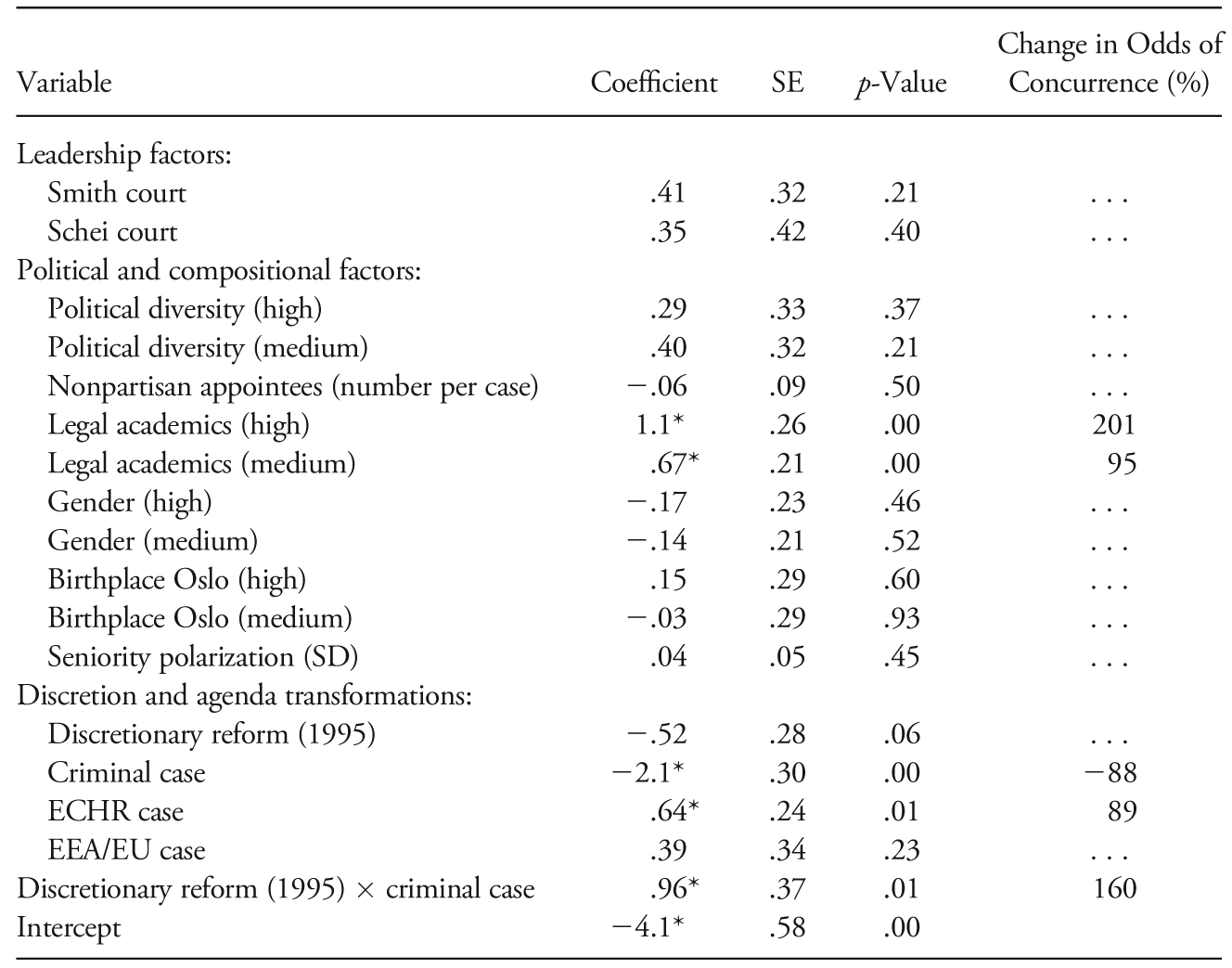
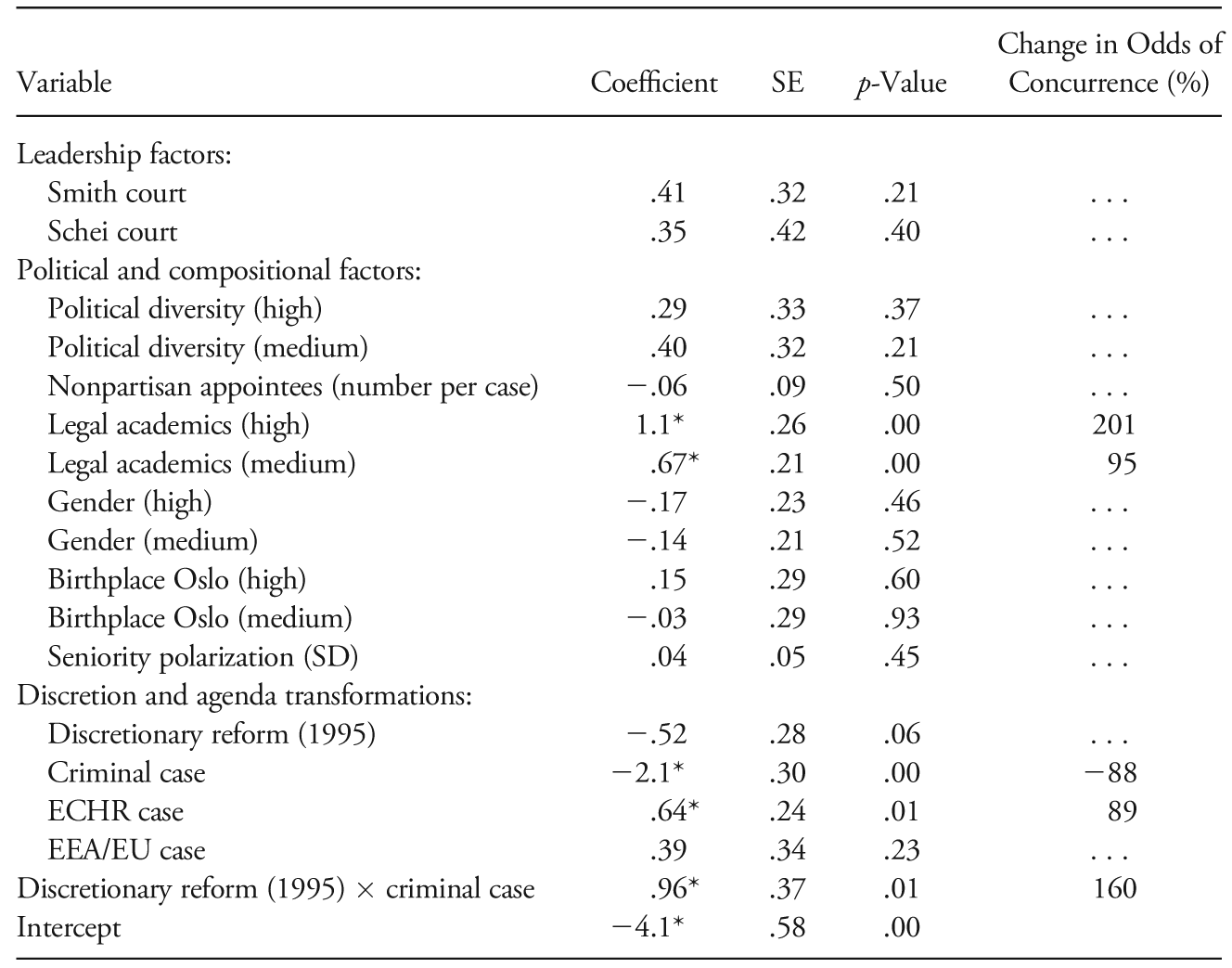
Table 3 shows the correlates of concurrence. First of all, there are no significant parameters for the effects of court leadership, which is consistent with the expectation that the chief justice to a lesser extent will use her institutional advantages to suppress concurrences (see, e.g., Corley Reference Corley2010).
Influence of Legal Academics and Agenda Transformations on Concurrences
Source.—The Norwegian Supreme Court Database (Grendstad, Shaffer, and Waltenburg Reference Grendstad, Shaffer and Waltenburg2017).
Note.—Logistic regression of case-level concurrences in the Supreme Court of Norway. Log-odds estimates, standard errors, and the percentage change in odds of a concurrence (for the statistically significant effects). The Sandene court is the reference category. R 2 = .09; N = 5,886.
*. p < .05 (two-tailed).
The results show significant parameters for the effects of legal academics. The odds of a concurrence increase by 95% when one legal academic is present on a case and by 201% when two or three academics are present. Given the more legalistic role of concurrences (Corley Reference Corley2010), this is consistent with the hypothesis that legal academics to a greater extent will use concurring opinions to forward new ideas and to try to force the law in certain directions (George Reference George2001).
There is also an effect of the discretionary reform and agenda change. The statistically insignificant effect of the discretionary reform shows that the reform did not increase the odds of a concurrence in civil cases, and the negative and statistically significant effect of criminal cases shows that the odds of a concurrence were about 88% less likely in a criminal case as opposed to a civil case prior to the reform.
The interaction term between the discretionary reform and criminal cases shows a statistically significant and substantial effect on concurrences; the odds of a concurrence in criminal cases increased by 160% after the implementation of the reform. In addition, there is a statistically significant and substantial effect of ECHR issues, whereby the odds of a concurrence increase by 89% when a case involves an ECHR issue. Overall, this shows that the Court’s treatment of more principled and salient cases also influenced the increasing rate of concurrences.
Finally, the remaining findings for concurrence show no significant parameters for the effect of political diversity, the number of nonpartisan appointees, court experience, birthplace, gender, or cases involving EU issues. We could, however, suspect that justices’ policy preferences play a lesser role in explaining concurrences (Corley Reference Corley2010) than in deciding winners and losers in outcomes of decisions.
Discussion and conclusion
Supreme courts make decisions under conditions that vary over time. Justices write opinions and cast their individual votes in collegial and institutional settings influenced by leadership, justice composition, discretionary power, and agenda. But the extent to which these various factors may induce changes in the overall behavior of supreme courts has been much debated. Fortunately, the Norwegian Supreme Court offers a relevant and testable European case for the hypotheses derived from the literature on rising dissent rates.
The findings from the foregoing analysis are consistent with the hypothesis that court leadership influences dissents. After controlling for compositional, institutional, and agenda-specific factors, there is a positive effect of the Smith court. This suggests that the more “academic” work environment introduced under Smith, which provided the justices with more time to write opinions and circulate drafts, made dissents a more natural part of the Court’s decision making.
The increasing number of legal academics also influenced the occurrence of dissents and concurrences (George Reference George2001). As in the Roosevelt court, the appointment of ivory-tower justices arguably played a role in altering the internal practices under the Smith court in a way that seems to have entrenched a higher level of dissensus (Corley et al. Reference Corley, Steigerwalt and Ward2013). In addition, the presence of legal academics on a case leads to a higher likelihood of concurrences compared to dissents. Given that concurrences have a more legalistic than a policy-centric function (Corley Reference Corley2010), the findings are consistent with the hypothesis that legal academics to a greater extent will use concurring opinions to forward new ideas and to try to force the law in certain directions (George Reference George2001).
Although leadership and compositional factors appear important, the results show that the implementation of the discretionary reform in 1995, and the subsequent change in agenda, had the most substantial influence on the rise in dissents and concurrences in the 1990s. The findings strongly suggest that the unleashing of time and discretion to focus on the more complex and contentious criminal issues following the reform in turn influenced the justices’ propensity to author dissents and concurrences. This is consistent with studies of the “demise of consensual norms” in the US Supreme Court, which argue that it was the Court’s greater authority to control its own docket that in turn catalyzed the subsequent rise in levels of dissent (e.g., Halpern and Vines Reference Halpern and Vines1977).
The more intensive treatment of human rights (ECHR) law has also become an important source of dissent. Due to developments in international law and the increasing power of judicial bodies, the Nordic supreme courts have shifted their focus when it comes to sources of law and to the extent to which the courts should engage in judicial review (Wiklund Reference Wiklund, Keller and Stone Sweet2008; Follesdal and Wind Reference Follesdal and Wind2009; Hirschl Reference Hirschl2011). In the Norwegian case, Kinander (Reference Kinander2016) and Robberstad (2016) argue that the justices vary in their willingness to, on the one hand, develop the law and use their judicial positions more actively to increase the power of the judicial branch in relation to other political actors and, on the other hand, defer to Parliament’s authority as a lawmaker and respect the authorities’ room for maneuvering with regard to international conventions. These conflicts over institutional activism and restraint, Kinander (Reference Kinander2016) argues, fit nicely with the concept of institutional activism observed in other courts (Voeten Reference Voeten2007; Lindquist and Cross Reference Lindquist and Cross2009). Future research should address this dimension more closely.
In conclusion, with the implementation of the Judges’ Bill (1925) in the United States, Chief Justice Taft empowered the judiciary and laid the conditions for the US Supreme Court to return to its “higher function” of interpreting the Constitution (Crowe Reference Crowe2007). This later opened the door for Chief Justice Stone to transform the internal dynamics of the Court and to initiate a change in the dominant philosophy toward the protection of civil liberties and individual rights (Hendershot et al. Reference Hendershot, Hurwitz, Noble Lanier and Pacelle2013). Fifty years later, the Norwegian Supreme Court underwent a similar reform of the case docket, which laid the ground for Chief Justice Smith to achieve his agenda that the Court should pursue its “higher function” of developing the law and to strengthen the protection of individual rights on the basis of international conventions (Smith Reference Smith1975). The evidence in this article suggests that these fundamental changes in the Supreme Court’s power and agenda served as the main catalysts for the rising levels of judicial conflict and dissent.
This study has produced a significant contribution to our understanding of how some universal factors, such as discretionary jurisdiction, agenda transformation, and court leadership, may drive judicial behavior and create conditions that are more conducive toward judicial conflict and dissents. The findings should also hold relevance for other European courts. As the political role of courts and judges has expanded (Tate and Vallinder Reference Tate and Vallinder1995; Shapiro and Sweet Reference Shapiro and Stone Sweet2002; Hirschl Reference Hirschl, Caldeira, Kelemen and Whittington2009), European courts have responded to higher workloads by accepting fewer and more policy-consequential cases, meaning that the justices now possess greater discretion and opportunity to treat the cases before them as instruments in the development of the law (Sunde Reference Sunde2015, 98–101). In addition, as the territorial scope of European rights-based constitutionalism widened and deepened in the post-1990 period, judges have been left with an extended room of discretion to decide on the constitutional and individual rights of European citizens (Keller and Sweet Reference Keller and Stone Sweet2008). The conditions have thus been set for increased disagreement over precedent, legal development, and the proper role of courts and justices in democracies throughout European high courts.