A significant body of research attests to the importance of oral language proficiency to reading comprehension outcomes in the elementary school years among monolingual children (Catts, Adlof, & Weismer, Reference Catts, Adlof and Weismer2006; National Reading Panel, 2000; Whitehurst & Lonigan, Reference Whitehurst and Lonigan1998). For the most part, oral language proficiency is operationalized in the first-language (L1) literature in terms of word-level skills (i.e., expressive or receptive vocabulary; National Institute of Child Health and Human Development Early Child Care Research Network, 2005). However, studies have been reported in which oral language was conceptualized more broadly to include oral narrative competence (Griffin, Hemphill, Camp, & Wolf, Reference Griffin, Hemphill, Camp and Wolf2004). Narrative competence is reflected in children's ability to tell and understand stories (Pellegrini & Galda, Reference Pellegrini and Galda1993). Narrative language samples are considered ecologically valid indicators of discourse-level oral proficiency (Bedore, Peña, Gillam, & Ho, 2010; Fiestas & Peña, Reference Fiestas and Peña2004; Justice et al., Reference Justice, Bowles, Kaderavek, Ukrainetz, Eisenberg and Gillam2006).
Research involving monolingual children has demonstrated an association between narrative competence (comprehension and production) and reading comprehension in the middle elementary years once code-related skills are established and reading increasingly becomes a meaning-making endeavor. Much of this research focuses on atypically developing children (Cain, Reference Cain2003; Cain, Oakhill, & Bryant, Reference Cain, Oakhill and Bryant2004; Feagans & Appelbaum, Reference Feagans and Appelbaum1986; Snyder & Downey, Reference Snyder and Downey1991), but evidence of an association between narrative competence and reading comprehension among typically developing children has been reported (Griffin et al., Reference Griffin, Hemphill, Camp and Wolf2004; Paris & Paris, Reference Paris and Paris2003). The relationship between narrative competence and reading comprehension is predicated on the idea that oral narratives, like their written counterparts, are characterized by decontextualized language (Curenton & Justice, Reference Curenton and Justice2004; Snow, Reference Snow, Eldering and Leseman1999; Sulzby, Reference Sulzby1985) and that the two share common structural features (Benson, 1997).
In contrast, previous research tends to downplay the role oral language plays in early reading comprehension outcomes in monolingual children (Roth, Speece, Cooper, & De la Paz, Reference Roth, Speece, Cooper and De La Paz1996; Verhoeven, Reference Verhoeven2000). This is attributable at least in part to the early instructional focus on print-based skill acquisition, which in turn influences the choice of reading materials children are initially expected to learn to read independently (Chall, Jacobs, & Baldwin, Reference Chall, Jacobs and Baldwin1990). These simple, predictable texts supported by rich illustrations place few demands on language, assuming that children bring to the early reading task a threshold (albeit low) level of oral language proficiency. This assumption is one that may not hold in the case of children who receive school instruction in a language that is not their dominant language, such as Canadian children in French immersion programs. This in turn raises the possibility that the associations between oral language proficiency, including narrative discourse skill, and reading comprehension that are largely absent in early L1 reading are discernible in the initial stages of second language (L2) reading acquisition.
As in the L1 literature, there is evidence in the L2 literature of an association between narrative competence (story comprehension in particular) and reading comprehension among children in the middle to upper elementary grades (Nakamoto, Lindsey, & Manis, Reference Nakamoto, Lindsey and Manis2008; Proctor, Carlo, August, & Snow, Reference Proctor, Carlo, August and Snow2005). Very few studies have explored the relationship between L2 narrative competence and reading outcomes in the early elementary grades. The question is of considerable importance, particularly in light of repeated findings that L2 children lag behind L1 children in reading comprehension (Geva, Reference Geva, August and Shanahan2006; Geva & Farniah, 2010). In order to meet the specific learning needs of the L2 student population, it is essential that the processes underlying L2 reading comprehension be more fully understood. The purpose of the present study, therefore, was to examine the relationship between a specific feature of L2 oral narrative competence (i.e., narrative morphosyntactic quality) and first grade L2 reading comprehension in a group of French immersion children.
ORAL NARRATIVE GENERATION AND READING COMPREHENSION
Storytelling is a universal practice that is central to human experience (Bruner, Reference Bruner1986). Stories provide us with a framework to organize, represent, and understand human actions and behavior (Astington, Reference Astington, Britton and Pellegrini1990). Stories are cognitively demanding linguistic constructions (Johnston, Reference Johnston2008). Crafting a well-told story requires the narrator to coordinate a number of complex tasks that include planning and ordering content in accordance to genre-specific rules to ensure coherence, choosing linguistic devices that knit the story elements into a cohesive whole, providing the precise vocabulary and explicit information needed to support listener comprehension, and attending to the artful quality of the narration to capture and hold the audience's attention (Johnston, Reference Johnston2008; Montonari, Reference Montonari2004; Pearson & de Villiers, Reference Pearson, de Villiers, Brown and Lieven2005; Snow, Reference Snow, Eldering and Leseman1999; Ukrainetz et al., Reference Ukrainetz, Justice, Kaderavek, Eisenberg, Gillam and Harm2005). Storytellers learn to integrate these complex tasks through frequent exposure to stories and opportunities to participate in the act of storytelling (Snow, Reference Snow, Eldering and Leseman1999; Uccelli, Hemphill, Pan, & Snow, Reference Snow, Eldering and Leseman1999).
Narrative competence is generally assessed in the research literature in terms of the three dimensions that comprise it: macrostructure, microstructure, and evaluation. Macrostructure, or episodic quality, is a measure of narrative coherence. Microstructure refers to story language. It includes indices of productivity (e.g., number of words, number of utterances), lexical diversity, inter- and intrasentential cohesion, linguistic complexity and, in the L2 literature in particular, grammaticality. Narrative microstructure has been found to be a particularly robust predictor of language and literacy outcomes (Justice, Bowles, Pence, & Gosse, Reference Justice, Bowles, Pence and Gosse2010; Pankratz, Plante, Vance, & Insalaco, Reference Pankratz, Plante, Vance and Insalaco2007). Evaluation is the means by which the narrator transmits character perspective, including the use of metacognitive language, reference to physical or internal states, and direct character speech (Benson, Reference Benson1993; Cain, Reference Cain2003; Justice et al., Reference Justice, Bowles, Pence and Gosse2010; Shapiro & Hudson, Reference Shapiro and Hudson1991; Stein & Albro, Reference Stein, Albro and Bamberg1997; Ukrainetz et al., Reference Ukrainetz, Justice, Kaderavek, Eisenberg, Gillam and Harm2005). The current study focuses on a particular aspect of L2 narrative microstructure (i.e., grammaticality) and its relationship to L2 reading comprehension.
One of two story elicitation techniques is typically used in the narrative literature, although there is some variation in procedures (e.g., Griffin et al., Reference Griffin, Hemphill, Camp and Wolf2004). The first is story retell (or recall) in which the child is asked to recount a story following an initial narration by the experimenter. Story retell is considered to be an indicator of expressive language skill by some (e.g., Cleave, Girolametto, Chen, & Johnson, Reference Cleave, Girolametto, Chen and Johnson2010; Riley & Burrell, Reference Riley and Burrell2007) and a measure of receptive skill by others (e.g., Kendeou, van den Broek, White, & Lynch, Reference Kendeou, van den Broek, White and Lynch2009; Paris & Paris, Reference Paris and Paris2003). The second elicitation technique is story generation, which involves a child-generated narration generally in response to a series of illustrations or a wordless picture book (e.g., O’Neill, Pearce, & Pick, Reference O’Neill, Pearce and Pick2004). Research by Gutiérrez-Clellen (Reference Gutiérrez-Clellen2002) has shown that story retell poses a particular challenge for children with limited language proficiency. She argues that the cognitive demands involved in processing incoming narrative information interfere with the child's ability to integrate the elements of the story into a coherent and cohesive whole. As a result, recall is adversely affected. The least proficient children in the Gutiérrez-Clellen (Reference Gutiérrez-Clellen2002) study demonstrated superior performance on a story generation task relative to a retell task. In light of this finding, and the limited language proficiency of the children participating in our study, we chose to focus the current study on narrative generation.
A number of studies have investigated the role of oral narrative production in reading achievement in a monolingual sample using generation tasks (Cain, Reference Cain2003; Feagans & Appelbaum, Reference Feagans and Appelbaum1986; Griffin et al., Reference Griffin, Hemphill, Camp and Wolf2004; Paris & Paris, Reference Paris and Paris2003; Snyder & Downey, Reference Snyder and Downey1991). Overall, there is compelling evidence for the existence of a relationship between narrative production and reading comprehension. For example, Feagans and Appelbaum (Reference Feagans and Appelbaum1986) found that a subgroup of 6- to 7-year-old children demonstrating specific language impairment with intact narrative skills obtained significantly higher scores on measures of reading comprehension 2 years later than did children with impaired narrative ability and intact syntactic and semantic skill. The authors conclude that narrative competence plays a defining role in reading achievement. Cain (Reference Cain2003) found that less skilled comprehenders produced stories judged to be significantly less coherent and cohesive than those of skilled comprehenders at 8 years of age. Finally, a study by Griffin and colleagues (Reference Griffin, Hemphill, Camp and Wolf2004) found that among typically developing children, the use of evaluative language at 5 years of age was predictive of reading comprehension at age 8. Taken together, studies investigating the association between narrative generation and reading outcomes suggest that storytelling ability, like vocabulary, makes a significant contribution to reading comprehension outcomes at the point at which children transition from the “learning to read” to “reading to learn” stage (Chall, Reference Chall1996). It is at this point that children are expected to tackle increasingly complex texts that tax knowledge of the semantic, syntactic, and morphological systems of the language–the very systems tapped by the task of narration.
With respect to the relationship between oral narrative production and reading comprehension, a single study was identified that addressed the issue in the L2 literature. In a cross-sectional study involving a large sample of Spanish-dominant Spanish–English bilinguals in kindergarten to Grade 3, Miller et al. (Reference Miller, Heilmann, Nockerts, Iglesias, Fabiano and Francis2006) examined patterns of association between various measures of narrative discourse in Spanish and English and reading achievement in both languages. The children's narratives were scored with respect to four features: mean length of utterance, number of different words, words per minute (a measure of verbal fluency), and narrative structure. Regression analyses controlling for grade revealed that the narrative measures entered in step 2 of the equation predicted significant variation in reading comprehension both within and across languages.
In the present study, we focused on narrative morphosyntactic quality. Following Gutiérrez-Clellen (Reference Gutiérrez-Clellen2002), we operationalized morphosyntactic quality in terms of the proportion of utterances that are grammatically correct. Morphosyntactic quality is a feature of microstructure that has received much attention in L2 studies. It has been shown by a number of researchers to be a particularly sensitive indicator of L2 development and oral language proficiency. (Bedore & Leonard, Reference Bedore and Leonard1998; Bedore et al., Reference Bedore, Peña, Gillam and Ho2010; Berman, Reference Berman, Verhoeven and Strömqvist2001; Cleave et al., Reference Cleave, Girolametto, Chen and Johnson2010; Fiestas & Peña, Reference Fiestas and Peña2004; Iluz-Cohen & Walters, Reference Iluz-Cohen and Walters2012; Muñoz, Gillam, Peña, & Gulley-Faehnle, Reference Muñoz, Gillam, Peña and Gulley-Faehnle2003). For example, Muñoz et al. (Reference Muñoz, Gillam, Peña and Gulley-Faehnle2003) found that morphosyntactic quality, as well as overall story structure, distinguished the English narratives generated by younger and older Latino preschool children of low socioeconomic status (SES). The proportion of grammatical utterances produced by the children in their study rose from approximately 59% to 80% between the ages of 4 years and 8 months and 5 years and 3 months. They concluded that grammatical accuracy was a significant marker of development in L2 narrative production. In another study, Bedore et al. (Reference Bedore, Peña, Gillam and Ho2010) found that the narrative measures that best predicted outcomes on a standardized test of bilingual (Spanish–English) language proficiency were mean length of utterance in English followed by English and Spanish grammaticality.
Previous research has demonstrated the effectiveness of measures of narrative grammaticality relative to standardized tests in capturing L2 children's morphosyntactic skill. (Cleave et al., Reference Cleave, Girolametto, Chen and Johnson2010; Rojas & Iglesias, Reference Rojas and Iglesias2009). For example, Cleave et al. (Reference Cleave, Girolametto, Chen and Johnson2010) compared the performance of monolingual and bilingual English language learner children with specific language impairment on standardized tests of morphosyntax and a narrative generation task. The bilingual group achieved significantly lower scores on the standardized measures but performed on par with the monolingual group on the narrative grammaticality measure (proportion of correct utterances). The authors concluded that narrative samples provide a more sensitive, unbiased assessment of expressive morphosyntactic skills than standardized measures because the functional, naturalistic task of storytelling offered their dual language learners a context within which to demonstrate linguistic competency. Despite the demonstrated sensitivity of narrative grammaticality as a measure of L2 oral language proficiency, studies investigating its relationship to reading outcomes are lacking. In light of the previous findings, and motivated by a gap in the L2 research literature relating to expressive morphosyntax and reading comprehension, we chose to use morphosyntactic quality as our indicator of oral language proficiency in the current study.
THE CURRENT STUDY
The aim of the present study was to evaluate the relationship between concurrent measures of L2 oral narrative production and L2 reading comprehension in a sample of French immersion children in their first year of formal reading instruction. Based on findings in the L1 research literature that suggest that narrative microstructure is a particularly robust predictor of reading comprehension and findings in the L2 narrative literature that suggest that narrative grammaticality is a reliable indicator of oral language proficiency, we narrowed our focus to narrative morphosyntactic quality. We hypothesized that L2 narrative morphosyntactic quality would explain a significant portion of the variance in the L2 reading comprehension outcomes of a sample of Grade 1 children with limited L2 language skill. To test the unique contribution of narrative skills, we controlled for nonverbal reasoning, maternal education, word reading, and vocabulary. These variables have been shown to relate to reading comprehension in young children in both the L1 and L2 literature (August & Shanahan, Reference August and Shanahan2006; National Reading Panel, 2000).
The children who participated in this study were students in a French immersion program in Ontario, Canada. French immersion programs are publicly funded school programs that implement government-mandated curricula with specific learning outcomes. They are offered in English language school systems in all 10 Canadian provinces. The goal of French immersion is additive bilingualism: the development of French proficiency while maintaining native or nativelike proficiency in the majority English first language (Wesche, Reference Wesche, Burmeister, Piske and Rohde2002). The children who participated in our study were enrolled in a program in which they began French language and literacy instruction in the fall of Grade 1. All academic content material was taught exclusively in French. As English is the dominant language of Ontario, the environment beyond the school offers little opportunity to develop oral French-language skills. While children in French immersion classrooms are expected to interact with one another in French over time, initial experiences hearing and speaking the language are generally limited to interactions with teachers.
METHOD
Participants
Participants in the present study were 81 first graders (52% males) enrolled in a French immersion school located in a large metropolitan area in Ontario, Canada, in which the majority language was English. The children were tested in the spring term of their academic year as part of a larger study examining English and French development in French immersion children. At the time of testing, the average age of the children was 6 years and 10 months (SD = 3.45 months). These children were in their first year of receiving formal instruction in school entirely in French. None of them was a native speaker of French.
Demographic information was collected through a family questionnaire designed by the researchers. All but two students spoke English at home to varying extents, with approximately 65% of them identifying English as their primary home language. The remaining children spoke a wide range of languages at home as their primary language, including Russian, Hebrew, Mandarin, Korean, Spanish, and Amharic. One child was reported to speak French most often at home. This child was included in the data analysis because the first language he learned to speak at home was English; his French vocabulary and word reading skills were found to be comparable with his peers on measures administered in the current study. Six out of the 81 children were born outside of Canada. For these children, the average age of arrival in Canada was 2 years and 0 months (SD = 13.42 months). Maternal education was used as a proxy for family SES (Gottfried, Gott-fried, Bathurst, Wright Guerin, & Parramore, Reference Gottfried, Gottfried, Bathurst, Wright Guerin, Parramore, Bornstein and Bradley2003). In our sample, all mothers had finished high school and close to 85% of the mothers had completed at least a college or university degree. Thus, the sample was of relatively high SES, as is typical of studies involving a Canadian French immersion population (Francis, Lesaux, & August, Reference Francis, Lesaux, August, August and Shanahan2006).
Design and procedures
Measures of French vocabulary, word reading, narrative competence, and reading comprehension were administered to all participants in the present study. Phonological awareness was assessed in English as part of the larger study. There is robust evidence for the transfer of phonological awareness across languages (e.g., Comeau, Cormier, Grandmaison, & Lacroix, Reference Comeau, Cormier, Grandmaison and Lacroix1999); therefore, it was deemed sufficient that phonological awareness be assessed in English only. A nonverbal reasoning task was administered to all participants as a measure of their general cognitive ability. In addition, parents of the participating children filled out a questionnaire probing family background and home literacy activities.
The French reading comprehension task was administered by the Grade 1 teachers in their classrooms in fulfillment of local school board requirements for French immersion programs. All other measures were given by trained undergraduate and graduate research assistants who were fluent in French in a quiet room at the French immersion school within school hours. Instructions for the French tasks were given in both French and English to ensure that the children understood the instructions. Instructions for the phonological awareness task and the nonverbal reasoning task were given in English. The order of the tests was counterbalanced across participants.
Measures
Nonverbal reasoning
Nonverbal reasoning ability was assessed using the Matrix Analogies Test (Naglieri, Reference Naglieri1985). This measure included four subtests: pattern completion, reasoning by analogy, serial reasoning, and spatial visualization. Each subtest was composed of 16 items of increasing difficulty. For each item, children were asked to complete a standard progressive matrix by choosing the missing piece from six patterned segments. A subtest was discontinued when children made four consecutive errors. The total score was the sum of correct items from each subtest. The reliability coefficient for this task was 0.86 at age 6.
Phonological awareness
Phonological awareness was measured in English using the elision subtest of the Complete Test of Phonological Processing (Wagner, Torgesen, & Rashotte, Reference Wagner, Torgesen and Rashotte1999). For each item, students were asked to delete individual syllables or phonemes from real words and to articulate the remaining part (e.g., Say “cat.” Now say “cat” without the /k/). This test contains three practice items and 20 test items. The test was discontinued when the child made three consecutive errors on the test items. The Cronbach alpha of this task is 0.92 for age 6 (Wagner et al., Reference Wagner, Torgesen and Rashotte1999).
Receptive vocabulary
Form A of the Échelle de Vocabulaire en Images Peabody (Dunn, Theriault-Whalen, & Dunn, Reference Dunn, Thériault-Whalen and Dunn1993) was used to assess students’ French receptive vocabulary. The Échelle de Vocabulaire en Images Peabody was normed on a sample of French-Canadian children. In this task, the experimenter read a word and asked the student to point to one of the four pictures that best reflected the meaning of the word just read. Children were given three practice items prior to the testing items to ensure understanding of the task. The task was discontinued when the child had made six errors on the previous eight consecutive items. The Cronbach alpha of this task for age 6 is 0.86.
Word reading
French word identification was measured using an experimental task that included a list of single words of increasing difficulty. There was a total of 120 items, arranged in sets of eight words. The child was asked to read each word accurately and fluently. The task was discontinued at the last item of a set in which the child had fewer than five correct items. The Cronbach alpha reliability coefficient calculated for this task was 0.98 in this sample of children.
Reading comprehension
The children's French reading comprehension was assessed using Alpha-jeunes (Barrett, Littleford, & Watson, Reference Barrett, Littleford and Watson2004) and was administered by trained classroom teachers. The test consists of a series of leveled narrative and expository texts of increasing difficulty. The text levels ranged from 1 to 24 and were recommended by the authors for use with children in kindergarten through the early elementary grades. The end of Grade 1 benchmark for French immersion students is Level 6, the end of Grade 2 benchmark is Level 14, and end of Grade 3 benchmark is Level 21. Text difficulty was determined as a function of length, vocabulary, story structure, and format (i.e., font size, spacing, picture–text correlation, repetition of sentence patterns, and story language). To begin testing, teachers identified an appropriate entry-level text for each child based on previous reading performance. Each child was tested independently and was asked to read aloud the selected text. During the read aloud, the teacher kept a running record of word reading accuracy. Following the read aloud, the child was encouraged to respond orally to four standard comprehension questions that tapped both literal and inferential understanding. The child's Alpha-jeunes score was the text level at which (a) oral reading accuracy was determined to be between 90% and 95% and (b) all four comprehension questions were answered correctly. If a child failed to meet either of these criteria, the teacher repeated the steps with text of decreasing difficulty as required until the criteria were met. Conversely, if the child performed above the established criteria, the teacher repeated the steps with text of increasing difficulty.
Narratives
Children's narrative skills were assessed using a story generation task in French. In order to elicit a narrative, each child was presented with one of three wordless picture books illustrated by Mercer Meyer: Frog, Where Are You? (Meyer, Reference Mayer1969); One Frog Too Many (Meyer & Meyer, Reference Mayer and Mayer1975), or A Boy, a Dog and a Frog (Meyer, Reference Mayer1967). Three books were used because of the longitudinal nature of the broader research study; the children generated a story in response to a novel book at each of the three time points at which they would eventually be tested in order to minimize familiarity effects. Assignment to books was random.
Following Paris and Paris (Reference Paris and Paris2003), shortened versions of the original books were created, each depicting a complete episode that adhered to classic story grammar (i.e., characters engage in goal-directed actions to resolve a problem made evident in the opening pages). The three shortened stories were equivalent in length comprising 16 pictures in total. The procedure for testing was as follows: the experimenter began by showing the child a copy of the wordless picture book, pointing out the absence of text. The child was asked to look carefully at the pictures in the book to try and figure out the story they were telling. The child was told to keep the story a secret from the experimenter until all pictures had been seen and s/he had “figured out what was happening.” This initial picture walk was unguided; the experimenter refrained from engaging the child in any book-related talk.
When the child was ready to tell the story, the experimenter took back the book, opening it to page 1. The experimenter was positioned so as to be unable to see the pictures. The child was told to tell a story that the experimenter would understand without looking at the pictures. The experimenter remained silent except to encourage the child to remain on task or to provide feedback that supported the child's efforts (“You’re doing a terrific job.”) without influencing the content or structure of the story. The child's story was audio recorded for later transcription by a research assistant.
Procedures for transcription and coding
All narratives were transcribed by trained undergraduate and graduate research assistants who were competent speakers of French. The transcripts were then segmented into utterances consisting of a single main clause and any dependent clauses. Following Craig et al. (2003), successive main clauses linked by simple coordinate conjunctions (et, mais) were segmented into separate utterances if the second clause included a subject. When the second clause elliptically omitted the subject, the two clauses were considered a single utterance. Twenty percent of the transcripts were randomly selected and retranscribed by a research assistant for reliability purposes. Interrater reliability was conducted using the following formula: [number of agreements/(number of agreements + disagreements)] × 100 (Sackett, Reference Sackett1978) and yielded 95% for words (n = 2503) and 96% for utterance boundaries (n = 303).
Following transcription, the narratives were coded by the first author, a nativelike speaker of French. The narrative feature of interest in this study was grammaticality. Grammaticality was operationalized as the proportion of total utterances that were morphologically and syntactically correct. Grammatically correct utterances were broadly defined as utterances that are produced in a manner that is typically acceptable by the majority of speakers in the linguistic environment. The majority of errors in the narrative samples were errors of inflection, word order, gender, and noun–adjective agreement. To avoid inflating grammatical error counts, only the first occurrence of a repeated syntactic or morphological error, for example, preceding the word grenouille (frog) with the masculine form of the definite article le (the), was scored as grammatically incorrect. Utterances containing one or more English words were not scored for grammaticality but were included in the total utterance count. For reliability purposes, 20% of the transcripts were randomly selected and recoded by a research assistant. Sackett's (1978) formula was applied again. Coding reliability for the proportion of grammatically correct utterances was 96% (n = 303).
RESULTS
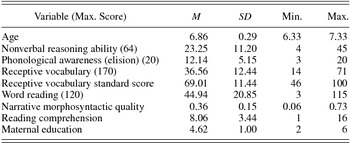
The means and standard deviations of each measure administered in this study are presented in Table 1. For reading comprehension, the median oral reading accuracy level is reported. There was adequate variability on all measures. We checked the data for normality for each predictor and outcome variable by inspecting skewness and kurtosis statistics. These statistics indicated normal distributions on all measures. Since three versions of the wordless picture book were used to measure narrative competence, we conducted a one-way analysis of variance with book assignment as the between-groups factor. The book effect was not significant, F (2, 78) = 1.74, p = .18, indicating equivalent performance across all three versions of the book.
Descriptive statistics for administered measures

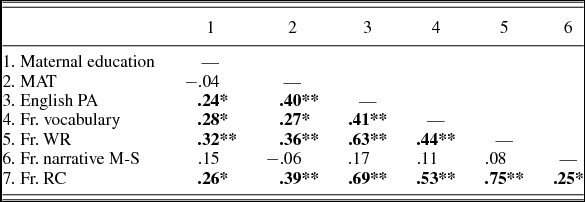
Table 2 shows the correlations among all variables. Reading comprehension was strongly associated with phonological awareness (p < .001), word reading (p < .001), receptive vocabulary (p < .001) and narrative morphosyntactic quality (p < .05).
Correlations among variables

Note: MAT, Matrix Analogies Test; PA, phonological awareness; Fr., French; WR, word reading; M-S, morphosyntax; RC, reading comprehesion.
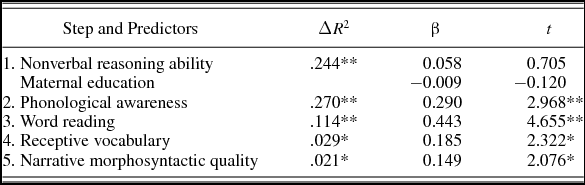
A hierarchical linear regression was performed to examine predictors of reading comprehension. In the regression, children's nonverbal reasoning ability and maternal education were entered in Step 1, followed by English phonological awareness in Step 2. French vocabulary and word reading were entered in successive steps. Narrative morphosyntactic quality was entered in the final step.
Table 3 shows the final beta weights for all of these tasks. Phonological awareness, word reading, and receptive vocabulary all made significant contributions to the prediction of reading comprehension, accounting for 27.0%, 11.4%, and 2.9% of the variance, respectively. Final beta weights indicate that they all explained unique variance in reading comprehension outcomes. It is notable that narrative morphosyntactic quality explained 2.1% of the variance in reading comprehension after taking into account all other variables. Final beta weights also suggested that narrative morphosyntactic quality explained unique variance in reading comprehension scores. All together, the variables entered in the model accounted for over 68% of the total variance.
Hierarchical linear regression predicting reading comprehension

*p < .05. **p < .01.
DISCUSSION
The present study examined the relationship between concurrent measures of L2 oral language proficiency and reading comprehension in a sample of children enrolled in a French immersion program in the spring of Grade 1. We examined the extent to which the morphosyntactic quality of oral narratives produced in response to a wordless picture book contributed to variance in reading comprehension outcomes. Regression analyses revealed that French morphosyntactic quality explained unique variance in French reading comprehension outcomes, after controlling for nonverbal reasoning, mother's education, English phonological awareness, French word reading, and French vocabulary. This is one of a very few studies to date that has explored the relationship between narrative competence and reading comprehension in an L2 population despite evidence of such a relationship in the L1 literature. Our findings corroborate those of Miller et al. (Reference Miller, Heilmann, Nockerts, Iglesias, Fabiano and Francis2006), who reported an association between measures of narrative structure, productivity and complexity, and reading comprehension in young Spanish–English bilinguals. They extend the Miller et al. (Reference Miller, Heilmann, Nockerts, Iglesias, Fabiano and Francis2006) findings, however, by examining the contribution of an additional aspect of L2 narrative (i.e., morphosyntactic quality) to reading comprehension and by examining its effect after controlling for a number of reading-relevant variables. Furthermore, our findings are consistent with those in the L1 research literature that suggest that narrative microstructure is a particularly robust predictor of reading comprehension (e.g., Justice et al., Reference Justice, Bowles, Pence and Gosse2010), thereby extending them to the L2 research literature.
Our review of the L1 literature points to a general consensus among researchers that narrative competence exerts an influence on reading comprehension in the years following initial reading instruction, when decoding skills are firmly established and reading shifts from a predominantly print-driven endeavor to a meaning-making endeavor (e.g, Griffin et al., Reference Griffin, Hemphill, Camp and Wolf2004). A similar consensus has been achieved with respect to the role of vocabulary in reading comprehension (Ouellette & Beers, Reference Ouellette and Beers2009; Ricketts, Nation, & Bishop, Reference Ricketts, Nation and Bishop2007). Our findings suggest that when learning to read in a L2, discourse-level oral language proficiency may make a significant contribution to reading comprehension outcomes even at the earliest stages in the reading acquisition process. They corroborate results reported by Verhoeven and van Leeuwe (Reference Verhoeven and van Leeuwe2012), who found that L2 narrative comprehension in Grade 1 predicted mid-Grade 2 reading comprehension in children from predominantly lower SES families who spoke Dutch as an L2. Thus, the findings of the current study, in conjunction with those of Verhoeven and van Leeuwe (Reference Verhoeven and van Leeuwe2012), provide preliminary evidence that skill in both expressive and receptive narrative skill makes a substantial contribution to L2 reading outcomes in the early elementary grades.
In the current study, both French L2 vocabulary and narrative grammaticality were found to make unique contributions to the prediction of L2 reading comprehension among a sample of French immersion children. Similar findings with respect to vocabulary alone have been reported in the L2 research literature (Verhoeven, Reference Verhoeven2000). However, to our knowledge, the present study is the first to demonstrate that narrative morphosyntactic quality, an aspect of supralexical (i.e., discourse-level) oral language proficiency, is also associated with L2 reading comprehension, and that its effect is discernible over and above that of vocabulary. The finding that these two measures of oral language were not intercorrelated may appear somewhat surprising. It is, however, in line with previous studies that have reported greater dissociations among the component skills of language among bilingual children than among their monolingual counterparts (Pearson, Oller, Umber, & Fernández, Reference Pearson, Oller, Umbel and Fernández1996). The lack of a significant relationship between French narrative morphosyntactic quality and receptive vocabulary demonstrates the added value of assessing productive discourse-level skill in studies examining associations between L2 oral and written language skills. It would appear from our results that L2 lexical- and discourse-level skills play independent roles in supporting Grade 1 L2 reading comprehension, necessitating a broad conceptualization of oral language proficiency.
It is generally recognized that the dissociation between print-based (i.e., decoding) and meaning-based skills that is evident in early L1 reading is a by-product of the nature of the beginning reading process. The instructional practices deemed to be developmentally appropriate in the early stages of learning to read focus on phonics and sight word learning. The quality of text children are expected to read reflects that focus. As a consequence, the texts place few demands on the semantic, syntactic, and morphological systems of L1 children. As predicted, our results suggest that the same may not be true for L2 children. The minimal level of proficiency early reading materials assume may very well exceed the oral language skills that many second-language learners bring to the initial stage of reading acquisition. Consequently, the associations between oral language proficiency and early reading that are largely absent in early L1 reading were shown to be discernible in early L2 reading. Our finding that narrative grammaticality accounted for unique variance in reading comprehension in a group of L2 learners with limited L2 exposure is an important one, particularly in light of repeated findings that L2 children lag behind L1 children in reading comprehension (e.g., Geva, Reference Geva, August and Shanahan2006). Although modest in scope, the results of the current study suggest the need to consider the role discourse-level language plays in determining L2 reading outcomes from an early age. Moreover, they highlight the need to include such skills in a comprehensive model of L2 reading.
Limitations of the study and further research
The primary limitation of this study lies in our measure of French reading comprehension. Our reliance on Alpha-jeunes, a teacher-administered test of reading comprehension, was largely motivated by the lack of standardized French reading comprehension measures designed specifically for French immersion children. Nevertheless, our use of Alpha-jeunes data allowed us to evaluate reading comprehension skills in as naturalistic a way as possible. The children were familiar with Alpha-jeunes test procedures and had established a relationship in French with the teacher who tested them. The teachers had received extensive training in test administration procedures and scoring, and the assessment criteria were objective and clearly defined. A second limitation of the study relates to its design. The data were collected at a single point in time so prediction was concurrent and had no causal implications. Longitudinal studies are underway to examine the development of narrative competence over the first 3 years of primary education in a French immersion setting and to relate a broad range of narrative outcomes to various aspects of language and literacy achievement.
A third limitation is more theoretical in nature. Ideally, listening comprehension would have been entered as a control variable in the regression equation predicting reading comprehension. Listening comprehension is the receptive counterpart of oral narrative; as such, it can reasonably be expected to precede oral narration. We would suggest that conceptually, the relationship between listening comprehension and narrative competence mirrors the relationship between receptive and expressive vocabulary. That is to say, narrative competence and listening comprehension would be correlated, and both would contribute causally to reading comprehension. Of course, the relationship may be reciprocal, meaning that reading comprehension also strengthens listening comprehension and narrative competence. However, because listening comprehension was not measured in the present study, this hypothesis has to be confirmed by future empirical studies. In the present study, the inclusion of receptive vocabulary scores as a control variable takes into account receptive language ability, albeit at the word level.
Implications for practice
Although the study's limitations restrict our ability to state strong implications for practice, our results tentatively suggest the value of providing L2 children with classroom-based language and literacy experiences that foster narrative competence. Our findings linking L2 narrative grammaticality and early reading comprehension suggest that it may be beneficial to create opportunities for children to hear stories as a means of exposing them to the literate language register and supporting their learning of narrative language. They further suggest the possible benefits of affording children opportunities to tell stories and of providing them with the guided practice needed to become proficient storytellers (Snow, Reference Snow, Eldering and Leseman1999; Uccelli et al., Reference Uccelli, Hemphill, Pan, Snow, Balter and Tamis-Lemonde1999). Shared storybook reading and sociodramatic play have been shown to be particularly effective in supporting storytelling ability (Aksu-Koç, Reference Aksu-Koç, Ravid and Shyldkrot2005; Engel, Reference Engel2005). They offer educators possible contexts within which to work to foster the development of early narrative competence. Research evaluating school curricula that include storytelling, story retelling, and story enactment as integral parts of the school day has shown such practices to be beneficial to the development of oral narrative competence (Baumer, Ferholt, & Lecusay, Reference Baumer, Ferholt and Lecusay2005; Nicolopoulou & Richner, Reference Nicolopoulou and Richner2007). Further research is needed, however, to evaluate the effects of such instruction on reading comprehension, particularly among L2 children.
Summary
This study contributes to the small body of literature relating L2 oral language proficiency and L2 reading comprehension. We broadened the definition of oral language to include both vocabulary and narrative competence, focusing in particular on narrative grammaticality. We found that L2 narrative morphosyntactic quality was associated with L2 reading comprehension in a sample of French immersion children in Grade 1. The results suggest that in even the earliest stages of L2 literacy acquisition, higher order L2 language skills may contribute to reading outcomes. Although our results are based on a sample of children in French immersion, they may be applicable to other bilingual programs, such as Spanish–English programs in the United States. However, because the broader sociolinguistic context of Spanish–English bilingual programs is considerably different from that of Canadian-French immersion programs, future research is needed to confirm our findings.
ACKNOWLEDGMENTS
This research was funded by a Social Sciences and Humanities Research Council of Canada grant (to X.C.).