Introduction
Biological control is considered one of the important elements in the integrated pest management programme. Bracon adoxophyesi Minamikawa (Hymenoptera: Braconidae) is an ectoparasitoid for palm pests such as Tirathaba rufivena Walker (Lepidoptera: Pyralidae) (Lv et al., Reference Lv, Zhong, Qin, Li, Yan and Han2020) and Opisina arenosella Walker (Lepidoptera: Oecophoridae) (Luo et al., Reference Luo, Liu, Huang, Yan and Ma2017), which can parasitise on middle-aged and advanced larvae of the pest, and a few parasitoid wasps that can parasitise on prepupae. Before oviposition, the female wasps inject venom into the host larvae, which are subsequently used as food sources. Usually, a few envenomed larvae have been used to deposit the eggs, and the remaining larvae cannot survive, and sooner or later, they will be colonised by microorganisms (Kryukov et al., Reference Kryukov, Kryukova, Tyurin, Yaroslavtseva and Glupov2018; Muslim et al., Reference Muslim, Ansari and Hasan2017). Currently, B. adoxophyesi has become one of the most important biological control agents for palm pests to control the T. rufivena and O. arenosella (Zhong et al., Reference Zhong, Lv, Qin and Li2021). Usually, natural enemy insects often need quality reserves to provide a steady and sufficient supply of parasitoids for use in biological control (Lü et al., Reference Lü, Han, Li, Liu and Li2019). However, there are few studies on the indoor breeding technology of these parasitoid wasps, especially in indoor preservation.
Cold storage is an important and valuable technology for the large-scale rearing of biological control agents (Rathee and Ram, Reference Rathee and Ram2018). In general, cold storage is the process of exposing insects to sub-lethal cold temperatures above 0°C to slow down their development and metabolic rates (Queiroz et al., Reference Queiroz, Bueno, Pomari-Fernandes, Grande, Bortolotto and Silva2017). This technology not only helps to provide a stable supply of insects for research, but also facilitates the conservation and transport of beneficial insects, synchronises the developmental stages required for release, and prolongs the availability of natural enemies for use in biological control programmes (Silva et al., Reference Silva, Cividanes, Pedroso, Barbosa, Matta, Correia and Otuka2013). The optimum storage temperature and time for different parasitoid wasps were determined by treating the host at low temperatures (before or after parasitism) or by treating the parasitoid at low temperatures, and then evaluating the parasitism of the parasitoids, such as Trichogramma evanescens (Westwood) (Hymenoptera: Trichogrammatidae) (Siam et al., Reference Siam, Zohdy, ELHafez, Moursy and Hael2019) and Habrobracon hebetor Say (Hymenoptera: Braconidae) (Chen et al., Reference Chen, Zhang, Zhu and Throne2013). At present, the applicationsof H. hebetor depend principally on inundative release, which requires a large number of H. hebetor (Wei et al., Reference Wei, Yang, Huang, Ou, Wang, Huang and Yu2023). The most common method to obtain an adequate number of parasitoids for pest control is to refrigerate female adults of H. hebetor (Seyahooei et al., Reference Seyahooei, Mohammadi-Rad, Hesami and Bagheri2018). Natural enemies such as parasitoids have different storage temperature tolerance, but the optimum range is 4–15°C (Van Lenteren and Tommasini, Reference Van Lenteren, Tommasini and van Lenteren2003). The quality of parasitoids after storage at low temperatures has been evaluated mainly through their ability to adapt for survival, development, and reproduction (Venkatesan et al., Reference Venkatesan, Singh and Jalali2000). Lü et al. (Reference Lü, Han, Li, Liu and Li2019) studied the storing prepupae at 13°C for 2, 3, and 4 weeks, which positively impacted the growth capacity of Trichogramma dendrolimi (Hymenoptera: Trichogrammatidae) parasitoid. Augustine and Shera reported that the cocoons of Fulgoraecia melanoleuca (Lepidoptera: Epipyropidae) can be stored at 10°C for 1 week and at 15°C for 1 or 2 weeks. Similarly, eggs can be stored at 15°C for 1 week because these temperature regimes and storage time exhibited negligible negative effects on developmental and reproductive parameters (Augustine and Shera, Reference Augustine and Shera2024). To date, the storage techniques under different cold temperatures for B. adoxophyesi have not been documented. This study aimed to investigate the effect at 9°C and 12°C of storage temperatures and incubation periods of 7, 14, 21, 28, and 35 days on the survival rate of adult wasps (B. adoxophyesi). The lifespan, parasitism rate on the host, fecundity, and fitness parameters of the parasitoid wasps were determined to provide a theoretical basis for developing indoor storage technology for B. adoxophyesi wasps.
Materials and methods
Insect culture
Bracon adoxophyesi was collected from the betel nut (Areca catechu L.) (Arecales: SubFam. Arecoideae) farm in Tunchang, Hainan Province, China. The parasitoid wasps were reared for over five generations on the 4th and 5th larval instars of Galleria mellonella Linnaeus (Lepidoptera: Pyralidae) under controlled conditions (26 ± 1°C, 65 ± 5% RH and a photoperiod of 14 L: 10D). The host (G. mellonella) was a self-propagated population at the Biological Control Laboratory of the Coconut Research Institute, Chinese Academy of Tropical Agricultural Sciences (China–Hainan). The same size, vigorous and active adult parasitoids were selected for the test.
Cold storage of B. adoxophyesi
The newly emerged wasps were placed in a glass test tube (1.5 cm × 10 cm) with a strip of filter paper dipped in 10% honey water as nutrient source (supplemented every 3 days), and the tubes were covered with a nylon mesh and then placed in a refrigerator (Huamei Medical Refrigerator LC-2000D) at temperatures of 9°C and 12°C, relative humidity (65 ± 5%), and photoperiod (14 L: 10D). The cold storage time was set at 7, 14, 21, 28, and 35 days, respectively. The corresponding parasitism and reproduction tests were carried out at the end of the storage period.
Effects of cold storage on the survival rate of B. adoxophyesi
The parasitoid wasps were selected for the tests with different cold storage temperatures and periods. The parasitoid wasps with the same cold storage conditions (temperature–time) were used as a treatment, and 25 pairs of wasps (Female: Male = 1:1) were used in each treatment and repeated 10 times. The filter paper strips were dipped in 10% honey water in each test tube as a nutrient source. After storage, the tubes were returned to normal rearing conditions (26 ± 1)°C to recover for 5 hours, and then the number of surviving female and male adults was observed, and the parasitoid wasps in each treatment were weighed using an electronic balance (JJ323BC, produced by Shuangjie Testing Instrument Factory in Changshu City, China). During the examination, the parasitoid wasps were counted as alive if they could crawl normally, otherwise, they were counted as dead. The survival rate of adults cultured at 26°C was observed as a control.
Effect of cold storage on longevity of B. adoxophyesi
Parasitoid wasps were collected at different storage temperatures and times, placed in glass test tubes and provided with filter paper strips (3 cm × 0.6 cm) containing 10% honey water as a nutrient supplement and placed under controlled conditions (26 ± 1°C, 65 ± 5% RH and a photoperiod of 14 L:10D) to observe the longevity of parasitoid wasps. The survival of parasitoids was monitored daily until all died. Parasitoid longevity was defined as the period from the end of cold storage to death. Each temperature–time treatment was repeated to observe 20 females and 20 males each. The longevity of females or males cultured at 26°C served as a control.
Effect of cold storage on the parasitism of B. adoxophyesi
Vigorous and active adult parasitoids were selected for the test after cold storage. Twenty of late larval instars of G. mellonella were placed in a rearing box (20.0 cm × 12.0 cm × 6.5 cm) as hosts, and five pairs of parasitoids (Female: Male = 1:1) were placed in each box at (26 ± 1°C) for parasite freely, and then the wasps were removed after 2 days. The parasitism was observed under a microscope (Phoenix XTL-165-VT), and the number of parasitic and mortality of hosts were recorded. Each treatment was repeated three times. The parasitism of B. adoxophyesi parasitoids without cold storage was used as a control.
Judging criteria: the parasitised body exhibits a robust, plump morphology with eggs visibly attached to its external surface; a dead host and no eggs on the body surface suggest that it was paralysed to death by the parasitoid wasps but not parasitised.
Effect of cold storage on the fecundity of B. adoxophyesi
The parasitoid wasps were paired as male and female with a ratio of 1:1. Each pair of mated parasitoid wasps was placed in tube (60 mesh tubes of 2.0 cm × 5.5 cm) with two mature larvae of G. mellonella, and incubated under controlled conditions at 26 ± 1°C, 65 ± 5% RH and a photoperiod of 14 L:10D. The wasps with the same refrigeration temperature and time combination were treated as one treatment and repeated 10 times. The number of laid eggs by the parasitoid wasps was checked and recorded daily until the death of the females. The hosts that died during the inspection were immediately replaced with an equal number of fresh hosts. After checking, the eggs of wasps were incubated with the host until the emergence of the parasitoid wasps. The development and survival of eggs, larvae and pupae, and the number of female and male wasps were observed and counted. The egg hatchability, pupation rate of larvae, eclosion rate of adults, and sex ratio of offspring were recorded. The fecundity of a B. adoxophyesi parasitoid without cold storage was used as a control (26 ± 1°C).
Statistical analyses
Statistical analysis was performed using one-way analysis of variance (ANOVA, SPSS 21.0). The means were compared using a Tukey test at a significant level of alpha = 0.05. Before conducting statistical analysis, the normality of the datasets was assessed.
Results
Effect of cold storage on the survival rate of B. adoxophyesi
The survival rate of both male and female wasps reached 100% when B. adoxophyesi adults were stored for 7 days at 9°C or 12°C. The survival rate of both males and females decreased with the extension of storage time. The survival rate of female wasps decreased to 96.8% after 28 days of storage at 9°C, and there were no significant differences from that of 14, 21, and 35 days of refrigeration (F 4,45 = 1.473, P = 0.226). The survival rate of male wasps reached its lowest point (91.2%) after 21 days of storage at 9°C. Statistical analysis revealed that this rate was significantly different from both the control group and the 7-day treatment, while no significant differences were observed compared to the 14-day, 28-day, and 35-day treatments (F 4,45 = 1.575, P = 0.197) (fig. 1). At 12°C, female parasitoid wasps survived more than 96.4% after refrigerated for 14, 21, 28, or 35 days (F 4,45 = 2.654, P = 0.045), and male parasitoid wasps survived more than 93% after refrigerated for 35 days, which displayed significantly different from the control (F 4,45 = 4.456, P = 0.004) (fig. 1). It should be noted that, under both temperature conditions, the survival rate observed after 21 days of cold storage was comparatively lower. In contrast, the survival rates after 28 days and 35 days of cold storage were slightly higher, although this variation did not reach statistical significance.
Survival rates of Bracon adoxophyesi adults stored for different storage temperature–time combinations with RH 65% ± 5% and a 14:10 h (light: dark) photoperiod. Values are represented as the mean ± SE. Different lowercase letters above the bars indicate significant differences among females’ survival rates at different storage times, while different uppercase letters indicate significant differences among the survival rates of males (Tukey’s test, P < 0.05).

There was no significant difference in the morphology of B. adoxophyesi wasps after different temperatures and times of refrigeration, and only the abdomen of the parasitoid was slightly dry and flat compared with the control. After the parasitoid wasps were refrigerated at different temperatures and times, the body weights of the parasitoid wasps in all treatments showed various degrees of weight loss, and this was more obvious with the extension of the storage time. When the cold storage time reached 35 days, the body weight of 50 parasitoid wasps was 0.0262 g (9°C, F 5,54 = 4.217, P = 0.003) and 0.0238 g (12°C, F 5,54 = 8.064, P = 0.000), which reduced to 33.96% (F 4,45 = 0.759, P = 0.557) and 34.27% (F 4,45 = 2.212, P = 0.083), respectively, compared with the control (table 1).
The changes in body weight of B. adoxophyesi adults stored for various storage temperature–time combinations with RH 65% ± 5% and a 14:10 h (light: dark) photoperiod

Means (± SE) in the same column followed by the same letter are not significantly different at the probability level of 0.05 determined by the Tukey test.
Effects of cold storage on the longevity of B. adoxophyesi
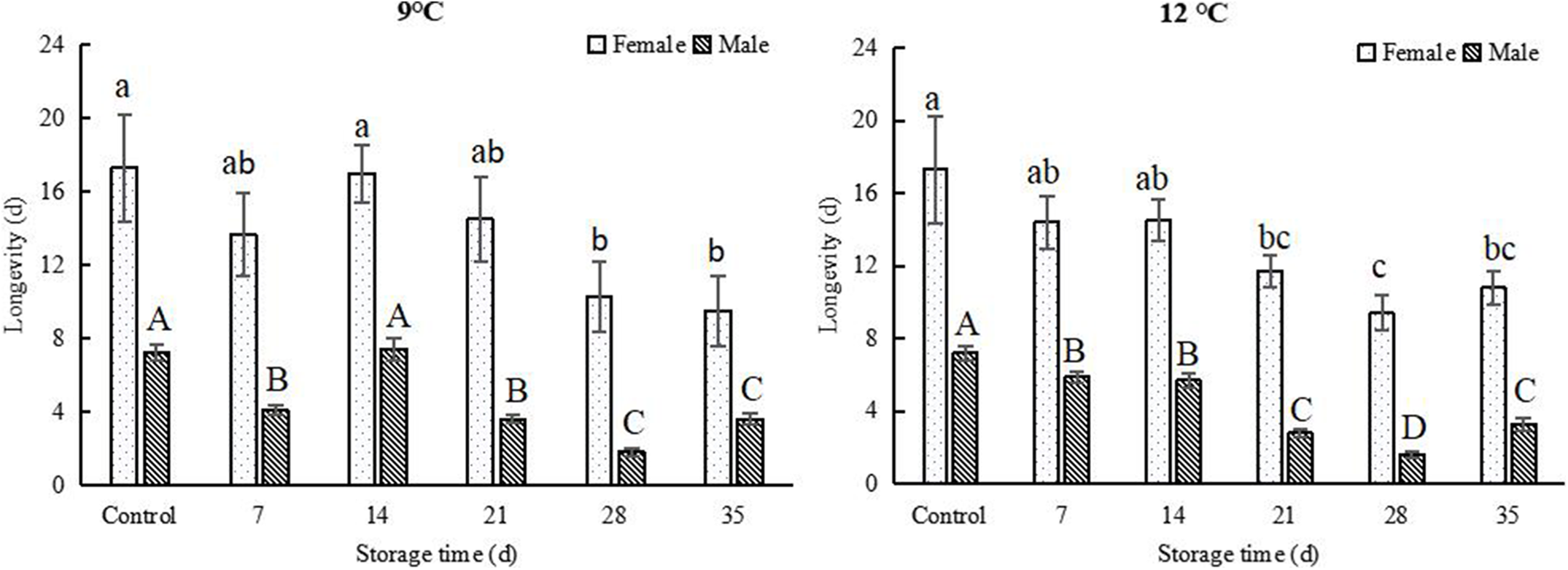
Cold storage has a certain effect on the longevity of B. adoxophyesi in the laboratory (fig. 2). Longevity decreased with the increase of storage time. The longevity of females was longer than that of males at different cold storage temperatures and times. This may be because females are better cold-tolerant than males. At 9°C, stored female wasps for 14 days had the longest lifespan (17.0 days), followed by those stored for 7 and 21 days (14.8 days and 14.5 days, respectively), and all were not significantly different from unrefrigerated females (17.3 days). When the cold storage time was prolonged to 28 and 35 days, the lifespans of females were short (10.3 days and 9.5 days, respectively) compared with the control (F 5,114 = 4.694, P = 0.001). The lifespan of males was progressively short (7.4–1.8 days) after different periods of refrigeration (9°C), with significant differences from that of unrefrigerated males (F 5,114 = 99.522, P = 0.000). The longevity of females was not significantly different from the control group after 14 days of cold storage at 12°C. However, the longevity of females significantly decreased after 28 days of refrigeration, with an average longevity of 9.4 days (F 5,114 = 7.348, P = 0.000). The longevity of males gradually decreased after different periods of cold storage, where the male lifespan was the shortest after 28 days of cold storage, with a survival period of 1.6 days (F 5,114 = 94.048, P = 0.000) (fig. 2).
The lifespan of Bracon adoxophyesi adults stored for different storage temperature-time combinations with RH 65% ± 5% and a 14:10 h (light: dark) photoperiod. Lifespan refers to the time from the end of cold storage to the death of the parasitic wasp. Values are represented as the mean ± SE. Different lowercase letters above the bars indicate significant differences among the longevity of females at different storage times, while different uppercase letters indicate significant differences among the longevity of males (Tukey’s test, P < 0.05).

Effects of cold storage on parasitism of B. adoxophyesi
There was no significant difference in the number of parasitic wasps that paralysed the host to death after refrigeration at different temperatures and times (9°C: F 5,24 = 0.596, P = 0.703; 12°C: F 5,24 = 1.767, P = 0.158). Still, there was a greater effect on the number of hosts parasitised after refrigeration (fig. 3). The parasitism rate of B. adoxophyesi on the host was the highest (43.0%) for 7 days of storage at 9°C, followed by 21 and 14 days of refrigeration with parasitism rates of 35.0% and 33.0%, respectively, and there were no significant differences between these three treatments and control (40.0%). The prolonged cold storage time for 28 and 35 days resulted in a significantly lower parasitism rate of 27.0% and 17.0%, respectively (F 5,24 = 10.973, P = 0.000). The reduction percentage was 32.5% and 57.5% after 28 and 35 days of storage, respectively. Therefore, the optimal cold storage time for B. adoxophyesi parasitoids was 21 days at a temperature of 9°C. The parasitism rate of B. adoxophyesi wasps reached 46.0% when refrigerated at 12°C for 7 days, which was slightly higher than that of the control treatment (40.0%), and the parasitism rate was 34.0% when refrigerated for 14 days, which was slightly lower than the control (F 5,24 = 9.494, P = 0.000). The extension of cold storage resulted in a gradual decline in the parasitism rate of the wasps on their hosts. When the cold storage time was extended to 35 days, the parasitism rate was 15.0%, which represents a decrease of 62.5% compared to control. The results indicated that the optimal storage temperature and time of B. adoxophyesi was 12°C for 14 days.
The paralysis and parasitism rate of Bracon adoxophyesi adults stored for different temperature–time combinations with RH 65% ± 5% and a 14:10 h (light: dark) photoperiod. Values are represented as the mean ± SE. Different lowercase letters above the bars indicate significant differences among the rate of paralysis of the host by the parasitoid wasps after storage for different times, while different uppercase letters indicate significant differences among the parasitism rate of the parasitoid wasps on the hosts (Tukey’s test, P < 0.05).

Effects of cold storage on the fecundity of B. adoxophyesi
The average total egg production of B. adoxophyesi adults was 193.5 ± 42.95, 237.7 ± 26.35, 150.5 ± 39.12, and 218.3 ± 53.45 eggs per stored female for 7, 14, 21, and 28 days at 9°C, respectively. There were no statistically significant differences between the treatments and control (F 5,54 = 2.681, P = 0.031). However, when the cold storage time was prolonged to 35 days, the total egg production of the wasps was reduced to 122.0 ± 27.48 eggs for each female, with a reduction percentage of 61.34% compared with the control group (fig. 4). Furthermore, different storage times had little effect on the spawning time and average daily egg production of female wasps, with the average spawning days ranging from 7.4 ± 1.48 to 11.6 ± 2.27 days (F 5,54 = 2.472, P = 0.044) and the average daily egg production of a single female ranging from 14.89 ± 2.05 to 21.63 ± 8.07 eggs (F 5,54 = 0.515, P = 0.764). These values were not significantly different compared to the control group (figs. 4, 5). At 12°C, the total egg production of females gradually reduced after 7 to 35 days of refrigeration, accompanied by a reduction in the egg-laying period. After 35 days of refrigeration, the total egg production decreased with an average of 130.5 ± 18.59 eggs per female (F 5,54 = 4.677, P = 0.001), and the egg-laying period was short (9.4 ± 0.97 days) (F 5,54 = 3.10, P = 0.016). These values represent a decrease rate of 58.65% and 38.96%, respectively, compared to the control group (315.6 ± 53.09 eggs/female and 15.4 ± 2.27 days) (F 5,54 = 1.891, P = 0.111) (figs. 4, 5).
The fecundity of Bracon adoxophyesi adults stored for various storage temperature–time combinations with RH 65% ± 5% and a 14:10 h (light: dark) photoperiod. Values are represented as the mean ± SE. Different lowercase letters above the bars indicate significant differences among total egg production of parasitic wasps, while different uppercase letters indicate significant differences among average daily egg production of parasitoid wasps (Tukey’s test, P < 0.05).

The spawning days of Bracon adoxophyesi adults stored for various storage temperature–time combinations with RH 65% ± 5% and a 14:10 h (light: dark) photoperiod. Values are represented as the mean ± SE. Different lowercase letters above the bars indicate significant differences among the spawning days of parasitoid wasps after different storage times (Tukey’s test, P < 0.05).

Effects of cold storage on the survival of B. adoxophyesi progeny
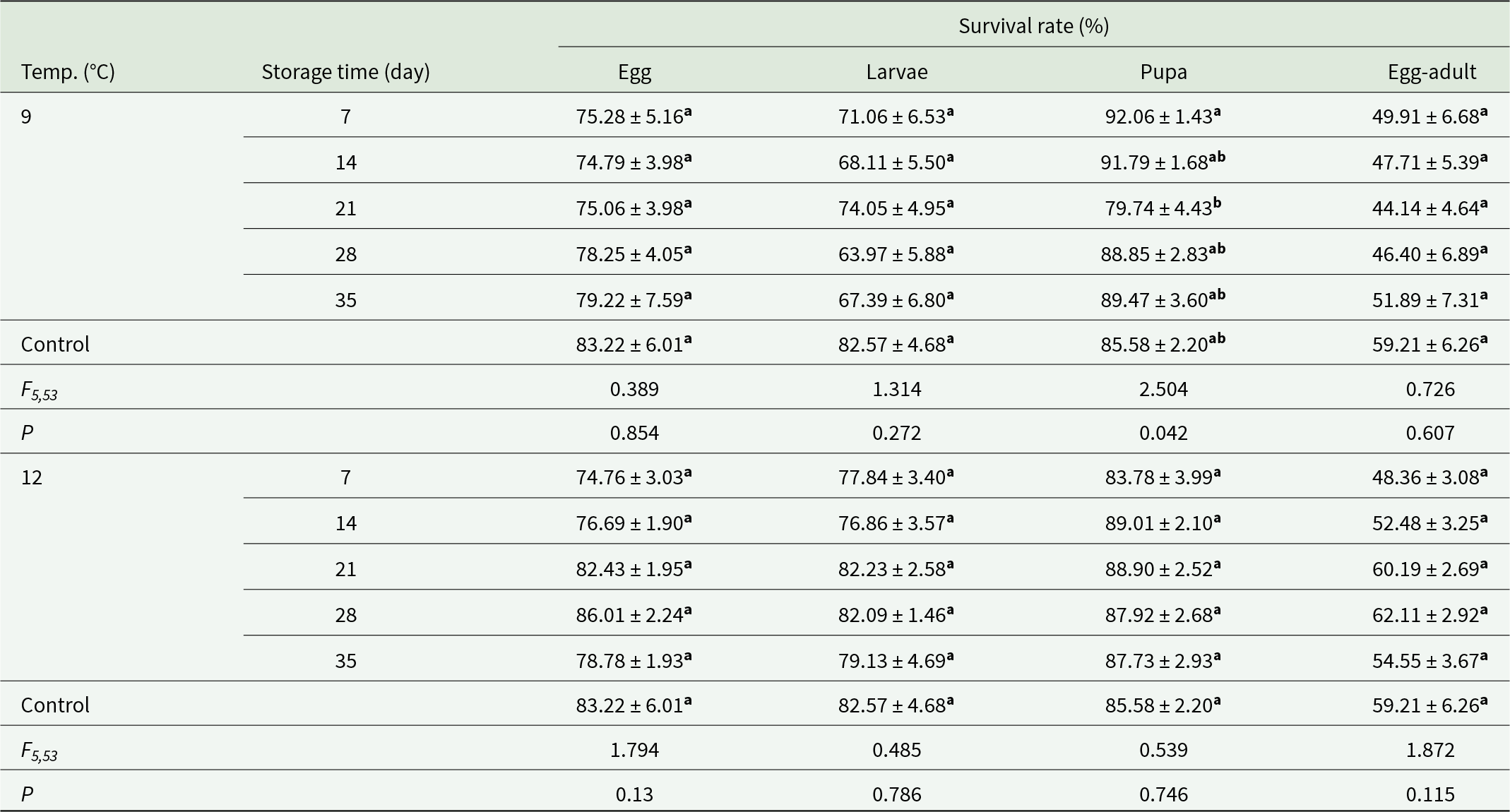
There was no significant difference in the survival rate of eggs and larvae of wasp offspring when the adults were refrigerated at 9°C for different periods (Eggs: F 5,53 = 0.389, P = 0.854; Larvae: F 5,53 = 1.314, P = 0.272). The pupation rate of the offspring was 92.06% after being stored for 7 days under refrigeration, which was higher than the control with a percentage of 7.57%. On the other hand, the pupation rate of the offspring for 21 days of cold storage was 79.74%, which was lower than the control with a percentage of 6.82% (F 5,53 = 2.504, P = 0.042). The survival rates of B. adoxophyesi progeny from egg to adult were 49.91%, 47.71%, 44.14%, 46.40%, and 51.89% after 7, 14, 21, 28, and 35 days, respectively, of storage. There were no significant differences in these values compared to the control (F 5,53 = 0.726, P = 0.607) (table 2). The refrigeration of B. adoxophyesi adult for 7 days at 12°C resulted in a low survival rate for their offspring, with percentages of 74.76%, 83.78%, and 48.36% for eggs, pupae, and egg-adults, respectively. Conversely, the survival rate of offspring larvae after 14 days of refrigeration was the lowest (76.86%). There were no significant differences in the survival rate of wasp offspring in all stages for different times at 12°C compared to the control group (Eggs: F 5,53 = 1.794, P = 0.13; Larvae: F 5,53 = 0.485, P = 0.786; Pupa: F 5,53 = 0.539, P = 0.746; Egg-adult: F 5,53 = 1.872, P = 0.115) (table 2).
Progeny survival rate of B. adoxophyesi after adults stored for various storage temperature-time combinations with RH 65% ± 5% and a 14:10 h (light: dark) photoperiod

Means (± SE) in the same column followed by the same letter are not significantly different at the probability level of 0.05 determined by the Tukey’s test.
Effects of cold storage on the sex ratio of B. adoxophyesi progeny
Cold storage affected the sex ratio of B. adoxophyesi progeny (fig. 6). The highest percentage of female wasp offspring was 47.62% when adults were stored at 9°C for 7 days compared to the control (29.20%). Prolonging the cold storage time led to a gradual decrease in the female population of B. adoxophyesi progeny. When the cold storage period was extended to 35 days, the female proportion of parasitoid offspring decreased to 15.55%, which represents a reduction of 46.75% compared to the control group. These results showed significant differences between the treatments (F 5,53 = 2.723, P = 0.029). At 12°C, the female percentage of B. adoxophyesi offspring was 46.35%, 42.01%, 41.34%, and 42.18% after being stored for 7, 14, 21, and 28 days, respectively, which were higher than the control group (29.20%). This phenomenon may be attributed to the extended adult longevity induced by cold storage, which enhances mating opportunities for females, thereby elevating fertilization rates and subsequently increasing the proportion of female offspring. After 35 days of cold storage, the percentage of female wasp offspring reduced to 27.80%, which was significantly different from the control group (F 5,53 = 3.369, P = 0.01).
The sex ratio of Bracon adoxophyesi progeny after adults stored for various storage temperature–time combinations with RH 65% ± 5% and a 14:10 h (light: dark) photoperiod. Values are represented as the mean ± SE. Different lowercase letters above the bars indicate significant differences among the female proportion of B. adoxophyesi progeny after adults stored after different times (Tukey’s test, P < 0.05).

Discussion
Using natural enemies is an important part of biological pest control. Cold storage technologies have been applied to natural enemy storage, which demonstrated that they impede the growth and development of natural enemies, as well as reduce their metabolic rate (Hance et al., Reference Hance, Baaren, Vernon and Boivin2007). Furthermore, the survival, emergence, and fecundity of these natural enemies declined as a consequence of the reduction in storage temperature and the extended storage period that led to the short lifespan of these natural enemies (Colinet and Boivin, Reference Colinet and Boivin2011; Forouzan et al., Reference Forouzan, Jalali, Ziaaddini and Hashemi2018). When B. hebetor wasps were stored at 12°C, wasps’ mortality increased with storage time (0, 1, 2, 3, and 4 months), and the female mortality rate exceeded 50% as the storage period went beyond 3 months (Mansour, Reference Mansour2017). In this study, the survival rate of males and females of B. adoxophyesi adults reached 100% after 7 days of cold storage at 9°C and 12°C. Survival of both male and female wasps was over 91% within 35 days of refrigeration at 9°C. At the same time, the study found that B. adoxophyesi females had a relatively higher tolerance to low temperature than the males, which is more favourable for offspring reproduction.
The longevity of B. adoxophyesi adults after cold storage declined with the extension of the time, which may be because the parasitoids were compelled to consume a considerable quantity of lipid nutrients and energy to withstand adverse temperature conditions. Furthermore, the adults themselves are unable to synthesise lipid substances, which resulting a trade-off in the distribution of resources for survival and reproduction that affects their lifespan (Jervis et al., Reference Jervis, Ferns and Heimpel2003; Visser et al., Reference Visser, Le Lann, Den Blanken, Harvey, van Alphen and Ellers2010). Moreover, the accumulation of toxic metabolites during prolonged cold storage may result in mortality or a reduction in fitness of parasitoids (Storey and Storey, Reference Storey and Storey1988). Additionally, similar results have been documented in multiple other species of parasitoids, such as H. hebetor (Chen et al., Reference Chen, Zhang, Zhu and Throne2013), Tamarixia radiate (Hymenoptera: Eulophidae) (Zhang et al., Reference Zhang, Lu, Guo, Shen, Wang, Sang and Qiu2020).
The parasitism rate of parasitic wasps exhibited a general decline as a result of the extension of storage time and low temperature, and the decline became clearer with an increase in storage time (Nadeem et al., Reference Nadeem, Ashfaq, Hamed and Ahmed2010). This is mainly because the cold damage caused by refrigeration will gradually accumulate with the decrease of temperature and/or the extension of refrigeration time (Colinet and Boivin, Reference Colinet and Boivin2011). The paralysis rate of B. hebetor was slightly reduced after 1– 3 months of storage at 12°C, and the paralysis rate was significantly reduced in females stored for 4 months, but the parasitism rate was slightly more affected by cold storage (Mansour, Reference Mansour2017). In this study, the number of paralysed hosts by B. adoxophyesi after refrigeration at different temperatures and times was not significantly different from the control group, and both were more than 80%. The parasitism rate of the parasitoid wasps on the hosts was 43.0% and 46.0% when refrigerated at 9°C and 12°C for 7 days, respectively. This was slightly higher than the control (40.0%), but there were no statistically significant differences between these results. Upon extending the refrigeration period to 35 days, the parasitism rate of the parasitoid wasps exhibited a notable decline, where reached to 17.0% (9°C) and 15.0% (12°C). The results demonstrated that the parasitism rate of B. adoxophyesi decreased with the extension of cold storage time.
The studies have demonstrated that cold storage impacts the egg production of parasitic wasps. In general, the fecundity of these wasps tended to decrease with low storage temperature and the extension of the period (Al-Tememi and Ashfaq, Reference Al-Tememi and Ashfaq2005). In this study, the total egg production of B. adoxophyesi females stored at 9°C and 12°C for 7–28 days showed no significant difference compared to the control group. However, when the storage period was extended to 35 days, the total egg production of the parasitic wasps decreased by 61.34% and 58.65%, respectively, relative to the control. This may be due to low temperatures delaying the sperm formation of the parasitoids (Hanna AD, 2009), or the consumption of lipids during storage leads to a decrease in the egg numbers in the ovaries of parasitic females (Ismail et al., Reference Ismail, Vernon, Hance and Baaren2010). However, the extremely low temperatures may severely affect the development of both ovaries and testes, which leads to infertility (Chen et al., Reference Chen, Yang, Sun, Tian, Sun and Wu2024; Zhang et al., Reference Zhang, Lu, Guo, Shen, Wang, Sang and Qiu2020). As for the specific reasons for the changes in total egg production after cold storage of B. adoxophyesi in this study, further investigation is needed.
Refrigeration may adversely affect the insect growth, development, longevity, and ability of parasitism or predation. These effects may occur immediately in the developmental stage or even in offspring (Colinet and Boivin, Reference Colinet and Boivin2011; Visser et al., Reference Visser, Le Lann, Den Blanken, Harvey, van Alphen and Ellers2010). The results of this study showed that cold storage of B. adoxophyesi adult parasitoids in a cold environment had no discernible impact on the survival of their offspring (egg hatching, larval pupation, and adult emergence). Cold storage can also change the sex ratio of insects (Foerster and Doetzer, Reference Foerster and Doetzer2004). The female percentage in the offspring of B. adoxophyesi parasitoid was higher than the control when stored at 9°C for 7 days or 12°C for 7, 14, 21, and 28 days. However, there were no statistically significant differences between these results. Although these values did not reach significant differences compared to the control, the cold storage may have increased the proportion of females in the offspring. Similar results were obtained in other parasitic wasps, such as T. radiate (Huang et al., Reference Huang, Tang, Liao, Sun, Lei and Wu2025; Zhang et al., Reference Zhang, Lu, Guo, Shen, Wang, Sang and Qiu2020), Lysiphlebus fabarum (Hymenoptera: Aphidiidae)(Mahi et al., Reference Mahi, Rasekh, Michaud and Shishehbor2014), and Exorista japonica (Diptera: Tachinidae) (Seo et al., Reference Seo, Seo, Lee and Cho2021). The sex ratio of parasitic wasps was affected by numerous factors, and further research is required to ascertain whether refrigeration can increase the female proportion of B. adoxophyesi progeny. To conclude, we demonstrated in this study the impact of low temperature and duration on the survival, parasitism, and reproduction of B. adoxophyesi. These results indicate that refrigeration at 9°C for 21 days and 12°C for 14 days was a viable approach. Additionally, the female percentage of B. adoxophyesi progeny may be enhanced under these conditions, which is an important method to provide sufficient the numbers of individuals for application on a large scale.
Conclusion
We present, for the first time, an analysis of the effects of storage temperatures of 9°C and 12°C, along with incubation periods of 7, 14, 21, 28, and 35 days, on the biological fitness of B. adoxophyesi. The results indicated that the survival rates of both female and male wasps exceeded 90.0% after storage at 9°C and 12°C for 35 days. Specifically, female wasps exhibited maximal longevity at 14 days post-refrigeration, while male longevity showed a progressive decline with increasing storage duration. Peak parasitism rates on the hosts were observed after 7 days of storage at both temperatures, with no significant variation in female fecundity over 28 days. Crucially, the highest wasp vitality was achieved after 21 days at 9°C or 14 days at 12°C, establishing these as the optimal temperature–duration combinations for storage. These findings carry substantial implications for the advancement of biocontrol strategies, particularly in optimising cold storage protocols for B. adoxophyesi. The proposed methodology not only ensures high survival rates and sustained parasitic efficacy but also enhances the proportion of female offspring, thereby bolstering long-term biocontrol effectiveness. This study provides a critical scientific foundation for refining the deployment of parasitic wasps in biocontrol programs, offering a robust, evidence-based approach to enhance their efficiency and sustainability in integrated pest management systems.
Supplementary material
The supplementary material for this article can be found at https://doi.org/10.1017/S0007485325100114.
Acknowledgements
This study was supported by the Major Planned Science & Technology Project of Hainan Province, China (Grant number: ZDXM 20120029) and the National Key Research and Development Program of China (Grant number: 2023YFD2200704).
Author contributions
Baozhu Zhong: Writing original draft, Validation, Supervision, Methodology, Investigation, Formal analysis, Funding acquisition, Conceptualisation. Chaojun Lv: Writing – review & editing, Validation, Software, Methodology, Data curation, Project administration. Talat M. Abdelrahman and Habib Ali: Review & editing, Visualization, Data curation. Chaoxu Li: Investigation. Wenlian Li: Investigation.
Competing interests
All authors read and approved this work for publication and declare no competing interests.
Data availability
Data will be made available on request.