INTRODUCTION
With the democratic transitions in Eastern Europe, social scientists have increasingly focused on the influence of state institutions on political values (Dalton 1994; Finifter 1996; Finifter and Mickiewicz 1992; Gibson and Duch 1993; Mason 1995; Miller, Hesli, and Reisinger 1994, 1996; Rohrschneider 1994; Rose and Page 1996). Of particular concern has been whether individuals long subject to totalitarian regimes retain nondemocratic political values that might impede the transition to a stable democratic system. Although the focus has been on political values, states can affect other values as well. For example, Rohrschneider (1996c) found that East German elites, because of their long-term participation within a socialist system, were less likely to have a positive view of market economies. Little systematic research, however, examines the ways in which state policy has long-term effects on gender roles. If long-term participation in nonfree elections inculcates nondemocratic attitudes, then long-term experience in a state where institutions encourage women's employment should also have a long-term effect on citizens' attitudes toward women. This article examines the extent to which states influence citizens' gender role attitudes by comparing East and West Germany since unification.
Separating regime effects from other factors influencing citizen values is difficult, and the literature is characterized by mixed conclusions (see, for example, Anderson and O'Connor 2000; Bauer 1991; Bauer-Kaase 1994; Dalton 1994; Finifter and Mickiewicz 1992; Mason 1995; Miller, Reisinger, and Hesli 1993; Rose and Page 1996). Two factors impede our ability to separate out regime effects on citizen values. First, national differences in citizen values can develop for many reasons (e.g., historical events, cultural norms). Hence, national differences alone cannot be used to characterize the effect of regimes on individual attitudes. Second, the lack of survey research on citizen values before and during communist regimes makes it difficult to utilize democratic transitions to isolate changes in regime type. Most other regime changes that affect gender role attitudes are small or occur gradually, and survey questions on gender roles have tended to follow, rather than to precede, such changes.
For these reasons, postunification Germany is a good case for exploring the effects of the state on gender roles. The separation of the two Germanys in 1949 and their unification 40 years later allows a direct and relevant comparison of citizens within the newly democratized state to those in an older democracy with the same cultural background (Rohrschneider 1996a). By comparing attitudes of East Germans and West Germans, I can hold cultural attitudes toward women constant and compare only the effects of the different regimes on attitudes (Rose and Page 1996). While the area that became East Germany had a different religious composition from that which became the Federal Republic of Germany, the division and unification of Germany provides, in Rohrschneider's (1996b, 43) words, a “quasi-natural experiment” that allows us to explore the impact of state policy on gender role attitudes.1
In addition to differences that existed pre–World War II, the quasi-natural experiment is not perfect in that emigration and flight resettled many conservative East Germans in the West.
In exploring the state's role in shaping gender roles, I contrast two alternative explanations for attitudes in East and West Germany: 1) Robert Rohrschneider's (1994, 1996a) institutional learning model and 2) a demographic/compositional explanation focusing on individual social characteristics, such as religion. While some compositional effects may be unrelated to state policy, society's composition can also be influenced by the regime. For example, the German Democratic Republic's ideology and policies contributed to the higher number of atheists in East Germany compared to West Germany. I explore two such indirect regime effects on societal composition that might influence citizens' gender role attitudes: differences in women's employment and in religiosity.
I begin by describing the East and West German regimes' gendered ideologies and policies. I then examine the wider literature on gender role attitudes and on the socializing effects of communist regimes. From this literature, I develop specific hypotheses to be examined empirically. The third section discusses the data sources and variables used in this analysis. The fourth section examines the results of the analysis, and the final sections elaborate the implications of these findings for understanding gender role attitudes, states' effects on citizen values, and German unification.
GENDER ROLES IN GERMANY
The governments of the German Democratic Republic (GDR) and the Federal Republic of Germany (FRG) took very different positions on the role of women in society, particularly on the question of whether women could combine work and family life. These differences were reflected in the two governments' social policies, affecting how citizens experienced the connection between motherhood and work.
The state policies toward women of the GDR were similar to those in communist countries throughout Eastern Europe.2
Commonalities among these countries exist despite huge differences in the situation and concerns of women within the individual countries (Gal and Kligman 2000b; Rueschemeyer 1998).
Like the policies of other postcommunist countries, the GDR's were designed to facilitate women's dual role as both worker and mother (Kolinsky 1993; Rueschemeyer and Schissler 1990). The East German constitution included a statement of equal rights, particularly the right of women to participate in the workplace (Kolinsky 1993). The GDR government also provided extensive benefits to working mothers: child care, maternity leave, and reduced work hours for those with two or more children. Its subsidized child-care system was widely utilized: 80% of children 6–36 months of age were in state-supported centers just prior to unification (Geissler 1991, 13; Rudolph, Appelbaum, and Maier 1990, 36). In addition, the rhetoric of the East German regime emphasized the dual “worker-mother” role, particularly after 1972 (Ferree 1993). Women were often portrayed as workers or working mothers in magazine and newspaper photos (Dölling 1990; Merkel 1991–92, 2–3). If the GDR regime emphasized women's employment, there was little or no attempt to change the division of labor within the family through social policy (M. Klein 1993, 273; Winkler 1990, 269). Indeed, the policies permitting women to combine motherhood and employment reinforced the idea that women were responsible for the household and children (Ferree 1993).3
Other gender inequalities ignored by the East German regime include the occupational segregation of women, their absence from leading political positions, problems of sexual violence, and the existence of multiple sexual orientations (Hampele 1991; Kolinsky 1993; “Programm des UFV” 1990). However, I focus here on two limited aspects of gender roles.
The positions and policies of the FRG government before unification, though less explicit, discouraged mothers from working. Until 1977, FRG law stated that women should only be employed if it did not interfere with their familial duties (Rueschemeyer and Schissler 1990, 74). Moreover, the lack of child-care facilities made a continuous career for women with children difficult. Hedwig Rudolph, Eileen Appelbaum, and Friederike Maier (1990, 36) reported that only 4% of children under three years of age were in child-care facilities and that there were insufficient kindergarten spaces to meet demand. Many child-care centers also kept short hours, closing at 4 p.m., and public schools expected children to go home for lunch (Geissler 1991, 19; M. Klein 1993, 276). Although the women's movement in the 1970s spurred policy changes that encouraged formal equality in the workplace and increased support for child care, FRG government policy has never encouraged the active employment of mothers. Like its East German counterpart, the FRG government also used its policies to encourage traditional marital roles (Geissler 1991). For example, West German tax policy gives preference to families based on traditional gender roles (M. Klein 1993, 276). To understand the role these policies may play in the formation of citizens' gender role attitudes, I first discuss the mechanisms by which citizens acquire these attitudes.
INSTITUTIONAL LEARNING AND COMPOSITIONAL EXPLANATIONS OF GENDER ROLES
Differences in gender role attitudes between East and West Germany may arise from two types of processes. First, citizens internalize values by participating in political systems that emphasize and reflect those values. This is the mechanism described in Rohrschneider's institutional learning hypothesis (Rohrschneider 1996a, 1999). Another possibility is that certain gender role attitudes are connected to particular social characteristics—either because of individual self-interest or because such characteristics represent lifestyle choices that are reflected in attitudes. Thus, the appearance of East–West differences in gender roles may be an artifact of the social or demographic composition of East and West Germany.
Regime Effects and Institutional Learning
Although a connection between citizen values and state institutions has long been posited (Almond and Verba 1963), the ability of political institutions to affect their citizens' political values is still hotly debated. Some suggest that nondemocratic political systems had little effect on public opinion (Dalton 1994; Finifter and Mickiewicz 1992), while others have found that regimes did influence citizens' beliefs and attitudes (Bauer 1991; Bauer-Kaase 1994; Mason 1995; Rose and Page 1996). James Gibson and Raymond Duch (1993) come to a mixed conclusion, finding evidence of regime effects in the former USSR even as they observe that many democratic values are widespread. Many of these studies are silent about the mechanisms by which citizens' values are affected by regimes. An exception is Rohrschneider (1994, 1996a, 1996b, 1996c, 1999), who posits an institutional learning model of attitude change. Under this model, individuals acquire democratic attitudes through day-to-day political experiences that expose them to the ideals that sustain the institutional frameworks and practices.
Given the explicit GDR policies that supported women in combining motherhood and employment, institutional learning predicts that the experience of East Germans with these policies would make them more supportive of combining motherhood and employment than West Germans. On the other hand, since the GDR regime, like its FRG counterpart, was mostly silent or more traditional in its (lack of) policies on marital roles within the family, one might expect that institutional learning in this case would produce a convergence of attitudes among East and West Germans. Thus, an institutional learning theory of gender roles would predict the following:
H1: East Germans should be more supportive of combining motherhood and employment than West Germans.
H2: There should be no differences between East and West Germans on attitudes toward women's role in the family.
The alternative hypothesis presented by Barbara Einhorn (1993, 162) and Jane Jacquette and Sharon Wolchik (1998, 13–14) argues that women have rejected public life and full-time employment as a result of their experiences under postcommunism. If this is the case, East German women should be less supportive of equal gender roles than West German women.
A second question that arises is how the policies of the unified Germany will affect any differences in gender roles between East and West Germans. Much depends on where we believe socialization ends. On the one hand, many scholars see socialization as occurring largely in the early years and then persisting throughout the adult years (Inglehart 1990; Searing, Schwartz, and Lind 1973; Sears 1990; Sears and Funk 1999). In this case, we should expect any differences to persist in the postunification period. Rohrschneider's institutional learning model, on the other hand, suggests that East German gender roles should move toward those of their West German counterparts as they begin to assimilate into the West German political system. Thus, two different dynamic hypotheses are suggested in the literature:
H3: Over time, the differences between East Germans and West Germans should diminish.
H4: Over time, the differences between East Germans and West Germans should persist.
Compositional Explanations
Many social characteristics explain gender roles, but two are clearly influenced by the East German state: religion and women's employment. Within the domain of religion, both respondents' religious denomination and strength of religious belief have been shown to have a significant effect on their stance on gender roles (Banaszak and Plutzer 1993a, 1993b; Erikson 2003; Inglehart and Norris 2003; Wilcox 1991; Wilcox and Jelen 1991). The evidence on religiosity is very consistent (see Wilcox 1991, 542); individuals who are very religious are less likely to support egalitarian gender roles, since religious doctrine often encourages a traditional view of women's roles. The role of religious denomination is less clear. Although the Roman Catholic Church has also promulgated a traditional view of women's roles, empirical analyses find that Catholicism does not always lead to more traditional attitudes (Hayes 1995; E. Klein 1987; Scott 1998; Wilcox and Jelen 1991; but see Erikson 2003 and Jelen and Wilcox 1998). Religious denomination is one characteristic of East and West Germany that differed before the founding of the GDR. In 1946, Catholics were concentrated in West German regions whereas East Germany was predominantly Protestant (Ausschuss der deutschen Statistiker für die Volks- und Berufszählung 1946 1949, 100–107). Therefore, in the following discussion, I focus not only on this difference but also on those that reflect changes wrought by the GDR regime. I expect that if religion is the main determinant of gender roles, differences between gender role attitudes of East and West Germans should diminish once religious denomination and religiosity are taken into account.
The second major factor that shapes gender role attitudes is women's labor force participation. Because workforce participation affects gender role attitudes through individual self-interest (broadly conceived), different considerations come into play for men and women. Women who work outside the home are more likely to believe that women's employment is acceptable and that policies supporting this lifestyle, such as child-care centers, are essential (Gerson 1985; Plutzer 1991; Scott 1999).4
Another possibility is that the causality is reversed; that is, gender role attitudes determine individuals' lifestyle choices. However, several panel studies suggest that the relationship is unidirectional and that lifestyle choices affect gender role attitudes (Andersen and Cook 1985; Thornton, Alwin, and Camburn 1983; Waite, Goldscheider, and Witsberger 1986).
The East German government greatly influenced religious composition and women's employment; beyond these, however, a number of other compositional variables influence gender role attitudes. I include these additional compositional “controls” in order to account for all factors that may contribute to compositional differences. These factors are education, socioeconomic status, age, family size, and left–right ideology. Previous research in the United States and Europe finds that education influences attitudes toward gender roles, the family, and sexual behavior (Banaszak and Plutzer 1993a, 1993b; Davis and Robinson 1991; E. Klein 1984; Plutzer 1988; Scott 1999; Wilcox 1991). Higher socioeconomic status may also affect gender role attitudes.5
Income is also a variable in many studies of gender roles, although several authors have found that it has little effect (Banaszak and Plutzer 1993a, 1993b; Wilcox 1991). However, differences in the cost of living as well as income disparities between East and West Germans make the variable misleading in an analysis of East and West Germany. Hence, I exclude income as a variable.
To summarize, even if East–West differences in gender role attitudes exist, differences in religious denomination, religiosity, the extent of women's employment, or other compositional factors may explain such differences. This suggests the following compositional hypothesis:
H5: After controlling for individuals' social characteristics, the gap between East and West German gender role attitudes will disappear.
The analysis that follows examines both institutional learning and compositional effects on gender role attitudes. I also focus specifically on the compositional effects of women's employment and religion given the East German government's influence on these factors.
DATA AND METHODS
I analyze data from four German General Social Surveys (ALLBUS) spanning 14 years.6
The ALLBUS is conducted regularly by the Zentralarchiv für Sozialforschung (Cologne) and the Zentrum für Umfragen, Methoden und Analysen (Mannheim). In this study I use data from the 1991, 1996, 2000, and 2004 ALLBUS, made available by GESIS—Gesellschaft Sozialwissenschaftlicher Infrastruktureinrichtungen e.V. (study numbers: ZA-Nr. 1990, ZA-Nr. 2800, ZA-Nr. 3450, ZA-Nr. 3762). The previously mentioned institutions bear no responsibility for the use of the data in this study.
Dependent Variable
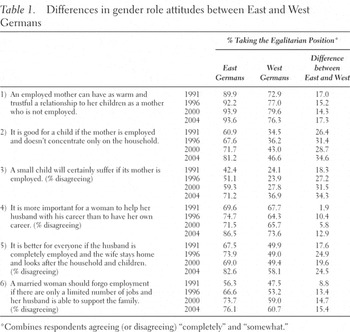
German public opinion polls since unification show that gender role attitudes differ between East and West Germans. Table 1 summarizes the answers to six questions about women's roles within the family and workplace asked in the ALLBUS. Those living in the five Länder of the former East Germany are more supportive of women's employment, more opposed to women sacrificing for their husbands' careers, less likely to think that young children or the family will suffer if women work outside the home, and less likely to agree that women should forgo employment during times when men may have difficulty finding work. There are fewer differences, however, in the attitudes of East and West Germans on the questions in Table 1 that focus on the division of labor between husband and wife (questions 4–6) than on those that focus on children and employment (questions 1–3).
Differences in gender role attitudes between East and West Germans

A confirmatory factor analysis on these six gender role questions confirms that they measure different concepts. The factor analysis found a two-factor solution in the 1996 and 2000 ALLBUS: questions 1–3 weighted heavily on the first factor and questions 4–6 weighted heavily on the second factor. In the 1991 and 2004 surveys, the same two factors appeared, although the second factor (representing attitudes about how employment affects marriage), which explained around 16% of the variance, had an eigenvector of less than one (.99 in 1991 and .92 in 2004).
Given these results and the previous discussion about the lack of GDR or FRG policies and positions against inequalities between husband and wife, two separate indicators of gender role attitudes are utilized in the analyses that follow. One dependent variable measures attitudes toward the effect of women's employment on the raising of children. Respondents were asked whether they 1) agree completely, 2) agree somewhat, 3) disagree somewhat, or 4) disagree completely with the first three statements in Table 1. The third statement was reverse coded so that higher numbers indicated a belief that outside employment does not harm children. The three questions were then added together to create a scale from 3 to 12, with higher numbers indicating that women should be able to combine employment and motherhood successfully.7
The three-item measure's reliability, using Cronbach's alpha, averages .66 (.65 in 1991, .63 in 1996, .65 in 2000, and .72 in 2004).
The second dependent variable measures beliefs about women's roles in relationship to their husbands. Again three questions—numbers 4–6 (all reverse coded) in Table 1—were combined to create this index. The three questions added together to create a scale from 3 to 12, with higher numbers indicating a belief that employment is appropriate for married women.8
The three-item measure's reliability using Cronbach's alpha averages .71 (.71 in 1991, .63 in 1996, .75 in 2000, and .77 in 2004).
Independent Variables
Institutional Learning
Following Rohrschneider (1994, 1996a, 1996b, 1996c) and others, I utilize a dichotomous variable, coded 1 to indicate if the respondent is a resident of the five new federal states or East Berlin. If this variable still has an effect after controlling for individual level characteristics, it would suggest that long-term experience with German Democratic Republic policy affected gender role attitudes.
Compositional Variables
Religious denomination is indicated by a set of three dummy variables. The first is coded 1 when the respondent is a member of the Roman Catholic Church. The second indicates when the respondent is not a member of a religion, and the third denotes when the respondent is a member of a non-state-sponsored Christian religion. The omitted group is mainstream Protestants.9
Members of non-Christian religions were deleted from the analysis. In 1991 they constituted only 13 respondents; after 1996, the sampling frame included non-Germans, hence increasing the number of non-Christians (in 1996 there were 95, though only nine were German citizens). In 2000, there were only 14 German non-Christians and by 2004, 33 Germans were non-Christian (about 1% of the sample).
Because my hypotheses suggest that a woman's own labor force participation affects her gender role attitudes while men are affected by the employment status of their partners, this variable is coded slightly differently for each sex, and men and women's attitudes are analyzed separately. For women, labor force participation is coded as a set of dummy variables representing whether the respondent works, is unemployed and looking for work, is retired, or is a student.10
The student category includes individuals who gave other reasons for not being in the workforce. These reasons were either unspecified or, for a small category of men, involved active duty in the army. However, more than 75% of this group were students.
Finally, I include seven other compositional variables in the analysis. I use a set of two dummy variables to measure education: a variable coded 1 if the respondent had a degree from a Realschule and a variable coded 1 if the respondent had an Abitur or more.11
Because students are tracked into different systems after the fourth year of study in West Germany (OECD 1995, 276–78) and the East and West German school systems differ, years of schooling is not a valid indicator of education. For coding the educational variables, a diploma from an East German polytechnical school after tenth grade is coded equal to a Realschule diploma and an E or F class Abitur or a diploma from an “Erweiterte Oberschule” after twelfth grade as equal to a West German Abitur.
Two prestige scales were available in the ALLBUS: the Wegener scale and a Treiman prestige scale. The Wegener scale was developed specifically in West Germany and is based on prestige ratings by individuals who were not given any categories ahead of time. In analyses not reported here, the Wegener scale correlated more highly to income and education than the Treiman scale, giving it greater predictive validity.
Rohrschneider (1994, 1996a) argues that participants in the GDR regime—such as Communist Party members—are more likely to be inculcated with the norms of the regime. Unfortunately, except in 1991 the ALLBUS does not ask about previous regime participation, and so I was unable to employ this variable. Voters for the PDS, the successor to the East German Communist Party (SED), are likely to have ideological connections with the old regime, but over time PDS identifiers and SED members are less likely to overlap (Zelle 1998).
RESULTS
Because the inculcation of gender role attitudes is likely to differ for men and women, I analyze each sex separately.14
On analyzing men and women separately, see Burns, Schlozman, and Verba (2001, 48–50).
Regime Effects and Institutional Learning
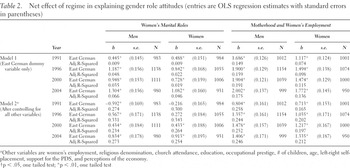
A sequence of regression models can help elucidate the role that institutional learning plays in explaining gender role attitudes (see Table 2). Model 1 is an ordinary least squares regression of gender role attitudes on an East German dummy variable. The coefficient for this variable indicates the mean difference in gender role attitudes between East and West Germans. In all four years, East Germans are significantly more supportive of nontraditional roles than are West Germans in their attitudes toward marital roles and combining motherhood and employment (see Model 1 of Table 2). However, the mean difference between East and West Germans is larger for attitudes about women combining careers with motherhood than for attitudes about the proper place of women in marriage.
Net effect of regime in explaining gender role attitudes (entries are OLS regression estimates with standard errors in parentheses)

When the compositional factors—religion, religiosity, and women's employment status—and other controls are included in the model (see Model 2 in Table 2), East Germans are still significantly different from West Germans in their gender role attitudes (with two exceptions), although the average effect of the East German dummy declines by 53% (77% for the marital roles variable and 29% for attitudes toward employment and motherhood). Hypothesis 1 is supported by this analysis; for both sexes, the coefficient for East Germans is significant and positive, indicating net of other factors that East Germans are stronger supporters of women combining career and motherhood than are West Germans.
Contrary to Hypothesis 2, however, such differences are also apparent in some of the analyses of marital roles. In 1991, as expected, East German women are not significantly different from West German women in their attitudes toward women's marital roles, and surprisingly, in the same year East German men are significantly less likely to have egalitarian attitudes toward marital roles than West German men after controlling for demographic characteristics. Over time, both East German men and women become more supportive than their West German counterparts of egalitarian marital roles. The dummy variable for East German women remains insignificant in 1996, but in 2000 and 2004 the coefficient is significant and positive, indicating that East German women are more supportive of egalitarian marital roles than are West German women. The size of the coefficient also increases between 1991 and 2004 for both sexes, meaning that East–West differences are growing larger over time.
Thus, the results suggest that regimes play a role in affecting attitudes toward motherhood and employment. The regime effect is not as strong on attitudes toward marriage roles, where the East German regime interfered little, though East–West differences are also found there. Two unexpected results also are found in the analyses of Table 2. First, the East–West gap is smaller in 1991 than in any subsequent year. One reason may be that the first survey was fielded during the months immediately following unification—a time of tremendous change and uproar against the entire East German regime—and the atypical characteristics of unification may have artificially decreased the regime effects. Thus, Rohrschneider (1999, 105) attributes East–West differences that became more pronounced over time to the overwhelming euphoria and consensus that developed during the unification process. It may be that 1991 is simply a poor starting point for our analysis because it was such an unusual time. Nonetheless, the gap between East and West German gender roles as a whole appears to widen over time, contradicting the hypotheses that regime effects should either weaken or merely persist. I return to this puzzle in the discussion.
The Role of Differential Composition
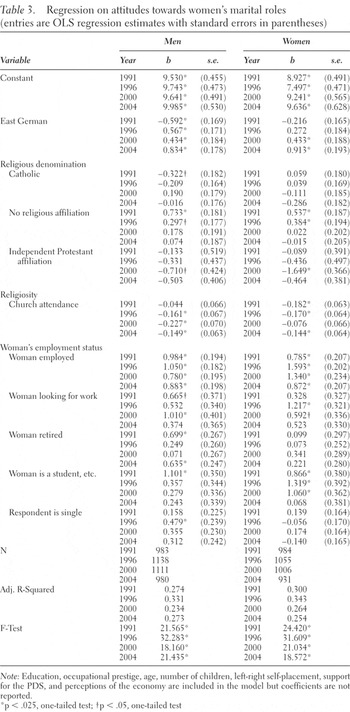
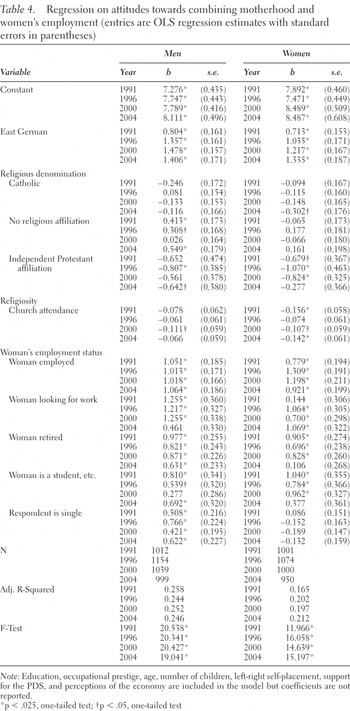
Demographics account for roughly half of the observed differences between East and West German gender role attitudes. Although social factors affect East and West Germans in a similar manner, the two regions differ in the distribution of these factors. This contributes, beyond the regime effects, to very distinct gender role attitudes in East and West Germany. The regression estimates for the variables in Model 2 of Table 2 are included in Table 3 (for attitudes toward women's marital roles) and Table 4 (for attitudes toward combining motherhood and employment). These tables indicate that women's employment and religious characteristics in East and West Germany help to generate the gender role differences between the two regions, in some cases in ways highly specific to a respondent's sex.
Regression on attitudes towards women's marital roles (entries are OLS regression estimates with standard errors in parentheses)

Regression on attitudes towards combining motherhood and women's employment (entries are OLS regression estimates with standard errors in parentheses)

The employment status variables show very consistent compositional effects. Employed women (or their husbands) are significantly different from female homemakers (or their husbands) in all years for both attitudinal measures. The effect of women's employment on gender role attitudes is also fairly large; the coefficient averages about one point on the nine-point scale. Although individual coefficients for other types of women's employment status (e.g., being unemployed or retired) are not always significant, joint F-tests of the employment status variables indicate that they are jointly significant in all 16 analyses in Tables 3 and 4. The coefficients are also uniformly positive, indicating that women homemakers (or their husbands) have less egalitarian gender role attitudes than women (or their husbands) who are unemployed, retired, or students.
These effects are notable because the East German regime changed the employment status of women in East Germany by placing heavy emphasis on women working full time. In 1989, at least 71% of all East German women were employed full time (Ferree 1993, n. 4; Winkler 1990, 63; see also Van Hoven and Pfaffenbach 2002).15
These are the most conservative estimates, which exclude women on maternity leave or those undergoing job-related educational programs. Official statistics placed the number at 91%.
Religion's influence on gender role attitudes appears to be much more varied, but two broad conclusions are possible from the results. First, there is no substantial Protestant–Catholic gap within either country. The coefficients for the dummy variable for Catholic (against the omitted category Protestants) are insignificant in 14 of the 16 equations in Tables 3 and 4. Thus, the fact that West Germany was more Catholic than East Germany does not explain the East–West differences in gender role attitudes.
Second, a secular–religious divide, tapped by church attendance in some models and by the dummy variable for no religious affiliation in others, plays a significant role in understanding gender role attitudes. In Table 3, church attendance is significantly and negatively related to marital gender role attitudes in six of the eight equations, indicating that higher church attendance leads to more traditional gender role attitudes. The dummy variable for respondents with no religious affiliation is significant and positive in four of the eight years in Table 3, leaving only one year in which secular individuals fail to diverge from the religious. In Table 4, church attendance is significant and negatively related to attitudes toward motherhood and women's employment in three of the four equations for women, while for men the dummy for no religious affiliation is significant in three of the four years (with church attendance being significant in the other year). Thus, in all but two (out of 16) analyses, either church attendance or the dummy variable for no religious affiliation is significant. Since the correlations between church attendance and declaring oneself to have no religious affiliation ranged from −.51 to −.59, these two variables are likely capturing the same underlying factor.
The significance of the secular–religious gap is telling because between 1946 and 1991, the GDR regime had a big influence on the percentage of individuals with no religious affiliation; in these years the percentage of individuals with no religious affiliation increased by more than tenfold in East Germany—from 6% to 64%—while in West Germany the percentage of nonreligious reached only 11% (Banaszak 1998, 548). The result is that West Germans are now more religious than East Germans. In the 2004 ALLBUS, fully 64% of the East Germans but only 26% of the West Germans (up from 21% in 1991) said that they never go to church. Church attendance explains about .17 of a point of the difference between East and West German women in attitudes toward mothers working, which is more than a third of the part of the gap explained by all compositional variables. Given the higher percentage of the nonreligious in East Germany, the importance of the religious–secular division increases the East—West differences in gender role attitudes.
STATE INFLUENCE ON GENDER ROLE ATTITUDES
Regimes can influence attitudes directly via institutional learning and indirectly by affecting the society's social composition. As the results show, the German Democratic Republic shaped gender role attitudes both ways.
The rhetoric and social policy of the German Democratic Republic encouraged women's employment, even during motherhood, and these analyses show that the regime had a lasting impact on the East German population. Even when social characteristics were taken into account, there was a lasting difference between East and West Germans in their gender role attitudes. This finding contradicts those of others who have explored East–West German value differences (Banaszak 1998; Bauer-Kaase 1994; M. Klein 1993; but see Rohrschneider 1999). Moreover, ignoring the volatile year of 1991, the regime effect is not dissipating over time and in fact appears to have widened somewhat since 1996. The widening of the difference between East and West Germans fits neither the theory that early attitudes persist throughout adulthood nor the theory that argues that socialization (and hence attitude change) continues through adulthood. In either case, the gap between East and West Germans should not have continued to widen after the GDR regime disappeared. Thus, we need to seek additional explanations for the increased difference. One likely factor may be the rising East German self-identification that positively evaluates some aspects of the GDR period (the so-called Ostalgie; see for example Zelle 1998). In any case, the trend suggests that we should expect the gap between East and West German gender role attitudes to continue for some time to come.
The variation in the composition of social characteristics in the two Germanys also affected the East–West difference in gender role attitudes. Here, women's employment has the strongest and clearest effect. Women's employment increased support for egalitarian gender role attitudes among men and women in both parts of Germany, on average, by a full point. Because women in the GDR continue to be more likely to work, men's and women's gender role attitudes are much more egalitarian. Moreover, this effect is unlikely to disappear in the future. Despite the demise of the policies that created the higher level of women's employment in East Germany, East German women are not abandoning the workplace. Even with the current high levels of unemployment in East Germany, more East German women than West German women are employed. Moreover, surveys show that unemployed East German women continue to aspire to full-time employment (Senatsverwaltung für Arbeit und Frauen 1992, 8). The data over time suggest that women remain interested in employment, which means that differences in gender role attitudes are likely to persist.
The division between the religious and the nonreligious is also an important factor in understanding attitudes about women's role in the marriage. East German policies discouraging people from joining organized religions have therefore had a lasting legacy on gender roles. There are many more East Germans than West Germans who have no religious affiliation and do not attend church. Moreover, unification did not result in a wave of East Germans returning to the church; the number of East Germans claiming no religious affiliation increased slightly between 1991 and 2004 (from 64.5% to 73%).16
These figures are taken from the 1991 and 2004 ALLBUS surveys.
Finally, these analyses suggest that it is important to understand the nuances of gender policy in order to capture regime effects. The East German government had a strong effect on attitudes toward combining employment and motherhood, as one would expect given their policies. The GDR regime's influence on attitudes toward the proper role of women in marriage was weaker, as the lack of official policy on the issue would lead us to believe. Yet social policy that increased women's employment and made society more secular had a strong effect on all gender role attitudes. The GDR's social policy reached beyond its immediate social effect to convey a political message to its citizens and to change the social characteristics of East German society in ways that influenced a variety of gender role attitudes.
CONCLUSION
This research suggests that states play a large role, both directly and indirectly, in transforming citizens' gender attitudes. Whether through rhetoric, ideology, or policy, individuals can learn basic values, like gender norms, from the states that govern them.
The regime effects found here suggest that political scientists need to take a wider view of the way that regimes influence citizen attitudes. Political scientists have tended to focus on how states influence citizens' political and economic attitudes. However, my research suggests that states influence other values besides explicitly political and economic ones. Indeed, this East–West German comparison shows that states' gender definitions gender their citizens' attitudes as well. The state's ability to alter citizens' gender attitudes has enormous implications for women's political, social, and economic equality. It also suggests that other social attitudes may be open to state influence.
If this research shows regimes influencing citizen attitudes, how can we explain the mix of findings in the wider comparative literature, some of which shows regimes having no effect on democratic and economic values while others find the opposite? In the area of gender roles, it is important to note that East Germany differs from other postcommunist countries in the degree to which gender role attitudes were contested. While other postcommunist countries have seen continued contestation around gender roles since the transition, the socialist state's policies toward the woman worker were challenged less in East Germany because those policies did not contradict beliefs held by many West Germans. Thus, one explanation for mixed findings on regime effects in postcommunist society may be the type of values that this literature has examined. It may be that communist regimes have had their largest and most lasting impact on values that were not contested in the transition process. This suggests that we must look more carefully at values within the transition process, and that the historical context of women's movements influences the degree to which gender role attitudes survive such a transition. If the West German women's movement changed anything since the 1970s, it altered attitudes about women's appropriate gender roles, creating greater acceptance of women's employment outside the home. As a result, the gender role attitudes underlying prevailing socialist policies may have been less contested in the East German transition to democracy (and unification with West Germany) than other ideas associated with socialism.
Finally, this analysis also shows that the effects of the GDR regime on gender role attitudes have lasted almost 15 years beyond unification, highlighting the need for data on the long-term effects of institutional learning. One obvious explanation is that compositional changes are hard to undo: Women, once employed, are unwilling to leave the workforce, and those who have been raised in a secular household are not likely to return to a religious denomination. Institutional learning also has persisted long beyond the demise of the GDR regime. The ever-increasing support for egalitarian gender roles, even in the face of the West German regime's more traditional gender policies, suggests that egalitarian gender roles, once generated, may well persist even in the wake of contrary policy. That the state's effect on gender role attitudes can endure long beyond the regime itself means that we need to pay closer attention to how states gender citizen attitudes.