1. Introduction
This essay presents an overview on demographic aspects of the Turkish migration to Europe. Europe is defined mainly as the European Union, and in some parts of the essay we switch the centre of our discussion from Europe to Austria and Germany. There are three main questions that are fundamental to our debates: first, how did the Turkish emigration develop and which population groups are involved? Second, what are the structural elements of the Turkish immigration to Europe, with special reference to Austria? And finally what are the subjective perspectives of the Turkish people in Austria and Germany concerning migration and integration?
Migration from Turkey to Europe is one of the many regional systems that European states are trying to deal with and manage. Turkish labour migration was historically synonymous with the guest worker programme of Fordism in Europe in the post Second World War era.Reference Castles and Miller1 The search for labour in expanding European economies in the 1960s and asylum flows throughout the 1980s and 1990s resulted in changes in the migration dynamics of the Euro-Turkish region. Most significantly, there was a formation of settled communities of Turkish migrants in various parts of Europe, as well as an emergence and diversification of migratory flows between Turkey and Europe. Within this context, the following section will present a retrospective on the last five decades of emigration history from Turkey.
2. Retrospective
In the early 2010s, fifty years after the start of extensive Turkish migration to Europe, for the first time in the history of this emigration the number of people emigrating from Turkey to Europe was less than the number of people, Turkish or foreigners, migrating from Europe, or returning, to Turkey.Reference İçduygu2 Currently, although there are still some tiny flows of migrants from Turkey to Europe mainly in the forms of family reunification, marriage migration, asylum seeking, irregular migration, and regular migration of some highly skilled, Turkey is no longer an outstanding source country of migrants to Europe.Reference İçduygu3 This trend of mixed flows between Europe and Turkey and the presence of sizeable Turkish immigrant communities in Europe should be viewed within this context of a legacy of early guest worker programmes and, additionally, as a result of contemporary globalization. Taking the five-decade history of Turkish emigration to Europe into consideration, it is possible to observe three different stages: the take off phases beginning with the 1960s; the changing migration after the halt of recruitment in the mid 1970s, and the downswing of emigration in the 1990s.
2.1 The Take-off of Emigration: The 1960s
Before the 1960s, Turkey was not known either as an immigration or as an emigration country. Turkey had no particular history of large-scale emigration, like Austria or Germany had in the nineteenth century. Emigration from Turkey remained limited until the early 1960s, except for the mass outflow of its non-Muslim population since the early 1920s, which was part of the nation building process in the country.Reference İçduygu and Kirişçi4
Turkey began to export labour after the negotiation of an official agreement with the Federal Republic of Germany in 1961.5 During the early 1960s, the post-war reconstruction of Europe was still in process, and the economies of many Western European countries were in need of labour. One of the unforeseen consequences of the baby boom was the exodus of the female labour force from the labour market to private households.
The demand for new labour matched the wish of the Turkish government (or the Yugoslavian one) to use emigration as a tool for economic development. As a consequence of the 1961 constitution, the First Five-year Development Plan (1962–1967) delineated the ‘export of surplus labour power’ as an ingredient of development policy concerning the prospective flows of remittances and reduction of unemployment.Reference Abadan-Unat6 The bilateral labour recruitment agreement with the Federal Republic of Germany in 1961 aimed to promote this policy. Similar bilateral agreements, specifying the general conditions of recruitment, employment and wages, were signed with other governments: in 1964 with Austria, the Netherlands and Belgium, in 1965 with France, and in 1967 with Sweden and Australia.Reference İçduygu7
The number of workers going to Europe increased immediately after 1961, and peaked at 66,000 annual departures in 1964. The recession of 1966–1967 caused a rapid decline in these numbers to 9,000 workers sent by the Turkish Employment Service (TES) and an upswing in the following years up to 100,000 emigrants annually. However, in 1974, because of economic stagnation the Western European governments stopped the entry of workers. Consequently, there was a dramatic decline of the number of labour emigrants, dropping to a total of 17,000 annually in the mid 1970s.Reference İçduygu8
When the Western European countries stopped the labour recruitment from Turkey in the mid 1970s, the emigration pressure in the country was still very high. In this period, the data from the TES showed that there were more than one million workers who wished to migrate in order to sell their labour power and register with the nationwide offices of the TES.Reference İcduygu9
2.2 The Changing Migration after the Halt of Recruitment
By the mid 1970s, at the latest, large-scale Turkish labour migration to Europe came to an end. Three main consequences could be noticed.
Geographical re-orientation
During the first downswing in the late 1960s the Turkish government quickly began to seek a new market for the export of labourers. The bilateral labour recruitment agreement with Australia in 1967 reflected the efforts of the Turkish emigration strategy of ‘falling back on another country if one showed signs of saturation and diminished absorption ability’.Reference Bahadır10 There was, of course, a significant contrast between the migration policies of Turkey and Australia at that time. While Australian immigration policy was based on the expectation of permanent settlement of immigrants, Turkish emigration policy was more oriented toward exporting ‘guest workers’. The signing of a migration agreement with Australia was a new step undertaken to maintain the continuity of emigration.
The geographical re-orientation includes another shift. The dramatic upsurge of oil prices after 1973, and the accompanying increase in the income levels of the oil-exporting Arab states with very small populations, boosted demand for labour in those countries. The result was a large influx of contract workers from other developing countries as well as from Turkey. The 1980s witnessed a high level of male labour emigration from Turkey to Arab countries, mainly to Saudi Arabia, Libya and Iraq.Reference İcduygu and Sert11
Demographic re-orientation
The second shift after the halt of further recruitment was demographic. The labour emigration decreased sharply, while family reunification and family migration arose. Labour migrants of the 1960s who stayed in Germany or Austria initiated a family reunification flow because it became obvious to them that leaving the country would mean never returning. Those who wanted to stay decided to switch from a temporary and short-term migration to a more long-lasting settlement. This included family reunification because it would not make any sense to maintain the split of the family. Family reunification, marriage migration and the return of the single male population, which wanted to return home, were the main flows.Reference Aybek12
Asylum seekers
Beginning with the 1980s the number of officially registered asylum seekers in Western European countries increased from about 15,000 in the early 1980s to nearly 45,000 in the late 1980s and early 1990s. The growing number of asylum seekers was a consequence, on the one hand, of the outbreak of the ‘Kurdish conflict’ in Turkey and the inability to solve this conflict; on the other hand, it was a reaction to the closing of labour-market doors in Western Europe. Over the last three decades, while nearly 700,000 asylum seekers from Turkey arrived in Europe, only approximately 17% of these were able to get refugee status, so that almost 600,000 were supposed to be sent back to Turkey. In practice, however, it was most likely that only some portions of those rejected asylum seekers returned to Turkey, while most managed to stay in Europe as irregular migrants.Reference İcduygu13
2.3 Downswing of Emigration in the 1990s
The 1990s were characterized by a considerable slowdown in emigration and asylum flows from Turkey to Europe. This decline is partly due to the restrictive immigration policies of the European receiving countries and, in addition, the positive economic, social and political developments in Turkey itself. As a consequence, Turkey's candidacy for EU membership and the start of accession negotiations with EU have, to a certain extent, led to a decline in pro-emigration attitudes within the population. Starting with the 1990s, the project-tied, or contract-based, migration from Turkey to the post-Soviet states, which developed through the businesses of Turkish construction companies who were carrying their workers from Turkey, also contributed to the declining emigration pressure from Turkey to Europe.Reference Karaçay14
Meanwhile the geopolitical situation within the main receiving countries changed significantly. The fall of the Iron Curtain was accompanied by opening up a large reservoir of qualified but unemployed or underemployed persons. The geographical location of the neighbouring countries in Central Europe as well as significant wage differences made Poland, Romania, Hungary and other former communist countries as the first choice recruitment region for Western Europe. A substitution of the low qualified Turkish immigrants by those from the Eastern neighbour countries led to a serious decline in the perceived attractiveness of Turkey as a sending country.
That is the statistical reality of today. The inflow of Turkish citizens is decreasing, the net migration nearly zero or negative and the stock of the Turkish immigrant community declining.
3. Structural Features of the Current Turkish Emigration
This section offers an overview on the current situation of Turkish migrants in Europe. The main emphasis here switches from the perspective of Turkey as a country of emigration to Europe and Austria as the receiving entities. The central focus moves to the geography as well as the structural integration of Turkish emigration.
3.1 Receiving Countries
Europe was for some decades the most important receiving continent for Turkish emigration. The number of people in Europe from Turkey (stock data) continued to increase from 600,000 in 1972 to almost 2,000,000 in the early 1980s, and to 2,900,000 in the mid-1990s. In the mid-2000s, the total number was over 2,500,000.Reference İcduygu15 The ten destination countries in Europe, which attracted the vast majority (more than 95%) of emigration from Turkey are Austria, Belgium, Denmark, France, Germany, the Netherlands, Norway, Sweden, Switzerland and the United Kingdom. Norway and the United Kingdom were new immigration countries for the Turkish migrants, receiving mostly asylum seekers, while the remaining eight countries had been receiving migrant workers since the early 1960s. Today new migrants tend to orient themselves to the old migrant communities in order to reduce transaction costs and to access relevant information and ethnically based forms of social security. Therefore, the geographical pattern remains stable (Figure 1).
Turkish citizens in Europe. Copyright: Austrian Academy of Sciences (Institute for Urban and Regional Research), EuroGeographics for the administrative boundaries. Data Source: Ref. 16, Graphic: M.L. Enengel.

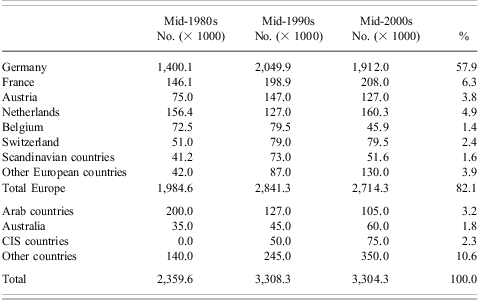
All in all, the Turkish migrant stock population living abroad is around 3.3 million or 5% of the Turkish population in Turkey. If you include in this those who show some Turkish migration background, the number would increase to 3.67 million (Eurostat data16) or 4.26 million (OECD data17) (Table 1).
Turkish migrant stock(s) abroad in mid-1980s, mid-1990s and mid-2000s

Source: Figures are compiled by İçduygu (2010)3 from various sources of OECD and Eurostat.
3.2 Demographic Features
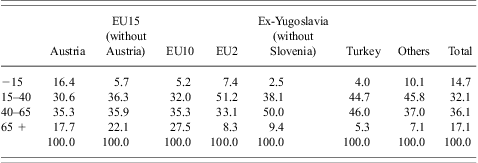
For the aging societies in Western Europe, immigration is, in principal, a slowdown in the aging process. Younger age groups are always over-represented among migrants – immigration thus rejuvenates the receiving society. Most of the migrants come from sending countries with a higher fertility rate than that of most countries in Europe. Therefore, the young migrants with higher fertility can support the demographic reproduction in the receiving countries. These facts may be demonstrated with data from Austria18 (Table 2).
Age by country of birth

Source: Statistik Austria (2012)18; own calculation.
In Austria the latest number of persons with at least a Turkish migration background is 167,000 (114,000 with Turkish citizenship and 53,000 Austrians born in Turkey). Of these, 45% are in the age group between 15 and 40, whereas in the entire population the share is only 32%. Surprisingly, only 4% are younger than 15. That means that most of the descendants of Turkish migrants are born in Austria. Only 5% are 65 and older, 18% is the overall value. The mean age for the Turkish migration background group is 40, 41 in the entire population.
Immigrants from Turkey are still a more male-orientated group with a traditional family structure. Three-quarters of all households are composed of a couple with one or more children. Single women with or without children are very rare. If women have children, they are integrated in a family household. On average, Turkish households are bigger than those of other groups and fertility lies clearly above the Austrian level.
In 2011, the total fertility rate in Austria was 1.43. The fertility rate of the Austrian population was 1.32, that of the foreign population 1.83 and that of Turkish migrant women 2.02. However, the adaptation process runs faster than expected. The total fertility rate of women who have become Austrian citizens is 1.49 and is quite similar to that of the native population.
3.3 Education and Occupational Position
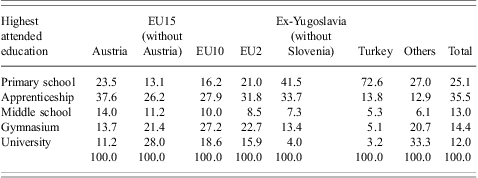
In many Western European countries there are concerns about elements of the Turkish immigrant community that are not integrating well into their host societies.Reference Kirişci and Erzan19 Among the concerns are: high levels of unemployment, poor educational performance of the children of migrants, voluntarily separation from the larger society and poor social and economic status of women. It is difficult to evaluate which factors are more important: the processes of exclusion and discrimination within the host society or the self-perception as excluded Turkish migrants accompanied by a lack of ambition and clinging to traditional ways of living (Table 3).
Highest education by place of birth

Source: Statistik Austria (2012)18; own calculation.
Structurally, it is also clear that as the vast majority of first-generation Turkish migrants were mostly limited formal education (73% only primary school), rural-background, low-skilled people, their children were not able to accumulate a high level of social capital that would provide them with relatively good educational and occupational opportunities. With this background, many of the second generation youngsters in the Turkish migrant communities found themselves in a socially disadvantaged environment of educational and occupational settings. However, any simple comparison between generations indicates that in general there are obvious improvements from one generation to the next in terms of educational and occupational status.
AvcıReference Avcı20 shows for Germany that nearly a quarter of Turkish students go to the Hauptschule (the lowest track of secondary education), which only 13% of all German students do, the situation is the opposite with respect to the Gymnasium – a quarter of the latter attend this most advantageous school-type whereas only 6% of Turkish students do. In Austria, two thirds of the population with a Turkish migration background possess only primary education, only another quarter have a completed apprenticeship and less than 10% secondary or tertiary education. There is some progress with the length of stay and from one generation to the next, but the dynamic of change is slow and the heritage of the structural features of the guest-worker regime dominant.
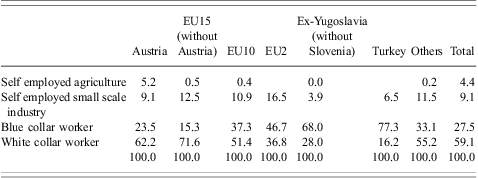
The low qualification profile shows a direct consequence in the weak labour market position, which is evident in many European countries. For example, the unemployment rate for Turkish immigrants in the Netherlands was almost three times as much as the Dutch average in the early 2000s. In Austria, the LFS shows that the majority of the Turks have to be satisfied with badly-paid, cumbersome and predominantly manual jobs. They are still employed as unskilled or semi-skilled blue collar workers (77%). Only a minority is employed as white-collar workers (16%) (see Table 4).
Employment position by place of birth

Source: Austria (2012)18; own calculation.
In Austria, the labour market provides jobs for Turks only in specific segments of the economy. These ‘niches’ exist largely in industry and the services sector and up to now the Turks could not succeed in ‘climbing up the ladder’. This is not only true for first generation immigrants, but to some extent also for their children, who are successful in getting better education in Austria and nonetheless still work in the same part of the labour market as their parents (de-qualification). And there is a specific gender differentiation that should be mentioned. Male Turks still have the same or even higher employment rates in all age groups than male Austrians. In the case of women, it is different: Turkish women are still very much influenced by the traditional role-model of Turkish society and so do not have to (or are not allowed to) look for a job.
3.4 Occupational and Social Mobility
The majority of the Turkish labour force is low skilled and positioned in sectors and branches that are badly paid and not very prestigious.
One can argue that this pattern is normal. Immigrants have to line up at the bottom and are not able to gain better positions until an integration process has started. In that context one can argue that immigrants have to acquire the common qualifications that are necessary to ‘survive’ in a competitive society and this takes time. Therefore, the decisive question is whether the unfavourable occupational position is stable or whether it changes in the course of time. If Turks manage to improve their occupational performance in the Austrian labour market the longer they are there, this can be interpreted as a clear indicator for a successful structural and systemic integration. But if the pattern remains stable, it is a signal for social barriers that the Turks cannot overcome despite a longer length of stay.
The answer turns out to be differentiated. The LFS shows on the one hand a clear correlation between the occupational positions and the length of stay: the longer the stay in Austria, the better the chance to leave marginal positions on the labour market. Turks (including Austrians with a Turkish migratory background), who have been staying in Austria for 30 or more years, are much more likely to be self-employed or to hold positions as qualified white-collar workers. On the other hand, Turks living in Austria with a long duration of stay and to some extent being ‘legal Austrians’ anyway, still are far from the same occupational positions as the Austrians. Although they were able to improve their positions on the Austrian labour market and at the same time their social status within society significantly, they still differ very much from those who have always been Austrians.
4. Subjective Dimensions
The final point, leaving aside the pure demographic analysis, is the presentation of the subjective perception of reality in Germany and Austria based on surveys. Beyond the objective structure that stands at the centre of the present analysis, it is the subjective perceptions of Turkish immigrants that play a role in the nature and dynamics of the relationship between the Turkish immigrant communities and the local receiving societies in Europe. It is within this context that one can try to answer the following questions: how do these migrants see Austria or Germany and how do they evaluate their social position?
4.1 General Perceptions
It is remarkable how their perceptions differ from the objective situation. The majority of all immigrants seem to be happy to live in the receiving communities. When more than 1,500 people with migration background in Austria were asked within the Integrationsmonitor ‘Do you feel like a native or at home in Austria?’, the overwhelming majority (86.5%) answered that they feel completely or largely at home. Only 7% feel less at home, and only 6.5% not at all.21 The same is true in the German Integrationsbaromater organized by the expert council for migration and integration in Berlin. Ninety-five percent of the interviewed said that they feel ‘very much’ or ‘moderately’ at home in Germany and only 5% answered that Germany is not their country.22
One reason for this high proportion of people saying ‘I feel here at home’ – despite high unemployment and less than successful upward mobility – is their perspective. While in Europe, Turkish workers are generally attested a very low social status, their social standing in Turkey improves markedly. The signs of their upward social mobility are visible in both rural and urban Turkish society: returnees were usually among the wealthiest people in their villages of origin, or emigration facilitated return migrants to relocate to urban areas. It is also visible when remittances are spent on building a modern house, buying land and farm machinery, purchasing urban apartments, cars and trucks, or electrical appliances.
In another studyReference Fassmann, Kohlbacher and Reeger23 focusing on the social mobility, it was asked how the respondents evaluate their social position compared with that of the parents’ generation. In the intergenerational comparison, the immigrants see themselves as winners. In spite of all the problems in everyday life and of the experienced discrimination they look upon themselves as ‘social climbers’. Traditional guest-worker migration means movement out of agriculture and that is in itself seen as progress. Even an unqualified and badly paid position as an unskilled worker in Austria is considered better than being a small-scale farmer at home. The work in a social welfare country offers a continuous, safe and comparatively high income with contracted work hours as well as accident, health and old age insurance. All this was not the case in the agrarian household of the parents.
4.2 The Turkish Pessimism
The optimism about successful structural integration is general among the immigrant population. It is possible to find some correlations of successful integration with formal education, household income and length of stay. Those who earn more, have completed a higher level of education, are better situated in the labour market and can look back on a long duration of stay, feel that they are more at home. But those who are in Austria for only a short period of time, are less educated and economically less successful, do not feel at home. It is obvious and easy to explain why.
In most of the questions in the Austrian Integrationsmonitor and the German Integrationsbarometer, another variable shows significance: the country of origin. Those who came from Turkey are showing more dissatisfaction or more emotional distance to the receiving country and society than other migrants.
It is possible to offer some examples. In the Austrian Integrationsmonitor, the population with a migrant background was asked if it agrees with the lifestyle observed in Austria. While 77% completely or largely agreed with the Austrian lifestyle, only 57.8% of those of Turkish origin did so. When asked if they feel at home in Austria 54% said yes, very much, but only 24% of those with a Turkish migration background said this.24 In the German Integrationsbarometer, the ‘index of integration climate’ was significantly higher for all Germans with a migration background (3.0) than for those with Turkish migration background (2.75).25
It is difficult to explain this Turkish pessimism, because it is a typical chicken and egg problem: Do Turks feel more excluded because of the attitudes of the receiving society? Or are Turks more excluded because they emphasize their greater distance to the receiving society? Maybe both are true: The Turkish migrant population have this heritage of a more rural and traditional background and they are confronted with a more Western and urban lifestyle, which produces cleavages on both sides.
In addition, the role of the Turkish nation state is important, the idea that Turkishness is something given by birth and can never be given away. Sometimes clear signals come from politicians demanding Austrian or German citizen with a Turkish migration background should maintain the emotional linkages to Turkey and to the Turkish community. This is producing concerns in the receiving countries.
5. Conclusion
As a result of 50-years of migratory trans-border exchange between Turkey and Europe, these two geographic entities have been drawn into a relationship that is marked by complex economic, social, political and cultural interchanges. The Turkish emigration, which was at the same time the Turkish immigration to Germany, France, the Netherlands and Austria, was significant in the past and is of less importance in the present. The number of Turkish migrants in everyday life is perceived differently by different people. In 2008, the net migration between Germany and Turkey was −5,500, which means more migration from Germany to Turkey than from Turkey to Germany. The net migration between Austria and Turkey was, in 2011, merely +629, whereas most people would think that the Turkish immigration continues on an undiminished scale.
In terms of migration stocks, Turks rank third in Austria and first in Germany. The stocks were mainly accumulated due to guest-workers and their family members and they are migration stocks characterized by an increasing duration of stay in the receiving countries. These stocks have to overcome the burden of the heritage of a low qualified migration from a rural background. This takes time and the receiving society and many politicians in Germany as well as in Austria should show more patience. The pessimism on both sides of the immigration society is understandable but in the longer run dispensable. Empirically, it can be shown that there is a correlation between the length of stay, the proficiency in the language of the receiving context, the occupational position and the social status. Furthermore, in all relevant indicators there is an improvement between the first and the second generation.
The Turkish migrant communities in Austria and in Germany will find a way of coexisting between voluntary assimilation and new forms of transnational mobility. There have been many obvious indicators to that course.
Acknowledgements
Many thanks to Maria Luzia Enengel for the accurate and precise collection of data and drawing the map for this article.
Heinz Fassmann studied Geography, History and Sociology. He holds a chair for Applied Geography, Regional Research and Spatial Planning at the University of Vienna and is managing Director of the Institute of Urban and Regional Research of the Austrian Academy of Sciences. Prior to his current position he held a chair (C4) at the Technical University of Munich. Heinz Fassmann is the author (or co-author) of more than 250 scientific articles and around 40 books, monographs or project reports. He is a member of the Academia Europaea and Full Member of the Austrian Academy of Sciences. He specializes in the field of demography, especially migration, in urban geography and in spatial planning.
Ahmet İçduygu is Professor of International Relations and the Director of the Migration Research Center at Koç University, Istanbul, Turkey. He currently serves as the national correspondent of Turkey to the SOPEMI-OECD, Paris, and as a member of the International Advisory Board of Mediterranean Migratory Observatory, Athens. In addition to his numerous articles in scholarly journals, he is the editor of books entitled, Citizenship in a Global World: European Questions and Turkish Experiences with Fuat Keyman (Routledge, 2005) and Migration and Transformation: Multi-Level Analysis of Migrant Transnationalism, co-edited with Pirkko Pitkänen and Deniz Sert (Springer, 2011).