1 Introduction
It is uncontroversial that intonational variation carries meaning. Research over many years has established that differences in intonational tune can encode a variety of referential meanings, speaker attitudes and emotions. Moreover, this work has demonstrated that the meanings communicated by intonation are more than just paralinguistic in nature (such as emotional states, indicators of urgency or other ‘non-grammatical’ properties of speakers and/or messages that are signalled by gradient phonetic phenomena), but are instead reflexes of underlying categorical phonological structures (e.g. Pierrehumbert Reference Pierrehumbert1980; Ladd Reference Ladd1983, Reference Ladd2008; Gussenhoven Reference Gussenhoven1984, Reference Gussenhoven2004; Ward & Hirschberg Reference Ward and Hirschberg1985; Pierrehumbert & Hirschberg Reference Pierrehumbert and Hirschberg1990; Steedman Reference Steedman1991, Reference Steedman2014). The standard framework for conceptualising these tune–meaning correspondences, what Ladd (Reference Ladd2008: 41) calls the Linguists’ Theory of Intonational Meaning, involves seeing ‘the elements of intonation [as] having morpheme-like meaning’. There is, however, disagreement in the literature over what those meaningful intonational units are. One position, associated primarily with the work of Pierrehumbert (1983), Pierrehumbert & Hirschberg (Reference Pierrehumbert and Hirschberg1990) and Steedman (Reference Steedman1991, Reference Steedman2014), maintains that the meaning of a tune is derived compositionally from the meanings of its constituent parts, where individual components of an intonational contour (e.g. pitch accents, phrase accents and boundary tones) are atomic units of meaning that combine to create the overall meaning of a tune. The alternative position, as argued by Gussenhoven (Reference Gussenhoven1984, Reference Gussenhoven2004) and Ladd (Reference Ladd1983, Reference Ladd2008), among others, maintains that the meaningful elements are the tunes themselves (e.g. rise, fall, fall–rise) which are associated with abstract meanings, such as signalling background information or to signal the selection of a discourse entity from the background (see Gussenhoven Reference Gussenhoven2004: 316–20 and Ladd Reference Ladd2008: 147–56 for reviews). According to this account, specific meanings are extrapolated in context via a process of pragmatic inference on the part of the listener, who interprets the abstract meaning of a tune in relation to local phonetic modifications or stylisations as well as the semantic/pragmatic information available in the moment. There is thus a clear divide in the literature on intonational meaning with regard to the specific phonological categories that function as meaningful intonational primitives. Nevertheless, as Ladd (Reference Ladd2008: 150) notes, these different frameworks are united in the belief that there exists a correspondence between a tune’s shape and its perceived meaning, and hence that ‘similarity of meaning should be reflected in similarity of phonological representation’ (Ladd Reference Ladd2008: 150). By implication, the obverse claim is also predicted to be true: that difference in meaning should be reflected by difference in phonological structure.
While conceptually fairly straightforward, this framework for intonational meaning is difficult to evaluate in practice because of the variability in how we can define both ‘meaning’ and ‘phonological representation’. In terms of phonology, there is the challenge of being able to read underlying representations from surface forms, and thus being able to distinguish output patterns that result from distinct underlying structures versus those that are simply realisational variants of the same representation (Ladd Reference Ladd2008: 116; see also Ladd & Morton Reference Ladd and Morton1997; Warren Reference Warren2016: 40). For meaning, a similar issue arises, though here the question is what particular kind of meaning we have in mind (Warren Reference Warren2016: 42). What type of semantic/pragmatic distinctiveness is necessary for us to decide that two tunes have different meanings? Is there a threshold at which we expect this semantic/pragmatic distinctiveness to be sufficiently large that it should correlate with distinct phonological representations? And how do we tackle the fact that intonation often carries multiple meanings simultaneously, some structural and others paralinguistic? Questions such as these are not a challenge to standard theories of intonational meaning itself. Instead, they represent recognised obstacles to the empirical evaluation of the theory ‘in action’, what Ladd (Reference Ladd2008: 156) describes as a set of ‘paralinguistic stalemates’.
In this article, I address one such stalemate that arises in the analysis of High Rising Terminal (HRT) contours on declarative utterances in London English.Footnote 1 In previous work (Levon Reference Levon2016), I demonstrate that there are two pragmatically distinct meanings of HRTs in the region, distributed across different group of users and conversational contexts. Given the different theories of intonational meaning outlined above, here I examine whether this pragmatic distinction correlates with differences in the phonological/phonetic shape of HRTs in London. Not only is this what some theories would predict (particularly those that focus on intonational compositionality), it is also what has been found in prior investigations of HRTs in other locations, including Australia, New Zealand, Canada and the United States (e.g. Fletcher & Harrington Reference Fletcher and Harrington2001; Fletcher, Stirling, Lushin & Wales Reference Fletcher, Stirling, Lushin and Wales2002; Warren Reference Warren2005; Warren & Daly Reference Warren and Daly2005; Barry Reference Barry2008; Shokeir Reference Shokeir2008; Ritchart & Arvaniti Reference Ritchart and Arvaniti2014). In the analyses below, I show that, unlike in other locations, salient differences in the meanings of HRTs in London do not correlate with differences in the contour’s phonological/phonetic form. While this finding seems to contradict compositional accounts of intonational meaning, I go on to argue that recent advances in the sociolinguistic theorising of indexicality and the development of indexical orders (e.g. Silverstein Reference Silverstein2003; Eckert Reference Eckert2008) allow us to reconcile these results with the core assumptions about form–meaning correspondence that underlie the Linguists’ Theory of Intonational Meaning.
I begin in section 2 with a summary (based on Levon Reference Levon2016) of my definition of HRTs, and of the social and pragmatic distribution of the feature that I found in naturally occurring conversations in London. In section 3, I review some of the various phonological and phonetic characteristics that have been investigated in relation to HRTs both in London and elsewhere, before turning, in section 4, to a detailed examination of three acoustic properties in the London dataset: rise excursion, rise dynamism and rise alignment. In section 5, I conclude by introducing a theory of indexical meaning to help account for my findings, and provide a discussion of the larger theoretical and empirical ramifications of my analysis.
2 The social distribution of HRT contours in London
The use of HRT contours on declaratives is an increasingly common feature of varieties of English around the world, and has been extensively studied in Australia (e.g. Guy & Vonwiller Reference Guy and Vonwiller1984; Guy, Horvath, Vonwiller, Daisley & Rogers Reference Guy, Horvath, Vonwiller, Daisley and Rogers1986; Fletcher et al. Reference Fletcher, Stirling, Lushin and Wales2002; McGregor & Palethorpe Reference McGregor and Palethorpe2008), New Zealand (e.g. Britain Reference Britain1992; Britain & Newman Reference Britain and Newman1992; Warren & Britain Reference Warren and Britain2000; Warren Reference Warren2005; Warren & Daly Reference Warren and Daly2005), Canada (e.g. Shokeir Reference Shokeir2008; Di Gioacchino & Crook Jessop Reference Gioacchino and Crook Jessop2011) and the United States (e.g. Ching Reference Ching1982; McLemore Reference McLemore1991; Ritchart & Arvaniti Reference Ritchart and Arvaniti2014). HRTs were first noted in British English by Cruttenden (Reference Cruttenden1986, Reference Cruttenden1994), who described them as an incipient feature of speech in London, associated with what he termed ‘New Yuppies’.Footnote 2 Since Cruttenden’s initial discussion, most studies of HRTs in the region have focused on the phonological properties of the contour, primarily in speech derived from laboratory-based tasks (e.g. Shobbrook & House Reference Shobbrook and House2003; Grabe Reference Grabe2004; Fletcher, Grabe & Warren Reference Fletcher, Grabe and Warren2005; Barry Reference Barry2008, though cf. Bradford Reference Bradford1997; Arvaniti & Atkins Reference Arvaniti and Atkins2016). What this means is that, to date, we have limited information about the social and pragmatic distribution of the feature in (Southern) British English, despite growing popular awareness of its presence (as evidenced, for example, by various ‘moral panic’ articles about HRTs in the British press).
In Levon (Reference Levon2016), I address this empirical gap by examining the distribution and use of HRTs by young Londoners in naturally occurring conversation. To accomplish this, 71 speakers of London English were recorded in 26 small friendship groups (between 3 and 5 individuals). All speakers were between 18 and 25 years old at the time of recording, were all born and still lived in the greater London area, and could be roughly characterised as middle-class (i.e. all were either university students or had already completed higher education). There were approximately twice as many women in the sample as there were men (47 women, 24 men), and three main British ethnic groups were represented: 19 British Asian speakers (13 women, 6 men), 10 black British speakers (6 women, 4 men) and 42 white British speakers (28 women, 14 men). Recordings were conducted by a member of each of the friendship groups, in an effort to approximate the conditions of spontaneous informal interaction as closely as possible. Recording sessions took place in the participants’ homes, and were recorded in high definition on a smartphone using freely available specialist software (either Tascam PCM Recorder MKII for iPhone or PCM Recorder for Android; both allow for the recording of 16-bit uncompressed WAV files at a sampling frequency of 44100 Hz). Each recording lasted between 20 and 30 minutes, resulting in a total corpus of approximately 15 hours of speech.
All declarative intonational phrases (IPs) within the corpus were identified and extracted for analysis (n=10,535). Of these, 993 were auditorily coded as containing HRTs (9.4%). Auditory coding for the presence/absence of HRTs was chosen based on a definition of HRT as a ‘marked rising intonation pattern found at the end of intonation units realised on declarative utterances’ (Warren Reference Warren2016: 2, emphasis added). As prior research has shown (Britain & Newman Reference Britain and Newman1992; Di Giaocchino & Crook Jessop Reference Gioacchino and Crook Jessop2011), there is no one-to-one correspondence between perceptual markedness of this kind and intonational shape (see also Ladd Reference Ladd2008: 155). For this reason, a static or purely acoustic operationalisation of HRTs would run the risk of overlooking tokens that are perceived by interactants as instances of HRT, even if they do not fall within certain predefined acoustic parameters. In an effort to capture the full range of pragmatic uses of HRTs in the corpus, I therefore chose to employ an auditory coding procedure. Auditory coding was operationalised in terms of certain phonetic and semantic/pragmatic benchmarks. Phonetically, a perceptually salient rise in the final pitch phrase of the IP (i.e. from the final nuclear syllable to the IP boundary) needed to be present, though there was no specific requirement as to the size or shape of the rise. Semantically, the rise needed to occur in a declarative utterance and, crucially, in a position that is pragmatically ‘marked’ in the discourse; that is, the rise needed to occur at the end of a phrase that would not prescriptively or historically be associated with rising tunes in the variety (see also Di Gioacchino & Crook Jessop Reference Gioacchino and Crook Jessop2011). For this reason, rises associated with list intonation and rises on declarative questions (i.e. interrogatives that are not syntactically marked as questions but nevertheless carry interrogative force) were not coded as HRTs, since these standardly appear with rising intonation in Southern British English. Ultimately, the dataset contained rises in IP-final position of the type that have previously been described in the literature as either ‘statements’ or ‘continuations’/‘floor holds’ (e.g. Shokeir Reference Shokeir2008; Ritchart & Arvaniti Reference Ritchart and Arvaniti2014; Arvaniti & Atkins Reference Arvaniti and Atkins2016), and included both simple rising contours (e.g. H* H–H% and L* H–H%) and complex fall–rises (i.e. H* L–H%). Initial coding was done by two research assistants on a five-point scale, ranging from ‘definitely no HRT’ to ‘probably no HRT’, ‘unsure’, ‘probably HRT’ and ‘definitely HRT’. I then conducted a second round of coding in which I discarded all ‘unsure’ tokens and relistened to all remaining tokens so as to collapse them into a binary division between ‘HRT present’ and ‘HRT absent’. All IPs were also coded for a variety of social, pragmatic and interactional factors (for full details, see Levon Reference Levon2016).
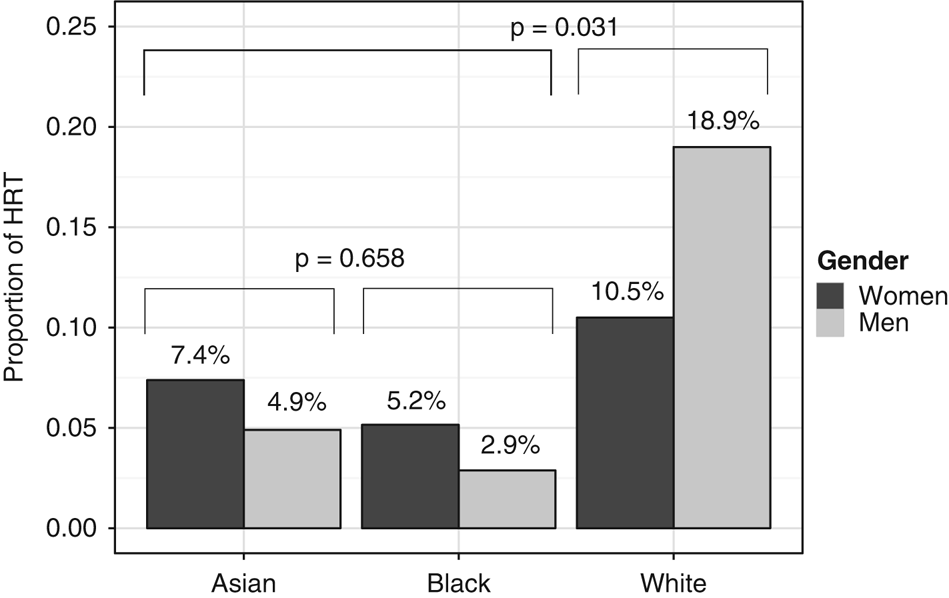
The distribution of the 993 instances of HRTs in the dataset was very uneven across speaker groups. In figure 1, we see that white speakers are the primary users of HRTs in the recordings. While both black and Asian speakers do make use of the feature occasionally, quantitative analyses demonstrate that this use tends to be idiosyncratic and speaker-specific. Thus while there is an average of approximately 5 per cent HRT use among black and Asian speakers as a whole, there is little evidence that the feature forms a regular component of either British Asian English or Black British English in London. This is, however, clearly not the case for white speakers, who display rates of use of between 10.5 peer cent (for the women) and 18.9 per cent (for the men). Subsequent analysis in Levon (Reference Levon2016), moreover, demonstrates that the frequency of occurrence of HRTs among white Londoners is subject to systematic pragmatic conditioning. These results are outlined below; full details are available in Levon (Reference Levon2016).
Mean HRT frequencies for speakers in the London sample by gender and ethnicity. For model details, see Levon (Reference Levon2016)

For both the white women and the white men in the sample, the prevalence of HRTs varies according to the type of speech act in which they are engaged. Using a taxonomy of speech act types developed by Guy et al. (Reference Guy, Horvath, Vonwiller, Daisley and Rogers1986) for the analysis of HRTs in Australia, results in Levon (Reference Levon2016) demonstrate that among the women the statement of facts contains the least amount of HRTs, the recounting of narratives the most, with opinions, descriptions and explanations falling somewhere in between. This pattern replicates what has been found elsewhere (e.g. Guy et al. Reference Guy, Horvath, Vonwiller, Daisley and Rogers1986 for Australia and Britain Reference Britain1992 for New Zealand), and supports an interpretation of HRTs as a tool for helping to structure conversational interaction. The idea behind this interpretation is that HRT is used more frequently in contexts that are interactionally more complex: while the statement of a fact can often be accomplished via a single utterance, recounting a narrative requires the use of multiple coordinated clauses and the development of a coherent story. Guy et al.’s (Reference Guy, Horvath, Vonwiller, Daisley and Rogers1986) taxonomy of speech act types is thus intended to represent a cline of conversational complexity. The observed correlation between HRT frequency and different speech act types among the white women in the current study thus provides evidence that the women are drawing on HRT’s ability to organise more complex forms of talk. For the white men in the sample, in contrast, no such differentiation across speech act types is evident. This can be taken to indicate that the men are not making use of HRT’s capacity to organise interaction, at least not in terms of conversational complexity.
In addition, white women in the London sample are shown to use more HRTs when presenting so-called discourse-new/hearer-old information (Prince Reference Prince1981, Reference Prince1992) – that is, information that is already known to conversational participants but has not yet been discussed in the immediate interaction. The white men, in contrast, use HRTs more often on discourse-new/hearer-new topics (i.e. brand new information). In both cases, then, speakers use HRT to emphasise a particular discourse referent in their talk, though the information status of that referent differs across the two groups. Finally, the placement of HRTs within narratives is also shown to vary between white women and white men. While the women use the feature predominantly during the orientation and evaluation portions of narratives (Labov & Waletzky Reference Labov and Waletzky1967), thus replicating the pattern identified in New Zealand by Warren & Britain (Reference Warren and Britain2000), the men use it most in complicating actions. In Warren & Britain’s study, the authors argued that the use of HRTs during the orientation and evaluation clauses of narratives was related to the feature’s ability to help establish a solidary common ground for conversational interaction. The use of HRTs in complicating actions, as we find among the white men here, is not predicted by Warren & Britain’s (Reference Warren and Britain2000) analysis.
Based on quantitative findings such as these, as well as additional qualitative evidence, I argue in Levon (Reference Levon2016) that HRTs serve distinct pragmatic functions for white women and white men in London. In short, I suggest that the women in the sample draw primarily on the instrumental function of HRTs, using them as a device to request activity alignment (Stivers Reference Stivers2008) and so maintain control of the conversational floor (cf. Guy et al. Reference Guy, Horvath, Vonwiller, Daisley and Rogers1986). In contrast, I propose that the men use HRTs to fulfil a referential or emphatic function, with which they request interactional affiliation (Stivers Reference Stivers2008) in an effort to build solidarity with other conversational participants (cf. Britain Reference Britain1992; Bradford Reference Bradford1997). Abstracting away from the details of these arguments (though see Levon Reference Levon2016), the important point for our current purpose is that this earlier study identifies a clear distinction between different pragmatic meanings of the HRT contour that correlates with distinct distributional patterns of the feature across speaker groups (women vs men), speech activity types (e.g. facts vs narratives) and information status categories (hearer-old vs hearer-new). In what follows, I examine whether these differences in meaning correspond to difference in the phonological/phonetic form of the HRT contours used.
3 Characterising HRT contours
Early descriptions of HRTs identified them as an instantiation of Tone 2 from Halliday’s (Reference Halliday1967) taxonomy of intonational tunes: a terminal rise that begins on a high nuclear pitch accent and continues to rise by approximately 40 per cent to the end of the phrase (e.g. Guy et al. Reference Guy, Horvath, Vonwiller, Daisley and Rogers1986). In autosegmental-metrical terms, this corresponds to an H* H–H% contour (e.g. Pierrehumbert Reference Pierrehumbert1980; Fletcher et al. Reference Fletcher, Grabe and Warren2005). Scholars subsequently argued that in Australian English HRT contours can also begin at a low-onset point (i.e. L* H–H%), an assertion that was confirmed by later laboratory-based investigations (e.g. Fletcher & Harrington Reference Fletcher and Harrington2001; Fletcher et al. Reference Fletcher, Grabe and Warren2005; McGregor & Palethorpe Reference McGregor and Palethorpe2008). Importantly, both Fletcher & Harrington (Reference Fletcher and Harrington2001) and Fletcher et al. (Reference Fletcher, Grabe and Warren2005) note that in Australia, the pitch level of the final high boundary tone for both low-onset rises (L* H–H%) and high-onset rises (H* H–H%) remains about the same, indicating that the difference between the two is not only related to the pitch level of the starting point but also to the overall size of the rise excursion. In other work, Fletcher and colleagues (Fletcher et al. Reference Fletcher, Stirling, Lushin and Wales2002) also describe the existence of what they term a low-range low-onset rise (L* L–H%), which they argue serves a more distinct set of functions in interaction than either of the (wider-range) rises do (see also Fletcher & Loakes Reference Fletcher and Loakes2006). Studies of HRTs in Australia have thus established that the size of rise excursion is one of the principal ways in which the contour can be characterised, and, crucially for our purposes, that differences in excursion size are often correlated with distinct grammatical and pragmatic functions. The importance of variation in excursion size, moreover, has also been confirmed in varieties other than Australian English. Ritchart & Arvaniti (Reference Ritchart and Arvaniti2014), for example, argue that the typical HRT contour in Southern California English is a low-range rise (L* L–H%). They note, however, that higher-range (L* H–H%) contours also occur, and that when they do they are associated with a distinct pragmatic function.
In addition to rise excursion, a number of other properties have also been investigated in the literature. Guy et al. (Reference Guy, Horvath, Vonwiller, Daisley and Rogers1986: 27), for example, claim that in Australia HRTs involve a rise with a ‘swift upward trajectory’, which they contrast with the rising declaratives in the United States that ‘start lower, rise more slowly, and terminate at lower levels’. Their observation in this regard is substantiated by later research in both Australia (Fletcher et al. Reference Fletcher, Stirling, Lushin and Wales2002) and New Zealand (Warren & Daly Reference Warren and Daly2005), which identified significant differences in rise slope (i.e. excursion/time) as a function of speech activity type (e.g. steeper slopes on narratives than on simple statements) and different speaker characteristics (e.g. steeper slopes for women than for men). Related to this, Warren & Daly (Reference Warren and Daly2005) and Warren (Reference Warren2005) further note that there exists not only a difference in overall slope, but also in the alignment of the rise to the nuclear pitch accent. Warren & Daly (Reference Warren and Daly2005) have shown that in many cases HRT rises can begin late in polysyllabic final pitch phrases, rather than being anchored to the nuclear syllable itself. They demonstrate, moreover, that rise alignment varies across speakers in New Zealand, with women’s rises tending to start later than men’s. In a follow-up study, Warren (Reference Warren2005) provides evidence that this timing distinction is a salient cue for New Zealand listeners when distinguishing between question rises and rises on declaratives. Thus, both rise slope and rise alignment have been shown to be key properties for the description of different types of HRT contours.
While many of the studies of variation in contour shape have focused on the phonological classification of different types of HRTs (i.e. in autosegmental-metrical terms), more recent research has argued for the importance of engaging in close quantitative analyses of the tune’s different phonetic properties. As Di Gioacchino & Crook Jessop (Reference Gioacchino and Crook Jessop2011) argue, attention to the phonetic detail of HRT variation allows for a more gradient examination, potentially revealing subtle patterns of acoustic differentiation that may be lost in a higher-level (and often qualitative) phonological analysis (though cf. Ladd Reference Ladd2008: 154). A similar argument is made by Barry (Reference Barry2008), who demonstrates, for example, that while both women and men in London tend to prefer low-onset rises (i.e. L* H–H%), in phonetic terms the women’s rises have larger excursions than the men’s. Similar differences are also reported by Ritchart & Arvaniti (Reference Ritchart and Arvaniti2014) and Tyler (Reference Tyler2015a) for speakers in California. The implications of studies such as these is not that phonological distinctions in HRT contours are unimportant. They may, however, not tell the whole story. For this reason, I focus in the current analysis on an examination of phonetic variation in HRT contours in London. I also attempt, however, to relate the acoustic properties uncovered to broader phonological categorisations throughout my discussion.
4 Acoustic properties of HRTs in London
My acoustic analyses of HRTs are restricted to those tokens that occurred in the speech of individuals in the sample who were shown to make regular use of the form, i.e. the 42 white speakers (total number of declaratives IPs=7,351, of which 719, or 9.8 per cent, contain HRTs). In the analyses, I focus primarily on the three properties of the contour that have been identified in previous research and are introduced in the previous section:
1. rise excursion, or the total span of pitch movement from the elbow of the rise trajectory to the end of the intonational phrase (IP);
2. rise dynamism, or the slope of pitch change during the final rise; and
3. rise alignment, or the point at which the upward movement of the rise begins in the final pitch phrase.
For each of these properties, I examine the extent to which it varies across the social and pragmatic categories that I previously found constrained the relative frequency and meaning of HRTs in London (i.e. speaker gender, text type and information status). In addition, I investigate whether the overall shape of the contour is subject to linguistic conditioning as a function of three internal factors, all of which have been examined in the previous literature: rise-initial pitch, rise-final pitch and rise duration. Details of how each of the three primary acoustic properties for analysis are operationalised and measured are provided in the course of the discussion below. All pitch measurements were made on the ERB-rate scale (Moore & Glasberg Reference Moore and Glasberg1983), in keeping with recent prior research on HRTs (e.g. Ritchart & Arvaniti Reference Ritchart and Arvaniti2014) and to allow for meaningful comparisons across speakers (Daly & Warren Reference Daly and Warren2001; Nolan Reference Nolan2003).Footnote 3 Measurements were done manually for all tokens in Praat (version 6.0; Boersma & Weenink Reference Boersma and Weenink2015) by the author and a research assistant.
4.1 Rise excursion
The size of the final rise excursions was measured in both absolute and relative terms. Absolute measures were derived by taking the difference between the fundamental frequency (f0) at the highest point of the rise IP-finally and the f0 at the onset of the rise elbow, defined as the point that showed the start of a clear upward trajectory of the contour (cf. Arvaniti & Ladd Reference Arvaniti and Ladd2009: 55). This provides an indication of the observed pitch span in the rise itself. To derive the relative excursion size, absolute excursion measures were expressed as a proportion of the total pitch span (i.e. f0-max – f0-min) of the encompassing IP (Di Gioacchino & Crook Jessop Reference Gioacchino and Crook Jessop2011). For example, an absolute rise excursion of 3 ERB contained within an IP that has a total pitch span of 6 ERB would receive a relative excursion value of 0.5. Similarly, an absolute rise excursion of 4 ERB contained within an IP that has a total span of 6 ERB would receive a relative excursion value of 0.67. Relative excursions, therefore, serve to normalise the observed absolute excursion values in relation to the prosodic environments in which they occurred, so as to obtain a measure that is more comparable across speakers and phrases.
To examine variability of both absolute and relative excursions, two sets of linear mixed-effects models were built using the lme4 package (Bates et al. Reference Bates, Mächler, Bolker and Walker2015) in R version 3.4 (R Core Team 2017).Footnote 4 The first set of models examined to what extent the external factors (speaker gender, speech activity type and information status) affect absolute and relative excursion size. The next set of models further explored whether the internal factors (rise-initial f0, rise-final f0 and rise duration) also play a role. To do so, separate models for the women’s and the men’s data were built that examine the effect of internal constraints on the measures of interest. Separate models for the women’s and the men’s data were constructed in order to avoid the emergence of significant findings as an artefact of differences in women’s versus men’s average f0 levels.Footnote 5 Instead, I draw on the comparative sociolinguistic method (e.g. Tagliamonte Reference Tagliamonte2013) to examine whether the internal factors behave similarly across women’s and men’s speech, and so extrapolate whether they interact with gender. All models were manually stepped down from full models that included all predictors and their interactions. Speaker was always included as a random intercept.
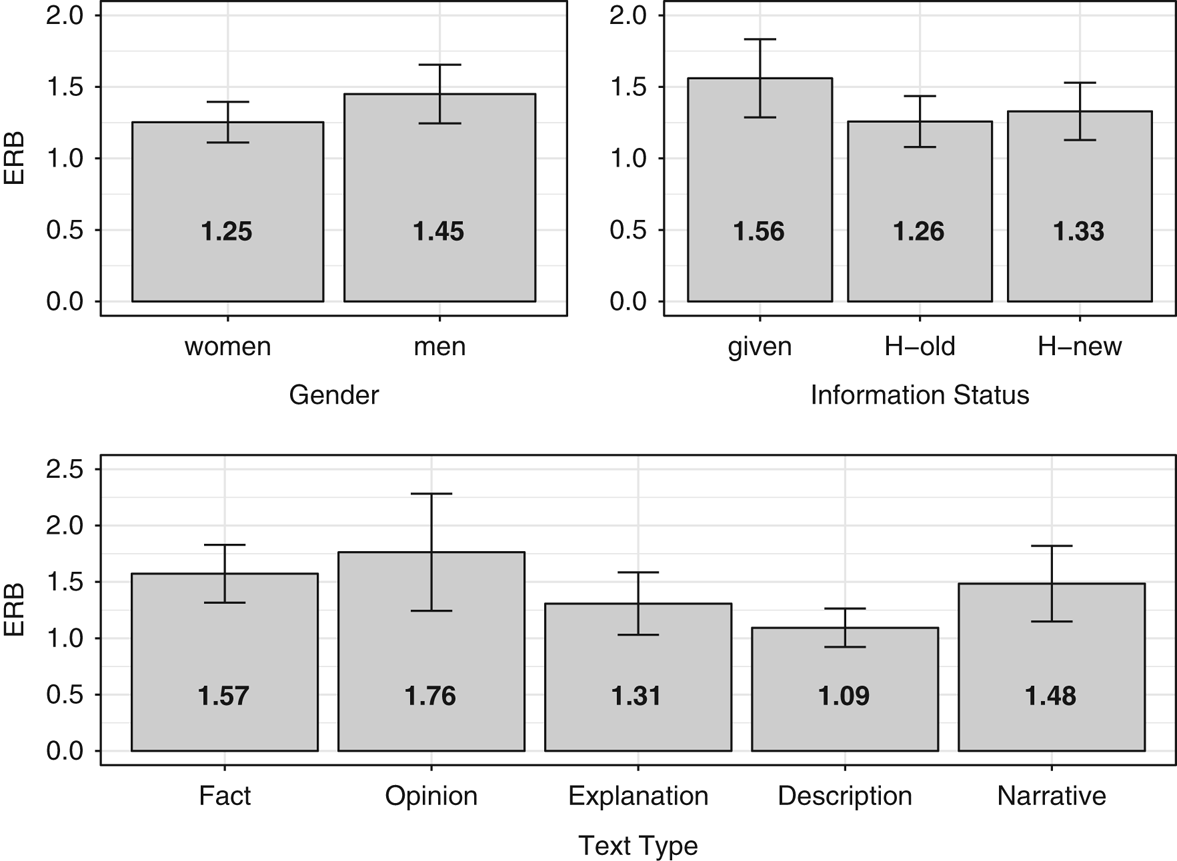
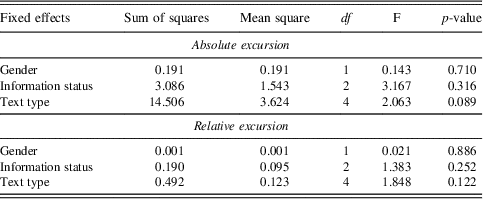
Figure 2 presents the mean absolute excursion values for the external factors under consideration (for full regression tables, see the Appendix). Only results for absolute measures are presented for ease of comparison with earlier studies of HRTs, though results for relative excursion measures follow precisely the same patterns as those depicted here. As we see in figure 2, none of the external factors have a significant effect on observed rise excursion. This is surprising given the robust findings of prior research that have demonstrated the importance of gender, discourse function/speech activity and information status in determining the shape of HRT contours. Research in New Zealand (Daly & Warren Reference Daly and Warren2001), Southern California (Ritchart & Arvaniti Reference Ritchart and Arvaniti2014) and London (Barry Reference Barry2008), for example, has all shown women to have average absolute excursion sizes between 0.39 and 1.5 ERB larger than men’s. In the current dataset, in contrast, men’s excursions are on average 0.20 ERB larger than the women’s, though this difference does not achieve statistical significance (for the relative measure, men have an average value of 0.54 as compared to the women’s average value of 0.44, and once again this difference is not statistically significant).
Means (and confidence intervals) of absolute excursion size (in ERB) as a function of gender, information status and speech activity type

These findings do, however, replicate the results of Tyler’s (Reference Tyler2015a) investigation of HRTs in spontaneous speech in Southern California, where he reports men as having marginally (but not significantly) larger absolute excursion sizes than women. Similarly, Arvaniti & Atkins (Reference Arvaniti and Atkins2016) found no difference between the women and the men in their sample of Southern British English speakers (from London and Kent) in terms of rise excursion size. It is noteworthy that, along with the current research, the studies by Tyler (Reference Tyler2015a) and Arvaniti & Atkins (Reference Arvaniti and Atkins2016) are the only other investigations to include an examination of HRTs in more naturally occurring speech outside a laboratory setting (Tyler’s Reference Tyler2015a data come from the Santa Barbara Corpus of Spoken American English, while Arvaniti & Atkins’ Reference Arvaniti and Atkins2016 data come from both map tasks and spontaneous speech recorded in participants’ homes). It may therefore be the case that the consistent gender difference reported for HRT excursion size in the literature does not generalise beyond the types of speech activities normally elicited in a laboratory environment, though additional research is necessary to explore this possibility further.
In terms of text type, it is difficult to establish a direct comparison between the results reported in figure 2 and the findings of previous research, since acoustic studies of HRTs to date have tended not to use Guy et al.’s (1986) taxonomy of text types. Nevertheless, as noted above, scholars have explored a range of different discourse functions and speech activities, and have shown there to be systematic variation in excursion size across these factors. Warren & Daly (Reference Warren and Daly2005), for instance, discuss significant differences in excursion size among both women and men between a storytelling task and a sentence-reading task in their New Zealand data. Likewise, Fletcher et al. (Reference Fletcher, Stirling, Lushin and Wales2002) demonstrate that their Australian speakers vary HRT excursions between more ‘forward-looking’ and more ‘backward-looking’ dialogue acts in a map task. Finally, Ritchart & Arvaniti (Reference Ritchart and Arvaniti2014) show how speakers in Southern California have significantly larger excursions both in a map task as opposed to a storytelling task, and on so-called ‘confirmation requests’ and ‘floor holding’ utterances as opposed to simple ‘statements’. Given these findings, it is therefore once again surprising that there is no significant difference in either absolute or relative excursion size among text types in the current dataset. While there is some variation observed – from a low of 1.09 ERB for Descriptions to a high of 1.76 ERB for Opinions – there is no evidence that these changes can be reliably correlated with the different text type categories. Interestingly, this finding is corroborated by Arvaniti & Atkins’ (Reference Arvaniti and Atkins2016) recent study of HRTs in Southern British English, where they also find no difference in excursion size across discourse functions.Footnote 6
Turning lastly to information status, we yet again find no significant differences in either absolute or relative excursion size across the three factor levels. This is in contrast to Barry (Reference Barry2008), who found that the women (though not the men) in her London sample had significantly larger rise excursions when describing new landmarks in a map task, as opposed to landmarks that had already been mentioned. More generally, we also might expect to find differences in excursion size as a function of information status given the hypothesised relationship between high pitch accents (H*) and the signalling of new information as opposed to low pitch accents (L*), which do not (e.g. Pierrehumbert & Hirschberg Reference Pierrehumbert and Hirschberg1990; McGregor & Palethorpe Reference McGregor and Palethorpe2008). Yet this is not the pattern observed here, where mean absolute excursion values of 1.56 ERB for given information, 1.26 ERB for discourse-new hearer-old information, and 1.33 ERB for discourse-new hearer-new information are not significantly differentiated (corresponding figures for average relative excursion size are 0.55, 0.44, and 0.50, and they too are not significantly different). In terms of external factors then, we find no systematic differences in the absolute or relative size of the HRT contours as a function of the parameters under investigation.
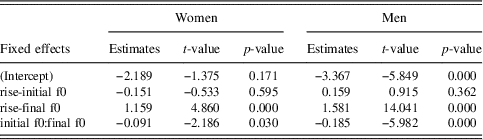
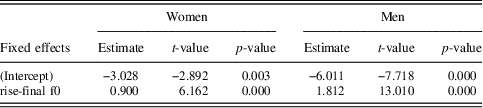
There are, however, significant internal constraints on excursion size, as demonstrated by the results of the regression analysis in table 1. (As before, results are presented for absolute measures for ease of interpretation. Findings for relative excursion size parallel those presented here.) In table 1, we see that in both the women’s and the men’s speech absolute excursion size is affected by a significant interaction between rise-initial f0 and rise-final f0.Footnote 7 Further inspection of this interaction reveals that the effect is principally due to a significant positive correlation between the f0 of the rise end point and overall excursion size, an effect which is attenuated for rises with very high starting f0. In other words, the size of rise excursion depends primarily on the height at which the rise terminates, such that rises that have higher final f0 are also those that are bigger (in both absolute and relative terms). The only point at which this correlation does not hold is for rises that begin very high (i.e. in the fourth quartile of all rise start points in the dataset). For these high(er) onset rises, the slope of the correlation between excursion size and rise end point is much flatter, meaning that these rises end high without necessarily having travelled very far.
Linear mixed-effects regression results for absolute excursion size, internal and external factors combined

For women, n=393; Random intercepts: Speaker (28); Log likelihood: −175.35; Conditional R2=0.712 For men, n=326; Random intercepts: Speaker (14); Log likelihood: −166.39; Conditional R2=0.913 Factors not significant in both models: rise duration (log), text type, information status (and all other interactions)
From these findings, it appears that distinguishing between low-range and high-range rises in the dataset is done by varying the height of the final pitch target, rather than varying the height of the rise start point. It is for this reason that excursion size correlates with rise-final f0 (and shows no significant correlation with rise-initial f0, aside from the ceiling effect noted above). Tyler (Reference Tyler2015a) identifies a similar pattern in his examination of HRTs in spontaneous conversation in Southern California, where (absolute) excursion size is correlated with rise-final f0 and not with rise-initial f0. Fletcher, Grabe & Warren (Reference Fletcher, Grabe and Warren2005), in contrast, identify the opposite pattern in their Australian map task data. In that study, the authors describe how some of the men in their sample differentiate between a ‘low rise’ contour on statements and a ‘high rise’ contour on questions. That differentiation is accomplished by varying the starting point of the rise (i.e. L* versus H*), while the location of the final high boundary tone (H%) for both remains the same. The results of the current study are not, however, necessarily a contradiction of Fletcher, Grabe & Warren’s (Reference Fletcher, Grabe and Warren2005) finding, since the difference they describe serves to distinguish rising terminal contours on statements versus questions, whereas the current dataset only includes statements. In other discussions of the same Australian data, Fletcher et al. (Reference Fletcher, Stirling, Lushin and Wales2002) also note how, even among statements, there is variation between what they term low-range rises (L* L–H%) and higher-range low-onset rises (L* H–H%). It is this latter type of variation that appears in the London data discussed here, though, unlike Fletcher et al. (Reference Fletcher, Stirling, Lushin and Wales2002), this variation does not appear to be socially or pragmatically constrained (at least not in terms of the parameters under consideration). Rather, the only factor shown to reliably influence the absolute or relative excursion size of an HRT contour in London is the f0 of the rise end point.
4.2 Rise dynamism
Like rise excursion, rise dynamism was also measured in both absolute and relative terms. Absolute measures are derived by dividing the total rise excursion size by the duration of the rise (e.g. Henton Reference Henton1995; Daly & Warren Reference Daly and Warren2001). This provides an indication of the speed at which pitch changes over the course of the rise (i.e. the slope of change). Relative dynamism measures express the slope of change in the rise as a proportion of the total dynamism in the IP. As for relative excursion, this allows for a normalised measure of rise dynamism that is more easily comparable across speakers and phrases. Quantitative analyses of both the absolute and relative measures were conducted in the same fashion as they were for rise excursion, with two sets of models, one examining external effects only and the other examining internal and external effects with the data partitioned by gender (see note 5).
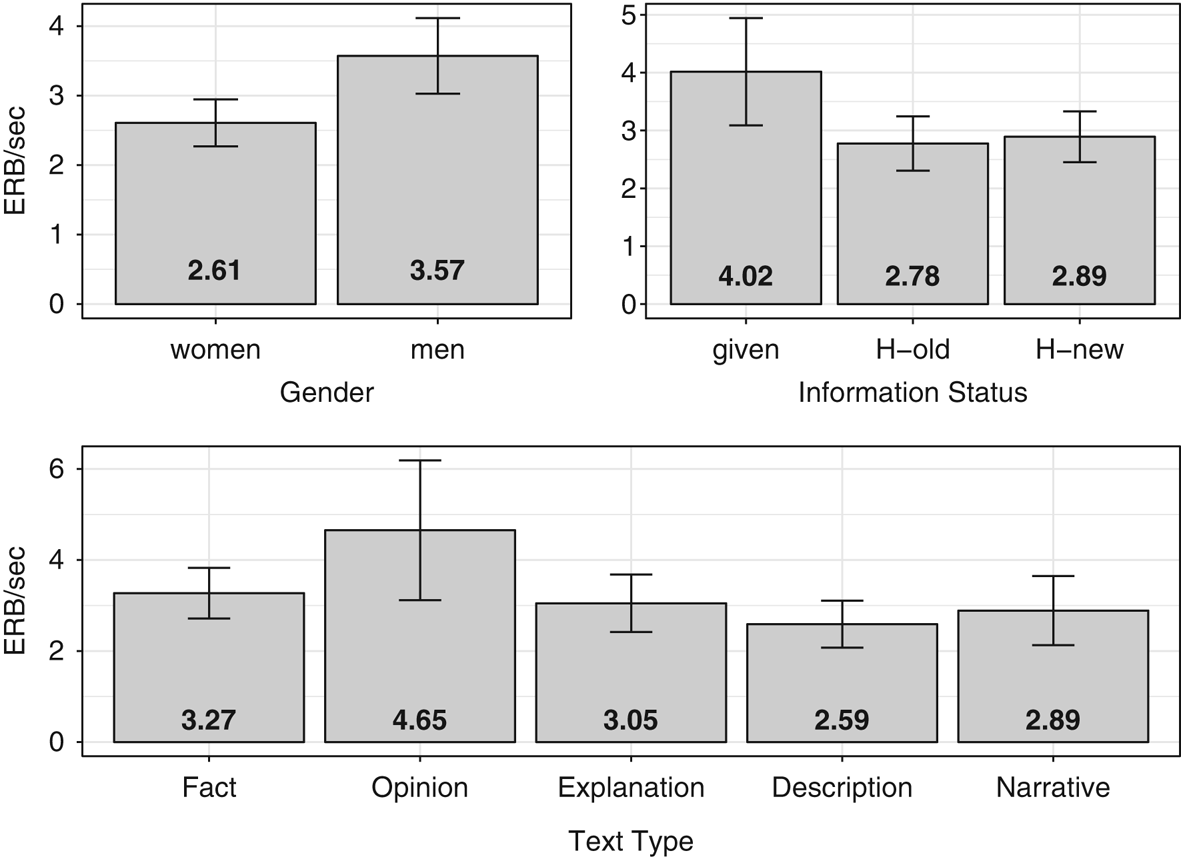
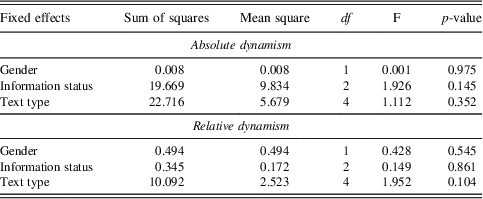
Figure 3 presents mean absolute dynamism ratings (in ERB/second) for the external factors examined (see Appendix for model details). We see in figure 3 that none of the external factors have a significant effect on the rate at which pitch changes during the rise (this finding is also replicated for analyses of relative dynamism, which are not displayed due to space limitations). What this means is that while there exist a variety of different observed absolute dynamism values, ranging roughly from an average of 2.59 ERB/s to an average of 4.65 ERB/s, this variation cannot be correlated with any of the external factors under consideration. As was the case for rise excursion, this lack of any significant differentiation across external factors contrasts with the results of prior research. Warren & Daly (Reference Warren and Daly2005) describe significantly higher levels of dynamism among women in New Zealand, as well as significantly more dynamic rises on narratives as opposed to other types of talk. Similarly, Arvaniti & Atkins (Reference Arvaniti and Atkins2016) report significantly less dynamic rises in their Southern British English dataset for what they term ‘confirmation requests’, as opposed to ‘statements’ or ‘floor holds’. They too, however, find no significant difference in dynamism between the women and the men in their sample.
Means (and confidence intervals) of absolute dynamism (in ERB/sec) as a function of gender, information status and speech activity type

An internal constraint on dynamism does emerge in the data, as illustrated in table 2. There we see that for both the women and the men, absolute dynamism is correlated with rise-final f0 (regression models for relative dynamism reveal the same pattern). What this means is that rises that have a higher pitch end point are also those that rise more steeply over the course of the contour.Footnote 8 When viewed in conjunction with the results for rise excursion (see table 1), the pattern that is revealed is one in which lower-range rises (i.e. with lower rise-final f0) are also those with lower levels of pitch dynamism, while higher-range rises (with higher rise-final f0) are those with higher levels of dynamism. This finding is similar to previous research on HRTs in other locations (e.g. Warren & Daly Reference Warren and Daly2005 in New Zealand), where excursion size and dynamism have been shown to pattern together. But unlike those earlier studies, the models for the current dataset provide no indication that these different types of rises (wider, more dynamic vs narrower, less dynamic) are associated with different pragmatic functions or social differences among speakers. Instead, the internal factors pattern similarly across all tokens in the dataset.
Linear mixed-effects regression results for absolute rise dynamism, internal and external factors combined

For women, n=393; Random intercepts: Speaker (28); Log likelihood: −411.97; Conditional R2=0.619 For men, n=326; Random intercepts: Speaker (14); Log likelihood: −378.41; Conditional R2=0.668 Factors not significant in both models: rise-initial f0, rise duration (log), text type, information status (and all other interactions)
4.3 Rise alignment
The relative alignment of the HRT rise was determined using the method described in Warren & Daly (Reference Warren and Daly2005). This measure approximates the point at which the upward trajectory of the rising contour begins in a polysyllabic final pitch phrase (identified by visual inspection of the pitch track to locate the position of the elbow marking the start of upward excursion).Footnote 9 Alignment is expressed as a number between 0 and 1, where 0 indicates that the rise begins on the nuclear pitch accent and 1 that the rise begins on the final syllable of the phrase. This figure is calculated as a proportional measure of distance (in syllables) from the leftward edge of the phrase, operationalised by identifying the syllable during which the upward excursion begins, counting how many syllables away from the left edge of the phrase that syllable is, and dividing that value by the total number of syllables in the phrase. For example, a four-syllable final pitch phrase with a rise that begins on the second syllable would receive an alignment score of 0.5 (i.e. 2/4). If the rise begins on the third syllable, it would receive an alignment score of 0.75 (i.e. 3/4). Thus, the higher the alignment score the later in the phrase the rise begins. Warren & Daly (Reference Warren and Daly2005) demonstrate that a distinction between early and late rises serves to differentiate both social groups (i.e. women’s rises begin later) and conversational functions in New Zealand English (see also Warren Reference Warren2005). Similarly, Ritchart & Arvaniti (Reference Ritchart and Arvaniti2014) also report a significant difference in terms of rise alignment between women and men in Southern California, with women’s rises starting on average 59 milliseconds later than men’s (Ritchart & Arvaniti used an absolute time-based measure for alignment, rather than a relative syllable-based one; while this type of absolute measure is useful since it also allows you to consider monosyllabic contours, it is unable to control for variation in speech rate across speakers and contexts). Finally, Shokeir (Reference Shokeir2008) details the existence of both early and late rises in Southern Ontario (Canada), which in her data are further correlated with a difference in height of rise-final f0 (early rises end higher than late rises).
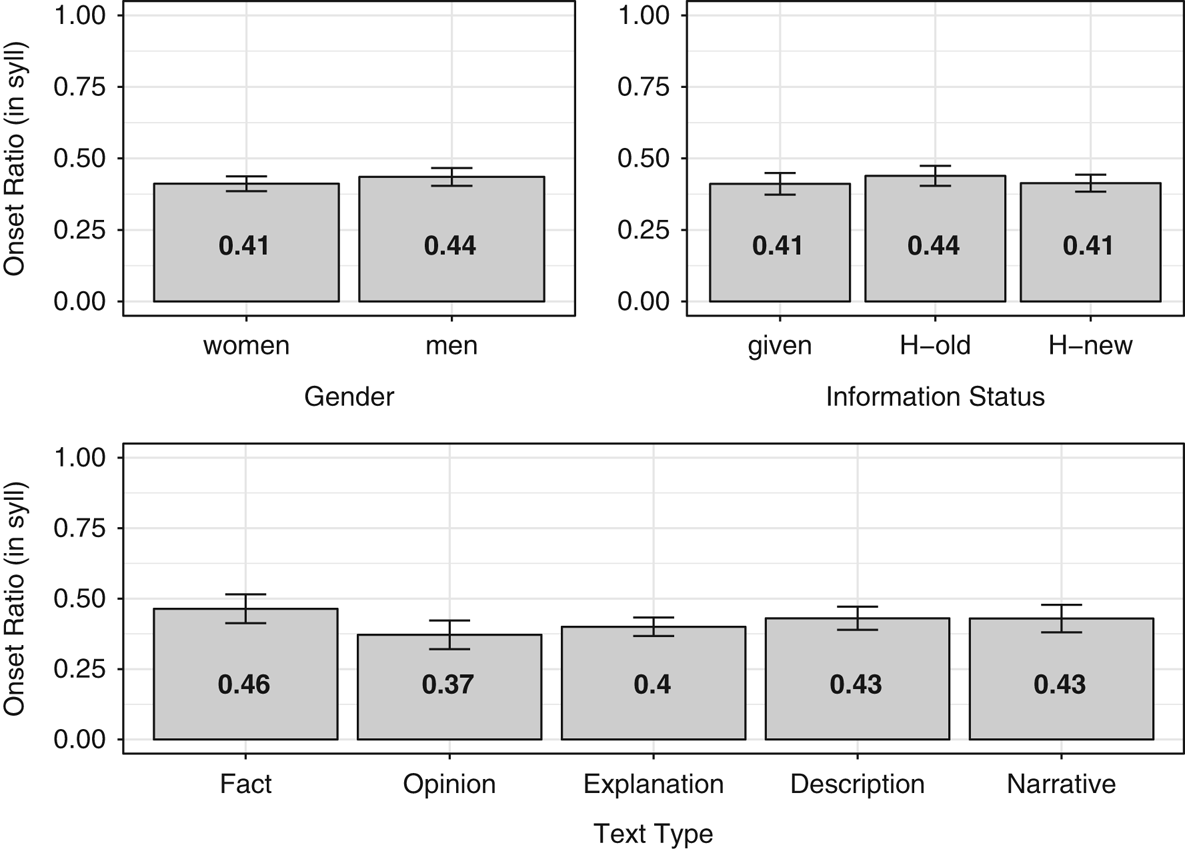
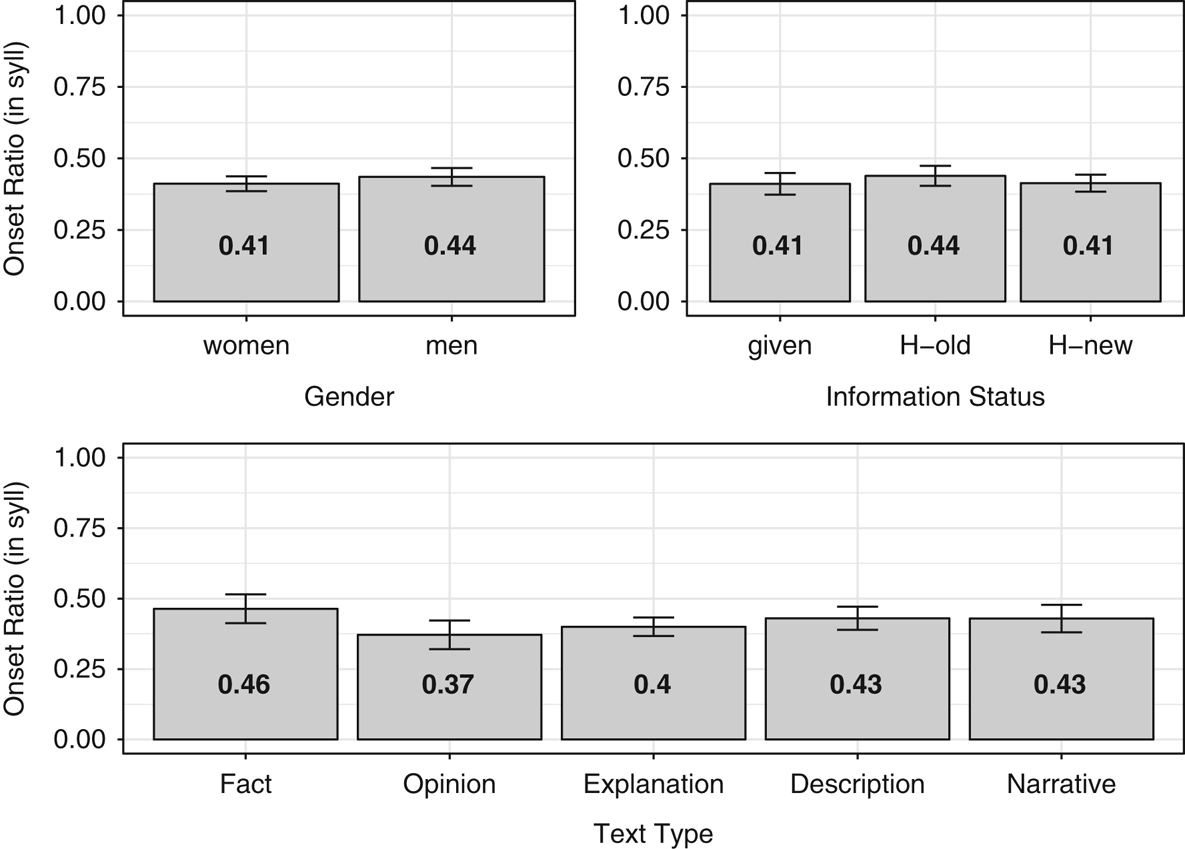
In the current dataset, 495 out of the total 719 HRT tokens occurred in polysyllabic pitch phrases (for women, n=272; for men, n=223). These polysyllabic phrases varied in length from 2 to 9 syllables, with a mean length of 2.90 syllables for women and 2.95 syllables for men. Figure 4 presents the mean alignment ratios for the 495 tokens in the dataset across the three external factor groups under investigation. We see in figure 4 that these mean values are very similar across the board, with little to no differentiation across factor levels. This pattern is confirmed by the regression analysis (see the Appendix), which selects none of the external factor groups as having a significant effect on alignment ratio. Subsequent analysis of the internal factors, both with and without external factors in the model, likewise finds no significant predictors of alignment ratio. Thus, unlike previous studies of this feature, HRT rises in London all appear to be aligned similarly. That alignment, moreover, is a fairly late one, beginning, on average, about 40 per cent of the way through the final pitch phrase.
Means (and confidence intervals) of alignment ratio of polysyllabic contours by gender, information status and speech activity type
4.4 Summary of findings
The analyses in the previous sections reveal no significant effects of gender, information status or speech activity type on rise excursion (either absolute or relative), rise dynamism (either absolute or relative) or rise alignment. Rather, the acoustic properties of HRTs investigated in the current dataset were shown to be broadly similar for both women and men; for the relating of given, hearer-old and hearer-new information; and for all speech activity types. On the whole, HRT contours in naturally occurring speech in London are shown to have an average absolute excursion size of 1.34 ERB, an average dynamism of 3.05 ERB/second and an average alignment ratio of 0.42 (meaning that they tend to begin about 40 per cent of the way through the final pitch phrase). From these facts, we can describe a ‘typical’ declarative rise in London English as being moderately large and dynamic (comparable to what has recently been reported for Southern California rises though smaller and less dynamic than most descriptions of HRTs in Australia and New Zealand) and with a fairly late onset (see also Arvaniti & Atkins Reference Arvaniti and Atkins2016).
In saying this, I do not mean to imply that there is no acoustic variation in the dataset. Examination of the internal factors provides evidence for an alternation between wider, more dynamic rises and narrower, less dynamic ones, characteristics that correlate with higher and lower rise-final f0, respectively. Yet there is no indication that these systematic realisational differences (Ladd Reference Ladd2008) correspond to any form of social or pragmatic specification, at least not in terms of the categories investigated here. This is despite the fact that prior analyses of this same dataset (Levon Reference Levon2016) demonstrate that these same categories (i.e. gender, information status and text type) all have a significant effect on the frequency with which HRTs appear, as well as the pragmatic function they are used to fulfil. While mindful of the need to treat null results with caution, I argue that these findings demonstrate that for HRTs in London, variation in form does not seem to map onto variation in function. In this respect, London English therefore appears to differ from many of the other varieties of English previously discussed in the literature (see also Shobbrook & House Reference Shobbrook and House2003).
5 Discussion
This article has explored the possibility that previously identified patterns of variation in use of HRTs in London are correlated with variation in the contour’s form. The exploration is motivated by the principal underlying hypothesis of much research on intonational meaning (e.g. Brazil, Coulthard & Johns Reference Brazil, Coulthard and Johns1980; Ladd Reference Ladd1983, Reference Ladd2008; Gussenhoven Reference Gussenhoven1984, Reference Gussenhoven2004; Bolinger 1986; Pierrehumbert & Hirschberg Reference Pierrehumbert and Hirschberg1990), namely that differences in the meanings of intonational tunes should correspond to differences in their phonological form. Yet the analyses above demonstrate that clear patterns of functional differentiation in how speakers use HRTs in London do not correlate with any observable differences in the acoustic shape of the contour. Rather, these analyses support the argument that HRT variation in London is what Ladd (Reference Ladd2008: 116) would term realisational in nature, i.e. a situation in which there exist ‘differences of detail in the phonetic realisation of the same tune’.
This finding has a number of theoretical and empirical ramifications. From an empirical perspective, the results indicate that HRTs in London behave differently than they do in other varieties of English. As described above, numerous studies of rising tunes on declaratives in Australia, New Zealand, Canada and California have all revealed systematic correlations between different tune shapes and the distinct functions that these tunes are used to perform. In the current dataset there is no evidence for such correlations, thus highlighting the fact that there are both systemic differences (‘differences in the inventory of phonologically distinct tune types’; Ladd Reference Ladd2008: 116) and semantic differences (‘differences in the meaning or use of the same tune’; Ladd Reference Ladd2008: 116) between London English and these other varieties. Interestingly, this study is not the first to argue that HRTs in Britain pattern differently than they do elsewhere. Both Shobbrook & House (Reference Shobbrook and House2003) and Barry (Reference Barry2008) argue that certain form–meaning correspondences for HRTs that exist in other varieties are not replicated in (Southern) British English, which instead displays more of what is described as ‘free’ variation between tune shapes (see also Arvaniti & Atkins Reference Arvaniti and Atkins2016 for a more recent demonstration of this same pattern). These authors hypothesise that the reason for this may be due to the comparatively recent emergence of HRTs as a feature in the region, such that the contour has yet to ‘grammaticalise’ to the same extent as it has elsewhere. While early studies in the United States (e.g. Lakoff Reference Lakoff1975; Ching Reference Ching1982) and Australia (e.g. Guy & Vonwiller Reference Guy and Vonwiller1984; Guy et al. Reference Guy, Horvath, Vonwiller, Daisley and Rogers1986) suggest that the feature has existed in those locations since about the 1960s, Cruttenden (Reference Cruttenden1994) argues that HRTs did not arrive in London until at least two decades later (see also Bradford Reference Bradford1997). It is possible that this twenty-year lag could account for the distinct patterns of variation found in London versus other locales. While the data I examine here cannot speak directly to this hypothesis, the results are certainly consistent with such an interpretation.Footnote 10
Yet at the same time, the analyses also demonstrate that the variation in tune shape observed in London is not completely ‘free’. There are internal constraints – including the effects of rise-final f0 and, to a lesser extent, rise-initial f0 – that have a significant influence on the overall contour shape. This is important because it indicates that HRT variability in London conforms to the principle of orderly heterogeneity (Weinreich, Labov & Herzog Reference Weinreich, Labov and Herzog1968), with speakers alternating between two well-formed rising tunes: a lower-range, less dynamic rise and a higher-range, more dynamic one. From a more general perspective, the fact that these linguistic effects do not interact with any of the social or pragmatic factors considered provides further support for the notion that there exists a modular separation between internal and external constraints on patterns of sociolinguistic variation (Labov Reference Labov2010). In other words, while there exist differences in terms of how the contour is used across speakers and contexts (Levon Reference Levon2016), whenever it is used, HRTs are subject to the same system-internal constraints. This finding indicates that HRTs are firmly established as an integrated component of the grammar of London English, and are thus not simply a borrowing or a ‘foreign’ form, as many popular discussions of the feature maintain (e.g. that people are just copying what they hear on the Australian soap opera Neighbours; see Bradford Reference Bradford1997).
Finally, I believe that the results of the current study can help to further clarify the nature of the relationship between intonational form and socio-pragmatic meaning. As noted above, there exists a general disagreement in the literature over the compositional nature of intonational meaning, and whether the meanings of intonational tunes are built up from a grammar of distinct meaningful tone units. For the most part, research on HRTs has assumed a compositional account, and has thus endeavoured to identify specific form–function correlations. This body of research has been largely successful, with numerous studies of HRT (and other contours) identifying specific variants of HRTs that correspond to different perceived meanings. There has, however, also been a substantial body of work that has demonstrated the potential for multiplicity in tone meanings, or as Pierrehumbert & Hirschberg (Reference Pierrehumbert and Hirschberg1990: 284) describe it, the ‘many-to-one mapping’ of functions to forms (see also, e.g., Hirschberg Reference Hirschberg2002; Podesva Reference Podesva2011).
I believe that the key to reconciling these two positions lies in what we take the ‘meaning’ or ‘function’ of intonation to entail. With respect to HRTs, numerous studies have documented how the contour can at times function as a floor-holding device and at others as a means to build in-group solidarity. Yet in both instances, these functions are second-order elaborations of a more fundamental meaning associated with the contour: non-finality (McLemore Reference McLemore1991; Tyler Reference Tyler2015b). In certain contexts, signalling non-finality allows a speaker to prolong their conversational turn and thus maintain control of the conversational floor, whereas in other contexts it encourages listeners to respond and so participate in the construction of a solidary common ground. The point is that these different specific functions both grow out of a shared first-order meaning of non-finality.
We can model the connections between these different yet related meanings of HRTs via Eckert’s (Reference Eckert2008) theory of indexical fields. According to Eckert, the meaning of a sociolinguistic variant is not fixed, but is instead distributed over a field of ideologically related meaning-potentials. The relationship between these meaning-potentials is, moreover, developmental in nature, with new orders of meaning emerging as creative elaborations of other, more fundamental indexical associations (Silverstein 2003). The use of HRTs to signal a non-completed turn, for example, can be elaborated to a second order of meaning where HRTs signal ‘floor control’, or to a different second-order meaning where they indicate the creation of a solidary common ground. Which specific meaning gets activated at any given moment is a product of the discourse context in which the variant occurs and the way in which the variant is construed by participants in the interaction (see also Eckert Reference Eckert2016). In many respects, Eckert’s theory of indexical fields is similar to the principles underlying Gussenhoven’s (Reference Gussenhoven1984) grammar of intonation, with basic (universal) tones conveying general (i.e. first-order) meanings that are then specified in context (see also Ladd Reference Ladd2008). Unlike Gussenhoven, however, Eckert does not require these basic tones to be stylised or otherwise modified in order for meanings to change and second-order meanings to emerge. Rather, underspecification is viewed as a defining feature of how meaning is communicated, allowing multiple meanings to be linked simultaneously to the same linguistic form. In addition, by positing a developmental link between the meanings in the field, Eckert’s framework makes explicit the process through which meanings change over time and the unified field of related meanings itself arises.
Applying Eckert’s model to the case of HRT in London, I would argue that the mapping between form and function happens at a first indexical order, at the level of signalling ‘non-finality’. This is why we find no pragmatically meaningful variation in the shape of the contour despite the previously identified significant differences in the way the form is used. In contrast, I suggest that in other varieties, such as Australian English or New Zealand English, the mapping between form and meaning happens at a second indexical order (e.g. floor control versus solidarity), in which functional differentiation is accompanied by differences in phonological form. There is thus in both cases a unique correspondence between form and (some level of) function. The distinction lies in whether that function is more general and can be interpreted variably across contexts (as in London) or whether it is more specific and hence fixed (as in Australia and New Zealand). While I am unable to provide a definitive explanation as to why we find these different types of mappings across varieties, it is likely to be linked to the respective age of the contour in different locations, such that mappings to second-order meanings emerge later in the course of language change (see also Tyler Reference Tyler2015b for a similar proposal based on perception testing of the meanings of HRTs in California). This is certainly a topic for future research. For the moment, I simply hope to have demonstrated the benefit of adopting a multi-level conceptualisation of meaning for the study of intonational patterns like HRT – a conceptualisation that I believe allows us to reconcile our theories of how the meanings of tunes are built from the bottom up with the reality of the diverse and complex ways those tunes are then put to use in naturally occurring conversation.
APPENDIX
■
Analysis of Variance Table (Satterthwaite approximations for degrees of freedom) for linear regression of absolute and relative excursion size (see figure 2)

Analysis of Variance Table (Satterthwaite approximations for degrees of freedom) for linear regression of absolute and relative rise dynamism (see figure 3)

Analysis of Variance Table (Satterthwaite approximations for degrees of freedom) for linear regression of rise alignment ratio (see figure 4)