Introduction
Social phobia is characterized by a marked and persistent fear of social or performance situations in which the person may be scrutinized by others and fears coming across in way that would be embarrassing or humiliating (APA, 1994). It is a chronic disorder, which usually begins in early adolescence and results in considerable impairment that increases over an individual's lifespan (Wittchen & Fehm, Reference Wittchen and Fehm2003). A lifetime prevalence ranging from 3% to 13% has been reported by epidemiological and community studies (APA, 1994). Effects on role functioning and quality of life are most severe for people with generalized social phobia and co-morbid avoidant personality disorder (Kessler, Reference Kessler2003).
The efficacy of psychological treatments for social phobia has been addressed in several reviews (e.g. Chambless et al. Reference Chambless, Baker, Baucom, Beutler, Calhoun, Crits-Christoph, Daiuto, DeRubeis, Detweiler, Haaga, Bennett Johnson, McCurry, Mueser, Pope, Sanderson, Shoham, Stickle, Williams and Woody1998; DeRubeis & Crits-Christoph, Reference DeRubeis and Crits-Christoph1998; Chambless & Ollendick, Reference Chambless and Ollendick2001; Roth & Fonagy, Reference Roth and Fonagy2005). Nonetheless, differing opinions exist as to what constitutes sufficient evidence to consider a practice evidence-based. Roth & Fonagy (Reference Roth and Fonagy2005, p. 480) required ‘replicated demonstration of superiority to a control condition or another treatment condition, or a single, high-quality randomized control trial’ (RCT), in addition to other criteria. In contrast, Chambless & Hollon (Reference Chambless and Hollon1998) differentiated efficacious and specific, efficacious, and possibly efficacious therapies. According to these criteria, for a designation of efficacious and specific, the therapy must have been shown to be ‘statistically significantly superior to pill or psychological placebo or to an alternative bona fide treatment in at least two independent research settings’ (p. 18). If the therapy proved more beneficial than no treatment in at least two settings, it would be considered efficacious. If there was only one study supporting the therapy's efficacy, or all the research has been conducted in one setting, the therapy would be considered possibly efficacious, pending replication. DeRubeis & Crits-Christoph (Reference DeRubeis and Crits-Christoph1998) used these criteria.
In this article, we review studies of psychological interventions for social phobia in adults and provide an update on which ones are empirically supported, using the scheme proposed by Chambless & Hollon (Reference Chambless and Hollon1998). This is a qualitative review, not a meta-analysis.
Method
A literature search for trials of psychological interventions for social phobia published up to the end of 2005 was conducted. Articles were identified through electronic searches of the PsycINFO and PubMed databases. A search strategy containing the following key words and combinations was used: (social phobia or social anxiety disorder) and (random, randomly, randomise, randomize, randomised, or randomized). The PubMed database was also searched for RCTs that contained the terms social phobia or social anxiety disorder. Manual searches of the reference lists of articles and chapters were also conducted. The first author completed the literature search.
Studies were included if they satisfied the following criteria: (1) evaluated the treatment of adult patients with a diagnosis of social phobia; (2) randomly allocated patients to psychological treatment or a no treatment, placebo or alternative treatment condition; (3) provided a clear description of the treatment method; and (4) were written in English. Studies were excluded if they satisfied any of the following criteria: (1) evaluated the efficacy of psychological treatment in a mixed sample of patients without examining diagnostic groups separately; (2) selected patients on the basis of them being ‘suitable’ for a particular intervention; and (3) compared patients on the basis of them being a particular type of responder (e.g. behavioral) in a test.
Articles were obtained, read and classified on the basis of which psychological interventions were evaluated. Data regarding treatment, participants and results were then extracted and tabulated. Studies were reviewed with a particular focus on comparisons between psychological interventions and no treatment or minimal treatment, psychological or pill placebo, and pharmacological or other psychological treatments. Finally, we identified which psychological interventions are empirically supported, using the scheme proposed by Chambless & Hollon (Reference Chambless and Hollon1998).
Results
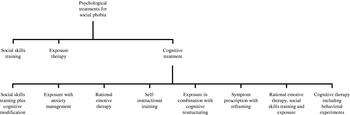
Thirty studies were identified that met our inclusion criteria. These studies evaluated the efficacy of social skills training (SST) (n=2), exposure therapy (n=15), and cognitive treatment (n=25) for social phobia (see Fig. 1). A number of trials investigated more than one intervention. There were no trials involving more traditional dynamic or humanistic approaches.
Classification of psychological treatments for social phobia in randomized controlled trials.

SST
The skills deficit model proposes that some forms of psychiatric disorder are caused or worsened by lack of social competence, and can be treated through training in social skills (Trower et al. Reference Trower, Bryant and Argyle1978). SST for social phobia involves identifying, discussing, and practicing feared situations. Behavioral modification techniques include the provision of instructions, modeling, role-rehearsal and feedback (Stravynski et al. Reference Stravynski, Marks and Yule1982, Reference Stravynski, Arbel, Bounader, Gaudette, Lachance, Borgeat, Fabian, Lamontagne, Sidoun and Todorov2000). Patients are encouraged to practice the skills they have learned in natural settings between sessions (Ost et al. Reference Ost, Jerremalm and Johansson1981).
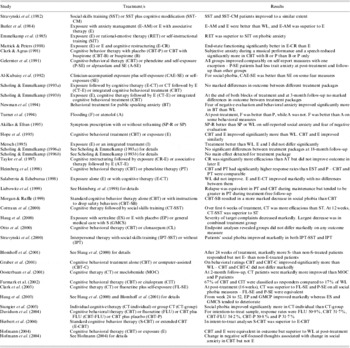
In RCTs, SST has been compared to behavioral treatment without training in social skills and SST with cognitive modification. An overview of these studies is presented in Table 1. In these trials, SST was conducted over a mean of 13 sessions (range 12–14).
Psychological treatments for social phobiaFootnote a

Control condition abbreviations: WL, waiting list; P, placebo; EST, educational-supportive therapy; ST, supportive therapy.
a A more detailed version of this table is available on the Journal's website (http://journals.cambridge.org).
Stravynski et al. (Reference Stravynski, Arbel, Bounader, Gaudette, Lachance, Borgeat, Fabian, Lamontagne, Sidoun and Todorov2000) reported that the rates of patients in remission following an intervention focused on improving interpersonal relationships with SST were equivalent to those following an intervention focused on improving interpersonal relationships without SST. SST may produce improvement in social phobia because of the ‘opportunity it provides for practice of previously avoided social responses in a non-threatening environment’ (Spence, Reference Spence, Lindsay and Powell1994, p. 266).
Exposure therapy
Learning theory postulates that the origin of neuroses can be dated back to a particular occasion of immense distress or the repeated arousal of anxiety in a recurring situation, and stimuli comparable to those in the precipitating situations can later evoke phobic reactions (Wolpe, Reference Wolpe1973). Extinction is the ‘progressive weakening of a habit though the repeated evocation without reinforcement of the responses that manifest it’ (p. 19). The paradigm of experimental extinction generated exposure techniques. Exposure treatment for social phobia involves constructing and then working through a hierarchy of feared social and performance situations, starting with the least anxiety-provoking situation and remaining in it until fear has decreased before moving on to the next situation. Flooding is the intensive application of exposure.
In RCTs, exposure therapy for social phobia has been evaluated against the effects of no treatment, relaxation training, pill placebo, pharmacological treatment, and cognitive therapy (CT). An overview of these studies is presented in Table 1. Exposure therapy in these trials was conducted over a mean of 12 sessions (range 6–20).
Exposure to feared social and performance situations has been shown to produce significantly greater improvements in social phobia symptoms than a waiting-list control condition (Butler et al. Reference Butler, Cullington, Munby, Amies and Gelder1984; Hope et al. Reference Hope, Heimberg and Bruch1995; Mersch, Reference Mersch1995; Salaberria & Echeburua, Reference Salaberria and Echeburua1998; Hofmann, Reference Hofmann2004; Hofmann et al. Reference Hofmann, Moscovitch, Kim and Taylor2004). Follow-up assessments up to 18 months after treatment have shown that the gains patients make in exposure treatment are largely maintained (Butler et al. Reference Butler, Cullington, Munby, Amies and Gelder1984; Hope et al. Reference Hope, Heimberg and Bruch1995; Mersch, Reference Mersch1995; Salaberria & Echeburua, Reference Salaberria and Echeburua1998). Not only do fear and avoidance decrease over the course of treatment, but in some studies there is evidence of cognitive change over exposure treatment too (Mersch, Reference Mersch1995; Salaberria & Echeburua, Reference Salaberria and Echeburua1998; Hofmann, Reference Hofmann2004).
In one trial, flooding was shown to be superior to pill placebo on self-reported social avoidance and distress, whereas atenolol, a beta-blocker, was not (Turner et al. Reference Turner, Beidel and Jacob1994). Independent evaluators judged flooding patients, but not atenolol patients, to be markedly more improved, have less symptomatology and avoid less social interactions than placebo patients. On an impromptu speech task, patients in the flooding group reported significantly more improvement in distress and positive and negative thoughts at the end of treatment than those in the other conditions.
Blomhoff et al. (Reference Blomhoff, Haug, Hellstrom, Holme, Humble, Madsbu and Wold2001) examined the efficacy of sertraline, exposure therapy and combined treatment in generalized social phobia. General practitioners who had received approximately 30 hours of training in assessment and exposure therapy for social phobia provided the treatment (Haug et al. Reference Haug, Hellstrom, Blomhoff, Humble, Madsbu and Wold2000). Markedly more sertraline- than non-sertraline-treated patients responded but no marked difference was observed between exposure- and non-exposure-treated patients (Blomhoff et al. Reference Blomhoff, Haug, Hellstrom, Holme, Humble, Madsbu and Wold2001). Nevertheless, quality of implementation was not measured. From the end of treatment to 6-month follow-up, however, patients who had been treated with exposure therapy plus placebo showed further improvement, whereas patients who had been treated with exposure therapy combined with sertraline or sertraline plus general medical care showed a tendency to deteriorate (Haug et al. Reference Haug, Blomhoff, Hellstrom, Holme, Humble, Madsbu and Wold2003).
Cognitive treatment
According to cognitive theory, exaggerated fear of being the focus of attention, of having one's ‘weaknesses’ exposed, and as a result being judged negatively by others leads to social anxiety (Beck et al. Reference Beck, Emery and Greenberg1985). ‘A vicious cycle is created whereby the anticipation of an absolute, extreme, irreversible outcome tends to make a person more fearful, defensive, and inhibited when entering the situation’ (p. 151).
In RCTs, the efficacy of cognitive interventions has been evaluated against the effects of no treatment, supportive therapy, relaxation training, SST, symptom prescription, exposure therapy, pill placebo and pharmacological treatments. An overview of these studies is presented in Table 1. Cognitive interventions in these trials were conducted over a mean of 12 sessions (range 3–20).
Some studies have examined the benefit of adding cognitive techniques to behavioral treatments. SST, alone or in combination with cognitive modification has been evaluated in patients with diffuse social phobia and avoidant personality disorder (Stravynski et al. Reference Stravynski, Marks and Yule1982). Both interventions produced significant improvements in social avoidance and distress, fear of negative evaluation, irrational beliefs, depression, social isolation and work inadequacy, although SST with cognitive modification did not lead to greater improvements than SST alone. There are a number of reasons why differences were not observed between the conditions. First, cognitive restructuring may not be an efficacious intervention for patients who have avoidant personality disorder in addition to social phobia. Nonetheless, in a recent RCT that compared CT, fluoxetine plus self-exposure and placebo plus self-exposure, presence of avoidant personality disorder did not predict treatment response (Clark et al. Reference Clark, Ehlers, McManus, Hackmann, Fennell, Campbell, Flower, Davenport and Louis2003). Second, cognitive restructuring may not have supplemented the efficacy of SST because it was administered at different times than SST, so that each component of treatment was self-contained (Heimberg & Barlow, Reference Heimberg and Barlow1988).
Exposure to feared and avoided social situations plus anxiety management training involving progressive muscle relaxation, distraction from symptoms and rational self-talk to address maladaptive thoughts has been shown to markedly reduce fear of negative evaluation, phobic severity and depression (Butler et al. Reference Butler, Cullington, Munby, Amies and Gelder1984). Gains made in treatment were significantly greater than those made over a waiting-list control condition. Of note, in a comparison treatment of exposure to feared and avoided social situations plus associative therapy, fear of negative evaluation did not change significantly. At 6-month follow-up, exposure plus anxiety management was superior to exposure plus the non-specific control treatment on patient-rated phobic severity, social avoidance and fear of negative evaluation.
Rational emotive therapy (RET) places an emphasis on rationally disputing irrational beliefs that are common among social phobics and produces significant reductions in anxiety (Emmelkamp et al. Reference Emmelkamp, Mersch, Vissia and van der Helm1985). In that study, few differences in outcome emerged between RET and exposure in vivo. The issue of whether better results are obtained when these interventions are administered in a sequential, or integrated manner has been the subject of several investigations.
In one RCT, an integrated treatment of RET, SST and in vivo exposure did not have a better outcome than in vivo exposure alone (Mersch, Reference Mersch1995). Similarly, Scholing & Emmelkamp (Reference Scholing and Emmelkamp1993b) found that exposure in vivo alone, RET followed by exposure in vivo and an integrated cognitive behavioral treatment were equally efficacious for patients with generalized social phobia. Moreover, in a sample of social phobics with a fear of blushing, trembling or sweating in social situations as the main problem, exposure in vivo followed by RET, RET followed by exposure in vivo and an integrated cognitive behavioral treatment all led to marked improvements in symptoms over the course of treatment, with no significant differences in outcome between the different treatment packages (Scholing & Emmelkamp, Reference Scholing and Emmelkamp1993a). Notwithstanding these findings, another study found that group-guided exposure and cognitive restructuring was significantly more efficacious than group-guided exposure alone on end-state functioning, behavioral approach and self-rated avoidance (Mattick & Peters, Reference Mattick and Peters1988). The integrated treatment had the same format as the exposure condition, except patients were instructed to use cognitive techniques during exposure. Cognitive restructuring combined systematic rational restructuring with aspects of RET.
Cognitive behavioral group therapy (CBGT) developed by Heimberg and colleagues is based on Beck et al.'s (Reference Beck, Emery and Greenberg1985) model of logical analysis and hypothesis testing and consists of cognitive restructuring integrated into in-session role-played exposure to feared situations and in vivo exposure homework assignments (Hope et al. Reference Hope, Heimberg and Bruch1995). ‘Integration of the cognitive and behavioral interventions maximizes access to central cognitions elicited by the anxiety-provoking situations and allows social phobics’ irrational thoughts to be challenged with behavioral evidence’ (p. 640). This and other group-based cognitive behavioral interventions based on Beck et al.'s (Reference Beck, Emery and Greenberg1985) model have been shown to be superior to a waiting-list control condition in the treatment of symptoms of social phobia, and over follow-up periods of up to 1 year treatment gains are largely maintained (Hope et al. Reference Hope, Heimberg and Bruch1995; Salaberria & Echeburua, Reference Salaberria and Echeburua1998; Gruber et al. Reference Gruber, Moran, Roth and Taylor2001; Furmark et al. Reference Furmark, Tillfors, Marteinsdottir, Fischer, Pissiota, Langstrom and Fredrikson2002; Hofmann, Reference Hofmann2004; Hofmann et al. Reference Hofmann, Moscovitch, Kim and Taylor2004). CBGT is also more efficacious than educational-supportive group therapy in ameliorating social phobia (Heimberg et al. Reference Heimberg, Liebowitz, Hope, Schneier, Holt, Welkowitz, Juster, Campeas, Bruch, Cloitre, Fallon and Klein1998).
While some studies have reported that group cognitive behavioral interventions do not lead to greater gains than group exposure therapy alone (Hope et al. Reference Hope, Heimberg and Bruch1995; Salaberria & Echeburua, Reference Salaberria and Echeburua1998), others have found that CBGT has a superior outcome. Hofmann (Reference Hofmann2004) found that although CBGT and exposure group therapy were equivalent in outcome at post-treatment, only CBGT patients continued to improve after treatment termination, which resulted in markedly lower social anxiety in CBGT than exposure group therapy patients at 6-month follow-up.
Benzodiazepines such as alprazolam and clonazepam, alone or in combination with instructions for self-exposure have been compared to CBGT. In one study, while patients who completed a course of treatment with clonazepam reported markedly less fear of negative evaluation and social interaction anxiety and more assertiveness than CBGT completers at post-treatment assessment, endpoint analyses revealed that the groups did not differ on any outcome measure (Otto et al. Reference Otto, Pollack, Gould, Worthington, McArdle, Rosenbaum and Heimberg2000). Another study compared CBGT, alprazolam plus self-exposure, phenelzine plus self-exposure and pill-placebo plus self-exposure (Gelernter et al. Reference Gelernter, Uhde, Cimbolic, Arnkoff, Vittone, Tancer and Bartko1991). Patients assigned to phenelzine plus self-exposure reported lower levels of trait anxiety at post-treatment and follow-up than those in the other groups. Groups improved comparably on other self-report measures, however.
The 5-HT1A partial agonists are a newer class of anxiolytic agent than the benzodiazepines (Stahl, Reference Stahl1996). In one RCT, musicians with a problem with performance anxiety and a diagnosis of social phobia who received CBGT with placebo or buspirone had a significantly better outcome than those who received buspirone or placebo alone in terms of pre- to post-treatment improvements in subjective anxiety during a musical performance and during a speech (Clark & Agras, Reference Clark and Agras1991). Over the 1-month follow-up period, musicians assigned to CBGT plus placebo had a superior outcome on confidence as a performer than those assigned to buspirone alone, placebo alone and CBGT plus buspirone.
While treatment with a selective serotonin reuptake inhibitor (SSRI) such as fluoxetine may produce more change in symptoms of social phobia over the initial weeks of treatment, at the end of treatment it has been reported that fluoxetine, CBGT and CBGT plus fluoxetine do not differ from one another (Davidson et al. Reference Davidson, Foa, Huppert, Keefe, Franklin, Compton, Zhao, Connor, Lynch and Gadde2004). Symptoms of social phobia have also been shown to improve markedly and comparably with CBGT and the SSRI citalopram (Furmark et al. Reference Furmark, Tillfors, Marteinsdottir, Fischer, Pissiota, Langstrom and Fredrikson2002).
Monoamine oxidase inhibitors such as phenelzine have also been compared to CBGT. Over the course of treatment while phenelzine was better than CBGT on some measures, both were superior to a pill-placebo condition and educational-supportive group therapy (Heimberg et al. Reference Heimberg, Liebowitz, Hope, Schneier, Holt, Welkowitz, Juster, Campeas, Bruch, Cloitre, Fallon and Klein1998). To examine the effects of maintenance treatment and persistence of treatment gains following treatment discontinuation, responders to either phenelzine or CBGT entered maintenance and treatment-free follow-up phases (Liebowitz et al. Reference Liebowitz, Heimberg, Schneier, Hope, Davies, Holt, Goetz, Juster, Lin, Bruch, Marshall and Klein1999). Although relapse during maintenance did not differ between phenelzine and CBGT, there was a tendency for more phenelzine than CBGT patients to relapse during treatment-free follow-up. Furthermore, among patients with generalized social phobia, relapse during the study was significantly greater with phenelzine than CBGT. Medications may produce a response that is more rapid and complete but less enduring than response to cognitive behavioral treatment. Nonetheless, CT has been shown to reduce the symptoms of social phobia significantly more than the reversible inhibitor of monoamine oxidase A (RIMA) moclobemide (Oosterbaan et al. Reference Oosterbaan, van Balkom, Spinhoven, van Oppen and van Dyck2001).
Although most patients respond to existing cognitive behavioral interventions (Heimberg et al. Reference Heimberg, Liebowitz, Hope, Schneier, Holt, Welkowitz, Juster, Campeas, Bruch, Cloitre, Fallon and Klein1998), fewer fully remit (Salaberria & Echeburua, Reference Salaberria and Echeburua1998; Otto et al. Reference Otto, Pollack, Gould, Worthington, McArdle, Rosenbaum and Heimberg2000) and it is apparent that there is scope for further improvement (Clark et al. Reference Clark, Ehlers, McManus, Hackmann, Fennell, Campbell, Flower, Davenport and Louis2003).
In a theoretical paper, Clark & Wells (Reference Clark, Wells, Heimberg, Liebowitz, Hope and Schneier1995) postulated that the tendency for social phobics to interpret social situations in a threatening manner is the result of various dysfunctional beliefs. Social phobics believe that when they enter particular social situations ‘they are in danger of behaving in an inept and unacceptable fashion’, and that ‘such behavior will have disastrous consequences in terms of loss of status, loss of worth, and rejection’ (pp. 69–70). A complex constellation of affective, behavioral, cognitive and somatic changes is activated when a social phobic perceives a social situation in this manner. It is argued that several processes prevent disconfirmation of dysfunctional beliefs about the danger inherent in social situations and thus maintain social anxiety. These maintenance processes include self-focused attention, in-situation safety behaviors, anxiety-induced performance deficits, and anticipatory and post-event processing.
Compared to controls, social phobics overestimate the likelihood that unpleasant social events will occur (Lucock & Salkovskis, Reference Lucock and Salkovskis1988) and underestimate their ability to cope with embarrassing events (Edelmann, Reference Edelmann1985). They underestimate their public-speaking performance compared to ratings made by observers and this difference is greater than that seen in non-clinical subjects (Rapee & Lim, Reference Rapee and Lim1992). Patients with generalized social phobia are more likely than controls to interpret ambiguous social events in a negative manner and respond in a catastrophic way to mildly negative social events (Stopa & Clark, Reference Stopa and Clark2000).
Social phobics' cognitions may not be data driven because they do not carefully monitor others' responses in social situations (Stopa & Clark, Reference Stopa and Clark1993). When expecting to give a speech, for example, anxious individuals attend more to internal than external cues (Mansell et al. Reference Mansell, Clark and Ehlers2003), and the more they notice body sensations during their speech, the more they overestimate how anxious they look and underestimate how well they come across (Mansell & Clark, Reference Mansell and Clark1999).
When anxious in social situations, social phobics are significantly more likely than controls to experience negative images of the self from an observer perspective (Hackmann et al. Reference Hackmann, Surawy and Clark1998). ‘Early unpleasant experiences may lead to the development of excessively negative images of their social selves that are repeatedly activated in subsequent social situations and fail to update in the light of subsequent, more favourable experiences’ (Hackmann et al. Reference Hackmann, Clark and McManus2000, p. 601). When holding a negative self-image in mind during a conversation, socially anxious individuals feel more anxious, use more safety behaviors and overestimate to a greater extent how poorly they come across, and the social interaction becomes contaminated because both parties rate the conversation as poorer (Hirsch et al. Reference Hirsch, Meynen and Clark2004). Interestingly, when socially anxious subjects appraise their social performance after viewing it using video, the ratings are closer to those made by independent observers than those made without viewing the video (Rapee & Hayman, Reference Rapee and Hayman1996). The therapeutic effects of video feedback are improved by cognitive preparation involving asking individuals to predict what they think they will see in the video, close their eyes and develop an image of how they think they came across, and then watch the video as though they are watching a stranger (Harvey et al. Reference Harvey, Clark, Ehlers and Rapee2000).
CT for social phobia based on Clark & Wells (Reference Clark, Wells, Heimberg, Liebowitz, Hope and Schneier1995) model aims to reverse the processes involved in maintaining the disorder and involves developing an idiosyncratic version of the model with patients, a self-focused attention and safety behaviors experiment, focusing attention on the social situation, video feedback following cognitive preparation, widespread use of behavioral experiments to test fears concerning various social situations, addressing problematic anticipatory and post-event processing, and identification and modification of dysfunctional assumptions using behavioral experiments and cognitive restructuring (Clark et al. Reference Clark, Ehlers, McManus, Hackmann, Fennell, Campbell, Flower, Davenport and Louis2003). The addition of instructions to drop safety behaviors has been shown to improve outcome in standard CBT for social phobia (Morgan & Raffle, Reference Morgan and Raffle1999). Moreover, exposure with instructions to decrease safety behaviors under a cognitive rationale of disconfirming negative thoughts is more efficacious in reducing anxiety and belief in feared outcomes than exposure with instructions to decrease safety behaviors under an extinction rationale or exposure alone with no instructions to change safety behaviors (Kim, Reference Kim2005).
In a RCT of treatments for generalized social phobia, CT was shown to be significantly more efficacious than fluoxetine plus self-exposure and placebo plus self-exposure in reducing social phobia, whereas both of the latter did not differ markedly (Clark et al. Reference Clark, Ehlers, McManus, Hackmann, Fennell, Campbell, Flower, Davenport and Louis2003). For the social phobia composite measure, pre- to post-treatment effect sizes were 2·14 for CT, 0·92 for fluoxetine plus self-exposure and 0·56 for placebo plus self-exposure, and pre-treatment to 12-month follow-up effect sizes were 2·53 for CT and 1·36 for fluoxetine plus self-exposure. It was noted that these effect sizes are larger than those reported in other trials of cognitive behavioral treatments. Nevertheless, CT was conducted by clinical psychologists who were knowledgeable and skilled in the use of cognitive behavioral therapies for anxiety.
In a further RCT of CT for social phobia, a version of the individual CT program was compared with a group version of the program (Stangier et al. Reference Stangier, Heidenreich, Peitz, Lauterbach and Clark2003). Therapists in the trial only had a modest amount of training in the intervention. Individual CT showed larger pre- to post-treatment effect sizes than group CT on social phobia measures (1·17 versus 0·55). The difference in effect sizes between the treatments increased over the follow-up period, and pre-treatment to 6-month follow-up effect sizes were 1·57 and 0·74, respectively, on the social phobia measures. Nonetheless, the effect sizes for individual CT were smaller than those obtained by Clark et al. (Reference Clark, Ehlers, McManus, Hackmann, Fennell, Campbell, Flower, Davenport and Louis2003). While differences in therapist training and experience may have contributed to the different outcomes, it is also noteworthy that the individual CT program was not identical in the trials. Only sessions 1–7 of individual CT in the Stangier et al. (Reference Stangier, Heidenreich, Peitz, Lauterbach and Clark2003) study followed the London-Oxford treatment closely, and the behavioral experiments that tend to dominate sessions 8–16 were not conducted (D. M. Clark, personal communication). Instead, cognitive work on schemas took up the majority of the second half of treatment rather than being conducted alongside behavioral experiments. Further research is required to determine whether CT for social phobia is more efficacious than other cognitive behavioral interventions.
Discussion
For the treatment of social phobia, there is little evidence to support the use of SST. The utility of a SST approach has also been questioned on the grounds that socially anxious individuals may have adequate social skills in their repertoire (Clark & Arkowitz, Reference Clark and Arkowitz1975).
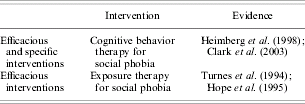
In several research settings, exposure therapy has been found to be more efficacious than no treatment for social phobia. One study showed that exposure was superior to pill placebo and a beta-blocker. Exposure therapy may therefore be considered an efficacious, but not specific, treatment for social phobia at this stage (see Table 2).
Empirically supported psychological interventionsFootnote a for social phobia
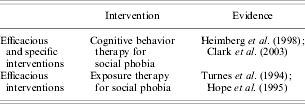
a Using the scheme proposed by Chambless & Hollon (Reference Chambless and Hollon1998) for determining when a psychological intervention for a specific disturbance may be considered established.
CBT for social phobia has been shown to be efficacious and specific. Educational-supportive group therapy, pill placebo, placebo plus self-exposure and fluoxetine plus self-exposure produce less change in symptoms. Phenelzine may produce a less enduring response than CBT. There are mixed findings regarding the relative efficacy of cognitive behavioral and exposure treatments. While some studies have shown that they lead to comparable improvements in social anxiety and avoidance, others have found that patients treated with CBT have a better outcome.
A number of problems may be encountered in exposure treatment for social anxiety, which may reduce the efficacy of this intervention. These include the difficulty of specifying graduated and repeatable tasks because social situations are unpredictable and variable, difficulties in prolonging exposure because of the brevity of many social situations, problems securing sufficient engagement during exposure due to dissociation from external cues, and dealing with fear of negative evaluation which is a fundamental aspect of social phobia (Butler, Reference Butler1985). Given that exposure alone may not markedly improve fear of negative evaluation, attention to cognitive factors may be especially important in treatment (Butler et al. Reference Butler, Cullington, Munby, Amies and Gelder1984).
The conclusions of this review are generally consistent with and update those of other reviews. DeRubeis & Crits-Christoph (Reference DeRubeis and Crits-Christoph1998) also used the scheme proposed by Chambless & Hollon (Reference Chambless and Hollon1998) for determining when a psychological intervention for a specific disturbance may be considered empirically supported, and classified exposure therapy and CBT as efficacious treatments for social phobia. Nonetheless, since their review more controlled evaluations of CBT have been published. Roth & Fonagy (Reference Roth and Fonagy2005) concluded that exposure therapy and CT in combination with exposure have clear evidence of efficacy. Efficacious, and efficacious and specific treatments for social phobia were not differentiated, however. They suggested that SST might best be kept for patients with established problems in social performance.
This review has a number of limitations. First, only articles written in English were reviewed. Second, we excluded single case studies, case series, open trials of therapies, and controlled comparisons of interventions in which patients were not randomly allocated to treatment conditions. RCTs are often considered the ‘gold standard of evidential enquiry’ (Roth & Parry, Reference Roth and Parry1997, p. 369) and remain the best way to test ideas of causal agency (Crits-Christoph et al. Reference Crits-Christoph, Wilson and Hollon2005). Although it has been argued that clinicians need information from RCTs in order to make treatment recommendations and provide evidence-based interventions, it has also been argued that RCTs lack ecological validity and concentrate on outcome and technique rather than questions of importance to practicing clinicians such as those regarding the therapeutic alliance and mechanisms of change (Persons & Silberschatz, Reference Persons and Silberschatz1998). Third, all the RCTs of psychological therapies for social phobia included in this review investigated the efficacy of behavioral and/or cognitive treatments. We therefore do not know how efficacious other psychological approaches are for social phobia. Lack of evidence for efficacy is not evidence of inefficacy (Westen et al. Reference Westen, Novotny and Thompson-Brenner2004).
Acknowledgements
This work was supported by a grant from the Josiah Macy Jr. Foundation (Project: 1003551, Myrna M. Weissman, Principal Investigator) and an Independent Scientist Award from the National Institute of Mental Health to S.D.H. (MH01697).
Note
Supplementary information accompanies this paper on the Journal's website (http://journals.cambridge.org).
Declaration of Interest
None.