Background
Quality problems in the US nursing-home industry
In the United States, approximately 1.6 million people receive care each day in approximately 16,000 nursing homes. More than 80 per cent of nursing-home residents have significant limitations in physical functioning, and most suffer from at least three chronic diseases. Two-thirds exhibit significant cognitive impairment, and about half have no relatives living near their nursing home. Public funds pay for just in excess of the majority of nursing home care in the USA. The industry that receives those payments is dominated by large for-profit corporations that operate multi-facility systems in several states (Phillips, Hawes and Leyk-Williams Reference Phillips, Hawes and Leyk Williams2003, Reference Phillips, Hawes and Leyk Williams2004).
Responsibility for assuring a high quality of care and life for these millions of individuals falls to state and federal agencies that regulate nursing homes. All nursing homes are licensed by the States. In order to receive funds through the Medicare or Medicaid programmes, however, homes must also be registered as eligible. Approximately 95 per cent of nursing homes are certified to participate in at least one of these two programmes. The federal Centers for Medicare and Medicaid Services (CMS) have developed extensive rules and regulations governing the operation of certified homes. CMS contracts with state agencies to perform annual, unannounced inspections to determine whether homes are meeting federal standards. These inspections involve a review of home policies and procedures, a review of a sample of resident records, observations of care, and interviews with a sample of residents. Failure to meet federal standards results in the citing of a deficiency by a survey team, which indicates a specific failing that must be corrected. More serious deficiencies may result in fines. A record of continuing, serious non-compliance with standards can result in de-certification.
Despite state licensure regulation, the introduction of federal standards, and the shared federal/state role in upholding those standards, a series of state reports document abysmally poor care and failed regulatory processes (Arkansas 1978; Colorado 1977; Governor's Blue Ribbon Commission 1980; Illinois 1984; Maryland 1973; Minnesota 1976; New Jersey 1978; New York 1975; Ohio 1978; Texas 1978; Virginia 1978). Essentially the same findings and criticisms were echoed in reports by federal agencies that regulate nursing homes (US DHEW 1958) and by Congressional agencies and committees (US House of Representatives 1985; US Senate 1975). In addition, a number of studies have provided evidence that physical and psychological abuse of nursing-home residents occurs regularly (Doty and Sullivan Reference Doty and Sullivan1983; Douglass et al. Reference Douglass, Hickey and Noel1980; Jacobs Reference Jacobs1969; Kayser-Jones Reference Kayser-Jones1981; Monk, Kaye and Litwin Reference Monk, Kaye and Litwin1984; Pillemer and Moore Reference Pillemer and Moore1989; Stannard Reference Stannard1973; US House of Representatives 1990).
State-sponsored advocacy for nursing home residents
As quality problems in nursing homes continued despite the increased legislative effort and official oversight, in 1978 the US Congress amended the Older Americans Act to require that States operate an ‘ombudsman’ programme. Ombudsmen serve as advocates for individual residents or families who have problems with care in individual facilities. Ombudsmen deal with consumer complaints, sometimes provide technical assistance to facilities, and report observed problems to the appropriate state agency. Ombudsmen are state employees or contractors working for the State. Volunteers recruited and trained by ombudsmen supplement the services of official ombudsmen.
Policy-makers and researchers have by and large paid scant attention to ombudsmen. The only real exception to this statement came in the 1990s, when the Institute of Medicine devoted an entire volume to an evaluation of long-term care ombudsmen programmes operating under the Older Americans Act (Harris-Wehling, Feasley and Estes Reference Harris-Wehling, Feasley and Estes1995). In addition, a very modest amount of academic research over the last two decades has investigated nursing-home ombudsmen (e.g. Estes et al. Reference Estes, Zulman, Goldberg and Ogawa2004; Persson Reference Persson2002; Phillips et al. Reference Phillips, Wildfire, Lux and Hawes1994; Zischka and Jones Reference Zischka and Jones1984).
Citizen advocacy for nursing-home residents
During the period that this formal structure of monitoring and regulation developed, an important grassroots citizens' movement was also growing. When one thinks of citizen advocacy in health care, groups that come to mind advocate for individuals with a specific disease or set of conditions related to particular organ systems. The list of such organisations includes such major forces as the American Heart Association, the American Lung Association, the American Diabetes Association, and the Alzheimer's Association. Another set of advocacy groups represent specific types of individuals for whom health issues are only one aspect of their needs. The American Association of Retired Persons and the National Alliance on Mental Illness fit among this class of organisations. Occasionally, one also finds organisations like Families USA, which restrict their advocacy to health-care issues but advocate for the entire population, or groups like Latino Health Advocacy whose advocacy activities are widely spread across a range of health issues but restricted to a specific segment of the population.
Not evident, however, are advocacy organisations that focus on one type of health-care setting or one type of health-care provider. As a rule, such groups do not exist. No citizens' group advocates solely for better care in emergency rooms, or solely for those individuals who receive care in hospitals. The National Citizens' Coalition for Nursing Home Reform (NCCNHR) and its local constituents or member organisations are, to the best of the authors' knowledge, the sole exception to this rule. These groups have historically focused on one type of care provider – nursing homes. Some literature exists on citizen advocacy groups in a limited number of specific policy areas (Weed Reference Weed1991; Staggenborg Reference Staggenborg1986) and on citizen advocacy in general (Freeman, Carroll and Hannan Reference Freeman, Carroll and Hannan1983; Nownes and Neeley Reference Nownes and Neeley1996; Andrews and Edwards Reference Andrews and Edwards2004). Our searches of the professional literature for information on ‘citizen advocacy and nursing homes’ leads us to believe, however, that such advocacy does not occur.
Even though the academic literature provides almost no information about citizen advocacy in long-term care, researchers whose work is concerned with political advocacy in long-term care (LTC) have a passing acquaintance with the activities of the NCCNHR or some state-level advocacy group (Hawes et al. Reference Hawes, Vladeck, Morris, Phillips and Fredeking2003). However, we currently lack a more general picture of citizen advocacy concerned with nursing homes and long-term care. This research attempts to fill this gap in the literature by providing information on 47 citizen advocacy groups that focus on nursing-home care.
Methods
Instrument development
We began instrument development with a series of project meetings at which the general areas of interest to be included in the instrument were outlined. These general topics were:
• how such organisations are formed;
• how they pursue their goals;
• how they allocate resources;
• how they generate resources;
• what they consider their major challenges;
• what they consider their major successes; and
• how such organisations ‘die’.
These areas were discussed in three focus groups with leaders of active citizen advocacy groups (CAGs). The focus groups provided the research team with insight into the operational reality of CAGs in relation to each of these issues. The insights generated through these focus groups helped in the development of specific questions for a postal questionnaire that contained both closed and open-ended response items. The instrument was pre-tested with four CAG leaders, who received the instrument in the mail and completed it. Project staff then completed telephone interviews with these respondents in which they reviewed the completed instrument. The instrument was revised following these interviews.
Sample and data collection
The staff at NCCNHR developed a population list of 52 active CAGs. NCCNHR is the only national advocacy group for nursing-home residents and their families and has been in operation for over 35 years. Most of the CAGs were NCCNHR state affiliates, but NCCNHR was also aware of those few CAGS that were not members. The revised postal survey instrument was sent to the 48 CAGs that had not participated in the pre-test. Follow-up postcards were sent to organisations that had not responded after two weeks. Follow-up phone calls were made to organisations that had not responded after four weeks. Three of the 48 organisations in the population were no longer in operation; one returned a form that was unusable because of missing data; one organisation did not respond. Forty-three organisations returned completed instruments, which were added to the data from the four organisations included in the pre-test. Thus, a total of 47 of 49 operating CAGs (96%) provided usable data. In addition to making calls to active CAGs, research team members conducted telephone interviews with individuals involved in eight CAGs that were no longer active.
Categorisation and analysis
The instrument was completed in different ways by different organisations. In some instances, completion was a collective process. In others, a single person completed the questionnaire. The responses to the open-ended questions (e.g. Table 5) were aggregated in three steps. Two authors independently read the responses and grouped them into categories that emerged from reviewing the content. The authors then met and compared the categories that they had developed separately. After a common set of categories was developed, each item was reviewed. This review involved consideration of the comment, how it was originally classified by each author, and the final set of categories. Any differences in coding were resolved through discussion between the two authors. No disagreements were so severe that a third party was needed to resolve the issue.
Analyses involved the development of descriptive statistics for each question with closed-ended responses and for the categorised responses to open-ended questions. Bivariate contingency tables and multivariate models were not used because of the small population. Since the responses constituted a population, inferential statistics were not used.
Results
CAG development
Eighty-one per cent of the respondents indicated that their CAG began operation because of the founder's concern about the care being provided in a local nursing home to a family member or significant other. One respondent indicated that the organisation had been ‘started by [the] founder after the death of a relative in a LTC [long-term care] facility’. Another respondent indicated that she had, ‘started alone after [her] father was abused in a nursing home and died’.
Most citizen advocates did not then become advocates from a sense of altruism or some general, selfless concern for the welfare of more vulnerable others. Their immediate concern was not the entire world of nursing-home care. Instead, they entered nursing-home advocacy to fulfil a perceived duty to their parents, relatives or significant others. Such a statement does not belie the love, respect or other emotions involved in this decision. It simply means that the initial and most fundamental impetus for the vast majority of activism in long-term care lies in the realm of familial obligation. This reality permeates the operation of CAGs and constitutes an important part of their strength. The deep commitment to reform that drives advocates quite often emanates from their deep familial commitments. The source of this commitment is also a potential source of weakness. Effective advocates must transform their own personal feelings of outrage into altruism toward nursing-home residents more broadly defined. Advocates must also successfully make the transition from family member to organisation member or leader.
The locations of the CAGs
Twelve of the 50 states have never had a CAG operating within their borders. Nine states had no active CAG at the time of the survey but had had one in the past. So, a total of 21 states had no operating CAG at the time of our survey. Seventeen states had one operating CAG, and 12 had more than one. States that never had a CAG were concentrated in the relatively sparsely populated states of the West and Upper Plains. States that ‘lost’ a CAG are randomly strewn across the US. As one might expect, those states with more than one CAG were among the most populous. In 2001, in the 12 states in which more than one CAG operated, there were just over three-quarters of a million nursing-home residents, and there were 580,000 in those states with only one CAG. Thus, almost one-quarter of a million nursing-home residents, roughly one-sixth of the national total, lacked support from local CAGs (Phillips, Hawes and Leyk Williams Reference Phillips, Hawes and Leyk Williams2004). These residents may benefit from the action of local ombudsmen or from the ‘action-at-a-distance’ of national groups like NCCNHR, but they have no local CAG support.
One CAG considered the nation its service area, but the majority of CAGs (56%) had state-wide service areas. Some CAGs (about one-third) served regions within a state, while nine per cent served a single metropolitan area or a single county. Three-quarters of CAGs served populations larger than a quarter of a million. Only three organisations identified their service area as containing fewer than 50,000 citizens. The median number of nursing homes reported in CAG service areas was 266.
CAG characteristics
The majority of CAGs (63%) had been active for more than a decade, and one-third for from two to 10 years. Only two CAGs (4.7%) had been in operation for less than two years. These results attest that citizen advocacy in long-term care has a relatively long history in the United States. They also indicate that the ‘birth-rate’ for CAGs may have slowed over time. The diffusion of CAGs into new states has slowed considerably over the years. One-half of the 16 relatively new groups were started in states that already had at least one active CAG. CAGs have started in only eight ‘new’ states in the last decade. The majority of CAGs were membership organisations, with memberships ranging from 10 to 14,000. Only two had more than 1,000 members. The median number of members was 188, but in those that did not consider themselves membership organisations, just 20. The number of paid CAG employees ranged from zero to over 100, with the majority (54%) having none. Only five CAGs reported more than six employees. The CAGs also differed dramatically in the number of active volunteers, which ranged from zero to 300, with a median of 52. Two-thirds of the organisations had elected officers. Just over 70 per cent were incorporated, and over 80 per cent of CAGs had a board of directors.
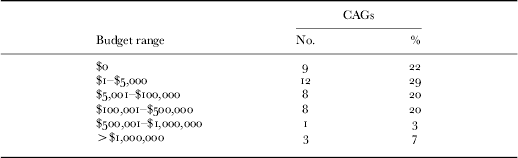
Human resources are not the only requirement of a CAGs. They also need financial resources. As Table 1 indicates, CAGs varied as much in their monetary resources as in their human resources. Nine CAGs (22%) had no annual budget. Any operating funds simply came, on an as-needed basis, from the pockets and bank accounts of members. Twenty-nine per cent of CAGs had annual budgets ranging from $100 to $5,000. This means that over 60 per cent of CAGs had an annual operating budget of $5,000 or less. Forty per cent had budgets ranging from $5,001 to half-a-million dollars. Three CAGs had budgets of over $1 million.
CAG annual operating budgets (N=41)
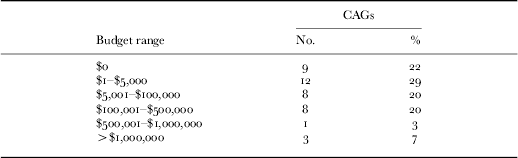
Note: Percentages do not add to 100 due to rounding.
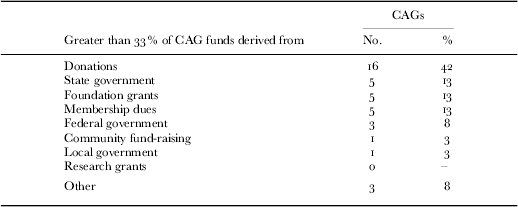
While the sources of human resources for CAGs were largely limited to the families and friends of nursing-home residents, their sources of funds varied much more. Table 2 shows that many CAGs received a significant proportion (33% or more) of their funds from several sources of revenue. It demonstrates that the most common source of funds for CAGs was donations but not as the result of planned community fundraising efforts. Instead, individual donors who were often organisation members provided these funds. Other significant sources of revenue (more than 10% of CAGs) were members' dues (13%), foundation grants (13%), and funds from state agencies (16%). Relationships between CAGs and ombudsman programmes are a sensitive issue. A few CAGs began operations by splitting off from an ombudsman programme, and some advocates see ombudsmen as hamstrung by state policy and forced to represent bureaucratic interests more often than resident needs. At the time of the survey, only six CAGs (14%) pursued their advocacy activities and also served as state contractors providing ombudsman services.
CAG sources of operating funds (N=38)
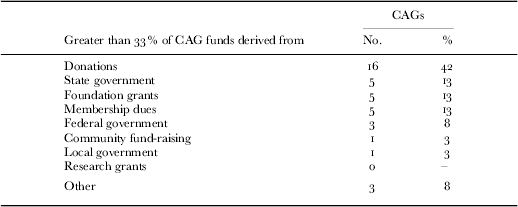
Notes: Number of CAGs may total greater than 38 because a single CAG may receive more than 33% of its funds from more than one source. Percentages may total greater than 100 since multiple sources may provide more than 33 per cent support to one CAG.
CAG activities
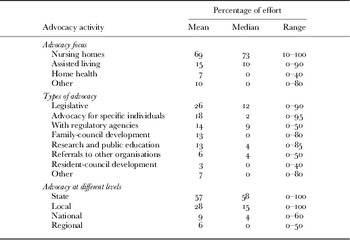
Table 3 presents the CAGs' responses to queries concerning how they allocated their advocacy efforts. It shows that nursing homes were the primary focus of citizen advocacy in long-term care. More than one-half of the respondents spent almost three-quarters (73%) of all their advocacy resources attempting to influence the quality of nursing-home care. While there was some focus on assisted living, home-care recipients were on ‘the edge of the radar screen’ for CAGs. One-half of CAGs spent no time dealing with home-care issues. In addition, the foci of CAG efforts were largely state wide.
Allocation of effort in advocacy (N=43)

The CAGs engaged in diverse advocacy activities. In all instances in Table 3, the mean of advocacy effort was higher than the median. This indicates that all these distributions include ‘outliers’, the higher values of which make the mean larger than the median. For example, the average percentage of effort aimed at family-council development was 13 but the median was zero per cent. This means that many CAGs placed no emphasis on family-council development, while a few spent the bulk of their resources focusing almost exclusively on this issue. The same holds true of advocacy for specific individuals. While the average percentage of effort was 18, the median was only two. So, the bulk of CAGs expended little effort duplicating, supplementing or complementing ombudsman advocacy. However, for a few CAGs, such micro-level advocacy was a major component of their organisational mission. The two activities that constituted the largest proportion of CAGs' advocacy efforts were legislative advocacy and Lobbying regulatory agencies. The two activities that received the least attention from CAGs were resident-council development and providing referrals to other organisations.
CAG priorities
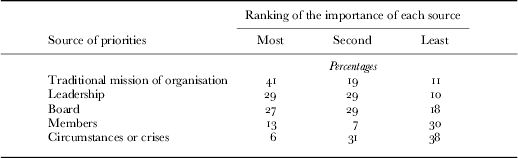
The survey found that the priorities of the CAGs might be set by members, the leadership or board members. Alternatively, the organisation may take cues from specific circumstances or may look to its own history for guidance. As Table 4 indicates, most CAGs look very seriously at what they have done in the past years to guide their current actions. Sixty per cent of the respondents indicated that the traditional mission of the organisation was either the first or second most important basis for setting organisational priorities. The two factors that respondents were likely to see as least important in setting priorities were the members of the organisation and specific substantive circumstances or crises.
Source of CAG priorities (N=38)
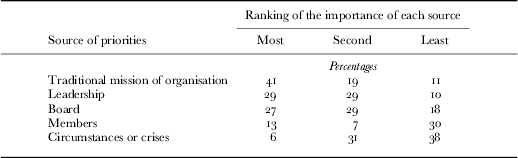
Note: Missing data varied for each indicator. The smallest number of respondents was 30.
Obstacles to effective operation
In pursuing their missions, CAGs saw various obstacles to maintaining effective operations. Over three-quarters of the respondents indicated that changes in organisational funding were the most important (67%) or second most important (10%) obstacle to effective operations. The next most important problems was change in organisational leadership. One-quarter of the respondents ranked leadership changes as the most important obstacle and almost one-half (46%) ranked it as the second most important obstacle. Changes in public or governmental interest in nursing homes, and changes in governmental personnel were rarely seen as major obstacles.
Allocation of time given to organisational maintenance
CAGs' funding and personnel were seen as important obstacles to successful operation. Nonetheless, the respondents indicated that fund-raising and recruitment were not central activities. On average, the respondents indicated that they spent only 10 per cent (median 4%) of the time they devoted to organisational maintenance on fund-raising. They indicated that they spent only an average of 19 per cent on recruitment (median 8%). The bulk of their time spent on organisational activities (mean 45%) fell into the ‘other’ category, implying that the daily details of operation absorbed that time.
Perceptions of success and failure
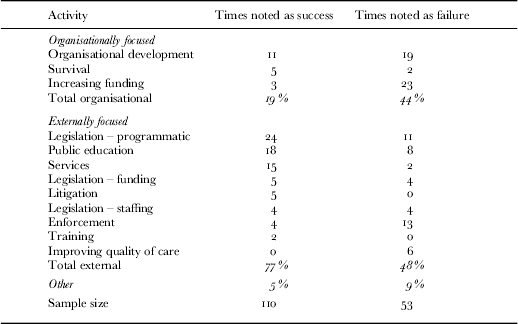
An important task in understanding CAGs is to gain knowledge about how they define success and failure. We asked an open-ended question about the CAGs' successes and failures in the last five years. Respondents could list as many events as they wished. These responses were aggregated into general categories (Table 5). The 43 respondents noted 110 successes and 53 failures. These responses were divided into the larger categories of organisationally-focused and externally-focused activities. The first striking aspect of these data is the difference in the proportion of successes and failures that were organisationally- or externally-focused. Three-quarters of successes were classified as external, while respondents split their failures almost evenly between organisationally- and internally-focused events. The type of failure most frequently noted was the inability to increase funding for their organisation. The next most frequently mentioned was a failure of organisational development (e.g. increasing membership, increasing visibility). The most frequently mentioned externally-focused failures were not increasing the effectiveness of enforcement and programmatic legislation not passing. The most frequently mentioned successes were legislative, constituting one-third of the total. The most common type of legislative success was programmatic (e.g. increased nurse-aide training, increased enforcement), but some CAGs reported success with mandatory minimum staffing legislation and with legislation aimed at increasing funding for services. Public education about nursing homes and long-term care was the area CAGs considered their activities next most successful. Service provision was the third most frequently mentioned area of success.
CAG perceptions of successes and failures in last five years
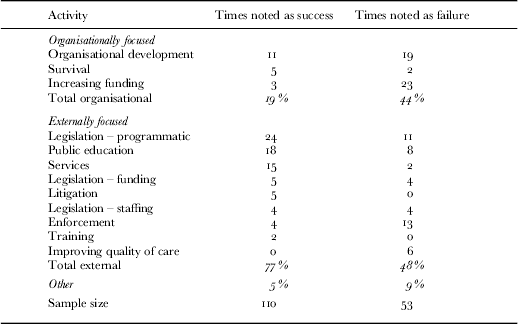
Note: Percentages may not equal 100 due to rounding.
Understanding the demise of a CAG
The operating CAGs that we contacted were obviously beset with a range of problems. Nonetheless, they reported an impressive array of successes over the last five years. However, five per cent of the successes reported by CAGs were simply ‘survival’. This indicates how precarious ‘life’ may be for CAGs devoted to improving quality in long-term care. Better to understand the lifecycle of CAGs, members of eight inactive CAGs were interviewed. Some of the literature on organisational decline and death focuses on the newness of an organisation as an important risk factor for death (Freeman, Carroll and Hannan Reference Freeman, Carroll and Hannan1983). That, however, did not seem to be an issue in the demise of CAGs involved in advocacy in long-term care. All eight failed groups had operated for more than 10 years; three had operated for more than 15 years.
When one reviews the organisational characteristics of these failed organisations, they look very much like those organisations that survived. When operating, five were incorporated and three were unincorporated. Seven of the groups had a board of directors. The annual budgets of these groups ranged from nothing to approximately $8,000. The primary source of income for the groups was largely from donations from the group members and volunteers themselves. These groups were actively engaged in legislative and regulatory advocacy (88%); family- and resident-council development (88%); individual advocacy (88%); referrals (88%); consumer education (75%); and research (25%). One of the groups involved with legislative and regulatory advocacy frequently served as plaintiff for the local legal services whenever the legal services group challenged relevant legislation.
In addition, much of the work on organisational decline focuses on changing external environments and a lack of adaptability to external threats as key factors in organisational decline (Weitzel and Johnson Reference Weitzel and Jonsson1989). In CAGs involved in long-term care, however, the reasons for organisational mortality were startlingly similar and revolved around issues internal to the organisations. Six of the eight groups had difficulty remaining open and active when their leaders were forced to become less active or resign for health or for other reasons. As one respondent put it, ‘For one thing, I got old all of a sudden, and I didn't have anyone to take my place, and I couldn't find anybody. They all said they couldn't do what I did’.
Three of the eight CAGS mentioned funding as an important factor, but rather than having to close, the lack of funding kept the CAG from being able to hire a new leader or someone to take an administrative position when the leader was no longer able to function. Previous research on a public-advocacy group (Mothers Against Drunk Driving) indicated that maintaining membership was an important issue in chapter mortality (Weed Reference Weed1991), but among the failed CAGs, membership was only mentioned by one group. All of the respondents from the eight CAGs felt the demise of their group could have been prevented had someone been willing to take over leadership. As one respondent noted, ‘You have to have a leader, and you have to have somebody who is willing to make the extra effort. I had the time and the money – my husband had a good job. I was willing to do that. When I moved to another town and had to focus on sick family members, I have not been able to focus on the organisation. There hasn't been anyone to take up the slack’. It seems that CAGs in long-term care are rather like families held together by the energy, dedication or personal power of a single family member. When that core person is no longer on the scene, there is often no replacement. Lacking that core, the family splinters into its constituent parts, or in the case of a CAG, it dies.
Discussion
In the sphere of US health care, only in the long-term care sector does one find citizen advocacy focusing on a single type of service provider. The authors surveyed colleagues involved in ageing research in over 20 nations in Europe and along the Pacific Rim. None indicated the existence in their country of anything similar to US CAGs. These unique advocacy organisations with their focus on nursing-home care are truly grassroots initiatives. They arise from the passion of individual citizens and their sense of responsibility and caring for specific individuals whom they love or who are family members. This passion is then generalised to all individuals at risk of injury from the same source that injured their loved one or placed them at risk of neglect or abuse.
Social psychologists tend to look at caring acts as of one of two categories. Acts for which the actor can expect some reciprocity or pay-off are considered pro-social behaviours. Acts of caring that occur with no intent to help oneself and even at some costs to the helper are considered altruistic (Staub Reference Staub1978). Individuals involved in nursing-home advocacy are obviously engaged in altruistic behaviour. The etiology of such behaviour is unclear, but social psychology offers us at least two interesting perspectives on their genesis. According to these perspectives, advocates' behaviour is triggered either by the strength and nature of their attachment to the person originally at risk of injury (Bowlby Reference Bowlby1988; Mikulincer et al. Reference Mikulincer, Shaver, Gillath and Nitzberg2005) or their acceptance of general social norms of reciprocity, social responsibility, or deservedness (Berkowitz and Daniels Reference Berkowitz and Daniels1963; Gouldner Reference Gouldner1960; Long and Lerner Reference Long and Lerner1974).
Whatever the source of the advocates' passion to help others, it constitutes both their greatest strength and their greatest weakness. Nursing-home CAGs largely focus their efforts on legislative and administrative advocacy. They see their successes and failure in terms of their mastery of the policy environment. They help individuals receive better nursing-home care by moving the instruments of government. The leaders and activists in these organisations are engaged in a ‘crusade’, and the more mundane demands on their time for the care and maintenance of their organisation are given short shrift. With few exceptions, these organisations operate with few financial resources that do not come from the wallets of their board, officers, members or volunteers. Financial resources are a constant problem, yet our results show how little time these organisations spend on fund-raising.
Even more important than financial failure, the most serious threat to their continued operation is a loss of leadership, but our focus groups revealed that few of these organisations have any plan for the grooming of future leaders. One respondent from an inactive CAG talked about the need for younger, more energetic leadership but the collected evidence indicates that this is simply not a reasonable hope. Nursing-home advocacy rarely draws in young altruists. The life-blood of these organisations flows through those middle-aged or elderly individuals who have translated a personal concern, for a specific person in their own lives who experienced poor care in a nursing home, to a general concern for all the vulnerable nursing-home residents in their State.
Nursing-home or long-term care CAGs have an impressive record of successes, ranging from increased training requirements through increased staffing requirements to increased enforcement activity. They are active and important players in state and national politics (Hawes et al. Reference Hawes, Vladeck, Morris, Phillips and Fredeking2003). But many of these CAGs are constantly operating on the edge of organisational failure. When almost 20 per cent of CAGs note simple ‘survival’ as a major agenda item, one knows that this advocacy sector is not characterised by deeply entrenched, stable organisations.
Perhaps this near-constant instability is the ‘shadow-side’ of the CAGs' focus on nursing homes in that it gives them a narrow range of supporters and a limited set of potential sources of support. The research evidence also points to the possibility that the leaders and members of these organisations have not committed themselves to the organisation as much as to the cause. Such commitment is commendable, but it places their organisations at risk of failure, or at the least to periodic organisational crises. Only when the members and leaders in these organisations expend greater energy on internal organisational maintenance will they provide greater protection for the future of their altruistic vision and for those individuals who will enter nursing homes next year, the year after, and the year after that.
What lessons might be learned from the experience of nursing-home CAGs? The lessons or conflicts cited above concerning stability, commitment and the allocation of resources to external or internal goals also apply to other similar advocacy groups. The CAGs belong to a larger class of advocacy organisations that Nownes and Neeley (Reference Nownes and Neeley1996) called ‘personal-disturbance public-interest groups’. Such groups are begun by ‘person disturbance entrepreneurs’, individuals moved to collective action by some disturbance in their personal world. In the case of CAGs, this disturbance can be a parent entering a poor quality nursing home. It can also be the death of a daughter killed by a drunk driver, which resulted in the development of Mothers Against Drunk Driving (MADD). These groups, with a few exceptions, tend to be largely self-funded and the province of dedicated political amateurs who are cause-oriented.
Such groups operate at relatively high risk of organisational demise, unless they clearly recognise that advocacy is both a calling and a business, a business with both short-term and long-term needs. In the short-term, advocacy ‘businesses’ need to pursue their policy goals but for long-term success, the leaders of these groups must expend more of their human and financial resources developing stable funding streams and training new generations of leaders who will carry the group's goals into the future. In order to grow successfully in new states, the advocacy community must find some way of identifying and supporting potential entrepreneurs. There is, however, neither a clear recognition of this need within the advocacy community nor a clear strategy of how to accomplish this diffusion of activism.
Nursing-home CAGs have a relatively long and quite illustrious history. They have their own national organisation (NCCNHR) that battles for nursing-home residents on the national political scene and provides services to the member groups. CAGs have played active roles in the passage of important state legislation aimed at enhancing the quality of care in nursing homes. They have done all of this despite the intrinsic difficulties that have been discussed. They will continue to do so, even if these issues are never addressed. The development of management skills and a plan for expansion into those areas with no CAG will help them more effectively spread their good works across both space and time.
Acknowledgements
The Commonwealth Fund research supported this research through Grant # 20040657 to the National Citizens' Coalition for Nursing Home Reform (NCCNHR), Janet Wells, Principal Investigator. Drs Phillips, Hawes and Kimbell's activities were undertaken as part of a sub-grant from NCCNHR to the Texas A&M University System Health Science Center, School of Rural Public Health, Department of Health Policy and Management, Program in Aging and Long-Term Care Policy. The authors thank Alice Hedt, Executive Director of NCCNHR, for her support of this effort.