

Among the keyboard compositions of Dieterich Buxtehude (c. 1637–1707) the small chorale partita Auf meinen lieben Gott (BuxWV 179) holds a unique place. The composer combines the (sacred) genre of the chorale with the (secular) genre of a dance suite by modelling the variations of the partita on popular dances: Allemande,Footnote 1 Double, Sarabande, Courante and Gigue. The hymn melody appears rhythmically embellished in the upper voice of each movement. Buxtehude's partita poses several questions: Why did he turn a hymn into a set of dances? Why this particular hymn? How was the composition used? Kerala Snyder has left the last question open in her seminal biography of Buxtehude. She suggests that the composer ‘may have intended it for harpsichord’; however, the use of dance movements does not preclude performance of the piece on the organ.Footnote 2 She refers to a note in the diary of a theological student visiting Lübeck, who had a discussion with theologians on the question:
whether it is pleasing to God and at the same time useful to the pious soul if the organist expounds sacred hymns for morning, evening, prayer, penitence, lamenting and comfort, praise and thanksgiving, songs of life, death, and heaven in a dance-like manner, so that an upright Christian person becomes confused by such variations, wondering whether he is sitting in a house of God or in a dance hall.Footnote 3
The complaint of theologians about dances on the organ had been a staple of theological reflection on church music since the sixteenth century. Martin Luther had vociferated against the transgression of the boundaries between the secular and the sacred, and abundant criticism of a similar nature can be found in the following centuries.Footnote 4 We cannot rule out the possibility that Buxtehude's partita should be understood in the context proposed by Snyder. However, an analysis of the piece and its original Sitz im Leben suggests another interpretation that explains the extraordinary (or perhaps not so extraordinary) characteristics of this chorale setting. In this study I will explore possible explanations and draw connections between cultural and religious practices of the late seventeenth century and Buxtehude's composition.
Buxtehude's partita has occasionally been associated with a similar attempt by Johann Mattheson (1681–1764). In his treatise Der vollkommene Capellmeister (The Complete Music-Director, 1739), the north German music theorist explores ways how to transform hymn tunes into dances and dances into simple chorale melodies.Footnote 5 In an long chapter on the design of melodies, Mattheson laments that composers did not sufficiently reflect on the rhythmical characteristics of their compositions and he points out that ‘[t]he power of rhythm in the fabrication of a melody is great and deserves deeper scrutiny than it has received so far’.Footnote 6 He presents a simple example to demonstrate how a change in rhythm affects the character of a melody: ‘I will take the opportunity … to prove with understandable and familiar examples how by changing the metre but keeping the melodic contour of the melodies one can turn hymn melodies into dances and dances into hymn melodies, if this is needed.’Footnote 7
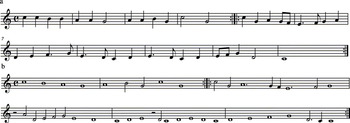
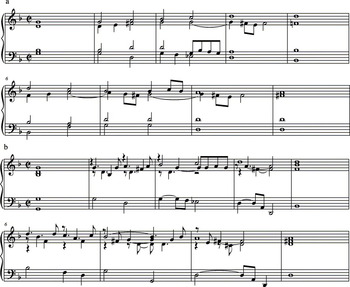
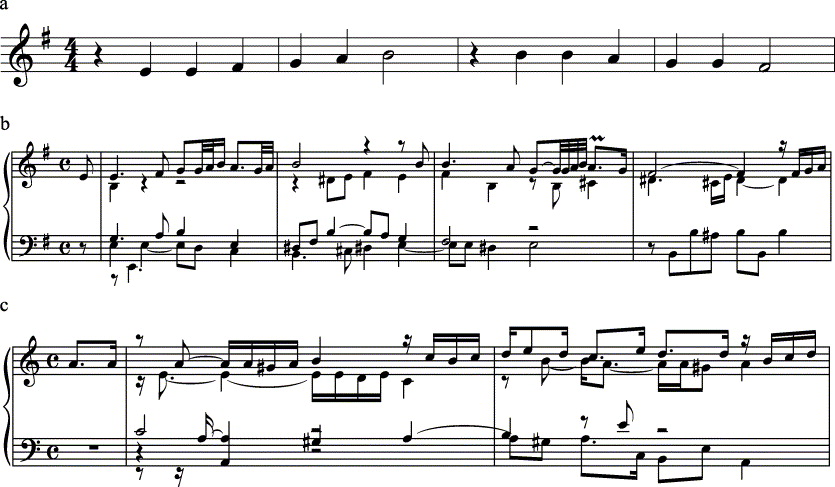
Mattheson employs the tunes of Wenn wir in höchsten Nöthen sein (Whenever we are in the greatest distress), Wie schön leuchtet der Morgenstern (How lovely shines the Morning Star), Herr Jesu Christ, du höchstes Gut (Lord Jesus Christ, you highest good), Werde munter, mein Gemüte (Be alert, my soul) and Ich ruf zu dir, Herr Jesu Christ (I cry to you, Lord Jesus Christ) and transforms them into dances: Menuett, Gavotte, Sarabande, Bourée and Polonaise.Footnote 8 Two examples will illustrate his technique. In Example 1 he transforms the hymn Wie schön leuchtet der Morgenstern into a Gavotte, maintaining the melodic progression of the tune but changing the rhythm.
Mattheson, Wie schön leuchtet der Morgenstern: (a) chorale melody; (b) Gavotte

A second example demonstrates how dances can easily be transformed into hymnlike melodies by reducing them to simpler and more uniform rhythmic values and by ‘de-colorating’ them (reducing the embellishments to their underlying melodic progression), as shown in Example 2.
Mattheson, Angloise: (a) original; (b) reduction to chorale melody

In a tone of self-confidence characteristic of his writings, Mattheson emphasises that this ‘experiment [was] new’, suggesting that he was the first one who tried it. The idea of rhythmic transformation of a given theme, however, was not entirely new and Mattheson was aware of this. Friedrich Erhard Niedt (1674–1708), in his Musicalische Handleitung Anderer Theil, Von der Variation des Generalbasses (Hamburg, 1706; 2nd edn, Hamburg, 1721), presented a method to generate a variation suite by using the same basso continuo and simply applying different rhythmic patterns to it.Footnote 9 There can be no doubt that Mattheson knew Niedt's treatise, for it was he who edited the second, expanded edition of the treatise in 1721. It is therefore obvious that Mattheson's ‘new experiment’ was in fact at least partially inspired by Niedt's treatise of 1706 – a point which Mattheson does not mention in 1739. The major difference between Mattheson and Niedt seems to be that Niedt suggests varying the bass line, while Mattheson uses the melody for variation. But even here Mattheson is too quick to label his ‘invention’ as new, since the rhythmic variation of a given melody had been a principle of the variation suite since the early seventeenth century. One (arguably unusual) example of such a variation suite is Buxtehude's chorale partita on Auf meinen lieben Gott. We must postpone the question of whether Mattheson knew Buxtehude's piece or whether he sold a foreign ‘invention’ as his own and examine the suite and its context first.
THE DANCE OF DEATH
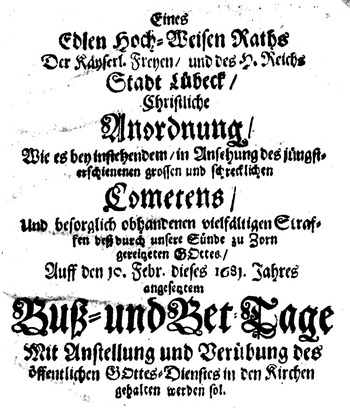
Buxtehude's chorale partita is based on a hymn from the turn of the century. The text dates from the late sixteenth or early seventeenth century, while the melody is older and was composed for a secular song by Jakob Regnart in 1576 (‘Venus, du und dein Kind, seid alle beide blind’ – Venus, you and your child are both blind). It appears with a sacred text in 1584. Johann Herman Schein finally combined the melody with the text ‘Auf meinen lieben Gott’ in his Cantional published in 1627.Footnote 10 The hymn Buxtehude chose for his partita was frequently used in the seventeenth and early eighteenth centuries for services of repentance and for funerals. A leaflet, issued by the town council in Lübeck in 1681, at which time Buxtehude was Organist at St Mary's, announced a day of repentance and prayer for February 1681 (see Figure 1). The occasion was the appearance of a comet, which was interpreted as a portent of disaster. The leaflet lists a number of penitential hymns for this occasion, one of them being Auf meinen lieben Gott. The hymn also appears frequently in the context of funerals.Footnote 11 The text lends itself to both purposes. It expresses trust in God during times of fear and need, but also at the time of death.
Eines Edlen Hoch-Weisen Raths Anordnung … (Lübeck, 1681)

The combination of death and dance in Buxtehude's partita evokes an interesting association: the partita could be connected to the Lübeck Totentanz, a famous painting from the fifteenth century that depicted Death dancing with twenty-four humans from all classes of society, from the pope and the emperor down the social ladder to peasants and infants.Footnote 12 The painting was an allegory of the mortality of humankind, regardless of their position in society. It was originally accompanied by a Middle Low German poem, which deciphered the depictions and their meaning. The painting was situated in the ‘Totentanz Chapel’, a small chapel to the left side of the main altar of St Mary's. The chapel also housed an organ with about forty stops, hanging on the east wall.Footnote 13 Buxtehude must have seen the painting on a regular basis.
The original painting was in such bad shape that it was replaced in 1701 by a (stylistically) modernised copy. The original text was also replaced with a new High German text, written by Nathanael Schott (1666–1703). The replacement of the painting and the text is remarkable since it suggests that the Lübeck Totentanz, even though a remnant of medieval art and pre-Reformation piety, was not, during Buxtehude's time, considered an outdated witness of an earlier stratum of religiosity. The theological implications of the understanding of death might have changed, and thus the actual interpretation of the Dance of Death in Lübeck had also changed. The awareness of mortality, however, was as acute as ever.Footnote 14
Could Buxtehude's dance partita, utilising a funeral song, be a reflection of the familiar Dance of Death? Was it possibly related to the replacement of the painting in 1701? The idea is intriguing but cannot be proven. A connection, however, is rather unlikely. The painting depicts twenty-four pairs (Death with one other person), which has no connection with the number of variations (or any other number or structure found in the piece). Furthermore, the text of the chorale shows no similarities with the central theme of the Totentanz, mortality regardless one's standing in society. A setting of the Lutheran hymn Mitten wir im Leben sind, based on the medieval hymn Media vita, would have been more appropriate for that purpose. Auf meinen lieben Gott instead expresses a general hope in Christ at the hour of death, a soteriological focus the Dance of Death lacks.
TRANSMISSION AND MEANING
Buxtehude's chorale partita, like most of his keyboard music, is not preserved in an autograph manuscript but only in a copy, written in the 1730s or 1740s by the composer Johann Gottfried Walther (1684–1748). The so-called Frankenberger'sche Walther Autograph contains 196 works by composers from northern and central Germany.Footnote 15 Buxtehude's chorale partita belongs to a collection of chorale settings towards the end of the manuscript. The works compiled in this part of the source have in common a focus on death and eternity. Buxtehude's partita, however, is the only one that is modelled on a dance suite. The remaining pieces are more traditional chorale preludes by Bach, Walther, Zachow and others.Footnote 16 Among them are also three other settings of the same chorale, composed by Georg Böhm, Johann Nicolaus Hanff and Friedrich Wilhelm Zachow.
The partita, in the form in which it is preserved in Walther's manuscript, poses a problem, since the sequence of the movements of the suite is unusual. While the dances appear in the order Allemande, Double, Sarabande, Courante, Gigue, a suite at that time would normally have the movements in the following order: Allemande, [Double], Courante, Sarabande, Gigue. The editor of Buxtehude's organ works, Klaus Beckmann, suggested that the sequence of movements might have been changed by Walther and he therefore rearranged them into the ‘correct’ order.Footnote 17 Christoph Albrecht, on the other hand, in his edition of the organ works for Bärenreiter, mentions the unusual sequence and supposes an error of Walther's but leaves the order of the source intact in his edition.Footnote 18 Matthias Schneider recently suggested that Buxtehude might have intentionally chosen the unorthodox order, since the Allemande and Double on the one hand, and the Courante and Gigue on the other, are based on a similar harmonic plan, while only the Sarabande, in central position, is harmonically different.Footnote 19 The exchange of the two dances thus led to a symmetric structure in which two movements are grouped on each side of the central Sarabande. Schneider, however, does not explain why Buxtehude might have desired this symmetric order. I will later suggest another explanation that takes into account not only a possible symmetry but the text of the chorale as well.
MODELS AND INFLUENCES
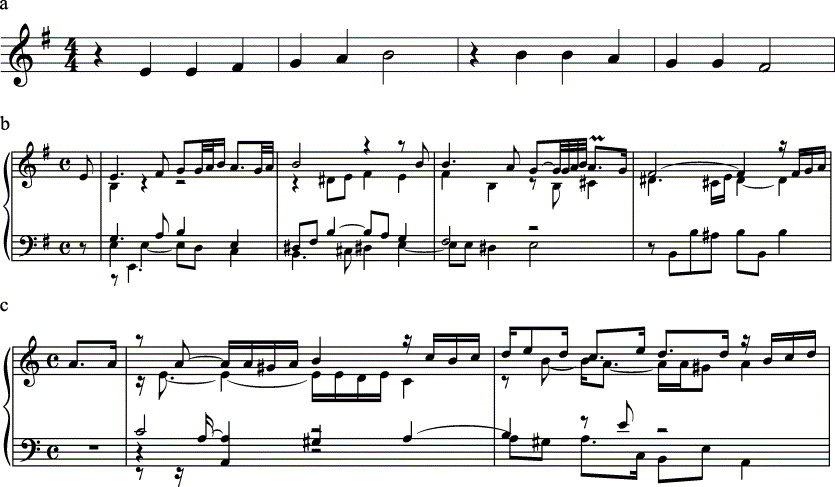
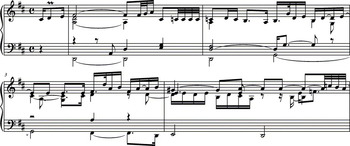
Buxtehude's suite Auf meinen lieben Gott is unusual, although not primarily for its stylistic features, which fit seamlessly into the history of the keyboard suite in the second half of the seventeenth century. The texture and rhythmical structure of BuxWV 179 are close to the other keyboard partitas by the same composer.Footnote 20 Even the melodic outline of the upper voice resembles other suites by Buxtehude and his contemporaries. Turning the hymn Auf meinen lieben Gott into a suite was admittedly a relatively easy endeavour: the repetition of the first note and the following stepwise motion upwards are similar to melodic progressions traditionally found in suites of this time. Buxtehude's suite in A minor BuxWV 244 (No. 18) sports an analogous melodic idea at the beginning. A similar example occurs in a suite in F sharp minor by the German-Swedish composer Christian Ritter, preserved in the Andreas-Bach-Buch. It would be easy to read the first four notes in Ritter's allemande (f♯′–f♯′–g♯′–a) as a quotation of the hymn tune (see Example 3). An interpretation of BuxWV 179 must therefore be very cautious. Whatever reason might have led Buxtehude to compose a set of dances based on the chorale, at least part of it was the inherent similarity of the melody with traditional dance melodies of the time. In other words, Buxtehude did it because it was possible.
Chorale melody Auf meinem lieben Gott, bb. 1–4; (b) Buxtehude, Suite ‘Auf meinen lieben Gott’, Allemande; (c) Buxtehude, Suite in A minor (BuxWV 244), Allemande, bb. 1–2
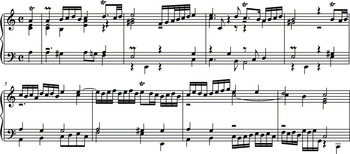
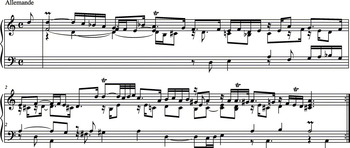
Buxtehude's dance suite is not the only dance that is based on the same chorale. The Andreas-Bach-Buch, a manuscript copied between 1705 and 1713Footnote 21 with keyboard pieces primarily by north German composers from the circle around BuxtehudeFootnote 22 preserves an anonymous and untitled Allemande employing the same hymn (see Example 4).Footnote 23 The piece stands between a fugue in E minor by Johann Heinrich Buttstedt (1666–1677) and Dietrich Buxtehude's Chaconne for organ in E minor (BuxWV 160).Footnote 24 Due to the anonymity of its author it is impossible to determine whether the Allemande was modelled on Buxtehude's Allemande; however, since the Andreas-Bach-Buch contains a large collection of works by Buxtehude, it can be assumed that the author of the piece might have belonged to the circle around Buxtehude or was at least familiar with his compositions. A connection with Buxtehude is even more likely as the anonymous Allemande shows some similarities with the Allemande of Buxtehude's suite in D minor (BuxWV 234). The first one and a half bars (at least in the upper voice) of the pieces are almost identical (see Example 5).
Anonymous, [Allemande] from the Andreas-Bach-Buch, bb. 1–4

Buxtehude, Suite in D minor (BuxWV 234), Allemande, bb. 1–3

An important influence apparent on Buxtehude's chorale partita is the contemporary variation suite. A cyclic unity among the individual movements of a suite could be created by using the same melodic idea (either in the bass or in the upper voices). We know early examples of this type of suite from the first decades of the seventeenth century, for instance Paul Peurl, Newe Padouan, Intrada, Däntz unnd Galliarda (1611), Isaac Posch, Musicalische Ehrenfreudt (1618), and the popular collection by Schein, Banchetto musicale (1617). Buxtehude could have known some of these compositions. More influential, however, might have been the suites by Johann Adam Reincken in his Hortus musicus (1688) and several variation suites for keyboard in manuscript.Footnote 25 Buxtehude and Reincken were friends, as a painting by Johannes Verhout from 1674 shows,Footnote 26 and he therefore presumably had access to Reincken's suites. In Buxtehude's own keyboard suites, on the other hand, variation techniques are less frequent than in the suites of his contemporaries, and the unity among the individual movements is normally looser than in the suites by Reincken.Footnote 27 The only full-fledged example of a variation suite is the partita Auf meinen lieben Gott.
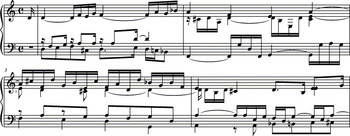
A second sphere of influence, as Matthias Schneider has argued convincingly, was the seventeenth-century tombeau. He points out that a group of Allemandes composed as tombeaux by Johann Jacob Froberger, in particular, might have served as a model for Buxtehude.Footnote 28 Both have similar characteristics: the rhythm and form of the allemande, arpeggiated chords (which are a remnant of the origins of the tombeau as a piece for luteFootnote 29), expressive chromaticism, and recitative-like embellishments in the upper voice.Footnote 30 The latter can be seen, for instance, in the occasional outbursts of semiquavers in the otherwise calm rhythm of Buxtehude's Allemande. We find similar gestures in Froberger's Meditation faist sur ma Mort future FbWV 611a/620 (compare Examples 3(b) and 6). Buxtehude may have known Froberger's Meditation, which is preserved in the Hintze-Manuscript,Footnote 31 a collection compiled by Matthias Weckmann.Footnote 32 Weckmann was later organist at St. Jacobi in Hamburg, and by this time Buxtehude, who had contact with the organists in that city, could have encountered the collection.
Froberger, Meditation faist sur ma Mort future (FbWV 611a/620), bb. 1–5

Schneider's observation that the Allemande in Buxtehude's suite was influenced by the contemporary tombeau answers only some questions, but poses others. Tombeaux were most often composed in commemoration of the death of a specific person or, in the case of some of Froberger's pieces, for a certain lamentable situation. Nothing is known about the context of either Buxtehude's suite or the anonymous Allemande on Auf meinen lieben Gott. Did Buxtehude (and the other composer) use the character of the tombeau as a musical equivalent to express the sad affect of the penitence and funeral chorale, or were the compositions intended as tombeaux in the traditional sense, using the layer of the chorale text as an intertextual enforcement of the lamenting tone?
KEYBOARD MUSIC AND THE ART OF DYING
Besides its roots in the traditions of tombeau and variation suite, Buxtehude's set of chorale variations belongs to a group of non-liturgical instrumental pieces from the seventeenth century that are based on (Protestant) funeral songs. Another piece that uses the hymn Auf meinen lieben Gott is a composition by Johann Flor (1626–97). Flor was probably trained in Hamburg or Lübeck and from 1652 to 1654 he served as organist at St Mary's in Rendsburg and then at St Lambert's in Lüneburg. From 1676 on, he was also organist at St John's in Lüneburg.Footnote 33 Flor's composition apparently is lost, but Johann Gottfried Walther mentions it in his music dictionary as follows:

The piece was composed for keyboard, based on the familiar hymn tune, which was treated in strict counterpoint. Flor's work belongs to a larger group of strictly contrapuntal compositions in northern Germany in the late seventeenth century for the commemoration of a funeral. Other contemporary examples are Christoph Bernhard's Prudentia prudentiana (1669), composed for the death of the mother and wife of Rudolf Capell, Bernhard's colleague at the Johanneum in Hamburg; and Buxtehude's own Fried- und Freudenreiche Hinfahrth (BuxWV 76), printed in 1674 in commemoration of the death of Buxtehude's father.Footnote 35 The only similarity between these prints and Buxtehude's dance partita is the cyclic setting of a chorale. While the three printed funeral compositions are strictly contrapuntal (a feature that, as Yearsley pointed out, is constitutive for this particular genre, in which the contrapuntal texture is a symbol for death,Footnote 36 Buxtehude's suite, with its lack of learned counterpoint, represents a contrasting concept.
A collection of pieces that is stylistically closer to Buxtehude's suite, insofar as it treats the chorale not strictly contrapuntally, is the Musicalische Sterbensgedancken by Johann Pachelbel, printed in 1683. Like Flor's composition, the work is lost. However, it is possible to reconstruct its contents within certain limits. Johann Gottfried Walther reports in his music dictionary that the collection contained four chorale partitas.Footnote 37 According to recent reconstructions, each set of variations started with a simple four-part setting of the chorale in the upper voice, which was then followed by four to twelve variations for keyboard without pedal. The pieces could be played either on the organ or on a stringed keyboard instrument like a harpsichord or a clavichord.
Even though Pachelbel did not compose dance suites based on the hymns, he occasionally employs a triplet dance pattern resembling a Gigue. Example 7, from his variations on ‘Was Gott tut, das ist wohlgetan’, shows how the composer combines the dance rhythm with melismatic embellishment of the chorale melody.
Pachelbel, Variations on Was Gott tut, das ist wohlgetan, Partita 8, bb. 1–4

The overall style of Pachelbel's chorale partitas in the Musicalische Sterbensgedancken is similar to that of secular keyboard collections for domestic use, like his own Hexachordum Apollonis, a set of song variations printed in 1699. Pachelbel's collection of chorale variations was published in reaction to the death of close relatives. Thus far it resembles the commemorative function of the prints by Buxtehude and Bernhard. That function, however, goes beyond the expression of purely personal distress. While the above-mentioned prints were small-scale publications, Pachelbel's collection was a larger publication, with four multi-movement chorale settings. We must therefore differentiate between the immediate cause of the publication and the actual purpose. The publication originated in the devastating experience of the death of Pachelbel's family members during the plague in Erfurt,Footnote 38 but the purpose was a different, more complex one. In order to understand the purpose of both Pachelbel's settings and, I wish to suggest, of Buxtehude's partita as well, we need to examine the use of harpsichord chorales in the seventeenth century, and of funeral hymns in particular.
KEYBOARD MUSIC AND DOMESTIC PIETY
Hymns were an integral part of domestic piety in the seventeenth and eighteenth centuries. Sacred songs were sung, read and played not only in church but at home as well. German harpsichord collections from the seventeenth century frequently contain – in addition to dances and variations on popular melodies – hymn settings of different types. A typical example from Buxtehude's time in northern Germany is the manuscript Mus. Ant. Pract. 1198 in the Lüneburg Ratsbücherei. The collection preserves a number of suites, single dance movements (158 secular pieces altogether) and twenty chorale settings, copied by two different hands.Footnote 39 While the second hand only added simple homophonic hymn settings, the settings in the first one are highly embellished. The copyist, and probably author, of the larger first part of the manuscript was the above-mentioned Christian Flor.Footnote 40
The common vocabulary of texture and embellishments bridges the gap between the secular dance movements and the sacred songs. The collection also contains an embellished setting of the chorale Auf meinen lieben Gott. A comparison between the hymn setting (Example 8) and the beginning of an Allemande in C from the same collection (Example 9) reveals how much the chorale setting already approximates the stylistic characteristics of the secular suite – even though the hymn had not been turned into an actual dance.
[Christian Flor], Auf meinen lieben Gott, bb. 1–8

[Christian Flor], Allemande, bb. 1–2

While these examples are taken from a mixed collection, containing both secular and sacred repertory, in the second half of the seventeenth and early eighteenth century we can also observe an increasing number of printed collections comprised exclusively of chorale settings for keyboard without pedals, intended not specifically for use in church but for the homes of the educated middle class as well.Footnote 41 One prominent example is the Musikalische Kirch- und Hauß-Ergötzlichkeiten by the Leipzig organist Daniel Vetter (d. 1721).Footnote 42 The collection was dedicated to several influential merchants in Leipzig, members of the wealthy and educated middle class, which, as Stephen Rose has pointed out, was the target audience for the print.Footnote 43 The collection appeared in two volumes (1709 and 1713). Both were initially published by Vetter himself, but the collection must have been quite a success, for in 1716 the Dresden publisher Johann Christoph Zimmermann issued a new edition of volume 1. Another edition was advertised in 1744 by J. N. Gerlach in Dresden.
In his preface Vetter explains the purpose of the print – the edification of mind and soul.Footnote 44 It is intended to provide delightful entertainment without being worldly or even frivolous:
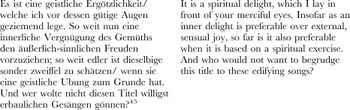
Vetter emphasises the spiritual impact of hymns. We know from other contemporary sources (especially funeral sermons) that hymns were used for edification, education and preparation for one's own dying.Footnote 46 Vetter points out that the hymns have the ability to stir the affects and thus prepare the heart for the sacred:

Vetter's view of music, and hymns in particular, stands in the tradition of a Lutheran theology of music. According to Luther, music was able to stir the emotions, make the happy sad, the sad happy, calm the angry and even drive away the devil.Footnote 48 After his musico-theological justification, Vetter explains his own intentions:
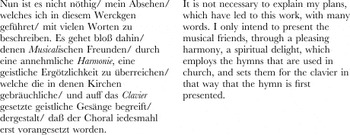

The music Vetter provides in his collection is easily accessible, both for the performer and the listener. The chorale melody is always present and audible. He suggests that a skilled performer could add embellishments (as we have seen earlier in the Lüneburg manuscript); however, he wanted to keep the settings simple for those performers who did not have the skills to play more complicated pieces. Example 10(a) shows Vetter's setting of Auf meinen lieben Gott. Vetter's ‘Variation’ (Example 10(b)) has a pulsating rhythm (dotted crotchet – quaver – dotted crotchet – quaver) that resembles the Allemande rhythm found in Buxtehude's setting. It is not likely that Vetter was influenced by Buxtehude or that he even knew the settings by the Lübeck composer. A comparison with other settings in Vetter's collection shows that the rhythm occurs frequently.Footnote 50 But even without a direct connection the similarity is revealing: Vetter turns the hymns into a style that was not far distant from contemporary dance settings for keyboard. Unlike Buxtehude, however, he does not transform the hymns into real dances, but he employs a similar idiom. The hymns are transferred into a style that was close to the ‘secular’ keyboard literature used by his target audience: dance suites. The Lüneburg manuscript by Flor occupies a somewhat middle position by embellishing the chorale melodies far more than Vetter does, but without taking the last step towards a real dance rhythm.
Vetter, Auf meinen lieben Gott: (a) plain setting; (b) variation, bb. 1–9

Books like Vetter's chorale collection or the Lüneburg manuscript were more than entertainment disguised as sacred music. Collections of hymn settings for the pious members of the middle class such as his Musikalische Kirch- und Hauß-Ergötzlichkeit filled a religious demand in the late seventeenth century. The Christian house was, besides the church, the place where religious doctrines were taught and religious practices – reading the Bible, singing and praying – were fostered. Playing the hymns (and the attractive settings by Vetter and Flor might have been an incentive to do so) was part of this praxis pietatis.
MUSIC AND ARS MORIENDI
The memory and the awareness of death – both one's own death and that of relatives – were a cornerstone of the praxis pietatis of early modern Protestantism. A large number of books provided the pious with meditative texts to reflect on their own mortality. Part of these reflections was a meditation on the blessings that came though the death of Christ and the consolation this provided.Footnote 51 The preparation for death, or ars moriendi, was a central aspect of Lutheran piety in the seventeenth and early eighteenth centuries. The aim of this preparation was to change one's life in the face of death and to die blessedly; ‘selig sterben’, as Johann Heermann emphasises in his widely read Schola Mortis: Todes Schule, a collection of funeral sermons of 1628.Footnote 52 Martin Luther himself had laid the groundwork for this theology in his treatise Sermon on Preparing to Die of 1519.Footnote 53 He urges his readers to reflect on their own dying: ‘We should familiarize ourselves with death during our lifetime, inviting death into our presence when it is still at a distance.’Footnote 54 The theology of the seventeenth century, influenced by the rediscovery in the early part of the century of mystical piety (which also influenced the Pietistic movement) and by the devastating experience of death and suffering during the Thirty Years War, inspired a growing emphasis on the memento mori and demanded an increasingly refined theology of death and a multitude of texts teaching the ars moriendi.
Several north German theologians, most of them in proximity to Dieterich Buxtehude, published books about the art of dying, such as the Rostock Superintendent Heinrich Müller, whose Geistliche Erquickstunden from 1664 revolves around the theme of the ars moriendi,Footnote 55 and especially the Lübeck Superintendent August Pfeiffer.Footnote 56 In his Anti-melancholicus, oder Melancholey-Vertreiber (1691) Pfeiffer delivers a very graphic description of the final hours:
I take fright as well whenever I think that my limbs, which I so carefully nourished and clothed and so tenderly cared for in my lifetime and which did me such steadfast service, should moulder and rot in the earth, and become a stinking carcass, dung, and filth, and perhaps be carried off by a thousand worms or maggots.Footnote 57
One central aspect of the ars moriendi, besides the awareness and meditation on one's own death, was reflection on the exemplary death of Jesus Christ and its soteriological meaning. This facet of the theology of death is rooted in Luther's theology. Luther pointed out in his Heidelberg Disputation of 1518:
He deserves to be called a theologian, however, who comprehends the visible and manifest things of God seen through suffering and the cross. … Now it is not sufficient for anyone, and it does him no good to recognize God in his glory and majesty, unless he recognizes him in the humility and shame of the cross. … A theologian of glory calls evil good and good evil. A theologian of the cross calls the thing what it actually is.Footnote 58
According to Luther, God reveals himself primarily in the crucified Jesus Christ. Ahasver Fritsch, a popular Lutheran author of religious literature and poetry in the second half of the seventeenth century, summarised this theology of the cross and its core importance for discipleship in a short exegesis of Luke 14: 27, ‘Wer nicht sein Creutz trägt / und mir nach folget / der kann nicht mein Jünger seyn’ (‘Whoever does not carry the cross and follow me cannot be my disciple’):

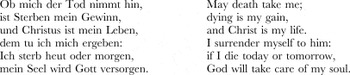
Memento mori and the memory of the death of Christ were two sides of the same coin.Footnote 60 Christ's death was the exemplary death. At the same time, it was the soteriological precondition for the hope that one's own death was not the end. The third stanza of the hymn Auf meinen lieben Gott describes exactly this relationship:
As hymns were an important part of the Lutheran ars moriendi, funeral sermons from the seventeenth and early eighteenth centuries refer frequently to the fact that the deceased had read the Bible, sung hymns and read religious literature.Footnote 61 An instructive example is the funeral sermon for the Mühlhausen Burgomaster Adolph Strecker, for whom Bach probably composed his famous Actus tragicus.Footnote 62 Even though the description is idealised, it may reflect at least roughly the process of preparation for death:

While Burgomaster Strecker had time to prepare for his own death, the literature teaching the ars moriendi urged readers to be prepared for an unexpected death as well. One's entire life should be a preparation for death. David Yearsley has pointed out that several Lutheran composers of the seventeenth century responded ‘in music to the admonitions of contemporary preachers that they prepare themselves for death’.Footnote 64 Two examples we have already mentioned are Johann Pachelbel's Musicalische Sterbens-Gedancken (1683) and Johann Flor's Todesgedancken (1692).
These publications, however, were not only a response but also an equivalent to the theological treatises mentioned above. The compositions might have been created as an individual reflection on mortality. But the fact that both Flor's and Pachelbel's pieces were published and printed demonstrates that they were geared towards a broader audience. Through the act of printing, the compositions left the realm of private reflection and became part of a broader cultural discourse about death and dying. Both were hymn settings for keyboard. Both could be played at home, and while playing the hymn settings (and reflecting on the texts that were known by heart) the player and his listeners could meditate on their own mortality and prepare for the hour of their dying. Playing settings of funeral hymns was equivalent to singing these hymns (which was part of the ars moriendi anyway) on a higher artistic level. In a similar vein, Daniel Vetter explains the inclusion of more funeral songs in the second volume of his Musikalische Kirch- und Hauß-Ergötzlichkeiten:

According to Vetter, the funeral songs were especially useful, since they kept conscious the necessary thoughts about death.Footnote 66 He could even refer to Luther as an example for the edifying impact of funeral songs:

Singing and playing hymns that reflected this ars moriendi fulfilled a dual purpose: The text, whether explicitly sung or implicitly remembered when the melody was heard, reminded the audience of the central aspects of mortality and of salvation through Christ's death. The music – according to the Lutheran theology of music – intensified the affective impact of the text and at the same time gave consolation in the grief (one could call it pedagogical grief) it evoked.
The examination of Vetter's, Pachelbel's and Flor's compositions can help enlighten the Sitz im Leben of Buxtehude's chorale partita. It was not – at least if we suppose that it was not played at church but at home – a transgression of the boundaries between the sacred and the secular, but part of the musical ars moriendi of members of the educated middle class in the second half of the seventeenth century. Buxtehude's chorale partita on the funeral hymn Auf meinen lieben Gott was music that could be played at home, providing religious and educational entertainment. The music was pleasing in its rhythmical character and pious at the same time. A player of the partita could memorise the familiar text of the hymn and prepare herself for her own hour of death. And we can assume a similar purpose for the anonymous Allemande on the same melody in the Andreas-Bach-Buch.
FORM AND MEANING
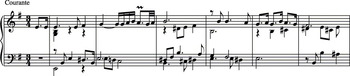
The purpose of Buxtehude's dance suite is underscored by its compositional gestalt. The suite has five movements, just as the chorale has five stanzas. The piece is not intended for alternatim performance, as were Buxtehude's chorale variations for organ.Footnote 68 The movements of the suite were to be played instead of the chorale, with each dance reflecting the content of one individual stanza of the hymn. As Matthias Schneider's analysis of the first movement of Buxtehude's chorale partita has shown, the Allemande not only follows the characteristics of a tombeau-allemande, but the expressive harmony and the rhythmic structure that is full of contrasts serve as an interpretation of the first stanza of the text. Schneider points out the emphasis put on words like ‘Gott’ and ‘Not’ (both at the end of a phrase) and the highly embellished setting of the fifth line of the chorale, ‘Mein Unglück kann Er wenden’. One could also add the demisemiquaver figuration on ‘Not’ as an example of Buxtehude's text interpretation:

The second movement of Buxtehude's suite, the Double, is based on the same harmonic progressions, only the motion is increased. The text fits the affect of the dance movement. One might even see the phrase ‘will ich verzagen nicht’ (I will not give up) interpreted by the continuous, forward-driving motion of the semiquavers:

I pass over the two ensuing movements for a moment and compare the last part of the suite with the text of the hymn. Buxtehude composes a vivid gigue, emphasising the joyful and hopeful affect of the last stanza. We find a similar, yet even more exuberant combination of a gigue and a chorale in Buxtehude's chorale fantasy Wie schön leuchtet der Morgenstern (BuxWV 223).Footnote 69 Compared to the Gigue in the fantasy, however, the movement in the partita is significantly more serious, since it still retains the chord progression from the first movement as its harmonic backdrop; the movement is joyful in characterFootnote 70 but at the same time carries the characteristic harmony and melody of the underlying funeral setting. The fifth stanza of the chorale expresses exactly that, a combination of thankful happiness and contemplation:

As mentioned before, the two remaining stanzas of Buxehude's chorale partita pose a problem. The order does not conform to the conventions of suites of the time or to Buxtehude's other suites for that matter. It could have been reversed by accident (or intention) during the process of transmission, as Beckmann suggested. If we follow Schneider's suggestion, however, and suppose that the order was correct, we can assume that the fourth movement (see Example 11) was based on the fourth stanza:

Buxtehude, Suite ‘Auf meinen lieben Gott’, Courante, bb. 1–6

This leaves the slow Sarabande, which then would have to be connected with the third stanza, which speaks about one's own dying in Christ. It is the soteriological centre of the hymn and it summarises the central thoughts of the Lutheran ars moriendi in a nutshell:

The movement is both harmonically and rhythmically different from the other movements, featuring a slow motion in crotchets. If Buxtehude had wanted to emphasise one stanza by a different harmonic underpinning and the slow pace of a Sarabande, then this stanza would have been the most appropriate, as contemporary theorists label the Sarabande as ‘serious’, ‘grave’ and ‘apt to move the Passions’.Footnote 71 It is thus likely that Buxtehude changed the order of the movements intentionally, to give the Sarabande the central position in the five-movement partita, corresponding with the soteriologically central third stanza of the chorale.
CONCLUSION
We must come back to our initial question of the relationship between Mattheson's remarks and Buxtehude's suite. Buxtehude surely did not know Mattheson's writings. The composer died in 1707, while Mattheson was born in 1681 and published his first theoretical text in 1713. The Vollkommene Capellmeister was published only in 1739. It is further unclear whether Mattheson knew Buxtehude's chorale partita Auf meinen lieben Gott. While he quotes a piece by Buxtehude in his treatise (Praeludium in A minor, BuxWV 152) as an example of the Stylus Phantasticus, he attributes it falsely to Froberger.Footnote 72 At another place in the same book he mentions Buxtehude's keyboard music and bemoans that (almost) nothing had been printed,Footnote 73 but the extent of his knowledge of Buxtehude's works in not clear from these sparse remarks. Arnfried Edler suspects that Mattheson did not know Buxtehude's chorale partita,Footnote 74 while Matthias Schneider sees Mattheson's treatise at least as a description of the technique found in Buxtehude's chorale partita Auf meinen lieben Gott;Footnote 75 and Doris Finke-Hecklinger goes as far as to label Mattheson's ‘new invention’ as a ‘theoretical parallel to Buxtehude's composition’.Footnote 76
Mattheson grew up in Hamburg and spent most of his life in the Hanseatic city; Buxtehude also had close connections with Hamburg. But this would only be coincidental evidence. It is impossible to answer the question definitively as long as we cannot locate a copy of Buxtehude's partita in the immediate circle of Mattheson. However, our examination of the religious and cultural context of Buxtehude's partita has shown that his ‘chorale suite’ was actually part of a wider cultural phenomenon in the musical and religious practices of the middle class in the seventeenth and early eighteenth centuries: hymns were played at home and occasionally also transformed into pieces that were close to secular keyboard genres. Stylistic characteristics of this domestic appropriation of hymns were the style brisé (broken style), expressive embellishments, rhythmic changes in the melody and even the transformation into dance movements. Hymn settings approximated secular keyboard settings as in Flor's manuscript Lüneburg 1198 or in Vetter's Kirch- und Hauß-Ergötzlichkeit, but they could also appear as actual dance movements, as in the anonymous Allemande in the Andreas-Bach-Buch.
Regardless of whether Mattheson knew Buxtehude's chorale partita, both reflect a broader practice of chorale treatment, which used hymns in a way to bridge the gap between the sacred and secular realms. There was obviously a problem when dance and chorale met in church, as the section from the diary quoted by Snyder in her study of BuxWV 179 shows. In the private realm, however, the melding of sacred and secular seems to have been a common practice. It is very likely that Buxtehude's chorale suite is only the tip of an iceberg.