Introduction
The Ediacara biota represent the oldest large and architecturally complex eukaryotes preserved in the geological record (Butterfield, Reference Butterfield2007; Narbonne, Reference Narbonne2011; Erwin et al., Reference Erwin, Laflamme, Tweedt, Sperling, Pisani and Peterson2011). Some are interpreted to represent early metazoans, whereas others represent extinct clades in the early evolution of biologically complex life forms (Narbonne, Reference Narbonne2005; Xiao and Laflamme, Reference Xiao and Laflamme2009). These organisms were highly diverse, consisting of rangeomorphs, erniettomorphs, and various bilaterian and discoidal forms (Xiao and Laflamme, Reference Xiao and Laflamme2009).
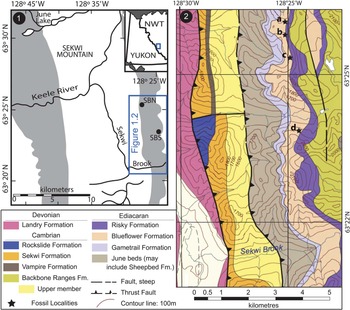
Ediacaran body fossils from Laurentia were first discovered by Hofmann (Reference Hofmann1981) from strata now regarded as the Blueflower Formation (Aitken, Reference Aitken1989) in the Sekwi Brook area of the Mackenzie Mountains (Fig. 1, 2). Body fossils of Inkrylovia sp. Fedonkin (in Palij, Posti, and Fedonkin, Reference Palij, Posti and Fedonkin1979) and Sekwia excentrica Hofmann, Reference Hofmann1981 were both reported along with the trace fossils Gordia Emmons, Reference Emmons1844, Gordia?, and Torrowangea Webby, Reference Webby1970. Subsequent studies at Sekwi Brook have extended the range of Ediacara-type body fossils into the underlying ‘June beds,’ which were previously correlated with the uppermost strata of the Sheepbed Formation (sensu Macdonald et al., Reference Macdonald, Strauss, Sperling, Halverson, Narbonne, Johnston, Kunzmann, Schrag and Higgins2013) and have substantially increased the known diversity of Ediacaran body fossils and trace fossils in this succession (Narbonne and Aitken, Reference Narbonne and Aitken1990; Narbonne, Reference Narbonne1994; Narbonne et al., Reference Narbonne, Laflamme, Trusler, Dalrymple and Greentree2014; Carbone and Narbonne, Reference Carbone and Narbonne2014). Most Ediacaran body fossils and trace fossils from the Mackenzie Mountains are from slope deposits (Dalrymple and Narbonne, Reference Dalrymple and Narbonne1996; MacNaughton et al., Reference MacNaughton, Narbonne and Dalrymple2000; Macdonald et al., Reference Macdonald, Strauss, Sperling, Halverson, Narbonne, Johnston, Kunzmann, Schrag and Higgins2013; Narbonne et al., Reference Narbonne, Laflamme, Trusler, Dalrymple and Greentree2014; Carbone and Narbonne, Reference Carbone and Narbonne2014), although shallow-water deposits at the top of the Blueflower Formation have yielded single specimens of the probable dickinsonid Windermeria Narbonne, Reference Narbonne1994 and an Ediacaria-morph of the holdfast disc Aspidella Billings, Reference Billings1872 (Narbonne and Aitken, Reference Narbonne and Aitken1990), along with a low diversity assemblage of mainly simple, sub-horizontal burrows (Carbone and Narbonne, Reference Carbone and Narbonne2014). Shallow-water equivalents of the Blueflower Formation in the Wernecke Mountains, 250 km west-northwest of Sekwi Brook (Pyle et al., Reference Pyle, Narbonne, James, Dalrymple and Kaufman2004), have yielded abundant Ediacara-type discoid body fossils and simple trace fossils along with a single specimen of the Ediacaran frond Charniodiscus Ford, Reference Ford1958 (Hofmann et al., Reference Hofmann, Fritz and Narbonne1983; Narbonne and Hofmann, Reference Narbonne and Hofmann1987; Pyle et al., Reference Pyle, Narbonne, James, Dalrymple and Kaufman2004), and were previously cumulatively considered the only Ediacaran shallow-water assemblage from NW Canada.
Location map. (1) Locations of studied sections containing shallow-water fossils of the uppermost Blueflower Formation, Sekwi Brook North (SBN) and Sekwi Brook South (SBS), Ediacaran strata shown in grey; (2) map of Sekwi Brook area, modified from Roots et al. (Reference Roots, Martel and MacNaughton2010) where stars indicate the approximate locations of fossil discoveries from Sekwi Brook North and South. (a) location of Windermeria; (b) location of Annulatubus; (c) location of segmented problematicum and Aspidella; (d) location of Sekwitubulus and Aspidella.

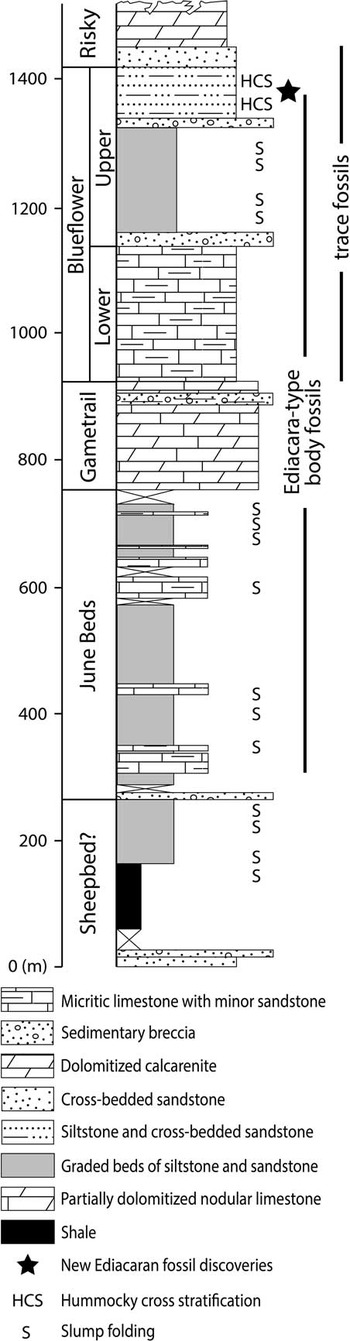
Generalized stratigraphic column of the Ediacaran strata at Sekwi Brook, modified from MacNaughton et al. (Reference MacNaughton, Narbonne and Dalrymple2000) and Macdonald et al. (Reference Macdonald, Strauss, Sperling, Halverson, Narbonne, Johnston, Kunzmann, Schrag and Higgins2013). The star shows the location of the newly discovered Ediacaran megafossils described in this paper.

The Ediacara biota is now known from nearly 40 localities spanning every continent except Antarctica (Fedonkin et al., Reference Fedonkin, Gehling, Grey, Narbonne and Vickers-Rich2007). Statistical studies of these fossil occurrences have consistently shown that they fall into three major assemblages, most commonly referred to as the Avalon, White Sea, and Nama assemblages (Waggoner, Reference Waggoner1999, Reference Waggoner2003; Shen et al., Reference Shen, Dong, Xiao and Kowalewski2008). However, there has been considerable discussion whether these assemblages reflect biogeography (Waggoner, Reference Waggoner1999), time (Xiao and Laflamme, Reference Xiao and Laflamme2009; Erwin et al., Reference Erwin, Laflamme, Tweedt, Sperling, Pisani and Peterson2011), ecology (Grazhdankin, Reference Grazhdankin2004; Gehling and Droser, Reference Gehling and Droser2013), or an interlinked combination of age and ecology (Narbonne et al., Reference Narbonne, Laflamme, Trusler, Dalrymple and Greentree2014).
A deliberate search for Ediacaran fossils in the uppermost Blueflower Formation at Sekwi Brook during the summers of 2011–2013 yielded two new tubular taxa and one Ediacaran problematicum. All specimens were found in frost-shattered talus directly below outcrop of the uppermost Blueflower Formation, with matching lithologies. These specimens and the two specimens described previously collectively represent the youngest collection of Ediacaran fossils from the most shallow-water facies at Sekwi Brook, and thus provide an opportunity to assess the factors that control the composition of Ediacaran assemblages.
Geological and paleontological setting
Ediacaran strata of the Mackenzie Mountains comprise the upper part of the Windermere Supergroup, a 3–5 km thick, mixed carbonate-siliciclastic succession that extends the length of the North American Cordillera and is commonly interpreted as reflecting sedimentation during the opening of the proto-Pacific Ocean (Aitken, Reference Aitken1989; Ross et al., Reference Ross, Parrish, Villeneuve and Bowring1989; Narbonne and Aitken, Reference Narbonne and Aitken1995; Dalrymple and Narbonne, Reference Dalrymple and Narbonne1996; MacNaughton et al., Reference MacNaughton, Narbonne and Dalrymple2000; Macdonald et al., Reference Macdonald, Strauss, Sperling, Halverson, Narbonne, Johnston, Kunzmann, Schrag and Higgins2013). Cryogenian strata of the Ice Brook Formation, correlated with 636.41±0.45 Ma Marinoan glacial deposits in Australia (Aitken, Reference Aitken1991; James et al., Reference James, Narbonne and Kyser2001; Hoffman and Halverson, Reference Hoffman and Halverson2011; Calver et al., Reference Calver, Crowley, Wingate, Evans, Raub and Schmitz2013; Macdonald et al., Reference Macdonald, Strauss, Sperling, Halverson, Narbonne, Johnston, Kunzmann, Schrag and Higgins2013), are overlain by the Ravensthroat cap carbonate and black shale of the Sheepbed Formation. The Sekwi Brook locality exposes more than 2 km of Ediacaran strata from a shale-dominated succession tentatively correlated with the uppermost Sheepbed Formation (Macdonald et al., Reference Macdonald, Strauss, Sperling, Halverson, Narbonne, Johnston, Kunzmann, Schrag and Higgins2013) to the top of the dolomitized Risky Formation (Fig. 2). Regionally, the Risky Formation is overlain by siliciclastic strata of the Ingta Formation that may span the Ediacaran-Cambrian boundary, but at Sekwi Brook, the Risky Formation is unconformably overlain by early Cambrian strata of the Backbone Ranges Formation (Aitken, Reference Aitken1989; MacNaughton et al., Reference MacNaughton, Narbonne and Dalrymple2000). No volcanic ash beds have been dated in this succession. Based on regional sequence stratigraphic and global chemostratigraphic correlations, including recognition of the Shurham C-isotope anomaly in the underlying Gametrail Formation, Macdonald et al. (Reference Macdonald, Strauss, Sperling, Halverson, Narbonne, Johnston, Kunzmann, Schrag and Higgins2013) inferred an age somewhere between 553–541 Ma for the Blueflower Formation. This age is equivalent to the assemblages of Ediacaran megafossils described from the Dengying Formation of China and the Nama Group of Namibia (Narbonne et al., Reference Narbonne, Xiao and Shields2012), implying that all three of these fossil assemblages are of latest Ediacaran age.
Ediacaran body fossils at Sekwi Brook occur in the informally named ‘June beds’ and throughout the Blueflower Formation (Hofmann, Reference Hofmann1981; Narbonne and Aitken, Reference Narbonne and Aitken1990; Macdonald et al., Reference Macdonald, Strauss, Sperling, Halverson, Narbonne, Johnston, Kunzmann, Schrag and Higgins2013; Narbonne, Reference Narbonne1994; Narbonne et al., Reference Narbonne, Laflamme, Trusler, Dalrymple and Greentree2014). These fossiliferous strata represent mainly slope facies, including turbidites, sandy contourites, and redeposited limestone, separated by unfossiliferous, variably dolomitized carbonate of the Gametrail Formation (Narbonne and Aitken, Reference Narbonne and Aitken1990; Dalrymple and Narbonne, Reference Dalrymple and Narbonne1996; MacNaughton et al., Reference MacNaughton, Narbonne and Dalrymple2000; Macdonald et al., Reference Macdonald, Strauss, Sperling, Halverson, Narbonne, Johnston, Kunzmann, Schrag and Higgins2013). Significantly, the uppermost ~75 m of the Blueflower Formation comprises a broadly shallowing-upwards succession of cross-stratified, medium- to thick-bedded, quartzose to dolomitic sandstone (MacNaughton et al., Reference MacNaughton, Narbonne and Dalrymple2000). Hummocky and swaley cross-stratification are abundant and support the interpretation that these strata were deposited in the lower shoreface to offshore transition. This implies a shallowing in the uppermost Blueflower Formation, bringing the depositional surface to between storm and fair-weather wave base (MacNaughton et al., Reference MacNaughton, Narbonne and Dalrymple2000).
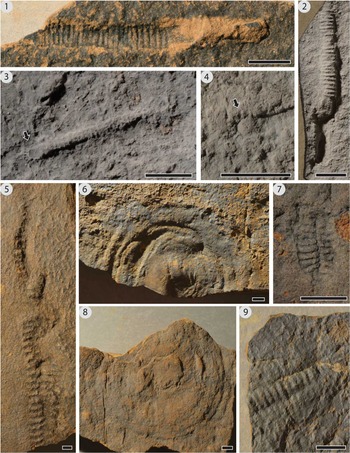
Uppermost Blueflower strata had previously yielded a large discoid holdfast referred to Ediacaria Sprigg, Reference Sprigg1947 (Narbonne and Aitken, Reference Narbonne and Aitken1990), and the probable dickinsonid Windermeria Narbonne, Reference Narbonne1994. New fossils from the uppermost Blueflower Formation comprise the rigid segmented tube Sekwitubulus annularis new genus new species, the undulatory segmented tube Annulatubus flexuosus, a top preservation of the Ediacaran holdfast disc Aspidella, and a previously undescribed Ediacaran problematicum. A single plate (Fig. 3) combines all new and previously described Ediacaran body fossils from the uppermost Blueflower strata.
Body fossils from the upper Blueflower Formation sandstone unit. Scale bars represent 1 cm. (1–4) Sekwitubulus annulatus n gen, et sp., locality d: (1, 2) high-relief specimen (ROM 63038) preserved in negative epirelief, full-relief, and positive epirelief along its length with annulations visible in both negative hyporelief and positive hyporelief; (1) natural specimen; (2) latex mold whitened with ammonium chloride; (3–4) Holotype of Sekwitubulus annulatus showing the annulated tube attached to a disc with rays (marked by an arrow), ROM 63039, (3) latex mold whitened with ammonium chloride; (4) close up of disc, natural specimen whitened with ammonium chloride; (5) Annulatubus flexuosus, two sub-parallel specimens preserved in hyporelief, ROM 63040, locality b; (6, 8) Ediacaria-morph of Aspidella Billings, Reference Billings1872: (6) specimen preserved in negative hyporelief, ROM 63041, locality c; (8) specimen preserved in positive hyporelief, GSC 95903, locality d; (7) Windermeria aitkeni Narbonne, Reference Narbonne1994, preserved in negative hyporelief, GSC 102374, locality a; (9) Segmented problematicum preserved in positive hyporelief, ROM 63042, locality c.

Systematic paleontology
The new fossils in this paper are reposited in the types collection of the Royal Ontario Museum (ROM) in Toronto.
Genus Aspidella Billings, Reference Billings1872
Type Species
Aspidella terranovica Billings, Reference Billings1872, by original monotypy
Aspidella terranovica Billings, Reference Billings1872
Description
The new specimen is an incomplete tripartite disc 111 mm in diameter preserved as a negative impression on a bed sole (concave hyporelief). An outer flange 12–15 mm wide is smooth with a sharp outer margin. The middle ring is 20–25 mm wide and exhibits a series of crescentic ridges subparallel to the margins of the ring, giving the fossil a petalled appearance. A mostly smooth inner disc 40 mm in diameter is marked by a 35–40 mm wide trapezoidal band of fine lineations that converge towards a hollow in the center of the disc. A similar-sized, tripartite specimen preserved as a positive feature on a bed sole (convex hyporelief; Fig. 3.8) was previously described from Sekwi Brook South (locality d in Fig. 1.2) by Narbonne and Aitken (Reference Narbonne and Aitken1990).
Materials
New specimen (ROM 63041; Fig. 3.6) from the upper Blueflower Formation at Sekwi Brook North (locality c in Fig. 1.2). Additional specimen previously described by Narbonne and Aitken (Reference Narbonne and Aitken1990) from locality d at Sekwi Brook South in Figure 1.2.
Remarks
The specimen in Figure 3.8 is a discoid fossil preserved in convex hyporelief, the normal preservation for specimens of Aspidella previously described from the Blueflower Formation (Narbonne and Aitken, Reference Narbonne and Aitken1990; MacNaughton et al., Reference MacNaughton, Narbonne and Dalrymple2000; Pyle et al., Reference Pyle, Narbonne, James, Dalrymple and Kaufman2004) and elsewhere worldwide (Gehling et al., Reference Gehling, Narbonne and Anderson2000; Fedonkin et al., Reference Fedonkin, Gehling, Grey, Narbonne and Vickers-Rich2007). Discoid fossils preserved as raised features on bed soles (convex hyporeliefs) are the most abundant fossils of the Ediacara biota, and formerly were described under a wide array of taxonomic names. Based on detailed study of several thousand Ediacaran fossil discs from Avalonian Newfoundland, Gehling et al. (Reference Gehling, Narbonne and Anderson2000) interpreted most named Ediacaran discoidal fossils as junior synonyms of the first-named Ediacaran disc, Aspidella terranovica Billings, Reference Billings1872. This interpretation has been supported by most subsequent workers (e.g., Mapstone and McIlroy, Reference Mapstone and McIlroy2006; Antcliffe and Brasier, Reference Antcliffe and Brasier2008; Hofmann et al., Reference Hofmann, O’Brien and King2008; Xiao and Laflamme, Reference Xiao and Laflamme2009; Hofmann and Mountjoy, Reference Hofmann and Mountjoy2010; Tarhan et al., Reference Tarhan, Droser and Gehling2010; Laflamme et al., Reference Laflamme, Schiffbauer, Narbonne and Briggs2011), but see Serezhnikova (Reference Serezhnikova2013) for a dissenting view. Comparison of Aspidella with discoid holdfasts on Ediacaran fronds such as Charniodiscus in England (Ford, Reference Ford1958), Australia (Jenkins and Gehling, Reference Jenkins and Gehling1978), and Newfoundland (Laflamme et al., Reference Laflamme, Narbonne and Anderson2004), coupled with the sporadic presence of stem impressions on Aspidella-like discs in Newfoundland, Australia, and NW Canada, led Gehling et al. (Reference Gehling, Narbonne and Anderson2000) to conclude that Aspidella most likely represents the attachment disc of an Ediacaran frond.
Preservation of ROM 63041 in concave hyporelief (Fig, 3.6) rather than the more normal convex hyporelief (Fig. 3.8) provides an opportunity to view the upper surface of a holdfast disc from the Blueflower Formation. A broadly circular depression in the middle of the specimen may represent the casting of the base of a stem. A series of ‘notches’ on the middle disc, and a trapezoidal array of subparallel lineations on the inner disc are oriented towards this central depression. These features strongly resemble the deformation described from so-called ‘mop’ structures, also preserved in negative hyporelief, that were interpreted as reflecting the stress exerted on holdfasts when strong currents pulled at fronds from South Australia (Tarhan et al., Reference Tarhan, Droser and Gehling2010). As in South Australia, these ‘pull and pucker’ marks did not obscure the disc shape, as larger discs are interpreted to be more resistant to current-associated perturbation including uprooting and dragging (Tarhan et al., Reference Tarhan, Droser and Gehling2010).
The presence of both lower and upper impressions of the large discs of the Blueflower Formation implies that the post-compactional shape of these large Aspidella holdfasts resembled an oblate spheroid, a three-dimensional shape similar to that observed in small Apsidella from Newfoundland (Laflamme et al., Reference Laflamme, Schiffbauer, Narbonne and Briggs2011). Although the simple morphology of Ediacaran discs has led to various interpretations of discs, including medusoids (Sprigg, Reference Sprigg1947, Reference Sprigg1949; Glaessner and Wade, Reference Glaessner and Wade1966), attached polyps (Fedonkin, Reference Fedonkin1985; Jenkins, Reference Jenkins1988, Reference Jenkins1989), frond holdfasts (Gehling et al., Reference Gehling, Narbonne and Anderson2000), or microbial colonies (Grazhdankin and Gerdes, Reference Grazhdankin and Gerdes2007), the presence of concave discoid surfaces with evidence of an overlying stem in specimens of Aspidella from South Australia (Tarhan et al., Reference Tarhan, Droser and Gehling2010) and Sekwi Brook (this study) confirm the interpretation of Gehling et al. (Reference Gehling, Narbonne and Anderson2000) that Aspidella represents the attachment discs of fronds.
Sekwitubulus new genus
Type Species
Sekwitubulus annulatus new species, by monotypy.
Diagnosis
As per species.
Etymology
From “Sekwi”, the location of the type specimen, and the Latin tubulus, a small tube.
Sekwitubulus annulatus n. sp.
Diagnosis
Straight, rigid, small (typically less than 5 mm diameter), thin-walled, cylindrical tube adorned with annular ridges uniformly spaced approximately 1 mm apart. Tube attached to the substrate via a tentaculate disc the same diameter as the tube.
Description
The holotype, ROM 63039 (Fig. 3.3, 3.4) is a straight, cylindrical, annulated tube, 33 mm in length and 3 mm in width, preserved in negative hyporelief or in full relief. The tube is ornamented with regularly spaced (~1 mm) annulations of thickened ridges, locally with fine lineations perpendicular to the annulations. The tube is attached to a circular disc preserved in positive hyporelief (see arrows in Figs. 3.3, 3.4). The disc is the same diameter as the tube, with rays radiating 1 mm beyond the diameter of the tube. The tube disappears distally, with no preservation of the distal end.
The other three specimens lack a disc, but support and enhance the diagnosis of this taxon. ROM 63038 (Fig. 3.1, 3.2) shows a tube, 52 mm long and 5 mm wide, preserved passing from negative hyporelief to a full relief cast to positive hyporelief along its length. The annulations are visible in positive and negative hyporelief, but are absent in the cast of the inside of the tube. ROM 63043 shows a small annulated tube, 9 mm long and 3 mm wide, partially obscured by a crack. ROM 63039 contains an additional short annulated tube, 11 mm long and 3 mm wide.
Etymology
Latin annulatus, referring to its ringed or annular ornamentation.
Material
Holotype (ROM 63039) and three other specimens (ROM 63038, 63043, 63044) from the upper Blueflower Formation at Sekwi Brook South (locality d in Fig. 1.2).
Remarks
All specimens show high relief, and the preservation of one specimen of Sekwitubulus as an uncompressed cylinder implies that it was considerably more rigid than typical “soft-bodied” Ediacara-type organisms. This specimen exhibits annulations on the outside of both positive and negative hyporelief sections, but annulations are absent from the full relief cast of the inside of the fossil, implying that Sekwitubulus was a hollow tube with a smooth interior and annulated exterior. The composition of the tube is unknown, but in view of its rigidity, it may have been mineralized. A trace-fossil origin can be ruled out by the combination of annulations that are not meniscate or beaded, evidence of a rigid lining, uniformly straight morphology, and presence of a holdfast at the proximal end of Sekwitubulus.
Tubes are simple structures that are common in the latter part of the Ediacaran. They have been found around the world as carbonaceous compressions or as casts and molds (Xiao et al., Reference Xiao, Yuan, Steiner and Knoll2002; Fedonkin et al., Reference Fedonkin, Gehling, Grey, Narbonne and Vickers-Rich2007). However, most of these tubes have strikingly different morphologies, such as the smooth and helical morphology of Somatohelix sinuosus Sappenfield et al., Reference Sappenfield, Droser and Gehling2011, or the tapered, flexible, and tetraradial tube, with a visible midline and helical twist morphology of Corumbella Hahn, Hahn, Leonardos, Pflug, and Walde, Reference Hahn, Hahn, Leonardos, Pflug and Walde1982 (Babcock et al., Reference Babcock, Grunow, Sadowski and Leslie2005). Sekwitubulus is more similar in morphology to the various carbonaceous fossils referred to as sabelliditids (Fedonkin, Reference Fedonkin1985), including Saarina Sokolov, Reference Sokolov1965, Sabellidites Yanichevsky, Reference Yanichevsky1926, Paleolina Sokolov, Reference Sokolov1965, and Calyptrina Sokolov, Reference Sokolov1967; however, Sekwitubulus appears more straight and rigid, and has a different annulation morphology. A recently discovered annulated tube with a potential holdfast, Wutubus annularis Chen, Zhou, Xiao, Wang, Guan, Hua, and Yuan, Reference Chen, Zhou, Xiao, Wang, Guan, Hua and Yuan2014, resembles Sekwitubulus in size, but is conical in shape and composed of a series of inflated units that increase in size distally instead of the rigid and uniform thickened ridges observed in Sekwitubulus (Chen et al., Reference Chen, Zhou, Xiao, Wang, Guan, Hua and Yuan2014). Hagadorn and Waggoner (Reference Hagadorn and Waggoner2000) described a series of tubes similar in size, morphology, and taphonomy to Sekwitubulus from shoreface siliciclastic facies of the lower Wood Canyon Formation, directly below the Ediacaran-Cambrian boundary in the upper portion of the lower Wood Canyon Formation in the SW United States. They referred these to Cloudina Hahn and Pflug, Reference Hahn and Pflug1985, but more recent research into Cloudina shows that it has a nested cone-in-cone morphology that is distinct from the annular ridges of Sekwitubulus. Some of the annulated tubes from the SW United States described by Hagadorn and Waggoner (Reference Hagadorn and Waggoner2000) appear curved and conical, features not observed in Sekwitubulus.
Annulated tubes reflect a simple morphology that could easily be repeated in different phylogenetic groups (Xiao and Laflamme, Reference Xiao and Laflamme2009). The presence of a disc with radiating rays invites comparisons with Ediacaran fronds such as Primocandelabrum Hofmann, O’Brien, and King, Reference Hofmann, O’Brien and King2008, but evidence that the tube was straight and completely uncompressed with annulated ridges on the outside of the tube is not consistent with interpretation of these tubes as the stems of Ediacaran fronds. Furthermore, the comparatively small size of the holdfast relative to the stem would provide minimal stability for an Ediacaran frond, particularly in the turbulent environment that characterized the uppermost Blueflower Formation. Most Ediacaran annulated tubes have been compared to annelids (most often tubes of sedentary annelids) or cnidarians (Xiao et al., Reference Xiao, Yuan, Steiner and Knoll2002; Cai et al., Reference Cai, Schiffbauer, Hua and Xiao2011; Skovsted and Peel, Reference Skovsted and Peel2011). The tentaculate disc (Fig. 3.3, 3.4) preserved at the end of one specimen is preserved in positive hyporelief, a preservational style that is consistent with the preservation of infaunal Ediacaran discs interpreted to be holdfasts from Sekwi Brook. This suggests that Sekwitubulus was likely a vertical tube, similar in construction to those of modern polychaete worms, that extended into the water column and was anchored to the substrate by a small holdfast disc. Sekwitubulus resembles the tube of a tubicolous polychaete worm because of its rigid tubicolous shell, smooth lumen, external collar-like ridges (possible growth annulations or peristomes), and lack of taper (Vinn and Zatoń, Reference Vinn and Zatoń2012). Annulations are consistent in thickness regardless of specimen size, suggesting these organisms likely grew by adding rings to the distal end, also similar to tubicolous polychaete worm tubes. However, this similarity in construction does not necessitate any phylogenetic relationship between Sekwitubulus and modern polychaete worms. Molecular divergence estimates imply that the crown group of annelids did not evolve until the Ordovician, although there is fossil evidence of annelids as far back as the Cambrian (Erwin, et al., Reference Erwin, Laflamme, Tweedt, Sperling, Pisani and Peterson2011).
Annulatubus new genus
Type Species
Annulatubus flexuosus new species, by monotypy.
Diagnosis
As per species.
Etymology
A combination of the Latin annulatus, meaning ringed, and tubus, meaning tube.
Annulatubus flexuosus n. sp.
2008 cf. “Tomaculate object with regularly spaced ornamentation” Grazhdankin et al., p. 805, fig. 3G.
Diagnosis
Undulatory, cm-wide cylindrical tube, ornamented with transverse to slightly lunate, annular ridges uniformly spaced approximately 5 mm apart.
Description
The slab, ROM 63040 (Fig. 3.5), is one of two fragmented annulated tubular structures that cross one another. The holotype is 178 mm in visible length, and 15 mm in width. The tube is wavy to discontinuous with poorly defined margins, preserved dominantly in low relief with the visible end preserved in unornamented full relief. The annulations are broadly lunate, 3 mm thick, and spaced 6 mm apart. Fine transverse laminations occur locally on the full relief portion of the tube. The other tube is also discontinuous and preserved in low relief; however, it is significantly less well preserved. It is 228 mm in visible length, and 15 mm in width.
Etymology
Latin flexuosus referring to its flexible and winding appearance.
Material
Slab containing the holotype (ROM 63040) crossing over an additional specimen from the upper Blueflower Formation at Sekwi Brook North (locality B in Fig. 1.2).
Remarks
The inability to trace the annulations across both tubes and the lack of a clear medial line between the tubes suggests that they do not represent a single bilobate specimen, but instead represent two subparallel tubes that locally abut and cross over each other. The crossover of the two specimens explains the relatively poor preservation of one tube and transitioning relief of both tubes.
These tubes resemble Sekwitubulus in being simple, annulate tubes, but there are few other similarities. Annulatubus is significantly wider than Sekwitubulus, with annulations that are lunate rather than transverse. Evidence that Annulatubus was flexible and easily compressible serves as another important difference. It is not known whether Annulatubus had a holdfast like that seen in Sekwitubulus. These tubes more closely resemble Wutubus annularis in size; however, Wutubus is a fairly straight and tapered tube with inflated units that increase in size distally (Chen et al., Reference Chen, Zhou, Xiao, Wang, Guan, Hua and Yuan2014), whereas Annulatubus is wavy with consistent tube and annulation diameters.
Most tube-like fossils from the Ediacaran are significantly smaller than this specimen. A series of Ediacaran ribbon-shaped fossils have been interpreted as compression tubes (Sokolov, Reference Sokolov1967; Xiao and Dong, Reference Xiao and Dong2006; Liu et al., Reference Liu, Xiao, Yin, Zhou, Gao and Tang2008; Dong et al., Reference Dong, Xiao, Shen, Yuan, Yan and Peng2008; Cohen et al., Reference Cohen, Bradley, Knoll, Grotzinger, Jensen, Abelson, Hand, Love, Metz, McLoughlin, Meister, Shepard, Tice and Wilson2009; Sappenfield et al., Reference Sappenfield, Droser and Gehling2011 and references therein). For example, Shaanxilithes Xing et al., Reference Xing, Ding, Luo, He and Wang1984 superficially resembles this specimen, but it is smaller in size (1–6 mm wide, several cm long) and has much finer laminations (Shen et al., Reference Shen, Xiao, Dong, Zhou and Liu2007), making direct comparison weak. Additionally, the specimens of Annulatubus are observed to overcross each other with none of the abrupt bends, twists, or folds that occur in Shaanxilithes specimens (Meyer et al., Reference Meyer, Schiffbauer, Xiao, Cai and Hua2012). No conclusions can be made about this fossil’s affinities at the present time.
Annulatubus strongly resembles the ‘tomaculate object with regularly spaced annulations’ described by Grazhdankin et al. (Reference Grazhdankin, Balthasar, Nagovitsin and Kochnev2008; fig. 3G) from the late Ediacaran Khatyspyt Formation of northern Siberia, both in sinuosity and ornamentation, and is herein regarded as representing the same genus. Both occurrences consist of flexible tubes that are cm-scale in diameter with thick, slightly arcuate annulations. The ‘tomaculate object’ of Grazhadankin et al. (2008) is wider (~50 mm in diameter with a preserved length of 250 mm), and more material is needed to determine whether this is within the size range of the species or deserves designation as a separate species. The ‘tomaculate object’ from Siberia is preserved as a carbonaceous compression, whereas the specimens from Sekwi Brook show Ediacara-type preservation on the sole of the bed. Annulatubus joins a growing list of taxa that have been found in both carbonaceous and Ediacara-type preservation (Xiao et al., Reference Xiao, Droser, Gehling, Hughes, Wan, Chen and Yuan2013). The Khatyspyt Formation is comprised of late Ediacaran (probably <549 Ma) deep-shelf limestones and shales that were deposited below storm wave base (Knoll et al., Reference Knoll, Grotzinger, Kaufman and Kolosov1995).
Segmented problematicum
Description
The single specimen is a fragment 33 mm in length that occurs in positive hyporelief. It consists of at least 14 parallel segments, each 2 mm in width. Two creases cross the fossil approximately transverse to the segmentation, making the overall structure appear trilobate. Segments meet in an opposite arrangement across the lower-right crease (as viewed in Figure 3.9), but in an alternate arrangement across the upper-left crease in this image. Segments in the central lobe exhibit fine lineations perpendicular to the segments.
Materials
Single specimen (ROM 63042) from the upper Blueflower Formation at Sekwi Brook North (locality C in Fig. 1.2).
Remarks
The specimen occurs on a bed sole with trace fossils and sporadic prod marks, but these markings do not appear on the fossil and the orientation of the segments on the fossil is strongly oblique to both the prod marks on the base and ripple cross-lamination in the overlying sandstone bed. The specimen is a fragment of a larger, segmented fossil that cannot be identified with certainty. More and better material is needed to determine the taxonomic and phylogenetic affinities of this problematic fossil.
Discussion
Most sandstone beds in the uppermost Blueflower Formation at Sekwi Brook exhibit erosional bases, a taphonomic condition that precluded preservation of the Ediacara biota as impressions on the soles of these sandstone beds. This may account for the relative scarcity of Ediacaran megafossils in these mainly high-energy, shallow-water deposits.
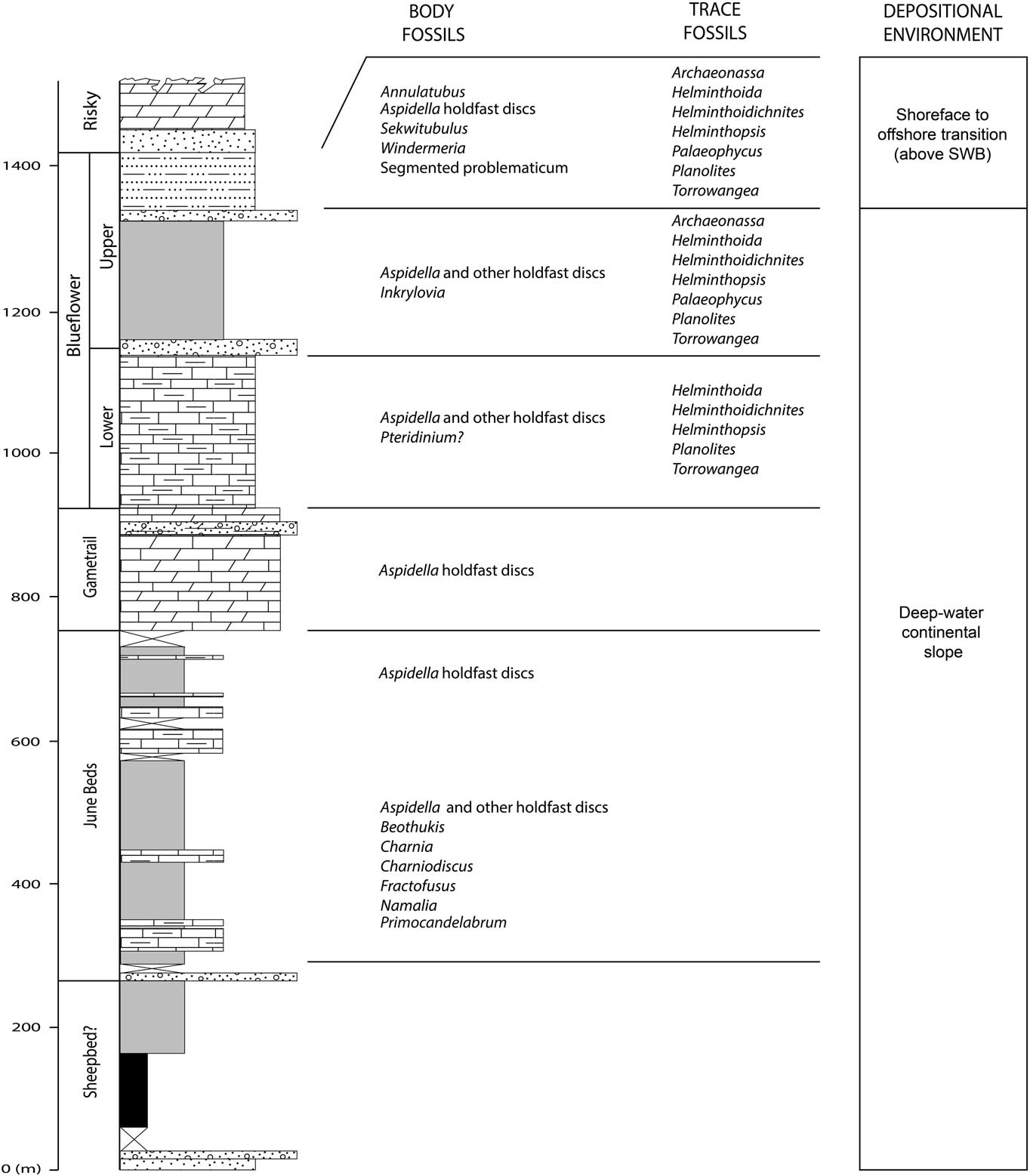
The stratigraphic distribution of Ediacaran fossils at Sekwi Brook is shown in Figure 4. Trace fossils interpreted as representing the activity of mobile bilaterian animals (Narbonne and Aitken, Reference Narbonne and Aitken1990; Carbone and Narbonne, Reference Carbone and Narbonne2014) are absent from the lower part of the Ediacaran succession but are abundant throughout the Blueflower Formation. There is little taxonomic difference in the trace fossils present from slope to subtidal shelf environments of the Blueflower Formation (Carbone and Narbonne, Reference Carbone and Narbonne2014; Fig. 4), a surprising result in view of the well-documented high level of environmental control on Phanerozoic trace fossil assemblages (Seilacher, Reference Seilacher1967; Pemberton et al., Reference Pemberton, MacEachern and Frey1992; MacEachern et. al., Reference MacEachern, Bann, Pemberton and Gringras2005), although MacNaughton and Narbonne (Reference MacNaughton and Narbonne1999) and Buatois et al. (Reference Buatois, Almond and Germs2013) have shown broad environmental tolerances in key Ediacaran and Cambrian ichnotaxa. Furthermore, most of the burrows from above and below storm wave base (SWB) throughout the Blueflower Formation were grazers within individual microbial mats that formed during low-energy periods (Carbone and Narbonne, Reference Carbone and Narbonne2014) instead of the episodic high-energy conditions characteristic of sandstone deposition in the uppermost Blueflower Formation. Skolithos Haldeman, Reference Haldeman1840, Diplocraterion Torell, Reference Torell1870, and the other vertical dwelling burrows that characterize Phanerozoic high-energy shoreface environments above SWB do not appear abundantly worldwide until sometime in the Cambrian (Seilacher et al., Reference Seilacher, Buatois and Mángano2005; Jensen et al., Reference Jensen, Droser and Gehling2006; Mángano and Buatois, Reference Mángano and Buatois2014).
Stratigraphic distribution of Ediacaran body fossils and trace fossils at Sekwi Brook (compiled from Hofmann, Reference Hofmann1981; Aitken, Reference Aitken1989; Narbonne and Aitken, Reference Narbonne and Aitken1990, Narbonne, Reference Narbonne1994, MacNaughton et al., Reference MacNaughton, Narbonne and Dalrymple2000, Narbonne et al., Reference Narbonne, Laflamme, Trusler, Dalrymple and Greentree2014, Carbone and Narbonne, Reference Carbone and Narbonne2014; this paper). The ichnogenus Helminthoida is used informally in the sense of Carbone and Narbonne (Reference Carbone and Narbonne2014).

Aspidella and other holdfast discs occur abundantly throughout the entire fossiliferous succession at Sekwi Brook, both above and below SWB, and in siliciclastic and carbonate strata. This distribution confirms previous reports that Aspidella is a long-ranging, eurybathic, cosmopolitan form-genus with limited value in Ediacaran biostratigraphy or paleoecology. Other Ediacaran body fossil taxa show more pronounced difference in distribution and, with the exception of Aspidella, there are no body fossil taxa in common between the deeper-water assemblages in the lower and middle part of the Sekwi Brook succession and the shallower-water deposits at the top of the Blueflower Formation (Fig. 4). Rangeomorphs such as Beothukis Brasier and Antcliffe, Reference Brasier and Antcliffe2009, Charnia Ford, Reference Ford1958, and Fractofusus Gehling and Narbonne, Reference Gehling and Narbonne2007 are the most common non-discoid fossils of the June beds, but are unknown from younger strata at Sekwi Brook, whereas the dickinsonid Windermeria and the annulated tubes Sekwitubulus and Annulatubus occur only in shoreface deposits at the top of the Blueflower Formation and are not known from the older and deeper-water deposits of the June beds. Windermeria is presently known only from the shallow-water environment at Sekwi Brook, but elsewhere in the world, dickinsonids are known exclusively from the shallow-water White Sea assemblage in Australia and the White Sea, Podolia, and Urals in Europe (Fedonkin et al., Reference Fedonkin, Gehling, Grey, Narbonne and Vickers-Rich2007).
In contrast, tubular megafossils are known from the shallow-water White Sea and Nama assemblages in Australia (Sappenfield et al., Reference Sappenfield, Droser and Gehling2011), Namibia (Cohen et al., Reference Cohen, Bradley, Knoll, Grotzinger, Jensen, Abelson, Hand, Love, Metz, McLoughlin, Meister, Shepard, Tice and Wilson2009), China (Xiao et al., Reference Xiao, Yuan, Steiner and Knoll2002; Shen et al., Reference Shen, Xiao, Dong, Zhou and Liu2007; Dong et al., Reference Dong, Xiao, Shen, Yuan, Yan and Peng2008; Chen et al., 2014), and Siberia (Grazhdankin et al., Reference Grazhdankin, Balthasar, Nagovitsin and Kochnev2008). The presence of Sekwitubulus in lower shoreface to offshore transition deposits in the SW USA and Annulatubus as a carbonaceous compression in moderately deep deposits in Siberia demonstrates that tubular megafossils existed in both shallow water (abundantly) and deeper water (rarely) after 560 Ma. No tubular megafossils have thus far been reported from the older (>560 Ma) deep-water slope deposits of the June beds or any of the Avalonian assemblages of England or Newfoundland and no Ediacaran shallow-water assemblages older than 560 Ma are known to date. Either tubular Ediacaran forms appeared around 560 Ma and were not environmentally restricted, or these taxa existed before 560 Ma, but were restricted to shallower water than typical Avalonian assemblages represented in the rock record. The presence of these new Ediacaran taxa therefore reflects their younger age, or their shallower-water environment, or a combination of both of these factors.
Conclusions
New fossil finds from the uppermost strata of the Blueflower Formation reflect the youngest and shallowest fossils from Sekwi Brook. This new assemblage contains three genera, Windermeria, Sekwitubulus, and Annulatubus. Tubular fossils Sekwitubulus and Annulatubus contribute to the increasingly abundant record of tubular fossils from shallow-water environments, including the Dengying Formation of China and the Nama Group of Namibia, and further emphasize the rarity of tubular fossils from deep-water Avalon assemblages.
Together with the presence of large holdfasts and the segmented problematicum, these fossils represent a shallower-water community that differs significantly from the underlying older and deeper-water assemblages as Sekwi Brook (Fig. 4). The apparent decrease in rangeomorphs in favor of dickinsonimorphs and tubular fossils at Sekwi Brook is consistent with the appearance of these forms around 555–545 Ma in shallow-water environments of the White Sea and Nama assemblages in Russia, Ukraine, Australia, and Namibia. Tubular forms have also been documented from the late Ediacaran, moderately deep Khatyspyt Formation of Siberia. The appearance of dickinsonids and tubular fossils in the uppermost Blueflower Formation likely demonstrates the combined influence of age and environment on the biota preserved in the section at Sekwi Brook.
The development of a distinct lower shoreface to offshore transition community in the late Ediacaran at Sekwi Brook is not reflected in the trace fossil record (Fig. 4). Trace fossils appear abruptly at the base of the Blueflower Formation, and undergo little to no diversity change from deep- to shallow-water environments. The abundance of microbial mats in both deep and shallow water caused low-energy periods in both environments to be suitable for colonization of microbial grazers. In contrast, body fossils may reflect some form of environmental specialization, since unique forms developed in shallow-water environments that were able to sustain both the low- and high-energy facies of the upper Blueflower Formation.
Acknowledgments
We would like to acknowledge funding through a Natural Sciences and Engineering Research Council (NSERC) Discovery Grant and a Queen’s Research Chair to GMN and an NSERC-USRA to THB. Thanks go to A. Brown for assistance in the field. We gratefully acknowledge the cooperation of Norman Wells and Tulita, and logistical assistance from A. Newton and Canadian Helicopters. Research was carried out under scientific permits from Aurora Institute, NWT. M. G. Mángano and M. Laflamme provided helpful comments. This paper is a contribution to IGCP 587, “Identity, Facies, and Time, the Ediacaran (Vendian) Puzzle.”