

Introduction
The presence of various metals in the agriculture industry and their impact on a number of different environmental aspects has gained academic attention around the world (Atafar et al, Reference Atafar, Mesdaghinia, Nouri, Homaee, Yunesian, Ahmadimoghaddam and Hossein Mahvi2010; Fisher, Reference Fisher2015; Li and Chen, Reference Li and Chen2005). The general population can be exposed to heavy metal contaminates through drinking water, dust, fumes and from a variety of food sources (Atafar et al, Reference Atafar, Mesdaghinia, Nouri, Homaee, Yunesian, Ahmadimoghaddam and Hossein Mahvi2010). Heavy metals can be transferred into edible animal products, such as meat, milk and eggs, and therefore be passed into the human food chain. A study conducted in the United States of America found the highest concentrations of the heavy metal arsenic were reported in seafood, rice, mushrooms, and poultry (Tao and Bolger, Reference Tao and Bolger1999). Arsenic has been found to be associated with several kinds of cancers in certain places such as Taiwan, Montana and Utah (Hsueh et al, Reference Hsueh, Cheng, Wu, Yu, Kuo and Chen1995; Lewis et al, Reference Lewis, Southwick, Ouellet-Hellstrom, Rench and Calderon1999; Lubin and Fraumeni, Reference Lubin and Fraumeni2000).
The accumulation of heavy metals within animal protein sources can be contributed to by the contamination of certain feed ingredients (Vremane et al, Reference Vreman, van der Veen, van der Molen and de Ruig1986; Spragg, Reference Spragg2008). The risk of heavy metal contamination in animal feeds has been increasingly scrutinised over the last decade. When evaluating the potential for contamination of ingredients such as trace mineral sources, contaminants can come from a variety of sources, including soil for growing crops (transfer into plant material), from contaminated mining sites (e.g. for inorganic mineral extraction), during transport, from processing techniques and in the feed mill.
There have been various food safety alerts across the world related to heavy metals in trace mineral sources (Farmer and Farmer, Reference Farmer and Farmer2000; Li and Chen, Reference Li and Chen2005). For example in 2004, zinc sulphate, originating from China and containing high concentrations of cadmium, was subsequently incorporated into animal feed and fed at 1500 farms throughout France and Belgium (European Commission, 2006). Additionally, in 2004 similarly contaminated zinc sulphate from China was imported into Norway and resulted in high levels of cadmium in beef, sheep and salmon products (Bethune, Reference Bethune2006). In 2008 zinc oxide destined for premix use and containing high levels of lead ended up into the Australian feed industry and resulted in excessive lead levels in the liver and kidneys of pigs (Spragg, Reference Spragg2008). In the European Union, food safety regulations have been updated based on the European Food Safety Authority's risk assessments and scientific opinions regarding specific contaminants and their potential for adverse performance and health effects in livestock and adverse health effects in humans consuming contaminated food products (European Commission, 2003).
The following paper covers a recent survey of feedstuffs from the Asian and North and Latin American regions, conducted as part of Alltech's Q+ mineral quality program (Alltech Inc, Nicholasville, Kentucky, USA), and contrasted this with other published findings regarding the relative potential risks from heavy metal contamination in materials fed to animals. Arsenic, cadmium and lead were the focus of this survey, as these have been shown to be common contaminants of trace minerals used in feed.
Materials and methods
A total of 3,147 samples of animal feeds and feed ingredients were collected and analysed from a range of companies in the feed industry including feed mills, premix operators and farms located in 29 countries in Asia-Pacific, North and Latin America between 2009 and 2016. Types of materials sampled included premixes, minerals including cobalt, chromium, copper, ferrous, magnesium, manganese, selenium and zinc. Complete aqua, pet, poultry, ruminant and swine feeds were also sampled.
Samples of individual minerals, premixes, and complete feed of 100 to 200 g were bagged on-site, labelled (country of collection, sample type, target species), and shipped for analysis to either the Alltech Center for Animal Nutrigenomics and Applied Animal Nutrition in Nicholasville, Kentucky, USA, Alltech Biotechnology in Tianjin, China or Alltech Biotechnology in Bangalore, India.
All samples were analysed for lead, arsenic and cadmium using inductively coupled plasma mass spectrometry (ICP-MS). Metal concentrations were compared against EU contamination limits for individual minerals, premixes and animal feed. Standards of each metal under investigation were subjected to serial dilution (mg/kg concentration) as required for inductively coupled plasma–mass spectrometry (ICP-MS) analysis in 5% nitric acid in deionised water solution to match the acid matrix of samples. Nitric acid was used to digest the samples and was added to the deionised water blanks before analysis in the same concentration as the acid concentration found in the feedstuffs under test. Dry feedstuff samples (12–16 g) were ground to a uniform powder in a cryogenic mill (SPEX SamplePrep 6870 FreezerMill, SPEX SamplePrep, Metuchen, New Jersey, USA) to ensure a uniform, dry powder. A 1 g subsample of each feedstuff was digested with 10 ml nitric acid in a MARS 5 microwave oven (CEM, Matthews, North Carolina, USA) for 15 minutes. After digestion, samples were diluted to a 50 ml volume with deionised water. Before analysis, samples were diluted 1000-fold using deionised water.
Analysis for presence and levels of the heavy metals under scrutiny was conducted using an Optima 7300 ICP optical emission spectrometry (OES) system (PerkinElmer LAS, Shelton, Connecticut, USA). The results for each type of feedstuff were tabulated to identify the average, minimum and maximum levels of contaminants. Any feedstuff or ingredient tested that was determined as having heavy metal levels above the EU permitted levels was defined as being contaminated.
Results
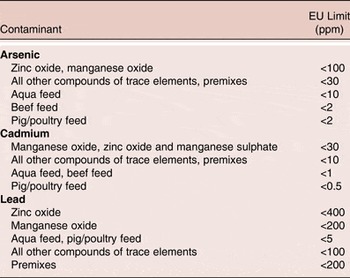
The EU has classified each heavy metal contaminant regarding its permitted levels in feedstuffs at the time of testing (EU Directive 2002/32/EC, European Commission, 2002; Table 1). This was used to compare the levels found in the accumulated samples, and to establish those that were considered ‘positive’ for toxic levels of heavy metal contamination.
EU permitted limits in feedstuffs and ingredients and common sourcing of contaminants (EU Directive 2002/32/EC).

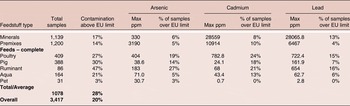
The results by feedstuff type for samples collected between 2009 and 2016 are shown in Table 2 below. When considered by sample type, for the 1139 individual mineral sources 17% were found to be contaminated with at least one heavy metal. The highest levels of arsenic, cadmium and lead found in individual mineral sources were 330 ppm, 28,559 ppm and 28,066 ppm respectively, which were all above EU allowed limits for feed materials. For the 1200 mineral pre-mixes sampled, 14% were found to be contaminated with at least one heavy metal. The highest levels of contaminants detected were seen for arsenic (3,190 ppm), cadmium (10914 ppm) and lead (6,467 ppm). Again, all were above EU limits for feed materials. A total of 1078 compete feed samples were analysed and compared with EU limits. The results showed that 28% were contaminated with at least one heavy metal above EU limits. Ruminant feed was found to contain the highest level of contamination, with 47% of the samples contaminated with at least one heavy metal, and 27% of the samples contaminated with arsenic. Poultry and swine feed contained 27% and 30%, respectively. The highest level of arsenic, cadmium and lead were 404 ppm, 782.8 ppm and 722.4 ppm, respectively and all found in the poultry feeds. All were above EU limits for complete feeds.
Levels of heavy metal contaminants in different feedstuffs sources from Asia, North and Latin America between 2009 and 2016.

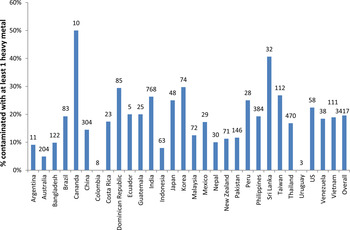
When compared by country, as a risk assessment of regional threat from heavy metal toxicity, certain countries showed much higher numbers of samples being contaminated with at least one heavy metal (Figure 1).
Levels of heavy metal contamination in feedstuffs and number of samples by country of sample origin from 2009 to 2016.

From 2009 to 2016, the highest contamination was seen for Canadian samples, with 50% containing at least one heavy metal. This was surprising, as it is generally considered that heavy metal contamination is associated with poorly regulated, highly populated and industrial areas, where crops are grown in contaminated soils and air pollution is a major problem. Next in order, having 41% of samples showing contamination, was Sri Lanka. Lowest levels were recorded for Australia, Argentina, Colombia, Indonesia and Uruguay, with less than 10% of samples testing positive.
Discussion
Risk management of heavy metal contamination relies on an understanding of their absorption, metabolism, carry over and toxicological profile and practical means to decrease their harmful effects. Toxic substances are usually degraded before or after their absorption in the intestinal tract and depending on their individual characteristics, some substances, such as veterinary drugs and feed additives are metabolised into naturally occurring and harmless constituents (Kan and Meijer, Reference Kan and Meijer2007). However other substances are persistent and remain in the animal and its edible products. Heavy metals are such substances and are not metabolised at all, with some being irreversibly bound to body tissues, such as lead in bone and cadmium in kidneys (Kan and Meijer, Reference Kan and Meijer2007). Studies by Vreman et al. (Reference Vreman, van der Veen, van der Molen and de Ruig1986) and Kreuzer et al. (Reference Kreuzer, Bunzl and Kracke1981) demonstrated that although meat and milk do not show high concentrations of heavy metals when animals are exposed to them through the diet, the liver and kidney often show a clear dose-response relationship to heavy metals.
Globally, screening of trace minerals needs to be implemented to ensure excessive levels of heavy metals are discovered before they enter the food chain via animal feeds and ingredients. Additionally another way of monitoring heavy metal contamination could be through routine testing of offal and bone samples from livestock to monitor long term effects. This may allow the generation of data on heavy metal bioavailability from minerals, premixes and completed feeds. Unfortunately, without such monitoring, heavy metal contamination will continue to exert negative effects on animal performance and health and food safety for humans worldwide.
Conclusions
Ideally, strict quality assurance methods should be implemented at the feed mill, and ingredients should be carefully scrutinised before being selected for use. Continued vigilance and investigation into which feeds, ingredients and regions of the world are most contaminated is necessary. However, this alone will not prevent contamination of feed on a practical basis. In order to decrease or remove the potential harmful effects of heavy metal contamination in the food chain, a robust sampling and testing schedule, forming part of an overall stringent quality assurance scheme is essential from the manufacturers and suppliers of trace mineral sources.
Acknowledgments
The laboratory work was funded by Alltech Inc, USA.
Declaration of interest
The authors S. Elliott and T. Jarman are employees of Alltech Inc, USA.