Implications
There is an urgent need to work on sustainable livestock production systems in the tropics. Intensive silvopastoral systems are being used in some countries as an alternative for sustainability. Hence, it is important to gather scientific information in this type of systems on the trade-offs between different sustainability indicators, such as environmental and animal welfare criteria. The present study contributes to this approach by providing information on the behaviour of cattle in these systems. The environmental conditions of an intensive silvopastoral system favour the expression of socially stable and positive behaviours of cattle. This intensive silvopastoral system, composed of grass and Leucaena leucocephala, in addition to increasing biodiversity, offers advantages for the welfare of cattle. This information is relevant for the development of efficient silvopastoral systems in the tropics reducing agricultural expansion into conservation areas.
Introduction
Dual-purpose systems in the tropical regions of Mexico are known to have low milk productivity, mainly due to low quality of grasses in monoculture pastures (Amendola, Reference Amendola2002). In addition, these systems are regarded as detrimental to ecosystem services and biodiversity (FAO, 2007 and 2012). Intensive silvopastoral systems (ISS), which consist of fodder shrubs at high densities intercropped with pastures and timber trees, have been introduced as sustainable alternatives (Murgueitio and Solorio, Reference Murgueitio and Solorio2008). Following the development of the ISS for dual-purpose cattle, research has been done to address some aspects of animal production and welfare. For example, some ISS provide microclimate conditions and food resources that help livestock to cope with heat stress and malnutrition (for a review see Broom et al., Reference Broom, Galindo and Murgueitio2013). Nevertheless, to have a better understanding on the impact that the ISS systems have on the welfare of livestock, detailed studies on cattle’s social behaviour are needed.
In group-living domestic species, changes in social behaviour can occur as a response to environmental challenges; therefore can be used as welfare indicators (Broom, Reference Broom1986; Keeling and Jensen, Reference Keeling and Jensen2002). Dominance relationships in cattle are highly stable, but aggression can increase with group size, when unfamiliar animals are mixed (Bouissou et al., Reference Bouissou, Boissy, Le Neindre and Veissier2001), and when food and space are scarce (Kondo et al., Reference Kondo, Sekine, Okubo and Asahida1989; Nielsen et al., Reference Nielsen, Mogensen, Krohn, Hindhede and Sorensen1997). Affiliative behaviour occurs when other needs, like finding food and shelter, have been met (Sato et al., Reference Sato, Sako and Maeda1991). Furthermore, the welfare of cattle can be affected by the type and intensity of social interactions between members. For example, intense aggression can lead to injuries and tend to disperse the individuals (Bouissou, Reference Bouissou1980). Social grooming can induce positive affective states (Boissy et al., Reference Boissy, Manteuffel, Jensen, Moe, Spruijt, Keeling, Winckler, Forkman, Dimitrov, Langbein, Bakken, Veissier and Aubert2007) and enhance group cohesion (Miranda de la Lama and Mattiello, Reference Miranda de la Lama and Mattiello2010).
To our knowledge, the expression of cattle’s social behaviour in ISS has not been studied before. Therefore, the aim of the present study was to describe how individuals socially interact with each other in both monoculture system (MS) and ISS system, and relate their social behaviour with system-specific environmental characteristics. As agonistic and affiliative behaviours are highly flexible and vary with environmental and management conditions, and ISS provide better food quality and availability, as well as shaded areas, we propose that in ISS affiliative behaviours and social stability are favoured, and agonistic encounters are lowered.
Materials and methods
Study areas and animals
The study was conducted in two dual-purpose cattle production systems in Yucatán, México: (1) a MS, situated at the Faculty of Veterinary Medicine and Animal Sciences, University of Yucatan (20°51′ N, 89°37′ W) and (2) an ISS, located at Dzununcán (20°50′ N, 89°39′ W), both at an altitude of 10 m. The two systems were 5.5 km apart. Observations were carried out during the dry (April to June) and the rainy (July to September) seasons. The climate of the region is classified as tropical sub-humid (Awo (i′) gw′′; García, 1988), with average annual temperature of 28°C, and annual precipitation ranging between 700 and 1100 mm, most rainfall occurring in the summer. The mean temperature and humidity index (0.72 (dry temperature+wet temperature)+40.6; McDowell et al., Reference McDowell, Hooven and Camoens1976) in the MS was 83.6±0.17 (mean±SE) and 82.18±0.16, in the dry and in the rainy seasons. The average temperature and humidity indexes in the ISS were 81.18±0.14 and 81.93±0.17, in the dry and in the rainy seasons (Améndola, Reference Améndola2013).
From each system, we selected three paddocks of 29±0.01 ha. The same three paddocks were used during the dry and rainy seasons. The MS paddocks consisted of Cynodon nlemfuensis, with average daily forage allowance of 1.86% (kg green leaves dry matter/100 kg live weight) in the dry season and 3.64% in the rainy season (Améndola, Reference Améndola2013). The ISS contained C. nlemfuensis, Megathyrsus maximus, Leucaena leucocephala in high densities, and trees (Brosimum alicastrum, Ceiba pentandra, Piscidia piscipula, Bursera simaruba, Lysiloma latisiliquum) as ‘live fence posts’ of shrubs and trees selected for their suitability as a barrier to the animals. Average daily forage allowances in the ISS were 14.40% in the dry season and 24.51% in the rainy season (Améndola, Reference Améndola2013).
The subjects were 16 1.5-year-old heifers (eight heifers per system), weighing between 280 and 300 kg of the cross-breed Bos indicus×Bos taurus. All animals were kept with their mothers until they were ~8 months old. As a standard management procedure, heifers were introduced to a larger herd at 8 months of age. The 16 heifers were selected from their respective larger herds (from 85 cows in the MS and 92 cows in the ISS) using as main criteria for selection the closeness of age and weight between individuals. The selected heifers of each system 10 months before observations were grouped and kept as a herd in fenced pens.
Vegetation characterization in the ISS
A detailed characterization of the vegetation coverage was made in the paddocks of the ISS. Each paddock was delimited with a GPS (Garmin eTrex Vista®, Olathe, Kansas, USA) using the perimeter fence, measurement accuracy of the GPS device is 3 m. The number of trees, the canopy area (m2) and tree height (m) were estimated. The canopy area was calculated measuring the greatest and smallest diameter of each tree with a measuring tape on the ground. The trees were identified and were geographically located with the GPS. Tree shadow coverage was defined as the estimated percentage of land area covered by tree canopy area. All spatial analysis were conducted with the software ArcGis 10.2 (Environmental System Research Institute, Reference Dudziński, Müller, Low and Schuh2014).
Behavioural observations
Before the observations started, the heifers were habituated to the observer for a period of 2 weeks. Each herd was introduced into each paddock at 0730 h and remained in it until 1530 h, when they were moved to fenced pens (standard management in the region). This procedure was carried out for 12 consecutive days in each season per each system, rotating between paddocks every 4 days. In both systems, heifers were offered water ad libitum at paddocks and pens. Observations were carried out between 0730 and 1530 h. The same observer made a total of 192 h of observations/system.
Using the GPS, positioned beside the right side of the heifer’s head, we registered the geographic location of each individual every 15 min. We recorded social interactions between each group as events using a continuous behaviour sampling (Martin and Bateson, Reference Martin and Bateson2007). Affiliative interactions included social licking (head or body of another cow, whereas vulva- and udder-licking were excluded; Krohn, Reference Krohn1994), ‘head leaning’ (resting the head on the back of another cow; Coulon et al., Reference Coulon, Baudoin, Depaulis-Carre, Heyman, Renard, Richard and Deputte2007) and social rubbing (rubbing or scratching the head against head or body of another cow; Krohn, Reference Krohn1994). Agonistic interactions included fighting (vigorously head-to-head pushing between two heifers; Welfare Quality®, 2009), head butting (pushing with forehead or horns another cow; Krohn, Reference Krohn1994), withdrawal and chasing up (an aggressive approach, butting or pushing, directed to a lying animal, which forces the receiver to stand; Krohn, Reference Krohn1994). As the observer was inside the grazing paddocks, it was possible to follow and observe all individuals at once >90% of the time.
Data analysis
Although traditional methods of data analysis do not allow the testing of unreplicated experiments, we applied some statistics tests in order to better understand and describe a biological phenomenon. We estimated the mean distance (m) of all cows with respect to a centroid point of the herd every hour for each system; we compared them using a Student’s t test. We calculated the frequency of each social behavioural category emitted by each cow. The frequency of affiliative interactions was composed by adding the frequencies of social licking, social rubbing and head leaning. The frequency of agonistic interactions was calculated by summing the frequencies of fighting, head butting and chasing up. The frequencies of affiliative and agonistic behaviours were then analysed with Mann–Whitney rank sum test for independent groups in R (R Development Core Team, Version 2.13.1). We report median and the 25th and 75th percentiles (Median [Q1; Q3]).
To evaluate the attributes of the dominance hierarchies, the frequencies of agonistic behaviours were summarized into social interaction matrices. We constructed one matrix per season in each system, with the actor of the behaviour in rows and the recipient in columns. With these matrices, we characterized the dominance hierarchy structures using SOCPROG 2.4 (Whitehead, Reference Whitehead2008). Linearity of the hierarchies was estimated using the Landau’s linearity index (h’; ranges from 0 to 1) corrected for tied and unknown relationships and tested for significance using 1000 permutations (de Vries, Reference Val-Laillet, Guesdon, von Keyserlingk, Passille and Rushen1995). We also calculated a directional consistency index (DCI) for each system/season combination, estimating the degree of directionality in behavioural interactions on a scale from 0 to 1 (van Hooff and Wensing, Reference Hafez and Bouissou1987, quoted by Langbein and Puppe, Reference Langbein and Puppe2004). Stability of the dominance structures between seasons in each system was measured using Dietz R-test, which correlates two matrices and it is equivalent to the ‘Spearman’s ρ approach (Dietz, Reference de Vries1983).
Results
Vegetation characterization
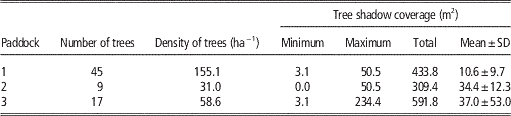
Five tree species were recorded in the ISS paddocks. The dominant species were Brosimum alicastrum and L. leucocephala. Tree density varied from 31 to 155 trees/ha (Table 1), and the tree shadow coverage fluctuated between 309 and 592 m2. The spatial distribution of trees was not homogeneous as they were concentrated in the peripheral area of the paddock, in many cases forming part of live fences.
Characterization of tree coverage in intensive silvopastoral system

Animal behaviour
The mean distance of each cow with respect to the centroid of the group was shorter in the ISS than in the MS (mean±SD: 5.8±5.35 and 7.87±5.03; t=1.9657, DF=414, P<0.01). The affiliative behaviour most frequently emitted was social licking, expressed in 47% and 78% of the affiliative interactions in the MS and ISS, respectively, and followed by social rubbing and head leaning. Head butting was the most frequently emitted agonistic behaviour, comprising 88% and 94% of the agonistic interactions in MS and ISS, respectively. Aggression induced withdrawal in 95% of interactions in both systems.
The differences between systems were significant on the frequency of affiliative interactions (Mann–Whitney test: W=74.5, P=0.04). Heifers in the MS (3 [2; 4.25]) interacted 40% less than heifers in the ISS (5 [3.75; 6.25]). There were non-significant differences in the agonistic interactions between systems (W=98.5, P=0.28; MS=9 [4.75; 17.5]; ISS=15 [6; 20.75]).
Dominance hierarchy attributes
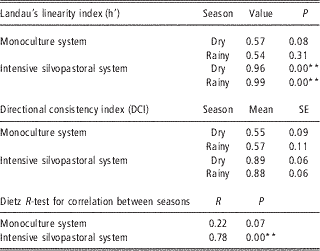
In the MS, dominance hierarchies were not significantly linear in either season, but in the dry season a tendency for linearity was detected (P=0.08); in the ISS, Landau’s linearity index (h’) was higher and significant in both dry and rainy seasons (Table 2). Furthermore, the DCI in both seasons was elevated in the ISS and low in the MS (Table 2). The correlation between the two seasons was low and non-significant in the MS, but high and significant in the ISS (Table 2).
Dominance hierarchy attributes estimated for the two systems

**P≤0.01.
Discussion
ISS are not widely developed. There are still very few cattle ranches in the Yucatan peninsula, and in general in Latin American countries, that have implemented this system. As a consequence, it was impossible to use repetitions in this study. We acknowledge that without proper repetitions the power to draw strong and generalizable conclusions is limited, and we also recognize that some of the differences between herds could reflect intrinsic factors of the groups and individuals, such as genetic background, conditions during development and early social interactions with other cows. In spite of this, our results provide useful information on how social behaviour of cattle in ISS can differ from that in a MS. Moreover, due to the fact that these systems can offer advantages for increasing biodiversity, improving animal welfare and allowing a profitable farming business where many other production systems are not, there is an increasing interest in generating scientific information to support developing them. Hence, we believe this study is a small contribution to further work in a more scientifically stringent manner.
Frequencies of all social behaviours were lower than reported in most studies of cattle’s social behaviour in enclosure conditions (Sato, Reference Sato1984; Sato et al., Reference Sato, Sako and Maeda1991; Val-Laillet et al., Reference van Hooff and Wensing2009), similar to the findings of Krohn (Reference Krohn1994). In grazing systems, the frequency of social interactions is usually lower than enclosure conditions, this difference is attributed to greater space allowance. However, due to the particular conditions in our observational schedule (from 0730 to 1530 h) several social interactions could have been missed while the cows were kept in the pens during the evening and night.
It has been reported that as forage conditions improve, herd dispersion decreases (Dudziński et al., Reference Dietz1982). Our results are consistent with this statement; heifers in the ISS had higher forage availability and were less disperse than heifers in the MS. In the present study, social licking was the most frequent affiliative behaviour in both systems. As we expected, affiliative interactions were more frequent in the ISS than in the MS. Social licking may be performed after high priority needs, such as food and shelter seeking, are met (Sato et al., Reference Sato, Sako and Maeda1991), and has been shown to occur more frequently after eating (Krohn, Reference Krohn1994) or delivery of fresh forage (Val-Laillet et al., Reference van Hooff and Wensing2009). In our subjects, differences in frequency of affiliative behaviours between MS and ISS could be due to higher daily forage allowance and more shade availability in ISS. In cattle, short-term benefits of social licking have been demonstrated; for example, maternal licking removes ticks from calves, therefore social licking may have hygienic functions (Rich, Reference Rich1973). Social licking reduces the heart rate of the recipient, which is associated to positive affective states (Laister et al., Reference Laister, Stockinger, Regner, Zenger, Knierim and Winckler2011). Hence, we infer that heifers in the ISS may have experienced more gratifying short-term outcomes from affiliative interactions than heifers in the MS. Unfortunately, we were not able to measure any health or physiological variables that could have been affected by the expression of affiliative behaviours.
The frequency of agonistic interactions in both systems was lower than reported for intensive systems (Krohn, Reference Krohn1994; Val-Laillet et al., Reference van Hooff and Wensing2009); probably because grazing conditions elicit scramble competition, whereas grass delivered in feeders elicit interference competition. Active defence of scattered resources may not be profitable (Preuschoft and van Schaik, Reference Preuschoft and van Schaik2000). Head butting, a low-intensity aggression that involves little risk of injuries or energy expenditure (Reinhardt et al., Reference Reinhardt, Reinhardt and Reinhardt1986; Krohn, Reference Krohn1994) was the most frequent agonistic behaviour in both systems. Although we expected less agonistic interactions in the ISS, the lack of differences between systems might have occurred due to competition for shadow in the ISS. In the ISS, almost 50% of agonistic interactions occurred under the shade; cattle is highly motivated to seek shade, and competition for shaded areas has been reported in other warm and humid climates (Schütz et al., Reference Schütz, Rogers, Poulouin, Cox and Tucker2010).
Dominance hierarchies in cattle have been reported as linear or triadic and stable (Schein and Fohrman, Reference Schein and Fohrman1955; Beilharz and Zeeb, Reference Beilharz and Zeeb1982), and maintained by displays, head butting and avoidance (Hafez and Bouissou, Reference García1975; Reinhardt et al., Reference Reinhardt, Reinhardt and Reinhardt1986; Krohn, Reference Krohn1994). In the ISS, dominance hierarchies were strongly linear and stable between seasons and the direction of dominance within each dyad was highly asymmetrical. In contrast, in the MS there was less evidence of linearity or stability, with a low degree of asymmetry in the direction of dominance within each dyad. Dominance relationships in cattle can break down when feeder space is restricted (Val-Laillet et al., Reference van Hooff and Wensing2009), possibly because competition increases, and aggression can increase with stocking density and frequent regrouping (Kondo et al., Reference Kondo, Sekine, Okubo and Asahida1989; Bouissou et al., Reference Bouissou, Boissy, Le Neindre and Veissier2001). In the ISS, heifers had access to shaded areas and higher forage availability, and experienced lower temperature and humidity (THI index), but we cannot determine which of these factors affected their dominance relationships. However, differences between systems in the linearity and stability of dominance hierarchies, and in the direction of dominance within each dyad could be a result of differences in affiliative behaviour, which was higher in the ISS. Social licking contributes to the stability of dominance relationships in cattle (Sato et al., Reference Sato, Tarumizu and Hatae1993), and tends to diminish escalated conflict and fighting (Reinhardt et al., Reference Reinhardt, Reinhardt and Reinhardt1986), and affiliative behaviour is important in the maintenance of relationships in long-standing cattle herds, particularly in environments with low competition for space (Krohn, Reference Krohn1994). Consequently, higher frequencies of affiliative behaviour might have helped induce stable and linear dominance hierarchies, and lowered the mean distance between group members in the ISS.
Conclusions
Although further research is needed in order to confirm the results, our study provided information indicating that ISS offer environmental conditions that can influence the social behaviours of cattle and relate to better welfare than MS. The ISS favoured social stability of the herd and the expression of sociopositive behaviours. Sociopositive behaviours are known to reflect positive affective states and environments that encourage expression of these behaviours promote animal welfare.
Acknowledgements
The project was funded by the Prosperity Fund, Foreign Commonwealth Office (FCU-UK), through the British Embassy in Mexico, and the programme PAPIIT-UNAM. The authors thank Dr Hugh Drummond for helpful comments and proofreading of the manuscript.