Introduction
Jāmiᶜ al-Tawārikh (“Compendium of Chronicles”) is a multi-volume universal history composed in the first decade of the fourteenth century by Rashid al-Din Fadl-Allāh (d. 1318), at the request of the Ilkhanid rulers Ghāzān Khān (r. 1295‒1304) and Uljāytu (r. 1304‒17). This work, which is considered to be the “first world history,”Footnote 1 consists of a history from the time of creation up to the date of its composition. This chronicle was divided into three volumes of unequal length, the last of which is not known to be extant. The first volume is devoted to Mongol history; and the second volume was divided into two parts, of which the first part on the history of Uljāytu is now missing. The second part of the second volume contains a history of the prophets and the pre-Islamic rulers of Persia, Islamic history up to extinction of the ᶜAbbasid dynasty, a history of Islamic Persian dynasties and a history of the non-Mongol peoples of Eurasia including Ughuz Turks, Chinese, Jews, Franks and Indians.Footnote 2
Rashid al-Din established an enormous multi-functional complex in the northeastern part of Tabriz, which was called Rabᶜ-i Rashidi (“Rashid’s Quarter”).Footnote 3 One of the main purposes of this complex was the transcription of Rashid al-Din’s own works. According to the endowment deed of the Rabᶜ-i Rashidi, two copies of the Jāmiᶜ al-Tawārikh, one in Persian and the other in Arabic, were to be transcribed yearly.Footnote 4 It is said that three copies of the Jāmiᶜ al-Tawārikh produced at the Rabᶜ-i Rashidi survive.Footnote 5 All these manuscripts belong to the second part of the second volume. The first is an Arabic version consisting of two fragments of one manuscript kept in the Edinburgh University Library and the Khalili collection.Footnote 6 Two others, which are written in Persian, are housed in the Topkapı Palace Library with the inventory numbers of Hazine 1653 and Hazine 1654. The Arabic codex and Hazine 1653 are dated 1314; and Hazine 1654 was transcribed three years later.Footnote 7
The present paper, which aims to discuss Hazine 1654, is a result of the examination of the original manuscript at the Topkapı Palace Library. The complicated history of this illustrated book can be reconstructed by the physical traces of its transfer from one owner to another.Footnote 8 It includes artistic additions in such workshops as Rashidiya, Jalayirid, Timurid, several Safavid libraries and Ottoman Istanbul. Moreover, the manuscript is jumbled: the locations of several folios have been replaced; at least twenty-five leaves are missing; and twenty-seven folios of the current manuscript were added in the Timurid period.
Considering the text not the illustrations, Hazine 1654 is the most complete surviving copy of the Jāmiᶜ al-Tawārikh produced at Rashid al-Din’s scriptorium. In its current state, the book consists of 350 folios, 323 of which are productions of the Rabᶜ-i Rashidi.Footnote 9
Although this codex has already been mentioned in several general publications on Persian painting, no comprehensive research has been done on it. The basic publications on this manuscript are those by Güner Inal.Footnote 10 Nearly all other discussions are based on her observations.Footnote 11 In 1963, Inal attributed all the later paintings in Hazine 1654 to the court of Shāhrukh and classified them in three different styles: “the Mongol style,” “the Shāhrukh style” and “the Timurid style.”Footnote 12 In 1992, she offered another classification of “approximately four different styles.”Footnote 13 A different view is offered by Basil Gray, who believes that most of the miniatures must have been painted about 1390.Footnote 14 Sheila Blair and Raya Shani have discussed that since the manuscript bears the seal of the Safavid ruler Safi II and a dedication to the shrine of Shaykh Safi al-Din, it may have remained in Tabriz until the seventeenth century, so that one should rather look for stylistic parallels in this region.Footnote 15 In this paper, I will explain the story of the migrations of the book and artistic additions to it in different periods.
The Complicated Life History of the Book
The content of Hazine 1654 is as follows: pre-Islamic history (fols. 1b‒51b), early Islamic history (fols. 51b‒109a), Umayyads (fols. 109a‒128b), ᶜAbbasids (fols. 128b‒168a), Ghaznavids (fols. 168b‒198a), Saljuqs (fols. 198b‒224b), Khwarazmshahs (fols. 225a‒236b), Ughuz Turks (fols. 237b‒250b), Chinese (fols. 251b‒271b), Children of Israel (fols. 272b‒294b), Franks (fols. 295b‒328a) and Indians (fols. 328b‒350a).Footnote 16
One significant matter that should be noted is the omission of the subsections on the histories of Salghurids, Fatimids and Ismaᶜilis in Hazine 1654. Compared with Hazine 1653, these two subchapters must have been located consecutively between the histories of Khwarazmshahs and Ughuz Turks.Footnote 17 It seems that these subsections in Hazine 1654 were not originally absent, because approximately one page of the text concerning the end of the history of Khwarazmshahs is also missing.Footnote 18 Therefore, it seems plausible to assume that the last leaf of the section on Khwarazmshahs and the next three subchapters were dropped.
According to its colophon on folio 350a, Hazine 1654 was finished on 3 Jumada I 717/14 July 1317.Footnote 19 It reads:
The transcription of the book of Jāmiᶜ al-Tawārikh was finished with God’s succor. Blessing be upon its owner; and may it benefit all Muslims. The completion of the writing was happened with God’s help in the third of the month Jumada I of the year 717. May God forgive the scribe and all Muslims.Footnote 20
The manuscript does not bear any other direct indication of the names of the artists and artisans, the original patron and the place of transcription. Since the manuscript was copied only a year before Rashid al-Din’s execution on 18 Jumada I 718/18 July 1318,it might well have been left unfinished when the Rabᶜ-i Rashidi was plundered. For this reason, as will be discussed later, approximately seven illustrations were added at the beginning—three of which survive—and other locations left for paintings remained blank.
Within the text, there are some current dates: a date of 700/1300‒1301 appears on folio 1b,Footnote 21 and the dates of 704 and 705 can be found on folios 252bFootnote 22 and 328a,Footnote 23 which are the years of composition of those parts of the text by Rashid al-Din rather than the date of transcription. Each leaf of the book measures 557 × 328 mm. The written surface of 342 × 244 mm carries the text in thirty-one lines of naskh script. According to a later added note at the end of the colophon, the manuscript once had 375 folios.Footnote 24 Careful scrutiny of the manuscript showed that the missing folios belong to different chapters of the book, and thus there are lacunae in the manuscript’s text.Footnote 25
When I examined the manuscript carefully, it became clear that nearly all spaces which had initially been left empty for narrative paintings were illustrated later, in the last decades of the fourteenth century. These clumsily executed miniatures were worked by a non-skilled artist. Basil Gray was the first scholar who attributed a group of the paintings of the manuscript to about 1390, and somewhere during the reign of Sultan Ahmad Jalāyir (r. 1382–1410).Footnote 26 A comparison between these miniatures and the Jalayirid paintings of the 1390s confirms his hypothesis. For example, the elongated human figures in a group of the paintings of Hazine 1654 have become like decorative puppets, which resemble the illustrations to Nasrullāh Munshi’s Kalila va Dimna copied at Baghdad in 794/1392, now in the Bibliothèque Nationale (Sup. Pers. 913).Footnote 27 The paintings of the latter manuscript, especially those depicting interior scenes, show close similarities in coloration, architectural decorations, garments, carpets and thrones.Footnote 28
Possibly the book was transferred to Herat in one of the three campaigns of the Timurid ruler Shāhrukh (r. 1405–47) to Azerbaijan.Footnote 29 It should be noted that the Arabic copy and Hazine 1653 were also in Shāhrukh’s possession, for they contain his library seals.Footnote 30 Although Hazine 1654 carries no clear evidence from the royal workshop of Shāhrukh, stylistic analysis of a group of its illustrations proves that it was refurbished under his patronage. As will be discussed later, a group of the paintings of the manuscript is modeled after the illustrations to the Arabic copy of the Jāmiᶜ al-Tawārikh.Footnote 31 This suggests that their painter had undoubtedly seen the Arabic codex, which was in the same library. Moreover, several depictions of the Chinese emperors and their attendants in Hazine 1654 are duplication of the images existing in Hazine 1653 and the dispersed manuscript.Footnote 32 The latter manuscript, which is a copy of Hazine 1653, was produced for Shāhrukh and contains the first volume of Hāfiz-i Abru’s Majmaᶜ al-Tawārikh and a section from the second volume of the Jāmiᶜ al-Tawārikh.Footnote 33
By the beginning of the fifteenth century, several folios in different chapters of Hazine 1654 must have been missing. The royal library of Shāhrukh completed the missing parts by inserting new papers including the current folios 1‒4, 22‒39, and 344‒48. These twenty-seven leaves are written in a naskh very similar to the calligraphy of the Rashidi folios. However, the use of nastaᶜliq script in some of the captions of these folios proves that these papers do not belong to Rashid al-Din’s scriptorium, because this script was invented at the end of the fourteenth century.Footnote 34 These papers are similar to the brownish Herati papers utilized in Hazine 1653 and the dispersed manuscript. While two different types of calligraphy can be discerned in the Rashidi folios,Footnote 35 the Shāhrukhi leaves have been written by a calligrapher of uniform hand.
The first four leaves of the manuscript, which are unillustrated, are productions of Shāhrukh’s kitābkhāna (i.e. royal library cum artists’ workshop). The only surviving Rashidi paintings of the manuscript are three illustrations on two sides of the fifth folio: “Enthronement of Jamshid,” “Zahhāk enthroned” and “Abraham in the fire.” These three episodes are also illustrated in the Arabic copy of the Jāmiᶜ al-Tawārikh.Footnote 36 Although some leaves at the beginning of the Arabic codex are missing, it includes four paintings before the “Enthronement of Jamshid.”Footnote 37 Since there are many overlaps in illustrated episodes of different copies of the Jāmiᶜ al-Tawārikh produced at Rashid al-Din’s scriptorium, it can be estimated that Hazine 1654 originally had at least seven Rashidi paintings.
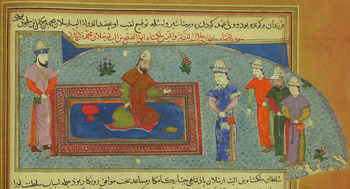
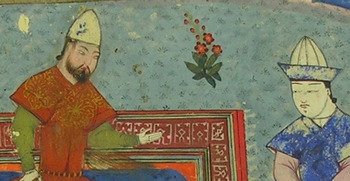
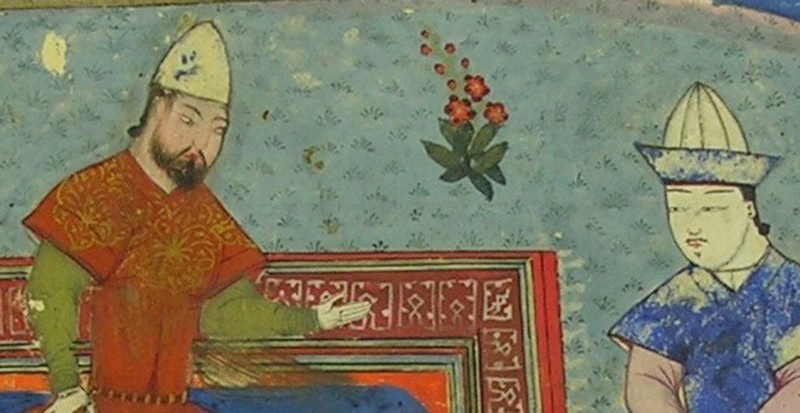
In the process of completion of the manuscript, Shāhrukh’s kitābkhāna decided to improve the quality of some of its illustrations. As a result, several paintings were partly restored, mostly the faces of important personages and the decorative motifs on their garments. In the painting depicting the Saljuq Sultan Malikshāh, for example, the faces of the sultan and one of the courtiers on the far right have been overpainted (Figures 1 and 2). It should be mentioned that the figure of Abraham on folio 5b, which originally had been painted in Rashid al-Din’s scriptorium, was also restored.
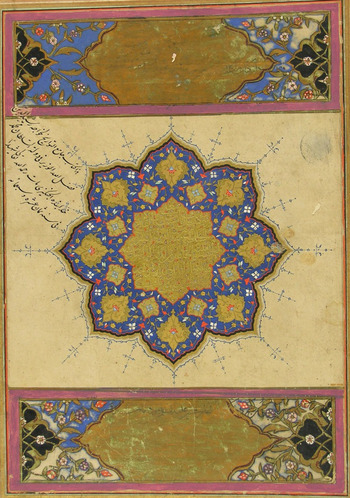
Detail of folio 1a from a copy of the Jāmiᶜ al-Tawārikh, opaque watercolor, ink and gold on paper, Tabriz, 1317. Topkapı Sarayı Library (Hazine 1654), photo by courtesy of the Topkapı Sarayı Library.

Detail of Figure 4.
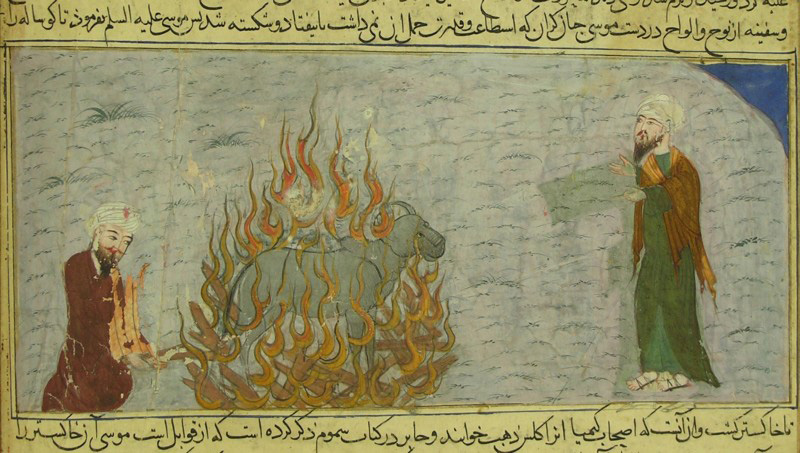
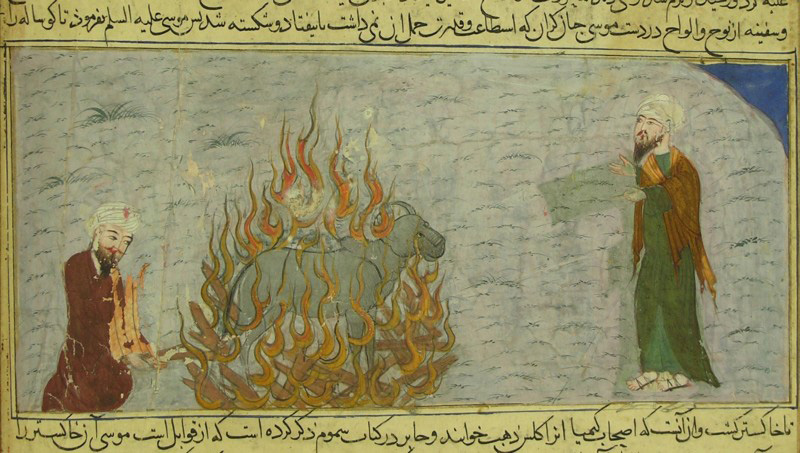
The more advanced phase of enhancing the quality of the manuscript is the overpainting of several fourteenth-century miniatures with new illustrations. This group of Shāhrukhi paintings has covered earlier miniatures completely (see Table A1, the table of illustrations, group IV). The traces of fourteenth-century miniatures beneath some of the illustrations in this group are clearly visible. For instance, in the illustration of “Moses orders to burn the golden calf,” the Jalayirid depictions of the figures of Moses and Aaron can be seen beneath the Timurid painting (Figure 3). The paintings in this group can be found in two blocks of text: first, the section on early Islamic history, and second, most of the miniatures on the last 120 leaves of the manuscript including the sections on Khwarazmshahs, Ughuz Turks, Jews and Indians. The fact that the paintings of some chapters have been covered completely perhaps shows the importance of these sections for Shāhrukh’s kitābkhāna, or maybe the paintings were in poor condition.
Detail of Figure 4.
The last group of Shāhrukhi images includes nine miniatures that were executed on fifteenth-century leaves added in Shāhrukh’s workshop. Compared with other paintings in the manuscript, the illustrations of this group have greater height (see Table A1, the table of illustrations, nos. 18‒26). Moreover, all these nine paintings are modeled after the illustrations to the Edinburgh fragment of the Arabic codex.Footnote 38
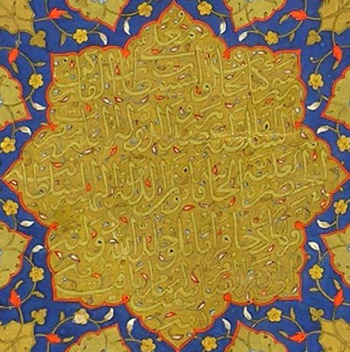
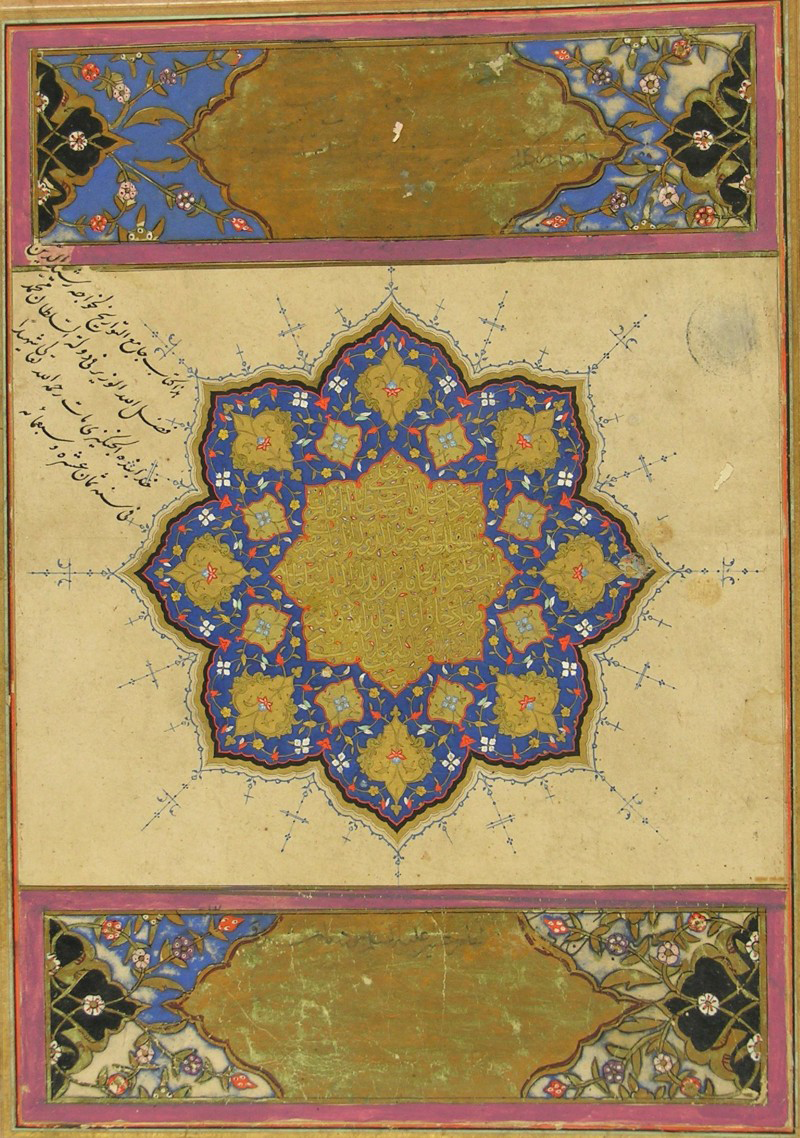
The initial star-shaped shamsa on folio 1a containing the dedicatory inscription of Farhād Khān Qarāmānlu (d. 1598) indicates that the manuscript was refurbished again in the Safavid period (Figures 4 and 5).Footnote 39 Farhād Khān was a great Qizilbāsh Amir of Shāh ᶜAbbās I (r. 1588‒1629), who was installed as governor of Fars in 1003/1594‒95, of Shiraz in 1004/1595‒96, and of Astarabad and Mazandaran in 1007/1598‒99.Footnote 40 In 1598, Farhād Khān fell out of favor with Shāh ᶜAbbās I, he was murdered and his properties were confiscated.Footnote 41
“Enthronement of Malikshāh ibn Alb Arsalān,” detail of folio 204b from a copy of the Jāmiᶜ al-Tawārikh, opaque watercolor, ink and gold on paper, Tabriz, 1317. Topkapı Sarayı Library (Hazine 1654), photo courtesy of the Topkapı Sarayı Library.
Detail of Figure 1.

Under the patronage of Farhād Khān, the book was re-margined with thick pinkish papers and eight illuminated ᶜunvāns were added to it.Footnote 42 Re-margination of the manuscript resulted in enlargement of the book’s size and the loss of original catchwords. At the time of re-margination, instead of adding new catchwords as in Hazine 1653, the versos of all the leaves were paginated. The page numbers were added in the lower left corner of the written surface. The person who paginated was mistaken in two cases. The first leaf on Ghaznavid history is numbered 169 instead of 168, and thus the page numbers towards the end of the book are erroneous. The same mistake occurs on the first leaf on Indian history (folio 328b), which is numbered 330 instead of 329.
Very similar to Hazine 1653, the borders of the written surface are ruled in eleven narrow lines of different thickness and such colors as brown, orange, black, blue, gold and white. The lines of the borders mask the transition from the original leaf to the marginal papers. In folio 205b, the original Ilkhanid jadval is visible: two inner red lines and an outer blue.
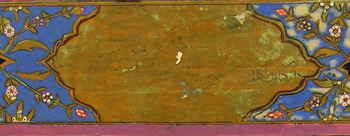
Above and below the initial shamsa are two illuminated friezes that resemble the Ottoman illuminations of the seventeenth century. They were added in order to cover some Safivid notes (Figure 4). I was able to read these notes in part. The inscription in the lower frieze, which is written in one line, is a panegyric to Imam Husayn.Footnote 43In the upper frieze, there is an important note written in at least three lines (Figure 6). A part of the central line reads, “waqf nimud in kitāb rā kalb-i āstān-i ᶜAli …” (the book was donated by the dog of the threshold of [Imam] ᶜAli). Kalb-i āstān-i ᶜAli was the well-known appellation of Shāh ᶜAbbās I.Footnote 44
“Moses orders to burn the golden calf,” detail of folio 283b from a copy of the Jāmiᶜ al-Tawārikh, opaque watercolor, ink and gold on paper, Tabriz, 1317. Topkapı Sarayı Library (Hazine 1654), photo courtesy of the Topkapı Sarayı Library.

Thirty pages of the book contain thirty-five waqf seals of the shrine of Shaykh Safi in Ardabil.Footnote 45 All seals were gilded over, but some of them remain legible. They are dated 1017/1608‒9 and read “waqf āstāna-yi mutabarraka-yi safiyya-yi safaviyya.”Footnote 46 Therefore, it becomes clear that Shāh ᶜAbbās included the manuscript in his own donations of 1607‒8 to the shrine of Shaykh Safi.Footnote 47
Above the shamsa, there is an Arabic inscription in nastaᶜliq indicating that the book is Rashid al-Din’s Jāmiᶜ al-Tawārikh.Footnote 48 Perhaps the book was transferred to Istanbul during the reign of ᶜOsman II (r. 1618‒22) because in that time, the Ottoman army conquered Ardabil and looted all its treasures.Footnote 49
In the Ottoman Istanbul, one of the Shāhrukhi paintings of the manuscript (“Sultan Sanjar Enthroned,” fol. 209b) was partly overpainted and the costumes of the personages were changed to resemble the Ottoman garments. The golden seal of Sultan Abdülhamid II (r. 1876‒1909) and the inscription “Zu-l-Vajhayn-i Kütübhane-i Humayuni” on the red binding indicate that the manuscript was bound at the Yıldız Palace in Istanbul. However, an impression of the original Safavid binding flap is visible on folio 129a.
The Illustrations, with Reference to the Table
One hundred seventeen pages are illustrated with 125 narrative illustrations. This means that eight pages contain two paintings.Footnote 50 Twenty-three pages comprise depictions of 108 figures of Chinese emperors and their attendants, starting from folio 254b and continuing to folio 271a. In fifty-five pages (from fol. 301a to fol. 328a), more than three hundred depictions of the Frankish popes and kings can be found.Footnote 51 That Hazine 1654 had more paintings is confirmed by pigment offset on the middle of folio 345a.Footnote 52 The illustration should have portrayed a scene from the life of Buddha. Unlike the earlier paintings in the Arabic copy of the Jāmiᶜ al-Tawārikh, all miniatures in Hazine 1654 are rectangles that stretch across the text. The only exception is the small painting “The encounter of Jacob and his family with Joseph and the grandees of Egypt,” which is placed at the lower left corner of the written area of folio 9a.
It is here proposed, pending further scientific analysis, that the paintings in Hazine 1654 can be classified according to six major groups, as follows:

With the exception of ten paintings (nos. 18‒26 and 94 in the table of illustrations), the location of all the narrative paintings and portraits were designated in Rashid al-Din’s scriptorium. There are considerable overlaps in illustrated episodes of the Jāmiᶜ al-Tawārikh manuscripts transcribed at the Rabᶜ-i Rashidi. A comparison between these manuscripts will reveal how similar these three codices are. In the Arabic and both Persian versions, the illustrations are not distributed uniformly through the text. The scribes of these codices left long blocks of approximately ninety folios on the end of the life of the Prophet, the Umayyad and ᶜAbbasid caliphates totally without painting.Footnote 53 By contrast, some sections like the pre-Islamic history, the Ghaznavids and the Saljuqs are richly illustrated with a painting every leaf or two.
In Hazine 1654, the pre-Islamic history (fols. 1b‒51b) contains twenty-eight paintings in fifty-one folios. Compared with the Edinburgh fragment of the Arabic codex, it seems that originally this section would have had more paintings. This is because, as mentioned before, the first four folios of Hazine 1654, which were substituted by Shāhrukh’s workshop, are unillustrated, while the same part of the text in the Arabic codex contains four miniatures. Moreover, it seems that, like the Arabic manuscript, in Hazine 1654 the story of the prophet Jeremiah was designated for illustration.Footnote 54 On folio 21b, the scribe wrote the last four lines of the text on Jeremiah in a v-shape, similar to the arrangement of colophons. This was a tradition in all surviving Rashidi manuscripts in order to place the illustration at the top of the succeeding folio.Footnote 55 However, folio 22 (the location of the painting) is one of the substituted leaves.
The early Islamic history (fols. 51b‒109a) is illustrated with twelve paintings on thirty-two leaves. Most folios of the same section in Hazine 1653 were replaced in Shāhrukh’s kitābkhāna. Thus, it is worthwhile to look at the Arabic version. Nearly all the illustrated episodes in this section in Hazine 1654 were also depicted in the Arabic codex.Footnote 56 Two paintings of the latter manuscript served as models for the depictions of the same episodes in Hazine 1654 (nos. 31 and 33).
Like the Arabic manuscript and Hazine 1653, the chapter in Hazine 1654 that deals with the post-caliphate dynasties of Iran is heavily illustrated, with an average of one image on every other leaf.Footnote 57 The subsections on the Ghaznavids (fols. 168b‒198a) with twenty-two paintings and the Saljuqs (fols. 198b‒224b) with sixteen miniatures were illustrated by the Jalayirids. While most of the illustrations to the Ghaznavids remain intact, the majority of the images of the Saljuqs were partly restored by the Shāhrukhi artists. The subsection on the Khwarazmshahs (fols. 225a‒236b) encompasses five paintings. All these five episodes are also illustrated in Hazine 1653.
Next comes the history of the Ughuz Turks (fols. 237b‒250b), with ten miniatures. In comparison, this subchapter in Hazine 1653 has more paintings. The scribe who copied Hazine 1653 left thirteen places for paintings.Footnote 58 The significance of this subchapter for Shāhrukh’s kitābkhāna is evident from the fact that all these images in Hazine 1654 were overpainted. As I have shown elsewhere, in the dispersed manuscript of the Majmaᶜ al-Tawārikh, which was produced for Shāhrukh, the subchapters on the Ughuz Turks and Chinese maintained their high rates of illustration, while the other subsections on the history of other nations have low rates of painting. This is not surprising for Shāhrukh, who maintained his Chaghatayid identity; and, on the other hand, he established a good relationship with the Chinese empire.Footnote 59
The subchapter on the Chinese in Hazine 1654 (fols. 251b‒271b) is comparable with Hazine 1653. In both manuscripts, the texts were copied at the Rabᶜ-i Rashidi and the depictions were executed in Shāhrukh’s workshop. The portraits of the Chinese emperors and their attendants in both manuscripts are identical, so that one should rather consider them to be the work of the same artist. It should be emphasized that all these Timurid depictions of the Chinese people emulate the portraits existing in the Arabic manuscript.
The subchapter on the Jews (fols. 272b‒294b) contains eight paintings, six of which have covered fourteenth-century miniatures. This subsection in Hazine 1653 was omitted by the Timurid historian Hāfiz-i Abru (d. 1430), but the same part of the text in the Arabic manuscript can be used for comparison. Not only do they both have approximately forty-five pages and eight paintings, but the episodes depicted are almost the same in each.Footnote 60
The importance of the subsection on Franks in Hazine 1654 (fols. 295b‒328a) is that it is the only surviving part of the text transcribed at the Rabᶜ-i Rashidi. The Frankish history in the Arabic copy has not been preserved, and in Hazine 1653 (fols. 411a‒421b) has been written in Shāhrukh’s kitābkhāna. The long illustrated table of Frankish history, which is fifty-five pages, starts from folio 301a.Footnote 61 The table consists of four columns titled: “history of the kings,” “the names and the portraits (suvar) of the kings,” “the names and the portraits of the popes” and “the history of the popes” respectively from right to left. Thus, the two central columns bear depictions and the names of the personages written in red. Each page consists of four rows, which chronologically record a brief history of the rulers and their contemporary popes. It starts with the lives of Jesus Christ and Augustus Caesar (d. 19 August 14), the founder of the Roman empire, and ends with the histories of Pope Benedict XI (d. 1304) and Adelbertus, the contemporary monarch.
As mentioned before, all these depictions were added in Shāhrukh’s workshop. All the popes as well as Jesus wear Mongol hats and nearly all are seated on a rectangular red couch. Therefore, they appear to be Chinese rather than Europeans. All the rulers wear tri-lobed golden crowns, and most of them are seated on the ground. These depictions are very repetitive, thus giving the impression of a rote arrangement. It seems that they have been added to the manuscript simply to fill the blank spaces. The use of diagrammatic forms follows the traditions common in European illustrated chronicles. For example, a copy of Chronologia Magna by Paolino Veneto, which was copied after 1323, shows a similar diagrammatic and synoptical arrangement of vertical columns and horizontal rows.Footnote 62 It contains tables of rulers, writers and events, including many portraits throughout.
The subsection on Indian history consists of twenty-two leaves (fols. 328b‒350a), five of which (fols. 344a‒348b) were transcribed in Shāhrukh’s kitābkhāna. According to the old pagination, ten Shāhrukhi leaves are missing. The seventeen Rashidi folios that deal with Indian history are heavily illustrated with twenty-three paintings. In comparison, the same subchapter in the Arabic manuscript has a lower rate of illustration. It contains only nine paintings on twenty-two folios. Like Hazine 1653 and the Arabic codex, some paintings in this subsection are purely landscapes (fols. 330b, 331a, 331b, 332a and 334a) or landscapes with animals (fols. 245b and 333a), and two miniatures on folios 333b and 335a depict only architecture.
Conclusion
Comparison of the three surviving copies of the Jāmiᶜ al-Tawārikh transcribed at the Rabᶜ-i Rashidi reveals that there are many overlaps in the illustrated episodes. This shows the standard procedure of the production of the Jāmiᶜ al-Tawārikh manuscripts in the scriptorium. All three codices remain unfinished: the Arabic codex contains some unfinished illumination,Footnote 63 and, as Sheila Blair states, its painters were under some pressure, as the illustrations towards the end of the book become more simplified;Footnote 64 most likely the paintings in Hazine 1653 were added from the beginning of the book to the middle of the subsection on Ughuz Turks (fol. 378b); and in Hazine 1654 approximately seven illustrations were inserted at the beginning of the book.
Considering the text, Hazine 1654 is the most complete surviving copy of the Jāmiᶜ al-Tawārikh produced at the Rabᶜ-i Rashidi. Some parts of the long chapter on the history of other nations only survive in this manuscript. Therefore, that would be of great importance in reconstructing fragmentary manuscripts transcribed in the same scriptorium. For example, comparison of the Topkapı manuscripts with the Arabic codex shows that the subsection on the Jews was not originally the last subchapter of the Arabic manuscript.Footnote 65 In addition, the special layout of the subchapter on Frankish history shows how the Rashidi scribes followed Western sources for the design of this part of the text.
Stylistic analysis of a group of the paintings in Hazine 1654 and its comparison with other historical manuscripts produced for Shāhrukh reveals that it was refurbished under his patronage. This is not surprising, for he had collected and completed several fourteenth-century fragmentary codices of Rashid al-Din’s enterprise,Footnote 66 and some copies of the text were produced at his own order.Footnote 67 These historical manuscripts served as a device to justify Shāhrukh’s rule in history and to connect him with the previous Ilkhanid sultanates in Iran.
Appendix