Monolingual reading research has shown that morphological awareness is a significant independent contributor to development of literacy skills in morphophonemic English (e.g., Carlisle, Reference Carlisle2000; Deacon & Kirby, Reference Deacon and Kirby2004; Nagy, Berninger, & Abbott, Reference Nagy, Berninger and Abbott2006) as well as logographic Chinese (e.g., Chen, Hao, Geva, Zhu, & Shu, Reference Chen, Hao, Geva, Zhu and Shu2009; Ku & Anderson, Reference Ku and Anderson2003). Recently, studies of bilingual children's literacy acquisition have also revealed that morphological awareness can be transferred from one language to facilitate the development of reading ability in another language (e.g., Deacon, Wade-Woolley, & Kirby, 2008; Pasqurella, Chen, Lam, Luo, & Ramirez, Reference Pasquarella, Chen, Lam and Luo2011; Ramirez, Chen, Geva, & Kiefer, Reference Ramirez, Chen, Geva and Kiefer2010; Wang, Yang, & Cheng, Reference Wang, Yang and Cheng2009).
Because there are cross-linguistic similarities as well as variations in morphological structure across languages, presumably, transfer of morphological awareness in biliteracy acquisition should be governed by the typological distance between the two languages of children, as suggested in Koda's (Reference Koda and Cook2005, Reference Koda, Koda and Zehler2008) transfer facilitation model. However, previous studies on transfer of morphological awareness have not adequately addressed this issue, largely because their morphological awareness measures in most cases only dealt with one structure shared by first language (L1) and second language (L2), such as inflectional morphology in French and English (Deacon et al., Reference Deacon, Wade-Woolley and Kirby2007) and compounding in Chinese and English (Wang et al., Reference Wang, Yang and Cheng2009). A better understanding of a linguistic distance effect on transfer of morphological awareness necessitates a concurrent investigation of more than one morphological structure in both L1 and L2, which was the objective of this study. Specifically, we aimed to examine how L1–L2 distance influences the facilitation effect of L1 morphological awareness transfer on L2 word learning, or lexical inference ability, by focusing on young Chinese-speaking readers of English as a foreign language (EFL).
MORPHOLOGICAL AWARENESS AND VOCABULARY ACQUISITION
Morphological awareness pertains to “the ability to reflect upon and manipulate morphemes and employ word formation rules in one's language” (Kuo & Anderson, Reference Kuo and Anderson2006, p. 161). Carlisle (Reference Carlisle2000) argued that morphological awareness “must have as its basis the ability to parse words and analyze constituent morphemes for the purpose of constructing meaning” (p. 170). As such, morphological awareness contributes to word reading by facilitating segmentation of morphologically complex words and the retrieval and retention of these words; more importantly, it is also a basic competence for word learning in that meanings of unfamiliar words can be inferred by use of morphological analysis. Many studies have revealed that morphological awareness is a significant contributor to word learning and vocabulary growth (e.g., Carlisle, Reference Carlisle2000; McBride-Chang et al., Reference McBride-Chang, Tardif, Cho, Shu, Fletcher and Stokers2008; McBride-Chang, Wagner, Muse, Chow, & Shu, Reference McBride-Chang, Wagner, Muse, Chow and Shu2005).
The conducive role of morphological awareness in vocabulary acquisition is no surprise given that the majority of words monolingual children encounter in print school materials are complex words that are morphologically transparent and children can use their morphological knowledge to derive the meanings of these words (Nagy & Anderson, Reference Nagy and Anderson1984). The competence of “morphological problem solving” (Anglin, Reference Anglin1993, p. 5) is thus essential to children's word acquisition in school.
Experimental studies have shown that skilled use of morphological information often leads to better inference and memory of word meanings. Wysocki and Jenkins (Reference Wysocki and Jenkins1987) reported that children performed better on transfer words that were derivationally related to the infrequent words they were previously taught than on control words for which they had not received any prior training. In Bowers and Kirby (Reference Bowers and Kirby2010), children who received “structured word inquiry” program, which highlighted morphological analysis as one core component, were more successful than those who had not participated in the program with regard to their use of base word knowledge to infer meanings of unknown derivational words, or their “morphological vocabulary.” Bauman, Edwards, Boland, Olejnik, and Kame'enui (Reference Baumann, Edwards, Boland, Olejnik and Keme'enui2003) reported that children who were explicitly taught derivational affixes and were encouraged to draw upon the various morphological clues (affixes and roots) better unlocked meanings of unfamiliar complex words than did counterparts who received instruction on content-central vocabulary from the textbooks with such strategies as textbook and dictionary definitions, predict/verify strategy, and so forth.
Because of the importance of morphological analysis to lexical inference, studies across diverse languages have found that a significant amount of variance in children's vocabulary knowledge can be accounted for by individual difference in their morphological awareness. McBride-Chang et al. (Reference McBride-Chang, Wagner, Muse, Chow and Shu2005) observed that morphological identification ability and morphological structure knowledge significantly predicted expressive vocabulary of English-speaking kindergarteners and second graders. Similarly, Chen et al. (Reference Chen, Hao, Geva, Zhu and Shu2009) revealed that Chinese first and second graders’ compound awareness uniquely predicted their expressive vocabulary knowledge, after adjusting for phonological skills. In Carlisle (Reference Carlisle2000), English-speaking children's derivational awareness accounted for a large amount of variance in their vocabulary knowledge. In a longitudinal study, McBride-Chang et al. (Reference McBride-Chang, Tardif, Cho, Shu, Fletcher and Stokers2008) tracked the development of compound awareness and vocabulary knowledge in Chinese- and Korean-speaking preschoolers. Across language groups, Time 1 compound awareness significantly predicted Time 2 vocabulary knowledge, even after Time 1 vocabulary knowledge, phonological processing skills and other related skills were controlled for.
CROSS-LINGUISTIC TRANSFER OF MORPHOLOGICAL AWARENESS
Research on L2 reading and biliteracy acquisition has generally concurred that reading subskills, such as metalinguistic awareness, can be transferred across languages (Durgunoglu, Reference Durgunoglu, de Groot and Kroll1997; Koda, Reference Koda and Cook2005, Reference Koda, Koda and Zehler2008). Koda's (Reference Koda and Cook2005, Reference Koda, Koda and Zehler2008) transfer facilitation model, for instance, specifically predicts that transferred competence of one language can provide top-down assistance for the development of reading and its related skills in another language. Previous research has generally endorsed transfer of phonological awareness (e.g., Durgunoglu, Nagy, & Hancin, Reference Durgunoglu, Nagy and Hancin1993) with relatively limited attention to transfer of morphological awareness. However, there is growing evidence that morphological awareness can also be transferred across languages and facilitate biliteracy development.
Deacon et al. (Reference Deacon, Wade-Woolley and Kirby2007) tracked the development of the ability to deal with past tense morphology and word reading from Grade 1 to 3 among English children enrolled in a French immersion program. The study revealed that early measures of English morphological awareness significantly predicted French reading, after controlling for French morphological awareness and other related skills; in addition, later measures of French morphological awareness also predicted English reading after accounting for the effects of English morphological awareness, English vocabulary, and other skills. These findings suggested bidirectional transfer of morphological awareness, albeit different in pattern at different times, in French–English biliteracy acquisition. Ramirez et al. (Reference Ramirez, Chen, Geva and Kiefer2010) showed that Spanish-speaking ESL learners’ knowledge of derivational affixes and morphological production ability in Spanish uniquely predicted English word reading, after all related English variables were controlled for. It suggested a transfer facilitation effect of Spanish derivational awareness in the acquisition of English reading ability.
Transfer of morphological awareness was also observed in literacy acquisition of Chinese and English, two typologically diverse languages and also the focal languages of the present study. Wang et al. (Reference Wang, Yang and Cheng2009) documented transfer of compound awareness in that Chinese immigrant children's English compound awareness accounted for a unique proportion of variance in Chinese character reading, over and above Chinese compound awareness and a few other related variables. A similar finding was also reported in a study of Chinese learners of English in a foreign language context. Zhang et al. (Reference Zhang, Anderson, Li, Dong, Yu and Zhang2010) trained fifth graders’ Chinese and English compound awareness. Four comparable classes were assigned to three experimental conditions: one received training on Chinese compound morphology, and one on English compound morphology; the other two served as controls. Children were posttested on a compound analogy task in both Chinese and English. The study showed that the Chinese intervention group significantly outperformed the control groups on the English task, which indicated an effect of cross-linguistic transfer from Chinese to English because the children who had received training in Chinese compounding applied their insights to English compound analysis. Interestingly, reverse transfer from English to Chinese also surfaced in the study, but this transfer only happened to those children with a high level of English proficiency.
TYPOLOGICAL DISTANCE EFFECT ON TRANSFER OF READING SUBSKILLS
As languages differ in linguistic structure and the ways in which phonological and morphological information are mapped onto orthography, cross-linguistic variations of metalinguistic awareness should be expected. Subsequently, according to the transfer facilitation model (Koda, Reference Koda and Cook2005, Reference Koda, Koda and Zehler2008), to what extent metalinguistic insights can be transferred or are “transfer-ready” depends on the linguistic distance between L1 and L2. Presumably, facets related to a linguistic structure that is typical of or productive in both languages are more likely to be transferred, whereas facets that are more L1/L2-specific (e.g., related to a structure productive in one language but not the other) would be less readily transferable.
In line with the prediction of the transfer facilitation model, Wang, Park, and Lee (Reference Wang, Park and Lee2006) reported that in Korean–English biliteracy acquisition, phonological awareness in children's L1 Korean transferred and assisted L2 English reading, but no transfer of orthographic processing skills from L1 to L2 was observed. This is because Korean and English are both alphabetic languages, but contrast in how phonemic information is represented in orthography. Although phonemes in English are represented orthographically in a linear string of letters, Korean phonemes are packed in nonlinear, character-shape Hangul blocks. Similarly, Wang et al. (Reference Wang, Yang and Cheng2009) reported that Chinese–English bilingual children transferred their Chinese phonological awareness in English word reading. However, no significant transfer facilitation effect of orthographic processing ability was observed from Chinese on English word reading and from English on Chinese character recognition. This lack of orthographic transfer should not be a surprise, given the two contrasting writing systems of English and Chinese.
Regarding morphological awareness, the findings of the preceding studies seem to imply that the facilitation effect of L1 morphological awareness transfer on L2 reading and its related skills should also be a function of the linguistic distance between L1 and L2. Presumably, a facet that represents a productive morphological structure of both L1 and L2 would be more transferrable, whereas transfer facilitation would be less readily available in L2 reading for a facet that is typical of L1 but not L2 or vice versa.
Take as an example the morphological structure of Chinese and English, the focal languages of the present study. Although compounding serves as a productive way of word formation in both languages (Fabb, Reference Fabb, Spencer and Zwicky1998; Packard, Reference Packard2000), derivation is productive only in English (Li & Thompson, Reference Thompson1981; Plag, Reference Plag2003). In Chinese, derivational process is very limited and derivational affixes are small in number and low in functional salience. A morpheme that serves as an affix in Chinese often has multiple meanings, and it can sometimes function as a root or a bound root and be combined with other root morphemes to form compound words, too. For example, 家 is often regarded as a derivational suffix, meaning one with expertise as in 画 家 (painter or artist). However, it also means home or family and forms compound words with other morphemes, such as 娘 家 (a married woman's parents’ home). Despite the low productivity and salience of derivation in Chinese, Ku and Anderson (Reference Ku and Anderson2003) found that children do develop insights into such a structure in their native language and the insights increase across grades. However, it remains a question whether Chinese children can transfer their L1 derivational knowledge to facilitate word learning and reading in L2 English.
Cheung et al. (Reference Cheung, Chung, Wong, McBride-Chang, Penney and Ho2010) observed that Hong Kong children's Chinese L1 compound awareness was transferred to facilitate English L2 word reading, over and above English derivational awareness and phonological awareness. The study, however, does not seem to directly support a linguistic distance effect on transfer of morphological awareness, because English compound awareness and Chinese derivational awareness were not measured and analyzed in their regression analyses. Wang, Cheng, and Chen's (Reference Wang, Cheng and Chen2006) study on biliteracy acquisition among immigrant children in the United States covered both compound and derivational morphology in Chinese as well as English. The study revealed that compound awareness in English, children's dominant language, explained a unique proportion of variance in Chinese reading. Such a predictive relation, however, was not found for English derivational awareness. Based on structural equation modeling analysis, Pasquarella et al. (Reference Pasquarella, Chen, Lam and Luo2011) observed that Canadian Chinese–English bilinguals’ English compound awareness significantly predicted Chinese vocabulary knowledge as well as reading comprehension; however, such relationships were not existent for English derivational awareness.
Taken together, the findings of the preceding studies suggest that transfer readily happened to awareness of compounding, a structure productive in both Chinese and English, but not awareness of derivational morphology, which is productive in and typical of English only. They, thus, appear to support a linguistic distance effect on transfer of morphological awareness as implied in the transfer facilitation model. A conclusion like this, however, should be made with caution because of the limitations of the studies.
To illustrate, in Wang, Cheng, et al. (Reference Wang, Cheng and Chen2006), when Chinese reading comprehension was regressed on related Chinese and English variables, Chinese morphological awareness was not in the regression equation. As a result, the unique contribution of English compound morphology to Chinese reading comprehension might only reflect the relationship of English compound awareness to Chinese compound awareness and that of Chinese compound awareness to Chinese reading comprehension. In other words, the unique contribution of English morphological awareness to Chinese reading comprehension might not indicate a transfer facilitation effect without partialing out the influence of Chinese morphological awareness. A similar concern rests with Pasquarella et al.'s (Reference Pasquarella, Chen, Lam and Luo2011) study as well. For instance, it is unclear why English compound awareness, as opposed to Chinese compound awareness (i.e., a lack of within-language effect), contributed to Chinese reading comprehension and why compound awareness in the two languages did not even have a significant relationship. In addition, because the study did not measure Chinese derivational awareness, as was the case in Wang, Cheng, et al. (Reference Wang, Cheng and Chen2006), there was a lack of understanding about the relationship between derivational awareness in the two languages and its relationship to vocabulary knowledge and reading comprehension cross-linguistically. Finally, although both studies revealed that English compound awareness predicted Chinese reading comprehension, it remains unclear how this link was established. Logic suggests that this cross-linguistic contribution should happen via children's ability to infer meanings of unknown words they have encountered while reading; thus, this “on the spot vocabulary learning” (Nagy, Reference Nagy, Wagner, Muse and Tannenbaum2007, p. 64), or lexical inference, might have helped learners resolve vocabulary gaps in reading and lead to better comprehension. Consequently, without having a clear understanding of the relationship of morphological awareness to lexical inference across languages, how morphological awareness subsequently facilitates reading comprehension would remain unclear.
THE PRESENT STUDY
The primary goal of the present study was to investigate a potential linguistic distance effect on cross-linguistic transfer of morphological awareness. We aimed to address how the facilitation effect of L1 morphological awareness transfer on L2 lexical inference ability is affected by the linguistic distance between Chinese and English. In other words, do Chinese compound awareness and derivational awareness have a similar level of facilitation on Chinese EFL learners’ ability to infer meanings of unknown English compound and derivational words, respectively? Based on the transfer facilitation model (Koda, Reference Koda and Cook2005, Reference Koda, Koda and Zehler2008) and earlier delineations of the morphological structure of Chinese and English, we predicted that the transfer facilitation effect from Chinese compound awareness on English compound word meaning inference is stronger than that from Chinese derivational awareness on English derived word meaning inference.
METHOD
Participants
Participants were sixth graders of a public elementary school located in the central town of a small county in Northeast China. Because the town is the county's business and political center, most of its residents are generally better educated and financially better off than those living in more rural areas. Nevertheless, most of the town residents still belong to the working class. The town is a largely monolingual community. Mandarin Chinese is predominantly used for both formal and informal communications. The 204 children participating in the current study included 115 boys and 89 girls with an average age of 12.08 years (SD = 0.61). They all spoke Mandarin Chinese as their home language. From Grade 3, these children had four 40-min English classes per week. With about 18 weeks in a semester, they should have received over 350 hr of classroom instruction at the time when the current study was conducted.
English tasks
English derivational awareness. Two tasks were used to measure derivational awareness in English. The morphological relation task touched on children's ability to perform morpheme segmentation for derived words. The children were asked to judge whether the second word in a word pair “came from,” or was morphologically related to, the first word. A similar test had been used in previous research to measure monolingual and bilingual children's English morphological awareness (e.g., Nagy et al., Reference Nagy, Berninger and Abbott2006; Saiegh-Haddad & Geva, Reference Saiegh-Haddad and Geva2008). The task included 10 related (e.g., teach and teacher) and 10 unrelated (e.g., man and many) word pairs, plus a practice item.
The affix choice task was based on Nagy et al. (Reference Nagy, Berninger and Abbott2006). It measured children's knowledge about the functions of English derivational affixes. The children were presented with a sentence frame followed by three derived words sharing a stem. They were to select an appropriate derived form to fill into the sentence. To minimize confounding from grammatical knowledge, all sentence frames were very simple in grammatical structure. An example is My little sister brings us a lot of ___ (happily, unhappy, happiness). To choose happiness as the correct answer, the children needed to know the function of the suffix -ness. This test consisted of 10 test items and 1 practice item.
English compound awareness. Two tasks were used to measure English compound awareness. The compound structure task followed Nagy et al. (Reference Nagy, Berninger and Abbott2006). It measured the understanding of the modifier–head structure of English nominal compounds. Children were to choose a better answer to a riddle from two given options, for example, Which is a better name for a bee that lives in the grass: a grass bee or a bee grass? Each riddle was paired with a version in which the modifier–head relationship between the two nouns was switched, for example, Which is a better name for grass where a lot of bees like to hide: bee grass or grass bee? The children had learned the relative clause structure on which the riddle questions were based. The task consisted of 20 items with 10 riddle pairs, plus 1 practice item.
The morpheme discrimination task was constructed following Ku and Anderson (Reference Ku and Anderson2003). It measured the understanding that a word part shared by different words may vary in meaning in these words. Children were presented with groups of three words (e.g., classroom, bedroom, and mushroom); two words in each group were transparent compound words with the target word component having the same meaning (classroom and bedroom). Children were to circle the word that did not belong (mushroom) to demonstrate their ability to differentiate meanings of the same morpheme in different words. There were 10 test items, plus 1 practice item.
English lexical inference. Lexical inference was defined as making appropriate predictions of meanings of unknown morphologically complex words based on morphological analysis and knowledge of the meanings of constituent morphemes. Although contextual and other factors have been found to support inference of meanings of unfamiliar words, they were not examined in this study. The lexical inference task covered both derived and compound words. Each target derived or compound word was followed by four English meaning choices constructed with simple grammatical structures. The children were to select the best meaning interpretation for each word. There were 15 derived words and 15 compound words, plus 1 word for practice.
The derived word part measured the ability to apply knowledge of affixes and word structure to infer meanings of derivational words. For example, reachable had as its four meaning choices to touch something, very far away, able to be grasped, and to ache again. To choose able to be grasped as the correct answer, children needed to correctly identify the base reach and then use knowledge of -able to modify its meaning. For the three inappropriate answers, the first was close in meaning but had a wrong part of speech (POS); the second was correct in POS but wrong in meaning; the fourth showed an orthographic resemblance only, and hence was wrong in both POS and meaning.
The compound word part measured the ability to apply knowledge of compound structure to infer the meaning of a target word. All target words were semantically transparent nominals with noun–noun structure because such compounds have a generally clear endocentric structure. For instance, houseboat had four choices: a boat good for living in as a home, a house that looks like a boat, to build a house on a big boat, and there is a small boat in a house. Children should be able to choose the first one as the best meaning explanation if they understood the modifier–head relationship between house and boat and the rule of noun–noun combination in yielding a nominal compound.
To control for potential confound of vocabulary knowledge, all words in the morphological awareness tasks, except those derived word choices in the affix choice task, were selected from the children's textbooks for earlier grades. The children's English teachers were also consulted so that the words that they thought might be difficult to some children were replaced by simpler ones. For the lexical inference task, all target words were relatively low in frequency. They had not appeared in the children's textbooks and, thus, should have been unfamiliar to the children. In contrast, the base morphemes were all highly frequent and had been learned by the children. The children's English teachers were consulted in the task construction process.
Chinese tasks
Chinese derivational awareness. Two tasks similar to the English ones were used to measure Chinese derivational awareness. For the morphological relation task, the children were presented a two-character derived word, followed by a character that appeared in the derived word but was not necessarily its base. They were to judge whether the character was morphologically related to the two-character word. The task included 10 related (e.g., 作 者–作) and 10 unrelated word–character pairs (e.g., 老 板–板). A practice item was also provided.
The affix choice task tested the children's knowledge of the function of Chinese derivational affixes. It asked them to select, from among three derived forms, an appropriate one to fill an incomplete sentence. All characters in the sentence frames were highly frequent and familiar to the children. All derived word choices were two-character forms sharing a pseudocharacter base. For example, 他 长 大 后 想 当  位 ___ (He wants to be a ___ after he grows up) (
 化, 可 , 家). To choose the correct answer 家, the children needed to know the function of the suffix 家 and discriminate it from the other two affixes 化 (denoting change) and 可 (-able). This task consisted of 10 test items and 1 practice item.
Chinese compound awareness. The form of the two Chinese compound awareness tasks was similar to that of the English ones. The compound structure task was constructed after Wang, Cheng, et al. (Reference Wang, Cheng and Chen2006) and Chen et al. (2008). Children were to choose a two-character compound that better answered a riddle, for example, 长 在 树 上 的 花 叫 什 么 更 好: 树 花 还 是 花 树 (Which is a better name for the flower that grows in a tree: a tree flower or a flower tree?). Its paired version was 只 长 花 的 树 叫 什 么 更 好: 花 树 还 是 树 花? (Which is a better name for the tree that grows a flower: a tree flower or a flower tree?). Following Wang, Cheng, et al. (Reference Wang, Cheng and Chen2006), more complex riddles involving three-character compounds were also used to increase the difficulty level of this task. For example, 用 铜 制 盒 子 包 装 的 糖 果 应 该 叫 什 么 好 呢 : 铜 糖 盒 , 铜 盒 糖 , 糖 盒 铜 , 还 是 盒 铜 糖 ? (Which is a better name for a candy that is packed in a box made out of bronze: bronze candy box, bronze box candy, candy box bronze, or box bronze candy?). The task consisted of 20 items with seven riddle-pairs of two-character compounds and three of three-character compounds, plus 1 practice item.
Based on Ku and Anderson (Reference Ku and Anderson2003), the morpheme discrimination task measured whether children understood that a root or a bound root might vary in meaning in different compound words. For example, 商 means commerce in 商 业 (business) and 商 品 (commercial product) but discuss or consult in 商 量. There were 10 test items, plus 1 practice item. All words in this task were familiar to 6th graders.
Chinese lexical inference. This task included both derived and compound words. Like the English task, four meaning interpretations were provided for each target word, and the children were to select the best interpretation. All of the target words, as opposed to the base morphemes, were low in frequency and unfamiliar to the children. In addition, as in the English task, all the compound words in this task were transparent nominals with the noun–noun structure. There were 15 derived and 15 compound words, plus 1 word for practice. Most items were from Ku and Anderson (Reference Ku and Anderson2003) and had been previously used on Grade 6 Chinese children. A compound example is 眼 界: (a) 把 眼 睛 睁 大, (b) 眼 睛 看 到 的 地 方, (c) 盖 眼 睛 的 东 西, and (d) 眼 睛 的 周 围; a derivative example is 射 手: (a) 举 起 手 把 箭 射 出 去, (b) 个 很 会 射 箭 的 人, (c) 射 到 很 远 的 地 方, and (d) 手 被 箭 射 伤 了.
Data collection and analysis procedures
Data were collected in the participants’ regular English and Chinese classes near the end of their Grade 6 year, and lasted about a month. All the instruments were printed on paper and administered in a whole class format. The morphological awareness tasks were administered first, followed by the lexical inference tasks. Children first worked on a practice item, and their questions related to the tests were then answered before they formally worked on the test items. To minimize potential confounding of decoding ability, children were encouraged to ask their English teachers about pronunciations of words in the tests.
The cross-linguistic relations between morphological awareness and lexical inference, or transfer of Chinese morphological awareness, were analyzed using the structural equation modeling (SEM) method (Kline, Reference Kline2004). All SEM analyses were conducted on EQS 6.1 (Bentler & Wu, Reference Bentler and Wu2002). Because the chi-square value is sensitive to sample size and is often significant with a large sample size, fit indices are adopted in covariance structure analysis to examine goodness of model fit. Hu and Bentler (Reference Hu and Bentler1999) suggest that a comparative fit index (CFI) larger than 0.95 and root mean squared error of approximation (RMSEA) smaller than 0.06 indicate a very good model. The current study used these two indices to judge goodness of model fit.
RESULTS
Transfer of compound awareness
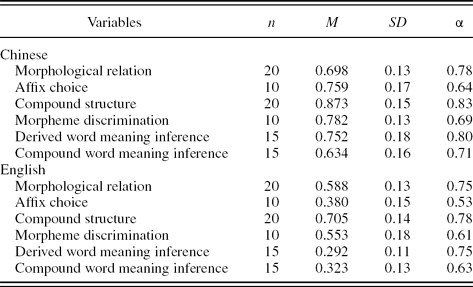
To examine a potential linguistic distance effect on cross-linguistic transfer of morphological awareness (i.e., how the similarities and differences in the morphological structure of Chinese and English influenced the pattern of transfer), this section and the section that follows report the analyses for transfer of compound awareness and derivational awareness, respectively. The means and standard deviations of children's performance on all tasks are provided in Table 1.
Means and standard deviations of all variables

Note: The mean is the mean proportion correct, and the α is the Cronbach α.
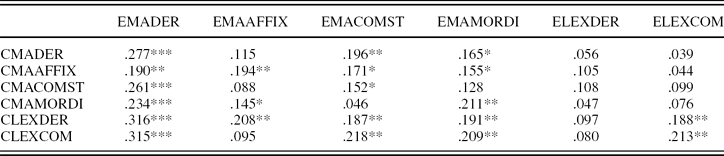
Table 2 shows the bivariate correlations between compound awareness and compound word meaning inference measures in Chinese and English. Chinese compound structure and English compound structure correlated significantly (r = .152, p < .05), so did Chinese morpheme discrimination and English morpheme discrimination (r = .211, p < .01). The two measures of Chinese compound awareness only weakly correlated with English compound word meaning inference; neither correlation has achieved significance. On the other hand, both English compound structure (r = .218, p < .01) and English morpheme discrimination (r = .209, p < .01) significantly correlated with Chinese compound word meaning inference. Finally, the measure of compound word meaning inference in the two languages significantly correlated (r = .213, p < .01).
Cross-linguistic correlations between morphological awareness and lexical inference
Note: EMADER, English morphological relation; EMAAFFIX, English affix choice; EMACOMST, English compound structure; EMAMORDI, English morpheme discrimination; ELEXDER, English derived word meaning inference; ELEXCOM, English compound word meaning inference. CMADER, Chinese morphological relation; CMAAFFIX, Chinese affix choice; CMACOMST, Chinese compound structure; CMAMORDI, Chinese morpheme discrimination; CLEXDER, Chinese derived word meaning inference; CLEXCOM, Chinese compound word meaning inference.
*p < .05. **p < .01. ***p < .001.
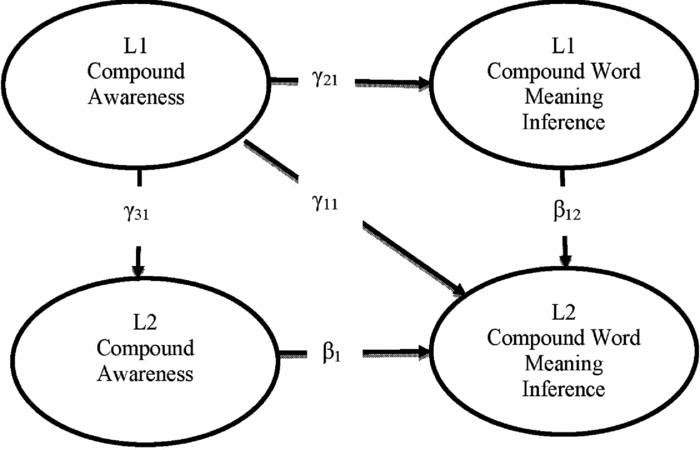
SEM analysis was performed to investigate further the cross-linguistic relations and test transfer of Chinese compound awareness in facilitating English compound word meaning inference. Based on the findings of previous research, we hypothesized that English compound word meaning inference was predicted by English compound awareness, Chinese compound word meaning inference, as well as Chinese compound awareness; in addition, Chinese compound awareness predicted English compound awareness and Chinese compound word meaning inference (see Figure 1 for a diagraphic representation of the hypothesized model).
The hypothesized model of transfer of compound awareness.
We constructed a baseline model based on the above hypotheses, with both measurement and structural components. In the baseline model, compound structure and morpheme discrimination in the respective language were indicators of the factor of compound awareness in that language. Chinese and English compound word meaning inference had only one indicator, namely, children's performance on the compound word part of the lexical inference task in Chinese and English, respectively. In testing the model, factor loadings of Chinese compound structure and English compound structure were made unitary as 1.0. For model optimization, a Lagrange Multiplier Test was first performed to see whether adding any parameter(s) would lead to improvement of model fit, followed by a Wald test, which helped reveal whether removing any parameter(s) would maintain the goodness of model fit while making the model more parsimonious.
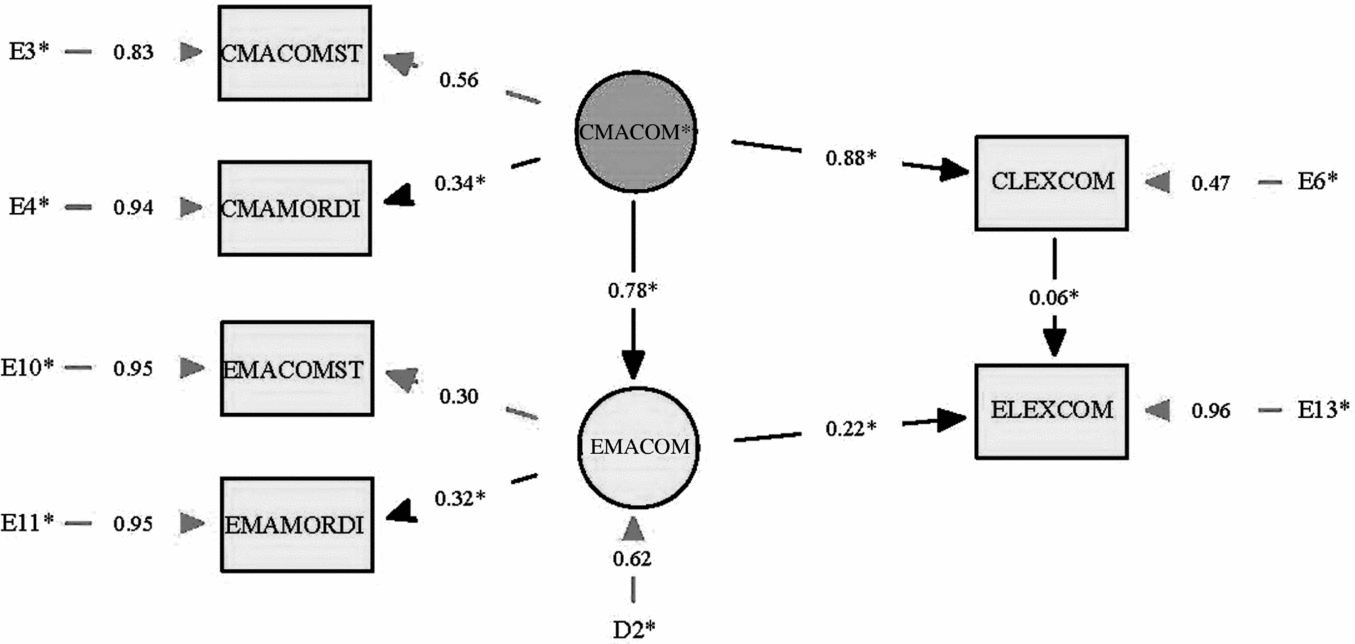
The baseline model showed very good model fit, χ2 (6, N = 204) = 5.191, p = .520; CFI = 1.000, RMSEA = 0.000, confidence interval (CI) = 0.000, 0.084. The normalized estimate of the Mardia κ was 2.32, which did not seem to result in chi-square and standard error biases, as Bentler and Wu (Reference Bentler and Wu2002) suggest that only values greater than 3 indicate nontrivial positive kurtosis. Therefore, adjustment of multivariate nonnormality and a test with the robust methodology were not needed (Satorra & Bentler, Reference Satorra and Bentler1988). A Lagrange Multiplier Test was performed to optimize the baseline model. The result revealed no significant improvement of goodness of model fit by adding any parameter(s). A Wald test was thus performed next, the result of which suggested that the model would become more parsimonious with no significant change of goodness of model fit from the baseline model, if the path from Chinese compound awareness to English compound word meaning inference was removed. The optimized model showed χ2 (7, N = 204) = 5.494, p = .600; CFI = 1.000, RMSEA = 0.000, CI = 0.000, 0.074. This new model displayed very good model fit, and while making the model more parsimonious, it did not lead to significant change to the baseline model: Δχ2 (1) = 0.303, p = .582. Therefore, this optimized model was considered the final model for the cross-linguistic relationship between compound awareness and compound word meaning inference in Chinese and English. Figure 2 provides a graphic representation of the final model.
The final model of transfer of compound awareness (N = 204). CLEXCOM, Chinese compound word meaning inference; CMACOM, latent variable of Chinese compound awareness; CMACOMST, Chinese compound structure; CMAMORDI, Chinese morpheme discrimination; ELEXCOM, English compound word meaning inference; EMACOM, latent variable of English compound awareness; EMACOMST, English compound structure; EMAMORDI, English morpheme discrimination.
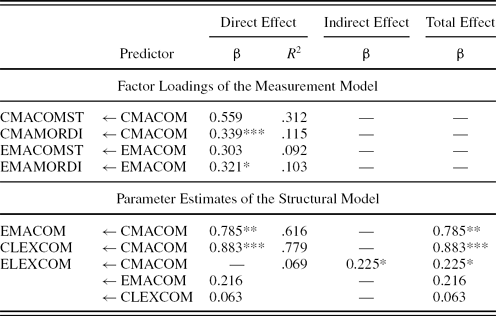
Table 3 details the standardized parameter estimates. For the measurement model, both measures of Chinese compound awareness loaded significantly on the factor of Chinese compound awareness (β = 0.559 and 0.339 for compound structure and morpheme discrimination, respectively). The factor explained about 31.2% and 11.5% of the variance in the two measures, respectively. The two English compound awareness measures also significantly loaded on the factor of English compound awareness (β = 0.303 and 0.321 for compound structure and morpheme discrimination, respectively). The latent variable explained about 9.2% and 10.3% of the variance in these two measures of English compound awareness, respectively.
Parameter estimates of the model for testing transfer of compound awareness
Note: CMACOMST, Chinese compound structure; CMACOM, latent variable of Chinese compound awareness; CMAMORDI, Chinese morpheme discrimination; EMACOMST, English compound structure; EMACOM, latent variable of English compound awareness; EMAMORDI, English morpheme discrimination; CLEXCOM, Chinese compound word meaning inference; ELEXCOM, English compound word meaning inference.
*p < .05. **p < .01. ***p < .001.
Table 3 also provides the standardized parameter estimates for the structural model with direct, indirect, and total effects. Chinese compound awareness significantly predicted both Chinese compound word meaning inference (β = 0.883, p < .001; 77.9% of variance explained) and English compound awareness (β = 0.785, p < .01; 61.6% of variance explained). English compound awareness and Chinese compound word meaning inference together explained about 6.9% of the variance in English compound word meaning inference. However, neither variable's unique contribution achieved significance at β = 0.216 for English compound awareness and β = 0.063 for Chinese compound word meaning inference. Different from the baseline model, the indirect effects of Chinese compound awareness on English compound word meaning inference, which were equal to the total effects of Chinese compound awareness in the final model, became significant (β = 0.225, p < .05).
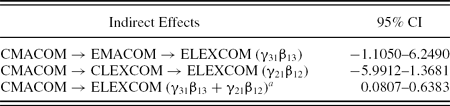
Two limitations were noted in the above analyses of indirect effects. First, the indirect effects were tested using a z test (Sobel, Reference Sobel1982), which requires a normal sampling distribution. As an indirect effect is made up of a multiplicative effect (e.g., γ31×β13 in Figure 1) whose sampling distribution is often unknown, the indirect effects reported above might be biased. Shrout and Bolger (Reference Shrout and Bolger2002) proposed the use of bootstrapping, a data-based simulation method for statistical inference, for testing indirect effects. The bootstrapping method uses empirical sample data to generate a certain number of bootstrap samples (typically 1,000) through random sampling with replacement. Each bootstrap sample is then analyzed to estimate a parameter. As the method uses CI to determine whether a statistic is significantly different from zero, it does not have the assumption of normality of sampling distribution. Cheung and Lau (Reference Cheung and Lau2008) showed that the bootstrapping method performed the best in estimating indirect effects, in comparison to a number of other methods. Second, like many other SEM programs, EQS only reports total indirect effects in the output. When there are multiple indirect effects of an independent variable on a dependent variable through different pathways, the indirect effect through each individual pathway and its relative contribution are unknown. For example, in the final model (see Figure 2), Chinese morphological awareness contributed to English lexical inference indirectly through two pathways: one via Chinese lexical inference (γ21β12) and the other via English morphological awareness (γ31β13). From the EQS-based SEM analyses, it was unknown whether these individual indirect effects were significant on their own, although the total indirect effects (γ31β13 + γ21β12) achieved significance. The bootstrapping method provides a robust way to disentangle and estimate these component indirect effects.
Considering these limitations, 1,000 bootstrap samples were generated from the original sample data to estimate the component indirect effects of Chinese morphological awareness on English lexical inference. To examine the frequency distribution of the parameters to be estimated, percentile scores of 2.5% and 97.5% were requested for computing 95% CI. As shown in Table 4, the total indirect effects of Chinese compound awareness on English compound word meaning inference (γ31β13 + γ21β12) were significantly different from zero, which confirmed the result of the Sobel test (95% CI = 0.0807–0.6383). However, neither the indirect effect via Chinese compound word meaning inference (γ21β12) nor the one via English compound awareness (γ31β13) was significant, because their CIs included zero (CI = −1.1050–6.2490 for γ31β13 and −5.9912–1.3681 for γ21β12, respectively).
95% Confidence interval for examining frequency distribution of indirect effect parameters in testing transfer of compound awareness
Note: CMACOM, latent variable of Chinese compound awareness; EMACOM, latent variable of English compound awareness; ELEXCOM, English compound word meaning inference; CLEXCOM, Chinese compound word meaning inference.
aTotal indirect effects of CMACOM on ELEXCOM from both paths.
Transfer of derivational awareness
The cross-linguistic relations between derivational awareness and derived word meaning inference in Chinese and English can first be seen from the correlations in Table 2. There were significant correlations between Chinese morphological relation and Chinese affix choice and their counterpart English measures, except the correlation between Chinese morphological relation and English affix choice. Neither Chinese morphological relation (r = .056) nor Chinese affix choice (r = .105) correlated significantly with English derived word meaning inference. However, the two English derivational awareness measures both correlated significantly with Chinese derived word meaning inference (r = .316, p < .001 for English morphological relation, r = .208, p < .01 for English affix choice). The correlation between derived word meaning inference in Chinese and English was weak and did not achieve significance (r = .097).
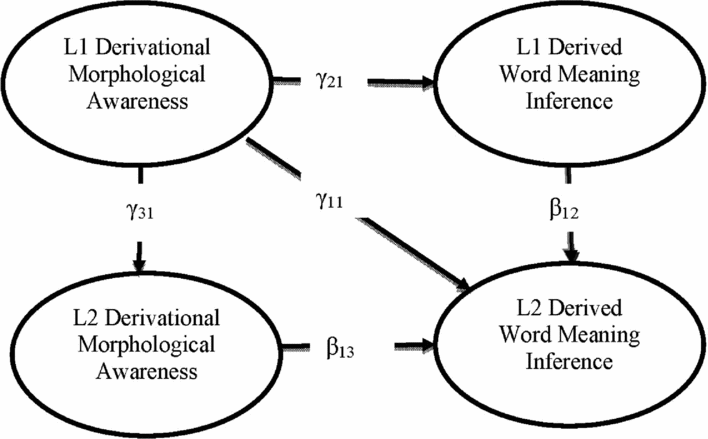
A similar model of cross-linguistic predictive relations between morphological awareness and lexical inference was hypothesized for derived words (see Figure 3). Chinese derivational awareness predicted its English counterpart (γ31) and L1 derived word meaning inference (γ21). English derived word meaning inference was predicted by English derivational awareness (β13), Chinese derived word meaning inference (β12), as well as Chinese derivational awareness (γ11).
The hypothesized model of transfer of derivational awareness.
Based on the above hypotheses, we proposed a baseline model for transfer of L1 derivational awareness. In the model, Chinese morphological relation and affix choice loaded on the factor of Chinese derivational awareness and English morphological relation and affix choice on the factor of English derivational awareness. Derived word meaning inference in both Chinese and English had only one indicator, namely, children's performance on the derived word part of the lexical inference task in the respective language. In testing the baseline model, factor loadings of Chinese morphological relation and English morphological relation were fixed at 1.0.
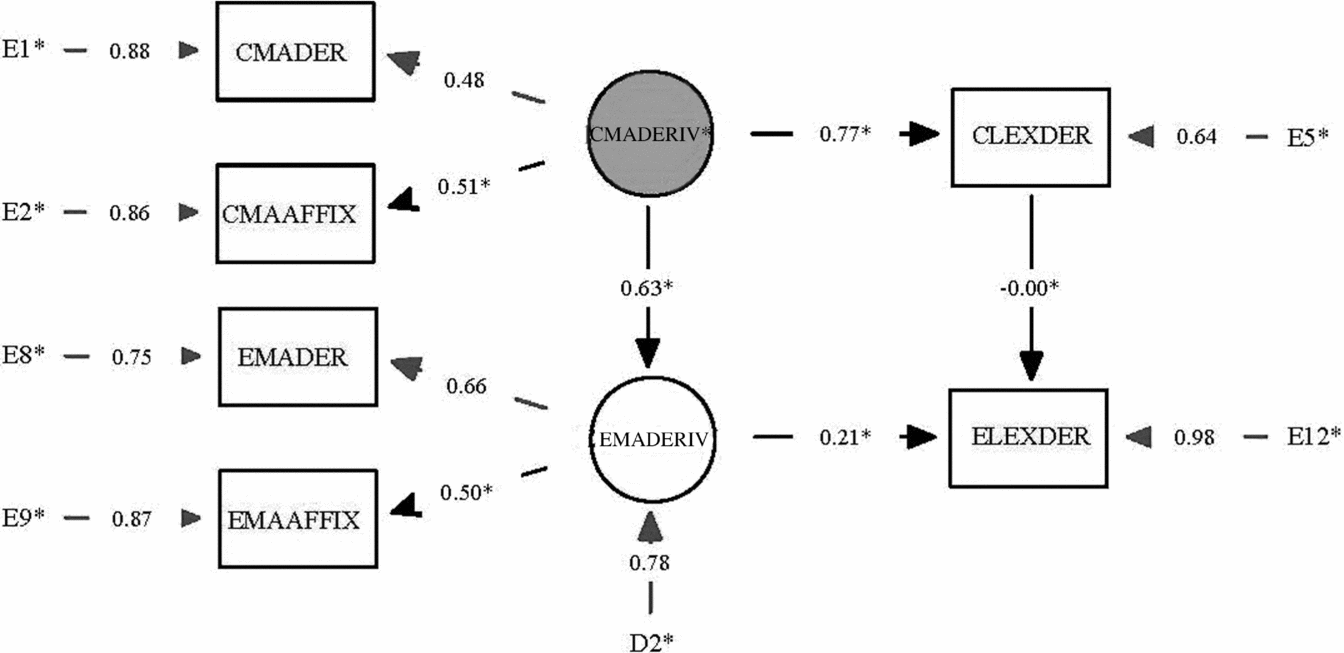
The baseline model displayed good fit, χ2 (6, N = 204) = 6.106, p = .411; CFI = 0.999, RMSEA = 0.009, CI = 0.000, 0.092. The normalized estimate of the Mardia κ was 1.45. No adjustment of multivariate nonnormality was needed and regular chi-square was reported without Satorra–Bentler correction. To optimize the baseline model, a Lagrange Multiplier Test was first performed. The result suggested that adding no path would significantly improve the baseline model's goodness of fit. A Wald test was performed next. The optimized model after the Wald test displayed very good model fit, χ2 (7, N = 204) = 6.229, p = .513; CFI = 1.000, RMSEA = 0.000, CI = 0.000, 0.074. There was no significant change of goodness of model fit from the baseline model: Δχ2 (1) = .123, p = .726. Thus, this new model was considered as the final model (see Figure 4 for a graphic representation of the model).
The final model of transfer of derivational awareness (N = 204). CLEXDER, Chinese derived word meaning inference; CMAAFFIX, Chinese affix choice; CMADER, Chinese morphological relation; CMADERIV, latent variable of Chinese derivational awareness; ELEXDER, English derived word meaning inference; EMAAFFIX, English affix choice; EMADER, English morphological relation; EMADERIV, latent variable of English derivational awareness.
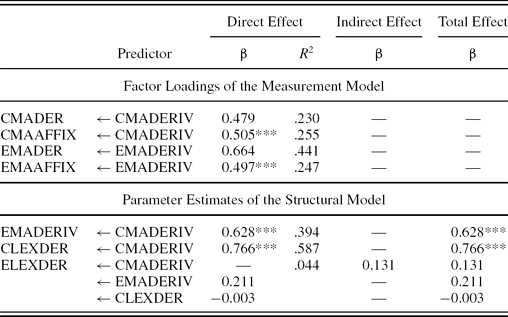
Table 5 details the standardized parameter estimates. In the measurement model, the two measures of Chinese derivational awareness significantly loaded on the latent variable at β = 0.479 for morphological relation (23.0% of variance explained) and β = 0.505, p < .001 for affix choice (25.5% of variance explained). The factor loadings of the two measures of English derivational awareness were also significant (β = 0.664 for morphological relation, β = 0.497, p < .001 for affix choice). The factor, English derivational morphological awareness, explained about 44.1% and 24.7% of the variance in the two observed variables, respectively.
Parameter estimates of the model for testing transfer of derivational awareness
Note: CMADER, Chinese morphological relation; CMADERIV, latent variable of Chinese derivational awareness; CMAAFFIX, Chinese affix choice; EMADER, English morphological relation; EMADERIV, latent variable of English derivational awareness; EMAAFFIX, English affix choice; CLEXDER, Chinese derived word meaning inference; ELEXDER, English derived word meaning inference.
***p < .001.
In the structural model, Chinese derivational awareness significantly predicted both Chinese derived word meaning inference (β = 0.766, p < .001; 58.7% of variance explained) and English derivational awareness (β = 0.628, p < .01; 39.4% of variance explained). English derivational awareness (β = 0.211) and Chinese derived word meaning inference (β = −0.003) explained about 4.4% of the variance in English derived word meaning inference. Neither variable's unique contribution achieved significance. The indirect effects of Chinese derivational awareness on English derived word meaning inference, now equal to its total effects, were not significant (β = 0.131). A further bootstrap-based analysis with 1,000 samples confirmed this finding in that the 95% CI −0.0161–0.6367 of the parameter for the total indirect effects (γ31β13 + γ21β12) included zero. As the total indirect effects were not significant, the two component indirect effects, one via English derivational awareness and the other via Chinese derived word meaning inference, could not be significant.
DISCUSSION
The significant contribution of Chinese compound awareness to English compound awareness found in this study does not seem to be a surprise, given that compounding is a productive way of word formation in both Chinese and English (Fabb, Reference Fabb, Spencer and Zwicky1998; Packard, Reference Packard2000). In other words, compound awareness is a shared facet of morphological awareness typical of both languages. The finding corroborates previous research that has examined transfer of morphological awareness with a focus on a shared structure of the focal languages (e.g., Deacon et al., Reference Deacon, Wade-Woolley and Kirby2007; Zhang et al., Reference Zhang, Anderson, Li, Dong, Yu and Zhang2010). Zhang et al. (Reference Zhang, Anderson, Li, Dong, Yu and Zhang2010), for example, found that young Chinese EFL learners who received training in the structure of Chinese compound words developed better insights into English compound structure than did those who had not received any such training, which suggested a transfer facilitation effect of Chinese compound awareness on English compound awareness. The present study extends Zhang et al. (Reference Zhang, Anderson, Li, Dong, Yu and Zhang2010) as well in that Chinese compound awareness also facilitated learners’ ability to infer meanings of unknown English compound words, albeit indirectly via its influence on English compound awareness and the ability to infer meanings of Chinese compounds (discussed later). It thus supports previous research that has observed the contribution of morphological awareness in one language to reading and its related skills in another language (e.g., Pasquarella et al., Reference Pasquarella, Chen, Lam and Luo2011; Ramirez et al., Reference Ramirez, Chen, Geva and Kiefer2010). It suggests that Chinese children's L1 compound knowledge can be a good resource for their learning of English L2 compound words.
Although the close relationship between Chinese and English compound awareness was expected, it was to our surprise that Chinese and English derivational awareness were also related, because there is clear cross-linguistic variation between the two languages regarding the productivity of derivational morphology, as delineated earlier. Because Chinese derivational awareness significantly predicted its English counterpart, it appears that Chinese children also transferred their insights into Chinese derivational morphology into the analysis of the structure of English derived words.
At first sight, the finding seems to contradict previous research that has documented a linguistic distance effect on transfer of reading subskills (e.g., Wang et al., Reference Wang, Yang and Cheng2009; Wang, Park, et al., Reference Wang, Park and Lee2006). A distinction, however, has to be made between those previous studies and the present study. In both Wang, Park, et al. (Reference Wang, Park and Lee2006) and Wang et al. (Reference Wang, Yang and Cheng2009), the focus was on transfer of phonological versus orthographic skills in biliteracy acquisition. Because the orthographies of Korean and Chinese entail different visual processes than that of English, the finding that Korean and Chinese learners of L2 English did not transfer their L1 orthographic processing skills to facilitate English reading seems to be justifiable. On the other hand, in the present study, although the two languages involved, Chinese and English, are typologically distant, the focal skill is of a particular linguistic level, that is, morphology. Morphological awareness is morphological awareness. In other words, although derivation is very limited in Chinese, once children have developed insights into this morphological process, they may naturally utilize these insights for analysis of the structure of English derived words. Previous research (e.g., Ku & Anderson, Reference Ku and Anderson2003) has shown that the low productivity of derivation in Chinese does not prevent children from developing some insights into this particular morphological process, although these insights clearly lag behind those related to compounding.
The next logical question to ask is why such a cross-linguistic relationship between Chinese derivational awareness and English reading subskill had not been observed in previous Chinese–English biliteracy studies, such as Paqsuarella et al. (Reference Pasquarella, Chen, Lam and Luo2011) and Wang, Cheng, et al. (Reference Wang, Cheng and Chen2006). We conjecture that this might be attributable to two possible reasons: first, Chinese derivational awareness was not measured in Pasquarella et al. (Reference Pasquarella, Chen, Lam and Luo2011), and consequently, it is unknown if there would be any relationship of Chinese derivational awareness to English reading skills in that study. Second, in both studies, the sample included children at diverse learning/developmental stages, whereas ours was a homogeneous group. Although grade or age was included as a covariate in the regression or SEM analysis, it is possible that the identified patterns about derivational awareness might not hold for each and individual group. Paris (Reference Paris2005) and Duke and Carlisle (2010) discuss a similar issue in the context of monolingual reading.
Do the above findings refute the prediction of the transfer facilitation model (Koda, Reference Koda and Cook2005, Reference Koda, Koda and Zehler2008) with regard to a linguistic distance effect on transfer of metalinguistic awareness? Not necessarily. As we can see from Tables 3 and 5, the relationship between Chinese and English compound awareness was clearly stronger than that between derivational awareness in the two languages. Chinese compound awareness explained more than 60% of the variance in English compound awareness, whereas the proportion was about 40% for derivational awareness. In addition, SEM results have shown that the indirect effect of Chinese derivational awareness on English derived word meaning inference did not achieve significance, whereas that of Chinese compound awareness on English compound word meaning inference was significant. Therefore, overall, the findings of the present study are aligned with, rather than divergent from, the prediction of the transfer facilitation model.
The present study also showed that in the situation where a significant transfer facilitation effect was observed (i.e., transfer of compound awareness), L1 morphological awareness did not have a significant, direct contribution to L2 lexical inference. SEM analysis indicated that after partialing out the influence of L2 morphological awareness and L1 lexical inference, L1 morphological awareness did not uniquely explain a significant amount of variance in L2 lexical inference. Percentile confidence intervals of bootstrap-based estimates of indirect effect parameters further revealed that the transfer facilitation effect of L1 morphological awareness on L2 lexical inference took place indirectly via its influences on L2 morphological awareness and L1 lexical inference.
It makes sense for indirect effects to be available in L2 reading or biliteracy acquisition because of the close relationship of L1 metalinguistic awareness with corresponding L2 metalinguistic awareness and L1 reading on the one hand, and that of L2 metalinguistic awareness and L1 reading with L2 reading on the other hand. Such close relationships are not uncommon, as can be seen in the correlation matrices of many previous biliteracy studies. Yet, a finding similar to ours has not surfaced in previous research, either because researchers were not interested in testing indirect effects or the method they used (i.e., conventional regression analysis) constrained them from doing so. As to the lack of significance for either one of the two component indirect effects in the present study, we speculate that it might be related to the context and stage of learning of the participants (i.e., Grade 6 EFL learners). Specifically, the low English proficiency of the learners and their limited exposure to morphologically complex words at the early stage of English learning in a foreign language context might have weakened the association between L1 compound awareness and L2 compound meaning inference as well as between L1 and L2 compound meaning inference (see Figure 2). Consequently, these two weak paths suppressed the component indirect effects of L1 compound awareness on L2 compound word meaning inference.
The question now comes to why there was a lack of a direct effect of L1 morphological awareness on an L2 reading-related measure, which appears to contradict previous research that has examined a similar issue. Wang, Cheng, et al. (Reference Wang, Cheng and Chen2006), for example, found that Chinese immigrant children's English (the societal language) compound awareness uniquely predicted reading comprehension in Chinese (the nonsocietal language). Deacon et al.'s (Reference Deacon, Wade-Woolley and Kirby2007) longitudinal study of English–French biliteracy acquisition revealed that Grade 2 English morphological awareness made a unique contribution to Grade 2 French word reading, and that Grade 3 French morphological awareness was a significant independent contributor to Grade 3 English word reading.
A close look at the preceding studies, however, suggests that the discrepancy of findings regarding whether there was a direct contribution of morphological awareness in one language to reading development in another language might be attributable to how relevant variables were statistically controlled in these studies. The present study tested cross-linguistic transfer within the SEM methodological framework where morphological awareness in both L1 and L2 as well as L1 lexical inference were used as predictors of L2 lexical inference. L1 morphological awareness did not contribute uniquely and significantly to L2 lexical inference, after controlling for both L2 morphological awareness and L1 lexical inference. However, such a control of covariates of L1 morphological awareness was not similarly conducted in most previous research. For example, in Wang, Cheng, et al. (Reference Wang, Cheng and Chen2006), which observed that English compound awareness uniquely contributed to Chinese reading comprehension, the two covariates of English compound awareness (i.e., Chinese compound awareness and English reading comprehension) were not included into the regression equation. Therefore, their shared variance with English compound awareness was not accounted for. Deacon et al. (Reference Deacon, Wade-Woolley and Kirby2007) controlled for English morphological awareness when using French morphological awareness to predict English reading ability. However, the effect of French word reading ability on the criterion variable was not accounted for. Given the relationship between word reading ability in French and English on the one hand and French morphological awareness and French word reading ability on the other hand, the significance of the contribution of French morphological awareness to English word reading might have diminished if French word reading had been controlled for as another covariate.
In Pasquarella et al. (Reference Pasquarella, Chen, Lam and Luo2011), however, the authors did include English reading comprehension in the model when Chinese reading comprehension served as a dependent variable, yet the study revealed a direct effect of English compound awareness on Chinese reading comprehension. Without concluding which finding, Pasquarella et al.'s or ours, stands as a better representation of the cross-linguistic relationship between compound awareness and reading or its related skills, we offer two explanations that may account for the divergence. First, on the side of the present study, the divergence might have resulted from its not including other related variables in the SEM model, a limitation that we explicate at the end of the paper. Second, with respect to Pasquarella et al.'s study, English and Chinese reading comprehension, which correlated significantly (see their table 2, p. 31) and were allowed to be mutually predicted, showed no significant relationship in the final structural model (see their figure 2, p. 34). In addition, besides Chinese word reading, neither Chinese vocabulary knowledge nor Chinese compound awareness, as opposed to English compound awareness, significantly predicted Chinese reading comprehension. We wondered if allowing all between-language variables to be bidirectionally predicted (hence, a complex nonrecursive model with little parsimony) and consequently, the very small participant/parameter ratio (i.e., 137 children for the estimate of dozens of path coefficients as well as error terms of all within and between language variables) have led to biased estimations in Pasquarella et al.'s study.
Whichever explanation above makes more sense, the issue of whether there is a linguistic distance effect on transfer of morphological awareness warrants more attention in future L2 reading or biliteracy research. In addition, a few interesting questions emerged from the findings of the current study, which could not be addressed here but should provide directions for future research. To begin with, what would the relationships be between morphological awareness, lexical inference, and reading comprehension, both intralingually and interlingually, in biliteracy acquisition? As mentioned earlier, lexical inference seems to a missing link in previous research on the relationship between morphological awareness and reading comprehension. With the effects of morphological awareness on lexical inference documented in this study, it would be interesting to further test how lexical inference ability functions in establishing the link between morphological awareness and reading comprehension. A question of interest would be: does lexical inference serve as a mediator for the effect of morphological awareness on reading comprehension in children's L1 as well as L2? Another interesting issue worth exploring would be: how does L1 morphological awareness contribute to the development of L2 reading comprehension ability? Zhang and Koda (in pressReference Zhang and Koda) noted that adult EFL learners’ morphological awareness predicted reading comprehension indirectly through the mediation of vocabulary knowledge as well as the multiple mediation of lexical inference ability and vocabulary knowledge. It remains a question whether such a relationship is similarly true of young learners’ L1 as well as L2. Finally, future research might want to consider whether the cross-linguistic relations identified in this study would hold for EFL learners of L1 backgrounds other than Chinese. Because the linguistic distance effect on morphological awareness transfer as found in this study was based on the similarities and variations in morphological structure of Chinese and English, the pattern may not necessarily hold for learners with L1s that share and contrast morphologically with English in different ways. To answer such a question, a more sophisticated statistical method, such as multiple-group SEM, would be needed to compare different learner groups by testing if there is structural invariance of cross-linguistic relationships.
CONCLUSIONS AND LIMITATIONS
Based on covariance structure as well as bootstrapping analyses, this study examined the effect of L1 morphological awareness transfer on L2 lexical inference ability. It showed that young Chinese EFL readers’ L1 compound awareness and derivational awareness significantly predicted corresponding English morphological awareness, but the relationship between Chinese and English compound awareness was stronger than that between derivational awareness in the two languages. In addition, Chinese compound awareness significantly contributed, albeit indirectly, to English compound word meaning inference. The indirect effect of Chinese derivational awareness on English derived word meaning inference, however, did not achieve significance. Overall, the findings, consistent with the prediction of the transfer facilitation model (Koda, Reference Koda and Cook2005, Reference Koda, Koda and Zehler2008), indicated a linguistic distance effect on transfer of morphological awareness and, therefore, enriched our understanding about metalinguistic awareness transfer in L2 reading and biliteracy acquisition.
A few limitations of the study are noted. To begin with, in devising the tasks, we used children's textbooks as references and also consulted children's English teachers to reduce potential confound of vocabulary and grammatical knowledge. Yet, the possibility that the variance in children's performance on the tasks may partly reflect individual difference in the two types of linguistic knowledge cannot be completely ruled out. For example, a few choice words in the English affix choice task might have already been known to the participants, although they did not appear in their textbooks. In addition, knowledge of English relative clause is necessary for resolving the riddles in the compound structure task and sometimes for correctly choosing a meaning explanation for target compound words for the lexical inference task. Although we had knowledge that the relative clause structures had been learned by the children, there was no way to ascertain that it did not influence children's performance on the tasks. Finally, a few other variables that might be related to both morphological awareness and lexical inference (e.g., language aptitude, home literacy environment, phonological awareness, etc.) were not considered in the study, such that the robustness of the findings might have been unfavorably affected. Future research might want to include more related variables in a cross-linguistic model, although the current literature does not seem to have produced a reliable list of such variables that are functioning in biliteracy acquisition.
ACKNOWLEDGMENTS
This paper is based on my doctoral dissertation completed at Carnegie Mellon University. Thanks to Keiko Koda, G. Richard Tucker, and William Nagy for their supervision and support, and all of the children for their participation in the study.