Introduction
Indigenous Australian Queer and Gender Diverse (QGD) people, including both authors, are defined as those who are either Aboriginal Australian and/or Torres Strait Islander, and identify as existing outside of normative heterosexual and/or cisgender identifiers. Indigenous Australian QGD identities are varied and complex. QGD Indigenous people refer to Aboriginal and Torres Strait Islander people who identify with specific cultural identities such as Brotherboy and Sistergirl as well as those who identify as lesbian, gay, bisexual, transgender, intersex, non-binary, gender-fluid and a variety of other articulations of self (Sullivan, Reference Sullivan2018, Reference Sullivan2019).
For Indigenous Australian QGD students, like both authors, our sexual and gender diversity have rarely been recognised or even considered in Australian higher education institutions. QGD Indigenous people are increasingly calling upon institutions to listen to, consider and develop strategies which reflect the needs of the QGD student cohort (Gorrie, Reference Gorrie2017; Power, Reference Power2017; Whittaker, Reference Whittaker2017). Elders in our communities confirm the need for inclusion has been fought over lifetimes (Johnson, Reference Johnson and D2015). QGD Indigenous people participate as students, and staff in higher education institutions across Australia, in part evidenced by the work of openly QGD Indigenous writers and scholars (Clark, Reference Clark2014; Monoghan, Reference Monoghan and D2015; Farrell, Reference Farrell2016; Whittaker, Reference Whittaker2017). Yet there is limited consideration of this cohort in these spaces. Recommendation 11 of the Behrendt Review (Reference Behrendt, Larkin, Griew and Kelly2012) states ‘universities continue to support Indigenous Education Units to provide a culturally safe environment for Aboriginal and Torres Strait Islander students’ (p. 20). How this support is defined and measured remains unclear, and certainly what this means for QGD Indigenous students is mute. In this article, we explore whether Indigenous student spaces communicate safety and inclusion to QGD Indigenous students.
This article begins with an examination of literature about Indigenous Australian participation in higher education, and then moves to a discussion on the experiences of QGD Indigenous students. We then outline our application of Queer Indigenous Standpoint Theory as our theoretical and methodological framework. Our analysis of data utilises the term ‘identifiable items’ (Poynter and Tubbs, Reference Poynter and Tubbs2008) as a tool to locate queer symbolism in both online and on-site university spaces that could be interpreted as communicating inclusion to potential and current QGD Indigenous students. We apply this analysis to five metropolitan universities located in Sydney, Australia, with established Indigenous spaces to demonstrate whether QGD Indigenous inclusion is communicated.
QGD Indigenous people and higher education
Indigenous Australian people are persistently under-represented in Australia's institutions of higher education. Despite Indigenous people accounting for 3% of the Australian population (ABS, 2016), Indigenous students comprise 1.6% of all domestic on shore students (DET, 2015). The federal government, universities and secondary school have undertaken several initiatives to increase the participation levels of Indigenous Australians in higher education (Page et al., Reference Page, Trudgett and Sullivan2017). However, course completion rates remain significantly lower among Indigenous students compared with their non-Indigenous counterparts (Wilks and Wilson, Reference Wilks and Wilson2015). Young Indigenous Australian people are aspiring to tertiary education in order to advance to professional and leadership positions, to drive positive outcomes for their communities and for the broader Australian community (Behrendt et al., Reference Behrendt, Larkin, Griew and Kelly2012, p. 9).
Indigenous students encounter unique stressors throughout their post-secondary education. Although experiences of discrimination may vary between individuals and across different institutions, some experiences, such as feeling devalued in comparison to White counterparts, and not feeling connected to the wider university population is common for Indigenous students. Indigenous students’ perceptions of post-secondary education are influenced by experiences of marginalisation and alienation on campus (Shotton et al., Reference Shotton, Yellowfish, Cintrón and Patton2010). A sense of connectedness for Indigenous students is significant to success, which is why in most instances the Indigenous centre will join forces with other spaces on campus, such as the Indigenous Studies department (Page et al., Reference Page, Trudgett and Sullivan2017).
Indigenous university spaces refer to the physical spaces of Indigenous centres and departments on campus as well as their online spaces, particularly their websites and social media pages. Page et al. (Reference Page, Trudgett and Sullivan2017) describe Indigenous centres as ‘engine rooms of Indigenous achievement in Higher Education, simultaneously nurturing student growth, driving institutional reform and producing the leaders of the future’ (p. 30), noting that while Indigenous Centres and Indigenous Studies departments are aligned, they are generally characterised by different functions and goals. The former characterised by support and access for Indigenous students in Higher Education and the latter by Indigenous Knowledges and their contribution to the curriculum and research. Both are significant sites for Indigenous progress and participation. Indigenous centres are crucial physical spaces where student identities are validated and celebrated (Andersen et al., Reference Andersen, Bunda and Walter2008). Indigenous centres have taken on many roles for their students and often work collaboratively with the Indigenous Studies departments to educate and support Indigenous students (Page et al., Reference Page, Trudgett and Sullivan2017). These entities have been considered extremely beneficial in the retention and academic success of Indigenous students and are considered an ‘island of sanctuary’, a space which is necessary for identity development, sense of self, and for the retention and success of students (Shotton et al., Reference Shotton, Yellowfish, Cintrón and Patton2010, p. 105).
Generally, both university spaces (including Indigenous Studies departments) and Indigenous student centres extend to online spaces often with separate websites and social media presence. Many Aboriginal and Torres Strait Islander people use social media sites as tools for community-building and connectedness (Bodkin-Andrews and Carlson, Reference Bodkin-Andrews and Carlson2016). Technology and the amount of services provided within a physical space are increasingly important to meeting the needs of tech savvy students (Rice et al., Reference Rice, Haynes, Royce and Thompson2016). As technology use increases, Indigenous centres presence online needs to increase, they should be inspired to create the same types of ‘safe’ spaces that have been created in their physical buildings. Further for Indigenous students, strong cultural identity and family connection can be enhanced by social media, such connections are linked to improved educational outcomes (Rice et al., Reference Rice, Haynes, Royce and Thompson2016). Incidentally, it is reported that Facebook usage among Aboriginal and Torres Strait Islander people is higher than the wider Australian population (Rice et al., Reference Rice, Haynes, Royce and Thompson2016), this indicates engagement and communication with Indigenous people on social media are both common and wide-reaching, therefore it is imperative that Indigenous centres utilise social media platforms to maintain connection with students.
In this study, we focused on Facebook and Twitter accounts used by Indigenous spaces at the selected universities. Many Indigenous spaces create closed Facebook groups as a means for student engagement, the Indigenous centre's themselves rarely have their own official website, rather a webpage within their universities website. For the purposes of this research, we have selected to observe only public online and physical spaces as our methodology relies on a Queer Indigenous Standpoint of a potential student looking into Indigenous spaces while considering choices of universities, this will be further discussed later.
Ahmed (Reference Ahmed2012) argues that diversity has become a ‘buzzword’ in the higher education sector, describing it as an ‘institutional speech act’, it is both descriptive and performative (pp. 56–57). Descriptive in the sense that it becomes a kind of official language used when speaking about higher education, and performative in that this language becomes the convention. We argue that in the context of Indigenous higher education, the same could be said for ‘cultural safety’ (Trudgett and Franklin, Reference Trudgett and Franklin2011). Cultural safety is defined by Williams as:
An environment that is spiritually, socially and emotionally safe, as well as physically safe for people; where there is no assault challenge or denial of their identity, of who they are and what they need (Reference Williams1999, p. 13).
Cultural safety is the recognition and protection of a person's cultural identity, its premise lies in the minimisation of power imbalances (Ramsden, Reference Ramsden2002), addressing issues of power, racism and discriminatory attitudes towards those who are from different cultures and cultural diversities (Ramsden, Reference Ramsden2002; Eckermann et al., Reference Eckermann, Dowd, Chong, Nixon and Gray2010). Culture and cultural diversity, of course, has complex meanings to Indigenous communities in Australia in that we are still resisting concepts of pan-Aboriginality imposed upon us that imagine Indigenous identity in a singular, fixed state (Moreton-Robinson et al., Reference Moreton-Robinson, Walter, Singh and Kimber2011). On the one hand, there is significant diversity literature considering Indigenous participation and performance at the level of higher education (Page et al., Reference Page, Trudgett and Sullivan2017), on the other, our communities tirelessly insist that we are diverse (Paradies, Reference Paradies2006). Like diversity (see Githens, Reference Githens2012), cultural safety has become a convention rather than an action. If we accept Indigenous Australian peoples as diverse communities of people with varying identities and cultures, then that insistence on ‘cultural safety’ must actually include all of our Indigenous Australian cultures and communities. When entering some Indigenous spaces, the Indigenous culture that is ‘culturally safe’ often caters for those who are heterosexual and cisgender. Perhaps ‘epistemological racism’, queer-phobia and a reductive definition of Indigeneity inform what counts as a culturally safe in higher education spaces.
QGD Indigenous students are often overlooked in implementations of cultural safety in Indigenous and LGBT post-secondary initiatives. Nicolazzo, who writes on Trans experiences in American colleges elucidates, it is as if ‘White supremacy, colonisation, racism, and sexism operate to erase—figuratively and literally—people and experiences from our shared past/present/future’ (Reference Nicolazzo2017, p. 3). For example, the National Best Practice Framework for Indigenous Cultural Competency in Australian Universities (Universities Australia, 2011), the Review of Higher Education Access and Outcomes for Aboriginal and Torres Strait Islander People (Behrendt et al., Reference Behrendt, Larkin, Griew and Kelly2012) and the Indigenous Strategy 2017–2020 (Universities Australia, 2017) call for an overall move towards a goal of cultural safety and cultural awareness in Australian universities but involve no mention of QGD Indigenous students. Rhetoric around cultural competency has also been implemented for the broader QGD community. The Rainbow Tick Guide to LGBT-inclusive practice lists ‘Culturally safe and appropriate services’ as the last component of their six-part framework (GLHV, 2016). The Australian LGBTI University Guide (New South Wales Gay and Lesbian Rights Lobby, 2018) offers a foundation for measuring LGBTI inclusion in Australian Universities, their framework focuses on educating the communities about the existence of protective policies and access to services as well as ally networks and designated LGBTI events and spaces (New South Wales Gay and Lesbian Rights Lobby & Star Observer, 2015). However, none of these frameworks considers QGD Indigenous identities.
QGD Indigenous people have received some attention in the health sector, particularly in relation to sexual (Kerry, Reference Kerry2014) and mental health (ATSISPEP, 2015). Findings from the Sexuality and Gender Diverse Populations Roundtable report (ATSISPEP, 2015) document a general desire amongst participants to be seen in relation to their cultural and social identities rather than their sexual and health status. Citing Rosenstreich and Goldner (Reference Rosenstreich and Goldner2010), the report also highlights the lack of formal information and data around the QGD Indigenous population (Aboriginal and Torres Strait Islander Suicide Prevention Evaluation Project, 2015). Crowhurst and Emslie (Reference Crowhurst and Emslie2014) assert that while universities actively gather demographic data about students' Aboriginality, gender and socio-economic status for the purpose of equity work and specified services, there seems to be general institutional resistance to collecting information around students' sexual and gender identities (pp. 278–279). On this topic, Farrell ponders that if institutions are not collecting data on QGD Indigenous people, do they see us? Or are we invisible? (2015).
Colouring the Rainbow (2015) provides a collection of life stories and essays by QGD Indigenous people, all different but with some common themes including experiences of lateral violence from Aboriginal and Torres Strait Islander community members. Dodson (Reference Dodson2011) has argued for cultural safety as a tool to combat lateral violence. But is this possible for QGD Indigenous people when power relations between heterosexual and/or cisgender Indigenous people and QGD Indigenous people are not lateral. Clark (Reference Clark and D2015) notes QGD Indigenous people are often spoken on behalf of by non-Indigenous people and by heterosexual and/or cisgender Aboriginal and Torres Strait Islander people (p. 3). We are often caught in a dangerous trap between (un)conscious investments in heterosexual and/or white settler privilege. Whittaker (Reference Whittaker and Hodge2015) writes ‘the Indigenous sexual and gendered subject is imbued with compulsory heterosexuality and cisgendered traits, and our culture is tempered with settler assumptions of both “original” and contemporaneous queer antagonism’ (p. 225). Both Clark (Reference Clark2014) and Whittaker (Reference Whittaker2017) link hostility against QGD peoples in both Indigenous and non-Indigenous spaces with regulations around ‘authentic’ Aboriginal identity. This kind of hostility can be implicit or remain invisible until interrogated. We argue the institutional assumption of ‘cultural safety’ across Indigenous student spaces relies on the regulation of ‘who counts as Aboriginal’ (Bodkin-Andrews and Carlson, Reference Bodkin-Andrews and Carlson2016) and contributes to the erasure and neglect of QGD Indigenous student identities and the systemic challenges we endure.
Issues which remain silent or unseen communicate a particular set of power relations about what needs to be said and what does not. At an institutional level, Ahmed (Reference Ahmed2012) describes this as ‘the wall’, she insists that:
‘[o]nly the practical labour of “coming up against” the institution allows this wall to become apparent. To those who do not come up against it, the wall does not appear—the institution is lived and experienced as being open, committed, and diverse’ (p. 62); with diversity being used as an ‘institutional speech act’ real progress towards inclusion and equity is being overlooked (p. 62).
We argue while the convention and language of cultural safety and diversity are being used at an official level in Indigenous student spaces, little is being done in these spaces to communicate the inclusion to QGD Indigenous students.
Queer Indigenous standpoint
For many QGD Indigenous people, there is little to no separation between our queer or gender identity and our cultural identity. QGD Indigenous people refer to Aboriginal and Torres Strait Islander people who identify with specific cultural identities such as Brotherboy and Sistergirl as well as those who identify as lesbian, gay, bisexual, transgender, intersex, non-binary, gender-fluid and a variety of other articulations of self (Sullivan, Reference Sullivan2018, Reference Sullivan2019). Many QGD Indigenous people have their own languages and words for their identities and many identities entail specific relationships to home communities, culture and country. It is also important to acknowledge those who are disconnected from community and culture, and those who have found their home amongst other QGD people, Indigenous and non-Indigenous.
Queer Indigenous Standpoint theory provides a framework through which QGD Indigenous people can look back at institutions, positioning us as knowledge holders of our experiences and our needs. It is important, as Nakata (Reference Nakata2007) states, we interrogate ‘how particular knowledges achieve legitimacy and authority at the expense of other knowledge’ (p. 195). He describes Indigenous standpoint theory as ‘theorising knowledge from a particular and interested position—not to produce the “truth” of the Indigenous position but to better reveal the workings of knowledge and how understanding of Indigenous people is caught up and implicated in its work’ (Nakata, Reference Nakata2007, p. 215).
Queer Standpoint theory builds on Indigenous Standpoint theory (Nakata, Reference Nakata2007) and Indigenous Women's Standpoint theory (Moreton-Robinson, Reference Moreton-Robinson2000, Reference Moreton-Robinson2013) to create a methodology specific to Queer Indigenous peoples. Like Indigenous Women's Standpoint theory, Queer Indigenous Standpoint theory assumes that although QGD Indigenous identities are extremely diverse, we share some common experiences (Moreton-Robinson, Reference Moreton-Robinson2000, p. xvi). These include, but are not limited to, experiences of survival in a homophobic and transphobic violent settler state, negotiating nuclear family structures, and navigating a colonial bureaucracy invested in erasing our relationships and identities. Relative to these, a key experience that QGD Indigenous people share is a learned instinct to exercise caution when entering new spaces and social settings. The threat of violence and exclusion for us is often multi-layered. As Whittaker (Reference Whittaker and Hodge2015, p. 226) and Farrell (Reference Farrell2015) note, QGD people exist at the margins of already marginalised communities. Queer Indigenous Standpoint theory involves centring the lived realities of QGD Indigenous people in a heteronormative colonial society, and offers the possibility of producing alternative knowledges with the ‘dual imperatives’ (Monoghan, Reference Monoghan and D2015) of queer(ing) and decolonial goals. In this study, it is implemented to enable QGD Indigenous students to reposition ourselves, to look upon institutions and ask: Is this a space for me? What is here for me? Is there anyone here like me?
Queer Indigenous Standpoint theory provides a decolonising model of inquiry that decentres dominant institutional narratives and centres QGD Indigenous perspectives. This methodology provides a way for QGD Indigenous people to critique and influence institutional policies, procedures and spaces. Queer Indigenous Standpoint theory is introduced and implemented in this article to highlight the importance of QGD Indigenous perspectives and influence in Indigenous higher education spaces. It is transferrable to other spaces and settings which require critique and reform to create actively inclusive environments for QGD Indigenous people and communities. Queer Indigenous Standpoint theory is a framework that simultaneously acknowledges the diversity in our communities by assuming there are multiple standpoints for QGD Indigenous people, but also recognises common goals and experiences which are shared. In this instance, we implemented our standpoint as QGD Indigenous students to demonstrate how Indigenous student spaces could communicate safety and inclusion to us and people like us in locations like ours. While this is a small part of a larger picture, it highlights the importance of our positionality and how existing social power structures determine that Indigenous standpoints are neither singular nor lateral.
Positionality and research intent
Given the complexity, the terminology is often an issue that is bounded by available language. The terms ‘Queer’ and ‘Gender Diverse’ are adopted in this paper, not as umbrella labels to capture the numerous identities that fall under these terms, such as queer, gay, transgender, non-binary or lesbian. All of these terms are in themselves complex and represent variances in identity. Further these terms do not adequately reflect Indigenous constructions of gender and sexual diversity. Notwithstanding the limits of language, the adoption of the terms ‘Queer’ and ‘Gender Diverse’ are useful as they challenge and critique ideologies of heteronormativity, cisnormativity asserting the multiplicity and fluidity of gender and sexuality.
We position ourselves within this article as Queer Indigenous authors. The first author is a Wiradjuri (Indigenous Australian) woman, a Senior Lecturer in Indigenous Studies, a doctoral candidate and a lesbian. The second author is an undergraduate student, and research assistant in Indigenous Studies, and a QGD person of Yuin and Gugu Yalandji heritage (Indigenous Australian). Our work is grounded in our experiences of Indigenous student spaces and universities as members of QGD communities. The data presented in this analysis have been viewed through our collective lens as Queer Indigenous people, our particular and interested position is centred on empowerment and improvement of social conditions for QGD Indigenous peoples.
Our intent with this research is to be fully supportive of Indigenous student centres and the hard work achieved by professional and academic staff in these spaces. Their work is vital to access, participation and success of Indigenous students studying in higher education institutions in Australia. However, we do believe the approach in centres to include Indigenous students from all over Australia into ‘culturally safe’ environments risks Indigenous identity becoming ‘pan-Aboriginal’. The histories, experiences and lives of Indigenous students are diverse and varied, and include variations of gender and sexuality. Whilst we acknowledge most Indigenous centres have limited resources (Page et al., Reference Page, Trudgett and Sullivan2017), such limitation should not be at the expense of Indigenous students who feel alienated in these spaces. As Indigenous students, we have actively made decisions on which universities to engage with, and which to avoid, based around our feelings of inclusion and sense of safety. Indigenous student centres which appear gender and/or sexually neutral may well be jeopardising their position of inclusion and hence ultimately, the number of Indigenous students enrolled at the institution.
Method
Our examination of the data involved searching for ‘identifiable items’ (Poynter and Tubbs, Reference Poynter and Tubbs2008) in Indigenous student spaces from a Queer Indigenous Standpoint. Comprehensive and culturally conscious frameworks that attempt to explain the process by which educational environments influence Indigenous QGD student success are difficult to find. Rather than a diversity model of inclusion, we have implemented a decolonising model grounded in QGD Indigenous experience as Samudzi (Reference Samudzi2016) argues ‘[t]he inclusion of marginalised experiences and identities without decentering dominant narratives is an understanding of diversity that leaves oppressive structures intact and, in fact, insulates them from criticism’ (para 4). As QGD Indigenous students, we are most often ‘looked upon’ and ‘looked over’ by higher education institutions. Institutional processes determine which educational spaces we are able to enter, evaluate our work as students, assess our eligibility to access services and to a large extent determine our advancement in study and careers. By centring QGD Indigenous student experience, we are attempting to decolonise the review of Indigenous higher education spaces. Our approach is grounded in our perspectives as QGD Indigenous students.
We have utilised a Queer Indigenous Standpoint position to identify and analyse the data as it is recognised that as Indigenous peoples we have a distinct knowledge and understanding of Indigenous Australian culture and ways of being (Nakata, Reference Nakata2007; Moreton-Robinson, Reference Moreton-Robinson2013), as both authors are also queer and Indigenous, we have a particular perspective and knowledge in which to identify and analyse the data. This framework for Indigenous standpoint methodologies has been informed by highly marginalised communities themselves. Extolling the benefits of advocating from the margins, hooks described the margins as:
a site of creativity and power, that inclusive space where we [marginalized peoples and populations] recover ourselves, where we move in solidarity to erase the category colonized/colonizer. Marginality as a site of resistance. Enter that space. Let us meet there (Hooks, Reference Hooks1990, p. 152).
A key tool of our analysis was searching for ‘identifiable items’ in Indigenous student spaces from a QGD Indigenous student perspective. Identifiable items as part of the ally network model have been shown to increase QGD comfort and awareness on campus (p. 130, Poynter and Tubbs, Reference Poynter and Tubbs2008). In this context, we use the meaning of the term to apply to items that communicate inclusivity and safety to members of the QGD Indigenous community—items that one can identify with and that help one identify welcoming communities. Identifiable items may include posters, stickers, pamphlets, flags, statements, imagery or content that is relevant to the QGD community.
Identifiable items, visual items whether it is imagery, words or people are important for Indigenous sense of belonging. Seeing items that we identify with as Indigenous people, whether that be Indigenous artwork, Aboriginal and Torres Strait Islander flags, or other words or images is important to our connectedness to place, and contributes to the sense of whether or not we belong, seeing the landscape and items which speak to identity as a part of that landscape have been a part of Indigenous ways of being since time immemorial (Harrison and Greenfield, Reference Harrison and Greenfield2011; Behrendt et al., Reference Behrendt, Larkin, Griew and Kelly2012). In the educational space, this imagery combats the perception of institutions as foci of White dominance and eurocentrism (Hickling-Hudson and Ahlquist, Reference Hickling-Hudson and Ahlquist2003; Harrison and Greenfield, Reference Harrison and Greenfield2011). In Indigenous university spaces, this could include hanging Rainbow and Trans flags in common areas, distributing QGD-inclusive sexual health pamphlets and using a poster or sticker to communicate membership to the ally network or the presence of a safe space at the entrance. On websites we were looking for identifiable items such as the imagery or items described above, or statements that included positive affirmations of Indigenous QGD people, for example, Deakin University in Victoria, Australia, has the following statement written by their Vice-Chancellor on their website:
‘Deakin sees the diversity of its staff and students as a great strength and a much valued asset for our learning community. We support diversity in the higher education sector and we recognise the rights of our lesbian, gay, bisexual, transgender and intersex students and employees to learn, live and work, free of prejudice and discrimination, with all the essential freedoms enjoyed by other members of our University community and the broader population’ (Hollander, Reference Hollander2018).
However, this is less about heterosexual and cisgender Indigenous people communicating inclusion to QGD Indigenous people (that would assume there are not already QGD Indigenous people working and participating in Indigenous student spaces), and more about locating communities and institutions that advocate safety and inclusion for QGD students and, with that, zero tolerance for violence and discrimination.
We conducted our research as both a desktop audit of online spaces and as a walk-through of the public areas of five Sydney universities' Indigenous departments and centres. The desktop audit involved thematic analysis of language and imagery on each of the five universities' websites, and an analysis of their public Twitter and Facebook accounts. The social media pages were scanned for any post, repost, image or content from the last 2 years that contained identifiable items. The Indigenous centre and department websites were also scanned for statements identifying them as ‘culturally safe’, safe or culturally supportive, and for identifiable items for QGD Indigenous students. For example, Western Sydney University's Indigenous centre has the following statement on their webpage, ‘Here at the Badanami Centre for Indigenous Education, you will find a supportive and culturally appropriate learning environment that caters to the needs of our Aboriginal and Torres Strait Islander Students’ (Badanami Centre for Indigenous Education, 2010). In addition, information in regard to Confirmation of AboriginalityFootnote 1 emerged in the findings. Details of Confirmation of Aboriginality have been included in this study as, from a Queer Indigenous Standpoint, we have identified it as a barrier to entry to Indigenous student spaces for QGD students. This is discussed further in our findings.
The review evaluated five Sydney universities with established Indigenous student spaces. While the scope of our project is limited, it is bounded by an area with a significant population of the relevant demographic. According to the 2016 Census, the majority of the Australian Indigenous population is located in New South Wales with the largest proportion living in Sydney (Australian Bureau of Statistics, 2017). This does not dismiss the multitude of other Indigenous peoples located outside this area. Rather, we intend to implement this study as a starting point that can be expanded with necessary resources. Although there are currently no population statistics in regard to QGD Indigenous peoples, we can look to the ABS statistics on Aboriginal and Torres Strait Islander people as well as the work on Queer Geographies in Sydney by Gorman-Murray and Nash (Reference Gorman-Murray and Nash2014) to devise there is a significant QGD Indigenous population in Sydney.
Limitations
This research was conducted in Sydney in late 2017, a period where Australian citizens were participating in a postal ballot on same-sex marriage. Rainbow flags, ‘Vote Yes’ posters and other supportive signs and symbols were common place at this time, decorating houses, stores, offices and university campuses across Sydney. The ‘It's O.K. To Vote No’ campaign was also present with posters and even sky-writing appearing in multiple locations across Sydney (SBS, 2017). Both campaigns were prominent on social media. There were also smaller campaign groups invested in the ballot including ‘Blackfullas for Marriage Equality’, a grassroots organisation focused on contributing QGD Indigenous voices to the conversation about the ballot (Nicol, Reference Nicol2017). This study occurred at a time when QGD people were hyper visible; identifiable items as well as anti-LGBTQIA+ rhetoric were omnipresent. This context is relevant as attempts by Indigenous student spaces to appear ‘neutral’ during this debate could have impacted our findings.
Results
The data provided insight into whether or not Indigenous centres were culturally responsive to the needs of Indigenous QGD students. The results are presented and discussed in relation to the findings, or lack thereof, in regard to the way in which institutions appear as safe, and/or inclusive spaces for Indigenous QGD students, and include recommendation centres that are employed to better relate to their Indigenous QGD students.
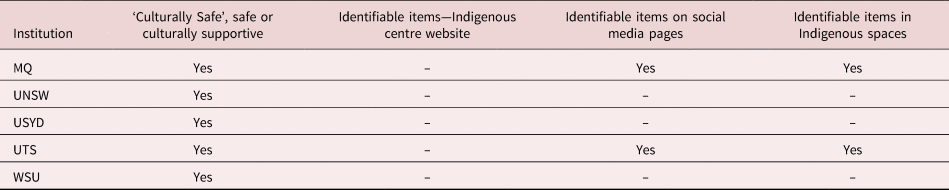
As shown in table 1, all five universities' Indigenous student spaces listed themselves as culturally safe, safe or culturally supportive spaces on their websites. No statements, imagery or other identifiable items for QGD Indigenous students were found on any of the Indigenous student spaces' websites. All five universities had similar statements that made clear their centres were ‘culturally safe’, for example, UTS states ‘The Jumbunna Institute for Indigenous Education and Research supports the academic, social, cultural and emotional well-being of Aboriginal and Torres Strait Islander students’ (Jumbunna, 2018). The Indigenous student spaces at both Macquarie University (MQ) and University of Technology Sydney (UTS) had identifiable items in posts on their social media pages, for example, MQ posted on 17 May 2017 ‘Walanga Muru recognises today as International Day Against Homophobia and Transphobia (IDAHOT). Today we acknowledge and celebrate our LGBTQI + family, friends and Community members. Our diversity is our strength’ the post was also accompanied with a pride flag (Walanga Muru, 2017). MQ's Indigenous space directly acknowledged QGD Indigenous people on their Facebook page in other posts to celebrate and market particular important dates including Sydney's Gay and Lesbian Mardi Gras and Valentine's Day, and posted images from an IDAHOT (International Day Against Homophobia and Transphobia) event. Both MQ and UTS had identifiable items in the public areas of their Indigenous student spaces including queer pride flags, Indigenous artwork, posters, stickers and pamphlets, for example, we found stickers indicating staff were affiliated with the university's ‘ally network’, posters with queer pride flag colours with wording such as ‘you are loved’, and pamphlets promoting sexual health for same-sex attracted people. The Indigenous online space at USYD reposted two articles about QGD issues on Twitter from an Indigenous academic and an Indigenous journalist.
Presence of university Queer visibility

MQ, Macquarie University; UNSW, University of New South Wales; USYD, The University of Sydney; UTS, University of Technology Sydney; WSU, Western Sydney University.
These findings suggest while cultural safety is listed as a value across these Indigenous student higher education spaces, little is being done to communicate safety and inclusion to QGD Indigenous students. From a Queer Indigenous Standpoint, there are few identifiable items visible in the online and on-site Indigenous student spaces included in this study. Less than half had identifiable items visible on their social media pages and in the public areas of their Indigenous student spaces. Although there were universities that did have identifiable items on their social media pages, they were not prominent or quick to locate. From the perspective of a potential or current QGD Indigenous student of these universities considering entry to or participation in these spaces, there is little that appears welcoming, safe or inclusive. As previously intimated, visual images are of particular importance for Indigenous students (Harrison and Greenfield, Reference Harrison and Greenfield2011), and are also an important factor for QGD students (Nicolazzo, Reference Nicolazzo2016). Although there are other measures of safety and inclusion that should be explored in further research, the findings from this study demonstrated from a Queer Indigenous Standpoint, claims of cultural safety, are redundant for QGD Indigenous students in these Indigenous higher education spaces.
An area of particular concern is the requirement by universities for Indigenous students to provide Confirmation of Aboriginality. In Australia, Indigenous people are not required to have their confirmation of Indigeneity unless they are accessing Indigenous-specific services or programmes that request it. For Indigenous Australian people and Indigenous people globally ‘self-determination and self-identification are their inherent and inalienable rights’ (Dodson, Reference Dodson1994, p. 6). However, that right is often not exercised because we as Aboriginal people necessarily feel the need to confirm our identities, rather it is a force of institutional and governmental processes. The process of confirmation of Aboriginality is at once both a ‘demand imposed by the nation-state’, yet simultaneously ‘an instrument of Aboriginal collective political self-determination’ (Carlson, Reference Carlson2016, p. 162). Those that are required to produce a confirmation of Indigeneity as a proof of their Indigenous Australian heritage must engage in a process of identifying their family history and genealogy, be accepted by the Indigenous community, and must readily self-identify as Indigenous (Bodkin-Andrews and Carlson, Reference Bodkin-Andrews and Carlson2016). This three-part criterion was initiated in the late 1970s by the Australian government for the purposes of administering resources and funding. The requirement to produce a confirmation of Aboriginality can be an entirely divisive affair, is it about individual self-determination, community politics, governmental processes or Aboriginal sovereignty?
With the exception of Macquarie University, the universities canvassed in this study required Confirmation of Aboriginality to gain full access to Indigenous services. Such necessity can be seen as a significant barrier to access and participation for QGD Indigenous students. Carlson (Reference Carlson2016) has written about the process of obtaining formal Confirmation of Aboriginality as one of the ways Indigenous and non-Indigenous apparatuses combine to regulate who can identify. She highlights one-third of the three part criteria, that an individual must be recognised and accepted by the community that they live in, can be exclusionary for many Aboriginal and Torres Strait Islander people:
In some cases, establishing community acceptance can be fraught for those without kin connections, a history of residence in a local area, the visible physical markers of Aboriginality or a particular colonial experience. This is especially so if those who oversee verification of the processes and documents either do not know an applicant or for whatever reason are not kindly disposed towards them (Bodkin-Andrews and Carlson, Reference Bodkin-Andrews and Carlson2016, p. 5).
In short, identity can be used as a means to both include and exclude. This is particularly problematic for QGD Indigenous people as these western euro-centric processes of colonial identification are subjected to policies in which demanding evidence of identity and connection can sometimes be impossible to prove. Whittaker surmises that:
‘Such systems neglect those for whom the impact of colonial frameworks means an actual or discursive separation from Country and Kin. With increasing population shifts from predominantly Indigenous rural communities to the metropole, the uprooting of populations from groups that might discharge one or several evidentiary burdens in identification presents some concern. Utilising white law as gatekeepers to formal identification—and thus to necessary services and policy—can entrench the disenfranchisement of these queer Indigenous diasporas' (2015, p. 229).
It is our position that Queer Indigenous Standpoint theory must engage with Confirmation of Aboriginality in its critique of institutions. If we are to engage in queer(ing) and decolonising practice, we must address how heteronormativity and racism combine in the implementation of Confirmation of Aboriginality to exclude QGD Indigenous people. There are significant factors in QGD Indigenous people's lived experiences that prevent us from gaining Confirmation of Aboriginality. Discrimination and dislocation are among them but name changes for Transgender Indigenous people, fear of violence/rejection and family and/or community disownment are on top of the already existing challenges for Indigenous people to prove their identity and community belonging. Not only can this process deny QGD Indigenous people access to educational opportunity, but it can also prevent access to spaces where we are able to (re)connect to our identities and communities. Findings related to Confirmation of Aboriginality are significant to this study as from a Queer Indigenous Standpoint it can be a signifier of inclusion or exclusion. This is certainly an area that requires further discussion, research and critique.
Conclusion
As marginalised people within an already marginalised community, QGD Indigenous students rely on identifiable items to navigate communities and spaces. However, QGD Indigenous students require more than acceptance and safety. Like all Indigenous students, QGD Indigenous students require Indigenous student higher education spaces which actively embrace us as members of communities and empower us to succeed in our education pursuits and careers. However, there are currently no processes in place to encourage QGD Indigenous university participation, progression and retention. There is a significant lack of data in this area. It is possible to suggest that, so far, Indigenous education research has been largely hetero and cis-normative in the sense that it assumes heterosexuality and overlooks queerness and gender diversity. It is time for Indigenous education research as well as Indigenous student spaces to be queer-ied.
While communicating safety and inclusion to QGD Indigenous students is important to increasing participation and access to Indigenous spaces, it does not replace the need for significant structural changes in higher education. Page et al. (Reference Page, Trudgett and Sullivan2017) highlight the relationship between Indigenous student access, retention and success and the inclusion of Indigenous peoples in university governance and management. Indigenous communities, including QGD Indigenous communities, must be included in decision-making processes in higher education.
It is clear from this study that the institution currently leading the way in the inclusion of QGD Indigenous student spaces is Macquarie University followed by the University of Technology Sydney. Evidently the universities canvassed for this study need to do much more to include QGD students. The onus for Indigenous QGD inclusion cannot fall solely on Indigenous student spaces. On campus queer spaces as well as Equity and Diversity units and indeed the broader university need to do more for Indigenous and QGD students. The importance of Indigenous QGD inclusion in Indigenous student spaces is, in part, relevant to a climate of hostility and exclusion experienced by Indigenous students across the broader university. Whilst identifiable items require some resourcing, the larger implication identified in this study for integration and inclusion of queered Indigenous spaces will require education for staff and other Indigenous students. The discussion in this paper has identified that students elect universities based on spaces that they feel that they belong. Institutions of Higher Education, and in particular Indigenous spaces within these institutions are called upon to create inclusive, culturally safe climates that celebrate sexual and gender diversity, to increase the participation, retention and success of Indigenous QGD students.
Corrinne Sullivan is an Aboriginal scholar from the Wiradjuri Nation in Central-West New South Wales. Her research interests are multi-disciplinary and focus broadly on experiences and effects of body and identity in relation to Aboriginal and Torres Strait Islander people. Corrinne's knowledges stem from the disciplines of Indigenous Studies and Human Geography, and she utilises both to understand the ways in which Aboriginal and Torres Strait Islander peoples are affected by their experiences of space and place.
Madi Day is a queer and gender diverse indigenous undergraduate student, and a research cadet in Indigenous Studies at Macquarie University.