Introduction
Marker-assisted selection (MAS) may provide the opportunity to make significant genetic gain in the improvement of economic traits in livestock. Implementation of the approach will first require identification of candidate genes or anonymous gene markers associated with the traits of interest. Candidate genes are those with a known relationship between physiological or biochemical processes and an economically important trait. In dairy cattle, genes associated with mammary gland growth, development and function are excellent genes for milk production traits.
Leptin is a hormone that is predominantly secreted from white adipose tissue and performs important roles in controlling body weight, milk production, feed intake, immune function and reproduction (Block et al., Reference Block, Butler, Ehrhardt, Bell, Van Amburgh and Boisclair2001). The primary factors affecting plasma leptin levels are body fat mass and energy balance (Block et al., Reference Block, Butler, Ehrhardt, Bell, Van Amburgh and Boisclair2001). Leptin binds to a receptor mainly localized on neuropeptide Y neurons, which results in a reduction of feed intake and an increase of energy expenditure. Neuropeptide Y is also involved in the control of reproductive function (Magni et al., Reference Magni, Motta and Martini2000). Genetic difference in the leptin gene was first observed in mice; ob/ob mice lack functional leptin and are hyperphagic, obese and infertile (Hamann and Matthaei, Reference Hamann and Matthaei1996). When leptin is administered, fertility is restored and body fat mass is reduced (Halaas et al., Reference Halaas, Gajiwala, Maffei, Cohen, Chait, Rabinowitz, Lallone, Burley and Friedman1995).
Several polymorphisms in leptin gene have been found. In exon 2, two restriction fragment length polymorphisms (RFLP) were described: CalaI (an A/T substitution resulting in an amino acid change from tyrosine to phenylalanine) (Lagonigro et al., Reference Lagonigro, Wiener, Pilla, Woolliams and Williams2003) and Kpn2I (a C/T substitution resulting in an amino acid change from arginine to cysteine) (Buchanan et al., Reference Buchanan, Fitzsimmons, Van Kessel, Thue, Winkelman-Sim and Schmutz2002). Another two RFLP were identified in exon 3: NruI (a C/T substitution resulting in a change from valine to alanine) (Lagonigro et al., Reference Lagonigro, Wiener, Pilla, Woolliams and Williams2003) and HphI (a C/T substitution resulting in a change from alanine to valine) (Haegeman et al., Reference Haegeman, Van Zeveren and Peelman2000). Moreover, a Sau3AI polymorphism in intron 2 was found (Pomp et al., Reference Pomp, Zou, Clutter and Barendse1997).
Buchanan et al. (Reference Buchanan, Fitzsimmons, Van Kessel, Thue, Winkelman-Sim and Schmutz2002) reported that a C to T transition in exon 2 of leptin that encodes on Arg25cys substitution is associated with body fat deposition in beef cattle. The T allele is associated with increased fat deposition and higher leptin mRNA levels in adipose tissue. Before calving, increased body condition provides energy stores to support milk production. Nevertheless, during early lactation dairy cattle are in negative balance. Body fat reserves play an important role in sustaining high milk production in early lactation, when the energy intake is limited. Buchanan et al. (Reference Buchanan, Van Kessel, Waldner, Christensen, Laarveld and Schmutz2003) have shown that animals homozygous for the T allele produced more milk (1.5 kg/day v. CC animals) and had higher somatic cell count linear scores, without significantly affecting milk fat and protein percentage over the entire lactation. Madeja et al. (Reference Madeja, Adamowicz, Chmurzynska, Jankowski, Melonek, Switonski and Strabel2004) did not find any effect of the SauA3I and Kpn2I polymorphisms, but they showed that the HphI polymorphism had an effect on the breeding value of milk production.
Objectives of this study were to detect genetic variants in leptin gene as the candidate gene in Iranian Holstein proven bulls and to test the effect of genetic polymorphisms on milk production traits and also to estimate the average effect of allele substitution.
Materials and methods
Semen samples from 134 Iranian Holstein proven bulls were obtained from the Animal Breeding Center of Iran. Genomic DNA was extracted according to Zadworny and Kühnlein (Reference Zadworny and Kühnlein1990). The 94 bp fragment of exon 2 of the bovine leptin gene was amplified using the following primers: 5′ ATG CGC TGT GGA CCC CTG TAT C 3′ and 5′ TGG TGT CAT CCT GGA CCT TCC 3′. A single reaction (25 μl) contained the following constituents: 10X PCR buffer(16 mM (NH4)2SO4, 67 mM TrisHcl pH 8.8, 0.1% Tween-20), 2.5 mM MgCl2, 200 μM dNTP, 10 pmol of each primers, 1 U Taq polymerase (Metabion, Martinsried, Germany) and 50 to 100 ng of genomic DNA. The amplification program consisted of an initial denaturation at 94°C for 2 min, then 35 cycles of 94°C for 45 s, 59°C for 30 s and 72°C for 30 s. A final extension of 72°C was maintained for 3 min.
A single digestion reaction consisted of 10 μl of the PCR product, 3.5 U (0.35 μl) of Kpn2I enzyme (Fermentase GmbH, Germany), 1.5 μl Tango buffer and 3.15 μl nuclease-free water. The final reaction volume of 15 μl was incubated at 55°C for 4 h. The fragments were separated on a 3% agarose gel by electrophoresis.
Calculation of allele frequency was based on the direct gene count method by (2n TT + n TC)/2n, and the standard error of frequency was calculated as  , where n is the sample size, p is the frequency of the T allele, and n TT and n TC are numbers of TT and TC types, respectively (Falconer and Mackay, Reference Falconer and Mackay1996). The χ 2 test was used to determine the Hardy-Weinberg equilibrium (Statistical Analysis Systems Institute (SAS), 2002). Statistical description of data and pedigree is shown in Table 1. Breeding values for milk-related traits (milk, fat and protein yield; and fat and protein percentage) were estimated using the first lactation data and the BLUP based on an animal model with a relationship matrix. The analysis was conducted using AI-REML procedures as programmed in the MATVEC package (Wang et al., 2002). The model included animal effect as random effect and age of calving as the covariate factor and fixed effect of herd–year–season.
Statistical description of data and pedigree for milk traits

The effect of leptin genotypes on the estimated breeding values for milk-related traits was analyzed using the least square method of the GLM procedure of SAS (2002) software. As the breeding values are the best available estimates of the additive genotype of the bulls, no environmental effects were included in the model. The used model was as follows:

where Yijk is the breeding value for milk-related traits, μ is the least square means of the traits, yeari is the effect of the ith birth-year of the bull (genetic trend), Gj is the effect of the jth genotype (j = 1, 2, 3) and eijk is the random residual effect. A Tukey-Kramer correction was used to evaluate the effect of leptin polymorphism.
Regression analyses were performed in which EBV for milk, fat, protein yield and percentage were the dependent variables, and the genotype was the independent variable. Average effect of allele substitution was determined by coding genotypes as 0 (CC), 1 (TC) and 2 (TT) to represent the number of T alleles present for the leptin polymorphism. As described by Falconer and Mackay (Reference Falconer and Mackay1996), the regression coefficient (α) estimates the average effect of allele substitution, or the average effect of replacing a C allele with a T allele. The y-intercept (a) estimates the average value of the CC genotype and dominance deviations (d) are estimated by the difference between observed and predicted values at the TC genotype.
Results and discussion
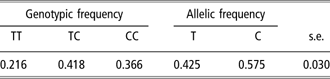
In this study that involved the 94 bp leptin fragments, we identified three Kpn2I digestion patterns in the Holstein proven bulls, indicating the following three genotypes: a 94 bp fragment indicated as TT genotype; 75 and 19 bp fragments as CC genotype; and 94, 75 and 19 bp fragments as TC genotype. Table 2 outlines the gene and genotypic frequency of Iranian Holstein bulls.
Distribution of leptin genotypes in Iranian Holstein proven bulls
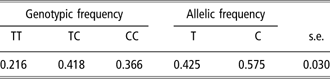
The T allele frequency was 0.425. Genotypes are distributed according to the Hardy-Weinberg equilibrium. The T allele frequency obtained in our study is in agreement with those reported by the other researchers, for example, Holstein, 0.46; Ayrshire, 0.62; Brown Swiss, 0.45; and jersey, 0.53 (Buchanan et al., Reference Buchanan, Van Kessel, Waldner, Christensen, Laarveld and Schmutz2003); Angus, 0.58; Herford, 0.55; Charolais, 0.34; and Simmental, 0.32 (Buchanan et al., Reference Buchanan, Fitzsimmons, Van Kessel, Thue, Winkelman-Sim and Schmutz2002) and Holstein Friesien cattle, 0.40; Jersey, 0.56 (Choudhary et al., Reference Choudhary, Kumar, Bhattacharya, Bhushan and Sharma2005) and Polish Black and White proven bulls 0.46 (Madeja et al., Reference Madeja, Adamowicz, Chmurzynska, Jankowski, Melonek, Switonski and Strabel2004).
The polymorphism located in exon 2 is a cytosine to thymine transition and is located in the first base position of the 25th codon. It changes the commonly reported amino acid at that position, an arginine (the C allele), into a cysteine (the T allele). The C allele was cleaved into two fragments of 75 and 19 bp, while the T allele remained uncut at 94 bp. The data set included 710 herds and production records for the first lactation between 1990 and 2007. The number of daughters for each bull was between 42 and 3066 and reliability was between 79.40 and 99.08. Six generations of pedigree were used for estimation of the breeding value. Relationship between bulls was 0.0001 to 0.39.
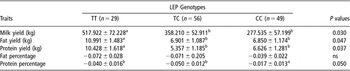
The effect of the genotypes of the Kpn2I polymorphism on the breeding values for milk-related traits was examined using least square methods. Least square means of the three leptin genotypes are presented in Table 3. The TT genotype was associated with higher milk, fat and protein yield compared to other genotypes (P < 0.05). The CC genotype had higher protein percentage compared to TT and TC bulls (P < 0.05). No associations (P > 0.1) were found between the genotypes and fat percentage. Buchanan et al. (Reference Buchanan, Fitzsimmons, Van Kessel, Thue, Winkelman-Sim and Schmutz2002) reported that the T allele was associated with fatter carcasses and the C allele with leaner carcasses. In the current study, we observed an increase in fat yield associated with the T allele. Animals homozygous for T allele expressed higher levels of leptin mRNA (Buchanan et al., Reference Buchanan, Fitzsimmons, Van Kessel, Thue, Winkelman-Sim and Schmutz2002). Buchanan et al. (Reference Buchanan, Van Kessel, Waldner, Christensen, Laarveld and Schmutz2003) demonstrated a striking impact of leptin genotype on milk yield, particularly in early lactation. Over the entire lactation, the TT genotype was associated with an increase in test-day milk yield of 1.5 kg/day v. the CC genotype. Kononoff et al. (Reference Kononoff, Deobald, Stewart, Laycock and Marquess2005) reported that the carcass weight of animal with the CC genotype tended (P = 0.07) to be higher than those of the TT genotype (365.5 v. 362.3 kg) but no significant difference was found between the TT and TC genotypes in carcass weight. The amino acid change from arginine to cysteine imparts a functional difference to the leptin molecule. One explanation may be that the presence of cystein in the A-helix of the leptin molecule may disrupt the binding of leptin to its receptor. Another explanation for a functional change may be that the presence of another unpaired cysteine in the leptin molecule could destabilize the disulfide bridge found between the two existing cytosines. This disulfide bridge has been shown to be critical for biological function (Rock et al., Reference Rock, Altman, van Heek, Kastelein and Bazan1996). Madeja et al. (Reference Madeja, Adamowicz, Chmurzynska, Jankowski, Melonek, Switonski and Strabel2004) did not find any association between the Kpn2I polymorphism and production traits. The reason for the conflicting results might be that the associations are due to the effects of linked genes rather than to the effects of leptin gene. In this case, the association in different populations might differ. Other reasons could be the statistical model used to analyze the data and small number of animals studied. In addition to genotype, many other factors influence milk yield and composition. These include environmental factors, the cow’s age, lactation parity and stage, and the animal’s health with special reference to the mammary gland. Although many nongenetic factors are included in the genetic evaluation model, they may still interfere with the genetic component.
Least square means and standard errors of breeding values for milk, fat and protein yield and percentage in Iranian Holstein bulls with different leptin genotype

Values with different superscripts are significantly different (P < 0.05).
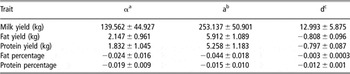
The average effects of replacing a C allele with a T allele are given in Table 4. The average effects of the gene substitution for Kpn2I amounted to 139.5 kg for milk yield, 2.1 kg for fat yield and 1.83 kg for protein yield, and −0.024 and −0.019 for fat and protein percentage, respectively.
Results from regression analyses of breeding value for milk, fat, and protein yield, and fat and protein percentage

aAverage effect of allele substitution.
bAverage breeding value of the CC genotype.
cDominance deviation.
In summary, association of the Kpn2I polymorphism on the breeding value for milk, fat, and protein yield and protein percentage was significant. The association of this polymorphism of leptin with milk production traits suggests that this marker may be useful for selecting animals based on difference at the DNA level.
Acknowledgments
This work was financially supported by the University of Tehran, Iran. Data and pedigree records and semen of Iranian Holstein bulls were provided through the Animal Breeding Center of Iran.