


Introduction
Soil science, a branch of knowledge that integrates studies on the distribution, formation, morphology and classification of soil (Gregorich et al. Reference Gregorich, Turchenek, Carter and Angers2001) and traditionally associated with food production, was developed mainly from the perspective of the farmer, which prevented, for some time, the study of soils in cold regions with low agricultural potential. Nevertheless, in light of the global climate change situation, there has been a growing recognition of the importance of polar soils as critical indicators of global environmental conditions (Brevik Reference Brevik2013).
However, it was not until the late 1990s that official soil classification systems included soils from polar and alpine regions. The introduction of the classes ‘Gelisols’ (Soil Taxonomy in 1999) and ‘Cryosols’ (World Reference Base for Soil Resources in 2006) was a significant step in recognizing these soils, which are influenced by ice and often impacted by permafrost. Geographically, studies on Antarctic soils take place in the ice-free regions (Fig. 1) after initially focusing on the Transantarctic Mountains region in the 1960s (Bockheim Reference Bockheim2015).
Ice-free regions of Antarctica, elaborated by the author based on Bockheim (Reference Bockheim2015). In order to facilitate visual analysis, the dimensions of the ice-free regions were enlarged to twice their original scale. a. Antarctic Peninsula. b. Ellsworth Land. c. Pensacola Mountains. d. Queen Maud Land. e. Enderby Land. f. Mac.Robertson Land. g. Wilkes Land. h. Transantarctic Mountains. i. Marie Byrd Land.

The objective of this study was to conduct a scientometric review of the scientific literature on Antarctic soils, spanning the period from 1958 to 2021, to gain a comprehensive overview of research in this field. Additionally, given the significance of geographical and spatial aspects in analysing scientific activity (Frenken et al. Reference Frenken, Hardeman and Hoekman2009, Xuemei et al. Reference Xuemei, Mingguo, Xin and Zhiqiang2014), the study employed spatial scientometrics methods to analyse the spatial distribution characteristics and research trends of Antarctic soils, utilizing site data from sampling locations (Xuemei et al. Reference Xuemei, Mingguo, Xin, Michel and Civco2011). This approach enabled mapping and spatial analysis considering the proximity aspects of variables such as the researchers’ countries of affiliation, the historical and geographical context of sampling as well as the research topics addressed.
Scientometric analysis involves the quantitative and qualitative analysis of scientific research activity and knowledge construction (Callon et al. Reference Callon, Courtial, Penan and Arenas1995), providing insights into the development and emerging trends within specific scientific fields. While scientometric studies in soil science are still scarce, some notable research has focused on soil erosion (Zhuang et al. Reference Zhuang, Du, Zhang, Du and Li2015), soil science as a whole (Oliveira Filho Reference Oliveira Filho2020) and soil microbiology-vegetation relationships (He et al. Reference He, Lan, Zhang and Ye2022). However, there has been no scientometric study specifically exploring soil research in Antarctica.
Materials and methods
The Web of Science (WoS) and Scopus databases were used for data retrieval. Together they cover a wide range of international scientific bibliographic data. Therefore, it is necessary to group the researched topic into key words. The goal is to create a search structure with the widest coverage and accuracy for finding the desired data.
Thus, two sets of key words were compiled that articulate the main ideas/concepts that the topic addresses. The books The soils of Antarctica (2015) and Cryopedology (2014), both organized and authored by James Bockheim (Reference Bockheim2014, Reference Bockheim2015), were used to select the key words. The groups of words were labelled ‘Main Terms’ and ‘Thematic Terms'. The ‘Main Terms’ are Antarctica and Antarctic. The ‘Thematic Terms’ are soil, Cryosol, Gelisol, pedology, cryogenic, permafrost, active layer, pedogeomorphology and soilscape. The terms formed the following search code: (TITLE ((Soil* OR Pedology* OR Pedogeomorphology* OR Cryosol* OR Gelisol* OR Soilscape* OR ‘active-layer’ OR permafrost OR cryogenic*) AND antarctica*) OR AUTHKEY ((soil* OR pedology* OR pedogeomorphology* OR cryosol* OR gelisol* OR soilscape* OR ‘active-layer’ OR permafrost OR cryogenic*) AND antarctica*)) AND (LIMIT-TO (DOCTYPE, ‘ar') OR LIMIT-TO (DOCTYPE, ‘ch')).
The search for terms was limited to the title and key words fields, as the terms placed in these sections are the main topics of the works. Publications on soils whose research had Antarctica as the study area, defined here by the Antarctic Treaty System (ATS) area of jurisdiction (i.e. at latitudes > 60° S), were analysed.
Data were extracted in February 2022. Search parameters yielded 721 records in Scopus and 641 in WoS. After removing duplicates and cleaning the data, 553 publications remained, covering the period 1958–2021. Data were processed using Microsoft Excel 2016 and VOSviewer 1.6.18 software. The latter is a tool for processing and displaying data and bibliometric networks. Such networks can include journals, authors, institutions, countries, publications and key words representing citation relationships, coauthorship and others.
VOSviewer handles the different file extensions coming from each database. As the Scopus database provided a larger number of records, the Scopus database file was considered as the reference (.csv) for merging the information into a single file. For publications that existed in both databases, the information from the Scopus database was retained. In addition, publications were classified according to their main topic, with reference to the departments and committees of the scientific structure of the Brazilian Soil Science Society. Other classes were added as needed.
The data analysis used the science mapping approach, which is based on a visual representation of the structure of the research field by distributing elements (publications, authors, journals, words, etc.) in different groupings (clusters). The network visualization is then used to create a spatial representation of the results in analogy with geographical maps. Science mapping has a macro focus and seeks to find patterns in the literature, which is considered as a body of work (Cobo et al. Reference Cobo, López-Herrera, Herrera-Viedma and Herrera2011, Zupic & Čater Reference Zupic and Čater2015). The treatment of bibliographic data was conducted according to the analysis protocol (Supplemental Table 1).
For the spatial analysis, the mapping approach was based on visualizing the occurrence of specific events. In this case, each event corresponds to the collection of a soil sample. For this purpose, geographical coordinates were extracted from the 553 publications. The first publication on an Antarctic soil (Jensen Reference Jensen1916) was added to the data as a historical milestone and benchmark for data interpretation.
Regarding the coordinate extraction process, it is essential to clarify that if the publications contained coordinates and/or maps, all registered points were extracted. If there was a textual indication of the area or physiographic element, only one point (in the central area) was included. Therefore, coordinates were not checked if the study's location was unknown or if it was not possible to access the publication or its summary. Only locations in the ATS area of jurisdiction were considered. In this way, a table was created with information on the location, year of publication, title, authors’ countries of affiliation and topic.
One or more topics were assigned to each document, depending on the case and the research focus. For example, if the article deals with biochemical aspects of soil, the topics ‘soil biology’ and ‘soil chemistry’ are assigned to it; if it deals with the spatial distribution of soil organisms, the topic ‘soil biogeography’ was assigned to it. In this way, it was possible to identify the most frequent aspects and to illustrate the general profile of the soil research. For the final analysis, each topic was counted individually.
The points were georeferenced using GIS software to make locations, and density maps (kernel density) were created to identify the hotspots studied. The spatial distribution patterns at continental and regional scales were analysed. The proximity between sampling points and existing facilities (research stations, semi-permanent camps and laboratories) was also assessed.
Overview and trends of publications
The distribution of documents by publication date (Fig. 2) covers a considerable period of 64 years. A general upward trend can be seen from 1958 to 2021, which can be divided into three distinct periods, one of which is a transitional period. The fluctuations in the number and distribution of publications indicate a dynamic development in the research field, with high productivity starting in 2013.
Scientific production (publications) per year between 1958 and 2021. WRB = World Reference Base for Soil Resources.

The first period (1958–1994) is characterized by low field productivity, with fewer than five annual publications. However, this period was fundamental for gathering initial information, establishing the foundations of Antarctic cryopedology and developing classification schemes for those soils. The work of researchers such as Campbell, Claridge, Tedrow, McCraw, MacNamara, Ugolini, Bockheim, Cameron and others was fundamental. These publications account for 11.6% of the total.
The transition period (1995–2012) is characterized by fluctuating growth, accounting for 38.3% of the total publications. The publication pattern changed from 9 to 27 annual publications. Important events for cryopedology occurred during this period: the classes of Gelisols and Cryosols were officially introduced, and the research carried out in the framework of the International Polar Year 2007–2008 marked the beginning of a period of greater productivity that was consolidated from 2012.
In addition, 1995–2012 saw increased concern about global climate change as it relates to the polar regions. An example of this was the adoption of the Protocol on Environmental Protection to the Antarctic Treaty in 1998, which reaffirmed the commitment to environmental protection and influenced several studies on pollution, remediation and restoration of soils and terrestrial ecosystems.
The consolidation period (2013–2021) is characterized by high productivity in the area (50.18% of the total), an increase in the number of scientists involved (from 100 authors in the first period to more than 900 in the third period), a high level of coauthorship between them (Fig. 3) and a high level of internationalization. Table I summarizes all of the data.
Coauthorship network.

Synthesis of data from publications in the Web Science and Scopus databases.

The soils of Antarctica have attracted the attention of researchers from around the world and have become a hotspot of Antarctic research in the last 10 years. The set of publications (553 records) consists mainly of journal articles (98%), but there are also articles from events, data and book chapters. Some 96% of the publications are in English language, but Russian, Spanish, Chinese, German, Korean and Portuguese publications also occur. Aspects of citation (such as number of citations per publication, per journal and per author) and coauthorship (between researchers, institutions and countries) are discussed in more detail in the following sections.
Coauthorship analysis
Coauthorship analysis enables the identification of the key researchers, institutions and countries involved in the literature, thereby facilitating the construction of coauthorship networks. By examining these elements, this analysis uncovers patterns of collaboration and sheds light on the interconnectedness of the field.
Authors’ networks
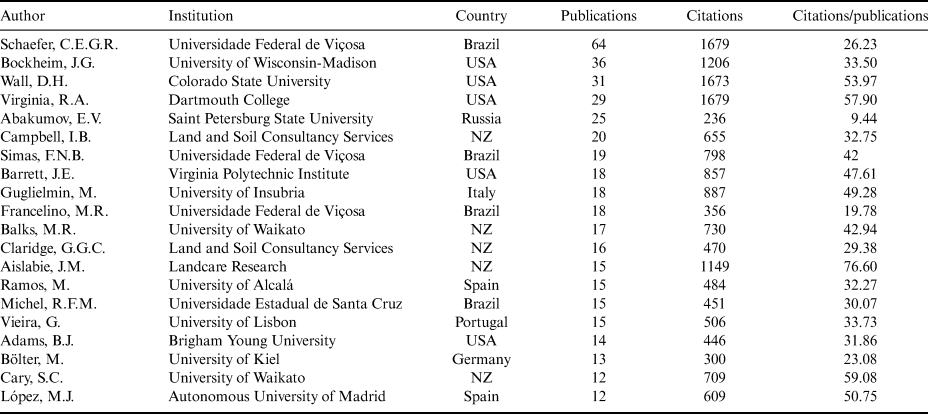
Based on the distribution of publications by author, the 20 most prolific authors were identified. According to Table II, Carlos Schaefer (Federal University of Viçosa), James Bockheim (University of Wisconsin-Madison) and Diana Wall (Colorado State University) are the authors with the highest number of publications.
The 20 most productive authors.
NZ = New Zealand.
When analysed by number of citations, authors such as Ross Virgínia (Dartmouth College) stand out as the most cited, along with Carlos Schaefer. The average number of citations per publication also highlights authors such as Jackie Aislabie (Landcare Research) and Stephen Cary (University of Waikato), with 76.60 and 59.08 citations per publication, respectively.
Coauthor networks, in which each node represents an author and the links between them, indicate collaboration through coauthorship in publications (Fig. 3). Only authors with three or more publications were considered when creating this network (i.e. 178 authors, of whom 133 were coauthors, resulting in 662 connections in the network). The sizes of the circles in Fig. 3 correspond to the number of publications.
In terms of collaboration, this network indicates strong interconnection between the different clusters. Several research communities were identified (black circles in Fig. 3) in which many authors collaborate with one or two very prolific authors (generally those listed in Table II).
A node with high betweenness centrality generally links two or more clusters, as in the case of J.G. Bockheim, I.B. Campbell, G.G.C. Claridge and M.R. Balks. Such authors are involved in a greater extent of subtopics in research and publications. When there is a large interaction between one or more scientific communities, there is no defined centrality, as in the case of the circle in Fig. 3 in which M. Guglielmin, N. Cannone, M. Ramos and D. Wagner, amongst others, are found.
There is a certain coherence in the groups of authors when considering the information regarding institutions and countries. Authors from the same institutions and/or countries tend to be closer to each other when grouped in the coauthorship network, which can be seen in the circles in Fig. 3 where C.E.G.R. Schaefer, E.V. Abakumov, M. Boelter and D.H. Wall can be found.
When analysing the distribution of the 10 most productive authors over the three periods (Fig. 2), as shown in Table III, productivity can be seen to be lower in the first period than in the other two periods.
Most productive authors in each period by number of publications.

From this distribution, we can see the changes in the authors’ contributions over time. At each stage different authors have contributed to the field, and some continue to be active in all areas, such as J.G. Bockheim, one of the pioneers of research on Antarctic soils.
Country and institution network
A network was created from the authors’ institutions and countries of origin. The countries network has 49 nodes and 222 connections. The sizes of the circles in this network (Fig. 4) also indicate the total number of publications. As shown in Fig. 4, the USA (161 publications), New Zealand (88) and Brazil (85) were the largest contributors in terms of number of publications and citations, indicating a concentration of productivity and impact in the literature.
Coauthorship network by country.

The USA has strong partnerships with New Zealand and Canada, but it also has close collaborations with Australia, the UK and China. Brazil has strong collaborations with the USA, New Zealand, Italy and Spain. Through the network, it is possible to identify the most important countries in this area and those that have made the greatest contributions to the field.
Not surprisingly, the USA has made the largest contribution, being the country with the highest investment in its Antarctic programme and with its research stations having the largest staffing capacity on the continents and being located in the most explored regions (Antarctic Peninsula and Transantarctic Mountains). The average number of citations per publication shows that countries such as South Africa, the UK and Italy have had a significant impact on the literature despite producing fewer publications (Table IV).
Number of publications and citations by country.

When analysing the contributions by country over time (Table V), the role of the USA over the three periods is clear, but so is increasing impact of countries such as Brazil and Spain. The constant contribution of countries such as New Zealand, Australia, Germany and China is striking. Also interesting is the case of Canada and Portugal, countries without Antarctic research stations but which achieved relatively high productivity through scientific cooperation and by sharing scientific expertise.
Most productive countries in each period by number of publications.

Institutional contributions were also identified (Table VI). Institutions involved in the development of research on Antarctic soils included the Federal University of Viçosa (66 publications), the University of Waikato (56 publications), Colorado State University (43 publications) and the University of Wisconsin-Madison (36 publications). These institutions can be considered global research centres on this topic. Dartmouth University, the University of Insubria, the British Antarctic Survey and the Universidad Autónoma de Madrid are also characterized by a high average number of citations per publication.
Number of publications and citations by institution of affiliation.

The network depicted in Fig. 5 was constructed from institutions that have produced at least three publications, totaling 123 institutions. However, only 111 of these institutions are interconnected in the network through coauthorship. Countries and institutions with a high betweenness centrality were considered. Countries such as the USA, Germany, Australia and New Zealand and institutions such as Colorado State University, the University of Waikato and the University of Wisconsin-Madison occupied key positions in the networks, linking research activities between different clusters (Figs 4 & 5).
Coauthorship network by institution.

The contributions of institutions over time were also analysed (Table VII). Over time, it can be observed that institutions from developing countries are making important contributions to this topic. Institutions in countries such as Brazil, Spain and Portugal showed high productivity in the last period, a trend that began in the preceding period. In addition to the map of cooperation between countries and institutions, there is a lively scientific exchange between pioneer countries such as the USA, New Zealand and Germany and countries that started their research later, such as Brazil, Russia, Spain and Portugal.
Most productive institutions in each period by number of publications.

NZ = New Zealand.
Key word co-occurrence analysis
In the WoS and Scopus databases, there are two types of key word: 1) ‘author key words', which are provided by the authors, and 2) ‘indexed key words', which are identified through journals. For this analysis, priority was given to the first type. Indexed key words were only used in the absence of author key words.
Key words represent the focus of research and are intended to convey the essence of an entire text. In general, bibliometric analysis tools have a key word co-occurrence analysis function that measures the number of occurrences of terms within the analysed literature. In this work, the parameters were refined to reveal search foci, setting a threshold of at least three occurrences of key words.
Of the total 1400 key words, 213 occurred more than twice. Non-meaningful terms such as ‘article’ or ‘research’ were manually removed, as were toponyms (geographical locations) such as ‘Dry Valleys’ or ‘Antarctic Peninsula'. The network created provides an overview of the different disciplines involved in Antarctic soils research that can be grouped into larger study areas (Fig. 6).
Key words network.

The sizes of the circles in Fig. 6 indicate how often the key word occurs in the dataset. The 10 most frequent key words were ‘Antarctica’ (frequency = 305), ‘soil’ (frequency = 133), ‘permafrost’ (frequency = 81), ‘active layer’ (frequency = 44), ‘Gelisol/Cryosol’ (frequency = 37), ‘carbon’ (frequency = 35), ‘climate change’ (frequency = 35), ‘microbial’ (frequency = 32), ‘ornithogenic soils’ (frequency = 32), and ‘pollution’ (frequency = 32).
This information shows that research on Antarctic Gelisols/Cryosols is mainly focused on the study of permafrost and the active layer. Soil chemistry topics, particularly carbon and pollution, are also informative. The class of ornithogenic soils, formed by the action of guano from birds, is also receiving considerable attention from researchers.
Soil microbial fauna is also the subject of intense research from various perspectives within soil microbiology and biogeography. Finally, climate change concerns can be interpreted as a background issue that permeates all research on Antarctic soils since c. 2000.
Three areas were identified for study: 1) the area of geoscience, where topics such as soil formation, morphology, classification and thermal regimes predominate, 2) the area of soil biology, with an emphasis on soil microbiology and biogeography, genetic sequencing of species, biodiversity and organic matter production, and 3) the area of local anthropogenic impacts, primarily from hydrocarbon and heavy metal pollution, and the search for soil bioremediation strategies using local species.
The frequent occurrence of toponyms is also striking. The soils of the Antarctic Dry Valleys were the first and are now the most studied soils on the continent, and they have been particularly highlighted in the last two periods. Other regions, such as Enderby Land in East Antarctica, were highlighted in the first and second periods. In the last period, sites in the Antarctic Peninsula region became favoured study areas, especially the South Shetland Islands archipelago, with a particular focus on King George Island.
Analysis of the research themes of the publications
To complement the traditional bibliometric analyses, each publication was classified according to its main topic based on the title, abstract and, when necessary, access to the full text (Supplemental Table 2). To capture the different topics and their overlap in each publication, one or more topics were assigned to each document depending on the specific situation and research focus of the publication. In other words, depending on the study theme of the publication, a new thematic class was created to categorize it.
Various aspects of soil biology and chemistry are represented in the publications, probably due to the importance and extent of the basic information on these two soil properties. Pedometrics also stands out, primarily because of the monitoring of the heat and water balance of permafrost and the active layer.
As indicated by previous analyses, there is a research focus on soil contamination and remediation issues and vigorous debate in this area, particularly with respect to the development of bioremediators using species native to Antarctica. However, there are few publications on areas of application of this knowledge that can help combat and solve the problem of pollution in the Antarctic environment.
Other topics were added to identify the other focus areas of the publications. Many dealt with the ecological aspects of soil, considering the relationships between biotic and abiotic components and considering soil as an ecosystem. Pedogeomorphological approaches were also identified (i.e. when the focus of the study was on analysing the influences of reliefs on the formation and spatialization of soils and/or pedological influences on the modification of relief forms). When the focus was on studying the distribution of soil biodiversity and the composition of one or more communities in space at different scales, the subject was called ‘soil biogeography'.
The relationship between the research topics is illustrated by the visualization map in Fig. 7, which allows for a better understanding of the differences in the occurrence of each subject, as well as their grouping based on occurrence relationships (i.e. the frequency of their co-occurrence in a classification).
Research themes co-occurrence network.

Figure 7 can be analysed as complementary to the map of key word co-occurrence (Fig. 6), as both show similar patterns in their groupings. Earth science topics tend to be placed on one side of the maps and biology-related topics on the other.
Highlighted in red in Fig. 7 are the topics of genesis/morphology and the survey/classification of soils, which often occur together because they are often steps that occur simultaneously or sequentially in the soil survey process. Soil mapping and soil geomorphology are associated with them and with each other, indicating the co-occurrence of these topics in the publications.
Pedometrics and the topics of soil physics, palaeopedology, soil mineralogy and review articles are highlighted in green in Fig. 7. The review articles must be analysed separately because they cover (albeit in small numbers) various topics such as genesis and morphology, survey and classification, palaeopedology, soil biology, soil mineralogy and soil physics.
Soil biology is closely related to the topics of biogeography, soil fertility and plant nutrition and is closely linked to soil chemistry and the topic of pollution and degraded land. The latter, in turn, is closely linked not only to soil chemistry but also to issues of planning, use, management and public perception of soil.
Journal analysis
From a total of 178 identified journals, the 15 most productive are listed in Table VIII. With a 20% share of total publications, Polar Biology (42), Antarctic Science (42) and Geoderma (30) are the leading journals in the field of Antarctic soils.
Number of publications and citations per journal.

Of the 15 journals presented, seven are specific to the field of Earth sciences, five are specific to biology, three are specific to polar sciences and one is general in nature. The fields and research topics already discussed are also reflected in the fields of the journals. In terms of total number of citations, the most influential journals were Soil Biology and Biochemistry, Polar Biology, Geoderma and Antarctic Science.
The average number of citations per document shows that FEMS Microbiology Ecology (74.44), Microbial Ecology (60.71) and Arctic, Antarctic, and Alpine Research (47.50) are other journals of interest to authors in this area because they have an impact on the literature, even though they have the lowest number of related publications.
Publication impact analysis
The influence of a publication in a field is primarily measured by citation analysis. The results of using the citations tool in both databases show that the total number of citations was 16.515, giving an average of 29.86 citations per document and providing an approximate idea of the size of the scientific production on the topic covered. The 15 most cited articles were identified, as shown in Table IX.
Publications classified according to the number of citations.

The publication with the most citations is that of Santos et al. (Reference Santos, Silva-Filho, Schaefer, Albuquerque-Filho and Campos2005), who studied heavy metal contamination in sediments and coastal soils near the Brazilian Antarctic station on King George Island. Table IX shows that the most frequently cited publications relate to soil biology topics, especially biodiversity issues and terrestrial ecosystem relationships.
Topics such as pollution, thermal regime monitoring, carbon cycling and formation and soil formation are also amongst the most cited area. Teixeira et al. (Reference Teixeira, Peixoto, Cury, Sul, Pellizari, Tiedje and Rosado2010) was the second most cited article, with 217 citations, addressing bacterial diversity in the rhizosphere in soil and how the bacterial community in soil can be altered by local climate change.
This was followed by Freckman & Virginia (Reference Freckman and Virginia1997; 211 citations - Freckman was Diana Wall's surname before her marriage), who addressed the low diversity of nematodes in Dry Valleys soils; Saul et al. (Reference Saul, Aislabie, Brown, Harris and Foght2005), who examined the effects of hydrocarbon pollution on soil bacterial communities; and Lee et al. (Reference Lee, Barbier, Bottos, McDonald and Cary2012), who sought to elucidate the factors shaping Dry Valleys terrestrial microbial communities and their biogeography.
The average citation data indicate the great importance of publications such as that of Van Goethem et al. (Reference Van Goethem, Pierneef, Bezuidt, Van De Peer, Cowan and Makhalanyane2018), with 36.5 annual citations, which investigated the distribution of antibiotic-resistant genes in primitive and remote soils near Mackay Glacier in the Dry Valleys. Another highlight is Van Dorst et al. (Reference van Dorst, Bissett, Palmer, Brown, Snape and Stark2014), with 16.25 annual citations, comparing the genetic data of microbial fauna from Arctic and Antarctic soils.
Spatial analysis
Of the 553 publications analysed, from 493 (89.16%) we could extract some location information, allowing for a spatial-bibliometric analysis of the subject (Supplemental Table 3).
In this context, ‘points’ refer to the soil sampling locations or sites. A value of almost 4 points per publication reflects the larger number of publications with 1–5 points (84.6%). Half of the publications had 1 point and 34% had 2–5 points (Supplemental Table 4). The remaining publications (15.4%) are divided into 64 (13%) with 6–20 points and 12 (2.4%) that studied > 20 sites.
The publication with the highest number of points (70) was that of Vieira et al. (Reference Vieira, Bockheim, Guglielmin, Balks, Abramov and Boelhouwers2010), who presented the results obtained during the International Polar Year (IPY) 2007–2008 on the thermal state of the permafrost and active layer throughout Antarctica, when the number of measurement points increased from 21 to 70.
The average distance of 46.72 km from a collection site to one of the three infrastructures considered is a value that represents a middle ground between local- and regional-level studies. Amongst other factors, researchers’ straight-line reach is influenced by climate, site accessibility and the need to deepen scientific knowledge in specific locations. It is interesting to note that the average distance from points to infrastructure has decreased over time (Supplemental Table 5). Although these values are affected by the number of installations at any given time, they suggest that the range of sampling was initially greater due to limited knowledge of the soils and of Antarctica itself. As knowledge increased and the number of stations increased, the distance between samples decreased, giving the surveys a more local character.
Almost half (49.84%) of the points are located at least 5 km from infrastructure, with 17.68% and 27.44% being within 500 m and 1 km of infrastructure, respectively (Supplemental Table 6). Thus, the range of 1–5 km contains the most points, at 22.40% of the points. However, 16.83% of the points are at least 100 km from a long-term human settlement, whilst 14.12% are between 100 and 200 km away from a long-term human settlement. The most distant point was investigated by Russian researchers (Lupachev & Abakumov Reference Lupachev and Abakumov2013) in the Lindsay Islands in the Marie Byrd Land (MB) region. The point was 695 km from an American camp and > 1000 km from Russkaya, the nearest Russian station.
Of the 60 publications without a location, most were by authors from the USA (17), New Zealand (14), Russia (6), China (6) and Brazil (6). The main topics of publications were soil biology (21), soil chemistry (11), reviews (9), pedometrics (8) and pollution, soil remediation and restoration of degraded areas (6). This group is composed of publications from all decades between 1958 and 2021.
When analysing the sites grouped by time interval using the natural breaks method, we note that the number of sites and publications increased over time, with these figures accelerating in the 1990s (Table S3). In the first period (1916–1973), with 28 sites and 24 publications, only the Transantarctic Mountains and Enderby Land regions were explored, and these were the first to attract scientific interest in terms of soil science, led by countries such as the USA (9) and New Zealand (10). Of course, this first phase of research was concerned with surveying and classifying soil and understanding its genesis and morphology through its biology and chemistry (e.g. Boyd Reference Boyd and Boyd1963, Claridge Reference Claridge1965, Cameron et al. Reference Cameron, King and David1970, Linkletter Reference Linkletter1970, Macnamara Reference MacNamara1969a,Reference MacNamarab).
The second period (1974–1991), with 67 items and 31 publications, includes research in at least six regions, with a particular focus on the Transantarctic Mountains, Queen Maud Land and Ellsworth Land. The USA, New Zealand and Japan are the major contributing countries here. The predominant themes are similar to those of the previous series but with a greater emphasis on soil chemistry and soil genesis and morphology. Publications reflecting this scenario include the studies by Heatwole et al. (Reference Heatwole, Saenger, Spain, Kerry and Donelan1989), Heine & Speir (Reference Heine and Speir1989), Matsumoto et al. (Reference Matsumoto, Akiyama, Watanuki and Torii1990a) and Bockheim (Reference Bockheim1990).
Between 1992 and 2006, 215 points were assessed in six regions, notably the Transantarctic Mountains, Antarctic Peninsula and Wilkes Land. Researchers from the USA, New Zealand, Australia and Germany made the largest contributions. The topic of pollution, soil remediation and restoration of damaged areas crystallized as a strong research area that would consolidate in the following years. ‘Heavy Metal Contamination in Coastal Sediments and Soils Near the Brazilian Antarctic Station, King George Island’ (Santos et al. Reference Santos, Silva-Filho, Schaefer, Albuquerque-Filho and Campos2005) is the publication with the most citations amongst the 553 analysed.
In addition, issues of pedometrics, genesis and morphology, ecology and soil physics also attracted greater interest during this period. Papers from this period such as Freckman & Virginia (Reference Freckman and Virginia1997), Burkins et al. (Reference Burkins, Virginia and Wall2001), Sletten (Reference Sletten2003), Parsons et al. (Reference Parsons, Barrett, Wall and Virginia2004) and Michel et al. (Reference Michel, Reynaud Schaefer, Dias, Bello Simas, De Melo Benites and De Sá Mendonça2006) were influential in their respective topics.
From 2007 to 2014, 668 samplings were conducted by seven regions and countries, with the most publications coming from the USA, New Zealand, Brazil, Spain, Italy and the UK. The research topics are diverse and are characterized by biology (Teixeira et al. Reference Teixeira, Peixoto, Cury, Sul, Pellizari, Tiedje and Rosado2010, Lee et al. Reference Lee, Barbier, Bottos, McDonald and Cary2012), chemistry (Schaefer et al. Reference Schaefer, Simas, Gilkes, Mathison, da Costa and Albuquerque2008, Simas et al. Reference Simas, Schaefer, Filho, Francelino, Filho and da Costa2008), pedometrics (Vieira et al. Reference Vieira, Bockheim, Guglielmin, Balks, Abramov and Boelhouwers2010, Bockheim et al. Reference Bockheim, Vieira, Ramos, López-Martínez, Serrano and Guglielmin2013), soil genesis and morphology (Simas et al. Reference Simas, Schaefer, Melo, Albuquerque-Filho, Michel and Pereira2007), soil geomorphology (Navas et al. Reference Navas, López-Martínez, Casas, Machín, Durán and Serrano2008, López-Martínez et al. Reference López-Martínez, Serrano, Schmid, Mink and Linés2012) and pollution, soil remediation and restoration of degraded areas (Klánová et al. Reference Klánová, Matykiewiczová, Máčka, Prošek, Láska and Klán2008).
The last interval had the highest score of 899 points, in addition to 221 publications covering eight of the nine ice-free regions, focusing on the Antarctic Peninsula and Transantarctic Mountains. The countries with the most publications were the USA, Brazil, Russia, Spain, China, New Zealand, Germany and Portugal.
In addition to chemistry and biology, the following research interests are cited: pedometrics and soil physics (Hrbáček et al. Reference Hrbáček, Láska and Engel2016, Oliva et al. Reference Oliva, Hrbacek, Ruiz-Fernández, de Pablo, Vieira, Ramos and Antoniades2017), pollution, soil remediation and restoration of degraded areas (Amaro et al. Reference Amaro, Padeiro, Mão de Ferro, Mota, Leppe and Verkulich2015) and soil ecology (Adriaenssens et al. Reference Adriaenssens, Kramer, van Goethem, Makhalanyane, Hogg and Cowan2017). It is noted that research in chemistry and soil genesis and morphology is highlighted in all periods, indicating a strong and consolidated research branch. The interest in ecology and the bioremediation of degraded land also illustrates the continuous growth of the field of soil biology.
Since 2007, the Antarctic Peninsula has been the region with the most publications focused on it, and since 2015 it has been the focus more publications and points, sharing the designation of the most studied region with the Transantarctic Mountains.
All points outside of some of the ice-free regions (no region; NR) were on Signy Island in the South Orkney Archipelago. A British research station is located on the island, which explains why the UK is involved in eight of the nine publications and 23 of the 24 points, in partnership primarily with Malaysia and Italy. The publications were produced between 2005 and 2020. The main research topics are soil biogeography (Chong et al. Reference Chong, Pearce, Convey, Tan, Wong and Tan2010, Dennis et al. Reference Dennis, Rushton, Newsham, Lauducina, Ord and Daniell2012) and pedometrics (Guglielmin et al. Reference Guglielmin, Worland and Cannone2012).
Finally, after the point density and distribution map was prepared (Fig. 8), a wide but uneven distribution of points was observed. The regions with the highest concentration were the Antarctic Peninsula and Transantarctic Mountains. It was expected that these areas would be the most heavily surveyed because they have the largest ice-free areas on the continent. Specific results for each region are discussed below.
Map of distribution and density (kernel) of points.

The Antarctic Peninsula region is very well researched and monitored, with kernel densities as high as 27.6 points/km2 due to factors such as the highest concentration of research stations on the continent (40), with a focus on the South Shetland Islands area with 20 stations, a semi-permanent camp and laboratory and several ice-free areas. Because of the historical spatial distribution of the data, the soils of the Transantarctic Mountains region were the first to be systematically studied, and they have continued to arouse interest ever since. The highest densities are found in the Vales Secos region, where a value of 14 points/km2 was reached.
Some sites were mostly the focus of earlier research (1974–1991), such as Ellsworth Land and the eastern portion of Queen Maud Land. In the Pensacola Mountains region, there was only one US site, with this research aimed at understanding the physics, chemistry and biology of local soils (Parker et al. Reference Parker, Boyer, Allnutt, Seaburg, Wharton and Simmons1982).
By looking at the spatial data at a regional scale, it was possible to compare them between different ice-free regions. Supplemental Table 7 provides various spatiobibliometric data for each region (except for the Pensacola Mountains).
Marie Byrd Land
Despite a total area of over 700 000 km2, ice-free sites on MB are rare, with an area of ~700 km2 (1.4% of the total ice-free area of Antarctica). MB is one of the most remote and difficult-to-access areas of Antarctica, and it is the only one to which no nation lays claim. Russkaya Station, the only building in the region, has been closed since 1990 but has been used for catalogued surveys.
Only recently has the study of soils in MB begun, with research occurring over the last 15 years. The majority of these publications are concentrated around the year 2013, as determined by the weighted average in which each year was weighted by the number of publications in that year. These are generally underdeveloped soils (even by Antarctic standards), with a weighting towards soils of the lytic subgroups, in addition to the organic soils associated with coastal island penguins. These are generally underdeveloped soils (even by Antarctic standards), with an weighting towards soils of the lytic subgroups, in addition to the organic soils associated with coastal island penguins.
The map in Fig. 9 shows the spatial distribution of sampling sites. One group of points is distant from the research station on the coast of the Canisteo Peninsula (an important region for penguins; Lupachev & Abakumov Reference Lupachev and Abakumov2013, Abakumov et al. Reference Abakumov, Trubetskoj, Demin and Trubetskaya2014b) and in the Hudson Mountains (Abakumov Reference Abakumov2010a,Reference Abakumovb, Nikitin et al., Reference Nikitin, Marfenina, Kudinova, Lysak, Mergelov, Dolgikh and Lupachev2017). Another group of points is concentrated mainly around the Russian research station (Nikitin et al. Reference Nikitin, Marfenina, Kudinova, Lysak, Mergelov, Dolgikh and Lupachev2017).
Map of Marie Byrd Land.

Ellsworth Land
In this region, ground surveys occur in the ice-free areas of the Ellsworth Mountains, which are divided into two elevation sections: Heritage Range to the east and the Sentinel Range to the west (Fig. 10). The latter hosts the highest peaks in Antarctica, including Vinson Massif (4897 m).
Map of Ellsworth Land.

The region is very isolated and still poorly explored (20 points). Although there is a Chilean camp, studies conducted there were mainly by Americans in the 1980s and 1990s (Bockheim & Leide Reference Bockheim and Leide1980, Vennum & Nejedly Reference Vennum and Nejedly1990) and more recently by Brazilian scientists (Delpupo et al. Reference Delpupo, Schaefer, Roque, de Faria, da Rosa, Thomazini and de Paula2017, Schaefer et al. Reference Schaefer, Michel, Delpupo, Senra, Bremer and Bockheim2017). Other publications report research by New Zealanders from the 1990s, but these were not found in the databases searched.
With a substantial ice-free area of 2095 km2, there is still plenty of fieldwork for future research. The predominant theme is genesis and soil morphology, indicating that knowledge in this area is still in the consolidation phase. Despite the difficult local conditions, the points are ~55 km from the nearest infrastructure.
Enderby Land
Enderby Land is the part of East Antarctica that extends from 40° E to ~65° E (Fig. 11). Although little explored, it is nearly 1500 km2 in area and is ice free, including several coastal oases and nunataks that rise above the ice sheet in the central part. The first publications in this region were made in the late 1960s (MacNamara Reference MacNamara1969a,Reference MacNamarab) in connection with exploration and sounding of the area.
Map of Enderby Land.

Three research stations, Mawson (Australia), Molodezhnaya (Russia) and Mountain Vechernyaya (Belarus), are located in the region. The points are located an average of 12 km from them, indicating a local character to the surveys, which are generally conducted near the research stations. The country that stands out in terms of number of points is Australia, especially in terms of restoration of degraded lands (Lewis et al. Reference Lewis, McGrath, Emmerson, Allinson and Shimeta2020). The map in Fig. 11 also shows that there are still many areas that remain for future surveys, especially in the central region and on the west coast near the Australian station.
However, the countries with the most publications in this region were Russia and the USA, with publications around the Russian station standing out, such as Zazovskaya et al. (Reference Zazovskaya, Mergelov, Shishkov, Dolgikh, Miamin, Cherkinsky and Goryachkin2017) on the age of soils using radiocarbon dating, Nikitin et al. (Reference Nikitin, Marfenina, Kudinova, Lysak, Mergelov, Dolgikh and Lupachev2017) on the microbial biomass of soils and Lupachev et al. (Reference Lupachev, Gubin, Abakumov, Frank-Kamenetskaya, Vlasov, Panova and Lessovaia2020), who addressed biogenic-abiogenic interactions in the structural organization of soils.
Wilkes Land
Despite its large area, Wilkes Land has ~700 km2 of ice-free area distributed near the coast. The largest of these is the Windmill Islands and its surroundings of 500 km2, near the Australian Casey Station. This distribution and extreme environmental conditions in the region constrain the distribution pattern of points near infrastructure, with an average point distance of 5.45 km from infrastructure (Fig. 12).
Map of Wilkes Land.

There are five research stations in the region: Mirny and Bunger Oasis (Russia), Casey (Australia), Dumont d'Urville (France) and Robert Guillard (France/Italy), and there is also a semi-permanent Australian camp.
Despite the restrictions in the area, systematic pedological studies have been conducted there since the late 1980s, mainly by Australians (Heatwole et al. Reference Heatwole, Saenger, Spain, Kerry and Donelan1989, Roser et al. Reference Roser, Seppelt and Ashbolt1993) and Germans (Bölter Reference Bölter1990, Beyer et al. Reference Beyer, Sorge, Blume and Schulten1995), and more recently by Russians (Nizamutdinov et al. Reference Nizamutdinov, Andreev and Abakumov2021). The cited publications represent the main research topics in this field (biology, chemistry, pollution and restoration of degraded areas).
Amongst the publications from the region that have made their way into the literature (larger numbers of citations) is that of Ferguson et al. (Reference Ferguson, Franzmann, Revill, Snape and Rayner2003), who examined the effects of nitrogen (and phosphorus) amendments on mineralization by the soil microbial community to identify organisms of interest for bioremediation of hydrocarbon contaminants from samples near Casey Station.
In general, soils in the region are poorly developed and young, and most have a rocky subsoil in the first 50 cm, subdivided into lithic subgroups. However, the diversity of landscapes in this large area results in soils mainly originating from flooded depressions, sandy areas, dry ridges, abandoned penguin nests and peat depressions. Such a difference in habitats suggests biological and ecosystem diversity, which may explain the focus of research on soil biology in this area.
Mac.Robertson Land
Mac.Robertson Land, a small region of East Antarctica, is the third largest ice-free area on the continent. The Lambert glacier system, nunataks and oases in the region attract diverse scientific attention as there are eight research stations here: Davis (Australia), Zhongshan (China), Bharati (India), Law-Racoviță-Negoiță (Romania) and Progress, Progress 3, Druzhnaya IV and Soyuz (Russia), the last two of which are temporarily closed. There is also one Chinese camp.
It was identified that the region has been studied since the end of the 1980s by Australians, who were focused on the topics of soil biology (Line Reference Line1988) and bioremediation (Kerry Reference Kerry1993, Green & Nichols Reference Green and Nichols1995), as well as more unusual themes in Antarctic pedology such as soil management (Kiernan & McConnell Reference Kiernan and McConnell2001) and soil fertility and plant nutrition (Leishman & Wild Reference Leishman and Wild2001).
The sampling sites are mainly spread across the Vestfold and Larsemann hills along the Ingrid Christensen coast, where most of the sampling stations in the region are located (Fig. 13). The spatial distribution pattern of the points in Mac.Robertson Land is similar to that of Wilkes Land, as sites near stations are studied more frequently, mainly on islands and coastal oases, with an average distance of 9.09 km from a facility. It is noted that there are places of interest from a pedological point of view in this region, such as the Prince Charles Mountains and other coastal areas, where more research is needed.
Map of Mac.Robertson Land.

The area with most points, Larsemann Hills, is mainly studied by Australians (Velasco-Castrillón et al. Reference Velasco-Castrillón, Schultz, Colombo, Gibson, Davies, Austin and Stevens2014), Russians (Abakumov et al. Reference Abakumov, Lodygin, Gabov and Krylenkov2014a), Indians (Rout et al. Reference Rout, Sahoo, Pal, Dhabekar, Bakshi and Datta2020) and Chinese (Zhu et al. Reference Zhu, Sun, Liu, Gong and Sun2011), but also by Germans (Bajerski & Wagner Reference Bajerski and Wagner2013) and Romanians (Negoita et al. Reference Negoita, Stefanic, Irimescu-Orzan, Oprea and Palanciuc2001). The main topics are related to biology, focusing on ecology, biogeography and restoration of degraded areas. Soil chemistry is also an important research topic in the region.
Queen Maud Land
Queen Maud Land or Dronning Maud Land is a vast Antarctic region stretching from 20° W to 45° E, covering 3400 km2, and it is the fourth largest ice-free area on the continent. There are 12 research stations in the region, namely: Princess Elisabeth (Belgium), Aboa (Finland), Maitri (India), Asuka (temporarily closed) and Syowa (Japan), Troll (Norway), Novolazarevskaya (Russia), SANAE IV and SANAP (South Africa), Wasa (Sweden) and Neumayer III and Kohnen (Germany), the latter of which is temporarily closed. There is still one Japanese camp.
Researchers state that the soils of the region were originally studied by MacNamara in the 1960s (MacNamara Reference MacNamara1969c). At that time, MacNamara pointed out that pedogenesis in the area was not very informative. Subsequently, Japanese researchers investigated the biology and chemistry of the soils in the coastal region along Luetzow-Holm Bay in the 1970s and 1980s (Miwa Reference Miwa1975, Ino et al. Reference Ino, Oshima, Kanda and Matsuda1980, Ino & Nakatsubo Reference Ino and Nakatsubo1986).
Since the 1990s, other countries have been the protagonists of research in the region, such as Russia (Kochkina et al. Reference Kochkina, Ozerskaya, Ivanushkina, Chigineva, Vasilenko, Spirina and Gilichinskii2014), India (Jojo et al. Reference Jojo, Kumar, Ramachandran and Prasad1995, Shivaji et al. Reference Shivaji, Reddy, Aduri, Kutty and Ravenschlag2004, Warrier et al. Reference Warrier, Mahesh, Sebastian and Mohan2021), Belgium (Tahon et al. Reference Tahon, Tytgat, Stragier and Willems2016) and South Africa (Cocks et al. Reference Cocks, Harris, Steele and Balfour1999), especially in the fields of biology, genesis and morphology and soil chemistry.
Stations are mostly located on the coast or on inland mountains, a pattern reflected in the distribution of sampling sites, with few exceptions being far from infrastructure (Fig. 14). The main study sites are the peaks of the Ahlmann Mountains south of the South African station, the Sor Rondane Mountains near the Belgian and Japanese stations and the east coast of Luetzow-Holm Bay near Syowa Station.
Map of Queen Maud Land.

Prevailing soils include mineral soils and lithic subgroups, which may occur under moss or algal cover on lakeshores, mountain tops and steep slopes. Polygonal soils also occur (Matsuoka & Hirakawa Reference Matsuoka and Hirakawa2006). The soils of the region are less developed than in other regions of East Antarctica because they are farther from the coast and have not been influenced by penguins and other birds (Zazovskaya et al. Reference Zazovskaya, Fedorov-Davydov, Alekseeva, Dergacheva and Bockheim2015).
Transantarctic Mountains
The Transantarctic Mountains represent the region with the largest ice-free area in Antarctica (48.9%) at 24 200 km2, and it is one of the best studied regions as well. The Transantarctic Mountains area was where US and New Zealander researchers (Blakemore & Swindale Reference Blakemore and Swindale1958, Flint & Stout Reference Flint and Stout1960, Claridge Reference Claridge1965, McCraw Reference McCraw1967, Campbell & Claridge Reference Campbell and Claridge1969) first paid scientific attention to Antarctic soils in the late 1950s in order to understand the dynamics of the landscapes in this region.
As can be seen from Supplemental Table 3, these countries remain the main scientific actors in the field, but since the 1990s they have been joined mainly by Japanese (Matsumoto et al. Reference Matsumoto, Hirai, Hirota and Watanuki1990b) and Italians (Guglielmin Reference Guglielmin2006) in researching and publishing relevant work on the soils of the region. Canada should also be highlighted; although it does not have a scientific base in Antarctica, it is conducting research in partnership with Americans because of its history of expertise in Gelisols and Cryosols.
There are six research stations in the region: McMurdo (USA), Scott (New Zealand), Gondwana (Germany), Mario Zucchelli (Italy), Jang Bogo (South Korea) and Leningradskaya (Russia), as well as two semi-permanent camps: one American and an Italian. With the exception of the Russian station, the others are located on islands or on the coast of the Ross Sea (Fig. 15).
Map of the Transantarctic Mountains.

With unique landscapes such as the McMurdo Dry Valleys, the Transantarctic Mountains are a natural laboratory for the study of various topics, and they are of great interest for studying soil formation in cold and dry environments (Bockheim Reference Bockheim1979, Gibson et al. Reference Gibson, Wentworth and McKay1983, Bockheim & McLeod Reference Bockheim and McLeod2006).
Soil studies from an ecosystem perspective are also strong in the region (Courtright et al. Reference Courtright, Wall and Virginia2001, Polito et al. Reference Polito, Emslie and Walker2002, Poage et al. Reference Poage, Barrett, Virginia and Wall2008, Lee et al. Reference Lee, Barbier, Bottos, McDonald and Cary2012, Andriuzzi et al. Reference Andriuzzi, Adams, Barrett, Virginia and Wall2018). Unique ice-free areas near the South Pole, around the Shackleton and Beardmore glaciers at 85° S, are sites of interest for understanding the dynamics of such extreme landscapes (Lyons et al. Reference Lyons, Deuerling, Welch, Welch, Michalski and Walters2016, Diaz et al. Reference Diaz, Gardner, Welch, Andrew Jackson, Adams and Wall2021) and at the frontiers of life on the planet (Dragone et al. Reference Dragone, Diaz, Hogg, Lyons, Jackson and Wall2021).
Sampling sites are distributed across all major ice-free areas in the region. The most studied sites are Ross Island and the dry valleys near McMurdo and Scott stations, with an emphasis on Taylor and Wright valleys and near the Italian and German stations (Fig. 15).
Antarctic Peninsula
Together with the anterior region, the Antarctic Peninsula is the region where most Antarctic pedological studies take place, representing almost 42% of the catalogued points and 40% of the publications on the topic. According to the specific bibliography and data for this research, the soils of the Antarctic Peninsula have been systematically studied since the 1970s (Allen & Heal Reference Allen, Heal and Holdgate1970, Everett Reference Everett1976, Martin & Peel Reference Martin and Peel1978). In the 1980s, research gained momentum and diversified in terms of its topics and scientific approaches.
Originally studied by British and American researchers, the region's soils are now studied by researchers from > 30 nations, including Brazilians, Spaniards, Portuguese and Chinese. Because it is a vast peninsula surrounded by islands and home to 40 research stations, two laboratories and two camps, sampling sites are generally located near facilities, with an average distance from such infrastructure of nearly 9 km.
The peninsula is the most ‘populated’ part of Antarctica, as it is visited in summer not only by scientists but also by tourists, and it is a preferred study area for research on pollution and environmental effects on soils. The milder and wetter climate from an Antarctic perspective and the rapid changes in the different landscapes of the Antarctic Peninsula arouse great scientific and pedological interest. In addition, the warming observed in the region over the last 50 years draws even more attention to the monitoring of permafrost and the active layer in order to observe the environmental changes caused by climate change (Brevik Reference Brevik2013).
The pattern of spatial distribution of sampling sites shows a concentration in the South Shetland archipelago and on the edges of Graham Land, Trinity Peninsula and nearby islands (Fig. 16). Half of the research stations in the region are located in this area, which also contains the largest ice-free areas in the region and has a large biodiversity of terrestrial ecosystems, which are preferred study sites.
Map of the Antarctic Peninsula.

Brazil's scientific work has been outstanding in this region. Brazil is the most important country for research on Antarctic Peninsula soils, with almost 19% of publications exclusively by Brazilians and 29.46% of publications in the region having at least one Brazilian researcher as a coauthor. Furthermore, that research is not concentrated in one area but is spatially distributed throughout the region, indicating a wide and significant geographical spread of Brazilian work in the region. The country publishes significant papers in the literature, mainly on biology (Teixeira et al. Reference Teixeira, Peixoto, Cury, Sul, Pellizari, Tiedje and Rosado2010), genesis and soil morphology (Michel et al. Reference Michel, Reynaud Schaefer, Dias, Bello Simas, De Melo Benites and De Sá Mendonça2006, Simas et al. Reference Simas, Schaefer, Melo, Albuquerque-Filho, Michel and Pereira2007, Reference Schaefer, Simas, Gilkes, Mathison, da Costa and Albuquerque2008, Schaefer et al. Reference Schaefer, Simas, Gilkes, Mathison, da Costa and Albuquerque2008) and pedogeomorphology (Francelino et al. Reference Francelino, Schaefer, Simas, Filho, de Souza and da Costa2011, Moura et al. Reference Moura, Francelino, Schaefer, Simas and de Mendonça2012, Michel et al. Reference Michel, Schaefer, López-Martínez, Simas, Haus, Serrano and Bockheim2014).
Portugal and Spain also stand out in terms of their research on various topics, but with an emphasis on pedometrics (Bockheim et al. Reference Bockheim, Vieira, Ramos, López-Martínez, Serrano and Guglielmin2013, de Pablo et al. Reference de Pablo, Blanco, Molina, Ramos, Quesada and Vieira2013) and pedogenomorphology (Navas et al. Reference Navas, López-Martínez, Casas, Machín, Durán and Serrano2008, López-Martínez et al. Reference López-Martínez, Serrano, Schmid, Mink and Linés2012).
China mainly researches the Fildes Peninsula, with an emphasis on the areas of soil biology (Wang et al. Reference Wang, Zhang, Zhang, Wang, He and Ding2015), soil chemistry (Zhu et al. Reference Zhu, Sun, Liu, Gong and Sun2011) and pollution and bioremediation (Zhang et al. Reference Zhang, Chen, Li, Wang, Zhu and Gao2015).
Based on the spatial distribution of sample points shown on the map in Fig. 16, and being the second region in terms of extent of ice-free area, the Antarctic Peninsula still has many sites with soils waiting to be studied, knowledge of which would help us to understand the dynamics of the different landscapes found in the region.
Conclusions
In conclusion, this study on Antarctic soils has shed light on the evolving knowledge of frozen soils in the Antarctic region and its critical role in understanding terrestrial ecosystems in a changing world. Through a scientifically sound overview, this research examined the status, trends and spatial characteristics of global research on Antarctic soils.
The study revealed significant growth in the scientific community dedicated to this field, with an increasing number of institutions worldwide engaging in Antarctic soil research. Key institutions from various countries, including the Universidade Federal de Viçosa (Brazil), the University of Waikato (New Zealand), Colorado State University (USA), the University of Wisconsin (USA), Dartmouth College (USA), the University of Insubria (Italy), the British Antarctic Survey (UK) and Universidad Autónoma de Madrid (Spain), have contributed significantly.
Understanding the ATS's emphasis on environmental preservation, this study highlighted the emergence and importance of issues related to soil pollution and remediation in the region. Notably, polycyclic aromatic hydrocarbons have received extensive attention as a prominent research topic.
This study further revealed the extent of the field of soil biology in the region, encompassing areas such as genetic sequencing, species distribution, biogeochemical relationships and the exploration of microorganisms’ biotechnological potential. Earth sciences, pioneered by researchers from the USA, the UK and New Zealand, have also played a crucial role in studying Antarctic soils. Thermal and water monitoring, soil investigation and classification, soil respiration, climate change effects on the landscape and pedogenomorphology are amongst the significant research topics in this field.
Additionally, this study incorporated a spatial analysis approach to examine the research activity on Antarctic soils from a geographical perspective. The spatial distribution of research points and the influence of scientific infrastructure on research patterns were explored. The findings emphasized the relationship between infrastructural presence, publication output and the geographical distribution of research sites. Half of the sites are at least 5 km from a facility, 22.33% are between 1 and 5 km from a facility and almost 18% are up to 500 m from a facility. In addition, several areas that are > 600 km away from any permanent or semi-permanent infrastructure have also been explored. These areas were particularly challenging for scientists to reach and conduct studies in due to their remote location. Factors such as historical research context and landscape elements also influenced research topics and spatial distribution patterns.
The countries with the most facilities in a given region tended to produce the greatest number of publications focused on those regions, except for the Antarctic Peninsula and Ellsworth Land. Similarly, countries with the most unique sampling points, where only one country has conducted the collection, were also correlated with higher publication rates. This indicates that countries with established infrastructures tend to publish more and carry out more independent research, with fewer coauthorships. Coauthorship, on the other hand, had a relatively lower impact on the publication output of major countries in a specific region.
The limitations inherent in bibliometric data were acknowledged, including potential discrepancies in listed addresses, database coverage biases, language biases, variations in publication and citation patterns across fields and the absence of a standardized technique for thematic classification. However, the spatial analysis approach provided valuable insights into the historical and geographical factors shaping scientific activity in Antarctica and facilitated a better understanding of statistical and spatial patterns in the various regions.
This study's outcomes offer crucial information for researchers and practitioners in the field of Antarctic soil science, which could guide future research endeavours and improve professional activities. By identifying key scientists, countries, institutions, research topics and spatial dynamics, this study equips professionals and new researchers with essential knowledge to enhance their work. Furthermore, the mapping approach utilized in this study has the potential to generate new insights, evaluate spatial dynamics over time and themes and identify potential research sites for Antarctic soil science.
Author contributions
FSdO, RFMM and MFR contributed to idea conception, research supervision and text revision. ISV contributed to conducting the research, retrieving, treatment and analysing the data and writing the first draft of the manuscript. MRF contributed to Research design and final text review.
Acknowledgments
We would like to thank the Postgraduate Program in Geography of the Geosciences Institute of the Federal University of Minas Gerais and the Coordination for the Improvement of Higher Education Personnel (CAPES) for granting a scholarship for ISV's master's degree research. We also thank the anonymous reviewers for providing their feedback.
Competing interests
The authors declare none.
Supplemental material
To view supplemental material for this article, please visit https://doi.org/10.1017/S0954102024000166.
The supplemental material contains seven tables providing a detailed analysis the protocol regarding the bibliographic data and specific information regarding the spatial analysis and on each period and ice-free region analysed.



