Introduction
In dialogue, interlocutors tend to copy each other's expressions (e.g., Gries, Reference Gries2005; Tannen, Reference Tannen1989). This behavior matching indicates underlying alignment of linguistic representations. And, crucially, this linguistic alignment can lead to shared understanding between interlocutors (Pickering & Garrod, Reference Pickering and Garrod2004, Reference Pickering and Garrod2021). To understand the mechanisms of alignment, we need to consider which factors influence it. One important concern is the extent to which it is affected by beliefs, with interlocutors matching their partners’ linguistic choices because they believe such matching will enhance understanding (e.g., Branigan, Pickering, Pearson & McLean, Reference Branigan, Pickering, Pearson and McLean2010; Branigan, Pickering, Pearson, McLean & Brown, Reference Branigan, Pickering, Pearson, McLean and Brown2011). An important example is speakers’ beliefs about their partner's linguistic competence (e.g., is the partner a native or non-native speaker of the language?). Many people speak more than one language, so that conversations can occur between native speakers, between non-native speakers, or between native and non-native speakers, and linguistic alignment might be affected by this composition of interlocutors (Costa, Pickering & Sorace, Reference Costa, Pickering and Sorace2008). In this paper, we manipulate whether the speaker and the addressee are native or non-native speakers of English in a communication task, to determine the effects of such manipulations on lexical alignment.
Evidence for alignment
Interlocutors mirror each other's language at many different levels (see Garrod, Tosi & Pickering, Reference Garrod, Tosi, Pickering, Rueschemeyer and Gaskell2018). They tend to copy accent, prosody, and speech rates (Giles, Coupland & Coupland, Reference Giles, Coupland, Coupland, Giles, Coupland and Coupland1991; Pardo, Reference Pardo2006). They also tend to adopt the same syntactic structures (Branigan, Pickering & Cleland, Reference Branigan, Pickering and Cleland2000; Levelt & Kelter, Reference Levelt and Kelter1982), and ways of describing situations (Garrod & Anderson, Reference Garrod and Anderson1987). In Garrod and Anderson (Reference Garrod and Anderson1987), if a speaker described her location in a maze using a coordinate description (e.g., I'm in B3), her partner also tended to use a coordinate description to refer to his location (e.g., A4), whereas if she said “I'm four up and one along”, her partner also tended to use a path-based description. Moreover, pairs tended to use the same interpretations of descriptions: for example, treating A1 as the top-left corner. Such interlocutors aligned their representations of language and of the situation under discussion.
But the most salient example of alignment is likely speakers’ tendency to repeat each other's referring expressions. For example, when speakers have a choice of synonyms to refer to an object (e.g., mug vs. cup), they tend to use the same expression as their partner. This convergence on words (henceforth, names) to designate an object is often called lexical alignment (or entrainment). Moreover, interlocutors often continue to use these names once they have been established (whether in the same or a previous interaction). For example, Brennan and Clark (Reference Brennan and Clark1996) found that after interlocutors had used a specific name (i.e., a hyponym, such as pennyloafer) to refer to an object in the context of several other objects from the same semantic category (e.g., multiple objects from the shoe category), they continued to use that name in other contexts even when a basic-level name (i.e., shoe) would have been sufficient to identify the object.
Pickering and Garrod (Reference Pickering and Garrod2004, Reference Pickering and Garrod2021) argued that such repetition of words across interlocutors underpins communicative success by helping interlocutors to achieve more similar mental representations of a situation. For example, participants are faster to identify target items in a picture display when the name used for the target item is a name they have previously used (Ferreira, Kleinman, Kraljic & Siu, Reference Ferreira, Kleinman, Kraljic and Siu2012). Accordingly, in task-oriented dialogue, lexical (and syntactic) repetition between interlocutors is predictive of greater task success (Reitter & Moore, Reference Reitter and Moore2014). Thus, lexical alignment seems to bolster alignment at the level of the situation model and hence lead to communicative success.
These benefits of alignment for communication may be particularly crucial in contexts involving non-native speakers, whose representations may be less aligned than those of native speakers (Costa et al., Reference Costa, Pickering and Sorace2008). Informally, natives tend to have similar representations to each other, in comparison to either a native and a non-native, or to two non-natives (who typically differ from each other in their native languages). In addition, speaking a second language is cognitively demanding: non-native production is subject to delayed lexical access (Ivanova & Costa, Reference Ivanova and Costa2008) and word-finding difficulties (Pivneva, Palmer & Titone, Reference Pivneva, Palmer and Titone2012), while non-native comprehension is vulnerable to deterioration in the presence of noise (Weiss & Dempsey, Reference Weiss and Dempsey2008). However, little experimental work has attempted to address the underlying mechanisms of alignment in dialogue involving non-native speakers.
In order to examine alignment between different types of speakers, we need to consider the mechanisms that underlie alignment in general, and furthermore which mechanisms might support communicative success in situations involving non-native speakers. Garrod and Pickering (Reference Garrod, Pickering and Gaskell2007) suggested two types of mechanism that are relevant to alignment in communication. In non-goal-directed mechanisms, alignment is an automatic consequence of the activation of a representation in one interlocutor leading directly to the activation of the matching representation in the other interlocutor (Pickering & Garrod, Reference Pickering and Garrod2004; Reference Pickering and Garrod2021). In goal-directed mechanisms, speakers align in order to achieve mutual understanding (audience design; Brennan & Clark, Reference Brennan and Clark1996; Clark & Schaefer, Reference Clark and Schaefer1987)Footnote 1. These mechanisms are not mutually exclusive, so that speakers’ alignment on a particular word in a particular situation might reflect either or both types of mechanism (Branigan et al., Reference Branigan, Pickering, Pearson and McLean2010; Reference Branigan, Pickering, Pearson, McLean and Brown2011).
Alignment as a non-goal-directed behavior
One possibility is that alignment is the result of automatic (resource-free) priming of linguistic representations, and as such is unaffected by extra-linguistic factors such as beliefs about a communicative partner. In other words, speakers will tend to copy their interlocutors’ language in a way that does not depend on having a goal of achieving mutual understanding. It is uncontroversial that language processing is affected by exposure to relevant, related stimuli (i.e., priming). For instance, processing and interpreting a name such as pennyloafer requires the comprehender to activate and retrieve the relevant lexical representations, which subsequently retain activation and so are facilitated for re-use (Meyer & Schvaneveldt, Reference Meyer and Schvaneveldt1971). Such facilitation occurs whenever representations are accessed, with the degree of priming being dependent on the extent to which representations are activated during comprehension (Ramponi, Richardson-Klavehn & Gardiner, Reference Ramponi, Richardson-Klavehn and Gardiner2007). Such activation might depend on how often or how recently a name has been used, or on its linguistic properties, but cannot depend on the speaker's beliefs about the interlocutor.
Some demonstrations of lexical alignment in dialogue are consistent with non-goal-directed mechanisms: under such mechanisms, alignment arises from the residual activation of representations whose initial activation is affected by attention, and whose subsequent activation decays over time and because of processing of other material. For instance, interlocutors are less likely to re-use their partner's choice of names (e.g., cup in preference to mug) in a picture-matching task after eight intervening turns than after two intervening turns (Branigan et al., Reference Branigan, Pickering, Pearson, McLean and Brown2011). The same pattern is found in syntactic alignment, in which interlocutors repeat the syntactic structure just used by their conversational partner (Branigan & McLean, Reference Branigan and McLean2016; Hartsuiker, Bernolet, Schoonbaert, Speybroeck & Vanderelst, Reference Hartsuiker, Bernolet, Schoonbaert, Speybroeck and Vanderelst2008). Moreover, syntactic alignment reduces when an interlocutor is not directly addressed (and hence is less likely to attend; Branigan, Pickering, McLean & Cleland, Reference Branigan, Pickering, McLean and Cleland2007; see also Ostrand & Ferreira, Reference Ostrand and Ferreira2019).
Furthermore, a number of studies suggest that children and adults from populations that are characteristically impaired in audience design show the same magnitude of lexical (and syntactic) alignment as typically developing peers (Allen, Haywood, Rajendran & Branigan, Reference Allen, Haywood, Rajendran and Branigan2011; Branigan, Tosi & Gillespie-Smith, Reference Branigan, Tosi and Gillespie-Smith2016; Hopkins, Yuill & Branigan, Reference Hopkins, Yuill and Branigan2017; Hopkins, Yuill & Keller, Reference Hopkins, Yuill and Keller2015; Slocombe, Alvarez, Branigan, Jellema, Burnett, Fischer, Li, Garrod & Levita, Reference Slocombe, Alvarez, Branigan, Jellema, Burnett, Fischer, Li, Garrod and Levita2012). Together, these findings are compatible with alignment effects that are sensitive to non-goal-directed factors such as depth of processing and linguistic interference, rather than goal-directed factors associated with establishing mutual understanding.
Alignment as a goal-directed behavior
Alignment may also arise from mechanisms that are aimed at achieving mutual understanding, whereby speakers design their utterances for the benefit of the intended audience (Clark & Schaefer, Reference Clark and Schaefer1987). Hence when speakers have a choice between alternative names for an object, they are more likely to select the name that they assume will be most intelligible to their addressee. To do this, they need to assess their addressee's knowledge and linguistic competence, based both on their a priori beliefs about their addressee's speech community (e.g., “what words is an addressee with this particular background likely to know and understand?” – a judgment based on their previous interactions with other speakers from that background) and their experiences of their addressee's language use (e.g., “what words has this particular addressee demonstrated that they understand through their own previous utterances?”). Such linguistic perspective-taking is known to be resource-demanding (Roßnagel, Reference Roßnagel2000).
Some demonstrations of alignment in dialogue are consistent with such audience design mechanisms. In five experiments, Branigan et al. (Reference Branigan, Pickering, Pearson, McLean and Brown2011) had participants read a name produced by their interlocutor and select a matching picture. Participants were told that their interlocutor was a computer or a person (who was in another room), but in fact the “interlocutor” was always a computer producing pre-programmed responses (i.e., a reverse Wizard of Oz paradigm; see Kelley, Reference Kelley1984). In critical conditions, the name was acceptable but somewhat unusual – for example, it might be seat (rather than the usually favored chair) for a picture of a chair. Participants then named the same picture back to their interlocutor (after an interval that differed across experiments). The questions of interest were whether they also used the unusual name and hence lexically aligned with their interlocutor, and whether this tendency was modulated by the participant's beliefs about their interlocutor's identity. Importantly, participants’ beliefs about their interlocutor's identity were manipulated independently of the interlocutor's language use (i.e., choice of name).
In fact, participants were more likely to align with their interlocutor when they believed their interlocutor was a computer than when they believed it was another person, even though their “interlocutor” displayed the same language use in each case. Moreover, participants also aligned more with a (presumed) computer when they were led to believe that it had limited communicative capabilities than when they were led to believe that it had more advanced capabilities, even though – again – the computer displayed the same communicative behavior in each case. These findings are consistent with goal-directed alignment aimed at communicative success, in which participants’ language choices were affected by their beliefs about their interlocutor.
Alignment in native speakers
We have seen that alignment of referring expressions plays an important role in achieving successful communication. But how might nativeness affect alignment, and in particular how might different mechanisms contribute to alignment in conversations between partners of differing nativeness? In fact, non-goal-directed versus goal-directed mechanisms might lead to different patterns of alignment between native and non-native interlocutors. We first consider native speakers’ language use, and how non-goal-directed versus goal-directed mechanisms might lead native speakers to show different patterns of alignment when interacting with native versus non-native interlocutors.
We expect that non-goal-directed mechanisms (i.e., priming of lexical representations) would lead native speakers to align with both native and non-native interlocutors. But we might expect that they would lead native speakers to align with non-native interlocutors to a lesser extent than with native interlocutors, for two reasons. First, there should be greater differences in activation profiles between a native speaker and a non-native speaker, than between two native speakers of the same language. Pickering and Garrod (Reference Pickering and Garrod2006) argued that speakers with shared backgrounds and experiences are likely to have similar levels of activation of relevant knowledge, such as the activation of lexical items and grammatical rules. In turn, these interlocutors are likely to produce their contributions in similar ways, not only discussing the same situation, but also using the same words and constructions when doing so. Therefore, before interacting two native speakers are both likely to have similarly high activation levels for mug when referring to a large, flat-bottomed object and similarly low activation levels for cup, reflecting the common preference among native speakers for mug over cup when referring to this type of object. In contrast, non-native speakers may not demonstrate this preference for mug, instead having a greater activation profile for the more general name cup. As such, in this scenario, a native and non-native interlocutor are inherently less likely to share naming preferences for some objects, compared with two native speakers of the same language.
Second, to the extent that priming effects are contingent on depth of processing, non-native speakers’ productions may be less effective than those of native speakers in activating the relevant representations in a native addressee (e.g., on the basis of differences in pronunciation; see Sumner & Samuel, Reference Sumner and Samuel2009, for this account in relation to dialectal variation); as such, they could yield reduced priming. In addition, attentional focus may modulate alignment through priming: anything that diverts attention from a representation – such as an unfamiliar pronunciation of a word due to non-nativeness – may reduce priming, and therefore, automatic lexical alignment in the listener. Language production is a limited-capacity system (e.g., it is impaired in dual-task contexts; Kemper, Herman & Lian, Reference Kemper, Herman and Lian2003; Ferreira & Pashler, Reference Ferreira and Pashler2002; Power, Reference Power1985) and processing a non-native accent is especially effortful (Gass & Varonis, Reference Gass and Varonis1994; Munro & Derwing, Reference Munro and Derwing1995). This focusing of attention on decoding unfamiliar phonology may therefore detract attention from lexical access and, in turn, reduce alignment by priming in subsequent production.
Turning to goal-directed mechanisms, non-native speakers tend to name objects differently from native speakers, with even experienced non-native speakers failing to learn language-specific idiosyncrasies in object naming (e.g., Malt & Sloman, Reference Malt and Sloman2003). Importantly, native speakers recognize that this is the case. Accordingly, native speakers engage in audience design when speaking to non-native speakers by adapting their speech according to their beliefs about a non-native speaker's language competence (in so-called foreigner talk; Ferguson, Reference Ferguson1975; Long, Reference Long1981, Reference Long1983; for a review, see Wooldridge, Reference Wooldridge2001). These beliefs are shaped by the interlocutor's previous language use. By using a name to refer to an object, a speaker provides evidence that they understand that name. Clearly this evidence is particularly important when the speaker is (manifestly) non-native and so might reasonably not know an alternative name for the object (even if an alternative name would normally be favored by native speakers). Native speakers might therefore rely heavily on such evidence and be particularly likely to re-use this name in subsequent interaction with that non-native interlocutor. In contrast, native speakers can judge accurately other native interlocutors’ likely knowledge, including what names they are likely to understand (Fussell & Krauss, Reference Fussell and Krauss1992).
In sum, we might expect that non-goal-directed priming mechanisms would lead native speakers to be less likely to align with non-native interlocutors than with native interlocutors – whereas audience design (i.e., goal-directed) mechanisms would lead native speakers to be more likely to align with non-native interlocutors than with native interlocutors.
Alignment in non-native speakers
But what about non-native speakers’ alignment with native and non-native interlocutors? There has been less investigation of how non-native speakers decide on appropriate referring expressions during dialogue. With respect to non-goal-directed mechanisms of alignment, it is possible that non-native speakers would align less with other non-native speakers than with native speakers. Firstly, it is unclear whether two non-native speakers of more distant native languages would tend to have more similar activation profiles than a non-native and a native speaker (i.e., activation profiles may vary greatly across speakers from different language backgrounds). That is, while we may know that two native speakers of English are likely to both have a greater activation profile for mug than for cup, we cannot be sure that two non-native speakers (who speak different native languages) will necessarily share similar activation profiles and so preferences for object names.
Additionally, while non-native interlocutors who share the same or similar native languages may share a processing benefit (e.g., in terms of having similar phonological, lexical or syntactic representations; see Bent & Bradlow, Reference Bent and Bradlow2003; Van Engen, Baese-Berk, Baker, Choi, Kim & Bradlow, Reference Van Engen, Baese-Berk, Baker, Choi, Kim and Bradlow2010), unfamiliar pronunciation by non-natives may lead to processing difficulty in other non-natives just as in natives, and hence lead to reduced priming.
With respect to goal-directed mechanisms of alignment, Costa et al. (Reference Costa, Pickering and Sorace2008) suggested that non-native speakers would engage in audience design when addressing non-native interlocutors, as native speakers do, and for the same reasons: when addressing a non-native interlocutor, a non-native speaker needs to assess the likelihood that their linguistic choices will be understood. In other words, the non-native speaker – just like the native speaker – must keep a model of the interlocutor's linguistic knowledge, based on a priori beliefs and evidence from their interlocutor's previous language use. Thus, in contrast to non-goal-directed alignment, we would expect that goal-directed alignment should lead a non-native speaker to align more with a non-native interlocutor than with a native interlocutor.
However, non-native speakers might show weaker effects of their interlocutor's nativeness than native speakers due to limited processing resources: given that language production is limited in capacity (Kemper et al., Reference Kemper, Herman and Lian2003; Ferreira & Pashler, Reference Ferreira and Pashler2002; Power, Reference Power1985), and the greater cognitive costs of production in a second language (Ivanova & Costa, Reference Ivanova and Costa2008; Pivneva et al., Reference Pivneva, Palmer and Titone2012), non-native speakers would presumably have fewer resources available to engage in effective audience design than do native speakers, though this might depend to some extent on proficiency (with more proficient non-native speakers having more available resources than less proficient non-native speakers; see Segalowitz & Hulstijn, Reference Segalowitz, Hulstijn, Kroll and de Groot2005).
There is one relevant experimental study by Bortfeld and Brennan (Reference Bortfeld and Brennan1997) examining alignment by native and non-native speakers: they investigated how native and non-native speakers adjusted their referring expressions in dialogue, depending on whether an addressee was a native or a non-native speaker. They found that alignment (in their terms, entrainment) occurred as often between a native and non-native interlocutor, as between two native interlocutors. However, the interlocutors’ language use was not controlled (i.e., pairs were allowed to communicate freely), so that their language behavior varied in many ways (e.g., semantic content, grammar) that might affect a speaker's choice of referring expressions (as in other work on native-non-native interaction; e.g., Long, Reference Long1981; Gaies, Reference Gaies1982). To determine the extent to which differences in nativeness affect alignment, it is important to manipulate beliefs about nativeness while controlling overall language behavior (as in Branigan et al., Reference Branigan, Pickering, Pearson, McLean and Brown2011).
Current study
We investigated the extent to which beliefs about an interlocutor's nativeness affect native and non-native English speakers’ lexical alignment with a native or non-native English-speaking partner. Participants completed a route-giving task with a native or non-native confederate (whose speech was scripted), in which they took turns to direct each other around a map to deliver a list of objects to different locations, with each player giving two rounds of directions each. Some objects (experimental objects) were repeated across the confederate's and the participant's delivery lists, so that the participant had to refer to an object that the confederate had previously referred to. For the experimental objects, confederates produced prime names that were either strongly favored or disfavored in relation to the pictured objects (e.g., mug vs. cup). We controlled confederates’ language behavior regarding their use of referring expressions for experimental objects (as well as other language content) to ensure that any effects of alignment were due to participants’ beliefs about the nativeness of their partner. Participants named each object twice per round, allowing us to measure lexical alignment between the confederate and the participant during the route-giving task and when confirming successful task completion during a recap.
We used the route-giving task in order to explore alignment in a setting that corresponded well to naturalistic dialogue, and in which participants could readily perceive the nativeness or non-nativeness of the confederate partner as in everyday interactions (most saliently, on the basis of the confederate's accent). We also used this task because it is relatively complex and cognitively demanding, as participants had to both decide upon an appropriate route and determine how to communicate it effectively (in contrast to previous work showing audience design effects on alignment that used minimal picture-naming/picture-selection tasks; e.g., Branigan et al., Reference Branigan, Pickering, Pearson, McLean and Brown2011), and required coordination of names for successful task completion. As such, it presents a context in which mutual understanding might be affected by both audience design and other task demands. In contrast, the recap task (explained to the participant as a ‘totaling of points’ for a given round) was included as a secondary test of alignment under lower processing demands and when coordination of names was not salient for communicative success.
We predicted a general effect of alignment for both native and non-native speakers – that is, speakers would be more likely to refer to an experimental object using the disfavored name in the route-giving task after hearing a disfavored prime than after hearing a favored prime. Such an effect would be consistent with automatic (non-goal-directed) linguistic alignment based on priming. But in addition, we predicted that participants would align to different extents as a function of the nativeness of their partner. Specifically, we predicted that they would manifest audience design, such that both native and non-native participants would be more likely to re-use their partner's use of a disfavored name for an object when their partner was a non-native speaker than when they were a native speaker.
We further investigated whether participants’ tendency to align more with a non-native partner than with a native partner might itself be affected by the participants’ own nativeness. That is, the additional processing demands of producing a second language might reduce non-native participants’ processing resources and hence their ability to engage in audience design, compared to native participants. If so, non-native participants might be less likely than native participants to adopt a non-native partner's use of a disfavored name; however, this tendency might be modulated by proficiency.
Methods
Participants
Native participants
Forty-two native English speakers (32 female, 10 male) aged 18–35 years old (X̄ = 20.18, SD = 3.27) took part in the study. Of these, 20 performed the experiment with a native English-speaking confederate, and 22 performed the experiment with a non-native English-speaking confederate. Participants were recruited through the University of Edinburgh volunteer panel and social media.
Non-native participants
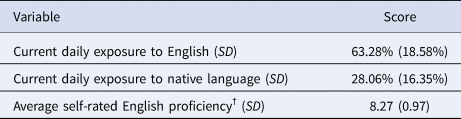
Thirty-six non-native English speakers (23 female; 13 male) aged 18–40 years old (X̄ = 26.28, SD = 6.01) took part in the study. Of these, 19 performed the experiment with a native English-speaking confederate, and 17 performed the experiment with a non-native English-speaking confederate. Participants were recruited through the University of Edinburgh volunteer panel and social media. Participants were asked to separately provide their language history via email: the Language Exposure and Proficiency Questionnaire (LEAP-Q; Marian, Blumenfeld & Kaushanskaya, Reference Marian, Blumenfeld and Kaushanskaya2007) was used to assess non-native speakers’ self-rated language proficiency (out of 10) and estimated daily exposure to English (out of 100%; see Table 1). Note that all of our non-native speakers spoke native languages (i.e., Czech, Dutch, Estonian, French, German, Greek, Hungarian, Italian, Japanese, Polish, Russian, Spanish, Swedish, Turkish) that are distant from the native language of our confederates, Mandarin: that is, they are genetically unrelated and typologically dissimilar (e.g., none of the participants’ native languages are tonal).
Average LEAP-Q scores for the non-native participants. (†) This average reflects N=29 non-native participants who responded to the self-rated proficiency question of the LEAP-Q.

Confederates
We recruited four female speakers to act as confederates: two native English speakers (aged 21 and 22 years), and two non-native English speakers whose native language was Mandarin (aged 26 and 29 years). Confederates were trained every other day for 2 weeks through mock experiments, in which they would swap between the roles of a confederate and naive participant. They were trained to produce all elements of the scripts (i.e., including pauses and hesitations) as naturally and consistently as possible. The acceptability of their accents as native English was assessed by 11 participants (6 native English speakers, 5 non-native English speakers). Participants rated accent nativeness on a 0-8 point scale (0 = “not native at all”; 8 = “completely native”). The native confederates were given an average nativeness rating of 6.36 (SD = 0.70), while the non-native confederates were given an average nativeness rating of 2.54 (SD = 1.47).
Stimuli & materials
Items
In a pre-test, 21 participants named pictures of everyday items with: 1) the first name that came to mind (first response), and 2) any other name they could use for the item (alternative responses). From this, we constructed 12 experimental items that were pictures of objects with both a favored and an acceptable disfavored name (e.g., favored name mug, disfavored name cup; see Fig. 1)Footnote 2. Favored names were given as first responses on average 76% (SD = 13%) of the time, while disfavored names were given as first responses on average 17% (SD = 10%) of the time. This is except for glasses/spectacles in which all participants produced glasses as their first response, and spectacles was the most frequent alternative response. Favored names were given as first responses significantly more than were disfavored names (t-test for paired samples: t(11) = 9.90, p < .001). We also created 8 filler items that were objects that participants judged as having only one acceptable name (e.g., toothbrush). We constructed two lists, each containing six experimental objects paired with their favored name and the other six experimental objects paired with their disfavored name. Each list also contained 4 filler items. As such, there were two lists of 6 experimental items and 4 fillers (see Appendix A for example item lists). The sequential order of items and fillers remained the same across sets and lists, but the fillers differed across lists.
Example of an experimental item used in the route-giving task. The favored name identified in the pre-test was “mug”; the disfavored name was “cup”.

Map
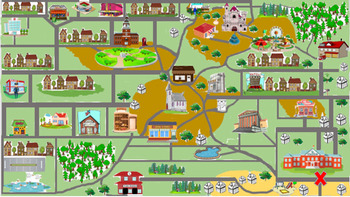
We created a city map with 16 public locations (e.g., library, school, museum) to serve as our target destinations and several roads leading to each location. The map was printed in color (size A1), and a removable red ‘X’ indicated the starting point for each round of the route-giving task (see Fig. 2).
Map and starting point (red X) for route-giving task.

Confederate scripts
To create the scripts used by the confederates, we carried out a pilot study in which two native and two non-native English speakers (native languages: Spanish and Mandarin) carried out the route-giving task. The aim was to record a sample of unconstrained, natural spontaneous speech from native and non-native English speakers, to identify the kinds of expressions and structures that they would use to direct each other. We created scripts based on these recordings for experimental and filler items. Each item was referred to twice by the confederate during a trial of the route-giving task, and then referred to a third time during a recap of where items had been delivered (for an example of a complete script, see Supplementary Materials: S1). For example, the confederate's script for an item (shirt / blouse) in Round 1 was as follows (with ellipses indicating pauses):
“Ok, so… the first object is the shirt/blouse. Do you have it? … Okay. If you start from the red X, facing the school, if you … turn left, go to the end of the road… and turn right, and then left… like on a curving road… and then go straight and…. take the second left and drop off the shirt/blouse at the swimming pool.”
The script for the recap for the same item was:
“First, you dropped off the shirt/blouse at the swimming pool.”
Procedure
Participants were randomly assigned to the native confederate or non-native confederate condition. The participant and confederate arrived at the lab at the same time. They sat opposite each other at a table, with a barrier between them. Throughout the task, the experimenter treated the confederate as if she was a naïve participant. Both players (i.e., the participant and confederate) were given written instructions that they would be playing a route-giving task as part of a study designed to improve an automated courier delivery service. The aim was to direct the other player to drop off particular items at specific locations. The instructions emphasized that it was important to give clear directions. They also stated that players were allowed to use only the name of buildings to identify the starting location and drop-off location, and that they must not interrupt their partner while he or she was giving an instruction. They were also told that, if they were unable to follow the given directions for the delivery of an object, they should put that object to one side. A point would be awarded for each item correctly dropped off (out of a total of 40), and the aim was to acquire as many points as possible. Players were then given a list showing a picture of each item and identified the location at which it should be dropped off, and were told that they were free to choose the route that they took to each destination (although the confederates always followed pre-defined routes). Additionally, they were provided with a map and a set of laminated cards, each depicting one item, which acted as markers for the location of objects on their copy of the map.
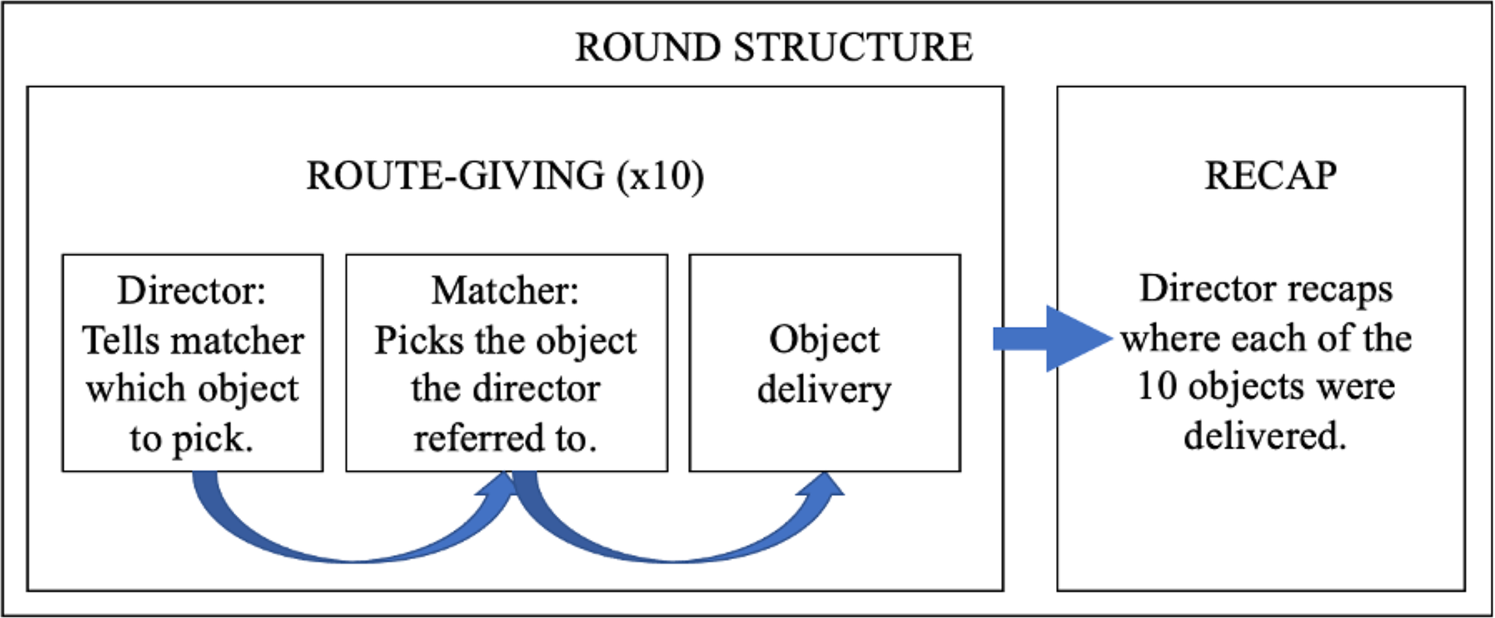
There were two roles within the task: the director and the matcher. Players completed 4 rounds (with two rounds being critical to the measurement of alignment in a participant) and alternated between being director and matcher (see Fig. 3). The participant was designated as the matcher on rounds 1 and 3, and as the director on rounds 2 and 4. For each trial of the route-giving task, the director referred to an item, and the matcher had to select that item from the item cards. The director then instructed the matcher on how and where to deliver the item. In each round, players completed 10 trials (i.e., 6 experimental items + 4 fillers) and then the director recapped each of the items that had been delivered. Each list of items was used twice within the experiment (e.g., List 1 was used for rounds 1-2; List 2 was used for rounds 3-4), so that we could measure a participant's alignment for an experimental item's name after hearing the confederate refer to the item in the previous round.
Structure of a round: the director referred to an item during both the route-giving task and in the recap.

Results
Coding
We examined participant responses for experimental items in rounds 2 and 4 (i.e., the rounds in which the participant was the director and so had the opportunity to refer to the item in both the route-giving task and the recap). Participant responses were coded as favored if the participant used the favored name for an item, as disfavored if the participant used the disfavored name for the item, or as other (i.e., any other response). In the route-giving task, there were 629 favored responses (67% of responses), 283 disfavored responses (30%) and 24 other responses (3%). In the recap, there were 555 favored responses (68%), 242 disfavored responses (30%) and 19 other responses (2%). Other responses were removed before analysis. For the numbers of response types given across conditions see Supplementary Materials (route-giving task: Table S2; recap: Table S3).
Route-giving task
Descriptive statistics
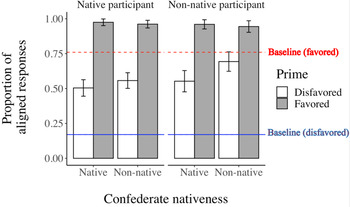
Figure 4 shows the proportion of aligned favored and disfavored responses by native and non-native participants following favored and disfavored primes in the route-giving task.
Proportion of aligned responses in the route-giving task. Error bars represent standard error of the mean. Baseline probability estimated from the pre-test is represented by the dashed red line for the favored name (X̄ = 76%) and the solid blue line for the disfavored name (X̄ = 17%).

Analysis of route-giving responses
Data were analyzed in R 3.6.1 (R Core Team, 2019; data and analysis scripts available at: https://osf.io/4dm3u/). We first established the presence of a general alignment effect within participants. Participants were more likely to use a disfavored name following a disfavored prime (X̄ = .57, SD = .50) than following a favored prime (X̄ = .05, SD = .21; Wilcoxon signed-rank test for paired samples: Z = 10.91, p < .001)Footnote 3.
Subsequent analyses focused on the alignment effect across conditions. We used mixed logistic regression to analyze these responses, as implemented in R's ‘lme4’ package v. 1.1-21 (Bates, Maechler, Bolker & Walker, Reference Bates, Maechler, Bolker and Walker2015) with backwards stepwise elimination for the selection of predictors, and likelihood ratio tests to compare model fits. Because disfavored responses were effectively at floor in the favored prime condition, we split response data by favored and disfavored primes and here report the results on the effects of Round (2 vs. 4), participant nativeness (Native vs. Non-native) and confederate nativeness (Native vs. Non-native) on responses following specifically the disfavored primes (for similar approaches see Experiment 4 in Branigan et al., Reference Branigan, Pickering, Pearson, McLean and Brown2011; see also Tobar-Henríquez, Rabagliati & Branigan, Reference Tobar-Henríquez, Rabagliati and Branigan2019; results for responses following a favored prime are supplied in Appendix B). Predictors were scaled and center-coded using R's default ‘scale’ function. The reference level for these analyses was set as Round: “2”, participant nativeness: “Native”, and confederate nativeness: “Native”.
For responses to the disfavored primes, the initial model included fixed effects for participant and confederate nativeness, as well as the interaction term between these two effects. After model reduction, the final model included only confederate nativeness as a fixed effect, as well as random intercepts by participant and by Item. There was a significant effect of confederate nativeness on response, such that both native and non-native participants were more likely to produce a disfavored name after hearing a disfavored prime when interacting with a non-native confederate than when interacting with a native confederate (β = 0.29, SE = 0.11, t = 2.61, p = .01; see Tables 2 & 3).
Production of disfavored responses following disfavored primes in the route-giving task: beta, standard errors, Z and p-values for fixed effects. Model fit by REML.

Production of disfavored responses following disfavored primes in the route-giving task: variance for random effects. Model fit by REML.

No. of Observations = 458.
In addition, we examined the effects of proficiency and daily exposure to English on alignment in the route-giving task for the 29 non-native participants who reported self-rated proficiency (0-10; with 10 meaning “native level”) and % of current daily exposure to English (i.e., 0-100%; with 100% meaning exposed only to English on a daily basis) on the LEAP-Q. We used logistic regression and modeled response by Proficiency, Exposure to English, Round, and confederate nativeness, with random intercepts by participant and by Item (No. of observations = 168). Proficiency did not predict alignment following a disfavored prime (p = .33), nor did Exposure to English (p = .82).
Recap
Descriptive statistics
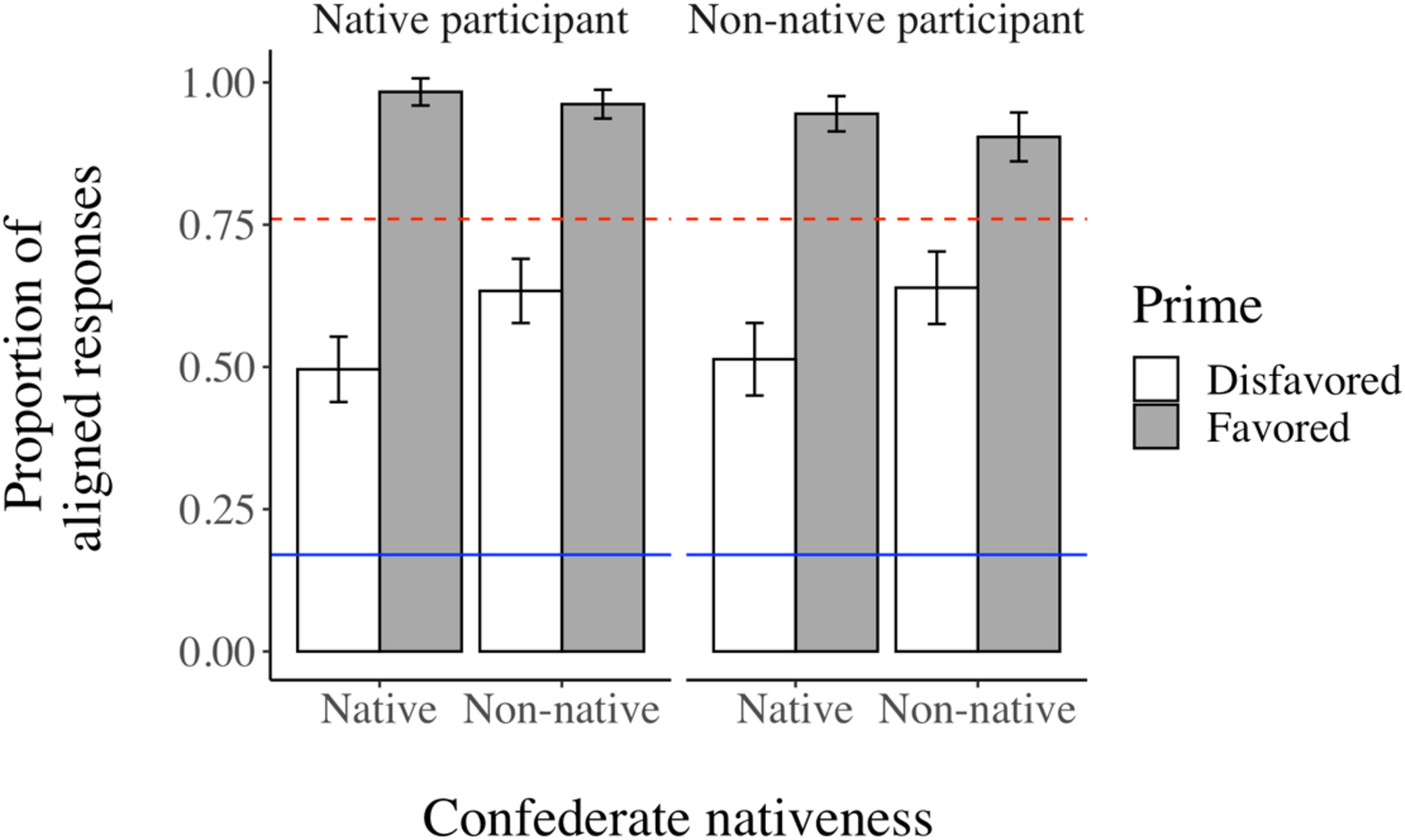
Figure 5 details the proportion of aligned favored and disfavored responses by native and non-native participants following favored and disfavored primes in the recap of the route-giving task. Ten participants (all non-native) were excluded in the recap due to experiment error (i.e., final N = 68).
Proportion of aligned responses in the recap. Error bars represent standard error of the mean. Baseline probability estimated from the pre-test is represented by the dashed red line for the favored name (X̄ = 76%) and the solid blue line for the disfavored name (X̄ = 17%).

Analysis of recap responses
Again, we established the presence of an alignment effect within participants. Participants were more likely to produce a disfavored name following a disfavored prime (X̄ = .57, SD = .50) than following a favored prime (X̄ = .04, SD = .19; Wilcoxon signed-rank test for paired samples: Z = 10.20, p < .001).
As disfavored production was again at floor in the favored prime condition, we split response data by favored and disfavored primes and report the results on responses following disfavored primes (results for responses following a favored prime are supplied in Appendix C). For responses to the disfavored primes, no model was a significantly better fit of the data than the null model (p = .16).
We also examined the effects of proficiency and exposure to English on alignment in the recap for the non-native participants who provided this information (N = 19; No. of observations = 110). We modeled response by Proficiency, Exposure, Round, and Confederate nativeness, with random intercepts by Participant and by Item. Proficiency did not predict alignment following a disfavored prime (p = .26), nor did Exposure to English (p = .73).
Discussion
We investigated the extent to which speaker beliefs about an interlocutor affected native and non-native English speakers’ lexical alignment with a native or non-native English-speaking partner. In a route-giving task, native and non-native speakers gave instructions referring to objects that a native or non-native interlocutor had previously named using a favored or disfavored name. Unlike previous research on alignment between native and non-native speakers, we controlled (confederate) interlocutors’ use of referring expressions, as well as other language content, so that any differences in patterns of alignment could not be attributed to differences in other aspects of their language use.
We found lexical alignment by both native and non-native participants. Both groups of participants were more likely to use a disfavored name for an item after hearing an interlocutor use this disfavored name than after hearing an interlocutor use a favored name; this effect was consistent across both the route-giving task and the recap. But crucially, we also found that alignment was modulated in both groups, and to the same extent, by the nativeness of the interlocutor: in the route-giving task (in which success relied upon players’ mutual understanding of how to name the objects), participants were more likely to align with a non-native speaker's use of a disfavored name than with a native speaker's use of a disfavored name, and this tendency did not differ between groups. Thus, our results indicate that lexical alignment is sensitive to interlocutor nativeness in at least some circumstances, and that this effect is similar across native and non-native speakers.
This pattern of results is informative about the mechanisms underlying alignment in task-based contexts. The finding that native and non-native speakers aligned with their interlocutors is compatible with non-goal-directed priming mechanisms, in which speakers reuse a partner's referential choices because the associated lexical representations have been activated and are therefore easier to access. However, if the effects were due solely to non-goal-directed mechanisms then we would have expected that non-native interlocutors’ productions would induce weaker initial activation (and hence weaker subsequent alignment) than native interlocutors’ productions, on the basis of reduced depth of processing and reduced attentional focus (e.g., Gass & Varonis, Reference Gass and Varonis1994; Munro & Derwing, Reference Munro and Derwing1995; Sumner & Samuel, Reference Sumner and Samuel2009). As such, we might have expected alignment based on automatic priming mechanisms to have been stronger with a native interlocutor than with a non-native interlocutor, contrary to our findings. Hence, we can conclude that although automatic priming mechanisms may have contributed to our alignment effects, such mechanisms were not the primary driver of alignment here.
Instead, our results support a major contribution of goal-directed audience-design mechanisms to alignment, in which speakers chose referring expressions based on their judgments of what their interlocutor would be likely to understand. In other words, both native and non-native participants showed evidence of modelling their interlocutor's language abilities and adapting their own language use accordingly. When they could not be confident about what words their interlocutor would be likely to understand on the basis of a priori beliefs about their interlocutor's speech community, they tended to rely more heavily on the direct evidence provided by their interlocutor's previous language use, leading to a stronger tendency to align with non-native interlocutors than with native interlocutors. Interestingly, this audience-design effect appears to have been relatively conservative (i.e., based on a relatively static interlocutor model), in the sense that it did not differ across rounds as participants gained more direct evidence of their interlocutor's language abilities (which could have potentially led them to update their interlocutor model).
Importantly, native and non-native speakers showed similar effects of audience design. This finding is perhaps surprising, given that audience design is cognitively demanding (Roßnagel, Reference Roßnagel2000) and that non-native speakers have fewer resources available when interacting in their second language (Ivanova & Costa, Reference Ivanova and Costa2008; Pivneva et al., Reference Pivneva, Palmer and Titone2012). Accordingly, Costa et al. (Reference Costa, Pickering and Sorace2008) predicted that audience design in non-native speakers might be particularly vulnerable to competing task demands in complex tasks such as route-giving (and to an extent that would depend on language proficiency). As such, we would have expected our non-native participants to show reduced alignment to non-native interlocutors in the route-giving task, compared to native participants, and that this reduction would be modulated by language proficiency. Instead, our results suggest that non-native speakers, irrespective of (self-rated) proficiency, are as sensitive as native speakers to their interlocutors’ likely knowledge and accommodate this knowledge accordingly, even within relatively demanding task settings.
However, we did not find evidence that speakers always align when they are able to do so. The evidence for audience design effects in a demanding task contrasts with the lack of such evidence in a much less demanding task (i.e., the recapping of objects’ final locations). Neither native nor non-native speakers showed a significantly greater propensity to use disfavored names during the recap with a non-native interlocutor who had previously used that name than with a native interlocutor. We suggest that lexical alignment based on audience design is most likely to be detected in contexts where successful task completion requires the coordination of names across partners and may be more variable in contexts where the coordination of names is less salient for communicative success. That is, the fact that native and non-native speakers can engage in detailed audience design does not mean that they always do so, even when they appear to have sufficient processing resources.
We also note that our results provide evidence for goal-directed alignment in a complex task specifically with non-native participants whose native languages were distant from the native language of their non-native interlocutors. Previous work (Bent & Bradlow, Reference Bent and Bradlow2003; Van Engen et al., Reference Van Engen, Baese-Berk, Baker, Choi, Kim and Bradlow2010) suggests that non-natives who speak more similar native languages to one another receive a benefit in processing (i.e., less processing cost) due to the representational and phonological overlap of their native languages. As such, it would be interesting to investigate goal-directed and non-goal-directed alignment in dialogues involving non-native interlocutors whose native languages are similar. Future work might also further examine how the proficiency of non-native speakers mediates alignment with interlocutors, using participants with a wider proficiency range than in the current study.
Our results show that both native and non-native speakers tend to align lexical choices when interacting with both native and non-native interlocutors, but that they show more alignment when interacting with a non-native interlocutor. Moreover, both groups show this stronger alignment to non-native speakers during a cognitively demanding communicative task, suggesting that lexical alignment based on audience design happens in naturalistic interactions and not only in minimal, highly structured tasks such as picture-naming. We conclude that non-native speakers engage in audience design during communication, in the same way as native speakers, and that such goal-directed mechanisms of alignment play an important role in interactions involving non-native interlocutors.
Acknowledgements
We thank the contribution of our confederates in making this research possible: Tianjiao Zeng, Yangzi Zhou, Emma Monaghan and Lydia Porter. The research leading to these results has received funding from the European Union's Seventh Framework Programme for research, technological development and demonstration under grant agreement no. 613465. This research was carried out as part of the Advancing the European Multilingual Experience project.
Supplementary Material
For supplementary material accompanying this paper, visit https://doi.org/10.1017/S1366728921000092.
Appendix A
Example items list 1.

Example items list 2.

Appendix B
For responses to the favored primes in the route-giving task, the final model included Participant nativeness as a fixed effect, with random intercepts by Participant and random slopes and intercepts for Participant nativeness by Item. However, there was not a significant effect of Participant nativeness on participants’ responses following favored primes (p = .18).
Production of disfavored responses following favored primes in the route-giving task: beta, standard errors, Z and p-values for fixed effects. Model fit by REML.

Production of disfavored responses following favored primes in the route-giving task: variance for random effects. Model fit by REML.

Appendix C
For responses to the favored primes in the recap, the final model included confederate nativeness as a fixed effect, with random intercepts by Participant and random slopes for confederate nativeness by Item. However, there was not a significant effect of confederate nativeness on participants’ responses following favored primes (p = .57).
Production of disfavored responses following favored primes in the recap: beta, standard errors, Z and p-values for fixed effects. Model fit by REML.

Production of disfavored responses following favored primes in the recap. Model fit by REML.