





Impact statement
When patients become agitated or aggressive during an inpatient psychiatric hospitalization, appropriate strategies must be implemented to de-escalate the aggression and ensure the safety of both staff and patients. Throughout history, restraint and seclusion (R/S) have been widely used to manage patient aggression, but the prevailing sentiment in modern psychiatry is that R/S should only be used as a last resort. Without adequate training in aggression management, however, mental health workers may continue to over-rely on unsafe and inhumane R/S practices, despite the associated risks to patients and staff. In low- and middle-income countries, safety concerns can be exacerbated by overcrowding, staff shortages and high acuity. In this study, we conducted in-depth qualitative interviews to understand the experiences of 20 healthcare workers at an inpatient psychiatric facility in Tanzania. Participants described using R/S, including physical and chemical restraint and locked seclusion, for the majority of their patients, which contributed to serious workplace hazards. They also reported detrimental effects on patients, including physical and emotional harm. Staff said that they had received almost no training on R/S, but expressed interest in learning about it and its alternatives. Many programs have been developed in other global settings to either reduce the use of R/S or emphasize its safe application. This study is an important first step toward informing the adaptation of such interventions to the Tanzanian context, targeting staff needs and safety, focusing on the particular resource limitations common in this setting and improving the provision of humane and patient-centered care. Furthermore, the overall stigma surrounding mental illness and the lack of resources dedicated to psychiatric care highlight the need for action at community and policy levels in Tanzania. Appropriate guidelines, knowledge and resources will be important pillars in improving patient and staff safety and well-being.
Background
Restraint and seclusion (R/S) are coercive measures used in psychiatric settings to manage severe agitation and aggressive behavior or to prevent self-harm (APA, 2022). Physical restraint refers to the manual or mechanical restriction of a patient’s movement (Centers for Medicare and Medicaid Services, 2013). Chemical restraint – also termed forced medication or rapid tranquilization – involves the involuntary administration of sedative or psychotropic medication orally, intravenously or intramuscularly (WHO, 2019; Muluneh et al., Reference Muluneh, Chavulak, Lee, Petrakis and Haines2025). Seclusion refers to the involuntary solitary confinement of a patient in a room they cannot leave (APA, 2022).
As aggressive patient behavior poses a severe challenge in psychiatric settings, R/S are intended to ensure safety for all patients and staff. Guidelines recommend using these measures only as a last resort (National Institute for Health and Care Excellence, 2015; APA, 2022). However, several studies document that R/S are frequently overused or inappropriately used, including for punishment, to control patient behavior beyond psychiatric emergencies, or as a supposedly therapeutic or preventive measure (Ntsaba and Havenga, Reference Ntsaba and Havenga2007; Mayers et al., Reference Mayers, Keet, Winkler and Flisher2010; Ndetei and Mbwayo, Reference Ndetei and Mbwayo2010; Cherif et al., Reference Cherif, Ben Thabet, Turki, Maalej, Omri, Feki, Zouari, Zouari and Charfi2019; Messedi et al., Reference Messedi, Charfeddine and Aribi2020). In practice, staff continuously negotiate R/S between guidelines, safety and moral judgment (Canzan et al., Reference Canzan, Patuzzo Manzati, Peloso, Longhini, Dal Bosco, Antonino, Imperadore and Lasalvia2026). R/S practices are commonly employed worldwide, but at widely varying rates (Belayneh et al., Reference Belayneh, Chavulak, Lee, Petrakis and Haines2024).
R/S are under growing critique, as they can be harmful for patients and staff, and may conflict with principles of human and patient rights, such as the right to autonomy, physical integrity and the liberty of choice or movement (Chieze et al., Reference Chieze, Hurst, Kaiser and Sentissi2019). R/S can cause harmful effects for patients, such as physical injuries (e.g., soft-tissue injury, fracture, thrombosis, asphyxia) from forceful restraint, adverse effects from chemical restraints or death – from thrombosis, suicide during seclusion (Grassi et al., Reference Grassi, Mandarelli, Polacco, Vetrugno, Spagnolo and De-Giorgio2018), aspiration or asphyxiation (Mohr et al., Reference Mohr, Petti and Mohr2003; Kersting et al., Reference Kersting, Hirsch and Steinert2019). Moreover, patients can be psychologically affected, as the experience of R/S is often traumatic (Bilanakis and Peritogiannis, Reference Bilanakis and Peritogiannis2008; Aluh et al., Reference Aluh, Ayilara, Onu, Grigaitė, Pedrosa, Santos-Dias, Cardoso and Caldas-de-Almeida2022) and the experience of R/S can impact the patient’s identity and sense of self (Norvoll and Pedersen, Reference Norvoll and Pedersen2016). The use of R/S also negatively impacts healthcare workers’ physical safety by increasing the risk of injury, e.g., through needle pricks, and their mental well-being through trauma or feelings of guilt or helplessness when applying R/S (Short et al., Reference Short, Sherman, Raia, Bumgardner, Chambers and Lofton2008; Mahmoud, Reference Mahmoud2017; Oyelade and Ayandiran, Reference Oyelade and Ayandiran2018). For both patients and healthcare workers, the experience and meaning of R/S is shaped by contextual, relational and situational factors, including whether the intervention is perceived as coercive, caring or necessary (Verbeke et al., Reference Verbeke, Vanheule, Cauwe, Truijens and Froyen2019).
In low- and middle-income countries (LMICs), there is a particular risk for overreliance on R/S (Hidayat et al., Reference Hidayat, Lawn, Muir-Cochrane and Oster2020). Structural factors – including under-resourced facilities, inadequate policies, insufficient training, high rates of involuntary admissions and stigmatizing attitudes about mental illness – have all been associated with higher rates of R/S (Alem et al., Reference Alem, Jacobsson, Lynöe, Kohn and Kullgren2002; Kallert et al., Reference Kallert, Glöckner, Onchev, Raboch, Karastergiou, Solomon, Magliano, Dembinskas, Kiejna, Nawka, Torres-González, Priebe and Kjellin2005; Aluh et al., Reference Aluh, Ayilara, Onu, Grigaitė, Pedrosa, Santos-Dias, Cardoso and Caldas-de-Almeida2022).
Given these challenges, there is a global effort to reduce R/S and ensure its safe application (APA, 2022; European Committee for the Prevention of Torture and Inhuman or Degrading Treatment or Punishment, 2017). Several programs have been developed to reduce the prevalence of R/S by targeting staff attitudes, providing training in alternative aggression management strategies such as verbal de-escalation, or by strengthening community mental health services (Mezzina, Reference Mezzina2014; El-Sayad, Reference El-Sayad2018; Coneo et al., Reference Coneo, Thompson, Parker and Harrison2020).
In Tanzania, to our knowledge, only one recent study explored the use of physical restraint from the perspective of patients (Eladi et al., Reference Eladi, Sanga and Ambikile2026). The study found that physical restraint was frequently used to maintain safety but was also associated with significant psychological and physical suffering, with some patients reporting that it was applied in a punitive, degrading or humiliating manner. Patients stated a preference for sedation, verbal de-escalation and more humane restraint practices. The present study adds a contextually grounded, meaning-oriented account of how healthcare workers understand and enact different coercive practices, with implications for improving patient care in Tanzania.
Methods
A multi-method observational and qualitative design was used to gain a comprehensive understanding of the practice of R/S and the perspectives of healthcare workers. The Interpretive Description approach was chosen to generate practice-relevant knowledge for clinical care. The research was conducted at a government regional referral hospital housing the only psychiatric inpatient unit (IPU) in a catchment area of over 15 million people. Between January and February of 2025, we conducted 51 h of observations over 13 days in the IPU, joining ward rounds, team meetings and discussing ward statistics. A structured observation guide was used to direct observations and focus on the setting, behaviors, conversations and context, while also allowing space for reflexive notes. During the observations, time was spent meeting with healthcare workers in the psychiatric ward and the ED to explain the research objectives, identify potential interview partners, build trust and gain a first-hand understanding of daily routines and care practices. We then conducted semi-structured qualitative interviews with 16 healthcare workers and 4 security guards from the IPU and Emergency Department (ED).
Interview participants were purposively sampled with a focus on recruiting participants with more work experience from each professional group (doctors, nurses, clinical officers and guards) until the predetermined sample size of 20 participants was reached. The target of 20 reflected practical constraints: the hospital employed few staff overall, and the sample approached a near-census of available personnel at the IPU, rather than a size determined via saturation assessment. This target also aligns with sample sizes reported as sufficient for thematic identification in qualitative interview studies (Guest et al., Reference Guest, Bunce and Johnson2006). Participants were approached in their place of work and invited to complete an interview in a private office at the hospital. We obtained written informed consent, administered a short set of quantitative questions regarding the interviewees’ opinions on the use of R/S, their training experiences and their perceptions of workplace safety, and then conducted the qualitative interviews using a guide developed in partnership with Tanzanian researchers and informed by prior literature on R/S in African settings (Coneo et al., Reference Coneo, Thompson, Parker and Harrison2020; Aluh et al., Reference Aluh, Ayilara, Onu, Pedrosa, Silva, Grigaitė, Santos-Dias, Cardoso and Caldas-de-Almeida2024).
The interviewer first asked participants to describe a recent incident involving physical restraint, chemical restraint or seclusion, using follow-up questions to explore the event in depth. We then asked questions about participants’ opinions, beliefs, training, hospital guidelines and workplace factors related to restraint and seclusion.
A Master’s in Clinical Psychology student from Germany and two Tanzanian research nurses with extensive prior training and experience in qualitative research conducted the interviews. The interviews lasted between 23 and 56 min and were conducted in either English or Swahili, depending on each participant’s preference. Each participant received a reimbursement of 10,000 Tanzanian Shillings (TZS), which is approximately 4 U.S. dollars.
The qualitative interviews were first translated to English as necessary, transcribed by bilingual members of the research team fluent in both English and Swahili, and then analyzed using applied thematic analysis (Guest et al., Reference Guest, M.MacQueen and Namey2012) in NVivo 15 software. We began with inductive line-by-line coding, creating a code for each subsection of meaning. However, the applied thematic approach acknowledges that inductive coding of semi-structured interview data is also informed (deductively) by the themes and questions from the interview guide. During the coding process, codes were organized in a hierarchical structure for better overview and clarity, with similar codes merged together. In an iterative process, three team members coded the same interview independently and afterward collaboratively discussed coding differences, cultural interpretations and reconciled differences in coding until consensus was reached. These consensus-building discussions provided room for gaining a mutual understanding of what was said and the meaning within the cultural and social context, and the codes were defined in a final codebook. Coding reflected participants’ own terminology and perceptions of the topics discussed, which does not necessarily reflect the study’s operational definitions. See supplementary material for a detailed codebook.
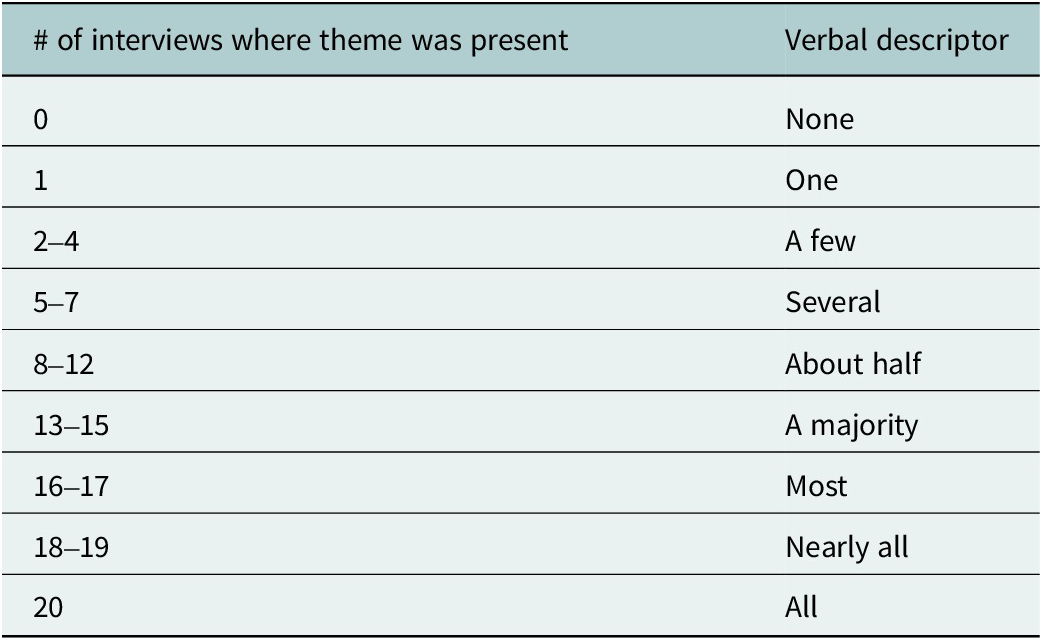
To ensure transparent reporting, the wording in the results section is guided by a rubric of verbal quantifiers to describe the frequency of responses (Table 1).
Verbal quantifiers and corresponding participant numbers

Table 1. Long description
The table consists of two columns. The left column is titled Number of interviews where theme was present and the right column is titled Verbal descriptor. The rows are organized as follows.
* 0 corresponds to None.
* 1 corresponds to One.
* 2 to 4 corresponds to A few.
* 5 to 7 corresponds to Several.
* 8 to 12 corresponds to About half.
* 13 to 15 corresponds to A majority.
* 16 to 17 corresponds to Most.
* 18 to 19 corresponds to Nearly all.
* 20 corresponds to All.
Reflexivity is central to qualitative research, as the researchers’ backgrounds, experiences and assumptions inevitably shape data collection, analysis and interpretation. The cultural background of the German team member warrants caution, as researchers from Western settings, where principles of individual autonomy are strongly emphasized, may interpret coercive practices differently than those embedded in the local context, and limited cultural knowledge risks decontextualized interpretation of findings. It may also have shaped participants’ openness during interviews. Therefore, partnership with the two Tanzanian research nurses and a Tanzanian psychiatrist as the local principal investigator, all of whom have clinical experience, was prioritized throughout the research process. This included the collaborative and iterative coding process, with regular team discussions, which provided space to reflect on divergent perspectives, build consensus and critically examine assumptions throughout the analysis.
Ethics
Ethical approval for the study was granted by the Tanzanian National Institute for Medical Research and the ethical review board at Kilimanjaro Christian Medical University. Written informed consent was obtained from all participants at the time of enrollment.
Results
Description of the sample
Interviews were conducted with 20 hospital staff members, including nurses, clinical attendants, doctors and security guards. Participants included 13 females and 7 males, ranging in age from 25 to 58 years (mean = 42). Work experience ranged from two weeks to 36 years, with an average of 9 years (Table 2).
Participant characteristics (N = 20)

Table 2. Long description
The table consists of three columns: Characteristic, n, and percent.
* Gender: Female (13, 65 percent), Male (7, 35 percent).
* Age in years: 25 to 36 (9, 45 percent), 37 to 48 (2, 10 percent), 49 to 60 (9, 45 percent).
* Profession: Nurse, clinical officer, medical attendant or nurse assistant (10, 50 percent); Doctor including medical doctor, psychiatrist, or intern doctor (6, 30 percent); Guard (4, 20 percent).
* Department: Inpatient psychiatric ward (13, 65 percent), Emergency department (7, 35 percent).
* Years in current job: less than 2 (6, 30 percent), 3 to 5 (5, 25 percent), 6 to 15 (4, 20 percent), greater than 15 (5, 25 percent).
Description of the setting
The IPU is divided into a male and female ward, each separated into an A-ward for “aggressive” patients and a B-ward for “calm” patients, as visualized in Figure 1. The seclusion rooms (approximately 2 × 2 m each) have a cement bed with a mattress on top, minimal natural light through small windows, no electric lighting and, in some cases, floor gutters connected to bathrooms. All wards are locked, and there is no designated outdoor area.
Outline of the inpatient psychiatric unit.

The appearance and demeanor of patients varied greatly. Some newly admitted patients, particularly those in the A-wards, appeared significantly drowsy – demonstrating difficulty in maintaining composure, sitting upright or chewing food. Signs of psychosis, such as incoherent speech, were observed in several individuals. In contrast, other patients were dressed in clean clothes and were able to engage in coherent conversations. According to unit documentation, the most treated disorders are schizophrenia, substance- or alcohol-induced psychosis and schizoaffective disorders.
Treatment was usually paid for by relatives and cost 10,000 Tanzanian shillings (roughly 4 U.S. dollars) per day, plus an additional 13,000 shillings for admission and discharge fees and additional fees for medication and medical equipment. A two-week stay amounts to more than half of the average monthly income of a typical person in Tanzania (World Bank, 2024). The unit also operates an outpatient clinic and, after discharge, patients and their relatives are encouraged to attend the outpatient clinic regularly. The clinic operated two days per week and provided screening, counseling and medication prescriptions.
At the ED, psychiatric patients first register and undergo an assessment by nurses and physicians. If an aggressive or potentially violent patient arrives, security guards are contacted immediately to accompany the patient during the admission process. There are no seclusion rooms or specific facilities for psychiatric patients at the ED.
Quantitative questions
Half of participants reported feeling safe in the workplace, approximately one-third stated that they felt unsafe, and the rest were neutral. Most participants stated that physical restraint should be used less, while chemical restraint and seclusion should be used more. Questions regarding seclusion were only posed to staff who had experience with its use. Most participants strongly agreed that training on the safe use of R/S, and on reducing R/S, would be beneficial to their workplace. However, four participants strongly or somewhat disagreed with the need for training to reduce R/S. All answers are summarized in Table 3.
Results from the quantitative questionnaire

Table 3. Long description
The table consists of seven prompts with responses mapped across a five-point scale.
1. At the workplace, I feel (Scale: Very unsafe to Completely safe): 1, 5, 4, 7, 3.
2. Physical restraint (Scale: It should be used a lot less to It should be used a lot more): 3, 8, 6, 2, 1.
3. Chemical restraint (Scale: It should be used a lot less to It should be used a lot more): 0, 2, 6, 3, 9.
4. Seclusion (Scale: It should be used a lot less to It should be used a lot more): 0, 3, 1, 5, 5.
5. It makes my workplace safer (Scale: I strongly disagree to I strongly agree): 0, 0, 0, 7, 13.
6. Patients are emotionally harmed (Scale: I strongly disagree to I strongly agree): 0, 0, 6, 9, 5.
7. Training for the safe use of R / S (Scale: I strongly disagree to I strongly agree): 0, 0, 1, 4, 15.
8. Training on how to reduce R / S (Scale: I strongly disagree to I strongly agree): 3, 1, 0, 1, 15.
Themes of the qualitative interviews
Arrival at the emergency department or inpatient psychiatric unit
About half of the participants reported that patients were most often brought to the facility by relatives, while several mentioned that patients were brought in by the police. A majority described how aggressive patients would be restrained or secluded by staff upon arrival, or were already in restraints upon arrival, such as ropes or handcuffs. Several participants reported that patients arrived with wounds or injuries resulting from physical restraint or violence in the community. A few participants described that they would release the physical restraints in which patients arrived, but more participants reported that they would keep the restraints in place until the injected medication took effect. A few participants also described that patients exhibited negative responses to admission, such as fear, anger or confusion.
Use of restraint and seclusion
Physical restraint, chemical restraint and seclusion were often reported to be used in combination. Among the six participants who compared the frequency of different methods, four stated that chemical restraint was used most often.
Physical restraint
A majority of participants reported that they would either not use physical restraint at all, or limited their use to specific items – most commonly bedsheets – while excluding others such as ropes. The most frequently mentioned method of physical restraint involved the use of bedsheets to cover the patient’s head in order to facilitate the administration of medication. A staff member from the ED explains the practice:
When a patient is aggressive and doesn’t want to take their medication, one staff will be behind the patient with the bed sheet, and the others will be distracting him. So, the one that’s behind will cover the patient’s head, and he will automatically sit down then others will administer medication quickly.
A majority of participants described using physical holding techniques, such as restraining the patient by holding them to the floor or securing their arms and legs. A few participants mentioned the use of ropes, either made from sisal or improvised using gauze.
Chemical restraint
Several participants reported using doses of up to 20 mg of diazepam administered by intramuscular (IM) injection, and five participants mentioned that diazepam and haloperidol would be used together. Several participants stated that they would ensure the patient has eaten and check vital signs prior to administering medication, and a few noted that they would perform follow-up checks such as monitoring blood pressure, oxygen saturation and blood glucose.
Seclusion
About half of the participants described the care provided during seclusion, such as offering food, IV fluids and medication. The reported frequency of checks ranged from every 30 min to every four hours. About half also discussed the decision-making process for ending seclusion, typically based on whether the patient had become less aggressive, calmer and more cooperative, appeared to have improved clinically or demonstrated insight. The length of seclusion was reported as ranging from several hours to one week. Several participants raised concerns about the risk of self-harm during seclusion, with two participants at the IPU recalling a recent incident of a patient attempting suicide while secluded using a bedsheet.
Reasons, benefits and rationale for the use of R/S
All participants identified safety as a reason for the use of restraint or seclusion: “[A]n aggressive patient can harm himself, other patients or the staff, so using these strategies helps the patient to become calm and safe.” (IPU). Most commonly, R/S were described as a means to protect other patients from being harmed.
All participants referred to patient aggression as a reason for using R/S, with descriptions of “aggressive” behavior ranging from abusive language or loud singing to physical assault. About half of the participants perceived patients as dangerous, and about half described patients as “not in their right mind,” sometimes using this as justification for the application of R/S. About half of the participants said they would use R/S only in response to aggression.
A majority of participants said that R/S were used to manage “disruptive behavior,” or actions seen as undesirable but not posing an immediate safety risk, such as hitting doors, excessive talking or stealing food.
“Not all of them are secluded because they are very aggressive. We seclude them sometimes because they make a lot of noise, or they have bad behavior.”
About half of the participants said they would use R/S to prevent patients from absconding. About half also said they would use R/S to help the patient. Fewer than half said that using R/S enabled them to provide better care – either by giving them the opportunity to focus on other patients or because medical checks could not be performed while a patient was in a state of acute agitation but became possible once the patient was sedated.
Two participants said R/S were used as a form of punishment, while two others said it would not be used for that purpose.
“We sometimes use it as a punishment because when the patient is in there, they are alone and can’t do anything. Also the environment in there is bad so this helps them not to misbehave again. But most of the time is for the safety of others.”
A few participants said that R/S was used to reduce workload or to facilitate their job.
Use of alternative measures
Most participants expressed that alternatives to R/S should be considered and that on-the-job training on such alternatives would be helpful; no one expressed neutral or critical views. About half said they would try to talk to patients to calm them. A few noted that talking was not always sufficient or possible, depending on the patient’s mental state. Several said that the mere presence of guards could intimidate or scare patients, which sometimes made the use of physical restraints unnecessary. Several of the participants said they either did not know or did not use alternative methods to manage aggression. A few described tricking patients into entering the seclusion room or accepting injection medication – for example, by saying the injection was for a malaria test. Two participants said they used the threat of seclusion to manage disruptive behavior.
Effects of R/S
Effects on staff
A majority of participants reported incidents of staff being physically attacked or injured by patients. They described situations in which staff were hit or bitten while attempting to physically or chemically restrain patients, or in which they could be pricked by needles. Several reported some form of negative emotional impact, either generally from working with psychiatric patients and the associated stress, or specifically due to the use of R/S. Some participants reported feeling stigmatized by others because they work in a psychiatric unit. Two participants recounted incidents of staff dying after being attacked by patients in the past, prior to the hiring of security guards for additional protection.
Effects on patients
Nearly all participants described that patients would “calm down,” “fall asleep,” or “become weak” after receiving injections. A majority described situations in which the first dose of medication was insufficient, requiring a second dose. Some participants explained that patients with substance use disorders would show a reduced response to drugs, leading them to administer doses of up to 40 mg diazepam. Several mentioned side effects such as hypoglycemia. A majority of participants discussed patients incurring wounds or injuries during R/S. These were attributed either to physical restraint by relatives or police prior to admission or to patients falling from high cement beds in the seclusion rooms while sedated. Two participants reported a patient death due to lack of medical assessment before administering diazepam. About half of participants indicated that R/S could have a negative emotional or psychological effect on patients. Several stated that R/S would have no emotional impact or could be beneficial, typically reasoning that the patients were mentally unwell and thus not susceptible to emotional harm.
Environmental factors
A majority of participants referred to the facilities as inadequate or not good. Half of the participants raised concerns specifically about the seclusion rooms; some stated that more seclusion rooms should be built, others pointed out that the beds should be lowered, ventilation was poor, and that grills should be added to the doors to allow staff to see the patient before entering. Several advocated for the construction of an outdoor area for patients. A few participants expressed a general need for the psychiatric unit to be renovated.
A majority of participants stated that there was not enough staff, while several said that staffing levels were sufficient. A majority of participants stated that they had received no specific training on the use of R/S, typically explaining that they learned about R/S on the job. A majority stated that they were not aware of any guidelines regarding the use of R/S, while several said they were aware of such guidelines. A few noted that very young or old staff, inexperienced staff and frequent staff rotation would pose problems.
About half of the participants stated that a lack of medication was a challenge. Several referred to financial difficulties, either due to relatives struggling to pay for treatment and medication or a lack of funding from the hospital. Several participants noted the absence of a rehabilitation center or step-down care for patients after discharge and expressed a desire for ongoing care and rehabilitation. A few participants said that psychiatry is stigmatized and has been left behind. A few also identified delays in treatment as a challenge, often caused by the need for relatives to first source the medication before it could be administered. Two participants mentioned a lack of activities in the unit, noting that patients had nothing to do and suggesting the addition of an occupational therapist. A few participants also stated that the community should be better educated about mental illnesses.
Of the ten participants who discussed changes in inpatient care over time, the majority stated that it had improved, referring to the addition of seclusion rooms and security guards. Several participants stated that the security guards were very helpful: “In the past years we didn’t have guards. We are now thankful that we have guards; we are no longer scared.”
Discussion
Tanzania is a lower-middle-income country with limited mental health resources, including severely constrained infrastructure for inpatient psychiatric care. In this mixed-methods study, healthcare workers described R/S practices as ubiquitous, with physical restraint, chemical restraint and seclusion frequently applied in combination, often at the point of admission. Security personnel were also used to manage patient behavior, either through show of force or actual involvement in restraint. R/S were primarily justified by safety concerns but was also employed punitively for non-violent disruptive behavior. Most staff had received little or no training in R/S but expressed openness to receiving it. Figure 2 summarizes how patient, staff and ward factors influence the use of R/S in inpatient psychiatric care, with community/systems factors shaping all other domains.
Aggression management, coercion and relevant factors.

Figure 2. Long description
The flowchart is organized into three horizontal tiers.
Top Tier: Ward Factors. This section is divided into three sub-categories with downward-pointing arrows.
* Facilities: Inadequate seclusion rooms and many patients in one room.
* Treatment and Care: Lack of medication and no rehabilitation center.
* Activities: Lack of activities and no outdoor area.
Middle Tier: A linear process flow from left to right.
* Staff: Severe workplace hazards and understaffing. Perception of patients as dangerous, aggressive and not in their right mind. Little or no prior training. Interest in receiving training.
* Practice of R / S: Routine use of haloperidol and diazepam. Manual hold, bedsheets/linen used to apply medication. Long seclusion after sedation. Guards used to intimidate patients.
* Patients: Severe, and acute psychotic symptoms. Involuntary admission, relapse, and readmissions. Reports of injuries, and deaths.
Bottom Tier: Community Factors. This section spans the width of the diagram.
* No clear and practical guidelines or mental healthcare policy.
* Lack of accessible community based mental health care services.
* Stigma and lack of knowledge, and harmful R / S use in the community.
Arrows on the far left and right sides of the diagram create a feedback loop between the Community Factors at the bottom and the Ward Factors at the top.
Safety concerns
Ensuring safety for all patients and staff was a key justification for the use of R/S, consistent with prior research (Riahi et al., Reference Riahi, Thomson and Duxbury2016; Aluh et al., Reference Aluh, Ayilara, Onu, Pedrosa, Silva, Grigaitė, Santos-Dias, Cardoso and Caldas-de-Almeida2024). However, the staff’s perceptions of safety differed in their qualitative responses and quantitative survey responses. While serious incidents of harm to staff were voiced in the interviews, only a minority stated in the questionnaire that they felt unsafe. This could be explained by the different positionalities and prior experiences of staff – a young, muscular security guard might evaluate workplace safety very differently than an older nurse who had already experienced injuries in the workplace. Staff might also differ in their openness to talk about the emotional impact of workplace hazards.
Patient behavior was frequently labeled as “aggressive,” encompassing actions ranging from serious violence to loud singing. Aggressiveness thus appears as a socially negotiated category that serves to justify R/S. The lack of distinction between disruptive and violent behavior raises concerns that, while safety risks may be genuine, appeals to safety can also serve to justify punitive or disciplinary use of R/S.
Having many patients in one room without access to an outdoor area, limited daytime activities, high psychopathology and limited treatment beyond medication all exacerbated safety concerns and may explain the staff’s preference for more seclusion, chemical restraint and guards. This aligns with Oyelade and Ayandiran (Reference Oyelade and Ayandiran201 Reference Cherif, Ben Thabet, Turki, Maalej, Omri, Feki, Zouari, Zouari and Charfi8) in Nigeria, who found that frequent violence on an inpatient unit led to an intense staff preference for R/S. Physical force may provoke rather than de-escalate aggression, prompting further coercive escalation. This bidirectional dynamic risk entrenching a self-perpetuating cycle in which coercion begets aggression and aggression begets coercion (Aluh et al., Reference Aluh, Ayilara, Onu, Pedrosa, Silva, Grigaitė, Santos-Dias, Cardoso and Caldas-de-Almeida2024). Such patterns may reflect the normalization of coercive responses as routine institutional practice. Without alternative aggression management strategies, psychiatric care can become focused on security and containment instead of treatment and recovery.
Human rights concerns
R/S use worldwide remains problematic in light of human rights concerns. Frequent, uncritical sedative use is concerning, given risks of overdose, long-term cognitive decline and patients’ experience as traumatic (Nielssen et al., Reference Nielssen, Buhrich and Finlay-Jones1997; Adams et al., Reference Adams, Chamberlain, Gronkjar, Brun Thorup and Conroy2023; Karanikola et al., Reference Karanikola, Nystazaki, Kaikoushi, Middleton and Chatzittofis2023). The use of improvised restraints, such as the “bedsheet method,” has been reported elsewhere (Aluh et al., Reference Aluh, Ayilara, Onu, Pedrosa, Silva, Grigaitė, Santos-Dias, Cardoso and Caldas-de-Almeida2024), and although its specific effects have not been studied, this routine use of deception and physical violence to administer medication is problematic. Tanzania is a signatory to the UNCRPD and the African Charter on Human and Peoples’ Rights (ACHPR), both of which mandate the protection of patients’ rights to dignity and autonomy. The UNCRPD goes further, demanding the complete abolition of R/S. These obligations stand in tension with serious safety threats in a resource-limited setting. Some staff reconciled this tension by minimizing patients’ capacity to experience harm, reasoning that psychiatric illness reduced their sensitivity to distress. However, deceptive and coercive practices with vulnerable patients undermine trust and might increase the patient’s resistance, aggression and reluctance to seek psychiatric care in the future.
Implications
This study has implications for research, policy and practice. Given the scarcity of research on R/S in Africa, future studies should focus on quantifying the effects of the practices identified in this work, including patient deception, the “bedsheet method” and the use of high-dose sedatives. In addition, intervention studies are needed to co-design or adapt evidence-based interventions with healthcare workers, patients and families, building on existing adaptive practices such as staff’s use of verbal calming to facilitate less harmful and more compassionate care, and to quantitatively assess the effects of these interventions on the frequency, nature and outcomes of R/S practices.
Physical and chemical restraint are regulated by the Standard Treatment Guideline (STG) of mainland Tanzania (Ministry of Health, 2021), which recommends de-escalation techniques as a first-line approach, limits physical restraint to acute situations requiring immediate safety and provides pharmacological guidance including diazepam (10 mg PO or IM for severely agitated patients, p. 537). Seclusion is not mentioned. In our study, over half of participants were unaware of the existence of these guidelines. We noted overuse of restraint, immediate escalation to IM medication and high medication dosages. All staff working with psychiatric patients should be trained on these guidelines to promote safe, humane and effective care. Additionally, the STG should acknowledge and regulate the use of seclusion, should provide much clearer and more detailed guidance on de-escalation techniques, and careful documentation of R/S should be mandatory, with revisions developed in consultation with frontline staff.
The mental healthcare system in Tanzania is severely under-resourced, as reflected in inadequate facilities, such as seclusion rooms with risk of injury and suicide and the lack of outdoor spaces. An environment that allows for voluntary withdrawal, and that is designed with a focus on treatment – rather than containment – might foster positive patient-staff relationships and reduce R/S. Moreover, rehabilitation and ongoing care are scarce, increasing the patients’ risk of relapse and readmission.
This study revealed a clear need for staff training and improved resources to reducing and improving R/S use. Without this support, R/S becomes not just the last, but the only resort. Staff expressed strong interest in capacity building. Emphasis should also be placed on practical skills such as de-escalation, self-defense and safe holding techniques (Ye et al., Reference Ye, Xia, Wang, Liao, Xu, Zhang, Yu, Li, Lin and Xiao2021). However, building trustful patient-staff relationships is central to reducing and improving R/S sustainably. Training must be context-sensitive and account for infrastructure limitations, including the absence of mechanical restraint equipment. Given that patients were frequently restrained by relatives before hospital admission, training and psychoeducation should also target families, and include guidance on managing crises and the risks of R/S at home. Across these areas, sustainable improvement is likely to depend on engaging healthcare workers, patients and families as partners rather than solely as recipients of training or policy change.
Strengths and limitations
The combination of extended observation, quantitative questions and in-depth qualitative interviews enabled a context-specific and comprehensive analysis of R/S in this setting. Collaboration between Tanzanian and non-Tanzanian researchers supported a culturally sensitive approach. However, the study has several limitations. The sample size was small (albeit representative of the staff in this setting), and data were collected at only one hospital, limiting the generalizability of findings. Due to small number of staff available to participate, data saturation may not have been achieved. The quantitative questions were developed by the research team and are not a validated psychometric tool. Translation between Swahili and English carries a risk of losing nuance, conflating distinct constructs or introducing misunderstandings. Given the sensitivity of the topic, social desirability bias is likely and may have been more pronounced when interviews were conducted by the German team member. Despite assurances of confidentiality, some participants justified their behavior or appeared to underreport certain practices, especially those that could be considered harmful to patients. Finally, we observed conceptual confusion between chemical restraint and psychopharmacological treatment, which may have led participants to speak more favorably about chemical restraint.
Conclusion
In this exploration of the use of R/S in a Tanzanian inpatient psychiatry setting, we identified several troubling practices, including the routine use of high-dose sedatives, extended periods in seclusion rooms without adequate monitoring, and the use of deception to employ improvised mechanical restraint. There is a clear need for education on practical and context-specific guidelines to ensure safe, humane and effective care, improved facilities, and training in safe R/S practices and verbal de-escalation techniques. These findings highlight how staff negotiate the tension between ensuring safety and providing humane, dignified care within a resource-limited setting.
Open peer review
To view the open peer review materials for this article, please visit http://doi.org/10.1017/gmh.2026.10291.
Supplementary material
The supplementary material for this article can be found at http://doi.org/10.1017/gmh.2026.10291.
Acknowledgments
We are deeply grateful to the study participants as well as the psychiatric patients and hospital staff who generously shared their time and experiences, and for their trust and openness to talk about this challenging topic. We also acknowledge the support of our research partners in Tanzania.
Author contribution
All authors contributed to the design, analysis, interpretation of findings and manuscript writing, and approved the final submitted version of the work.
Data availability statement
The original data from this study are not publicly available as they contain sensitive information that could compromise the privacy of research participants. A de-identified codebook may be available from the corresponding author upon reasonable request and subject to a non-disclosure agreement and permission from the relevant ethics committees.
Competing interests
The authors declare no conflicts of interest.
Ethics and approvals
The authors assert that all procedures contributing to this work comply with the ethical standards of the relevant national and institutional committees on human experimentation and with the Helsinki Declaration of 1975, as revised in 2008.
Funding statement
B.A.K. was supported by a Career Development Award from the NIH National Institute of Mental Health (K08 MH124459). We also acknowledge support received from the grant, “Sociobehavioral Sciences Research to Improve Care for HIV Infection in Tanzania” (D43 TW009595).


 Open access


Comments
Brandon A. Knettel, Ph.D.
Email: Brandon.Knettel@duke.edu
Professor Judy Bass and Professor Dixon Chibanda, Editors-in-Chief
Cambridge Prisms: Global Mental Health
February 2, 2026
Dear Professors Bass and Chibanda,
Please see our enclosed manuscript, “Restraint and seclusion practices in psychiatric inpatient hospitalization in Tanzania: Healthcare worker perspectives and implications for patient-centered care,” which we are submitting for your consideration. Many African settings, including the sites where we work in Tanzania, are woefully under-resourced to provide mental health care. In the context of inpatient treatment, this leads to challenging conditions for both patients and staff.
Ensuring the safety of both staff and patients in inpatient care is a serious concern that requires appropriate aggression management strategies. In Tanzania, staff often over rely on restraint and seclusion (R/S), despite the associated risks to patients. In this qualitative study, we elicited the experiences of 20 healthcare workers at an inpatient psychiatric facility in northern Tanzania. Staff described widespread use of R/S despite having minimal training in the safe use of these practices, which had detrimental effects for patients and staff. Staff were open to receiving training and implementing more patient-centered strategies, and this study is an important first step to informing those strategies.
Given the broad implications and potential for high impact of this work, we believe that this manuscript is a strong fit for your journal and will be of interest to your readers. We present a sound methodological approach and analysis, and we believe this manuscript will add to the literature informing intervention development in a vital area of the global mental health field.
The manuscript has not been previously published, nor is it under consideration for publication elsewhere. We declare that we have no conflicts of interest in relation to this research and all sources of support have been appropriately disclosed. The authors are the sole owners of the compiled data, which may be made available upon request. All listed authors contributed substantially to the work and manuscript according to ICMJE criteria.
Thank you for your consideration. We look forward to your review and to the possibility of having our work published in Cambridge Prisms: Global Mental Health.
Sincerely,
Brandon A. Knettel, Ph.D.
Associate Professor of Nursing and Global Health
Associate Director, Duke Center for Global Mental Health
Duke University School of Nursing and Duke Global Health Institute