INTRODUCTION
By the word ‘wreck’, we usually mean the remains of a craft, aircraft or any other object of conspicuous dimension which, due to various possible causes (from accidental collisions to acts of war or terrorism, or deliberate sinking), is partially or totally submerged by seawater.
In Resolution No. 1869, adopted in 2012, the Parliamentary Assembly of the Council of Europe underlined that ‘shipwrecks are among the biggest sources of ocean pollution. The Mediterranean has 4% of the world's sunken vessels, high considering its size and the fragile marine environment of landlocked seas. Some 75% of sunken wrecks date back to the Second World War’ (Parliamentary Assembly of the Council of Europe, 2012). These thousands of vessels, aircraft and other commercial and military devices located at the bottom of the Mediterranean Sea due to accidents, collisions, etc, are a cryptic source of pollution, since the uncontrolled leakage of toxic material and organic/inorganic pollutants can generate ecological damage, thus modifying the natural biological diversity, leading to unpredictable hazards and potentially dangerous effects on the marine ecosystem (Sprovieri et al., Reference Sprovieri, Barra, Del Core, Di Martino, Giaramita, Gherardi, Innangi, Oliveri, Passaro, Romeo, Rumolo, Manta, Tamburrino, Tonielli, Traina, Tranchida, Vallefuoco, Mazzola, Andaloro and Hughes2013).
In spite of the potential hazards, sunken vessels are commonly deployed as artificial reefs (Arena et al., Reference Arena, Jordan and Spieler2007), because they help to enrich and diversify the local fish community. This is well known outside the Mediterranean Sea, where the use of decommissioned marine ships as artificial reefs for fisheries or conservation is a common practice in many coastal countries (Jensen et al., Reference Jensen, Collins and Lockwood2000; Love et al., Reference Love, Schroeder, Lenarz, MacCall, Bull and Thorsteinson2006; Arena et al., Reference Arena, Jordan and Spieler2007) and increased fishing yields can be obtained almost immediately after the installation of these artificial structures (Seaman & Jensen, Reference Seaman, Jensen and Seaman2000). In the Mediterranean Basin, the Professional Diving Schools Association, with the support of the Malta Tourism Authority, has successfully promoted several wreck dive sites around the Maltese Islands by intentionally scuttling vessels at suitable locations. As a result, Malta has become one of the most popular wreck-dive destinations in Europe.
In the Mediterranean Sea, although the effects on fish diversity of other artificial structures, such as extractive platforms and artificial reefs, have been investigated (Fabi et al., Reference Fabi, Grati, Lucchetti and Trovarelli2002a, Reference Fabi, Luccarini, Panfili, Solustri and Spagnolob, Reference Fabi, Grati, Puletti and Scarcella2004; Consoli et al., Reference Consoli, Azzurro, Sarà, Ferraro and Andaloro2007, Reference Consoli, Romeo, Ferraro, Sarà and Andaloro2013; Andaloro et al., Reference Andaloro, Castriota, Ferraro, Romeo, Sarà and Consoli2011, Reference Andaloro, Ferraro, Mostarda, Romeo and Consoli2012; Scarcella et al., Reference Scarcella, Grati and Fabi2011), no data on the role played by shipwrecks in Mediterranean marine ecosystems are available.
Due to the high number of military ships abandoned on the seabed of the Mediterranean Basin due to accidents during the First and Second World Wars (Sprovieri et al., Reference Sprovieri, Barra, Del Core, Di Martino, Giaramita, Gherardi, Innangi, Oliveri, Passaro, Romeo, Rumolo, Manta, Tamburrino, Tonielli, Traina, Tranchida, Vallefuoco, Mazzola, Andaloro and Hughes2013), it is pressing to increase our knowledge about the role played by these artificial structures in marine ecosystems; this becomes crucial and is assuming considerable importance on a worldwide scale for its implications on biodiversity and especially on fish diversity. Moreover, according to the 2012 Resolution of the Parliamentary Assembly of the Council of Europe, Member States of the Council of Europe should support research in order to improve the technology of remotely operated underwater vehicles (ROVs), with a view to reducing the cost of identifying and locating wrecks.
The main aim of this study was, therefore, to study the fish communities associated with four different shipwrecks by means of underwater visual censuses (UVCs) performed by a ROV, and to test the difference in the composition of the fish assemblage between these shipwrecks and adjacent soft bottoms.
MATERIALS AND METHODS
Study area
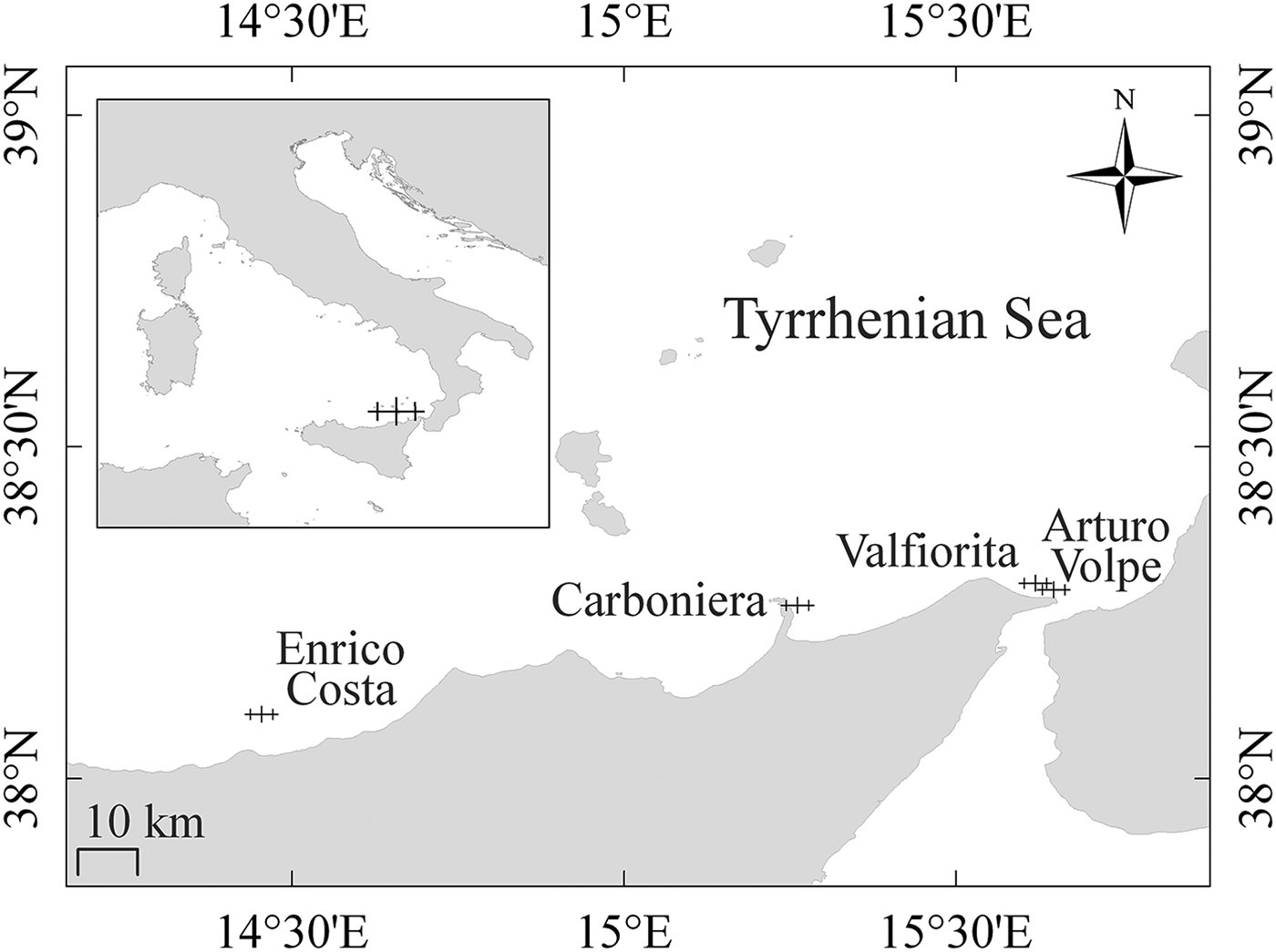
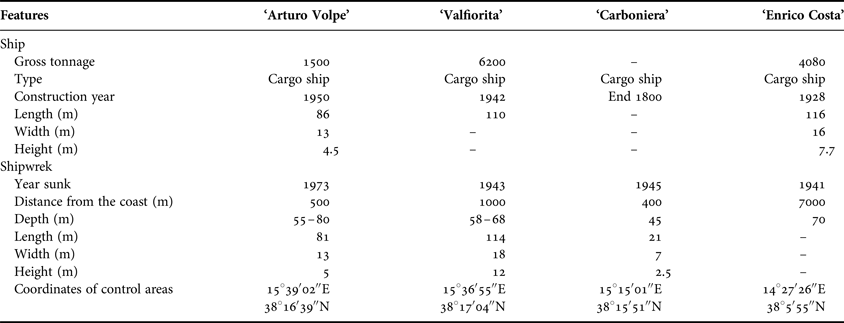
The wrecks investigated are all located in the southern Tyrrhenian Sea (northern coast of Sicily; Figure 1). The data come from literature sources of the Italian Army Historical Office, as well as from Loran maps which provide information on submerged obstacles for marine traffic. The study was performed on four wrecks (‘Arturo Volpe’, ‘Valfiorita’, ‘Enrico Costa’ and ‘Carboniera’), located on the continental platform in the province of Messina at depths between 50 and 100 m. Detailed information on the four investigated ships is shown in Table 1.
Sampling area with the four investigated wrecks.

Location and physical characterization of vessel-reefs and their control sites.

Data acquisition
First of all, the shipwrecks were identified during a pre-survey, by acoustic remote survey using a hull-mounted RESON SeaBat 8111 MultiBeam echosounder (MBES), operating at a frequency of 100 kHz and a nominal resolution of 3.7 cm. Data were acquired with 40% lateral overlap and processed to remove spikes due to navigation system problems and/or to the acquisition system by means of the PDS2000 Thales packet. The xyz data, detected by MBES, were processed in post-processing with the ArcGIS 9.2 ESRI software to map and characterize physically the four shipwrecks, information reported in Table 1.
Once the four vessels had been found and mapped, data on associated fish assemblages were collected, during the June 2010 survey, by means of UVCs, performed by ROV ‘Pollux’.
The ROV was equipped with a digital camera (Nikon D80, 10 megapixels), a strobe (Nikon SB 400), a high-definition video camera (Sony HDR-HC7), and three jaw grabbers. The ROV also hosted a depth sensor, a compass, and two parallel laser beams providing a 10 cm scale for measuring the frames and the specimen size, and it was equipped with an underwater acoustic tracking position system (Tracklink 1500 MA, Link Quest Inc.) providing detailed records of the transects along the seabed.
Underwater visual censuses were carried out on four wrecks and at the four control sites, one for each sunken vessel, randomly located on soft bottoms at a distance of 300 m from the respective wreck and at the same depth. The fish communities (fish species and their abundance) associated with the four investigated wrecks were surveyed by random transects, lasting 10 min each, conducted along the surfaces of the sunken hulls. Moving at an average speed of 6 m min−1, the ROV performed a transect around each wreck, achieving an approximate total distance of 600 m in 10 min (covering an area of 1200 m2 for each run, the visual field of the ROV being 2 m when moving at a distance of 1.5 m from the bottom). Four replicates were carried out at each wreck and four at each control site for a total of 32 observation units (total explored area = 38,400 m2).
Fish abundance was estimated by counting single specimens up to a maximum of 10 individuals, and using abundance-classes (11–30, 31–50, 51–100, 101–200, 201–500, 500) for schools. This recording system leads to a similar degree of error over a wide range of abundances, ensuring homogeneity of variance after log-transformation of the data (Frontier, Reference Frontier and Frontier1986; Guidetti et al., Reference Guidetti, Terlizzi, Fraschetti and Boero2003).
Remotely operated vehicle trials were recorded and stored on hard disks and four different researchers contributed to analysing both underwater and video data recordings, thus reducing any systematic error between methods. During the video analysis, the data were entered onto spreadsheets, with the following fields: Date; ID-Video; Wreck; Replicas of transects; Time; Depth; Temperature; horizontal and vertical Visibility; and Species.
Data analysis
The fish community was described by means of fish abundance (N), species richness (S) and frequency of occurrence (%O) data. A one-way permutational multivariate analysis of variance (PERMANOVA) (PERMANOVA; Anderson, Reference Anderson2001; McArdle & Anderson, Reference McArdle and Anderson2001) was used to test for differences between fish assemblages with regard to the factor SITE (made up of 8 levels, 4 wrecks + 4 control sites). The analysis was designed to test the null hypothesis of no significant differences between wrecks/controls in terms of fish assemblages. The test was based on Gower distances calculated on log (x + 1) transformed data, and each term in the analysis was tested using 4999 random permutations of appropriate units (Anderson & ter Braak, Reference Anderson and ter Braak2003). This permutation method is generally thought to be best suited because it provides the best statistical power and avoids the probability of Type I errors (Anderson & Legendre, Reference Anderson and Legendre1999). Moreover, a one-way permutational univariate analysis of variance (permutational ANOVA) was performed in order to detect significant differences between the mean values of species richness and abundance recorded at each site. Unlike the multivariate analyses described above, we used the Euclidean distance in this univariate model. Data were transformed to log (x + 1) in order to reduce the weighting of abundant categories and increase that of rarer ones.
Both univariate and multivariate analyses were employed using the software package PRIMER 6 with PERMANOVA + add-on (Anderson et al., Reference Anderson, Gorley and Clarke2008). Whereas ANOVA/MANOVA assumes normal distributions, PERMANOVA works with any distance measurement that is appropriate to the data, and uses permutations to make it distribution-free. Thus, the same F-statistics were calculated, but P-values were obtained by permutation. Moreover, the similarity percentage procedure SIMPER (Clarke & Warwick, Reference Clarke and Warwick2001) was used to identify the fish species contributing most to the differences between wrecks and control sites.
RESULTS
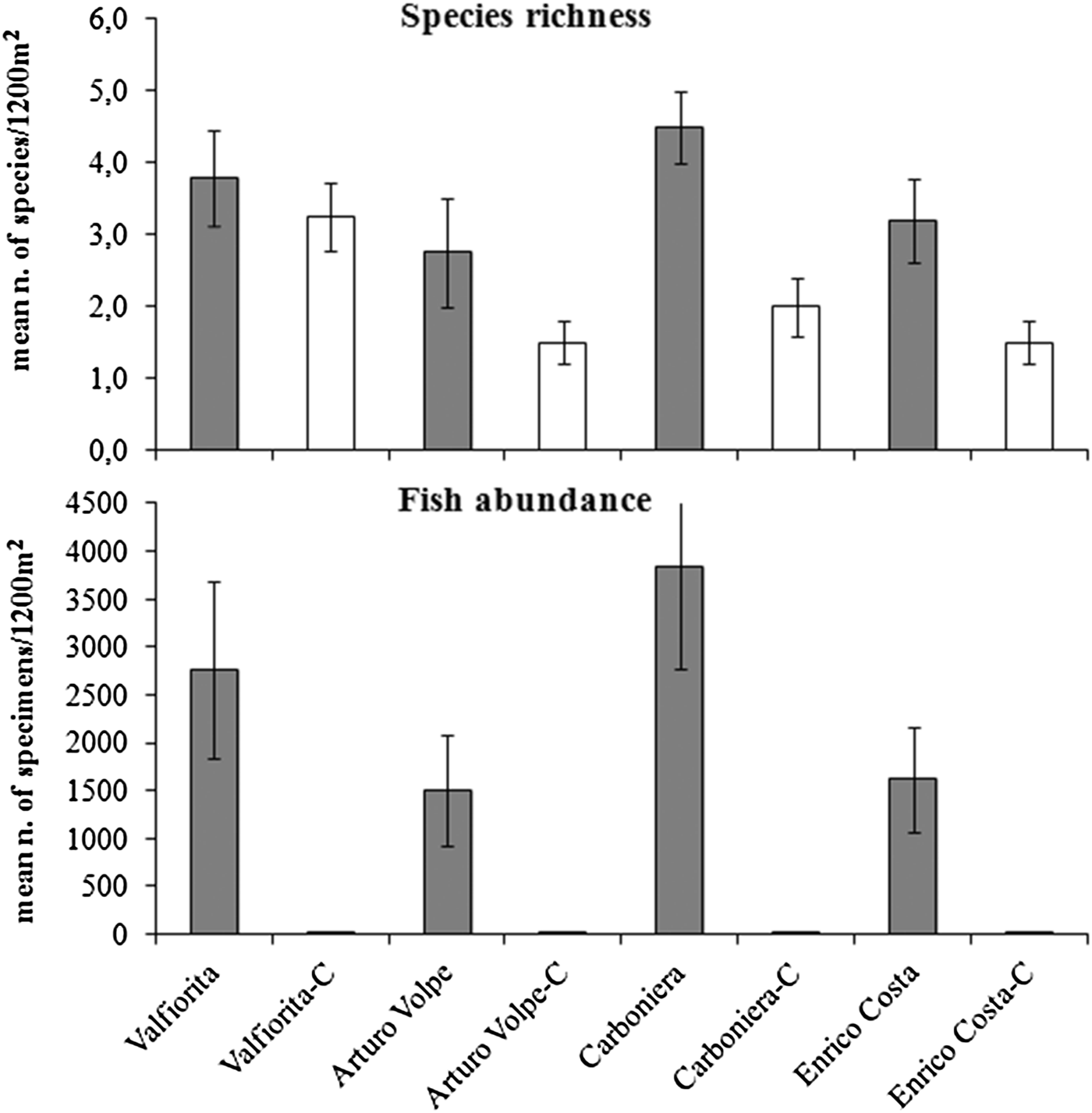
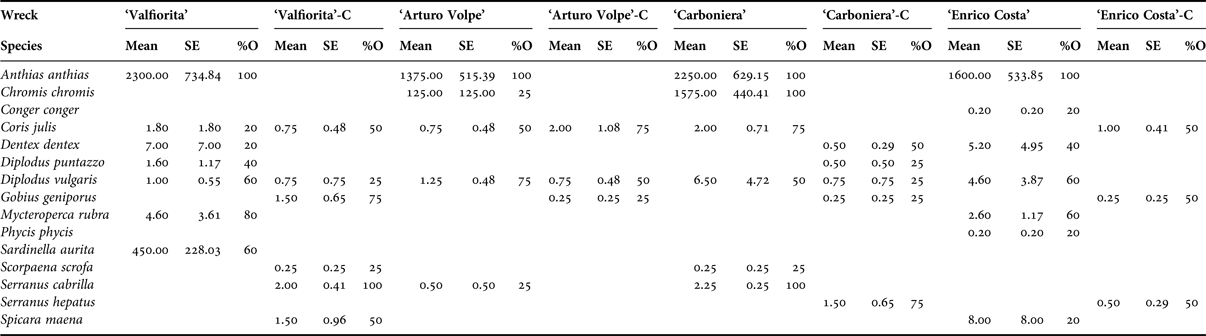
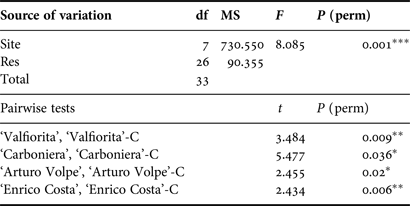
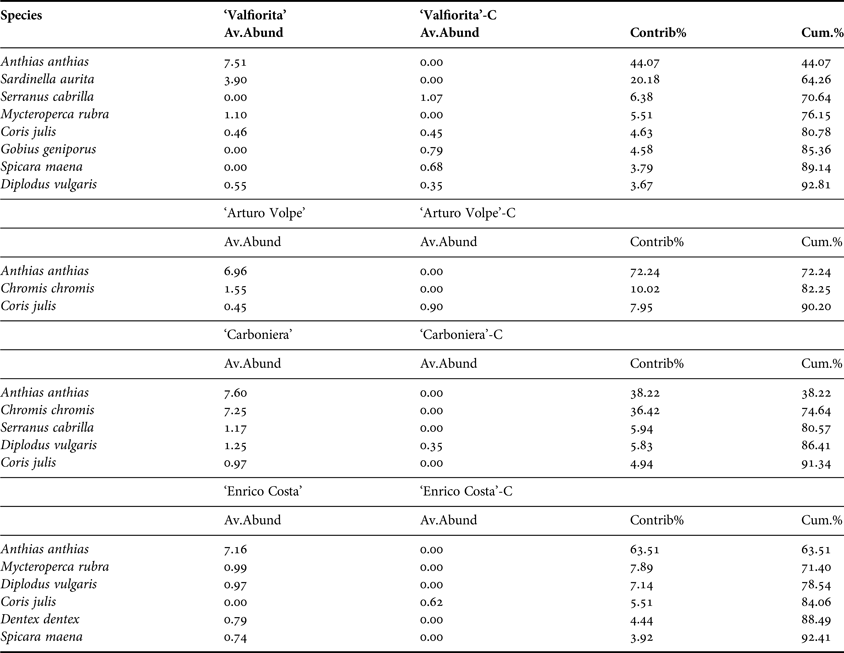
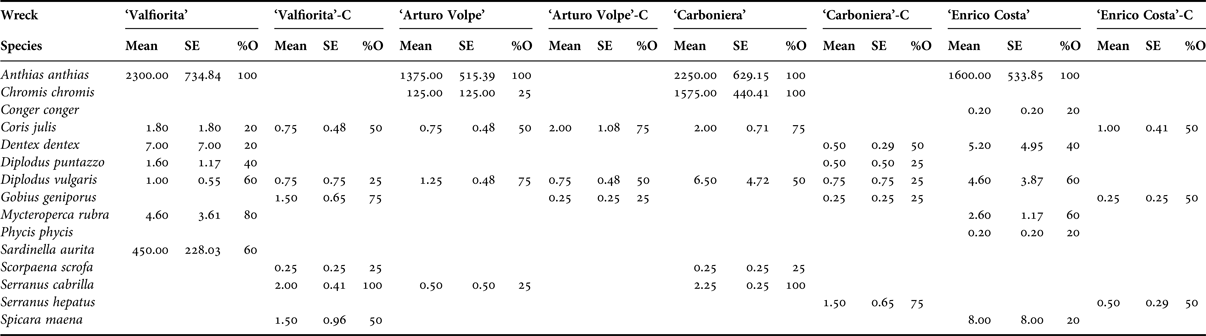
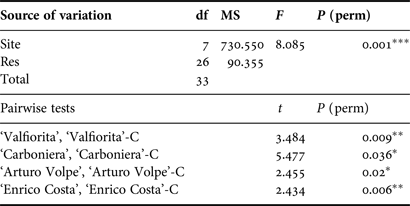
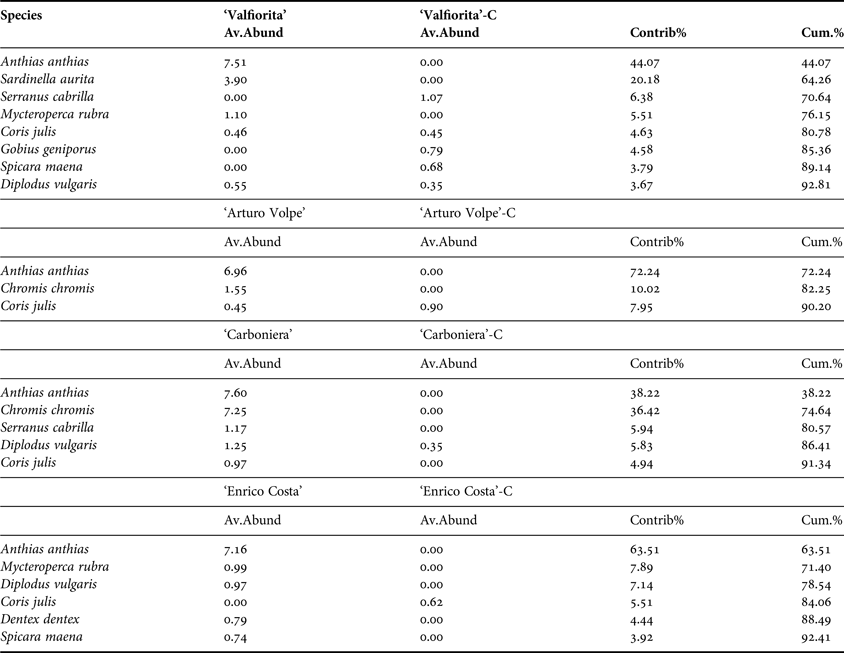
In Table 2, mean abundances, standard errors (SEs) and frequencies of occurrence for each species are shown for the four vessel-reefs and their respective natural sandy bottoms (control sites). Overall, 15 fish taxa belonging to 15 families were recorded in the study area; nine taxa were found on control sites and 13 on shipwrecks. Six species were common to both locations (shipwrecks and controls), six were exclusive to wrecks, whereas only two species were exclusively observed on the control sites. In particular, high-value species, such as Mycteroperca rubra and Phycis phycis were observed only on artificial structures (Table 2). Multivariate analysis (PERMANOVA) on the total fish assemblage showed significant differences for the factor WRECK (Table 3), indicating that fish assemblages changed between sampling sites. Pair-wise tests revealed that each wreck was significantly different from its control site (P < 0.05). SIMPER analysis pinpointed some fish taxa as the major contributors to these dissimilarities (Table 4). Indeed, high densities of Anthias anthias characterized the censuses carried out on vessel-reefs, thus helping to differentiate the fish communities on shipwrecks from those on nearby natural soft bottoms. As shown in Figure 2, the mean species richness and fish abundance were higher at the four artificial structures than at their natural control sites.
Mean species richness and fish abundance (mean number of species/1200 m2 ± standard error) for each wreck and its control.

Mean abundances, standard errors (SEs) and percentages of occurrence (%O) of fish species recorded at the four wrecks and their control sites.
One-way permutational multivariate analysis of variance analysing the effect of factor wreck, on fish assemblage based on Bray–Curtis dissimilarities of log transformed data. The P values of pair-wise comparisons are also reported. *P < 0.05; **P < 0.01; ***P < 0.001.
SIMPER of the fish species contributing most (%) to the dissimilarity between wrecks and controls.
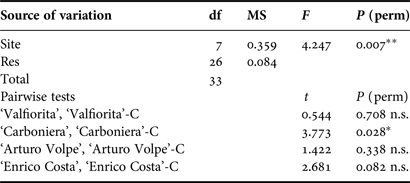
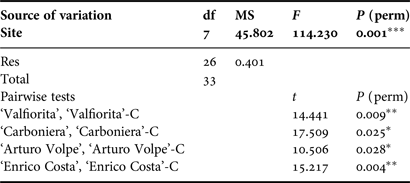
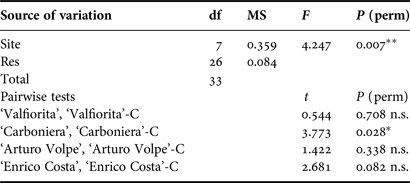
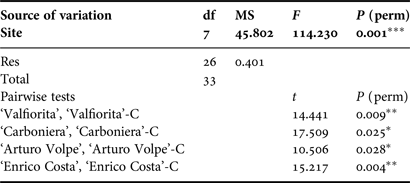
Permutational univariate ANOVAs on overall abundance and species richness, confirming the multivariate test result, showed significant differences for the factor SITE considered in the analyses (Tables 5 and 6). In spite of this, pair-wise tests showed significant differences in species richness only between the ‘Carboniera’ and its control site (P < 0.05; Table 5) whereas, as regards fish abundance, pair-wise tests confirmed significant differences in all comparisons.
Analysis of variance table for permutational univariate analyses of species richness based on Euclidean distance of log transformed data. The P values of pair-wise comparisons are also reported. *P < 0.05; **P < 0.01; ***P < 0.001; n.s., not significant.
Analysis of variance table for permutational univariate analyses of fish abundance based on Euclidean distance of log transformed data. The P values of pair-wise comparisons are also reported. *P < 0.05; **P < 0.01; ***P < 0.001.
DISCUSSION
There are thousands of sunken vessels (4% of the world's shipwrecks), at the bottom of the Mediterranean Sea (Parliamentary Assembly of the Council of Europe, 2012; Sprovieri et al., Reference Sprovieri, Barra, Del Core, Di Martino, Giaramita, Gherardi, Innangi, Oliveri, Passaro, Romeo, Rumolo, Manta, Tamburrino, Tonielli, Traina, Tranchida, Vallefuoco, Mazzola, Andaloro and Hughes2013). As the environmental risks posed by these artificial structures are still unclear, studies focusing on their impact on biodiversity are crucial. Indeed, to our knowledge, in the Mediterranean Sea, the role played by shipwrecks in the marine ecosystem and, particularly, on fish assemblages, has not yet even been investigated.
This study was designed to fill this gap and, indeed, detected significant differences between fish communities living either close to or far from these artificial structures. Moreover, in accordance with other studies carried out on extractive platforms and artificial reefs in the Mediterranean Sea (Fabi et al., Reference Fabi, Grati, Lucchetti and Trovarelli2002a, Reference Fabi, Luccarini, Panfili, Solustri and Spagnolob, Reference Fabi, Grati, Puletti and Scarcella2004; Scarcella et al., Reference Scarcella, Grati and Fabi2011; Consoli et al., Reference Consoli, Romeo, Ferraro, Sarà and Andaloro2013), our survey recorded higher levels of species richness and abundance near all wrecks than at a short distance from them (control areas), indicating that these sunken vessels act as artificial reefs (usually deployed for production or protection), attracting aggregations of fish species (tigmotrophic effect) and leading to an enrichment and a greater diversification of the local fish assemblage. These effects were mainly due to a higher occurrence around the structures of reef-dwelling or partially reef-dwelling species, which were not present further from the wrecks on natural soft bottoms. In particular, as shown by SIMPER analysis, planktivorous species such as Anthias anthias and Chromis chromis were the dominant trophic group on vessel-reefs, thus contributing most to the dissimilarity between wreck and control areas. These results are comparable to previous studies carried out on oil platforms (Rilov & Benayahu, Reference Rilov and Benayahu2000) and on a shipwreck (Lindquist & Pietrafesa, Reference Lindquist and Pietrafesa1989): in both cases, the authors reported planktivores to be the most numerous species.
The main mechanism invoked to explain the aggregation effect of these artificial structures is a higher habitat complexity in comparison to control sites located on natural soft bottoms. In fact, habitat complexity, defined as ‘heterogeneity in the arrangement of physical structure in the habitat surveyed (Lassau & Hochuli, Reference Lassau and Hochuli2004), is one of the most important ecological factors in shaping structure and community dynamics, influencing fish abundance, diversity and species richness (Bell & Galzin, Reference Bell and Galzin1984; Roberts & Ormond, Reference Roberts and Ormond1987; Jones, Reference Jones1988; Bell et al., Reference Bell, McCoy and Mushinsky1991; Hixon & Beets, Reference Hixon and Beets1993; Warfe & Barmuta, Reference Warfe and Barmuta2004; Harvey et al., Reference Harvey, White and Nakamoto2005; Willis et al., Reference Willis, Winemiller and Lopez-Fernandez2005). Indeed, a positive relationship has been reported for several natural environments between habitat complexity and community structure (i.e. both numbers of individuals and numbers of fish species; Luckhurst & Luckhurst, Reference Luckhurst and Luckhurst1978; Roberts & Ormond, Reference Roberts and Ormond1987; McClanahan, Reference McClanahan1994; McCormick, Reference McCormick1994; Öhman & Rajasuriya, Reference Öhman and Rajasuriya1998; Gratwicke & Speight, Reference Gratwicke and Speight2005; Garcia Charton & Pérez Ruzafa, Reference Garcia Charton and Pérez Ruzafa2008). More complex habitats increase the amount of refuge available to prey species, thus reducing predation pressure (Hixon & Beets, Reference Hixon and Beets1993; Macpherson, Reference Macpherson1994; Caley & St John, Reference Caley and St John1996; Almany, Reference Almany2004a). Increases in available refuges due to enhanced substrate topography have also been shown to reduce competition for space (Hixon & Menge, Reference Hixon and Menge1991; Almany, Reference Almany2004b) as well as adding to niche dimensionality (MacArthur & Levins, Reference MacArthur and Levins1967), both of which potentially increase fish abundance and distribution. The same pattern regarding spatial complexity, fish abundance and species richness has also been reported by previous studies carried out on various man-made structures such as artificial reefs (Chang et al., Reference Chang, Lee and Shao1977; Higo et al., Reference Higo, Hashi, Takahama, Tabata, Nagashima, Sakono, Kasmimizutara and Yamasaki1980; Buckley, Reference Buckley1982; Roberts & Ormond, Reference Roberts and Ormond1987; (Gorham & Alevizon, Reference Gorham and Alevizon1989; Hixon & Beets, Reference Hixon and Beets1989; Bohnsack et al., Reference Bohnsack, Johnson, Ambrose, Seaman and Sprague1991; Charbonnel et al., Reference Charbonnel, Serre, Ruitton, Harmelin and Jensen2002; Gratwicke & Speight, Reference Gratwicke and Speight2005), fringing reefs (Roberts & Ormond, Reference Roberts and Ormond1987), shipwrecks (Chandler et al., Reference Chandler, Sanders and Landry1985; Arena et al., Reference Arena, Jordan and Spieler2007; Fagundes-Netto et al., Reference Fagundes-Netto, Gaelzer, Coutinho and Zalmon2011) and extractive platforms (Rooker et al., Reference Rooker, Dokken, Pattengill and Holt1997; Rilov & Benayahu, Reference Rilov and Benayahu1998, Reference Rilov and Benayahu2000, Reference Rilov and Benayahu2002; Love et al., Reference Love, Schroeder and Nishimoto2003, Reference Love, Nishimoto and Schroeder2010, Love & York, Reference Love and York2006; Love & Nishimoto, Reference Love and Nishimoto2012; Consoli et al., Reference Consoli, Romeo, Ferraro, Sarà and Andaloro2013).
Greater species richness, as well as the several exclusive fish species (six) found at the four investigated vessel-reefs, suggests these artificial habitats are providing unique habitat characteristics, which may not be found on surrounding natural ones. In spite of this, it is important to underline that shipwrecks, which are an ideal target for recreational fishermen, could contribute to the over-exploitation of some high-value fish species, such as Mycteroperca rubra, Dentex dentex and Diplodus spp., attracted by the artificial hard substrate of the vessel-reefs.
The present study also helped to identify the strengths and weaknesses of the ROV as a tool for studying the fish community associated with sunken vessels. In fact, it is unlikely that the wreck areas contained only the 13 fish species observed; this would mean that the ROV probably did not allow for a complete description of the fish assemblage associated with these artificial structures. Similar conclusions were drawn by Andaloro et al. (Reference Andaloro, Ferraro, Mostarda, Romeo and Consoli2012) in other artificial habitats (extractive platforms) located in the Mediterranean Sea, by comparing UVCs performed using a ROV and by scientific SCUBA divers. According to these authors, the ROV is unable to identify crypto-benthic species due to their small size and to their tendency to hide in holes or crevices. This cryptic behaviour, which is also a well-known constraint for the UVC methodology performed by divers (Smith, Reference Smith1988; Willis, Reference Willis2001), makes these fish invisible to the camera, whose resolution and field of vision is clearly lower than the diver's eye. By contrast, according to Tessier et al. (Reference Tessier, Chabanet, Pothin, Soria and Lasserre2005) and Andaloro et al. (Reference Andaloro, Ferraro, Mostarda, Romeo and Consoli2012), the ROV is an appropriate method for censusing planktivorous fish, both from a qualitative and quantitative point of view, mostly in relation to their high abundance and low mobility.
Francour et al. (Reference Francour, Liret and Harvey1999) highlight the less invasive nature of the ROV in comparison with the presence of SCUBA divers, the possibility of recording at dawn and dusk by means of highly sensitive cameras and, lastly, the ability to gather data for longer periods than a single dive. In spite of its limits, UVCs performed by ROV are the only way to explore depths where divers cannot operate.
Finally, the evidence of leakages and/or transfer of hazardous contaminants, from similar sunken vessels in the same area, to the sediments (Sprovieri et al., Reference Sprovieri, Barra, Del Core, Di Martino, Giaramita, Gherardi, Innangi, Oliveri, Passaro, Romeo, Rumolo, Manta, Tamburrino, Tonielli, Traina, Tranchida, Vallefuoco, Mazzola, Andaloro and Hughes2013) suggests that there is an urgent need to better understand the crucial role played by this potential source of pollutants for the marine environments and ecosystem. Therefore, an ecosystem approach to study and monitor this pollutant source is mandatory for appropriate remediation and/or mitigation of the potential negative effects on a productive and healthy ocean (Sprovieri et al., Reference Sprovieri, Barra, Del Core, Di Martino, Giaramita, Gherardi, Innangi, Oliveri, Passaro, Romeo, Rumolo, Manta, Tamburrino, Tonielli, Traina, Tranchida, Vallefuoco, Mazzola, Andaloro and Hughes2013).
ACKNOWLEDGEMENTS
We would like to thank the crew and researchers of RV ‘Astrea’ for their help during ROV operations. The authors would also like to thank Anthony Green for kindly reviewing the English of the manuscript.
FINANCIAL SUPPORT
This study has been conducted by ISPRA, within the project n.490 Relitti–SIA, financed by the Italian Ministry of the Environment, Land and Sea.