In Spanish, as in other languages with grammatical gender, the morphological masculine gender in animate noun phrases (NP) presents an ambiguity between a masculine and a mixed-gender reading. Specifically, regarding human masculine plural nouns, such as los profesores (the teachers), its masculine reading would consist of a group of men who are teachers, whereas, in its mixed-gender reading, it would describe a group of people, in which both men and women are included. The ambiguous status of masculine plural NPs makes both a continuation with a masculine partitive anaphor (1a) and with a feminine partitive anaphor (1b) grammatical in Spanish. The feminine anaphor should be licensed by the mixed reading of the NP, whereas the masculine anaphor, and not the feminine, is licensed if the antecedent NP receives an exclusively masculine interpretation.

The current article focuses on whether both meanings, masculine or mixed-gender, are equally accessible for the listener in sentences such as (1) thus indicating that the masculine NP ambiguity is balanced or unbalanced and whether the gender stereotype associated with the noun affects the interpretation of the ambiguous NP.
The possibility of using masculine forms to refer to both men and women, as well as to nonbinary gender, is at the center of an international, cross-linguistic social debate about inclusive language (Gabriel, Reference Gabriel2008; Gabriel et al., Reference Gabriel, Gygax and Kuhn2018; Stahlberg et al., Reference Stahlberg, Braun, Irmen, Sczesny and Fiedler2007). Defenders of the use of masculine plural NPs seem to assume that masculine NPs are a case of balanced ambiguity and, consequently, the mixed-gender interpretation is accessed consistently and without effort, therefore rendering the use of alternative referential expressions unnecessarily redundant. On the other hand, defenders of alternative expressions treat masculine NPs as a case of imbalanced ambiguity, where the mixed-group reading would be more costly to access, therefore making the presence of women invisible by use of the masculine grammatical gender.
Empirical substantiation of a pattern for Spanish, nevertheless, is lacking from the debate. Thus, our study aims to shed light on the interpretation of masculine plural NPs in Spanish when they are presented out of context and to contribute therefore to the first step of understanding how these Spanish NPs are interpreted in everyday language use. This investigation is based on previous experimental studies on the interpretation of masculine human NPs in other languages, reviewed in the next sections. Nevertheless, the Spanish pronominal system allows for a methodological choice that more accurately tests the accessibility of the mixed-gender interpretation of masculine NPs.
Stereotypes determine interpretation
Previous studies have analyzed the interpretation of human NPs in languages with and without grammatical gender. The stereotype associated with the noun has proven to be the main factor affecting the interpretation of human NPs in languages without grammatical gender, such as English (Carreiras et al., Reference Carreiras, Garnham, Oakhill and Cain1996; Duffy & Keir, Reference Duffy and Keir2004; Garnham et al., Reference Garnham, Oakhill and Reynolds2002; Gygax et al., Reference Gygax, Gabriel, Sarrasin, Oakhill and Garnham2008), Finnish (Pyykkönen et al., Reference Pyykkönen, Hyönä and van Gompel2010), as well as Norwegian, where feminine grammatical gender use is declining (Gabriel et al., Reference Gabriel, Behne and Gygax2017). Using, in most cases, paradigms of anaphoric resolution with sentences such as (2) and (3), these studies show that feminine anaphoric expressions, such as she in (2b), are judged less acceptable and involve more processing cost when the possible antecedent is associated with a masculine stereotype or carries no gender stereotype, than in cases in which the noun is stereotypically feminine.

These results are interpreted in the sense that the mental representation activated by processing the antecedent NP (the footballer in the example) is constrained by the stereotypicality of the noun: the footballer leads to a mental representation of a man who plays football. The congruity or incongruity of the subsequent anaphor with the gender of this mental representation explains the processing cost of some anaphoric expressions. This finding applies both to singular (Carreiras et al., Reference Carreiras, Garnham, Oakhill and Cain1996) and plural NPs (Garnham et al., Reference Garnham, Gabriel, Sarrasin, Gygax and Oakhill2012; Gygax et al., Reference Gygax, Gabriel, Sarrasin, Oakhill and Garnham2008).
In languages with grammatical gender, in which the masculine gender is used with a mixed-gender meaning as well as the exclusively masculine reading, the questions are whether the masculine grammatical marking has an effect on the interpretation of the NPs and whether the masculine morphological marking interacts with the stereotypicality of the noun. Focusing on masculine plural NPs (but see Carreiras et al., Reference Carreiras, Garnham, Oakhill and Cain1996; Esaulova et al., Reference Esaulova, Chiara and von Stockhausen2014; Irmen & Schumann, Reference Irmen and Schumann2011; Redl et al., Reference Redl, Eerland and Sanders2018 for singular NPs), their interpretation has been analyzed in German (Garnham et al., Reference Garnham, Gabriel, Sarrasin, Gygax and Oakhill2012; Gygax et al., Reference Gygax, Gabriel, Sarrasin, Oakhill and Garnham2008; Irmen, Reference Irmen2007; Irmen & Rossberg, Reference Irmen and Rossberg2004; Stahlberg & Sczesny, Reference Stahlberg and Sczesny2001); French (Garnham et al., Reference Garnham, Gabriel, Sarrasin, Gygax and Oakhill2012; Gygax et al., Reference Gygax, Gabriel, Sarrasin, Oakhill and Garnham2008); and Russian (Garnham & Yakovlev, Reference Garnham and Yakovlev2015). These studies find that the masculine gender induces a mental representation of a group of men, suggesting a strong effect of the gender grammatical marking in the mental representation of the referent’s sex or social gender. Specifically, the common finding is that in sentence pairs like (3), where the antecedent is expressed in the grammatical masculine form, participants more often accepted continuations with a masculine anaphoric NP (plusieurs hommes, several men) than with a feminine one (plusieurs femmes, several women).

The effect of the stereotype in languages with grammatical gender is less consistently found: no stereotype effect on French and German sentence acceptance is found in Gygax et al. (Reference Gygax, Gabriel, Sarrasin, Oakhill and Garnham2008), but Garnham et al. (Reference Garnham, Gabriel, Sarrasin, Gygax and Oakhill2012) found stereotype effects in both languages. Likewise, the results regarding the processing cost are not uniform: Gygax et al. (Reference Gygax, Gabriel, Sarrasin, Oakhill and Garnham2008) and Garnham et al. (Reference Garnham, Gabriel, Sarrasin, Gygax and Oakhill2012) found an anaphor gender effect on decision times in German and only a slightly effect in their French data. Similarly, the effect of the noun stereotype in processing costs measures is not consistent in previous literature: the stereotype of the NP had no effect in the decision times in Gygax et al. (Reference Gygax, Gabriel, Sarrasin, Oakhill and Garnham2008) and in Garnham et al. (Reference Garnham, Gabriel, Sarrasin, Gygax and Oakhill2012), but reading times were affected by the stereotype of the antecedent in Irmen and Rossberg (Reference Irmen and Rossberg2004).
Co-reference and possible confounds
Previous studies analyzing the interpretation of plural masculine NPs use different varieties of anaphors in the second sentence, including plural demonstrative NP and personal pronouns (Irmen, Reference Irmen2007; Irmen & Rossberg, Reference Irmen and Rossberg2004) necessarily interpreted as co-referential and coextensive with the plural NP antecedent. Partitive anaphors were used in order to test whether the mixed-group interpretation is accessed (Gabriel et al., Reference Gabriel, Behne and Gygax2017; Garnham et al., Reference Garnham, Gabriel, Sarrasin, Gygax and Oakhill2012; Garnham & Yakovlev, Reference Garnham and Yakovlev2015; Gygax & Gabriel, Reference Gygax and Gabriel2008; Gygax et al., Reference Gygax, Gabriel, Sarrasin, Oakhill and Garnham2008): accepting a feminine partitive anaphor would imply accessing the interpretation where part of the individuals of the antecedent group are women (as opposed to the whole group). In all cases, the partitive expressions were composed of a quantifier (some, most, one…) and a partitive complement, also called “inner NP,” introduced by a preposition (of the women/of the men) (Sleeman & Ihsane Reference Sleeman and Ihsane2016). However, we argue that the explicit mention of the definite plural inner NP might favor the reading in which the men/the women refers to the whole set of individuals in the plural antecedent. If this reading is being accessed by participants in previous studies (Gabriel et al., Reference Gabriel, Behne and Gygax2017; Garnham et al., Reference Garnham, Gabriel, Sarrasin, Gygax and Oakhill2012; Gygax et al., Reference Gygax, Gabriel, Sarrasin, Oakhill and Garnham2008), it is possible that the answers rejecting constructions such as The neighbors … one of the women are in fact rejecting the co-referential and coextensive reading between the neighbors and the women (all of the neighbors were women, a reading favored by the definiteness of the NP), and not the possibility of having a mental representation of the neighbors in which some of the members of the group (but not all of them) were women.
Both Gygax et al. (Reference Gygax, Gabriel, Sarrasin, Oakhill and Garnham2008) and Garnham et al. (Reference Garnham, Gabriel, Sarrasin, Gygax and Oakhill2012) acknowledge that this kind of interpretation might have occurred in their studies but argue that it is unlikely. Their arguments, however, are not without caveats and what the secondary short tasks included in their study to reject this possibility show is that the mixed-group interpretation of a collective NP (the group, the people) is possible, but they do not eliminate the suspicion that the co-extensive reading of the anaphor is, in fact, preferred in their stimuli. To sum up, the question of whether the anaphoric choice in previous studies actually tests for the access to the mixed-gender reading of plural NPs is, in our view, still open and an experimental design with a partitive anaphor that does not allow for the coextensive reading is, as Gygax et al. recognize, desirable (Reference Gygax, Gabriel, Sarrasin, Oakhill and Garnham2008, p. 482). In the experiment presented here, we choose an anaphoric form that avoids ambiguity between the coextensive and the noncoextensive readings of the anaphor.
Attitudes toward inclusive language as a predictor
Finally, and provided the lively social debate about inclusive language, it is worth considering whether the attitude toward inclusive language could affect the interpretation of masculine plural NPs. Stahlberg and Sczesny (Reference Stahlberg and Sczesny2001) investigated this issue using a categorization paradigm in which participants would decide if a person shown in a picture pertained to a category presented immediately after the picture. Categories were presented by means of a masculine singular noun in German (for example, athlete) and included nouns with a masculine, a feminine, or no gender stereotype. To evaluate attitudes toward inclusive language, a questionnaire based on previous studies (Prentice, Reference Prentice1994) was applied. Stahlberg and Sczesny (Reference Stahlberg and Sczesny2001) found that participants with a favorable attitude toward the use of a nonsexist language had slower response times in recognizing a female individual as belonging to a category carrying a masculine stereotype, such as in the pair “picture of a woman” – “politician”. This means that participants who were more sympathetic toward uses of nonsexist language found it more costly to accept that a woman in the picture was referred to by means of a singular masculine noun, especially if the noun carries a male stereotype, arguably because these participants would expect the feminine grammatical form to be more appropriate to designate the pictured woman. Building on this finding, we consider it relevant to measure whether attitudes toward inclusive language affect the interpretation of masculine plural NPs in Spanish.
Our experiment
This paper focuses on the interpretation of human masculine plural NPs in Spanish, which are ambiguous between an exclusively masculine interpretation (a group of men) and a mixed-gender interpretation (a group of men and women). The current article addresses four research questions. First, we seek to determine if the two meanings of human masculine NPs are balanced or unbalanced. Second, we address the question of whether the bias toward the masculine interpretation of human masculine NPs, found in previous studies on different languages and with different anaphoric choices, is also present in Spanish masculine NPs. Our third question is whether the interpretation of masculine NPs in oral speech parallels the findings of masculine gender interpretation in reading. Finally, the study addresses the question of whether the speaker’s attitude toward inclusive language influences the interpretation of masculine human NP.
Although this experiment follows the steps of previous studies in other languages, it contributes to the literature in the following way. First, to avoid the potential confound of a coextensive reading between the masculine antecedent and the inner NP of the partitive expression, the men/the women, the indefinite pronoun uno/una is used here. This partitive anaphor is marked for gender and does not explicitly include a gender-marked inner NP. Uno/una obligatorily triggers a partitive reading when its antecedent is a plural NP: one of the elements in the group referred to by the plural NP. Second, we are interested in the processing of masculine NPs in oral speech, rather than in reading. So far, it is unclear whether the results obtained with reading paradigms can be extrapolated to general language processing (Gabriel et al., Reference Gabriel, Behne and Gygax2017). Here we aim to contribute to answering this question observing the interpretation of Spanish masculine NPs in oral speech processing.
Finally, we seek to further test whether the speaker’s attitude toward inclusive language can influence the interpretation of masculine human NPs. In order to test this hypothesis, a questionnaire on attitudes toward inclusive language based on two previous studies (Parks & Roberton, Reference Parks and Roberton2000; Prentice, Reference Prentice1994) is included.
Method
The experiment used a Sentence Continuation Paradigm (Gabriel et al., Reference Gabriel, Behne and Gygax2017), in which the participants listened to two sentences and were asked to judge whether the second sentence was a coherent continuation of the first one. For its design, it was first necessary to apply a pretest of the gender stereotypicality of nouns.
Pretest of the gender stereotypicality of nouns
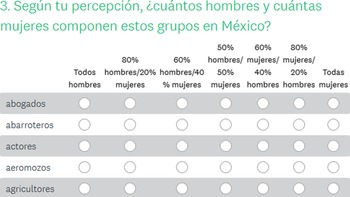
The test consisted of an online questionnaire in which participants were presented with 120 masculine plural human nouns and had to judge the proportion of men and women in such human groups. The participants were asked: According to your perception, how many men and how many women make up these groups in Mexico? The responses were registered on a scale from 100% men to 100% women. Figure 1 shows part of the questionnaire.
Fragment of the Stereotypicality of Nouns Pretest.

One-hundred participants, ages 16 to 60, provided answers to this questionnaire. Only 40% of the participants provided information about their gender: 37.5% masculine; 60% feminine; 2.5% nonbinary. All participants were from Mexico, since the goal of this test was to obtain the stereotypicality of nouns for Mexican speakers. From their responses, nouns were classified into three groups: the 12 nouns mostly judged as composed of all or of almost all men (nouns stereotyped as masculine), the 12 nouns mostly associated with women (stereotyped as feminine), and the 12 nouns which were mostly assigned a 50% men/50% women composition (neutral regarding gender stereotype).
Participants
Thirty-six Mexican undergraduate and graduate college students participated in the study (18 self-designated as men and 18 self-designated as women), from 18 to 31 years of age. All of them were monolingual native speakers of Spanish. Even though they have all had contact with the English language in school, they do not use it in their daily communication.
Materials
Thirty-six experimental items were created (see Appendix 1). Each one consisted of a pair of sentences. The first sentence included a masculine plural NP (e.g., los ciudadanos) in subject position and the second sentence included a singular indefinite pronoun, either in the masculine (uno) or in the feminine form (una), in subject position, which referred back to the NP subject of the first sentence. Example (4) illustrates the stimuli.

Twelve of the sentences included an NP subject with a masculine stereotype, 12 other sentences included a feminine stereotyped NP subject, and the final 12 included an NP subject that was neutral with respect to gender stereotype. For each of these stereotype conditions, six of the NPs were combined with the feminine anaphor una in the second sentence and six with the masculine anaphor uno.
Thirty-six filler sentences were included in the experiment. Fillers also consisted of two sentences; the first one included a plural NP subject and the second one included a subject anaphoric expression other than uno/una. Given that a positive response (judging b as a possible continuation of a) was expected for the test items, the fillers were designed to favor negative responses, following Gygax et al. (Reference Gygax, Gabriel, Sarrasin, Oakhill and Garnham2008). For this purpose, the fillers either showed a referential incongruence (e.g., Las madrinas fueron vestidas de morado. De ellos, algunos estaban visiblemente molestos llevando ese vestido. “The bridesmaids were dressed in purple. Among them (masc.), some (masc.) were visibly upset wearing that dress”) or other kind of semantic incongruencies (e.g., Los profesores tomaron un descanso bajo el sol. Algunas abrieron sus paraguas para protegerse de la lluvia. “The professors (masc.) took a break under the sun. Some (fem.) opened their umbrellas to protect themselves from the rain”). Each participant listened to a total of 72 pairs of sentences (36 test + 36 fillers), and the order of presentation of both test sentences and fillers was randomized.
The stimuli were recorded by a masculine voice, in contrast to Gabriel et al. (Reference Gabriel, Behne and Gygax2017) in which a feminine voice was used. The items were recorded at the Laboratorio de Lenguaje y Cognición (Language and Cognition Laboratory) of the Centro de Investigación en Ciencias Cognitivas (Center of Research in Cognitive Science) of the Universidad Autónoma del Estado de Morelos, Mexico, using the Audacity 2.3.1 program. The recordings were made at a frequency of 44100 Hz. The intonation and speed of the sentences were uniform. The Audacity audio compressor was applied to reduce the background noise.
Questionnaire of attitude toward sexist/nonsexist language
The questionnaire consisted of 15 items presented with a rating scale to measure participant agreement with the statement. Specifically, participants were asked to judge 10 statements on a scale from 1 to 5, 1 being “Completely Disagree” and 5 “Completely Agree” (see Appendix 2). One of the statements is given in (5):

The last five items consisted of examples of sentences that could be judged as sexist or not sexist. For these sentences, participants indicated on a scale to what degree they considered the statement sexist; in the scale, 1 was “Nonsexist at all” and 5 “Definitively sexist.” Example (6) is one of these items.

The items were selected from the questionnaires in Prentice (Reference Prentice1994) and Parks and Roberton (Reference Parks and Roberton2000) and were translated into Spanish for this study.
NP and anaphora interpretation experiment
The experiment was designed and conducted using SuperLab 5, and the participants took the test on a laptop. The procedure is based on previous studies on the processing of masculine plural NPs (Gabriel et al., Reference Gabriel, Behne and Gygax2017; Gygax et al., Reference Gygax, Gabriel, Sarrasin, Oakhill and Garnham2008) The instructions given to participants were to listen to the pairs of sentences and press the “q” key on the laptop keyboard for “yes” if they thought the second sentence was a coherent continuation of the first one, or the “p” key on the laptop to indicate “no” if they did not think so. The participants were asked to keep their forefingers in the respective buttons and to answer as fast as possible.
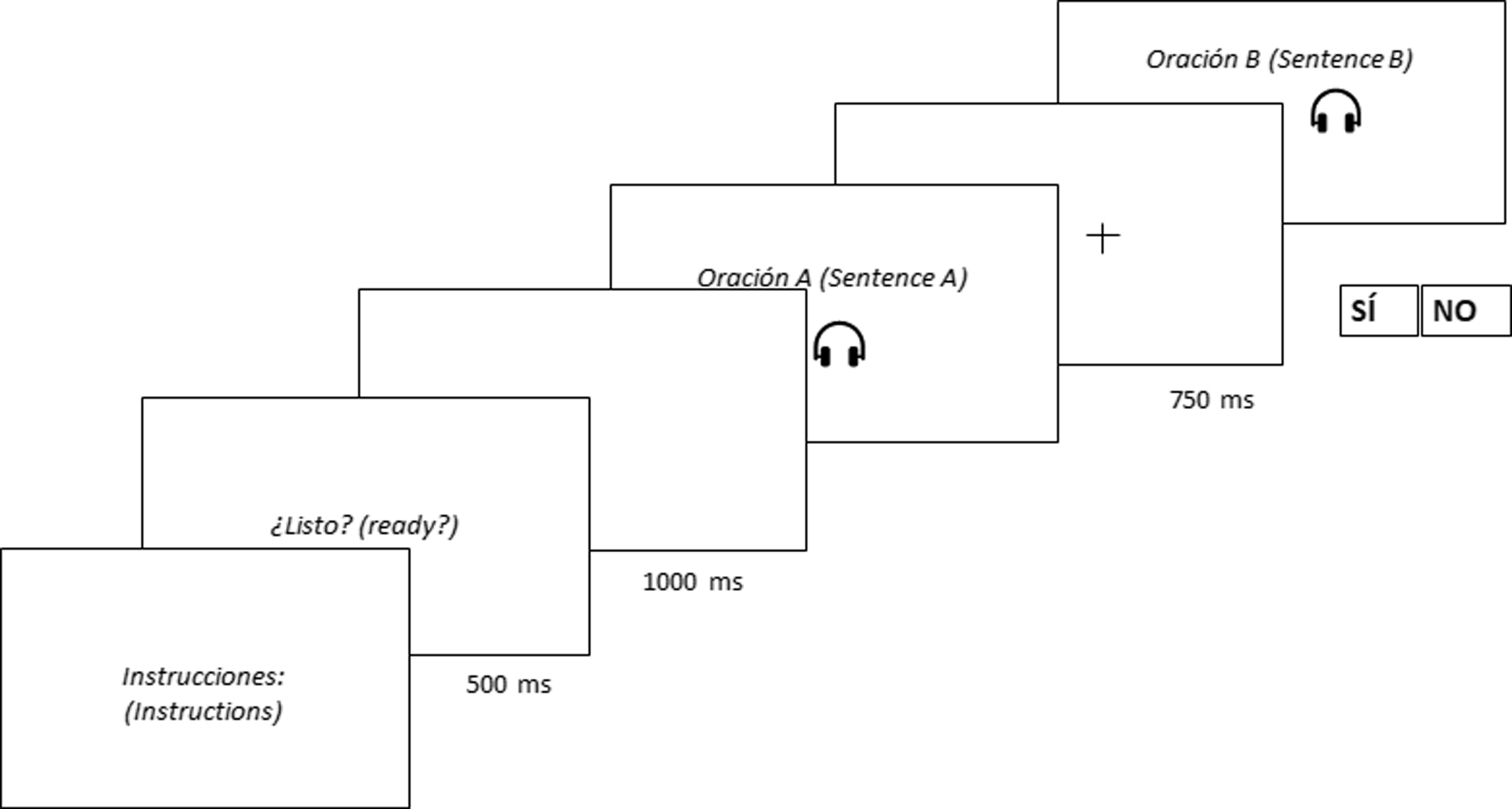
The question ¿listo? (ready?) appeared on the screen for 500 ms. After that, a blank screen appeared for 1000 ms; when that time was over, the participants listened to the first sentence; then, they saw another blank screen for 750 ms and finally they listened to the second sentence. When the second sentence stopped, a third blank screen appeared until the participant made a decision. The procedure can be seen in Figure 2.
Schematized Procedure of the Experiment.

At the end of the experiment, the participants answered the questionnaire to evaluate their attitude toward inclusive language described above. SuperLab recorded the time from the onset of the second sentence until the moment when the participants pressed a button on the keyboard. To obtain the response time, we subtracted the length of the second sentence audio from the recorded time, which provided us with the time it took to respond to each item after the end of the audio. The participants were first given six practice test trials to get familiar with the test. There was a 15 second break after every 12th pair of sentences and a 1 min break after completing 36 pairs of sentences.
Design
The design of the study was 3 (stereotype of the noun in the first sentence: masculine, feminine, or no stereotyped) × 2 (anaphoric pronoun gender: uno/una).
Results
Yes-responses, as well as the response time for yes-responses and no-responses, were analyzed using generalized linear mixed models with three fixed factors: sex of the participant (male and female; male = 1); stereotype of the noun, with three possible values (masculine, feminine, or no stereotype; feminine is reference category); and anaphor, with two values (masculine and feminine; masculine = 1). Since multiple items are nested in respondents, and key predictor variables vary within subjects, we treat items as nested in participants in the context of mixed models. We assume random intercepts in the models below – adjusting for individual differences in baseline yes-responses – and test whether random slopes are warranted. The analyses were performed using the lme4 package of the R software platform (Bates et al., Reference Bates, Mächler, Bolker and Walker2015).
Acceptance
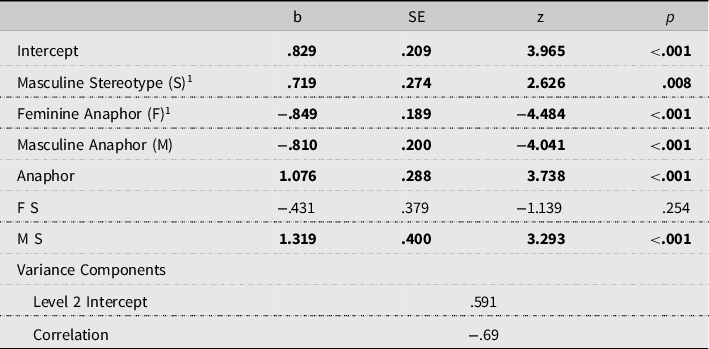
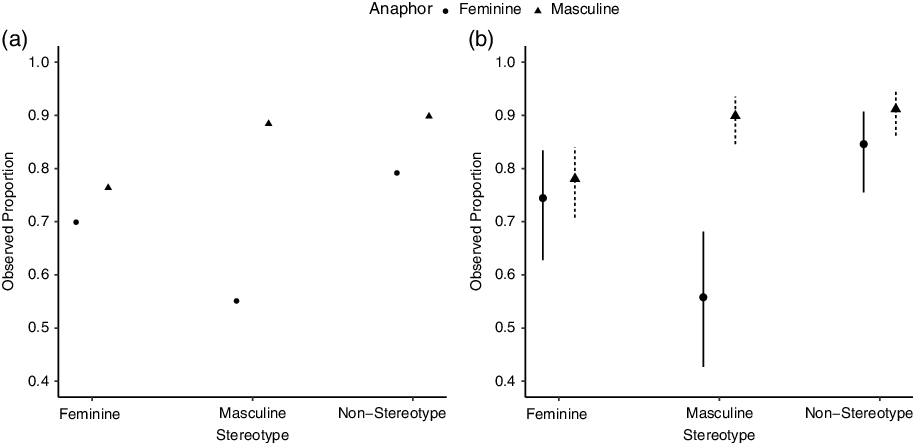
We analyzed the repeated binary responses to judge whether the second sentence was a coherent continuation of the first one using mixed effects logistic regression. Table 1 presents the results. Footnote 1 There is a significant difference in the odds of acceptance by anaphor: there are more yes-responses when the anaphor is masculine than when the anaphor is feminine. With respect to the effect of stereotype, there is a higher proportion of affirmative responses when the NPs were not stereotyped than in sentences with NPs carrying a masculine stereotype or a feminine one. Figure 3a illustrates these results, showing the observed proportions and predicted probabilities of a yes-response by both these factors.
Summary of mixed effects logistic regression model

Note:
1 Reference category is no stereotype.
*p < .05,
**p < .01,
***p < .001.
Observed Proportions and Predicted Probability of Yes-Response by Condition. Results Drawn from Table 1.

The interaction effect between anaphor and the stereotype improved model fit (Chi-squared = 25.95, DF = 2, p < .001). To illustrate the interaction effect, Figure 3b again shows the predicted probabilities from the mixed effects logistic regression model. We find that there are more affirmative responses when the antecedent NP carries a masculine stereotype and the anaphor is also masculine (for example, Los bomberos… Uno; The firemen… One {masc}) than when the masculine NP antecedent, with masculine stereotype, is followed by a feminine anaphor (Los bomberos… Una; The firemen… One {fem}). This difference between the acceptance rate of feminine and masculine anaphors is not found when the stereotype associated to the antecedent NP is feminine or when the noun does not carry a gender stereotype.
Response time for yes-responses
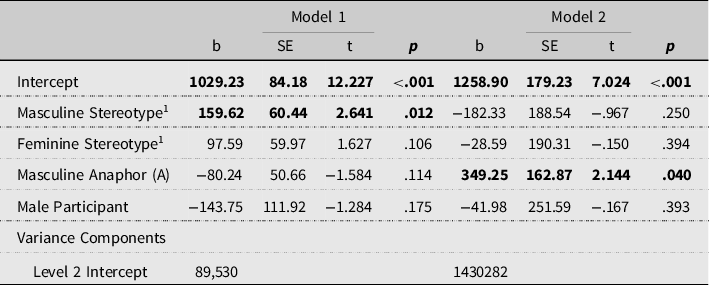
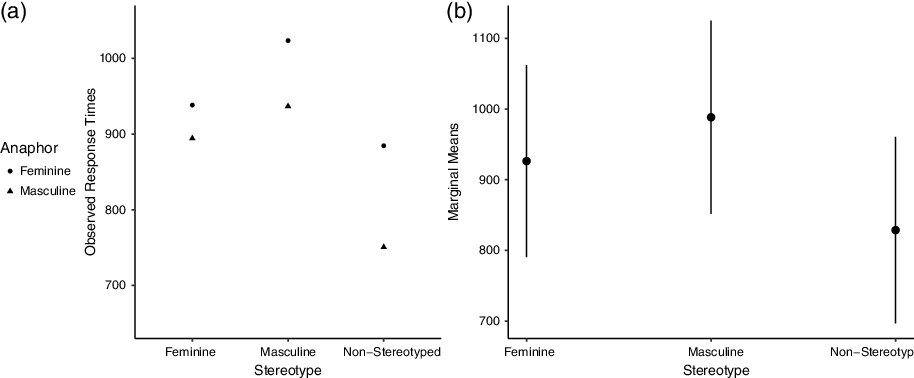
For this first analysis, only the response time for yes-responses (responses that judged the second sentence as a coherent continuation) was considered, following Gygax et al.(Reference Gygax, Gabriel, Sarrasin, Oakhill and Garnham2008), Garnham et al. (Reference Garnham, Gabriel, Sarrasin, Gygax and Oakhill2012) and Gabriel et al. (Reference Gabriel, Behne and Gygax2017). Table 2 presents results from a mixed effects regression model, with the multiple continuous response times nested in participants. In this case, we found no evidence that anaphor and the stereotype of the noun interact (Chi-squared = .82, DF = 2, p = .66), nor any evidence that the predictors should have random slopes. As summarized in Model 1, positive responses were slower with the masculine anaphoric pronoun (uno) than with the feminine pronoun (una) (b = −80.24, p = .114). Regarding noun stereotype, when participants listened to pairs of sentences with a nonstereotyped noun (for example, los trabajadores {the workers, masc grammatical gender}), their positive responses were fastest, with pairs of sentences with an NP carrying a feminine stereotype (los enfermeros {the nurses, masc.}) the second fastest, and pairs of sentences with an NP carrying a masculine stereotype (los bomberos {the firemen, masc.}) the slowest (Figure 4). The masculine/nonstereotyped contrast is significant, but the feminine/nonstereotyped contrast is not significant.
Summary of mixed effects regression model predicting response times. Model 1 predicts timing to yes responses and model 2 predicts timing to no responses

Note:
1 Reference category is no stereotype.
*p < .05,
**p < .01,
***p < .001.
Response Time for Yes Responses, by Anaphor and Stereotype of the Noun. Results Drawn from Table 2.

Response time for negative-responses
We also performed a statistical analysis for the negative responses, that is, responses judging that the second sentence was not a coherent continuation of the first one (273 responses). The results of a linear mixed-effects model including participant sex, stereotype, and anaphora as fixed effects is showed in Model 2 of Table 2. As with positive response times, we found no evidence for an interaction between anaphor and the stereotype of the noun, nor for random slopes. When judging that the second sentence was not a good continuation of the first one, the response times were slower for sentences with a masculine anaphor than for sentences with a feminine anaphor (b = 349.25, p = .04).
Responses to the attitude questionnaire
The analysis of the responses to the questionnaire evaluating the attitude toward a sexist/nonsexist language followed Parks and Roberton (Reference Parks and Roberton2000). Participants were divided in three groups according to their scores on the questionnaire: participants with a point range between 35 and 42.48 showed a negative attitude toward a nonsexist language; scores from 42.49 to 47.45 indicated a neutral attitude, and scores from 47.46 to 55, a positive attitude toward a nonsexist language. Participants with a point range outside these ranges (N = 8) showed contradictory responses in the questionnaire, and it was, therefore, difficult to determine their attitude toward sexist language.
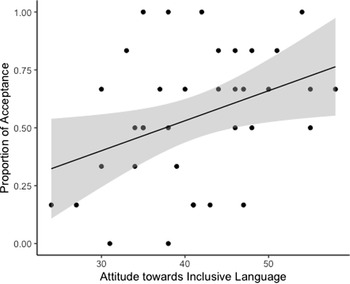
To determine whether participant attitudes were predictive of acceptance of feminine anaphors as continuations of NPs with masculine stereotypes, a linear regression was performed with standardized attitudes as the predictor variable and the proportion of acceptances (out of six trials) as the outcome variable. The results indicated that every standard deviation increase in favorable attitudes toward nonsexist language results in a .11 increase in the proportion of acceptances (se = .046, p = .026). This means that when participants with a positive attitude toward nonsexist (inclusive) language listened to pairs of sentences in which the NP of the first sentence had a masculine stereotype (e.g., Los camioneros, the lorry drivers) and the anaphor of the second sentence was feminine (una), they were more likely to give a yes-response. To illustrate, Figure 5 presents our overall data and the regression line from the model.
Acceptance of Nonsexist Language Predicts Acceptance of Feminine Anaphors as Continuations of Masculine Stereotyped NP Antecedents.

Discussion
In answer to our research questions, our results show that continuations with the masculine uno were overall more frequently accepted than continuations with the feminine una. These results provide evidence that the grammatical masculine gender in human NPs in Spanish is a case of unbalanced ambiguity, where the exclusively masculine meaning is more prominent than the mixed-gender one, and is immediately and automatically activated when the NP is presented out of context. This finding, overall, corroborates the findings of previous literature on the interpretation of masculine human NPs in other languages with grammatical gender (Gabriel et al., Reference Gabriel, Behne and Gygax2017; Gygax et al., Reference Gygax, Gabriel, Sarrasin, Oakhill and Garnham2008, Reference Gygax, Gabriel, Lévy, Pool, Grivel and Pedrazzini2012; Irmen, Reference Irmen2007).
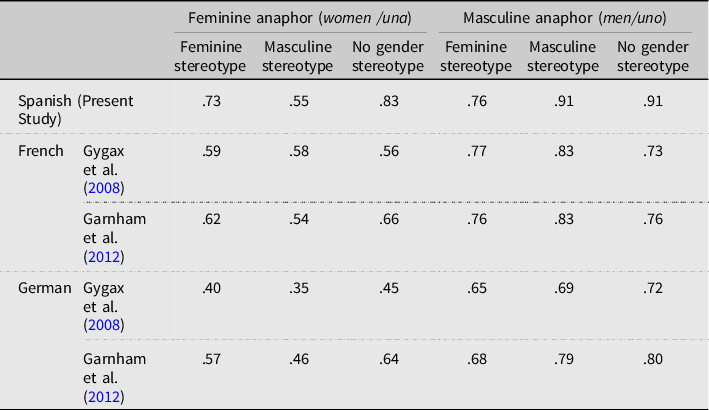
The singular indefinite pronoun uno/una was chosen as the anaphoric element in order to ensure a partitive reading of the anaphor in our experiment. The rejection of una continuations necessarily indicates that the mixed-gender meaning of the masculine NP was not accessed, and its acceptance indicates that the mixed-gender interpretation was accessed. The considerably higher rates of acceptability of the feminine continuations in our study (see Table 3) suggest that at least some of the stimuli in previous studies (Garnham et al., Reference Garnham, Gabriel, Sarrasin, Gygax and Oakhill2012; Gygax et al., Reference Gygax, Gabriel, Sarrasin, Oakhill and Garnham2008) could have favored a co-referential and coextensive reading and, consequently, that the rejection of the feminine anaphor could have meant rejecting the use of “the women” to refer to a human group previously referred to by a masculine NP.
Mean proportions of positive judgments in Spanish (this experiment), French, and German (Gygax et al. Reference Gygax, Gabriel, Sarrasin, Oakhill and Garnham2008 and Garnham et al. Reference Garnham, Gabriel, Sarrasin, Gygax and Oakhill2012), as a function of stereotypes and gender of the anaphor

The feminine anaphor in our study requires access to the mixed-gender interpretation of the masculine antecedent and is more easily accepted than the masculine NP referring to a group of women. Yet, crucially, our results still show a bias of grammatical masculine Nps toward the masculine interpretation.
Unlike previous studies, our results reveal an effect of stereotype on the acceptance responses: the rejection of una is greater when the antecedent carries a masculine stereotype (e.g., the firefighters). Contrary to what Gygax et al. (Reference Gygax, Gabriel, Sarrasin, Oakhill and Garnham2008) concluded, the effect of stereotype in the representation of gender is therefore not limited to cases where grammatical cues are not available (Braun et al., Reference Braun, Gottburgsen, Sczesny and Stahlberg1998; Garnham et al., Reference Garnham, Gabriel, Sarrasin, Gygax and Oakhill2012; Rothmund & Scheele, Reference Rothmund and Scheele2004). When the noun carries no stereotype or a feminine stereotype, listeners accept the feminine anaphor more often than they reject it, thus confirming that they can access the mixed-gender interpretation. Response times indicate that the acceptance of una clauses was slower (by hypothesis, more costly) than the acceptance of uno, which only required accessing the masculine meaning. These results are evidence that, even though the masculine plural NPs in Spanish are ambiguous, the masculine meaning is in fact favored, that is, more immediately activated, when the noun appears in a masculine plural form. The slower acceptance of una suggests a process of reevaluating the mental representation created upon interpretation of the antecedent NP. Interestingly, when the feminine anaphor was rejected, this rejection took place faster than the (infrequent) rejection of masculine anaphors, supporting the idea that the extra-cost inferred by longer response times indicates a process of modifying the gender characterization of the mental representation evoked by the NP.
Regarding the (weak) effect of stereotype on response times, NPs with no gender stereotype seem to allow for a slightly faster acceptance of the continuation, both with uno and with una, than NPs with masculine stereotype. It could be argued that nouns that are neutral regarding a gender stereotypical representation facilitate the acceptance of either of the anaphoric continuations, but the overall slower response times when the antecedent NP carries a masculine stereotype remain unexplained.
The effect of continuation (gender of the anaphor) on the response times is consistent with previous studies (Ganham et al., Reference Garnham, Gabriel, Sarrasin, Gygax and Oakhill2012; Gygax et al., Reference Gygax, Gabriel, Sarrasin, Oakhill and Garnham2008), in spite of the different modality used: reading versus listening paradigms. We can, therefore, conclude that the slower response to feminine continuations is not limited to reading experimental paradigms, where physically regressing to previous discourse in search of the antecedent could explain the slow response. Instead, processing oral utterances also allows us to see the cognitive cost difference between the access to the two meanings of the NP.
A final question that our study seeks to answer is whether the listeners’ attitude toward the use of inclusive language forms would affect the interpretation of masculine human NPs. Our results showed that our participants’ self-reported attitudes toward inclusive language were mathematically predictive of their directly measured acceptance of the nonsexist antecedent–anaphor combination in our stimuli, namely masculine-stereotyped NP antecedents with feminine anaphors. This is especially meaningful inasmuch as the significant regression relationship holds across methodologies. The first is a self-report, indirect measure of attitude, and the second is a direct measure of acceptance of a particular anaphoric relationship between antecedents marked for masculine plural that are most likely not interpreted, on average, as mixed-gender, but rather as masculine, and anaphoric pronouns (una) that force the NP antecedent to be interpreted as a mixed-gender group. This statistical relationship is an evidence that across speakers, plural nouns identified as stereotypically masculine can in fact be represented as consisting of a mixture of men and women. Further, the participants who are most likely to allow this mixed-gender interpretation are those with the most favorable view of nonsexist language. To the contrary, those who reject nonsexist language are the participants who are least likely to accept that a feminine pronoun could be a grammatical anaphor for a stereotypically masculine antecedent. Thus, depending on the participant’s attitude toward inclusive language, one is more or less likely to interpret masculine plural NPs as mixed gender. What this entails is that there is not one, single grammatical representation of masculine plural NPs, but rather that grammar will permit or deny co-reference relationships as a function of a speaker’s language attitude. This state of affairs is advantageous inasmuch as it allows a mechanistic vision of grammar, allowing certain features of lexical items to be consistent with one another and others not, while it allows for sociological factors to influence how masculine and feminine grammatical features attach to these lexical items.
The finding that the speaker’s language attitude affects the representation of grammatical masculine NPs are in line with Stahlberg and Sczensy’s (Reference Stahlberg and Sczesny2001) findings. However, the effect of the speaker’s language attitude is not exactly the same in singular and plural masculine NPs: for singular NPs, in the binary gender representation (man/woman) used in these studies, speakers with a more positive attitude toward nonsexist language favor a nonambiguous, that is, one form – one meaning, gender system, where feminine entities are described by means of a feminine NP and masculine entities, by means of a masculine NP. In the case of Spanish plural NPs, however, there are three theoretical possibilities for the composition of the referent regarding gender (again, considering only a binary gender representation): all men, all woman, and a mixed group, but only two grammatical genders, masculine and feminine. An unambiguous association between grammatical gender and gender of the group referent is therefore impossible. What this study shows is that, maintaining that masculine plural NPs are ambiguous between the “all men” and “mixed group” readings, speakers with a more positive attitude toward nonsexist language tend to activate the mixed group representation more often than speakers with a less positive attitude toward sexist language, especially for nouns with a masculine stereotype. In spite of these different outcomes, for both plural and singular NPs, the interpretation of grammatical gender feature is constrained by sociological factors.
Overall, this study confirms the finding that, in languages with grammatical gender, the masculine grammatical gender is a case of unbalanced ambiguity in which the exclusively masculine meaning is the dominant meaning. Accessing the subordinate meaning is possible when the discourse coherence requires it, but this involves a processing cost. This pattern is the expected pattern of an ambiguous unbalanced expression, in which access to the subordinate meaning is affected by contextual information (Binder & Morris, Reference Binder and Morris1995; Duffy et al., Reference Duffy, Kambe, Rayner and Gorfein2001; Gadsby et al., Reference Gadsby, Arnott and Copland2008). How much contextual information is needed, in discourse, to override the undeniable masculine bias of masculine grammatical gender forms is still an open question.
The results of this study offer useful information to the social discussion on inclusive language. The debate on inclusive language is a sociolinguistics – or, for some, a politics – debate, and the choice of using or avoiding the inclusive language has to do with the speaker’s ideology (and the speaker’s desire to convey such ideology), as much as (or even more than) with the communicative aim of referring to a group of people. That being said, part of the debate has been constructed on the discussion of whether the masculine gender does successfully convey the mixed-gender meaning, and therefore whether people who do not self-identify as men can be successfully referred to with a masculine form. In this sense, the data here examined offered a first and partial answer: overall, there is a tendency for the masculine NP to activate the exclusively masculine interpretation and, therefore, the use of referential expressions explicitly mentioning referents that are not men may be necessary to activate the mixed-gender mental representation of the noun. When and how often in the discourse is this explicit mention necessary is yet to be investigated.
Conclusion
We investigated whether human masculine plural NPs in Spanish are a case of balanced or unbalanced ambiguity between the two possible interpretations: an exclusively masculine (a group of men) or a mixed gender (a group including both men and women) meaning. An experiment using a sentence continuation task with oral stimuli offered evidence that corroborates previous findings in other languages: masculine grammatical gender biases toward the exclusively masculine interpretation. The higher acceptance rate of continuations with the pronoun uno than with the feminine una referring back to a masculine plural NP showed that the exclusively masculine meaning is accessed more frequently than the mixed-gender meaning of the masculine NP. It was also shown that accessing the mixed-gender meaning involved more cognitive cost and that the effect of the grammatical masculine gender interacts with the stereotypicality of the noun: nouns with masculine stereotypes make it less plausible to access to the mixed-gender interpretation. Finally, the study also found that the speaker’s attitude toward the inclusive language affects the interpretation of masculine NPs, in such a way that participants with a more positive interpretation toward inclusive language are more likely to accept the mixed-gender interpretation of masculine NPs carrying a masculine interpretation. Overall, the study confirms the masculine grammatical gender bias toward an exclusively masculine interpretation and opens the floor for further studies on the interpretation of Spanish masculine plural NPs in discourse, where contextual information is expected to affect the interpretation of the unbalanced ambiguous nouns.
Acknowledgments
This work was supported by the Secretaría de Educación Pública-PROMEP, Mexico (UAEMOR-PTC-412); Conacyt, Becas Nacionales and National Science Foundation (NSF-1551903). The funding source had no involvement in the study design, collection, analysis, or interpretation of data.
Conflict of interest
None.