The creative insight or insight phenomenon is pervasive in nearly all domains, particularly in managerial innovation, artistic creation, technical invention and scientific discovery (see Sternberg & Davidson, Reference Sternberg and Davidson1995), and has been documented and scientifically investigated for only a century since it was first described by the Gestalt psychologists. Recently, an increasing number of empirical studies have attempted to demystify the phenomenon using various approaches or combinations of approaches including behavioral measures, cognitive experiments, neuroscientific scanning and brain stimulation (e.g., Chi & Snyder, Reference Chi and Snyder2011; Jung-Beeman et al., Reference Jung-Beeman, Bowden, Haberman, Frymiare, Arambel-Liu, Greenblatt and Kounios2004; Kaplan & Simon, Reference Kaplan and Simon1990; Knoblich, Ohlsson, & Raney, Reference Knoblich, Ohlsson and Raney2001; Luo & Knoblich, Reference Luo and Knoblich2007; Metuki, Sela, & Lavidor, Reference Metuki, Sela and Lavidor2012; Shen, Yuan, Liu, & Luo, Reference Shen, Yuan, Liu and Luo2017; Weisberg, Reference Weisberg2013). A great deal of new knowledge about the potential psychological and neural underpinnings of insight has been accumulated.
One key finding is that insight, especially that problem-solving, often accompanies a particular kind of subjective experience, termed insight experience or sometimes the “aha!” moment. Whilst the existence of insight experience has long been recognized, it has been neglected by scientists due to its subjective nature and phenomenological characteristics. Early studies treated insight experience as a by-product of insight that was of little interest. Anecdotes demonstrate that the feeling of insight can occur at any place regardless of what the problem solver is doing - during showering, walking, sleeping, talking, driving or subway travel. For instance, Kekule’s insight into the ring structure of benzene occurred in a dream and Archimedes’s sudden insights into the law of buoyancy took place whilst he was bathing. Poincare was stepping onto a bus when he made one of the most important breakthroughs of his life (Lehrer, Reference Lehrer2008; Topolinski & Reber, Reference Topolinski and Reber2010a). Fortunately, recent studies have started to attribute great importance to the insight experience itself, and revealed that it influences subsequent memory, as well as characterizing emotionality or deconstructing the affective components of insight and even defining the insight itself (including circumventing the circular definition of insight through classic insight problems). For example, Topolinski and Reber (Reference Topolinski and Reber2010a) proposed a processing fluency account of insight experience, suggest that insight experience running through the entire problem-solving process or its constituent parts, is induced by the sudden emergence of the solution and the concomitant gain in fluency.
Impasse, a mental state in which a solver is stuck or absorbed and does not know how to go forward, has been considered an inherent aspect of the induction of deep problem-solving processing that eventually leads to insight. According to Ohlsson (1992, p. 4), “insights occur after the problem-solver has encountered an impasse… Insight, I suggest, is the act of breaking out of an impasse… Without the impasse, there is no insight, only smooth progress”. Similar ideas have been expressed in many recent studies (e.g., Fleck & Weisberg, Reference Fleck and Weisberg2013; Moss, Kotovsky, & Cagan, Reference Moss, Kotovsky and Cagan2011; Shen, Liu, Yuan, Zhang, & Luo, Reference Shen, Liu, Yuan, Zhang and Luo2013; Weisberg, Reference Weisberg2013). It is an indication of the importance of impasse to the insight phenomenon that insight problem-solving is increasingly treating as an impasse-insight sequence (e.g., Luo & Knoblich, Reference Luo and Knoblich2007; Ohlsson, Reference Ohlsson1992; Weisberg, Reference Weisberg2013) in which mental impasse and sudden insight (the moment at which an insight solution emerges) are two relatively independent processes or stages. This has been elaborated as the cognitive processing account of alternation between an old (pre-established) mindset/knowledge and a new thinking mode/pathway (i.e., the interplay of old-new thoughts/mindsets; Cronin, Reference Cronin2004; Luo & Niki, Reference Luo and Niki2003; Shen et al., Reference Shen, Yuan, Liu and Luo2017). This idea regarding impasse-insight sequence is also reflected in work by Cosmelli and Preiss (Reference Cosmelli and Preiss2014) that emphasized the dynamic past–future interplay aspect of the insight phenomenon and attempted to demonstrate the temporality of creative insight, especially insight phenomenology. Empirical findings from some recent insight studies have implied the existence of impasse-related insight experience and referred to the equal importance of impasse-related experience as a subjective experience occurring at the “aha!” moment. For example, Hill and Kemp (Reference Hill and Kemp2018) revealed that negative insight experience is an important aspect of everyday insight experience and argued that it reflects the experience of being at an impasse, i.e. being unable to make progress towards solving a problem (Beeftink, van Eerde, & Rutte, Reference Beeftink, van Eerde and Rutte2008). Drawing on the implicit theory of everyday insight experience, Shen and colleagues documented some insight experience components linked to mental impasse and speculated that there are two qualitatively different types of insight experience, namely insight experiences associated with the moment at which an insight solution is achieved (i.e., solution-related insight experience or “aha!” experience) and the states of impasse preceding a sudden insight (i.e., impasse-related insight experience; see Shen, Yuan, Zhao et al., Reference Shen, Tong, Yuan, Zhan, Liu, Luo and Cai2018).
The aim of this study was to extend previous finding on impasse-related insight experience and to investigate the characteristics of such experiences. A careful review of previous research on insight experience produced substantial evidence that the construct of impasse-related insight experience is as important as the “aha!” experience construct, if not more so. Danek, Fraps, von Müller, Grothe, and Öllinger (Reference Danek, Fraps, von Müller, Grothe and Öllinger2014) stressed the importance of incorporating impasse or impasse-related phenomenological elements into models of the subjective experience accompanying an insight solution and provided some evidence for the legitimacy of impasse-related experience components. Several recent empirical studies using a variety of methods have revealed that some negative experience components can appear at any point during the insight problem solving process, which is inconsistent with the established idea that “aha!” experience is a compound of positive affect and related cognition. Participants in three behavioral studies by Shen, Yuan, Liu and Luo (Reference Shen, Yuan, Liu and Luo2016) reported not only positive affect and cognitive experiences, e.g. ease of processing, but also negative affect and cognitive experiences - described by terms such as “lost”, “frustrated”, “nervous” and “hesitant” - throughout the entire process of insight problem solving. This is inconsistent with previous empirical findings (e.g., Gick & Lockhart, Reference Gick, Lockhart, Sternberg and Davidson1995; Ludmer, Dudai, & Rubin, Reference Ludmer, Dudai and Rubin2011) and theoretical work (e.g., Topolinski & Reber, Reference Topolinski and Reber2010a) suggesting that the “aha!” experience only involves positive affect and cognitive experience. An electrophysiological study by Shen, Yuan, Tang et al. (Reference Shen, Tong, Yuan, Zhan, Liu, Luo and Cai2018) described the somatic precursor of spontaneous insight induced by solving remote association problems in which participants’ electrodermal and cardiovascular activity was monitored continuously. They found that skin conductance in the four-second period prior to solution was greater on insight trials than non-insight trials; they also found two marginally significant correlations between heart rate variability preceding sudden insight and solution time on insight trials and they argued these represented somatic markers of impasse-related processing.
The extant evidence suggests that impasse-related insight experience does indeed exist and consists mainly of negative affect plus some inactive/passive cognitive components. We used well-validated compound remote association (CRA) problems to determine the characteristics of impasse-related insight experience. This approach has been widely used in similar studies (Shen, Yuan, Liu, et al., Reference Shen, Yuan, Liu and Luo2016; Fleck & Weisberg, Reference Fleck and Weisberg2004, Reference Fleck and Weisberg2013) and was appropriate because whether an impasse occurs or not is mainly determined by the interplay of the participants’ knowledge/experience and the characteristics of the problem itself (Ohlsson, Reference Ohlsson1992; Knoblich et al., Reference Knoblich, Ohlsson and Raney2001; Shen, Liu, et al., Reference Shen, Liu, Yuan, Zhang and Luo2013). It is the solver who is the most credible source of data on whether impasse occurred or not so in this study we asked participants to report the feelings (affect and/or cognitive sensations) they experienced during mental impasses that occurred during the solving of CRA problems. Building on previous recommendations by existing studies (Shen, Yuan, Liu et al., Reference Shen, Yuan, Liu and Luo2016; Cosmelli & Preiss, Reference Cosmelli and Preiss2014), this work adopted the forced-choice paradigm combining personal free-report to analyze participants’ self-supplied subjective feeling depictions as experienced at the moment of mental impasses. Shen, Yuan, Liu et al. (2016, Exp. 3) devised a good reference, building on the solvers’ self-report on solution experience, emotional bipolarity and a consideration of collecting as precise experience descriptions as possible (namely freely reporting some low-frequency experience items via the item ‘others’; Shen, Yuan, Liu, et al., Reference Shen, Yuan, Liu and Luo2016), to help participates to select the options depicting their experiences as being stuck, asking participants to select one or more of the 8 emotional items -calmness, happiness, loss, ease, nervousness, certainty, hesitation, and others. Due to the established appropriateness of this emotion selection reference (e.g., Shen, Yuan, Liu, et al., Reference Shen, Yuan, Liu and Luo2016; Shen, Tong et al., Reference Shen, Tong, Yuan, Zhan, Liu, Luo and Cai2018), it was thus used here. In summary, two experimental studies were developed here. In Study 1, we firstly used a forced-choice task to identify the characteristics of impasse-related insight experience by requiring participants to analyze their feelings and subjective experiences during mental impasses that occurred during the solving of CRA problems. To replicate Study 1, a second study (Study 2) was thus devised in which participants were asked to solve a set of classic insight problems and to freely report any feelings (if experienced) of being at an impasse.
STUDY 1
Method
Participants
Thirty-three native Chinese-speaking college students with normal or corrected-to-normal vision were recruited as paid volunteers. Three participants were excluded due to suspiciously unreliable responses (n = 2) or quitting midway of the experiment (n = 1), leaving a final sample of 30 participants (24 women) with a mean age of 23.07 years (SD = 2.71) years. None of the participants had a history of neurological or psychiatric illness or had been exposed to similar experiments before and all were right-handed. Approval for the study was granted by the Institutional Ethics Committee and participants provided written, informed consent before the experiment.
Materials
The materials were 138 Chinese CRA problems (Shen, Yuan, Yi, et al., Reference Shen, Yuan, Liu and Luo2016) with the same properties as the CRA problems created by Bowden and Jung-Beeman (Reference Bowden and Jung-Beeman2003). Each item consisted of three Chinese characters and participants were asked to come up with a single character that could be used to form two-character words with each of the characters from the triad. These problems sometimes trigger feelings of insight and sometimes do not. Additionally, eight emotional terms borrowed from Shen, Yuan, Liu et al. (Reference Shen, Yuan, Liu and Luo2016) - ‘calmness’, ‘happiness’, ‘loss’, ‘ease’, ‘nervousness’, ‘certainty’, ‘hesitation’, and ‘other’ - were devised as eight forced-choice options.
Procedure
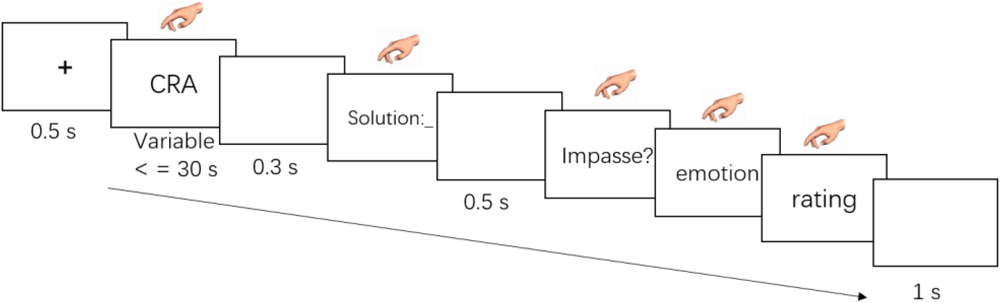
Participants completed a 10-trial practice session before tackling the 128 experimental CRA problems. They were asked to follow the procedure illustrated in Figure 1. Each trial started with a 500 ms presentation of a fixation cross and then the problem triad was presented in the center of the screen. The triad was displayed until the participant worked out the solution or 30,000 ms had elapsed. Participants indicated that they had solved the problem by pressing a designated button the keyboard, which triggered presentation the prompt “Solution?” on the screen. After a 300 ms interval the solution could be entered. The entering of solutions was untimed and ended when the participant pressed “Enter”. If the key triggering the “Solution?” screen had not been pressed by the end of the 30,000 ms triad presentation period the “Solution?” screen was displayed anyway; participants were instructed simply to press “Enter” straightaway in this scenario. Participants were informed that they should not continue to think about the CRA problem after it disappeared from the screen, irrespective of whether they had solved it or not. After solution entry or at the end of the triad presentation period a buffer screen was displayed for 500 ms and then the word “Impasse?” was displayed to prompt participants to press a button (mapping was counterbalanced across participants) to indicate whether or not they had experienced an impasse whilst attempting to solve the problem. Then the word “Emotion” was displayed to prompt participants to select one or more of the eight options displayed (‘calmness’; ‘happiness’; ‘loss’; ‘ease’; ‘nervousness’; ‘certainty’; ‘hesitation’; ‘other’) to indicate the emotions or thoughts they had experienced during their mental impasse or during the trial as a whole if they had not experienced impasse. The order in which the options were displayed was counterbalanced using a Latin square design. If the ‘other’ option was selected the participant was asked to subjectively report (silently) their emotions different from the given specific emotions indicated by seven choice-items (other than the item ‘others’) and subsequently input the depictions of their felt emotions into the blank as prompted. After participants had registered the emotions they had experienced they were asked to rate their intensity using a nine-point Likert scale ranging from 1 (extremely weak) to 9 (extremely strong) regardless of whether the emotions related to an impasse experience or not. The trial ended with a 1,000 ms presentation of a blank screen.
Schematic illustration of a trial.

Prior to the practice sessions, participants were told the following: Mental impasse is a psychological process or mental state in which the solver subjectively feels unable to push forward problem-solving progress or feels the problem solving process being in standstill after the failure of repeated attempts and explorations. Metaphorically speaking, a mental impasse is like a dead end or a stuck state. The state of impasse is different from the eventual state of problem solving -the state whether a given problem was successfully solved. Besides, the state of impasse is not necessarily linked to it. That is, a solver may have met an impasse or not met any mental impasse even if the problem was successfully solved. For the solved problem with impasses, the solver is assumed to meet and finally break impasses. However, for the unsolved problem with impasses, it cannot conclude that the solver has not met any impasse (may not break her/his encountered impasses). On the contrary, although some problems were not successfully solved, they do not necessarily include an impasse. This is because those problems have large enough problem space or involve many time-consuming cognitive (sub-) processes, rendering that the solver has not idea or enough time to complete the whole process of successful problem solving. For example, individual may easily have ideas to work out the solution to the problem like “1+1=?”. Undoubtedly, the solver would not experience any impasse or stuck state. Similarly, the solver would not encounter any impasse during solving the problem like “224=?” This is because its successful solution heavily relies on step-by-step calculation and enough time available. Accordingly, this problem was not successfully solved within the limited time interval, but they didn’t necessarily involve an impasse. In a word, the impasse is a mental state in which the solver feels her/his problem-solving process is stuck or has stepped into a dead end, without any new idea to break this impasse. Also, the impasse could last a long time and may last a short period of time.”
Results and Discussion
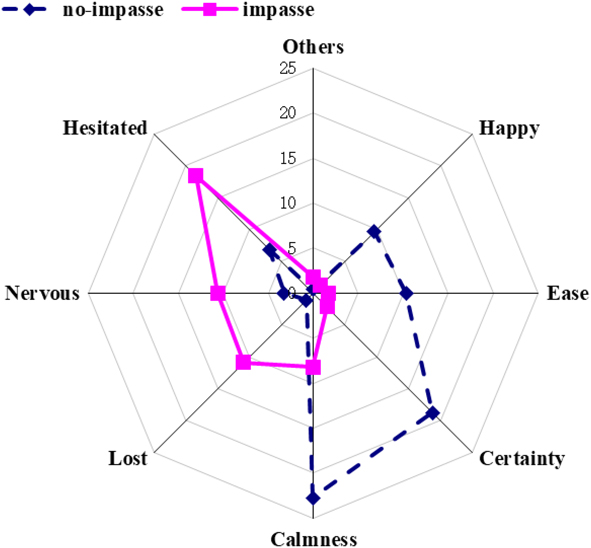
Visual inspection of the data (see Figure 2) suggested that there might be differences between the frequency with which various emotions were experienced in impasse and no-impasse trials. Paired t tests were used to determine whether these differences reached significance (p < .05). These tests indicated that ‘loss’ (M ni = 1.10, SD ni = 2.63; M im = 10.93, SD im = 9.11; t = –5.51, p < .001, Cohen d = 1.07), ‘hesitated’ (M ni = 6.87, SD ni = 5.09; M im = 18.40, SD im = 10.98; t = –4.89, p < .001, Cohen d = 1.03), and ‘nervousness’ (M ni = 3.23, SD ni = 5.73; M im = 10.60, SD im = 12.55; t = –3.65, p < .001, Cohen d = 0.67) were experienced more frequently in impasse trials than no-impasse trials. Participants reported more personal, specific emotions on impasse trials: ‘Other’ responses were more frequent (M ni = 0.37, SD ni = 0.55; M im = 1.80, SD im = 3.06; t = –2.62, p < .05, Cohen d = 0.48). On the other hand ‘calmness’ (M ni = 22.73, SD ni = 19.14; M im = 8.20, SD im = 8.00; t = 4.42, p < .001, Cohen d = 0.81), ‘happiness’ (M ni = 9.63, SD ni = 10.97; M im = 1.17, SD im = 1.80; t = 4.20, p < .001, Cohen d = 0.77), ‘ease’ (M ni = 10.33, SD ni = 6.88; M im = 1.67, SD im = 3.35; t = 5.90, p < .001, Cohen d = 1.20) and ‘certainty’ (M ni =18.80, SD ni = 13.41; M im = 2.17, SD im = 4.20; t = 7.46, p < .001, Cohen d = 1.36) were reported more frequently after impasse trials than no-impasse trials.
Conceptual structure of impasse-related experience during insight.

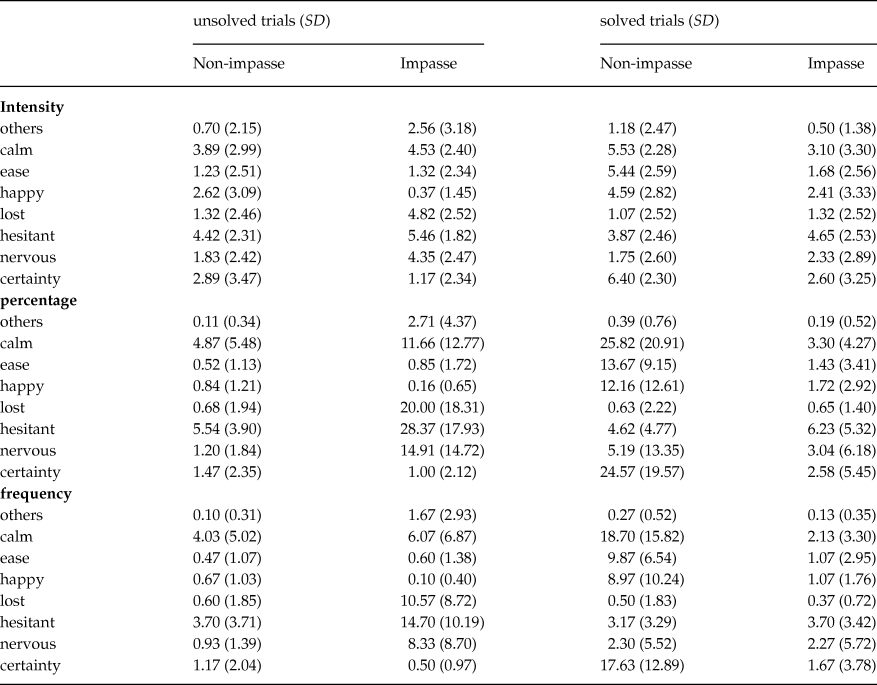
To determine any differences in emotion intensity, emotion frequencies and the percentagesFootnote 1 of trials with impasse or non-impasse (see Table 1) under different solution states (solved vs. unsolved), the repeated measure 2 (impasse type: impasse vs. non-impasse) × 2 (solution type: Solved vs. unsolved) × 8 (emotion type: ‘Others’, ‘calm’, ‘ease’, ‘happiness’, ‘loss’, ‘hesitated’, ‘nervousness’, ‘certainty’), three factorial ANOVAs were employed. For emotional intensity, the ANOVA results showed that, with the exception of the insignificant effects of solution type, F (1, 29) = 22.91, p > .05, partial η2 = 0.08, and impasse type, F (1, 29) = 1.34, p > .05, partial η2 = 0.04, the remaining effects—including the main effect of emotion type, F (7, 203) = 18.15, p < .001, partial η2 = 0.39, and the interaction of emotion type with solution type, F (7, 203) = 19.46, p < .001, partial η2 =0.40, —were significant. Further analyses showed that the unsolved problems with impasse triggered greater experience of personalized feelings, calmness, loss, hesitation, and nervousness, but significantly weaker happiness, than did the solved problems with impasse, which in turn were found consistently to produce weaker feelings of calmness, ease, happiness, and certainty than were the solved problems without impasse. Furthermore, the unsolved problems with impasse triggered stronger feelings of loss, hesitation, and nervousness, and weaker feelings of calmness, ease, happiness, and certainty, than did the solved problems without impasse, which in turn triggered greater feelings of calmness, ease, happiness, and certainty than did the unsolved problems without impasse. Additionally, compared with the unsolved problems without impasse, the unsolved problems with impasse produced stronger experiences of personalized feeling (i.e., ‘other’), loss, hesitation, and nervousness, and weaker feelings of happiness and certainty.
Results on Emotion Intensity and Task Performance of Each Type of Problems

For the frequencies of selected emotions, the ANOVA results showed that all the tested effects, regardless of their specific nature (i.e. main effect or interaction), reached a level of statistical significance of at least p < .001. For emotion type, F (7, 203) = 12.26, partial η2 = 0.30; for solution type, F (1, 29) = 40.19, partial η2 = 0.58; for impasse type, F (1, 29) = 7.89, partial η2 = 0.21; for solution × emotion, F (7, 203) = 28.02, partial η2 = 0.49; for solution × impasse, F (1, 29) = 376.81, partial η2 = 0.93; for emotion × impasse, F (7, 203) = 29.42, partial η2 = 0.50; for solution × emotion × impasse, F (7, 203) = 7.45, partial η2 = 0.20. Simple effects indicated that the unsolved problems with impasse led to more frequent reports of personalized experience (i.e., ‘other’), loss, hesitation, and nervousness, and fewer reports of happiness and certainty than did the unsolved problems without impasse; which in turn led to less frequently reported experiences of calmness, ease, happiness, and certainty than did the solved problems without impasse. By contrast, the unsolved problems with impasse produced less frequent feelings of calmness, ease, happiness, and certainty, and more frequent feelings of loss, hesitation, nervousness, and personalized experience, than did the solved problems without impasse; which in turn were more often reported to be accompanied by feelings of calmness, ease, happiness, and certainty than were the solved problems with impasse. Meanwhile, the solved problems with impasse were associated with less frequent calmness, personalized experience, loss, hesitation, and nervousness, but more happiness, than were the unsolved problems with impasse.
Moreover, given that participants received an unequal number of impasse vs non-impasse trials, we calculated the proportion of trials with or without impasse in which each emotional term was selected (Table 1). A similar ANOVA to that described above was applied to these proportion data. The results revealed that, with the exception of insignificant effects for solution type, F (1, 29) = 2.52, partial η2 = 0.08, and impasse type, F (1, 29) = 1.81, partial η2 = 0.06, all the other effects—including the main effect of emotion type, F (7, 203) =12.52, partial η2 = 0.30, and the two-way interaction of solution type with impasse type, F (1, 29) = 783.38, partial η2 = 0.96, —remained significant, with ps < .001. Importantly, the proportion data displayed the same pattern as that shown by the frequency data for the simple effects, with the following exceptions: The additional difference between unsolved problems without impasse and those unsolved with impasse for calmness, MD = –6.79, SE = 2.17, p < .01, and the lack of difference in the proportion data for certainty, MD = 0.48, SE = 0.30, p > .05.
Furthermore, we also assessed differences in response times (i.e., the gap between receiving the emotion prompt and selecting a response) for emotion term selection. This analysis allows us to examine the influence on response speed of confidence and impasse-related veracity (Topolinski & Reber, Reference Topolinski and Reber2010b). The repeated measure ANOVA (with emotion type and impasse type as within-subject variables) revealed a significant main effect of impasse type only, F (1, 29) = 17.87, p < .001, partial η2 = 0.38, suggesting that participants spent more time selecting their emotion response in the trials with impasse, M = 3,007.53, SD = 153.60, than in those without impasse, M = 3,588.22, SD = 178.75. In accordance with this finding, Topolinski and Reber (Reference Topolinski and Reber2010b) observed that fast responses are more likely to reflect true experiences. In contrast to the fluency-derived “aha” experience that accompanies post-impasse solution or non-impasse responses (Topolinski & Reber Reference Topolinski and Reber2010a), impasse and impasse-related experience is largely not fluent and resistant, meaning more time being taken to complete the selection of emotion responses for those trials with than without impasse.
STUDY 2
Method
Participants
Study 2, was follow-up research conducted to consolidate the findings of Study 1 in a laboratory setting. A total of 130 healthy, native Chinese students aged 18−25 years were recruited from two universities as participants. Six were subsequently excluded because of a suspiciously inappropriate responding pattern (n = 1) or the absence of experience descriptions (n = 5), leaving a final sample of 124 (34 males), with an average age of 21.77 years, SD = 1.73. None of the participants had been exposed to similar experiments before. Approval for the study was granted by the Institutional Ethics Committee.
Materials
The stimuli used were four classic insight problems (two verbal and two visuospatial) that have been used in previous studies on insight (e.g., Shen, Yuan, Yi, et al., Reference Shen, Yuan, Liu and Luo2016; for details, see the Appendix): the Cheap Necklace Problem, Triangle Problem, Water Jug Problem, and Timing Problem. All the problems were printed on a page and presented to participants for completion using a pencil-and-paper approach.
Procedure
The participants were individually invited to complete a paper-and-pencil exercise comprising the four classic insight problems. The introduction on impasse and task instructions were given were consistent with those used in Study 1. As in Study 1, participants were not allowed to begin the experimental process until they had completely understood the instructions and the definitions of the terms, such as impasse. They were encouraged to ask for further explanation of the instructions where necessary, by raising their hands. All participants were required to solve the problems within the permitted time period (four minutes for each problem, without writing). Participants were requested to stop working on the problem if they had not arrived at an answer within the given interval) and then to freely (not time-limited) describe their solving process and experience by reporting whether or not they had come to an impasse during each problem-solving process. To rule out any potential confounding effect of procedural differences in responding pattern or task complexity, participants were asked to describe their entire problem-solving process even if they had not encountered any impasse. Responses to problems that the participant had seen before (i.e., old responses) were excluded from subsequent analyses because of the low numbers.
Results and Discussion
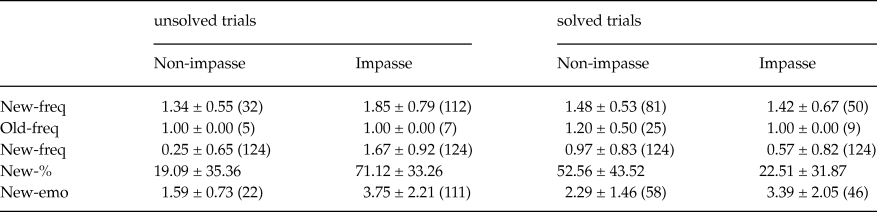
Four of the 124 participants reported having previously encountered two (n = 3), or three (n = 1) of the four problems presented, and 50 old responses were given (9 responses from 9 individuals reported that they had encountered the successfully solved problem with impasse before; 29 responses from 24 individuals reported previously encountering the solved problem without impasse; and 7 responses from 7 individuals and 5 responses from 5 others reported having encountered the unsolved problems with impasse or without impasse before) that would be excluded from later detailed analyses. A total of 71, 117, 208, and 42 individual responses were recorded for the problems that participants had not previously encountered, for solved with impasses, solved without impasses, unsolved with impasses, and unsolved without impasses, respectively.
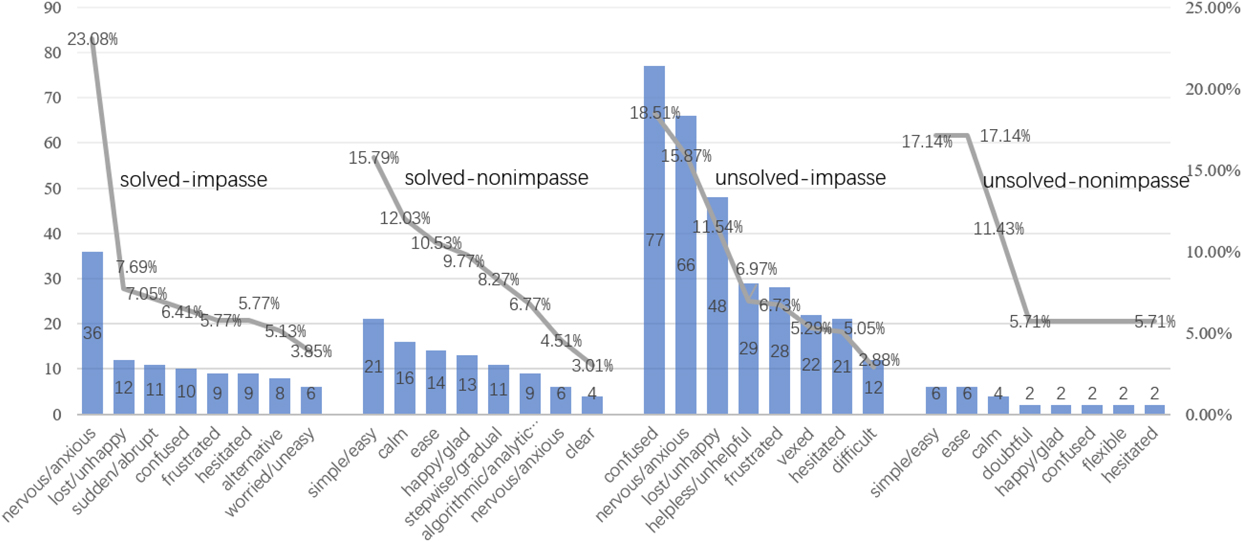
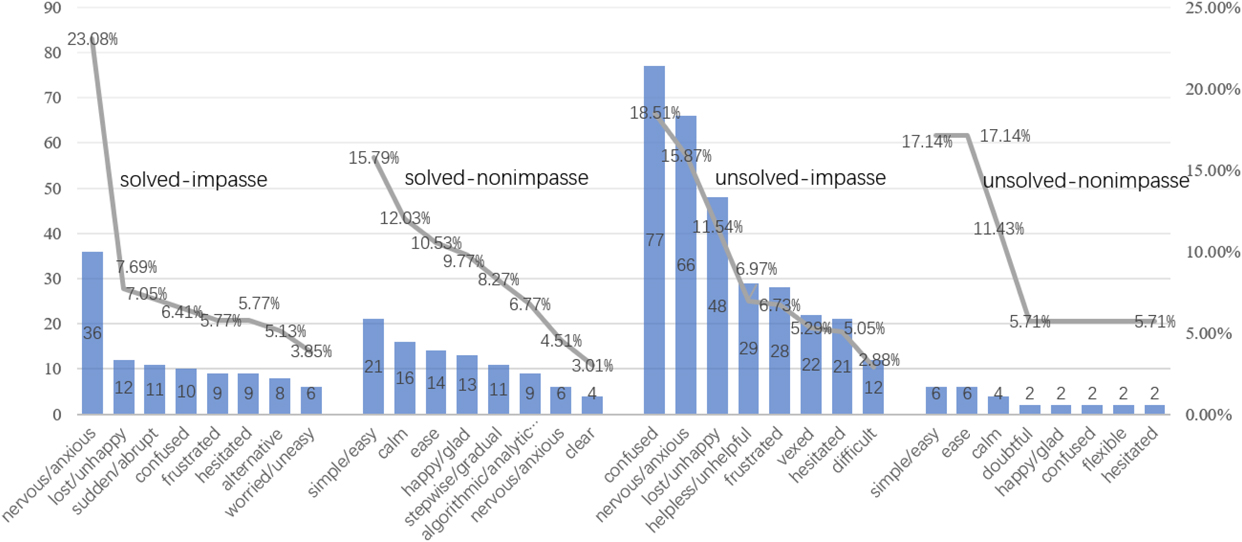
With regard to the number of unsolved or solved trials (Table 2), a two-way repeated measures ANOVA with both solution type (unsolved vs. solved) and impasse type (impasse vs. non-impasse) as within-subject variables, was employed to determine whether any observed differences were significant. Results demonstrated a significant main effect of solution type, F (1, 123)=7.62, p < .01, partial η2 = 0.06, and problem type, F (1, 123) = 38.32, p < .001, partial η2 = 0.24, and a significant interaction of impasse type with solution type, F (1, 123) = 102.49, p < .001, partial η2 = 0.46. Further analysis revealed that the differences between all possible two-way interactions between impasse (impasse vs. non-impasse) and solution (solved vs. unsolved) were significant, with ps < .05. Moreover, for the relative proportion of each type of trial involving impasse or non-impasse, in addition to a marginally significant effect of solution type (solved vs. unsolved), F (1, 123) =3.39, p = .068, partial η2 = 0.03, the effects of problem type, F (1, 123 ) = 28.89, p < .001, partial η2 = 0.19 and the interaction between impasse and solution, F (1, 123) = 97.81, p < .001, partial η2 = 0.44, were both significant. Furthermore, simple effects indicated that the unsolved trials with impasse were more than any of the three other types of trial in proportion, with the obvious superiority of solved trials without impasse over the remaining two types, with ps < .001. As can be seen from Figure 3, solvers provided more expressions (within the scope of terms reported in Shen, Yuan, Liu et al., Reference Shen, Yuan, Liu and Luo2016) on subjective experience for the trials with impasse (regardless of whether the problem was solved or not) than those without impasse, and reported more experiences with the unsolved trials with impasse. Figure 3 shows the more frequent negative components, especially affective experience such as ‘nervousness’ and ‘loss,’ observed for trials with impasse, which is consistent with the results of Study 1 and previous associations reported between impasse and negative affect (see Fleck & Weisberg, Reference Fleck and Weisberg2004; Shen et al., Reference Shen, Tong, Yuan, Zhan, Liu, Luo and Cai2018). Overall, Study 2 replicated the findings of Study 1, showing that compared with trials involving non-impasse, those involving impasse are more frequently associated with negative cognitive and affective experience; this is particularly true of unsolved trials with impasse.
Results for Trials with or without Impasse under Different Solution States (M ± SD)

Note. The values in the parenthesis represent the total amount of trials under different conditions.
Descriptive results on self-reported emotions under different conditions (the numbers placed at the left Y axis suggest the absolute times of each nominated experience while those at the right Y axis mean the percentages of each nominated experience).
General Discussion
The aim of this work, consisting of two experimental studies, was to determine the psychological structure of impasse-related insight experience. Study 1 primarily used a forced-choice paradigm and an established insight experience framework that was developed based on subjective experience at the moment of sudden insight solution or the “aha!” experience (Shen, Yuan, Liu et al., Reference Shen, Yuan, Liu and Luo2016). There is increasing evidence that the impasse-insight sequence (e.g., Knoblich et al., Reference Knoblich, Ohlsson and Raney2001), a dynamic process involving a serials of mental manipulations, has affective and perhaps even somatic components as well as cognitive components. Mental impasse, as a key mental manipulation or cognitive process of impasse-insight sequence, often emerges after repeated failure and accompanies exhaustion of the available heuristics, options and resources. In general, impasse is a persistent rather than transient state, the solver feels stuck or stranded, perhaps even helpless. Traditional accounts of impasse stress its cognitive (set-related fixation) characteristics, but Beeftink et al. (Reference Beeftink, van Eerde and Rutte2008) argued that impasse is an affective state involving negative emotions such as frustration and confusion (e.g., Fleck & Weisberg, Reference Fleck and Weisberg2004), which eventually reach a sufficiently high level to prompt a decision to give up (Beeftink et al., Reference Beeftink, van Eerde and Rutte2008; Payne & Duggan, Reference Payne and Duggan2011). Study 2 was devised to replicate the association between mental impasse and negative experience (including negative cognitive and affective components) observed in Study 1. Across two studies, one of the main findings of our study is that impasse trials (i.e., CRA trials during which a participant experienced mental impasse whilst trying to solve the problem, regardless of the eventual outcome) were more frequently linked to negative psychological experiences, especially negative affect such as loss, nervousness and hesitation and more specific, personal emotions, than no-impasse trials. In addition to some findings (e.g., Bailey & Konstan, Reference Bailey and Konstan2006; Gruber, Reference Gruber, Sternberg and Davidson1995; for details see Beeftink et al., Reference Beeftink, van Eerde and Rutte2008) indicating that impasse is associated with negative affect, there have been two recent studies based variously on implicit (Shen, Yuan, Zhao et al., Reference Shen, Tong, Yuan, Zhan, Liu, Luo and Cai2018) and explicit (Shen, Yuan, Liu et al., Reference Shen, Yuan, Liu and Luo2016) theories of insight experience which suggested that negative affective and cognitive experiences are likely associated with of the phase of being at an impasse.
Another key finding is that the participants reported more positive or approached cognitive experiences, for example feelings of ease, happiness and certainty, in the no-impasse trials than the impasse trials. Calmness, designed to represent a baseline emotional and arousal state, was more frequently reported in no-impasse trials. These results differ from previous findings on the structure of the “aha!” experience, in which only happiness was found to be more frequent in the “aha!” condition than in the no-“aha!” condition, and hesitation, loss, and nervousness were reported more frequently in the no-“aha!” condition. Except the opposite pattern for the frequency in terms of personalized emotions as revealed by the “other” responses, frequencies of certainty, ease and calmness were similar in the two conditions. The differences between impasse-related experience and “aha!” experience in terms of hesitation, loss, and nervousness (the response of “other” was excluded because specific emotions nominated in two studies may be differed) may be accounted by the fact the non-correspondence between impasse and insight (precisely “aha!”), consistent with previous idea that insight may not always trigger an impasse (e.g., Fleck & Weisberg, Reference Fleck and Weisberg2004) or insights do not always follow impasses, at least on the level of subjective experience (Jones, Reference Jones2003; Ormerod, MacGregor, & Chronicle, Reference Ormerod, Macgregor and Chronicle2002, p. 797). Additionally, Danek et al. (Reference Danek, Fraps, von Müller, Grothe and Öllinger2014) incorporated impasse into the “aha” experience as a component and found impasse to be less important for insight than was previously thought (Ohlsson, Reference Ohlsson1992). This may be due partly to the abstractness of impasse when conceptualizing and operationalizing, and partly to the multidimensionality of impasse-related experience (unsuitable for packaging as a single component) and phasic malposition. Also, this inconsistency indicates that future research into the insight experience should include comparisons of both “aha!” and no-“aha! ” conditions and impasse and no-impasse conditions.
The findings of this study have at least three implications. First, our findings suggest that insight experience appears not only at the “aha!” moment, when sudden illumination occurs, but also during impasses; thus it reveals the multidimensional structure of impasse-related insight experience, providing empirical evidence for the two-stage model of insight experience suggested by electrophysiological (Shen, Tong, et al., Reference Shen, Tong, Yuan, Zhan, Liu, Luo and Cai2018; Shen, Yuan, Tang, et al., Reference Shen, Tong, Yuan, Zhan, Liu, Luo and Cai2018) and implicit theoretical research (Shen, Yuan, Zhao et al., Reference Shen, Tong, Yuan, Zhan, Liu, Luo and Cai2018) on insight experience. They also highlight the importance of investigating the entire insight sequence. Second, this study demonstrates that impasse-related insight experience is negative and is a compound of cognitive and affective components; it also implies that mental impasse manifests emotionally as well as cognitively, and the appropriateness of insight experience documented in the other stages beyond the state of aha moment or a sudden solution. Finally, given that mental impasse marks the start of an incubation process, our findings shed some light on the mechanism underlying incubation, at least that during insight problem solving. As mentioned above, impasse-related insight experience is mostly negatively valenced, whereas solution-related insight experience or “aha!” feeling is positively valenced, and the emotion regulation processes involved in this change in valence may influence incubation, as Beeftink et al. (Reference Beeftink, van Eerde and Rutte2008) noted. Like most previous studies, this study has two limitations. First, the study was based on previous findings on subjective experience of the entire insight sequence or process of insight problem-solving. To make a comparison with some previous studies in this field (especially on insight experience and “aha!” experience), directly used existing reference framework on emotion selection, without developing a new emotion selection framework by asking participants to self-report their experiences felt in the stage of mental impasse. Second, to avoid the potential influence of interruption on insight problem-solving (e.g., Beeftink et al., Reference Beeftink, van Eerde and Rutte2008), participants were asked to report their subjective experience retrospectively rather than immediately. Further studies which address these limitations should be carried out in order to generalize and extend our findings.