Attachment style consists of a complex set of interconnected thoughts, emotions, beliefs, assumptions, predispositions, expectations, and behaviours in close personal relationships (Guerrero, Farinelli, & McEwan, Reference Guerrero, Farinelli and McEwan2009). This complex set of influences underlies the perceptions people have of themselves, others, and their relationships (Guerrero, Reference Guerrero, Baxter and Braithwaite2008; Jang, Reference Jang2008; Trees, Reference Trees, Baxter and Braithwaite2006). Attachment style informs a person's communication choices and expectations of a partner's response, and shapes their relational communication strategies (Dainton, Reference Dainton2007). This habitual style is likely to become more relied upon during times of relational stress (Bodie et al., Reference Bodie, Burleson, Gill-Rosier, McCullough, Holmstrom, Rack, Hanasono and Mincy2011; Mikulincer, Shaver, Bar-On, & Ein-Dor, Reference Mikulincer, Shaver, Bar-On and Ein-Dor2010; Tucker & Anders, Reference Tucker and Anders1999). The present study explores the influence of attachment style on the communication choices people make in their relationships during these times of duress, as exemplified in their communication of relational dissatisfaction and disengagement.
Attachment Style
Attachment style develops in the patterns of thoughts and beliefs embodied in internal interpretive schema or mental models of how relationships work. These schema begin forming in early childhood through interactions with a primary caregiver and they continue to develop throughout adult life (Ainsworth, Blehar, Waters, & Wall, Reference Ainsworth, Blehar, Waters and Wall1978; Anders & Tucker, Reference Anders and Tucker2000; Bartholomew, Reference Bartholomew1994; Bowlby, Reference Bowlby1969; Holmes & Johnson, Reference Holmes and Johnson2009; Matthewson, Smith, & Montgomery, Reference Matthewson, Smith and Montgomery2012). A person's attachment history forms a predisposition based on past social-behavioural experiences, memories, and attitudes. This history affects his or her present sense of relational trust, emotional safety, security, desired level of intimacy, need for independence, and expectations of the partner (Abaied & Rudolph, Reference Abaied and Rudolph2010; Arseth, Kroger, Martinussen, & Bakken, Reference Arseth, Kroger, Martinussen and Bakken2009; Birnbaum, Reference Birnbaum2010; Holmes & Johnson, Reference Holmes and Johnson2009; Pistole, Roberts, & Chapman, Reference Pistole, Roberts and Chapman2010; Simpson & Rholes, Reference Simpson and Rholes2010). These predispositions form nested expectations within relationship types (e.g., romantic partners, parents, siblings, close friends) and ultimately influence the communication strategies employed. More broadly, the communication choices made within a particular romantic relationship are nested within the larger expectations and habits of that type of relationship in general (Herzog, Hughes, & Jordan, Reference Herzog, Hughes and Jordan2010; Sibley & Overall, Reference Sibley and Overall2010; Sprecher & Fehr, Reference Sprecher and Fehr2010). These nested expectations guide an individual's communication behaviour in close relationships and affect a person's perceptions, ability to regulate emotions, cognitions, problem-solving abilities, relational coping strategies, and repertoire of communication skills, particularly during times of relational duress (Collins & Ford, Reference Collins and Ford2010; Cortina & Liotti, Reference Cortina and Liotti2010; Dwyer et al., Reference Dwyer, Fredstrom, Rubin, Booth-LaForce, Rose-Krasnor and Burgess2010; Parsons, Young, Murray, Stein, & Kringelbach, Reference Parsons, Young, Murray, Stein and Kringelbach2010; Shaver & Mikulincer, Reference Shaver and Mikulincer2010). An adult's attachment style can change over time. However, when similar relational experiences occur repeatedly across relationships, habitual patterns form that perpetuate and reinforce an attachment style and shape an enduring predisposition toward the relational communication choices that are enacted (Feeney & Van Vleet, Reference Feeney and Van Vleet2010; Guerrero, Reference Guerrero, Baxter and Braithwaite2008; Mikulincer et al., Reference Mikulincer, Shaver, Bar-On and Ein-Dor2010).
Perceptions of Self and Other
Bartholomew and Horowitz (Reference Bartholomew and Horowitz1991) classify attachment into four styles: secure, preoccupied, dismissing-avoidant, and fearful-avoidant. These four styles represent fundamentally different perceptual orientations that vary along two dimensions. These dimensions represent a person's positive and negative perceptions of self, and of others (Arseth et al., Reference Arseth, Kroger, Martinussen and Bakken2009; Bartholomew, Reference Bartholomew1994; Bartholomew & Horowitz, Reference Bartholomew and Horowitz1991; Bartholomew & Perlman, Reference Bartholomew and Perlman1994; Daly & Mallinckrodt, Reference Daly and Mallinckrodt2009).
Secure attachment identifies a positive image of one's self and of the other (Arseth et al., Reference Arseth, Kroger, Martinussen and Bakken2009). This positive orientation moderates emotional expressions through confident proximity-seeking with a partner and flexible, responsive patterns of communication (Abaied & Rudolph, Reference Abaied and Rudolph2010; Pistole et al., Reference Pistole, Roberts and Chapman2010). A secure attachment style provides an encouraging and accepting relational basis for emotional availability and acceptance that promotes an increased sense of self-esteem, self-efficacy, confidence, relational interdependence, autonomous functioning, positive mood, and continued positive perceptions of the other (Feeney & Van Vleet, Reference Feeney and Van Vleet2010). Securely attached adults generally feel more comfortable in close relationships, are more interdependent with their partners, and are able to offer more emotional-relational support (Guerrero, Reference Guerrero1996; Guerrero & Jones, Reference Guerrero and Jones2005).
A preoccupied attachment style characterises a negative self-image while maintaining a high regard for the other. This combination can produce high relational anxiety and preoccupation with a need for acceptance and positive evaluation of the other (Arseth et al., Reference Arseth, Kroger, Martinussen and Bakken2009). Doubt and anxiety over self-worth can reduce relational closeness, cohesion, and perceptions of a partner's fairness (Daly & Mallinckrodt, Reference Daly and Mallinckrodt2009; Tucker & Anders, Reference Tucker and Anders1998). Negative perceptions of self increase feelings of being unworthy in the relationship and can create a hyper-vigilance to perceived relational threats. This can increase self-doubt, anxiety about the relationship, and eagerness to please in an attempt to avoid rejection (Hawley, Shorey, & Alderman, Reference Hawley, Shorey and Alderman2009; Pistole et al., Reference Pistole, Roberts and Chapman2010).
A dismissing-avoidant style expresses a positive self-image but a negative perception of the other. This style emerges from a discomfort with intimacy and closeness, a view of others as needy and dependent, a desire to not feel obligated to others, and a preference for not being dependent on them (Arseth et al., Reference Arseth, Kroger, Martinussen and Bakken2009). This discomfort with dependency and intimacy can lead to a preference for low emotional involvement, distancing from stress-related stimuli, concealment of negative emotions, and use of behavioral disengagement coping strategies (Abaied & Rudolph, Reference Abaied and Rudolph2010; Pistole et al., Reference Pistole, Roberts and Chapman2010).
A fearful-avoidant style fosters a negative perception of self and a negative regard for the other. This combination can produce high relational anxiety with both a desire for closeness and a fear of rejection. This desire for closeness-fear of rejection tension produces a hoped for intimacy but a behavioral tendency toward relational avoidance (Arseth et al., Reference Arseth, Kroger, Martinussen and Bakken2009; Pistole et al., Reference Pistole, Roberts and Chapman2010).
Communicating Relational Dissatisfaction and Disengagement
When people become dissatisfied with a relationship there are multiple ways in which they can communicate that dissatisfaction. Four potential responses are identified as: (a) voice the dissatisfaction openly with the hope of improving the relationship; (b) show loyalty for the relationship and quietly hope that it will get better; (c) neglect the relationship, allowing it to atrophy and fall apart; or (d) exit the relationship. These responses vary along the dimensions of active–passive communication and constructive–destructive relationship styles. Voice shows an active, relationally constructive style of communication; loyalty expresses a passive-constructive communication style of relational maintenance; neglect demonstrates a passive relationally destructive style of communication; and exit represents an active, relationally destructive approach (Rusbult, Zembrodt, & Gunn, Reference Rusbult, Zembrodt and Gunn1982).
When dissatisfaction is not resolved and relationship disengagement occurs, additional communication choices are required. At least five types of relationship disengagement strategies can be pursued: de-escalation, behavioural de-escalation, negative identity management, positive tone, and justification (Banks, Altendorf, Greene, & Cody, Reference Banks, Altendorf, Greene and Cody1987; Cody, Reference Cody1982; Krahl & Wheeless, Reference Krahl and Wheeless1997). De-escalation involves ending the relationship but leaving open an opportunity for reconciliation and the possibility of a renewed relationship in the future. Behavioural de-escalation takes the approach of avoiding contact and physically withdrawing from the relationship. Negative identity management means telling the partner that you are ending the relationship and explaining why you believe it is the best thing for both of you. Positive tone is a strategy that involves expressing grief over ending the relationship, showing concern for the partner, and making an attempt to avoid hard feelings. Justification involves stating reasons and rationalisations for ending the relationship, but without necessarily addressing a partner's feelings, needs, or desires (Banks et al., Reference Banks, Altendorf, Greene and Cody1987; Cody, Reference Cody1982; Krahl & Wheeless, Reference Krahl and Wheeless1997).
Attachment Style, Relational Dissatisfaction, and Disengagement
Attachment style is related to expressions of relational intimacy and gratitude toward a romantic partner (Murray & Hazelwood, Reference Murray and Hazelwood2011); and research shows that a person's attachment style influences his or her relational communication, especially when that relationship is stressed (Dainton, Reference Dainton2007). Securely attached individuals are more confident and assertive in their relationships, believe that their partners are more available and responsive, view conflict as an opportunity to engage in self-disclosure, develop more relational intimacy, and trust that their partners will respond supportively and communicate constructively (Domingue & Mollen, Reference Domingue and Mollen2009). They show higher regard for the partner and use more assurances and positive tone (Anders & Tucker, Reference Anders and Tucker2000; Tucker & Anders, Reference Tucker and Anders1999). These behaviours help sustain and improve the relationship through pleasant interaction, cooperative conflict management, statements of intimacy, pledges of love, and assurances of relationship continuation (Pistole et al., Reference Pistole, Roberts and Chapman2010).
Less securely attached individuals who use either preoccupied or avoidant styles are more likely to make demands, quietly stonewall, or withdraw from the relationship, either as a way of protesting a partner's perceived unresponsiveness or because they believe that a partner will reject them. Preoccupied individuals fear that their partner will not be available when needed, or will abandon them. Consequently, relational conflict often raises intense emotions that can make it difficult to communicate constructively. Avoidant individuals, in general, tend to have low expectations of others, perceive them to be less trustworthy, and often see their treatment by others as unfair (Ronen & Mikulincer, Reference Ronen and Mikulincer2009). Dismissing-avoidant individuals often interpret demands for self-disclosure and emotional intimacy as unwanted interpersonal intrusions, construe conflict as a threat, and respond by seeking relational independence. Fearful-avoidant individuals, experiencing the tension between the desire for intimacy and tendency toward avoidance, display a mixture of dismissing and preoccupied tendencies (Domingue & Mollen, Reference Domingue and Mollen2009). They often experience heightened physiological arousal and increased heart rates during times of relational conflict, report high anxiety, and can be relatively ineffective in their ability to regulate emotions or respond to stress (Abaied & Rudolph, Reference Abaied and Rudolph2010).
Relational stress can heighten these influences of attachment style on a person's communication (Abaied & Rudolph, Reference Abaied and Rudolph2010; Anders & Tucker, Reference Anders and Tucker2000; Simpson et al., Reference Simpson, Kim, Fillo, Ickles, Rholes, Orina and Winterheld2011; Tucker & Anders, Reference Tucker and Anders1999). Feelings of rejection can undermine a person's sense of self-worth, raise doubts about the trustworthiness and availability of relational partners, and create uncertainty about the relationship (Shaver, Mikulincer, & Feeney, Reference Shaver, Mikulincer and Feeney2009). Research shows that during times of relational dissatisfaction, securely attached individuals are more likely to use constructive responses such as voice and loyalty to express dissatisfaction, and less likely to use the more relationally destructive responses of exit or neglect (Sinclair & Fehr, Reference Sinclair and Fehr2005). Individuals who fear intimacy are more likely to respond to conflict with the relationally destructive responses of exit and neglect (Gaines & Henderson, Reference Gaines and Henderson2002; Gaines, Work, Johnson, Youn, & Lai, Reference Gaines, Work, Johnson, Youn and Lai2000; Jang, Smith & Levine, Reference Jang, Smith and Levine2002; Scharfe & Bartholomew, Reference Scharfe and Bartholomew1995). A secure style predicts a positive tone and a disinclination toward behavioural de-escalation. Preoccupied and fearful-avoidant styles correlate with behavioural de-escalation. A dismissing-avoidant style relates to de-escalation and positive tone (Krahl & Wheeless, Reference Krahl and Wheeless1997; Lambert & Hughes, Reference Lambert and Hughes2010).
This literature review identifies a set of individual influences, but stops short of providing a coherent model of those multiple, simultaneous influences of attachment style on relational communication choices. Past findings show that a secure attachment style predicts active, relationally constructive communication strategies such as the use of voice to express dissatisfaction and a positive tone when negotiating relational disengagement (Sinclair & Fehr, Reference Sinclair and Fehr2005). Preoccupied individuals are more likely to communicate less constructively, either quietly stonewalling or withdrawing from the relationship through behavioural de-escalation (Lambert & Hughes, Reference Lambert and Hughes2010). A dismissing-avoidant attachment style also predicts de-escalation but with a positive tone to their communication (Ronen & Mikulincer, Reference Ronen and Mikulincer2009). People with a fearful-avoidant style are more likely to use the relationally destructive responses of exit or neglect (Gaines & Henderson, Reference Gaines and Henderson2002; Gaines, Work, Johnson, Youn, & Lai, Reference Gaines, Work, Johnson, Youn and Lai2000; Jang, Smith & Levine, Reference Jang, Smith and Levine2002). These findings are helpful for developing a coherent model of the influences, but the articulation of that unified model remains. The purpose of the present study is to identify and test a coherently integrated model of the multiple influences of attachment style on the communication choices made during times of relational dissatisfaction and disengagement. The following hypotheses summarise our predictions based on these research findings.
Hypotheses
H1: A secure attachment style predicts that active, relationally constructive communication choices will be made in response to the relational challenges of dissatisfaction and disengagement.
H2: A preoccupied attachment style predicts that passive communication choices will be made in response to the relational challenges of dissatisfaction and disengagement.
H3: A dismissing-avoidant style predicts relationally destructive communication choices will be made in response to the relational challenges of dissatisfaction and disengagement.
H4: A fearful-avoidant style predicts that communication choices of avoidance and withdrawal will be made in response to the relational challenges of dissatisfaction and disengagement.
Method
Participants
To qualify for participation in the study, respondents must have experienced a recently terminated romantic relationship. Respondents who did not meet this criterion had the option of participating in an alternative study. Participants in this study (N = 209) were students at a medium-sized southwestern university. These participants were instructed to think about a personal romantic relationship that had ended and to respond to each question based on that relationship.
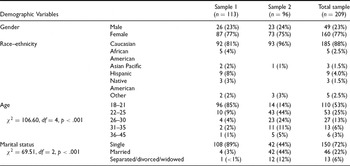
Participants included 160 females (77%) and 49 males (23%). In order to obtain more honest responses, participants were asked to not put their names on responses, with participant names being checked off a central list once they had turned in a sealed response packet. One hundred and eighty-five of the participants (88%) indicated a race-ethnic background of Caucasian, five (2%) African American, three (1%) Asian Pacific Islander, nine (4%) Hispanic, three (1%) Native American, and five (2%) responded ‘other’. One hundred and ten of the participants were: 18–21 (53%); fifty-three were 22–25 (25%); twenty seven were 26–30 (13%); thirteen were 31–35 (6%); five were 36–45 (2%); and one was older than 45 (1%). One hundred and fifty participants (72%) were single and never married, forty-six (22%) were married, and thirteen (6%) were separated or divorced.
Procedures
Karantzas, Feeney, and Wilkinson (Reference Karantzas, Feeney and Wilkinson2010) indicate that sample demographics such as age (middle-aged adults vs. adolescents) influence some scale measures of attachment style, particularly indices of preoccupation. Therefore, participants were recruited in two separate samples with differing participant demographics. The first sample (n = 113) was recruited face-to-face at the beginning of communication and psychology classes. With the permission of the course instructor, the principal investigator (PI) visited the classroom and asked for volunteers. The PI reviewed the informed consent with participants, allowed time for questions, provided an instruction booklet, and collected measures of attachment style, relational dissatisfaction, disengagement strategies, and demographic information. The second sample (n = 96) was recruited through an email sent by the PI to students who took online courses. The email contained an invitation to participate, a consent form, and the link to an anonymous online survey. The samples are relatively equal in size (n = 113 and n = 96), and comparable in participant race-ethnicity and gender distributions. However, participant age (χ2 = 106.60, df = 4, p < .001) and marital status (χ2 = 69.51, df = 2, p < .001) show significant differences between the two samples (see Table 1).
Comparison of Subsample Demographics

Analysis of Attachment Style
Past research has measured attachment style using either an interview method or a self-report questionnaire. The interview method measures the emotional regulation of attachment. The self-report attachment style questionnaire focuses on an individual's mental model or schema and provides indices into the cognitive strategies and non-conscious attachment schema that affect an individual's relational communication choices (Allen & Miga, Reference Allen and Miga2010; Shomaker & Furman, Reference Shomaker and Furman2009; Sibley & Overall, Reference Sibley and Overall2010). The present study uses the self-report questionnaire method to examine the influence of mental models, attitudes, and beliefs, on the relational communication choices made during relational dissatisfaction and disengagement.
This self-report questionnaire provides interval-level scales to measure attachment style. Gaines and Henderson (Reference Gaines and Henderson2002), Guerrero and Jones (Reference Guerrero and Jones2003, Reference Guerrero and Jones2005) and Lambert and Hughes (Reference Lambert and Hughes2010) have treated attachment style as a categorical measure; and Lambert and Hughes (Reference Lambert and Hughes2010) argue that this categorical approach is ‘equally reliable to continuous measures’ (p. 176). However, researchers increasingly use interval-level scales to measure attachment, and interval level measurement is more appropriate for the present statistical analysis (Fiori, Consedine, & Merz, Reference Fiori, Consedine and Merz2011; Gentzler, Oberhauser, Westerman, & Nadorff, Reference Gentzler, Oberhauser, Westerman and Nadorff2011; Guerrero et al., Reference Guerrero, Farinelli and McEwan2009; Jang, Reference Jang2008; Richards & Schat, Reference Richards and Schat2011).
Underlying this measurement issue of attachment is the conception of its dimensionality. Guerrero (Reference Guerrero1996) identifies five dimensions of attachment style (avoidance, lack of confidence, preoccupation, fearful, and relationships as secondary). LePoire, Shepard, and Duggan (Reference Le Poire, Shepard and Duggan1999) find three categories: secure, preoccupied, and dismissively avoidant. Punyanunt-Carter (Reference Punyanunt-Carter2007) report three attachment styles (secure, avoidant, and anxious/ambivalent). Lambert and Hughes (Reference Lambert and Hughes2010) report four (secure, dismissive, preoccupied, and fearful); and finally, Guerrero et al. (Reference Guerrero, Farinelli and McEwan2009) identify four dimensions (secure/confidence, dismissiveness, preoccupation, fear of intimacy) and provide evidence that these four dimensions do a better job of getting at ‘the unique characteristics associated with each attachment style’ (p. 496). The present research uses these four dimensions of attachment style and the labels of secure, preoccupied, dismissing-avoidant, and fearful-avoidant that were applied to them by Bartholomew and Horowitz (Reference Bartholomew and Horowitz1991), making the attachment style dimensions used in the present study comparable to past research.
Karantzas et al. (Reference Karantzas, Feeney and Wilkinson2010) note that many factor analysis models of attachment style provide a relatively poor fit, having comparative fit indices (CFIs) of .62, .76, or .83, or marginal fit with a CFI of .91. Other researchers report CFIs as low as .55, .62, .71, and .67 (LePoire et al., Reference Le Poire, Shepard and Duggan1999). Given these past research results, the present study used the following method to develop a strong, internally consistent, and reliable measure of attachment style.
Measures
Attachment style
All participants completed an attachment style questionnaire containing a set of 5-point Likert-type scales (5 = very much like me; 1 = not like me at all). These scales are derived from Griffin and Bartholomew's (Reference Griffin, Bartholomew, Bartholomew and Perlman1994) measure and tap into the attitudes and beliefs relevant to relational communication (Crowell, Fraley & Shaver, Reference Crowell, Fraley, Shaver, Cassidy and Shaver1999; Guerrero, Reference Guerrero1996; Guerrero et al., Reference Guerrero, Farinelli and McEwan2009; Guerrero & Jones, Reference Guerrero and Jones2003, Reference Guerrero and Jones2005; Krahl & Wheeless, Reference Krahl and Wheeless1997; Lambert & Hughes, Reference Lambert and Hughes2010; Le Poire, Shepard & Duggan, Reference Le Poire, Shepard and Duggan1999; Shomaker & Furman, Reference Shomaker and Furman2009). To make the study results more generalisable to samples with different demographics, the questionnaire scale items showing a significant difference in response between the two samples were dropped from subsequent analyses. To be conservative, and because alpha error is less of a concern in this instance than beta error, a t test of difference using p < .10 was used to determine significant differences. Responses of the participants in the two samples were not significantly different on 19 of the scale items and these items were used in subsequent analyses.
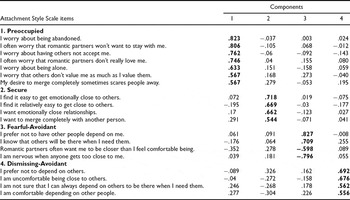
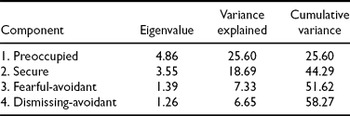
A principal components analysis of these 19 items was performed with an oblique rotation and using standard rules of exploratory factor analysis. Extraction decisions were made using a scree test and the criteria of retaining components having an eigenvalue of 1.0 or greater, accounting for at least 5% of additional variance, and having three or more scales loading cleanly on the component, with a primary loading of at least .50 and a difference of at least .20 for any secondary loadings (Gorsuch, Reference Gorsuch1983). Components converged in eight iterations. Seven items loaded on the first component, four on the second, four on the third, and four on the fourth. These components accounted for 58.27% of the variance and loaded as expected (Bartholomew & Horowitz, Reference Bartholomew and Horowitz1991). Table 2 shows the wording of these items and their loadings on the principal components of attachment style.
Attachment Style Scale Item Loadings in Rotated Principal Component Matrix

Note: Principal Component Extraction; Oblique rotation with Kaiser Normalization converged in 8 iterations. The name of each component and the scale loadings for that component appear in bold text.
Attachment Style Component Eigenvalues and Variance Explained

Factor scores were used as the indices of the preoccupied, secure, fearful-avoidant, and dismissing-avoidant components in all subsequent analyses. “The estimation of factor scores is a crucial step in the continuing explication of constructs” (Nunnally, Reference Nunnally1978, p. 425). Factor scores provide standardised weighted coefficients for each participant on the factors (Nunnally, Reference Nunnally1978). The use of factor scores is preferable to the original scores as they do a better job of capturing the dimensionality of the measure and provide a more accurate pattern of interrelationships among the measures (Gorsuch, Reference Gorsuch1983; Tabachnick & Fidell, Reference Tabachnick and Fidell2001). They are more generalisable across samples and in principal components analysis an exact determination of these scores can be made (Gorsuch, Reference Gorsuch1983).
Relational dissatisfaction and disengagement
Communication responses to relational dissatisfaction were assessed using Rusbult et al.'s (Reference Rusbult, Zembrodt and Gunn1982) interval-level measure of exit, voice, loyalty, and neglect on 5-point Likert-type scales indicating (1 = I would definitely not do this; 5 = I would definitely do this). This instrument has been used in past research studies of relational dissatisfaction (Gaines & Henderson, Reference Gaines and Henderson2002; Gaines et al., Reference Gaines, Work, Johnson, Youn and Lai2000; Sinclair & Fehr, Reference Sinclair and Fehr2005). The measure of disengagement is based on the work of Cody (Reference Cody1982), as developed by Banks, Altendorf, Greene, and Cody (Reference Banks, Altendorf, Greene and Cody1987) and by Krahl and Wheeless (Reference Krahl and Wheeless1997). This interval-level scale measures the communication strategies of de-escalation, behavioural de-escalation, positive tone, justification, and negative identity management on 5-point Likert-type scales (1 = I definitely did or said this; 5 = I definitely did not do or say this). This measure has been used by Krahl and Wheeless (Reference Krahl and Wheeless1997) and Lambert and Hughes (Reference Lambert and Hughes2010). The same procedure described above for developing the attachment scale measure was performed to obtain the relational dissatisfaction and disengagement questionnaire items used in subsequent analyses. Each item was subjected to a t test of difference comparing the two samples (p < .10).
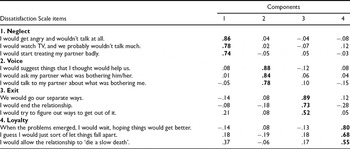
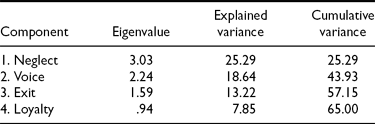
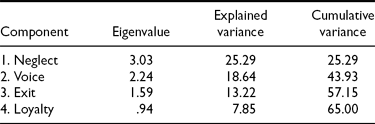
Twelve dissatisfaction scales showed non-significant differences between the two samples and were retained for subsequent analyses. Three of these items loaded on each of the four components, which accounted for 65.0% of the variance and replicated the results reported in the earlier work of Gaines and Henderson (Reference Gaines and Henderson2002), Gaines et al. (Reference Gaines, Work, Johnson, Youn and Lai2000), and Sinclair and Fehr (Reference Sinclair and Fehr2005). Factor score coefficients calculated for neglect, voice, exit, and loyalty were used in subsequent analyses. Table 3 shows the wording of the dissatisfaction items and their principal component loadings.
Relational Dissatisfaction Loadings in Rotated Principal Component Matrix

Note: Principal Component Extraction; Oblique rotation with Kaiser Normalization converged in 7 iterations. The name of each component and the scale loadings for that component appear in bold text.
Relational Dissatisfaction Component Eigenvalues and Variance Explained
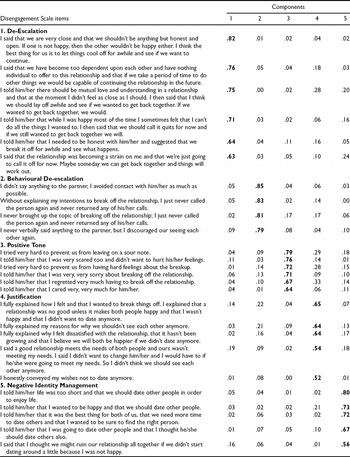
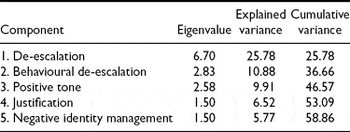
Twenty-three of the disengagement scales showed non-significant differences between the two samples and were retained for further analysis. Six of these scales loaded on the first component, four on the second, six on the third, three on the fourth, and four on the fifth. These five components accounted for 58.86% of the variance and replicated the results of earlier research (Krahl & Wheeless, Reference Krahl and Wheeless1997; Lambert & Hughes, Reference Lambert and Hughes2010). The resulting factor scores provided the indices for de-escalation, behavioural de-escalation, positive tone, justification, and negative identity in the subsequent analyses. Table 4 shows the wording of the disengagement scales and their principal component loadings.
Relational Disengagement Loadings in Rotated Principal Component Matrix

Note: Principal Component Extraction; Oblique rotation with Kaiser Normalization converged in 8 iterations. The name of each component and the scale loadings for that component appear in bold text.
Relational Disengagement Component Eigenvalues and Variance Explained

Figure 1 shows the path analysis model used to test the predictions of the multiple, simultaneous attachment style influences affecting the communication choices made in response to relational dissatisfaction and disengagement. The secure, preoccupied, dismissing-avoidant, and fearful-avoidant attachment styles are exogenous variables. The voice, exit, neglect, and loyalty responses to dissatisfaction and the de-escalation, positive tone, justification, negative identity management, and behavioural de-escalation disengagement strategies are endogenous variables.
Path analysis of attachment styles and communication choices made in response to relational dissatisfaction and disengagement.

This model was tested using AMOS. Weak links (those having a β value of less than .02) were removed to produce a more parsimonious model. The model's goodness of fit was assessed using six indices: χ2, χ2 to df ratio, comparative fit index (CFI), normed fit index (NFI), relative fit index (RFI), and root mean square error of approximation (RMSEA). A number of researchers offer guidelines for interpreting these indices. Karantzas et al. (Reference Karantzas, Feeney and Wilkinson2010), for example, suggest that a CFI = .943 is an acceptable fit. The present research study used the following guidelines. For an adequate fit the χ2 must be non-significant, the χ2 to df ratio less than 5 (Marsh & Hocevar, Reference Marsh and Hocevar1985), the comparative fit index (CFI) close to 1 (Bentler, Reference Bentler1990), normed fit index (NFI) greater than .90 (Bentler & Bonett, Reference Bentler and Bonett1980), relative fit index (RFI) close to 1 (Bollen, Reference Bollen1986), and the root mean square error of approximation (RMSEA) less than .08 (Browne & Cudeck, Reference Browne, Cudeck, Bollen and Long1993). See Tabachnick and Fidell (Reference Tabachnick and Fidell2001) for a fuller description of these indices and the rationale for these limits. These measures indicate that the present model provides a good fit to the data, with a non-significant χ2 = 23.12, df = 35, p = .94, χ2/df ratio = .66, CFI = .99, NFI = .92, RFI = .80, and RMSEA = .001.
Results
The model shows that the secure attachment measure is positively correlated with preoccupied (r = .13) and negatively correlated with dismissing-avoidant (r = −.12) and fearful-avoidant (r = −.21). Dismissing-avoidant is positively correlated with fearful-avoidant (r = .25) and preoccupied (r = .15). Preoccupied is positively correlated with fearful-avoidant (r = .17).
The secure attachment style predicts a dissatisfaction response of voice (β = .17) and has negative relationships with exit (β = −.12) and neglect (β = −.22). However, secure also predicts a disengagement strategy of de-escalation (β = .18). These findings support the hypothesis 1 expectation of active relational communication, but question the relationally constructive part of that prediction.
The preoccupied style predicts the passive communication responses to dissatisfaction of neglect (β = .14) and loyalty (β = .15), and maintains a negative relationship to exit (β = −.26). These findings support hypothesis 2. However, preoccupied also connects to the more active disengagement strategy of de-escalation (β = .14), which calls for a refinement in that prediction.
The dismissing-avoidant style predicts the passive dissatisfaction response of neglect (β = .08). This provides some support for hypothesis 3. However, the present results show a stronger connection to maintaining the relationship through loyalty (β = .26). When disengagement happens, it is likely to occur through a passive strategy of behavioural de-escalation (β = .11) rather than de-escalation, and with little or no justification (β = −.12).
The fearful-avoidant style has a weak relationship with exit (β = .04). This provides minimal support for hypothesis 4. In addition, negative relationships with loyalty (β = −.13), neglect (β = −.03), and negative identity management (β = −.12) show an overall lack of relational involvement.
These results provide mixed support for the hypothesised predictions. The rest of the relationships presented in the model help qualify these influences further and clarify the communication choices reported by our participants. Voice predicts de-escalation (β = .13), positive tone (β = .06), and justification (β = .20), and maintains a negative relationship with behavioural de-escalation (β = −.21). Exit has a negative relationship with voice (β = −.09), de-escalation (β = −.08), and positive tone (β = −.10), and predicts behavioural de-escalation (β = .09). Neglect shows a positive relationship with exit (β = .19), de-escalation (β = .14), negative identity management (β = .13), and behavioural de-escalation (β = .20). Loyalty predicts neglect (β = .31), de-escalation (β = .14), positive tone (β = .11), and behavioural de-escalation (β = .11). De-escalation predicts positive tone (β = .30), justification (β = .19), and negative identity management (β = 39).
Overall, the model provides both a good statistical and a good theoretical fit. It accounts for 4% of the variance in voice (r2 = .04), 12% of exit (r2 = .12), 19% of neglect (r2 = .19), and 9% of loyalty (r2 = .09). The model also accounts for 10% of de-escalation (r2 = .10), 13% of positive tone (r2 = .13), 15% of justification (r2 = .15), 19% of negative identity management (r2 = .19), and 16% of behavioural de-escalation (r2 = .16).
Discussion
Being secure means being willing to say you are sorry during times of relational dissatisfaction and disengagement, and doing so with a positive tone and some justification. The present results show that the positive image of self and others associated with a secure attachment style leads to communication choices of voicing relational dissatisfaction and a negative propensity toward exiting the relationship. When disengagement does occur it is through de-escalation: that is, talking about the relationship in an open and honest way, with a positive tone, justification for one's actions, and a negative identity management strategy that helps a partner deal with any negative identity issues raised by being left.
This pattern of responses to relational dissatisfaction expresses a willingness to talk with a partner about concerns, asking about what is happening in the relationship, and pro-actively making helpful suggestions. Then, when disengagement does occur, a participant continues to express love, concern for a partner's happiness, and hope for a possible future relationship. This model of communication choices offers a fuller picture than that provided by past research studies.
The model shows the multiple influences of a secure attachment style on relational communication during times of dissatisfaction and disengagement. Past studies conclude that secure attachment predicts active, relationally constructive communication. The present model supports that claim but refines it, showing the influence of a secure attachment style on constructive communication choices for disengaging from that relationship as well.
The preoccupied style, affected by a negative self-image and high regard for the other, predicts a different set of communication choices in response to dissatisfaction and disengagement. Dissatisfaction is responded to with neglect — getting angry, not talking, and treating the partner badly — and with loyalty — hoping things will get better but allowing the relationship to die slowly, while at the same time not exiting the relationship. Yet the model softens the prediction that a preoccupied style leads only to a passive communication, by showing the choice between the active communication of de-escalation and the passive maintenance strategies of loyalty and neglect. Exiting the relationship does not occur immediately, but through de-escalation. That communication choice, if acted upon, may lead to more open expressions of love, concern, and hope in future relationships than the passive approaches of loyalty and neglect.
The model shows more limited communication choices for a dismissing-avoidant style with its positive self-image, negative perception of others, and concomitant discomfort with intimacy, desire to not feel obligated, view of others as needy, and preference for not depending upon them. A dismissing-avoidant style predicts the expression of loyalty and neglect, with no justification for disengaging. Yet, some positive choice remains. Neglect may lead to de-escalation with a positive tone and negative identity management rather than to behavioral de-escalation. Loyalty, too, may lead to a positive tone rather than to a behavioral de-escalation strategy of ending the relationship by breaking off contact and avoiding the person.
The fearful-avoidant style, with its negative regard for self and others, high relational anxiety, and desire for closeness but fear of rejection, predicts fewer choices. Exiting the relationship is the most likely possibility. Neglect is unlikely. Loyalty and negative identity management are even more unlikely.
Summary of Past and Present Results
Past research results indicate that securely attached individuals are more likely to use the relationally constructive responses of voice to express dissatisfaction and less likely to use exit or neglect (Sinclair & Fehr, Reference Sinclair and Fehr2005). The present results confirm these findings but provide a fuller model of communication choices in response to dissatisfaction and disengagement. De-escalation is equally as likely as voice. Both are active communication strategies for resolving relationship issues and they differ from passive neglect and exit. Neglect means getting angry and not talking. Voice means suggesting things that may help. Exit means ending the relationship. De-escalation means discussing the relationship and talking about ending it for now. In addition, this de-escalation discussion can be undertaken with a positive tone and justification that can develop better ongoing relational communication strategies.
The preoccupied style predicts a different set of communication choices. Past research indicates an expectation of neglect and loyalty (Lambert & Hughes, Reference Lambert and Hughes2010). Present results support that expectation, showing positive relationships to both neglect and loyalty, and a negative relationship to exit. However, in the present results a preoccupied style also predicts de-escalation, suggesting that the communication choices of a preoccupied style can create a different, more active, relational path than the one taken through neglect and loyalty.
The dismissing-avoidant style also leads to neglect and loyalty. A positive tone may occur, but justification is unlikely. Behavioural de-escalation appears to be the disengagement strategy of choice, modifying past research expectations with an even more passive and avoidant communication response to dissatisfaction and relational disengagement (Ronen & Mikulincer, Reference Ronen and Mikulincer2009; Lambert & Hughes, Reference Lambert and Hughes2010).
The fearful-avoidant style predicts the most limited set of communication choices. A weak relationship occurs for exit. Negative relationships exist with neglect, loyalty, and negative identity management. This replaces past expectations for a fearful-avoidant style of exit or neglect with a type of relational communication paralysis (Gaines & Henderson, Reference Gaines and Henderson2002; Gaines, Work, Johnson, Youn, & Lai, Reference Gaines, Work, Johnson, Youn and Lai2000; Jang, Smith & Levine, Reference Jang, Smith and Levine2002).
The present model provides a more complete analysis of the relational communication choices affected by attachment style than is offered in past research findings. Although these choices are embedded within relational communication habits that are deeply ingrained within attachment styles learned over multiple relationships, the model shows the possibility of personal choice and change. A securely attached person may choose to voice dissatisfaction or to de-escalate the relationship, both done through pro-active communication. Preoccupied shows the choice between de-escalation and relational loyalty and neglect. Although de-escalation will end this relationship the pro-active communication process may result in a more open communication practice in future relationships. Dismissing-avoidant, through neglect, offers the potential of de-escalation, and through loyalty the possibility of a positive tone. However, neglect and loyalty also predict the potential for behavioral de-escalation. Fearful-avoidant, as weakly connected as it appears, still offers a small opportunity for choice, through exit, of the relationally constructive communication occurring in negative identity management.
Adult attachment styles represent predispositions that influence habitual relational communication patterns learned iteratively across relationships but changeable through active choice. Communication is the process for developing and changing these relational predispositions. The model shows alternative paths representing different communication choices that are likely to affect expectations and understandings in future relationships. The active communication choices made during times of relational stress (e.g., to voice dissatisfaction or de-escalate a relationship in a positive tone and with justification) likely will lead to more positive long-term relational outcomes. Passive communication choices of neglect, loyalty, and behavioral de-escalation are likely to present future relational challenges.
Limitations and Future Research
The present study examines these relationships based on participant responses to a single past relationship. A fuller description of these influences and subsequent communication choices could be developed by following participants across several relationships and querying changes in their attachment style and communication responses to dissatisfaction and disengagement across those relationships. This would allow a longitudinal examination of changes in adult attachment style over time and the influences on relational communication habits observed by Feeney and Van Vleet (Reference Feeney and Van Vleet2010), Guerrero (Reference Guerrero, Baxter and Braithwaite2008) and Mikulincer et al. (Reference Mikulincer, Shaver, Bar-On and Ein-Dor2010).
The present study offers some methodological advantage by drawing participants from two demographically different samples; comparing the responses; using scales demonstrated to be generalisable across samples to index attachment style, dissatisfaction, and disengagement; and developing a model that provides good statistical and conceptual fit based on those scales. However, the present analyses are still based on a relatively small number of university student respondents.
The present study indicates that attachment style differences are important influences on relational communication and that these influences deserve further study. Additional research with larger samples of respondents having different demographic profiles would be useful to confirm these patterns of influence. The present patterns represent a complex set of cascading influences, with attachment affecting the communication of relational dissatisfaction, and attachment and dissatisfaction in combination, affecting disengagement choices.