Introduction
Marine gastropod infection by trematode parasites is a widely studied phenomenon (Wright, Reference Wright1966; Køie, Reference Køie1969; Lauckner, Reference Lauckner and Kinne1980; Galaktionov & Dobrovolskij, Reference Galaktionov and Dobrovolskij2003). Many larval trematodes cause castration of their first intermediate hosts (Lauckner, Reference Lauckner1986); modifications of secondary sexual organs and growth may also occur (Rothschild, Reference Rothschild1941; Køie, Reference Køie1969; McClelland & Bourns, Reference McClelland and Bourns1969; Mouritsen & Jensen, Reference Mouritsen and Jensen1994). Infected gastropod populations may show declines or large fluctuations in abundance (Combes, Reference Combes1982; Lauckner, Reference Lauckner1986; Huxham et al., Reference Huxham, Raffaelli and Pike1993; Lafferty, Reference Lafferty1993) due to the effect of castration by rediae or sporocysts, which reduces the number of breeding individuals within the host population (Kuris, Reference Kuris1973, Reference Kuris1974; Lauckner, Reference Lauckner1986). These larval stages first appear in the haemocoelic spaces but may occupy the complete gonad/digestive gland, causing physical weakness and the reduction of environmental stress tolerance, among other detriments to the host (Willey & Gross, Reference Willey and Gross1957; Vernberg & Vernberg, Reference Vernberg and Vernberg1963; Ginetsinskaya, Reference Ginetsinskaya1988; Rohde, Reference Rohde2005).
The Neogastropoda are known to be infected by trematodes of several genera. Within the neogastropod family Nassariidae, a number of species are known to be parasitized by cercariae from the most diverse trematode families; in particular, various ophtalmotrichocercous cercariae belonging to the Lepocreadiidae have been reported (references in table 1).
Presently known lepocreadiid ophtalmotrichocercous cercariae, their hosts, localities, and prevalences (mean and/or ranges) in the first intermediate host (1°IH). Square brackets indicate experimental hosts. Source are: Miller & Northup, Reference Miller and Northup1926(1); Palombi, Reference Palombi1934(2), Reference Palombi1937(3); Martin, Reference Martin1938(4); Cable, Reference Cable1963(5); Bartoli, Reference Bartoli1966(6), Reference Bartoli1967(7); Stunkard, Reference Stunkard1969(8), Reference Stunkard1970(9); Køie, Reference Køie1975(10); Bartoli & Prévot, Reference Bartoli and Prévot1978(11); Stunkard, Reference Stunkard1980(12), Reference Stunkard1983(13); Bartoli, Reference Bartoli1983(14); Bray & Gibson, Reference Bray and Gibson1990(15); Ching, Reference Ching1991(16); Martorelli, Reference Martorelli1991(17); Russell-Pinto & Bartoli, Reference Russell-Pinto and Bartoli2002(18); Russell-Pinto et al., Reference Russell-Pinto, Gonçalver and Bowers2006(19); Rato et al., Reference Rato, Russel-Pinto and Barroso2009(20).

W. Hole, MA: Woods Hole, Massachusetts, USA.
Previous reports on trematode infections in marine gastropods from the south-western Atlantic Ocean are scarce. Among existing knowledge is the occurrence of Digenea larvae of the Lepocreadiidae Odhner, 1905, reported by Martorelli (Reference Martorelli1991) in Buccinanops monilifer (Kiener, 1834) from Buenos Aires sandy littorals (38°00′S, 57°33′W). The cercariae found possessed eyespots and a tail with numerous setae, used a jellyfish for a secondary intermediate host and a pelagic fish for a definitive host (Martorelli, Reference Martorelli1991), and would have belonged to the genus Opechona Looss, 1907.
The genus Buccinanops d'Orbigny, 1841 is endemic to the south-western Atlantic Ocean; seven species are known. Buccinanops cochlidium (Dillwyn, 1817) ranges from Rio de Janeiro, Brazil (reported as B. gradatum, see Rios, Reference Rios1994) to Nuevo Gulf, Patagonia, Argentina. In northern Patagonia, B. cochlidium lives in temperate coastal waters on subtidal soft bottoms, usually up to 15 m in depth (in low tides).
This work reports the finding, discovered during a study of the seasonality of reproduction of B. cochlidium, of a larval trematode causing host castration. We identified the larvae and the seasonality in the prevalence of infection, and we studied the development of the cercariae and compared it with the reproductive cycle of the host.
Materials and methods
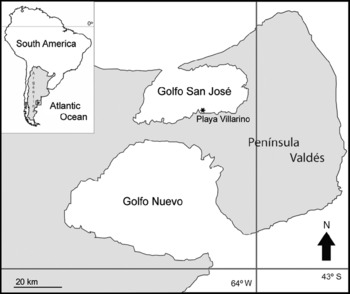
Approximately 20 individuals representing the complete size range (adults and juveniles) of B. cochlidium were collected monthly over a 2-year period (December 2004 to November 2006). Sampling was performed by scuba diving at depths of 5–15 m at Villarino beach, San José Gulf (42°25′S, 64°31′W) (fig. 1), Patagonia, Argentina. Total shell length (TSL) was measured to the nearest 0.1 mm and each individual was sexed by the presence or absence (female or male, respectively) of accessory glands and vagina. The penis length (PL) (the distance from the base to the tip) was measured. All measurements were made using a 0.1 mm precision calliper.
Sampling locality: Villarino beach, San José Gulf.

Host location and parasite identification
Samples of the medial zone of the gonad and digestive gland were taken; small pieces 10 mm in width were fixed in Bouin's solution for 2 h, preserved in 70% ethanol and processed for histology. Sections 5 μm thick were stained with haematoxylin–eosin and observed under a light microscope to determine the presence and location of parasites.
Additionally, 15 individuals of B. cochlidium were randomly collected in October 2008 with the aim of studying live parasite larvae. Snails were maintained in individual flasks of sea water for 48 h and observed regularly for cercarial emission. Cercariae were stained alive with neutral red and Nile blue for light microscopic study. Several cercariae were fixed in 10% formalin, dehydrated in a graded ethanol series, and treated for 5 min with hexamethyldisilazane. They were then dried, mounted, observed and photographed with a Jeol JSM-6460LV scanning electron microscope (SEM).
Prevalence, seasonality and penis length reduction
The monthly prevalence of infection (%) was recorded for males and females throughout the complete study period. Complementarily, the stage of larval development was determined for each parasite infra-population from histological sections (0 = rediae containing mainly germinal balls, 1 = rediae containing mainly developing cercariae, and 2 = mainly fully developed extra-redial cercariae) to determine the seasonality of larval emission. Cercariae were considered as fully developed whenever the tail, eyespots, ovary and testes were present.
The penis length was recorded and related to shell length in both parasitized and unparasitized male snails.
In order to compare larval development with a seasonal (temperature) cycle, the bottom water temperature was recorded at a single point, to the nearest 0.1°C, once every 6 h period with a HOBO datalogger (Measurement Systems Limited, Newbury, Berkshire, UK).
The sex ratio was tested by χ2 among infected and uninfected individuals. The mean shell length of parasitized and unparasitized snails was compared by a Student's t-test. The correlation between host size and parasite prevalence was studied by a Spearman test.
Results
Parasites in B. cochlidium were observed during the entire 2-year period of study, occupying mainly the gonad and, less frequently, also the digestive gland. Affected gonads showed an abnormal macroscopic aspect (heterogeneous) and colour (grey). The histological analysis of those tissues showed the presence of trematode larvae.
Host location and parasite identification
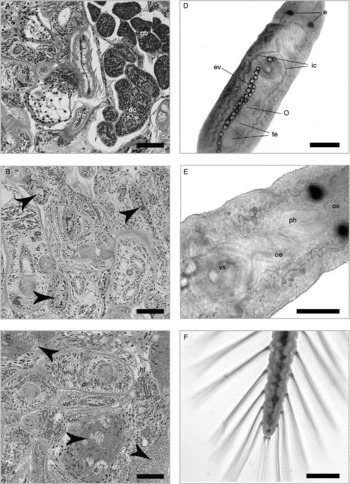
The parasite larval-stage rediae containing germinal balls and/or developing cercariae and fully developed extra-redial cercariae (fig. 2) were identified as belonging to the digenean family Lepocreadiidae. No other parasite was found. One of the 15 B. cochlidium individuals collected and maintained alive, expelled a large number of cercariae, which swam actively under the surface of the water.
Lepocreadiid larvae. (A) Rediae (r) containing germinal balls (gb) and developing cercariae (dc), and the tail (t) of a developed extra-redial cercaria. (B) Gonad acini (arrows) compressed by developed cercariae (c). (C) Heavy intensity of infection, rediae and cercariae invading the haemolymphatic (hl) space in digestive gland. (D) Emerged cercaria showing eyespots (e), intestinal caeca (ic), excretory vesicle (ev) filled with refringent granules, ovary (o) and testes (te) in tandem. (E) Anterior part of the body with oral sucker (os), pharynx (ph), oesophagus (oe) and ventral sucker (vs). (F) Posterior tail with setae. Scale bars: 100 μm (A); 50 μm (B, C); 100 μm (D, E); 50 μm (F).

The larval stages occupied the gonad of B. cochlidium. In most cases, the gonad was completely invaded by the parasites, resulting in severe histological disorganization and complete castration (fig. 2A). When remains of gonad acini were observed, they had become compressed and atrophied by larval parasites (fig. 2B). In high-intensity infections, larvae were also present in the haemocoelic spaces of the digestive gland (fig. 2C).
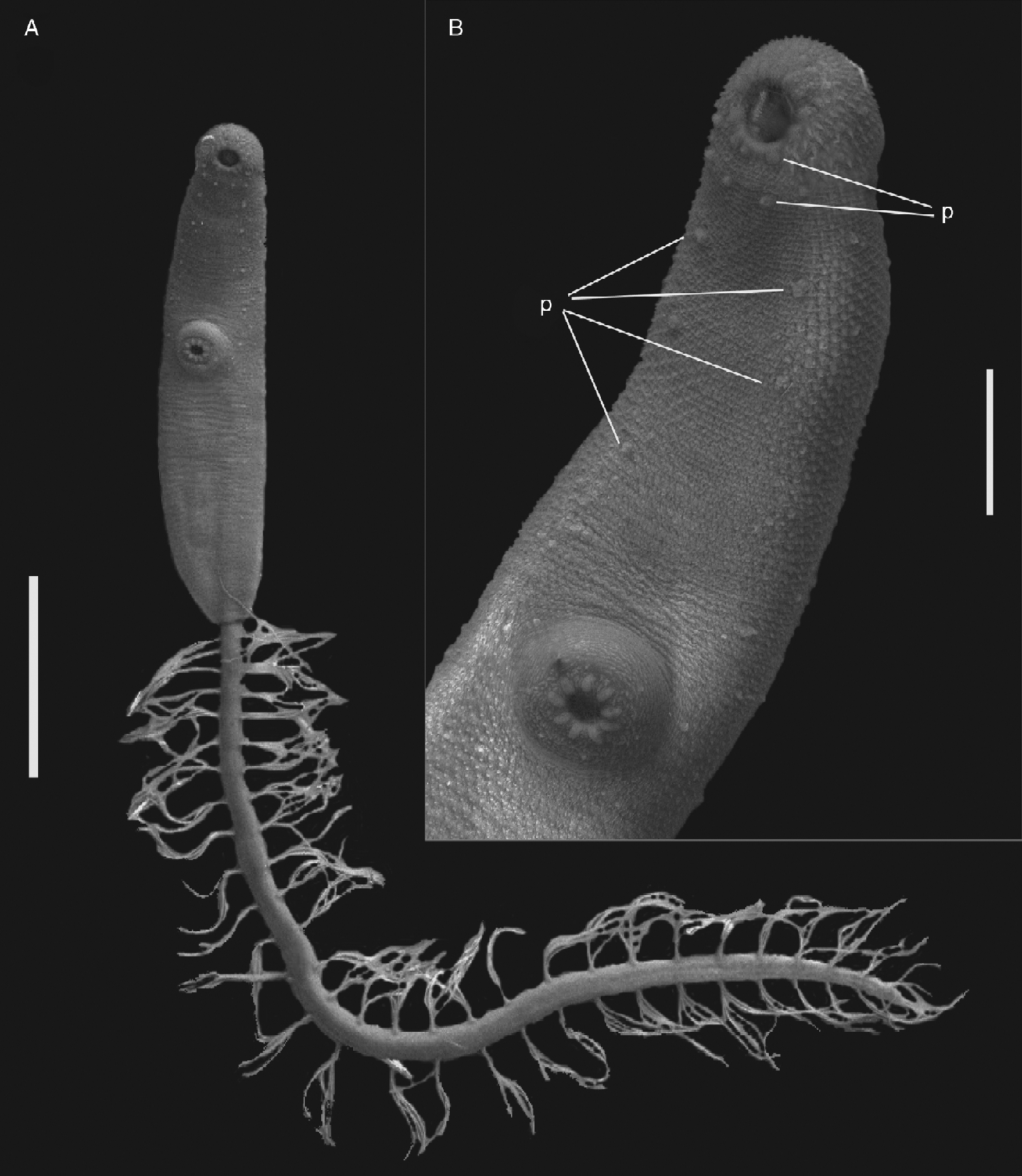
Fully developed cercariae were characterized by the presence of oral and ventral suckers (figs 2D–E and 3B), a tegument with large spines (figs 2E and 3B), a pair of eyespots at the pharynx level (figs 2D–E), and a long tail with setae (figs 2F and 3A). The pharynx is followed by the oesophagus, the intestinal bifurcation in the forebody and two caeca that reach the posterior extremity (figs 2D–E). The ovary is pre-testicular and smooth; the two oval and smooth testes are placed in tandem, in the posterior hindbody (fig. 2D). The cirrus sac was found to be claviform and bore a subglobular internal seminal vesicle; an external saccular seminal vesicle was present. The genital pore is close to the ventral sucker. The excretory vesicle was found to be I-shaped, long, extending into the forebody and filled with excretory granules (fig. 2D). The uroproct was not observed.
SEM of cercariae. (A) General view of the cercaria body and tail with setae. (B) Body showing spinous tegument, oral and ventral suckers, and papillae (p). Scale bars: 200 μm (A); 50 μm (B).

Prevalence, seasonality and penis length reduction
The overall prevalence of parasitization was 15.5% (n = 426), varying monthly between 0 and 54.2% during the study period (with this maximum corresponding to February 2006; n = 24).
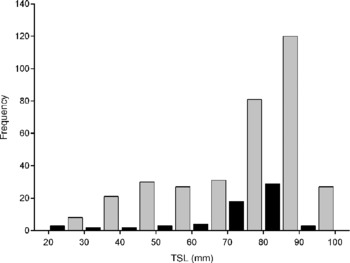
No difference in the sex ratio of parasitized snails was observed. Results showed parasitization in 53.7% of males (with sizes ranging from 37 to 94 mm in TSL) and 46.3% of females (44–107 mm in TSL) (df = 65; χ2 = 2.0; P>0.05; n = 66). Consequently, in order to compare the prevalence among the host sizes and the months of the year, the data were pooled. Statistically significant differences were observed between parasitized snail sizes ( = mean ± SD: 84.1 ± 17.0) and unparasitized ones (75.4 ± 20.3) (df = 407; t = 3.228; P < 0.005; n = 409). A Spearman correlation test showed a significant correlation between snail size and prevalence (P < 0.05; r = 0.839; n = 10). The size frequency distribution of parasitized and unparasitized snails is shown in fig. 4.
Size frequency histogram (TSL = total shell length) of parasitized (black) and unparasitized (grey) snails.

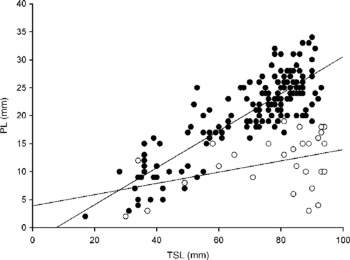
Castrated snails showed a reduction in penis size. Figure 5 shows the relationship between the shell length (TSL) and the penis length (PL) for parasitized and unparasitized snails. In unparasitized snails the penis length increased along with shell size according to the linear function: f(x) = 0.33x − 2.491; r 2 = 0.716, while in parasitized snails this increase was consistently less f(x) = 0.1003x+3.912 (r 2 = 0.154) (fig. 5). Non-statistically significant differences between shell sizes of parasitized and unparasitized males were found (t = − 1.87; P>0.05; n = 192). In comparing penis length, the parasitized snail penises were found to be significantly smaller than those of unparasitized snails (t = 6.94; P < 0.001; n = 192).
Relationship between total shell length (TSL) and penis length (PL) of parasitized (○) and unparasitized (●) snails.

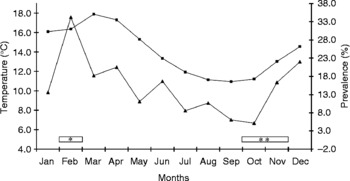
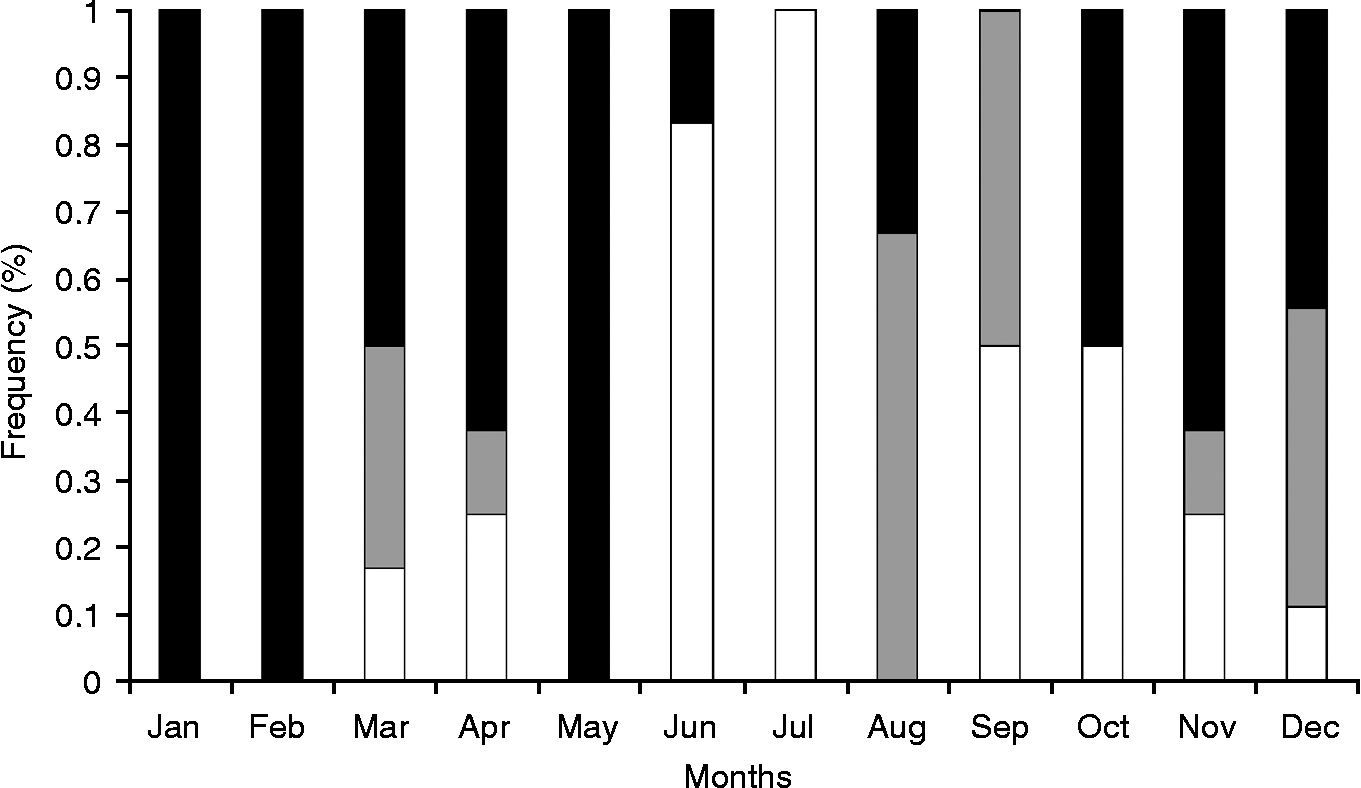
Even though parasitized snails were found all year round (fig. 6), the prevalence rose with increasing water temperature and dropped with decreasing water temperature. Furthermore, snails hosting fully developed cercariae were predominant between December and May, coinciding with increasing water temperature, while individuals containing rediae with germinal balls were more abundant from June to November (fig. 7).
Seasonality of prevalence (▲) and water temperature (■). Horizontal clear bars indicate snails: juvenile hatching*, oviposition**.

Frequency of different parasite developmental stages through time: white bars = germinal balls; grey bars = developing cercariae, and black bars = fully developed cercariae.

Discussion
The presence of a digenean parasite in B. cochlidium is reported for the first time in the present work. A single parasite species was identified affecting the gonad and, to a lesser extent, the digestive gland, corresponding to rediae and ophtalmotrichocercous cercariae of the family Lepocreadiidae. In life cycles involving this type of cercariae, snails act as the first intermediate host. The second intermediate hosts are mainly jellyfish and ctenophores, and pelagic fish are the definitive hosts (Palombi, Reference Palombi1934, Reference Palombi1937; Martin, Reference Martin1938; Bartoli, Reference Bartoli1966, Reference Bartoli1967, Reference Bartoli1983; Stunkard, Reference Stunkard1969, Reference Stunkard1970, Reference Stunkard1980, Reference Stunkard1983; Køie, Reference Køie1975; Bartoli & Prévot, Reference Bartoli and Prévot1978; Bray & Gibson, Reference Bray and Gibson1990; Rusell-Pinto et al., Reference Russell-Pinto, Gonçalver and Bowers2006). Most species involving ophtalmotrichocercous lepocreadiid cercariae use, as the first intermediate host, gastropods of the superfamily Buccinoidea and, in particular, Nassariidae (table 1).
The in vivo study of emerged cercariae suggests that the parasite is conspecific with that described by Martorelli (Reference Martorelli1991) in B. monilifer, found off Buenos Aires Province in the Argentine Sea, which was identified as belonging to Opechona Looss, 1907. The features of the ophtalmotrichocercous cercaria observed herein allow its inclusion in the family Lepocreadiidae and in the genus Opechona (Bray, Reference Bray, Jones, Bray and Gibson2005). Presently known ophtalmotrichocercous cercariae and their hosts are shown in table 1.
In the case of Digenea, specificity for the first intermediate host is generally observed at a generic level (Lauckner, Reference Lauckner and Kinne1980), as in the case reported here. In order to identify the parasite at species level, it is necessary to elucidate its life cycle and to obtain it in the adult stage. In the Argentine Sea, adults of Opechona have been found in the mackerel Scomber japonicus (Scombridae) from Buenos Aires Province (Cremonte & Sardella, Reference Cremonte and Sardella1997). This pelagic fish is a potential definitive host to the parasite found in B. cochlidium, as it feeds on jellyfish and seasonally inhabits the San José Gulf.
Although it is common to find more than one parasite species in a single host species (e.g. Køie, Reference Køie1969; Lauckner, Reference Lauckner and Kinne1980; Rato et al., Reference Rato, Russel-Pinto and Barroso2009), in this study no other parasites were found other than larvae presently reported.
The mean prevalence of this trematode in B. cochlidium surpasses the 1–10% expected in Digenea–Gastropoda systems (Fried & Graczyk, Reference Fried and Graczyk1997); however, the values are not extreme. Previous reports on lepocreadiid cercariae parasitizing Buccinoidea showed overall prevalences always below 8%, which is half of what was observed in B. cochlidium (table 1). In the present study, we demonstrated that parasite larvae affect male and female hosts equally, which is expected considering the results of previous work on other host species (e.g. Køie, Reference Køie1969; Lauckner, Reference Lauckner and Kinne1980). Furthermore, prevalence increases along with host size; this may be due to the fact that larger snails are older and therefore have had more opportunities to become infected (Fried & Graczyk, Reference Fried and Graczyk1997). The parasite produces complete castration of the host, as do most Digenea in their asexual intra-molluscan stages (Lauckner, Reference Lauckner and Kinne1980; Galaktionov & Dobrovolskij, Reference Galaktionov and Dobrovolskij2003).
Parasitized specimens of B. cochlidium were, in most cases, heavily infected and were always associated with castration. Complementarily, in parasitized adult male snails, a reduction of penis size in relation to snail size was observed. This was particularly remarkable in larger males, which showed a larger dispersion of shell length vs. penis length observed values and, consequently, reduced the goodness of fit of the linear function. Atrophy of genital secondary organs is a common phenomenon in this kind of infection (Ginetsinskaya, Reference Ginetsinskaya1988). In this work, no sexual reversion of the gonad or genitalia was found, although such reversion has been described in other gastropods infected by trematodes (Ginetsinskaya, Reference Ginetsinskaya1988). It seems that the absence of immune recognition and lack of parasite destruction by the host haemocytes is standard for infections caused by trematode larvae that undergo asexual reproduction in molluscs (Cheng & Rifkin, Reference Cheng, Rifkin and Snieszko1970; Perkins, Reference Perkins, Couch and Fournie1993).
Seasonality in the prevalence of parasitism was observed, reflected by the total prevalence and the larval developmental stages (figs 6 and 7). The minimum values of prevalence coincide with the lowest water temperature levels, and with the host spawning peak in October–November (Averbuj & Penchaszadeh, Reference Averbuj and Penchaszadeh2010). During these months, cercariae start to be expelled and gamete evacuation and oviposition occur (Averbuj & Penchaszadeh, Reference Averbuj and Penchaszadeh2010). On the other hand, maximum prevalence occurs while the hatching of host juveniles peaks during the season of highest water temperature (Averbuj & Penchaszadeh, Reference Averbuj and Penchaszadeh2010); this coincides with the moment when most cercariae should be expelled. In 1988, Ginetsinskaya postulated that a longer period of cercarial emission is expected in months with higher water temperature and that emission is stopped in seasons of lower temperature. It remains to be confirmed whether the period of greater emission coincides with the presence of jellyfishes and fishes in the area that could act as intermediate secondary hosts and definitive hosts, respectively, for the parasite.
Acknowledgements
This research was partially supported by Projects UBACyT X-171, PICTR-01869, PIP-5301 and PICT 01374. We thank Oscar Wheeler and Eugenia Zavattieri for collaborating on sample collection and to Jaime Groizard (Aluar S.A.) for SEM assistance. The authors thank Dr Cristián Ituarte and Dr Jennifer Antonides for early suggestions on the manuscript. The field work was conducted in a Protected Natural Area of Chubut Province with permits from the Secretaría de Turismo y Areas Protegidas. The authors are members of CONICET.