I. INTRODUCTION
NiO nanomaterials, which have at least one dimension within nanoscale, have aroused world-wide interests due to their unique chemical and physical properties that are different from bulk counterparts and due to their wide-range application as electrode materials for lithium-ion batteries,Reference Poizot, Laruelle, Grugeon, Dupont and Tarascon1 catalysts,Reference Park, Kang, Son, Park, Lee, Kim, Kim, Noh, Park, Bae, Park and Hyeon2, Reference Li, Zhang, Xie, Liu, Xu and Shen3 electrochemical supercapacitors,Reference Liu and Anderson4, Reference Zhang, Shi, Zhu, Zhao, Ma, Mhaisalkar, Maria, Yang, Zhang, Hng and Yan5 magnetic materials,Reference Felici, Lama, Piacentini, Papa, Debowska, Kisiel and Rodzik6 and gas sensors.Reference Mattei, Mazzoldi, Post, Buso, Guglielmi and Martucci7 As the properties of NiO nanomaterials are greatly size- and shape-dependent, synthesis of NiO nanomaterials with controllable size and morphology is significant for designing, preparing, and selecting NiO nanomaterials with desirable properties. Various NiO nanostructures, such as nanowires,Reference Wu, Liu, Guo, Hu, Abbas, Hu and Xu8 nanosheets,Reference Ni, Zhao, Zhou, Zheng, Cheng and Li9 nanoflowers,Reference Zhao, Ke, Bao, Wang, Dong and Chen10 nanotubes,Reference Malandrino, Perdicaro, Fragalà, Nigro, Losurdo and Bruno11 nanorings,Reference Liang and Li12, Reference Wang, Xu, Wang and Li13 and nanospanners,Reference Hu, Zhu, Chen, Yang, Li, Suchopar and Richards14 have been synthesized by precursor decomposition,Reference Liang, Zhu and Hu15 hydrothermal method,Reference Yang, Zhu, Tong, Liang and Wang16 sol–gel method, and template method.Reference Yang, Sha, Ma and Yang17, Reference Sun, Liu and Li18
Among the numerous methods, the direct decomposition of nickel hydroxide is the most common and facile way for the synthesis of NiO. Studies have shown that NiO materials could be obtained with unchanged morphology by direct thermal decomposition of nickel hydroxides.Reference Ni, Zhang, Tian, Zheng and Wang19 Thus, nickel hydroxides were given considerable attention for the crucial application as the most important precursors for the synthesis of NiO, as well as electrode material in alkaline rechargeable batteries.Reference Olivaa, Leonardia, Laurenta, Delmasb, Braconnierb, Figlarzc, Fievetc and De Guibert20, Reference Wang, Casalongue, Liang and Dai21 Nickel hydroxides usually adopt two well-documented polymorphs: α-Ni(OH)2 and β-Ni(OH)2. Both α-Ni(OH)2 and β-Ni(OH)2 have layered structure. β-Ni(OH)2 adopts the chemical formula Ni(OH)2 and crystallizes in a hexagonal brucite-type structure.Reference Liang, Zhu and Hu15 The ordered “NiO2” slabs stack closely along the c-axis, and the interlayer distance is about 4.6 Å.Reference Qi, Qi, Li and Lu22 Compared with β-Ni(OH)2, α-Ni(OH)2 is a poorly ordered phase with a larger interlayer spacing of 7.6 Å, in which anions were intercalated in the positively charged layers of [Ni(OH)2-x(H2O)x]x + for charge balance.Reference Rajamathi, Kamatha and Seshadri23 Because of the crystal structure differences, the properties of nickel hydroxides varied with their phase. For example, α-Ni(OH)2/γ-NiOOH couple has larger discharge capacity than β-Ni(OH)2/β-NiOOH couple.Reference Corringan and Knight24, Reference Barnard, Randell and Tye25 But α-Ni(OH)2 is less stable than β-Ni(OH)2 in alkaline solution.Reference Xu, Ding, Chen, Zhao, Rimkus, Joesten and Suib26 Also, nickel hydroxides with different phase would have great influence on the synthesis of NiO as precursors. Accordingly, it would be of great significance studying the rules underlying the phase transformation within α-Ni(OH)2 and β-Ni(OH)2, as well as synthesizing of nickel hydroxides with controllable morphologies.
In this article, we demonstrate the controlled synthesis of nickel hydroxides with predictable phase and morphology. The hierarchical α-Ni(OH)2 spheres and β-Ni(OH)2 nanosheets have been synthesized in a facile oleylamine-assisted approach. The water-induced phase and morphology transformations were investigated in detail. NiO hierarchical spheres and nanosheets have been obtained by thermal decomposition of the isomorphological precursors. In addition, NiO spheres and nanosheets derived at a similar synthesis system provided a good model to study the shape-dependent textural and catalytic properties of as-obtained NiO materials, which would be suggestive for developing function-oriented materials.
II. EXPERIMENTAL SECTION
A. Materials
All the chemicals were of analytical grade and used as received without further purification. Ni(NO3)3·6H2O, oleylamine, and absolute ethanol were supplied by Beijing Chemical Reagent Company (Beijing, China).
For the synthesis of precursor-A, 0.291 g Ni(NO3)3·6H2O was dissolved in 20 mL ethanol to form solution A. Two milliliters of oleylamine was mixed with 10 mL ethanol to form solution B. Solution A was mixed with solution B with stirring. Then, the mixture was transferred to a 50-mL autoclave. The autoclave was sealed and heated at 180 °C for 12 h. As the autoclave cooled to room temperature naturally, the supernatant solution was poured out, and the samples could be directly collected from the bottom of the autoclave. The samples were washed by dispersing in 10 mL of cyclohexane and precipitating by the addition of 10 mL of ethanol. The green precipitates were dried at 80 °C to get precursor-A powders. For the synthesis of NiO-A, the above precursor-A was calcined in a muffle furnace at 400 °C for 2 h to obtain NiO. The temperature ramping rate was 2 °C min−1.
For the synthesis of precursor-B powder, 0.291 g Ni(NO3)3·6H2O was dissolved in 10 mL ethanol and 10 mL H2O to form solution A. Two milliliters of oleylamine was mixed with 10 mL ethanol to form solution B. The following steps are identical with the steps in the synthesis of precursor-A. For the synthesis of NiO-B, the above precursor-B powder was calcined in a muffle furnace at 400 °C for 2 h to obtain NiO-B. The temperature ramping rate was 2 °C min−1.
B. Characterization
The phase characterization of the products was done by x-ray powder diffraction (XRD) (Bruker AXS: D8 FOCUS; Bruker AXS, Madison, WI) with Cu-Ka as the radiation source (λ = 0.15406 nm). The morphology and size of the particles were characterized using a scanning electron microscope (SEM) (SUPRA 55/55VP, Carl Zeiss, Oberkochen, Germany). Nitrogen adsorption and desorption isotherms were obtained at −196 °C using a Thermo Fisher Scientific spectrophotometer 1990 apparatus (Thermo Fisher Scientific, Waltham, MA). Thermogravimetric (TG) analysis and differential scanning calorimetric (DSC) measurements were performed using a Setaram Setsys EV 24 thermal analyzer (Setaram Setsys, Caluire, France) and a O2–He mixture (20 mL min−1, 25% O2 by volume) as a carrier gas at a heating rate of 10 °C min−1 in the range of 100–700 °C. Temperature-programmed reduction with H2 (TPR-H2) was carried out in a quartz tube reactor, and 20 mg sample was used for each measurement. Prior to the reduction, the sample was pretreated in an O2–He (9.98% O2 by volume) steam at 500 °C for 30 min and in N2 stream at 500 °C for another 30 min and then cooled to room temperature. After that, a H2–He mixture (5.25% H2 by volume) was switched on, and the temperature ramp was 10 °C min−1 from 40 to 700 °C. The catalytic activities of NiO for a CO + O2 reaction were performed under a steady-state condition, involving a feed stream with a fixed composition of CO 1%, O2 16%, and Ar 83% by volume, where Ar was used as diluent. A quartz tube was used as a reactor, and a 200 mg NiO sample was used for each test. The reaction was carried out with the same space velocity of 120 L g−1 h−1. Nicolet Nexus 470 FTIR (Thermo Nicolet Corporation, Madison, WI) was used for analyzing the products.
III. RESULTS AND DISCUSSION
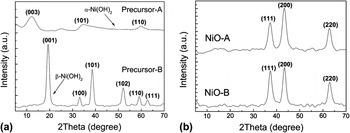
Nickel hydroxides can be obtained by using Ni(NO3)3·6H2O as starting material in the presence of oleylamine through solvothermal treatment. The solvent used in the synthesis approach is predominant absolute ethanol and subordinate water. Figure 1(a) displays XRD patterns of as-synthesized nickel hydroxides derived from different water volumes. The nickel hydroxides derived at water volumes of 0 mL and 10 mL were marked as precursor-A and precursor-B, respectively. The XRD pattern of precursor-A shows broad peaks of (003), (101), and (110) planes, corresponding to the d-spacing at 7.79, 2.68, and 1.54 Å, fitting well with rhombohedral α-Ni(OH)2-layered structure with lattice constants a = 3.08 Å and c = 23.41 Å (Joint Committee on Powder Diffraction Standards (JCPDS) card number 38-0715). XRD pattern of precursor-B matches well with the hexagonal phase of β-Ni(OH)2 with lattice constants a = 3.114 Å and c = 4.617 Å (JCPDS No. 03-0177), suggesting that precursor-B is pure phase β-Ni(OH)2. It can be seen from XRD patterns that precursor-A has a higher crystallinity than precursor-B. As well documented, β-Ni(OH)2 has a well-ordered crystal structure, and α-Ni(OH)2 adopts a poor-ordered crystal structure. The differences in crystallinity shown by XRD patterns are well consistent with the crystal structure of α-Ni(OH)2 and β-Ni(OH)2.
X-ray powder diffraction (XRD) patterns of (a) precursor-A and precursor-B and (b) NiO-A and NiO-B.

By annealing at 400 °C for 2 h, the precursors converted to the pure phase of NiO. Figure 1(b) shows the XRD patterns of as-synthesized samples NiO-A and NiO-B, derived from precursor-A and precursor-B, respectively. Both XRD patterns of NiO-A and NiO-B could be well indexed to the face-centered cubic NiO phase (JCPDS No. 71-1179). The peaks located at the d-spacing at 2.40, 2.08, and 1.47 Å, corresponding to the (111), (200), and (220) crystal planes, respectively. No impurity peaks are found, suggesting as-prepared precursors transfer to pure phase of NiO under the designed heat treatment. It is worthy of noting that the relative diffraction intensity of (111) planes and (200) planes varied from NiO-A to NiO-B. For NiO-A, the ratio I (111)/(200) is ∼1.55, while the value is ∼1.12 for NiO-B. The small differentia in XRD patterns indicated the morphology distinction of as-prepared NiO samples.
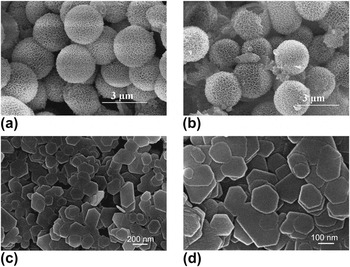
The morphology and microstructure of as-prepared nickel hydroxides and corresponding nickel oxides were investigated by SEM observations. Figures 2(a) and 2(b) show typical SEM images of precursor-A and NiO-A samples. Precursor-A was flower-like spheres with an average size about 3 μm. Careful observation on the surface of the spheres shows that the flower-like spheres are composed of densely packed irregular sheets. The NiO-A samples prepared from the calcination of precursor-A at 400 °C keep similar flower-like morphology. The spheres corrupted slightly during the calcination process. SEM image of precursor-B in Fig. 2(c) reveals a hexagonal sheet-like morphology with an average diameter of about 400 nm. The corresponding NiO-B shows a similar hexagonal sheet-like morphology [Fig. 2(d)].
Scanning electron microscope (SEM) images of (a, b) precursor-A and corresponding NiO-A and (c, d) precursor-B and corresponding NiO-B.

On the basis of above experimental results, it can be concluded that the water content in synthetic systems plays a crucial role in controlling the phase and morphology of nickel hydroxides. It seems that water can induce the phase transformation of nickel hydroxides from α-Ni(OH)2 spheres to β-Ni(OH)2 sheets. Meanwhile, α-Ni(OH)2 has a trend to form flower-like spheres composed of irregular sheets, and β-Ni(OH)2 trends to form hexagonal sheets. The morphology evolution from α-Ni(OH)2 to β-Ni(OH)2 can be attributed to their crystallographic characteristics: α-Ni(OH)2 takes a poor disordered layered structure with intercalated anions in the layers, whereas β-Ni(OH)2 takes a well-ordered hexagonal crystal structure with ordered stacked “NiO2” slabs along the c-axis, which has strong trends to form hexagonal sheets.
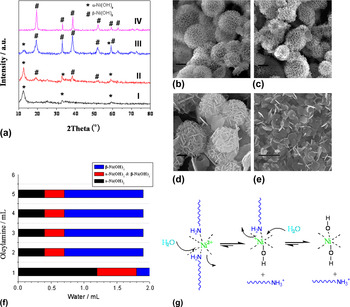
A number of experiments have been carried out to study the phase and morphology evolution. It was documented that the synthesis system was sensitive to the existence of water. A small amount of water can drive the phase transformation from α-Ni(OH)2 to β-Ni(OH)2. Given that oleylamine volume was 2 mL, the as-prepared samples transfer from α-Ni(OH)2 to β-Ni(OH)2 as the water volume varied from 0.4 to 0.7 mL. The phase transfer process was clearly illustrated by XRD profiles in Fig. 3(a). Sample I derived at 0.4 mL H2O was pure phase of α-Ni(OH)2, whereas sample IV derived at 0.7 mL H2O possess pure phase of β-Ni(OH)2. Samples II and III, which were derived at 0.5 and 0.6 mL H2O, exhibit the intermediate state with coexistence of α-Ni(OH)2 and β-Ni(OH)2. Accompanying with the phase transformation, as-prepared samples also suffer a morphology evolution, which was shown in Figs. 3(b)–3(e). As-prepared samples varied from flower-like spheres to sheets as the phase evolves from α-Ni(OH)2 and β-Ni(OH)2; the intermediate states consist of both sheets and spheres. Clearly, the morphologies of the as-prepared nickel hydroxides have close relationship with their crystal structures.
(a) XRD profiles used to investigate the phase transition of as-prepared nickel hydroxides. Samples I–IV denote the samples prepared at 0.4, 0.5, 0.6, and 0.7 mL H2O, respectively; * denotes α-Ni(OH)2 and # denotes β-Ni(OH)2. (b–e) SEM images of the nickel hydroxides prepared at different water volumes: (b) 0.4 mL, (c) 0.5 mL, (d) 0.6 mL, and (e) 0.7 mL; the scale bar is 1 μm. (f) The dependence of the nickel hydroxides phase on the volume of oleylamine and water. (g) Illustration of the formation mechanisms.

Furthermore, it is worth mentioning that similar controlled experiments were carried out at different oleylamine volumes. It can be deduced statistically from the experimental results that a phase transition from α-Ni(OH)2 spheres to β-Ni(OH)2 sheets occurred as a function of the water and oleylamine volume added in the synthesis system [Fig. 3(f)]: (i) at 1 mL oleylamine, the phase transition from α-Ni(OH)2 spheres to β-Ni(OH)2 sheets occurs from the water volume 1.2 to 1.8 mL and (ii) at 2∼5 mL oleylamine, the phase transition started from α-Ni(OH)2 spheres at 0.4 mL water and ended up with β-Ni(OH)2 sheets as the water volume reaches 0.7 mL. The mechanism for the water-induced phase transformation was illustrated in Fig. 3(g). Ni element trends to adopt a six-coordination structure and forms coordination bonds with oleylamine. Oleylamine is typical Lewis base, which can donate lone pair electrons. Thus, the nickel–oleylamine coordination bonds quickly hydrolyse in the presence of H2O. The cooperation of H2O and oleylamine accelerates the hydrolysis of Ni(II) ions, which may exert an influence on the phase transformation of as-formed nickel hydroxides. It can be inferred that β-Ni(OH)2 tends to form at fast hydrolysis process of Ni(II) ions, whereas α-Ni(OH)2 tends to form at a relatively slow hydrolysis process. This mechanism can well explain the phenomenon that there needs more water to complete the phase transformation at 1 mL oleylamine. In addition, it is well documented that α-Ni(OH)2 is unstable and is easily converted to β-Ni(OH)2 in alkaline solution.Reference Zhao, Wang, Chen, Pana, Zhang and Cao27 pH measurements revealed that pH of reaction solution is about 8–10, and the addition of a specified volume of water in the synthesis system could enhance the pH value of the reaction solution slightly (Fig. S1), which is also in favor of the formation of β-Ni(OH)2.
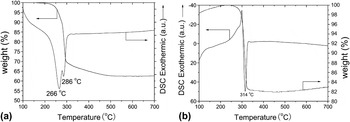
TG-DSC curves of α-Ni(OH)2 spheres and β-Ni(OH)2 sheets are shown in Fig. 4. The measured weight loss value of 18.1% for β-Ni(OH)2 sheets is consistent with the idealized value of 18.6% calculated from the molecular formula Ni(OH)2 even though the weight loss value for α-Ni(OH)2 spheres is 37.6%. The increase of weight loss might be caused by the absorbed water molecular, organic molecular, and intercalated anions. These differences could be also observed in DSC curves. For β-Ni(OH)2 sheets, there is one strong endothermic peak at 314 °C, corresponding to the phase transformation temperature of β-Ni(OH)2.Reference Kuang, Lei, Pan, Yu and Su28 For α-Ni(OH)2 spheres, there are two endothermic peaks located at 266 and 286 °C, respectively. The endothermic peaks at 266 °C could be assigned to the combustion of the absorbed organic species. The endothermic peak at 286 °C corresponds to the phase transformation process of α-Ni(OH)2. Accordingly, two points could be concluded from the TG-DSC analysis. First, the decomposition temperature of β-Ni(OH)2 is higher than that of α-Ni(OH)2, indicating that β-Ni(OH)2 is more stable than α-Ni(OH)2. Second, the high weight loss of α-Ni(OH)2 and the endothermic peak at 266 °C reveal that α-Ni(OH)2 can absorb more organic species, water molecular, and other anions in the structure. This feature may be caused by the flower-like morphology and the higher layer distance in the α-Ni(OH)2 crystal structure.
Thermogravimetry and differential scanning calorimetry (TG-DSC) curves for (a) α-Ni(OH)2 and (b) β-Ni(OH)2 prepared at 10 mL H2O.

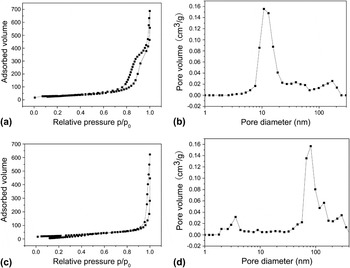
N2 adsorption–desorption analysis was carried out to investigate the surface area and textural properties of sample NiO-A spheres and NiO-B sheets. Figure 5 shows the N2 adsorption–desorption isotherm and Barrett–Joyner–Hallenda (BJH) pore-size distribution curve of NiO spheres and sheets. N2 adsorption–desorption isotherms for both NiO spheres and sheets show IUPAC type IV type H3 hysteresis loops, which mainly result from the disordered lamellar pore and slit-shaped pores. The pore-size distribution curves were obtained by BJH model calculation on the desorption branch data. For NiO spheres, there are one strong peak with the center located at 11 nm and two weak peaks with the center at 39 and 167 nm, respectively. The pore-size distribution is a comprehensive expression of the intersphere spacing and intrasphere disordered slit-shaped pores. By contrast, there are mainly two peaks for NiO sheets: one weak peak with the center at 4 nm and one strong peak with the center at 82 nm. The smaller pores ∼4 nm could be related to the pores generated by recrystallization during the annealing process. The bigger pores might be caused by the interparticle spacing. The pore-specific volume is 0.6400 and 0.2850 cm3/g for NiO spheres and sheets, respectively. The Brunauer–Emmett–Teller specific surface areas were 100.2 and 79.0 m2/g for NiO spheres and sheets, respectively. The higher pore volume of NiO spheres contributed to the higher specific surface area. So, it can be concluded that the flower-like NiO spheres possess higher pore volume and specific surface area than the NiO sheets.
N2 aborptioin and desorption isotherms and pore-size distribution curve of (a, b) NiO-A spheres and (c, d) NiO-B sheets .

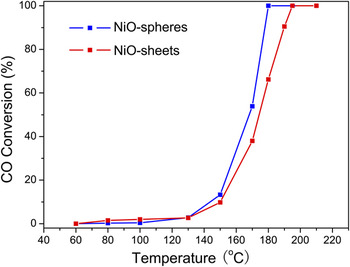
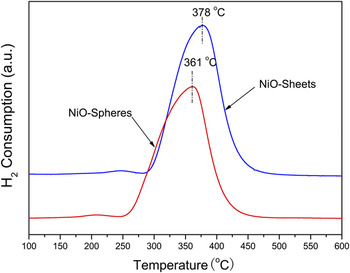
As NiO spheres and NiO sheets were synthesized by the same synthesis approach and only the water contents were monitored to obtain NiO spheres and NiO sheets, the influence of impurity ions induced by different synthesis methods on catalysis properties could be excluded. These NiO spheres and sheets provided an effective way to investigate the morphology effect on catalysis properties. The catalytic performance of NiO-A spheres and NiO-B sheets were evaluated by CO oxidation. The results are shown in Fig. 6. It is clear that NiO-A spheres are more active than NiO-B sheets. At 170 °C, the percentage CO conversion is 54% over NiO-A spheres and 38% over NiO-B sheets. TPR-H2 characterization was carried out to analyze the oxidation–reduction properties of NiO-A spheres and NiO-B sheets (Fig. 7). For both samples, there is one main peak, corresponding to the reduction of NiO to Ni. The peak temperature for NiO-A spheres is 361 °C, which is lower than that of NiO-B sheets (378 °C). This means that NiO spheres possess higher reducibility than sample NiO sheets. This result is consistent with the catalytic activity test for CO oxidation and N2 adsorption–desorption analysis results. So, it can be concluded that the flower-like NiO spheres possessed higher reducibility and more active catalysis performance than NiO sheets for CO oxidation.
Percentage conversion versus temperature plots over NiO-A spheres and NiO-B sheets for CO oxidation.

Temperature-programmed reduction with H2 curves for NiO-A spheres and NiO-B sheets.

IV. CONCLUSIONS
NiO spheres and sheets have been synthesized by direct decomposition of nickel hydroxides based on a facile oleylamine-assisted approach. α-Ni(OH)2 flower-like spheres and β-Ni(OH)2 hexagonal sheets have been prepared through the oleylamine-assisted solvothermal approach by tuning the water volume in synthesis system. The mechanism of water-induced phase and morphology transformation from α-Ni(OH)2 spheres to β-Ni(OH)2 sheets has been investigated. The influence of H2O and oleylamine in the hydrolysis rates of Ni(II) ions exerts a crucial role on the phase transformation of as-formed nickel hydroxides. In addition, the studies on the shape-dependent textural and catalytic properties of as-obtained NiO spheres and sheets show that NiO spheres possess higher surface area, reducibility, and catalysis activities for CO oxidation than NiO sheets.
ACKNOWLEDGMENTS
This work was financially supported by Nature Science Foundation of China (Grant no. 21001015, 20821004), The Research Fund for the Doctoral Program of Higher Education (Grant no. 20100010120003), and the State Key Project of Fundamental Research for Nanoscience and Nanotechnology (2011CB932402).