Introduction
Increased intra-individual variability (IIV) in reaction time (RT) across various tasks is one ubiquitous neuropsychological finding in attention deficit hyperactivity disorder (ADHD) (Castellanos et al. Reference Castellanos, Sonuga-Barke, Scheres, Di Martino, Hyde and Walters2005; Klein et al. Reference Klein, Wendling, Huettner, Ruder and Peper2006; Di Martino et al. Reference Di Martino, Ghaffari, Curchack, Reiss, Hyde, Vannucci, Petkova, Klein and Castellanos2008; Kuntsi & Klein, Reference Kuntsi and Klein2012; Tamm et al. Reference Tamm, Narad, Antonini, O'Brien, Hawk and Epstein2012) and may serve as a potential endophenotype for ADHD (Castellanos et al. Reference Castellanos, Sonuga-Barke, Scheres, Di Martino, Hyde and Walters2005; Doyle et al. Reference Doyle, Willcutt, Seidman, Biederman, Chouinard, Silva and Faraone2005; Rommelse et al. Reference Rommelse, Altink, Oosterlaan, Beem, Buschgens, Buitelaar and Sergeant2008; Uebel et al. Reference Uebel, Albrecht, Asherson, Borger, Butler, Chen, Christiansen, Heise, Kuntsi, Schafer, Andreou, Manor, Marco, Miranda, Mulligan, Oades, van der Meere, Faraone, Rothenberger and Banaschewski2010; Frazier-Wood et al. Reference Frazier-Wood, Bralten, Arias-Vasquez, Luman, Ooterlaan, Sergeant, Faraone, Buitelaar, Franke, Kuntsi and Rommelse2012). Such variability is quantified either by the mean and s.d. of RT (Klein et al. Reference Klein, Wendling, Huettner, Ruder and Peper2006), or by its ex-Gaussian RT distributional model (Leth-Steensen et al. Reference Leth-Steensen, Elbaz and Douglas2000). The latter, a convolution of Gaussian and exponential components, fits RT data well and provides insights into individual differences across experimental paradigms (Balota & Yapp, Reference Balota and Yap2011). The ex-Gaussian model generates three parameters: μ (mu) and σ (sigma), the mean and s.d. of the Gaussian portion, respectively, and τ (tau), mean of the exponential portion. Changes in τ typically capture the extent of the positive skew of RT distributions. Among the three parameters, smaller μ and greater σ and τ in ADHD, larger τ is the most significant index to differentiate ADHD from controls across tasks, including the choice RT task (Leth-Steensen et al. Reference Leth-Steensen, Elbaz and Douglas2000), Conners' continuous performance test (CCPT) (Hervey et al. Reference Hervey, Epstein, Curry, Tonev, Arnold, Conners, Hinshaw, Swanson and Hechtman2006) and working memory tasks (Buzy et al. Reference Buzy, Medoff and Schweitzer2009). Despite several models that might account for increased RT variability in ADHD (Kuntsi & Klein, Reference Kuntsi and Klein2012; Tamm et al. Reference Tamm, Narad, Antonini, O'Brien, Hawk and Epstein2012), the neurobiological underpinnings of IIV in ADHD have not been fully delineated yet.
Synthesis of limited studies in ADHD (Rubia et al. Reference Rubia, Smith, Brammer and Taylor2007; Suskauer et al. Reference Suskauer, Simmonds, Caffo, Denckla, Pekar and Mostofsky2008; Kuntsi & Klein, Reference Kuntsi and Klein2012), frontal-lobe dementia (Murtha et al. Reference Murtha, Cismaru, Waechter and Chertkow2002), traumatic brain injury (Stuss et al. Reference Stuss, Murphy, Binns and Alexander2003), typically developing (TD) youths (Simmonds et al. Reference Simmonds, Fotedar, Suskauer, Pekar, Denckla and Mostofsky2007), healthy adults (Bellgrove et al. Reference Bellgrove, Hester and Garavan2004) and elders (Bunce et al. Reference Bunce, Anstey, Christensen, Dear, Wen and Sachdev2007) have consistently suggested a crucial role of the prefrontal cortex in regulating behavioral consistency and RT variability. The prefrontal cortex, including the dorsolateral prefrontal cortex (DLPFC) (Wood & Grafman, Reference Wood and Grafman2003; Mars & Grol, Reference Mars and Grol2007), ventrolateral prefrontal cortex (VLPFC) (Levy & Wagner, Reference Levy and Wagner2011), medial prefrontal cortex (MPFC) (van Noordt & Segalowitz, Reference van Noordt and Segalowitz2012) and the orbitofrontal cortex (OFC) (Kringelbach, Reference Kringelbach2005), and its long-range connections with the dorsal striatum (Alexander et al. Reference Alexander, DeLong and Strick1986), namely frontostriatal circuitry, are critical to higher-order executive control (Miller & Cohen, Reference Miller and Cohen2001; Liston et al. Reference Liston, Watts, Tottenham, Davidson, Niogi, Ulug and Casey2006; Casey et al. Reference Casey, Nigg and Durston2007b ). Abnormal function of the PFC and frontostriatal circuitry entails failure in executive control and attention regulation that link to increased behavioral variability (Kuntsi & Klein, Reference Kuntsi and Klein2012). Reduced synchronized activity between the prefrontal area and striatum (Cubillo et al. Reference Cubillo, Halari, Ecker, Giampietro, Taylor and Rubia2010; Konrad & Eickhoff, Reference Konrad, Dielentheis, El Masri, Bayerl, Fehr, Gesierich, Vucurevic, Stoeter and Winterer2010; Liston et al. Reference Liston, Cohen, Teslovich, Levenson and Casey2011), aberrance in frontostriatal anatomy (Valera et al. Reference Valera, Faraone, Murray and Seidman2007; Nakao et al. Reference Nakao, Radua, Rubia and Mataix-Cols2011) and decreased microstructural integrity of frontostriatal tracts (Konrad & Eickhoff, Reference Konrad, Dielentheis, El Masri, Bayerl, Fehr, Gesierich, Vucurevic, Stoeter and Winterer2010; de Zeeuw et al. Reference de Zeeuw, Mandl, Hulshoff Pol, van Engeland and Durston2012a ; Shang et al. Reference Shang, Wu, Gau and Tseng2012) suggest extensive involvement of the frontostriatal system in ADHD. Microstructural organization of the circuitry has been demonstrated to be associated with cognitive control (Casey et al. Reference Casey, Epstein, Buhle, Liston, Davidson, Tonev, Spicer, Niogi, Millner, Reiss, Garrett, Hinshaw, Greenhill, Shafritz, Vitolo, Kotler, Jarrett and Glover2007a ) and executive functions in both ADHD and TD youths (Shang et al. Reference Shang, Wu, Gau and Tseng2012) and attention performance in TD youths only (de Zeeuw et al. Reference de Zeeuw, Mandl, Hulshoff Pol, van Engeland and Durston2012a ; Wu et al. Reference Wu, Gau, Lo and Tseng2012). However, whether it is directly associated with IIV in ADHD warrants investigation.
Besides the frontostriatal tracts, the default mode network (DMN) interference hypothesis (Sonuga-Barke & Castellanos, Reference Sonuga-Barke and Castellanos2007; Castellanos et al. Reference Castellanos, Kelly and Milham2009) suggests that IIV in ADHD is related to trial-to-trial trade-off balance between the brain regions that support task performance and those that mediate task-irrelevant mental process. The DMN principally comprises of two hubs, the anterior MPFC and posterior cingulate cortex (PCC), and two subcomponent systems, the dorsomedial prefrontal cortex and the medial temporal lobe (Andrews-Hanna et al. Reference Andrews-Hanna, Reidler, Sepulcre, Poulin and Buckner2010). The DMN deactivates during cognitive tasks, while the executive network is activated. The anti-phase relationship presumably reflects competitive balance between oppositional mental processing (Fox et al. Reference Fox, Snyder, Vincent, Corbetta, Van Essen and Raichle2005; Weissman et al. Reference Weissman, Roberts, Visscher and Woldorff2006).
Stronger negative correlations between the opposing networks and greater suppression of DMN activity during effortful cognitive tasks predict less IIV and higher performance stability (Weissman et al. Reference Weissman, Roberts, Visscher and Woldorff2006; Kelly et al. Reference Kelly, Uddin, Biswal, Castellanos and Milham2008). ADHD children with increased behavioral variability may have attenuated suppression of default activity (Fassbender et al. Reference Fassbender, Zhang, Buzy, Cortes, Mizuiri, Beckett and Schweitzer2009) or reduced anterior cingulate cortex (ACC) activity (Rubia et al. Reference Rubia, Smith, Brammer and Taylor2007); the aberrance in the DMN was normalized with stimulant use (Peterson et al. Reference Peterson, Potenza, Wang, Zhu, Martin, Marsh, Plessen and Yu2009; Liddle et al. Reference Liddle, Hollis, Batty, Groom, Totman, Liotti, Scerif and Liddle2011). Such competition between the DMN and executive network is dysregulated in ADHD (Castellanos et al. Reference Castellanos, Margulies, Kelly, Uddin, Ghaffari, Kirsch, Shaw, Shehzad, Di Martino, Biswal, Sonuga-Barke, Rotrosen, Adler and Milham2008; Sun et al. Reference Sun, Cao, Long, Sui, Cao, Zhu, Zuo, An, Song, Zang and Wang2012), with measurement of resting state functional connectivity between the ACC (representing executive network) and the PCC (representing DMN). The ACC and PCC are interconnected structurally with the cingulum bundle, whose microstructural integrity might mediate orthogonality between the coupling regions (van den Heuvel et al. Reference van den Heuvel, Mandl, Luigjes and Hulshoff Pol2008; Honey et al. Reference Honey, Sporns, Cammoun, Gigandet, Thiran, Meuli and Hagmann2009). A few diffusion tensor imaging (DTI) studies have investigated cingulum tract microstructural integrity in ADHD (Hamilton et al. Reference Hamilton, Levitt, O'Neill, Alger, Luders, Phillips, Caplan, Toga, McCracken and Narr2008; Makris et al. Reference Makris, Buka, Biederman, Papadimitriou, Hodge, Valera, Brown, Bush, Monuteaux, Caviness, Kennedy and Seidman2008; Pavuluri et al. Reference Pavuluri, Yang, Kamineni, Passarotti, Srinivasan, Harral, Sweeney and Zhou2009; Konrad et al. Reference Konrad, Dielentheis, El Masri, Bayerl, Fehr, Gesierich, Vucurevic, Stoeter and Winterer2010, Reference Konrad, Dielentheis, Masri, Dellani, Stoeter, Vucurevic and Winterer2012) with different analytic approaches and variable regions of interest (ROIs), and yielded inconsistent findings.
Despite studies investigating white matter integrity in relation to performance variability (MacDonald et al. Reference MacDonald, Li and Backman2009) and to cognitive instability in healthy individuals across the life span (Bunce et al. Reference Bunce, Anstey, Christensen, Dear, Wen and Sachdev2007, Reference Bunce, Anstey, Cherbuin, Burns, Christensen, Wen and Sachdev2010; Fjell et al. Reference Fjell, Westlye, Amlien and Walhovd2011; Jackson et al. Reference Jackson, Balota, Duchek and Head2012; Tamnes et al. Reference Tamnes, Fjell, Westlye, Ostby and Walhovd2012), and white matter volume to reaction variability (Anstey et al. Reference Anstey, Mack, Christensen, Li, Reglade-Meslin, Maller, Kumar, Dear, Easteal and Sachdev2007; Walhovd & Fjell, Reference Walhovd and Fjell2007; Ullen et al. Reference Ullen, Forsman, Blom, Karabanov and Madison2008; Moy et al. Reference Moy, Millet, Haller, Baudois, de Bilbao, Weber, Lovblad, Lazeyras, Giannakopoulos and Delaloye2011), there has never been any research investigating the relationship between white matter and IIV in ADHD. The present study sought to investigate the microstructural integrity of white matter and its association with RT variability as assessed by ex-Gaussian parameters of RT of the CCPT in ADHD and TD youths. Based on the theory of top-down executive control (Halperin & Schulz, Reference Halperin and Schulz2006) and its competitive relationship with the DMN (Sonuga-Barke & Castellanos, Reference Sonuga-Barke and Castellanos2007), we focused our investigation on the frontostriatal tracts and the mid-cingulum bundles. The importance of the circuitry that we were interested in was further supported by the functional study of Christakou et al. (Reference Christakou, Murphy, Chantiluke, Cubillo, Smith, Giampietro, Daly, Ecker, Robertson, Murphy and Rubia2013) showing problematic deactivation in the DMN and frontostriatal dysregulation related to response variability in ADHD. Of note, other brain areas were also reported to be associated with IIV in ADHD, including the temporal area (Rubia et al. Reference Rubia, Smith, Brammer and Taylor2007) and premotor cortex (Suskauer et al. Reference Suskauer, Simmonds, Caffo, Denckla, Pekar and Mostofsky2008). We decided not to include these areas in the analysis owing to the divergent theoretical framework accounting for IIV, i.e. dysregulated visual spatial attention allocation (temporal area) and aberrant response preparation (premotor area).
We employed diffusion spectrum imaging (DSI) instead of DTI to reconstruct tractography and measure microstructural integrity for a better resolution of the complex organization of the crossing fibers (Wedeen et al. Reference Wedeen, Wang, Schmahmann, Benner, Tseng, Dai, Pandya, Hagmann, D'Arceuil and de Crespigny2008). We hypothesized that microstructural integrity of the mid-cingulum bundles and frontostriatal tracts would be disturbed and the aberrance would directly correlate with RT variability.
Method
Participants and procedure
We recruited 38 youths with ADHD (25 males, 89.3%), aged 7–18 years (mean = 11.54 years, s.d. = 2.30 years), at the Department of Psychiatry, National Taiwan University Hospital (NTUH), Taipei. The inclusion criteria were: Han Chinese youths with an intelligence quotient (IQ) >80, aged 7–18 years, who were clinically diagnosed with ADHD according to Diagnostic and Statistical Manual of Mental Disorders, fourth edition (DSM-IV) diagnostic criteria, their ADHD diagnosis confirmed by psychiatric assessments using the Chinese Kiddie epidemiologic version of the Schedule for Affective Disorders and Schizophrenia (K-SADS-E) interview (Gilbert & Burgess, Reference Gilbert and Burgess2008; Gau & Shang, Reference Gau and Shang2010) by the corresponding author (S. S.-F. Gau); and who and whose parents provided written informed consent. The participants who had any lifetime major systemic disease or neurological disorders, or who had lifetime diagnoses of learning disability, substance use, autism spectrum disorders, schizophrenia, bipolar disorders, or major depression, or who currently had diagnosis of anxiety spectrum disorders were excluded. Of the eligible 38 youths with ADHD, only 28 (73.7%; 17 combined type, 11 inattentive type) participants' imaging data could be used for DSI analysis owing to the suboptimal quality of the imaging data. Those excluded from the analysis were significantly younger than those included (p = 0.013), with no statistically significant sex difference between the two groups (p = 0.337). Of the 28 cases with ADHD, 22 were also included in our previous report for associations between microstructural integrity of frontostriatal tracts with executive functions assessed by the Cambridge Neuropsychological Test Automated Battery (Shang et al. Reference Shang, Wu, Gau and Tseng2012).
We recruited 33 TD participants, but only 28 who had high-quality imaging data were included in the final analysis. The 28 TD youths were individually matched in age (aged 7–18 years, mean = 11.57 years, s.d. = 2.75 years), sex, handedness, and full-scale IQ assessed by the Wechsler Intelligence Scale for Children, 3rd edition (ADHD: mean = 107.86, s.d. = 14.75; TD: mean = 107.71, s.d. = 12.00) with the ADHD group. These 28 TD youths did not have any significant sex (p = 0.443) or age (p = 0.265) differences relative to those excluded. They were recruited from schools with similar school districts to the ADHD group through the help of principals and schoolteachers rather than advertisement. All participants were right-handed, as assessed with the Edinburgh Inventory (Oldfield, Reference Oldfield1971). Similar inclusion and exclusion criteria to the ADHD group were used except no lifetime diagnosis of ADHD for TD youths.
The NTUH Research Ethics Committee approved this study prior to study implementation (NTUH IRB no. 200 612 093M; ClinicalTrials.gov no. NCT00 529 893). The procedures and purpose of the present study were clearly explained to the participants and their parents, who then provided written informed consent, followed by the K-SADS-E interviews for each child's DSM-IV psychiatric diagnoses. All the participants received the same clinical, neuropsychological and magnetic resonance imaging (MRI) assessments. All the participants, including 17 ADHD youths who ever took methylphenidate before, had not taken any medication for at least 1 week before the assessments. All medicated youths with ADHD had not taken stimulants for more than 6 months.
RT and data processing for ex-Gaussian distribution analysis
The CCPT (Conners et al. Reference Conners, Epstein, Angold and Klaric2003) go/no-go paradigm is a non-X type CPT test offering plenty of RT series to analyse intra-individual response variability, especially for ADHD (Hervey et al. Reference Hervey, Epstein, Curry, Tonev, Arnold, Conners, Hinshaw, Swanson and Hechtman2006). There are 360 trials lasting for 14 min in the CCPT. The proportion of no-go targets is 10% (36 trials); the others are go targets (324 trials). The individual is required to respond by pressing the spacebar when a letter appears, except when the letter X (target) appears.
The 360 trials were presented in the standard format of six blocks with three sub-blocks (20 trials for each sub-block). The sub-blocks differed only in that the inter-stimulus intervals (ISIs) were 1, 2 and 4 s between the letter presentations, and the sequence of ISI conditions was presented in a random order. Mean RT and RT s.e. were described as the ‘Hit RT’ (correct response) in normal distribution (Conners et al. Reference Conners, Epstein, Angold and Klaric2003).
We fitted the ex-Gaussian distribution by using the distrib toolbox for MATLAB (Lacouture & Cousineau, Reference Lacouture and Cousineau2008). We kept all the data because none of the participants' Hit RT was less than 100 ms (Ulrich & Miller, Reference Ulrich and Miller1994). The Hit RT data were estimated based on three different contextual conditions: the overall Hit RT in the whole task; in each ISI (1 s, 2 s, 4 s) condition; and in each two blocks of data as a dataset for block conditions (block 1 for sub-blocks 1–2, block 2 for sub-blocks 3–4, block 3 for sub-blocks 5–6). We also compared the following RT indices between the two groups: Hit RT and its s.e., Hit RT and its s.e. changed by blocks, and Hit RT and its s.e. changed by ISIs.
MRI assessments
In the following paragraphs, procedures of image acquisition, DSI data analysis and tractography analysis are described. In sum, we performed tract-specific analysis to examine microstructural integrity of the frontostriatal tracts and mid-cingulum bundles. The fiber pathways of the tracts were constructed using deterministic tractography based on local fiber orientation provided by the DSI data. Having constructed the tracts of interest, generalized fractional anisotropy (GFA) derived from DSI was sampled along the path of each individual tract to indicate the microstructural integrity.
Image acquisition
Participants were scanned on a 3-T MRI system using a 32-channel head coil (Trio; Siemens, Germany). Both T2-weighted imaging and DSI were acquired with the same slice orientation (parallel to the anterior commissure–posterior commissure line) and scan range (from the vertex to the inferior tip of the cerebellum). The T2-weighted images were acquired using a turbo spin echo sequence, repetition time (TR) = 5920 ms, echo time (TE) = 102 ms, matrix size = 256 × 256, spatial resolution = 0.98 mm × 0.98 mm, and slice thickness = 3.9 mm. DSI data were acquired using a twice-refocused balanced echo diffusion echo planar imaging sequence (Reese et al. Reference Reese, Heid, Weisskoff and Wedeen2003), TR = 9100 ms, TE = 142 ms, image matrix size = 128 × 128, spatial resolution = 2.5 mm × 2.5 mm, and slice thickness = 2.5 mm. A total of 102 diffusion-encoding gradients were sampled on the grid points in a half sphere in the three-dimensional (3D) q-space with the maximum diffusion sensitivity bmax = 4000 s/mm2 and |q|⩽3.6 units. The scan time for T2-weighted imaging and DSI was 2.5 min and 16 min, respectively.
DSI data analysis
Having acquired the DSI data of the half sphere in the q-space, the data in the other half sphere were filled based on the assumption that the diffusion signal S(q) was real and antipodal, followed by zero-filling in the eight corners outside the sphere. Fourier transform was performed on the filled S(q) to obtain the diffusion probability density function P(r) (Callaghan, Reference Callaghan1991). The orientation distribution function (ODF) was determined by computing the second moment of P(r) along each radial direction (Wedeen et al. Reference Wedeen, Hagmann, Tseng, Reese and Weisskoff2005). The ODF was reconstructed onto 362 directions corresponding to the vertices of a 6-fold regularly tessellated dodecahedron projected onto the sphere. The orientations of individual crossing fibers were determined by decomposing the original ODF into several constituent components, which were used to reconstruct the tracts (Yeh et al. Reference Yeh, Wedeen and Tseng2008). The GFA, computed for each voxel by a formula [(s.d. of ODF)/(root mean square of ODF)], was used as the index of white matter microstructure integrity (Tuch, Reference Tuch2004).
Tractography of frontostriatal tracts and cingulum bundles
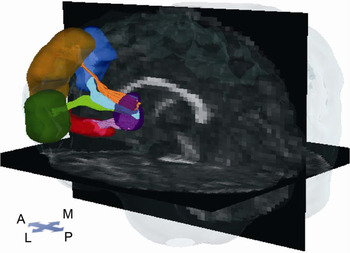
A topological correspondence of the projections from different prefrontal regions, i.e. DLPFC, VLPFC, OFC and MPFC regions, to different parts of the caudate nucleus (Afifi & Bergman, Reference Afifi and Bergman1998) has been reported in the rhesus monkey (Yeterian & Pandya, Reference Yeterian and Pandya1991). Accordingly, we divided frontostriatal fiber tracts into four tract bundles corresponding to different cortical regions in each hemisphere (Fig. 1) (Manoach, Reference Manoach2003).
Regions of interest (ROIs) and reconstructed frontostriatal tracts in the left hemisphere. The ROIs at the dorsolateral prefrontal cortex (brown), medial prefrontal cortex (blue), orbitofrontal cortex (red), ventrolateral prefrontal cortex (green) and caudate nucleus (purple) are shown. The dorsolateral prefrontal–caudate tract (orange), the medial prefrontal–caudate tract (light blue), the orbitofrontal–caudate tract (pink) and the ventrolateral prefrontal–caudate tract (light green) are shown. For better orientation, T2-weighted images in sagittal and axial views are inserted, and a transparent brain contour is overlaid. A, Anterior; P, posterior; M, medial; L, lateral.

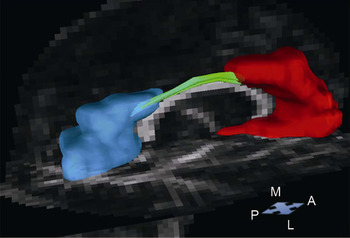
The cingulum bundle lies within the white matter of the cingulate gyrus, and the cingulum is connected to the thalamus, prefrontal area and associative cortical area. The portion of the cingulum bundle that contains the most condense parallel fibers lies dorsal to the body of the corpus callosum and consists of the fiber tracts between the ACC and PCC. Based on anatomical features and a hypothetical framework, we focused our analyses on the mid-portion (connecting the ACC and PCC) of the cingulum bundle (Fig. 2).
Regions of interest (ROIs) and reconstructed mid-cingulum tract in the right hemisphere. The ROIs at the anterior cingulate cortex (red) and the posterior cingulate cortex (blue), and the mid-cingulum tract (green) are shown. A, Anterior; P, posterior; M, medial; L, lateral.

We used MARINA software (Bender Institute of Neuroimaging, University of Giessen, Germany) to define seven regions on the Montreal Neurobiology Institute (MNI) template, namely the caudate nucleus, DLPFC, VLPFC, OFC, MPFC, ACC and PCC regions. After the regions were identified, we performed linear and non-linear transformations from the image coordinates of individual participants' brains to the MNI coordinates. The coordinates of the cortical regions defined in the MNI template were then mapped onto individual participants' brains through the inverse transformation using the calculated deformation matrix. This entailed two steps. First, co-registration between unattenuated DSI images (b0) to T2-weighted images was estimated by a 3D affine transformational matrix. Second, spatial normalization between T2-weighted images and the T2-weighted template (ICBM-152) in MNI space was performed by non-linear transformation. All of the transformations from individual brains to the MNI template were performed using the built-in functions of SPM8 (Wellcome Trust Centre for Neuroimaging, University College London, UK).
In this study, a streamline-based fiber-tracking algorithm was performed on the resolved fiber vector fields provided by DSI. The voxels with GFA values higher than a given threshold of 0.1 were selected as the white matter regions and used as seed voxels for tractography over the whole brain. For each seed voxel, the proceeding orientation for the next step was determined by the angular deviation between the primary orientation within the seed voxel and all the fiber orientations of its neighboring voxels; the most coincident orientation with the minimum angular deviation was chosen. By moving the seed point with a proceeding length of 0.5 voxels for each step along the most coincident orientation, the new starting point was then obtained. The tracking would stop if all of the angle deviations were higher than a given angular threshold, in our case 60°. In each hemisphere, four bundles of frontostriatal fiber tracts, namely the caudate–DLPFC, caudate–VLPFC, caudate–MPFC and caudate–OFC, were determined (Fig. 1). Only fibers projecting from the four prefrontal regions to the caudate head were reconstructed (Shang et al. Reference Shang, Wu, Gau and Tseng2012; Wu et al. Reference Wu, Gau, Lo and Tseng2012). The mid-portion of the cingulum bundle was determined by selecting the fiber tracts extending from the ACC to the PCC. Anatomical parcellation of the ACC is consistent with the functional segregation model proposed by Bush et al. (Reference Bush, Luu and Posner2000). The resulting 40–50-mm section of the cingulum bundle covered the fibers interconnecting the ACC and PCC (Fig. 2). GFA values corresponding to different fiber bundles were sampled according to the position coordinates of the tracts, and the mean GFA value for each fiber bundle was calculated. The tractography was reconstructed and visualized by using in-house software (DSI Studio; http://dsi-studio.labsolver.org). The tract-specific analysis of GFA was performed using an in-house program developed in Matlab (The Mathworks, USA) (Chiang et al. Reference Chiang, Wang, Huang, Yeh and Tseng2007).
Statistical analysis
We used SAS version 9.1 (SAS Institute Inc., USA) to carry out data analysis. To conduct a matched case–control analysis for continuous variables, we used a linear multilevel model to compare the mean GFA of the four pairs of frontostriatal tracts and the cingulum between the ADHD and TD groups. Mixed linear model analyses were used to address repeated measures of three ex-Gaussian parameters across different ISI levels within the same participant and to test the interaction between ISIs and group (ADHD v. TD). The α value was preselected at the level of p < 0.05. The effect sizes were further computed using Cohen's d, with small, medium and large effect sizes as Cohen's d 0.3–0.5, 0.5–0.8 and ⩾0.8, respectively.
To control for inflation of type I error in calculating multiple univariate correlations, multiple linear regression models were conducted to find the relationship between the three ex-Gaussian parameters of RT and the GFA measures of the four pairs of bilateral frontostriatal tracts and cingulum. The GFA values of the 10 tracts were entered as independent variables, and μ, σ and τ as the dependent variables. We used a backward elimination procedure to identify the fitted model containing the variables from these 10 tracts that maintained significant effects on each of the ex-Gaussian parameters. The R 2 value provided a quantitative measure of how well the fitted model with these tracts predicted μ, σ and τ.
Results
Youths with ADHD had significantly lower GFA values than TD youths in the four pairs of frontostriatal tracts (all p values < 0.01, Cohen's d ranging from 0.77 to 1.45), while the difference was not significant in the right (p = 0.423) and left (p = 0.720) mid-cingulum bundles (online Supplementary Table S1).
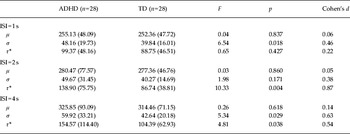
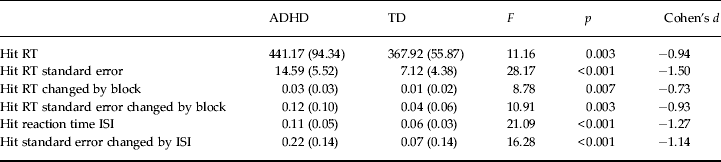
Regarding the ex-Gaussian distribution, youths with ADHD had significantly larger σ values at 1 s and 4 s ISIs and larger τ values at 2 s and 4 s ISIs than TD youths, with no significant group difference in μ value (Table 1). Table 2 presents RT and s.e. in normal distribution for the two groups. Youths with ADHD had significantly longer Hit RT and higher RT s.e. across conditions such as blocks and ISIs.
Differences in ex-Gaussian parameters across three ISIs between youths with ADHD and TD youths

Data are given as mean (standard deviation).
ISI, Inter-stimulus interval; ADHD, attention deficit hyperactivity disorder; TD, typically developing; μ, mu; σ, sigma; τ, tau.
* Significant interaction between group and ISI (p < 0.05).
Comparisons of performance of the continuous performance test between youths with ADHD and TD youths

Data are given as mean (standard deviation).
ADHD, Attention deficit hyperactivity disorder; TD, typically developing; RT, reaction time; ISI, inter-stimulus interval.
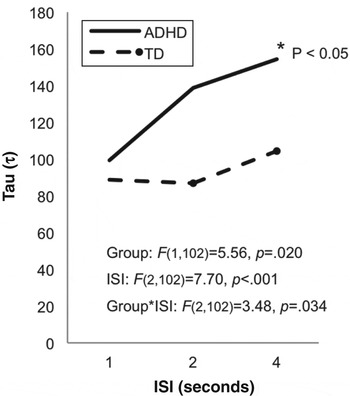
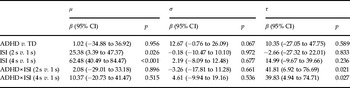
There was a significant main effect from group comparison for τ (F 1,102 = 5.56, p = 0.02), and from the three different ISI conditions, showing longer ISIs produced larger values of τ (F 2,102 = 7.70, p < 0.001). A statistically significant interaction between group and ISI was found only for τ (F 2,102 = 3.48, p = 0.034). ADHD youths had disproportionally larger values of τ than their TD counterparts at 2 s and 4 s ISIs using 1 s ISI as a reference (Table 3 and Fig. 3).
Tau (τ) plotted across 1 s, 2 s and 4 s inter-stimulus intervals (ISIs) for the attention deficit hyperactivity disorder (ADHD) and typically developing (TD) groups.

Moderating effects of ISIs on ex-Gaussian parameters

ISI, Inter-stimulus interval; μ, mu; σ, sigma; τ, tau; β, estimate of regression coefficient; CI, confidence interval; ADHD, attention deficit hyperactivity disorder; TD, typically developing youths.
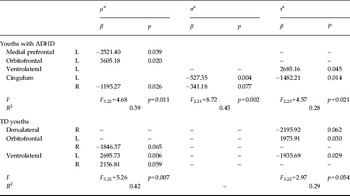
Table 4 presents apparently different patterns of associations of the integrity of five pairs of tracts with RT ex-Gaussian parameters between the ADHD and TD groups. In the ADHD group, the GFA values of the left medial prefrontal, left orbitofrontal and right cingulum were significantly associated with μ and explained 39% of the variance of μ; left cingulum GFA was significantly associated with σ; and left ventrolateral and cinglum GFA values were significantly associated with τ (Table 4). In the TD group, left ventrolateral GFA was significantly associated with μ; and left orbitofrontal and ventrolateral GFA values were significantly associated with τ (Table 4). The σ was not explained by any of the fiber pathway GFA and cingulum integrity was not associated with any of the ex-Gaussian parameters in TD youths.
Prediction from frontostriatal tracts and the cingulum to three Gaussian parameters of reaction time (backward selection)

μ, Mu; σ, sigma; τ, tau; β, estimate of regression coefficient; ADHD, attention deficit hyperactivity disorder; L, left; R, right; TD, typically developing; ISI, inter-stimulus interval.
a Sum of ISI 1 s, ISI 2 s and ISI 4 s.
Discussion
To the best of our knowledge, our study based on DSI tractography analysis in a strictly matched case–control sample provided the first data on the associations between white matter microstructural integrity of the frontostriatal tracts and mid-cingulum bundles and IIV as indexed by ex-Gaussian parameters of RT in both ADHD and TD youths. We found that youths with ADHD had disturbed white matter integrity in all frontostriatal tracts but not in the mid-cingulum bundles; ADHD youths demonstrated significant IIV, which particularly correlated with cingulum bundle integrity in ADHD youths only. Our findings support that the integrity of the cingulum bundle might account for IIV in ADHD.
Reduced white matter integrity of all four pairs of frontostriatal tracts in ADHD is consistent with previous DTI (Liston et al. Reference Liston, Cohen, Teslovich, Levenson and Casey2011; van Ewijk et al. Reference van Ewijk, Heslenfeld, Zwiers, Buitelaar and Oosterlaan2012) and DSI (Wu et al. Reference Wu, Gau, Lo and Tseng2012; Shang et al. Reference Shang, Wu, Gau and Tseng2012) studies, strongly suggesting that frontostriatal integrity disturbance is one of the core structural correlates of ADHD pathophysiology.
No significant group difference in mid-cingulum bundle integrity was contradictory to our hypothesis based upon the work of Castellanos et al. (Reference Castellanos, Margulies, Kelly, Uddin, Ghaffari, Kirsch, Shaw, Shehzad, Di Martino, Biswal, Sonuga-Barke, Rotrosen, Adler and Milham2008) and Sun et al. (Reference Sun, Cao, Long, Sui, Cao, Zhu, Zuo, An, Song, Zang and Wang2012). Despite some ROI-based DTI studies showing abnormal cingulum bundles in children (Pavuluri et al. Reference Pavuluri, Yang, Kamineni, Passarotti, Srinivasan, Harral, Sweeney and Zhou2009) and adults (Makris et al. Reference Makris, Buka, Biederman, Papadimitriou, Hodge, Valera, Brown, Bush, Monuteaux, Caviness, Kennedy and Seidman2008) with ADHD, other similar studies failed to replicate such findings (Hamilton et al. Reference Hamilton, Levitt, O'Neill, Alger, Luders, Phillips, Caplan, Toga, McCracken and Narr2008; Konrad et al. Reference Konrad, Dielentheis, Masri, Dellani, Stoeter, Vucurevic and Winterer2012). These discordant findings may be explained by heterogeneity of participants and sample sizes, different analytic strategies, and anatomically dependent variation in FA values. The cingulum bundle not only associates with the whole cingulate gyrus, but also interconnects prefrontal and temporal areas, thalamus, and striatum in anterior portions, and extends connection to parietal and temporal regions in posterior portions (Burgel et al. Reference Burgel, Amunts, Hoemke, Mohlberg, Gilsbach and Zilles2006; Schmahmann et al. Reference Schmahmann, Pandya, Wang, Dai, D'Arceuil, de Crespigny and Wedeen2007), contributing variable branching fibers joining along the cingulum bundle. The curving geometry of the cingulum bundle, along with branching and crossing fibers made estimation of FA by DTI, especially in the posterior and anterior parts, unreliable (Nezamzadeh et al. Reference Nezamzadeh, Wedeen, Wang, Zhang, Zhan, Young, Meyerhoff, Weiner and Schuff2010). In our work, using tractography as a guide to define the fiber tracts reduces variability from inaccurate ROI areas, and avoids confounding from adjacent associative fibers. Concurrently, using DSI, which resolves complex problems in crossing axonal fibers by applying hundreds of diffusion-encoding gradients at 3D grid points in a diffusion-encoding space (Wedeen et al. Reference Wedeen, Wang, Schmahmann, Benner, Tseng, Dai, Pandya, Hagmann, D'Arceuil and de Crespigny2008), helps reliably identify the quantification of the middle-cingulum bundles. Our findings suggest that parcellations of the cingulum bundle and examination of their separate functional relevance are indispensible in future structural connectivity studies in ADHD.
In the present study, we found that only τ was disproportionately heightened in the ADHD group as the ISIs increased. In line with previous work that manipulated event rates, individuals with ADHD had more inattentive and variable response at a slower event rate (Sergeant & van der Meere, Reference Sergeant and van der Meere1990; Hervey et al. Reference Hervey, Epstein, Curry, Tonev, Arnold, Conners, Hinshaw, Swanson and Hechtman2006). Although the importance of characterizing the ex-Gaussian distribution of RT in ADHD has been attested (Leth-Steensen et al. Reference Leth-Steensen, Elbaz and Douglas2000; Hervey et al. Reference Hervey, Epstein, Curry, Tonev, Arnold, Conners, Hinshaw, Swanson and Hechtman2006; Geurts et al. Reference Geurts, Grasman, Verte, Oosterlaan, Roeyers, van Kammen and Sergeant2008; Buzy et al. Reference Buzy, Medoff and Schweitzer2009; Vaurio et al. Reference Vaurio, Simmonds and Mostofsky2009), to our best knowledge, this is the first study that explores its association with microstructural integrity of white matter in both ADHD and TD youths.
As hypothesized, our results demonstrated a direct association between τ and the integrity of the left cingulum and frontostriatal tract (left ventrolateral PFC–caudate) in ADHD, with an association of τ solely with the frontostriatal organization (left ventrolateral and left orbitofrontal tracts) in TD youths. The τ and σ effect in ADHD may represent lapses in attention (Leth-Steensen et al. Reference Leth-Steensen, Elbaz and Douglas2000), which is considered to be partially mediated by aberrant DMN deactivation (Weissman et al. Reference Weissman, Roberts, Visscher and Woldorff2006; Fassbender et al. Reference Fassbender, Zhang, Buzy, Cortes, Mizuiri, Beckett and Schweitzer2009) and reduced ACC activity (Rubia et al. Reference Rubia, Smith, Brammer and Taylor2007). Our work demonstrated integrity of the mid-cingulum bundle, which interconnects the ACC and PCC and may relate to functional anticorrelation between the task-positive network and the DMN (van den Heuvel et al. Reference van den Heuvel, Mandl, Luigjes and Hulshoff Pol2008; Greicius et al. Reference Greicius, Supekar, Menon and Dougherty2009), which was associated with τ as well as σ in ADHD. The distinct relationship might indicate a role of DMN-interference theory (Sonuga-Barke & Castellanos, Reference Sonuga-Barke and Castellanos2007; Castellanos et al. Reference Castellanos, Kelly and Milham2009) to explain IIV in ADHD.
In the context of attentional process, the left VLPFC was indicated to filter task-irrelevant stimuli (Chong et al. Reference Chong, Williams, Cunnington and Mattingley2008) and the OFC was considered to play a necessary role in controlling interference from emotional information (Hartikainen & Knight, Reference Hartikainen, Knight and Polich2003). Our findings of association between integrity of the left VLPFC and OFC tracts and IIV suggest the importance of top-down modulation in sustained attention performance (Bellgrove et al. Reference Bellgrove, Hester and Garavan2004; MacDonald et al. Reference MacDonald, Nyberg and Backman2006; Bunce et al. Reference Bunce, Anstey, Christensen, Dear, Wen and Sachdev2007; Ullen et al. Reference Ullen, Forsman, Blom, Karabanov and Madison2008).
No group difference in μ might be explained by inadequate statistical power to detect the difference (Bezeau & Graves, Reference Bezeau and Graves2001). The distinct association patterns between μ and white matter integrity for the two groups lend credence to the hypothesis that ADHD may engage adaptive mechanisms and require more effortful processing to compensate for impairments in other brain regions (Fassbender & Schweitzer, Reference Fassbender and Schweitzer2006). Our finding of association between left ventrolateral tract and μ in TD youths is in line with research implicating the VLPFC in cognitive control.
Limitations
The present study must be interpreted in the context of some limitations. First, the cross-sectional design cannot determine whether the role of white matter microstructural integrity in IIV reflects the pathophysiological processing or compensatory mechanisms of ADHD. Second, we did not distinguish ADHD subtypes in our analysis due to a small sample size. However, minimal differences in IIV across ADHD subtypes (Geurts et al. Reference Geurts, Verte, Oosterlaan, Roeyers and Sergeant2005; Pasini et al. Reference Pasini, Paloscia, Alessandrelli, Porfirio and Curatolo2007; Epstein et al. Reference Epstein, Langberg, Rosen, Graham, Narad, Antonini, Brinkman, Froehlich, Simon and Altaye2011b ) and lack of developmentally diagnostic stability of ADHD subtypes (Lahey et al. Reference Lahey, Pelham, Loney, Lee and Willcutt2005; Willcutt et al. Reference Willcutt, Nigg, Pennington, Solanto, Rohde, Tannock, Loo, Carlson, McBurnett and Lahey2012) have been reported. Third, recruiting pairwise matching of youths with ADHD and TD in full-scale IQ might reduce the effect of intelligence on the phenotype and the neural underpinnings (de Zeeuw et al. Reference de Zeeuw, Schnack, van Belle, Weusten, van Dijk, Langen, Brouwer, van Engeland and Durston2012b ). However, the selectivity of the participants conforming to the IQ criteria might bias representativeness and limit generalizability owing to clinically relevant relationship between IQ and ADHD (Frazier et al. Reference Frazier, Demaree and Youngstrom2004; van der Oord et al. Reference van der Oord, Prins, Oosterlaan and Emmelkamp2008). Fourth, the present study only focused on associations of frontostriatal tracts and the mid-cingulum bundle with IIV in ADHD, based on a clear hypothesis in terms of an executive control model (Halperin & Schulz, Reference Halperin and Schulz2006) and DMN-interference theory (Sonuga-Barke & Castellanos, Reference Sonuga-Barke and Castellanos2007). Exploration of premotor connectivity (Suskauer et al. Reference Suskauer, Simmonds, Caffo, Denckla, Pekar and Mostofsky2008), temporo-parietal networks (Rubia et al. Reference Rubia, Smith, Brammer and Taylor2007; Konrad et al. Reference Konrad, Dielentheis, Masri, Dellani, Stoeter, Vucurevic and Winterer2012) and other model-based neural substrates is warranted. Fifth, we anatomically defined the mid-cingulum boundary grounded on the functional segregation model proposed by Bush et al. (Reference Bush, Luu and Posner2000). Work examining whether different approaches in parcellation of the cingulate cortex (Beckmann et al. Reference Beckmann, Johansen-Berg and Rushworth2009; Vogt, Reference Vogt2009) would distinctly link to separate pathophysiological processes in ADHD is merited. Lastly, some of participants with ADHD had received methylphenidate before, which had been washed out for at least 1 week. With methylphenidate, RT variability attenuates (Castellanos et al. Reference Castellanos, Sonuga-Barke, Scheres, Di Martino, Hyde and Walters2005; Spencer et al. Reference Spencer, Hawk, Richards, Shiels, Pelham and Waxmonsky2009; Epstein et al. Reference Epstein, Brinkman, Froehlich, Langberg, Narad, Antonini, Shiels, Simon and Altaye2011a ) and decrease of white matter volume lessens (Castellanos et al. Reference Castellanos, Lee, Sharp, Jeffries, Greenstein, Clasen, Blumenthal, James, Ebens, Walter, Zijdenbos, Evans, Giedd and Rapoport2002). The relationships between stimulants, IIV and underlying microstructural integrity in ADHD need further elucidation.
Conclusions
The present study is the first to demonstrate associations of the integrity of the mid-cingulum bundles and frontostriatal tracts with ex-Gaussian parameters in ADHD youths. With a carefully matched case–control design, DSI tractography analysis, and an ex-Gaussian RT distribution, our finding of disturbed frontostriatal microstructural integrity suggests that the frontostriatal system is one of the core neurobiological underpinnings of ADHD and that no abnormality in mid-cingulum bundle integrity in ADHD reflects functional heterogeneity in the cingulate cortex and underlying white matter. Our new contribution is that mid-cingulum bundle integrity may play an important role in RT variability in ADHD youths, while frontostriatal integrity may mediate RT variability in TD youths. Involvement of different brain systems in mediating IIV may relate to a distinctive pathophysiological processing, such as DMN-interference, may represent an adaptive compensatory mechanism, or reflect complex interaction between the above two conjectures. Further studies, involving a large sample size, a longitudinal design, more extensive but hypothetically driven white matter tractography, and integration of multimodal imaging works, are warranted.
Supplementary material
For supplementary material accompanying this paper visit http://dx.doi.org/10.1017/S0033291713001955.
Acknowledgements
The present study was supported by grants from the National Health Research Institute (no. NHRI-EX98-9407PC and NHRI-EX100-0008PI to S.S.-F.G.) and grants from the National Science Council (no. NSC96-2628-B-002-069-MY3 and NSC99-2321-B-002-037 to S.S.-F.G.), Taiwan. We would like to express our thanks to the participants and their parents for their generous contribution.
Declaration of Interest
None.