When Deborah Warner's staging of Johann Sebastian Bach's John Passion premiered at the English National Opera in London in April 2000, everything seemed to be going well. A sequence of poignant visual gestures – dozens of muted lights descending from above during the opening chorus; mourners slowly laying down flowers for Christ's burial – combined with compelling performances from most of the soloists to create a ‘quietly devastating’ spectacle.Footnote 1 But then the final scene arrived: an ‘artistic miscalculation’ that ‘sabotaged the atmosphere’.Footnote 2 While the ensemble performed the penultimate chorus (‘Ruht wohl’), the Evangelist (Mark Padmore) received into his hands a real, living lamb. Perhaps inevitably, the animal then bleated its way through the closing musical moments, eliciting ‘peals of laughter’ from the audience.Footnote 3 Reviewers variously described the procedure as ‘a ridiculous concluding note’ or ‘an apotheosis of kitsch’.Footnote 4 A central image in Christian theology, the lamb appears in both the Old and the New Testament as a sacrificial animal, and it is in the Gospel of John (1:29) that Jesus is named the ‘Lamb of God’. It seemed appropriate, therefore, that the programme book for the ENO production should feature a famous ‘Agnus Dei’ painting, by the seventeenth-century artist Francisco de Zurbarán. But for the final moment of the performance, Warner went further and realized the metaphor in the flesh, making a familiar emblem of Christ's martyrdom tangible and audible in a way that appears to have left her spectators decidedly ill at ease.
Why the embarrassment? Like the real elephants in past productions of Verdi's Aida (or two lions and a cheetah, in a recent version by Opera Africa in Johannesburg), livestock on the operatic stage is certainly not unprecedented, even if it always harbours the titillating threat of disrupting a performance. But, of course, there is a crucial difference: Bach's Passions are not operas. Although many of their formal and expressive devices were borrowed directly from opera, their function and dramaturgy still place them in a separate realm. In those terms, it is not just the lamb that is objectionable, but also potentially the whole enterprise of staging these works in the first place. The American writer Richard Freed offers a fairly typical assessment when dismissing past attempts to choreograph the Matthew Passion as ‘gratuitous embellishments of a masterwork conceived as a musical offering and wholly empowered by its sounds’.Footnote 5 According to The Times critic Richard Morrison, a poor staging of this piece amounts to nothing less than an act of ‘sacrilege’; though not against the Christian deity, but against ‘one of the towering works of Western sacred art’.Footnote 6 Clearly such sentiments rest on the twentieth-century mythologies of Werktreue and Urtext, which elevate the supposed integrity of the work as preserved in the score – or a ‘faithful’ reading of that score in a concert presentation – above its realizations in more unorthodox performance situations. Yet given that these pieces are being staged (by now, one might claim, almost routinely) and that audiences are coming to see them, the most productive question to ask might be not what such experiments do to the artwork, but instead what they do to (or for) their recipients – in Tom Sutcliffe's terms, whether they ‘make the truth tell’.Footnote 7
Encountering Bach's Passions on stage thus urges us to grapple more comprehensively with these pieces as actualized in real-time performances. Any such actualization (in church, on the concert platform, on a theatrical stage) will be located somewhere along a fluid work-event spectrum, bounded at one end by a hardcover Bärenreiter volume, and at the other by the less solid notion of a fully immersive aesthetic experience. Carolyn Abbate's much-noted discussion of ‘drastic’ versus ‘gnostic’ modes of musical appreciation – setting the elusive quality of presence against the hermeneutic impulse towards decoding a work's meanings – is instructive in this context; although, instead of her binary opposition, her two modes are perhaps also best treated as a spectrum of possibilities, and one which intersects rather than neatly maps onto an imagined work–event axis.Footnote 8 Taken together, these terms can thereby delineate a conceptual field for critical inquiry into the place of Bach and his Passions in the Western cultural landscape today. Beyond simply cataloguing the ways in which any staged performance departs from the musical text, then,Footnote 9 I intend to explore here the significance of re-animating these musical relics in contemporary settings that transgress the conventional spaces, visuals, and sounds customarily associated with Bach's music.
Such an approach does not imply dispensing with the historical dimension of the pieces at hand, however. Bach's Passions were created at a particular time and place; and while they have managed in certain ways to ‘transcend the specific dogma of their origins’, and may appear comfortably integrated in contemporary cultural life, they cannot be fully untethered from those origins.Footnote 10 Notwithstanding the enduring myth of Bach's universality traversing temporal and geographical barriers, their historicity sticks to them in their musical gestures, in the image of the wigged cantor herding unruly choirboys, and particularly in their textual content. In his recent exploration of Bach's relationship with modernity, John Butt has suggested that his Passions ‘contributed to a specifically modern appropriation of religion’, which still regards the tale of Jesus's martyrdom as central to the formation of Western civilization.Footnote 11 But how can a contemporary audience, regardless of their religious convictions, relate to this narrative as filtered through the prism of early eighteenth-century Lutheran faith? What kind of access can they gain to the alien metaphors in the Passion librettos, the ancient biblical ones as well as the extravagant Baroque ones? Both the particular beliefs and the sheer violence contained in these texts potentially become much more conspicuous in a staging, raising the question of how far the ‘make believe’ of a staged production can go – given a story that not only centres on a cruel murder, but also one that is to be believed in as the source of humanity's salvation. What happens, in other words, when Bach's music meets the ‘real’ world on stage, for instance in the form of a lamb, which clearly did not appreciate that it was in the presence of a masterwork? Unwittingly, the beast performed a kind of Brechtian break with its symbolic role in the spectacle; whereas, had it refrained from bleating, its corporeal presence alone might have been inoffensive, since the aural domain would have remained untainted.
Stagings of Bach's Passions thus have the capacity not only to distract from the works as we know them in productive ways, but also to highlight their peculiar place in contemporary Western culture, with its characteristic anxieties about the role of the sacred, the powers of the visual, and the effects of an ever-advancing mediatization. Rather than presenting a straightforward chronological survey, this article will explore a selection of past productions in light of such larger issues: starting with the problem of the works' dated poetic language, I will then address the challenge of stage realism and personification in Bach's Passions, and consider different strategies of inducing a sense of spiritual, political, or aesthetic presence through dramatization. The final section aims to draw together these themes by focusing on several recent danced choreographies that have gone furthest in re-envisaging Bach's ‘concert hall’ works as immersive events through their emphasis on intense physical engagement. Throughout my discussion, detailed analysis of the critical reactions to each production seeks to expose the conflicting experiences inspired by these occasions, of distance and alienation on the one hand, and familiarity, closeness, and catharsis on the other. Such stagings, in short, present an ideal site for investigating some of the deep-seated contradictions that define the reception of Bach in the twenty-first century. Faced with these contradictions, it would be simple enough either to retreat back to the supposed purity of the notes on the page, or else to subject this modern figure of Bach to wholesale deconstruction. But, as Antoine Hennion has argued, ‘one cannot just critique sociologically the cult of Bach: there was, and continues to be, a simultaneous production of a taste for Bach, of an oeuvre corresponding to this taste and, more generally, of a new mechanism for musical appreciation’.Footnote 12 As a significant constituent of this present-day cult of Bach, these staged performances can serve as a starting point for developing a positive critical practice, of the sort outlined by Bruno Latour, that moves us closer to understanding Bach as a powerful and long-standing ‘matter of concern’.Footnote 13
The Rainbow Challenge
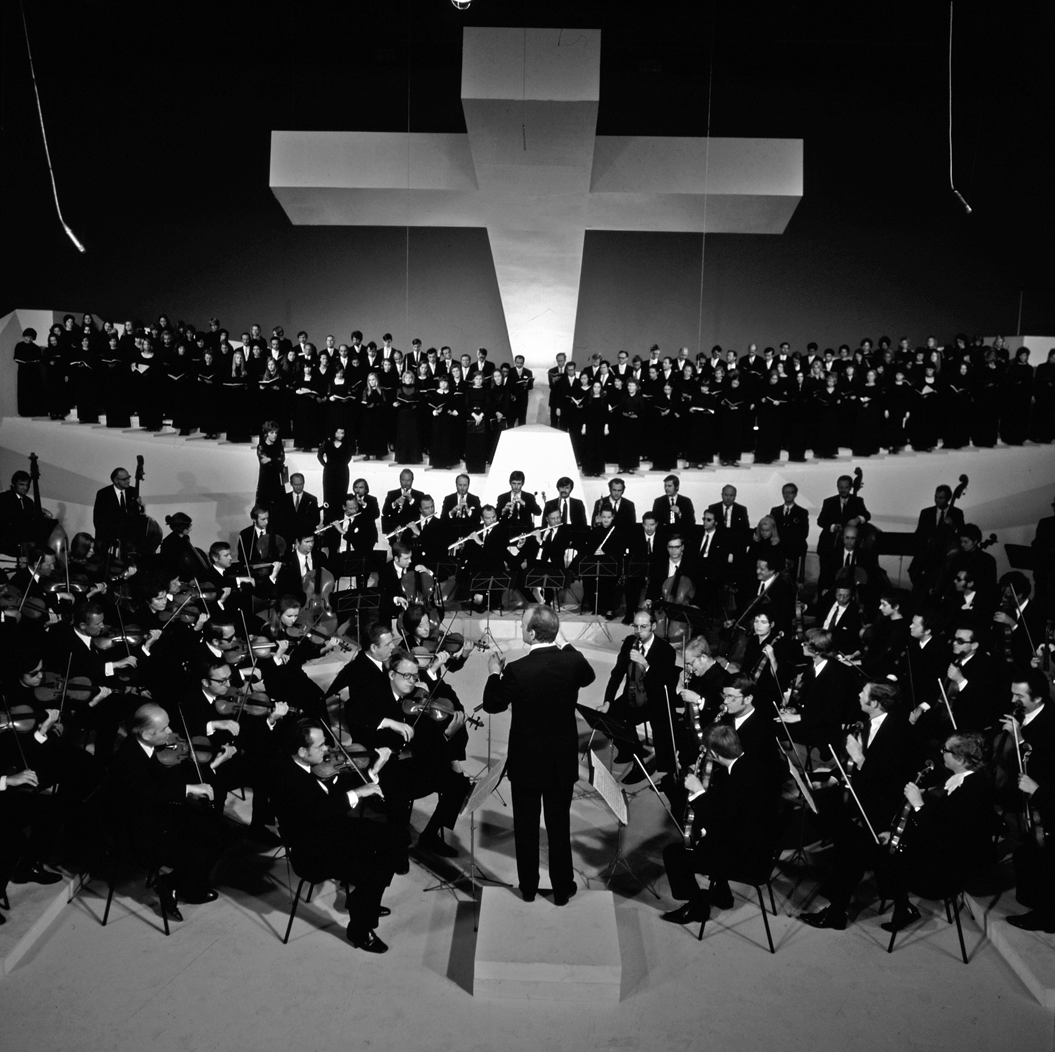
Perhaps Bach never quite had his ‘kairos’, that ideal moment when his music, its meanings, and its listeners would have been in complete accord. For Carl Dahlhaus, the Matthew Passion reached that ‘point of perfection’ in the legendary 1829 revival by Felix Mendelssohn in Berlin, when it was finally recognized for the artistic qualities that Bach's contemporaries had been unable to appreciate.Footnote 14 But its nineteenth-century transplantation from sacred to secular venue was widely met with the kind of qualms that still affect the work's reception today, eliciting, for instance, the noted dictum from Adolf Bernhard Marx that the Singakademie performance constituted not a ‘festival of art’ but a ‘most solemn religious celebration’.Footnote 15 Nonetheless, the piece had clearly outstripped the liturgical function it was meant to serve already in the 1720s, and the claims it made for itself as music could gain full traction once the threshold to the so-called ‘aesthetic era’ had been crossed.Footnote 16 Crucially, however, this transformation into a piece of absolute music – with the added frisson of sacrality that became essential to the celebration of great art (a category which the Matthew Passion itself helped to define) – meant eliminating those aspects of representational content that could spoil the illusion of direct communion with the music. The rituals and choreography of the concert hall in themselves arguably constitute a form of ‘staging’ as incongruous as today's theatrical versions; but they certainly aided that sense of decontamination, with neat rows of musicians and reverently silent listeners replacing the lively social stage of the church (or the opera house) in Bach's time.Footnote 17 These tendencies are further heightened in later renditions such as Karl Richter's filmed version of the Matthew Passion from 1971, presenting black blocks of performers in symmetrical patterns, with a pristine white cross hovering above (Figure 1).
J. S. Bach, Matthäus-Passion, cond. Karl Richter (1971). © Unitel.

And yet the poetic language was still there, in all its colourful excess of hearts and tears, even if musicologists have tended to treat the words primarily as ‘Klangträger’, as phonetic material to carry the musical sounds.Footnote 18 If Bach can be seen to straddle the divide between a pre-modern and modern mindset, as Butt has claimed, then surely the poetry he set in his Passions largely falls in the category of the pre-modern, which summarily failed to speak to the generation of Mendelssohn and his collaborator Carl Friedrich Zelter.Footnote 19 The latter famously complained to Johann Wolfgang Goethe about the ‘despicable German sacred texts’ that made Bach's church compositions unpalatable for listeners in the 1800s.Footnote 20 Not surprisingly, all but two of the arias were cut for the 1829 performance – although the representational made its way back into the piece in other ways, for instance in the re-orchestration of the earthquake following Jesus's death.Footnote 21 Still today, the writings of Christian Friedrich Henrici (alias Picander), librettist of the Matthew Passion, are held in remarkably low regard: as Emil Platen has shown, Picander's poetic conception is rich in subtle connections and interpretative nuances, yet the scholarly response has tended to remain dismissive or to emphasize Bach's contribution over that of his colleague.Footnote 22
For Bach's contemporaries in early eighteenth-century Leipzig, this ‘despicable’ poetry would presumably have formed a key element in their experience of listening and worship, and its metaphors potentially struck them as both convincing and real. The aria ‘Erwäge, wie sein blutgefärbter Rücken’ from the John Passion, sung after Jesus's flagellation, offers an eloquent example:
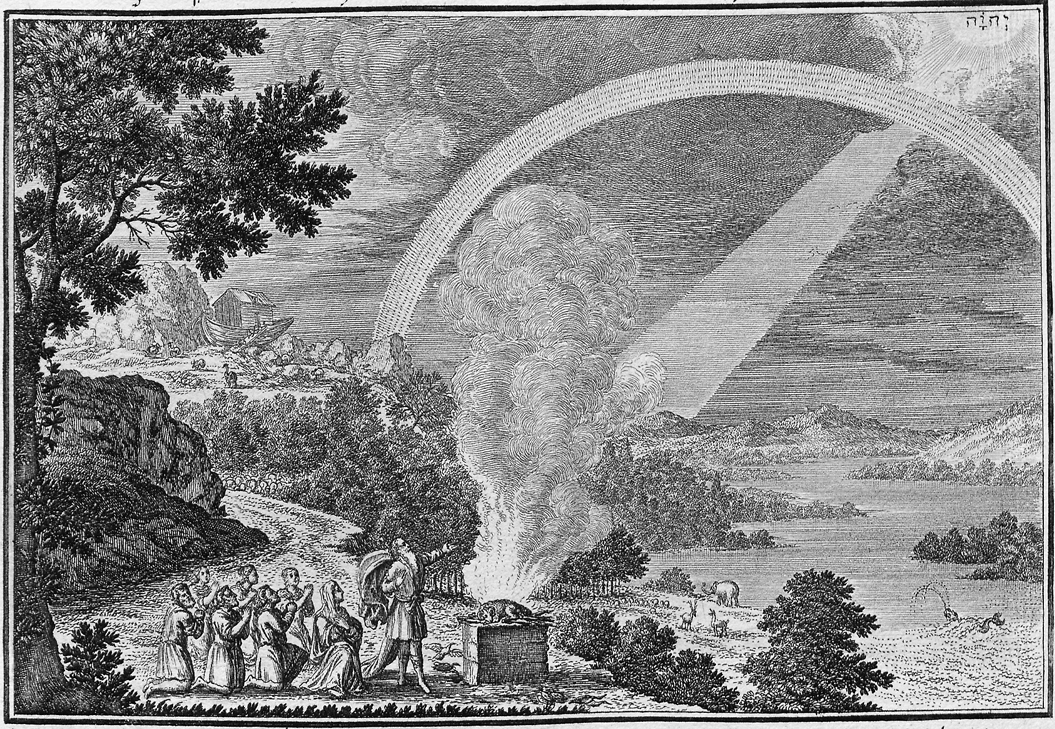
The anonymous librettist here provides a striking image that Butt has called ‘initially absurd’.Footnote 24 Yet the idea of the rainbow would have been a familiar and evocative symbol for eighteenth-century Protestant bible readers and churchgoers. In the first Book of Moses, a rainbow appears to Noah after the Flood as a sign of the new covenant between God and man, a scene that is illustrated with a woodcut in Martin Luther's Bible of 1534, as well as many later editions. In a version from 1705, Noah is shown burning a sacrificial animal as the waters recede, framed by the symbolic arch (Figure 2). Elsewhere, the rainbow was connected with ideas of death and the Final Judgement, when Jesus would appear sitting on a ‘golden rainbow’.Footnote 25 When the tenor in the John Passion sings of Jesus's wounds as resembling a rainbow, then, the words potentially carried a host of powerful associations – of Jesus's own impending demise, of mankind's sins that caused his martyrdom, of the forgiveness achieved through it, and of the approaching Second Coming – that would have seemed eminently sensible to a Bachian congregation. In dwelling on the vision of the violated body, the metaphor brings home the painful reality of this moment in the narrative, while at the same time heightening and beautifying that reality by enveloping it in a layer of redemptive symbolism.
Johann Ulrich Kraus, Historischer Bilder-Bibel Erster Theil (Augsburg, 1705), Plate 6. Universitätsbibliothek Augsburg, Sign. 02/XIII.1.2.173-1. Used by kind permission.
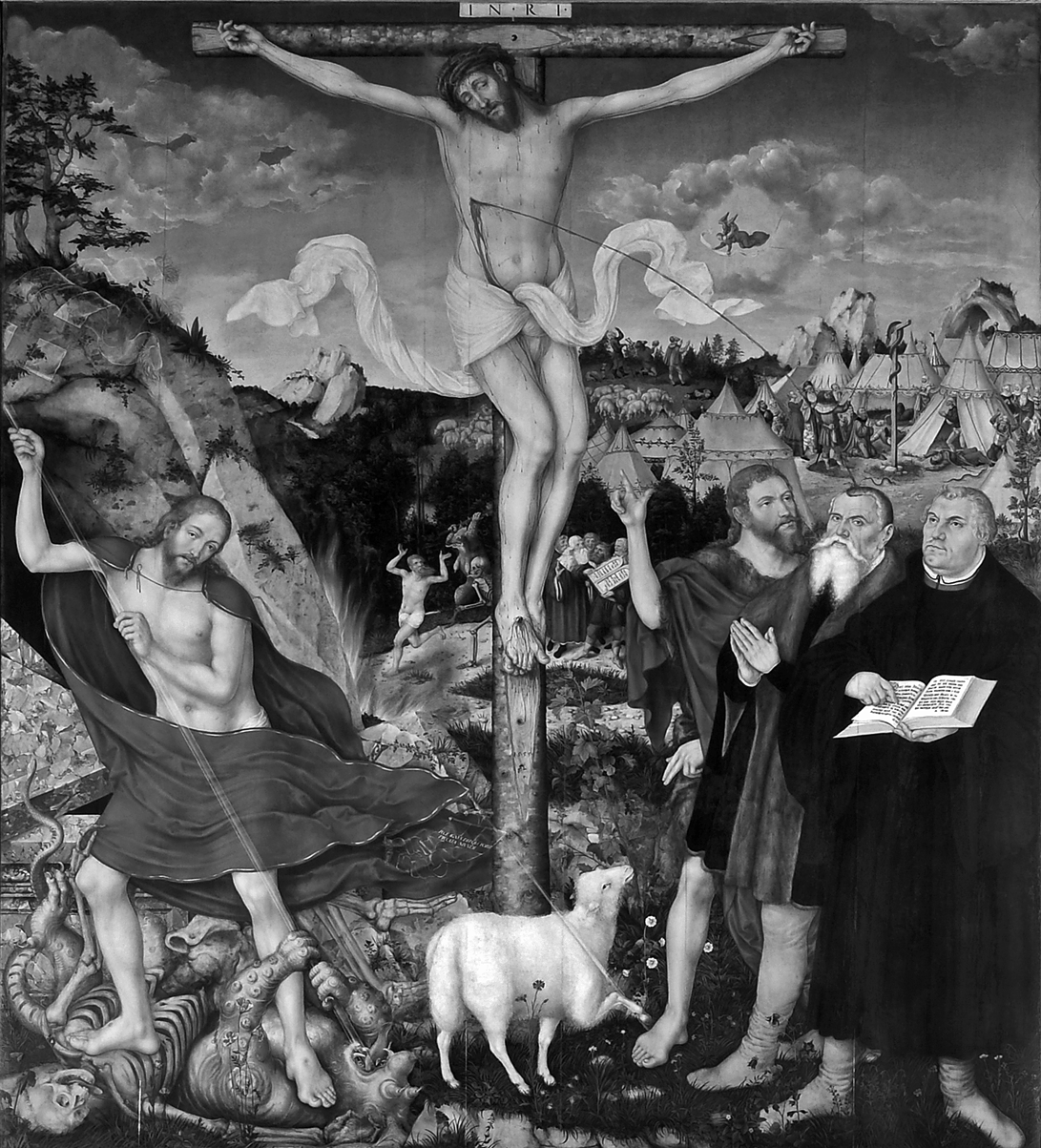
The librettist's strategy here is, of course, typical of early modern Lutheran art. The Reformations of the sixteenth century had done much to combat the Catholic fixation on the physical minutiae of Christ's suffering, shifting the focus back onto the meaning of his martyrdom for the faithful.Footnote 26 Yet the fascination with his ordeal never fully went away, just as public executions in early eighteenth-century Europe continued to inspire a ‘reliquary cult’ around the limbs and blood of the deceased.Footnote 27 In the celebrated Weimar altarpiece by Lucas Cranach the Younger (1555), Christ's body certainly appears less anguished than in some earlier depictions, such as Matthias Grünewald's famous Isenheim Altar (1512–16). The ray of blood flowing from his pierced side onto the head of a bystander (the artist himself) is clearly figurative, with the person next in line (Martin Luther) pointing to the bible verse ‘The blood of Christ cleanses us from all sin’ (1 John 1:7). But the red liquid is still there, and arguably makes for the most eye-catching line in the painting, a hyper-real curve at once implausible and strangely concrete (Figure 3).
Lucas Cranach the Younger, Weimar Altarpiece (1555). Used by kind permission of the Evangelisch-Lutherische Kirchengemeinde Weimar and Gunnar Heydenreich, Cranach Digital Archive.
The same attention to physical detail appears in certain post-Reformation musical renditions of the Passion, such as Dietrich Buxtehude's cantata cycle Membra Jesu nostri from 1680.Footnote 28 Its medieval text, addressing each body part of Christ on the Cross in turn, resurfaces in Bach's Matthew Passion in the guise of Paul Gerhardt's chorale ‘O Haupt voll Blut und Wunden’, of which Bach used five stanzas across the piece. The opening verse is sung after Jesus has been beaten and spat at by the mob:
Other contemporary Passion meditations are rather more graphic in their retelling of the torture scenes. In Barthold Heinrich Brockes's Passion oratorio from 1712, on which large portions of Bach's John Passion text are modelled (including the ‘rainbow’ aria), the damage caused by the crown of thorns is portrayed thus: ‘Hark, how with a grinding sound its leaves, like dragon teeth, tear into tendons, veins and flesh! … The tender temples are drilled through all the way to the brain. Behold, o Soul, how a burbling stream of bloody crimson flows from the divinely beautiful forehead, like a scarlet dew pouring from the starry sky.’Footnote 30
In light of such sources, it seems clear that the horrors of Jesus's suffering would have been vividly present in the imagination of Protestant believers at the time, even if the Lutheran prohibition against the theatrical prevented any real-life enactment in the vein of, say, the Oberammergau Passion play, instituted in 1634. And although Bach's librettists avoided Brockes's more radical means of dramatic actualization, his Passion settings still invited an attitude of emotional identification, of suffering with and through Christ's torment as a means of internalizing one's own culpability.Footnote 31 As a vital distinction from the more voyeuristic pleasures of opera, this ‘suffering through’ was facilitated by the particular dramaturgy and temporal structuring of these works, making them appear like an opera turned inside out, as it were, with the audience put on stage themselves to look back out at the world. The level of ‘fictive present’, in which the action is played out in direct dialogue between the protagonists, is supplemented by a level of ‘contemplative present’, comprising the arias and chorales that appear to be spoken by the congregation or individuals from it; tied together by the all-knowing, past-tense report of the Evangelist.Footnote 32 Those memorable metaphors of the ‘rainbow’ variety largely belong to that contemplative dimension, seeking to render the narrative intensely present to its eighteenth-century addressees.
And yet it is exactly this level of present-tense reflection that can generate a powerful impression of temporal remove for a twenty-first-century audience, and hence poses a considerable challenge for directors now. This dilemma perhaps informed Warner's decision to let listeners join in with three of the chorales in her John Passion production, with the house lights turned up for those numbers.Footnote 33 But if it was indeed an attempt to bridge the gulf between audience and work – even when such active participation was most likely not common practice in Bach's time – it apparently proved largely unsuccessful.Footnote 34 Although the critic and broadcaster Edward Seckerson found the experience ‘cathartic’, a greater number of reviews observed Warner's listeners hesitating to follow her invitation, as if they resisted being put on that stage on which the gruesome tale was unfolding – or even back in that church where the Matthew Passion was first experienced as part of a congregational ritual.Footnote 35 The conventions of listening at the opera house usually allow an audience to witness the travails of their protagonists from a safe distance; even if the emotional effects of story or music are experienced ‘drastically’, the actual events still traditionally take place within the proscenium frame. Warner breached those conventions at least twice: with the communal chorales, she induced the audience to ‘become’ the work and embrace its lingering demands of spiritual involvement; whereas in the scene with the lamb, she made the music collide with the uncanny living presence of the creatures on stage. In both cases, the different temporal levels of the piece became awkwardly entangled with the present tense of those in attendance. Bach's musical language may still be regarded as timeless and directly emotive by many of his devotees, and in a concert performance listeners are at liberty to glance at the curious texts as much or as little as they choose. Yet a staging inevitably challenges that attitude, not only by granting the words a novel degree of prominence through set design and surtitles, but also by exposing the complex temporalities that remain tenaciously attached to the artwork.
Staging Violence
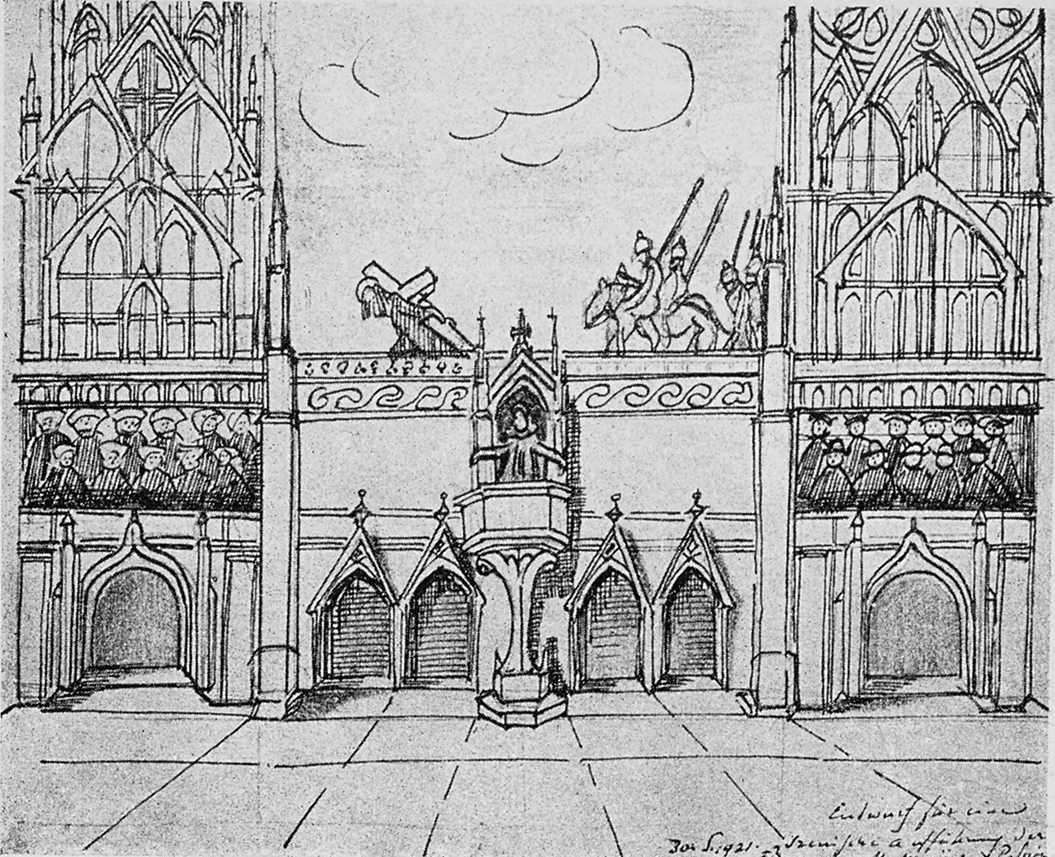
Problems of representation and credibility are in no way unique to stagings of Bach, of course, but haunt operatic productions more generally. Laughable fake dragons or Rhine maidens floating in a tank of water in productions of Wagner's Ring demonstrate that often neither the ‘real’ thing nor a stand-in will ring true. Nor do historical clues about how a work was staged originally offer much help, but they can at least provide a reference point against which to develop solutions for later audiences.Footnote 36 Since no such original scenario exists for Bach's Passions, the earliest recorded attempts at staging them, dating from the early twentieth century, turned to different theatrical traditions for inspiration. Carl Orff's production of the spurious Luke Passion (Munich, 1931) took the form of a contemporary epic play; called ‘Dreigroschenpassion’ by contemporary critics, it followed Mendelssohn's lead in eliminating virtually all the arias.Footnote 37 Ten years earlier, Ferruccio Busoni had proposed the same measure in his plans for a staged Matthew Passion, a project that never came to fruition. From a published sketch, it appears that his vision included a full-size cross being dragged across the stage, followed by soldiers on horseback. The different stage levels in his distinctly sacred set design, meanwhile, are suggestive of medieval mystery plays, while also pointing to avant-garde political theatre of the 1920s (Figure 4).Footnote 38 A dramatized version of both Bach Passions, published in 1930 by the Swiss playwright Max Liehburg, similarly recommended translating the works' multiple textual layers into corresponding spatial divisions on stage.Footnote 39
Ferruccio Busoni, ‘Zum Entwurfe einer szenischen Aufführung v. J. S. Bachs Matthäuspassion’, in Von der Einheit der Musik (Berlin: Hesse, 1922), 380. Used by kind permission of Cambridge University Library.
Whereas Busoni's outline is too skeletal to offer much insight into the proposed stage action, the adaptations by Orff and Liehburg reveal starkly contrasting approaches to the question of realism. Their choices are particularly telling with regard to the episodes of torture and bloodshed, mapping out a range of responses to the ‘crisis of representation’ in early twentieth-century theatre.Footnote 40 In Orff's production, the protagonists were instructed to aim for a ‘gestural presentation’ that avoided anything ‘theatrical’: to project the affective content through vocal and bodily expression, with few of the narrated events enacted on stage. Jesus (an ‘idealistic teacher type’) was provided with a bench, on which he sat down at the moment of his death, while the other singers stepped onto a small podium to deliver their parts.Footnote 41 Liehburg, on the other hand, aimed for a mode of ‘total theatre’, with a sit-down last supper, Christ mocked and punched by the crowd, and a sky ‘filled with red streaks’ during the scourging in the John Passion.Footnote 42 By that point, however, the actor representing Jesus was no longer meant to be on stage; likewise, for the act of crucifixion, the curtain was to close, although it opened again soon after to allow spectators to witness Jesus's dying moments on the cross, with the stage lights going off as he expired.
Even Liehburg's evident commitment to concrete action, then, did not stretch to the scenes of most jarring brutality, obeying an unspoken taboo that remained in force in most later productions of the Passions. In one sense, such resistance to staging the central act of murder is entirely un-operatic, of course: the standard opera repertoire is famed for its often explicit depictions of onstage deaths, ranging from stabbing, shooting, drowning, and beheading to immersion in boiling water. And yet all such fatalities – which incidentally often befall female, exotic, or marginal characters – present serious difficulties for opera directors, too, who need to tread a fine line between literalism and suggestion to pull off these ‘strange parod[ies] of death throes’ convincingly.Footnote 43 Moreover, the outrage caused by certain extreme solutions, such as the below-stage chainsaw massacre in David Alden's 1984 production of Tchaikovsky's Mazeppa, demonstrates that the operatic sphere operates with a comparable (if somewhat wider) margin of decorum, whose infringement still inspires critical invective and directorial notoriety.Footnote 44 As Tom Sutcliffe has suggested, Alden's transgression was perhaps easier to digest because the piece in question did not form part of the mainstream operatic canon – unlike Bach's Passions, which sit right at the heart of the Western classical legacy.Footnote 45 Any ‘fear of destruction’, in other words, of a piece being undone by a production, only arises in case of a shared attachment to a canon of works and values.Footnote 46
Partly, then, the issues surrounding the portrayal of Jesus's death stem simply from the ‘liveness’ of the action on stage. By comparison, past cinematic treatments of the Passion story have certainly not shied away from candid depictions of cruelty. Martin Scorsese's The Last Temptation of Christ (1988) shows, with raw sensuality, the slaughter of a Passover lamb, before moving on to scenes of Jesus removing his own heart, and the wine at the Last Supper turning into actual blood. An even greater fixation on the sanguine is evident in Mel Gibson's R-rated blockbuster The Passion of the Christ (2004). A prime example of the controversial cinematic mode of ‘hyperreal’ violence, it gives such a graphic portrayal of Christ's death that the American critic Roger Ebert pronounced it the most violent film he had ever seen.Footnote 47 Meanwhile, in direct inversion of the offence caused by Alden's Mazeppa, Roberto Rossellini's 1975 film Il Messia was criticized by some for its lack of explicit detail, while the smoothly beautiful Gesù di Nazareth by Franco Zeffirelli (1977) has been dismissed as ‘too operatic’ (not surprising perhaps, given the director's training ground in nineteenth-century opera).Footnote 48 Even Bach's John Passion, once transposed into the medium of film, has featured a close-up of a sweating, bloodied Jesus being whipped while tied to a wooden pole.Footnote 49 The fourth wall of the cinema screen, then, ensures a particular kind of space between narrative and viewer, allowing intense proximity from a safe distance, which significantly alters the aesthetic perception of violence and its association with Bach's Passions. This widely influential mode of filmic realism has, in turn, left unmistakable traces in recent live stagings, which to a greater or lesser extent have had to engage with this paradigm of virtuality.
But clearly more is at stake in a staged performance of Bach than the added third dimension, since such an event still falls in a different category from a cinema screening. For a start, although they may convey religious content to varying degrees, most filmed versions of the Passion dramatize the life of Jesus as a historical figure; consequently they often aim, like Scorsese or Gibson, to transport the viewer back to the event ‘as it happened then’. The primary intent of Bach's Passions, on the other hand, was to incite Lutheran believers to devotion, by means of moving Jesus's martyrdom forward to their own present. And if recent Passion films have tended towards aestheticizing the story's violent potential, in Bach's Passions it was instead the music that, from the nineteenth century onwards, became the object of ardent aestheticization, coupled with an enduring reverence for their sacred subject matter even as the liturgical framework dropped away. This process culminated in the early twentieth-century practice, still sometimes maintained today, to refrain from applauding at the end of the Matthew Passion, granting it an exceptional status in classical concert culture. At a performance in a Hamburg church in April 2012, for instance, ‘sustained devout silence’ concluded what one reviewer tellingly described as an extraordinary ‘Klangerlebnis’ (sound experience) – though he also found it a fitting preamble to the Easter holiday.Footnote 50 In many places, performances of Bach's Passions are still customarily scheduled for Holy Week, revealing their lasting function as Ersatz religious markers. Against this background, any too explicit visualization could situate the works unnervingly close to more consumerist forms of entertainment, where the fascination with visual spectacle might render the spiritual dimension secondary. If Liehburg had intended to give Bach's Passions a dramatic shape which they originally could not take in the anti-theatrical climate of eighteenth-century Leipzig, then the remnants of this early modern Protestant suspicion of the visual still inflect their reception today – merged with a characteristically twentieth-century unease about the power of images to reveal a world that is more real than the visible world.Footnote 51
In this context, it is perhaps significant that many of the earliest attempts at staging the Passions – whether by Busoni, Orff, Liehburg, or the British playwright Edward Gordon CraigFootnote 52 – came from outside the German Protestant tradition. One notorious later production which did show a real Jesus on a cross was mounted in 1984 by Pier Luigi Pizzi at La Fenice in Venice: an ‘Italian and Catholic’ interpretation of the Passion that included ‘authentic and realistic depictions of the cruel suffering inflicted on Christ by real executioners, a true crucifixion of bodies’.Footnote 53 Warner's more sober John Passion instead opted for a cinematically mediated representation of the scourging and crucifixion. In both scenes, she relied on the distancing effect of the screen to reveal any glimpses of their corporeal impact, offering a prime example of the ‘incursion of mediatization into the live event’.Footnote 54 During the flagellation, only a video projection showed the exposed back of the singer (Paul Whelan) receiving blows from an invisible implement. ‘No whips and no bloody weals, heaven be praised’, commented the London critic Hugh Canning.Footnote 55 For his execution, Jesus merely ended up standing at the foot of an upright wooden plank. A red trickle across Whelan's face on the screen formed the only reminder of the attendant bodily harm: a stylish digital remake of Cranach's splattering ray of blood.
Jonathan Miller's acclaimed production of the Matthew Passion from 1993 – initially presented in a London church, but revived in 2011 at the National Theatre – found an even more discreet solution that reads as a variation on Liehburg's closed curtain. In a more sustained attempt to reduce his audience's distance from the spectacle, Miller presented the piece with performers in street clothes singing from memory, and listeners surrounding them on all sides. Everything geared towards dramatic intensity and intimacy, in other words; yet for the climactic moment of his death, Jesus left the auditorium. Miller's strategy here actively resisted the filmic mode – ‘it shouldn't look like a Cecil B. DeMille “The Greatest Story Ever Told”’, he said in an interview – and instead reached back to classical conventions of tragedy, where the key occurrence takes place out of sight.Footnote 56 For most reviewers, this restraint in fact heightened their sense of ‘being there’ with the action: ‘we could imagine that we were in Jerusalem that holy week, seeing these things as they happened’, wrote John Yohalem in Opera Today, while another reviewer pronounced the performance ‘more revelatory and believable than any re-interpretation could have been’.Footnote 57 A more radically disembodied solution had been tested half a century earlier during a staged Matthew Passion performance at the Metropolitan Opera in New York in 1943, choreographed by George Balanchine. In this version, billed as a ‘modern miracle play’, Jesus's presence on stage was vaguely suggested by means of a wandering light beam, a ploy which attracted open critical mockery.Footnote 58 If too physical an interpretation has been widely considered beyond the pale, the complete lack of a flesh-and-blood Christ figure was patently not the answer either.
Yet Bach did not set an easy task for directors grappling with this problem of impersonation. Instead of the unambiguous cast list of an operatic work, the vocal scoring in both Passions often hinders the identification of individual singers with specific protagonists. Without delving too far into the ongoing performance practice debate surrounding Bach's vocal works, it seems indisputable that the principal singers in both his Passions fulfilled multiple duties, leading, for instance, to the bass soloist in the John Passion singing both Jesus's last words on the cross and the subsequent aria commenting on his death (‘Mein teurer Heiland’). In the Matthew Passion, a single singer covered the roles of Pilate, Peter, Caiaphas and the second priest; and although it may appear from the opening movement that the two choruses represent discrete groups of people, this separation is not maintained across the work, so the same crowd who calls for Jesus's execution later laments his passing. This muddling of character roles also sets off dramatic collisions between the temporal layers discussed above, as in the aria following Jesus's capture in the Matthew Passion (‘So ist mein Jesus nun gefangen’). The contemplative duet between the soprano and alto is interrupted repeatedly by the second chorus, actively trying to intervene in the unfolding action on Jesus's behalf. As Daniel Melamed has outlined, Bach's scoring decisions most likely resulted from a mixture of ‘musical conventions, dramatic (or at least narrative) considerations and practical matters’, and could vary from one performance to the next.Footnote 59 For Bach's own listeners, many of these details probably mattered little, since they would hardly have seen the musicians at all, arranged above them on the galleries around the organ.
Stagings today are aided in some ways by the nineteenth-century concert performance tradition of the Passions, which has tended to present – in full view of the audience – individual singers taking distinct character roles, including an extra set of soloists in addition to the Evangelist and Jesus to sing the arias written for their range. But if most recent staged productions have adopted that same practice, the issue remains how to integrate these spare singers into the narrative. Named protagonists such as Pilate can easily be fitted with a theatrical persona: Orff imagined him as a ‘crude soldier figure’, while at the ENO, the baritone David Kempster, ‘in a grey suit, adjusting his tie as he made his entrance’, was ‘the prevaricating Pilate to the life, a slippery political trimmer’.Footnote 60 But when singing the first aria in the piece, ‘Von den Stricken’, the alto soloist in Warner's version (Catherine Wyn-Rogers) could do little more than fill the allotted time span with ‘evidently mournful gestures’.Footnote 61 Such ‘freeze-frame’ numbers are typical in opera as well, of course, and contemporary productions of eighteenth-century operatic repertoire often struggle with sustaining the narrative momentum through numerous da capo arias. Nonetheless, singing ‘out of time’ lies at the heart of the conventions governing the suspension of disbelief in operatic spectatorship. In dramatizations of Bach's Passions, it appears, these reflective moments can instead draw unwelcome attention to the unfamiliarity of the staged setting, and the perceived redundancy of adding pantomime to the musical expression. Commenting on a staged performance of the Matthew Passion in London in 2011, led by the British conductor Suzi Digby, the habitually sceptical Telegraph critic Rupert Christiansen reported ‘a good deal of aimless processing, a lot of rapt but pained emoting and phoney solemnity’.Footnote 62 Guy Dammann, writing for The Guardian, similarly found that such ‘ritualized mopings and gropings’ added up to no more than ‘a gloopy cocktail of bleeding-heart symbolism and generalized mournfulness’.Footnote 63
Digby's production, choreographed by opera designer Patrick Kinmonth, was staged in a disused concrete laboratory in the University of Westminster, taking the piece out of both its customary concert hall environment and the rarefied social space of the opera house. The project formed part of an ambitious outreach programme intended to convert young people to classical music; as a result of this target demographic, the event was technologically enhanced in a more pronounced fashion than Warner's staging. Explicitly aspiring to ‘the high production values of Lady Gaga’, the performance culminated in a ‘virtual choir’ of three hundred teenagers singing the post-crucifixion chorale on tape while images of their faces were projected onto the floor.Footnote 64 Aside from this disembodied chorus, the lines between performers and listeners were blurred by the dramatic use of the unusual theatrical space, further emphasizing the ‘event’ character of the production. The front rows of the seating were occupied by the chorus, with soloists singing from all parts of the auditorium, including its many staircases, meaning that ‘half the time you didn't know whether they were latecomers or about to sing’.Footnote 65 The distribution of roles was additionally complicated through the participation of fifteen mute actors as well as split parts for some of the soloists, including the Evangelist – to widespread critical puzzlement. Dammann, for instance, attested that Kinmonth took hold of the ‘problematic seeds’ inherent in the piece and ‘sowed them on the fertile ground of gratuitous confusion’.Footnote 66 Partly as a legacy of nineteenth-century performance practice, then, the identity of the protagonists, and their authentic singing expression, do play a vital role in the perception of narrative coherence in Bach's Passions – as long as their actions do not become too distressingly real.
Therapy and Liminality
Although the mixed-up character distribution in Digby's production appeared perplexing to some critics, it effectively served to decouple some of the action on stage from the presentation of the musical work, which, in one assessment, emerged ‘battered but unbowed’.Footnote 67 Such a strategy can have a distancing effect, then, not unlike the cinema screen, allowing for fairly concrete enactment to unfold alongside the aural experience – as in Warner's staging of Handel's Messiah in 2009, also at the ENO, where the music accompanied scenes from contemporary everyday life. In this type of staging, the music can seem to become merely a ‘soundtrack to their director's or choreographer's alternative scenarios’.Footnote 68 Yet such a response remains focused on how far a production might damage or overshadow a work, assuming an antagonistic relationship between the two in the manner of Regietheater, where pieces are transplanted into alien environments through radical updating. Bach's Matthew Passion underwent this perhaps most ‘operatic’ of treatments in Katie Mitchell's production for Glyndebourne in 2007, which was almost uniformly panned by the press.Footnote 69 No reviewer missed the clear allusions to a modern-day tragedy – in particular, the massacres at Dunblane (1996) or Beslan (2004) – in her set design of a school room overturned by an act of violence, with the grieving parents (the chorus) being visited by three travelling musicians who retell the Passion story to them. The overall approach of ‘touchy-feely group therapy for bereaved people’ was condemned as ‘mawkish’ and ‘luridly sensationalist’.Footnote 70 Instead of opening a different kind of conduit between the artefact and its listeners, the contemporary setting, with its story within a story, appeared to erect its own ‘fourth wall’, inviting the audience to witness passively the misfortune of a separate community, as if consuming a catastrophic news report from the comfort of a plush armchair.
With an imagined plot grafted on top of the musical work, Mitchell's production ultimately came across as no more than a second-hand comment on the piece, disconnected from what James Treadwell has called the ‘regenerative dimension of theatricality’.Footnote 71 Arguably, her attempt to bring Bach's music into contact with current reality – decried by some as ‘dour, didactic’, and ‘soul-sappingly po-faced’ – did manage to recover to some extent the original educational function of the Passion meditation:Footnote 72 eighteenth-century sermons on the Passion primarily aimed to highlight its relevance for contemporary believers, to inspire them to imitate Christ in their own lives; and Bach's libretto, too, contains several passages of direct moral instruction (e.g. the movement ‘Mein Jesus schweigt zu falschen Lügen stille’). Yet overall, Mitchell's updating appears to have underlined, once again, the conceptual dualism between the historical score and its present-day realization. That dualism has had an enduring influence on Western classical music appreciation, even though, paradoxically, the music in performance hardly tends to be perceived as historical; as Stephan Mösch has pointed out, ‘heterogeneous temporal orders are part of the music as much as of the staging’.Footnote 73
Perhaps, then, it takes a production not conceived as a ‘staging’ at all to overturn the engrained hierarchies of work and performance. In a 2010 presentation of the Matthew Passion by the Berlin Philharmonic Orchestra, the American director Peter Sellars also hoped to ‘find a way to speak of the spiritually charged lives and morally challenged paths that every human being negotiates hourly’; but instead of a specific political reading, he devised a sophisticated dramatization of those heterogeneous temporalities.Footnote 74 Famous for his ‘grossly real’ stagings of Mozart, Sellars here instead achieved a keen sense of theatrical conviction by asking his performers to ‘embody’ the musical affect, to let their gestures and physical interactions project the narrative intensity.Footnote 75 The result was nothing short of an ‘Easter Miracle’: ‘dramatic furor and gripping interiority’, ‘emotionally charged truthfulness’, ‘heart-wrenching immediacy and intimacy’.Footnote 76 The Salzburg critic Reinhard Kriechbaum even reported that ‘never in my fifty-five years of concert going did I see so many wet handkerchiefs and teary eyes’ among listeners that sat ‘fascinated and transfixed’ – transported, in other words, to that state of self-forgetting or ‘liminality’ that the experience of aesthetic or ritual presence is meant to induce.Footnote 77
‘Ritualization’ is what Sellars chose to call his production, in fact, and his approach indeed circumvented many of the problems of representation plaguing more operatic readings by actively building on the entangled character roles and time layers in the piece. Jesus (Christian Gerhaher) stood aside the action on one of the balconies throughout, surrounded by a spotlight halo, already dead; his elevated placement perhaps reminiscent of the pulpit in Busoni's layout, except that there the position presumably was to be occupied by the Evangelist narrator. In Sellars's version, it was this narrator – again Mark Padmore – who instead suffered all the events in a story that he himself was telling in the past tense, living through them with a commanding sense of bodily presence. As the Berlin critic Andre Sokolowski observed:
Mark's body appears very slim and delicate, he moves his limbs very nimbly, revealing what is told and can be told in an almost mimetic way. His head, shaved very close to make his scalp visible, emanates a firm mildness, inducing continuous icy shudders of delight. And his voice … draws his listeners into a centre that cannot truly be described in this dimension.Footnote 78
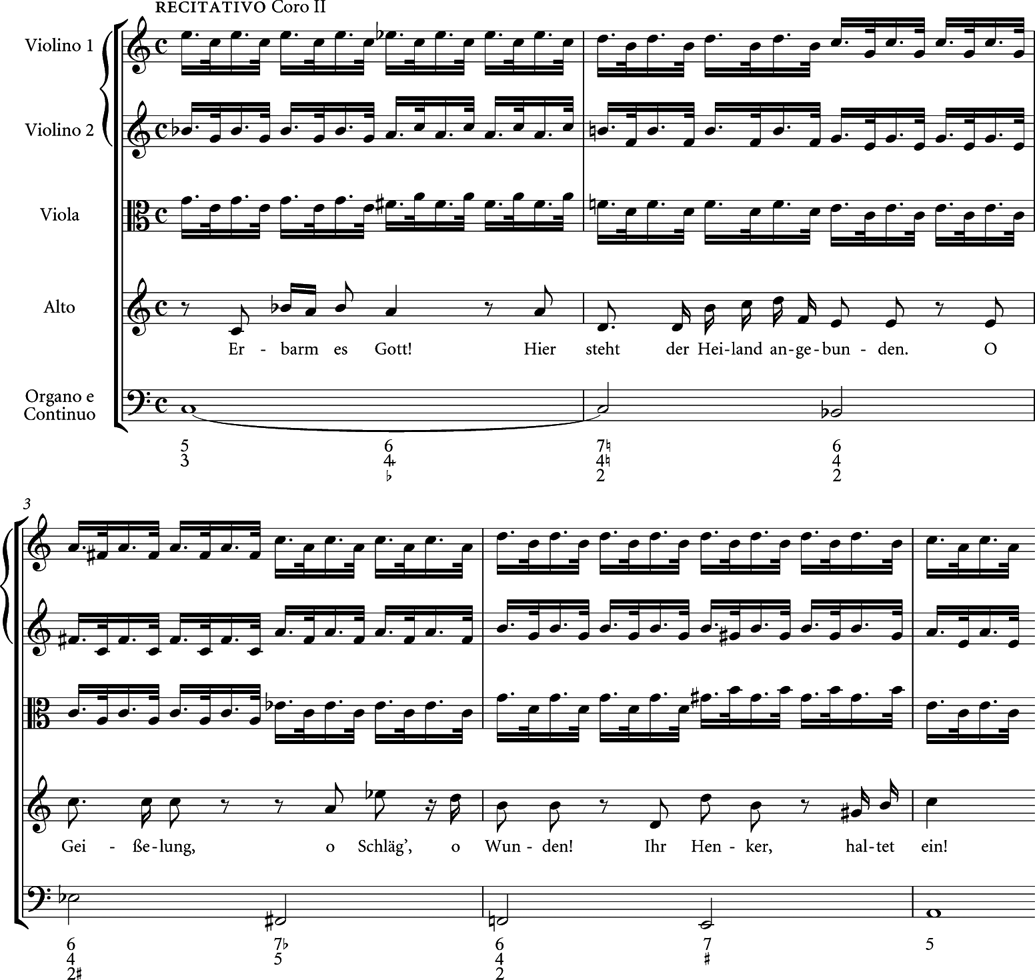
Close physical engagement also characterized Padmore's encounters with the other singers, including a sensuous kiss on Judas's lips that delayed the musical proceedings for a few long seconds. The impression of Padmore ‘embodying’ the story became particularly vivid during the flagellation, which Bach's music captures so hauntingly in the arioso ‘Erbarm es Gott’, with relentless beating rhythms in the strings accompanying the alto's plea for mercy (Example 1). Here, it was neither Jesus nor the soloist (Magdalena Kožená) who underwent the torture, but again Padmore, lashed like Warner's Christ by an imaginary device. No shying away from the peripeteia of the action, in other words, but avoiding too literal a rendition by displacing it onto a ‘neutral’ narrator figure.
J. S. Bach, Matthew Passion, No. 51, ‘Erbarm es Gott’, bars 1–5.
Sellars's concept was significantly aided by his cast of celebrated, charismatic singers – some of them, like the visibly pregnant soprano Camilla Tilling or the disabled bass-baritone Thomas Quasthoff, drawing attention to the physical merely through their presence on stage – instead of some less well-known actors in Mitchell's or Miller's stagings. Numerous other aspects of Sellars's production, however, appeared directly inspired by the latter version, in particular the intimate dialogue in most arias between the singer and respective instrumental soloist, a strategy that simultaneously seemed to naturalize and draw attention to the peculiar notion of singing as a form of inter-human communication. Fully exploiting the in-the-round architecture of the Berlin concert hall, Sellars's design also featured no proscenium and frequently saw members of the ensemble – all in muted black clothes – disperse across the auditorium, easily blending in with the audience. Remnants of eighteenth-century ‘congregational’ practice sublimated into avant-garde theatre, one might say, thereby apparently achieving that ‘expression of spontaneity, immediacy, and freedom, of feeling and breathing, of conviction and commitment’ that can make a performance ring true beyond a reassertion of the work.Footnote 79
From another perspective, however, such claims of shared, spontaneous expressivity might easily be challenged, since the production was specifically devised to be commemorated and reproduced: not only was it simultaneously streamed on the Berlin Philharmonic website, but it has also been available since in their digital concert hall and on DVD, offering various options for out-of-the-moment, private consumption.Footnote 80 Moreover, if many critics experienced the performance as an instance of perfect ‘make-believe’, this effect arguably relied on the compelling myth of Bach's music as autonomously beautiful, excluding any unwelcome intrusions from the external world. Unlike the alienating and therefore thought-provoking moments in Warner or Mitchell, Sellars's solution primarily served to gratify its urbane audience, reaffirming the idea of hearing a great masterwork as a deeply ethical undertaking. But although the tearful catharsis inspired by the Berlin performances may have occurred on a less critical level than the disenchanting catharsis of laughter brought about by Warner's lamb, perhaps – in the positive spirit of Latour – such affirmative gatherings need not be unconditionally debunked. Their success, however, is predicated on full commitment to the work from both performers and listeners, thereby aiding its continued reification. Notwithstanding the pronounced ‘event’ qualities of the occasion (in Sellars's words, ‘there are no auditors, there are only participants’), it was Bach's most venerated creation that was unapologetically placed centre stage here.Footnote 81
Bach at the Zoo?
Perhaps, then, the ‘brave new work-less world’ invoked by Roger Parker as a possible consequence of ongoing debates over the work concept, is still a way off.Footnote 82 At least one recent production, however, has taken the step that Parker only tentatively suggests: modifying the musical text. Much of Bach's music has of course been reworked in various stylistic guises since the nineteenth century, but most recent stagings of the Passions – unlike their early twentieth-century predecessors – have stuck more or less rigidly to the Urtext, as if tampering with the visual dimension seemed audacious enough on its own. The further move into the aural domain, significantly, took place in the context of dance, which has tended to treat its musical materials with greater laxity than is customary in opera. As a medium of ‘pure performativity’, dance presumes a high degree of narrative abstraction while enabling intense bodily involvement – one reason, certainly, for the sustained opposition in eighteenth-century Lutheranism against its worldly powers of seduction.Footnote 83 Reviewers at a pioneering Matthew Passion choreography by the American dancer John Neumeier, premiered in Hamburg in 1981, still appeared troubled by this friction between spiritual subject matter and physical display: the Spiegel critic Hellmuth Karasek complained that ‘even in the Pas de deux the dancers have to pretend only to be interested in God, or God knows what, rather than their own bodies’.Footnote 84 Neumeier's version moreover dissociated the act of dancing entirely from the performance of the music, which was provided by a taped recording.Footnote 85 Although the choreography has since achieved something approaching cult status, with an annual revival at Eastertide, some viewers have found this split between invisible singers and dancers impersonating them not entirely convincing. A performance in 2005, for instance, was described by Frankfurt critic Gerald Siegmund as ‘four hours in which they pretended as if’ – the live dance apparently unable to overcome the impression that the artwork somehow remained ‘absent’.Footnote 86
In a more recent danced staging of the John Passion at the Berlin Dom in February 2013 (with further performances up to Good Friday), the music was instead played in situ by the Berliner Symphoniker and Symphoniechor, led by the German director Christoph Hagel. The role of Jesus was here sung and embodied by the same person, the ballet dancer and opera singer Christian Oldenburg, with the bass arias performed by another soloist. And this Jesus figure was aggressively manhandled by the crowd, revealing a lot of human flesh and the occasional smear of fake blood. Comparable perhaps to the function of the symbolic language in ‘Erwäge’, the danced choreography here by all accounts helped to concretize and also to beautify the ugly reality through concentrated physicality. The cavernous performance space of the Dom further augmented this sense of enhanced realism, having been covered in five tons of black earth to evoke the filthy path up to Golgotha. Praised as a ‘realistic representation that persuasively avoids anything too literal’, Hagel's version could be said to try out many aspects of Liehburg's dramatic fantasy; but at the same time it constituted a distinctly contemporary undertaking, ‘magically combining martial arts, circus artistry, hip-hop, break-dance and classical ballet’ into a ‘daring event-experiment’.Footnote 87
Yet still the musical material remained untouched here, even if the strident blows from several wooden rods hitting the ground during the scourging threatened to drown out the accompanying arioso. It took another (lapsed) Catholic, the Belgian director Alain Platel, to create a Matthew Passion makeover that radically transformed its musical fabric, in his 2008 project PITIÉ! Footnote 88 Famed for putting human misery on stage with ‘unsentimental empathy’,Footnote 89 Platel devised an extremely physical dramaturgy described by one critic as a ‘torturization’; ‘bodies stick to each other like limpets, they embrace and hook around each other, they slide off and clash into each other, they tear at each other, bore into tensed-up bellies’, wrote the Frankfurt reviewer Peter Michalzik.Footnote 90 Inspired by the Passion movies of Gibson and Pier Paolo Pasolini (1964), Platel's production had a pronounced filmic quality – and subsequently became the subject of a film – while nonetheless claiming ‘liveness’ as one of its essential attributes, thereby testing out a characteristically twenty-first-century mode of presence.Footnote 91 The London critic Luke Jennings specifically noted close parallels to Lars von Trier's film The Idiots (1998), in which actors ‘attempt to achieve personal liberation by imitating the chaotic behaviour of the mentally ill. They call this “spazzing” … [In PITIÉ!], the story is presented through a series of fractured tableaux, with extreme spazzing motifs given a virtuoso edge to produce wild flips and shoulder spins, manic body-slams and desperate manipulations that veer between the pieta and pinfall.’Footnote 92 Even in its many scenes of unflinching profanity, Platel's choreography thus confronted its viewers with present-day ‘sacred’ subjects of mental illness, violence and torture. In Ryan Platt's analysis, his approach fell in line with recent trends in dance practice ‘aspiring to exceed the intelligible range of expression predicated by the individual unity of corporeal and theatrical form.’Footnote 93
Accordingly, few of the ten dancers and three singers in Platel's show took on recognizable roles, apart from the Congolese countertenor Serge Kakudji, who sang and danced the part of Christ. The other performers primarily embodied ‘states, wounds, excesses’, contorted by paroxysms like in a medieval hell painting, leapfrogging past the eighteenth century back to images of Grünewald or Hieronymus Bosch.Footnote 94 They were accompanied by eight onstage musicians, who performed an arrangement by the Belgian saxophonist Fabrizio Cassol that ‘liberated the emotions contained in Bach's Passion by blending African, gypsy and Blues influences’.Footnote 95 The affective centre lay in the treasured aria ‘Erbarme dich’, articulating the overarching theme of compassion, and here intoned as a trio. Yet while it clearly still mattered to critics that the production dealt with a piece by Bach, most reviewers spent little time commenting on the quality of either the music or its presentation, instead focusing on moments of performative ecstasy generated by the multimedial spectacle. In the opening sequence, recalls Platt, a dancer
vaults himself with one arm into a handstand. He lingers for an ineffable moment, poised at the tip of his balance before commencing an elegantly athletic solo of dexterous flips, delicately suspended inversions, and graceful recoveries. This display of ideal muscularity is dance in its most elevated definition and imparts a familiar, albeit increasingly infrequent sensation: pleasure … Resembling religious rapture, Platel's choreography seeks to suspend lapsarian binaries, such as the gap between spectator and performer.Footnote 96
In such an assessment, the production indeed appears to have achieved that sense of ‘re-enchantment’ which Erika Fischer-Lichte has identified as central to an aesthetic of the performative.Footnote 97 Any awareness of historical depth collapses into an exuberant present instance, and acutely encountered corporeality eclipses the potential for signification.
And yet, for some, the desire for signification remained strong. Platel's conception worked at not only the expense of the narrative – ‘I miss the/a story’, wrote Andre Sokolowski – but also the capacity for meaning more broadly, ultimately leaving performers and viewers in a state of empty exhaustion.Footnote 98 Beyond the sense of communal bliss that Hans Ulrich Gumbrecht has associated with the display of unadulterated athletic beauty, Platel's production raised the expectation of something more, in line with Karol Berger's observation (in response to Carolyn Abbate) that ‘we cannot help it: we are hermeneutic creatures through and through’.Footnote 99 On one level, PITIÉ! clearly did offer fragmentary meanings surrounding the subjects of love, cruelty and sacrifice, and individual choreographic gestures carried more specific interpretative potential as well. Nonetheless, the same writer who so marvelled at that opening handstand later condemned the performance as a ‘senseless spectacle of revolting regression’ – an alarming reversion, in other words, of the Western civilizing process that has traditionally served to keep the bodily sphere at a safe remove.Footnote 100 Perhaps such a confrontation with the materiality of human life could be seen to induce an ‘uncomfortable catharsis’, but for French journalist Daniel Conrod, it chiefly created the impression of a ‘human zoo’, forestalling any feelings of empathy by turning its witnesses into detached voyeurs.Footnote 101 If the experience of aesthetic presence has been figured as the ultimate fulfilment of a deep-rooted longing to overcome the mind–body dichotomy of Western modernity, it also carries the disquieting potential of negating not only the possibility for rational reflection, but also the whole societal framework on which such artistic endeavours are initially predicated.
Where, then, does this leave Bach and his early eighteenth-century contributions to the Lutheran Easter liturgy? Although the wide range of dramatic adaptations of his Passions certainly suggests that his music can serve as a carrier for most interpretative visions, it is clearly not enough to conclude that, whatever is being done to his works, they somehow ‘survive’. Arguably, in Platel's case, Bach's score is broken up to an extent that the work no longer forms a recognizable entity at all, but this ontological quandary is perhaps less relevant than the observation that the performative stance in his staging patently took precedence over the presentation of a musical text. Yet still, it was Bach's piece – its sounds, its history, its aura – that set the creative process in motion and conditioned any reactions to it. In John Butt's assessment, the key to this continuing dialogue between Bach's Passions and successive generations of listeners is found in their quality of ‘meaningfulness’, generated by the unique complexity and richness of his musical language.Footnote 102 But at least some of the approaches discussed here suggest that this music affords possibilities that exceed the privileged domain of meaning. From Mendelssohn's 1829 revival onwards, these dramatized performances of Bach's Passions might in fact be seen to outline a range of historical versions of the drastic, though assimilated in many cases to ‘higher’ purposes of spiritual renewal or moral edification. If Bach's works originated at a historical juncture where modernity brought about a definitive rupture between God and humanity, his Passions have held for many the promise of a path back towards this receding sphere of the divine. According to the Cologne critic Ulrike Gondorf, even a choreography as unspiritual as Platel's acquired this capacity on account of the accompanying fragments of Bachian sounds, which ‘rise with awe-inspiring power’ to offer ‘confirmation of a utopia that demands to be realized’.Footnote 103 In the rich reception history of Bach's Passions from the nineteenth to the twenty-first centuries, presence and meaning thus emerge not as mutually exclusive but mutually enabling categories, revealing the hermeneutic as well as the drastic potential of his music as closely interlinked projections of a distinctly modern mindset.
Appendix
Staged, danced, and filmed adaptations of Bach's Passions mentioned in the text.