Working memory is a complex higher order cognitive system that is involved in the maintenance and manipulation of online information and the control of attention (e.g., Baddeley, Reference Baddeley2003). The executive control component of working memory allows individuals to selectively attend to goal-relevant stimuli and enact goal-oriented behaviors while inhibiting dominant impulsive reactions and interference from distracting information (Baddeley, Reference Baddeley2003). Working memory is understood to be a foundational process underlying academic abilities (Alloway & Alloway, Reference Alloway and Alloway2010; Bull, Espy, & Wiebe, Reference Bull, Espy and Wiebe2008) and subserves multiple aspects of self-regulation, such as cognitive reappraisal and management of negative reactivity (e.g., Bridgett, Oddi, Laake, Murdock, & Bachmann, Reference Bridgett, Oddi, Laake, Murdock and Bachmann2013). In addition, researchers have identified working memory as a key cognitive process that underlies various cognitive disorders, psychopathologies, and health behaviors across the life span. For example, studies with adolescents and adults have documented strong associations between poor working memory and impulsivity (Hinson, Jameson, & Whitney, Reference Hinson, Jameson and Whitney2003), depression (Davis & Nolen-Hoeksema, Reference Davis and Nolen-Hoeksema2000), alcohol use (Khurana et al., Reference Khurana, Romer, Betancourt, Brodsky, Giannetta and Hurt2013; Thush et al., Reference Thush, Wiers, Ames, Grenard, Sussman and Stacy2008), and sexual risk taking and debut (Khurana et al., Reference Khurana, Romer, Betancourt, Brodsky, Giannetta and Hurt2012, Reference Khurana, Romer, Betancourt, Brodsky, Giannetta and Hurt2015). Collectively, findings from these studies indicate individuals with lower working memory are at greater risk for serious mental health and psychosocial difficulties. As such, research focused on elucidating the social mechanisms that might explain individual differences in the development of working memory may have significant implications for disparities in mental health.
Development of Working Memory
Research has demonstrated that working memory develops very early in childhood and steadily improves across adolescence, coinciding with the protracted maturation of the prefrontal cortex (Diamond, Reference Diamond, Bialystock and Craik2006; Garon, Bryson, & Smith, Reference Garon, Bryson and Smith2008). Several longitudinal studies have found significant age-related improvements, between the ages of 3.5 and 7 years, in children's ability to use attentional control to update contents in their working memory (Diamond, Prevor, Callender, & Druin, Reference Diamond, Prevor, Callender and Druin1997; Hughes, Reference Hughes1998). Due to its prolonged postnatal development, many investigators have proposed that distal and proximal processes within the child's environment may be highly operative in shaping individual differences in working memory (e.g., Hackman, Farah, & Meaney, Reference Hackman, Farah and Meaney2010). Thus, the first and primary aim of the present study was to test a socioecological process model for the development of children's working memory. Toward this, we examined direct associations between early exposure to family socioeconomic risk and children's developing working memory, and then compared the differential mediating effects of maternal harsh discipline and responsiveness within a socioeconomically diverse sample. Second, in accordance with recent psychobiological models of maternal caregiving (Barrett & Fleming, Reference Barrett and Fleming2011; Mileva-Seitz & Fleming, Reference Mileva-Seitz, Fleming, Booth, McHale and Landale2011), we tested whether individual differences in maternal working memory might differentially moderate the initial links between family socioeconomic status (SES) and harsh discipline and responsive caregiving within the context of child working memory development.
Impact of SES on Child Working Memory
Previous developmental research with children has largely examined the effects of poverty on global executive functioning (e.g., Blair et al., Reference Blair, Granger, Willoughby, Mills-Koonce, Cox, Greenberg and Fortunato2011; Sarsour et al., Reference Sarsour, Sheridan, Jutte, Nuru-Jeter, Hinsh and Boyce2011; Waber et al., Reference Waber, de Moor, Forbes, Almli, Botteron, Leonard and Rumsey2007). There has been much less research that has examined working memory as an individual process. However, in their seminal cross-sectional study, Noble, Norman, and Farah (Reference Noble, Norman and Farah2005) demonstrated that low-income children performed disproportionately worse on measures of working memory than their middle-income counterparts. In addition, in a recent longitudinal analysis of children from the ages of 10 to 13, Hackman et al. (Reference Hackman, Betancourt, Gallop, Romer, Brodsky, Hurt and Farah2014) found that socioeconomic-related disparities in working memory did not narrow or accumulate overtime, but rather emerged in early development and stabilized in adolescence. This growing body of evidence documenting associations between SES and working memory in middle childhood and early adolescence has led many to conclude that the putative mechanisms that underlie individual differences might be operating in the family environment at younger ages than previously examined. Despite the plausibility of these hypotheses, research focused on identifying and comparing the differential strength of specific caregiving practices as mediators for child working memory during early development has been significantly lacking.
Mediating Role of Caregiving: Maternal Harsh Discipline and Responsiveness
According to family stress models, the caregiver relationship is considered to act as a primary conduit through which the effects of the larger socioeconomic context influence child development (e.g., Conger, Conger, & Martin, Reference Conger, Conger and Martin2010). This is because caregivers are primarily responsible for structuring the child's environment during the early years of development. Extant developmental research in this area has predominately focused on broad forms of parenting in relation to global child executive functioning (e.g., Fay-Stammbach, Hawes, & Meredith, Reference Fay-Stammbach, Hawes and Meredith2014). Findings from these correlational studies have indicated that lower levels of positive and negative parenting across infancy and the early toddler years predict poor global executive functioning outcomes among impoverished samples (e.g., Blair et al., Reference Blair, Granger, Willoughby, Mills-Koonce, Cox, Greenberg and Fortunato2011). This has provided evidence to suggest that global forms of caregiving may be operative in transmitting the effects of SES on children's developing neurocognitive systems. However, what types of caregiving practices might be the most relevant still remains relatively unknown. Toward greater specificity, the present study aimed to examine how specific domains of maternal caregiving may be differentially related to children's working memory.
From a developmental perspective, the discipline domain is one of the primary socialization contexts of parent–child interactions in early childhood (e.g., Grusec & Davidov, Reference Grusec and Davidov2010). Disciplinary parent–child interactions become more salient during the toddler and preschool years with increases in children's mobility and interest in mastering their environment. During this time, mothers are charged with the difficult task of balancing their support for their child's autonomy-seeking behaviors with the need for behavior management and limit setting. Socialization practices such as noncoercive parental limit setting and reasoning are theorized to promote child's cognitive capacity to use social norms to monitor their decisions and behaviors while simultaneously inhibiting personal desires or emotional reactions that are not socially appropriate (e.g., Grusec & Davidov, Reference Grusec and Davidov2010). This seems highly relevant to working memory, given it is understood to provide the mental space and capacity for activating self-directed speech, sensory images, and representations in order to engage in problem solving, self-reflection, and rule application to guide socially adaptive behavior (Baddeley, Reference Baddeley2003). Conversely, caregiver use of harsh and power-assertive behavioral control strategies limits opportunities for children to exert developmentally appropriate levels of autonomy over their thoughts and behaviors (e.g., Grusec & Davidov, Reference Grusec and Davidov2010), and often causes greater dysregulations in child affect and behavior (e.g., Chang, Schwartz, Dodge, & McBride-Chang, Reference Chang, Schwartz, Dodge and McBride-Chang2003). Given socialization experiences are theorized to shape executive functions (e.g., Carlson, Reference Carlson2003), it seems plausible that harsh discipline may undermine children's working memory. However, this has yet to be examined within the developmental literature.
Other studies have focused on maternal sensitivity and responsiveness and their relations to the development of early executive functions in children. In particular, maternal responsiveness to the child's bids for attention and requests is theorized to foster executive functions through providing experiences where the child can successfully master his or her environment (Carlson, Reference Carlson2003). Some developmental work has found associations between maternal responsiveness and global child executive functioning in low-income samples (e.g., Blair et al., Reference Blair, Granger, Willoughby, Mills-Koonce, Cox, Greenberg and Fortunato2011; Rhoades, Greenberg, Lanza, & Blair, Reference Rhoades, Greenberg, Lanza and Blair2011); however, others have failed to detect significant correlations (e.g., Hughes & Ensor, Reference Hughes and Ensor2005). With respect to working memory, Doan and Evans (Reference Doan and Evans2011) found that maternal responsiveness in middle childhood might moderate the influence of allostatic load on outcomes in adolescence, but did not examine it as a potential mediating mechanism. To our knowledge, there have yet to be any studies that have examined relations between maternal responsiveness and early child working memory, specifically, and in particular whether it more proximally mediates the influence of SES on children's developing capacities over and above other developmentally salient forms of caregiving, such as discipline. Given these gaps, the study seeks to elucidate whether maternal harsh discipline and maternal responsiveness assessed when children were 3.5 years old differentially mediate pathways between early family SES and individual differences in child working memory at age 5.
Moderated Mediation: Role of Maternal Working Memory
Recent psychobiological models of maternal caregiving (e.g., Barrett & Fleming, Reference Barrett and Fleming2011; Mileva-Seitz & Fleming, Reference Mileva-Seitz, Fleming, Booth, McHale and Landale2011) emphasize that appropriate mothering requires the activation of multiple systems that regulate attention, emotion, and executive functioning. As delineated by Barrett and Fleming (Reference Barrett and Fleming2011), mothers need to be able to selectively attend to their offspring in the context of competing stimuli, be consistent and restrained in their responsiveness, and direct and redirect their attention to information relevant to the enactment of parenting goals and standards. Empirical work with human models has been limited, but within the past several years, an emerging body of parenting research has found associations between individual differences in working memory and maternal reactive negativity (Deater-Deckard, Sewell, Petrill, & Thompson, Reference Deater-Deckard, Sewell, Petrill and Thompson2010) and sensitivity (Gonzalez, Jenkins, Steiner, & Fleming, Reference Gonzalez, Jenkins, Steiner and Fleming2012). In particular, this research has suggested that individual differences in maternal working memory might contribute to the extent to which mothers are able to monitor their decisions and behaviors during parent–child interactions, and their emotional reactivity in response to child misbehavior.
In addition, social cognitive psychology models of executive function and its role in self-regulation (e.g., Hofmann, Schmeichel, & Baddeley, Reference Hofmann, Schmeichel and Baddeley2012) propose that working memory may act as process moderator in associations between situational and psychological risk factors and failures in regulation, such as eating behavior (Hofmann, Friese, & Roefs, Reference Hofmann, Friese and Roefs2009) and anger expression upon provocation (Hofmann, Gschwendner, Friese, Wiers, & Schmitt, Reference Hofmann, Gschwendner, Friese, Wiers and Schmitt2008). In particular, experimental research has found individuals who have lower working memory show stronger correspondences between automatic or impulsive processing and behavior when under conditions of high stress (Grenard et al., Reference Grenard, Ames, Wiers, Thush, Sussman and Stacy2008; Hofmann, Rauch, & Gawronski, Reference Hofmann, Rauch and Gawronski2007). Consistent with this, our investigative team found that in a sample of 185 mother–child dyads, maternal working memory moderated associations between mother's negative attributions about her child and her use of harsh discipline (Sturge-Apple, Suor, & Skibo, Reference Sturge-Apple, Suor and Skibo2014), and that the moderating effects of working memory were further explained by the socioeconomic context of the family.
In extension of our previous work, our present study aimed to examine whether maternal working memory operates as a process moderator within a socioecological process model for the development of child working memory. In particular, even though deficits in child working memory may be more probable because socioeconomic adversity often leads to greater breakdowns in caregiving, there may be caregiver processes, like maternal working memory, that act as moderators of this risk. In other words, we aimed to test whether initial pathways of the mediation model, from SES to caregiving, would be moderated by maternal working memory. Within this, we sought to examine whether the moderating effects of maternal working memory would be specific to harsh discipline or if it would also moderate paths including maternal responsiveness. Given previous work has yet to differentially compare associations between maternal working memory and distinct domains of caregiving and examine its developmental consequences, these findings have the potential to inform more targeted approaches to maternal caregiving interventions aimed at ameliorating risk in child outcomes.
In sum, the present study utilized a sample of 185 socioeconomically diverse mother–child dyads assessed when children were 3.5 and 5 years old. Based on previous findings with older school-age children (Farah et al., Reference Farah, Shera, Savage, Betancourt, Gianetta, Brodskey and Hurt2006; Noble et al., Reference Noble, Norman and Farah2005), we first hypothesized that early SES, assessed when children were 3.5, would be associated with child working memory at age 5. Second, we hypothesized that maternal harsh discipline, observed when children were 3.5, would mediate associations between family SES and child working memory at age 5, over and above the potential mediating role of maternal responsiveness. Based on our previous work (Sturge-Apple et al., Reference Sturge-Apple, Suor and Skibo2014) and psychobiological models of caregiving (e.g., Barrett & Fleming, Reference Barrett and Fleming2011), we hypothesized that individual differences in maternal working memory would moderate the initial path of the meditation model, specifically associations between family socioeconomic context and maternal harsh discipline. Although partly exploratory, we did not expect to find a significant moderating pathway for maternal responsiveness as this form of caregiving might involve less effortful cognitive processing in comparison to discipline.
Method
Participants
Participants included 185 mothers (M age = 31.9, SD = 5.53) and their 3.5-year-old children (53% boys) from a midsized city in the Northeastern region of the United States. Mothers and their children were recruited through posting flyers in community locations (e.g., doctor's offices, daycares, and libraries) and recruiters at local Women, Infant, and Children assistance offices. Recruitment efforts focused on obtaining a diverse sample of mother–child dyads experiencing a wide range of socioeconomic experiences. The majority of participants identified themselves as European American (64% of mothers and 59% of children), followed by moderate percentages of African American (20% of mothers and 19% of children) and Latino (8% of mothers and 3% of children), and smaller percentages of biracial (5% of mothers and 15% of children), Asian (less than 1% of mothers and 1% of children), and Native American/Alaskan (2% of mothers and 3% of children) participants. Mothers and their children participated in an additional wave of data collection when children were 5 years old (M = 63.12 months, SD = 2.57). One hundred and forty-nine mother–child dyads participated in Wave 2. The cumulative retention rate across the two waves of data collection was 80.5%.
Procedure
Mothers and their children visited the laboratory at two annual time points when children were 3.5 and 5 years old. Laboratory visits across the two waves ranged from 2.5 to 3 hr in length. Informed consent from mothers and their children was obtained at the beginning of each visit. At the first wave, mothers completed a demographics survey, an auditory working memory assessment, and a battery of questionnaires. In addition, mothers and their children participated in a free-play/compliance interaction task, which entailed the mother–child dyad playing in a room filled with attractive age-appropriate toys. Mothers were instructed to play with their children as they normally would at home for 10 min. At the end of the 10 min, an experimenter cued the mother to initiate cleanup with her child, which included mothers trying to get their child to cleanup the toys and put them in a “toy bin” in the corner of the room. The cleanup portion of the task lasted for 5 min. The entire mother–child interaction was videotaped for later observational coding of maternal caregiving behaviors. Mothers and their children returned to the laboratory when children were 5 years old and participated in a variety of tasks, including assessments of child auditory and visuospatial working memory, which are the focus of the present study. All of the methods and procedures of this study were approved by the university's institutional review board prior to each wave of data collection.
Measures
Family SES
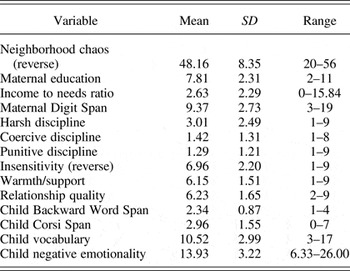
At the first wave of data collection, we collected information relevant to the family's socioeconomic environment. We adopted a continuous approach to measuring family SES based on multiple indicators. This method of characterizing SES draws upon previous conceptualizations in the literature (Conger et al., Reference Conger, Conger and Martin2010; Dearing, McCartney, & Taylor, Reference Dearing, McCartney and Taylor2001; Hackman et al., Reference Hackman, Betancourt, Gallop, Romer, Brodsky, Hurt and Farah2014). First, mothers completed a demographics survey where they reported their highest level of education, number of adults and children living in the home, and the annual household income. There was substantial socioeconomic variability in the sample. Maternal education ranged from “having some high school” (n = 29) through “advanced degree” (e.g., masters degree, doctorate degree; n = 41). The median family income of participants was $59,332 a year (range = $0–$365,000), with 35% receiving public assistance. The family's income to needs ratio was computed by dividing the total family income by the poverty-level income based on the number of total individuals in the household. Poverty-level guidelines were based on the 2012 Department of Health and Human Services Poverty Guidelines (US Department of Health and Human Services, 2012). An income to needs ratio below 1 indicates that the total income of the household was below the federal definition of poverty. Income to needs ratios ranged from 0.00 through 15.84 (M = 2.63, SD = 2.29), with 44% of mothers reporting an income to needs ratio at or below the federal poverty line.
Second, mothers completed the revised version of the Neighborhood Organization and Affiliation Assessment (Knight, Smith, Martin, Lewis, & LONGSCAN Investigators, Reference Knight, Smith, Martin and Lewis2008) to assess neighborhood characteristics. For this analysis, the neighborhood chaos subscale was used as an indicator of the quality of the family's neighborhood. In particular, the subscale measures problems in the mother responder's neighborhood (e.g., “There is open drug activity,” “houses are broken into”), ratings were on a 4-point scale ranging from strongly disagree to strongly agree. The internal consistency coefficient for this subscale was high (α = 0.93). The neighborhood chaos subscale was reversed scored in our analyses. The three assessments of family SES: maternal education, income to needs ratio, and neighborhood chaos (reverse scored), were significantly correlated with one another (rs = .40–.52) and were used as indicators of family SES.
Maternal caregiving
During the first wave of data collection, observational ratings of maternal behavior during the mother–child free-play and cleanup interaction task were completed separately using different subscales from the Iowa Family Interaction Rating Scales (IFIRS; Melby & Conger, Reference Melby, Conger, Kerig and Lindahl2001) that were adapted for the current project. Ratings were assessed on a 9-point Likert scale ranging from 1 (not at all characteristic) to 9 (mainly characteristic). Based on previous conceptualizations (e.g., Davies & Cicchetti, 2013; Doan & Evans, Reference Doan and Evans2011), three subscales from the IFIRS were used to assess maternal responsiveness during the free-play interaction. The insensitivity/parent-centered subscale measured maternal difficulties in identifying and attending to her child's needs, psychological states, and competencies. This was reverse scored so higher ratings reflected higher maternal sensitivity, engagement, and greater awareness of child's needs, emotional states, and capabilities. The warmth–support subscale measured the extent to which the mother expresses liking, appreciation, praise, and care for the child. Finally, the relationship quality subscale assessed the global quality of the mother's relationship with her child. A high score indicates that the relationship is warm, open, happy, and emotionally satisfying. To determine interrater reliability, two coders completed ratings on 25% of the interactions. The intraclass correlation coefficients of shared ratings of the three scales were acceptable and ranged from 0.83 to 0.84. The subscales were significantly correlated with each other (rs = .55–.78).
We used three subscales adapted from the IFIRS to measure maternal harsh discipline behaviors during the mother–child cleanup interaction. The coercive discipline subscale assessed the degree to which the mother displays harsh, angry, critical, matter of fact, disapproving, and/or rejecting behavior toward her child's behavior, appearance, or state. Forms of both nonverbal and verbal communication are taken into account when completing ratings. For nonverbal indicators, we assessed the extent to which mothers displayed angry or contemptuous facial expressions and menacing/threatening body posture; emotional expressions, such as irritable, lack of patience and sensitivity, sarcastic, or curt tones of voice; and rejection, such as actively ignoring the child, showing contempt or disgust for the child or the child's behavior, and denying the child's needs. For verbal indicators, we assessed the extent to which the content of the mother's statements included complaints about the child or denigrating or critical remarks, for example, “You could never manage that.” The harsh discipline subscale measured the extent to which mothers delivered commands in an angry or hostile tone in order to gain unquestionable compliance from the child; examples of such commands include “You need to clean up” and “Clean up now.” Commands that were delivered in a neutral but firm manner were not coded under this construct. Finally, the punitive discipline subscale was used to assess mother's use of punishment in response to “misbehavior” or violation of specific standards (stated or implied rules, regulations, and expectations). Punishment included the use of disciplinary techniques such as belittling, shaming, yelling, threatening, or physically grabbing the child. To determine interrater reliability, two coders completed ratings on 25% of the interactions. The intraclass correlation coefficients of shared ratings of the three scales were acceptable and ranged from 0.73 to 0.85. The subscales were significantly correlated with each other (rs = .43–.88).
Maternal working memory
At Wave 1, mothers were administered the digit span subtest from the Wechsler Adult Intelligence Scale—Fourth Edition (Wechsler, Reference Wechsler2008). The digit span assesses auditory working memory and has demonstrated high reliability across all age groups (ranging from .89 to .94; e.g., Sattler & Ryan, Reference Sattler and Ryan2009). In addition, previous research has utilized the digit span as a measure of maternal auditory working memory in associations with harsh forms of parenting (e.g., Deater-Deckard et al., Reference Deater-Deckard, Sewell, Petrill and Thompson2010; Sturge-Apple et al., Reference Sturge-Apple, Suor and Skibo2014). The digit span is composed of three distinct subtests: digits forward, digits backward, and digits sequencing, which are administered in that order. In the digits forward condition, a trained experimenter read aloud a string of numbers ranging in length from two to nine digits, and mothers were required to immediately repeat back the string of numbers in the order they were presented. For digits backward, the same procedure was followed except the mother was required to repeat the digits in backward order. For this condition, sequences increased in length from two to eight numbers. Finally, in the digits sequencing condition, the same initial procedure was followed, except mothers were required to repeat the digits in ascending numerical order (from lowest to highest). Sequences increased in length from two to nine numbers. There were two trials for each sequence length across the forward, backward, and sequencing conditions. Each condition is discontinued once the mother fails both trials within an item. All research personnel received extensive training on how to properly administer the digit span and were supervised by three psychology doctoral students throughout data collection. The three subtests were significantly correlated with one another (rs ranged from .49 to .52). The norm-referenced scaled score based on performance across three subtests was used in the analyses as an index of maternal working memory.
Child working memory
At Wave 2, children were administered auditory and visuospatial working memory span tasks. Children were administered the Backward Word Span (Carlson, Moses, & Breton, Reference Carlson, Moses and Breton2002), which required them to repeat a list of single-syllable, non-semantically related words in reverse order. At the beginning of the task, the experiment used a puppet, named Ernie, to demonstrate saying words backward (e.g., if I say “book, cup,” Ernie says, “cup, book”). Children were told to do as Ernie did. They were given four practice trials, and corrective feedback was provided for wrong answers. If a child did not pass at least one of the practice trials, the task was discontinued. For the test trials, no feedback was given to the child, and the number of words children had to repeat in backward order increased by one after each successful trial. There were three trials for each sequence length. The maximum sequence length was five words. Following Carlson et al.'s (Reference Carlson, Moses and Breton2002) protocol, children were given a score based on their span length (1–5). Children who failed all four practice trials were given a score of 1, as were children who did not pass any of the three two-word test trials. Seventy-eight percent of children were able to pass the practice and three two-word test trials, which is comparable to previous studies with this age group (Carlson et al., Reference Carlson, Moses and Breton2002).
Children were also administered the PathSpan application (Version 1.2) developed for the iPad (Hume, Reference Hume2012), which is based on the Corsi Block Tapping Task (Berch, Krikorian, & Huha, Reference Berch, Kirkorian and Huha1998; Pagulayan, Busch, Medina, Bartok, & Krikorian, Reference Pagulayan, Busch, Medina, Bartok and Krikorian2006) and has been shown to be a useful assessment of visuospatial working memory in preschool-age children (e.g., Bull et al., Reference Bull, Espy and Wiebe2008; LeFevre et al., Reference LeFevre, Fast, Skwarchuk, Smith-Chant, Bisanz, Kamawar and Penner-Wilger2010). The PathSpan application was developed based on the Count Me In Study and has been field-tested with young children in daycare settings (LeFevre et al., Reference LeFevre, Fast, Skwarchuk, Smith-Chant, Bisanz, Kamawar and Penner-Wilger2010). In the current study, children were presented with the iPad, and the experimenter read aloud the instructions that were displayed on the screen. The experimenter then demonstrated how to do the task by touching the buttons on the screen. For each PathSpan trial, nine buttons are displayed on the screen in a static layout. The child initiated each trial by touching a green “PLAY” button at the bottom of the screen. After this button is pressed, the buttons flashed one at a time (1-s intervals) in a sequence of predetermined length. All buttons are disabled while the sequence is flashed. At the end of the sequence, all the buttons become touchable and “Your turn” is displayed on the screen. The child was then required to reproduce the pattern in the same order it was presented and press the “Done” button when finished. The sequence length increased by one after each successful trial (ranging from 2 to 8), and the child was allowed three tries for each sequence length. The task was discontinued if the child failed to reproduce at least one correct pattern on any of the trials for a given sequence length. Children were assigned a score based on their maximum span length (0–8). Children were given a span length of 0 if they failed to reproduce any correct trials. Performance was tracked and scored within the application program and then downloaded onto a computer for subsequent data analysis. The passing rate for the sample was 90.7%.
The two working memory assessments were significantly correlated with each (r = .44, p <. 01). For the primary analyses, the span length scores from both assessments were used to form a latent variable for child working memory.
Covariates
Negative emotionality
At Wave 1, mothers completed the short form of the Children's Behavior Questionnaire (CBQ; Putnam & Rothbart, Reference Putnam and Rothbart2006). The CBQ short form is a 94-item questionnaire that measures caregiver reports of child temperament and has been validated with this age group and in ethnically and socioeconomically diverse samples (Putnam & Rothbart, Reference Putnam and Rothbart2006). Mothers were asked to rate their child's behavior using a 7-point Likert scale, ranging from extremely untrue of your child to extremely true of your child. We utilized four subscales from the CBQ short form that have been shown to converge and significantly load on the negative affectivity factor: anger–frustration, sadness, falling reactivity/soothability (reverse scored), and discomfort (Rothbart, Ahadi, Hershey, & Fisher, Reference Rothbart, Ahadi, Hershey and Fisher2001). Three reverse-scored items from the sadness scale (“rarely cries when s/he hears a sad story,” “rarely becomes upset when watching a sad event in a TV show,” and “rarely becomes discouraged when s/he has trouble making something work”) were dropped because they were not correlated with other items in the scale. The subscales showed adequate internal consistency that was similar in magnitude to previous studies (e.g., Lengua & Kovacs, Reference Lengua and Kovacs2005; Putnam & Rothbart, Reference Putnam and Rothbart2006), sadness (α = 0.60), discomfort (α = 0.78), soothability (α = 0.75), and anger–frustration (α = 0.78). Principle component analyses revealed that all the subscales loaded on a single factor and loadings ranged from .62 to .87. The subscales were all correlated with each other (rs = .36–.74). The subscales were summed to create a composite score of child negative emotionality (α = 0.81). We included child negative emotionality as a covariate in our model given research demonstrating that negative emotionality may be a susceptibility factor for harsher and less responsive caregiving (e.g., Belsky & Pluess, Reference Belsky and Pluess2009) and may predict lower working memory (e.g., Bridget et al., Reference Bridgett, Oddi, Laake, Murdock and Bachmann2013).
Verbal ability
At Wave 2, child verbal ability was assessed with the vocabulary subtest from the Wechsler Preschool and Primary Scale of Intelligence—Third Edition (Wechsler, Reference Wechsler2002), which is appropriate for children between the ages of 2.5 and 7.25 years. The vocabulary subtest of the Wechsler Preschool and Primary Scale of Intelligence provides an estimate of children's expressive vocabulary, word knowledge, and fund of information (Wechsler, Reference Wechsler2002). Given previous evidence suggesting high correlations between child verbal ability and child executive functions (e.g., Hughes & Ensor, Reference Hughes and Ensor2005), scaled scores from the vocabulary subtest were included as a covariate in path analyses.
Results
Preliminary analyses
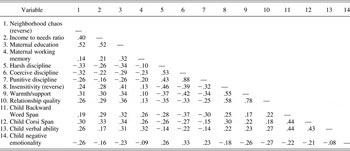
Tables 1 and 2 show the means, standard deviations, ranges, and correlations for the main variables in the study. Median missing data across variables at each wave was 2% at Wave 1 and 7.4% at Wave 2. To maximize our sample size, we utilized full information maximum likelihood estimation (e.g., Enders, Reference Enders2001) available in Amos 22.0 statistical software (SPSS Inc., Chicago, 2007). This method is appropriate when data are missing completely at random (e.g., no identifiable pattern exists in the missing data) and can be used even when the amount of missing data is as high as 50% (Schlomer, Bauman, & Card, Reference Schlomer, Bauman and Card2010). To evaluate any potential identifiable patterns to missing data, we examined whether there were any significant differences in participants who were retained versus those who dropped out of the study at Wave 2 along the primary and demographic variables. The results indicated there were no significant differences. To further evaluate whether data were missing completely at random (MCAR), we examined the patterns of missingness using Little's MCAR test (Little, Reference Little1988). The results suggested that the data were MCAR, χ2 = 364.9, p > .05. In addition, we also reran all analyses with only participants who were retained across the two waves, and the results were replicated with those using the full sample. Thus, we elected to retain the full sample in our final analyses. Finally, we examined the data for outliers and found one case on the maternal working memory variable and two cases on the child negative emotionality variable that were greater than three standard deviations above the sample mean. There were no outliers on the other predictor or outcomes variables. We removed these cases and reran the analyses to determine if these were influential in findings. The results were identical to those with the full sample. Due to similarity in results, we elected to retain these cases in our final analyses.
Correlations among primary variables

Note: Correlations larger than .17 are significant at p < .05, and correlations larger than .23 are significant at p < .01.
Descriptives for primary variables in model

Primary analyses
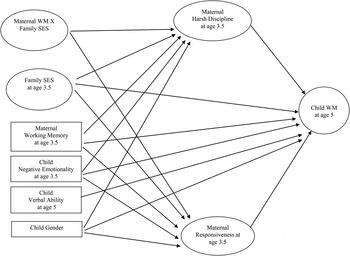
Path analyses were conducted within a structural equation modeling framework in order to test our hypothesized model (Figure 1). The path model was performed using AMOS 22.0 statistical software (SPSS Inc., Chicago, 2007). Predictor variables were centered prior to running analyses in order to avoid issues with multicollinearity (Aikin & West, Reference Aiken and West1991). The latent family SES variable was indicated by income to needs ratio, maternal education, and neighborhood chaos, which were all measured at Wave 1. Latent variables for maternal harsh discipline and maternal responsiveness were formed using subscales from the IFIRS, which were also measured at Wave 1. The latent variable representing child working memory was formed from the two working memory assessments at age 5. We used a manifest variable for maternal working memory based on mother's performance on the digit span at the first wave. Manifest variables for child gender, negative emotionality, and verbal ability were included as covariates in all models. For the latent variable interaction analyses, we utilized a residual centering approach outlined by Little, Bovaird, and Widaman (Reference Little, Bovaird and Widaman2006), which is an orthogonalizing technique that ensures full orthogonality between the interaction variable and its first-order effects. This technique began with the formation of all possible products between the indicators of the latent SES variable and the manifest maternal working memory variable. In the following step, each of the product indicators was regressed onto the set of indicators of the main-effect constructs in order to remove any of the main effect information contained in any of the indicators of the constructs. For each regression, the residual of the prediction was saved as a new variable in the data set. The new residual indicators were then used as indicators for the latent interaction variable representing the interaction between maternal working memory and family SES.
Hypothesized model testing mediating effects of maternal harsh discipline and maternal responsiveness and moderating effects of maternal working memory in associations between family socioeconomic status and child working memory at age 5. WM, Working memory; SES, socioeconomic status. For clarity, covariances among predictor and covariate variables are not depicted.

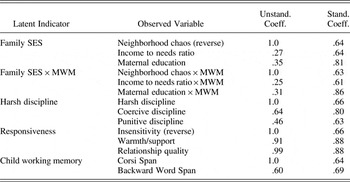
Prior to conducting our structural equation modeling analyses, we tested the fit of the measurement model. We calculated three commonly used model fit indices, including the relative χ2 statistic (Wheaton, Reference Wheaton1987), the comparative fit index (CFI; Bentler, Reference Bentler1990), and the root mean square error of approximation (RMSEA; Steiger & Lind, Reference Steiger and Lind1980). The results showed that the model fit the data well, χ2 (103, N = 185) = 123.75, p = .08, χ2/df = 1.20, RMSEA = 0.03, 90% confidence interval (CI) [0.00, 0.05], CFI = 0.98. Loadings of indicators on latent variables are presented in Table 3.
Loadings of observed variables on latent indicators
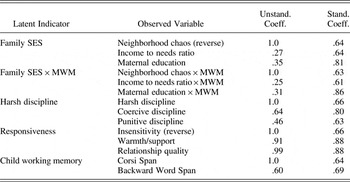
Note: SES, Socioeconomic status; MWM, maternal working memory. All coefficients are significant at p < .001.
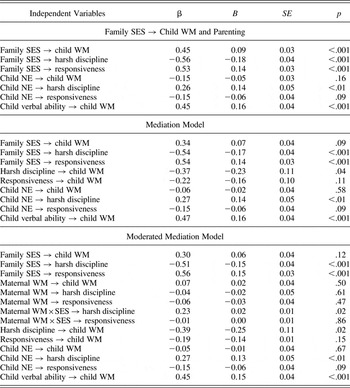
In our first set of path analyses, we tested whether maternal harsh discipline and responsiveness mediated the effects of family SES on children's working memory at age 5. We examined the direct effects of family SES on maternal harsh discipline, maternal responsiveness, and child working memory. Child gender, verbal ability, and negative emotionality were included as covariates in the model. The model was acceptable, χ2 (65, N = 185) = 93.75, p = .01, χ2/df = 1.44, RMSEA = 0.05, 90% CI [0.02, 0.07], CFI = 0.97. Examination of direct effects showed that lower family SES was concurrently associated with higher levels of maternal harsh discipline at age 3.5 (β = –0.56, p < .001), lower levels of maternal responsiveness (β = 0.53, p < .001), and predicted lower working memory among children at age 5 (β = 0.45, p < .001). Child gender and negative emotionality did not significantly predict child working memory at age 5. Child negative emotionality was associated with higher harsh discipline (β = 0.26, p < .01) but was only marginally associated with lower maternal responsiveness (β = –0.15, p = .09). Child verbal ability was positively associated with child working memory (β = 0.45, p < .001). See Table 4 for all parameter estimates. Family SES accounted for 46.7% of the variance in maternal harsh discipline, 35% of the variance in maternal responsiveness, and 45.6% of the variance in child working memory. Child verbal ability accounted for 18.2% of the variance in child working memory.
Results of path models

Note: SES, Socioeconomic status; WM, working memory; NE, negative emotionality. Parameter estimates for child gender are not depicted because of nonsignificance across all path models.
In the next step of our mediation analyses, we tested the indirect effects by including the paths from maternal harsh discipline and maternal responsiveness (measured when children were 3.5) to child working memory at age 5. The model was acceptable, χ2 (63, N = 185) = 88.57, p = .02, χ2/df = 1.41, RMSEA = 0.05, 90% CI [0.02, 0.07], CFI = 0.97. See Table 4 for all parameter estimates in the model. As expected, we found that exposure to higher levels of maternal harsh discipline when children were 3.5 years old significantly predicted lower working memory among children at age 5 (β = –0.37, p = .04). Conversely, maternal responsiveness was not significantly associated with child working memory at age 5 (β = –0.22, p > .10). In addition, parameter estimates for the direct paths from family SES to maternal harsh discipline and maternal responsiveness were similar in magnitude and remained significant (βs = –0.54 and 0.54, p < .001, respectively) in comparison to the previous model. However, now the direct effect of family SES on child working memory was only marginally significant (β = 0.34, p = .09). See Table 4 for all parameter estimates in the model. Family SES and maternal caregiving accounted for 52.3% of the variance in child working memory. Child verbal ability accounted for 20.4% of the variance. The significance of the indirect path including maternal harsh discipline was evaluated by computing the confidence interval using the PRODCLIN program (MacKinnon, Fritz, Williams, & Lockwood, Reference MacKinnon, Fritz, Williams and Lockwood2007) via the RMediation web applet (Tofighi & Mackinnon, Reference Tofighi and MacKinnon2011). The results indicated that the indirect path was significant (z = 0.04, SE = 0.02, 95% CI [0.002, 0.09]), supporting our hypothesis that maternal harsh discipline partially mediated the influence of family SES on child working memory outcomes at age 5.
In our next model we tested for moderated mediation, specifically whether maternal working memory moderated the association between family SES and maternal harsh discipline and maternal responsiveness. In order to accomplish this, we tested the main effects of family SES and maternal working memory and their latent two-way interaction on maternal harsh discipline and maternal responsiveness. Paths including effects of family SES, maternal harsh discipline, and maternal responsiveness on child working memory were also modeled simultaneously. We also examined the main effects of maternal working memory on child working memory. As in our previous models, child gender, negative emotionality, and verbal ability were included as covariates. The results indicated that the model fit the data well, χ2 (110, N = 185) = 145.63, p = .01, χ2/df = 1.32, RMSEA = 0.04, 90% CI [0.02, 0.06], CFI = 0.96. As in the previous model, main effects of SES on maternal harsh discipline (β = –0.51, p < .001) and maternal responsiveness (β = 0.56, p < .001) were significant. The main effect of child negative emotionality on maternal harsh discipline was significant (β = 0.27, p < .01) but was only marginally significant for maternal responsiveness (β = –0.15, p = .09). The main effects of maternal working memory on maternal harsh discipline and maternal responsiveness were not significant (β = –0.04 and β = –0.06, p >.10). The results showed that the path including the latent variable interaction between family SES and maternal working memory on maternal harsh discipline was significant (β = 0.23, p= .02). However, the path including the latent variable interaction between family SES and maternal working memory on maternal responsiveness was not significant (β = –0.01, p > .10). The path from maternal harsh discipline to child working memory was significant (β = –0.39, p = .02), whereas the path from maternal responsiveness to child working memory was not significant (β = –0.19, p > .10). The direct paths from family SES and maternal working memory to child working memory were not significant (β = 0.30 and β = 0.07, p > .10, respectively). As in previous models, child negative emotionality and child gender were not significantly associated with child working memory (β = –0.05 and β = 0.02, p > .10, respectively). Child verbal ability was significantly associated with child working memory (β = 0.45, p < .001). See Table 4 for parameter estimates. We then recalculated the 95% confidence interval of the indirect effect of family SES via maternal harsh discipline on child working memory to determine whether it remained significant in the moderated mediation model. Our results showed that the indirect effect was still significant (z = 0.04, SE = 0.02, 95% CI [0.004, 0.08]).
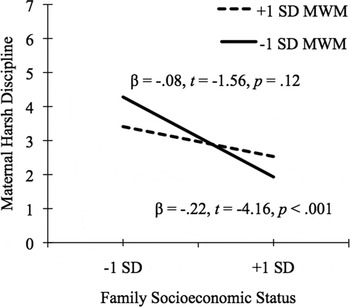
Next, simple slope analyses were conducted to parse the significant interaction between maternal working memory and family SES on maternal harsh discipline. We utilized an online utilities program (Preacher, Curran, & Bauer, Reference Preacher, Curran and Bauer2006; http://www.quantpsy.org/interact/mlr2.htm) for our simple slope analyses. Maternal working memory was set as the moderator, and both maternal working memory and SES were plotted at +/– 1 SD from their means. The results showed that the simple slope for mothers with lower working memory was significantly different from zero (β = –0.22, t = –4.16, p < .001), whereas the simple slope for mothers with higher working memory was not significantly different (β = –0.08, t = –1.56, p > .10). Specifically, for mothers with working memory that fell 1 SD below the mean, lower levels of family SES were associated with higher levels of maternal harsh discipline. Conversely, for mothers with working memory that fell 1 SD above the mean, family SES was not associated with maternal harsh discipline (see Figure 2).
Plot of significant Family Socioeconomic Status × Maternal Working Memory interaction on maternal harsh discipline. Standardized coefficients, t scores, and p values for simple slopes are shown for each line. MWM, Maternal working memory.

Discussion
The findings from the present study demonstrate the utility of family stress (e.g., Conger et al., Reference Conger, Conger and Martin2010) and psychobiological parenting frameworks (e.g., Barrett & Fleming, Reference Barrett and Fleming2011) for understanding socioeconomic-related differences in children's early working memory. In particular, the current findings suggest that maternal harsh discipline might partially mediate the association between family SES and child working memory outcomes, over and above the influence of maternal responsiveness. To date, most studies examining relations between SES and individual differences in children's working memory have either assessed older samples (e.g., Doan & Evans, Reference Doan and Evans2011; Evans & Schamberg, Reference Evans and Schamberg2009; Hackman et al., Reference Hackman, Betancourt, Gallop, Romer, Brodsky, Hurt and Farah2014) or utilized cross-sectional designs (e.g., Noble, McCandliss, & Farah, Reference Noble, McCandliss and Farah2007; Noble et al., Reference Noble, Norman and Farah2005; Sarsour et al., Reference Sarsour, Sheridan, Jutte, Nuru-Jeter, Hinsh and Boyce2011). In addition, examination and simultaneous comparison of specific caregiving mechanisms has largely been neglected, which has limited precision in our understanding of how different forms of caregiving might influence child working memory outcomes. Thus, to our knowledge, this represents the first study that has found specific associations among family SES, maternal harsh discipline, and child working memory during this developmental period.
As stated previously, disciplinary situations are one of the primary contexts of parent–child interaction after the age of 2. For example, research has shown that conflict between parents and young children occurs between 3.5 and 15 times an hour (Dix, Reference Dix1991). One of the stage-salient tasks for children during this developmental period is the acquisition of regulation and control. Toward this, parents are required to utilize the resources at their disposal to modify their child's behavior so it conforms to societal standards and expectations while also teaching strategies to inhibit personal desires and distractions from competing attention grabbing stimuli. Dysfunctional forms of discipline, such as harsh discipline, are theorized to undermine children's acquisition of these stage-salient tasks. In particular, overly punitive, critical, and power-assertive discipline is thought to limit child's opportunities for honing their emerging capacities for independent control of attention and behavior (e.g., Fox & Calkins, Reference Fox and Calkins2003). However, how harsh discipline might also influence underlying neurocognitive mechanisms that contribute to self-control of emotion and behavior are less understood. Given that developmental context of discipline coincides with significant age-related changes in child's capacity for attentional control (e.g., Diamond et al., Reference Diamond, Prevor, Callender and Druin1997; Hughes, Reference Hughes1998), the current results potentially indicate that harsh discipline may confer negative developmental consequences for children's working memory.
On a biological level, it is widely understood that the human and animal brain is highly plastic during early childhood, and open to the influence of the immediate caregiving context (e.g., Cicchetti, Reference Cicchetti2002; De Bellis, Reference De Bellis2001). Within the animal literature, studies have found that exposure to acute, uncontrollable stress impairs working memory abilities of the prefrontal cortex (Arnsten & Goldman-Rakic, Reference Arnsten and Goldman-Rakic1998; Murphy, Arnsten, Goldman-Rakic, & Roth, Reference Murphy, Arnsten, Goldman-Rakic and Roth1996). In the human literature, experiences of child maltreatment and other forms of psychosocial stress have been associated with greater perturbations in specific brain regions and physiological mechanisms that influence the degree of balance between higher order prefrontal control systems and the lower order limbic systems involved in automatic, emotional reactive responding, often resulting in the latter being a more efficient and potent driver of behavior (Cicchetti & Curtis, Reference Cicchetti and Curtis2005; Cicchetti & Rogosch, Reference Cicchetti and Rogosch2009; Pollak, Cicchetti, Klorman, & Brumaghim, Reference Pollak, Cicchetti, Klorman and Brumaghim1997; Pollak, Klorman, Thatcher, & Cicchetti, Reference Pollak, Klorman, Thatcher and Cicchetti2001). Thus, it could be that socioeconomic adversity and harsh discipline during this developmental window alters brain areas that support working memory and related neurocognitive processes. Given we did not assess neurobiological structures that support working memory within out current study, our interpretations are speculative but offer a potential blueprint for future research.
Consistent with our hypotheses, we did not find maternal responsiveness to mediate associations between family SES and child working memory over and above harsh discipline. To date, there has been limited research on associations between maternal responsiveness and child working memory in early childhood as the majority of research has focused on caregiving in relation to global executive functioning (Fay-Stammbach et al., Reference Fay-Stammbach, Hawes and Meredith2014). However, we believe our results can be interpreted within a domain-approach to parenting framework (Grusec & Davidov, Reference Grusec and Davidov2010), which posits that maternal responsiveness during reciprocal parent–child interactions primarily functions to communicate to the child that the caregiver is available and attuned to child requests. This sharply contrasts with disciplinary contexts where caregivers are using discipline methods to help children achieve greater self-control over their emotions and behaviors in the face of competing personal interests and distractions. This may explain why in the developmental literature, greater maternal responsiveness is often more correlated with later peer acceptance, cooperation, and positive affect regulation (e.g., Davidov & Grusec, Reference Davidov and Grusec2006; Grusec & Davidov, Reference Grusec and Davidov2010), which on a behavioral level are less relevant to individual differences in working memory.
Psychobiological models of maternal caregiving (Barrett & Fleming, Reference Barrett and Fleming2011; Mileva-Seitz & Fleming, Reference Mileva-Seitz, Fleming, Booth, McHale and Landale2011) emphasize the importance of examining how neurocognitive mechanisms within the caregiver might alter the extent to which broader contextual factors impact caregiving and ultimately child functioning. A secondary aim of the present analyses was to examine how maternal working memory may mitigate the risk that family SES has for mothering and ultimately child working memory. We also included child negative emotionality as a covariate to determine if effects would still be present above the potential effect of child characteristics that might elicit negative caregiver reactions. Our results revealed that maternal working memory significantly moderated the influence of family SES on maternal harsh discipline, even while controlling for child negative emotionality. Maternal harsh discipline continued to partially mediate the main effects of family SES on children's working memory with the interaction path in model. In addition, we found that there was no main effect of child negative emotionality on child working memory. Advancing our previous work (Sturge-Apple et al., Reference Sturge-Apple, Suor and Skibo2014), we also found that the mitigating effect of maternal working memory was specific to harsh discipline, as moderating pathways did not predict maternal responsiveness. The finding of specificity in the moderating effect of maternal working memory on harsh discipline within the context of child working memory development is intriguing, and to our knowledge, this is the first study to find empirical support for this.
Consistent with our previous study, our simple slope analyses revealed that for mothers with lower working memory, higher harsh discipline was observed as family SES decreased. In other words, lower maternal working memory was only a risk factor for use of harsher disciplinary practices within lower SES environments. As we describe in Sturge-Apple et al. (Reference Sturge-Apple, Suor and Skibo2014), this aligns with the notion that risk situations may have similar effects on working memory as do experimental manipulations of cognitive load (e.g., Hester & Garavan, Reference Hester and Garavan2005), such that individuals with lower working memory are more susceptible to experiencing failures in effortful control of emotion and behavior when environmental stress is increased than those with higher working memory.
At the bivariate level, we did observe small but significant correlations between child negative emotionality and some of the indicators of SES (e.g., neighborhood chaos and maternal education), and in our path model, higher levels of child negative emotionality was associated with greater use of maternal harsh discipline. Thus, lower rates of child behavior problems may partially account for why lower maternal working memory is not associated with harsher discipline within higher resource socioeconomic contexts. Consistent with our previous study, we also found that the association between family SES and harsh discipline was not significant for mothers with higher levels of working memory, even with child negative emotionality in the model. It was interesting that this finding still held; one might expect that in situations where child negative emotionality is coupled with socioeconomic stress, caregivers might result to harsher discipline strategies regardless of having higher maternal working memory abilities. However, examination of bivariate associations among our sample suggests that maternal working memory and child negative emotionality were not correlated, which further confirms our previous finding that maternal working memory is a protective factor against use of harsh discipline despite the presence of higher sources of stress in low-income environments. Critically, within our broader model, this result may also represent one resilience pathway for better working memory outcomes among low-income children.
To our knowledge, this was the first study that examined the potential mitigating effects of maternal working memory on associations between family SES and maternal responsiveness. There have been a couple of studies that have found associations between maternal working memory and maternal responsiveness within higher risk samples. For example, two studies have documented associations between maternal working memory and sensitivity to child cues during infancy among mothers with histories of maltreatment and other forms of psychosocial adversity (e.g., Chico, Gonzalez, Ali, Steiner, & Fleming, Reference Chico, Gonzalez, Ali, Steiner and Fleming2014; Gonzalez et al., Reference Gonzalez, Jenkins, Steiner and Fleming2012). The current contrasting findings may be interpreted based on a psychobiological model of maternal caregiving. As delineated by Barrett and Fleming (Reference Barrett and Fleming2011), the challenges that mothers face vary depending on developmental age of the child, and different developmental stages require different adaptations in caregiving. They argue once specific forms of caregiving behavior become more habituated and consolidated within the mother–child relationship, more familiar caregiving contexts may not activate higher order executive processes to the same degree. Based on this framework, it could be that individual differences in maternal working memory are more proximally associated with maternal responsiveness and sensitivity in mothers with infants, and the strength of these associations may weaken over time and become more relevant to the discipline domain of caregiving, which might require more effortful processing. This might be the case for low-income mothers in particular, who are not only coping with child misbehavior but with social and economic challenges as well.
Collectively, this research highlights how individual differences in maternal executive functions, such as working memory, might differentially influence caregiving practices depending on the broader socioeconomic context, and how this might in turn influence the development of corresponding cognitive processes in children. Despite these intriguing findings and their potential public-health implications, this research is not without its limitations. This study was correlational with only two waves of data, which significantly attenuates causal interpretations. Relatedly, this study did not assess child working memory at the first wave, so we were not able to control for baseline levels and assess change over time. Future work should examine how the interplay between socioeconomic and caregiving processes influences developmental changes in children's working memory. Moreover, use of experimental and larger multiwave research designs will help to strengthen conclusions regarding causality. Due to the limited number of maternal cognitive assessments, we were unable to control for maternal IQ and verbal ability. Although working memory is considered to be a foundational process that supports more global aspects of cognitive functioning, and previous research has demonstrated working memory as a unique contributor to reactive forms of maternal caregiving while controlling for maternal IQ (Deater-Deckard et al., Reference Deater-Deckard, Sewell, Petrill and Thompson2010), this represents a limitation of the study. In addition, it will be important for future work to include global measures of maternal self-regulation to parse effects further.
There were also limitations with respect to our measurement of the caregiving environment. In particular, future work should assess broader aspects of the home environment and the potential influence of other caregivers, such as fathers, which might help to strengthen conclusions regarding specificity. In this vein, it will be important to test alternative moderating and mediating pathways with respect to caregiver working memory and parenting. Although our intent was to conceptualize family SES from a family stress perspective (Brooks-Gunn & Duncan, Reference Brooks-Gunn and Duncan1997; Conger et al., Reference Conger, Conger and Martin2010), which emphasizes how the confluence of risk impacts parental functioning and child outcomes, another important direction might include parsing the influence of specific socioeconomic stressors. Finally, even though we assessed the effects of child negative emotionality, we did not assess whether poorer child working memory at age 3.5 might have evoked harsher discipline.
In sum, the present study offers insights into how the interplay among family SES, maternal working memory, and specific forms of maternal caregiving may have negative consequences for the development of children's working memory. Cognitive psychology models propose that working memory might represent a central process that both moderates and mediates the link between exposure to early or chronic situational risk factors and pervasive failures in self-regulation across the lifespan (e.g., Hofmann, Friese, Schmeichel, & Baddeley, Reference Hofmann, Friese, Schmeichel, Baddeley, Vohs and Baumeister2011). Thus, these findings may implicate developmental precursors to various psychopathologies and health problems, such as depression (Joormann & Gotlib, Reference Joormann and Gotlib2008) and alcohol abuse (Bechara & Martin, Reference Bechara and Martin2004). The results also have implications for intervention. For example, animal studies have provided preliminary evidence to suggest that targeted training can alter neuronal circuitry in ways that lead to enhancement in different aspects of working memory (e.g., Arnsten, Reference Arnsten2015). Recent working memory trainings with humans have demonstrated initial effectiveness in improving working memory in conjunction with decreasing anxiety (Siegle, Ghinassi, & Thase, Reference Siegle, Ghinassi and Thase2007) and increasing effortful regulation of behavior in psychiatric populations (Bickel, Yi, Landes, Hill, & Baxter, Reference Bickel, Yi, Landes, Hill and Baxter2011). In addition, preliminary studies on working memory trainings with young children have shown some promising results (e.g., Diamond & Lee, Reference Diamond and Lee2011; Holmes, Gathercole, & Dunning, Reference Holmes, Gathercole and Dunning2009). A potential avenue to remediate risk may be to design a parent–child intervention that targets improving working memory skills in caregivers and children simultaneously, which might have multiple benefits, including improving the quality of the parent–child relationship, caregiver functioning, and promoting better academic and mental health outcomes in children. Ultimately, we may find that greater societal investment in developing targeted preventive interventions that focus on increasing neurocognitive skills in caregivers and children may help to disrupt the cyclical nature of mental health issues that disproportionately affect low-income populations.