Introduction
Dementia occurs in every region of the world. Ferri et al. (Reference Ferri2005) estimated that, there are 24.3 million cases of dementia worldwide, with an annual incidence of 4.6 million cases per year. According to that estimate, the numbers will double every two decades reaching a figure of 81.1 million by the year 2040, with over 70% of them living in the developing countries (Ferri et al., Reference Ferri2005). Prevalence of dementia varies from one region of the world to another (Hatada et al., Reference Hatada, Okazaki, Yoshitaka, Takada and Nakane1990, Hendrie et al., Reference Hendrie1995; Chandra, et al., 1998; Riedel-Heller et al., Reference Riedel-Heller, Busse, Aurich, Matschinger and Angermeyer2001; Shaji et al., Reference Shaji, Bose and Verghese2005; Zhang et al., Reference Zhang2005; Rodriguez et al., Reference Rodriguez2008). In reviews by Jorm and Jolley (Reference Jorm and Jolley1998) and Fratiglioni et al. (Reference Fratiglioni, De Ronchi and Agűero-Torres1999), some of the reasons adduced for these differences include methodology, sampling and diagnostic pattern. This issue was explicitly demonstrated by the study of Erkinjuntti et al. (Reference Erkinjuntti, Øtbye, Stern-Huis and Hachinski1997) in which data from the Canadian Study of Health and Aging were subjected to different diagnostic methods and poor agreement was found. In addition to methodological differences, Hatada et al. (Reference Hatada, Okazaki, Yoshitaka, Takada and Nakane1990) suggested that culture, lifestyle and urbanization might influence this variation. Prevalence of dementia can also vary between regions of the same country as was the case in India (Shaji et al., Reference Shaji, Bose and Verghese2005; Vas et al., Reference Vas, Pinto and Panikker2001).
The prevalence estimate of dementia in Europe based on the results of 11 population studies was 6.4% in persons over the age of 65 years (Berr et al., Reference Berr, Wancata and Ritchie2005). This is higher than those from developing countries (Hendrie et al., Reference Hendrie1995; Chandra et al., 1998; Shaji et al., Reference Shaji, Bose and Verghese2005; Jacob et al., Reference Jacob, Kumar, Gayathri, Abraham and Prince2007; Rodriguez et al., Reference Rodriguez2008).
Likewise, community-based studies on dementia in Africa reported low prevalence. Hendrie et al. (Reference Hendrie1995) reported a prevalence of 2.29% for dementia and 1.41% for Alzheimer's disease in the Yoruba of Nigeria, while Guerchet et al. (Reference Guerchet2009) reported a prevalence of 2.6% for dementia in the Republic of Benin. However, Farraq et al. (Reference Farraq, Farwiz, Khedr, Mahfouz and Omran1998) reported a prevalence of 4.5% among elderly Arabs in Egypt over the age of 60 years.
In view of the fact that few community-based studies of dementia have been carried out in Africa, there is a need for further epidemiological studies, especially in areas where there seems to be some cultural and educational differences when compared with areas already studied.
Methods
Study area
This was a cross-sectional descriptive study carried out in Zaria, which is an ancient walled city populated predominantly by a Hausa-Fulani ethnic group and founded around AD 1000. It lies within the Savannah region of northern Nigeria and it consists of six political wards with an estimated population of 345,200 (based on the 1991 National Population Census), 3.5% of whom are 65 years and older (National Population Commission, 1993). A large number of buildings within the city are made of mud bricks with thatched roofs, but some modern houses now exist side by side with their traditional neighbors.
The majority of male inhabitants are subsistence farmers and merchants, but a few are full-time Islamic scholars. Some female inhabitants engage in small trading and cottage crafts, but most undertake domestic duties in the home.
Age determination
The majority of the participants did not have birth certificates, though some had their births recorded using the lunar system of Islamic dating. However, they were able to relate their ages to important historical events which took place in the city or in Northern Nigeria. A table of such historical events was drawn up and tested using ten subjects who had documented birth records and did not participate in the study. Their ages were estimated using major historical events and these were compared with their birth records. The estimations were found to be correct within a margin of error of one to two years. A similar method was used among elderly Yoruba Nigerians in Ibadan (Ogunniyi and Osuntokun, Reference Ogunniyi and Osuntokun1993). Participants whose dates of birth were recorded using lunar system of Islamic dating had them converted to the Gregorian calendar using the following formula: Gregorian year = {(32 × Hijira year ÷ 33) + 622} (Lunde, 2006). Additional information was the age at which males started paying poll taxes (18 years) and the age of marriage for females (about 13–14 years in the past), as well as the age of the first child. These were used were used to cross-check the estimates.
Grading of education and literacy
In Zaria city, a local form of education based on the Koran has been in existence for centuries. This system is well established and it is possible to equate various levels roughly with primary, secondary and post secondary education. Aside from this there is the western form of education which is also well entrenched, and some of the older persons in this cohort have acquired both forms of education. In order words, there are two parallel forms of education but virtually all participants experienced some level of local education. Instructions in local education are given in either the Hausa or Arabic language; both of which have written forms. The usual pattern is that children attend schools for formal education in the morning and local koranic schools in the evenings Literacy in this study is defined as the ability to read and write in any language. This was confirmed by ability to read the consent form and also the ability to write a sentence during administration of the Mini-mental State Examination (MMSE). The grading of years of local education was carried out in consultation with Islamic clerics.
Instruments
The following instruments were used in the study:
Community Screening Interview For Dementia (CSI-D)
This instrument was designed by Hall et al. (Reference Hall, Hendrie, Brittain and Norton1993) to screen for dementia in cross- cultural community studies. It consists of two sections: a cognitive test and an informant interview. The informant section assesses performance in everyday living, memory and social activities. The strength of the CSI-D lies in two areas. The first is that literacy dependent items are excluded. The second is the informant interview, which gives an insight into the subject's cognitive functioning and daily activities. Therefore, it has a high probability for predicting dementia. Three different scores can be generated from the CSI-D: the COGSCORE is obtained from the cognitive test section; the RELSCORE from the informant interview; and a discriminant function score (DFSCORE) is derived by combining the COGSCORE and RELSCORE. The CSI-D has been translated into various languages and validated in various communities all over the world (Hall et al., Reference Hall, Gao, Emsley, Ogunniyi, Morgan and Hendrie2000; Prince et al., Reference Prince, Acosta, Chiu, Scazufca and Verghese2003; Liu et al., Reference Liu, Prince, Chiu, Chen, Sun and Yip2005).
Consortium to Establish Registry for Alzheimer's disease (cerad)
The CERAD was developed for diagnosis of dementia in the elderly (Morris et al., Reference Morris1989). The version modified by the Indianapolis-Ibadan Dementia project was used in this study. However, two sections of the CERAD were excluded due to the effect of education. These are the Boston Naming Test and the Constructional Praxis; the latter being replaced by the Stick Design Test (Baiyewu et al., Reference Baiyewu2005). In the Stick Design Test a subject is asked to use match sticks to construct objects of various geometrical shapes. The stick design test discriminates between normal, cognitive impairment and dementia. Other sections of the CERAD used are Mini-mental State Examination (modified to take into account the effect of education), the Animal Fluency Test, Word List Learning Test, and Delayed Recall Test. Normative values for Nigerians have been previously determined (Gureje et al., Reference Gureje1997).
Blessed dementia scale
This is a widely used questionnaire for assessing activities of daily living in subjects with dementia (Blessed et al., Reference Blessed, Tomlinson and Roth1968). It is an 11-item instrument administered to an informant, usually a relative of the subject. The Blessed Dementia Scale is easy to administer and has been used in previous studies in Nigeria (Hendrie et al., Reference Hendrie1995). The instrument generates scores ranging from 0 to 16, with higher scores indicating impairment.
Sociodemographic questionnaire
This was designed to obtain sociodemographic information about the subjects, taking into consideration the broader characteristics of the study population. The sociodemographic questionnaire assesses literacy and duration of both Western and local education, and other demographic variables. Education was dichotomized into more or less than 6 years because children spend 6 years in primary school and such education is generally adequate to make them proficient in reading and writing.
Translation of the instruments
The instruments used in the study were translated into the Hausa language by bilingual experts, one of whom was a psychiatrist. The Hausa language version was back translated by another psychiatrist. A panel of four physicians consisting of the two translators and two other physicians met and harmonized the two versions.
Training in the use of the instruments
One of us (AJY) administered all the instruments having been trained in their use by OB and members of the Ibadan Dementia Project. In addition, AJY observed the administration of these instruments on subjects enrolled in the Ibadan Dementia Project. OB also visited Zaria city and participated in the assessment of a random sample of subjects in the field.
Sample size determination
The sample size was calculated based on the prevalence rate of dementia reported in Ibadan, Nigeria (Hendrie et al., Reference Hendrie1995), at 95% confidence interval and 0.02 degree of precision. A total sample size of 214 subjects was calculated. However, this was increased by 50% to give a total of 322 subjects.
Ethical clearance
Approval of the Scientific and Ethical Committees of both Ahmadu Bello University Teaching Hospital and Kaduna State Ministry of Health was obtained for the study. Informed consent was obtained from all the subjects and their caregivers before interviews were conducted. The consent form was written both in English and Hausa.
Pilot study
A pilot study was conducted in the community using ten subjects who were not included in the main study. This was to ensure the appropriateness of the instruments and to identify any problems likely to be encountered during the main study. One of the problems identified was the instruction in the CSI-D requesting that the interviewer pat a chair and instruct the participant to name it. This presented some difficulty as both the subject and the interviewer usually sat on a mat with no chair in sight. We therefore had to carry a plastic chair along during the main study.
Procedure
Zaria city consists of six political wards. The six ward heads were invited for discussion at the beginning of the study and were asked to select the two wards in which the study would be conducted by ballot. The two wards selected through balloting were Kwarbai and Limanci.
In each of the two wards boundaries were established with the assistance of the ward heads. This was followed by numbering and listing of all the housing units in each ward by AJY with the help of two local guides and a representative of the ward head. The list of the housing units formed the sampling frame from which the subjects were selected.
Thereafter, a systematic sampling technique was used to select the housing units from which the subjects for the study were recruited. This was carried out by determining the sampling fraction (f) using the following formula by Singha (Reference Singha1996):

Using a random number table, a number x was drawn less than the sampling interval K, where K = 1/f.
The housing unit on the sampling frame which corresponded to the serial number “x” was picked as the first housing unit. Subsequent housing units were selected using the following formula: x + K, x + 2K, x + (n – 1) K (Singha, Reference Singha1996).
In each of the housing units selected, subjects who fulfilled the inclusion criteria were enrolled for the study. In a few situations where more than one subject fulfilled the inclusion criteria in a housing unit, all were enrolled. Age was determined at the point of enrollment. The name, age, sex and address of each subject were recorded for easy tracing during the interview phase of the study. This was a face-to-face interview that took place in the subject's house. The consent form was read out to each subject who could not read and they were requested to sign or thumb-print the form before commencement of the interview.
All the subjects were interviewed in the Hausa language irrespective of their proficiency in English and all underwent a physical examination. The survey took place between March and October 2007.
Diagnosis
The diagnosis of dementia in this study was based on fulfilling the diagnostic criteria for dementia in both ICD-10 and DSM-IV. The DSM-IV criteria were used to diagnose AD while ICD-10 criteria were used for vascular dementia (American Psychiatric Association, 1994; World Health Organization, 1992). Dementia with Lewy bodies was diagnosed using clinical criteria (McKeith et al., Reference McKeith, Galasko and Korsaka1996), and the clinical criteria for frontotemporal dementia (McKhan et al., Reference McKhann, Albert, Grossman, Miller, Dickson and Trojanowski2001) were used to subtype other cases of dementia. Although individual item scores on the CSID were reviewed with scores of other questionnaires during diagnosis, COG scores and df scores which are computer generated were not factored into the diagnosis. Diagnosis was by consensus between OB and AJY, after reviewing all available information from the questionnaires and clinical evaluation.
Data management
The data obtained from the study were cleaned and coded. Version 15 of the Statistical Package for Social Sciences (SPSS) was used for analysis. Descriptive statistics were used for all continuous and categorical variables, and frequency distribution and cross tabulations were generated. Confidence intervals for prevalence estimates were calculated, and mean scores were compared using student's t-test and χ2 test for categorical variables. Statistical significance was set at 5% level of probability. After univariate and bivariate analysis, multiple regression was done on those variables that were significant in the initial analysis.
Results
Sociodemographic characteristics:
All 322 subjects who were initially approached agreed to participate, probably because of the reassurance they had from the ward heads and the religious leaders, and the prospect of receiving some form of health care.
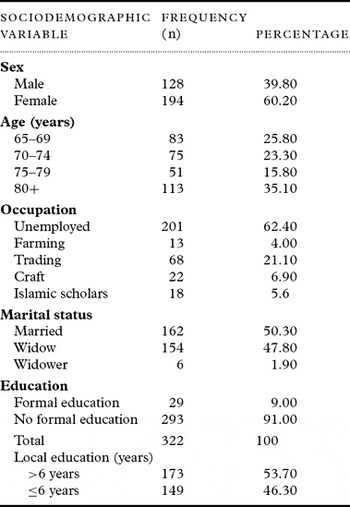
The sociodemographic characteristics of the subjects are shown in Table 1. Of the 322 subjects interviewed, 194 (60.2%) were female. The overall mean age of the subjects was 75.54 years (SD ± 9.41), with the mean age of males being slightly higher at 77.13 (SD. ± 10.23) years compared with 75.42 (SD. ± 8.93) years for females. However, there was no significant difference. There were 113 subjects (35.1%) who were 80 years or older, while 64.9% of the subjects were below the age of 80 years. Thirty-one subjects (12.1%) received a monthly pension.
Sociodemographic characteristics of the subjects

All the subjects lived in multigenerational settings, in some cases up to four generations living together. The subjects were divided into two groups: those without dementia and those with dementia. The Cog and df scores of the two diagnostic groups are shown in Table 2; as expected, those with dementia had poorer performance on both Cog scores and df scores (p < 0.001).
Mean Cog and df scores by diagnostic groups

Prevalence of dementia and dementia subtypes:
The prevalence of dementia in the study was 2.79% (CI 1.0–4.58%). The prevalence of Alzheimer's disease (AD) was 1.86% (0.37%–3.35%). The most common type of dementia was AD, accounting for 66.67% of subjects with dementia. The second most common type was vascular dementia (VaD) constituting 22.22%, while frontotemporal dementia accounted for only one case (11.11%).
Risk factors for dementia:
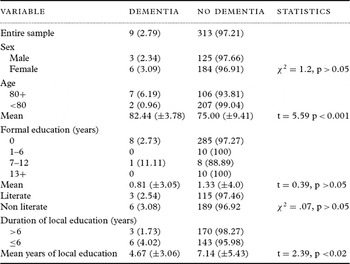
In the initial analysis there were more females than males with dementia. There was also a higher prevalence in those subjects aged 80 years and over and a higher prevalence in subjects with less than six years of local education (Table 3).
Prevalence of dementia by sociodemographic group

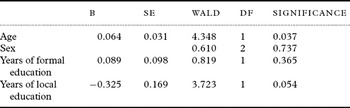
However, after multiple regression in which age, sex, years of local education and years of Western education were entered into the equation, with the dependent variable being dementia/no dementia, only age came up as significant (Table 4).
Summary of multiple regression

Discussion
The prevalence of dementia in this study is similar to that reported for elderly Yoruba in Ibadan (Hendrie et al., Reference Hendrie1995). A recent collaborative study between researchers from France and the Benin Republic (a neighboring country to Nigeria) also reported a prevalence of 2.6% for dementia (Guerchet et al., Reference Guerchet2009).
Multigenerational living arrangements are very common in most developing countries and very few subjects live alone. This means that there are many potential caregivers for the elderly, although this may not always translate into adequate care.
Another important finding is that only 12.1% of the participants in this study were on a pension. Although we did not measure family income, the pension received by a participant is a measure of the money available for care in a country where there is no other public assistance.
The prevalence of dementia in this study is relatively low, as has been reported in a number of other studies in developing countries (Hendrie et al., Reference Hendrie1995; Chandra et al., 1998; Vas et al., Reference Vas, Pinto and Panikker2001; Shaji et al., Reference Shaji, Bose and Verghese2005). AD is the most common type of dementia reported by this study, a finding similar to many others studies including those from developing world (Hendrie et al., Reference Hendrie1995; Shaji et al., Reference Shaji, Bose and Verghese2005).
The prevalence of dementia in this study increases with advancing age, as observed in many previous studies both in developing and technologically advanced countries. An important factor in dementia research is education. It has been postulated that education is protective against dementia (Katzman, Reference Katzman1993). Formal Western education is low among elders of many developing countries. In this study, neither Western education nor local koranic education are independently related to dementia, and thus are not protective against dementia. The reason for this is unclear, but the sample size and inherently low level of Western education may partially explain this.
By comparison, the population in Zaria is similar to Ibadan with regard to Western education, occupations, income and multigenerational living arrangements. The local form of education described here is also available in Ibadan, but was received by a much lower percentage of people.
An ongoing controversy on the issue of lower prevalence of dementia in developing countries centers around the fact that elders in these regions are not expected to involve themselves in the instrumental activities of daily life, as the family takes care of these. It is postulated that some family members with mild dementia might thus be missed (Rodriguez et al., Reference Rodriguez2008). However it is possible that there are true differences which might be due to a differentially higher mortality in the developing countries because of poorer health care, lower cardiovascular risk factors and genetic or racial factors. Apolipoprotein ϵ4, a known risk factor for AD, is not found to be related to either dementia or AD in two studies from West Africa (Gureje et al., Reference Gureje2006, Guerchet et al., Reference Guerchet2009). Also the only incidence study on dementia to be carried out in Africa reported a lower incidence rate compared with studies from developed countries (Hendrie et al., Reference Hendrie2001). Apart from this, while elders in Africa may be excused some household chores, they certainly receive greater social stimulation, and remain involved in the decision-making at many levels.
Conclusion
The prevalence of dementia is low in this cohort of community-dwelling elderly in northern Nigeria, as has been reported elsewhere. However, dementia increases with age, and, in this study, is not shown to be affected by local education or formal Western education. One strength of this study is that we did not do a two-stage study consisting of screening and clinical evaluation. Prince et al. (Reference Prince, Acosta, Chiu, Scazufca and Verghese2003) have shown that a single stage assessment may be more cost effective in developing countries and might even limit attrition.
Conflict of interest
None.
Description of authors’ roles
OB designed the study. Data collection was undertaken by AJY, who also wrote the initial draft of the paper. All authors participated in reviews of the draft as well as initial planning of the study.
Acknowledgments
The authors are grateful to the Emir of Zazzau for his support towards this study. They also thank the elders of Zaria and the members of Ibadan Dementia Research Project.