


Introduction
There has been much work since the 1970s on the order of emergence of various interrogative structures produced by children and how this is to be explained. There has been significantly less work on the emergence of understanding, (though see e.g., Casillas, Bobb & Clark, Reference Casillas, Bobb and Clark2016; Ervin-Tripp, Reference Ervin-Tripp1970; Tyack & Ingram, Reference Tyack and Ingram1977; Veneziano, Reference Veneziano1985).
In this paper we consider the order of emergence of comprehension of wh-questions and polar-questions. What are the factors that determine the order of emergence of understanding? Plausible factors to consider are the semantic and syntactic complexity of different kinds of questions and of the answers associated with such questions. As we discuss in our Background (literature review) section, considerations of complexity and input favour the earlier emergence of polar-questions; on the other hand, if one assumes that question understanding emerges as a consequence of interactive learning (Moradlou & Ginzburg, Reference Moradlou, Ginzburg, Muller and Rieser2014), this favours (certain) wh-questions, as well as a small subclass of polar-questions, primarily those used as requests.
After discussing previous work on the emergence of questions in production and comprehension in the Background section, we present corpus evidence from the Providence corpus (Demuth, Culbertson & Alter, Reference Demuth, Culbertson and Alter2006) in the Corpus Section. This suggests, with several important caveats, that wh-questions emerge earlier than (information oriented) polar-questions; one caveat is that this is a generalization that does not concern interrogative structures/construction types as such, but uses to which the interrogatives are put.Footnote 1 In this way it is analogous to proposition (the denotation of declarative uses, belief states etc). Hence, here we reserve interrogative for the structure/construction type. Another is that interrogatives that intrinsically involve sentential answers (such as why- or how-questions) are apparently understood later. We tested this finding using elicitation studies on German and Chinese speaking children described in Section Methods. As discussed in our Results and Discussion section, these elicitation studies confirm the finding from the corpus study. Some implications and further work are discussed in a concluding section.
Background
The syntax and semantics of questions and short answers
Although there has been much work in formal semantics on the meaning of interrogatives (for surveys see e.g., Ginzburg, Reference Ginzburg, van Benthem and ter Meulen2010; Groenendijk & Stokhof, Reference Groenendijk, Stokhof, van Benthem and ter Meulen1997; Wiśniewski, Reference Wiśniewski, Fox and Lappin2015), as Wiśniewski (Reference Wiśniewski, Fox and Lappin2015, p.377) says ‘No commonly accepted theory of questions has been elaborated so far.’ The questions literature has not addressed the issue of how questions might be acquired, nor for any given theory the cognitive plausibility of the semantic entity that theory assumes as an interrogative denotation.
Nonetheless, on just about all existing theories, the entities denoted by wh-interrogatives are (in a sense we will elaborate on shortly) more complex entities than those denoted by polar-interrogatives. We exemplify this with respect to two such theories. In the partition theory (Groenendijk & Stokhof, Reference Groenendijk, Stokhof, van Benthem and ter Meulen1997), a question is seen to be a partition of the set of possible worlds. Each block of the partition represents an exhaustive answer to the question. On this account, a polar-interrogative denotes a partition that has exactly two entities (corresponding to the question being resolved positively or negatively, respectively.) With a unary wh-interrogative, the size of the partition is less determinate; it depends on the number of possible candidate entities that could serve as fillers for the property in question – if that number is known to be n, then the size is 2n.Footnote 2
In the propositional function view of questions (Ginzburg, Reference Ginzburg2012; Ginzburg & Sag, Reference Ginzburg and Sag2000) on the other hand, a polar interrogative denotes a constant function, whose value is the queried proposition. A unary wh-interrogative denotes a function from possible candidate entities into the answers where they instantiate the property in question.
On both views, the polar-question is an entity whose makeup does not vary with the nature of the queried proposition, in contrast to the wh-question whose complexity is tied to the predicate and wh-word at issue.
From a syntactic point of view once again there is no clear argument that polar-interrogatives are more complex; if anything, the opposite holds. We mention two representative views. In Head-Driven Phrase Structure (HPSG) (Ginzburg & Sag, Reference Ginzburg and Sag2000; Sag, Reference Sag2010) polar-interrogatives are analyzed as a subtype of the Subject-Auxiliary-Inversion (SAI) construction, a ternary branching construction headed by an auxiliary verb; (root) wh-interrogatives are analyzed as involving a filler–gap structure whose head–constituent is also a subtype of the Subject-Auxiliary-Inversion construction.Footnote 3 While the details and conception in Government and Binding and Minimalist analyses are quite different (Chomsky, Reference Chomsky1986, Reference Chomsky1995) – for comparison between the frameworks’ approaches see (Borsley & Müller, Reference Borsley, Müller, Müller, Abeillé, Borsley and Koenig2019; Müller, Reference Müller2018) – a similar point can be made for these analyses. In GB theory polar interrogatives are analyzed as binary branching structures headed by the auxiliary viewed as the complementizer of an IP, whereas a wh-interrogative is viewed as structure in which the wh-word is moved into a SPEC of a CP, whose sister is a C’ structure, identical to the structure posited for the polar interrogative.Footnote 4 Although minimalism changes many aspects of the analysis, in terms of the basic structure, there is no significant difference between GB and minimalist analyses. Thus, both HPSG and GB and minimalist analyses have polar interrogative structures (or essentially isomorphic structures) as constituents of the structures they posit for wh-interrogatives.
What of the complexity of the form of the answers that children use initially to reply to questions, one word (or more generally non-sentential) short answers to wh-interrogatives and one word answers to polar questions?Footnote 5 Here the answer given is also theory-specific, but theory involves two dimensions, syntax-semantics interface and the denotations assigned to the words and phrases involved.
From a semantic point of view yes has often been viewed as a function that returns as output a proposition derived from the question asked (Ginzburg, Reference Ginzburg2012; Groenendijk & Stokhof, Reference Groenendijk and Stokhof1984); no involves a somewhat more complicated function: for positive polar-questions, it returns the negation of the proposition derived from the question asked, whereas for negative polar-questions it affirms the proposition derived from the question asked. In both cases, one needs to operate on propositions – abstract entities of some kind. Answering a wh-question involves predication: the property associated with the question of the referent deriving from the answer. But in this case, at least for some types of wh-phrases, the predication involves concrete arguments: visible entities or locations.Footnote 6
A syntactic perspective on this views both polar words and short answers as remnants of fully spelled out sentences. Merchant (Reference Merchant2004) develops a view of short answers as involving fronting and deletion of the remaining material (see Jacobson (Reference Jacobson2016) for detailed critical comparison between this proposal and semantically-based proposals). Similarly, Holmberg (Reference Holmberg2015) proposes that yes and no associate with the specifier of focus phrase (FocP) in the left periphery of p-structure, linking up with a null element associated with the complement of the focus head: namely, a polarity phrase (PolP). As far as one can gather, there is no very obvious complexity difference between polar words and short answers – they both involve dislocation of the non-sentential utterance to the left periphery, generation of sentential material and its deletion.
To summarize:
1. Semantic theories of questions view polar-questions as generally simpler entities than wh-questions.
2. In terms of syntactic structure wh-interrogatives are viewed as structures one of whose constituents is a polar interrogative structure.
3. Semantically oriented theories of the meaning of short answers and polar words suggest that the latter are more complex in that they involve abstract propositional entities, whereas short answers with words like where, what and who involve predication of concrete entities
4. Syntactically-oriented theories of short answers and polar words do not offer a clear hypothesis with respect to their comparative complexity; both involve dislocation of the non-sentential utterance to the left periphery, generation of sentential material and its deletion.
The emergence of interrogatives
Children's production of questions.
Children's question asking behavior has long been a topic of interest (Davis, Reference Davis1932; Smith, Reference Smith1933). Smith (Reference Smith1933) reported that questions constituted 13% of children's utterances, and that the use of wh-words by children significantly declined with age (2 to 5 years) from 49 to 37 percent. The commonest wh-questions were what- and where-questions. Similarly, Ingram (Reference Ingram1971) reports that in his corpus of 10 children aged 2.5 to 3 years, 19% of children's utterances were questions. Questions are frequent from early on in speech to young children; Newport, Gleitman, and Gleitman (Reference Newport, Gleitman, Gleitman, Snow and Ferguson1977), for example, report that 44% of child directed utterances are questions (15% wh-questions, 21% polar questions and 8% deictic questions). Cameron-Faulkner, Lieven, and Tomasello (Reference Cameron-Faulkner, Lieven and Tomasello2003) report these to be 31% of maternal utterances. These early questions often have multiple communicative functions, such as requests for information or requests for action (Shatz, Reference Shatz1978, Reference Shatz1979).
Even young children recognize the turn-allocating constraint on questions (Ervin-Tripp & Miller, Reference Ervin-Tripp and Miller1977), possibly through prosodic processes (Geffen & Mintz, Reference Geffen and Mintz2011), and sensitivity to word order (Geffen & Mintz, Reference Geffen and Mintz2015). Indeed, Geffen and Mintz (Reference Geffen and Mintz2011) showed that infants as young as 7 months can differentiate between questions and statements. They investigate how this early ability arises, focusing mainly on prosodic cues, like pitch range, pitch peak and duration of the final syllable of each sentence. They showed that infants liked to listen to sentences of the same type (question or statement) as in the familiarization phase of the experiment, and that questions and statements were significantly different on the prosodic dimensions mentioned previously. However, the results do not exclude the possibility of other contributing factors such as word order. In a subsequent study Geffen and Mintz (Reference Geffen and Mintz2015) showed that 12 months olds were able to distinguish between polar interrogatives and declaratives even when all prosodic cues were removed from the acoustic signals of such utterances.
Question acquisition has been extensively studied within Government and Binding and minimalism from the mid 1980s, to assess the extent of children's syntactic knowledge, with particular interest in structure and movement in wh-interrogatives in English (see for example, de Villiers, de Villiers & Roeper, Reference de Villiers, de Villiers and Roeper2011; Radford, Reference Radford1994; Stromswold, Reference Stromswold1995; Thornton, Reference Thornton1990).
Johnson (Reference Johnson1983) showed that children's early questions consisted largely of formulaic what is this or what is that used in a limited set of routinized interactions.
She hypothesized that children first start out with a small number of formulaic uses and then extend these to a larger variety of contexts. The early formulaic utterances rely on frame types rather than the use of different wh-words.
Similarly, Dabrowska and Lieven (Reference Dabrowska and Lieven2005) studied children's early question constructions between the ages of 2 and 3, using a relatively dense corpus of spontaneous speech. They divided the corpus at each age into two parts, and attempted to derive children's syntactic questions in the test corpus from a larger main corpus, using only lexically specific units, and two operations, juxtaposition, and superimposition. This grammar could account for 90 percent of children's interrogatives in their test corpora. They analyzed the remaining 10 percent, and showed that these are no more complex than the successfully derived utterances, and that most are in fact near misses; they take this as evidence for children extrapolating from their existing linguistic knowledge rather than applying previously mastered rules. Their lexically specific grammar for children's interrogatives provides a concrete alternative to accounts requiring innate abstract rules for acquisition of interrogatives.
There appears to be a relatively robust order of acquisition for the production of wh-words in interrogatives reported for a variety of languages, in which what and where (and their cross-linguistic equivalents) are acquired before other wh-words (e.g., why, how and when) (in English for example see, Bloom, Merkin & Wooten, Reference Bloom, Merkin and Wooten1982; Brown & Hanlon, Reference Brown, Hanlon and Hayes1970; Smith, Reference Smith1933, in Serbo-Croatian, Savlć Reference Savlć1975, and in Korean, Clancy, Reference Clancy1989). Bloom et al. (Reference Bloom, Merkin and Wooten1982) proposed a complexity-based account. On this line, the first wh-questions to emerge are wh-identity questions – questions that ask for the identities of things or places. These are suggested to occur with what Bloom et al. term the ‘relatively simple’ what and where, and should occur primarily with the copula. Later on, the wh-words, which now also include who, are envisaged to start occurring with a greater variety of main verbs (e.g., Where has he gone?, What are you doing?). There have also been more recent alternative accounts of such phenomena in terms of input frequency (see Rowland, Pine, Lieven & Theakston, Reference Rowland, Pine, Lieven and Theakston2003; Theakston, Lieven, Pine & Rowland, Reference Theakston, Lieven, Pine and Rowland2001, and references therein).
Estigarribia (Reference Estigarribia2010) studied the emergence of polar questions. He showed, based on a wide ranging study of corpora and in contrast to the focus on canonical, inverted polar structures in the literature, that “noncanonical” polar interrogative structures (such as You about ready to eat? In the morning?) are common in the input and emerge early in children's speech. Estigarribia argued that such structures, less complex structurally, facilitate the acquisition of canonical ones and formulated a model (‘Right-to-left elaboration’) which explicates this.
Children's comprehension of questions
There are fewer studies that investigated question comprehension in young children. Ervin-Tripp (Reference Ervin-Tripp1970) investigated the responses to questions in two separate groups of children, the first study is a longitudinal observation of 5 children from 1;9–2,5 for about a year. In this data-set she observed that yes/no, what, and where were the first questions to be understood. She found a similar order of acquisition in production of such questions, and noted a delay of several months between evidence for comprehension and the productive use of questions. She investigated question comprehension in a second study that was specifically designed to measure children's ability to answer different types of wh-questions. 30 different questions were asked using a picture book every month for a year, of 24 children (2;6–3;1). Error analysis of the responses led Ervin-Tripp to hypothesize four basic strategies for the child to process questions, based on child's cognitive development, and the verb in the question utterance: (1) If you recognize the question word, give a correct reply. (2) If there is a transitive verb, respond with the object of that verb. (3) If you are over three, and there is an animate subject and an intransitive verb, give a causal explanation. (4) For the remaining intransitives, give a locative or direction if it is missing.
Tyack and Ingram (Reference Tyack and Ingram1977) found a similar pattern in production of questions, with yes/no, what, and where being most common, where questions declining with age, and other wh-questions becoming more frequent. They conducted an answer elicitation study of where-, when-, and how-questions in transitive and intransitive constructions, and what-questions in subject and object syntactic frames with transitive verbs. Their analysis of children's errors showed some support for Ervin-Tripp's strategy two. However, the semantic features of the verbs themselves seemed to play a role in how children answered the questions, as well. Based on these observations, they proposed revisions to Ervin-Tripp's answering strategies to emphasize semantic features of the verb and its location in the question utterance.
As mentioned earlier, one of the reasons for prevalence of questions in child directed speech is children's ability to discern their turn allocating properties which enable them to participate in conversation with their parents (Bloom, Rocissano & Hood, Reference Bloom, Rocissano and Hood1976). Due to their intrinsically dialogical nature, question–answer sequences are a natural candidate for studying parent/child interaction. Olsen-Fulero and Conforti (Reference Olsen-Fulero and Conforti1983) investigated how variables such as each conversational partner's motivation, constraints on answers, difficulty and function of questions affect children's response rates. They also described the conversational structure of question–answer interaction. More recent studies like (Casillas et al., Reference Casillas, Bobb and Clark2016) and (Clark and Lindsay, Reference Clark and Lindsay2016) have looked at the timing of children's responses to questions. Casillas et al. (Reference Casillas, Bobb and Clark2016) investigated factors contributing to response latencies in question–answer pairs between children and their caregiver, sampled from the Providence corpus (Demuth et al., Reference Demuth, Culbertson and Alter2006) in six age points (1;8–3;5). They coded responses for question type (syntactic: what, where, who, or yes/no), answer type, question complexity, answer complexity, givenness, routine familiarity, if the question was information seeking or was meant to test children, if the response was confirming or disconfirming, and if the response was fricative-initial. Differences in response latencies were small for question types: polar-questions were answered the fastest, and wh-questions acquired earlier (what and where) had shorter latencies than who. They presented a mixed effect model with the previously mentioned factors, and found that answer type was a better predictor of latency than question type. In a second study they focused on polar-questions, sampling a new set of question–answer pairs, to investigate how age affects response latencies for different answer types (minimal answers vs more complex answers). Children were faster at starting a simpler answer, they got faster at responding within a certain type of answer with age, and in the last age point response latencies for different answer types converged. They suggest that the underlying mechanism for these effects is processing demands of formulating an answer in conversational setting.
Moradlou and Ginzburg (Reference Moradlou, Ginzburg, Muller and Rieser2014) investigated children's answering behavior for wh-questions, in a study using the Rollins corpus, (Rollins, Reference Rollins2003). They classified question–answer interactions in three semantic/pragmatic classes of increasing complexity; with a view towards how these classes of interactive behaviors facilitate learning of question meanings, they called them games. These games are hierarchical in that each more complex class generalizes the less complex game class:
1. Salient Object Identification games: a question is asked prompting for an appropriate descriptor of an object presented to the child:
(1) a. [Mother turns page to reveal page with mirror on it.]: who's that? who's hat? huh? can you see? rabbit.
b. [Mother walks Big Bird up] who's that? who's that? is that Big_Bird ?
2. Erotetically plausible question games: a question is asked in a situation where an obvious question arises:Footnote 7 For instance, Someone V'ed raises the issue Who V'ed. When shown an object, the question will be: Who/What is that?; when an object disappears, the question will be: Where is SO?; seeing an animal – What noise does it make? seeing an object: What things can it do?; when observing a balloon being squeezed – Will the balloon explode? etc. Footnote 8
(2) a. [Mother pulling hair from rattle]: Where is all this hair coming from?
b. [Mother removes big bird] Where did Big Bird go? [pulls big bird up into line of sight] peek a boo.
3. Situational Description games: a question is asked about properties of objects observable in the situation:
(3) a. [Mother looks at book]: What kind of colors do we have here? [puts book on tray] Look there's purple. That's Mot [ = mommy's] favorite color. and pink. and blue.
b. [Child holding car] What's on this car? [grabs other side of car Chi has in hand and turns it over.] This car has a butterfly sticker on it.
The general idea underlying this paradigm is that the child already has questions in their cognitive system, just like they have propositions (beliefs about the world). Hence, to the extent that the answers can be understood by the child, then given sufficient exposure the child deduces an association between the pre-answer utterance and a question. Assuming that a relatively restricted set of questions is asked of children at this stage, this could lead to learning of these, though it does not directly explain the learning of interrogative constructions in their full generality.
Based on a random sample of 20 wh-questions of each file (31–48% of all wh-questions present in the files from early files of Naima in the Providence corpus, Demuth et al., Reference Demuth, Culbertson and Alter2006), Moradlou and Ginzburg (Reference Moradlou, Ginzburg, Muller and Rieser2014) found no evidence that caregivers present children with the games discussed above sequentially (i.e., the frequency of the games did not change in favour of more complex ones over time.). However, they did find evidence that salient object identification and erotetically plausible questions are easier for the child to answer compared to situational description questions: the former get answered more often and might therefore be easier to learn.
A corpus study of question answering
Ginzburg and Moradlou (Reference Ginzburg, Moradlou, Fernández and Isard2013) made the observation that short answers to wh-questions constitute a substantial number of children's single word utterances and noted the relative absence of yes and no answers at this early stage. This is potentially an indication that children understand wh-questions earlier than polars. To investigate young children's ability to answer wh- and polar-questions, we annotated the child's responses to a sample of questions in three children in the Providence corpus (Demuth et al., Reference Demuth, Culbertson and Alter2006).
A question was considered answered if the child provided a verbal or non-verbal response after the parent's question that was comprehensible to the parent and pertained to the question. A shrug, a nod, a head shake, or an action, for instance, are all examples of non verbal responses to polar-questions; where and which questions are often adequately answered non-verbally by pointing.
We analyzed data from three 1-year-old children. We annotated 30 +/- 3 minutes of each file and a total of 13 files. For Lily files 2, 4, 6, 8, and 10 (age 1;1.16 to 1;5.08), for Violet, files 1, 3, 5, 7, and 9 (age 1;2.00 to 1;6.03), and for Naima, files 2, 3, 4, 5, and 6 (age 1;0.14 to 1;2.07) were annotated.Footnote 9 All three children answered significantly more wh-questions versus polars. This despite the fact that on the whole more polar questions were posed (Violet : 256 polar v. 212 wh; Naima: 292 polar v. 205 wh; Lily: 271 polar v. 291 wh). Table 1 summarizes the results. Furthermore, no verbal yes or no responses were found. The polar-questions answered in these samples were all request polars, exemplified in (4):
(4) a. Mother: you want some rice? Child: (reaches out with bowl)
b. Mother: you gonna kiss the horse? Child: (kisses horse)
c. Mother: Can you close the box? Child: (closes box).
Answering rates for Lily, Naima, and Violet of Providence corpus

Answering rates in percent
Caregivers tend to answer their own questions at a very high rate (Moradlou & Ginzburg, Reference Moradlou, Ginzburg, Muller and Rieser2014; Veneziano, Reference Veneziano1985). As indicated in Table 2, our corpus study found that the self-answering rate is somewhat higher for wh-questions compared to polars. However, given that polars are significantly more frequent, in terms of raw numbers of carer–answered questions encountered by the child, in two cases out of three (Naima and Violet) polars are as numerous or more than wh-questions.
Self answering rate for polars and wh-questions

Caregivers’ self answering
Samples are from files 2,4, and 6 of Naima, 144 questions, 101 polars, 43 wh, 2,4, and 6 of Lily, 152 questions, 64 polars, 88 wh, files 1,3, and 5 of Violet, 149 questions, 90 polars, 59 wh
Experimental study
In the corpus study mentioned above it was observed that the ability to answer wh-questions emerges before the ability to answer polars.Footnote 10
For certain classes of wh-questions, the answer involves reference to a concrete and sharable entity; this also applies to the requested object in request polars; for informational (non-request) polars, such potential reference is not available. Given this, the order of understanding is hypothesized to be correlated with questions whose answers are easier to understand. Additionally, it is possible that children answer polar-questions later, because the use of polar particles requires a representation of propositions. To better understand different factors in children's ability to answer different types of early questions, we conducted elicitation studies in the context of shared picture book reading.
The studies were conducted on German and Chinese speaking children in day-care centres in Germany and China. German, like English, is a language where the non-sentential strategy for responding to polar-questions involves using interjections (ja ‘yes’, nein ‘no’); it is also, like English, a language with a special purpose polar-question construction involving verb fronting, as exemplified in (5a)–though in contrast to English, such fronting is not limited to auxiliary verbs; as in English, wh–interrogatives typically involve a fronted whP, as illustrated in (5b); this can be answered sententially, as in (5c), or non-sententially, as in (5d); for more detail on German interrogatives in various frameworks see (Müller, Reference Müller2018).
-
(5)
a. Ist das ein Ball? Ja./Nein.
is-3Psg that a-nom ball-masc yes/no
Is that a ball? Yes./No.
b. Wo ist der Ball?
where is-3Psg the-masc-nom ball-masc-nom
Where is the ball?
c. Der Ball ist zu Hause.
the-neut-nom ball-masc-nom is-3Psg at home-dat
The ball is at home.
d. Zu Hause.
In Chinese there are several polar–question constructions (Zhu & Wu, Reference Zhu and Wu2011) – one strategy involves a string ‘V not V’, another uses ordinary declarative syntax with the particle ma at the end, as exemplified in (6a,b). The former is taken to be less biassed and was exclusively used in our experiments. One crucial contrast with English and German concerns the non-sentential response strategy: this does not involve special purpose interjections, but repetition of the verb (for positive responses) or the negative prefixed verb (for negative responses), as exemplified in (6b). For wh–interrogatives, the whP is not dislocated, as in (6c). The sentential answer retains the same surface syntax, whereas, like English and German, a non-sentential answer is possible, as in (6d,e) respectively:
(6)
a. Zhè shì qiú ma? shì./bùshì.
that is ball q-part is/neg-is
Is that a ball? Yes./No.
b. Zhè shì bùshì qiú? shì/bùshì
that is neg-is ball is/neg-is
Is that a ball? Yes./No.
c. Qiú zài nălǐ?
ball in where
Where is the ball?
d. Qiú zài jiālǐ.
ball in home
The ball is at home.
e. jiālǐ.
home
(The ball is) at home.
Our aim in choosing German and Chinese was not contrastive as such, since these languages contrast in several ways (+/− special purpose polar interjections, +/−surface wh–fronting, and also +/− lexical tone). But rather to see if the corpus generalization from English survives in 1) a language that is similar in the relevant respects (German) and 2) one which differs crucially in the domain of polar interjections.
Methods
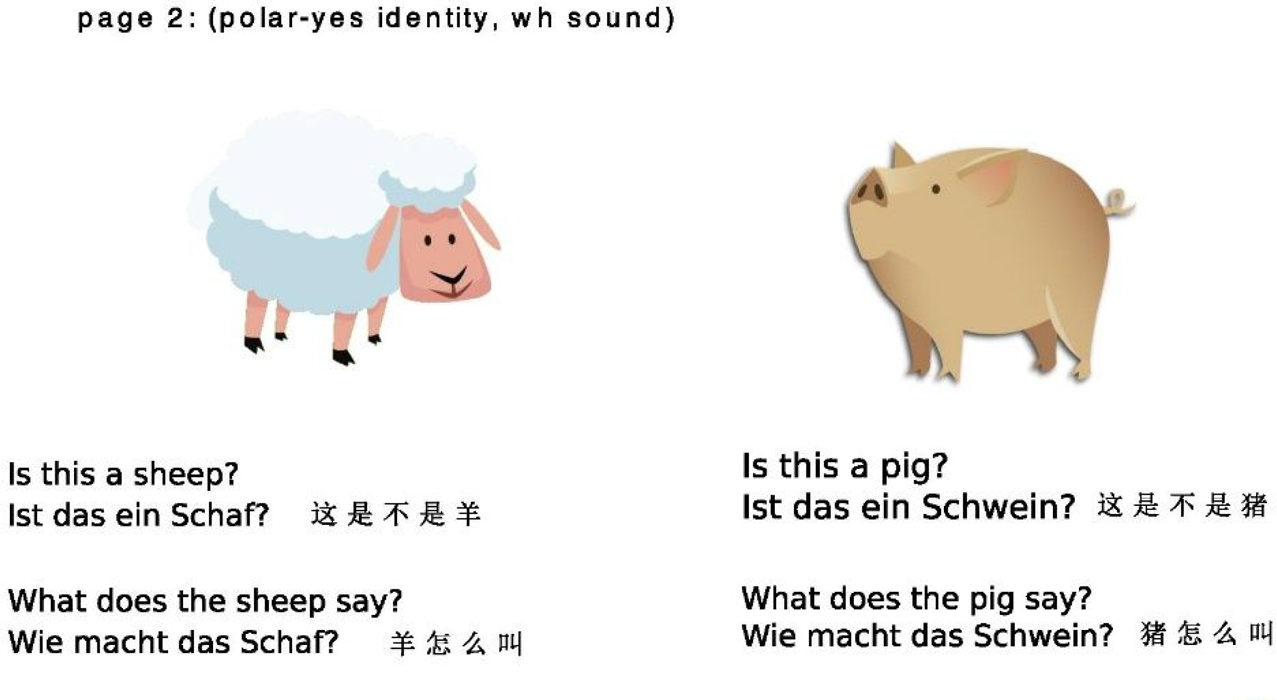
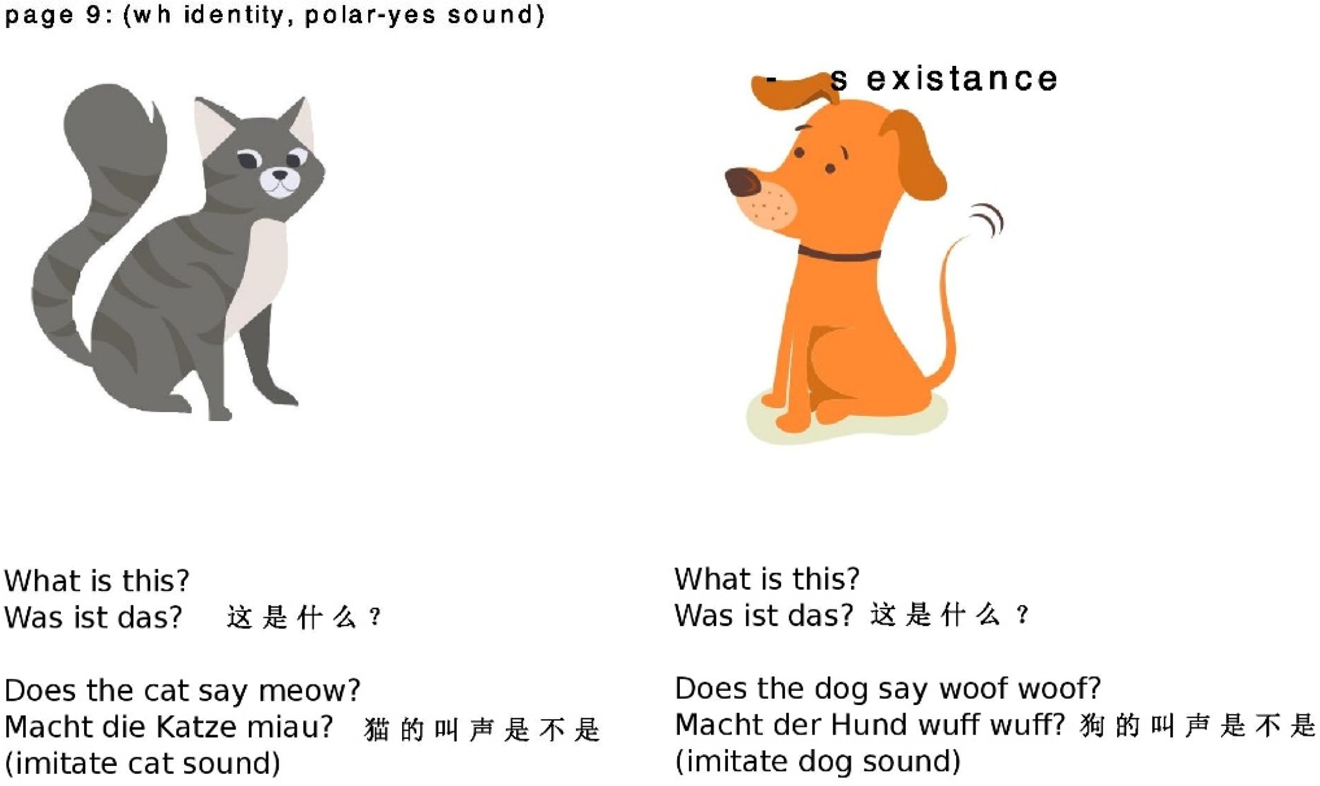
We designed a picture book using drawings of colorful objects and animals (ten pages, two pictures per page) chosen based on The MacArthur-Bates Communicative Development Inventory (CDI) scores for German (Szagun, Stumper & Schramm, Reference Szagun, Stumper and Schramm2009) in the age group of our study (18–30 months) and checked against Chinese CDI norms in (Tardif, Fletcher, Zhang, Liang, Zuo, and Cheng, Reference Tardif, Fletcher, Zhang, Liang, Zuo and Chen2008). The motivation of this study is that by limiting the range of questions we would get a better picture of what makes a question hard or easy to answer. Two such factors included in our experiment are: question type (what feature of the object, the question is about), and presence or absence of wh-word.
We chose a set of three common question types : identity: What is this?, Is this a cat?, location/existence: Where is the flower?, Is there a flower there?, and animal sounds: What does the cow say?, Does the cow say moo?; the German and Chinese forms used are given in the appendix. Each of these question types is asked at some point in the experiment in three different conditions capturing presence or absence of a wh-word: wh, polar with correct answer yes, and polar with correct answer no. The aim here is to control for the contextual setup and truth bias of the questions. In natural parent/child conversation the (positive) proposition associated with polar question is often true; we added polar-questions which were answered correctly with a negative response to see if this would encourage the children to reply to polar-questions more often.
The choice of which questions are asked on what pages and the order in which they are asked on each page was made randomly with a number of constraints to disallow invalid orderings. We wrote a python program to find a random ordering where the following conditions are met (i.e., find a solution to a constraint satisfaction problem): disallow orderings where the answer to the first question, gives away the answer to the second question (e.g., Is this a flower? in yes condition, followed by Where is the flower?). Disallow orderings where there is a mismatch between the
question type and the picture (e.g., What does the apple say?, wh and yes polar of the same question type do not appear on the same page.) Additionally every experimental item shows up at least once, and no item appears in more than one place. Figure 1 shows a page from our booklet as an example (see appendix for the complete booklet with questions in English, along with their German, and Chinese translations). Every experimental condition (question type × +/-wh) was asked on two pages (four pictures). The booklet is composed of ten pages, 40 questions: 4 questions per experimental condition, and 4 fillers.
(l) Is this a hen? What does the hen say?
(r) Is this a duck? What does the duck say?

As mentioned above, the experiments were carried out in day-care centres in Germany and China (ages 1;2.22–3;1, mean 1;9.21 for German, and 1;5–2;9, mean 2;0.19 for Chinese). The experimenter looked at the pictures with each child and asked two questions about each picture after establishing joint attention. She gave feedback on child's responses and repeated the questions when needed.
Results and discussion
Only the data from children who engaged with the task and produced at least one response, irrespective of correctness, were analyzed: 17 children (7 female) for German, 27 children (10 female) for Chinese.
In addition to coding the answers for being true or false, we coded for two other dimensions, type correctness, and pragmatic congruity. An answer is type correct if it is of the same type as a true answer; a what question is, for instance, asking for a label of an entity, whereas a where question correspondingly seeks a location. An answer is pragmatically congruent if it could be considered an acceptable response in the conversational context. A point was given for matching each of these dimensions and a score out of three was calculated. If the child did not respond to the question, that was given a score of zero. Answers can be verbal, non-verbal, or a combination of both. Examples for this coding are given in Table 3.Footnote 11
Coding dimensions of responses provided by children
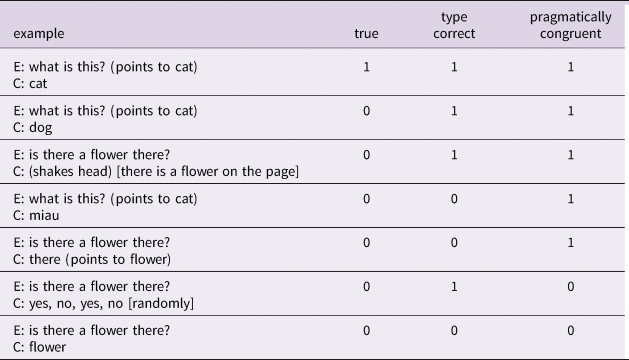
If an answer is both true and type correct, it is also pragmatically congruent.
Table 4 gives an overview of each child's performance by including their mean score for wh-questions, the associated standard deviation, and the difference from the mean score for polar-questions (designated by ΔWh−Pol). These means are averages over trials, and Δ is between -3 and 3. For the German cohort, in all but three cases ΔWh−Pol is positive and in these cases ΔWh−Pol is small. For the Chinese cohort, three subjects scored 0 in both cases. For the rest, ΔWh−Pol is positive for 15/24 of the children, while 9/24 had a negative ΔWh−Pol. However, in the latter case ΔWh−Pol was generally very small and the scores on wh-questions quite high.
Mean scores attained by each child for wh-questions and the differential from means for polars; German (l), Chinese (r), ordered by size of wh−polar differential

Moving to a detailed look at the aggregated scores, answers to polars got lower scores compared to wh-questions for both German and Chinese (see Figure 2). Figure 3 shows average scores for experimental conditions. Our experiments show that wh-questions are easier, even when answering was prompted using truth biasFootnote 12, and the context is relatively restricted compared to naturally occurring talk. Recall that we mentioned previously that Chinese might be hypothesized as encoding a bias helping polar-questions, given the fact that there are no special purpose affirmative/negative particles and that the non-sentential means for answering such questions are presented in the polar ‘V not V’ structure. Is this expectation fulfilled? On the one hand, the average scores for polar-questions are better in Chinese than in German, though the average differential between the scores for wh–questions and polar-questions is comparable (0.44 for German, 0.27 for Chinese). At the same time, the scores for wh–questions are also better in Chinese and the average age of the cohort in Chinese is 3 months more (2;0 v. 1:9); hence, it is somewhat difficult to affirm clearly with our data that the expectation for a polar–bias in Chinese is met.
Average scores for wh vs polar-yes and polar-no

Average scores for experimental conditions

We used linear regression to assess the role of each variable in predicting the answer scores. The model using both variables, +/- wh, and question type predicted the scores significantly better than models with only +/- wh or question type (nested model comparison using anova function in R). Tables 5a and 5b summarize the results. When considering each question type separately, differences between wh- and polar-questions were significant at p < .05 for question type location in both languages, and question type sound in Chinese. As we noted in our Background section, existing theories of questions generally view polar-questions as simpler entities than wh-questions; as for the answers, a syntactically-oriented view of ellipsis resolution does not seem to offer clear grounds for differentiation, whereas semantically-oriented views associate propositional operators with polar words, whereas predicates of concrete associate visually accessible individuals with short answers.
Best fitting models
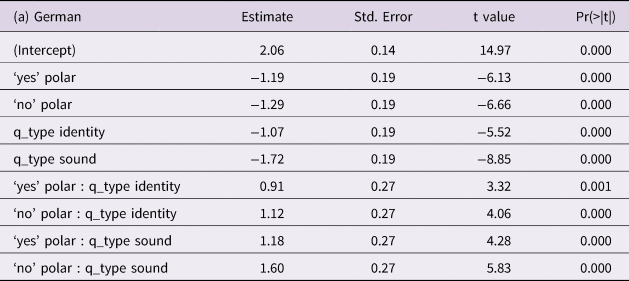
score ~ +/-wh (whq, yes polar, no polar) * question type (location, identity, sound).
Reference levels are +/-wh = whq and question type = location

score ~ +/-wh (whq, yes polar, no polar) * question type (location, identity, sound).
Reference levels are +/-wh = whq and question type = location
The study described in the Methods section was motivated by our corpus study discussed earlier that suggested earlier ability to answer wh-questions as compared with polar-questions. As expected from our corpus study, polars were significantly harder for the children to answer compared to wh-questions. We found the answerability of question types to be in the following order for both languages: location > identity > sound – post hoc pairwise comparisons revealed significant differences between questions types in both cohorts at at least p < .005 except for sound versus identity in Chinese with p = 0.057, also see Figure 4.
Average scores for question types

We postulate that the complexity of the answer is the driving force for the observed disparity in answerability of wh-questions and polars in two ways. Pointing to an object, for instance, is both easier for a young child to perform (Children are faster at responding with gestures than answering verbally (Clark & Lindsey, Reference Clark and Lindsay2015)), and more perceptually grounded than labeling it verbally. Pointing to a location in response to a where question adequately answers it; even a location/existence yes polar (e.g., Is there a banana there?) is indirectly answered by pointing to the object in question. Answers to location questions are in this sense easy to produce (see Figure 4)Footnote 13.
The second component of answer complexity, concreteness and perceptual grounding of the answer, is important in terms of learning interrogative meanings from question–answer interactions. This is different from the notion of answer complexity (‘answer types’) described by Casillas et al. (Reference Casillas, Bobb and Clark2016), where complexity, and subsequently the timing of an answer, arises from the effort needed for planning a particular answer by children. This explains in part, we think, why our results are different from the ones reported by Casillas et al. (Reference Casillas, Bobb and Clark2016), which we discussed in the Background section. In addition, there are other factors distinguishing the studies: (a) Age: Casillas et al. started sampling at around 1;8, our oldest samples are of age 1;6 in our corpus study. (b) Sampling: Casillas et al. sampled only from successful question–answer interactions.(c) Repetition as affirmation: Casillas et al. accepted verbatim repetitions of words from a polar-interrogative as affirmative answers, whereas we do not. (d) Non-informational polar-questions: polars in the corpus compiled by Casillas et al. are mostly offers, invitations, clarifications, and requests. This is not the case for our experiments. (e) Phonological effect: Casillas et al. found a main effect of fricative-initial answers; these happen more often in answers to wh-questions which might explain the longer latencies for answers to wh- compared to polar-questions.
An interactive learning view in line with Moradlou and Ginzburg (Reference Moradlou, Ginzburg, Muller and Rieser2014) – in which interrogative meanings are learned from situated question and answer pairs, both offered by caregiver themselves – would explain the seemingly earlier arrival of short answers to wh-questions compared to verbal yes and no responses. Could this difference be (more simply?) explained in terms of routinization?Footnote 14 The idea would be that wh-questions occur typically as part of, for instance, book reading or feeding routines, whereas polar–questions do not (or far less so). We cannot rule out such an explanation, which would require a careful and extensive coding of all question occurrences in such terms and a rigorous definition of ‘routine’; moreover, in any case, such an explanation is not inconsistent with an emphasis on the role of interactive learning. There are two considerations, nonetheless, that suggest that routinization does not provide a full account. First, one finds in the data no dearth of wh-questions posed and answered by the carer in what seem to be “non-routine” situations, whereas conversely one finds polar-questions in routine situations such as book reading and feeding:
(7)
a. (Free play) *MOT: where's the spoon Daddy? *FAT: where I don't know where is the spoon *FAT: where's the spoon? *MOT: is the spoon in the basement *MOT: where's the spoon? *FAT: there it is. *FAT: there's the spoon. (Naima, 1;02.07)
b. (Free play) *MOT: and what else is in here *MOT: what're [: what are] you doing? *MOT: woah. *MOT: are you building a tower with that Cuisinart
(Naima 1;01.11)
c. (looking through a picture album) *MOT: is that a picture of xxx? *MOT: xxx? *CHI: yyy. *MOT: xxx. *MOT: yes that is xxx. (Naima 1;0.14)
d. (While eating) *MOT: d'you [: do you] want a little bit more yogurt *MOT:no(Naima 1;0.14)
A second consideration is that, in our elicitation experiments, the questions where the scores were lowest were onomatopoeia (“animal sound”) questions. These are perhaps the clearest example of questions used in a routine, when parent and child interaction are looking at pictures of animals. Moreover, animal sounds are more forgiving and open to interpretation than labels for objects, for example. Finding an explanation for the relative difficulty such questions pose and, more generally, for the differentials across question types, to the extent the scores we obtained scale up, is an interesting question for future research.
It is important to note that even the best fitting model explains the variation in answerability only partially (Adjusted R-squared: 0.14, and 0.12). Since we only had permission to record audio and take notes during the experiment, we were unable to precisely account for other factors such as attention, on a second by second basis. This is somewhat remedied by the fact that for each condition, we have four data points from each child.
Conclusions and further work
In this paper, we offer evidence about the order of emergence of understanding in questions. Following the theoretical literature on questions, we assume that understanding a question is correlated with the ability to provide an answer to a question (posed by an adult). At a minimum, the evidence we provide can simply be viewed as relating to the emergence of the ability to answer questions appropriately.
We have tested the hypothesis that arises from work by Moradlou and Ginzburg (Reference Moradlou, Ginzburg, Muller and Rieser2014) on the English speaking Providence corpus from CHILDES (Demuth et al., Reference Demuth, Culbertson and Alter2006): namely, that on the whole (a class of) wh-questions emerges earlier as answerable than polar-questions. This hypothesis is supported on the basis of elicitation studies on German and Chinese speaking children. A priori, Chinese provides some additional bias in favour of polar–questions, as non-sentential positive and negative answers involve repetition of words from the polar-interrogative (‘…V not-V …’), not special purpose particles like yes/ja/no/nein. However, as we have seen, our results do not show a clear difference on this score between German and Chinese.
From a theoretical point of view, the earlier emergence of wh–question answerability suggests that neither the syntactic nor the semantic complexity of interrogatives/questions are explanatory factors, as on most semantic theories of questions, polar-questions are in a fairly clear way less complex entities than wh-questions; nor is there any clear additional complexity for the former in terms of their syntactic structure. Similarly, as far as the input goes, polar-questions are at least as frequent and often more frequent than wh-questions. Moreover, even though there is evidence that wh–questions are answered at a somewhat higher rate than polar-questions by the child's carers, in terms of raw question–answer pairs encountered, polar-questions seem to be no less frequent (though our data on this score is not conclusive). Relatedly, it is not straightforward to reduce these results to a “routine”/“non-routine” dichotomy, to the extent that such a distinction can be drawn in a principled way: there seem to be no dearth of wh–questions being posed and answered by carers in spontaneous interaction and, conversely, there are polars in “routinized” interaction. Moreover, the worst scores obtained in our elicitation experiments occur for the most prototypically routinized: namely, onomatopoeia (“animal sound”) questions.
What does seem to be a factor is the ease in understanding an answer to a given type of question. This ties in with an earlier proposal by Moradlou and Ginzburg (Reference Moradlou, Ginzburg, Muller and Rieser2014) that question answerability emerges via a sequence of gradually more complex interactions between carer and child. On this view certain wh-questions emerge earlier because the answer that can be provided to such questions in “training sessions” between carer and child is easier to ground perceptually than the abstract entities expressed by propositional answers required for polar-questions.
We should clarify two points here with respect to these results. First, clearly they do not imply that the entire class of wh-questions emerges before polar-questions; to take one example, why- and how- questions that intrinsically involve sentential answers.Footnote 15 This is consistent with our explanation concerning the importance of understanding the answer. Second, the generalisation does not concern decontextualized classes of constructions: we have pointed out that polars used as requests get answered at an early stage, comparable to the first wh-questions. And more generally, there is some variability in the answerability of the various subclasses of wh–questions and polar-questions investigated here. Thus, what we have shown is that a class of wh-question meanings gets better established in interaction before information oriented polar-questions; this does not imply any general claims about structure as such.
Naturally enough, the conclusions we draw here are tentative and in need of further experimental replication in languages other than German and Chinese and for those languages as well with larger samples. They also suggest the need for a computational account of the interactive learning model sketched by Moradlou and Ginzburg (Reference Moradlou, Ginzburg, Muller and Rieser2014), one which can also test rigorously the role of routinization in the learning process.
Acknowledgements
This work is partially supported by a public grant overseen by the French National Research Agency (ANR) as part of the program “Investissements d'Avenir” (reference: ANR-10-LABX-0083). It contributes to the IdEx Université de Paris - ANR-18-IDEX-0001. We also acknowledge the support of a senior fellowship from the Institut Universitaire de France for the third author. We also thank Dagmar Bittner (ZAS Berlin) for her help in conducting the experiments in Berlin. We thank Eve Clark, Raquel Fernández, Judit Gervain, Patrick Healey, Barbara Hemforth, Aliyah Morgenstern, Edgar Onea, and Andrzej Wisniewski for stimulating discussions. We are also indebted to Ben Ambridge and two anonymous referees for Journal of Child Language for many perceptive comments that significantly improved the paper. Portions of this paper have been presented at QuestPro 2016, Poznan, at the Workshop on the Role of Pragmatic Factors in Child Language Processing, Berlin 2016, at AmLaP 2018, Berlin, and at the Learning Language in Humans and in Machines workshop, 2018, Paris. We thank participants in these fora for their comments.
Appendix Picture book used in the experiments