Mycobacterium chimaera is a slow-growing nontuberculous mycobacteria (NTM) and a member of the Mycobacterium avium complex (MAC). M. chimaera is commonly found in the environment, such as soil and water sources, and typically causes infection in patients who are immunocompromised or have underlying respiratory diseases. Reference Trudzinski, Schlotthauer and Kamp1 In 2015, an international outbreak of M. chimaera infections among patients undergoing cardiothoracic surgeries was associated with exposure to contaminated LivaNova 3T heater-cooler devices (HCDs) (formerly Stöckert 3T heater-cooler system). Reference Perkins, Lawsin and Hasan2–Reference Jarashow, Terashita, Balter and Schwartz5 An HCD is used to warm and cool the patient’s blood during a cardiopulmonary bypass. 6 Although water in the HCD water circuits does not come into direct contact with the patient, the 3T HCDs were likely contaminated at the production site and were found to disperse M. chimaera–containing aerosols from the internal water tanks into the operating room through the exhaust vent, Reference Haller, Höller and Jacobshagen7 likely leading to patient infection. In response to the outbreak, the US Food and Drug Administration (FDA) issued a safety communication in October 2015 with recommendations for the use of HCDs. 8 In October 2018, the manufacturer released updated disinfection protocols and introduced device upgrades to reduce the risk of airborne transmission of NTM from 3T HCDs. 9
On July 14, 2017, the Kansas Department of Health and Environment (KDHE) notified the Centers for Disease Control and Prevention (CDC) of M. chimaera infections in 2 patients who were exposed to 3T HCDs at hospital A from April to June 2017. In response to this cluster, on July 1, 2017, hospital A replaced all 5 of its HCDs with 5 new loaner 3T HCDs that were manufactured after September 2014 (manufacture dates of April–May 2017), the date after which FDA determined newly manufactured 3T HCDs as having lower risk of M. chimaera contamination due to procedure changes in the production line. 10 Despite this measure, KDHE notified the CDC of 11 additional patients identified by hospital A with M. chimaera infections associated with cardiothoracic surgeries from February to December 2019. On December 3, 2019, at the request of the KDHE, a CDC team joined KDHE and hospital staff to perform an onsite investigation to determine the cause of ongoing infections.
On November 5, 2019, the Los Angeles County Department of Public Health (LACDPH) notified CDC of M. chimaera surgical site infections in 2 patients exposed to 3T HCDs during bilateral orthotopic lung transplantation at hospital B from February 2017–March 2018. Subsequently, hospital B identified 2 additional patients with M. chimaera infections, who had undergone cardiothoracic surgery with exposure to 3T HCDs. The 4 patients were identified with M. chimaera infections from September 2018–October 2020. All had undergone cardiothoracic surgery with 3T HCDs manufactured after September 2014 (manufacture dates of December 2014–September 2017). On December 6, 2019, LACDPH staff joined hospital staff to conduct an onsite investigation.
Methods
Case definition
A case was defined as isolation of M. chimaera (or MAC that did not undergo further species identification) from a nonrespiratory specimen collected after January 1, 2010, in a patient who had undergone cardiothoracic surgery.
Kansas investigation
To identify additional cases, investigators queried microbiology records to identify MAC isolates from nonrespiratory specimens of patients who had undergone cardiothoracic surgeries using HCDs, with a culture date from July 2017 to December 2019. July 2017 was the earliest date that microbiology records were available for review due to changes in the hospital’s microbiological data records system.
The investigators reviewed medical charts and abstracted data on patient demographics, underlying medical conditions, signs and symptoms, sources of specimen culture, clinical diagnosis, and procedures performed. To assess operating room setup and positioning of HCDs prior to and during surgery, investigators observed 2 open-chest cardiac surgeries in which HCDs were in use and inspected the 5 HCDs in circulation. To assess HCD maintenance practices, investigators reviewed the manufacturer’s instructions for use (IFUs) 11 and inspected hospital A’s practices for cleaning and disinfection of HCDs, processes for filling and draining HCDs, mitigation measures undertaken to minimize potential exposure of M. chimaera-containing aerosols, and implementation of manufacturer-recommended device upgrades of vacuum cannister installation and internal sealing of water tanks. 6,9
Sample collection was performed on 1 HCD with manufacturer-recommended device upgrades and 1 HCD without upgrades. M. chimaera cultures were obtained from (1) air samples collected while HCDs were operational, (2) swab samples from the HCD water tanks and surfaces of operating room equipment, and (3) water samples from HCDs and operating room scrub sinks. Whole-genome sequencing (WGS) was performed by the CDC Division of Healthcare Quality Promotion (DHQP) to determine genetic relatedness of the clinical and environmental isolates.
California investigation
The investigators observed the placement of HCDs in the operating room and inspected the 2 HCDs in circulation. To assess HCD maintenance practices, investigators inspected hospital B’s cleaning and disinfection of HCDs to ensure consistency with FDA recommendations and the manufacturer’s IFU, 6,11 as well as implementation of manufacturer-recommended device upgrades. 6,9 WGS was performed by the CDC DHQP to determine the genetic relatedness of the clinical isolates.
Results
Kansas investigation
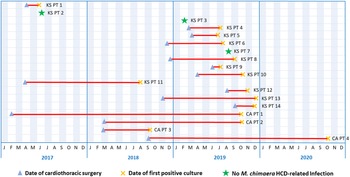
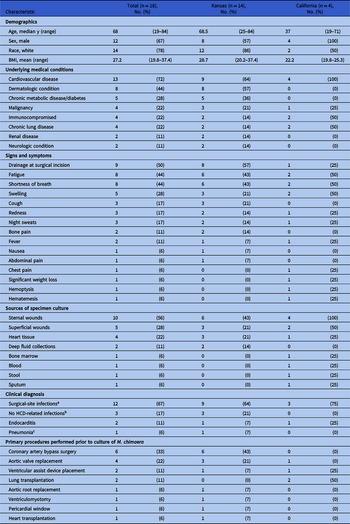
One additional case was identified through retrospective case finding; in total, 14 patients with M. chimaera infection met the case definition. A medical record review identified 11 patients (79%) with history of cardiothoracic surgery prior to the first culture date (mean number of days from surgery to culture, 191 days; range, 38–491). The other 3 patients did not have prior cardiothoracic surgery, and their only exposure to HCD was during the index surgery when the specimen that tested positive for M. chimaera was collected (Fig. 1). The most common presenting symptoms were drainage at the surgical incision (n = 8, 57%), fatigue (n = 6, 43%), and shortness of breath (n = 6, 43%). The most common infection type was surgical site infection (n = 9, 64%) (Table 1). Most patients required surgical debridement to treat the infection (n = 8, 57%). The only death occurred in a patient placed in palliative care due to metastatic cancer, and this death was not attributed to M. chimaera infection.
Timeline of events from date of cardiothoracic surgery to date of collection of the first Mycobacterium chimaera–positive clinical culture, Kansas and California, February 2017–October 2020. Patients with no M. chimaera HCD–related infection did not have a prior cardiothoracic surgery. Samples collected during index surgery were positive for M. chimaera, but patients did not develop clinical infection, indicating that M. chimaera-containing aerosols likely contaminated the specimens during the index surgery. Note: KS, Kansas; CA, California; PT, patient; HCD, heater-cooler device.

Patient Demographics and Clinical Characteristics of Patients With Mycobacterium chimaera Infection Associated With Cardiothoracic Surgery, Kansas and California, February 2017–October 2020

Note. HCD, heater-cooler device; BMI, body mass index.
a Of the 12 patients with surgical site infections, 4 had sternal osteomyelitis.
b Samples collected during index surgery were positive for M. chimaera, but patients did not develop clinical infection, indicating that M. chimaera-containing aerosols likely contaminated the specimens during the index surgery; 2 of the patients underwent aortic valve replacement and 1 patient underwent a pericardial window.
c This was the documented clinical diagnosis, but the specimen culture was collected from pleural fluid.
During observation of cardiac surgeries, only 1 HCD at hospital A had undergone the manufacturer-recommended device upgrades of vacuum cannister installation and internal sealing of water tanks, 6,9 despite hospital A’s request to the manufacturer. The HCD was positioned toward the surgical bed and instrument table and was turned on prior to the patient’s arrival into the operating room. Once the patient was intubated and draped for skin incision, the HCD was repositioned with the exhaust vent directed at a 45° angle away from the surgical bed, but not toward the operating room exhaust, and it was not placed outside of the laminar airflow as recommended by FDA and the manufacturer’s IFU due to operating room design and limited space. 6,11 During skin closure, the HCD was repositioned to its original configuration with the exhaust vent facing the surgical bed and instrument table. In October 2018, hospital A began draining the HCD water tank daily and discontinued daily monitoring of hydrogen peroxide concentration and disinfection of the water circuits as recommended by the manufacturer, 9,11 with the assumption that daily draining of water tanks would decrease the risk of microbial growth in the water circuits and obviate the need for routine disinfection. Additionally, filling and draining of the HCDs were performed inside the operating room, and water was observed on the operating room floor due to overflow of HCDs or to the change in tubing.
For the HCD without device upgrades, M. chimaera was recovered from (1) air samples collected at the surgical bed and 0.30 m (1 foot) away from the HCD exhaust, (2) swabs of brass connectors used to connect the HCD to the heart-lung machine, and (3) HCD water samples. For the HCD with device upgrades, which was not associated with any cases, M. chimaera was recovered from HCD water samples but not from air or swab samples.
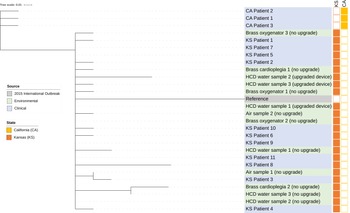
The WGS of 11 available M. chimaera patient isolates and 13 available M. chimaera environmental isolates indicated that all were closely related to each other and to previous isolates from the international outbreak identified in 2015 (0–13 single nucleotide variants [SNVs] across 93.05% core genome) (Fig. 2). Reference Hasan, Lawsin and Perry12
Maximum likelihood phylogenetic tree of Mycobacterium chimaera environmental and clinical isolates in patients with M. chimaera infection associated with cardiothoracic surgery, Kansas and California, February 2017–October 2020. M. chimaera was recovered from 3 water samples only (not from air or swab samples) of the Kansas HCD that had undergone the October 2018 manufacturer-recommended device upgrades. 9 No patients who had undergone cardiothoracic surgery with the upgraded HCD developed M. chimaera infection. Note: KS, Kansas; CA, California; HCD, heater-cooler device.

California investigation
Onsite observations at hospital B revealed that the HCD exhaust vent was directed at a 90° angle away from the surgical field and toward the operating room exhaust. The 2 HCDs in circulation had the appropriate manufacturer-recommended device upgrades of vacuum cannister installation and internal sealing of water tanks. 6,9 However, at the time of surgery for the 4 cases, the HCDs had not undergone the recommended device upgrades and had not been disinfected prior to use for the first time as recommended by the manufacturer’s IFU. 11 No samples from HCDs or the operating room environment were collected.
The WGS of 3 available M. chimaera patient isolates indicated that the isolates were closely related to each other and to previous isolates from the international outbreak identified in 2015 (2–13 SNVs, across 93.05% core genome) (Fig. 2). Reference Hasan, Lawsin and Perry12
Discussion
These investigative findings at 2 hospitals provide strong evidence of persistent contamination of 3T HCDs with M. chimaera and ongoing patient risk of infection even with the use of devices manufactured after September 2014. Hospitals may consider that using newer HCDs poses lower infection risk than HCDs manufactured prior to September 2014, 10 but our findings highlight that strict adherence to FDA recommendations and the manufacturer’s IFU are imperative to mitigate risk. Once the HCD is turned on, the HCD exhaust should be directed away from the sterile field, instrument tables, and surgical bed, even if the patient has not yet been placed on the bed, to prevent M. chimaera-containing aerosols from contaminating the operating room environment. 6,11 Ideally, HCDs should be positioned with the exhaust vent facing the air exhaust in the operating room and should be placed outside the laminar airflow of the operating room. 6,11 As demonstrated by our environmental sampling results, device upgrades likely reduced the number of aerosolized organisms to below detectable limits. 3T HCDs should undergo the manufacturer-recommended device upgrades of vacuum cannister installation and internal sealing of water tanks. 6,9 Hospitals should consider prioritizing the use of HCDs with these device upgrades and should contact the manufacturer as soon as possible. The manufacturer should ensure that the recommended device upgrades are implemented in a timely manner.
HCD tubing and water basins retain water despite draining, promoting biofilm growth. Reference Lyman, Grigg and Kinsey3,Reference Garvey, Ashford and Bradley13 HCDs should be disinfected prior to use for the first time and every 14 days, even if tanks are drained daily, to prevent microbial growth. 11 Hydrogen peroxide concentration in the water circuit should be monitored on a daily basis, before HCD use, and even if the HCD is not in routine use. 9,11 Deviation from the IFU may place patients at greater risk for infections. In addition, hospitals should consider filling and draining HCDs outside the operating room to avoid splashing and contamination of the surgical environment. 11
In 2016, the CDC advised hospitals to notify patients with exposure to 3T HCDs of the potential risk of infection to facilitate early detection of M. chimaera infections. 14 Hospitals that performed an initial notification but have identified HCD-associated patient infections among patients who had undergone cardiothoracic surgeries after the notification should update the notification to increase awareness of infection risk to patients not included in the initial notification. These hospitals may also consider using preoperative informed consent to educate patients about the potential infection risk associated with 3T HCDs, as well as the signs and symptoms of infection, at least until all recommended mitigation steps have been implemented. Healthcare providers should continue to consider M. chimaera infection when evaluating cardiothoracic surgery patients presenting with surgical site infections or signs or symptoms of disseminated NTM infection. 14
The CDC and FDA continue to be actively engaged in evaluating the risk of M. chimaera infections associated with 3T HCDs and monitoring for reports of new infections. 6 Although the current investigation involved M. chimaera infections associated with 3T HCDs, hospitals should follow FDA recommendations for the use of any HCD to reduce NTM infection risk to patients. 15 If hospitals or healthcare providers identify patients with NTM infections associated with exposure to HCDs, they should submit an FDA MedWatch report 16 and should notify public health authorities.
Acknowledgments
The authors thank the following individuals for their contributions: Michelle Adamczyk, Cecilia Bardossy, MD, Erin Breaker, MS, Bryan Christensen, PhD, Alison Laufer Halpin, PhD, Hollis Houston, Adrian Lawsin, MS, Carrie Sanders, MS, Valerie Stevens, Matthew Stuckey, PhD, Erisa Sula, MS, Division of Healthcare Quality Promotion, CDC; Justin Blanding, MPH, Sheri Tubach, MPH, Kansas Department of Health and Environment; Omer Beaird, MD, Kim De La Cruz, MS, Amy Hallmark, MS, Ruel Mirasol, Curtis Murata, Susan Realegeno, PhD, Shaunte Walton, MS, University of California at Los Angeles; Susan Hathaway, MPH, Amy Marutani, MPH, Steve Moon, Los Angeles County Department of Public Health; Rachael Liesman, PhD, Jamie Newberry, Jennifer Pennington, University of Kansas Medical Center; Kelly Bauer, MS, Angela Dixon-Allamby, Nicole Gillette, Suvajyoti Guha, PhD, Elaine Mayhall, PhD, Jon Weeks, PhD, Catherine Wentz, US Food and Drug Administration.
Financial support
No financial support was provided relevant to this article.
Conflicts of interest
All authors report no conflicts of interest relevant to this article.