1 Introduction
Generally, gravity–capillary waves are produced by wind which generates a shear flow in the uppermost layer of the water and consequently these waves propagate in the presence of vorticity. These short waves play an important role in the initial development of wind waves, contribute to some extent to the sea surface stress and consequently participate in air–sea momentum transfer. Accurate representation of the surface stress is important in modelling and forecasting ocean wave dynamics. Furthermore, the knowledge of their dynamics at the sea surface is crucial for satellite remote sensing applications.
In this paper we consider both the effect of surface tension and vorticity due to a vertically sheared current on the modulational instability of a weakly nonlinear periodic short wave trains. Recently, Thomas, Kharif & Manna (Reference Thomas, Kharif and Manna2012) have derived a nonlinear Schrödinger (NLS) equation for pure gravity water waves on finite depth with constant vorticity. Their main findings were (i) a restabilization of the modulational instability for waves propagating in the presence of positive vorticity whatever the depth and (ii) the importance of the nonlinear coupling between the mean flow induced by the modulation and the vorticity. One of our aims is to extend Thomas’ investigation to the case of gravity–capillary waves propagating on a vertically sheared current.
The number of studies on the computation of steadily propagating periodic gravity waves on a vertically sheared current is quite large. For a brief review one can refer to the paper by Thomas et al. (Reference Thomas, Kharif and Manna2012). On the other hand, investigations devoted to the calculation of nonlinear gravity–capillary waves in the presence of horizontal vorticity are rather scarce. One can cite Bratenberg & Brevik (Reference Bratenberg and Brevik1993) who used a third-order Stokes expansion for periodic gravity–capillary waves travelling on an opposing current and Hsu et al. (Reference Hsu, Francius, Montalvo and Kharif2016) who extended this work to the case of co- and counter-propagating waves. Kang & Vanden-Broeck (Reference Kang and Vanden-Broeck2000) computed periodic and solitary gravity–capillary waves in the presence of constant vorticity on finite depth. They derived analytical solutions for small-amplitude waves and numerical solutions for steeper waves. Using the bifurcation theory, Wahlen (Reference Wahlen2006a ,Reference Wahlen b ) proved the rigorous existence of periodic capillary waves and capillary–gravity waves in the presence of an arbitrary vorticity distribution. For a review on this aspect of the problem, one can refer to the paper by Wahlen (Reference Wahlen2007). More recently, Martin & Matioc (Reference Martin and Matioc2014) demonstrated the existence of steady periodic capillary–gravity waves with a piecewise constant vorticity distribution.
To our knowledge, the unique study concerning the modulational instability of gravity–capillary waves travelling on a vertically sheared current is that of Hur (Reference Hur2017). The stability of irrotational gravity–capillary waves has been deeply investigated by several authors. Djordjevic & Redekopp (Reference Djordjevic and Redekopp1977) and Hogan (Reference Hogan1985) derived nonlinear envelope equations and considered the modulational instability of periodic gravity–capillary waves. Note that in the gravity–capillary range, three-wave interaction is possible whereas modulational instability corresponds to a four-wave resonant interaction. The numerical computations were extended to capillary waves by Chen & Saffman (Reference Chen and Saffman1985) and Tiron & Choi (Reference Tiron and Choi2012). Zhang & Melville (Reference Zhang and Melville1986) investigated numerically the stability of gravity–capillary waves including, besides the four-wave resonant interaction, three-wave and five-wave resonant interactions. For a review on the stability of irrotational gravity–capillary waves, one can refer to the review paper by Dias & Kharif (Reference Dias and Kharif1999).
This study is devoted to the modulational instability of weakly nonlinear gravity–capillary wave packets propagating at the surface of a vertically sheared current of finite depth. In § 2, the governing equations are given and the nonlinear Schrödinger equation in the presence of surface tension and constant vorticity is derived by using a multiple scale method. In § 3, the linear stability analysis of a weakly nonlinear wave train is carried out as a function of the Bond number, the dispersive parameter and the intensity of the vertically sheared current.
2 Derivation of the NLS equation in the presence of surface tension and vorticity
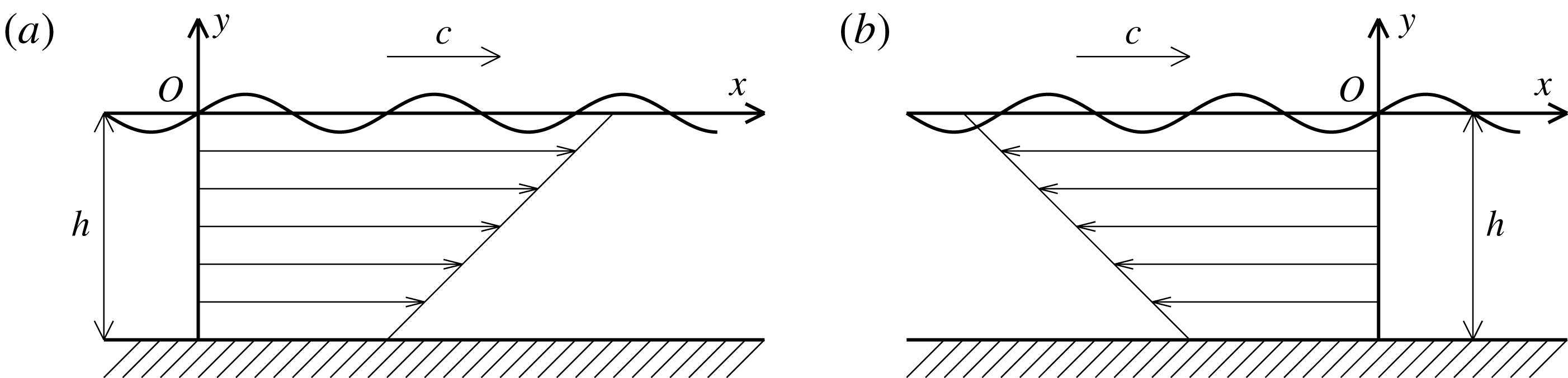
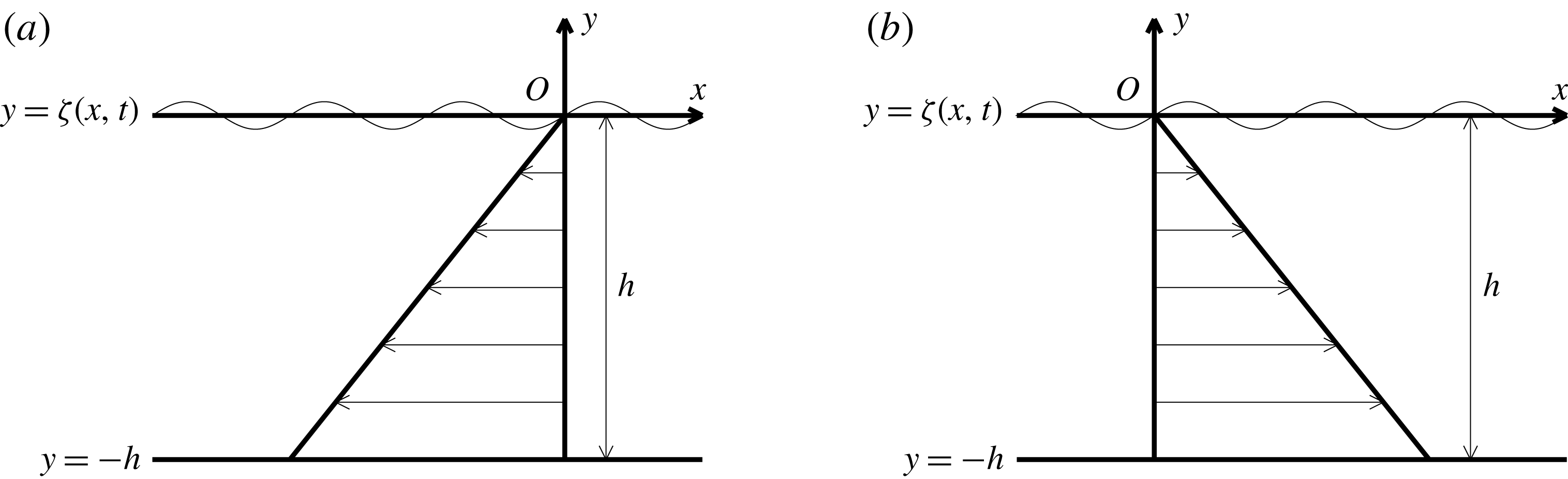
We consider the modulational instability of weakly nonlinear surface gravity–capillary wave trains in the presence of vorticity. Our investigation is confined to two-dimensional water waves propagating in finite depth. Viscosity is disregarded and the fluid is considered incompressible. The geometry configuration is presented in figures 1 and 2. We choose an Eulerian frame
 $(Oxyz)$
with unit vectors
 $(\boldsymbol{e}_{x},\boldsymbol{e}_{y},\boldsymbol{e}_{z})$
. The vector
 $\boldsymbol{e}_{y}$
is oriented upwards so that the gravity is
 $\boldsymbol{g}=-g\boldsymbol{e}_{y}$
with
 $g>0$
. The equation of the undisturbed free surface is
 $y=0$
whereas the disturbed free surface is
 $y=\unicode[STIX]{x1D701}(x,t)$
. The bottom is located at
 $y=-h$
.
Shear flow in the fixed frame where
 $c$
is the wave velocity. (a) Waves propagating downstream (
 $\unicode[STIX]{x1D6FA}>0$
). (b) Waves propagating upstream (
 $\unicode[STIX]{x1D6FA}<0$
).

Shear flow in the reference frame moving with the surface current velocity. (a) Waves propagating downstream (
 $\unicode[STIX]{x1D6FA}>0$
). (b) Waves propagating upstream (
 $\unicode[STIX]{x1D6FA}<0$
).

The waves are travelling at the surface of a vertically sheared current of constant vorticity. In the fixed frame, the underlying current is given by
 $\boldsymbol{u}_{0}(y)=(U_{0}+\unicode[STIX]{x1D6FA}y)\boldsymbol{e}_{x}$
where
 $\unicode[STIX]{x1D6FA}$
is the current intensity and
 $U_{0}$
is the current velocity at the surface. Note that the vorticity is
 $-\unicode[STIX]{x1D6FA}$
. We choose a reference frame moving with the horizontal velocity
 $U_{0}$
. Consequently, in this frame of reference, the current at the surface vanishes. In the moving frame the fluid velocity is given by
 $$\begin{eqnarray}\displaystyle \boldsymbol{u}(x,y)=\unicode[STIX]{x1D6FA}y\boldsymbol{e}_{x}+\unicode[STIX]{x1D735}\unicode[STIX]{x1D719}, & & \displaystyle\end{eqnarray}$$
where
 $\unicode[STIX]{x1D735}\unicode[STIX]{x1D719}(x,y,t)$
is the wave induced velocity. The waves are potential due to the Kelvin theorem which states that vorticity is conserved for a two-dimensional flow of an incompressible and inviscid fluid with external forces derived from a potential. There is no loss of generality if the study is restricted to carrier waves with positive phase speeds so long as both positive and negative values of
 $\unicode[STIX]{x1D6FA}$
are considered.
The potential
 $\unicode[STIX]{x1D719}$
satisfies the Laplace equation
 $$\begin{eqnarray}\displaystyle \unicode[STIX]{x1D6FB}^{2}\unicode[STIX]{x1D719}=0, & & \displaystyle\end{eqnarray}$$
and the Euler equation can be written as follows
 $$\begin{eqnarray}\displaystyle \unicode[STIX]{x1D735}\left(\unicode[STIX]{x1D719}_{t}+\frac{1}{2}u^{2}+\frac{P}{\unicode[STIX]{x1D70C}_{w}}+gy\right)=\boldsymbol{u}\wedge \unicode[STIX]{x1D74E}, & & \displaystyle\end{eqnarray}$$
with
 $\unicode[STIX]{x1D74E}$
the vorticity vector along
 $z$
,
 $P$
the pressure and
 $\unicode[STIX]{x1D70C}_{w}$
the water density. Subscripts stand for derivatives of corresponding variables.
Using the Cauchy–Riemann relations
 $$\begin{eqnarray}\displaystyle \unicode[STIX]{x1D713}_{y}=\unicode[STIX]{x1D719}_{x},\quad \unicode[STIX]{x1D713}_{x}=-\unicode[STIX]{x1D719}_{y}, & & \displaystyle\end{eqnarray}$$
where
 $\unicode[STIX]{x1D713}$
is the streamfunction
 $$\begin{eqnarray}\displaystyle \boldsymbol{u}\wedge \unicode[STIX]{x1D74E}=\unicode[STIX]{x1D735}\left({\textstyle \frac{1}{2}}\unicode[STIX]{x1D6FA}^{2}y^{2}+\unicode[STIX]{x1D6FA}\unicode[STIX]{x1D713}\right). & & \displaystyle\end{eqnarray}$$
The Euler equation (2.3) can be rewritten as follows
 $$\begin{eqnarray}\displaystyle \unicode[STIX]{x1D735}\left(\unicode[STIX]{x1D719}_{t}+\frac{1}{2}\unicode[STIX]{x1D719}_{x}^{2}+\frac{1}{2}\unicode[STIX]{x1D719}_{y}^{2}+\unicode[STIX]{x1D6FA}y\unicode[STIX]{x1D719}_{x}+gy-\unicode[STIX]{x1D6FA}\unicode[STIX]{x1D713}+\frac{P}{\unicode[STIX]{x1D70C}_{w}}\right)=0. & & \displaystyle\end{eqnarray}$$
Spatial integration gives the Bernoulli equation
 $$\begin{eqnarray}\displaystyle \unicode[STIX]{x1D719}_{t}+\frac{1}{2}\unicode[STIX]{x1D719}_{x}^{2}+\frac{1}{2}\unicode[STIX]{x1D719}_{y}^{2}+\unicode[STIX]{x1D6FA}y\unicode[STIX]{x1D719}_{x}+gy-\unicode[STIX]{x1D6FA}\unicode[STIX]{x1D713}+\frac{P}{\unicode[STIX]{x1D70C}_{w}}=C(t). & & \displaystyle\end{eqnarray}$$
In the presence of surface tension at the free surface
 $y=\unicode[STIX]{x1D701}(x,t)$
, the Laplace law is written as
 $$\begin{eqnarray}\displaystyle P=P_{a}-T\frac{\unicode[STIX]{x1D701}_{xx}}{(1+\unicode[STIX]{x1D701}_{x}^{2})^{3/2}}, & & \displaystyle\end{eqnarray}$$
where
 $P_{a}$
is the atmospheric pressure and
 $T$
surface tension.
The dynamic boundary condition at the free surface
 $y=\unicode[STIX]{x1D701}$
is
 $$\begin{eqnarray}\displaystyle \unicode[STIX]{x1D719}_{t}+\frac{1}{2}\unicode[STIX]{x1D719}_{x}^{2}+\frac{1}{2}\unicode[STIX]{x1D719}_{y}^{2}+\unicode[STIX]{x1D6FA}\unicode[STIX]{x1D701}\unicode[STIX]{x1D719}_{x}+g\unicode[STIX]{x1D701}-\unicode[STIX]{x1D6FA}\unicode[STIX]{x1D713}-\frac{T}{\unicode[STIX]{x1D70C}_{w}}\frac{\unicode[STIX]{x1D701}_{xx}}{(1+\unicode[STIX]{x1D701}_{x}^{2})^{3/2}}=0. & & \displaystyle\end{eqnarray}$$
Without loss of generality, we set
 $P_{a}=0$
and incorporate
 $C(t)$
into the potential
 $\unicode[STIX]{x1D719}$
.
Along with these, we have the kinematic free surface boundary condition
 $$\begin{eqnarray}\displaystyle \unicode[STIX]{x1D701}_{t}+\unicode[STIX]{x1D701}_{x}(\unicode[STIX]{x1D719}_{x}+\unicode[STIX]{x1D6FA}y)-\unicode[STIX]{x1D719}_{y}=0,\quad y=\unicode[STIX]{x1D701}(x,t), & & \displaystyle\end{eqnarray}$$
and the bottom boundary condition
 $$\begin{eqnarray}\displaystyle \unicode[STIX]{x1D719}_{y}=0,\quad y=-h. & & \displaystyle\end{eqnarray}$$
Following Thomas et al. (Reference Thomas, Kharif and Manna2012) we can remove
 $\unicode[STIX]{x1D713}$
by differentiating (2.9) with respect to
 $x$
. Then using relations (2.4), keeping in mind that we are dealing with weakly nonlinear waves (low wave steepness), and that (2.9) is evaluated at
 $y=\unicode[STIX]{x1D701}$
, we get the equation
 $$\begin{eqnarray}\displaystyle & & \displaystyle \unicode[STIX]{x1D719}_{tx}+\unicode[STIX]{x1D719}_{ty}\unicode[STIX]{x1D701}_{x}+\unicode[STIX]{x1D719}_{x}(\unicode[STIX]{x1D719}_{xx}+\unicode[STIX]{x1D719}_{xy}\unicode[STIX]{x1D701}_{x})+\unicode[STIX]{x1D719}_{y}(\unicode[STIX]{x1D719}_{xy}+\unicode[STIX]{x1D719}_{yy}\unicode[STIX]{x1D701}_{x})+\unicode[STIX]{x1D6FA}\unicode[STIX]{x1D701}_{x}\unicode[STIX]{x1D719}_{x}\nonumber\\ \displaystyle & & \displaystyle \qquad +\,\unicode[STIX]{x1D6FA}\unicode[STIX]{x1D701}(\unicode[STIX]{x1D719}_{xx}+\unicode[STIX]{x1D719}_{xy}\unicode[STIX]{x1D701}_{x})+g\unicode[STIX]{x1D701}_{x}+\unicode[STIX]{x1D6FA}(\unicode[STIX]{x1D719}_{y}-\unicode[STIX]{x1D719}_{x}\unicode[STIX]{x1D701}_{x})\nonumber\\ \displaystyle & & \displaystyle \qquad -\,\frac{T}{\unicode[STIX]{x1D70C}_{w}}\left(\unicode[STIX]{x1D701}_{xxx}-\frac{3}{2}\unicode[STIX]{x1D701}_{x}^{2}\unicode[STIX]{x1D701}_{xxx}-3\unicode[STIX]{x1D701}_{xx}^{2}\unicode[STIX]{x1D701}_{x}\right)=0,\quad y=\unicode[STIX]{x1D701}(x,t),\end{eqnarray}$$
that matches the one derived by Thomas et al. (Reference Thomas, Kharif and Manna2012) for
 $T=0$
.
Following Davey & Stewartson (Reference Davey and Stewartson1974), we look for solutions depending on slow variables
 $(\unicode[STIX]{x1D709},\unicode[STIX]{x1D70F})=(\unicode[STIX]{x1D700}(x-c_{g}t),\unicode[STIX]{x1D700}^{2}t)$
where
 $\unicode[STIX]{x1D700}=ak$
(
 $\unicode[STIX]{x1D700}\ll 1$
) and
 $a$
,
 $k$
and
 $c_{g}$
are the amplitude, wavenumber and group velocity of the carrier wave, respectively. The system of governing equations becomes
 $$\begin{eqnarray}\unicode[STIX]{x1D700}^{2}\unicode[STIX]{x1D719}_{\unicode[STIX]{x1D709}\unicode[STIX]{x1D709}}+\unicode[STIX]{x1D719}_{yy}=0,\quad -h\leqslant y\leqslant \unicode[STIX]{x1D701}(\unicode[STIX]{x1D709},\unicode[STIX]{x1D70F}),\end{eqnarray}$$
 $$\begin{eqnarray}\displaystyle & \displaystyle \unicode[STIX]{x1D719}_{y}=0,\quad y=-h, & \displaystyle\end{eqnarray}$$
 $$\begin{eqnarray}\displaystyle & \displaystyle \unicode[STIX]{x1D700}^{2}\unicode[STIX]{x1D701}_{\unicode[STIX]{x1D70F}}-\unicode[STIX]{x1D700}c_{g}\unicode[STIX]{x1D701}_{\unicode[STIX]{x1D709}}+\unicode[STIX]{x1D700}\unicode[STIX]{x1D701}_{\unicode[STIX]{x1D709}}(\unicode[STIX]{x1D700}\unicode[STIX]{x1D719}_{\unicode[STIX]{x1D709}}+\unicode[STIX]{x1D6FA}[y+h])-\unicode[STIX]{x1D719}_{y}=0,\quad y=\unicode[STIX]{x1D701}(\unicode[STIX]{x1D709},\unicode[STIX]{x1D70F}), & \displaystyle\end{eqnarray}$$
 $$\begin{eqnarray}\displaystyle & & \displaystyle \unicode[STIX]{x1D700}^{3}\unicode[STIX]{x1D719}_{\unicode[STIX]{x1D70F}\unicode[STIX]{x1D709}}-\unicode[STIX]{x1D700}^{2}c_{g}\unicode[STIX]{x1D701}_{\unicode[STIX]{x1D709}}+\unicode[STIX]{x1D700}^{3}\unicode[STIX]{x1D719}_{\unicode[STIX]{x1D70F}y}\unicode[STIX]{x1D701}_{\unicode[STIX]{x1D709}}-\unicode[STIX]{x1D700}^{2}c_{g}\unicode[STIX]{x1D719}_{\unicode[STIX]{x1D709}y}\unicode[STIX]{x1D701}_{\unicode[STIX]{x1D709}}+\unicode[STIX]{x1D700}^{3}\unicode[STIX]{x1D719}_{\unicode[STIX]{x1D709}}(\unicode[STIX]{x1D719}_{\unicode[STIX]{x1D709}\unicode[STIX]{x1D709}}+\unicode[STIX]{x1D719}_{\unicode[STIX]{x1D709}y}\unicode[STIX]{x1D701}_{\unicode[STIX]{x1D709}})\nonumber\\ \displaystyle & & \displaystyle \qquad +\,\unicode[STIX]{x1D700}\unicode[STIX]{x1D719}_{y}(\unicode[STIX]{x1D719}_{\unicode[STIX]{x1D709}y}+\unicode[STIX]{x1D719}_{yy}\unicode[STIX]{x1D701}_{\unicode[STIX]{x1D709}})+\unicode[STIX]{x1D700}^{2}\unicode[STIX]{x1D6FA}\unicode[STIX]{x1D701}_{\unicode[STIX]{x1D709}}\unicode[STIX]{x1D719}_{\unicode[STIX]{x1D709}}+\unicode[STIX]{x1D700}^{2}\unicode[STIX]{x1D6FA}\unicode[STIX]{x1D701}(\unicode[STIX]{x1D719}_{\unicode[STIX]{x1D709}\unicode[STIX]{x1D709}}+\unicode[STIX]{x1D719}_{\unicode[STIX]{x1D709}y}\unicode[STIX]{x1D701}_{\unicode[STIX]{x1D709}})+\unicode[STIX]{x1D700}g\unicode[STIX]{x1D701}_{\unicode[STIX]{x1D709}}\nonumber\\ \displaystyle & & \displaystyle \qquad +\,\unicode[STIX]{x1D6FA}(\unicode[STIX]{x1D719}_{y}-\unicode[STIX]{x1D700}^{2}\unicode[STIX]{x1D719}_{\unicode[STIX]{x1D709}}\unicode[STIX]{x1D701}_{\unicode[STIX]{x1D709}})-\unicode[STIX]{x1D700}^{3}\frac{T}{\unicode[STIX]{x1D70C}_{w}}\left(\unicode[STIX]{x1D701}_{\unicode[STIX]{x1D709}\unicode[STIX]{x1D709}\unicode[STIX]{x1D709}}-\frac{3}{2}\unicode[STIX]{x1D700}^{2}\unicode[STIX]{x1D701}_{\unicode[STIX]{x1D709}}^{2}\unicode[STIX]{x1D701}_{\unicode[STIX]{x1D709}\unicode[STIX]{x1D709}\unicode[STIX]{x1D709}}-3\unicode[STIX]{x1D700}^{2}\unicode[STIX]{x1D701}_{\unicode[STIX]{x1D709}\unicode[STIX]{x1D709}}^{2}\unicode[STIX]{x1D701}_{\unicode[STIX]{x1D709}}\right)=0,\quad y=\unicode[STIX]{x1D701}(\unicode[STIX]{x1D709},\unicode[STIX]{x1D70F}).\nonumber\\ \displaystyle & & \displaystyle\end{eqnarray}$$
An asymptotic solution to the system (2.13)–(2.16) is sought in the following form
 $$\begin{eqnarray}\displaystyle \unicode[STIX]{x1D719}=\mathop{\sum }_{n=-\infty }^{+\infty }\unicode[STIX]{x1D719}_{n}E^{n},\quad \unicode[STIX]{x1D701}=\mathop{\sum }_{n=-\infty }^{+\infty }\unicode[STIX]{x1D701}_{n}E^{n}, & & \displaystyle\end{eqnarray}$$
where
 $E=\text{e}^{\text{i}(kx-\unicode[STIX]{x1D714}t)}$
is a plane wave with
 $\unicode[STIX]{x1D714}$
the frequency of the carrier wave. We impose that
 $\unicode[STIX]{x1D719}_{-n}=\bar{\unicode[STIX]{x1D719}}_{n}$
and
 $\unicode[STIX]{x1D701}_{-n}=\bar{\unicode[STIX]{x1D701}}_{n}$
where the bar denotes complex conjugate, so that the functions are real. The amplitudes
 $\unicode[STIX]{x1D719}_{n}$
and
 $\unicode[STIX]{x1D701}_{n}$
are then expanded in a perturbation series in terms of
 $\unicode[STIX]{x1D700}=ak$
 $$\begin{eqnarray}\displaystyle \unicode[STIX]{x1D719}_{n}=\mathop{\sum }_{j=n}^{+\infty }\unicode[STIX]{x1D700}^{j}\unicode[STIX]{x1D719}_{nj},\quad \unicode[STIX]{x1D701}_{n}=\mathop{\sum }_{j=n}^{+\infty }\unicode[STIX]{x1D700}^{j}\unicode[STIX]{x1D701}_{nj}. & & \displaystyle\end{eqnarray}$$
The terms depending on surface tension occur only at a higher order. The expansions (2.18) are substituted into the system of equations. The linear Laplace equation (2.13) is easier to handle, since solutions can be derived iteratively. Here we will simply write the first-order solution for
 $\unicode[STIX]{x1D719}_{11}$
that is obtained by using the bottom boundary condition (2.14)
 $$\begin{eqnarray}\displaystyle \unicode[STIX]{x1D719}_{11}=A(\unicode[STIX]{x1D709},\unicode[STIX]{x1D70F})\frac{\cosh [k(y+h)]}{\cosh (kh)}, & & \displaystyle\end{eqnarray}$$
where the slow-varying function
 $A(\unicode[STIX]{x1D709},\unicode[STIX]{x1D70F})$
will be used to express all other terms. Higher-order expansions of the Laplace equation introduce more unknown functions into the solutions. Nevertheless, through expansions of the boundary conditions they can all be combined to
 $A(\unicode[STIX]{x1D709},\unicode[STIX]{x1D70F})$
.
The evolution of this unknown will depend on the initial condition
 $A(\unicode[STIX]{x1D709},0)$
. We then use (2.18) in the dynamic and kinematic free surface boundary conditions, and collect terms of equal power in
 $\unicode[STIX]{x1D700}$
and
 $E$
, which allows the expressions for the
 $\unicode[STIX]{x1D701}_{ij}$
and
 $\unicode[STIX]{x1D719}_{ij}$
to be found successively.
The calculations are somewhat tedious but some steps are of interest. At first, the linear dispersion relation is derived
 $$\begin{eqnarray}\displaystyle \unicode[STIX]{x1D714}^{2}+\unicode[STIX]{x1D70E}\unicode[STIX]{x1D6FA}\unicode[STIX]{x1D714}-\unicode[STIX]{x1D70E}gk(1+\unicode[STIX]{x1D705})=0, & & \displaystyle\end{eqnarray}$$
where
 $\unicode[STIX]{x1D70E}=\tanh (\unicode[STIX]{x1D707})$
with
 $\unicode[STIX]{x1D707}=kh$
and
 $\unicode[STIX]{x1D705}=Tk^{2}/\unicode[STIX]{x1D70C}_{w}g$
.
As mentioned above, we consider a carrier wave travelling from left to right whose frequency
 $\unicode[STIX]{x1D714}$
, phase velocity
 $c_{p}$
and group velocity
 $c_{g}$
are
 $$\begin{eqnarray}\displaystyle & \displaystyle \unicode[STIX]{x1D714}=-\frac{\unicode[STIX]{x1D6FA}\unicode[STIX]{x1D70E}}{2}+\sqrt{\left(\frac{\unicode[STIX]{x1D6FA}\unicode[STIX]{x1D70E}}{2}\right)^{2}+g\unicode[STIX]{x1D70E}k(1+\unicode[STIX]{x1D705})}, & \displaystyle\end{eqnarray}$$
 $$\begin{eqnarray}\displaystyle & \displaystyle c_{p}=-\frac{\unicode[STIX]{x1D6FA}\unicode[STIX]{x1D70E}}{2k}+\sqrt{\left(\frac{\unicode[STIX]{x1D6FA}\unicode[STIX]{x1D70E}}{2k}\right)^{2}+\frac{g\unicode[STIX]{x1D70E}}{k}(1+\unicode[STIX]{x1D705})}, & \displaystyle\end{eqnarray}$$
 $$\begin{eqnarray}\displaystyle & \displaystyle c_{g}=-\frac{\unicode[STIX]{x1D6FA}h}{2}(1-\unicode[STIX]{x1D70E}^{2})+\frac{(1-\unicode[STIX]{x1D70E}^{2})(\unicode[STIX]{x1D6FA}^{2}h\unicode[STIX]{x1D70E}/2+g\unicode[STIX]{x1D707}(1+\unicode[STIX]{x1D705}))+g\unicode[STIX]{x1D70E}(1+3\unicode[STIX]{x1D705})}{\sqrt{\unicode[STIX]{x1D6FA}^{2}\unicode[STIX]{x1D70E}^{2}+4gk\unicode[STIX]{x1D70E}(1+\unicode[STIX]{x1D705})}}. & \displaystyle\end{eqnarray}$$
The relation between
 $A(\unicode[STIX]{x1D709},\unicode[STIX]{x1D70F})$
and
 $\unicode[STIX]{x1D701}_{11}$
is the following
 $$\begin{eqnarray}\displaystyle \unicode[STIX]{x1D701}_{11}=\text{i}\frac{\unicode[STIX]{x1D714}(1+X)}{g(1+\unicode[STIX]{x1D705})}A(\unicode[STIX]{x1D709},\unicode[STIX]{x1D70F}), & & \displaystyle\end{eqnarray}$$
where
 $X=\unicode[STIX]{x1D70E}\unicode[STIX]{x1D6FA}/\unicode[STIX]{x1D714}$
.
From the above dispersion relation we can show easily that
 $X>-1$
. We note that
 $X$
depends also on the surface tension through
 $\unicode[STIX]{x1D714}$
and its associated dispersion relation. It is also to be noted that the expression of the mean-flow term, which is important in the development of the modulational instability, is similar to that of Thomas et al. (Reference Thomas, Kharif and Manna2012). Nevertheless, surface tension takes place through the phase velocity
 $c_{p}$
, the group velocity
 $c_{g}$
and
 $\unicode[STIX]{x1D714}$
.
 $$\begin{eqnarray}\displaystyle (c_{g}(c_{g}+\unicode[STIX]{x1D6FA}h)-gh)\unicode[STIX]{x1D719}_{01,\unicode[STIX]{x1D709}}=\left(\frac{g\unicode[STIX]{x1D70E}}{c_{p}^{2}}(2\unicode[STIX]{x1D714}+\unicode[STIX]{x1D70E}\unicode[STIX]{x1D6FA})+k^{2}c_{g}(1-\unicode[STIX]{x1D70E}^{2})\right)|A|^{2}, & & \displaystyle\end{eqnarray}$$
and
 $$\begin{eqnarray}\displaystyle g\unicode[STIX]{x1D701}_{02}=(c_{g}+\unicode[STIX]{x1D6FA}h)\unicode[STIX]{x1D719}_{01,\unicode[STIX]{x1D709}}-k^{2}(1-\unicode[STIX]{x1D70E}^{2})|A|^{2}. & & \displaystyle\end{eqnarray}$$
Although the expressions are identical to those of Thomas et al. (Reference Thomas, Kharif and Manna2012), it should be noted that the surface tension acts through the dispersion relation, affecting
 $\unicode[STIX]{x1D714}$
,
 $c_{p}$
and
 $c_{g}$
.
At order
 $O(\unicode[STIX]{x1D700}^{3}E)$
the nonlinear Schrödinger equation is found for the potential envelope
 $A$
, so that
 $$\begin{eqnarray}\displaystyle \text{i}A_{\unicode[STIX]{x1D70F}}+\unicode[STIX]{x1D6FC}A_{\unicode[STIX]{x1D709}\unicode[STIX]{x1D709}}=\unicode[STIX]{x1D6FE}|A|^{2}A, & & \displaystyle\end{eqnarray}$$
where the coefficients
 $\unicode[STIX]{x1D6FC}$
and
 $\unicode[STIX]{x1D6FE}$
depend on
 $(\unicode[STIX]{x1D705},\unicode[STIX]{x1D6FA},kh)$
.
Then the dispersion coefficient reads
 $$\begin{eqnarray}\displaystyle \unicode[STIX]{x1D6FC} & = & \displaystyle \frac{-\unicode[STIX]{x1D714}}{k^{2}\unicode[STIX]{x1D70E}(2+X)}\left[\unicode[STIX]{x1D70E}\unicode[STIX]{x1D70C}^{2}+\unicode[STIX]{x1D707}\frac{1+X}{1+\unicode[STIX]{x1D705}}(\unicode[STIX]{x1D70E}[\unicode[STIX]{x1D70E}+\unicode[STIX]{x1D707}(1-\unicode[STIX]{x1D70E}^{2})]-1)\right.\nonumber\\ \displaystyle & & \displaystyle \left.+\,\unicode[STIX]{x1D707}(1-\unicode[STIX]{x1D70E}^{2})(\unicode[STIX]{x1D70C}-\unicode[STIX]{x1D707}\unicode[STIX]{x1D70E})X-\frac{\unicode[STIX]{x1D705}}{1+\unicode[STIX]{x1D705}}\unicode[STIX]{x1D6FC}_{1}\right],\end{eqnarray}$$
with
 $$\begin{eqnarray}\displaystyle \unicode[STIX]{x1D6FC}_{1} & = & \displaystyle -\unicode[STIX]{x1D707}(1+X)(1-\unicode[STIX]{x1D70E}^{2})(\unicode[STIX]{x1D707}\unicode[STIX]{x1D70E}-1)+\unicode[STIX]{x1D70E}(1+X)(1+2\unicode[STIX]{x1D70C})\nonumber\\ \displaystyle & & \displaystyle +\,2\left(\unicode[STIX]{x1D70E}\unicode[STIX]{x1D70C}+\unicode[STIX]{x1D707}(1-\unicode[STIX]{x1D70E}^{2})X-2\frac{\unicode[STIX]{x1D70E}\unicode[STIX]{x1D705}}{1+\unicode[STIX]{x1D705}}(1+X)\right),\end{eqnarray}$$
where
 $\unicode[STIX]{x1D70C}=c_{g}/c_{p}$
is here the ratio of the group velocity to the phase velocity of the carrier. It can be expressed in a concise form
 $$\begin{eqnarray}\displaystyle \unicode[STIX]{x1D70C}=\frac{(1-\unicode[STIX]{x1D70E}^{2})\unicode[STIX]{x1D707}+(1+X)\left(\unicode[STIX]{x1D70E}+\displaystyle \frac{2\unicode[STIX]{x1D70E}\unicode[STIX]{x1D705}}{1+\unicode[STIX]{x1D705}}\right)}{\unicode[STIX]{x1D70E}(2+X)}, & & \displaystyle\end{eqnarray}$$
which depends only on
 $\unicode[STIX]{x1D707}$
,
 $\unicode[STIX]{x1D705}$
and
 $X=\unicode[STIX]{x1D70E}\unicode[STIX]{x1D6FA}/\unicode[STIX]{x1D714}$
.
The nonlinear coefficient is
 $$\begin{eqnarray}\displaystyle \unicode[STIX]{x1D6FE} & = & \displaystyle \frac{k^{4}}{2\unicode[STIX]{x1D714}(1+X)(2+X)}\left[-\frac{3\unicode[STIX]{x1D70E}^{2}\unicode[STIX]{x1D705}}{1+\unicode[STIX]{x1D705}}(1+X)^{2}-2(1+\unicode[STIX]{x1D705})(1-\unicode[STIX]{x1D70E}^{2})[(1+X)^{2}-\unicode[STIX]{x1D70E}^{2}]\right.\nonumber\\ \displaystyle & & \displaystyle +\,\unicode[STIX]{x1D70E}^{2}(1+X)(8+6X)+\frac{1+X}{\unicode[STIX]{x1D70E}^{2}-\unicode[STIX]{x1D705}(3-\unicode[STIX]{x1D70E}^{2}+3X)}\unicode[STIX]{x1D6FE}_{1}\nonumber\\ \displaystyle & & \displaystyle +\,2\left.\frac{(1+X)(2+X)+\unicode[STIX]{x1D70C}(1+\unicode[STIX]{x1D705})(1-\unicode[STIX]{x1D70E}^{2})}{(1+\unicode[STIX]{x1D705})\left(\unicode[STIX]{x1D70C}^{2}+\unicode[STIX]{x1D707}\unicode[STIX]{x1D70C}\displaystyle \frac{X}{\unicode[STIX]{x1D70E}}-\frac{\unicode[STIX]{x1D707}(1+X)}{\unicode[STIX]{x1D70E}(1+\unicode[STIX]{x1D705})}\right)}\unicode[STIX]{x1D6FE}_{2}\right],\end{eqnarray}$$
with
 $$\begin{eqnarray}\displaystyle \unicode[STIX]{x1D6FE}_{1} & = & \displaystyle 9-10\unicode[STIX]{x1D70E}^{2}+\unicode[STIX]{x1D70E}^{4}+(18-4\unicode[STIX]{x1D70E}^{2}-4\unicode[STIX]{x1D70E}^{4})X+(15+3\unicode[STIX]{x1D70E}^{2})X^{2}\nonumber\\ \displaystyle & & \displaystyle +\,(6+2\unicode[STIX]{x1D70E}^{2})X^{3}+X^{4}\nonumber\\ \displaystyle & & \displaystyle +\,\unicode[STIX]{x1D705}\left[21-10\unicode[STIX]{x1D70E}^{2}+\unicode[STIX]{x1D70E}^{4}+(42+2\unicode[STIX]{x1D70E}^{2}-4\unicode[STIX]{x1D70E}^{4})X\right.\nonumber\\ \displaystyle & & \displaystyle +\left.(30+12\unicode[STIX]{x1D70E}^{2})X^{2}+(9+5\unicode[STIX]{x1D70E}^{2})X^{3}+X^{4}\right],\end{eqnarray}$$
and finally
 $$\begin{eqnarray}\displaystyle \unicode[STIX]{x1D6FE}_{2} & = & \displaystyle (1+\unicode[STIX]{x1D705})\left[(1+X)^{2}\left(1+\unicode[STIX]{x1D70C}+\frac{\unicode[STIX]{x1D707}X}{\unicode[STIX]{x1D70E}}\right)+1+X-\unicode[STIX]{x1D70E}(\unicode[STIX]{x1D70C}\unicode[STIX]{x1D70E}+\unicode[STIX]{x1D707}X)\right]\nonumber\\ \displaystyle & & \displaystyle -\,\unicode[STIX]{x1D705}(1+X)(2+X).\end{eqnarray}$$
We can check that these coefficients reduce to those of Djordjevic & Redekopp (Reference Djordjevic and Redekopp1977), or Hogan (Reference Hogan1985) in deep water, if
 $\unicode[STIX]{x1D6FA}=0$
and to those of Thomas et al. (Reference Thomas, Kharif and Manna2012) if
 $\unicode[STIX]{x1D705}=0$
.
The last term in brackets of (2.31) corresponds to the coupling between the mean flow due to the modulation and the vorticity which occurs at third order. This coupling was found by Thomas et al. (Reference Thomas, Kharif and Manna2012) for the case of pure gravity waves and has an important impact on the stability analysis of progressive wave trains.
We can see that in (2.31) there are two possible singularities that one should avoid, either
 $$\begin{eqnarray}\displaystyle \unicode[STIX]{x1D70E}^{2}-\unicode[STIX]{x1D705}(3-\unicode[STIX]{x1D70E}^{2}+3X)=0, & & \displaystyle\end{eqnarray}$$
which corresponds to the first gravity–capillary resonance at
 $\unicode[STIX]{x1D705}_{c}=\unicode[STIX]{x1D70E}^{2}/(3-\unicode[STIX]{x1D70E}^{2})$
without vorticity, associated with the Wilton ripple phenomenon, or
 $$\begin{eqnarray}\displaystyle \unicode[STIX]{x1D70C}^{2}+\unicode[STIX]{x1D70C}\frac{\unicode[STIX]{x1D707}X}{\unicode[STIX]{x1D70E}}-\frac{\unicode[STIX]{x1D707}(1+X)}{\unicode[STIX]{x1D70E}(1+\unicode[STIX]{x1D705})}=0, & & \displaystyle\end{eqnarray}$$
which is rewritten as follows
 $$\begin{eqnarray}\displaystyle c_{g}^{2}+\frac{g\unicode[STIX]{x1D707}}{\unicode[STIX]{x1D714}}X\frac{1+\unicode[STIX]{x1D705}}{1+X}c_{g}-\frac{g^{2}\unicode[STIX]{x1D707}\unicode[STIX]{x1D70E}}{\unicode[STIX]{x1D714}^{2}}\frac{1+\unicode[STIX]{x1D705}}{1+X}=0. & & \displaystyle\end{eqnarray}$$
In the absence of vorticity, the latter condition reduces to
 $c_{g}^{2}=gh$
which matches the long wave/short wave resonance as shown by Davey & Stewartson (Reference Davey and Stewartson1974) and Djordjevic & Redekopp (Reference Djordjevic and Redekopp1977). From equation (2.21) we can derive the following relation
 $$\begin{eqnarray}\displaystyle \unicode[STIX]{x1D714}^{2}=g\unicode[STIX]{x1D70E}k\frac{1+\unicode[STIX]{x1D705}}{1+X}. & & \displaystyle\end{eqnarray}$$
Substituting this expression for
 $\unicode[STIX]{x1D714}^{2}$
into (2.36) gives
 $$\begin{eqnarray}\displaystyle c_{g}^{2}+\unicode[STIX]{x1D6FA}hc_{g}-gh=0, & & \displaystyle\end{eqnarray}$$
which admits as solution the group velocity of a carrier wave travelling from left to right
 $$\begin{eqnarray}\displaystyle c_{g}=-\frac{\unicode[STIX]{x1D6FA}h}{2}+\sqrt{gh+\unicode[STIX]{x1D6FA}^{2}h^{/}4}. & & \displaystyle\end{eqnarray}$$
The right-hand side of (2.39) is the phase velocity of a long gravity wave propagating on a linear shear current of intensity
 $\unicode[STIX]{x1D6FA}$
. Consequently, the long wave/short wave resonance persists in the presence of vorticity.
3 Stability analysis and results
Let us write
 $\unicode[STIX]{x1D701}$
in the form
 $$\begin{eqnarray}\displaystyle \unicode[STIX]{x1D701}={\textstyle \frac{1}{2}}(\unicode[STIX]{x1D716}a\text{e}^{\text{i}(kx-\unicode[STIX]{x1D714}t)}+\text{c.c.})+O(\unicode[STIX]{x1D716}^{2}), & & \displaystyle\end{eqnarray}$$
where
 $a=2\unicode[STIX]{x1D701}_{11}$
is the envelope of the free surface elevation and c.c. denotes complex conjugation. Using (2.24) the NLS equation (2.27) is rewritten for the complex envelope
 $a(\unicode[STIX]{x1D709},\unicode[STIX]{x1D70F})$
as follows
 $$\begin{eqnarray}\displaystyle \text{i}a_{\unicode[STIX]{x1D70F}}+\unicode[STIX]{x1D6FC}a_{\unicode[STIX]{x1D709}\unicode[STIX]{x1D709}}=\tilde{\unicode[STIX]{x1D6FE}}|a|^{2}a, & & \displaystyle\end{eqnarray}$$
where
 $$\begin{eqnarray}\displaystyle \tilde{\unicode[STIX]{x1D6FE}}=\frac{g^{2}}{4\unicode[STIX]{x1D714}^{2}}\left(\frac{1+\unicode[STIX]{x1D705}}{1+X}\right)^{2}\unicode[STIX]{x1D6FE}. & & \displaystyle\end{eqnarray}$$
The nonlinear coefficient
 $\tilde{\unicode[STIX]{x1D6FE}}$
can be written in a more compact form
 $$\begin{eqnarray}\displaystyle \tilde{\unicode[STIX]{x1D6FE}}=\frac{\unicode[STIX]{x1D714}^{2}}{4k^{2}\unicode[STIX]{x1D70E}^{2}}\unicode[STIX]{x1D6FE}. & & \displaystyle\end{eqnarray}$$
In this section we consider the stability of a Stokes wave solution of the NLS equation (3.2) to infinitesimal disturbances.
Equation (3.2) admits the following solution
 $$\begin{eqnarray}\displaystyle a_{s}(\unicode[STIX]{x1D70F})=a_{0}\text{e}^{-\text{i}\tilde{\unicode[STIX]{x1D6FE}}a_{0}^{2}\unicode[STIX]{x1D70F}}, & & \displaystyle\end{eqnarray}$$
with the initial condition
 $a_{0}$
.
We consider infinitesimal perturbations to this solution, in amplitude
 $\unicode[STIX]{x1D6FF}_{a}(\unicode[STIX]{x1D709},\unicode[STIX]{x1D70F})$
and in phase
 $\unicode[STIX]{x1D6FF}_{w}(\unicode[STIX]{x1D709},\unicode[STIX]{x1D70F})$
, so that the perturbed solution
 $a_{s}^{\prime }$
is written as
 $$\begin{eqnarray}\displaystyle a_{s}^{\prime }=a_{s}(1+\unicode[STIX]{x1D6FF}_{a})\text{e}^{\text{i}\unicode[STIX]{x1D6FF}_{w}}. & & \displaystyle\end{eqnarray}$$
Substituting this expression in the NLS equation (3.2), linearizing and separating between real and imaginary parts, yields to a system of linear coupled partial differential equations with constant coefficients. Then, this system admits solutions of the form
 $$\begin{eqnarray}\displaystyle \left.\begin{array}{@{}c@{}}\unicode[STIX]{x1D6FF}_{a}=\unicode[STIX]{x1D6FF}_{a_{0}}\text{e}^{\text{i}(p\unicode[STIX]{x1D709}-\unicode[STIX]{x1D6E4}\unicode[STIX]{x1D70F})},\\ \unicode[STIX]{x1D6FF}_{w}=\unicode[STIX]{x1D6FF}_{w_{0}}\text{e}^{\text{i}(p\unicode[STIX]{x1D709}-\unicode[STIX]{x1D6E4}\unicode[STIX]{x1D70F})}.\end{array}\right\} & & \displaystyle\end{eqnarray}$$
The necessary and sufficient condition for the existence of non-trivial solutions is
 $$\begin{eqnarray}\displaystyle \unicode[STIX]{x1D6E4}^{2}=\unicode[STIX]{x1D6FC}p^{2}(2\tilde{\unicode[STIX]{x1D6FE}}a_{0}^{2}+\unicode[STIX]{x1D6FC}p^{2}). & & \displaystyle\end{eqnarray}$$
The Stokes wave solution is stable when
 $\unicode[STIX]{x1D6FC}(2\tilde{\unicode[STIX]{x1D6FE}}a_{0}^{2}+\unicode[STIX]{x1D6FC}p^{2})\geqslant 0$
and unstable when
 $\unicode[STIX]{x1D6FC}(2\tilde{\unicode[STIX]{x1D6FE}}a_{0}^{2}+\unicode[STIX]{x1D6FC}p^{2})<0$
.
The growth rate of instability is then
 $$\begin{eqnarray}\displaystyle \unicode[STIX]{x1D6E4}_{i}=p(-2\tilde{\unicode[STIX]{x1D6FE}}\unicode[STIX]{x1D6FC}a_{0}^{2}-\unicode[STIX]{x1D6FC}^{2}p^{2})^{1/2}. & & \displaystyle\end{eqnarray}$$
We set
 $\unicode[STIX]{x1D6FC}=\unicode[STIX]{x1D714}\unicode[STIX]{x1D6FC}_{2}/k^{2}$
and
 $\tilde{\unicode[STIX]{x1D6FE}}=\unicode[STIX]{x1D714}k^{2}\tilde{\unicode[STIX]{x1D6FE}_{1}}$
, so that
 $\unicode[STIX]{x1D6FC}_{2}$
and
 $\tilde{\unicode[STIX]{x1D6FE}_{1}}$
are dimensionless functions of
 $\unicode[STIX]{x1D707}=kh$
,
 $X=\unicode[STIX]{x1D70E}\unicode[STIX]{x1D6FA}/\unicode[STIX]{x1D714}$
and
 $\unicode[STIX]{x1D705}$
only. The growth rate of instability becomes
 $$\begin{eqnarray}\displaystyle \unicode[STIX]{x1D6E4}_{i}=\frac{\unicode[STIX]{x1D714}\,p}{k^{2}}(-2\tilde{\unicode[STIX]{x1D6FE}_{1}}\unicode[STIX]{x1D6FC}_{2}a_{0}^{2}k^{4}-\unicode[STIX]{x1D6FC}_{2}^{2}p^{2})^{1/2}. & & \displaystyle\end{eqnarray}$$
The maximal growth rate is obtained for
 $p=\sqrt{-\tilde{\unicode[STIX]{x1D6FE}_{1}}/\unicode[STIX]{x1D6FC}_{2}}\,a_{0}k^{2}$
and its expression is
 $\unicode[STIX]{x1D6E4}_{imax}=\sqrt{-\tilde{\unicode[STIX]{x1D6FE}_{1}}/\unicode[STIX]{x1D6FC}_{2}}\,\sqrt{-\tilde{\unicode[STIX]{x1D6FE}_{1}}\unicode[STIX]{x1D6FC}_{2}}\,\unicode[STIX]{x1D714}(a_{0}k)^{2}$
. Note that instability occurs when
 $\tilde{\unicode[STIX]{x1D6FE}_{1}}$
and
 $\unicode[STIX]{x1D6FC}_{2}$
have opposite signs.
The growth rate of instability is written in the following dimensionless form
 $$\begin{eqnarray}\displaystyle \frac{\unicode[STIX]{x1D6E4}_{i}}{\unicode[STIX]{x1D714}a_{0}^{2}k^{2}}=\tilde{p}\,(-2\tilde{\unicode[STIX]{x1D6FE}_{1}}\unicode[STIX]{x1D6FC}_{2}-\unicode[STIX]{x1D6FC}_{2}^{2}\tilde{p}^{2})^{1/2}, & & \displaystyle\end{eqnarray}$$
where
 $\tilde{p}=p/(a_{0}k^{2})$
.
The dimensionless bandwidth of instability is
 $\unicode[STIX]{x0394}\tilde{p}=\sqrt{-2\tilde{\unicode[STIX]{x1D6FE}_{1}}/\unicode[STIX]{x1D6FC}_{2}}$
and
 $\unicode[STIX]{x0394}p/k=\sqrt{-2\tilde{\unicode[STIX]{x1D6FE}_{1}}/\unicode[STIX]{x1D6FC}_{2}}\,a_{0}k$
.
For
 $\unicode[STIX]{x1D705}=0$
and
 $\unicode[STIX]{x1D6FA}\neq 0$
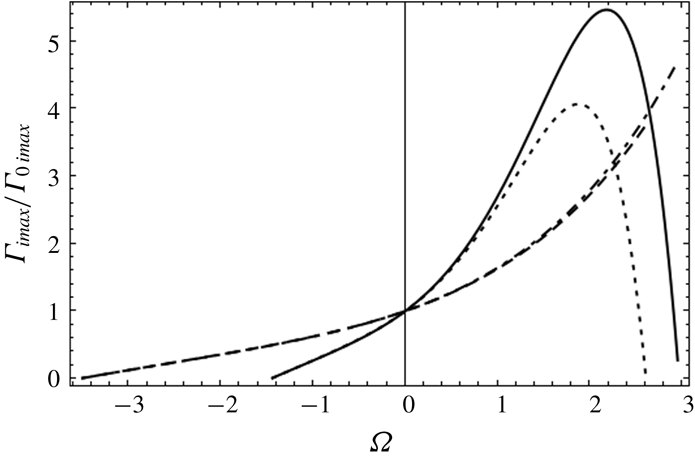
, equation (3.11) gives the rate of growth of Thomas et al. (Reference Thomas, Kharif and Manna2012). Figure 3 shows plots of the dimensionless maximal growth rate of the modulational instability of pure gravity waves and gravity waves influenced by the surface tension effect (
 $\unicode[STIX]{x1D705}=0.005$
) as a function of
 $\unicode[STIX]{x1D6FA}$
for infinite and finite depths. We can observe that the combined effect of surface tension and vorticity increases significantly the rate of growth of the modulational instability of short gravity waves propagating in finite depth and in the presence of negative vorticity (
 $\unicode[STIX]{x1D6FA}>0$
) whereas the effect is insignificant in deep water. For positive vorticity (
 $\unicode[STIX]{x1D6FA}<0$
) the curves almost coincide at finite depth and deep water and the increase of the rate of growth due to surface tension is of the order of
 $\unicode[STIX]{x1D705}$
.
Dimensionless maximal growth rate of modulational instability as a function of
 $\unicode[STIX]{x1D6FA}$
in finite depth (
 $\unicode[STIX]{x1D707}=2$
) and deep water (
 $\unicode[STIX]{x1D707}=\infty$
). Solid line (
 $\unicode[STIX]{x1D705}=0.005,\unicode[STIX]{x1D707}=2$
); dot-dashed line (
 $\unicode[STIX]{x1D705}=0.005,\unicode[STIX]{x1D707}=\infty$
); dotted line (
 $\unicode[STIX]{x1D705}=0,\unicode[STIX]{x1D707}=2$
); dashed line (
 $\unicode[STIX]{x1D705}=0,\unicode[STIX]{x1D707}=\infty$
).
 $\unicode[STIX]{x1D6E4}_{0\;imax}$
is the maximal growth rate for
 $\unicode[STIX]{x1D6FA}=0$
.

For
 $\unicode[STIX]{x1D6FA}=0$
and
 $\unicode[STIX]{x1D705}\neq 0$
, equation (2.20) of Djordjevic & Redekopp (Reference Djordjevic and Redekopp1977) becomes
 $$\begin{eqnarray}\displaystyle \text{i}a_{\unicode[STIX]{x1D70F}}-\frac{\unicode[STIX]{x1D714}}{8k^{2}}\frac{1-6\unicode[STIX]{x1D705}-3\unicode[STIX]{x1D705}^{2}}{(1+\unicode[STIX]{x1D705})^{2}}a_{\unicode[STIX]{x1D709}\unicode[STIX]{x1D709}}=\frac{k^{2}\unicode[STIX]{x1D714}}{16}\frac{8+\unicode[STIX]{x1D705}+2\unicode[STIX]{x1D705}^{2}}{(1-2\unicode[STIX]{x1D705})(1+\unicode[STIX]{x1D705})}|a|^{2}a, & & \displaystyle\end{eqnarray}$$
for the envelope of the surface elevation in deep water.
The coefficients
 $\tilde{\unicode[STIX]{x1D6FE}_{1}}$
and
 $\unicode[STIX]{x1D6FC}_{2}$
corresponding to this NLS equation are
 $$\begin{eqnarray}\displaystyle \tilde{\unicode[STIX]{x1D6FE}_{1}}=\frac{1}{16}\frac{8+\unicode[STIX]{x1D705}+2\unicode[STIX]{x1D705}^{2}}{(1-2\unicode[STIX]{x1D705})(1+\unicode[STIX]{x1D705})},\quad \unicode[STIX]{x1D6FC}_{2}=-\frac{1}{8}\frac{1-6\unicode[STIX]{x1D705}-3\unicode[STIX]{x1D705}^{2}}{(1+\unicode[STIX]{x1D705})^{2}}. & & \displaystyle\end{eqnarray}$$
Consequently, the rate of growth of the modulational instability of pure capillary wave trains on an infinite depth, obtained for
 $\unicode[STIX]{x1D705}\rightarrow \infty$
, is
 $$\begin{eqnarray}\displaystyle \unicode[STIX]{x1D6E4}_{i}\rightarrow \frac{\unicode[STIX]{x1D714}}{8k^{2}}(3a_{0}^{2}k^{4}p^{2}-9p^{4})^{1/2}\quad \text{as}~\unicode[STIX]{x1D705}\rightarrow \infty , & & \displaystyle\end{eqnarray}$$
which can be found in Chen & Saffman (Reference Chen and Saffman1985). The wavenumber of the fastest-growing modulational instability is
 $p_{max}=a_{0}k^{2}/\sqrt{6}$
and the maximum growth rate is
 $\unicode[STIX]{x1D714}(a_{0}k)^{2}/16$
. Tiron & Choi (Reference Tiron and Choi2012) have extended the linear stability of finite-amplitude capillary waves on deep water subject to superharmonic and subharmonic perturbations without a vorticity effect.
We have considered the case of pure capillary waves on deep water (
 $\unicode[STIX]{x1D705}\rightarrow \infty$
and
 $\unicode[STIX]{x1D707}\rightarrow \infty$
) in the presence of vorticity (
 $\unicode[STIX]{x1D6FA}\neq 0$
). The corresponding analytic expressions of
 $\tilde{\unicode[STIX]{x1D6FE}_{1}}$
and
 $\unicode[STIX]{x1D6FC}_{2}$
are
 $$\begin{eqnarray}\displaystyle & \displaystyle \tilde{\unicode[STIX]{x1D6FE}_{1}}=-\frac{3+14X+23X^{2}+11X^{3}-3X^{4}}{24(X+1)(3X+2)}, & \displaystyle\end{eqnarray}$$
 $$\begin{eqnarray}\displaystyle & \displaystyle \unicode[STIX]{x1D6FC}_{2}=\frac{3(X+1)(X^{2}+X+1)}{(2+X)^{3}}, & \displaystyle\end{eqnarray}$$
where
 $X=\unicode[STIX]{x1D6FA}/\unicode[STIX]{x1D714}$
and
 $\unicode[STIX]{x1D714}=-\unicode[STIX]{x1D6FA}/2\pm \sqrt{(\unicode[STIX]{x1D6FA}/2)^{2}+k^{3}T/\unicode[STIX]{x1D70C}_{w}}$
.
Due to the high wave frequency of capillaries on deep water we assume
 $|X|\ll 1$
. The coefficients
 $\tilde{\unicode[STIX]{x1D6FE}_{1}}$
and
 $\unicode[STIX]{x1D6FC}_{2}$
become
 $$\begin{eqnarray}\displaystyle & \displaystyle \tilde{\unicode[STIX]{x1D6FE}_{1}}=-{\textstyle \frac{1}{16}}\left(1+{\textstyle \frac{13}{6}}X\right)+O(X^{2}), & \displaystyle\end{eqnarray}$$
 $$\begin{eqnarray}\displaystyle & \displaystyle \unicode[STIX]{x1D6FC}_{2}=\frac{3}{8}\left(1+\frac{X}{2}\right)+O(X^{2}). & \displaystyle\end{eqnarray}$$
The rate of growth of the modulational instability of capillary waves on deep water in the presence of vorticity is
 $$\begin{eqnarray}\displaystyle \unicode[STIX]{x1D6E4}_{i}=\frac{\unicode[STIX]{x1D714}\,p}{8k^{2}}\sqrt{3a_{0}^{2}k^{4}-9p^{2}+(8a_{0}^{2}k^{4}-9p^{2})X}+O(X^{2}), & & \displaystyle\end{eqnarray}$$
and in dimensionless form
 $$\begin{eqnarray}\displaystyle \frac{\unicode[STIX]{x1D6E4}_{i}}{\unicode[STIX]{x1D714}\,a_{0}^{2}k^{2}}=\frac{\tilde{p}}{8}\sqrt{3-9\tilde{p}^{2}+(8-9\tilde{p})X}+O(X^{2}). & & \displaystyle\end{eqnarray}$$
The maximal growth rate of instability is obtained for
 $p=(1+5X/6)a_{0}k^{2}/\sqrt{6}+O(X^{2})$
and its value is
 $(1+13X/6)\unicode[STIX]{x1D714}a_{0}^{2}k^{2}/16+O(X^{2})$
. The bandwidth of modulational instability is
 $\unicode[STIX]{x0394}p=(1+5X/6)a_{0}k^{2}/\sqrt{3}$
.
Consequently, the rate of growth of modulational instability of capillary waves in deep water is larger for negative vorticity (
 $X>0$
) than for positive vorticity (
 $X<0$
). The bandwidth of the instability presents the same trend.
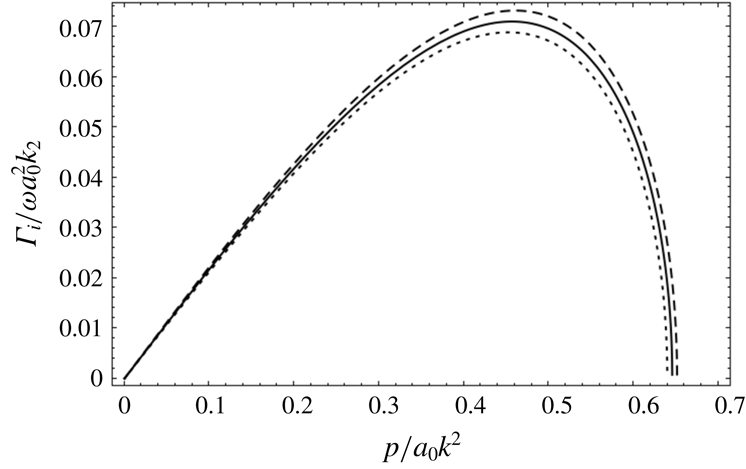
In figure 4 we show the dimensionless rate of growth of the modulational instability of pure capillary waves in finite depth as a function of the wavenumber of the perturbation, for several values of
 $\unicode[STIX]{x1D6FA}$
. The rate of growth of the instability increases as
 $\unicode[STIX]{x1D6FA}$
increases, as with infinite depth.
Dimensionless growth rate of the modulational instability of pure capillary waves in finite depth (
 $\unicode[STIX]{x1D707}=2$
) as a function of the dimensionless wavenumber of the perturbation for several values of
 $\unicode[STIX]{x1D6FA}$
.
 $\unicode[STIX]{x1D6FA}=0$
(solid line);
 $\unicode[STIX]{x1D6FA}=2$
(dashed line);
 $\unicode[STIX]{x1D6FA}=-2$
(dotted line).

The
 $(\unicode[STIX]{x1D707},X)$
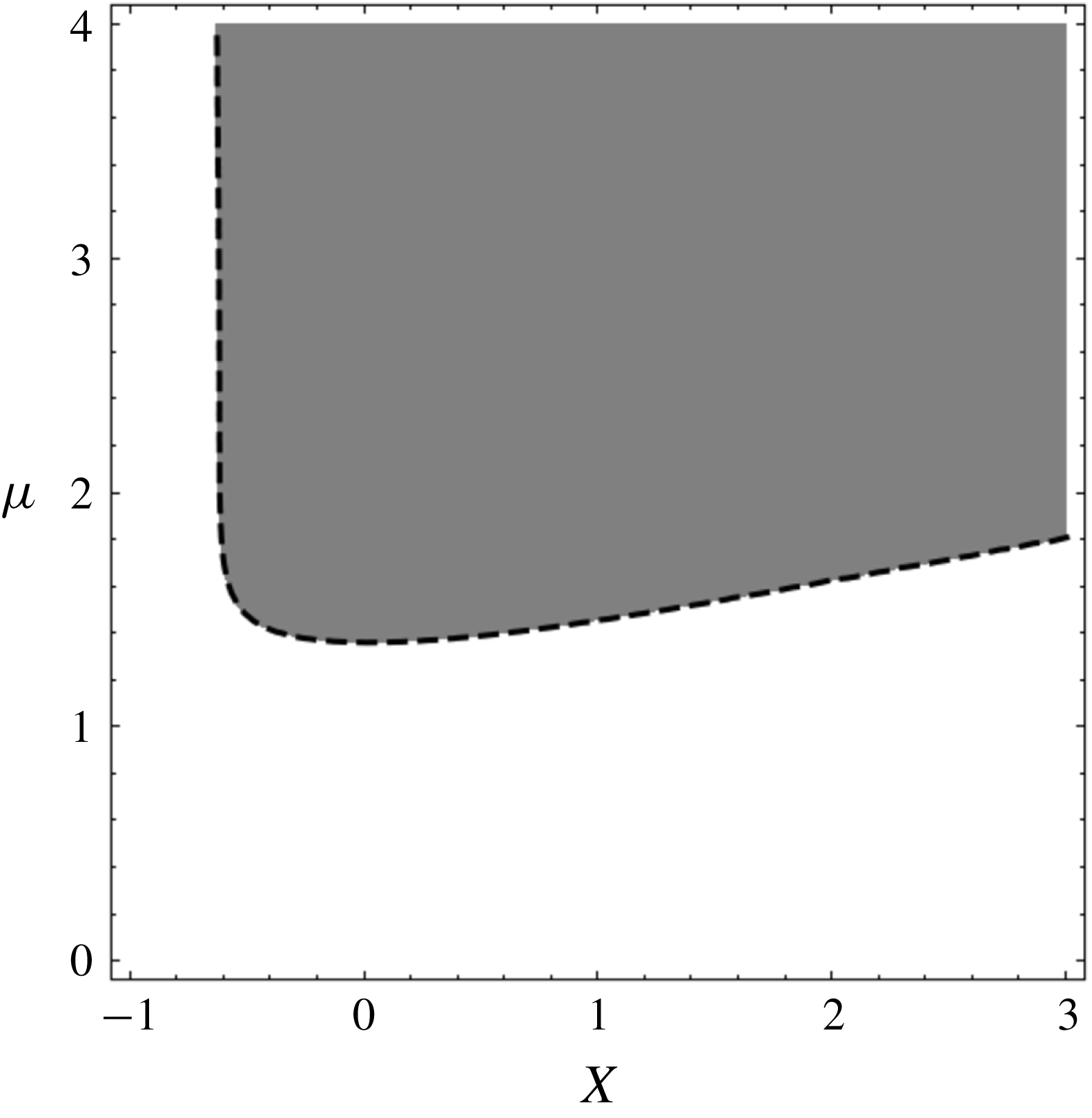
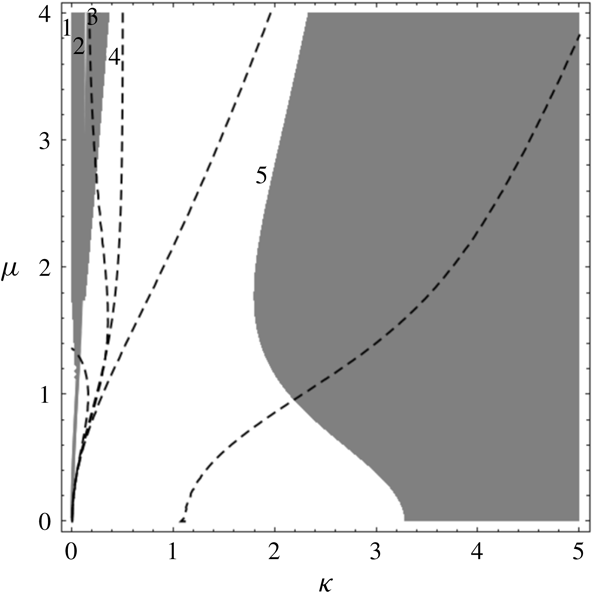
-instability diagram for gravity waves, matching the results of Thomas et al. (Reference Thomas, Kharif and Manna2012) (dashed lines). Here, there is no surface tension. The unstable regions are in grey whereas stable regions are in white. For
 $X=0$
(or
 $\unicode[STIX]{x1D6FA}=0$
) the value
 $kh\approx 1.363$
is found, below which there is no instability.

The
 $(\unicode[STIX]{x1D707},\unicode[STIX]{x1D705})$
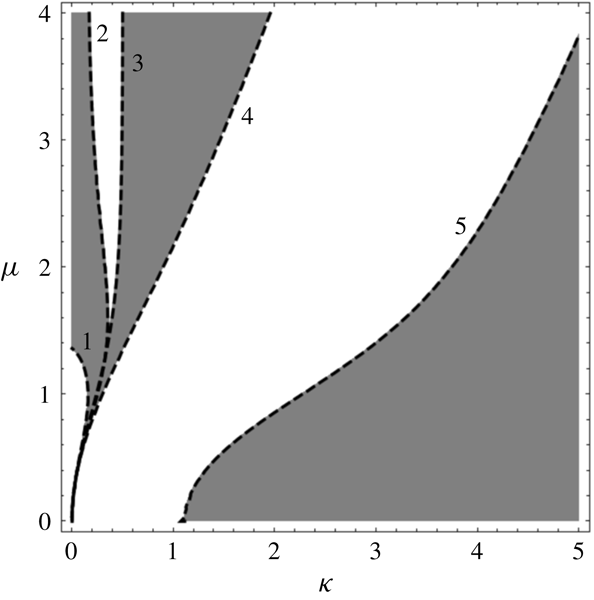
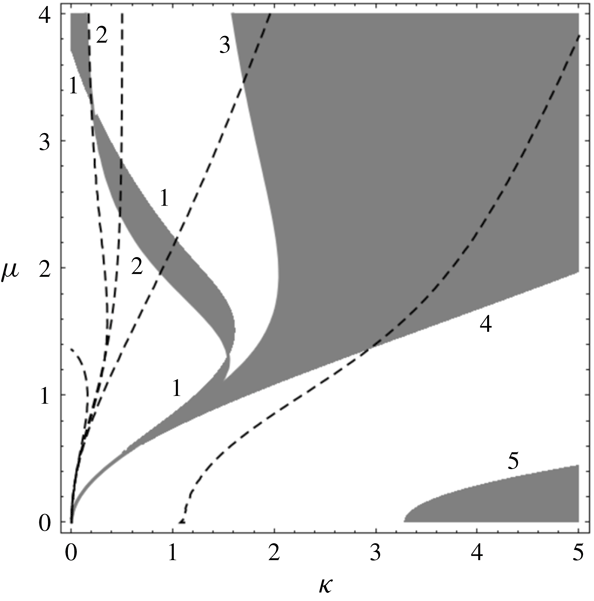
-instability diagram for gravity–capillary waves, matching the results from Djordjevic & Redekopp (Reference Djordjevic and Redekopp1977) (dashed lines). Here, there is no vorticity. The unstable regions are in grey whereas stable regions are in white.

The sign of the product
 $\unicode[STIX]{x1D6FC}\tilde{\unicode[STIX]{x1D6FE}}$
determines the stability of the solution under infinitesimal perturbations. If the product is positive then the solutions are modulationally stable, otherwise they are modulationally unstable and grow exponentially with time. Davey & Stewartson (Reference Davey and Stewartson1974) and Djordjevic & Redekopp (Reference Djordjevic and Redekopp1977) showed that this criterion, which works for one-dimensional propagation, can be extended to the case of two-dimensional propagation. In this way, our stability diagrams could be compared to those of Djordjevic & Redekopp (Reference Djordjevic and Redekopp1977) when
 $\unicode[STIX]{x1D6FA}=0$
. The linear stability analysis only captures the linear part of the instability, and thus its onset. We plot in the
 $(\unicode[STIX]{x1D707}=kh,\unicode[STIX]{x1D705})$
-plane, for fixed values of the vorticity
 $\unicode[STIX]{x1D6FA}$
, the unstable and stable regions. As a check, the instability diagrams we obtain are compared in figures 5 and 6 with those obtained by Thomas et al. (Reference Thomas, Kharif and Manna2012) for
 $\unicode[STIX]{x1D705}=0$
and Djordjevic & Redekopp (Reference Djordjevic and Redekopp1977) for
 $\unicode[STIX]{x1D6FA}=0$
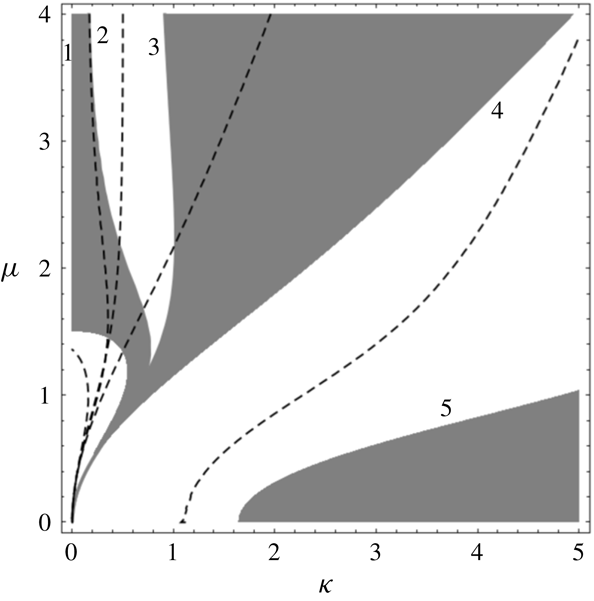
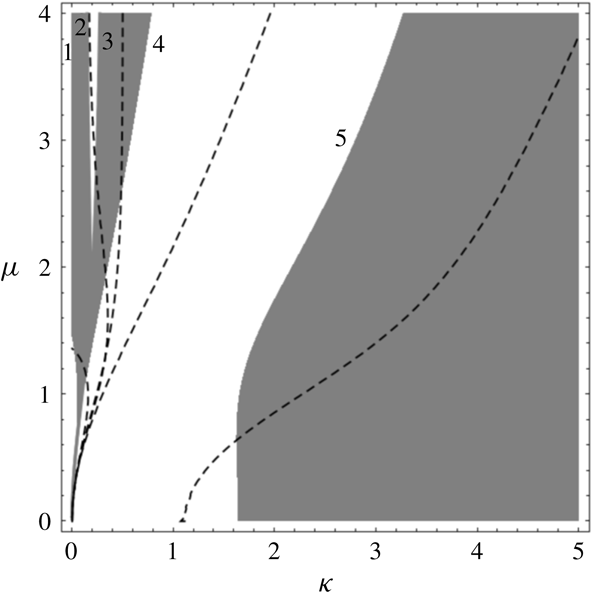
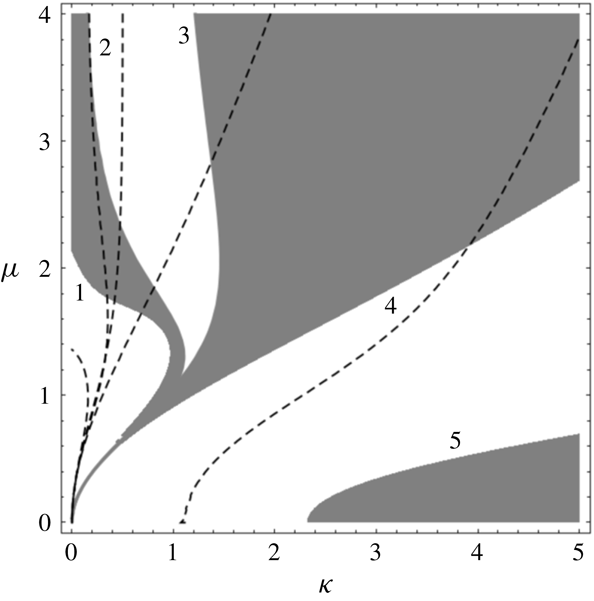
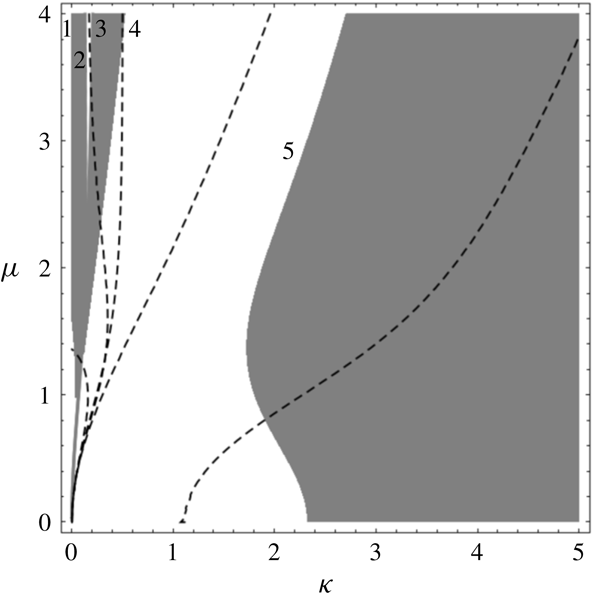
. In that way, we can verify that these limiting cases are reproduced correctly. Following Djordjevic & Redekopp (Reference Djordjevic and Redekopp1977), the boundaries of the unstable regions have been numbered from 1 to 5. Curve 1 crosses the
 $\unicode[STIX]{x1D707}$
-axis at the point corresponding to restabilization of the modulational instability. Note that this feature holds for two-dimensional water waves. Curve 2 corresponds to vanishing of the dispersive coefficient
 $\unicode[STIX]{x1D6FC}$
and minimum phase velocity (
 $c_{g}=c_{p}$
) whereas along curves 3 and 4 the nonlinear coefficient
 $\tilde{\unicode[STIX]{x1D6FE}}$
is singular. These singularities define Wilton and long wave/short wave resonances, respectively. The Wilton ripple phenomenon considered herein corresponds to a bifurcation in which a steady progressive gravity–capillary wave can double its wavelength and the associated value of
 $\unicode[STIX]{x1D705}$
is given implicitly by
 $$\begin{eqnarray}\displaystyle \unicode[STIX]{x1D705}=\frac{\unicode[STIX]{x1D70E}^{2}\unicode[STIX]{x1D714}(\unicode[STIX]{x1D705})}{(3-\unicode[STIX]{x1D70E}^{2})\unicode[STIX]{x1D714}(\unicode[STIX]{x1D705})+3\unicode[STIX]{x1D70E}\unicode[STIX]{x1D6FA}}. & & \displaystyle\end{eqnarray}$$
The critical value depends strongly on
 $\unicode[STIX]{x1D6FA}$
and consequently curve 3 becomes distorted as
 $|\unicode[STIX]{x1D6FA}|$
increases, this trend is amplified when vorticity intensity is large.
Curve 4 corresponds to the long wave/short wave resonance. The group velocity
 $c_{g}$
of the short gravity–capillary wave matches the phase velocity of the long gravity wave influenced by vorticity (see (2.39)). Significant resonant wave interaction is to be expected in this case. Note that because (3.2) breaks down for these two resonances a different analysis and scaling is required.
Curves 1 and 5 correspond to simple zeros of the nonlinear coefficient
 $\tilde{\unicode[STIX]{x1D6FE}}$
.
Curve 4 has the following asymptote
 $$\begin{eqnarray}\displaystyle \unicode[STIX]{x1D707}=\left(1+\frac{\unicode[STIX]{x1D6FA}^{2}}{2}-\sqrt{\frac{\unicode[STIX]{x1D6FA}^{2}}{4}(4+\unicode[STIX]{x1D6FA}^{2})}\right)\left(\frac{9}{4}\unicode[STIX]{x1D705}-\frac{3}{4}\right),\quad \unicode[STIX]{x1D707}\gg 1, & & \displaystyle\end{eqnarray}$$
whereas curve 5 has the asymptote
 $$\begin{eqnarray}\displaystyle \unicode[STIX]{x1D707} & = & \displaystyle \frac{9}{4}\left(1+\frac{\unicode[STIX]{x1D6FA}^{2}}{2}-\sqrt{\frac{\unicode[STIX]{x1D6FA}^{2}}{4}(4+\unicode[STIX]{x1D6FA}^{2})}\right)\unicode[STIX]{x1D705}+\frac{1}{4}\left(-35+3\unicode[STIX]{x1D6FA}^{2}+\frac{29\unicode[STIX]{x1D6FA}}{\sqrt{4+\unicode[STIX]{x1D6FA}^{2}}}-\frac{3\unicode[STIX]{x1D6FA}^{3}}{\sqrt{4+\unicode[STIX]{x1D6FA}^{2}}}\right),\nonumber\\ \displaystyle & & \displaystyle \unicode[STIX]{x1D707}\gg 1.\end{eqnarray}$$
For
 $\unicode[STIX]{x1D6FA}=0$
, the equations of Djordjevic & Redekopp (Reference Djordjevic and Redekopp1977) are rediscovered except that instead of
 $-61/8$
we found
 $-35/4$
which is slightly different. The asymptotes have the same slope. In the region between these two asymptotes the capillary waves (
 $\unicode[STIX]{x1D705}\gg 1$
) are modulationally stable. This feature was emphasized by Djordjevic & Redekopp (Reference Djordjevic and Redekopp1977) in the absence of vorticity.
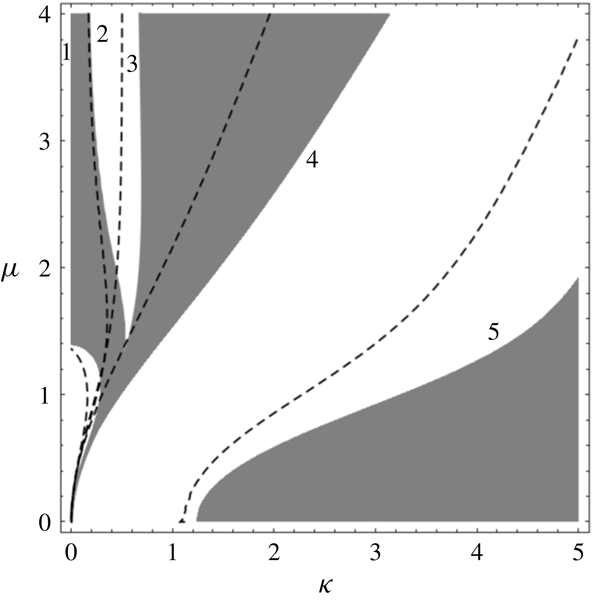
The
 $(\unicode[STIX]{x1D707},\unicode[STIX]{x1D705})$
-instability diagram for
 $\unicode[STIX]{x1D6FA}=-0.5$
(positive vorticity). The dashed lines correspond to
 $\unicode[STIX]{x1D6FA}=0$
.

The
 $(\unicode[STIX]{x1D707},\unicode[STIX]{x1D705})$
-instability diagram for
 $\unicode[STIX]{x1D6FA}=0.5$
(negative vorticity). The dashed lines correspond to
 $\unicode[STIX]{x1D6FA}=0$
.

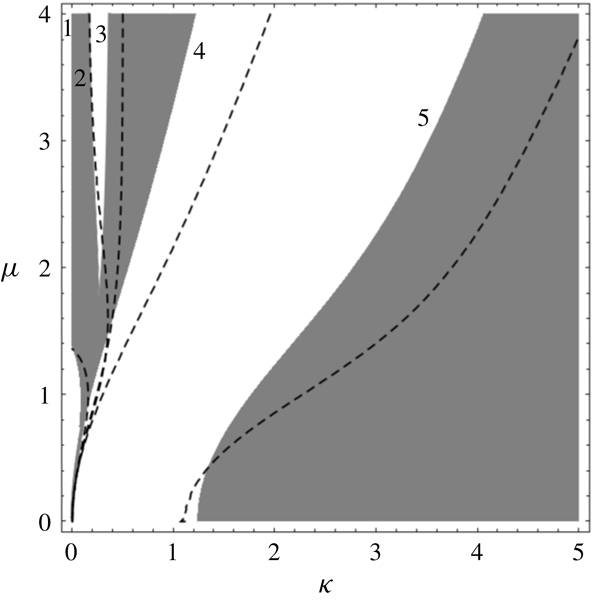
Same as figure 7 for
 $\unicode[STIX]{x1D6FA}=-1$
.

Same as figure 8 for
 $\unicode[STIX]{x1D6FA}=1$
.

Same as figure 7 for
 $\unicode[STIX]{x1D6FA}=-1.5$
.

Same as figure 8 for
 $\unicode[STIX]{x1D6FA}=1.5$
.

In figures 7–14 the effect of positive and negative vorticity on the
 $(\unicode[STIX]{x1D707}=kh,\unicode[STIX]{x1D705})$
diagrams is investigated. The curves of Djordjevic & Redekopp (Reference Djordjevic and Redekopp1977) have been plotted to show the effect of the vorticity. As it can be observed, the vorticity has a significant effect on stability diagrams of gravity–capillary waves. Very recently, this feature was emphasized by Hur (Reference Hur2017) who proposed a shallow water wave model with constant vorticity and surface tension. This model presents some differences with our approach: (i) dispersion is introduced heuristically and is fully linear; (ii) nonlinear terms due to surface tension effect are ignored; (iii) the coupling between nonlinearity and dispersion is not taken into account.
As positive vorticity (
 $\unicode[STIX]{x1D6FA}<0$
) increases, we observe in figures 7, 9, 11 and 13 along the
 $\unicode[STIX]{x1D707}$
-axis in the vicinity of
 $\unicode[STIX]{x1D705}=0$
an increase of the region where the Stokes gravity–capillary wave train is modulationally stable. Consequently, gravity waves influenced by surface tension behave as pure gravity waves (see Thomas et al. (Reference Thomas, Kharif and Manna2012)). Nevertheless, a very thin tongue of instability persists, near
 $\unicode[STIX]{x1D705}=0$
, in the shallow water regime.
As the intensity of negative vorticity (
 $\unicode[STIX]{x1D6FA}>0$
) increases, the band of instability along the
 $\unicode[STIX]{x1D707}$
-axis that corresponds to small values of
 $\unicode[STIX]{x1D705}$
becomes narrower, as shown in figures 8, 10, 12 and 14. Contrary to the case of positive vorticity, the region of restabilization along the
 $\unicode[STIX]{x1D707}$
-axis does not increase in the vicinity of
 $\unicode[STIX]{x1D705}=0$
.
Same as figure 7 for
 $\unicode[STIX]{x1D6FA}=-2$
.

Same as figure 8 for
 $\unicode[STIX]{x1D6FA}=2$
.

4 Conclusion
A nonlinear Schrödinger equation for capillary–gravity waves in finite depth with a linear shear current has been derived which extends the work of Thomas et al. (Reference Thomas, Kharif and Manna2012). The combined effect of vorticity and surface tension on the modulational instability properties of weakly nonlinear gravity–capillary and capillary wave trains has been investigated. The explicit expressions of the dispersive and nonlinear coefficients are given as a function of the frequency and wavenumber of the carrier wave, the vorticity, the surface tension and the depth. The linear stability to modulational perturbations of the Stokes wave solution of the NLS equation has been carried out. Two kinds of waves have been especially investigated that concern short gravity waves influenced by surface tension and pure capillary waves. In both cases, the effect of vorticity is to modify the rate of growth of the modulational instability and the instability bandwidth. Furthermore, it is shown that the vorticity effect modifies significantly the stability diagrams of the gravity–capillary waves.