Introduction
Not all heart attacks (HAs) present clinically with the classic symptoms of chest pain (CP) or chest discomfort (CD). Numerous studies have reported non-CP symptoms to be common for myocardial infarctions (ie, HAs). Reference Horne, James, Petrie, Weinman and Vincent1–Reference Dracup, Moser, Eisenberg, Meischke, Alonzo and Braslow5 Delays in getting hospital treatment for HAs are also common Reference Horne, James, Petrie, Weinman and Vincent1,Reference Dracup, Moser, Eisenberg, Meischke, Alonzo and Braslow5–Reference Finn, Bett, Shilton, Cunningham and Thompson7 and tend to occur more often in patients experiencing their first HA episode and/or present with unexpected HA symptoms. Reference Horne, James, Petrie, Weinman and Vincent1
Emergency Medical Dispatchers (EMDs) using the Medical Priority Dispatch System (MPDS) are all taught in their certification training course to select Protocol 10 (Chest Pain/Chest Discomfort) as the Chief Complaint Protocol for non-CP HA symptoms—in addition to using Protocol 10 for the classic HA complaint of CP/CD. Specifically, the EMD instructions in the Additional Information section of Protocol 10 read:
EMDs may initially receive non-specific complaints in heart attack cases. Due to patient denial or caller confusion, the following symptoms may not be recognized as a heart attack: aching pain, chest pain/discomfort (now gone), constricting band, crushing discomfort, heaviness, numbness, pressure, and tightness. While these symptoms are most common in the chest, they may also (or only) be present in the arm(s), jaw, neck, or upper back. These symptoms should be handled on Protocol 10.
Despite the above detailed and long-standing EMD instructions, it is still unknown how often callers report HA symptoms other than CP/CD, including what specific words and phrases callers use to describe these potential HAs. This study examined the use of MPDS Protocol 10 by EMDs and sought to identify specific caller descriptions of HA symptoms other than CP/CD.
Objectives
The objective of the study was to characterize the caller descriptions of (classic and non-classic CP) HA symptoms, the distributions of the identified descriptions of the HA symptoms, and the distribution of the use of case entry (CE) question clarifier.
Methods
Design and Setting
The retrospective, non-randomized descriptive study was conducted from January through October 2021 at five emergency communication centers in the United States of America: (1) Medstar Mobile Healthcare, Fort Worth, Texas USA; (2) Johnson County Emergency Communications, Olathe, Kansas USA; (3) Richmond Ambulance Authority, Richmond, Virginia USA; (4) Broward County Sheriff’s Office, Regional Communications, Fort Lauderdale, Florida USA; and (5) Butler County Emergency Communications, El Dorado, Kansas USA. All are accredited by the International Academies of Emergency Dispatch (IAED; Salt Lake City, Utah USA) as Accredited Centers of Excellence (ACE) and have demonstrated high compliance to dispatch protocols.
Population
Since this was a descriptive study, sample size determination was not possible. Therefore, it was estimated that each of the five agencies would collect 300 audio files—totaling 1,500 cases—depending on the available resources. However, due to manpower constraints, some agencies did not meet their target of 300 cases.
Study Case Review Process
Cases were accessed using two options: (1) Virtual Private Network (VPN)—for agencies that had Quality Review Program (QPR) in place; and (2) manual case extraction and upload—for review by QPR experts.
VPN Process—This process involved using a structured quality assurance software (AQUA; Priority Dispatch Corp, Inc.; Salt Lake City, Utah USA) for case randomization and review. The QPR provides dispatch agencies with external, unbiased call review and immediate support for implementing the AQUA program. It included case review, quality assurance, and weekly mentoring feedback that is backed and supported by the IAED. In this study, the QPR professional established a VPN connection with the agency’s server, auto-randomly extracted cases that had been handled in Protocol 10 (Chest Pain/Chest Discomfort) in the ProQA software database, and uploaded into AQUA for review.
Manual Process—In this process, each agency randomly selected cases from a pool of cases that were triaged using the Chief Complaint 10 (Chest Pain/Chest Discomfort) protocol where the EMD was compliant to the protocol. The agencies performed the case selection process at varying frequencies (ie, daily, weekly, or monthly basis) then uploaded the cases online via a secure website for review.
The audio files for the selected cases were reviewed by the QPR professionals to identify patient information (gender, age, caller party) as well as to capture the complaint description, in the caller’s own words, to determine the initial chief complaint as well as any associated signs/symptoms. This information was then logged in a spreadsheet template for data analysis.
Outcome Measures
The endpoints of the study were: (1) caller descriptions of (classic and non-classic CP) HA symptoms; (2) distributions of the identified descriptions of the HA symptoms; and (3) distribution of the use of CE question clarifier.
Data Analysis
STATA for Windows software (STATA Statistical Software, BE—Basic Edition, Release 17.0; StataCorp LLC; College Station, Texas USA) was used for data analysis. The records in the dataset were evaluated manually for accuracy and completeness—duplicates, incorrect case (ie, not a CP/CD call), and incomplete audio file were excluded.
The primary symptoms were then classified into classic and non-classic CP/CD categories. The Classic CP Symptoms category included four groups: CP alone (mentioned without additional problems); CP and HA (mentioned together); CP and specific symptoms [SSx] (mentioned together); and CP, HA, and SSx (mentioned together). The Classic CD Symptoms category included four groups: CD alone; CD and HA; CD and SSx; and CD, HA, and SSx. The Non-Classic Symptoms category included three groups: HA alone; HA and SSx; and SSx alone.
The differences in the outcome measures were then assessed by patient gender and age, caller party-type, and the use of a CE key question clarifier. The significance of the inter-group differences was assessed at the two-sided Chi-Square Test 0.05 significance level cut-off. Detailed documentation of other HA symptoms, key question clarifiers, and caller-provided answers to the clarifiers were also presented.
Ethics Approval
The study was approved by the International Academies of Emergency Dispatch Institutional Review Board (IRB# IRB00006450).
Results
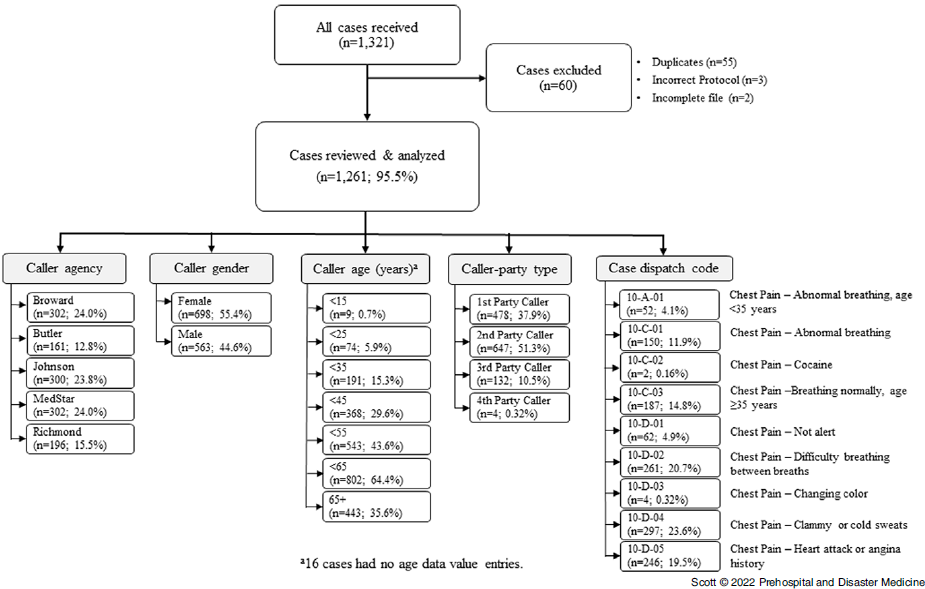
A total of 1,261 audio cases for Protocol 10 were reviewed (Figure 1). Of these cases, 90.2% were either second party (51.3%) or first party (38.9%); 55.4% were female callers; overall, 15.3% were under 35 years of age (median: 57 years); and 69.0% were DELTA calls/cases (highest: 10-D-4 [24.0%] and 10-D-02 [21.0%]).
Case Characteristics.

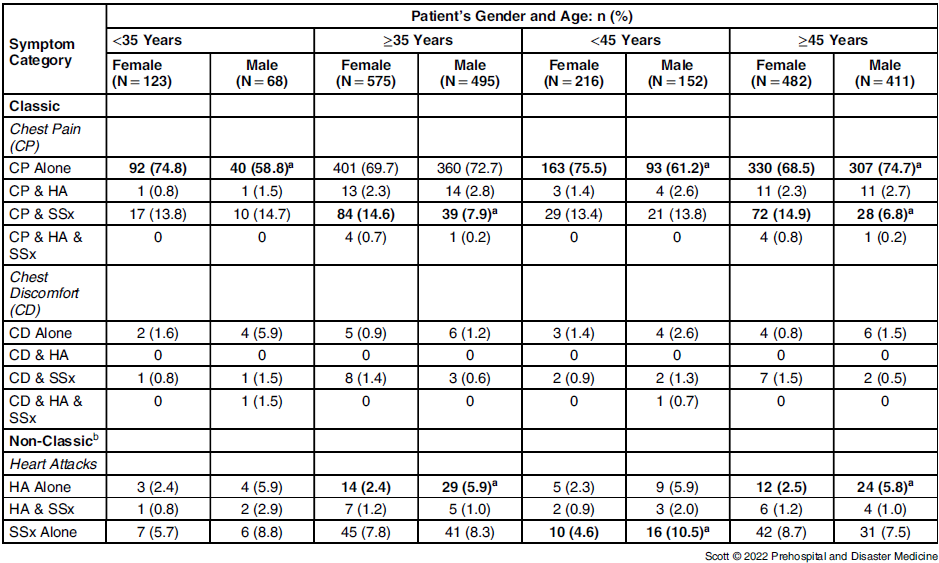
Overall, 87% of the time, CP or CD symptoms were mentioned alone or accompanied with other problems. However, CP symptom was mentioned alone 70.8%, HA alone 4.0%, and CD symptom alone 1.4% of the time. Otherwise, other SSx were mentioned alone only (without CP, CD, or HA) 7.9% of the time. Generally, the distributions of symptoms did not statistically differ significantly by patient gender at the two-sided Fisher’s Exact test’s 0.05 cut-off level of significance. Nevertheless, CP was significantly mentioned alone for the female more than male patients younger than 35 years (74.8% and 58.8%; P = .022, respectively) and younger than 45 years (75.5% and 61.2%; P = .003, respectively; Table 1). However, it was mentioned alone for only male more than female patients aged 45 years or older (74.7% and 68.5%; P = .040, respectively).
Primary Problem – Distributions of Cases by Patient’s Symptom, Gender, and Age

Abbreviations: CP, chest pain; HA, heart attack; SSx, specific symptoms (such as tightness, pressure, numbness, heaviness, aching, sharp/stabbing, constricting, and crushing); CD, chest discomfort.
a Significant difference between patient gender.
b Chest pain/chest discomfort not mentioned.
Chest pain was mentioned in addition with other SSx for female more than male patients overall (14.5% and 8.7%; P = .002, respectively), for female patients aged 35 years or older (14.6% and 7.9%; P = .001, respectively), or female patients aged 45 years or older (14.9% and 6.8%; P <.001, respectively).
Chest discomfort was mentioned alone more only for those younger than 35 years of age than those aged 35 years or older (3.1% and 1.0%; P = .020, respectively).
Heart attack was mostly mentioned alone for male more than female patients overall (5.9% and 2.4%; P = .002, respectively), and among those aged 35 years or older (5.9% and 2.4%; P = .004, respectively) or among those aged 45 years or older (5.8% and 2.5%; P = .011, respectively).
Finally, SSx were mostly mentioned alone only among male than female patients younger than 45 years (10.5% and 4.6%; P = .030, respectively).
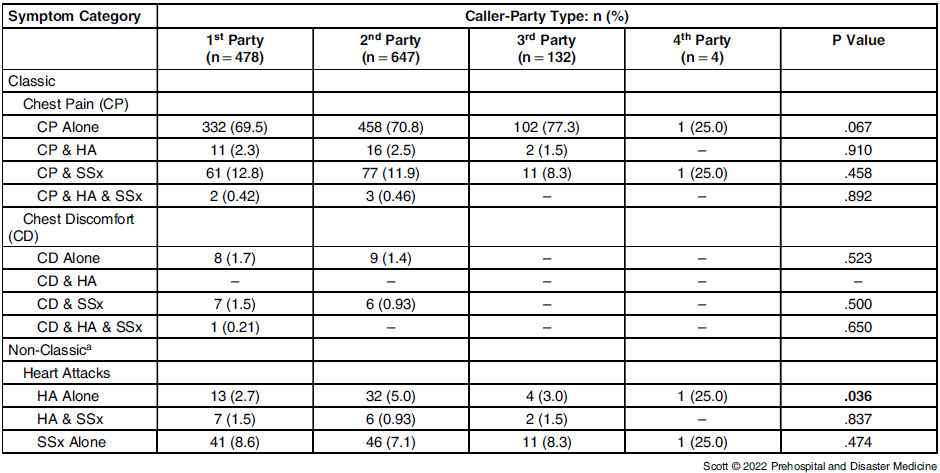
The distributions of HA symptoms alone (mentioned alone without any other accompanying problems) was the only category that significantly differed, statistically, by caller party type (P = .036; Table 2). Generally, the second party callers (5.0%) mention the HA symptoms alone more often than the other callers, followed by third party callers (3.0%) and first party callers (2.7%).
Primary problem – distributions of cases by patient’s symptom and caller-party type.

Abbreviations: CP, chest pain; HA, heart attack; SSx, specific symptoms (such as tightness, pressure, numbness, heaviness, aching, sharp/stabbing, constricting, and crushing); CD, chest discomfort.
a Chest pain/Chest discomfort not mentioned.
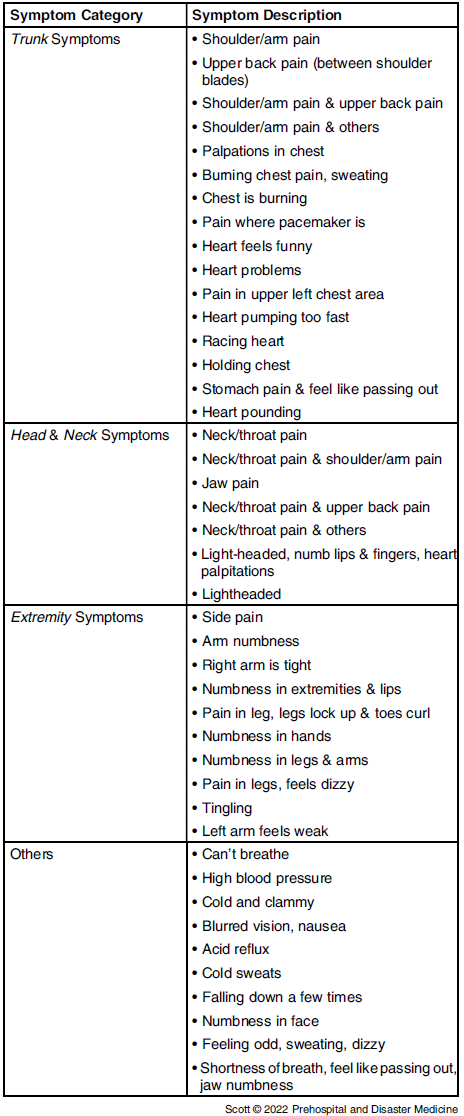
Apart from the classic and non-classic CP symptoms, callers reported that patients presented numerous other trunk, head, neck, and extremity-related symptoms, including respiratory, vision, and motion/coordination problems (Table 3).
Other Heart Attack and Additional Symptoms

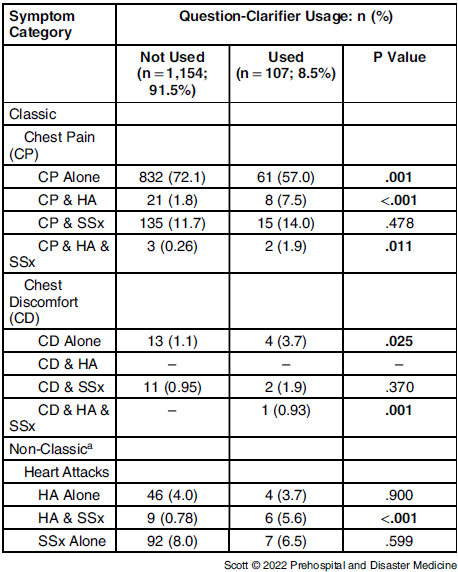
Overall, the clarifier for the CE chief complaint query (“Tell Me Exactly What Happened”) was used only 8.5% of the time (Table 4). Specifically, the distribution of the use and non-use of the clarifier significantly differed among the patients where the following problems/symptoms were mentioned: CP alone (57.0% versus 72.1%, respectively; P = .001); CP and HA (7.5% versus 1.8%, respectively; P <.001); CP, HA, and other SSx (1.9% versus 0.3%, respectively; P = .011); CD alone (3.7% versus 1.1%, respectively; P = .025); CP, HA, and other SSx (0.9% versus 0.0%, respectively; P = .001); and HA and other SSx (5.6% versus 0.8%, respectively; P <.001).
Primary Problem – Distributions of Cases by Patient’s Symptom and Question Clarifier

Abbreviations: CP, chest pain; HA, heart attack; SSx, specific symptoms (such as tightness, pressure, numbness, heaviness, aching, sharp/stabbing, constricting, and crushing); CD, chest discomfort.
a Chest pain/Chest discomfort not mentioned.
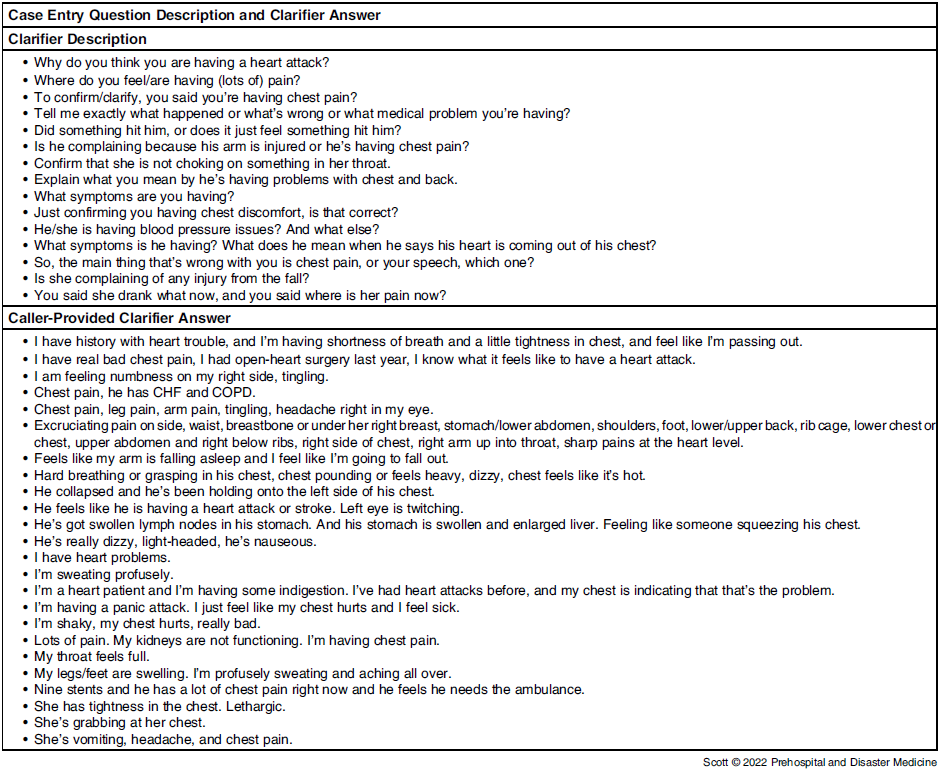
For the cases where EMDs used a CE question clarifier, callers were able to provide more detailed and accurate descriptions of the problem that enabled the EMDs to effectively code the case as Chief Compliant Chest Pain/Chest Discomfort (Table 5).
Descriptions of Case Entry Question Clarifiers and Answers

Discussion
The findings in this study demonstrate that 9-1-1 callers report suspected or potential HA cases using a variety of terms and descriptions, most commonly CP, with symptoms such as numbness, pressure, tightness, heaviness, aching, constricting, crushing, as well as arm, shoulder, back, and neck pain also mentioned at times. Since poor knowledge of HA signs and symptoms by the public has been associated with delays in care and worsened patient outcomes, Reference Finn, Bett, Shilton, Cunningham and Thompson7–Reference Mol, Rahel, Meeder, van Casteren and Cramer12 it is important that EMDs are well-educated on both commonly used terms—and less commonly used terms—associated with a HA and to select Protocol 10 (Chest Pain/Chest Discomfort) promptly for such cases. Effective EMD triage of these cases enables the dispatch of the proper emergency medical responder personnel as well as the delivery of needed dispatch life support instructions, even before arrival of trained responders, such as precise instructions on taking aspirin that could be on-hand at the patient’s location. Reference Barron, Clawson and Scott13
While this study did not report hospital-confirmed discharge diagnosis of the cases studied, a previous study indicated that EMDs following MPDS Protocol 10 (Chest Pain/Chest Discomfort) with high protocol compliance can accurately identify and triage hospital-confirmed cardiac-related problems—including hospital-diagnosed HAs—using the Chest Pain/Chest Discomfort Protocol with a high degree of sensitivity and a moderate degree of specificity. Reference Scott, Clawson and Gardett14
The term “having a heart attack” is often used by both the patient herself/himself and the second party caller (ie, someone with the patient at the time of calling the 9-1-1 service) as the sole complaint description, or in combination with other SSx. When given only the description “having a heart attack” by a caller, it has been a long-standing practice for EMDs to query the caller for more clarifying information, most importantly for specific physical symptoms that the patient is experiencing. The results of this study reinforce the importance of that practice—although the clarifier was seldom used (only approximately nine percent of the time)—indicating that callers provided quite substantial and accurate descriptions of the problems. In fact, a recent study demonstrated the risk of lower priority triage for hospital-confirmed HA patients when EMDs do not recognize non-CP HA symptoms, although this occurs at a relatively low frequency (0.5%) within the MPDS. Reference Olola, Broadbent, Gardett, Scott and Clawson15
The other non-classic CP/CD symptoms that were reported here are mostly consistent with other studies that have examined patient descriptions of HA symptoms. Reference Horne, James, Petrie, Weinman and Vincent1–Reference Milner, Vaccarino, Arnold, Funk and Goldberg4,Reference Patel, Fang, Gillespie, Odom, Luncheon and Ayala8,Reference Fang, Keenan and Dai9
Future studies that evaluate the predictive value of specific 9-1-1 caller-described terms and symptoms mentioned in this study to determine cases of hospital-confirmed HAs could be useful for medical dispatch protocol evolution and improved prioritization of potential HA cases reported to 9-1-1.
Limitations
There are some limitations to this study. The study did not attempt to collect hospital discharge diagnosis outcome data of the patients reported to 9-1-1 with HA symptoms; therefore, the authors were unable to draw any associations between specific symptoms reported and actual formally diagnosed HA. Such analysis is recommended for future studies to explore. Additionally, while five separate, accredited dispatch agencies (from four states in the USA) contributed to this study, that contribution represents only a small fraction of EMD agencies that use the MPDS in North America and world-wide, hence, generalizability of the results is not entirely known.
Conclusion
9-1-1 callers report potential HA cases using a variety of terms and descriptions—most commonly CP—however, other less-common symptoms associated with HA may be mentioned in combination or individually. Other symptoms may include numbness, pressure, tightness, heaviness, constricting, crushing, as well as arm, back, shoulder, jaw, and neck pain. The EMDs must be well-educated on caller descriptions associated with HA symptoms and be prepared to probe the caller with a clarifying query to elicit more specific information when “having a heart attack” is the only complaint initially mentioned. Proper prioritization by EMDs may potentially reduce treatment time and improve care, including pre-arrival aspirin administration, for a subset of patients with HAs who do not present with the classic symptoms of CP or CD.
Conflicts of interest
Jeff Clawson is the inventor of the Medical Priority Dispatch Protocols studied.
Acknowledgements
The authors would like to thank Lindy Curtis (EMD Compliance Manager) and Angela Larson (ED-Q) of MedStar Mobile Healthcare, Fort Worth, Texas USA; Cynthia Agee, NRP, ED-Q of Richmond Ambulance Authority, Virginia USA; and Jeremy Seglem (Director), Butler County Emergency Communications, Kansas USA for their support in coordinating the data acquisition logistics.