INTRODUCTION
Language acquisition is influenced by various genetic and biological factors, and also by social environmental factors (Harrison & McLeod, Reference Harrison and McLeod2010). It is important to acknowledge an interaction between different factors as well as their joint effects (Desmarais, Sylvestre, Meyer, Bairati & Rouleau, Reference Desmarais, Sylvestre, Meyer, Bairati and Rouleau2008). Although humans are claimed to have an innate, genetically determined predisposition towards language acquisition and processing, early language experiences are needed to activate genetic programmes underlying language production and comprehension (Arshavsky, Reference Arshavsky2009). For example, Bruner (Reference Bruner1981, Reference Bruner1983) has pointed out that, in this learning process, early routinized social activity, where the mother or other caretaker interprets the child's signals and imputes meanings to them, as well as the caretaker's ability to follow the child's attentional focus, are of key importance. In fact, a considerable number of studies of maternal verbal interactive style, or child-directed speech (CDS), have concluded that it plays an important role in the development of children's early communicative and linguistic skills (e.g. Masur, Flynn & Eichorst, Reference Masur, Flynn and Eichorst2005; Tamis-LeMonda, Bornstein & Baumwell, Reference Tamis-LeMonda, Bornstein and Baumwell2001). CDS is referred to as a particular manner of speaking, and it is characterized by simplified syntax and meaning, and exaggerated prosodic structure as if adapted to the capacities of the child (e.g. Ferguson, Reference Ferguson, Lust and Foley2004 [1978]). Additional studies are still needed in order to generate more accurate and profound conclusions about the role of maternal interactive style in child early language acquisition. This line of research is important, not least because it is closely related to speech and language therapy, in particular to interactive models of language intervention (e.g. Ciccone, Hennessey & Stokes, Reference Ciccone, Hennessey and Stokes2012; Gibbard, Coglan & MacDonald, Reference Gibbard, Coglan and MacDonald2004; Girolametto, Weitzman, Wiigs & Pearce, Reference Girolametto, Weitzman, Wiigs and Pearce1999; Kaiser & Hancock, Reference Kaiser and Hancock2003; Roberts & Kaiser, Reference Roberts and Kaiser2011).
Maternal verbal interactive style and its role in child early linguistic development
The reports of the earlier studies of the possible language-facilitating characteristics of CDS have emphasized, for example, the importance of fine-tuning the structural and conceptual complexity of verbal communication to the child's developmental level (Bornstein, Tamis-LeMonda & Haynes, Reference Bornstein, Tamis-LeMonda and Haynes1999; Furrow, Nelson & Benedict, Reference Furrow, Nelson and Benedict1979; Landry, Smith & Swank, Reference Landry, Smith and Swank2006). On the other hand, Snow (Reference Snow, Fletcher and MacWhinney1995) argued that the appropriately simplified structure and conceptual complexity of CDS is not sufficient in facilitating child linguistic development, if object references are frequently used to redirect the child's focus of attention as opposed to following it. A frequent use of prescriptives or object references that redirect the child's focus of attention has indeed been reported to be related to slower early vocabulary growth and a less varied vocabulary (e.g. Akhtar, Dunham & Dunham, Reference Akhtar, Dunham and Dunham1991; Della Corte, Benedict & Klein, Reference Della Corte, Benedict and Klein1983; Masur et al., Reference Masur, Flynn and Eichorst2005; Tomasello & Farrar, Reference Tomasello and Farrar1986). In turn, joint attention refers to a situation in which both the adult and the child are jointly attending to a common aspect of the situation. Joint attention shared by the adult and child helps the child identify the intended target of the adult's utterance, while talking about objects or events in the ‘here-and-now’, as well as using familiar words for the target information, provide further help for the child to understand adult utterances (for a review see Clark, Reference Clark2009, pp. 36–38).
When considering maternal skills in sharing and maintaining joint attention with a child, the concept of responsiveness is usually brought up. Maternal responsiveness refers to a mother's ability to perceive her child's signals accurately and to respond to them promptly, contingently, and appropriately (Bornstein et al., Reference Bornstein, Tamis-LeMonda and Haynes1999). It has often been shown to be associated with child language outcomes (Bornstein et al., Reference Bornstein, Tamis-LeMonda and Haynes1999; Girolametto, Bonifacio, Visini, Weitzman, Zocconi & Pearce, Reference Girolametto, Bonifacio, Visini, Weitzman, Zocconi and Pearce2002; Girolametto et al., Reference Girolametto, Weitzman, Wiigs and Pearce1999; Hoff & Naigles, Reference Girolametto, Bonifacio, Visini, Weitzman, Zocconi and Pearce2002; Kaiser & Hancock, Reference Kaiser and Hancock2003; Masur et al., Reference Masur, Flynn and Eichorst2005; Roberts & Kaiser, Reference Roberts and Kaiser2011). In turn, constantly redirecting the child's focus of attention, and also attempts to command and control the child's behaviour, have been considered characteristics of directive interactive style (Della Corte et al., Reference Della Corte, Benedict and Klein1983; Hoff & Naigles, Reference Hoff and Naigles2002; Masur et al., Reference Masur, Flynn and Eichorst2005). However, Pine (Reference Pine1992) has pointed out that behavioural directives are quite frequently used to support an ongoing activity, and therefore they do not necessarily have the intrusive quality of attention-directing utterances. Flynn and Masur (Reference Flynn and Masur2007) have added that possible negative outcomes of directiveness may come about specifically because directive utterances are commonly used to redirect children's attention. Hence, directive utterances may not only be intrusive but also supportive, depending on the child's current focus of attention (see also Akhtar et al., Reference Akhtar, Dunham and Dunham1991; Lloyd & Masur, Reference Lloyd and Masur2014; Masur, Flynn & Lloyd, Reference Masur, Flynn and Lloyd2013; Pine, Reference Pine1992). For example, Masur et al. (Reference Masur, Flynn and Eichorst2005) found in their study of mothers and children between the ages 0;10 and 1;9 that maternal supportive directives were positively and intrusive directives negatively related to children's early advances in expressive vocabulary. All in all, it is important to take into consideration not only the pragmatic but also the attentional aspects of directives.
Bidirectional nature of the relationship between maternal verbal interactive style and child language skills
It is also important to take into consideration that individual characteristics of children in mother–child conversational interactions may influence maternal behaviour (e.g. D'Odorico, Salerni, Cassibba & Jacob, Reference D'Odorico, Salerni, Cassibba and Jacob1999; Lloyd & Masur, Reference Lloyd and Masur2014; Masur et al., Reference Masur, Flynn and Lloyd2013). Hence, one might also think that individual variation among children in communicative and language abilities at a given age might at least in part explain the differences in verbal interactive style among mothers. This is an important point, because during the early stages of linguistic development quite a considerable level of individual variation and instability can still be considered normal (Clark, Reference Clark2009, p. 14; Darrah, Hodge, Magill-Evans & Kembhavi, Reference Darrah, Hodge, Magill-Evans and Kembhavi2003; Fenson, Dale, Reznick, Bates, Thal & Pethick, Reference Fenson, Dale, Reznick, Bates, Thal and Pethick1994; Fenson, Bates, Dale, Goodman, Reznick & Thal, Reference Fenson, Bates, Dale, Goodman, Reznick and Thal2000; Stoel-Gammon, Reference Stoel-Gammon2011). Furthermore, characteristics of maternal verbal interactive style that facilitate growth at one age might be irrelevant at another (Masur et al., Reference Masur, Flynn and Eichorst2005; Rowe, Reference Rowe2012; Soderstrom, Reference Soderstrom2007).
Several researchers have suggested that CDS may be more influential around the onset of word production than at later stages of language development (e.g. Barrett, Harris & Chasin, Reference Barrett, Harris and Chasin1991; D'Odorico et al., Reference D'Odorico, Salerni, Cassibba and Jacob1999; Silvén, Niemi & Voeten, Reference Silvén, Niemi and Voeten2002). It is possible that the role of CDS, at least in vocabulary development, declines quite sharply once the child has grasped the idea of using words as a vehicle of communication. Hoff and Naigles (Reference Hoff and Naigles2002) added that, by the time children have become competent at staying engaged and following their mothers’ focus, individual differences in maternal contingency decrease in importance. However, in a study by Dunham, Dunham, and Curwin (Reference Dunham, Dunham and Curwin1993), joint attention parameters were manipulated in order to determine their effects on the ability of children to learn new words at the age of 1;6. A significant learning advantage for the attention-following versus attention-redirecting context was still found at that age. Hence, in order to make more profound conclusions concerning these matters, further investigations are in order, even up until the third year of children's life. In addition, because according to some earlier findings the way an individual mother talks to her child is significantly determined by the child's own linguistic and communicative ability (see Gleitman, Newport & Gleitman, Reference Gleitman, Newport and Gleitman1984; Hampson & Nelson, Reference Hampson and Nelson1993; Lloyd & Masur, Reference Lloyd and Masur2014; Masur, Reference Masur1982; Snow, Reference Snow, Fletcher and MacWhinney1995), it would be interesting to study to what extent maternal contingency is stable over the course of time during significant changes in children's linguistic skills. However, in a study by Flynn and Masur (Reference Flynn and Masur2007), maternal responsiveness and intrusive attentional directiveness demonstrated considerable stability between the children's ages of 0;10 and 1;9.
The present study
The purpose of the present longitudinal study was to investigate maternal responsive and directive speech to children and its role in early linguistic development in a new language community (Finnish). In the analyses of maternal speech, the categories presented earlier by Flynn and Masur (Reference Flynn and Masur2007) were used. These categories capture aspects of responsive and directive speech that reflect both the essential pragmatic and attentional characteristics. By considering these characteristics simultaneously, it is possible to improve understanding of the critical language-facilitating features of maternal speech. Maternal speech was analyzed at age 0;10, i.e. around the time the children have started to comprehend words and are quite soon expected to produce their own first words. The same analyses were repeated at age 2;0, i.e. around the end of the prelinguistic developmental period (for different stages of prelinguistic development, see Mundy & Gomes, Reference Mundy, Gomes, Adamson and Romski1997). Although children typically show signs of intentional communication already at the end of their first year, and also word production usually starts soon after that, during the second year of life they still rely quite heavily on non-verbal communicative means. Gradually the usage of gestures and vocalizations in isolation decreases, with an increase in the usage of coordinated gestures and vocalizations as well as words (Wetherby, Cain, Yonclas & Walker, Reference Wetherby, Cain, Yonclas and Walker1988). Finally, towards the end of the second year, the usage of communicative acts consisting of only words increases. Because age 2;0 can be considered an important transitional point from the prelinguistic to linguistic developmental stage, this could be reflected in maternal interactive style. The role of maternal responsiveness and directiveness may change as children rely heavily on spoken language as their main form of communication. Children's linguistic abilities were assessed at ages 1;0 and 2;6. A number of similar previous studies examined only productive vocabulary as an outcome measure (Akhtar et al., Reference Akhtar, Dunham and Dunham1991; Bornstein et al., Reference Bornstein, Tamis-LeMonda and Haynes1999; Masur et al., Reference Masur, Flynn and Eichorst2005). In the present study, receptive skills were also assessed.
First, we examined the relations between each maternal utterance category separately at the children's ages of 0;10 and 2;0. Second, we wanted to know whether there are some changes in the frequencies of maternal responsive and directive utterances over the course of time, and to what extent verbal behavioural patterns are stable in individual mothers. To obtain this information, we examined the relations of each utterance category between the children's age points of 0;10 and 2;0. Finally, the relations of maternal utterance categories to child early linguistic development were examined. Our approach in these final analyses was to use the measures of maternal speech from each age to predict the results of the subsequent linguistic assessment.
We used absolute frequencies of maternal utterances in the analyses, because the amount of maternal speech may have a role in promoting child language development (Brent & Siskind, Reference Brent and Siskind2001; Goodman, Dale & Ping, Reference Goodman, Dale and Ping2008; Hurtado, Marchman & Fernald, Reference Hurtado, Marchman and Fernald2008). However, we also used partial correlational analyses, controlling for the total number of utterances, in order to obtain information concerning the characteristics of maternal speech and its role in child language development independently of the overall amount of verbal interaction. Because earlier studies have indicated that during the early stages of development girls tend to produce more words than boys (e.g. Fenson et al., Reference Fenson, Dale, Reznick, Bates, Thal and Pethick1994; Stolt, Haataja, Lapinleimu & Lehtonen, Reference Stolt, Haataja, Lapinleimu and Lehtonen2008), the possible effects of gender were also considered, in terms of both child linguistic development and also the measures of maternal speech.
METHOD
Participants
Participants were twenty-four first-born children (12 girls and 12 boys) and their mothers, who were native speakers of Finnish. They were recruited from the maternity ward in a hospital located in northern Finland. All the children were healthy and full term at birth after normal pregnancy and delivery. Families meeting these criteria were selected on the basis of their willingness to participate in a longitudinal study of mother–child interaction and child early linguistic development. All mothers gave their written informed consent to participate.
At the beginning of data collecting, maternal age ranged from twenty-two to forty-two years (M = 27). The mothers were well educated, having completed an average of seventeen years of schooling. Fifteen of them had a tertiary education (e.g. polytechnic, university) and nine mothers had an upper secondary education (e.g. senior secondary school, vocational and professional education institutions). Households were of middle socioeconomic status based on the occupational status of the parents.
Procedure
Participants were visited in their homes by the first author at the children's ages of 0;10 and 2;0 in order to collect videotaped samples of mother–child interaction. Each dyad was videotaped for about 20 minutes in a semi-structured free-play session using a standard set of age-appropriate toys. The set of toys was adapted from the free-play segment of the Parent–Child Early Relational Assessment (PCERA; Clark, Reference Clark1985), including, e.g. toy telephones, a baby doll, a teddy bear, some building blocks, a ball, and a couple of picture books. At 2;0 a shape sorter, crayons, and drawing paper, as well as a tea set, were added. The mothers were instructed to interact with their children in the way they usually did. Videotapes were later transcribed verbatim. The basic unit of the transcription was the utterance. It was defined as any sequence of words or vocalization that is preceded and followed by a pause or a change in conversational turn, topic, or intonation pattern. In addition to verbal and vocal utterances, the transcripts included non-verbal acts, which served, either alone or in conjunction with a vocalization or with speech, to initiate or maintain interaction. Both the maternal and child utterances and non-verbal acts were included in the transcripts. The transcription procedure was carried out by three researchers (second, third, and fourth authors), each of them managing one-third of the whole video data. The transcription reliability was checked so that 50% of the data was reanalyzed by another researcher. The percentage of agreement was 100%, concerning the segmentation of the sequences of words and vocalizations into utterances and also the inclusion of non-verbal acts in the transcripts.
With respect to assessment of child linguistic abilities, at the children's age of 1;0 mothers were given a questionnaire: the Finnish version of the MacArthur Communicative Development Inventories (MCDI; Fenson et al., Reference Fenson, Dale, Reznick, Bates, Thal and Pethick1994; Lyytinen, Reference Lyytinen1999). At 2;6, the Finnish version of the Reynell Developmental Language Scales III (RDLS III; Edwards, Fletcher, Garman, Hughes, Letts & Sinka, Reference Edwards, Fletcher, Garman, Hughes, Letts and Sinka1997; Finnish version, Reference Edwards, Fletcher, Garman, Hughes, Letts and Sinka2001) was administered by the first author during a home visit.
Measures
Maternal utterances. In this study, we employed the categories of mothers’ responsive and directive speech that were adapted from the earlier work of Flynn and Masur (Reference Flynn and Masur2007). These four mutually exclusive categories are: Responsive Utterances, Supportive Directive Utterances, Intrusive Behavioural Directives, and Intrusive Attentional Directives. The categorization system takes into consideration both the mother's sensitivity to the child's focus of attention at the time of the utterance, and the mother's pragmatic intent. From each videotaped free-play session, altogether ten minutes were analyzed with the help of the transcripts, starting from the beginning of the third minute until the end of the twelfth minute.
Utterances that referred to an object, action, or attribute on which the child was currently visually focused or with which the child was actively engaged were identified as following the child's attention, whereas others were designated as leading the child's attention (see Akhtar et al., Reference Akhtar, Dunham and Dunham1991; Landry, Chapienski & Schmidt, Reference Landry, Chapienski and Schmidt1986; Masur et al., Reference Masur, Flynn and Eichorst2005). Pragmatic categorization reflected the function of the utterance (see Pine, Reference Pine1992). The definitions of the four categories are as follows:
-
(a) Responsive Utterances are statements describing a person's behaviour, actions, feelings, etc., or an object or an event present in the immediate situation (e.g. ‘You are patting the dog.’ ‘The ball is bouncing.’ ‘Is that a red car?’). They are following the child's focus of attention. So-called fillers (e.g. ‘uh oh’, ‘mm’) that were not conveying any referential meaning and appeared to be used as automatic responses were not included.
-
(b) Supportive Directives aim to control the child's physical behaviour by suggesting, commanding, or encouraging the child (e.g. ‘Throw the ball to mummy.’ ‘Let's have a tea party.’ ‘Could you give me some more tea, please?’). They are also following the child's focus of attention.
-
(c) Intrusive Behavioural Directives have the same pragmatic intent as Supportive Directives, but they direct the child's focus of attention away from the action or object with which the child is currently engaged, and/or lead the child's behaviour in a new direction.
-
(d) Intrusive Attentional Directives attempt to redirect or lead the child's focus of attention (e.g. ‘Look at this picture. Can you see the doll?’).
Utterances that were not counted in any of the above-mentioned categories are included in the total number of maternal utterances. In the present study, they are not examined further. Non-verbal acts included in the transcripts are not examined either. Still, the inclusion of the non-verbal acts in the transcripts was important for the purposes of the present study, because it made it easier to categorize maternal utterances. Similarly to the transcription, the categorization was also carried out by three researchers. In the beginning of this procedure some parts of the data were viewed together in the whole research group, and the principles of categorization were discussed thoroughly. In order to test the reliability of the categorization of maternal utterances, 50% of the data was reanalyzed by another researcher. The percentage of agreement was 91·9% for the video data collected at the children's age of 0;10, and 90·2% for the data collected at the children's age of 2;0 (the number of utterances that were categorized in the same way ÷ the number of utterances categorized either in the same way or differently × 100 = the agreement %). Cohen's kappa values were also run to determine the level of agreement between the researchers in categorizing maternal utterances. The values for the video data at 0;10 and 2;0 were 0·83 and 0·84, respectively. For the most part, the discrepancy found was between the categories Responsive Utterances and Supportive Directives. Hence, the mother's sensitivity to the child's focus of attention was interpreted in the same way between the researchers, but the mother's pragmatic intent was in some cases unclear. In addition, some utterances that were categorized as responsive by one researcher were not counted in any of the four categories by the other. In these cases, the other researcher considered an utterance to be a so-called filler.
Child linguistic measures. For the purposes of assessing early linguistic skills at the children's age of 1;0, the Finnish version of the MacArthur Communicative Development Inventories (Fenson et al., Reference Fenson, Dale, Reznick, Bates, Thal and Pethick1994; Lyytinen, Reference Lyytinen1999) was used, which is based on parental reports. The younger children's form of the MCDI, which is designed for children aged 0;8 to 1;4, was used in this study. It provides information on children's phrase and vocabulary comprehension as well as on vocabulary production. In addition, a composite of early symbolic actions and communicative gestures, a measure called Total gestures, is derived from parental reports.
The children's linguistic competence at 2;6 was assessed using the Finnish version of the Reynell Developmental Language Scales III (Edwards et al., Reference Edwards, Fletcher, Garman, Hughes, Letts and Sinka1997; Finnish version, Reference Edwards, Fletcher, Garman, Hughes, Letts and Sinka2001). These scales give scores for language comprehension and expressive skills. The Comprehension scale has sixty-two items organized into ten sections, which test, e.g. comprehension of single words and basic relations between words, and understanding of attributes and spatial relations, as well as complex grammatical and inference skills. The Expressive scale also has sixty-two items, in six sections, for which the examiner asks the child, e.g. to name objects, describe activities, and define words.
Statistical analyses
Statistical analyses were produced with SPSS version 23·0 for Windows. Descriptive statistics (means, standard deviations, and ranges) for maternal utterances are presented first in order to describe the distribution and the amount of variation in the data. The possible effects of gender were assessed using the Student's t-test for independent samples. Thereafter, the relations between the total number of maternal utterances and each utterance category, both at the children's ages of 0;10 and 2;0, were examined using the Pearson product–moment correlations. Partial correlations controlling for the total number of utterances were used to examine the relations between different utterance categories separately at 0;10 and 2;0. The Pearson correlations and partial correlations were used to examine the relations between the two age-points. In addition, the dependent t-test was used for further investigations of the possible changes in the frequencies of utterances over time.
With regard to the child linguistic measures at 1;0 and 2;6, descriptive statistics are presented first. The possible effects of gender were again assessed using the Student's t-test for independent samples. To examine the relations between the different maternal utterance categories and child linguistic measures, the Pearson product–moment correlations and partial correlations controlling for the total number of utterances were used. Our approach was to use the measures of maternal utterances from each age to predict the results of the subsequent linguistic assessment.
RESULTS
Maternal responsive and directive speech at the children's ages of 0;10 and 2;0
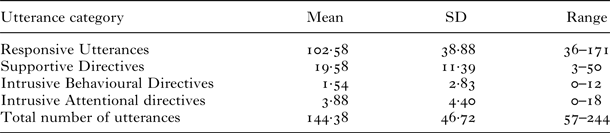
Descriptive statistics for maternal responsive and directive utterances, as well as the total number of utterances at the children's age of 0;10, are presented in Table 1, and at the children's age of 2;0 in Table 2. As can be seen, individual variation in the frequencies of all the utterance categories, as well as in the total amount of maternal speech, was considerable. The possible effects of gender were investigated by using the Student's t-test for independent samples. No statistically significant gender differences were found.
Mean frequencies, standard deviations, and ranges of maternal utterances at the children's age of 0;10

Mean frequencies, standard deviations, and ranges of maternal utterances at the children's age of 2;0

Pearson product–moment correlations were used to analyze the relations between the total number of utterances and the different utterance categories. At the children's age of 0;10, there were positive correlations between the total number of maternal utterances and the frequencies of Responsive Utterances (r = 0·888, p < ·0001), Supportive Directives (r = 0·480, p = ·017), and also Intrusive Attentional Directives (r = 0·423, p = ·039). The investigations at the age-point 2;0 indicated positive correlations between the total number of maternal utterances and the frequencies of Responsive Utterances (r = 0·902, p < ·0001) and Intrusive Attentional Directives (r = 0·500, p = ·013). Because of these quite consistent associations, the next analyses of maternal verbal interactive style control for utterance frequencies.
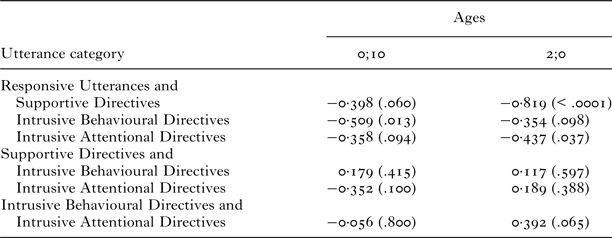
Partial correlations controlling for the total number of maternal utterances showed negative relations between responsive and directive utterances at both age-points (see Table 3). At 0;10 the correlation between Responsive Utterances and Intrusive Behavioural Directives was significant. In addition, there was a negative trend in the correlation between Responsive Utterances and Supportive Directives. At 2;0, Responsive Utterances correlated negatively with Supportive Directives and also with Intrusive Attentional Directives. Furthermore, at 2;0 a positive trend was found between Intrusive Behavioural and Intrusive Attentional Directives.
Partial correlations between maternal responsive and directive utterance frequencies at the children's ages of 0;10 and 2;0, controlling for the total number of utterances (p-values are in parentheses)

Changes of maternal responsive and directive utterances with the child's age
The relations in the frequencies of responsive and directive utterances between the two age-points were analyzed first by using Pearson product–moment correlations and second by using partial correlations, controlling again for total utterance frequencies at both age-points. The results of these analyses are presented in Table 4.
Pearson product–moment correlations and partial correlations, controlling for total utterance frequencies, between the measures of maternal responsive and directive utterances at the children's ages of 0;10 and 2;0 (p-values are in parentheses)

Pearson correlations showed a positive relationship between Responsive Utterances at the two age-points, whereas partial correlation was not statistically significant. Furthermore, Pearson correlations showed a significant positive correlation between Supportive Directives at the children's ages of 0;10 and 2;0. This relation remained significant when the total utterance frequencies were controlled. In addition, there was a positive correlation between the total number of utterances at the age-points 0;10 and 2;0 (r = 0·519, p = ·009).
We also used a dependent t-test for investigations of the possible changes in the frequencies of different kinds of utterances between the two time-points. These analyses indicated that the mothers produced significantly more Responsive Utterances at the children's age of 2;0 compared to age 0;10 [(p < ·0001, 95% Confidence Interval (CI) –16·944 to (–4·397)]. By contrast, there were no statistically significant changes in the frequencies of directive utterances. The total utterance frequency increased significantly over time [p = ·004, 95% CI –46·185 to (–10·148)].
Relations of maternal responsive and directive utterances to child language outcomes
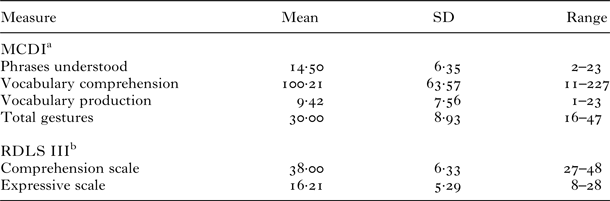
The descriptive statistics of the language measures are presented in Table 5. One gender difference was found in the measures: a Student's t-test for independent samples showed that girls produced more words than boys at 1;0 (p = ·049, CI 95% 0·019–11·981).
Means, standard deviations, and ranges for the child language measures at 1;0 and 2;6

notes: aThe MacArthur Communicative Development Inventories; bThe Reynell Developmental Language Scales III.
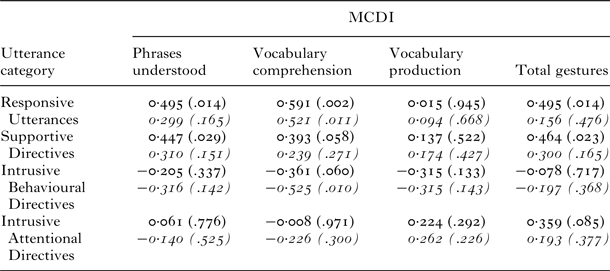
The possible relations between maternal verbal style and children's language outcomes at ages 1;0 and 2;6 were investigated by using Pearson product–moment correlations and partial correlations. Maternal Responsive Utterances at 0;10 were positively related to a child's ability to comprehend phrases and words at 1;0, although only the latter was also shown by partial correlation (see Table 6). Rather similar findings were made with regard to Supportive Directives, but these relations were not indicated when the total number of maternal utterances was controlled. In turn, a negative relation between Intrusive Behavioural Directives and Vocabulary comprehension was found, although only the partial correlation was statistically significant. Furthermore, Pearson correlations showed that both maternal Responsive Utterances and Supportive Directives were positively related to a child's production of early symbolic actions and communicative gestures (Total gestures). By contrast, none of the maternal utterance category was related to the measure of child Vocabulary production, as can been seen in Table 6.
Pearson product–moment correlations and partial correlations (in italics), controlling for total utterance frequencies, between the maternal responsive and directive utterances at the children's age 0;10 and child language measures at 1;0 (p-values are in parentheses)

With regard to the total number of utterances, it was positively related to Phrases understood (r = 0·417, p = ·043), Vocabulary comprehension (r = 0·421, p = ·041), and Total gestures (r = 0·487, p = ·016). In contrast, the total utterance frequency was not related to Vocabulary production (r = –0·032, p = ·882).
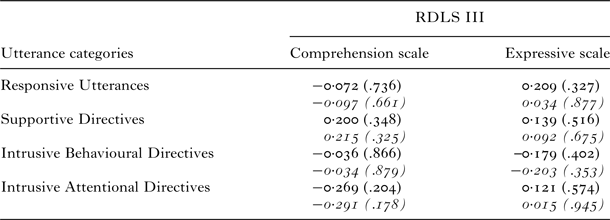
The investigations of the age-points 2;0 and 2;6 indicated no relations between any maternal utterance category and child language skills (see Table 7). The same was true for the total number of maternal utterances and child comprehensive skills (r = 0·091, p = ·627) and also for productive skills (r = –0·034, p = ·875).
Pearson product–moment correlations and partial correlations (in italics), controlling for total utterance frequencies, between the maternal responsive and directive utterances at the children's age 2;0 and child language measures at 2;6 (p-values are in parentheses)

DISCUSSION
The purpose of the present longitudinal study was to investigate maternal responsive and directive speech to children, and its role in early linguistic development, by applying an analysis procedure presented by Flynn and Masur (Reference Flynn and Masur2007). In this procedure, maternal verbal utterances are divided into four mutually exclusive categories that are: Responsive Utterances, Supportive Directive Utterances, Intrusive Behavioural Directives, and Intrusive Attentional Directives. Both the mother's sensitivity to the child's focus of attention at the time of the utterance and the mother's pragmatic intent are taken into consideration. Maternal speech was analyzed at the children's ages of 0;10 and 2;0. First, the relations between each maternal utterance category, both at the children's ages of 0;10 and at 2;0, were examined. Second, the relations of each utterance category between the children's age-points 0;10 and 2;0 were examined. In addition, children's linguistic abilities were assessed at ages 1;0 and 2;6. Thereafter, the measures of maternal speech from each age were used to predict the results of the subsequent linguistic assessment.
First, it is important to point out that individual differences between mothers in the frequencies of different utterance categories and in the total number of utterances were considerable at both age-points. Also Hurtado and colleagues (Reference Hurtado, Marchman and Fernald2008) reported considerable variation between mothers in the amount of speech and also in its variability and complexity. In addition, Rowe (Reference Rowe2008) found a relationship between directiveness and a smaller number of words, which is also in accordance with the present findings. In the present study, a positive correlation was found between responsive utterances and the total number of utterances at both age-points, and also between supportive directives and the total number of utterances at the children's age of 0;10. However, contrary to the findings of Rowe (Reference Rowe2008), in the present study a positive correlation was also identified between maternal intrusive attentional directives and the amount of speech at both age-points. An interesting question is to what extent the amount of speech and also other features of CDS are individual characteristics of the mother, and to what extent the child contributions in communicative interchanges influence the mother. It could be argued that the way an individual mother talks to her child is significantly determined by the child's own linguistic and communicative ability (see Gleitman et al., Reference Gleitman, Newport and Gleitman1984; Hampson & Nelson, Reference Hampson and Nelson1993; Lloyd & Masur, Reference Lloyd and Masur2014; Masur, Reference Masur1982; Snow, Reference Snow, Fletcher and MacWhinney1995). For example, in cases with passive, incomprehensive, and inattentive children still in toddlerhood, maternal intrusive directiveness may be an inevitable compensation. In a study of mothers and their children at age 1;3, Lloyd and Masur (Reference Lloyd and Masur2014) found that differential patterns of maternal responsive versus directive behaviours were prompted by different child initiatives (see also Masur et al., Reference Masur, Flynn and Lloyd2013). In a study by Vigil, Hodges, and Klee (Reference Vigil, Hodges and Klee2005), mothers of late-talking toddlers were less responsive and less keen on following the child's focus of attention compared to mothers of typically developing children (see also van Balkom, Verhoeven & van Weerdenburg, Reference van Balkom, Verhoeven and van Weerdenburg2010).
In the examinations of each age-point separately, we found some relations between the different maternal utterance categories. Negative correlations between responsive utterances and all the three different kinds of directive utterances were found. These results are partly similar to the findings of Flynn and Masur (Reference Flynn and Masur2007). They analyzed maternal speech at the children's ages of 0;10, 1;1, 1;5, and 1;9. Contrary to what we had expected, there was a negative correlation between responsive utterances and supportive directives. Similarly to Flynn and Masur, we observed no relations between supportive and intrusive directives. Contrary to the findings of Flynn and Masur, in the present study no relation was found between intrusive behavioural and attentional directives.
When considering the two different age-points of the present study, the frequencies of maternal utterance categories were less stable than in the data presented by Flynn and Masur (Reference Flynn and Masur2007). The last part of the second year in children's life might be a period of such dramatic developmental changes that the maternal interactive style also changes considerably. In the present study, the number of maternal responsive utterances increased over time. Flynn and Masur also found that overall frequencies of responsive utterances, as well as supportive directives, increased slightly over time. Smolak (Reference Smolak1987) reported that the use of directives decreases as children grow older. It is possible that this occurs in conjunction with the increase in the word production of the child, and overall with the development of a child's capacities to participate in communicative interactions. Words are likely to be easily perceived as communicative by the adult and hence responded to.
In accord with several earlier research findings (e.g. Akhtar et al., Reference Akhtar, Dunham and Dunham1991; Della Corte et al., Reference Della Corte, Benedict and Klein1983; Masur et al., Reference Masur, Flynn and Eichorst2005; Tomasello & Farrar, Reference Tomasello and Farrar1986), this study highlights the importance of joint attention shared by the adult and child during the first steps of language acquisition. Maternal responsive utterances and supportive behavioural directives at around the onset of child word production, i.e. at 0;10, were related to child receptive language skills, as well as to the skills in symbolic actions and communicative gestures at the age of 1;0. Quite interestingly, at the same time there was a negative correlation between responsive utterances and supportive directives, as mentioned earlier. Furthermore, both of these categories correlated positively with the total number of maternal utterances. This suggests that not only responsive but also directive interactive style may facilitate child language growth, provided that the directives follow the child's current focus of attention. The results also indicated a negative relationship between maternal intrusive behavioural directives and child receptive vocabulary at 1;0. In turn, the roles of responsiveness and directiveness appear to decrease in importance by the end of the prelinguistic developmental period, i.e. the time when children are expected to begin to rely on spoken words as their main form of communication. No statistically significant correlations were found between the maternal utterance categories at the children's age of 2;0 and child language measures at 2;6. Masur et al. (Reference Masur, Flynn and Eichorst2005) investigated the role of maternal responsiveness and directiveness to child vocabulary between the children's ages of 0;10 and 1;9. They found that maternal responsiveness and also supportive directiveness at the child's age of 1;5 were still positively related to child vocabulary at 1;9. Age 2;0 can be considered an important transitional point from a prelinguistic to linguistic developmental stage that could be reflected in maternal interactive style. Furthermore, Hoff and Naigles (Reference Hoff and Naigles2002) have pointed out that once children have reached the first stages of language utilization, semantic contingency of adult utterances to the child's previous utterances or focus of attention may no longer explain the differences among children in their capacities. However, this is not to say that by the end of the second year of children's life CDS loses its facilitating effects altogether. Based on the current literature, it is suggested that it is more probable that some other characteristics of CDS become important in explaining later advances in child language development. These characteristics might include lexical diversity (Hoff & Naigles, Reference Hoff and Naigles2002; Huttenlocker, Waterfall, Vasilyeva, Vevea & Hedges, Reference Huttenlocher, Waterfall, Vasilyeva, Vevea and Hedges2010; Rowe, Reference Rowe2008, Reference Rowe2012), as well as syntactical diversity (Hoff & Naigles, Reference Hoff and Naigles2002; Huttenlocker et al., Reference Huttenlocher, Waterfall, Vasilyeva, Vevea and Hedges2010), vocabulary sophistication, and also the use of different kinds of decontextualized utterances falling into categories such as explanations, pretence, and narrative (Rowe, Reference Rowe2012). Altogether, it is likely that certain aspects of parenting affect certain child outcomes and that different aspects are important at different stages of development (Masur et al., Reference Masur, Flynn and Eichorst2005; Rowe, Reference Rowe2012; Soderstrom, Reference Soderstrom2007; Tamis-LeMonda et al., Reference Tamis-LeMonda, Bornstein and Baumwell2001).
To conclude, it is possible that merely revealing the relationship between CDS and child language development does not in itself demonstrate that certain characteristics of CDS actually facilitate children's language acquisition. In a relatively recent research report, Song, Spier, and Tamis-LeMonda (Reference Song, Spier and Tamis-LeMonda2014) suggested a bi-directionality in mother–child associations. They found that, although the quantity and quality of CDS had implications for children, early cognitive skills of children subsequently affected maternal language. However, we should not ignore the presence of individual variation in maternal speech that exists, even when the children are of the same age or linguistic level (e.g. Bornstein et al., Reference Bornstein, Tamis-LeMonda and Haynes1999; Rescorla & Fechnay, Reference Rescorla and Fechnay1996).
Our observations may not be applicable to other situations or populations, and they should be interpreted with caution because of the small sample size. Altogether, language acquisition is a complex process, and in the present study only a limited set of factors that potentially affect child language development were examined. It is also important to acknowledge that the presence of the researcher and the fact that the mothers and children were videotaped may have affected maternal interactive style at least to some extent. The samples that were analyzed were also relatively short, at only 10 minutes. However, they were regarded as sufficient, because the length of the samples analyzed in the study by Flynn and Masur (Reference Flynn and Masur2007) was only 8 minutes. With regard to the coding scheme, it can be regarded as suitable for the present data. However, it is important to point out that quite a number of maternal utterances were not included in any of the categories. Most of these utterances were so-called fillers that were not conveying any referential meaning and appeared to be used as automatic responses. They were included in the transcripts because they had an important role in maintaining interaction and conversation-like turn-taking structure between the mother and the child. In the present data, all of the mothers were relatively similar in their interactive style in the sense that there were altogether a rather small number of intrusive directives. The most considerable variation among the mothers was actually found in the total number of utterances. If there had been more variation in directiveness, it would have been possible to draw more profound conclusions concerning maternal verbal interactive style – its consistency, stability, and role in child early linguistic development. Nevertheless, even if the sample of mothers was rather homogeneous, as they all were middle class and well educated, some significant relations were found. A Bonferroni correction was not carried out, because the sample size is small and therefore there is the potential to mask true significant findings.
Also, with regard to the linguistic measures, a number of limitations should be acknowledged. First, the measures used, the MCDI and RDLS III, were quite different from each other. A relatively limited set of tests and assessment methods are available in Finnish. Second, the longitudinal span was limited when examining the role of maternal speech to very early linguistic development. However, we wanted to capture the time around the onset of word production. When examining later development, the longitudinal span was perhaps more appropriate. At 2;6, children are already expected to have many skills that are also tested in the RDLS III, and also more individual variation is likely to be seen than during developmental stages a little bit earlier. Still, it is possible that the RDLS III did not distinguish the children sufficiently.
Regardless of the above-mentioned constraints, the present study provided valuable information on some central characteristics of maternal verbal interactive style, responsiveness, and directiveness, during interaction with children at ages 0;10 and 2;0, as well as concerning the ways in which maternal communicative style can make a relevant contribution to the development of child early linguistic skills. Our findings provide support and also greater specificity to previous findings. Contrary to some earlier studies that examined only productive vocabulary as an outcome measure (Akhtar et al., Reference Akhtar, Dunham and Dunham1991; Bornstein et al., Reference Bornstein, Tamis-LeMonda and Haynes1999; Masur et al., Reference Masur, Flynn and Eichorst2005), in the present study receptive skills were also assessed. Furthermore, the present study was carried out in a new language community (Finnish).
All in all, this kind of information can be beneficial when planning early intervention programmes for children with late language emergence, in particular those based on training parents to use language-facilitating communicative strategies. Further studies should in particular aim to capture the transactions between mothers and their children. In addition, in order to be able to draw conclusions concerning the role of mother–child interaction for children's communicative and linguistic development with increased confidence, larger and more diverse samples are needed than that used in the present study.