INTRODUCTION
The activities of the Boko Haram Islamic sect (BH) and the Joint Task Force (Nigeria's principal tool for countering BH) have come to represent a cruel paradox for residents of northern Nigeria. Whereas the impact of BH terrorism is profoundly agonizing, the counter-terrorism operations undertaken by the Nigerian state security forces are no less abrasive, thus posing the paradox of terrorism and counter-terrorism in northern Nigeria. It is a truism that every state has a duty to protect its citizens against all sovereign and individual existential threats, including terrorism. The Office of the United Nations High Commissioner for Human Rights (OHCHR) has acknowledged that security of the individual is a basic human right and the protection of individuals is, accordingly, a fundamental obligation of government. States therefore have an obligation to ensure protection for the human rights of their nationals and other residents, by taking positive measures to protect them against the threat of terrorist acts and by bringing the perpetrators of such acts to justice.Footnote 1
In spite of this concession to state responsibility in protecting its nationals against terrorism, the United Nations (UN) has consistently deprecated the obnoxious measures adopted by states in countering terrorism, particularly after al Qaeda's attacks on the United States of America in September 2001 (9/11). The UN and other regional organizations have therefore taken a number of regulatory steps to abate this trend, including the drafting of several documents on countering terrorism and respecting human rights.Footnote 2 The OHCHR co-ordinates global efforts at ensuring that states' counter-terrorism measures comply with their obligations under relevant international and regional treaties, such as the International Covenant on Civil and Political Rights (ICCPR),Footnote 3 the European Convention for the Protection of Human Rights and Fundamental Freedoms,Footnote 4 the American Convention on Human Rights,Footnote 5 the African Charter on Human and Peoples' Rights (African Charter)Footnote 6 and, most importantly, the UN Global Counter-Terrorism Strategy, which was adopted by the General Assembly in 2006.Footnote 7
Ultimately therefore, the regime of international human rights in counter-terrorism seeks to strike a balance between national security and those fundamental rights that have been guaranteed under international and regional instruments, as well as domestic or municipal laws and constitutions. Notwithstanding these global and regional efforts at bringing counter-terrorism within the limit of law, states have continued to flout these regulatory measures and, by extension, their obligations under international law. The US-led “global war on terror” (GWOT), launched by the Bush administration in the aftermath of 9/11, gained notoriety for its human rights abuses, as the US and its allies circumvented or outrightly defied their obligations under international law in pursuit of the GWOT.Footnote 8 Whereas the human rights community in Nigeria joined its international associates in condemning states that embraced human rights abuses while countering terrorism, little did it envisage that the phenomenon would migrate to Nigeria sooner rather than later.
Since 2008, Nigeria has been locked in a vicious circle of violence, as BH and Nigeria's security forces have engaged in violence and counter-violence, with devastating consequences on human and national security. As the activities of BH terrorists proliferated in 2011, the Federal Government established a Special Joint Military Task Force, known as Operation Restore Order, but more specifically known in official circles as the Joint Task Force (JTF). The task force, comprising personnel and officers of the Nigerian Army, Nigerian Navy, Nigerian Air force, Nigerian Police and the State Security Service (SSS), was stationed at Maiduguri and given the mandate to neutralize the BH threat in the north-eastern region of Nigeria. Although there is no consensus on the casualty figures, it is estimated that the sect's violence has occasioned the loss of over 1,000 lives since the explosion of its grievances in 2009.Footnote 9 Paradoxically, counter-BH operations by the JTF have become anathema to the local communities, who are the victims of BH terrorism and the assumed objects of protection by the JTF. Its disproportionate use of force and other arbitrary acts have led to a significant loss of life, destruction of property and extensive human suffering.
This article therefore seeks to examine the paradox of BH terrorism and Nigeria's counter-terrorism as personified by the JTF. It contends that, while the activities of BH terrorists negate everything that human rights represent, those of state security forces in countering BH activities are no less deleterious to human rights. It argues that the Nigerian government cannot ignore its obligations under the litany of international human rights treaties and its Terrorism (Prevention) Act 2011 (TPA) in its fight against terrorism. Among other recommendations, the article advocates the enactment of general rules of engagement for law enforcement operations by security forces and encourages strict adherence to the procedural guarantees prescribed under the TPA and other international instruments to which Nigeria has subscribed.
TERRORISM IN NIGERIA: A DEFINITIONAL QUAGMIRE
The word terrorism has proved to be one of the most difficult concepts to define; indeed no concept has defied consensus in its definition as has terrorism. Easson and Schmid, for instance, have compiled 260 definitions of terrorism, containing incongruent variables.Footnote 10 Perhaps the only consensus or unanimity amongst scholars and analysts regarding terrorism is that there is no universally acceptable definition of the concept.Footnote 11 This lack of unanimity affects the characterization of conducts as “acts of terrorism” and, by extension, reference to persons who indulge in such conduct as “terrorists”. This conceptual exercise is therefore aimed at explaining why the description of BH as a “terrorist group” and its campaign of violence as “terrorism” have remained not only problematic but contestable, despite fitting all the legal parameters of Nigeria's legal definition of terrorism in the TPA.
From a legal point of view, international efforts at evolving a universally acceptable legal definition of terrorism have so far failed. The definition proposed by the UN Security Council in resolution 1566, is non-binding and therefore lacks legal authority in international law. This failure is predicated, among other reasons, on the emotional and political character of terrorism as identified by several analysts,Footnote 12 as well as the debate over “whether States can be guilty of terrorism as well as non-State groups, and whether terrorism includes acts of resistance against foreign occupations”.Footnote 13 These shifting dynamics may have led Bassiouni to suggest that: “to define terrorism in a way that is both all-inclusive and unambiguous is very difficult, if not impossible”.Footnote 14 Notwithstanding these obstacles, many regional organizations and national authorities have managed to define terrorism in their legal texts. For example, article 3 of the African Union Convention on the Prevention and Combating of Terrorism (Algiers, 1999) contains a definition of terrorism, which has in turn influenced municipal definitions of terrorism on the continent.
Municipal definitions of terrorism generally reflect their specific historical, political, social and legal contexts. It is the respective context that largely accounts for differences, not only in the way terrorism is interpreted but also in ways that it is countered, including the textual narrative of anti-terrorism legislation. Consequently, acts that may not constitute terrorism in one period may be regarded as terrorist acts in another. This, for example, would occur if a state adopts new anti-terrorism legislation in response to changing security dynamics occurring either within or outside its territory, or both. Thus, at the minimum, an act becomes labelled as terrorism when it has been defined as such in the anti-terrorism legislation of a specific state or in international instruments or legal texts to which it subscribes.Footnote 15 It is against this conceptual backdrop that the categorization of BH's campaign of violence by Nigerian authorities as terrorism can be understood.
Religious fundamentalism and its resultant violent extremism have been a consistent security feature in northern Nigeria since independence;Footnote 16 nevertheless, their manifestations have been treated as criminal and ideological challenges to the state and dealt with through political and criminal justice mechanisms. However, given the sustained international pressure that was exerted on African states to criminalize certain conduct as terrorism after 9/11, as well as the significant damage that religious extremism has inflicted on Nigeria's national security and national image, Nigeria found the opportunity to characterize violent religious extremism as terrorism to be quite attractive.Footnote 17 In recent times, growing Islamic militancy in northern Nigeria and its suspected affinity to external terrorist groups has become a serious concern to Nigeria's security agencies and justified its characterization as terrorism under the TPA.
Unfortunately, the designation of the activities of Islamic militants as terrorism has created the dilemma of classifying their acts simply as terrorist or criminal acts. The state has constantly battled with the idea of classifying violent extremism in the mould of BH as terrorism, therefore deserving of a strict criminal justice approach, or treating it as a socio-political and / or ideological challenge, requiring political settlement. There is also the tendency to classify such acts as criminal terrorism,Footnote 18 and therefore use legislative or criminal justice and military approaches as preferred management strategies. Yet, throughout, the human rights community has remained critical of abuses by security forces in the use of counter-violence. These challenges therefore have implications for the evolution of appropriate management approaches that would be acceptable to all stakeholders.
Furthermore, the characterization of BH violence as terrorism also generates a definitional quagmire under Nigeria's legal regime, thereby making it difficult to prosecute acts of terrorism. In attempting to define terrorism or acts of terrorism, the TPA has spread its definitional dragnet over a large gamut of acts, including violent and non-violent conduct as well as a wide array of conduct already prohibited in existing penal and other laws. To reinforce this position and aid clarity, section 40 of the TPA defines a “terrorist” “as any person involved in the offences under sections 1 to 14 of this Act [including] his sponsor”. The acts encapsulated under these sections are voluminous and cannot be accommodated within the ambit of this article.Footnote 19 Nevertheless, the problems inherent in these expansive definitions of terrorism include the likelihood or probability of subsuming a cocktail of violent and even non-violent crimes under the definition, thereby providing the alibi for repressive governments to classify any form of violent dissent as terrorism. Furthermore, this extravagant definition creates unnecessary duplicity of offences, thereby constituting a challenge for prosecutors in the drafting of charges, as many of these offences are already prohibited under Nigeria's dual penal codes.Footnote 20 Ultimately therefore, the debate on whether BH activities constitute terrorism will continue to rage in scholarly and opinion fora. As far as the Nigerian state is concerned, the TPA has circumscribed acts of terrorism in its provisions; consequently, any act that comes under this definitional tenor (including those of BH) would be legally designated and treated as a terrorist act.
BOKO HARAM TERRORISM: BACKGROUND
The extremist Islamic sect, now universally known as BH, has gone through much transformation, in terms of both its identity and ideology. Initially known as the Nigerian Taliban, the group, then referring to itself as the Muhajirun [migrants], first appeared on the scene in 2003 and was primarily composed of religious students, just like the Afghan group, whose name it adopted.Footnote 21 Indications have recently emerged from Ahmad Datti, chief negotiator between the sect and the Federal Government of Nigeria, that the sect may have been founded by a handful of students from Ahmadu Bello University Zaria, Bayero University Kano, University of Maiduguri and Abubakar Tafawa Balewa University Bauchi.Footnote 22
The appropriate name for the sect has also been the subject of media and scholarly controversy; some had at different times referred to the sect as Al-Sunna Wal Jamma'a,Footnote 23 Ahlul Sunnah Wa-Jama'ah and Muhajirun Wal-Takhfir respectively.Footnote 24 The name BH (which literally means “western education is sinful”) was popularized at the height of Ustaz Mohammed Yusuf's ascendency between 2004 and 2009, due to the sect's professed abhorrence for western education. During this period, some also referred to it as the Yusufiyya Movement, a name that was modelled after its leader. The sect however officially disowned the name BH after the death of Ustaz Yusuf in 2009, claiming it was not particularly opposed to western education, but to the perverted western civilization and culture. The post-Yusuf acting leader of the sect, Mallam Sanni Umaru, therefore proclaimed its official name as Jama'atu Ahlissunnah lidda'awati wal Jihad [People Committed to the Propagation of the Prophet's Teachings and Jihad].Footnote 25
There is unanimity in the literature on the sect's ideology.Footnote 26 The group is a “back to the source” Islamist movement driven by what could be seen as the Salafi doctrine.Footnote 27 It seeks the return to orthodox Islam as practised by the Sahabah [companions of Prophet Mohammed] and the following two generations: the Tabi'un and the Tabi' al-Tabi'in.Footnote 28 It is specifically intent on establishing Islamic Sharia in Nigeria and overthrowing the current secular order through jihad. This has been the sect's fundamental objective from its formative stage. According to Aliyu:
“[T]he intention of the group [the Nigeria Taliban] was to establish an independent Islamic State out of the present day Nigeria, comprising the areas in the vicinities of Kannama, Yunusari and Toshiya in Yobe State. The new State, as explained in the leaflets which they distributed, would be placed under the leadership of Mullah Omar, the wanted former leader of the Taliban movement in Afghanistan. The secondary objective of the group, as contained in the leaflets was to mobilize all Muslims to prepare for Islamic revolution (Jihad) and kill any security agent they considered a nonbeliever.”Footnote 29
An account of the first attack by BH is essential in tracing its early operational tactics. On 22 December 2003, members of the sect attacked the Kanama Divisional Police headquarters in the Yunusari local government area of Yobe State, killing a police constable and looting the armoury. This was followed by the torching of the residences of the local government chairman, the divisional police officer and the district head, as well as several other properties, in retaliation for the police response to their earlier attacks.Footnote 30 Similarly, on 21 September 2004, members of the sect attacked Bama and Gworza police stations in Borno State, killing several policemen and stealing arms and ammunition. It maintained intermittent hit-and-run attacks on security posts in some parts of Borno and Yobe States until July 2009 when it provoked a major anti-government revolt in Nigeria.Footnote 31 However, the extra-judicial killing of Yusuf and some of his followers in 2009 by security forces introduced a paradigm shift in its operational strategy. Video footages of Yusuf's extra-judicial murder later released by Aljazeera were used as radicalizing media and a call to martyrdom by its surviving leaders.
Since the July 2009 revolt however, the sect has evolved from a group that waged poorly planned open confrontation with state security forces to one that increasingly uses improvised explosive devices (IEDs), guerrilla warfare, targeted assassinations and suicide bombings in its violent campaign.Footnote 32 It has recently added the forced conscription of young boys and massive abduction of women and girls, bank robbery and other criminal activities, as well as territorial conquest to its catalogue of tactics. Unlike the poorly co-ordinated hit-and-run attacks of its earlier years, recent attacks have been more co-ordinated and sophisticated; they are authorized by an 18-member shura (a consultative council which decides the affairs of its members in a democratic manner as prescribed by the Quran) and led by BH's new spiritual leader, Imam Abubakar Shekau. Apart from security forces, recent attacks have also focused on Christian worship centres in order to provoke religious conflict and significantly destabilize the government. To a lesser degree, the sect has targeted community and religious leaders, politicians, mosques, schools and other civilians whom they consider to be “enemies”.
TERRORISM AND HUMAN RIGHTS: EXPLORING LINKAGES AND MAPPING REGULATORY STANDARDS
It is a truism that terrorism strikes at the very heart of existential values; it is a global threat to democracy, the rule of law, human rights and stability.Footnote 33 Terrorism debases the whole concept of human rights, especially the right to life which is cardinal to the enjoyment of other rights. Nevertheless, the harsh and arbitrary treatment of suspected terrorists by state agents often results in the gross violation of human rights. As earlier conceded, states are duty bound to protect their citizens against terrorism and indeed any other form of aggression. This much has been conceded by the UN Security Council, which says “states have the duty to protect persons under their jurisdiction from terrorism and to employ to the maximum, their legal weapons to repress and prevent terrorist activities”.Footnote 34 Despite this, measures taken by states to protect their citizens against terrorism must comply with established human rights standards, and must accord with the principles of proportionality and non-discrimination.Footnote 35 This perspective is supported by all the regional bodies on human rights, the European Union and other multilateral organizations, civil society organizations, human rights NGOs, scholars and all freedom-loving men and women the world over.
While consistently condemning the activities of terrorists, the UN has equally decried the degree of human rights abuses resulting from states' counter-terrorism measures. It therefore took steps to redeem individual rights and liberties, which are indeed cardinal to its overarching objective. In June 2004, the UN High Commission on Human Rights appointed Robert Goldman as an independent expert on the protection of human rights and fundamental freedoms while countering terrorism. The commission's special rapporteur on torture, Theo Van Boven, had earlier drawn the attention of the UN General Assembly to the prevalence of torture (cruel, inhuman or degrading treatment and punishment) in countering terrorism.Footnote 36 This led the General Assembly and the commission to call upon the OHCHR inter alia to: examine the question of protecting human rights and fundamental freedoms while countering terrorism; make general recommendations concerning states' obligation to promote and protect human rights while taking actions to counter terrorism; and provide assistance and advice to states, upon their request, regarding the protection of human rights while countering terrorism.Footnote 37
Consequently, in 2003 the OHCHR published the Digest of Jurisprudence of the UN and Regional Organizations on the Protection of Human Rights While Countering Terrorism. The digest outlined some non-derogable rights under the UN and regional systems and addressed the core principles of necessity and proportionality as fundamental to lawful counter-terrorism measures.Footnote 38 All regional bodies have also exposed both the threat of terrorism as well as the potentially negative impact of counter-terrorism measures on human rights in relevant publications. The Council of Europe was the first regional body to adopt a specific international instrument on human rights and terrorism, when it published its Guidelines on Human Rights and the Fight against Terrorism in July 2002. This text reaffirms the obligation of states parties to protect everyone against terrorism, lawfully and without arbitrariness, and reiterates the absolute prohibition of torture. It also prescribes measures relating to privacy, arrest, police custody and pre-trial detention, legal proceedings, extradition and compensation of victims.
The Organization of American States, through its American Commission on Human Rights, also adopted recommendations on terrorism and human rights in December 2001, which included prohibiting trial by military tribunals except where no civilian court exists. Even in the absence of such regular courts, the military tribunal must respect the minimum guarantees established under international law, which include non-discrimination between citizens and non-citizens, an impartial judge, the right to counsel of choice and access by defendants to evidence against them. Similarly, the Inter-American Convention against Terrorism, adopted in 2002, reinforced the obligations of states parties and individuals under international law, in particular international humanitarian law, international human rights law and international refugee law.Footnote 39 Also, in January 2003, the Inter-American Committee Against Terrorism adopted a declaration at its third regular session where it declared that counter-terrorism measures must be carried out with full respect for the personality, sovereignty and independence of member states, the rule of law, human rights and fundamental freedoms, in compliance with international human rights law, the international law of refugees and international humanitarian law.Footnote 40
In Africa, article 22(1) of the Organisation of African Unity (OAU) Convention on the Prevention and Combating of Terrorism (Algiers, 1999) stipulates that no provisions of the convention may be interpreted in a manner that derogates from the general principles of international law, particularly the principles of international humanitarian law and the African Charter. Furthermore, African Union (AU) states parties have committed themselves to outlawing torture and other degrading and inhuman treatment, including discriminatory and racist treatment of terrorist suspects, which is inconsistent with international law.Footnote 41 Of critical importance to terrorism and human rights in Africa, is the African Commission on Human and Peoples' Rights (ACHPR)'s resolution on the protection of human rights and the rule of law in the fight against terrorism.Footnote 42 Through this resolution, the ACHPR expressed concern over the increase in terrorist activities on the continent, as well as the proliferation of legislation and other measures by states parties that were inconsistent with the provisions of the African Charter. It therefore enjoined states parties to ensure that measures taken to combat terrorism comply fully with their obligations under the African Charter and other international human rights treaties.Footnote 43
Ultimately, global efforts at ensuring respect for human rights and the rule of law in counter-terrorism crystallized into the development of a UN global counter-terrorism strategy in 2006.Footnote 44 The strategy recognized that effective counter-terrorism measures and the protection of human rights are not conflicting goals, but complementary and mutually reinforcing, and stressed the need for states to promote and protect the rights of terrorism victims. Among other specific measures, the strategy enjoins states to ensure that all measures taken to combat terrorism comply with their obligations under international law, in particular human rights law, refugee law and international humanitarian law. The strategy therefore mandates states to undertake to develop and maintain effective national criminal justice systems (based on the rule of law) that can ensure that any person who participates in the financing, planning, preparation or perpetration of terrorist acts or in support of terrorist acts is brought to justice, on the basis of the principle to extradite or prosecute, with due respect for human rights and fundamental freedoms.Footnote 45
In spite of these regulatory measures by the UN and regional organizations to bring states' counter-terrorism legislation and policies within the ambit of human rights, it is regrettable that states' counter-terrorism measures have continued to offend relevant international treaties and domestic law provisions on human rights. As demonstrated in the analysis below, Nigeria's counter-terrorism measures fall grossly short of its international obligations on human rights, as well as its constitutional and legislative provisions on law enforcement generally and counter-terrorism specifically. Thus, in their efforts to counter the activities of BH, Nigerian security forces have engaged in gross human rights abuses themselves, thus begging the question “which of them is worse, the Joint Task Force or BH terrorists?”
NIGERIA'S LEGAL FRAMEWORK ON LAWFUL COUNTER-TERRORISM
As a member of the UN and AU, Nigeria is bound by all UN General Assembly, UN Security Council and AU resolutions; hence it is obliged to comply with General Assembly resolution 60/288, the ACHPR's resolution on the protection of human rights and the rule of law in the fight against terrorism and other similar UN and AU resolutions on counter-terrorism and human rights protection. In addition to its global and regional obligations, Nigeria is a constitutional democracy governed by a supreme constitution and laws of the National Assembly (NASS) (ie federal laws) and states' Houses of Assembly (state laws) where applicable. In terms of hierarchy, the constitution is supreme to any other law (federal or state) and, where any law or policy is inconsistent with a constitutional provision, the constitutional provision shall prevail and such law or policy becomes null and void to the extent of the inconsistency.Footnote 46 Similarly, federal laws take precedence over state laws and, therefore, prevail over state laws where there is a controversy or inconsistency in their provisions.
In terms of policy, no valid instrument has laid down guidelines or procedures on countering terrorism in Nigeria; what does exist is a draft National Counter-Terrorism Strategy 2012 (NACTEST), which is currently undergoing institutional scrutiny before its eventual adoption by the Federal Government. Although it is still in draft form, NACTEST undertakes that the fight against terrorism “would be driven by the Terrorism Prevention Act 2011 and a well-articulated National Counter-terrorism Strategy that would respect the rights of the citizenry and operate within the ambit of international human rights (IHR) and the rule of law”.Footnote 47 This undertaking indicates the willingness to subject counter-terrorism to the rule of law. Whereas the NACTEST is yet to attain policy validity, the Constitution of the Federal Republic of Nigeria 1999 (1999 Constitution), which has all the legal guarantees on protecting human rights in the prosecution of all forms of criminal activity, including acts of terrorism, has the full force of law.
The 1999 Constitution recognizes a cocktail of rights under its chapter IV. These rights include the right to life, right to fair hearing, right to freedom of expression and the press, right to freedom from discrimination, right to dignity of human persons, right to private and family life, right to peaceful assembly and association, right to acquire and own immovable property, right to personal liberty, right to freedom of thought, conscience and religion, and right to freedom of movement. Each of the sections that guarantees a particular right also makes commensurate provisions on specific situations where that right could be derogated. However, section 45 is an omnibus provision on the derogation of all rights guaranteed under chapter IV of the constitution and therefore deserves close scrutiny.
Section 45(1) provides that, nothing in sections 37–41 of the constitution (dealing with rights to privacy, freedom of expression, assembly and movement) shall invalidate any law that is reasonably justifiable in a democratic society, enacted in the interest of defence, public safety, public order, public morality or public health, or for the purpose of protecting the rights and freedom of other persons. This implies that the NASS may enact any law that is reasonably justifiable in the interest of defence, public safety, public order, or for the purpose of protecting the rights and freedom or other persons, which has the effect of derogating the rights circumscribed under sections 37–41. Counter-terrorism is theoretically a measure or set of measures targeted at enforcing public safety, public defence and the rights of victims of terrorism. Nonetheless, the NASS has not enacted any law that has the effect of derogating these rights, as the TPA rather protects these rights as opposed to derogating from them.
Furthermore, section 45(2) of the 1999 Constitution says that a law shall not be invalidated by reason only that it provides for the taking, during periods of emergency, of measures that derogate from the rights guaranteed under sections 33 and 35 of the constitution (dealing with rights to life and personal liberty). However, no such measures shall be taken in pursuance of any such act during any period of emergency, save to the extent that those measures are reasonably justifiable for the purpose of dealing with the situation that exists during that period of emergency: Provided that nothing shall authorize any derogation from the provisions of section 33 of the constitution (ie right to life), except in respect of death resulting from acts of war, or authorize any derogation from the provisions of section 36(8) of this constitution (dealing with the criminal law principles of nullum crimen sine lege [a person shall not be criminally responsible unless the conduct in question constitutes, at the time it takes place, a crime within the jurisdiction of the court] and nulla poena sine lege [no punishment without a law authorising it] respectively). The implication of this provision is that the NASS could enact any law providing for the derogation of the rights to life and personal liberty under periods of emergency, if those measures are reasonably justifiable for the purpose of dealing with the situation that exists during that period of emergency, provided that there is no derogation from the right to life, except in circumstances of death resulting from acts of war. Section 45(3) defines a period of emergency as “any period during which there is in force, a proclamation of a state of emergency declared by the President in exercise of the powers conferred on him under section 305 of this Constitution”. Section 305 of the constitution outlines conditions or circumstances that would necessitate the declaration of a state of emergency and procedures for its declaration, ratification, nullification and cessation.
When the activities of BH terrorists intensified towards the end of 2011, President Goodluck Jonathan invoked his powers under section 305 of the constitution, declaring a state of emergency in 14 local government areas spread across four states in northern Nigeria where BH activities preponderated. The president's act was justified by the sect's persistent and unprecedented attacks on government establishments, international organizations, security forces and civilian targets, especially places of worship. The Emergency Powers Regulations that defined incidental powers to the state of emergency declaration were published on 27 April 2012. Among other specific powers set out in the regulations were the detention of suspects, the taking of possession or control of any property in the emergency area, the entry and search of any premises, and the payment of compensation and remuneration to people affected by the order.
Indeed the constitution justifies the declaration of a state of emergency where there is an actual or threatened breakdown of public order and public safety anywhere in the Federation to such extent as to require extraordinary measures to restore peace and security, or where there is any other public danger which clearly constitutes a threat to the Federation's existence.Footnote 48 However, the JTF's activities in pursuance of the state of emergency have so far impinged on individual rights and freedoms. On the declaration of a state of emergency in these affected areas, the JTF embarked inter alia on the arbitrary mass arrest of persons on suspicion of terrorism, the extra-judicial execution of suspects, extensive entry and search of premises, and the arbitrary detention of persons suspected of terrorism. It is particularly disturbing that, despite the lapse of the state of emergency, human rights abuses have persisted with greater intensity.Footnote 49
In terms of legislation, the NASS passed the TPA into law in 2011, criminalizing acts of terrorism and laying down legal procedures, including for: the investigation, search of premises and seizure of persons or materials;Footnote 50 surveillance activities;Footnote 51 the seizure of terrorist cash and property;Footnote 52 extradition;Footnote 53 and the arrest and detention of suspected terrorists and their prosecution.Footnote 54 The TPA recognizes the inter-relationship between counter-terrorism and the rule of law, hence its provisions endorse the minimum human rights guarantees in relevant international human rights treaties and the constitution. For instance, under section 28 of the TPA, a person arrested on suspicion of terrorism can only be detained in custody for a period not exceeding 24 hours from his arrest. In addition, s/he shall also have access to a medical doctor and legal counsel provided by the detaining authority during this period. Section 30 of the act also directs law enforcement agencies to collaborate and co-operate with the investigating agencies, if different, in the investigation or prosecution of any offence relating to terrorism. All searches of persons, vessels and property, seizure or forfeiture of property, seizure of cash, surveillance and extradition, among others, are to be done with legal approval by the courts.
THE NIGERIAN PARADOX: COUNTERING BH AND VIOLATING HUMAN RIGHTS
Terrorism clearly has a very real and direct impact on human rights, with devastating consequences for the enjoyment of the rights to life and liberty, and the physical integrity of victims. In addition to these individual costs, terrorism can destabilize governments, undermine civil society, jeopardize peace and security, and threaten social and economic development. All of these also have a real impact on the enjoyment of human rights.Footnote 55 This is true of terrorists all over the world yet, as stated above, the consequences of counter-terrorism sometimes present a dilemma of preference between terrorism and counter-terrorism. Viewed from the prism of their impact, the activities of BH terrorists on the one hand, and the JTF on the other, present a paradox of some sort; hence a cursory comparison of their respective impact on human rights is imperative. As demonstrated in table 1 below, BH's campaign of violence has led to an enormous loss of life and property, destroyed sources of livelihood and fractured many families in northern Nigeria, thus constituting violation of the right to life as well as the right to private and family life. Christians have been the sect's primary target since 2009, as several churches have been burnt and worshippers killed or injured. These acts constitute a violation of the rights to freedom of conscience and religion, as well as freedom from discrimination. Media and communications companies have also been consistently targeted by the sect in what represents a violation of the right to freedom of expression and the press, among many others.
Alleged BH attacks on public places (2009–2012)

Source: Compiled by the author from several newspaper reports. This chronicle excludes isolated assassinations by sect members.
On the other hand, JTF activities have been characterized by greater violence, occasioning severe human rights abuses, in stark contrast to Nigeria's obligations under international human rights law, the 1999 Constitution and the ideal vision and principles espoused in both the NACTEST and TPA. The white paper on the report of the Presidential Committee on the Security Challenges in the North-East Zone of Nigeria reaffirmed the committee's report, which had earlier noted allegations of high-handedness against the JTF, bordering on rape, destruction of property, extra-judicial killings, harassment and intimidation of Maiduguri residents.Footnote 56 Amnesty International, a London-based international human rights organization, has also reported: cases of extra-judicial and summary executions and lack of investigation into deaths; barriers to complaints; enforced disappearances; forced evictions and house burning; incommunicado, arbitrary and unlawful detention; denied rights under arrest; denied access to lawyers, family members and medical care; flouting of due process by security forces; delayed prosecution; and, on the obligatory side, absence of witness protection as well as insufficient support, justice and reparation for victims.Footnote 57 The current state of the counter-terrorism human rights dilemma, as enforced by the JTF, is explained below, highlighting the JTF's human rights violations under specific heads.
Right to life
The right to life is recognized by articles 3 of the UN Declaration on Human Rights and 4 of the African Charter. Section 33(1) of the 1999 Constitution provides that “[e]very person has a right to life, and no one shall be deprived intentionally of his life, save in execution of the sentence of a court in respect of a criminal offence of which he has been found guilty in Nigeria.” Apart from the generic derogations circumscribed under section 45 of the constitution and discussed above, section 33(2) provides for circumstances where derogation to the right to life could be justified. It says:
“[A] person shall not be regarded as having been deprived of his life in contravention of this section, if he dies as a result of the use, to such extent and in such circumstances as are permitted by law, of such force as is reasonably necessary - (a) for the defence of any person from unlawful violence or for the defence of property; (b) in order to effect a lawful arrest or to prevent the escape of a person lawfully detained; or (c) for the purpose of suppressing a riot, insurrection or mutiny”.
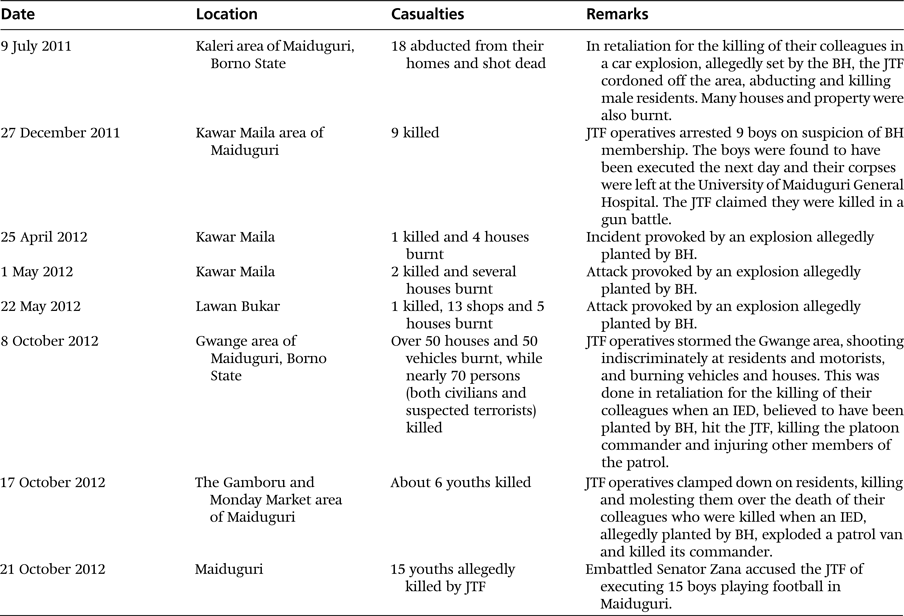
As shown in table 2 above the JTF has a reputation for summarily executing persons arrested on suspicion of BH membership. Most victims are killed during JTF operations and labelled as BH militants killed in gun battle, while others are executed after arrest and / or in custody. Other victims are abducted from their homes and executed in isolated places outside their homes, shot or beaten to death in detention, or killed and dumped on the streets. Amnesty International has chronicled some incidents of extra-judicial executions and enforced disappearance in its report.Footnote 58 An Abuja-based legal practitioner, handling civil claims regarding extra-judicial executions against the JTF, told the author that defence lawyers have relied heavily on section 33(2) of the 1999 Constitution and the 2011 state of emergency, since most executions were carried out in that period. He says that, apart from undue pressure and intimidation from the state, he feels that these legal provisions constitute a significant impediment to plaintiffs' cases.Footnote 59
Alleged extra-judicial executions and other human rights abuses by the JTF
Source: Author's compilation from newspaper reports
The NASS has not enacted any law that defines the circumstances where the right to life may be lawfully derogated; however, the police order on the use of firearms has attempted to explain situations where the use of lethal force is permissible.Footnote 60 Section 3(e) permits police officers to use firearms to “arrest a person who takes to flight in order to avoid arrest, provided the offence is such that the accused may be punished with death or imprisonment for 7 years or more”. Ojomo has criticized this police order for allowing wider grounds for the use of lethal force than are permissible under international law and standards, arguing further that, since escaping custody or resisting arrest is punishable with seven years' imprisonment under Nigeria's penal laws, it is disproportionate to allow police officers to shoot anyone who flees, as the constitution and police order seem to approve.Footnote 61 On the other hand, the JTF is essentially military and so not guided by the police order, and there are no known rules of engagement regulating its conduct. Consequently, the JTF has always rationalized extra-judicial killings on the ground of “gun battle” with BH militants as well as sections 33(2) and 45 of the 1999 Constitution.
Violation of right to a fair trial
The right to a fair trial is fundamental to the enjoyment of human rights, hence its recognition by the Universal Declaration of Human RightsFootnote 62 and the African Charter.Footnote 63 The minimum guarantees on the right to fair trial are set out under the ACHPR's resolution on the right to recourse and fair trial.Footnote 64 By the dictates of this resolution, the right to a fair trial requires that: persons arrested shall have all their cause determined by independent and impartial tribunals; persons arrested shall be informed promptly of the reason(s) for their arrest and the charges against them; persons arrested or detained shall be promptly brought before a judge and have their causes tried within a reasonable time; and persons charged with criminal offences shall be presumed innocent until proven guilty by a competent court. The right also requires that persons standing trial should: be given adequate time and facilities for the preparation of their defence and to communicate in confidence with counsel of their choice; examine or have examined the witnesses against them, and obtain the attendance and examination of witnesses on their behalf; have the free assistance of an interpreter if they cannot speak the language used in court; and be guaranteed the right to appeal to a higher court.
Following the adoption of this resolution in Africa, these minimum guarantees were developed into comprehensive Principles and Guidelines on the Right to a Fair Trial and Legal Assistance in Africa, in which the right to fair trial is expounded.Footnote 65 In Nigeria, section 36 of the 1999 Constitution, which is on the same subject as the resolution, has adopted these safeguards on fair hearing, thereby providing the legal basis for enforcing the violation of the principles and standards associated with a fair trial.
Since the explosion of BH violence in 2009 however, hundreds of BH suspects have been arrested by the JTF and detained in several detention centres. Although it is difficult to ascertain the actual number of detainees due to the covert nature of JTF operations, Amnesty International has estimated that: over 200 people are believed to be detained at Giwa Military barracks, 21 Armoured Brigade, in Maiduguri; over 100 in the SARS police station (commonly known as the “abattoir”) in Abuja; while dozens have been detained at the SSS headquarters in Abuja and other smaller detention facilities around the country. Many of the detainees have been taken without being informed of the reasons for their arrest, and kept in custody without access to the outside world, including lawyers, families and courts. According to Amnesty International, few, if any, of the people detained by the JTF in Maiduguri have been brought before a court or had the opportunity to challenge the lawfulness of their detention. Court orders for the production of detainees have been ignored by the military and the police.Footnote 66 G, an Abuja-based lawyer, told the author that:
“The JTF arrested my brother at Bulunkutu in Maiduguri, on the 21 July 2012, and kept him in detention since then. I travelled to Maiduguri and went to JTF headquarters to inquire about the circumstances of his arrest. In spite of introducing myself to them as a lawyer, they refused to disclose his whereabouts to me let alone allow me speak to him. I reported to the Commissioner of Police who said he would investigate. I have also petitioned the Inspector General of Police, the Chief of Defence Staff and the Chief Security Adviser to the President. I am waiting to hear from them.”Footnote 67
Furthermore, the arrest and detention of suspected BH members without trial has led to the bourgeoning of their numbers in detention facilities, thereby violating their rights to personal liberty as enshrined in section 35 of the 1999 Constitution. The few brought to court have been remanded in custody by various court orders while their trials are characteristically slow. Although the TPA is silent on rights to bail for the offence of terrorism, the combined effect of sections 340 and 341 of the Criminal Procedure Code (applicable to northern Nigeria) is that a person arrested with or without warrant and charged with any offence, other than an offence punishable with death, shall be granted bail, except where his bail would prejudice the investigation of the case or where there is a serious risk of his escaping from justice. Acts of terrorism under the TPA are not punishable with death; by section 33 of the TPA, where death results from any terrorist act, the penalty shall be life imprisonment. In spite of these provisions, it seems that terrorism has been treated as a de facto non-bailable offence, as only a few terrorist suspects with very high profiles have so far been granted bail, albeit on very stringent conditions. Although one does not expect government and the law to treat terrorism with kid-gloves, there is no gainsaying that not all persons arrested on suspicion of terrorism are guilty of the offence; drawing that conclusion would render the presumption of innocence a nullity. Moreover, the speedy trial and conviction or acquittal of suspects would rather serve the purpose of justice by incarcerating the guilty while discharging and acquitting the innocent.
Right to dignity of the human person
The right to dignity of the human person is recognized in the preamble to the Universal Declaration of Human Rights and article 5 of the African Charter. The right to dignity of the human person is codified under the 1999 Constitution and other relevant human rights treaties to which Nigeria has acceded. Section 34 of the constitution provides that “every individual is entitled to respect for the dignity of his person, and accordingly, no person shall be subject to torture or to inhuman or degrading treatment”. Notwithstanding this provision, inhuman and degrading treatment of detainees by Nigerian security forces, especially the police, is widespread and documented.Footnote 68 Its reinforcement under counter-BH operations only feeds into an age-long and systemic violation of the right by security forces.
The mass arrest of BH suspects has served to bourgeon the population of Nigeria's already overcrowded prisons. As at 2009, the Nigerian Prisons Service gave the total inmate population as 41,106, out of whom 29,105 were pre-trial detainees.Footnote 69 This population snowballed to 56,785 as at 30 June 2014 (of whom 38,743 were standing trial),Footnote 70 indicating an increase of over 15,600 inmates. This number excludes BH suspects held in special detention centres including army barracks, the SARS detention centre in Abuja, SSS detention centres and others for which the Nigeria Prisons Service is not accountable. In view of the sheer number of inmates and the inadequate facilities in these detention centres, detainees are subjected to degrading and inhuman treatment in detention. Apart from the substandard detention conditions chronicled by Amnesty International,Footnote 71 there are widespread reports of torture and other obnoxious interrogation techniques, starvation, lack of access to Medicare, deliberate denial of exercise and sunshine, and several other treatments that offend human rights standards. Although the JTF has consistently denied these allegations, detainees released from these detention centres have always maintained that they were subjected to these treatments while in detention. With the extant notoriety for human rights abuses by the police, analysts are persuaded to believe these allegations.
Apart from detainees, residents within JTF's jurisdiction have also complained of the invasion of their dignity by JTF operatives. Abdu, a former resident of Bayan quarters in Maiduguri, told the author that “they [soldiers] entered my compound and asked all of us - my wives, daughters and sons - to undress and lie face-down. They stripped the women and girls naked in front of their sons and brothers. I lost my dignity as a father in front of my family. They have no respect for religion and tradition.”Footnote 72 These and many other acts violate the right to personal dignity under the 1999 Constitution and the rights to privacy, family and home under article 17 of the ICCPR.
Violation of property related rights (compulsory acquisition of property and forced evictions)
Property rights are recognized under several international instruments to which Nigeria has acceded, while some aspects are codified under the 1999 Constitution. Article 17 of the ICCPR provides that “no one shall be subjected to arbitrary or unlawful interference with his … home”, while article 11 of the International Covenant on Economic, Social and Cultural RightsFootnote 73 recognizes everyone's right to an adequate standard of living for himself and his family, including adequate housing. Similarly, section 44(1) of the 1999 Constitution provides that:
“No moveable property or any interest in an immovable property shall be taken possession of compulsorily and no right over or interest in any such property shall be acquired compulsorily in any part of Nigeria except in the manner and for the purposes prescribed by a law that, among other things, (a) requires the prompt payment of compensation therefore and … (k) relating to the temporary taking of possession of property for the purpose of any examination, investigation or enquiry”.
Two prominent modes of operation of the JTF in countering BH in northern Nigeria are house-to-house search and forced evictions. Whenever there is a BH attack, the JTF cordons off an area and asks all residents to leave their homes, sometimes without notice or the opportunity to take their belongings. Forced evictions have been deployed by the JTF in Jos, Maiduguri, Yobe and Kano, among other cities. In most cases, a whole town or village is asked to leave so that house to house searches can be conducted. Many residents have complained of physical assault, invasion of personal dignity, the conversion or destruction of property by JTF operatives and arson in such operations.Footnote 74 As shown in table 2 above, there are several other cases where the JTF engaged in the arbitrary burning of houses, shops and other personal property like vehicles, especially when it incurred human or material losses in BH attacks. These acts violate international human rights standards and Nigeria's Constitution as noted above.
CONCLUDING RECOMMENDATIONS
The issue of human rights abuses by Nigerian security forces in dealing with internal security threats is systemic and primordial. Although the practice was ubiquitous during the military era, it has survived military dictatorship. Shortly after the return to civilian rule in 1999, soldiers stormed the Ijaw community of Odi and razed every building to the ground. Hundreds of people were killed, while women and girls were allegedly raped, in what was a revenge mission for the alleged murder of 12 policemen by Ijaw militants. A similar revenge mission led to the military campaigns in the Niger Delta communities of Ayokoroma, Okerenkoko and Gbaramatu in 2009, where several people were killed and the communities destroyed. Earlier in October 2001, a detachment of Nigerian soldiers rounded up and killed over 200 unarmed civilians in a town of Zaki Biam, while shelling all the houses with their machine guns, in apparent retaliation for the alleged killing of 14 of their colleagues by Tiv militiamen.
This trend has persisted, largely due to the state's inability to hold its security forces accountable for these human rights abuses. As stated earlier, Nigeria is party to several international human rights instruments which prohibit the unlawful lethal use of force by security agents. Nevertheless, these instruments have not been domesticated under Nigerian law. Unfortunately, under Nigerian law, an international instrument, signed and ratified by Nigeria, cannot be enforced in a Nigerian court unless it has been domesticated by being re-enacted into domestic law.Footnote 75 Accordingly, except for the African Charter, which has been domesticated as chapter A9, Laws of the Federation of Nigeria, 2004,Footnote 76 the other human rights instruments mentioned above have not been domesticated. Attempts to criminalize abuses by security forces as crimes against humanity, and to give jurisdiction to the International Criminal Court, have crystallized into A Bill for an Act to provide for the Enforcement and Punishment of Crimes Against Humanity, War Crimes, Genocide and Related Offences, and to Give Effect to Certain Provisions of the Rome Statute of the International Criminal Court in Nigeria, 2012, which is currently before the NASS. However, the bill is under severe threat as several lobby groups have launched scathing attacks against it, labelling it as neo-colonial, among other delegitimizing labels. As noted by Odinyi, the Nigerian executive has dragged its feet in seeing the passage of the bill, as the government is unwilling to push through a bill that would expose its forces to international criminal sanctions; this may explain the delay in passing the bill.Footnote 77
Despite these criticisms, indications are that the bill will become law, as it is an executive bill proposed by the Attorney General of the Federation. The proposition of this bill became inevitable, owing to the persistent pressure brought upon the Nigerian government by the international community to take steps towards abating human rights abuses by the security forces. These abuses have also constituted moral and financial liability for the Nigerian state, as recent court orders have imposed enormous damages on the Federal Government over such cases of human rights abuses. The bill, which was gazetted on 17 July 2012, had its second reading on 22 May 2013, indicating that it has enjoyed significant progress.
Despite the proposition of this bill, the author proposes the following measures to help abate the extant regime of human rights abuses by security forces during internal security operations. First, the government should domesticate the litany of human rights instruments to which it has acceded, thereby giving citizens the leverage to seek their enforcement in the courts. Although state authorities often explore means of evading accountability for human rights violations, despite their obligations under international mechanisms and domestic laws, domesticating international human rights treaties holds significant promise for strengthening accountability in many ways. According to human rights activist Chinedu Nwagu, the domestication of international human rights treaties gives victims the legal basis to hold perpetrators accountable as well as providing civil society organizations with a platform for advocacy.Footnote 78 With specific reference to the Rome Statute of the International Criminal Court, Nwagu argued that, in the absence of the statute's domestication in Nigeria, advocacy by civil society organizations for accountability would only be hinged on UN Security Council referral or on the prosecutor's initiative under article 13(b)–(c) of the Rome Statute. He argued further that a variety of rights have been guaranteed in several international instruments which Nigeria has ratified; yet their violations are not actionable in criminal or civil causes since the instruments that criminalize their violation have not been domesticated. Torture, for instance is prohibited by section 34(1)(a) of Nigeria's Constitution; however it is not criminalized, as the UN Convention against Torture has not been domesticated. Accordingly, the domestication of these international instruments provides the legal basis for pressing for accountability.
Secondly, the scope of rights provided under international mechanisms is often more elaborate than those guaranteed under the constitution and domestic laws. Accordingly, domestication of international mechanisms provides victims with more legal remedies beyond the limited scope of rights guaranteed domestically. Furthermore, domestication serves the purpose of reinforcing or strengthening extant domestic mechanisms; for example, if the Convention on the Elimination of All Forms of Discrimination against Women were to be domesticated, it would strengthen Nigeria's extant penal laws (the Criminal Code and Penal Code) provisions on sexual offences, as many of the convention's provisions on sexual offences are more elaborate than those in Nigeria's penal laws. Ultimately therefore, the expectation is that domestication of these international mechanisms would give victims the leverage to institute actions against the state in the event of a violation of rights provided in these domesticated instruments. It would also avail victims of remedies beyond the limited rights that are guaranteed under domestic instruments.
Thirdly, the enactment of Rules of Engagement (RoE) for internal law enforcement operations by security forces is imperative. Presently, it is doubtful whether the JTF has any rules guiding its counter-terrorism operations: hence the recommendation for the enactment of general RoE for internal security operations. In view of the public outcry over the covert nature of the rules guiding security operations, if any, it is recommended that the applicable provisions of the TPA on subsidiary legislation be exploited to enact proposed general RoE for law enforcement operations by security forces generally. Sections 9(6), 36(4) and 39 of the TPA give the Attorney General power to make regulations. The Attorney General should seize the opportunity provided under these provisions to enact general RoE for counter-terrorism and other internal security operations by security forces. This would, among other benefits, bring the rules within the public domain and scrutiny, and provide enduring and universal RoE for all armed and security forces, as opposed to the current practice of drafting ad hoc rules, which are often made for operations by individual security agencies. Most significantly, the general RoE would become a public document and, therefore, provide the basis for holding errant security personnel responsible for human rights abuses during internal security operations. Most significantly however, the RoE would complement the national counter-terrorism strategy when it eventually comes into force. It is recommended that the draft NACTEST be enacted as soon as practicable.
Beyond domestication of international treaties and the enactment of RoE, the strengthening of existing human rights accountability mechanisms is imperative. These mechanisms include the law courts, National Human Rights Commission, Public Complaints Commission, Nigeria Police Council and legislature. The National Human Rights Commission is empowered to handle all issues of individual human rights abuses brought before it, as well as mass human rights abuses. The National Human Rights Commission (Amendment) Act 2010 guarantees the commission's independence and insulates it from executive meddling; however its leadership is still subject to executive appointment and, therefore, susceptible to executive interference. In order to reinforce its independence, the commission has to be made accountable to Parliament. The same issues of independence, or lack of it, challenge the efficiency of the other accountability bodies listed above. Despite the criticisms of law courts over their naivety in enforcing human rights abuses against government agencies, Nigerian courts have recently demonstrated sufficient courage in their judicial activism over gross human rights abuses by security forces. For example, in separate judgements, the Federal High Court ordered the Nigerian government to pay 37 and 41.8 billion Naira to victims of the OdiFootnote 79 and Zaki BiamFootnote 80 massacres respectively. Sustaining this level of activism would present a significant prospect for reducing the spate of human rights abuses by security forces in internal security operations. Finally, the NASS has to demonstrate some level of independence, particularly in handling petitions of gross human rights abuses. Ultimately therefore, the firming up of domestic accountability mechanisms would complement and give impetus to the enforcement of international instrument domestication by Nigeria.