INTRODUCTION
Visual perception is defined as the way in which we view and interpret stimuli we see in the physical environment, and comprises physiological and psychological processes (Bruce, Green, & Georgeson, Reference Bruce, Green and Georgeson2003). The physiological component refers to how our ocular system assimilates visual details by converting incoming light into a series of neural impulses, known as sight or vision. What people “see” is, however, not simply an objective translation of retinal information, but encompasses personal and subjective interpretations, which in turn rely on a range of cognitive factors, such as attention, expectation, and life experiences. It is thus not hard to appreciate how anomalies in visual perception could contribute to symptoms of clinical disorders. Body dysmorphic disorder (BDD) is characterized by repetitive behaviors and/or mental acts occurring in response to preoccupations with perceived (visual) defects or flaws in physical appearance (American Psychiatric Association, 2013). In this disorder, anomalies in basic ocular processes could underpin the ways in which affected individuals perceive appearance-related “flaws.”
Configural Processing versus Gestalt Perception for Faces
Human faces embody a psychologically unique class of visual stimuli, and are recognized more quickly and accurately relative to other imagery (Farah, Wilson, Drain, & Tanaka, Reference Farah, Wilson, Drain and Tanaka1998). Configural processing and Gestalt perception are central to this. Configural face processing occurs when holistic processing strategies are implemented, involving assimilation of facial features in parallel (Maurer, le Grand, & Mondloch, Reference Maurer, le Grand and Mondloch2002). Consideration of fundamental metric relations and spatial distances between facial features are critical for forming a meaningful global structure, distinct from featural information, such as hair texture or skin smoothness (Diamond & Carey, Reference Diamond and Carey1977; Rhodes, Reference Rhodes1988).
Configural processing can be further distinguished on two levels of visual encoding - first-order (i.e., a pair of eyes above the nose and mouth) versus second-order (i.e., spatial relations of internal features). Related research has shown that inverted human faces (but not animals or objects) disrupt configural processing, known as the face inversion effect (Leder & Carbon, Reference Leder and Carbon2006; Valentine, Reference Valentine1988; Yin, Reference Yin1969). It is hypothesized that a general configural template, comprising an overall facial structure with homogeneous arrangement of standard features, exists and facilitates face processing (Freire, Lee, & Symons, Reference Freire, Lee and Symons2000). This template is, however, not valid for inverted faces, which engage serial analysis of discrete components. Inverted faces, therefore, disrupt the encoded sensitivity of featural associations, with the face inversion effect effectively demonstrating operation of unique configural mechanisms during facial identification (Farah et al., Reference Farah, Wilson, Drain and Tanaka1998).
Gestalt perception denotes the processing of individual components of complex visual stimuli as an organized whole (as opposed to a collection of disparate parts). It is determined by: (i) proximity, (ii) similarity, (iii) common fate, (iv) good continuity, (v) closure, and (vi) area, symmetry, and surroundedness (see Bruce et al., Reference Bruce, Green and Georgeson2003). The alignment of constituent facial features in a well-defined schematic form thus greatly enhances its perceptibility, as shown by superior recognition of intact versus scrambled faces (Homa, Haver, & Schwartz, Reference Homa, Haver and Schwartz1976). These Gestalt operations are related but distinct from configural processing, with both implicated in face perception.
Face and Object Perception in BDD
A handful of studies have directly examined face perception in BDD (facial emotion processing has been covered elsewhere, see Toh, Castle, & Rossell, Reference Toh, Castle and Rossell2015). Feusner, Moller, et al. (Reference Feusner, Moller, Altstein, Sugar, Bookheimer, Yoon and Hembacher2010) asked participants to match upright or inverted facial photographs presented for brief versus extended durations. A significantly diminished face inversion effect (denoted by increased response latency) was identified in BDD, but only for the extended exposure condition. When this was replicated with use of famous faces, it was corroborated that persons with BDD were significantly better at recognizing inverted faces relative to healthy controls (HC; Jefferies, Laws, & Fineberg, Reference Jefferies, Laws and Fineberg2012). Another study conversely found no differences in global processing based on inverted and composite faces in BDD (Monzani, Krebs, Anson, Veale, & Mataix-Cols, Reference Monzani, Krebs, Anson, Veale and Mataix-Cols2013).
In an functional magnetic resonance imaging study, participants were asked to match neutral facial photographs with low spatial frequency (LSF) versus high spatial frequency (HSF) information (Feusner, Townsend, Bystritsky, & Bookheimer, Reference Feusner, Townsend, Bystritsky and Bookheimer2007). Greater left hemispheric activity was found in BDD for the LSF task, whereas similar regions were activated in HC for the HSF task. Patients with BDD also showed hyperactivation of the amygdala to LSF and HSF faces, which was not found in HC. A follow-up study incorporated participants’ own faces (Feusner, Moody, et al., Reference Feusner, Moody, Hembacher, Townsend, McKinley, Moller and Bookheimer2010), with BDD patients exhibiting hyperactivation of the left orbitofrontal cortex and bilateral caudate head to their own unaltered faces. There was also relative hypoactivity in the left occipital cortex for LSF faces only. No group differences in facial matching were detected in either study.
Another study comparing BDD with anorexia nervosa on a similar paradigm found comparable aberrant activation patterns in both groups (Li et al., Reference Li, Lai, Bohon, Loo, McCurdy, Strober and Feusner2015). These findings collectively suggest functional abnormalities during visual processing in BDD, with a predominance of detail encoding and analysis for LSF and unaltered faces in BDD, only found for HSF faces in HC. In other words, five studies (two behavioral, three neuroimaging) have indicated that BDD patients display a bias for local or piecemeal processing, as opposed to the holistic management of visual information.
In terms of non-face stimuli, impaired local and global processing has been reported for people with BDD using the embedded figures and Navon tasks (Kerwin, Hovav, Hellemann, & Feusner, Reference Kerwin, Hovav, Hellemann and Feusner2014). Monzani et al. (Reference Monzani, Krebs, Anson, Veale and Mataix-Cols2013) conversely found no deficits in holistic viewing in BDD patients based on the Navon task. Yet related neuroimaging studies have revealed anomalous cerebral activity in BDD, consistent with an imbalance in local versus global processing, also generalized to non-face stimuli (Feusner, Hembacher, Moller, & Moody, Reference Feusner, Hembacher, Moller and Moody2011; Li et al., Reference Li, Lai, Bohon, Loo, McCurdy, Strober and Feusner2015). In persons with non-clinical, but elevated body image concerns (BIC), initial findings have been mixed. Mundy and Sadusky (Reference Mundy and Sadusky2014) reported these high BIC individuals showed enhanced discrimination of inverted faces, bodies, and scenes, implicating an overall bias toward local detail-oriented processing. These findings have since been replicated (Beilharz, Atkins, Duncum, & Mundy, Reference Beilharz, Atkins, Duncum and Mundy2016) but also refuted (Duncum, Atkins, Beilharz, & Mundy, Reference Duncum, Atkins, Beilharz and Mundy2016), where a general increased inversion effect was instead found.
On the whole, preliminary studies have suggested a preference for piecemeal processing of faces, and possibly objects, in BDD, with disproportionate attention directed toward localized details, possibly implicating faulty configural and/or Gestalt processes. This has been corroborated by anomalies in brain activation patterns. These findings are tentative and call for replication.
Face and Object Perception in OCD
Limited research has examined face perception per se in obsessive-compulsive disorder (OCD), with a small number of studies having analyzed facial discrimination, largely with no deficits found (Aigner et al., Reference Aigner, Sachs, Bruckmuller, Winklbaur, Zitterl, Kryspin-Exner and Katschnig2007; Boldrini et al., Reference Boldrini, Del Pace, Placidi, Keilp, Ellis, Signori and Cappa2005; Bozikas et al., Reference Bozikas, Kosmidis, Giannakou, Saitis, Fokas and Garyfallos2009; Shin et al., Reference Shin, Jang, Kim, Shim, Hwang, Kim and Kwon2013). In terms of object perception, research has yielded mixed findings. Again based on the Navon task, Rankins, Bradshaw, and Georgiou-Karistianis (Reference Rankins, Bradshaw and Georgiou-Karistianis2005) demonstrated that OCD patients were impaired in global processing strategies, whereas those with comorbid Tourette’s syndrome had difficulties with the perception of local details. These results were interpreted as indicative of anomalies in the hierarchical processing of visual information in OCD. A pair of replicating studies conversely found no significant difficulties in local processing of these visual aspects in people with OCD (Moritz & Wendt, Reference Moritz and Wendt2006; Moritz, Wendt, Jelinek, Ruhe, & Arzola, Reference Moritz, Wendt, Jelinek, Ruhe and Arzola2008).
Yet local encoding deficits in OCD have been inferred from studies in other cognitive domains. Specifically, impaired verbal memory has been linked to deficient organizational strategies (Deckersbach et al., Reference Deckersbach, Savage, Dougherty, Bohne, Loh, Nierenberg and Rauch2005, Reference Deckersbach, Savage, Reilly-Harrington, Clark, Sachs and Rauch2004; Savage et al., Reference Savage, Deckersbach, Wilhelm, Rauch, Baer, Reid and Jenike2000), whereas visuospatial constructional difficulties are believed to arise from fragmented processing of complex visual stimuli (Deckersbach, Otto, Savage, Baer, & Jenike, Reference Deckersbach, Otto, Savage, Baer and Jenike2000; Moritz et al., Reference Moritz, Kloss, Jacobsen, Kellner, Andresen, Fricke and Hand2005; Penades, Catalan, Andres, Salamero, & Gasto, Reference Penades, Catalan, Andres, Salamero and Gasto2005; Savage et al., Reference Savage, Deckersbach, Wilhelm, Rauch, Baer, Reid and Jenike2000; Shin et al., Reference Shin, Park, Kim, Lee, Ha and Kwon2004). Overall, few studies have examined perceptual difficulties specific to faces in OCD, with limited research using non-face stimuli producing differing accounts. Cognitive studies seemingly implicate an overemphasis of local, piecemeal processing of visual information, but more research is needed to clarify this.
Hypotheses
The current study aimed to investigate face perception in BDD and OCD with two novel modifications. First, Mooney faces were used. These stimuli comprise deliberately degraded imagery resulting in ambiguous, fragmented facial representations (Mooney, Reference Mooney1957). For face intact recognition, two visuocognitive operations are involved: facial discrimination (i.e., special capacity to discern human faces) and perceptual closure (i.e., Gestalt fusion of “breaches” to form complete facial representations). Furthermore, there is evidence that marked face inversion effects exist for upside-down Mooney faces (George, Jemel, Fiori, Chaby, & Renault, Reference George, Jemel, Fiori, Chaby and Renault2005; Latinus & Taylor, Reference Latinus and Taylor2005; McKone, Reference McKone2004). Second, Mooney objects were incorporated to compare face versus object perception. Intact object recognition still engages Gestalt principles, but involves configural processing to a lesser degree. In combination, these stimuli should be sensitive to holistic processing deficits, and moreover, facilitate disentangling between configural and Gestalt contributions. Mooney faces have been used with clinical populations, for example with significant anomalies detected in schizophrenia (Buchanan, Holstein, & Breier, Reference Buchanan, Holstein and Breier1994; Schwartzman, Maravic, Kranczioch, & Barnes, Reference Schwartzman, Maravic, Kranczioch and Barnes2008). We are not aware of any studies that have used them in BDD and OCD.
Two main hypotheses were put forward: (i) Relative to the HC group, BDD participants would exhibit a significantly reduced face inversion effect, denoted by smaller accuracy differences in recognizing upright versus inverted Mooney faces. Although a corresponding object inversion effect has not been defined in the literature per se, emerging studies have begun to examine the processing of inverted non-face imagery in BDD or OCD (e.g., Beilharz et al., Reference Beilharz, Atkins, Duncum and Mundy2016; Duncum et al., Reference Duncum, Atkins, Beilharz and Mundy2016; Monzani et al., Reference Monzani, Krebs, Anson, Veale and Mataix-Cols2013; Mundy & Sadusky, Reference Mundy and Sadusky2014; Shin et al., Reference Shin, Jang, Kim, Shim, Hwang, Kim and Kwon2013). Therefore, it would be interesting to explore whether the expected reduced face inversion effect in BDD would be replicated in the object category. (ii) Relative to the HC group, the BDD participants would demonstrate impaired recognition of Mooney faces, whereas the OCD group would display impaired recognition of Mooney objects (it remained unclear whether these deficits would generalize to Mooney faces in OCD owing to a lack of prior comparable studies).
The rationale for using Mooney faces and objects was to help disentangle abnormalities in configural from Gestalt processing, but given limited research in BDD and inconclusive findings in OCD, more definitive hypotheses could not be offered; some of our enquiries remain exploratory in nature.
METHOD
Participants
Twenty-one BDD patients and 19 OCD patients were recruited from a specialized outpatient psychiatric service and community sources. Twenty-one HC participants were recruited via a voluntary healthy participant database, based on a null personal and immediate family history of diagnosed psychiatric disorders. Clinical diagnoses were verified with the Body Dysmorphic Disorder-Diagnostic Module (BDD-DM) for BDD (Phillips, Reference Phillips2005) and Mini International Neuropsychiatric Interview-English Version 5.0.0 (MINI500) for OCD and other major disorders (Sheehan et al., Reference Sheehan, Lecrubier, Sheehan, Amorim, Janavs, Weiller and Dunbar1998). Clinical participants had a past (within the past 12 months) or current diagnosis of their respective disorders; comorbid conditions, with the exception of psychotic disorders were permitted (for patterns of specific comorbid conditions, interested readers are asked to refer to Toh, Castle, & Rossell, Reference Toh, Castle and Rossell2017).
Primary disorder severity was assessed using the Yale-Brown Obsessive-Compulsive Scale Modified for Body Dysmorphic Disorder (BDD-YBOCS; Phillips et al., Reference Phillips, Hollander, Rasmussen, Aronowitz, DeCaria and Goodman1997) and Yale-Brown Obsessive-Compulsive Scale (YBOCS; Goodman et al., Reference Goodman, Price, Rasmussen, Mazure, Fleischmann, Hill and Charney1989). Anxiety and mood ratings were collected with the Social Interaction Anxiety Scale (SIAS; Mattick & Clarke, Reference Mattick and Clarke1998), Brief Fear of Negative Evaluation-Revised (BFNE-II; Carleton, McCreary, Norton, & Asmundson, Reference Carleton, McCreary, Norton and Asmundson2006), and Self-rating Depression Scale (SDS; Zung, Reference Zung1965). Insight was evaluated using the Brown Assessment of Beliefs Scale (BABS; Eisen et al., Reference Eisen, Phillips, Baer, Beer, Atala and Rasmussen1998). All instruments were administered to clinical as well as non-clinical participants (n.b. The HC group responded to the BDD-YBOCS and BABS based on an intentionally elicited appearance-related concern).
Most clinical participants were undergoing psychiatric treatment. Psychopharmacotherapy comprised selective serotonin reuptake inhibitors (SSRIs) alone, or with adjunctive atypical antipsychotics (SSRIs: BDD=11, OCD=10; serotonin-norepinephrine reuptake inhibitors; SNRIs: BDD=6, OCD=3; tricyclic antidepressants; TCAs: BDD=1, OCD=1, with some atypical antipsychotic augmentation: BDD=6, OCD=4). The following inclusion criteria also applied: (i) aged 18 to 65 years, (ii) spoke English as preferred language, (iii) no known history of neurological disorders or serious ocular conditions, (iv) normal visual acuity (at least 20/100) and color vision, and (v) estimated IQ above 70 based on the Wechsler Test of Adult Reading (WTAR; Wechsler, Reference Wechsler2001). The study received ethics approval from the Human Research Ethics Committee at the Alfred Hospital, Melbourne, Australia, and conformed to the Declaration of Helsinki (World Medical Association, 2008). Participants also provided written, informed consent.
Materials
A set of 40 standardized Mooney face diagrams arranged in ascending order of recognition difficulty was used (Mooney, Reference Mooney1957). These fragmented black-and-white facial depictions comprised interspersed patches of white against a shadowy backdrop in left-, center-, or right-facing orientations (Figure 1). Each face was 510×650 pixels, and shown in three configurations (i.e., upright, inverted, or scrambled). Scrambled stimuli were constructed by a random digital scrambling procedure, producing disrupted Mooney-like images in which no faces could be perceived. Akin to Mooney and Ferguson (Reference Mooney and Ferguson1951), 40 comparable Mooney object diagrams were composed based on a variety of commonplace objects (e.g., car, piano, telephone). These images were “moonified” by applying a stamp filter via Adobe Photoshop, and presented in the same three configurations (scrambled objects were created using the same procedure described).
Examples of Mooney diagrams. From top to bottom and left to right: Upright face, inverted face, upright object, inverted object, scrambled face and scrambled object.

Procedure
Participants were seated in line with the screen at an estimated viewing distance of 30 cm. Stimuli were pseudorandomized into four blocks (two faces, two objects) of 60 images, with rest breaks between blocks. At the start of each trial, a fixation target was presented for 500 ms, followed by a Mooney diagram against a gray backdrop for 500 ms under free-viewing conditions, with a 2000-ms interval designated for participant response (responses occurring beyond this were deemed incorrect; corresponding latencies were assigned the maximum of 2000 ms). A brief exposure period was chosen to elicit configural processes (Hsiao & Cottrell, Reference Hsiao and Cottrell2008). Task instructions were to decide whether each diagram represented a human face, an object or neither, and to respond as quickly and accurately as possible based on a forced-choice paradigm. Before the actual task, 18 practice trials were administered. The task had an average completion time of 10 min.
Statistical Analysis
Statistical analyses were performed using the PASW® software, v.18. One-way analyses of variance (ANOVAs) were used to examine face inversion effects in hypothesis 1. In line with Cohen (Reference Cohen1988), effect sizes were computed based on eta-squared (small=.01; medium=.06; large=.14). A series of mixed between-within subjects ANOVAs, with performance measures (accuracy, response latency) as the dependent variable, group (BDD, OCD, HC) as the between-subjects factor, category (face, object) as the first within-subjects factor, and configuration (upright, inverted, scrambled) as the second within-subjects factor, was used to examine hypothesis 2. Multivariate statistics (i.e., Pillai’s trace) were interpreted (Field, Reference Field2009). When significant main effects were identified, post hoc comparisons (i.e., Tukey’s honest significant difference test) and/or within-subjects contrasts were carried out. When significant interactions occurred, follow-up ANOVAs were carried out. Pearson’s product moment correlations between participant and Mooney variables were also performed. These added analyses were used to check whether potential Mooney deficits were related to symptoms of interest and to partial out the extraneous effects of anxiety and depression.
RESULTS
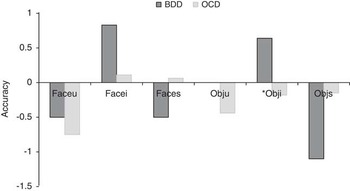
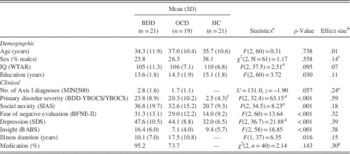
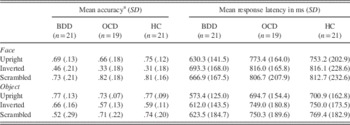
Basic participant demographic and clinical characteristics are briefly summarized in Table 1. Group means and standard deviations for Mooney performance are shown in Table 2. Accuracy statistics according to category and configuration have been standardized with respect to HC, and are illustrated in Figure 2.
Standardized group means for accuracy according to category and configuration (with zero representing HC). Faceu=upright Mooney faces; Facei=inverted Mooney faces; Faces=scrambled Mooney faces; Obju=upright Mooney objects; Obji=inverted Mooney objects; Objs=scrambled Mooney objects (significant accuracy differences between clinical groups denoted by *). BDD=body dysmorphic disorder; OCD=obsessive-compulsive disorder.

Participant demographic and clinical characteristics

Note. WTAR=Wechsler Test of Adult Reading; MINI500=Mini International Neuropsychiatric Interview-English Version 5.0.0; BDD-YBOCS=Yale-Brown Obsessive-Compulsive Scale Modified for Body Dysmorphic Disorder (0–48); YBOCS=Yale-Brown Obsessive-Compulsive Scale (0–48); SIAS=Social Interaction Anxiety Scale (0–80); BFNE-II=Brief Fear of Negative Evaluation-Revised (0–48); SDS=Zung Self-rating Depression Scale (0–60); BABS=Brown Assessment of Beliefs Scale. Clinical instruments rated on 5-point Likert scales ranging from 0=minimal symptoms to 4=extreme symptoms, except SDS rated on a 4-point Likert scale ranging from 1=none to 4=always.
a Statistics refer to one-way analyses of variance unless otherwise stated; chi-square tests for independence (sex, medication) and Mann-Whitney U test (number of Axis I diagnoses).
b Effect size refers to eta-squared unless otherwise stated.
c Cramer’s V (sex).
d Welch F ratio.
e r (number of Axis I diagnoses).
f BDD-YBOCS administered based on specially elicited appearance-related concern over past week; score of 0 assigned in the absence of any concerns.
g Phi (medication).
Descriptive statistics for Mooney performance by category and configuration

Note. BDD=body dysmorphic disorder; OCD=obsessive-compulsive disorder; HC=healthy control.
a Accuracy (range 0 to 1) calculated as proportion of correct responses (out of 40).
Inversion Effects: Hypothesis 1
Face inversion effects were computed by taking the difference between upright versus inverted Mooney faces for accuracy and response latency. Object inversion effects were derived using the same procedure. The latter have been relatively less studied, but are believed to not implicate configural operations (unlike face inversion effects). Stemming from these diverse theoretical underpinnings, these effects were held as independent. Two discrete sets of ANOVAs were thus performed, and no Bonferroni adjustment was applied. For accuracy, a significant face inversion effect was identified, F(2,60)=5.85, p=.005, ɳ2=.17. Post hoc comparisons indicated that the BDD group (m=.27; SD=.23) exhibited less of a face inversion effect relative to the OCD (m=.33; SD=.16) and HC (m=.40; SD=.20) groups, which did not differ from each other.
A significant object inversion effect was also observed, F(2,60)=3.39, p=.040, ɳ2=.10. Post hoc comparisons indicated that the BDD group (m=.10; SD=.08) exhibited less of an object inversion effect relative to the HC group (m=.18; SD=.11), whereas the OCD group (m=.16; SD=.11) did not differ from either of the two groups. For response latency, no significant face, F(2,60)=0.38, p=.684, ɳ2=.01, or object, F(2,60)=0.47, p=.631, ɳ2=.02, inversion effects were identified.
Accuracy and Response Latency: Hypothesis 2
Mooney data were submitted to two 3×2×3 mixed between-within subjects ANOVAs. For accuracy, there was no significant main effect for group. Significant main effects for category, F(1,59)=25.06, p<.001, η2=.30, and configuration, F(2,59)=177.2, p<.001, η2=.86, were observed, for which follow-up contrasts, respectively, revealed greater accuracy for Mooney objects (m=.67; SD=.17) relative to faces (m=.62; SD=.18); the same effect was found for upright (m=.73; SD=.50) versus inverted (m=.49; SD=.17), but not scrambled (m=.72; SD=.21), configurations. Significant two-way interactions of group by configuration, F(2,59)=4.90, p=.001, η2=.14, as well as category by configuration, F(1,59)=38.07, p<.001, η2=.57, were observed (the latter interaction did not involve group differences, and was not considered in further analyses).
Follow-up ANOVAs were performed to investigate group differences further; Bonferroni adjustment of .05/3=.017 was applied. There were significant group differences in accuracy for inverted Mooney diagrams only, F Inverted (2,60)=4.58, p=.014, η2=.14. Post hoc comparisons revealed that the BDD group (m=.56; SD=.15) was more accurate in identifying inverted Mooney diagrams relative to the OCD (m=.45; SD=.13) and HC (m=.45; SD=.12) groups, which did not differ from each other. No group differences were detected for the other configurations, F Upright (2,60)=1.86, p=.165, η2=.06 and F Scrambled (2, 60)=4.05, p=.023, η2=.12.
For response latency, there was a significant main effect for group, F(2,59)=4.92, p=.011, η2=.15. Post hoc comparisons indicated that the BDD group (m=624 ms; SD=155 ms) demonstrated quicker response latency relative to OCD (m=765 ms; SD=177 ms) and HC (m=767 ms; SD=197 ms) groups, which did not differ from each other. Significant main effects for category, F(1,59)=10.77, p=.002, η2=.16, and configuration, F(2,59)=26.77, p<.001, η2=.48, were also observed, for which follow-up contrasts, respectively, revealed increased response latency for Mooney faces (m=751 ms; SD=196 ms) versus objects (m=690 ms; SD=176 ms) as well as for inverted (m=738 ms; SD=186 ms) and scrambled (m=737 ms; SD=203 ms) relative to upright (m=686 ms; SD=169 ms) configurations. No significant interactions were identified (expected given the task design).
Correlations and Covariates
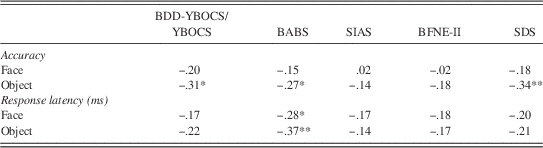
A two-fold validity check was performed to assess whether (i) symptoms of interest (i.e., illness severity and level of insight) were correlated with observed Mooney deficits, and (ii) extraneous anxiety and mood ratings were statistically controlled, where appropriate. To this end, correlation analysis was performed; clinical characteristics under consideration were illness severity, insight as well as anxiety and depression ratings. To limit Type I error, only correlations significant at the .01 level were considered. As shown in Table 3, there was a significant negative correlation between insight (as measured with the BABS) and Mooney objects response latency, such that individuals with poor insight responded significantly faster to Mooney objects. In addition, depression (i.e., SDS) was negatively correlated with Mooney objects accuracy. Yet mood ratings were elevated only for the clinical groups, and moreover, exerted an inconsistent influence on Mooney performance. It was thus deemed statistically inappropriate to conduct follow-up analyses of covariance (Miller & Chapman, Reference Miller and Chapman2001).
Correlation analysis between Mooney and clinical variables

Note. BDD-YBOCS/YBOCS=Yale-Brown Obsessive-Compulsive Scale Modified for Body Dysmorphic Disorder; BABS=Brown Assessment of Beliefs Scale; SIAS=Social Interaction Anxiety Scale; BFNE-II=Brief Fear of Negative Evaluation-Revised; SDS=Zung Self-rating Depression Scale.
* Significant at .05 level (two-tailed).
** Significant at .01 level (two-tailed).
DISCUSSION
The current study used a modified Mooney paradigm to investigate perceptual anomalies in BDD and OCD. Proposed hypotheses were only partially supported. In line with hypothesis 1, the BDD group had a significantly reduced face inversion effect relative to the OCD and HC groups. In other words, these individuals exhibited less of a discrepancy in accuracy between upright and inverted Mooney faces perception.
Contrary to the first part of hypothesis 2, BDD participants did not demonstrate impaired recognition of Mooney faces relative to the HC participants. In fact, the BDD group was more accurate in identifying inverted Mooney faces and objects relative to the OCD and HC groups. However, there was a trend toward significance indicating poor accuracy for scrambled Mooney diagrams (p=.023) in the BDD group relative to the OCD and HC groups. The second part of hypothesis 2 was also not supported; the OCD group did not display impaired recognition of Mooney objects (or faces) relative to the HC group. Effect sizes for all significant results were large, denoting that group differences were quantitatively substantial.
In line with Feusner, Moller, et al. (Reference Feusner, Moller, Altstein, Sugar, Bookheimer, Yoon and Hembacher2010), a significantly diminished face inversion effect was established in BDD, although their results related to response latency, whereas our findings stemmed from accuracy scores. They also used long exposures, whereas we used relatively short exposures. These differences may be accounted for by considering the nature of experimental stimuli (i.e., Mooney diagrams vs. real-life photographs) and task design. In the current study, a closer inspection of the reduced face inversion effect in BDD revealed this was largely induced by elevated accuracy for inverted (rather than diminished accuracy for upright) Mooney faces, in line with Jefferies et al. (Reference Jefferies, Laws and Fineberg2012). Enhanced processing of inverted Mooney faces is, therefore, suggestive of skilled piecemeal processing strategies. It can thus be theorized that people with BDD place a disproportionate emphasis on fragmented, localized processing, inadvertently enhancing their capacity for recognizing inverted imagery. This premise is further supported by a reduced object inversion effect in BDD accounted for similarly (i.e., elevated accuracy for inverted Mooney objects).
In the OCD sample, Mooney performance was comparable with that of the HC group in terms of accuracy and response latency. No significant deficits were identified, including the hypothesized impaired Mooney objects perception. This finding received some support from studies corroborating an absence of a local processing bias in OCD (Moritz & Wendt, Reference Moritz and Wendt2006; Moritz et al., Reference Moritz, Wendt, Jelinek, Ruhe and Arzola2008). Although cognitive research has suggested that difficulties perceiving the local aspects of visual information could exist, these studies tend to implicate higher order processing. In contrast, Mooney perception relies on relatively rudimentary sensory operations. It may thus be posited that perceptual operations in OCD remain intact at a fundamental level, although higher order anomalies could still exist.
Several secondary findings also emerged. Response latency failed to display significant interactions, likely as an artifact of imposed time limits (see the Procedure section). Yet there was a significant main effect, with the BDD group showing faster response latency. A visual inspection of group means revealed that the BDD group exhibited comparable accuracy for upright, but superior accuracy for inverted, Mooney diagrams relative to the OCD and HC groups. This makes it unlikely that the rapid response latency shown by BDD participants was due to haphazard responding. A consideration of Mooney performance according to category and configuration revealed interesting trends. For instance, Mooney objects overall were recognized with greater accuracy and quicker response latency than faces. Not surprisingly, upright Mooney diagrams garnered higher accuracy and faster response latency than those in inverted or scrambled configurations.
On the whole, the BDD group exhibited relatively intact Mooney performance, with no evidence of gross impairment in visual perception. Although configural and gestalt processing appeared functional, these individuals seemingly relied more on fragmented bottom–up, as opposed to holistic top–down, perceptual operations, for both face and object viewing. Alongside the expected diminished face inversion effect, the BDD group exhibited a reduced object inversion effect, suggesting that the overreliance on serial analysis in BDD tended to generalize to non-face imagery as well (c.f. Feusner et al., Reference Feusner, Hembacher, Moller and Moody2011; Li et al., Reference Li, Lai, Bohon, Loo, McCurdy, Strober and Feusner2015).
From a clinical perspective, it is not hard to see how such serial, piecemeal visual analysis could contribute toward BDD symptoms. Notably, although facial concerns are common, primary or secondary preoccupations with other (non-face) body parts are often reported. These patients are known to fixate exclusively on the feature(s) forming the focus of their preoccupation to the exclusion of the rest of their appearance. Common BDD concerns also relate to notions of symmetry and proportion, which necessitate a holistic viewpoint for accurate appraisals.
Perhaps delving into the results obtained from using similar Mooney stimuli in other psychiatric disorders, such as autism spectrum disorders (ASDs) and schizophrenia, might facilitate useful inferences toward better insights and management of BDD. These limited studies have generally pointed toward preserved face inversion effects in ASDs (Tavares, Mouga, Oliveira, & Castelo-Branco, Reference Tavares, Mouga, Oliveira and Castelo-Branco2016), but deficits in recognizing Mooney faces in schizophrenia, which possibly extend to individuals with high schizotypy (Buchanan et al., Reference Buchanan, Holstein and Breier1994; Schwartzman et al., Reference Schwartzman, Maravic, Kranczioch and Barnes2008). Of interest, these deficits were seemingly ameliorated by antipsychotic medications. Although these perceptual deficits in BDD tend to be less overt, appropriate psychopharmacological interventions could be helpful in this regard.
Limitations and Strengths
The current study was subject to several methodological limitations. These included relatively limited sample sizes, psychiatric comorbidity, as well as uncontrolled medication status. Notably, use of the Mooney stimulus set served as both a strength as well as weakness. The original Mooney faces task was aimed at testing perceptual closure ability in children (Mooney, Reference Mooney1957), and subsequent studies in clinical populations have been limited. In the current study, task modification was undertaken (i.e., using digital presentation, reducing exposure duration and simplifying task instructions) targeted at specifically assessing potential face inversion effects. A lack of available data to verify task validity thus served as a limitation. In addition, Mooney objects were associated with certain shortcomings, for instance inconsistent resolution and sizing, and would, therefore, benefit from further standardization. From a neuropsychological perspective, a lack of significant correlations between Mooney performance variables and specific clinical or cognitive elements within each clinical group meant that it was impossible to offer further interpretation of underlying factors affecting Mooney task performance; this relationship remains speculative pending future empirical investigations.
On the other hand, there were numerous strengths. The study has added to the scant literature on perceptual anomalies in BDD, and represents the first of its kind to use a Mooney task within this clinical population, with processing of these images (compared with regular photographs used in past studies) more directly accessing configural and Gestalt perception. A wide range of everyday items was incorporated as Mooney objects, and inclusion of this category facilitated a direct comparison of face versus object processing in BDD. Furthermore, clinical groups were well-matched on major demographic and clinical variables, making it likely that observed perceptual deficits were due to BDD, rather than peripheral factors.
Directions for Future Research
There are several directions future research efforts could take. Replication studies are essential to verify the nature and extent of these perceptual anomalies in BDD, especially given limited related studies to date. The use of larger participant numbers, using “pure” BDD and OCD groups as well as groups with comorbid BDD/OCD would serve as fruitful replication efforts. These endeavors could also encompass enhancements to existing task parameters and stimuli, for instance, by engaging longer exposure durations thereby facilitating integration of an eye-tracking paradigm. This technique was omitted in the current study, as the brief viewing periods would not yield meaningful scanpath data. Exploration of scanpath strategies in relation to diminished face and object inversion effects would shed further light on underlying perceptual processes. In fact, preliminary research has indicated that configural, featural, and holistic processing strategies evoke discrete eye movement patterns (Bombari, Mast, & Lobmaier, Reference Bombari, Mast and Lobmaier2009). Incorporation of participants’ own faces that had been accordingly “moonified” could be another interesting protocol extension. Future research could also use other visual imagery, for instance involving geometric figures or dynamic social scenes to explore the extent of perceptual anomalies in BDD.
Acknowledgments
All authors declare that they have no conflicts of interest. This research did not receive any specific grant from funding agencies in the public, commercial, or not-for-profit sectors.