1. Introduction
The WTO and its predecessor, the GATT 1947, have historically sought to concentrate the use of trade barriers into a single measure, tariffs, as a way of providing transparency and predictability to traders, as well as facilitating their progressive liberalization over time (Daly and Kuwahara, Reference Daly and Kuwahara1998). At the same time, the WTO recognizes that governments need to be able to retain their right to pursue other objectives – such as the protection of the health of their citizens or the protection of the environment – and these interventions may require the use of measures other than tariffs and have an impact on trade. Because the world of ‘non-tariff measures’ (NTMs) is complex, highly country-specific, and constantly changing, crafting methods to minimize their potential trade-distorting effects is not only difficult, but also essential for the multilateral trading system (MTS) to respond to the needs of its Members and remain relevant.
From its inception, the text of the GATT 1947 regulated and prohibited a vast array of NTMs, in particular quantitative restrictions (QRs), as a mean of protecting the value of tariff concessions which had been negotiated (Jackson, Reference Jackson1967). Had the GATT been strictly limited to an exchange of tariff concessions, their value could have easily been impaired, or even lost, through a number of ‘border’ policy instruments. The literature commonly asserts that tariffs were systematically reduced through multilateral rounds of negotiations and that NTMs became a ‘more evident’ or ‘more predominant’ instrument of protection in the 1970s and the 1980s (Daly and Kuwahara, Reference Daly and Kuwahara1998). This renewed focus does not mean, however, that the MTS woke up late to the importance of these measures.
GATT Contracting Parties devised a number of instruments to continuously identify the main problems affecting trade, including a series of inventories based on ‘reverse’ notifications. These played a key role in determining the negotiating agenda. While the Uruguay Round (UR) resulted in a comprehensive set of rules in this area, NTMs have continued to evolve. The WTO's Doha Development Agenda (DDA) was launched in 2001 precisely as an effort to improve existing rules and to discipline new areas. Notwithstanding these ongoing negotiations, the question remains: Is the WTO equipped to systematically identify and tackle new problem areas?
This paper seeks to provide an overview of the multilateral instruments that have been used to identify NTMs acting as barriers to trade (NTBs). Because of the broad nature of the subject matter, the paper will not address in detail the myriad of legal and economic issues surrounding the specialized disciplines. Section 2 describes the terminology used with an emphasis on the context provided by the legal framework of the GATT. Section 3 describes the use of NTB inventories in the GATT and concludes that a compilation of the specific trade concerns raised in certain WTO bodies could serve to develop a new instrument for NTB identification. Section 4 looks at the provisions cited by complainants in multilateral disputes as proxy of the most important NTBs that have been challenged and their evolution from 1948 to 2011. Evidence shows that while the core principles of the GATT (i.e. elimination of quantitative restrictions, national treatment, and MFN clause) remain relevant in challenging NTBs, new specialized disciplines have also proven useful. It also shows that agricultural and non-agricultural products have traditionally faced different types of barriers. Moreover, while disputes concerning agricultural products are increasingly about ‘behind-the-border’ NTBs, there appears to be a reverse situation for non-agricultural products.
2. Tariffs, measures, restrictions, and barriers in the GATT
The selection of tariffs and other tax-based measures as the ‘policies of choice’ is apparent from Paragraph 1 Article XI of the GATT 1947, which states that ‘[n]o prohibitions or restrictions other than duties, taxes or other charges, shall be instituted or maintained by any contracting party on the importation of any product of the territory of any other contracting party’ (emphasis added) The decision by GATT negotiators to favor tariffs over QRs was not only important from the policy point of view, but it was also a crucial element in normalizing post-war trade relations.
Against this background, it is perhaps surprising that the term ‘tariff’ is not defined in the GATT. Article II:1(b), the main provision governing schedules of tariff concessions, makes a distinction between ‘ordinary customs duties’ (first sentence) and ‘other duties and charges’ (second sentence), which are known in the jargon as ‘ODCs’ or ‘para-tariffs’. While there is no doubt that the ordinary meaning of the term ‘tariff’ includes the ‘ordinary customs duties’, it is not apparent from this provision alone whether the term could also encompass ODCs. The fact that ODCs were not included in the schedules of concessions annexed to the GATT 1947, a requirement that first appeared in paragraph 1 of the UR Understanding on the Interpretation of Article II:1(b) of the GATT 1994, strongly suggests that ODCs were not meant to be considered ‘tariffs’. Article II:2 of the GATT provides that, notwithstanding the tariff concession in the schedules, Members are allowed to impose internal taxes (Article III:2), AD or CVDs (Article VI), as well as fees and charges commensurate with the cost of the service rendered (Article VIII). In other words, there are a number of duties, taxes, and charges that can be levied on imports on top of the tariffs and that are ‘non-tariff’ in nature.
The GATT refers to certain policy actions as ‘measures’, ‘restrictions’, and ‘barriers’, depending upon the context. The term ‘measure’ is used on more than 90 occasions throughout it to denote government actions or omissions in general, irrespective of whether they are permitted, used with protectionist intent, or have the effect of limiting imports. The term ‘non-tariff measures’ is preferred by some in the literature to refer to all government actions, because it conveys more clearly the fact that many of them do not discriminate or put the imported good at a disadvantage (see, for example, Goode, Reference Goode2007). Certain NTMs, such as standards, may even have a positive effect on trade if harmonized across countries.
The terms ‘prohibition’ and ‘restriction’ also arise in the GATT and typically refer to a direct or indirect limitation on imports. While the ordinary meaning of the term prohibition is relatively straightforward, disputes have had to clarify what is meant by ‘restriction’. The panel in Colombia – Ports of Entry found that, in the context of Article XI:1, the term ‘restriction’ relates to measures imposing a ‘limiting condition’ or a ‘limitation on action’ (i.e. the importation is technically allowed, but subject to conditions that make it onerous) (WTO 2009b). This panel also observed that Article XI is meant to protect ‘competitive opportunities’ of imported products and, therefore, includes measures that have an indirect effect on imports, such as those that create uncertainties that would affect investment plans, restrict market access for imports, or make importation prohibitively costly (WTO, 2009: paras. 7.232–7.240).
The WTO Agreements do not define the term ‘non-tariff barrier’ (NTB), but the concept can be inferred from the third tiret of the preamble of the GATT which speaks of ‘tariffs and other barriers’. No consensus exists in the literature as to what transforms an NTM into an NTB. Part of the literature puts the emphasis on the fact that barriers are measures that restrict access or put the imported product at a disadvantage (Goode, Reference Goode2007), which could lead to the impression that the term ‘NTB’ is always synonym of ‘non-tariff restriction’. However, others have observed that the term may also be used to refer to ‘interferences’ with trade, such as export subsidies, that promote trade, but ‘distort’ the international markets (Deardorff and Stern, Reference Deardorff, Stern, Deardorff and Stern2000: 4). From a historical perspective, GATT inventories considered that ‘government aids’ were ‘NTBs’. Definitions could also be construed based on governments' ‘intent’ (i.e. NTBs are those introduced for protectionist reasons or to please domestic lobbies) or even the ‘legality’ of the measure (i.e. NTBs are those that are in breach of WTO rules). Lang (Reference Lang2011: 170) observes that categorizing government actions is not a self-evident exercise, so is not always clear whether a particular measure can be considered a ‘distortion’ or a ‘market failure’. Furthermore, Howse (Reference Howse2002: 104) considers that the existence of a ‘barrier’ is given by an ‘intuitive understanding’ of trade policy makers; that is, NTBs are measures considered to be ‘abnormal’ at a certain point in time.
Over time, work within the MTS treated sub-categories of NTBs separately, often transforming the reference to ‘NTBs’ into a residual category. Thus, as the multilateral system evolved, the use of the term also transformed, with a scope that would expand or contract depending on the priorities of those involved in the discussions. For the purposes of this paper, the term NTB is adopted as the primary category of analysis. It is understood to be a broad term that includes all government imposed and sponsored actions or omissions that act as prohibitions or restrictions on trade, other than ordinary customs duties in the sense of Article II:1(b) of the GATT, plus all other measures that distort international trade without necessarily restricting it (e.g. subsidies). Rather than attempting to identify them from an objective perspective, the paper will focus on those measures that countries have considered to act as NTBs in the context of the MTS (i.e. from a subjective point of view).
3. Identification and classification of NTBs for the purpose of negotiations
3.1 GATT (1948–1994)
The GATT relied for almost four decades on a number of ‘inventories’ for the identification of problems. Contracting Parties would compile information on the basis of ‘reverse’ notifications, where exporting countries were asked to notify barriers affecting their exports into other markets. They would, in a second stage, and often based on compilations or analysis prepared by the Secretariat, review the information available with a view to identifying general trends and problems. Finally, in a third stage, they would draw conclusions and make recommendations pointing the way forward (GATT, 1987a). These recommendations were usually not implemented in the short-term, but eventually led to new rules in those areas.
Inventories played a special role in understanding trade in agricultural products. As early as 1958, during the ‘Programme for Expansion of International Trade’, a Committee was tasked with assembling data, in collaboration with FAO, based on notifications relating to: (1) subsidies, including all forms of income and price support; (2) mixing regulations; (3) import restrictions; (4) state-trading operations; and (5) a description of national agricultural policies (GATT, 1960, 1961). Questionnaires and inventories were used in the Kennedy and Tokyo Rounds, and contributed to clarifying the situation of NTBs affecting agricultural trade. While the results of the Kennedy and Tokyo Rounds were modest (e.g. the plurilateral agreements on cereals and bovine meat), the technical work undertaken contributed in significant ways to the outcomes of the Uruguay Round (UR). For example, a working document prepared by the Secretariat in 1972 (GATT, 1972) reflects most of the elements now contained in the UR Agreement on Agriculture (AoA).
Inventories also played a more critical role in identifying and solving problems affecting industrial products. In the Kennedy Round, Contracting Parties decided to establish a Committee on Trade in Industrial Products that would be in charge of elaborating an inventory of ‘non-tariff and para-tariff measures’ faced in other markets (GATT, 1968a, 1968b). This preparatory work was particularly important for the Tokyo Round and resulted in a number of plurilateral agreements on NTMs often referred to as the ‘Tokyo Round Codes’. These codes provided more detail and guidance on how to implement certain GATT provisions in the areas of subsidies and countervailing measures (SCM), AD, customs valuation, technical barriers to trade (also known as the ‘Standards’ code), import licensing procedures, and government procurement.
As the work based on inventories advanced, the process of classification and analysis became more sophisticated. A dedicated ‘Group on Quantitative Restrictions and Other Non-Tariff Measures’ was established in 1983 to manage the process of collecting information from Contracting Parties (GATT, 1983). This technical work provided the basis for preparing reports and recommendations on a number of NTBs and laid down the basis for launching the UR (see, for example, GATT, 1986).
3.2 WTO Agreements resulting from the Uruguay Round
While some of the Agreements that resulted from the UR, such as the Agreement on Import Licensing Procedures and Agreement on Subsidies and Countervailing Measures, allow for reverse notifications as a surveillance mechanism, the idea of having a comprehensive inventory of NTBs was abandoned in the WTO. Members preferred instead a piecemeal approach whereby reverse notifications are made in the context of each Agreement or, residually, in the context of the Committee on Market Access.
Nevertheless, the WTO has progressively evolved to include mechanisms other than inventories for identifying NTBs in some areas. In fact, a large part of the work undertaken by certain WTO bodies, such as the TBT and SPS Committees, revolves around the discussion of ‘specific trade concerns’ (STCs). The limited use of reverse notifications, coupled with the considerable increase in the number of STCs in certain committees, suggests that Members now prefer this route to highlight problems faced in other markets. For example, by the end of 2010, more than 312 STCs had been raised in the SPS Committee (WTO, 2011a) and 286 in the TBT Committee (WTO, 2011b). This preference may be explained by its effectiveness: approximately 82 of the STC raised in the SPS Committee have been reported as ‘resolved’. There is, unfortunately, no equivalent information available for the TBT Committee. STCs are also responsive to shifts in national priorities and regulatory approaches resulting both from the WTO legal framework and changing economic conditions. Unfortunately, these are the only two WTO bodies that systematically compile and report this type of information.
Amid the financial crisis of 2008–2009, WTO Members were concerned by the increased pressure to introduce protectionist measures. They requested the Director-General to produce a report under the Trade Policy Review Body that would summarize trade-related developments with a view to monitoring the situation. These ‘DG Monitoring’ reports are based on Members' notifications of new measures introduced, as well as a variety of public and unofficial sources of information that the WTO Secretariat then verified for accuracy. The reports stress that the inclusion of a measure ‘does not imply a judgment by the WTO Secretariat on whether such measure is protectionist in nature’ (WTO, 2009a: para. 12).
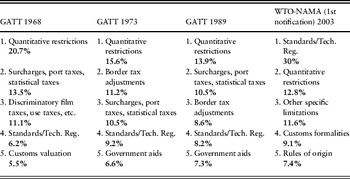
In the context of the Doha Development Agenda (DDA), the Negotiating Group on Market Access for Non-Agricultural Products (NAMA) revived the idea of an inventory as a way of identifying the NTBs to be negotiated (WTO, 2003). When compared to the inventories used during the GATT, this first NAMA inventory showed a significant increase in the number of barriers related to standards and technical regulations (both TBT and SPS), which would suggest that these are the main types of measures affecting trade in non-agricultural products. This also explains why a large number of TBT-related proposals are being discussed in the context of the NAMA negotiations (WTO, 2011b) (see Box 1).
The World Bank, UNCTAD, and the International Trade Centre (ITC) have made efforts in order to establish inventories of government ‘measures’ in coordination with the WTO, as well as business surveys with problems faced by the private sector. Data have been compiled in UNCTAD's TRAINS and the World Bank's Transparency in Trade (‘TNT’) databases, and the WTO recently launched an ‘Integrated Trade Intelligence Portal’ (I-TIP), which compiles information contained in the traditional ‘self’ notifications. While many of these efforts may provide a useful complement to information collected through WTO processes, the information collected is not publicly available, tends to be limited in terms of country coverage, includes only one point in time, and there are no plans for systematically updating the data. Similarly, a number of countries prepare annual reports compiling information about the ‘barriers’ being faced in other markets, which focus on problems that are relevant to their own exporters. This means they are not necessarily representative of barriers faced by other exporters.
To conclude, there is no multilateral instrument that would allow a global overview of all perceived ‘barriers’ affecting world trade in goods nor the manner in which they evolve over time. This situation creates uncertainty on what are the emerging problems or trends that may need to be tackled by the multilateral trading system. This is not necessarily a problem for those with sufficient analytical capacity to identify problems of interest to their constituencies, but it may pose a serious constraint to those unable to do so, and in particular the least-developed countries. Bearing in mind that reverse notifications have been replaced to a large extent by specific trade concerns, an effort could be made to systematically compile and classify specific trade concerns raised in the various WTO bodies.
Inventories of reverse notifications concerning non-agricultural products: evolution of top-five categories, 1968, 1973, 1989, and 2003 (inventory category and share of measures notified)

Note: The GATT estimates are based on reverse notification by Contracting Parties in the context of discussions of ‘industrial goods’. The figures were adjusted to take account of changes over time in the categories (see WTO, 2002). The 2003 figures relate to the first set of notifications in the context of the NAMA negotiations.
Source: Authors' own calculation. See Table A.1 for more details.
4. GATT and WTO disputes as a proxy of NTBs faced
Disputes are arguably one of the best sources for identifying barriers faced by traders, in particular because they represent the measures governments considered important enough to challenge. However, Nottage (Reference Nottage2009) observes several problems that may prevent WTO developing country Members from bringing disputes to the MTS, including lack of technical capacity and resources, which means that a number of NTBs have gone unchallenged. Because barriers differ widely depending on the products and exporting country involved, the measures that have been challenged may not be statistically representative of all NTBs faced by all countries. Most importantly, although the disputes can serve as a proxy of NTBs that fall within the scope of the existing rules, nothing can be inferred about the measures that fall outside of that framework.
With these caveats in mind, this section will explore: (1) what are the main types of NTBs that have been challenged multilaterally, as inferred from the provisions used to challenge them; (2) the role played by the specialized NTB provisions that were progressively negotiated over time; and (3) whether the type of measure challenged varies according to the type of product being affected (agricultural and non-agricultural products), and whether these have changed over time. The results presented in this section are based on two specially designed datasets: one for GATT disputes (1948–1994) and another one for disputes for the first 17 years of the WTO (1995–2011). Together, these datasets compile detailed information for a period of more than 60 years.
The analysis reported in this paper was complicated by the fact that, for any dispute, complainants tend to cite a large number of provisions which have been allegedly breached by the respondent. Some of those provisions are in fact duplicates or intimately related to other provisions in the GATT, which means that one cannot simply rely on frequency counts of provisions cited to infer the number and types of NTBs that have been challenged. Mindful of this situation, a methodology was developed on the basis of the lex specialis principle in order to adjust the data and to take account of the most evident situations, e.g. the Agreement on Antidumping and Article VI of the GATT 1947. Annex 1 provides a detailed explanation of the manner in which the two datasets were developed, as well as the methodology used to adjust the frequency counts presented in the tables and figures which are contained in the web-appendix.Footnote 1
4.1 Types of NTBs challenged in disputes
During 1948–1994, a large proportion of disputes under the GATT focused on NTBs. In a pioneering work, Hudec (Reference Hudec1993: 344–345) found that only 44 out of 207 GATT disputes had involved tariff issues (i.e. 21.3%), whereas the remaining 163 (i.e. 78.7%) involved various forms of NTBs, e.g. 20 relating to AD and CVDs, 33 relating to subsidies, and 108 relating to other NTBs. While largely representative of the overall situation, approximately 55 subsequent disputes were not taken into account by this work. According to our analysis, only two of those 55 additional disputes dealt with tariff-related issues, including TRQs, which means that approximately 82.5% of all GATT disputes involved NTBs.
A large number of measures questioned during the 1948–1994 period involved the three core principles of the GATT. The bulk of these disputes involved the elimination of QRs (30% of the disputes involved Article XI), as well as alleged violations of the national treatment principle (21% invoked Article III)Footnote 2 and the MFN clause (16% invoked Article I and 13% Article XIII) (see Figure B.1). Although Article VI was rarely invoked during the early years, trade remedy and subsidy issues quickly gained importance after the Tokyo Round Codes were adopted. When taken together, cases involving AD (8.4% of the cases), CVD (7.3%), and subsidies (12.6%) comprised almost 28.3% of the GATT disputes, most of which were filed during the negotiations of the UR. Approximately 32% of the GATT disputes involved at least one ‘behind-the-border’ NTB, defined as those involving Article III, subsidies, or standards (see Table A.5).
The importance of NTBs has intensified under the WTO. Of the 427 request for consultations filed by 31 December 2011, only 32 out of the 393 disputes on goods (i.e. 8.1%) involved tariff-related issues, including tariff-rate quotas.Footnote 3 The types of NTBs challenged has also changed. Our analysis suggests that while 35.8% of the WTO disputes have been based on the three core principles of the GATT,Footnote 4 trade remedies and subsidies have become the largest areas of litigation. When taken together, and excluding overlaps, AD (22.6%), subsidies (19.6%), safeguards (9.9%), and CVDs (8.4%) account for more than half of the WTO disputes on goods thus far.
This change in the composition of the types of NTBs being challenged suggests that the MTS has progressively moved from disputes dealing with blunt barriers applied at the border (e.g. tariffs and QRs), to more nuanced situations involving the national treatment principle (III:4 in particular), trade remedies, subsidies, and domestic regulation in respect of standards (i.e. TBT and SPS). According to this analysis, behind-the-border NTBsFootnote 5 have been an issue for 49% of the WTO disputes on goods and appear to be increasingly important for agricultural products (see Table A.5).
4.2 Are the new rules being used to challenge NTBs?
The core principles embodied in the GATT remain crucial in challenging today's NTBs. As of 31 December 2011, 84% of the 393 WTO disputes on goods have cited at least one provision of GATT 1994. Although this share reduces to 53.4% after the adjustment described in Annex 1, and further to 45.8% if Article X references are not taken into account, the GATT remains the most frequently cited Agreement in goods' disputes (see Table A.2). If the GATT remains so important, what has then been the role played by the specialized Agreements? Because many of these disciplines find their origins in the Kennedy, Tokyo, and Uruguay Rounds, this analysis grouped the disputes around these time periods in order to get a sense of whether, and if so when, the new rules had been used. The results are mixed.
Some of the new agreements have rarely been used in disputes. For example, no dispute was ever brought under the 1967 Anti-dumping Code, and there were only two AD disputes based on Article VI before the Tokyo Round.Footnote 6 Similarly, only one GATT dispute was based on the TR Import Licensing CodeFootnote 7, and the WTO's Agreement on Government Procurement has only been cited in four disputes (see Table A.2). While an assessment of the reasons for such limited use goes well beyond the scope of this paper, it may be explained by a number of reasons including full compliance with the new disciplines, lack of sufficient motivation to challenge a measure on that basis, the plurilateral nature of these constructs, or simply that the new rules did not provide a good basis for a dispute.
There are, on the other hand, several specialized disciplines that have proven popular in the context of the disputes. While the Tokyo Round Codes on SCM (9.3% of the disputes, 5% relating to CVDs and 5% to subsidies) and Anti-dumping (3.8%) were of limited importance during the GATT, the multilateral equivalents of the UR are fundamental to WTO litigation (see Figure B.2). Similarly, the WTO AoA (16.8% of the disputes on goods), TBT (10.2%), Safeguards (9.9%), SPS (9.4%), and Import Licensing Procedures (8.9%) have been frequently used to challenge a number of measures. The increased importance of some of these Agreements in comparison to the Tokyo Round equivalents may be explained not only by an increased use of those measures, but also by the multilateral nature of the UR Agreements.
4.3 Evolution of NTBs facing agricultural and non-agricultural products
Do different types of products face different NTBs? To explore this question in the context of the disputes, and inspired by Hudec (Reference Hudec1993) and Reinhardt (Reference Reinhardt1996), the 393 requests for consultations relating to goods were classified in three categories according to the type of product involved: (i) agricultural (as defined in Annex 1 of the AoA), (ii) non-agricultural, and (iii) generic/mixed. Our analysis suggests that the types of problems affecting each product category is not only different, but has evolved over the years.
The analysis indicates that there were more disputes involving agricultural (44.7% of the disputes) than non-agricultural (41.2%) or mixed/generic products (14.1%) under the GATT 1947. In contrast, most of the 393 WTO disputes on goods have involved non-agricultural products (51.4%) rather than agricultural (34.6%) or mixed/generic (14%) products. This variation may be partially explained by the reduced importance of trade in agricultural products since the 1950s (Figure B.3). The single most important type of NTB faced by agricultural products during the 1948–1994 period was QRs (39.3% of disputes involving agricultural products cited Article XI), followed by alleged violations of the national treatment principle (28% cited Article III, mainly paragraph 4), and discrimination in the administration of restrictions (14.5% cited Article XIII). This has changed considerably under the WTO, where 35 of the 136 disputes involving agricultural products (i.e. 25.7%) involved the national treatment principle of Article III (mostly paragraph 4), and only 10.3% of them challenged QRs through Article XI. Interestingly, the GATT remains the most frequently cited Agreement for these products, even after adjusting the references (55.9% of the disputes involving agricultural products) and excluding references to Article X (50%).
The specialized agreements have, however, also proven crucial in challenging NTBs affecting trade in agricultural products. The most important ones have been the AoA (cited in 36% of the relevant disputes), SPS (19.9%), TBT (14.7%), and Import Licensing Procedures (13.2%) (see Figure A.4). Article 4 of the AoA was the most frequently cited provision of this specialized agreement (25% of the relevant disputes) and was often mentioned in relation to the schedules of concessions and the tariffication process. One conspicuously absent agreement in the list is the SCM Agreement, which many expected would result in an avalanche of disputes challenging agricultural subsidies provided by developed countries. While the expiration of the so-called ‘peace clause’ (Article 13 of the AoA) on 1 January 2004 explains the reduced number of disputes up to this year, its relatively low number thereafter is probably explained by the considerable increase in prices of agricultural commodities since 2007 which would make it very difficult to prove ‘injury’. This analysis suggests the prevalence of a wide array of measures affecting trade in these products, but, most importantly, that NTBs affecting trade in these products are moving behind the border (see Figure B.6). Very few disputes involving agricultural products have dealt with AD or CVDs.
Disputes on NTBs affecting trade in non-agricultural products also involved the core principles of the GATT during the 1948–1994 period. Of the 108 disputes involving these types of products, 25% challenged QRs based on Article XI:1 and 21.3% alleged a breach of the national treatment principle under Article III. However, this situation started evolving with the introduction of the Tokyo Round Codes, where the codes on AD (14 disputes) and SCM (10 disputes) began to be used. These non-agricultural cases involved not only industrial products, but also fish and fish products. This trend has been reinforced since the establishment of the WTO where most of the 202 WTO disputes involving non-agricultural products have involved anti-dumping (33.2% of the relevant disputes), subsidies (23.3%), and the UR Agreement on Safeguards (11.9%) (see Figure B.5).
In spite of the considerable importance of the specialized agreements in disputes involving non-agricultural products, the GATT remains the most frequently cited Agreement (46% after adjustment and 37.1% if Article X is not taken into account). The national treatment principle in Article III (17.8%) and elimination of QRs under Article XI (9.9%) have considerably declined in importance with respect to the GATT, but this is probably explained by the equivalent provisions in the specialized agreements. One unexpected finding is that the importance of ‘behind-the-border’ NTBs in disputes involving non-agricultural products has been consistently decreasing since the year 2000 (see Figure B.6).
While the TBT Agreement was the third-most relevant specialized agreement for non-agricultural products between 1995 and 2001, its prominence in the requests for consultations fell considerably following the launch of the DDA. The fact that these products account for more than 90% of world trade in goods calls into question the view that technical regulations and conformity assessment procedures act as one of the main ‘barriers’ to this kind of products (see Box 2). Reasons for this discrepancy could include: (1) lack of resources by those affected to bring a dispute, (2) that these measures are not restricting trade to the point where a dispute is warranted; (3) that the current rules are insufficient for dispute purposes; or (4) that the TBT Committee is being successful in preventing disputes through the discussion of specific trade concerns, etc. In contrast, the TBT Agreement continues to be important to trade in agricultural products where recent cases include US–COOL (DS384 and DS386) and United States – Measures Affecting the Production and Sale of Clove Cigarettes (DS406).Footnote 8
5. Conclusion and recommendations
The three core principles of the GATT 1994 remain relevant in challenging a number of traditional NTBs. While border measures remain the most relevant in the context of disputes for non-agricultural products, ‘behind the border’ measures are increasingly relevant for agricultural products. The increasing reliance on specialized agreements to challenge measures that are not, or are not sufficiently covered, by the WTO Agreement demonstrates the value of clarifying existing rules and developing new ones. This is not only useful but necessary to allow the MTS to remain relevant. However, because disputes only allow countries to attack barriers of the type that can be challenged, they are not necessarily a good indicator of emerging problem areas. Beyond the individual requests by Members to tackle a specific problem in the Committees or the DSU, the WTO does not have in place tools that would allow it to systematically detect new types of problems.
The MTS should go beyond the current efforts of identifying ‘measures’ and devise new ways to detect new ‘barriers’ at an early stage. While going back to a system based on reverse notifications may prove difficult in the WTO context, steps could be taken for the systematic compilation and classification of all the ‘specific trade concerns’ raised in the various WTO bodies (e.g. SPS and TBT). Finally, areas of future work could include an identification of patterns in the inventories and disputes based on the level of development of those involved, as well as the role that specific trade concerns may be playing in preventing disputes.
Annex 1: Data sets and methodology for the adjustment of citations to agreements and articles in the GATT
1. Data sets
The analysis presented in this paper is based on two separate datasets. The first one relates to GATT disputes and is largely based on a dataset of 241 requests for consultations by Reinhardt (Reference Reinhardt1996), who in turn is based on Hudec's work (1993) and comprised information on 207 GATT Panels for the period 1948–1989. It should, however, be noted that our dataset was reviewed and substantially complemented to include a total of 262 requests for consultations.Footnote 9
The second data set is for WTO disputes and is largely based on the database on requests for consultations maintained by the Legal Division of the WTO and the WTO website. It has information on 427 requests for consultations circulated under the document series beginning with the symbol WT/DS series as of 31 December 2011. This dataset was checked for consistency with the World Bank's database on WTO disputes maintained by Professors Horn and Mavroidis.Footnote 10 Because the paper focuses on NTBs, which is a concept only relevant for trade in goods, the analysis focused on 393 of the 427 requests for consultations filed, and excluded 25 requests for consultations relating mainly to intellectual property issues,Footnote 11 as well as nine requests relating mainly to the GATS.Footnote 12 This issue was, for obvious reasons, not relevant for the GATT 1947 dataset.
Inspired by Hudec (Reference Hudec1993) and Reinhart (Reference Reinhardt1996), this analysis classified the disputes in both datasets according to the product at issue in three mutually exclusive categories: agricultural, non-agricultural, and generic/mixed products. Unlike them, and in order to allow for a better understanding of the legally relevant definitions in the WTO, the classification is based on the definition of agricultural products in Annex 1 of the AoA.
2. Rationale for adjusting the frequency count of GATT Articles
Complainants tend to cite a large number of Agreements and specific provisions in their requests for consultations when bringing a dispute to the WTO. Because of the manner in which the provisions relate to one another, an identification of NTBs based on such citations will inevitably lead to an overestimation of certain NTBs. For example, a complainant in a typical anti-dumping case will normally argue that the respondent is in breach of some substantive and procedural rules of the Agreement on Anti-dumping, together with a reference to Article VI of the GATT (the original legal foundation of anti-dumping claims). Complainants will probably also argue that the additional duty being imposed is in excess of the tariff binding (Article II:1(b) of the GATT). And because it is only applied on imports from a specific company exporting from a certain country, it will probably also argue that it is in violation of the MFN clause (Article I of the GATT). It is obvious that, in this type of case, any frequency count should try to minimize the incidence of these relationships.
This paper assumes that the two main types of relationships that need to be taken into account are those of ‘specialization’ (e.g. several agreements develop further the disciplines of a GATT Article) and ‘subsidiarity’ between them (e.g. a claim citing both Articles II and XIX of the GATT (1947), as well as the Agreement on Safeguards (WTO, 1994), is almost certainly about a safeguard and not about tariffs). It is noted that the WTO Agreement itself recognizes the possibility of the first type of relationship and adopts the principle of lex specialis.Footnote 13
3. Assumptions and adjustment methodology
Because the purpose of this paper is not to have a statistical analysis of all provisions cited in the disputes, but rather to identify the types of NTBs affecting trade, references to GATT Articles XX, XXI, XXII, XXIII, XXIV, and XXVIII were excluded. The duplication problem was addressed through a two-step approach which began by filtering out the reference to certain GATT Articles before calculating the overall frequency counts of Agreements. GATT Articles were filtered as follows:

While Table A.3 of the web-appendix presents the frequency count of GATT Articles without filtering, Table A.4 presents the results after the application of the filters. The second step consisted in calculating the frequency counts of the GATT excluding the Articles that were identified in the first step. Both the adjusted and unadjusted frequency count of the Agreements for both datasets are presented in Table A.2 of the web-appendix. While these adjustments result in a slightly different picture than the one presented by other studies, the unadjusted results are largely in tune with them.Footnote 14 The adjustment appears to be considerably less relevant for disputes under the GATT 1947, which may be a reflection of modern litigation tactics.
The methodology has limitations and occasionally yields unwanted results for some cases. For example, in US–Gasoline the panel preferred to have an analysis based on Article III than the TBT Agreement. However, it appears to yield reasonably sound results which are considerably more accurate in identifying NTBs than unadjusted frequency counts.