Introduction
Among the more dramatic changes affecting marine ecosystems over the past 250 Myr were the arrival and subsequent diversification of secondarily marine vertebrates. Once they had adapted to a saltwater environment, these animals often achieved competitive parity with native marine fishes and cephalopods. Communities ranging from rocky shores to mangroves, reefs, mudflats, the pelagic realm, and even deep waters have been competitively dominated by secondarily marine vertebrates throughout nearly all of the Mesozoic and Cenozoic eras, despite the much higher diversity of fishes. The largest marine benthic and pelagic predators, benthic herbivores, and pelagic zooplanktivores are land-derived mammals (Vermeij Reference Vermeij2016). The rise of dominance of successive groups of marine reptiles, birds, and mammals in the sea was enabled by the high mobility and metabolic scope that were inherited from terrestrial or freshwater ancestors and often enhanced in derived members of marine clades, as well as by increasing marine productivity (Vermeij and Dudley Reference Vermeij and Dudley2000; Pyenson and Vermeij Reference Pyenson and Vermeij2016).
The conditions that permitted or encouraged initial colonization of the sea and that led some lineages to succeed in offshore oceanic settings are not well understood. One possibility is that the great mass extinctions triggered colonization of the sea by terrestrial and freshwater vertebrates in the wake of profound ecological disruptions both on land and in the sea. Initial stages of land to sea transitions involve species not well suited to the new environment, especially when compared with incumbent species that already occupied the environment before the newcomers arrived (Vermeij and Dudley Reference Vermeij and Dudley2000). Depleted marine ecosystems might offer less collective resistance to colonization from fresh water or the land, especially if extinctions eliminated top consumers and competitors. Intense competition in donor ecosystems for scarce food resources might force some surviving lineages to seek refuge and food in the sea. Tentative support for this hypothesis has come from secondarily marine clades with multiple living members (Procheş et al. Reference Procheş, Polgar and Marshall2014). A broad temporal peak in transitions among land, sea, and fresh water was found between 40 and 60 Ma, interpreted as evidence that the end-Cretaceous extinction at 66 Ma stimulated these ecological shifts (Procheş et al. Reference Procheş, Polgar and Marshall2014). This analysis is compromised, because clades that did not diversify or that comprise only fossil members were omitted.
Prior extinction is only one of several hypotheses that could account for the timing and circumstances of marine entry by clades from land and fresh water. Intense competition in highly diverse donor biotas could compel some subordinate lineages to expand into coastal marine environments, especially if those environments are both safer and more productive than the donor environments (Vermeij and Dudley Reference Vermeij and Dudley2000).
These hypotheses are not mutually exclusive, because clades need not all respond to the same enabling and competitive agencies in the same way. Moreover, the conditions that led some lineages to become oceanic might differ from the circumstances surrounding initial marine colonization. We explore these issues in the present paper.
An evaluation of these hypotheses and factors requires that all transitions from nonmarine to marine environments be considered and dated in conjunction with data on the geographical and ecological conditions prevailing during both initial colonization and subsequent specialization.
We perform this task here to shed light on the roles that secondarily marine vertebrates have had in shaping post-Permian marine ecosystems.
Materials and Methods
We compiled all clades of secondarily marine amniotes. These are defined here as vertebrates whose diets consist primarily of marine or intertidal organisms and whose locomotion includes the ability to swim, dive or wade in salt water to obtain food. We expanded and modified earlier compilations (Carroll Reference Carroll1985; Rasmussen et al. Reference Rasmussen, Murphy, Ompi, Whitfield Gibbons and Uetz2011; Pyenson et al. Reference Pyenson, Kelley and Parham2014; Kelley and Pyenson Reference Kelley and Pyenson2015) in the light of new ecological, fossil, and phylogenetic evidence. Miller and Wiens’s (Reference Miller and Wiens2017) compilation is full of errors and was not used. Many animals that only occasionally or incidentally feed on marine food sources or that never enter water were excluded. Among these are the Alaskan brown bear (Ursus arctos) (Smith and Partridge Reference Smith and Partridge2004), Asian fishing cat (Prionailurus viverrinus) (Haque and Vijayan Reference Haque and Vijayan1993; Malla Reference Malla2016), clawless South African otter (Aonyx capensis) (van der Zee Reference Zee1981), European river otter (Lutra lutra) (Conroy and Jenkins Reference Conroy and Jenkins1986), Brazilian tufted capuchin monkey (Cebus apella apella) (Fernandes Reference Fernandes1991), European rock pipit (Anthus spinoletta) (Gibb Reference Gibb1956), Northern Hemisphere crows (Corvus spp.) (Clegg Reference Clegg1972; Zach Reference Zach1978, Reference Zach1979; Richardson and Verbeek Reference Richardson and Verbeek1986; Cadée Reference Cadée2006), fossil American teratorns (Hertel Reference Hertel1995; Fox-Dobbs et al. Reference Fox-Dobbs, Stidham, Bowen, Emslie and Koch2008), fossil and living American condors (Cathartidae) (Fox-Dobbs et al. Reference Fox-Dobbs, Stidham, Bowen, Emslie and Koch2008; Stucchi et al. Reference Stucchi, Emslie, Varas-Malca and Urbina-Schmitt2015), alligatorids including New World caimanines (Grigg et al. Reference Grigg, Beard, Moulton, Queiro Melo and Taplin1998; Hastings et al. Reference Hastings, Bloch, Jaramillo, Rincon and MacFadden2013), various Asian turtles (genera Batagur, Carettochelys, and Pelochelys) (Rasmussen et al. Reference Rasmussen, Murphy, Ompi, Whitfield Gibbons and Uetz2011), and several snakes (Grayia in Africa; Natrix in North Africa and Europe; and the tropical American Helicops, Hydrops, Liophis, and Tretanorhinus) (Rasmussen et al. Reference Rasmussen, Murphy, Ompi, Whitfield Gibbons and Uetz2011; Murphy Reference Murphy2012). Also excluded were Early Permian mesosaurids, known from enclosed seas in the Southern Hemisphere (Modesto Reference Modesto2010; Villamil et al. Reference Villamil, Nuñez Demarco, Meneghel, Blanco, Jones, Rinderknecht, Laurin and Piñeiro2016).
Based on known feeding habits and habitats, we included in our tally many birds that commonly feed in both fresh and salt water and animals that, in addition to foraging on the shore or in coastal waters, also spend time on land. Among these are the polar bear (Ursus maritimus), which is capable of diving (Stirling and van Meurs Reference Stirling and van Meurs2015) and whose diet consists primarily of marine mammals (Thiemann et al. Reference Thiemann, Iverson, Stirling and Obbard2011; Galicia et al. Reference Galicia, Thiemann, Dyck and Ferguson2015). We accepted several marine crocodiles (Crocodylus acutus, C. johnsoni, and C. porosus), because they regularly take prey in coastal marine waters (Webb et al. Reference Webb, Hollis and Manolis1991; Mohd Sah and Stuebing Reference Mohd Sah and Stuebing1996; Ortiz et al. Reference Ortiz, Plotkin and Owens1997; Platt et al. Reference Platt, Thorbarnnarson, Rainwater and Martin2013). Several monitor lizards (Varanus spp.) in southeast Asia and Australia forage and swim in the sea (De Lisle Reference De Lisle2007; Tremul Reference Tremul2017) and were also included. We consider humans (Homo sapiens) as marine because of our intensive exploitation of marine resources beginning in the late Pleistocene. The only other primate we included is the southeast Asian long-tailed macaque (Macaca fascicularis aureus), which commonly eats marine hard-shelled foods (Gumert et al. Reference Gumert, Kluck and Malaivijitnond2009; Gumert and Malaivijitnond Reference Gumert and Malaivijitnond2012; Tan et al. Reference Tan, Tan, Vyas, Malaivijitnond and Gumert2015).
Times of transition to the sea were mostly inferred from the earliest appearance of marine members of clades. Studies of stratigraphic confidence intervals and rates of evolution early in the history of major marine tetrapod clades (Motani et al. Reference Motani, Jiang, Tintori, Ji and Huang2017) indicate that the age of the earliest marine fossil member is within 1 to 2 Myr of the time of transition. We used molecular divergence times only if they are in close agreement with fossil evidence or if they account for higher evolutionary rates early in the marine history of the clade (Motani et al. Reference Motani, Jiang, Tintori, Ji and Huang2017).
The 252 Myr interval considered here encompasses recovery phases from three global mass extinctions (end-Permian, end-Triassic, and end-Cretaceous) and three lesser disruptions (end-Toarcian in the Early Jurassic, end-Cenomanian in the Cretaceous, and end-Eocene in the Cenozoic). Other disruptions, including several oceanic anoxic events in the Cretaceous, the end-Paleocene warming, and the mid-Miocene and mid-Pliocene cooling, were less disruptive to coastal marine ecosystems and were not considered.
We inferred a direct stimulus from nearshore extinctions if colonization of the sea occurred within 7 Myr of the end-Permian and within 3 Myr of the end-Triassic and end-Cretaceous crises under the assumption that conditions returned to pre-extinction norms within those intervals. The post-Permian recovery is longer than the others because of the demonstrated duration of extreme heat, low productivity, and high instability in the Early Triassic (Sun et al. Reference Sun, Joachimski, Wignall, Yan, Chen, Jiang, Wang and Lai2012; Grasby et al. Reference Grasby, Beauchamp and Knies2016). We inferred a liberal 2 Myr recovery phase after each of the three lesser disruptions.
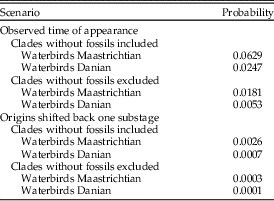
We tested whether marine colonization was more frequent during post–mass extinction intervals than at any other times by comparing empirical times of colonization with what would be expected if the probability of marine colonization was constant over the past 252 Myr. For example, 6 of the 69 marine colonizations occurred during the intervals immediately following the three mass extinctions. Their times of origin, distributed over 13 Myr, were compared with a simulation in which we randomly drew 69 samples from a uniform distribution of origins from 0 to 252 Ma. The simulated sampling was carried out one million times to assess the probability that 6 or more colonizations would fall in the postcrisis intervals. We repeated this comparison with and without clades that are known only from estuarine conditions or from living species only, given that this category of marine colonizations heavily biases the results to the Recent and that these colonizations would likely to be missed in the fossil record. The same analyses were performed under two scenarios concerning the origin of the waterbird clade. We did the analysis with this clade originating in the latest Cretaceous (our preferred option) or with its evolving in the early Paleocene (Danian). Finally, we repeated all analyses with the time of origin shifted back one substage, given the likelihood that the actual time of colonization was slightly earlier than the observed first appearance.
Results and Discussion
Phylogenetic Distribution
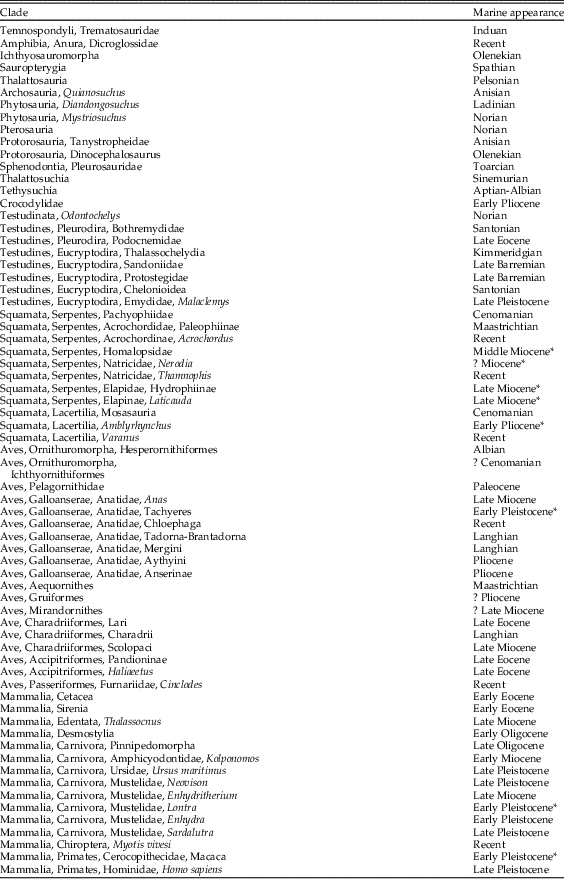
We identify a minimum of 69 post-Permian clades of amniotes that became secondarily marine (Table 1). These clades occur throughout the amniote phylogenetic tree, but several prominent clades lack living or fossil marine representatives. Among these exclusively nonmarine clades are Caudata (salamanders), caecilians, nonavian dinosaurs, amphisbaenians, Strigores (hummingbirds, swifts, and nightjars), Columbaves (cuckoos, pigeons, and their allies), dicynodont therapsids and mammaliaforms, Metatheria (marsupials), Lipotyphla (moles, shrews, and their allies), rodents, Perissodactyla and South American ungulate clades, Lagomorpha (hares and rabbits), and Neogene Artiodactyla, (for phylogenies, see O’Leary et al. Reference O’Leary, Bloch, Flynn, Gaudin, Giallombardo, Giannini, Goldberg, Kraatz, Luo, Meng, Perini, Randall, Rougier, Sardis, Silcox, Simmons, Spalding, Velazco, Weksler, Wible and Cirranello2013; Prum et al. Reference Prum, Berv, Dornburg, Field, Townsend, Lemmon and Lemmon2015; Baron et al. Reference Baron, Norman and Barrett2017). Only a single species or lineage of each became primarily dependent on marine food among Anura (frogs and toads), Passeriformes (songbirds), Chiroptera (bats), and Edentata (sloths and anteaters). In contrast, multiple transitions are documented for Testudines (turtles, 7 cases), Squamata (snakes and lizards, 11 cases), Galloanserae (ducks and geese, 7 cases), and Carnivora (bears, dogs, cats, weasels, and their allies, 8 cases).
Marine amniote clades and their first appearance in the sea. Sources are given in the table footnote. An asterisk (*) indicates that the date is based on phylogenetic divergence time.

Table sources:
Temnospondyli: Steyer Reference Steyer2002.
Amphibia: Gordon et al. Reference Gordon, Schmidt-Nielsen and Kelly1961; Elliott and Karunakaran Reference Elliott and Karunakaran1974.
Triassic reptiles: Nicholls et al. Reference Nicholls, Brinkman and Wu1998; Li et al. Reference Li, Rieppel and LaBarbera2004, Reference Li, Wu, Cheng, Sato and Wang2006, Reference Li, Wu, Zhao, Sato and Wang2012; Rieppel et al. Reference Rieppel, Li and Fraser2008; Cheng et al. Reference Cheng, Chen, Zeng and Cai2012; Jiang et al. Reference Jiang, Motani, Huang, Tintori, Hu, Rieppel, Fraser, Ji, Kelley, Fu and Zhang2016; Motani et al. Reference Motani, Jiang, Chen, Tintori, Rieppel, Ji and Huang2015, Reference Motani, Jiang, Tintori, Ji and Huang2017; Pritchard et al. Reference Pritchard, Turner, Nesbitt, Irmis and Smith2015; Stocker et al. Reference Stocker, Zhao, Nesbitt, Wu and Li2017.
Pterosaurs: Kellner and de Almeida Campos Reference Kellner and de Almeida Campos2002; Lockley and Wright Reference Lockley and Wright2003; Ősi Reference Ősi2011; Benson et al. Reference Benson, Frigot, Goswami, Andres and Butler2014; Witton Reference Witton2015.
Sphenodontia: Bever and Norell Reference Bever and Norell2017.
Crocodylomorpha: Gasparini et al. Reference Gasparini, Vignaud and Chong2000; Gozzi and Renesto Reference Gozzi and Renesto2003; Brochu Reference Brochu2004; Maisch and Kapitzke Reference Maisch and Kapitzke2010; Oaks Reference Oaks2011; Martin et al. Reference Martin, Amiot, Lécuyer and Benton2014; Young et al. Reference Young, Steel, Foffa, Price, Naish and Tennant2014.
Testudines: Davenport et al. Reference Davenport, Spikes, Thornton and Kelly1992; Gaffney et al. Reference Gaffney, Tong and Meylan2006; Joyce Reference Joyce2007; Anquetin Reference Anquetin2012; Ehret and Atkinson Reference Ehret and Atkinson2012; Anquetin et al. Reference Anquetin, Püntener and Billon-Bruyat2015; Cadena Reference Cadena2015; Cadena and Parham Reference Cadena and Parham2015; Crawford et al. Reference Crawford, Parham, Sellas, Faircloth, Glenn, Papenfuss, Henderson, Hansen and Simison2015; Ferreira et al. Reference Ferreira, Rincón, Solórzano and Langer2015.
Serpentes: Shine et al. Reference Shine, Harlow, Keogh and Boeadi1995; Dunson and Travis Reference Dunson and Travis1994; Sanders Reference Sanders, Mumpuni, Hamidy, Head and Gower2010a,Reference Sanders, Mumpuni and Leeb, Reference Sanders, Lee, Mumpuni, Bertozzi and Rasmussen2013; Alfaro et al. Reference Alfaro, Karns, Voris, Brock and Stuart2008; Rasmussen et al. Reference Rasmussen, Murphy, Ompi, Whitfield Gibbons and Uetz2011; Kumar et al. Reference Kumar, Sanders, George and Murphy2012; Murphy Reference Murphy2012; Houssaye et al. Reference Houssaye, Rage, Bardet, Vincent, Amaghzaz and Messlouh2013; Hsiang et al. Reference Hsiang, Field, Webster, Behlke, Davis, Racicot and Gauthier2015; McVay et al. Reference McVay, Flores-Villela and Karstens2015; Rage et al. Reference Rage, Vullo and Néradeau2016.
Lacertilia: Caldwell and Palci Reference Caldwell and Palci2007; Polcyn et al. Reference Polcyn, Jacobs, Araújo, Schulp and Mateus2014; MacLeod et al. Reference MacLeod, Irisarri, Vences and Steinfartz2016.
Ornithuromorpha: Clarke Reference Clarke2004; Bell and Chiappe Reference Bell and Chiappe2015.
Pelagornithidae: Mayr Reference Mayr2011a.
Galloanserae: Howard Reference Howard1963; Livezey Reference Livezey1991, Reference Livezey1995, Reference Livezey1996a,Reference Livezeyb,Reference Livezeyc, Reference Livezey1997a,Reference Livezeyb,Reference Livezeyc; Kurochkin et al. Reference Kurochkin, Dyke and Karhu2002; Mayr Reference Mayr2008; Gonzalez et al. Reference Gonzalez, Duttmann and Wink2009; Bulgarella et al. Reference Bulgarella, Sorenson, Peters, Wilson and McCracken2010, Reference Bulgarella, Kopuchian, Di Giacomo and Matus2014; Zelenkov and Panteleyev Reference Zelenkov and Panteleyev2015; De Pietri et al. Reference De Pietri, Scofield, Zelenkov, Boles and Worthy2016b; Ottenburgs et al. Reference Ottenburgs, Megens, Kraus, Madsen, van Hooft, van Wieren, Crooijmans, Ydenberg and Groenen2016; Olson Reference Olson1985.
Aequornithes: Smith Reference Smith2010; Smith and Ksepka Reference Smith and Ksepka2015; Gibb et al. Reference Gibb, Kennedy and Penny2013; Mayr et al. Reference Mayr, Goedert and Vogel2015, Reference Mayr, De Pietri and Scofield2017.
Gruiformes: Livezey Reference Livezey1998; Mayr Reference Mayr2009; Elzanowski and Zelenkov 2014.
Mirandornithes: Mayr Reference Mayr2014, Reference Mayr2015.
Charadriiformes: Chandler and Parmley Reference Chandler and Parmley2003; Pons et al. Reference Pons, Hassanin and Crochet2005; Baker et al. Reference Baker, Pereira and Paton2007; Fain and Houde Reference Fain and Houde2007; Mayr Reference Mayr2009, Reference Mayr2011b; De Pietri and Mayr Reference De Pietri and Mayr2012; De Pietri et al. Reference De Pietri, Costeur, Güntert and Mayr2011, Reference De Pietri, Scofield, Hand, Tennyson and Worthy2016a.
Accipitriformes: Ericson et al. Reference Ericson, Anderson, Britton, Elzanowski, Johansson, Källersjö, Ohlson, Parsons, Zuccon and Mayr2006; Griffiths et al. Reference Griffiths, Barraclough, Groth and Mertz2007; Mayr Reference Mayr2009.
Passeriformes: Sabat et al. Reference Sabat, Fariña and Soto-Gamboa2003, Reference Sabat, Maldonado, Fariña and Martínez del Rio2006.
Cetacea: Bajpai and Gingerich Reference Bajpai and Gingerich1998; Houssaye et al. Reference Houssaye, Tafforeau, de Muizon and Gingerich2015.
Sirenia: Domning Reference Domning2001.
Edantata: Amson et al. Reference Amson, de Muizon and Gaudin2017.
Desmostylia: Ray et al. Reference Ray, Domning and McKenna1994; Beatty Reference Beatty2009.
Carnivora: Berta et al. Reference Berta, Ray and Wyss1989; Willemsen Reference Willemsen1992; Tedford et al. Reference Tedford, Barnes and Ray1994; Lambert Reference Lambert1997; Sealfon Reference Sealfon2007; Vianna et al. Reference Vianna, Ayerdi, Medina-Vogel, Mangeo, Zeballos, Apaza and Faugeron2010, Reference Vianna, Medina-Vogel, Chehébar, Sielfeld, Olavarría and Faugeron2011; Cahill et al. Reference Cahill, Green, Fulton, Stiller, Jay, Ovsyankov, Salamzade, John, Stirling, Slatkin and Shapiro2013.
Chiroptera: Blood and Clark Reference Blood and Clark1998; Otálora-Ardila et al. Reference Otálora-Ardila, Herrera M., Flores-Martinez and Voigt2013.
Primates: Marean Reference Marean2014; Liedigk et al. Reference Liedigk, Kolbeck, Böker, Meijaard, Md-Zain, Abdul-Latiff, Ampeng, Lakim, Abdul-Patah, Tosi, Brameier, Zinner and Roos2015, 2016; Klein Reference Klein2016.
Amniote lineages were considered to have entered the sea independently if they are phylogenetically separated from each other by terrestrial or freshwater ancestors, or if early representatives of marine clades are preserved in continental deposits. In general, we took conservative positions concerning the number of independent transitions to the sea, but in all cases we analyzed the available phylogenetic and fossil evidence carefully. We discuss several cases below. Reynoso (Reference Reynoso2000) tentatively suggested that the Albian sphenodontian Ankylosphenodon from the Tlayúa Formation of Mexico was a semiaquatic animal that might have been marine. Although this remains a possibility, we have elected to omit this taxon from our compilation. There have been disagreements about which clades of turtles entered the sea. Joyce (Reference Joyce2015, Reference Joyce2017) has argued on functional, morphological, and ecological grounds that all early turtles, including stem turtles, were terrestrial animals. Unpublished evidence seen by one of us (R.M.), however, indicates that the Late Triassic stem turtle Odontochelys occurs in a fully marine environment (see also Li et al. Reference Li, Wu, Rieppel, Wang and Zhao2008), despite its seemingly terrestrially adapted hands. We accept Toxochelys as the earliest chelonioid (Gentry Reference Gentry2017). Following the advice of Walter G. Joyce (personal communication to G.J.V., April 2017), we inferred a single marine colonization for Late Jurassic turtles (thalassochelydians) separate from that of later protostegids.
The large, mainly Cenozoic waterbird clade Aequornithes is here very conservatively inferred to have entered the sea just once in the Late Cretaceous (see Smith Reference Smith2010; Mayr Reference Mayr2011a; Mayr et al. Reference Mayr, Goedert and Vogel2015, Reference Mayr, De Pietri and Scofield2017; Gibb et al. Reference Gibb, Kennedy and Penny2013). It is likely, however, that multiple marine colonizations took place. Marine habits in the Fregatidae (frigatebirds) and Pelecanidae (pelicans) appear to be derived relative to freshwater habits in early representatives of these families (Louchart et al. Reference Louchart, Tourment and Carrier2011; Stidham Reference Stidham2015) and were acquired separately from each other and from the early members of Aequornithes such as lineages leading to penguins (Sphenisciformes, early Paleocene) and other ocean-going birds (Mayr et al. Reference Mayr, Goedert and Vogel2015, Reference Mayr, De Pietri and Scofield2017). In one recent phylogeny, the waterbird clade is combined with waders into a superclade Aequorlitornithes (Prum et al. Reference Prum, Berv, Dornburg, Field, Townsend, Lemmon and Lemmon2015), but other interpretations favor a separate origin for waterbirds, Charadriiformes, and Gruiformes (e.g., Hackett et al. Reference Hackett, Kimball, Reddy, Bowie, Braun, Braun, Chojnowski, Cox, Han, Harshman, Huddleston, Marks, Miglia, Moore, Sheldon, Steadman, Witt and Yuri2008). Early gruiforms are uniformly terrestrial (Mayr Reference Mayr2009; Worthy et al. Reference Worthy, Worthy, Tennyson and Scofield2013; Elzanowski and Zelenkov Reference Elzanowski and Zelenkov2015). We consider Gruiformes separately from the waterbird clade and from Charadriiformes, but accept a single transition to the sea in Gruiformes despite the high likelihood that rails (Rallidae), herons (Ardeidae), and cranes (Gruidae) colonized seashores independently, perhaps several times each. We accept a single marine transition for the charadriiform clade Lari, but more than one colonization likely occurred in this clade also. Within Lari, the marine auks (Alcidae) had entered the sea by the late Eocene (Chandler and Parmley Reference Chandler and Parmley2003; Smith and Ksepka Reference Smith and Ksepka2015), before and separately from gulls, terns, and their allies (Laridae, Sternidae, and Stercorariidae). A basal marine tern is known from the Calvert Formation (middle Miocene) of Maryland (Olson Reference Olson2011), but early gulls (genus Laricola) were freshwater birds (De Pietri et al. Reference De Pietri, Costeur, Güntert and Mayr2011). In fact, confirmed marine gulls (genus Larus) are perhaps no older than the early Pliocene (Olson Reference Olson1983; Warheit Reference Warheit1992; Pons et al. Reference Pons, Hassanin and Crochet2005).
We accept a single colonization of the sea by Pinnipedimorpha because of the monophyly of this carnivoran clade (Arnason et al. Reference Arnason, Gullberg, Janke, Kullberg, Lehman, Petrov and Váinolá2006). There could, however, have been two transitions, one in the North Pacific in the Chattian (late Oligocene) genus Enaliarctos followed by Otarioidea (sea lions and walruses), and a slightly later (early Miocene) transition in the North Atlantic by the clade Phocoidea (seals) (Ray Reference Ray1976; Koretsky and Domning Reference Koretsky and Domning2014). If all of the more liberal interpretations of colonization are accepted as discussed earlier, there would be at least eight additional cases of marine entry. This would bring the total to 72 colonizations. The patterns and conclusions we identify below remain qualitatively the same regardless whether the more conservative number of 64 invasions or the more liberal number of 72 colonizations is used.
Times of Transition
Times of colonization of marine environments by amniotes are difficult to estimate; our best approximations are given in Table 1. Those based on a marine clade’s divergence time (indicated by an asterisk in Table 1) are often too early, because (1) the molecular rates of evolution on which those dates are based were faster during early stages of transition and adaptive radiation than during later stages of marine adaptation (Motani et al. Reference Motani, Jiang, Tintori, Ji and Huang2017); (2) inappropriate calibrations were used in calculating molecular rates of divergence times (Mayr et al. 2011b; Smith and Ksepka Reference Smith and Ksepka2015); or (3) difficulties in identifying the oldest member of a clade that can be confidently designated as marine.
The fossil record of birds presents particular difficulties. Stem-group members and early radiations of anseriforms, Mirandornithes, gruiforms, and charadriiforms are nearly all preserved in freshwater lacustrine sediments (see sources in Table 1). One Paleocene species of the stem anseriform genus Presbyornis (P. isoni) is known from fragmentary material in the marine Aquia Formation of Maryland and Virginia (Olson Reference Olson1994), but whether this species was a marine shorebird is uncertain. It is also not known whether the long premarine intervals for these clades reflect a true history of restriction to freshwater habits or a taphonomic bias in favor of preservation in lakes. The high abundance and diversity of marine birds at many late Neogene sites (Brodkorb Reference Brodkorb1955; Olson Reference Olson1983; Emslie Reference Emslie1995a, Reference Emslieb; Emslie and Correa Reference Emslie and Correa2003; Olson and Rasmussen Reference Olson and Rasmussen2001; Stucchi and Urbina Reference Stucchi and Urbina2004; Dyke and Walker Reference Dyke and Walker2005) and the fact that undoubted marine birds (especially pelagornithids) are known from the Paleogene point to an interpretation indicating late colonization of marine environments by many bird lineages. It is particularly striking that such iconic shorebirds as gulls, sandpipers, oystercatchers, ducks, and geese are late arrivals, being known mainly from the Pliocene or perhaps the Miocene onward in both the Northern and Southern Hemispheres (see Warheit Reference Warheit1992; Pons et al. Reference Pons, Hassanin and Crochet2005; Ottenburgs et al. Reference Ottenburgs, Megens, Kraus, Madsen, van Hooft, van Wieren, Crooijmans, Ydenberg and Groenen2016). Taxa more at home over the open ocean (petrels, albatrosses, pelagornithids, and auks) have much longer Cenozoic histories.
With these caveats, we recognize 25 Mesozoic and 42 Cenozoic colonizations of the sea by amniotes. As noted earlier, the number of Cenozoic transitions could be as high as 50. Although some of the apparently greater number of Cenozoic as compared with Mesozoic colonizations are attributable to greater phylogenetic resolution for Cenozoic clades and to much greater knowledge about living species than about fossil ones, we argue below that opportunities for marine invasion have generally increased over time. Extinction appears to have played a minor role in providing such opportunities.
The Role of Extinction
Most of our analyses indicate that intervals immediately following mass extinction events contain a disproportionate number of marine colonizations of amniotes (Table 2). We identified six such colonizations, or seven if the waterbird clade colonized the sea after rather than before the end-Cretaceous event. The only exception among the eight scenarios we tested is the case where observed times of appearance are used and in which clades with only living species or with only estuarine taxa are included. Here the probability of 0.0629 is just above the 0.05 criterion of statistical significance. All of the seven other scenarios are well below this threshold.
Probabilities that amniote clades entered the sea during postcrisis intervals by chance. Number of clades with only living species: 16; number of clades with fossil record: 53; total number of clades: 69.

The Early Triassic, the interval following the most severe among the crises, accounts for most of the postcrisis colonizations. This effect is dramatically magnified if all times of origin are shifted back by one substage (Table 2).
It is notable that the end-Cretaceous crisis did not trigger any marine colonization, unless the waterbird clade entered marine environments after the Cretaceous instead of during the latest Cretaceous. Following Mayr and colleagues (2017) and others, we prefer a Maastrichtian marine colonization of this clade.
Productivity and Incumbency
Two primary factors, alone or together, could explain the high rate of marine entry by amniotes during the postextinction interval of the Early Triassic. These are the relative absence of effective incumbents (competitors and predators) in the sea and an abundant food supply. Dunson and Mazzotti (Reference Dunson and Mazzotti1989) pointed out that initial colonization of the sea by late Cenozoic amniotes often occurred in estuarine environments, including river mouths, mangroves, and salt marshes. Comparable environments are also conduits for marine lineages expanding to fresh water. Estuaries are generally highly productive but are also ecologically less diverse than nearby marine, freshwater, and terrestrial ecosystems. Likewise, open rocky shores have been sites of colonization for several lineages, including the Galapagos marine iguana (Amblyrhynchus cristatus) and perhaps the Chilean ovenbirds of the genus Cinclodes. The polar bear was also not an estuarine invader. The iguana, Cinclodes, and two additional lineages (the late Miocene to Pliocene Peruvian marine sloth Thalassocnus and the Mexican bat Myotis vivesi) entered the sea from notably unproductive dry terrestrial conditions to highly productive marine settings. Humans in South Africa likely began exploiting marine resources on a large scale under similar circumstances (Marean Reference Marean2014). High productivity in the initial recipient marine environment may therefore have been more important as an enticement for colonization than was the relatively diminished diversity of competitors and predators there. The role of incumbents in preventing marine invasion was likely much greater for other would-be invaders such as terrestrial arthropods than for metabolically active and mobile tetrapods (Vermeij and Dudley Reference Vermeij and Dudley2000).
Although several marine amniote clades have given rise to freshwater descendants—hydrophiine sea snakes, plesiosaurs, mosasaurs, pinnipeds, and cetaceans (Kocsis et al. Reference Kocsis, Ősi, Vennemann, Trueman and Palmer2009; Fulton and Strombeck Reference Fulton and Strombeck2010; Rasmussen et al. Reference Rasmussen, Murphy, Ompi, Whitfield Gibbons and Uetz2011; Benson et al. Reference Benson, Fitzgerald, Rich and Vickers-Rich2013; Gutstein et al. Reference Gutstein, Cozzuol and Pyenson2014)—transitions from marine to fully terrestrial habits are apparently unknown among post-Devonian amniotes, except on some isolated oceanic island such as Hawaii (Paxinos et al. Reference Paxinos, James, Olson, Sorensen, Jackson and Fleischer2002; Olson Reference Olson2013). Even among fish, where intertidal habits are widespread, only one blenny has become fully terrestrial (on Rarotonga), again on an oceanic island (Ord et al. Reference Ord, Summers, Noble and Fulton2017). Either the adaptive hurdles for such transitions are too high or the land is simply too difficult for most marine-adapted vertebrates to compete with terrestrial species, particularly if they have lost the capacity to move easily on dry land.
There are some indications from living species that entry into marine environments represents not just the opportunity for gaining nutritional resources, but also for evading competitors in the donor biota. Male polar bears are competitively dominated by brown bears where the two species co-occur (Cahill et al. Reference Cahill, Green, Fulton, Stiller, Jay, Ovsyankov, Salamzade, John, Stirling, Slatkin and Shapiro2013), suggesting that exploitation of marine vertebrates on ice by polar bears might have begun as a response to avoid competition with brown bears. The saltwater crocodile Crocodylus porosus apparently enters salt water only to find suitable rivers for feeding and mating after individuals are driven from their freshwater birthplaces by competitively superior territorial individuals (Webb et al. Reference Webb, Hollis and Manolis1991). It is difficult to gauge the generality of such findings, but the possibility that most amniote lineages entering the sea were competitive refugees deserves further study.
With the possible exception of chelonioid turtles, all Mesozoic transitions involve predators. By contrast, at least seven Cenozoic amniote clades entered the sea as herbivores; the marine iguana, three clades within Galloanserae (Aythyini, Anserinae, and Chloephaga), and the mammalian clades Sirenia, Desmostylia, and Thalassocnus. Two of these (the iguana and Sirenia) entered in the tropics, although a major sirenian lineage (Hydrodamalinae) became important herbivores in the North Pacific. The other Cenozoic herbivorous amniotes originated in temperate waters, three in the Northern Hemisphere (Aythyini, Anserinae, and fossil Desmostylia) and two in temperate South America (Chloephaga and Thalassocnus).
Another factor contributing to the larger number of Cenozoic as compared with Mesozoic colonists is the exploitation of small marine food items by Cenozoic shorebirds. Small crustaceans, gastropods, bivalves, and polychaetes—many in the 2 to 5 mm size range—constitute the bulk of the diet of many wading birds (Charadriiformes), waterfowl (Anseriformes), the South American ovenbird Cinclodes, and their more terrestrial congeners and ancestors (see, e.g., Reeder Reference Reeder1951; Recher Reference Recher1966; Bengtson and Svensson Reference Bengtson and Svensson1968; Edington et al. Reference Edington, Morgan and Morgan1973; Burton Reference Burton1974; Jehl Reference Jehl1975; Evans et al. Reference Evans, Herdson, Knights and Pienkowski1979; Piersma et al. Reference Piersma, Aelst, Kurk, Berkhoudt and Maas1998; Sabat et al. Reference Sabat, Fariña and Soto-Gamboa2003; Elner et al. Reference Elner, Beninger, Jackson and Potter2005; Prakash et al. Reference Prakash, Quéré and Bush2008; Cadée Reference Cadée2011).
Unsurprisingly, all secondarily marine ectothermic amniotes (amphibians and reptiles) entered the sea under warm-water conditions. This is likely to have been true also for some endothermic clades such as Cetacea, Sirenia, Macaca, Myotis, Pelagornithidae, and perhaps auks. At least four mammalian clades (Neovison, Enhydra, Lontra, and Ursus) and two birds (Chloephaga and Tachyeres) entered in cold-temperate to polar conditions; and many others initially colonized in cool- to warm-temperate sites, including Pinnipedimorpha, Kolponomos, Sardalutra, Thalassocnus, Homo, Desmostylia, Anas, Mergini, Tadorna, Aythyini, and Anserinae. The rise in marine colonizations during the Cenozoic (42 clades in 66 Myr, mean 0.64 clades per 1 Myr) compared with the Mesozoic (25 clades in 186 Myr, mean 0.14 clades per 1 Myr) is therefore due in part to endothermic clades, which were able to enter the sea in regions inaccessible to most Mesozoic lineages or in climatic zones that hardly existed at that time.
These data clearly show that Cenozoic marine amniote clades did more than simply replace extinct Mesozoic clades, as Miller and Wiens (Reference Miller and Wiens2017) claim. Instead, at least three novel ecological groups—herbivores, cold-adapted endotherms, and species specializing on a diet of tiny benthic or planktonic animals—entered the sea during the Cenozoic that had few or no Mesozoic counterparts. These novel clades therefore represent a substantial ecological expansion of marine amniotes during the Cenozoic relative to the Mesozoic. It is striking that similar expansions of ecological equivalents occurred among fishes, especially herbivorous bony fishes and regionally endothermic cartilaginous and bony fishes.
Conclusions
The frequent colonization of the sea by land-based or freshwater amniotes since the Permian implies that the conditions for entry have become increasingly common and widespread over time. A further indication of this comes from the many species that occasionally venture into marine environments to feed (see “Materials and Methods”). Prior extinction was an important trigger for marine colonization during the Early Triassic but not at other times in the Mesozoic and Cenozoic eras. Instead, a combination of enabling factors and selective agencies—competition in the donor ecosystem, adaptive predisposition in candidate clades, and especially high productivity and abundant food in nearshore habitats—favored ecological expansion of amniote clades into coastal marine environments. Increased marine productivity over time, especially during the late Cenozoic (Vermeij Reference Vermeij2012), and the rise of endothermic birds and mammals expanded these opportunities geographically and trophically. Colonization of the sea by amniotes enriched marine ecosystems, indicating that the latter were undersaturated with species throughout the post-Permian interval.
In the historical analysis of marine colonization we present here, it has proven essential to consider the ways of life and adaptive characteristics of participating species as well as the ecological circumstances in both the donor and recipient ecosystems. The traits of species and communities affect whether and how colonization proceeds and which lineages among the numerous potential candidates take part. Our approach of assigning properties to lineages and ecosystems contrasts with many macroevolutionary viewpoints in which taxa, clades, and times are assumed to be interchangeable and whose particular characteristics have little bearing on the course of history. As an account of events and interactions among living things that vary in space and time, history can and does reveal large-scale patterns and trends, but the causes and feedbacks that underlie these grand themes ultimately emanate from a combination of selection, opportunity, and limitation, all of which are strongly influenced by life itself. To understand history fully, we need more than names, counts, and dates of players and a chronology of events.
These are important, of course, but history also demands a context of function, interaction, and environment. Living things do not work in isolation; they are part of an evolving network of interactions whose properties change over time in knowable ways that reflect fundamental principles.