


Introduction
Most Americans are not meeting the daily recommended intake of fruit and vegetables. Diseases primarily associated with diet and lifestyle (e.g. obesity, cardiovascular disease (CVD), and type-2 diabetes) have increased significantly over the past three decades. It is well documented that eating more fruits and vegetables and reducing sugar, along with regular exercise can reduce the rates of these illnesses. In 2019, the Centers for Disease Control (CDC) reported that 12.3% of U.S. adults met fruit intake recommendations and 10.0% met vegetable intake recommendations.(Reference Lee, Moore, Park, Harris and Blanck1) In Indiana, 13% of adults met fruit recommendations and 10.5% met vegetable recommendations. In Ohio, 9.5% of adults met fruit recommendations and 7.4% met vegetable recommendations.(Reference Lee, Moore, Park, Harris and Blanck1) Rural residents are six times more likely to be obese than urban and suburban residents.(2) Barriers for poor health in rural communities include higher poverty rates and reduced access to fresh produce with grocery stores sporadically located.(Reference Miller, Rogalla, Spencer, Zia, Griffith and Heinsberg3) Produce farms, both large and small, are often situated in rural areas, making produce more accessible through various avenues such as food hubs and farmers’ markets.(Reference Barnidge, Hipp, Estlund, Duggan, Barnhart and Brownson4) Still, daily recommended intake of fruits and vegetables among the general public lags. Public health research has established the important role that agriculture plays in the health of communities around the globe.(Reference Frimpong and Vermund5) However, there is very little information on more formal connections or health educational programming that partners farmers with health professionals to work to increase the daily intake of fruits and vegetables by the general public. If residents do not eat produce, this affects not only their health, but the income of local farmers. Even considering these clear connections, farmers have traditionally defined their roles based upon their farming practices or motivations to build and maintain a thriving agrobusiness rather than in light of their potential contribution to the health of communities.(Reference James and Sulemana6) While there is evidence to suggest that farmers do consider their contributions to the nutritional health of their families and the communities they live in, there is very limited literature that explores their willingness to formally partner with health professionals to better the health of their communities.
The purpose of this qualitative study was to explore two guiding research questions: (1) What relationships do farmers envision as significant to their ability to contribute to community health? (2) How do the farmers construct their role as influencers of the health and well-being of their communities?
How farmers impact people in their community
What role do farmers play in rural midwestern culture? The literature is replete with examples of smaller-scale, diversified crop growers choosing to participate in localized food systems to benefit the health of their community.(Reference Grover and Gruver7–Reference Beingessner and Fletcher10) There is evidence suggesting that local food systems, Community Supported Agriculture (CSA) operations, farmers markets, and other local, food-forward businesses are providing more access to produce and helping farmers and consumers develop meaningful and lasting bonds.(Reference O’Kane11) Farmer and Betz in their study of West Virginia specialty crop farmers highlighted that the farmers’ motivations for selling direct to consumer ranged from wanting to be good stewards of the land, to producing high quality foods, and to reducing health risks associated with chemical usage.(Reference Farmer and Betz12,Reference Schoolman, Morton and Han13)
By participating in farmers markets and through their own marketing channels (e.g. social media, websites, and word of mouth), small scale diversified crop farmers do encourage the public to eat fruits and vegetables. Farmers market attendees have reported eating healthier because of farmers markets.(Reference Witzling, Shaw and Wolnik14) Nationally, the number of farmers markets has increased over the past several decades. Farmers markets proliferated in urban and suburban areas in the early to mid-90s, but recently there has been significant growth of farmers markets in rural areas.(15) Health educators, extension services, and residents in rural areas recognize that rural areas, just like urban food deserts, experience limited access to fresh and healthy foods.
Grocery stores with links to national and global food chains have traditionally been the source for many people to get their fruits and vegetables. But as populations in rural communities continue to decline, chain grocery stores (e.g. Kroger, Meijer, Albertsons) have no incentive to locate themselves in rural communities. Farmers markets, food hubs, and CSA programs offer alternative pathways to increasing the consumption of fresh and nutritious foods in rural areas.(Reference Larsen and Gilliland16,Reference Sage, McCracken and Sage17) In addition, many more farmers markets are now sites for redeeming benefits from food assistance programs such as the Supplemental Nutrition Assistance Program (SNAP) and Women Infant and Children Farmers Market Nutrition Program (WIC FMNP). The United States Department of Agriculture (USDA) Food and Nutrition Service reported that $33 million in SNAP benefits were redeemed at farmers markets in 2020.(18) Food hubs – organizations that source and aggregate regionally grown products, selling them to institutions and in some cases direct to consumers – also help consumers connect to fresh and healthy foods in some rural areas. Food hubs and CSAs, often start at a grassroots level; being championed by people within the community (e.g. motivated citizens, farmers themselves, and local businesses) with additional financial and organizational support from land grant extension services, county health departments, and state and federal-level departments of agriculture.
Commodity crop farmers (i.e. large-scale farms that typically grow row crops like corn and soybeans in the Midwest) want to feed people. The literature does not support that large-scale commodity crop growers are concerned about fruit and vegetable intake. However, the literature does support that they want to make sure we have enough food to eat. Many large-scale farmers ascribe to Norman Borlaug’s idea of ‘feeding the world’,(Reference Borlaug19) which is rooted in Green Revolution ideology. Borlaug, an agronomist who led global initiatives to increase agricultural production to feed the world, won the Nobel Peace Prize in 1970 for this work and is widely acknowledged as the Father of the Green Revolution. Borlaug spent his career developing genetically modified commodity crops to ‘end man’s war with hunger’ with the expressed goal of feeding a growing population.(Reference Borlaug20) Many conventional crop growers still function under this narrative. While large-scale farmers want to feed the world and save people from starvation, there is no evidence to suggest that they are working with healthcare professionals to increase fruit and vegetable intake. Moreover, they are part of a global food system with the goal of maximizing food production so people do not go hungry.
There is much we do not understand about how farmers perceive their role as community members, or their ‘farmer identity’.(Reference McGuire, Morton and Cast21) As farmers continue to take a more significant position in the public health system within communities, a clearer understanding of the ways in which farmers conceptualize their role as community health stakeholders is needed.
Methods
Study design
A qualitative approach was taken to investigate farmers’ attitudes and beliefs about public health and nutrition and to identify their interests and ideas about collaborating with community partners and other public health members to improve fruit and vegetable consumption. This study included in-depth, face-to-face semi-structured interviews with 24 farmers within a 100-mile radius of Dayton, Ohio. The data was collected between May and September 2019.
Purposeful sampling and the snowball method were used to select 24 farm owners and/or operators in Indiana and Ohio to represent three types of farming methods: conventional (C), certified organic (CO) and non-certified organic (NCO). These farming categories were selected in order to find farmers from a wide variety of backgrounds and experiences. Contact information was found by searching for farmers on Google, Facebook farm accounts, and through word of mouth. Inclusion criteria required participants to be at least 18 years old, be an owner and/or operator of a farm in Indiana or Ohio, and self-identify as one of the three defined farming methods. Farmers who refused to be audiotaped would be excluded from the study. An invitation to participate script was used to invite potential subjects via email or telephone.
Data collection
A list of questions to be used as an interview guide was content validated by an expert panel, including the research team. The panel included researchers in the fields of public health, sustainability and nutrition with expertise in qualitative research methods in the subject area. The questions were written to be open-ended and designed to capture farmers’ attitudes, beliefs and behaviors related to the research questions for this project. Farmers who offered comments not related to the list of questions were included in the results. The questions were pilot-tested for external validity on a subset of farmers who resided in the study area, but were not part of the study. After the pilot tests, to improve clarity, minor adjustments were made to two questions. A letter of informed consent, approved by Ball State University Institutional Review Board (IRB) committee, was provided to each participant. The IRB approval number was 1398343-2.
Interviews were conducted over a five-month period from May to September of 2019. The interviews took place on the farmers’ properties. The primary researcher and one research assistant were present at each of the 24 interviews. At the beginning of each interview, the letter of informed consent was reviewed with the participants and then signed. Next, an eight-question, written demographic questionnaire was administered. The primary researcher used the interview questions as a guide to complete the interviews. Not all interviews followed the questions exactly. Follow-up questions were asked throughout the interview to clarify what the farmers were discussing. The interviews averaged 40 min in length. The shortest interview was 25 min and the longest interview was 1 h 8 min. The research assistant recorded the interviews using the Olympus digital voice recorder WS-321M, while the primary researcher conducted the interview.
Data analysis
Each participant was assigned a number to protect their identity. The audio files from the voice recorder were transcribed to text by uploading the voice recordings to the QSR NVivo version 12 voice to text transcription service (2014). The transcripts were converted to a Microsoft Word document and reviewed by peer triangulation. The documents were reviewed by the primary researcher to ensure translation conformity, and errors were corrected. The transcripts were next reviewed by one of the co-PIs to ensure exact translation. The revised transcripts were reuploaded to the QSR NVivo Version 12 data analysis software program. The transcripts were analyzed using the constant comparative method.(Reference Glaser22) by three of the researchers, generating main themes. These researchers independently read each transcript to determine these overall themes. They met to discuss and reconcile differences in identified themes prior to coding. Another researcher reviewed the data and then compared the themes to the findings. The data themes were cross-referenced with demographics to identify differences by farming method. Two of the researchers then coded the data per the identified themes using NVivo for organization of data, which enabled the identification of recurrent commonalities across interviews. Peer debriefing was used to review all interviews, transcripts and interpretations of the data. Reporting of findings was then separated using the Consolidated criteria for reporting qualitative research.(Reference Tong, Sainsbury and Craig23) Three categories: Conventional (C), Certified Organic (CO), and non-certified organic (NCO) were established to label the quotations from the farmers.
Integrating a framework for analysis: the socio-ecological model
To mitigate bias, inductive analysis preceded theory application.(Reference Garvey and Jones24) Rather than selecting a framework and then exploring the fit between the data and the framework, which may introduce bias in the attempt to fit the data to a specific theory, the authors first explored the data and thoughtfully questioned multiple frameworks to select one that best fit the available data. Consequently, the theory was then used to categorize our themes and served as a guide for the presentation of our results. After a consideration of the theories best matched to our data, the socio-ecological model (SEM) was the theory aligned with the findings as it underscores multilevel influences, emphasizing the complexity of behavior shaped by intrapersonal, interpersonal, organizational/community, environmental, and public policy factors. The SEM offers an entry point for investigating the potential layers of influence that a farmer may envision when defining their roles in the public health system. Thus, this paper explores ways in which farmers conceptualize their roles as contributors to the public health system through the lens of the SEM.(Reference Bronfenbrenner25) A number of nutrition and public health interventions and strategies have been developed with foundations in the SEM.(Reference Townsend and Foster26,Reference Fenta, Tiruneh and Anagaw27) Applying the SEM in this context provides a structured framework to identify and understand upstream (structural and policy-level) and downstream (individual and community-level) factors influencing farmer perceptions of identity. Themes are reported with descriptions and illustrative exemplar quotes from the data.
Results
Subject demographics
Demographic information collected at the beginning of each interview included individual farmer demographics (gender, age, education level, years farming, farming full time or part time) and farm demographics (geographic location of the farm, annual gross sales, and how many acres were farmed). Of the 24 farmers in the study, 18 were men and 6 were women. There were 8 conventional farmers (C), 8 CO farmers and 8 NCO farmers. The farmers were >18 years and the owner and/or operator of their farm. The age range was between 28 and 80 years, with a mean age of 49 years ± 15 years. All farmers lived and farmed in either Indiana (8 farmers) or Ohio (16 farmers) and were located within a 100-mile radius of Dayton, Ohio. Full-time farming was defined as cases where the money obtained from farming was the sole source of income, whereas farming as a secondary job was defined as cases where a farmer received income from another source outside of farming. There were 13 farmers who farmed full-time and 11 farmers who farmed as a secondary job [See Table 1].
Sample demographics

Table 1. Long description
The table presents demographic information of 24 farmers categorized into conventional, certified organic, and non-certified organic farming types. It includes data on gender, state, job status, education level, and gross sales. The table has 16 rows and 5 columns. Column headers are Variable, Conventional (n = 8), Certified organic (n = 8), Non-certified organic (n = 8), and Total (n = 24). Row labels include Gender (Male, Female), State (Indiana, Ohio), Job status (Full time job, Secondary job), Education level (High school, 2-year college, 4-year college, Advanced degree, Other), and Gross sales (Less than 25,000, 25,001-49,999, 50,000-99,999, 100,000-249,000, 250,000-549,999, 500,000-999,999, More than 1,000,000). Each cell contains the percentage of farmers in each category. Notable trends include a higher percentage of male farmers in conventional farming and a higher percentage of full-time farmers in non-certified organic farming.
Themes
Through analysis of the data, four primary themes were identified to best represent the viewpoints of farmers in framing their perceptions of their identity as members of the community health system. Namely, (1) Farmer attitudes demonstrate a personal commitment to high quality products that positively influence communities; (2) Farmers see partnerships with health professionals in clinical environments as enabling a direct connection to consumers; (3) Farmers frame their influence on communities through community education on farming practices and healthy eating; and (4) Farmers see partnerships with health professionals as key to helping them overcome challenges in altering relevant policies.
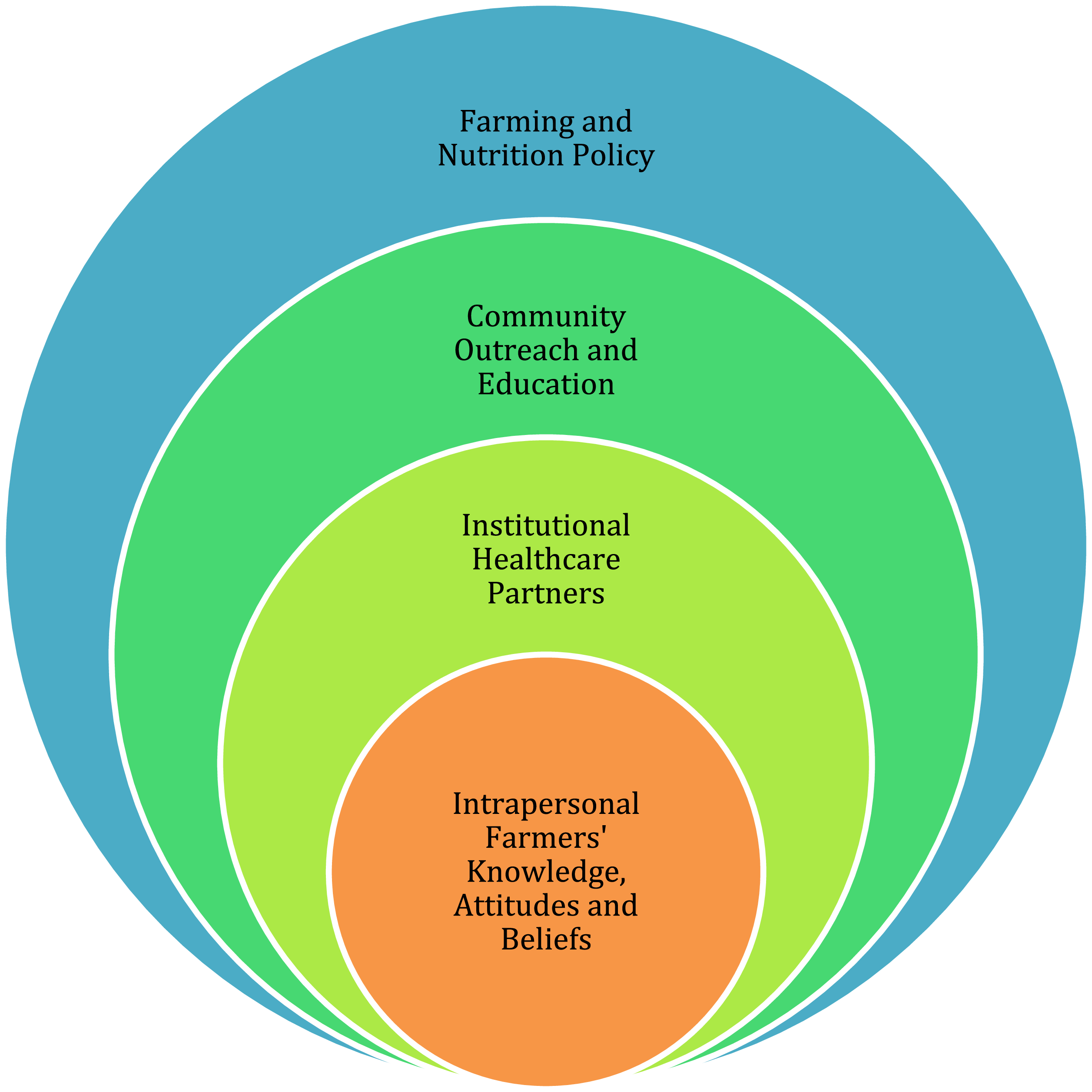
As farmers elaborated on their roles within their communities, many shared how their own knowledge and attitudes (intrapersonal factors) clearly framed their perceptions regarding their ability to influence community food systems and nutrition education. In this, we envisioned theme one as a clear fit within the intrapersonal level of influence. Farmers also spoke to the ways in which partnerships with Registered Dietitian Nutritionists (RDNs) in clinical settings enabled them to reach low-resource consumers, which we saw as fitting within the organizational/institutional level of influence. Farmers also defined their contributions based upon interactions as educators in community organizations and outreach programming, which we aligned with the community level of influence. Lastly, farmers also discussed how policies can affect their farming decisions, with a recognition of the ways in which partnerships with other stakeholders could aid in changing policy. We saw this discourse as fitting with the policy level of influence. The data, however, lacked evidence to include the interpersonal category; therefore, the research team adapted the SEM to the results [see Figure 1]. While there was an overlap in some data, results differed by farming method (conventional, CO or NCO) and this is specified.
Using the socio-ecological model to understand how farmer’s perceive their role in addressing healthy eating & local food systems.

Intrapersonal level: farmer attitudes & knowledge influence community food quality and quantity
The farmers interviewed were committed to providing high quality products which they believed positively influenced the health and well-being of the communities they served. The definition of quality seemed to vary based on the type of farming method. In this regard, we have separated this portion of the results to reflect the differences.
Certified organic and non-certified organic farmer attitudes
Most certified and NCO farmers viewed good quality as growing safe, natural products without using chemicals. These organic farmers believed that not using chemicals would keep their consumers healthy. When asked about the benefits of using organic farming methods, one farmer replied, ‘Well what’s good about it is I don’t poison myself or the land…I go to bed with [a] clear conscience that I’m not destroying the ecosystem for profit. My health is not being destroyed’. (Farmer 5 – NCO) When asked about why they farm organically, another farmer responded, ‘…that’s one of the biggest reasons is health reasons’. (Farmer 7 – NCO) The organic farmers did not want to feed consumers products that were sprayed with chemicals due to the potential negative health impact. One CO farmer stated, ‘I feel like I’m providing a high-quality product to people’. (Farmer 12 – CO) The organic farmers were not as motivated by the economic benefit of larger yields as conventional farmers. One NCO farmer put it very plainly, ‘I grow not just to make money…But I grow because I want people to have good vegetables to eat…’ (Farmer 7 – NCO)
Conventional farmer attitudes
Conversely, conventional farmers indicated that good quality was evidenced by having an increased product yield. One farmer stated, ‘[I]f the market drives us to do something different it’s because there was a cost benefit or potential increase in yield…I would honestly say production is probably number one’. (Farmer 4 – C) Although the conventional farmers did believe that good nutrition is important for the overall health of consumers, they continued to use chemicals to promote a higher yield and thus more product in the hands of their partners and consumers. Conventional farmers were concerned about the stability of their businesses and did not see organic farming methods as an alternative due to the higher cost and increased time commitments. One conventional farmer put it very bluntly, saying, ‘Anybody who has a mortgage or payroll is going to spray if he has to’. (Farmer 11 – C)
Organizational/institutional level: RDNs and farmers as partners in the clinical setting
The farmers in this study had thoughts on how their relationships with health professionals in clinical organizations could influence community health. Farmers, especially those who farmed organically, believed that collaborating with an RDN could help connect people to the farmers markets to ensure that the community had access to fresh, local produce. These farmers mentioned that produce should be accessible to all low and middle-income consumers. One farmer stated, ‘And so we’re looking for additional pathways to get that food to the hands of people that need it and want it. And dietitians I think can play a huge role in that’. (Farmer 23 – NCO) Some NCO farmers suggested that RDNs and farmers could work together to form a preventative care program to connect people with local produce and include the participation of local physicians. One farmer stated, ‘…like a preventative care program that…involved…getting local produce…making it accessible to a wider…audience…if they were somehow connected through the dietitian’. (Farmer 10 – NCO) Another farmer suggested, ‘doctors instead of prescribing medication would actually say well you need to…eat more broccoli. Here’s your prescription. Go buy broccoli’. (Farmer 13 – NCO)
Some farmers commented that the locations and hours of farmer’s markets could be limiting access for some low-income community members. They reported consumers struggled to access the market on the days and times it was open, especially if the market was only open one day a week. One farmer stated, ‘Low income, middle income… people…don’t have access to that type of local produce…the farmer’s market hours don’t work for them…’ (Farmer 14 – CO) This CO farmer suggested an RDN could work with a food hub to help deliver food to those not able to get to the farmers markets. They stated that, ‘a community nonprofit food hub like that you know, I think it could be a cool place to involve dietitians’. (Farmer 14 – CO)
Community level: farmers as community health educators
When asked about the impact farmers could have on the health of their community, many commented they had an educator role to play by sharing their knowledge of farming with others. Conventional farmers were open to having people come to their farms to learn, but they did not have regular interactions with the public. It was mentioned that educating young children about where food comes from might result in understanding that a healthy diet is important. A few conventional farmers regularly invited school groups to their farms. One of these conventional farmers stated, ‘I also believe that people want to be more educated and…education helps them be more healthy about what they’re eating. When they know where it comes from, they can ask questions about it’. (Farmer 11 – C) Another conventional farmer reported his surprise about people’s lack of education on food, stating, ‘I’m really kind of amazed that people are not thinking about what they put in their mouth and giving a little bit of thought about where did this come from? How was it raised? Is it fresh?’ (Farmer 1 – C)
The certified and NCO farmers seemed to believe that they had a more direct role in educating people to encourage them to eat more fruits and vegetables. They felt that they could use the opportunity of selling their products as educational moments with customers. One CO farmer stated, ‘Everybody chooses what they put in their mouths. So I think education has a lot to help with that’. (Farmer 17 – CO) One NCO farmer commented on the overall value of farmer’s markets as a place for communication between farmers and the public, ‘It’s a real sense of community, and the sense of communication with people who grow your food, that’s healthy…’ (Farmer 8 – NCO) These organic farmers were proud to grow products that have good nutritional value and they wanted to promote health. One of the farmers stated, ‘I’m growing good nutritious food for people. And the more they eat of it, the healthier they’re going to be in my opinion’. (Farmer 12 – CO)
The farmers were asked if they felt that people in their communities consumed an adequate number of fruits and vegetables. They were provided a reference to the USDA Dietary Guidelines.(28) All of the farmers agreed that people in Indiana and Ohio were not likely meeting the USDA recommendations. One farmer stated, ‘[I]t’s also the lifestyle that everybody lives… restaurants and lifestyle… no more sit down meals hardly any more…people need to change their habits a little bit and sit down and eat a meal’. (Farmer 7– NCO) Other farmers mentioned that because people are very busy and ‘on the go’, time could be a factor in a family’s produce intake. Still other farmers discussed that the cost of fresh produce could be a factor that affected intake. One farmer stated, ‘I get the general sense that most people avoid fruits and vegetables either because of their preference or because of the cost’. (Farmer 14 – CO)
The farmers who had CSA programs felt that they were helping to improve customers’ consumption of fruits and vegetables by providing boxes of fresh produce each week. One NCO farmer reflected on his CSA members as evidence of this. ‘We’ve had lots of customers who’ve joined our CSA program and… after the summer they…had…a doctor checkup and…they lost weight, their…blood pressure was down and…lots of positive things and they…mostly attributed it to the fact that they were in….a CSA and it was helping them eat more vegetables…’ (Farmer 10 – NCO)
Policy level: RDNs & farmers as partners in overcoming policy barriers
Farmers expressed some frustrations with policies, but also envisioned methods for working with public health stakeholders to make changes to policies. For the CO farmers, there were regulations and policies they must follow in order to gain and maintain that certification. One farmer stated, ‘Selling organic impacts how I farm because there’s certain laws and regulations that I have to follow in order to do that’. (Farmer 18 – CO) A NCO farmer reported that they had some issues when applying to become CO, ‘I tried to go the organic certified route and I have commodit[y] farmers of corn and soybeans too close to my property. So I cannot grow and be CO on paper’. (Farmer 19 – NCO) Another farmer stated, ‘Most of what I deal with is through the Ohio Ecological Food and Farm Association (OEFFA) which is a certifying body for organic. So if there’s regulations and stuff, that’s kind of what I’m dealing with. Which is essentially no sprays…’ (Farmer 18 – CO) Documentation and paperwork were significant concerns for organic farmers. One CO farmer noted, ‘…there is a paper trail for everything…I have to write down every time I do anything’. (Farmer 2 – CO) Conversely, NCO farmers generally had smaller farms and did not seem to be affected as much by policies. One NCO farmer stated, ‘…How small I am, on my scale, there’s not much…But like just selling at farmers markets…there’s not a whole lot of regulations’. (Farmer 13 – NCO) The CO farmers expressed a frustration with policy systems that influenced their everyday farming decisions. While these farmers maintained an interest in ensuring the safety of their products regardless of certification, the strict regulations of the OEFFA(29) and other governmental bodies led some to question the benefit of organic certification. Through voicing their concerns regarding the impact of these regulations, farmers envisioned their role as agents of policy change.
One conventional farmer reported, ‘In order to buy and purchase chemicals and fertilizers, you have to have a license. And so in order to keep your license, you have to attend so many hours of classes every year’. (Farmer 11 – C) Similar to the organic farmers, conventional farmers must keep very careful records. The records revolved around their spraying schedule, weather, and wind because of the impact that sprays can have on the environment and other areas around them. One farmer stated, ‘There are rules and regulations. For example, wind…drift. You’ve got to…be stringent on what time of day you should be spraying and wind…And you have to keep records of what, when, and where…the temperature that you’re spraying in, the humidity you’re spraying in…’ (Farmer 15 – C)
In light of envisioning a role in policy change, the farmers suggested that RDNs could become a partner in how they engage with policies and regulations. These farmers suggested that if RDNs understood farmers’ needs, the RDNs could then communicate this information to legislative policy advocates. This would ensure that the farmers’ thoughts were being heard by the policy makers.
Discussion
Data analysis was guided by the application of the SEM to help frame how farmers viewed themselves as contributors to community health. The farmers demonstrated how their attitudes about farming and health influenced their farming method choices. The farmers showed a sense of pride and community responsibility in that they wanted to provide good quality products to the community, contributing to increased consumption of fruits and vegetables. The institutional level of the SEM was represented in the farmers’ desire to partner with RDNs to improve the overall health of their communities. They also discussed how policies influence their methods and subsequently saw themselves as potential agents of change in policy agendas.
Intrapersonal attitudes & beliefs influencing food quality & quantity
Corresponding to research question two, conventional and CO farmers perceived their impact on health to be significant, particularly in connection to their influence on food quality and food quantity. The conventional farmers believed they were positively affecting the health of the public because they supplied food on a large scale. Their goals were to have large yields and provide as much product as possible, thus potentially dropping the price for goods, which in turn makes produce available to more consumers. This is similar to Borlaug’s theory of Feeding the World by producing a large amount of commodity food crops.(Reference Borlaug19) One of the conventional farmers in this study stated, ‘And so we believe firmly that our model of a large commercial farm is going to be the answer for…providing food security for the world in the years to come’. (Farmer 22 – C) The organic farmers’ ideas on health and good quality products related to the nonuse of pesticides or other chemicals in their products. These organic farmers generally had smaller scale operations and expressed values that focused on sustainability for the earth by employing chemical-free techniques. While it was clear that conventional farmers defined their community influence through their contributions to addressing issues of food insecurity, organic farmers defined their place in the health of the community through their focus on environmental sustainability and a product with high nutritional value.
Partnerships with RDNs in institutional settings
Corresponding to research question one, the current research indicates that farmers are interested in being part of the solution to the nation’s increasing chronic disease prevalence by partnering with clinicians in various institutional settings to promote better health. Americans are not consuming the recommended servings of fruits and vegetables and local farmers are positioned to reverse this trend. The CDC has released strategies to help increase fruit and vegetable consumption. Some of these strategies include adding ‘farm to institution’ programs in public areas such as schools, hospitals, and other institutions and improving access at stores and markets.(30) Institutions such as hospitals are trying to incorporate fresh produce into their cafeterias. Research on facilities in San Francisco and Wisconsin show that there are benefits but also some barriers.(Reference Klein and Michas31,Reference Warsaw and Morales32) One of the barriers includes the structure and organization of the foodservice system. There needs to be key stakeholders who will work to get the farm to hospital system integrated. These systems usually work best with small and midscale local farmers. In the current study, the farmers seemed willing to consider working with programs like this so they can share more of their produce and provide good nutrition to others.
Farmers as educators in community health outreach
Educating the public on produce consumption was a common theme for many of the farmers. Certified and NCO farmers, likely because they interfaced with the public directly at farmers markets or CSA programs, seemed to focus on individual interactions with the public. Conventional farmers who sold to commodity processors were also vocal about their role in consumer education, focusing on having groups of people come to their farm. All of the participants wanted to share their knowledge of farming with the community around them. Prior studies reflect this attitude of farmers’ interest in educating the public.(Reference Alonso33–Reference Jones35) There is research showing that interactions between farmers and customers at farmers markets can create short term and long-term behavioral changes.(Reference Carson, Hamel and Giarrocco36) The education received at a farmers market could affect future choices and purchasing behaviors. Research shows there can be ‘positive dietary changes, improvements in local economies through support of local producers, and increased support for pro-environmental food systems through availability of production information’.(Reference Carson, Hamel and Giarrocco36) Farmer educational background and expertise in health information is an important consideration in their work as educators, however, as the potential for misinformation could be present. Ensuring that farmers are partners with community health experts and RDNs in this work is essential, as the content knowledge of these professionals could provide an extra level of reassurance that the information provided by farmers in these settings is accurate and fitting for consumers.
All farmers interviewed believed that the people in Indiana and Ohio were not eating enough fruit and vegetables. Many of the farmers who took their produce to the farmers markets or had CSA programs believed that they were doing their part in helping to provide more fruits and vegetables. Some farmers had feedback from their customers that their health improved because their fruit and vegetable intake increased after participating in the CSA program. A study that focused on SNAP recipients’ participation at farmers markets found that those who took part in education at farmers markets were positively influenced by the education strategies.(Reference Savoie-Roskos, LeBlanc, Coombs, Palmer, Jewkes and Hunsaker37) The vendors reported increased produce sales when the education booth was scheduled. When education was provided at the site where produce was available, sales increased. Farmers have the ability to work with other healthcare professionals such as RDNs where they could create nutrition education programming which would benefit the farmers’ businesses, the overall farmers market business, and the health of the community.
In line with prior research, farmers suggested a potential partnership with RDNs to create a presence in the virtual world on their social media platforms such as Facebook or Twitter in order to promote fruit and vegetable intake.(Reference Greene38,Reference Mete, Kellett, Bacon, Shield and Murray39) One CO farmer in the current study discussed the use of social media and stated, ‘…if you had a registered dietitian…monitoring that whole site…that can be really helpful’. (Farmer 9 – CO) Farmers can be either too busy or be tech novices, but they realize that to be relevant to younger consumers they need to maintain a social media presence. Previous research has examined the use of a farmers market Facebook page and found it connected and engaged the local community.(Reference Cui40)
Farmers as policy advocates
Agricultural policies have an important influence on a variety of public health outcomes including obesity, food safety, and ensuring a stable food supply. As put best by Jackson and colleagues, ‘agriculture policy is health policy’.(Reference Jackson, Minjares, Naumoff, Shrimali and Martin41) The farmer’s voice has been powerful in a variety of local and federal policy change efforts, particularly in light of food security,(Reference Hamilton42) sustainability,(43) and land use planning.(Reference Shahpari and Eversole44) However, in a number of policy spaces, advocates often assume that they know farmers, their challenges, and solutions to these challenges, as well as farmers’ preferences, without clearly representing authentic farmer voices.(Reference Sulemana45) As empowered change agents, the farmers in our sample envisioned their role as a partner in policy change, bringing forward real world insight into how agricultural regulations influenced their everyday practices.
The USDA Farm Bill, which provides financial support to farmers through subsidies, insurance and payments for implementing conservation practices, is a safety net to farmers.(46) Most of this financial support is directed to conventional commodity farmers. Findings in this study indicate there were some certified and NCO farmers who thought the government should provide more funding specific to small grower, organic farmers. These farmers envisioned themselves as advocates in policy conversations about funding for organic growers through these large, government-subsidized, programs.
The USDA’s WIC program is a national initiative that provides recipients with support to help in purchasing food. The USDA has implemented the WIC FMNP, where participants are given vouchers that can be used to purchase fresh fruits and vegetables at farmers’ markets. According to the Ohio WIC website, in 2023, ‘Ohio received $700,831 in federal funding, which allowed 30,171 participants to receive farmers’ market benefits….170 farmers, 55 markets and 109 farm stands were authorized in 68 counties’.(47) The farmers in the current study highly value these programs. One farmer stated, ‘Policy things obviously you know like the WIC and seniors program with the farm bill is great. And that is actually one area where I feel like people have access to my stuff that wouldn’t have in the past because they have those vouchers’. (Farmer 12 – CO) These voucher programs provide a great opportunity for farmers to interact as stakeholders in broader social policy.
Conclusion
Farmers are stereotypically thought of as being only a part of the agriculture system. This research shows that farmers have thoughts and opinions on much more than just growing food. They personally value community health and well-being and want to share their knowledge with others. Across institutions and communities, they are willing to work with others in the healthcare field to provide more access to their products and provide education about improving fruit and vegetable intake. Farmers have innovative ideas about health, nutrition and the future of community health that may be important to consider in future policy efforts. Healthcare professionals should consider farmers a part of the healthcare and food systems network. The ideas and suggestions gathered from farmers in the current study could be the beginning of partnerships and programs to help promote health in communities, especially rural locations. These partnerships could reduce cases of malnutrition and chronic diseases by increasing intake of fresh produce and providing important nutrition education to all people of the community.
Future recommendations
Health professionals would benefit from considering how the beliefs and practices of local agricultural professionals may influence community health outcomes, and consequently, how partnerships with these individuals could be innovative and reflective of local needs. Further studies must investigate if this partnership is equally valued in other samples across geographic boundaries.
The farmer’s role as a policy advocate is potentially the most important to consider in future investigation, as it provides for the opportunity of large-scale change. The farmers in this study see themselves as holding unique insight into agricultural, economic, and social policy agendas that could influence community health. These viewpoints could be beneficial in partnerships with other professionals who hold more knowledge about how to best interact in state-based or national policy spaces. One way farmers could contribute their voices in local policy outlets is through Food Policy Councils (FPCs). FPCs were not mentioned by respondents in this study, but these groups have been gaining in popularity nationally.(Reference Fox48,Reference Fiser, Peemoeller and Abdulhadi49) FPCs can be a medium for discussions and are proving useful in helping farmers engage with and shape agricultural policy in the places where they live. Important questions might consider how farmer voices can be valued as equitable to other health professionals and how community support for policy can be influenced by the voices of our farmers.
Limitations
The farmer cohort for this study was sourced from a small region of Indiana and Ohio. Farmers in other areas of the country may have different opinions regarding their role in improving health outcomes in their communities. Moreover, specific demographic variables (such as gender and education level) were not found to have a significant influence on our findings and as such, were lesser explored. Additional consideration of these factors and others (farmer health or nutrition literacy, for example) in an expanded sample would be a meaningful step forward.
Data availability statement
Survey data that support the findings of this study cannot be shared with third parties because consent for this was not obtained from survey participants.
Acknowledgements
The authors would like to thank the farmers for their time during the height of the growing season who participated in the interviews for this study. The two data collection assistants, Cindy and Eric are very appreciated. Permission was granted from the data collection assistants to recognize them.
Author contributions
Lindsay Schultz was the primary researcher for this study, drafted the interview script, conducted the interviews with the farmers, transcribed the audio data to text, analyzed the data to generate themes, and led the writing of the manuscript. Christina Doll content validated the survey instrument, assisted with analysis of the data, provided feedback on the socioecological model, and assisted with the writing of the manuscript. Deanna Pucciarelli assisted in drafting the research questions and interview script, content validated the survey instrument, reviewed the interview transcripts, co-analyzed the data, and assisted in the writing of the manuscript. Joshua Gruver located previous research on farmers and assisted in writing of the manuscript.
Financial support
A Nutrition and Health Sciences Research Grant was awarded to Lindsay Schultz from the Department of Nutrition and Health Sciences at Ball State University to carry out this research. The grant was for the amount of $500.00. Per the proposed budget, $380.00 was used to purchase 17 h of voice to text transcription from the QSR NVIVO program. The remaining $120.00 was used for gas mileage. A detailed log of the mileage was kept and submitted each month. Participants were not compensated.
Competing interests
None.
Ethical standards
This study was conducted according to the guidelines laid down in the Declaration of Helsinki and all procedures involving research study participants were approved by the IRB committee at Ball State University. Written informed consent was obtained from all subjects. The consent letter was reviewed and signed by each participant before the researcher commenced with the interview.


 Open access

