Introduction
Andries Teeuw and David Wyatt first offered scholars a glimpse of southern Thailand's earliest historical chronicle, the Hikayat Patani, in 1970.Footnote 1 Pivotal for understanding the little-studied Malay–Thai border region, their work rooted the chronicle within the political context which produced it during the seventeenth and eighteenth centuries. More recently, Davisakd Puaksom argued that the authors of the Hikayat Patani fashioned the chronicle as a political statement in the face of increasing Ayudhyan intrusion into local affairs, particularly from the last decade of the seventeenth century onwards.Footnote 2 While these studies have eloquently illuminated the political circumstances surrounding the chronicle, they have not paid adequate attention to internal social forces that coalesced in the writing of the Hikayat Patani, namely the desire by certain intellectuals to re-establish a moral order through writing during a period of social and political collapse. Set within the context of widespread economic downturn in Southeast Asia after 1650, the present study of the Hikayat Patani offers scholars an illustration of a society in turmoil with comparative possibilities across the entire region.
Authors composed the Hikayat Patani during the period 1690–1730 and it remains the earliest indigenous source for the sixteenth through eighteenth-century history of the region, during which time Patani was a semi-independent coastal trading polity. As I will show in the course of this article, the Patani sultanate experienced a period of turmoil after 1650 that eventually led to a social collapse in the court. Internal conflict wracked the sultanate as various contenders for the throne of Patani fought against one another as they attempted to legitimise themselves against numerous rivals. In their world, moral authority came to form the building blocks of their own claims to rule in Patani. A close reading of the chronicle sheds light upon the motivation of the authors as witnesses to the restoration and re-imagining of Patani as a place and a society.
The establishment and maintenance of moral order in Southeast Asia has received little attention in the scholarly literature, particularly in the pre-colonial period. Craig Reynolds, in his groundbreaking article, showed how historical texts served as legitimising forces in early Bangkok when King Rama I, the founder of the Chakri dynasty, felt a need to strengthen his position as the new monarch.Footnote 3 He faced particular problems because he was of no relation to the former Ayudhyan kings. Strong parallels may be drawn between Rama I and many of the claimants to the Patani throne in the 1710s and 1720s who either held weak genealogical claims to former rulers or were ambitious bendahara Footnote 4 who sought to usurp the throne. Political competitors thus employed historical texts as legitimising forces and as handbooks of raja-ship by which a just and wise ruler might restore the glory of Patani's perceived golden age of the seventeenth century. The resulting chronicles that authors produced in the period 1690–1730 eventually coalesced into the unified Hikayat Patani chronicle by the early nineteenth century.
The proliferation of early nineteenth-century historical writing that David Wyatt and others have noted throughout the Tai world coincided with a similar pattern in Patani.Footnote 5 While Wyatt argued that political turmoil compelled people in the central and northern Tai regions to turn to Bangkok as a moral centre, Patani embraced Mecca on an unprecedented level at the same time.Footnote 6 The period 1810–40 witnessed a great rise in local knowledge production and dissemination that included both historical as well as explicitly Islamic texts. It was precisely during this period that an anonymous compiler first brought together the stories that had been written over a century earlier in the form of the Hikayat Patani,Footnote 7 the oldest extant copy of which dates to 1839.
An investigation into the historical consequences of Patani's distinct form of moral authority and its active writing tradition leads one naturally to engage in what Professor John Smail termed ‘autonomous history’.Footnote 8 He compelled scholars of Southeast Asia to study autonomous history as part of a movement away from colonial era scholarship and the nationalist counter-narrative. Smail sought to liberate pre-colonial history from the contemporary imprint often imposed back upon earlier times. In recent years, efforts by scholars such as Sunait Chutintarinond and others have made great strides forward in the realm of autonomous history.Footnote 9 On the Malay-speaking region of southern Thailand, however, there remains a dearth of scholarship, particularly regarding the history of the Patani Sultanate prior to its formal inclusion into Siam. The aim of this article is to explore the history of Patani when it was a political centre in contrast to the Malay–Thai borderland's position today on the periphery between the nation states of Thailand and Malaysia.
First, I will contextualise the Hikayat Patani within the broader genre of court hikayat writing to identify common characteristics and peculiarities about the text in question. Before looking at the critical events surrounding the origins of the text, I would redraw the chronology of Patani history after 1650 based upon recent scholarship concerning the history of the peninsula. By making adjustments to the established chronology of Teeuw and Wyatt, I argue that the first section of the text draws upon oral tradition while authors penned succeeding sections as contemporary witnesses to the events they recorded. I then follow with analysis of political relations between Patani and Ayudhya that formed the basis for the authors’ preoccupations with the survival of the Patani court. Finally, I conclude by analysing the social crisis that arose after the conflict between Patani and Ayudhya in the 1690s that compelled intellectuals to preserve the history and traditions of the sultanate in the writing of the Hikayat Patani in which music was a centrepiece.
The Hikayat Patani within the genre of court hikayat
Many of the emerging Malay-Islamic polities possessed their own court chronicles, such as Pasai and Aceh in north Sumatra, Patani and Kedah on the Malay peninsula, and Banjarmasin on Borneo.Footnote 10 These court hikayat are the earliest surviving examples of officially sanctioned histories from these polities and possess a number of similarities that warrant note. At the core, court hikayat seemed most focused upon explaining and justifying the social hierarchy, its origins and its continued relevance and significance in society. Each contained a story of the city's foundation and its conversion to Islam. These two stories explained and justified the position of the raja and his court as the sole political and moral authorities of the sultanate. Furthermore, genealogies followed that charted rising or falling fortunes of the polities, tied intimately to the character of the raja that descended through the generations. Finally, each hikayat discussed the rules and customs that ordered the societies and kept them from falling into ruin (or contained descriptions of how straying from such practices caused decline).
Court hikayat possess a foundation story that explains the manner in which the ruling dynasty obtained legitimate power over the polity. In the opening scene, the city's founder often chooses the site of the settlement based upon some perceived sign of protection or ingenuity. In the Hikayat Patani, Raja Phaya Tu Nakpa heard reports of a pelanduk,Footnote 11 an animal renowned for its wisdom, sighted along the coast and thus he chose to build a new settlement on that very place.Footnote 12 The raja seems then to have inherited the spiritual qualities of the mouse-deer, thus bestowing prosperity upon the city as it grew. In this light, the placement of each city was not coincidental but, according to a prophecy that continued to have meaning for future generations, guided by the power and strength of the raja's descendants. The foundation story might even attempt to erase competing explanations of the city's origin from collective memory as in the Hikayat Patani, where the authors deliberately marginalised tales that told of an earlier settlement founded by a man named Pak TaniFootnote 13 who, according to competing stories, gave his name to the city.Footnote 14
The second fundamental characteristic of court hikayat is the story of Islamic conversion. The raja's relationship with Islam bolstered his position at the pinnacle of moral authority in the sultanate and continued to justify the position of his descendants. A Sufi sheikh with powers of healing converted the raja of Patani and then instructed him about the proper beliefs and practices he should follow.Footnote 15 The court then followed the raja's example. At several points in the stories that follow, the authors of the Hikayat Patani tell how local people beyond the court walls rarely followed Islam, perhaps again attempting to erase other tales that told a different story.Footnote 16
A royal genealogy forms an intricate part of every court hikayat. Detailed from the earliest ancestor – often a spiritual or divine entity such as the Princess of the Foam or Princess of the Bamboo – the story unfolds with the deeds of the rulers, one after another. Relationships between rulers are often given meticulous detail, showing that it was important, through the generations, to establish a legitimate claim for the present ruler of the dynasty. By combining human ancestors with supernatural beings, the stories expand the authority of the rulers beyond the temporal world. This collective memory of the pre-Islamic past is striking and plays a role in every court hikayat. Thus, rather than an attempt to erase the world before conversion, the stories afford the Hindu-Buddhist-animist world a mythical quality over which Islam triumphed in very real and powerful ways. Within this framework, the authors of the Hikayat Patani tell how legitimate rule passed through successive generations leading down to the present or last raja and how each managed to increase or decrease the prosperity of the court and the city.
Rulership is a major theme in all court hikayat. Here I use the term ‘rulership’ explicitly because of the frequent occurrence of female rulers, especially in the case of Patani. The stories pay great attention to the official regalia of the ruler and the manner in which he or she conducted affairs in the court. This is likely due to the fact that the authors of court hikayat were nearly always ministers with a vested interest in the exalted position of the current ruler. Traced back through the genealogy, authors established legitimacy for the rulers through the continued practise of sacred rituals and traditions of court conduct that served to further strengthen the line of raja. When the ministers abandon the queen in her confrontation with the bendahara in the Hikayat Patani, she removes her scarf and gives it to her adversary as a sign of submission.Footnote 17 In the same tale, the authors dedicated an entire chapter to telling the origin of the famous Patani cannon, which symbolised the polity's strength in relation to its neighbours.Footnote 18 These are just two of many examples of courtly items that signified political power or authority.
Other than the ruler, however, other ministers play an active part in the tale, showing that the authors did not reserve sole authority and agency for the ruler. Bendahara and other ministers often embroiled themselves in court intrigue, siding with one claimant or another, and constituted an important part of the ruler's following if he or she were to triumph against other rivals. In the example cited above, where the queen confronted her chief minister, it was not until her followers abandoned her that she was forced to show subservience to the bendahara. At other times, important officials work as secret agents for the ruler, carrying out assassinations, engaging in diplomacy or merely posing as spies in enemy courts. In some cases, authors even included the genealogies of the bendahara in the hikayat text, though this seems unique to the Hikayat Patani text.Footnote 19
In the case where conflicts arise, the authors detail the traditions of making war in court hikayat. Conflicts are often decided by a symbolic show of strength, as in the Hikayat Raja-Raja Pasai, where the overwhelming armies of Majapahit are defeated when the small buffalo of Minangkabau beats the larger buffalo of Majapahit by biting off its testicles.Footnote 20 Here the authors champion the valour and character of the defenders against the overwhelming odds of the larger invading force. Patani, too, staged conflicts not only against Siam, but also Johor and other Malay polities. These contests played out in the court through intrigue, lust and betrayal.Footnote 21 The Hikayat Patani also details the sacred music of wartime that played a role in organising an army either for an offensive against Patani's neighbours or to respond to an outside threat.Footnote 22
Court intellectuals often composed hikayat during a time of political decline, thus these hikayat constitute a way of remembering the past in the form of a perceived golden age. In this regard, the authors chose tales for the collections both as a part of an officially sanctioned memory as well as a handbook on proper rule and custom. The tales they recorded bound their past to the deeds of their kings as a fusion of temporal and spiritual authority. Customs and court etiquette were of great interest and importance to the authors of the texts, who depicted an ordered world in stasis and protected from internal and external threats by the raja. Stories of decline often followed tales of the perceived golden age when some cataclysmic event or series of events eventually brought ruin upon the court.Footnote 23 In this raja-centred and court-centric worldview, hikayat were central to historical consciousness in building and maintaining the moral authority of the ruler.
The historical context of the ‘original’ Hikayat Patani
Having positioned the Hikayat Patani text within the wider genre of court hikayat, I will now focus the lens upon the period 1635–1730, one which has posed many chronological problems for historians of the region. By revising the established chronology of Teeuw and Wyatt, I offer a new interpretation of the social context of the ‘original’ Hikayat Patani. There is considerable evidence to suggest that the dynastic change that appears in the Hikayat Patani, dated to 1688 by Teeuw and Wyatt, may have actually occurred around the mid-seventeenth century. This modification to the generally accepted chronology illuminates the existence of a strong oral tradition that conveyed stories of the first dynasty to early eighteenth-century Patani court intellectuals. Secondly, a contrast should be drawn between the stories of the first dynasty and the later sections of the text which were authored by contemporary witnesses of events.
The Hikayat Patani itself only provides two dates and both occur very late in the text. The first is the death of Raja Laksamana Dajang ‘in the year of the cow, on Friday the tenth of the month Muharram’.Footnote 24 Teeuw and Wyatt have proven the only acceptable date is 23 March 1721, because of the infrequency of the tenth day of the Muslim month of Muharram, falling on a Friday in the Thai year of the cow.Footnote 25 The second date only appears in the Thai-language version of the chronicle and is more exact than the first, stating that the last ruler mentioned in the text, Alung Yunus, died ‘on Friday, the seventeenth day of this month of Muharram in 1142’, which translates to 12 August 1729.Footnote 26 Both of these dates help establish the chronology of events that appear in the final sections of the Hikayat Patani but neither of them reveals much about the history of the text before 1700.
Raja Kuning, the fourth queen of the Inland Dynasty,Footnote 27 began her reign around 1635 when her mother died during preparations for an imminent attack on the city by Siam.Footnote 28 Raja Kuning continues to appear in Dutch records until 1644 at which time Patani and Johor established peace after a brief period of rising tension.Footnote 29 There is very little information on the period 1645 to 1671, but in the 1670s and 1680s, Dutch and English records again refer to a queen ruling in Patani.Footnote 30 A long war between the ruler of Songkhla and Patani ended around 1680 with the defeat of the former. Thereafter, French travellers in Siam mention a queen of Patani as late as 1689.Footnote 31
By 1689, if the queen was still Raja Kuning, she would have been very old. Teeuw and Wyatt thought her to be the ‘little daughter’ of Raja Ungu mentioned by Peter Floris in 1612.Footnote 32 Because of this, Teeuw and Wyatt speculate that she could not have reigned much later than 1688.Footnote 33 More problematic, however, are Japanese trade records that mentioned a queen ruling in Patani as late as 1694.Footnote 34 While it is not impossible that Raja Kuning still occupied the throne, it seems unlikely that she could have sustained a 60-year reign, especially one full of internal and external struggles for power and a gradual decline in trade.Footnote 35 The French priest Nicolas Gervaise also remarks that the queen of Patani entertained many lovers in the 1670s, which would indicate that the ruler at that time was younger, perhaps a different queen.Footnote 36
Most histories written about Patani in this period agree that Raja Kuning's reign ended in 1688. In that year, Phetracha usurped the throne in Ayudhya, deposing the ill King Narai. Patani refused to recognise the new ruler and invaded several nearby areas, including Songhkla, to take advantage of the confusion then ongoing in Siam.Footnote 37 By 1689, Ayudhya had recovered and dispatched an army to the south. The queen chose to retreat into the hills, offering no initial resistance to the army occupying the city. When it became apparent that attempts to poison the water supply had failed and that the army was prepared to remain in the city, the queen was forced to negotiate a peace in 1694.Footnote 38 Japanese accounts suggest a queen active in both military and political matters, once again suggesting that the ruler at that time had not reached an advanced age.Footnote 39
A second problem in sorting out the chronology of this period is that gender is often not specified in the Malay language. The third person pronoun can refer to either he or she. Female rulers in Patani also bore the title of raja (king), once again obscuring the gender of rulers mentioned in the Hikayat Patani who bear names that are not explicitly male or female. Thus it is difficult to match characters in the stories of the Hikayat Patani with other sources from the same period.
Ahmad Fathy al-Fatani offers a possible solution to this problem in his work on the history of Patani based on the Hikayat Patani and some Kelantanese sources.Footnote 40 Teeuw and Wyatt agree that rulers from Kelantan controlled Patani after the end of Raja Kuning's reign but have not explained how this occurred. Fatani tells us that Patani and Kelantan forged an alliance in 1619 during the reign of Raja Biru.Footnote 41 This was a mutual protection agreement in which Kelantan gave its allegiance to Patani in return for protection of their mutual trade and military interests. Fatani argues that in the 1640s, however, Raja Kuning refused to recognise Raja Sakti I of Kelantan, who had come to power after a succession dispute.Footnote 42 The army of Kelantan invaded Patani in 1649, dethroned Raja Kuning and the sultan installed his own son as ruler in 1651, thereby re-establishing the relationship Patani and Kelantan had previously.Footnote 43 Siam and Kelantan likely coordinated their attack on Patani, the northern polity focusing upon Songhkla while Kelantan attacked Patani.Footnote 44
The new ruler, Raja Bakal,Footnote 45 the first of the Kelantan dynasty, is mentioned briefly in the Hikayat Patani, and is likely the ‘king’ referred to by the Dutch traveller John Nieuhoff in 1662.Footnote 46 He was subsequently succeeded by Raja Emas Kelantan,Footnote 47 assumed by Teeuw and Wyatt to be a male ruler.Footnote 48 Fatani, however, states that Raja Emas Kelantan was a queen, the widow of Raja Bakal and the mother of future queen Raja Jayam.Footnote 49 She succeeded her husband because their only children, two daughters, were too young to rule. Fatani gives 1670 as the date that began her reign precisely at the time when foreign records again mention a queen after a period of about 25 years in which there is little record.Footnote 50 Europeans were always swift to mention queens ruling in Patani because to them such a practice was unusual; thus the absence of queens in their records in the 1650s and 1660s is as telling as their remarks in other decades about female rule. Most revealing, however, is the conflict detailed in Section V of the Hikayat Patani that Teeuw and Wyatt attributed to the 1690s. A close reading of the text, when matched with other available sources for the period, shows that the internal conflicts of Raja Emas Kelantan's reign must have begun in the 1670s.Footnote 51
Fatani offers a reasonable critique of the established chronology by Teeuw and Wyatt which I have shown to contain a number of problems. If we accept Fatani's chronology, we may illuminate several characteristics of the Hikayat Patani text. First, a dynastic change around the mid-seventeenth century suggests that intellectuals writing the text in the early decades of the eighteenth century were not witnesses to the events of the first dynasty. This further entails that they relied upon a waning tradition of oral recitation for stories relating to the early raja and sultans in contrast to later sections penned by contemporary witnesses. Thus the Hikayat Patani text has preserved within it a vivid illustration of the traumatic shift between the stable court culture of the first dynasty, when cohesion and unity were embodied in an active oral tradition, and the second dynasty which experienced a disintegration of local traditions that caused people to turn to a written, if more immediate and desperate, record. Secondly, the long-term effect of the Siamese invasion of 1689 might then be seen not to have unseated the ruling family of Patani, but rather to have disrupted Patani's economy. In the decades following, the Dutch, English and Japanese all withdrew from Patani citing internal disorder that prevented them from pursuing profitable trade as they had in years past. The collapse of the Patani market led to political and social upheaval in the sultanate that ultimately set the stage for the composition of the Hikayat Patani.
Tribute and revolt: Ayudhya–Patani relations, 1550–1690
To understand the evolving and ever-changing political relationship between Patani and Ayudhya that authors featured so prominently in the Hikayat Patani, I will chart the history of political relations between the two polities. Conflict seemed to be the general rule, though some extended periods of peace persisted, particularly in the pre-1630 period. After the ascendance of the Prasartthong dynasty, the peninsula was in near-constant conflict for six decades until Patani was decisively defeated in the 1690s. At times, I broaden the lens when regional activities played a direct role in the political outcomes of the peninsula.
Evidence suggests that, as early as 1563, Patani engaged in a tributary relationship with Ayudhya. As long as a strong ruler existed in Ayudhya, Patani did not resist paying tribute to its northern neighbour in the form of the bunga mas dan perak, gold and silver flowers.Footnote 52 But whenever an opportunity to rebel against the power of Ayudhya arose, Patani did so. In 1564, when a Burmese army moved to attack Ayudhya, King Chakkraphat requested assistance from Patani, one of the obligations a powerful mandala might expect of its vassals in return for the protection it offered.Footnote 53 However, as the Ayudhyan army suffered defeat against its enemy, Patani turned and occupied the city for a brief period, supported by a fleet of 200 ships, before the returning army managed to expel Patani's force.Footnote 54 Patani's Sultan Mudhaffar Syah died in the fighting but entrusted rule to his brother Sultan Manzur Syah who he compelled to return by ship to Patani.Footnote 55 Interestingly, in the Hikayat Patani, this episode is only remembered as an attack on Siam, never mentioning tributary obligations or Patani's change of heart during the conflict because the authors were not interested in supporting such claims.Footnote 56
In the 1630s, following the coup that placed King Prasartthong upon the throne of Ayudhya, Patani refused to pay tribute to the new king.Footnote 57 Former Patani rulers had generally taken the title peracau, bestowed by the Ayudhyan king, but Raja Ungu, the third of the Patani royal sisters to rule, refused to take the title which inferred obeisance to Ayudhya.Footnote 58 She and the datuk besar, a chief official of the sultanate, carried out the rebellion citing that King Prasartthong was ‘a rascal, murderer, and traitor’, who had no legitimate claim to rule, a position that rulers of other polities also took.Footnote 59 Patani attacked Phattalung and Songhkla in 1630 and seized two Siamese merchant vessels bound for Batavia.Footnote 60 Raja Ungu further refused to negotiate with the Dutchman Anthonij Caen sent as a Siamese envoy to negotiate peace in 1632.
This time Patani carried out a sustained rebellion against Ayudhyan political encroachment following three decades of profitable trade and bolstered by close relations with Johor, Pahang and Portuguese Melaka.Footnote 61 The four peninsular powers had been gradually drawn together in the 1620s in opposition to growing Acehnese naval power in the straits.Footnote 62 Aceh had by then developed a near monopoly over Sumatran pepper and sought to defeat the peninsular states in order to consolidate its military and political power on both sides of the straits. The four fleets defeated Aceh in a great naval battle just off of Melaka in 1629 in which Patani played a significant role.Footnote 63
Patani had also strengthened its relationship with other Malay polities through skillful marriage alliances. Raja Kuning, the daughter and heiress of Raja Ungu, married the raja of Siak, who was the brother of Sultan Alauddin Riayat Shah II of Johor, as early as 1623.Footnote 64 Furthermore, Raja Ungu herself had been married to the sultan of Pahang, who played a secondary role to Johor in the alliance.Footnote 65 Whether via political interests or familial bonds, Patani had, by 1630, bolstered its political position in relation to Ayudhya.Footnote 66 Furthermore, the conflict of the 1630s between Patani and Ayudhya might be seen as one episode in a larger straits-peninsular war.
In response to Patani's refusal to pay tribute, Ayudhya mustered an army of nearly 60,000 soldiers with many elephants, horses, artillery and ammunition, and attacked Patani in May 1634.Footnote 67 King Prasartthong also sent a small fleet of ‘forty junks and galleys with ammunition and the necessary provisions’ to Patani.Footnote 68 This fleet, even in comparison to Patani's forces alone, was inadequate to make any impact upon the invasion. Patani is known to have sent 100 ships against Aceh in 1626 and likely increased its forces by the greater 1629 battle.Footnote 69 When one considers also the strength of the fleets of Pahang, Johor, and Portuguese Melaka, it quickly becomes apparent that Siam's naval forces were insufficient to have any significant bearing upon the battle and their failure deprived the land troops of necessary supplies.Footnote 70 Johor and Pahang alone are said to have sent ‘fifty large Malay galleons’ and 5,000 soldiers.Footnote 71 To add to Siam's problems, a Dutch fleet intended to assist Ayudhyan forces against Patani failed to arrive until early June, by which time the battle had already turned against the Siamese.Footnote 72
On land, the fighting was much bloodier than at sea, but Patani forces eventually forced the Ayudhyan soldiers into retreat. The city endured a month-long siege during which tactical blunders and a shortage of provisions played a role in the defeat of the invading army.Footnote 73 Only when King Prasartthong raised another army in 1635 for the same purpose did the sultan of Kedah intercede and convince Raja Ungu and her advisors to acquiesce to Ayudhya's demands.Footnote 74 Finally, envoys appeared in Ayudhya in October of that year stating that Raja Ungu was now prepared to make payments of bunga mas once again.Footnote 75 King Prasartthong sent a diplomatic mission to Patani, now ruled by Raja Ungu's daughter Raja Kuning, that eventually precipitated Patani's bunga mas dan perak arriving in Ayudhya in March 1636.Footnote 76
By the mid-1640s, the Patani-Johor-Pahang-Portuguese alliance had disintegrated, largely because of Melaka's capture by the Dutch. Thus in the decades following, Patani fostered closer relationships with its peninsular neighbours, particularly Songhkla. Peaceful relations only existed between Ayudhya and Patani for a decade, for in 1646 Kedah and Songhkla rose in rebellion. Patani and other neighbouring tributary states of Ayudhya joined the revolt the following year.Footnote 77 King Prasartthong mustered an army of 15,000 soldiers and 60 warships, sending them south in 1646 to quell the rebels. A second force, amounting to 7,000 soldiers recruited from Nakhon Si Thammarat (Ligor), was supposed to join the main force, but failed to do so. The military expedition failed in suppressing the peninsular polities and the Ayudhyan king set about organising a second army in 1647–48. Meanwhile, Songhkla subjugated Phattalung because it had provided troops to Siam the previous year.Footnote 78 Siam continued to rely upon support from the Dutch, who obtained trade monopolies over tin and hides in exchange for their assistance, but artillery from Batavia failed to arrive before a second defeat had been endured by the Ayudhyan army.Footnote 79 Having survived the two previous invasions, Songhkla led a counter-attack in 1649, fully supported with the armies of Patani and Phattalung, and conquered Nakhon Si Thammarat.Footnote 80 This time, Siam responded with an army of 25,000 soldiers, 300 elephants and many horses, as well as a fleet of 20 ships operated by Dutch soldiers and sailors. Finally, Ayudhya defeated the peninsular polities and they agreed to again send annual payments of bunga mas dan perak, though Songhkla continued petty warfare with Ayudhya throughout the period.
Through the 1650s and 1660s, Patani returned to paying annual tribute, though in the 1670s, renewed conflict on the peninsula eventually led to Ayudhyan intervention. In 1670–71, war erupted between Patani and Songhkla despite efforts by the sultan of Kedah to mediate a peace accord.Footnote 81 Patani's advantage over Songhkla seems to have been its larger army, for an English observer stated that the Songhkla soldiers were more experienced in the use of firearms, including both muskets and cannons.Footnote 82 Feeling confident after conquering its neighbour, Patani rebelled against Ayudhya in 1673.Footnote 83 King Narai sent an Ayudhyan army south which managed to capture Patani in January 1674.Footnote 84 A nobleman of Patani, second in power only to the raja was said to be the cause of the rebellion and Ayudhyan forces brought him back to the capital where he was put to death along with his two sons.Footnote 85 King Narai then elevated a second Patani nobleman, a Raja Mansur, to the position of governor of Phattalung in an attempt to increase Ayudhya's control of Songhkla. Upon succession in Songhkla in 1676, the son of the former ruler indeed visited Ayudhya to receive confirmation of his position as raja but his submission was short lived.
Later in 1676, Kedah refused to pay tribute and the following year, Patani and Songhkla coordinated a rebellion against Ayudhya.Footnote 86 Patani had improved its military with the importation of a large number of English firearms, which they received via Kedah.Footnote 87 Furthermore, Siam suspected Patani and Johor to be planning an attack on Nakhon Si Thammarat with 200 ships.Footnote 88 In 1678, Ayudhya sent an army south, but it experienced a number of initial setbacks. Sometime before February 1679, the Siamese governor of Phattalung was poisoned, probably by an internal anti-Ayudhya faction, for the city then joined the other polities in their war against Ayudhya.Footnote 89 Only by an alliance with Portuguese maritime forces, which blockaded Songhkla, and Dutch ships, which bolstered the attack on Patani, were Siamese armies able to secure victory. Ayudhya even ordered Dutch artillerists to raze Patani to the ground if they managed to capture the city, but a shortage of resources compelled the Siamese, Portuguese and Dutch forces to concentrate more fully on Songkhla.Footnote 90 Though many people died in the fighting, rampant starvation throughout the peninsula resulted in the greatest number of casualties because of spoiled harvests, supply shortages and coastal blockades.Footnote 91 No details survive to tell how the various warring groups established peace, but tribute again appeared in Ayudhya from Patani in November 1680.Footnote 92
The conflicts between Ayudhya and Patani reached a climax in 1688. When Phetracha seized power in Ayudhya, Patani rebelled by attacking Songhkla in 1689 with an army of approximately 10,000 to 15,000 soldiers.Footnote 93 Ayudhya then supported Songhkla in a counter-attack, defeating Patani the following year and forcing the raja to again send tribute to Ayudhya. By 1692, Chinese and Japanese merchants and other travellers reported that Patani had rebelled again, though the reasons for refusing to pay tribute are unclear.Footnote 94 Ayudhya then attacked by sea and chased Raja Emas Kelantan and her people into the hills and mountains surrounding Patani, where their familiarity with the terrain allowed them to effectively evade any further attacks against them. In what skirmishes resulted, Patani defeated Siam's army of 6,000 soldiers, but its success was short lived.Footnote 95 After frequent attempts at poisoning the river water failed to extricate the Siamese army from Patani, the queen eventually surrendered and promised to again send tribute to Ayudhya.Footnote 96
The conflict between Patani and Ayudhya eventually wore down the peninsular polity's ability to fight off its more populous and militarily powerful northern neighbour. The most chilling repercussions for Patani were economic rather than political destruction, however, evidenced by the general decline in trade after 1690. Whereas the court continued to provide some stability until the 1710s, the economy collapsed after the conflict of the 1690s, further suggesting that the Siamese army destroyed valuable economic assets during its invasion. Subsequent writings by Chinese and English merchants told of unfavourable trading conditions, local banditry and piracy along the coast that threatened their ships and goods.Footnote 97 Most foreign merchants soon ceased trading with Patani altogether and thus the political power of the sultanate likewise declined as port revenue evaporated. Patani was no longer able to mount effective rebellions against Ayudhya and, through the course of the eighteenth century, came further under the political hegemony of Siam. The conflicts and the resulting political decline of the second half of the seventeenth century set the stage for social crisis in the early decades of the following century during which time court elites composed the Hikayat Patani. The authors had six decades of conflict with Siam on their minds when they composed the chronicle and through their work, they hoped to restore Patani to its former glory.
A breakdown of the social order in Patani, 1650–1730
An understanding of the elite social hierarchy will shed light upon the world of the intellectuals who wrote the Hikayat Patani. A number of forces other than the intermittent warfare already mentioned brought about a breakdown of the social order in Patani after 1650. The sultanate differed from many other polities in the region because it was not an absolutist state regime and elites found it easier to protect private property and maintain their positions in the social hierarchy than elsewhere.Footnote 98 The roots of the elites’ secure position vis-à-vis neighbouring polities can be traced to the economic and political development of the sixteenth and early seventeenth centuries.
Patani rose to prominence as a mid-level pepper port after the fall of Melaka to the Portuguese in 1511. By the end of the sixteenth century, the sultanate had become a major player in the South China Sea trading networks with ties to southern China, Japan, Sulawesi, Borneo, Java and Sumatra.Footnote 99 In the early decades of the seventeenth century, Patani's market for Chinese goods attracted Dutch and English merchants to the port.Footnote 100 In all of the sultanate's trade, the queen and the orangkaya controlled a significant portion of the trade by seeking to establish their own monopolies, much to the chagrin of foreign merchants who competed fiercely against them.Footnote 101
By the mid-1620s, Patani merchants sent as many as 40 ships to Maluku to engage in the spice trade, were dwelling by the thousands in Makassar and held the most prominent positions among the diasporic Malay community.Footnote 102 To support its growing urban population, which peaked to over 50,000 in the 1630s, Patani imported rice from Cambodia and Siam and slaves from Java and Borneo.Footnote 103 Patani also commercialised its economy by minting gold coins by the early seventeenth century.Footnote 104 A sophisticated money market complemented Patani's active marketplace, led most prominently by the queens who often provided merchants with much-needed capital.Footnote 105
After 1650, as Asian and European merchants scaled back their trade with Patani, the sultanate experienced a period of social crisis. The Dutch and English withdrew their factories at Patani in the early 1620s but both merchant companies continued to trade with Patani until the 1640s, when local rebellions began to erode interest in the Patani market.Footnote 106 The Dutch carried on a sporadic pepper trade with Patani in the 1650s and 1660s, but the port had clearly declined in importance as an exporter of pepper.Footnote 107 Patani participated in a region-wide boycott of Dutch trade in 1655–56 that also included Aceh, Perak, Johor, Banten and Makassar, but this does not seem to have soured relations permanently with the Dutch company.Footnote 108 Trade with the Dutch and English increased in the 1670s and 1680s before it dwindled in the decades that followed.Footnote 109 To support its wars against Siam and its peninsular neighbours in the 1670s, Patani imported large numbers of English firearms via Kedah.Footnote 110 The Portuguese at Macao carried on a trade with Patani either aboard their own ships or via English vessels in the 1680s.Footnote 111 Signs also point to the decline of Patani's pepper market, due to peninsular wars that disrupted supply lines and destroyed the region's pepper fields in the period 1634–94.Footnote 112
Patani remained connected to the South China Sea trading networks as late as 1655, when a Dutch merchant commented upon the extensive Chinese networks on the peninsula.Footnote 113 These networks were most likely remnants of the old pepper-porcelain trade, but also included elephant tusks for which Patani had become quite famous.Footnote 114 Patani also traded with Makassar even after the Dutch captured the city in 1669 where they were among the most prominent Malay traders.Footnote 115 Patani's merchants were also among the most prominent Malay traders in Batavia, where one family held the position of Kapitan Melayu until 1732.Footnote 116 Merchants from Patani traded in Banjarmasin in the 1660s, most likely for pepper, spices and other commodities.Footnote 117 Elsewhere on Borneo, Patani exported cannons to the coastal trading polity of Pasir in the 1660s which suggests that the products of their foundry appeared elsewhere as well.Footnote 118 As late as 1680, Patani merchants traded in Riau with the English, Siamese and other traders.Footnote 119 From these myriad trading connections, we can see that Patani's trade gradually declined after 1650 and more sharply from the 1670s onwards.
Patani also attracted merchant diasporas from around maritime Asia other than the aforementioned Chinese. Policies espoused by Mataram's Amangkurat I caused many Javanese merchants to relocate to Patani, among other trade havens, which shows that trade links between Patani and Java that had been alive since the early seventeenth century and likely earlier, had persisted as late as the 1650s and 1660s.Footnote 120 Other foreign merchants from India's Coromandel Coast, via Bantam, traded at Patani alongside Javanese and Malay merchants who operated as business partners.Footnote 121 As trade in Patani declined, these populations shifted their activities to other ports where they could still find profits.
Patani's most enduring trade was with Japan. This trade was generally routed through Fukien and Chekiang where it was carried aboard junks operated by Chinese and Japanese merchants.Footnote 122 Patani–Japan trade peaked in the 1650s when Japanese records show 20 ships having docked in Nagasaki.Footnote 123 Trade declined sharply into the 1670s, when Patani was engaged in near-constant warfare, revived slightly in the 1680s and 1690s, and then ceased altogether after 1709.Footnote 124 The decline in Patani–Japan trade was due to a number of internal and external factors including Patani's numerous local rebellions against Siam and its resulting economic and agricultural destruction, its failure to stem the rise of piracy along its coast from the 1690s onwards, and the copper shortages Japan experienced by the turn of the eighteenth century.Footnote 125 Indeed, other merchants complained of the dangerous conditions in or near to Patani that contrasted with their earlier visits.Footnote 126 Together the forces of economic decline led to negative demographic shifts that ultimately undercut the sultanate's ability to fend off foreign aggressors.
The cumulative effects of economic decline had drastic effects upon the residents of Patani. The sultanate experienced at least two famines that appear to have devastated an already declining population. A Dutch company official wrote of a great famine in Patani in 1694, likely due to a combination of problems relating to the recent war with Siam during which the occupying army had destroyed Patani's agricultural resources.Footnote 127 After another conflict with Siam, Patani endured a famine in 1714 that affected the entire mid peninsula where food prices had risen dramatically.Footnote 128 The famines and continued economic fallout led to widespread starvation and migration from Patani and left the sultanate in a weakened state in comparison to Siam and other neighbouring polities. Whereas the Dutch official John Nieuhoff estimated Patani's total fighting strength to be approximately 180,000 men in 1662, Japanese merchants state that Patani operated armies of only 10,000 to 15,000 soldiers in the 1689–94 conflict.Footnote 129 While these numbers should be regarded with a high degree of scepticism, they nevertheless indicate a general trend towards population decrease and resulting economic and military decline.Footnote 130
When the economy collapsed, remaining orangkaya retreated from the market to the court as the main arena of social competition. This influx of powerful but desperate elites into court affairs quickly overloaded the court's capacity to absorb new players into the fold.Footnote 131 The raja were unable to keep various factions at bay and became increasingly reliant upon orangkaya for their hold on power. Powerful orangkaya then began promoting puppet candidates for the throne, leading to a breakdown in the social order in the sultanate especially after 1710.Footnote 132 Without a united front, Patani could not repel invasions from Ayudhya and after the attack of 1690, the sultanate never recovered its political cohesion.
The resulting breakdown of the social order compelled court intellectuals to write of the glorious past in the Hikayat Patani with the hope that their world might be restored. The authors chiefly concerned themselves with aspects of the past that told of the glory of the raja during the period of prosperity, i.e. before 1650, and pointed to various problems that arose after that time that led to increasing turmoil. In doing so, they constructed a new moral authority in the form of the Hikayat Patani which served as a handbook of proper rule and a guide for proper court etiquette. Together these stories and rules provided future generations with guidelines for an ordered and prosperous society, though one that remained unrealised through the course of the eighteenth century.
Composing the Hikayat Patani
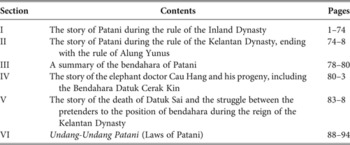
Teeuw and Wyatt argued that the text of the Malay versions of the Hikayat Patani could be separated into six sections, each one potentially having its own author.Footnote 133 Teeuw and Wyatt argued that Section I of the Hikayat Patani was then written down around 1690 according to their chronology. As argued above, the Inland Dynasty lost power around the mid-seventeenth century; thus Section I could have been committed to text earlier. As I shall argue in this section, however, evidence within the chronicle suggests that the authors of Section I did not commit the stories to text until at least the 1690s or the early decades of the eighteenth century.
A stark difference can be seen in the style of the text of Section I (stories about the Inland Dynasty) and Section II (stories of the Kelantan Dynasty), suggesting that the contexts that produced each of them were markedly different. The earlier tales possess a sense of distance from the events described. For example, with the succession of each queen to the throne of Patani, it is told in a manner that suggests the event occurred long ago, often using the clichéd phrase, ‘as told by the old people’.Footnote 134 The passage of time is also vague, such that each succession is explained, ‘After the Queen had reigned for some time she fell ill and died.’Footnote 135 Teeuw and Wyatt considered these passages to be insignificant to understanding how the authors composed the text. They further commented on the emotional detachedness of Section I when compared with Section II as evidence that they possessed separate authors. The difference in styles, however, seems likely due to the fact that the earlier stories had been passed down through an oral tradition unique to the Inland dynasty, while the later stories occurred contemporaneously to the authors’ writing.Footnote 136
Section I bears evidence of an oral tradition embedded within the text that had been maintained by the Inland dynasty. The story flows as if it were told to the writer rather than remembered personally by the writer or copied from an existing manuscript. The possibility that the text was transmitted orally before being written down is confirmed by Newbold in his account of a copy of the Hikayat Patani, now lost:
The preface declares it to be a story received orally by the writer (whose name as commonly the case in Malay MSS. is not mentioned) from aged men, regarding the origin of the Raja who first founded this fine state.Footnote 137
The date given by Teeuw and Wyatt seems reasonable, then, given that the 1690s were a period of particular political disorder caused both by the invasion from Ayudhya and the constant internal struggles for the position of bendahara.Footnote 138 During such a time of crisis and political disintegration, when one's current social position seemed threatened, protecting and preserving the past in writing may have seemed most prudent.
The theme of struggle against encroaching Siamese political and military pressure is evident throughout the stories of Section I. Patani's second sultan, Raja Mudhaffar Syah perished in a futile attack against Ayudhya in 1563.Footnote 139 In the 1630s, Raja Ungu and Raja Kuning refused to take the submissive title of peracau and faced a large-scale invasion from the north.Footnote 140 Throughout the text, the rulers of Patani are forced to send tribute to Ayudhya, showing their position of vassalage to Siam. While all of these events are important to the history of Patani, the most pressing problem in the minds of court intellectuals in the 1690s was Siamese political encroachment as the sultanate struggled to recover from the devastating attacks of 1689–94. Japanese merchants wrote of the constant turmoil in those years that prevented them from engaging in the profitable trade as they had in times past.Footnote 141 By the end of the decade, they ceased their visits to Patani, stating that the market was no longer satisfactory, nor was the coastline safe from pirates and other bandits.Footnote 142
The disorder of the period after 1690 provided the context in which Patani intellectuals wrote the Hikayat Patani. Within this context, then, it may be argued that one or more court officials collaborated to compose the stories of the Inland dynasty as early as the 1690s based upon a dying oral tradition. Evidently, such courts often had professional lore-keepers whose duty it was to remember the important stories from olden days. In the 1690s, as the world of the court intellectuals collapsed, ambitious intellectuals committed the stories of the Inland dynasty to written form both as a way of preserving the traditions of the past as well as a blueprint for restoring the polity to its former glory.
In the decades following the Ayudhyan invasion, political realities continued to erode in Patani. Because of the weakened position of Patani's ruler after Siamese withdrawal, struggle for control of the position of bendahara intensified. Raja Emas Kelantan was not a particularly capable ruler and served as a marginal referee in a court fraught with internal strife.Footnote 143 According to the Hikayat Patani, ‘During the reign of Marhum Kelantan many noblemen of Patani fought over the function of prime minister, and there were many prime ministers.’Footnote 144 As many as nine bendahara held power during her reign and players in Patani politics also included ‘a number of competing local factions, regional interests, neighbouring states, and foreign powers’.Footnote 145 Furthermore, Ayudhya became embroiled in Patani affairs at the same time as war erupted between Songhkla and Phattalung in the 1670s.Footnote 146
The theme of internal political disintegration continues through Section II, culminating with the death of Raja Alung Yunus in 1729. In the course of Section II, events are described in ever-increasing detail, suggesting the authors composed that section shortly after the last ruler's death. The authors afforded the first two rulers of the Kelantan dynasty, Raja Bakal and Raja Emas Kelantan, few scant lines that tell only of their political problems without any personal details because several decades separated the authors from the two raja.Footnote 147 From 1720 onwards, the sultanate was again plagued by struggles to control the position of bendahara, and in several cases, bendahara actually promoted themselves or their own candidate as raja. The final paragraph of Section II translates as follows:
Now since the King was buried in Purut, Patani has no longer had a king, up to the present time. The country of Patani has been in great confusion and its people suffer from many ills, while rules and customs are no longer observed; but it is not for any creature to know the command of God – praise be to Him and may He be exalted – with regard to what lies ahead.Footnote 148
The impending doom of the present situation is evident in the writer's account. The raja preserved the strength and cohesion of the sultanate, but here Patani approached a time of decline in which the old ways – exemplified by the memory of the old rules and customs – were no longer followed. One may assume, if the passage may be taken literally, that the story could not have been written more than a month or two after the death of Alung Yunus, for the throne would not have remained vacant for longer than that.
According to the Thai version of the Hikayat Patani, a man by the name of ‘Dato Charakan’ came to power immediately after the death of Alung Yunus in 1729, but does not appear in the Malay versions of the text.Footnote 149 Teeuw and Wyatt believed that Datuk Cerak Kin lived in the seventeenth century, based upon the detailed genealogy that claimed he was the grandson of an elephant doctor who lived during the reign of Sultan Mudhaffar Syah (d. 1564). Such claims may have been more figurative, however, with ‘grandfather’ meaning ancestor, or invented entirely to strengthen his claims to the throne. If ‘Charakan’ and ‘Cerak Kin’ are the same person, then Section IV could easily be seen as an attempt to legitimise his imminent candidacy by giving him long-standing connections to previous Patani noblemen. Almost certainly, the author of Section IV, therefore, was different from that of Section II, and had designs to promote Datuk Cerak Kin as the next raja of Patani. The fact that this bendahara is given so much attention sets him apart from all of the previous ministers who rarely appear more than once or twice in the stories.
Section V again returns to the political factionalism that existed throughout the rule of the Kelantan dynasty. Section VI follows bearing details of the laws of Patani. In this final section, the remarks of the writer at the end of Section II become all the more appropriate. As mentioned, one of the sources of political decline was failure to follow the laws as people had in the past, defined to include well-established customs, etiquette and signs of social respect. It seems likely that the writer of Section VI may have been the same as that of Section II, or that separate authors worked closely together because of a mutual concern about the problems Patani faced and the importance of returning to old rules and customs.
Here it is important to note that in the Abdullah bin Abdulkadir manuscript used by Teeuw and Wyatt in their translation, there appeared a colophon at the end in which the text is referred to as Kitab Undang-Undang Patani (The book of the laws of Patani).Footnote 150 This description hardly holds true for a majority of the text. Sections I and II tell of the deeds of the kings and the struggles for control of royal power. Section III briefly describes the bendahara of Patani. Section IV discusses the genealogy of Datuk Cerak Kin, a nobleman alive at the time of the last sultan mentioned in the text of Section II. The colophon, then, refers strictly to Section VI, which Teeuw and Wyatt believed constituted one of the oldest portions of the text. In this light, Sections I–V might all be seen as additions to an original book containing a description of sacred laws, rituals and court etiquette.
The authors of the Hikayat Patani wrote the text with an intention on effecting change in the present. Section VI of the text thus represents the core of their vision. As A.C. Milner has argued, a raja's central role was a ceremonial one.Footnote 151 Much of Section VI of the text contains instructions on how to perform music intended for all sorts of court rituals, various rites of passage, the call to war, the marking of seasons, the passing of time and for many other situations. Music was the crux between court function, ceremony and symbol. Thus Section VI preserved ancient court rituals for future raja to perform and perpetuate.
By preserving Patani's court music, which is featured so prominently throughout all sections of the text, the authors kept alive the possibilities of the raja restoring order and maintaining the beauty and sacredness of the ancient court traditions. Decay occurred very early, however, for after the assault on Ayudhya in 1564, the most extensive of Malay court orchestras already lacked enough talented musicians to perform properly.Footnote 152 Whether future generations ever replenished the depleted ranks of the orchestra is unclear, but the court intellectuals who composed the final section of the Hikayat Patani managed to preserve the tradition before the final destruction of the court itself.
The musical instruments, known collectively as nobat, possessed sacred power and were used to induct a new raja of the court, among other things.Footnote 153 The instruments represented symbolic authority passed down through the generations from the sultanate's primordial beginning and bore legitimacy for the current ruler. As recorded in the Malay text, Sejarah Melayu, Patani received its nobat from the sultan of Melaka, like other peninsular polities of its time.Footnote 154 While the presentation of nobat insinuated Melaka's ritual superiority over other polities, it also invested Patani with sacred sovereignty that came to form the most important part of its courtly tradition. Given the sacred power inscribed into Section VI of the text, then, it is not surprising that Abdullah bin Abdulkadir's manuscript bore the colophon referring to the laws of Patani represented by nobat. Just as the raja was the locus of all courtly activity, so too was nobat used to perform all sacred customs of the court. The destruction or disappearance of Patani's nobat during the Siamese invasion of 1785–86 definitively ended an era of symbolic power in Patani, but the memory of this court etiquette survives in the final section of the Hikayat Patani.Footnote 155
It is probable that the different sections of the Hikayat Patani each had their own author, but that the authors were in close collaboration. The disintegration of the world of the court intellectuals, who were as affected as any by the court factionalism, political decline and external threat, can be seen clearly in their perception of past events. As their position eroded, they reconstructed their hope for a better future by detailing the failures of present political players. The futility of their rallying behind Datuk Cerak Kin is clear; the story was not continued after his short and disappointing reign. Had he offered Patani a respite from its troubles, perhaps, the authors would have composed additional chapters, telling of the return to the proper order of things.
Conclusion
One of the authors of the Hikayat Patani believed Patani had entered a time of damnation exhibited by the disintegration of long-established rules and customs.Footnote 156 In what seemed to be an apocalyptic time, the authors laid out their vision for a just society based upon the moral principles of the past. During the preceding years of general prosperity, oral tradition served the Patani court by preserving and proclaiming the moral authority of the sultanate in the form of an officially sanctioned history. In the years that followed, however, the system of oral recitation broke down and ambitious intellectuals wrote down stories of the past to preserve them for future generations. They sought to rejuvenate society through writing and by clearly delineating how Patani's glory might be restored. In doing so, the writers themselves played a role in the transformation of the way in which court elites preserved and projected historical knowledge.
Moral authority, as expressed through the Hikayat Patani, centred upon a number of key elements in Patani society. Foremost among themes in the chronicle is the position of the raja as the defenders of the moral order who resided at the sacred centre of the society. The rulers performed not only their functional roles as raja, but also had an important ceremonial position in the court tied intimately to sacred music, the detail and expression of which was of paramount importance to the authors of the chronicle. In their capacity as producers of an officially sanctioned history, the authors constructed the legitimacy of the raja by placing them at the crux of the foundation of the polity, the conversion to Islam and the maintenance of a justified social order.
Between 1729, when the authors wrote the last of the stories, and the 1830s when the chronicle ‘resurfaced’ in its present compilation, Patani endured great changes. If the period 1690–1730 was a time of writing and scholarship, the remainder of the eighteenth century followed with no writings, or at least none that have survived.Footnote 157 The time of intellectual output, when court scribes felt compelled to write about the past had definitively ended. In the interim years, between the end of the Hikayat Patani and the disastrous invasion by Siam in 1785, little is known of the sultanate, though Patani's court continued to linger on in a weakened form. The sultanate, which had effectively been united with Kelantan under one raja at various periods since 1715 split apart in 1749 under two rulers.Footnote 158 After 1769, a new family may have come to occupy the Patani throne under Sultan Mahmud who was subsequently slain in battle against the Siamese army in August 1786.Footnote 159 Furthermore, the soldiers burned the ancient palace of Patani to the ground and confiscated the three famous cannons, thus undermining the most potent symbols of power possessed by the political elite of Patani.Footnote 160 After the invasion, no local ruler managed to regain the power of the old raja, though rebellions against Siamese control occurred in 1791, 1802, 1808, 1832 and 1838 which resulted in further slave-raiding by the Siamese and other depopulation as well as increased political dismemberment.Footnote 161
The invasion by Siam destroyed the old political order leaving a void at the top of the social hierarchy in the years that followed that Islamic leaders eventually came to fill. During the initial invasion, the Siamese army slew countless number of local inhabitants, captured many slaves who were taken to Bangkok and drove the remainder of the population southward into the neighbouring states of Kedah, Kelantan and Perak.Footnote 162 As late as 1789, the British officer at Penang, Francis Light, believed Patani to have been permanently destroyed and depopulated, when he included it in an economic survey of the peninsula.Footnote 163 Eventually refugees returned in the final decade of the eighteenth century and rebuilt the city of Patani at its present site a few kilometres from the old site where the old Gresik mosque still stands today.
Having gone through a period of utter devastation after 1785, during which time the Siamese army killed, enslaved or displaced a large portion of the sultanate's population, Patani people turned away from the raja as the centre of social life and toward a new moral authority — Mecca. Indeed, Patani experienced a social revolution in the early nineteenth century that elevated Islam from one of a number of social forces to the primary dynamic for cohesion in the community, thus completely reshaping Patani's social fabric.Footnote 164 The greatest of Patani Islamic scholars, Sheikh Daud bin Abdullah al-Fatani and others travelled to Mecca to study core doctrines, to reflect upon Patani's political problems and to advocate for educational reforms back on the peninsula.Footnote 165
This new generation of Islamic leaders began to reconstruct their conceptions of Patani as a society through religious writing as a way of rationalising their position atop the social hierarchy. The raja-centred historical narrative of the Hikayat Patani had been decisively altered by the 1785–86 invasion forcing intellectuals to incorporate the wider community in their view of Patani as a distinct and cohesive society. This ‘new’ Patani also found expression through the compilation of the Hikayat Patani, which for the first time, drew together the six loosely affiliated tales as one story of Patani. To the compiler and others in the 1830s, however, the pre-1785 history of Patani continued to have meaning in defining Patani as a conquered people possessing a distinct historical unity within an expanding state.
The anonymous compiler of the Hikayat Patani expressed a vision of Patani as a place with its own past, similar in that regard to chronicles of other places in the emerging Thai nation state, such as Chiang Mai and Nakhon Si Thammarat. With this in mind, studies of the Hikayat Patani must afford Patani an autonomous history when placing the chronicle within the social and historical context in which it was written. In doing so, we may gain a deeper understanding of the motivations, aspirations, and accomplishments of the writers and the condition of the world in which they lived. Future scholarship on the early history of the Malay–Thai borderland should continue to forge along the same path to move beyond nation-state-dominated historical paradigms that impress contemporary strictures back upon earlier times.
Appendix
Teeuw and Wyatt's division of the Abdullah Abdulkadir manuscript