Bovine milk proteins contain about 20% of whey proteins, primarily β-lactoglobulin (β-Lg) and α-lactalbumin (α-La), considered as major whey proteins, and BSA, immunoglobulins (Ig) and LF in minor quantities. These globular proteins have important physiological effects but are heat-labile. They can undergo conformational changes leading to denaturation along with physicochemical and biological changes during heating (≥70°C) of raw milk. However, raw milk is usually subjected to thermal processing, mostly high-temperature short-time (HTST, 72°C/15 s) or ultra-high temperature (UHT, 140°C/5 s) treatments, to assure food safety and extended shelf life (Bogahawaththa et al., Reference Bogahawaththa, Chandrapala and Vasiljevic2017a; Patel et al., Reference Patel, Singh, Anema and Creamer2006; Wijayanti et al., Reference Wijayanti, Bansal and Deeth2014). The HTST can result in considerable denaturation of IgG and LF, while they can be totally denatured by UHT (Bogahawaththa et al., Reference Bogahawaththa, Chandrapala and Vasiljevic2017a; Abbring et al., Reference Abbring, Hols, Garssen and Van Esch2019).
Bovine or cow's milk is considered one of the most common food allergens that causes well-known cow's milk protein allergy (Bogahawaththa et al., Reference Bogahawaththa, Chandrapala and Vasiljevic2017a). However, about 15 epidemiological studies suggested that consumption of raw or unprocessed milk can contribute to development of a protective effect against allergies and asthma that has become an emerging research interest presently (Sozańska, Reference Sozańska2019; van Neerven and Savelkoul, Reference van Neerven and Savelkoul2019). Bioactivity of native whey proteins, primarily minor whey proteins, appears to be associated with this effect, which can, however, be suppressed upon heating of milk at ≥72°C (Bogahawaththa et al., Reference Bogahawaththa, Chandrapala and Vasiljevic2017a; Abbring et al., Reference Abbring, Hols, Garssen and Van Esch2019; van Neerven et al., Reference van Neerven, Knol, Heck and Savelkoul2012). Although the underlying mechanism of this protective effect is still not known, mainly due to ethical concerns in conducting controlled human trials, several studies have shown some related evidence (van Neerven et al., Reference van Neerven, Knol, Heck and Savelkoul2012; Abbring et al., Reference Abbring, Hols, Garssen and Van Esch2019). For instance, exposure to raw milk in childhood appeared to increase number of regulatory T cells (Treg), which can assist in development of a protection against childhood allergies (Lluis et al., Reference Lluis, Depner, Gaugler, Saas, Casaca, Raedler, Michel, Tost, Liu and Genuneit2014). Bovine milk can contain some allergen-specific IgG that may bind to the relevant allergens in human consumers and develop immune complexes creating a regulatory environment to control allergic reactions (van Neerven et al., Reference van Neerven, Knol, Heck and Savelkoul2012). Furthermore, we reported that purified bovine IgG stimulated human PBMCs to secrete a significantly higher level of Th1-type cytokines over Th2 that is usually secreted during an allergic reaction. The purified BSA suppressed expression of all Th-types cytokines and weakened immunogenicity (the ability to elicit an immune response) of other milk proteins (Bogahawaththa et al., Reference Bogahawaththa, Ashraf, Chandrapala, Donkor and Vasiljevic2018a). Hence, in the present work our objective was to further investigate the hypothesis that the consumption of raw or unprocessed cow's milk contributes to lowered prevalence of allergies. To this end, we studied thermal denaturation of BSA, IgG and LF in milk under selected temperature and time combinations around HTST conditions and assessed the ability of IgG and BSA to modulate milk immunogenicity at different concentrations using human PBMCs.
Materials and methods
Materials
Murray Goulburn Co-Operatives (Laverton North, VIC, Australia) supplied raw bovine milk. Purified (≥95%) BSA and IgG were purchased from Sigma Aldrich Pty Ltd. (Castle Hill, NSW, Australia).
Sample preparation and treatment
To determine thermal denaturation of BSA, IgG and LF, the raw milk was defatted (Bogahawaththa et al., Reference Bogahawaththa, Chandrapala and Vasiljevic2017b) and resultant skim milk was heated at 72, 75 or 78°C for 0, 15, 30, 60, 120, 180, 240 or 300 s using a water bath as explained previously (Anema, Reference Anema2017). Then, the pH of the resultant milk samples was adjusted to 4.6 by adding sodium acetate buffer and they were centrifuged to separate caseins and denatured whey proteins (pellet) from native whey proteins (supernatant) (Anema, Reference Anema2017). Residual native BSA, IgG and LF in the supernatants were assessed by sodium dodecyl sulphate polyacrylamide gel electrophoresis (SDS-PAGE) under reducing conditions using β-mercaptoethanol as reported by Anema (Reference Anema2017). Level of the residual native proteins in the heated samples was expressed as a percentage (%) of those in the unheated milk sample.
To assess immunogenicity of BSA and IgG, another portion of skim milk was spiked with either BSA or IgG to prepare 7 samples; 4 samples with inclusion of 0.4, 0.6, 0.8 or 1.0 mg/ml of BSA (coded 0.4, 0.6, 0.8 and 1.0 BSA, respectively) and 3 samples with inclusion of 0.8, 1.2 or 1.6 mg/ml of IgG (coded 0.8, 1.2 and 1.6 IgG, respectively). The skim milk without addition of either BSA or IgG was considered the control. The concentration of BSA and IgG in bovine milk is approximately 0.1–0.4 and 0.6–1.0 mg/ml, respectively (Bogahawaththa et al., Reference Bogahawaththa, Chandrapala and Vasiljevic2017a).
Assessment of immunogenicity
The Victoria University Human Research Ethics Committee approved the use of PBMCs in this study. PBMCs were separated from buffy coats obtained from Australian Red Cross Blood Services (Melbourne, Australia). Challenge of PBMCs with the milk stimulants was carried out as described in detail previously (Bogahawaththa et al., Reference Bogahawaththa, Ashraf, Chandrapala, Donkor and Vasiljevic2018a, Reference Bogahawaththa, Buckow, Chandrapala and Vasiljevic2018b). In brief, PBMCs (1 × 10⁶ cells/ml) were incubated with each milk stimulant (100 μl/ml) at 37°C for 96 h in 5% CO2. PBMCs were also challenged with lipopolysaccharide (LPS) at 1 μg/ml (Escherichia coli O111:B4, Sigma Aldrich Pty Ltd.) as the positive control and PBMCs only in the complete culture medium (RPMI-1640), without the milk stimulants, were tested as the negative control. Supernatants of all the wells were collected and concentration of the selected cytokines; IL-4 (interleukin), IL-12, IL-10 and IFN-γ (interferon), in the supernatants was quantified by enzyme-linked immunosorbent assay (ELISA) (Thermo Fisher Scientific, Scoresby, VIC, Australia) as per the manufacturer's instructions. Data were analysed by Origin Pro 2018 (v. 95E) using ANOVA with Tukey test (P < 0.05).
Results and discussion
Thermal denaturation behaviour of BSA, IgG and LF
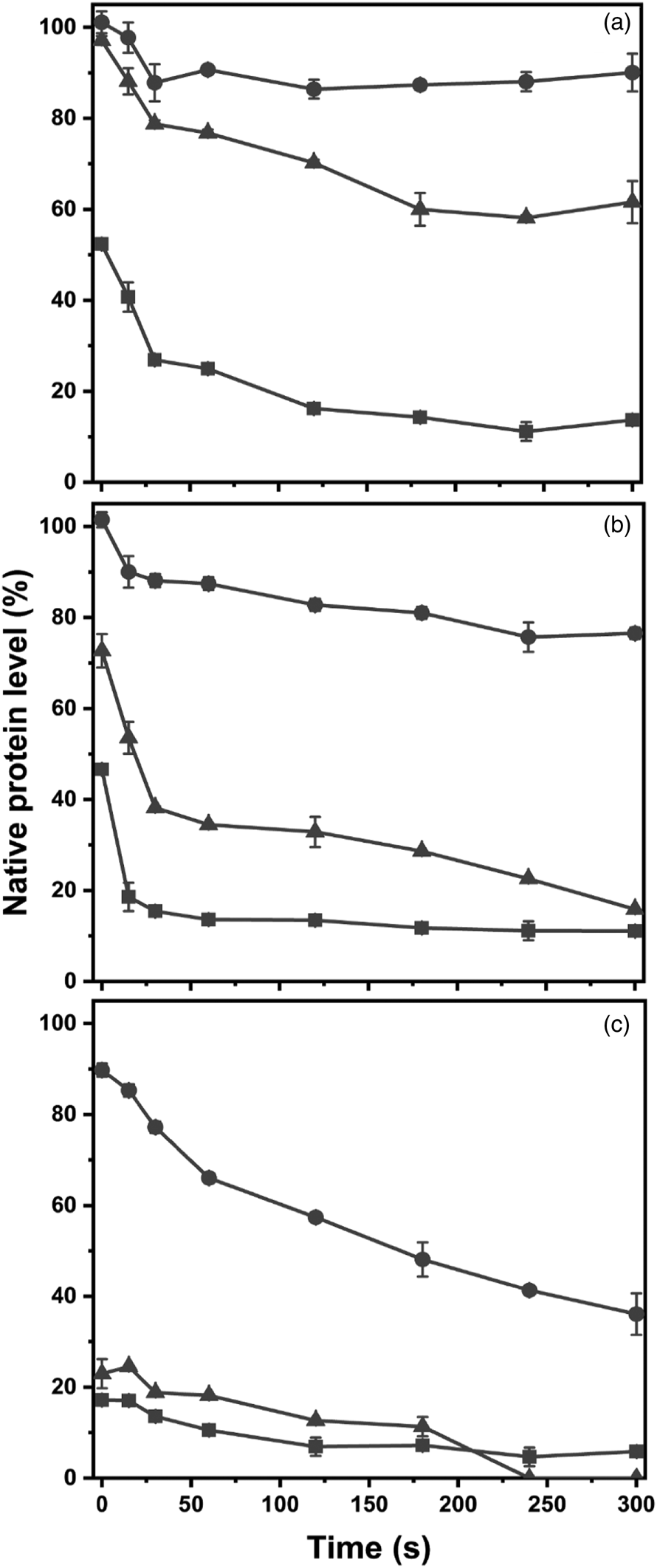
Generally, denaturation of BSA, IgG and LF increased with increase in temperature (72–78°C) and holding time (0–300 s) as shown in Fig. 1 and online Supplementary Fig. S1. Simultaneously, BSA, IgG and LF, in the same order, showed an increasing trend of protein denaturation under equivalent treatment conditions. Level of native BSA was mostly above 80% at 72 and 75°C even after 300 s, while BSA was denatured rapidly at 78°C after 30 s. A similar rapid aggregation of BSA was observed previously at 80°C (Wijayanti et al., Reference Wijayanti, Bansal and Deeth2014). It appeared that IgG initiated its denaturation at 72°C and level of native IgG decreased <80% when the holding time was ≥30 s. IgG denatured quickly at 75°C resulting in <40% native form after 30 s, while holding at 78°C caused >70% denaturation for 0–300 s, which mostly agreed with the denaturation kinetics of bovine IgG (Anema, Reference Anema2017). LF appeared to be the most denatured protein with >50% denaturation in the samples subjected to the all temperature and time combinations tested and >80% denaturation at 75 or 78°C for ≥15 s. A significant reduction of native LF has been reported, in comparison to other whey proteins, when milk was heated at 72°C for 20 s (Brick et al., Reference Brick, Ege, Boeren, Böck, Von Mutius, Vervoort and Hettinga2017). The standard HTST condition (72°C/15 s) resulted in substantial denaturation of IgG (~12%) and LF (~59%) indicating its severity in regard to denaturation of minor whey proteins (Patel et al., Reference Patel, Singh, Anema and Creamer2006; Bogahawaththa et al., Reference Bogahawaththa, Buckow, Chandrapala and Vasiljevic2018b). It is important to note that milk can be subjected to slightly severe heating conditions than the minimum 72°C/15 s treatment in the industry. As well, IgG and LF can lose their bioactivity earlier than the complete denaturation after some initial heat-sensitive conformational changes (Bogahawaththa et al., Reference Bogahawaththa, Chandrapala and Vasiljevic2017b; Abbring et al., Reference Abbring, Hols, Garssen and Van Esch2019).
Level (%) of native bovine serum albumin ( ), immunoglobulin G (
 ) and lactoferrin (
 ) remaining in the milk samples heated at 72°C (a), 75°C (b) or 78°C (c) for 0–300 s. The level of these proteins present in the unheated sample was considered as 100%.

Modulation of milk immunogenicity
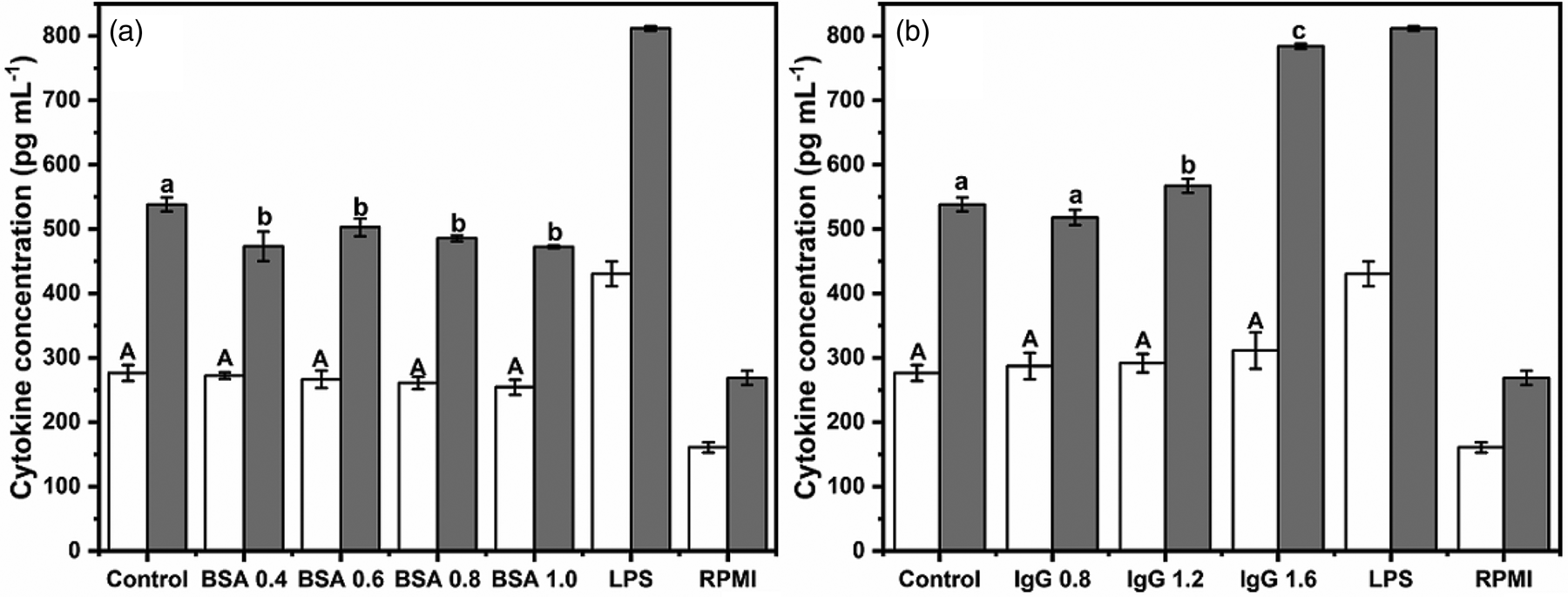
Appropriateness and limitations of the use of human PBMCs for the assessment of T cell-mediated immune reactions in vitro, in response to dietary proteins, have been discussed previously (Bogahawaththa et al., Reference Bogahawaththa, Ashraf, Chandrapala, Donkor and Vasiljevic2018a). As well, impact of the common heat treatments (e.g., HTST and UHT) on modulation of the immunogenicity of purified milk proteins, protein mixtures, and skim milk has already been studied in vitro in comparison to their unheated counterparts (Bogahawaththa et al., Reference Bogahawaththa, Ashraf, Chandrapala, Donkor and Vasiljevic2018a, Reference Bogahawaththa, Buckow, Chandrapala and Vasiljevic2018b). The four different cytokines tested for this study are mainly produced by Th1 and Th2 cells. IFN-γ and IL-4 are the signature-cytokines of Th1 and Th2 cells, respectively. IL-12 and IL-10 belong to Th1 and Th2-type cytokines, respectively (Bogahawaththa et al., Reference Bogahawaththa, Ashraf, Chandrapala, Donkor and Vasiljevic2018a). As production of IL-4 and IL-12 could not be detected in response to all the milk stimulants, the immune response of Th2 was assessed according to the concentration of IL-10 (Vocca et al., Reference Vocca, Canani, Camarca, Ruotolo, Nocerino, Radano, Del Mastro, Troncone and Gianfrani2011; Bogahawaththa et al., Reference Bogahawaththa, Ashraf, Chandrapala, Donkor and Vasiljevic2018a, Reference Bogahawaththa, Buckow, Chandrapala and Vasiljevic2018b). In response to all milk stimulants, PBMCs secreted substantially higher concentration of IL-10 and IFN-γ in comparison to the negative control (Fig. 2).
Secretion of IL-10 ( ) and IFN-γ (
 ) by PBMCs in response to different milk stimulants. Panel A; the milk samples with added 0, 0.4, 0.6, 0.8 or 1.0 mg/ml of BSA (Control, 0.4 BSA, 0.6 BSA, 0.8 BSA and 1.0 BSA, respectively). Panel B; the milk samples with added 0, 0.8, 1.2 or 1.6 mg/ml of IgG (Control, 0.8 IgG, 1.2 IgG and 1.6 IgG, respectively). LPS; PBMCs simulated by LPS (positive control) and RPMI; non-stimulated PBMCs (negative control). Values are the mean cytokine secretion plus or minus standard deviation (sd). The bars representing the same cytokine with different letters on the top are significantly different (P < 0.05).
BSA was observed to suppress the secretion of cytokines by human PBMCs previously (Vocca et al., Reference Vocca, Canani, Camarca, Ruotolo, Nocerino, Radano, Del Mastro, Troncone and Gianfrani2011; Bogahawaththa et al., Reference Bogahawaththa, Ashraf, Chandrapala, Donkor and Vasiljevic2018a). Secretion of IFN-γ by PBMCs in the current study significantly decreased in response to all the milk samples spiked with BSA in comparison to that of the control, but IL-10 concentration did not change (P > 0.05). Generally, added BSA was not able to stimulate PBMCs differently to modulate their cytokine production greatly, although a considerable reduction of both cytokines was observed in response to 1.0 BSA. However, this suppressive effect was stronger when BSA was alone or in a binary mixture with IgG (Vocca et al., Reference Vocca, Canani, Camarca, Ruotolo, Nocerino, Radano, Del Mastro, Troncone and Gianfrani2011; Bogahawaththa et al., Reference Bogahawaththa, Ashraf, Chandrapala, Donkor and Vasiljevic2018a). Immunomodulatory effects of individual proteins appear to become more profound when they are progressively purified from the original source of milk (Bogahawaththa et al., Reference Bogahawaththa, Ashraf, Chandrapala, Donkor and Vasiljevic2018a).
PBMCs secreted a significantly higher level of IFN-γ in response to 1.2 and 1.6 IgG in comparison to the control, but the level of IL-10 did not change (P > 0.05) due to added IgG. A prominent gap was observed between levels of IFN-γ and IL-10 in response to 1.6 IgG, which indicated a tendency of moving Th1/ Th2 balance towards Th1 (IFN-γ > IL-10). The mutual-inhibitory effect between IFN-γ and IL-10 could also lead to this gap (Bogahawaththa et al., Reference Bogahawaththa, Chandrapala and Vasiljevic2017a). We previously observed a similar Th1-skewed cytokine profile (IFN-γ > IL-10) when PBMCs were challenged with purified IgG at 0.8 mg/ml (Bogahawaththa et al., Reference Bogahawaththa, Ashraf, Chandrapala, Donkor and Vasiljevic2018a). This type of Th1-skewed cytokine profile may not create an environment to trigger a Th2-skewed allergic reaction.
In conclusion, according to the thermal denaturation behaviour of BSA and IgG, and their ability to modulate milk immunogenicity, native BSA may not contribute to development of an allergy-protective effect, but IgG could be part of that mechanism. The prominent Th1-skewed cytokine profile was stimulated by IgG, especially at higher concentrations, indicating its potential for mediating the allergy related immune responses (Th2-skewed). Native LF can be suggested to be involved in development of this protective effect due to its rapid denaturation under typical pasteurization conditions. The results need to be established using comprehensive in vivo studies considering digestion process of milk proteins in human digestive system, their bioavailability and related immune responses.
Supplementary material
The supplementary material for this article can be found at https://doi.org/10.1017/S0022029920000989