

Introduction
Britain's ‘East of Suez’Footnote 1 role had become an ‘embarrassment’. That was the view of military historian Michael Howard in 1966. In an article titled, ‘Britain's Strategic Problem East of Suez’, he wrote that the United Kingdom's major military bases in the Arabian Peninsula and Southeast Asia, namely Aden and Singapore, had become ‘liabilities’.Footnote 2 Many in government shared his thinking. Harold Wilson's Labour administration was quietly preparing to withdraw from these last bastions of empire, having accepted the need for retrenchment the year before. The drawdown, which was announced in phases from February 1966 to January 1968, was largely complete by the close of 1971.Footnote 3
Almost fifty years on, the British government is re-establishing fixed positions East of Suez under the banner of ‘Global Britain’. Two new bases have been opened in the Middle East in recent years with a further installation mooted for the Asia-Pacific. On a visit to Bahrain in 2016, Boris Johnson, then UK Foreign Secretary, declared that ‘Britain is back East of Suez’. In his speech, Johnson criticised the original withdrawal, which he claimed was taken out of shortsightedness in January 1968 in the wake of a currency crisis. Wilson, he believes, gave in to financial pressures, as well as Cabinet members, such as Roy Jenkins, who wanted Britain to retreat from East of Suez and join the European Economic Community (EEC). He explained:
Those were the two adversaries, [Chancellor] Roy Jenkins … who yearned to take Britain into what was then called the European Common Market … and [Foreign Secretary] George Brown, and the argument went on in the Cabinet for 7 consecutive meetings … And what was that argument about? It was about Britain's role in the Gulf, and everywhere East of Suez; and whether the country, my country, could any longer afford it … George Brown lost; the flag came down; the troops came home, from Borneo, from the Indian Ocean, from Singapore, and yes from the Gulf and we in the UK lost our focus on this part of the world … I want to acknowledge that this policy of disengagement East of Suez was a mistake and … we want to reverse that policy.Footnote 4
The current British prime minister therefore believes that the original drawdown was taken rashly and ill-advisedly. This amounts to an erroneous and potentially dangerous reading of events – on two counts. First, the UK never actually left ‘East of Suez’. It is necessary to distinguish between the basing strategy East of Suez, which largely ended with the retreat from Aden and Singapore during the Cold War, and the East of Suez presence, which never truly ceased.Footnote 5 The idea of a unique British role East of Suez practically disappeared from the lexicon once the major bases were closed and only resurfaced with the unveiling of the Bahrain naval site in 2014. Britain's oscillating involvement in the Middle East and the Asia-Pacific in the interim period was not wrapped up in the language of an East of Suez role. Thus, it is fair to say that ‘East of Suez’ is synonymous with the basing strategy. The role was largely rooted in substance; the role was Aden and Singapore and these bases were the role.Footnote 6 There was little point in proclaiming a special role for the little that remained afterwards.Footnote 7 In the wake of the drawdown from the key military installations, British policymakers placed greater emphasis on their role as a bridge between the United States and Europe, courtesy of their involvement in NATO and later the EEC.Footnote 8
Boris Johnson's analysis that East of Suez ended with Harold Wilson's government is therefore correct if he is referring to the basing strategy (although a less charitable interpretation would be that he conflates the basing strategy with presence). More importantly, however, he is mistaken on the rationale for retrenchment from Aden and Singapore. This article reviews the historical record and finds that the decision to retreat from East of Suez was not a knee-jerk reaction to some domestic political crisis or because Britain's relative economic decline compelled retrenchment. This was a process that took place over several years.
What led policymakers to embrace retrenchment? Britain's fiscal position certainly forms part of the explanation, but it was not deterministic. Despite successive financial storms, the UK could still have maintained bases in the Arabian Peninsula and Southeast Asia within a reduced defence budget. The focus on Britain's economic frailties has led to an omission: the shifting strategic calculus for retaining East of Suez. Britain's poor fiscal health prompted a series of defence reviews. It was through this process that policymakers in Whitehall realised that the East of Suez garrisons were doing more harm than good.
Large military bases in the Arabian Peninsula and Southeast Asia had become strategically vulnerable. They were designed to serve as hubs from which to operate but had instead become targets for local nationalist and communist movements. Far from enhancing agility, the bases became a drag on British resources. Thus, the rationale for preserving East of Suez shifted over the course of the 1960s; the increasing strain placed on British forces outweighed the diminishing benefits that could be accrued from retaining permanent military installations. The choice was made to abandon East of Suez and concentrate on NATO commitments in Europe.
If there were indeed sound, strategic reasons for withdrawing in the first place, is it wise to reverse those decisions? This article will first delve into the archival record and chronologically trace how the thinking on East of Suez evolved during the 1960s. The analysis incorporates defence reviews, diplomacy with key allies, as well as wider political and economic developments that shaped grand strategic thinking. The second section will summarise the argument, before testing it against alternative explanations. The third section contains the most significant contribution: the policy recommendations for British officials who are charting a return East of Suez today.
Revisiting retrenchment: Tracing the decision to withdraw from East of Suez
Harold Wilson entered office in October 1964 to find British forces perilously overstretched. In Europe, the UK was bound by the 1954 Brussels Treaty to maintain four divisions (fifty-five thousand troops) – the British Army on the Rhine (BAOR) – in West Germany. While ministers felt that this figure could be reduced, given that the risk of war with the Soviet Union was low, they assessed that ‘our first concern should be Europe’.Footnote 9
In the Persian Gulf, Britain was responsible for the defence of Qatar, Bahrain, Kuwait, and the Trucial States (which later became the United Arab Emirates). All were regarded as vulnerable to Soviet influence, as well as predation from aspiring regional hegemons (Egypt, Iraq, Saudi Arabia, and Iran) because they were resource rich. Kuwait not only provided 40 per cent of Britain's total oil requirements, but the Emir also held £300 million of British pound sterling reserves.Footnote 10 These interests were safeguarded by a large military base in the port of Aden (located in modern day Yemen). Not only did it serve as a deterrent against local expansionism, but it was also a stepping-stone to Singapore.
In Southeast Asia (or ‘the Far East’ as British officials termed it), the UK had a major base in Singapore, as well as smaller installations dotted across Malaysia and Brunei. British forces were engaged in a ‘low-intensity guerrilla war’, known as the ‘Confrontation’, with Indonesia on behalf of Malaysia in the jungles of Borneo.Footnote 11 The unification of the British territories of Singapore, Sabah, and Sarawak with Malaya in 1963 had prompted Indonesian President Sukarno to undermine the new grouping. The British were obliged to defend the nascent federation under the Anglo-Malaysian Defence Agreement. The ‘Confrontation’ drew in over fifty thousand British and Commonwealth soldiers, as well as one-third of the Royal Navy's surface fleet.Footnote 12
Even before Wilson entered office, civil servants had started to question the efficacy of Britain's East of Suez role. Foreign Office mandarins, who could normally be relied upon to resist any proposed cut in commitments, believed that the Singapore base had become a political ‘liability’. They predicted that ‘future Malaysian governments are likely to be more radical than at present and less tolerant of foreign military establishments’. Officials also highlighted the base's declining utility as a staging point for other military operations in the area (relating to the Southeast Asia Treaty Organization or SEATO), now that ‘the bulk of our land forces in the area have their hands too full with the Borneo fighting (or with internal security duties in Singapore itself)’. Finally, they noted that the cost of the Singapore base – £300 million a year (£6.1 billion in today's money), or 15 per cent of the total defence budget – was wholly disproportionate to the UK's marginal economic interests (only 3 per cent of Britain's world trade was done in the region). They noted that ‘other Western nations trade just as successfully with South-East Asia without deploying military strength there’. All of that said, the Foreign Office was against any drawdown while the ‘Confrontation’ was ongoing. Nothing should be done which might jeopardise ‘the global Anglo-American partnership … that is cardinal to the conduct of our whole foreign policy’.Footnote 13
To begin with, ministers followed their advice. The new team agreed to limit defence expenditure at £2 billion in 1964 prices (£41 billion in today's money) by 1969–70, instead of letting it rise to £2.4 billion, but they refused to axe any of the UK's commitments in Europe or East of Suez.Footnote 14 With regard to the latter, ministers felt that Britain had a responsibility in Southeast Asia to the United States, Australia, New Zealand and the Malaysian Federation so any grand strategic changes would have to wait until the ‘Confrontation’ had abated. In the interim, defence spending on new capabilities would be cut so that budget did not exceed the new ceiling.Footnote 15 Within six months, however, it was clear that such reductions would be insufficient. Only £200 million had been saved; defence spending was still on course to rise to £2.2 billion by 1970.Footnote 16
To rectify this, Defence Secretary Denis Healey distributed a paper to the principal forum for British grand strategy, the Defence and Oversea Policy Committee (or DOPC, which included Wilson, Healey, Chancellor James Callaghan, Wilson's deputy George Brown and Foreign Secretary Michael Stewart).Footnote 17 Healey explained how the changing character of war was making the bases East of Suez more vulnerable, as ‘relatively poor countries can get sophisticated equipment quickly and cheaply from the great powers’, namely the Soviet Union and China. He proposed a ‘major revision of our Middle East commitments’ and a ‘substantial change in our Far East posture’.Footnote 18 With regard to the latter, he believed that Britain should withdraw from Singapore after the ‘Confrontation’ had concluded and establish a smaller base in Australia (if Canberra was willing to foot the bill). In future, British power in Southeast Asia would be limited to air and naval assets. NATO obligations, meanwhile, were to be spared from any cuts.
The DOPC met at Chequers, where they agreed that the BAOR should be exempt from any reductions. The transatlantic alliance was going through one of its periodic bouts of instability, largely thanks to President Charles de Gaulle, who had withdrawn the French Navy from NATO's Mediterranean command and was threatening further acts of nonconformity. Civil servants assessed that, while the probability of a Soviet assault on Europe was low, a drawdown would ‘provoke a major crisis of confidence within the Western alliance’.Footnote 19 Ministers agreed that the core should be prioritised above the periphery.Footnote 20
The DOPC shifted its gaze towards the Arabian Peninsula. Instead of serving as a springboard for operations in the Persian Gulf and the Asia-Pacific, the Aden base had become the target of a nationalist insurgency. With Egyptian (and, by extension, Soviet) support, the National Liberation Front was conducting a campaign of targeted assassinations and bombings to undermine British rule in Aden.Footnote 21 By mid-1965, London had been forced to station five additional battalions in the port in a futile attempt to maintain order.Footnote 22 The ‘presence of British troops’, Denis Healey later noted, ‘was becoming an irritant rather than a stabilising factor’.Footnote 23
Ministers therefore agreed at Chequers to pull out of Aden. They also accepted that this would eventually lead to a broader retreat from the Persian Gulf. ‘The influence of Arab nationalism’, they noted, ‘was bound to extend in the area and pressures against our presence would increase’.Footnote 24 Wilson's deputy, George Brown, argued that ‘we should not seek to duplicate such military facilities in the Persian Gulf [after the withdrawal from Aden], where there was some reason to believe that our military presence was of doubtful advantage to our oil interests and might indeed on the contrary be a disruptive influence’.Footnote 25 Within nine months of taking office, the DOPC had approved the withdrawal from the biggest military base in the Middle East, as well as a further drawdown in the long run. Their reasoning was based on the declining utility of hard power to protect economic interests in the face of Arab nationalism.
What of Britain's commitments further east? Unilateral withdrawal from Southeast Asia was seen as unpalatable while the ‘Confrontation’ was still ongoing. That did not, however, stop ministers from planning for the aftermath. They agreed that, ‘once confrontation ended it was likely that we should have to withdraw from Singapore’. Even if Malaysia's Tunku Abdul Rahman or Singapore's Lee Kuan Yew ‘wished us to remain they would probably be unable to resist popular pressure for our withdrawal’. Looking to the 1970s, the DOPC foresaw a world in which ‘bases like Aden and Singapore with large static garrisons would have been eliminated’.Footnote 26 It is significant that, contrary to Boris Johnson's interpretation, Wilson's government embraced radical changes to Britain's East of Suez commitments as early as June 1965.
In August 1965, Singapore was ejected from the Malaysian Federation, a development that accelerated this thinking. Ministers judged that it would be ‘undesirable and dangerous not to accept that recent developments have significantly shortened the prospects of our being able to stay in Singapore’.Footnote 27 Officials also noted the growing strength of the Socialist Front (Barisan Sosialis), which might undermine the support of local civilian labour, without which the base could not function.Footnote 28 Ministers agreed to consult their allies over possible peace talks with Indonesia in order to bring the ‘Confrontation’ to an end as soon as possible. If this could be achieved, Britain could then withdraw from Singapore to northern Australia.
The following month, diplomats from Australia, New Zealand, and the United States made clear to their British counterparts that they were opposed to any drawdown from Southeast Asia in the foreseeable future.Footnote 29 For Australia and New Zealand, Britain's base in Singapore provided their forward defence. The US, meanwhile, was busy entangling itself in Vietnam; the Johnson administration wanted the British to remain East of Suez as they were reluctant for practical and domestic political reasons to become the world's sole police officer.Footnote 30 The Americans had some tangible leverage over the British, as the US Treasury was supporting the pound.Footnote 31
Despite these objections, policymakers in London continued to quietly plot a course of limited retrenchment. ‘Whatever our allies now say’, Foreign Office mandarins noted, ‘Singapore may have proved untenable by 1970’.Footnote 32 The month after allied talks, Defence Secretary Denis Healey told Wilson ‘that it would be right to give up the bases in the Middle East and to be ready to move from Singapore to Darwin’ when the ‘Confrontation’ concluded.Footnote 33 Healey's advice clearly shaped the prime minister's thinking. Wilson told the Americans later that year that the British ‘could not expect to hold Singapore indefinitely’, given that the island had fallen prey to ‘Chinese political penetration’.Footnote 34
The prime minister's message was not well received in Washington; Secretary of State Dean Rusk and Defense Secretary Robert McNamara warned Wilson that continued US involvement in NATO could not be assured if the American public came to suspect that allies such as Britain were retreating from their shared responsibilities elsewhere.Footnote 35 Disregarding these concerns, the Labour government pressed on with changes that would ultimately limit the UK's ability to operate East of Suez. The previous Conservative administration had shirked the decision over whether to order a new aircraft carrier, the CVA01, as a replacement for the Ark Royal. Healey, who was ‘inclined towards the RAF’, preferred the American F-111 bomber.Footnote 36 He believed that this long-range aircraft could provide a general capability for the British to intervene East of Suez at a lower premium than the aircraft carrier project.
In addition to the predicted cost of the CVA01, Healey reasoned that the only area where it could be used was East of Suez, but this was the government's first target for reductions once the ‘Confrontation’ was over.Footnote 37 The other DOPC ministers agreed that they ‘would not be justified in planning for a large independent capability in the Far East into the 1980s’.Footnote 38 Given that aircraft carriers were regarded as ‘the symbol of British power East of Suez’,Footnote 39 this episode therefore sheds light on the government's thinking with regard to East of Suez in the long term.Footnote 40
The aircraft carrier debate fed into the wider Defence Review of 1966, which prompted the Navy Minister, Christopher Mayhew, to resign on the grounds that: ‘you cannot have East of Suez without sea-borne airpower’.Footnote 41 Not being privy to the DOPC discussions, Mayhew was unaware that ministers had accepted a broader withdrawal from East of Suez once conditions were more favourable.
The government's thinking had evolved substantially since taking office. A close reading of the Defence Review suggests that significant changes were afoot. It stated that the Singapore base would only be retained ‘as long as the Governments of Malaysia and Singapore agree that we should do so on acceptable conditions’. It also mentioned that a smaller, replacement base in Australia was already under discussion.Footnote 42 The review therefore hinted at the DOPC's plan to move from Southeast Asia to northern Australia after the ‘Confrontation’. Healey went further in the House of Commons, warning that Britain would ‘go home’ if this new facility near Darwin was not available in the event of a UK withdrawal from Southeast Asia.Footnote 43
The government also used the Defence Review to announce the withdrawal from Aden.Footnote 44 The nationalist fires being stoked by Gamal Abdel Nasser were out of control. The rationale for military bases was evolving in Whitehall. Denis Healey told MPs that, ‘to seek to maintain military facilities in an independent country against its will can mean tying down so many troops in protecting one's base that one has none left to use from it. The base then becomes a heavy commitment in itself and loses all its military value.’Footnote 45 The Aden withdrawal, combined with the evolving language on Southeast Asia, as well as the CVA01 decision, signalled that Britain's days East of Suez were numbered.
In August 1966, the British government received some welcome news as the ‘Confrontation’ came to an abrupt end; President Sukarno was displaced in a military coup led by General Suharto. Despite this ‘good fortune’, the British government's balance sheet made for grim reading.Footnote 46 The previous month, Britain had endured a significant currency crisis. The government staved off devaluation, but the rescue package to stabilise the pound diverted money away from other departments. Thus, in October 1966, the Chancellor called for a tighter cap on defence spending: £1.85 billion by 1970/71.
Despite his resentment at having to take the knife to the defence budget once again, Healey proposed the idea of equal cuts in Europe, the Persian Gulf, and Southeast Asia.Footnote 47 This ‘strategy based on penny-packages’ (that is, a limited deployment such as a frigate or a battalion to honour an alliance commitment) would, he claimed, enable Britain to meet its alliance obligations but at a reduced cost.Footnote 48 For East of Suez sceptic and the newest member of the DOPC, Richard Crossman, the Defence Secretary's proposal meant leaving ‘token forces … quite unable to fulfil any of the precise obligations’ to allies in the Persian Gulf and Southeast Asia.Footnote 49
Sending a lone warship would be of little use to an imperilled ally. In such a scenario, British forces would likely find themselves dragged into a regional conflict in which they would be hopelessly outnumbered. Why did Healey propose such a plan, having previously accepted the need to retrench? At heart, he remained committed to the alliances with Australia, New Zealand and the US. He hoped to maintain a shell of the East of Suez presence (that is, without any significant military bases).
Healey's suggestion was given short shrift. The prime minister and the chancellor, James Callaghan, were opposed to a general reduction in capabilities while commitments were maintained. It made little sense, given that officials had already established: (a) the declining efficacy of hard power East of Suez; and (b) that any cuts in Europe would undermine NATO. More stringent measures East of Suez would be required. Accordingly, ministers commissioned a study on the likely impact of a total withdrawal from Southeast Asia.Footnote 50
Three months later, Healey submitted his revised plans to the DOPC. By 1970/71, the UK would have removed all British land forces from Southeast Asia; naval and air support would continue until 1975/76.Footnote 51 The decision to ultimately leave Singapore had been reached in 1965, but a date had now been agreed. In future, Britain would adopt a ‘peripheral strategy’, bolstered by ‘a minimum military presence’ (naval and air assets) in northern Australia.Footnote 52
The Australia base was more of an aspiration than a firm commitment. Wilson agreed with Healey that Britain had a duty to Canberra and Wellington, as they had previously ‘joined with us in resisting aggression’. Then again, he mused, ‘it was not essential that we should have forces stationed in Australia, any more than Australia and New Zealand had forces stationed in this country in 1914 or 1939’.Footnote 53 Even some of Healey's staff later confessed that the whole idea was ‘crazy’, given that Canberra had never shown much enthusiasm for it.Footnote 54
In July, the wider Cabinet officially signed off on Healey's drawdown plans and the peripheral strategy after he toned down the language of ‘minimum military presence’ to ‘capability for use’ (the F-111 aircraft), thereby implying that British forces would not be permanently stationed in the region. Finally, the withdrawal announcement was also blurred to the ‘middle 1970s’Footnote 55 to placate Britain's allies, who were chiefly troubled about the effect of a public announcement on regional stability.Footnote 56
It should be noted that the government did not include the Persian Gulf when the drawdown plans were unveiled in July 1967. It would, however, be wrong to read too much into this. By this stage, the DOPC was unconvinced that military bases helped to guarantee the safe passage of oil. The Six-Day War of June 1967 provided further proof of their declining utility. Supposed allies such as Kuwait placed an embargo on oil supplies to Western powers, including the UK, for their ties to Israel. Ministers noted that ‘the recent Middle East crisis had demonstrated the inability of our forces overseas to play any worthwhile role in a critical situation’.Footnote 57 The Six-Day War therefore indirectly confirmed the futility of a basing strategy in securing influence with local regimes.
Some ministers were intent on declaring ‘intentions in respect to our future position in the Middle East in terms comparable to those which were envisaged in respect of the Far East’. The majority, however, judged that ‘present circumstances in the Middle East’ meant ‘it would be imprudent and contrary to our interests to make any statement in this regard at the present time’.Footnote 58 Thus, despite the Persian Gulf not being included in the Southeast Asia withdrawal announcement, ‘both regions were set on the same trajectory by July 1967’.Footnote 59 The result was certainly enough to satisfy East of Suez sceptics in the wider Cabinet; Transport Secretary Barbara Castle triumphantly declared in her diary that ‘East of Suez is dead’.Footnote 60
Britain publicly embraced retrenchment from East of Suez on 18 July 1967 when Healey unveiled the government's drawdown plans to the House of Commons. The timetable was brought forward six months later. In November, the government devalued the pound from $2.80 to $2.40 after another financial crisis. Chancellor James Callaghan resigned (having staked his job on avoiding devaluation) and was replaced by the pro-European Roy Jenkins. The new chancellor insisted on further cuts in public spending to support the pound at its new level.
In January 1968, the Cabinet convened to decide on the requisite medicine. Jenkins identified large savings from the education and healthcare budgets. It would, however, be political suicide for a Labour chancellor to reduce social spending in isolation. To sweeten the pill, Jenkins targeted the defence budget; he proposed to shelve an order of fifty F-111 aircraft from the United States and to shift the East of Suez withdrawal date from the mid-1970s to March 1971.Footnote 61
It is important to appreciate that the heated Cabinet debates that followed (and which Boris Johnson focused on in his Bahrain speech) were over the timing of drawdown and not over whether to retrench. The latter had already been accepted. Foreign Secretary George Brown underscored that ‘it would be wrong to suppose that any new major change of policy was now in question … the issue was now whether our withdrawal should be accelerated’.Footnote 62 He was, however, concerned that a hastened retreat would jeopardise the UK's alliances in Southeast Asia. Similarly, Healey was irate about the cancellation of the F-111 contract, as it was regarded as a means of providing a ‘capability for use’ East of Suez (that is, in the event that Australia and New Zealand required assistance). Both men had carefully managed expectations with Britain's allies throughout 1967, but the UK was now clearly scuttling on its commitments. A reasonably methodical process of retrenchment was morphing into a disorderly rout.
What was particularly galling for Healey and Brown was that the savings that could be realised from defence were marginal; Jenkins was only insisting on them as political insurance for unpopular cuts to social spending. Indeed, the costs of maintaining Britain's military bases East of Suez for another few years were largely irrelevant. On hearing of Britain's intention to leave, the rulers of Qatar and Abu Dhabi offered to cover the £25 million cost of stationing British forces in the region.Footnote 63 London was uninterested in these proposals; the rationale for stationing troops in the Persian Gulf had diminished. Ministers noted that the garrisons were ineffective as they ‘could not defend our oil supplies’. Any blowback would be limited as ‘the oil producing states needed us as customers for their oil’.Footnote 64
Healey and Brown stubbornly resisted changes to the withdrawal timetable and the cancellation of the F-111 contract, but they were outvoted in Cabinet. Wilson, who had become ‘desperately worried about the survival of the government and of his premiership’ in the wake of devaluation, signed off on Jenkins's proposals.Footnote 65 On 16 January 1968, the prime minister told the House of Commons that ‘our commitments, and the capacities of our forces to undertake them, should match and balance each other’. Britain would therefore be withdrawing from East of Suez as its ‘security lies fundamentally in Europe and must be based on the North Atlantic Alliance’.Footnote 66
Reconsidering retrenchment: the causes of Britain's retreat from East of Suez
This article has shown that key members of the Labour government questioned the efficacy of Britain's two major installations East of Suez – Aden and Singapore – as early as 1965 (that is, over two years before the January 1968 deliberations). The DOPC were unable to publicise this shift in strategic thinking, as Britain was duty-bound to assist the fledging Malaysian Federation in its ‘Confrontation’ with Indonesia. Ministers deemed it necessary to honour the UK's alliances in the Asia-Pacific. The announcement was made in stages with Aden in February 1966 and Singapore in July 1967. The timetable for retrenchment was ultimately accelerated in January 1968 due to the political fallout from devaluation.
This chronological correction is important because it sheds light on the underlying motives for the withdrawal. Retrenchment was not a rash mistake as Boris Johnson claims. Officials had been evaluating global commitments for years as part of a deliberative effort to find savings in the defence budget. In the act of appraising Britain's global commitments, officials came to realise that permanent military installations in unstable regions were less a strategic asset and more a security vulnerability.
In the Middle East, the base at Aden was designed for power projection, but its efficacy declined after it was targeted by Arab nationalist movements. British officials feared that the Nasserist-sponsored violence would spread to Bahrain, Qatar, Kuwait and the Trucial States. When the treaties with the protectorates in the Gulf were first signed, the costs were minimal as Britain could impose its will through the gunboat. The situation was much less favourable by the 1960s, as local nationalist movements were empowered by the wave of decolonisation and able to access cheap technology from great power patrons. British policymakers assessed that the blood and treasure required to maintain order was disproportionate to the benefits accrued from the basing strategy.
The Six-Day War and the oil embargo demonstrated the limits of the UK's influence over Arab elites. George Brown was critical of ‘the Kuwaitis [who] feel free to discriminate against British interests while we remain committed to their defence’.Footnote 67 Moreover, while many local rulers wanted to retain UK forces (and some even offered to pay for their upkeep) as a security guarantee, the British doubted whether their views were shared by the wider population. The political agent in Bahrain later noted that, had it not been for Egypt's defeat in the Six-Day War, ‘we might well have had an Aden situation in the Gulf’.Footnote 68 The same assessment was made for Southeast Asia. While Lee Kuan Yew may have wanted the British to remain, London regarded that option as impractical, given the presence of Chinese-backed political movements in Singapore.
Having summarised the findings, it is now worth examining how this article's interpretation relates to existing explanations for retrenchment.
The East of Suez withdrawal was the inevitable result of Britain's economic decline
The argument that financial pressures compelled retrenchment merits consideration. After all, reminders of the country's poor economic health pervade memoirs and the archival record. The prime minister's private secretary later reflected that, ‘one cannot understand the Wilson government's conduct of its foreign policy without constantly remembering that it had to be done under a permanent economic thundercloud’.Footnote 69 Looking at Table 1, one might easily conclude that there is a clear correlation between Britain's economic decline and its ability to fund its armed forces.
British defence expenditure as a percentage of GDP, 1964–70.Footnote 70

It is perhaps unsurprising, then, that the first verdict to emerge was one of economic determinism. In 1973, Phillip Darby assessed that ‘ultimately lack of resources rather than intellectual rejection ensured its abandonment’.Footnote 71 Michael Dockrill agreed that the withdrawal is ‘the one clear case where economic circumstances forced Britain into a sudden change of course’.Footnote 72
This argument underrates the agency of the Labour government. Imposing a £2 billion ceiling on the defence budget was a political choice, not a necessity.Footnote 73 Had the Conservatives won the 1964 election, they would likely have let spending rise to £2.4 billion by the end of the decade. The Labour Party was elected on a mandate to increase spending on social services. This raises a further question: did Harold Wilson's administration jeopardise Britain's security interests for the sake of better health care?
US Secretary of State Dean Rusk certainly thought so; he ‘could not believe that free aspirins and false teeth were more important than Britain's role in the world’.Footnote 74 Yet the reality is more complicated. It is true that Labour wanted to invest more at home, but this was not the sole reason for the budget ceiling. British policymakers were concerned that they were spending a disproportionate amount on defence compared to their European neighbours. When Wilson took office, West Germany was spending 4.3 per cent of GDP on defence, compared to Britain's 5.8 per cent.Footnote 75 As such, when the British public were suffering from the effects of deflationary measures in the mid-to-late 1960s, ‘it was inevitable that the Labour Government should have felt it essential only to spend resources on defence which were commensurate with the size of British economy, and not to continue to take on burdensome defence commitments which neither Germany nor France were prepared to support’.Footnote 76 Moreover, many of Britain's European neighbours were able to trade successfully East of Suez without having fixed military bases in either the Middle East or the Asia-Pacific.
Irrespective of the motives for the defence cap, its imposition did not automatically spell the end for East of Suez. The budget ceiling forced ministers to make a choice and they opted to ringfence the BAOR and nuclear deterrent budgets at the expense of East of Suez commitments. As George Peden notes, ‘there were, in theory, other options: the nuclear deterrent might have been abandoned or NATO commitments might have been cut’.Footnote 77 Both were protected as European security was prioritised in the grand strategic trade-off.Footnote 78 As Foreign Secretary George Brown explained: “the one thing that would make no sense at all would be to keep troops at the furthest and most expensive end of the line and not defend our own front door in Europe. Our troops are on the mainland of Europe as an essential part of the defence of this country.’Footnote 79
This economic determinism argument also overlooks the fact that the Gulf monarchs were prepared to cover British expenses to remain. If it were just a matter of making ends meet, London would have surely accepted this offer. Moreover, British policymakers knew that they might be hit with financial penalties for abandoning East of Suez; lucrative defence contracts in the Middle East were lost because of the scuttle.Footnote 80 In short, retrenchment, particularly from the Persian Gulf, could hardly be seen as a silver bullet to Britain's financial woes.
The reasons for the drawdown run much deeper than a story of economic decline. This article has refined the economic argument away from its deterministic origins. Britain's poor fiscal health led policymakers to appraise Britain's global defence obligations. The process of reviewing these commitments exposed the flaws of a basing strategy. Military installations in volatile regions were increasingly seen as an excessive liability.
The East of Suez withdrawal was the result of domestic politics
This article also contrasts with the work of Jeffrey Pickering, David Reynolds, Gill Bennett, and John Darwin (hereafter the devaluation school) who highlight the importance of domestic politics on the withdrawal process. Devaluation upset the political balance of power in Cabinet as the chancellor, James Callaghan, was replaced by ardent Europeanist, Roy Jenkins. The crisis also weakened Harold Wilson, who gave Jenkins the authority to proceed with cuts to East of Suez.Footnote 81 The devaluation school appears to have influenced Boris Johnson, given that he placed such emphasis on the January 1968 Cabinet meetings in his Bahrain speech.
Other historians have pushed back against the devaluation school and shown that the decision to retrench was reached long before January 1968; by that stage, the debate was over when, not whether, to withdraw. Matthew Jones believes that the ‘rubicon of a pullout’ was crossed in 1966.Footnote 82 Saki Dockrill places great emphasis on the July 1967 Supplementary Statement on Defence Policy.Footnote 83
While a number of scholars agree with Dockrill and Jones that the East of Suez withdrawal was a process that took place over years, they differ over the cause of retrenchment. Tore Petersen, for example, argues that ‘Wilson and the Labourites were intent, all along, on ending Britain's overseas commitments for reasons of ideology’, namely anti-imperialism.Footnote 84 This paints the Labour Party with too broad a brush. To be sure, figures such as Richard Crossman and Tony Benn were opposed to any East of Suez commitments but this was not true of Wilson, Healey, Callaghan, and Brown, who held sway on the DOPC. If the latter group were so ideologically minded, then why did they not implement retrenchment in 1964? Why did they continue the ‘Confrontation’ and honour Britain's obligations to Australia and New Zealand, which were a legacy of imperial ties? Petersen's argument is also difficult to reconcile with Healey's pursuit of an Australia base.
Petersen contends that Nasser's defeat in the Six-Day War ‘provided Britain with a golden opportunity’ to rectify the situation in Aden, but ‘the local scene was of little concern to Labour’.Footnote 85 This overlooks the security situation in the port, which deteriorated substantially in early 1967. The British had to send an extra battalion to cover their retreat. The New York Times was even likening the situation to Vietnam.Footnote 86 The troubles in Aden underscored the rationale for broader retrenchment. Such bases were now not only more expensive to maintain, but they also no longer fulfilled their strategic promise.
In contrast to Petersen, P. L. Pham believes that the DOPC was committed to East of Suez and only withdrew because of pressure from unruly Labour MPs. In the words of one rebel, ‘there were all sorts of right-left arguments within the party. The Europeans had a funny alliance with the extreme left. The extreme left were against imperialism, of course, and were against East of Suez. The Europeans were in favour of concentrating our efforts on Europe.’Footnote 87 Pham sees a clear link between the Parliamentary Labour Party's growing restlessness and the government's decision to publish a Supplementary Statement on Defence Policy in July 1967. Several weeks before Healey presented his revised proposals to the DOPC, over sixty malcontent backbenchers abstained on a defence vote. Pham, who only concentrates on Southeast Asia and not the bases in the Arabian Peninsula, believes this was ‘the great turning point’ and notes that Healey's subsequent withdrawal timetable from East of Suez was ‘put together so hurriedly that the Cabinet Office and Foreign Offices had little notice of them, and no time to properly judge their effects’.Footnote 88
As this article has demonstrated, ministers had been considering the retreat from Singapore since the summer of 1965. The DOPC had already accepted the need to retrench, even if they had not conveyed so to the parliamentary party. The defence rebellion of February 1967 might have ‘surprised’ Wilson, but it did not change anything that was set in motion.Footnote 89 Ministers had already agreed to undertake another review of defence policy in late 1966 (months before the backbench MPs abstained), which included the possibility of a total withdrawal from Southeast Asia.
East of Suez was sacrificed at the altar of the European Economic Community
Throughout the 1960s, a cross-party consensus (at least among the Conservative and Labour leaderships) emerged that Britain should join the EEC. The Macmillan government applied for entry in 1961, only for Charles de Gaulle to veto the bid. In 1967, Harold Wilson announced that Britain would reapply. Some scholars believe the timing of Britain's approach to Europe and its retrenchment from East of Suez are not coincidental. Saki Dockrill, for example, believes ‘Europe played a major role in determining Britain's decision on East of Suez.’Footnote 90 The logic runs that Britain had to retrench from East of Suez to prove its European credentials to the French president.
Dockrill is right that Europe was a key factor, but this did not relate to the EEC. Rather, it was NATO commitments that the British cared about. In April 1967, Foreign Secretary George Brown told Dean Rusk that ‘there was absolutely no connection whatsoever between the timing of the [withdrawal] proposals … and the timing of any renewed British approach to Europe’.Footnote 91 He had little reason to lie, given that the Americans wanted the British to join the EEC.
The closest that officials came towards acknowledging the link between the two was in 1964, when Foreign Office mandarins noted that, ‘as long as Britain wants eventually to join the European Economic Community, she must maintain a posture of active interest in Europe. To some extent this will be judged by the level of our military commitment on the mainland of Europe’.Footnote 92 British grand strategy was not reoriented on the basis that Charles de Gaulle might retract his veto. Moreover, a significant contingent of the Labour Party was hostile towards British membership of the EEC. Indeed, leading Cabinet members and East of Suez critics, such as Tony Benn, Barbara Castle, and Richard Crossman, could hardly be described as enthusiasts of the EEC bid.
In summary, the direct links between the abandonment of East of Suez and the EEC bid are tenuous. It is, however, fair to argue that, once retrenchment from Aden and Singapore was complete, the UK's role was recast to emphasise its European credentials through its involvement in both NATO and the EEC. This was seen as essential to maintaining relevance in Washington. Having dismantled its military bases, the resources could be repurposed to strengthen Britain's role as a bridge between the United States and Europe.Footnote 93
The argument presented here – that the strategic rationale for maintaining sizeable military bases East of Suez eroded over the course of the 1960s – is closest to the regional studies of Steven Galpern and Matthew Jones. Neither book explicitly sets out to explain why Britain withdrew from East of Suez but both shed light on the matter. Galpern concentrates on Britain's presence in the Middle East and its linkages to oil and the stability of pound sterling. Policymakers, he discerns, eventually ‘reached the conclusion that keeping British forces in the Gulf to protect against the possibility of some future event that denied Britain access to oil … was not worth the cost of keeping those forces there’.Footnote 94 In his work on Anglo-American cooperation and rivalry in Southeast Asia, Jones notes that, during the 1960s, London began to ‘question how long the obtrusive British bases could be maintained before local hostility was generated and they were driven out’.Footnote 95
This article builds on their regional studies by examining the East of Suez withdrawal holistically. Galpern's analysis is correct, but Southeast Asia is an essential component of the East of Suez story. The Singapore base and the British contribution to the ‘Confrontation’ were the most significant aspects of the East of Suez role in the 1960s. The same point goes for Jones's excellent study of Southeast Asia; Aden and the Persian Gulf are integral aspects of the East of Suez history and must be told alongside the developments further east. This article has demonstrated that the rationale for retrenchment was the same in both regions: the basing strategy had become increasingly counterproductive to British interests.
Reversing retrenchment: Britain's return East of Suez
The lessons of this study are particularly pertinent to those who are currently charting a return East of Suez today. Since the Cameron government, it has been British policy to re-establish fixed positions in the Persian Gulf. The decision to reverse retrenchment therefore predates the Brexit vote and the May government's ‘Global Britain’ foreign policy. Gareth Stansfield and Saul Kelly believe that the motives for returning were twofold: (1) to strengthen burgeoning economic ties with the Gulf states and (2) to ‘do something’ to remain close to the Americans as they ‘pivot’ to Asia.Footnote 96
In December 2014, Britain announced that it would build a new naval base in Bahrain, the first of its kind since the withdrawal in 1971. The site is now the permanent home of a Royal Navy Type 23 frigate, four minesweepers, and a Bay-class dock landing ship. In 2017, Britain and Oman reached an agreement giving Britain long-term basing rights at Duqm port, the only facility in the region capable of berthing the UK's new aircraft carriers. The installation will also house a sizeable logistics and training hub for the British Army. The RAF, meanwhile, has access to airfields in Qatar, Oman, and the UAE.
Since the Brexit vote, the Asia-Pacific has been incorporated in the return East of Suez under the banner of ‘Global Britain’. Defence Secretary Gavin Williamson announced in February 2019 that Britain will soon establish a ‘permanent’ presence in the region; a new base in Singapore or Brunei has been mooted.Footnote 97 More recently, the Royal Navy's Fleet Commander, Vice Admiral Jerry Kyd, has floated the idea of a Carrier Strike Group being ‘forward-based’ in the ‘Indo-Pacific’.Footnote 98
Is it wise to return East of Suez? Prime Minister Boris Johnson believes the original withdrawal was a mistake, taken out of economic shortsightedness and to enhance Britain's EEC membership bid. This article has shown that neither of these explanations adequately accounts for the decision. The East of Suez basing strategy had become more costly in terms of blood and treasure; many of the nationalist groups opposed to British rule had foreign backing, courtesy of the Soviet Union and China. The military installations in both regions no longer served as a useful deterrent or a platform from which to operate in the area. Moreover, policymakers in the 1960s realised that these symbols of British power failed to accrue much influence with local elites.
It is vitally important that the current generation of British officials are clear-eyed about the rationale for the original withdrawal. Trade is seemingly a key component of the ‘Global Britain’ vision. The UK is exploring trade deals in Asia and has formally expressed an interest in joining the revamped Trans-Pacific Partnership. This invites the question: will a return East of Suez enhance the trade prospects of ‘Global Britain’? In the 1960s, British policymakers realised that many of their European counterparts were trading well in the Asia-Pacific and the Middle East without permanent installations in either region. The same applies today; Germany, Italy, and the Netherlands have developed strong trade links with Southeast Asia without needing military bases in the region. It therefore remains unclear why ‘Global Britain’ advocates now believe that a revamped basing strategy is necessary to facilitate new trade agreements.
Singapore today is a wealthy and stable country that could potentially host a larger British base. Yet the dynamic with China has changed significantly over the past fifty years. Theresa May's government had high hopes for a free trade agreement with Beijing.Footnote 99 A new base in the Asia-Pacific would undoubtedly scupper any chances of that. Moreover, there are security concerns. Wherever one sits in the debate over how best to manage Chinese assertiveness, it should be evident that forward-deploying warships to the region will increase the danger of escalation. David Blagden believes that ‘this risk could even be more pronounced for Britain, if – say – Beijing decided that a UK warship was an appropriate proxy target against which to assert its counter-Western preferences without guaranteeing the full blowback that would follow an attack on a US naval vessel’.Footnote 100 Furthermore, a British base in Singapore would play into Beijing's suspect narrative that Western powers are at fault for mounting tensions in the South China Sea.
Turning to the bases in Bahrain and Oman, the local threat environment has evolved since the 1960s.Footnote 101 Today, the British no longer need fear Egyptian-backed revolutionaries. Yet the region could hardly be described as a beacon of political stability. Bahrain was rocked by protests during the Arab Spring. It is true that Oman has traditionally been regarded as one of the more secure monarchies in the region. During the Arab Spring, for example, protestors demanded reforms rather than regime change. Yet with the passing of the popular Sultan Qaboos in January 2020, Oman's future looks uncertain. It would be overly optimistic to assume that the country's relative political stability can endure indefinitely.
Tensions with Iran pose a further threat to the new UK bases. Tehran has long guarded against the return of the British. During the Iraq War, for example, Iran funnelled weapons to Shia militias in Basra to undermine the British presence. Royal Navy sailors were captured on two occasions when their patrol boats were surrounded by Iranian fast attack craft. Since then, the decades-old rivalry between Iran and Saudi Arabia has intensified. By developing close ties with the Gulf monarchies, the UK has placed itself firmly in the Sunni corner of this evolving sectarian conflict.
Not only are the local conditions not amenable to a return East of Suez, but the UK's ability to do so is also questionable. Britain's East of Suez role today is reminiscent of Denis Healey's ‘penny packages’ idea in late 1966. The UK no longer possesses the capacity to return at scale (a situation which is unlikely to change, given the economic ramifications of Covid-19). The trouble with such lean deployments, as one former British general noted, is that they ‘would be large enough to “get us into trouble” but too small to get us out of trouble once it starts’.Footnote 102 The Royal Navy boasts 19 high-end frigates and destroyers but these are not all operational at one time; those warships that are deployed are spread thin. This was aptly demonstrated in July 2019 when the Iranian Navy detained a British flagged oil tanker, despite the efforts of HMS Montrose.
This issue will intensify when the UK deploys the first of its aircraft carriers in 2021. In a high-threat environment, such as the Gulf, an aircraft carrier will require an escort of two destroyers, two frigates, an attack submarine, a tanker and a solid support ship.Footnote 103 The deployment of a Carrier Strike Group will necessitate such a concentration of an unprecedentedly small escort fleet that the Royal Navy will struggle to perform its other commitments, which are currently (just about) fulfilled by lone-ship deployments.Footnote 104 Thus, while a Queen Elizabeth-class Carrier Strike Group will represent the most powerful UK naval force since the 1970s, it will come at the expense of a British presence elsewhere.
If the carrier group is in the Pacific when a crisis erupts in the Gulf, will Britain be able to defend its interests there, while honouring its other commitments closer to home? The Royal Navy regularly partakes in NATO exercises from the North Atlantic to the Black Sea. It is arguably more important for the UK to uphold its NATO obligations in Europe if the US is intent on shifting resources to the Asia-Pacific. Can the UK square this circle in returning East of Suez and honouring the ‘continental commitment’, while pressures on resources mount?Footnote 105
A heavy bet is being placed on the reliability of allies. The Royal Navy plans to include American, Australian, and European warships in a flexible UK-led Carrier Strike Group, thereby freeing up British warships for service elsewhere.Footnote 106 In 2018, MPs on the Defence Committee scathingly observed that, ‘operating aircraft carriers without the sovereign ability to protect them is complacent at best and potentially dangerous at worst’.Footnote 107 Alternatively, allied ships can pick up the slack in other regions. This strategy is not without risks, given the changeability of allies. During the Iran tanker crisis of July 2019, US Secretary of State Mike Pompeo declared that the British were responsible for protecting their own shipping.Footnote 108 The Biden administration will likely prove a more steadfast partner, but future US leaders may be drawn inwards by domestic strife. To the extent they look beyond their own shores, their gaze will largely concentrate on Asia, the new geopolitical centre of gravity. Thus, it is risky to assume that the US Navy will always be on hand to assist the Royal Navy elsewhere.
Finally, the return East of Suez raises ethical and political questions. First, is the government comfortable about deepening ties with regimes that have questionable human rights records? Second, does the British public know of and support a return East of Suez? The latter did not factor in the decision to withdraw during the 1960s. The electorate had little awareness or interest in these matters; East of Suez was not an issue in either the 1964 or 1966 elections. Historian William Roger Louis agrees that ‘the dismantling of the empire took place in Aden, Sarawak, and North Borneo with hardly a flicker of attention from the British public’.Footnote 109 It is not clear whether such deferential conditions hold true today.Footnote 110
Above all, the government has yet to spell out its objectives in returning East of Suez. Is the goal to protect commercial interests, the global commons, the ‘Special Relationship’ or all three? The 1966 Defence Review noted that ‘defence must be the servant of foreign policy, not its master’.Footnote 111 Today, the government risks putting the cart before the horse, by opening military bases without specifying their political purpose. It falls on those drafting the Integrated Review of Security, Defence, Development and Foreign Policy to rectify this oversight. Their task has been made harder and more pressing by Covid-19, as the economic fallout from the crisis will further stretch the UK's resource base.
Britain has genuine economic and political interests East of Suez. The real question is: do these concerns necessitate the establishment of permanent military bases in the Middle East and the Asia-Pacific? History suggests not. Policymakers should be realistic about the reasons for withdrawing in the first place or else they may be in danger of repeating the mistakes of the past.
Acknowledgements
I thank Paul van Hooft, Dan Jacobs, Peter Slezkine, Henry Lawton, Lora Botev, the 2019–20 Ernest May Fellows at Harvard Kennedy School, and the four anonymous reviewers for their invaluable comments on earlier versions of this article. I am also grateful to Rob Johnson, Dominic Johnson, Steve Walt, Barry Posen, John Bew, and Neil MacFarlane, as well as the participants of an International Security Program seminar at Harvard Kennedy School, for influencing my thinking on this topic.
Dr William D. James is the Transatlantic Defence Research Fellow at the University of Oxford's Changing Character of War Centre, where his research is generously supported by the Ax:son Johnson Foundation. William is also a non-resident Hans J. Morgenthau Fellow at the University of Notre Dame's International Security Center. William holds a DPhil in International Relations from the University of Oxford and was previously a fellow of MIT's Security Studies Program and Harvard Kennedy School's Belfer Center for Science and International Affairs.
Appendix
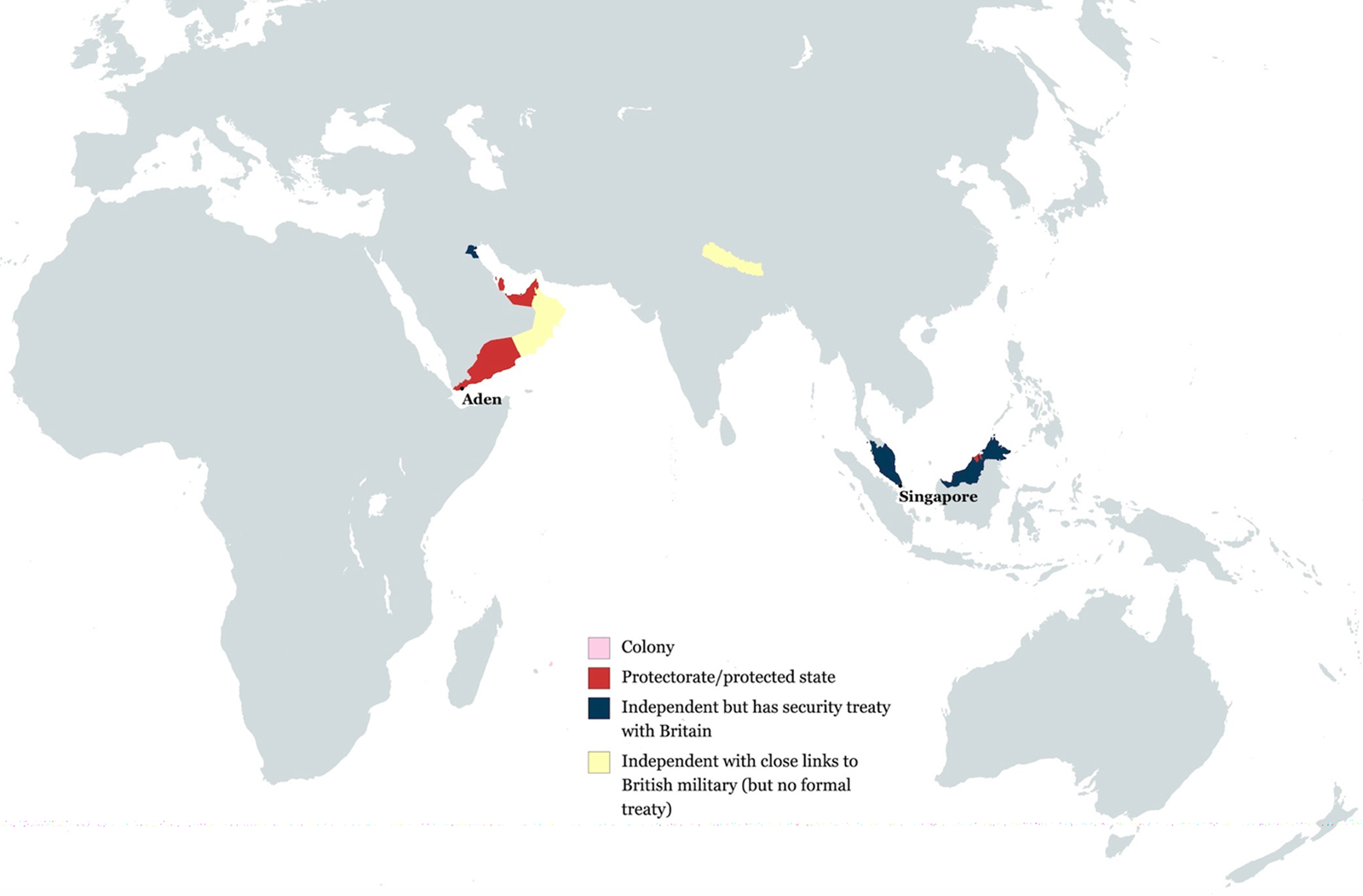
This map depicts the East of Suez presence in 1964. Many of these states were independent but had security treaties with Britain (for example, Malaysia, Kuwait), while others were formal protectorates (for example, the Trucial States). Several were formal colonies (for example, Hong Kong) and a handful had no formal links but had strong ties to the British military (British advisers were heavily involved in the Sultanate of Muscat and Oman's defence infrastructure and the Royal Air Force had unrestricted access to two airfields).
Britain's East of Suez presence, 1964.