Candidate gender quotas have diffused rapidly around the world in recent years.Footnote 1 Today, more than one hundred countries have explicit policies requiring the selection of female candidates to political office. Most research on these measures to date has tended to focus on three main issues: the forms that quotas take, the reasons for their adoption and the variations in their effects. As a whole, the literature identifies three broad types of gender quota policies: reserved seats, political party quotas and legislative quotas.Footnote 2 Four explanations are provided for quota adoption: women’s mobilization,Footnote 3 strategic incentives of political elites,Footnote 4 consistency with existing political normsFootnote 5 and international norms and transnational sharing.Footnote 6 Finally, the fact that some quotas are more effective than others is accounted for by pointing to the details of quota designs,Footnote 7 their ‘fit’ with existing institutional frameworksFootnote 8 and the balance between actors who support and those who oppose quota policies.Footnote 9
The majority of studies focus on individual cases, seeking to understand how quotas operate within a particular national context. Alternatively, they analyse diversity among quotas at the global level, aiming to distil similarities and differences across disparate quota campaigns.Footnote 10 However, a growing number of scholars attempt a middle level of analysis by mapping region-specific trends in Latin America,Footnote 11 Sub-Saharan AfricaFootnote 12 and Western Europe.Footnote 13 While a welcome development, the work endeavours mainly to signal broad similarities and differences across cases. Few scholars use this information in a wider sense (1) to theorize systematic variations across countries that are more or less comparable to one another, or (2) to interrogate possible links in these cases between quota types, quota adoption and quota impact.
This article addresses this gap in the literature by analysing quota campaigns across the West, focusing on the broadly similar political systems of Western Europe, North America, Australia and New Zealand. This sample of countries offers a unique starting point for undertaking comparative research on gender quotas. On the one hand, it is not restricted to a single region of the world. At the same time, however, it includes countries that share important points of contact both culturally and historically. On the other hand, the sample consists of quota campaigns that began earlier than many other quota debates around the world,Footnote 14 usually before international and transnational actors began to politicize this issue on a global scale. It therefore permits closer examination of the various national-level factors that affect how quotas are received, as domestic norms interact with global trends to shape the introduction and translation of quota demands in various national contexts.
The first section begins with an overview of quota policies in Western Europe, North America, Australia and New Zealand. Although reserved seats do not exist in these countries, party quotas and legislative quotas are extensive. A further category of measures is also evident: policies taken up more informally by political parties, or ‘soft’ quotas. The second section surveys quota debates across these countries. It finds that quotas are controversial in different ways across national contexts, revolving around competing definitions of equality, representation or gender. Based on these conflicts, four general models of political citizenship are elaborated that reflect distinct configurations of these political principles. Combining these two analyses, the third section illustrates how citizenship models generate distinct logics that shape the form, adoption and impact of gender quota policies. The article concludes that models of political citizenship play a crucial role in determining the shape and success of gender quota campaigns. However, while the analysis indicates that prior political contexts are important, the case studies also suggest that agency is vital in framing the degree to which quotas challenge or conform to existing political principles. Therefore, although structures provide opportunities and constraints in gender quota campaigns, actors ultimately construct the meanings that are given to quotas as reforms that either fulfil or undermine reigning definitions of equality, representation and gender.
Gender quotas in the west
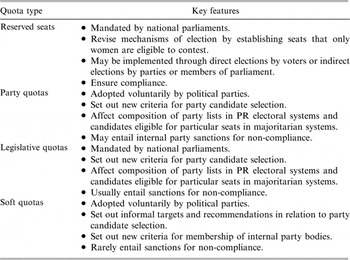
Most work on gender quotas identifies three basic kinds of quota measures: reserved seats, which designate places for women in political assemblies that men are not eligible to contest; party quotas, which involve pledges by individual parties to nominate a specific percentage of women; and legislative quotas, which require that all parties put forward a certain proportion of women.Footnote 15 Some scholars exclude reserved seats from comparative studies of gender quotas, on the grounds that they do not influence candidate nomination processes, but rather make specific guarantees as to who may accede to political office.Footnote 16 Others divide party quotas into two types: aspirant quotas, which affect pre-selection processes by establishing that only women may be considered as nominees for certain elected positions, and candidate quotas, which require that parties select a particular proportion of women among their final lists of candidates.Footnote 17 Still others draw distinctions between various kinds of legislative quotas, separating out those quotas that are instituted through changes to the electoral law from those that are secured through constitutional reforms.Footnote 18 Despite these nuances, these latter contributions do not fundamentally challenge the assertion that reserved seats, party quotas and legislative quotas constitute three broad categories of measures that share similar concerns to increase the numbers of women elected to political office. To these, however, it is possible to add the fourth category of ‘soft’ quotas (see Table 1). These are distinct from other types of quotas in that they seek to encourage, but do not require, parties to promote the selection of more female candidates. Indeed, in many they are often not even called ‘quotas’, although they often influence candidate recruitment processes to an equal or greater degree than ‘hard’ quotas.
Gender Quota Policies Worldwide

Party Quotas
Reserved seats are not found in any countries in Western Europe, North America, Australia or New Zealand, but instead appear primarily in Africa, Asia and the Middle East.Footnote 19 Party quotas, in contrast, are the most common type of formal quotas in the West: they are found in eighteen of the twenty-two countries in the sample. In global perspective, they were first adopted in the early 1970s by various socialist and social democratic parties in Western Europe. Over the course of the 1980s and 1990s, however, they appeared in green parties, social democratic parties and even conservative parties more broadly across the West, as well as in a diverse array of political parties in other regions around the world. At their most basic, party quotas are measures adopted voluntarily that commit parties to aim for a certain proportion of women among their candidates to political office. In this sense, they alter party practices by setting out new criteria for candidate selection that require elites to recognize existing biases and to consider alternative spheres of political recruitment.Footnote 20
Party quotas typically mandate that women constitute between 25 and 50 per cent of parties’ electoral slates. However, the particular phrasing of this requirement varies: some policies identify women as the group to be promoted by the quota,Footnote 21 while others set out a more gender-neutral formulation, specifying a minimum representation for ‘each sex’ or establishing that ‘neither sex’ can account for more than a particular proportion of the party’s candidates.Footnote 22 Further, given distinct political systems, these measures may be implemented in a number of ways. In countries with proportional representation electoral systems, party quotas govern the composition of party lists. Some parties apply the quota to the list as a whole, while others simply direct it to the number of seats in the list that they anticipate winning in the next elections. In countries with majoritarian systems, party quotas pertain to a collection of single-member districts. This may entail nominating a proportion of women across all the districts where the party is running candidates.Footnote 23 Alternatively, the policy may apply to a designated set of seats that the party expects to win; for example, seats where one of the party’s incumbents is stepping down, or seats that the party expects to capture in the next round of elections.Footnote 24
Legislative Quotas
Legislative quotas are much less common in the West. With few exceptions, they tend to be found in developing countries, especially Latin America, and/or post-conflict societies, primarily in Africa, the Middle East and Southeastern Europe.Footnote 25 They exist in only five of the twenty-two states in the sample, although they have recently been proposed – and subsequently rejected – by national parliaments in several countries, namely Austria (1999) and Italy (2006).Footnote 26 These patterns may be explained in part by the fact that legislative quotas are the newest kind of gender quota policy, appearing for the first time only in the 1990s, generally after parties in many Western countries had already adopted other kinds of quota measures. Legislative quotas are similar to party quotas in that they address party selection processes, but they differ in that they are reforms which are passed by national parliaments that require all parties to nominate a certain proportion of female candidates. Thus, they are mandatory provisions that apply to all political groupings, rather than simply those who choose to adopt quotas. In the process, these reforms take important steps to legitimize positive action and recognize ‘gender’ as a political identity, altering the basic meanings of equality and representation that inform candidate selection processes.
Similar to party quotas, legislative quotas call for women to form between 25 and 50 per cent of all candidates. However, they involve more extensive processes of reform, focused on changing the language contained in constitutions and electoral laws, rather than the content of party statutes. As such, their passage requires some degree of cross-partisan agreement; indeed, most legislative quotas are approved nearly unanimously by legislators representing parties from across the political spectrum. The language contained in these measures is generally gender-neutral, speaking of women and men together or making reference to the ‘underrepresented sex’. All the same, the provisions vary in terms of how strictly or specifically their goals are articulated: some speak vaguely about ‘facilitating access’,Footnote 27 while others offer more concrete prescriptions regarding the selection and placement of female candidates.Footnote 28 Like party quotas, legislative quotas are implemented in different ways depending on the electoral system, applying alternatively to party listsFootnote 29 or to a broader group of single-member districts.Footnote 30 Given their status as law, a distinctive feature of these measures is that they usually contain sanctions for non-compliance and are subject to some degree of oversight from external bodies.
Soft Quotas
Soft quotas are perhaps the most prevalent kind of quota measures in the West. The exact number of such policies is difficult to calculate, however, given that these measures are often not labelled ‘quotas’. Further, many of the parties and countries that employ them generally reject or resist the idea of positive action per se as an option for bringing more women into political office. Nonetheless, these policies are often functionally equivalent to formal quotas in that they seek to increase women’s political representation in some concrete way. The two main forms they take are informal targets and recommendations, which are anticipated to affect directly the nomination of more female candidates, and quotas for internal party bodies, which are expected to influence indirectly the numbers of women who run for elected office.Footnote 31 As such, despite the care taken to disassociate them from quotas, these provisions are often adopted with the express purpose of stimulating – although not necessarily guaranteeing – the election of more women to various kinds of political bodies. Consequently, soft quotas are not the same as the aspirant quotas applied by some political parties, which stipulate that only women may be considered among the potential candidates for a particular elected position.Footnote 32 Indeed, they stop short of such mandates, and instead ‘encourage’ possible female candidates. Similarly, soft quotas also do not include the many formal quotas that for various reasons are given a name other than ‘quotas’, such as parité in FranceFootnote 33 or varannan damernas in Sweden.Footnote 34 Rather, they are measures that step back from the spirit and aims of formal quota policies, even as they agree with – and seek to promote – the same or at least similar ends.
Models of political citizenship
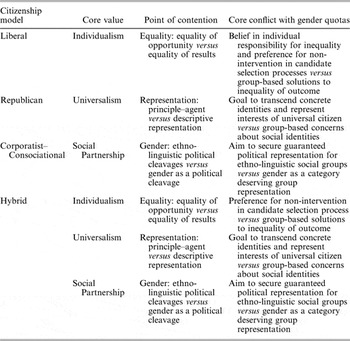
While quotas have now been taken up in many countries in the West and beyond, they nonetheless remain deeply controversial.Footnote 35 Indeed, even when they are adopted nearly unanimously within political parties or by national legislatures, doubts often linger as to their legitimacy and legality.Footnote 36 Most discussions revolve around whether or not quotas are in fact the best way to promote women’s access to political office. However, quotas are controversial in at least three ways: (1) they encourage positive action in candidate selection procedures, provoking a conflict between competing principles of equality; (2) they promote identities over ideas, leading to a clash between distinct notions of political representation; and (3) they recognize ‘women’ as a political category, raising questions about gender and its relation to other kinds of political identities.Footnote 37 While quotas may be disputed for all these reasons, cross-case comparisons reveal striking parallels with existing citizenship typologies:Footnote 38 quota debates are similar within but distinct across countries with different configurations of political ideals. Based on these patterns, it is possible to distinguish four general models of political citizenship (see Table 2). Importantly, these ideal types may vary at the national and the party levels. All the same, as will become apparent below, debates at the party level are often framed or informed by values at the national level. Reflecting distinct political logics, the four models influence the adoption and impact of quota policies by generating relatively predictable patterns of opportunities and constraints for gender quota campaigns, even if actors are ultimately responsible for the meanings given to specific quota reforms.
Political Citizenship Models and Gender Quota Debates

Liberal Citizenship Models
Countries with liberal citizenship models are characterized by a philosophical commitment to individualism and are often associated with majoritarian electoral systems that yield two-party systems, one-party cabinets and executive dominance.Footnote 39 Quotas are contentious in liberal models because of their explicit challenge to reigning definitions of equality, which is often exacerbated by significant political obstacles to quota implementation in electoral systems organized around single-member districts. In general, liberal citizenship models favour equal opportunities, attributing responsibility for unequal outcomes to individuals themselves and therefore viewing prospects for change in terms of individual initiative. Quota policies, by contrast, seek to promote equal results, recognizing that inequalities may derive from broader structures that are best altered through group-based solutions. Thus, although similar objections are raised in nearly all quota campaigns, equality-based concerns are particularly powerful in countries governed by liberal frameworks. In contrast, questions of representation and gender are less subject to dispute in these debates. Liberal models stress principal–agent representation and as such do not offer any further expectations about links between personal characteristics and policy outcomes. In related vein, they simply bracket the issue of gender by focusing on individuals rather than groups. Taken together, these three elements suggest that quotas are least likely to appear in countries with a liberal citizenship model.
Republican Citizenship Models
Republican citizenship models, in contrast, embody a philosophical commitment to universalism and typically involve a politically centralized form of democracy in which popular sovereignty is expressed at the level of the nation.Footnote 40 Quota debates in republican models are most divided on the question of political representation. Meanings of political representation vary by their emphasis on ideas versus identities. Principal–agent notions consider representation to be adequate when a representative acts on behalf of and according to the ideas of those who are represented. In contrast, descriptive conceptions deem the presence of representatives with relevant social or other characteristics to be sufficient.Footnote 41 Gender quotas privilege descriptive representation and, in this way, strongly contradict the logic of the republican model. Given their commitment to universalism, republican systems promote a version of principal–agent representation that takes into account only the interests of the universal citizen, who exists above and beyond any particularistic group-based concerns. In comparison, issues of equality and gender remain largely below the radar. Republican models promote equal opportunities, but ignore gender and other group bases of inequality. Instead, citizens are enjoined to transcend their individual identities to assume the position of the universal citizen. These features indicate that quotas are also not very likely to emerge in countries with this type of citizenship model, unless they are successfully framed to mesh in some way with these universalistic aspirations.
Consociational–Corporatist Citizenship Model
Consociational and corporatist citizenship models are often treated as distinct, because consociationalism normally signifies political arrangements, while corporatism is typically used to refer to relations of social and economic bargaining.Footnote 42 In the context of this discussion, however, these two models of citizenship are more similar than they are different: they share a philosophical commitment to social partnership and consensus and are generally governed by proportional representation.Footnote 43 Quotas are much less controversial in a consociational–corporatist model and are relatively easily implemented due to the presence of list-based electoral systems. Nevertheless, they provoke vivid debates as to the nature and relevance of gender as a political identity. The main point of contention in these systems concerns the unity of the category ‘women’ and, as a subset of this question, the relationship between equality for women and for members of other marginalized groups. Gender quotas to date have employed the category of ‘women’ as a single entity, strategically overlooking the fact that women as a group are invariably stratified by a host of other identities. The claims of women may therefore clash with those of other groups that are guaranteed, or seek to be guaranteed, representation in consociational–corporatist political arrangements. As a result, efforts to institute gender quotas may clash with attempts to facilitate access for other marginalized groups. By way of contrast, definitions of equality and representation are much less subject to debate. Consociational–corporatist models aim to foster equal results, place the onus for unequal outcomes on broader social structures, and understand the potential for change in terms of collective responsibility. Consistent with this approach, they emphasize descriptive representation and view quota policies as a means to acknowledge and promote group-based identities and interests. These characteristics imply that quota policies – whether or not they specifically involve provisions for women – are the most compatible with this kind of citizenship model, which is the least apt to challenge quotas on these various normative grounds.
Hybrid Citizenship Model
Hybrid citizenship models, which are often known in other typologies as social democratic regimes,Footnote 44 combine various features of liberalism, republicanism and consociationalism–corporatism. At times, therefore, they are treated as a single and separate model;Footnote 45 at others, they are viewed as a subset of other types.Footnote 46 For this very reason, they are most usefully conceptualized as a hybrid of the three other kinds of citizenship models. They integrate simultaneous philosophical commitments to individualism, universalism, and social partnership and consensus through direct relations between states and individuals, and universalistic welfare state policies.Footnote 47 Similarly, they employ proportional representation electoral systems, but their multi-party systems produce mixed effects, leaning towards either one-party dominance or an emphasis on broad cross-partisan coalitions.Footnote 48 Reflecting these varied features, proposed quotas spur contentious disputes along a number of different lines, at the same time as tensions among these debates lead them to be resolved in relatively consensual ways. The focus on individualism in these systems, for example, leads to a preference for equality of opportunities over equality of results. However, this faith in the value of incremental change over an extended period of time is accompanied – due to the presence of a consociational–corporatist public policy strand – by a recognition of various structural factors that might get in the way of ‘natural’, automatic change over time.Footnote 49 Similarly, the emphasis on universalism in these models tends towards the representation of ideas over the representation of identities. Nonetheless, the presence of strong and distinct party ideologies co-exists – again, stemming from a broader emphasis on social solidarity – with a more general awareness of the need for a certain degree of group representation.Footnote 50 Finally, the weight given to partnership and consensus in these systems is traditionally conceived in terms of social class and, to a slightly lesser degree, other more traditional cleavages like language and religion.Footnote 51 However, efforts by feminists to extend notions of individualism and universalism to women have led to increasing acknowledgment of gender as a political identity.Footnote 52 These complex patterns indicate that quota policies in hybrid citizenship models are likely to be widespread but also to take highly differentiated forms, depending on how these tensions are resolved in practice in particular countries over time.
Gender quotas and models of political citizenship
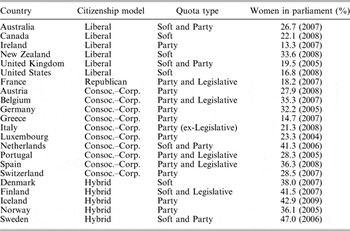
Differences across these four models of political citizenship suggest that quota debates are likely to take distinct forms and experience varying rates of success, depending on how particular proposals mesh with reigning or emerging political norms. A survey of quota policies across the West largely confirms these expectations, with clear patterns surfacing between types of citizenship models and the form, adoption and impact of gender quota policies (see Table 3). More specifically, the equality-based controversies in liberal models appear to generate a preference for soft quotas – and, to a lesser extent, party quotas – that tend to produce only small increases in women’s political representation. In contrast, representation-centred debates in republican models compel the more radical solution of legislative quotas, although with more limited success in promoting the election of women. The gender-focused controversies in consociational–corporatist models incline towards party quotas – and, increasingly, legislative quotas – with often substantial jumps in the numbers of women elected to political office. Finally, the multiple dimensions of contestation in hybrid models are resolved through the varied adoption of party, legislative and soft quotas, generally with great success in bringing more women into political office.
Adoption and Effects of Gender Quotas by Models of Political Citizenship

Soft Quotas and the Liberal Citizenship Model
As outlined above, soft quotas aim to increase women’s representation indirectly through internal party quotas or more directly through informal targets and recommendations. Most likely, they prevail in countries with liberal citizenship models because they facilitate access but do not necessarily mandate fixed outcomes, thus achieving a compromise between the promotion of women and the wish to emphasize equal opportunities over equal results. Indirect soft quotas are employed in many political parties, and are the main measures used by parties to advance women’s representation in the United States. In the West, the United States stands out as the only country in which proposals for gender quotas for elected positions have made virtually no mark in political debates, in spite of the presence of measures to ensure the representation of African-Americans and Latinos.Footnote 53 Despite their lack of attention to candidate provisions, however, both major parties have devoted a significant amount of time to discussing quotas for internal party positions. Soon after women gained the right to vote in 1920, the Democratic party mandated that the Democratic National Committee (DNC) be composed of one man and one woman from each state and territory. The Republican party adopted a similar measure that same year, which they abandoned in 1952 but replaced in 1960 with a rule calling for 50–50 representation in all convention committees.Footnote 54 Following protests at its party convention in 1968, the DNC later ratified guidelines requiring state parties to select women as national convention delegates in proportion to their presence in the state population.Footnote 55 When these reforms came under attack in 1972, the party rewrote delegate selection rules to ban ‘quotas’ in favour of ‘affirmative action’. The Republicans, in contrast, chose not to regulate the state parties, although some states mandated 50–50 representation on their state central committees.Footnote 56 Reflecting the country’s liberal citizenship model, all of these debates have centred on the issue of equality, fluctuating between a desire to combat discrimination and concerns to preserve ‘merit’ as a criterion of delegate selection.Footnote 57 With some exceptions, these soft quotas have enabled women to participate to a greater degree in party matters. However, while women originally pursued equal representation on party committees out of the belief that these positions would provide an important wedge for gaining broader influence as a group within the parties, vacillations regarding ‘quotas’ – combined with the hesitation to take these policies into the realm of candidate selections – have produced few gains for women in US electoral politics. In 2008, women won only 16.8 per cent of the seats in the House of Representatives and 15.3 per cent of the seats in the Senate, still below the world average of 18.4 per cent.Footnote 58
More direct soft quotas have been utilized in New Zealand. As early as the 1970s, the New Zealand Labour Party (NZLP) began to take concrete steps to nominate women, largely in response to a disastrous electoral defeat in 1975. Women used the opportunity to campaign for more women in parliament and in decision-making positions, not least because the party had lost crucial electoral support to the new left-wing New Zealand Values party, which presented 25 per cent female candidates in 1975.Footnote 59 These policies never approximated formal quotas, however, even though the country has a strong national discourse concerning the rights of Maoris, the indigenous people of New Zealand, for whom a certain number of seats have always been reserved in parliament.Footnote 60 The idea of quotas reached the political agenda again in 1993, when the country adopted a new mixed-member proportional electoral system. Following this reform, the NZLP leader proposed party quotas, but these were rejected by the party in favour of a change in its constitution to include a principle of ‘gender balance’ for all selection procedures.Footnote 61 Thus, at each candidate selection conference, the party is supposed to ‘pause for thought’ after each bloc of five candidates to consider the balance of gender, ethnicity, age and experience. The Green party embraces a similar principle of parity in its nominations, but the party has never adopted specific quotas or applied strict alternation on its lists, in contrast to Green parties elsewhere in the world. The centre-right National party, for its part, has not adopted quotas, but also talks of the need to take ‘balance’ into account.Footnote 62 Consistent with its liberal citizenship model, debates over gender quotas in New Zealand have been sensitive to issues of equality, but have largely given way to the belief that change will occur without the need for formal rules. However, despite claims that the parties’ attitudes have evolved beyond quotas, the application of these measures over time reveals the limits of their ‘soft’ nature: while all parties increased the number of female candidates in the first two elections under the new more ‘women-friendly’ electoral system, the election of women decreased from 31 per cent in 1999 to 28 per cent in 2002.Footnote 63 Although much of the decline in 2002 was due to the victory of right-wing parties with relatively few women on their lists, even the NZLP had placed fewer women in spots where they were likely to be elected, because the policy of ‘pausing for thought’ had become less effective with each successive election. Although women’s representation later increased to 32.2 per cent in 2005 and 33.6 per cent in 2008,Footnote 64 the success of soft quotas has led to widespread complacency among all parties that these trends will continue upward, leading many to claim that women no longer need ‘special treatment’ in order to be elected to top political positions.Footnote 65
While soft quotas constitute a novel solution to the widespread resistance to quotas in states with liberal citizenship models, two parties in these countries – the Australian and British Labour parties – have nonetheless approved formal quota policies. Notably, these are both left-wing parties, and this suggests that party ideology may play an important role in mitigating the effects of broader national-level citizenship models. The best evidence for the influence of ideology can be seen in the fact that most party quotas around the world have been adopted by socialist and social democratic parties,Footnote 66 matching the strong support for quotas inside the Socialist International.Footnote 67 All the same, the liberal citizenship model continues to affect debates in these countries on the form, adoption and implementation of gender quotas. In the United Kingdom, for example, the Labour party initially employed various kinds of soft quotas in an attempt to improve the share of women among its candidates. Given the country’s electoral system, organized around single-member districts and winner-take-all elections, these policies focused not on party lists but on party shortlists, namely, the slates of possible candidates in each district. In 1987, the party mandated that in districts where a woman had been nominated, at least one woman had to be included on the shortlist for constituency selection. It strengthened this policy in 1990, when the party conference agreed to a 40 per cent quota for women in all positions inside the party and a target of 50 per cent women in the party’s delegation to parliament within ten years or three general elections. Only when both measures failed to increase the number of women elected did the party move to a formal quota policy in 1993, which called for all-women shortlists to be used to select candidates in half of all vacant seats that the party was likely to win. Nonetheless, quotas remained very controversial for reasons similar to those in other countries with liberal citizenship models: while proponents argued that increasing the proportion of women would achieve greater equality between women and men,Footnote 68 opponents – which included a sub-group inside Labour, as well as Liberal Democrats and Conservatives – expressed concerns about the possible stigmatization of ‘quota women’ and the need to preserve ‘merit’ as a central criterion of candidate selection.Footnote 69 Although the policy was soon overturned on the grounds that it violated the terms of the Sex Discrimination Act, it was eventually reinstated following reform of this Act in 2002, when the party decided again to apply all-women shortlists in at least half of the all seats where incumbent Labour MPs were retiring.Footnote 70 As a result of these shifts, the number of women elected to the House of Commons doubled from 9.2 per cent in 1992 to 18.4 per cent in 1997, dropped to 17.9 per cent in 2001 when no parties applied quotas, and climbed to 19.5 per cent in 2005 when new quota policies were instated.Footnote 71 Interestingly, sustained attention to women in politics, combined with three consecutive electoral losses, has recently led the Conservatives to adopt their own soft quota measures. This includes a ‘priority list’ of aspirant candidates, consisting of at least 50 per cent women and a ‘significant’ proportion of black, minority ethnic and disabled candidates, who are to be considered for Conservative-held and target seats.Footnote 72 As such, while party quotas have been adopted in the United Kingdom, they are restricted to the Labour party and have been controversial because they violate prevailing national ideas about equality. In contrast, soft quotas are common, even spreading to a party that is otherwise strongly opposed to equality guarantees.
Legislative Quotas and the Republican Citizenship Model
Legislative quotas are laws passed by national parliaments that govern the selection of female candidates by all political parties. They appear in the one country in the sample with a republican citizenship model, France, and in this case largely because they resolve – albeit, in a dramatic fashion – fundamental questions about the means and ends of political representation.Footnote 73 The earliest proposals for gender quotas in France were party quotas adopted by the Socialist party (PS) in 1974.Footnote 74 As early as 1975, however, several female members of parliament began to press for legislative quotas in municipal elections. They succeeded in gaining a 25 per cent quota in 1982, but this law was almost immediately overturned by the Constitutional Council on the grounds that it violated articles in the Constitution that did not permit the ‘division’ of voters and candidates into ‘categories’ for the purposes of election.Footnote 75 This verdict defended a notion of representation that did not recognize social differences, but instead privileged the primacy of ideas. Seeking to reframe the connection between identities and opinions, supporters launched a new campaign for quotas in the 1990s and eventually secured constitutional reform in 1999 and change to the electoral law in 2000 to mandate a 50 per cent quota – or ‘parity’ – for women in local, regional, national and European elections. Inspired by discussions inside the Council of Europe over the concept of ‘parity democracy’, they argued that existing understandings of equality and representation – as well as their subject, the universal citizen – were originally deemed to apply only to men. Instead of abandoning these concepts, they proposed reforming the Constitution to provide for the equal representation of women and men in political life, on the basis that this was the only way to acknowledge the two sexes of the abstract universal citizen.Footnote 76 This policy differed from quotas, they claimed, because quotas implied special representation rights for minorities, while parity simply called for the equitable sharing of power between women and men, the two halves of the human race.Footnote 77 Opponents responded that parity reified sexual differences and threatened to spur claims by other groups for similar concessions, with fatal consequences for the secular and universal republic.Footnote 78
The republican model of political citizenship thus compelled advocates to re-define equal representation, in a manner that could – and did – gain near unanimous approval from both houses of parliament. Nonetheless, many parity advocates were disappointed with the final version of the quota law because it focused on the nomination of female candidates, rather than on the proportion of women elected, and made weak provisions for elections to the National Assembly, where the low percentage of women had inspired the parity campaign in the first place.Footnote 79 As a result of these features, the law’s impact varies widely across levels of government. In local elections, where parties face rejection of their lists if they do not present lists with equal numbers of women and men, women’s representation increased from 25.7 per cent in 1995 to 47.5 per cent in 2001.Footnote 80 In contrast, in national elections, where parties are required to present equal numbers of male and female candidates across all electoral districts, the percentage of women increased only marginally from 10.9 per cent in 1997 to 12.2 per cent in 2002 and 18.2 per cent in 2007. While regulations for local elections imposed specific placement mandates, regulations for national elections made no mention of placement and imposed relatively mild financial penalties for those parties that did not comply, equal to half the difference in their percentages of male and female candidates. These allowances offered greater opportunities for elites to deviate from the spirit – if not the letter – of the law.Footnote 81 On-going discussions on the details of the law reflect the systemic nature of the parity reforms, which combined with the many voting systems in France, require close attention to the dynamics of implementation at various levels of election. They also speak to continuing tensions in attempts to re-define equal representation in a system that gives precedence to ideas over identities via the figure of the abstract universal citizen.
Party Quotas and the Consociational–Corporatist Citizenship Model
Party quotas are provisions adopted voluntarily by political parties as part of a pledge to increase the number of female candidates to political office. These measures dominate in countries with consociational–corporatist citizenship models, generally because they build on commitments that parties have already made in terms of promoting the representation of other kinds of social groups. In some cases, parliaments have subsequently transformed these party-specific promises into legislative quota policies that apply to all parties, thus extending the obligation of gender-based representation to the entire political system. An example of a country with party quotas is Germany, where quotas were first adopted in 1983. That year, the newly formed Green party applied a 50 per cent quota and required that all its lists alternate between women and men.Footnote 82 The Social Democratic Party (SPD), concerned about possible erosion of its electoral support to the Greens in the late 1980s, responded by adopting its own 25 per cent quota in 1990, which it subsequently raised to 33 per cent in 1994 and 40 per cent in 1998. These events eventually led the SPD’s main rival, the Christian Democratic Union (CDU), to adopt its own 33 per cent policy for party lists in 1996. Aware of negative connotations of the word ‘quota’ in conservative circles, the CDU devised the less objectionable term ‘quorum’ to refer to its requirement of one woman for every two men.Footnote 83 In the wake of reunification in 1990, the Party of Democratic Socialism also adopted a 50 per cent quota, but this decision was embedded in a separate set of political dynamics and thus took place largely in isolation from developments in former West Germany. In line with its corporatist citizenship model, debates in Germany have revolved primarily around ‘gender’ as an identity deserving political representation. While opponents voiced concerns about gender quotas, advocates in former West Germany justified these measures on the grounds that women were ‘equal citizens’ whose increased participation would enhance the overall quality of politics,Footnote 84 while those in former East Germany noted the high price of reunification and its especially strong impact on women.Footnote 85 These arguments, however, generally made little progress until women’s groups succeeded in convincing influential male allies to throw their support behind gender quotas, most often by casting women’s representation as an issue that would enable their parties to win crucial votes among women.Footnote 86 As a result of these strategies, all but two parties – the Christian Social Union and the Free Democratic Party – apply gender quotas in their candidate selection procedures. Among seats decided by proportional lists, where quota policies govern the selection of many candidates, most parties approximate their quota goals, nominating between 34 per cent and 49 per cent women. In contrast, in constituency elections parties generally do not match their quotas for list elections, presenting between 21 per cent and 37 per cent women.Footnote 87 Despite disparities between parties and seats, these patterns resulted in the election of 32.8 per cent women in 2002 and 32.2 per cent women in 2005.Footnote 88
A country where party quotas have later led to the adoption of legislative quotas is Belgium. The first party quotas appeared as early as 1985, when the Flemish Liberal party adopted a 20 per cent policy. It was soon followed by the Movement of Citizens for Change, now part of the French Liberal party, with a 33 per cent quota in 1986; the Flemish Green party with a 50 per cent quota in 1991; the Flemish Social Democratic party with a 25 per cent quota in 1992; and the French Green party and French Socialist party with 50 per cent quotas in 2000. On the initiative of the government, the first legislative quotas were mandated by the Belgian parliament in 1994. The Smet–Tobback Law specified that women should comprise at least 25 per cent of all electoral lists until 1999, after which the quota requirement would be raised to 33 per cent. When a new law on equality between women and men was subsequently passed, the parliament revisited the quota requirement and raised it to 50 per cent in 2002.Footnote 89 Reflecting its consociational citizenship model, debates over gender quotas in Belgium have developed in reference to a long-standing tradition of descriptive representation, which guarantees the participation of a range of different social groups based on language, religion and class.Footnote 90 In the case of linguistic groups, a certain number of seats are reserved for Flemish, French and German speakers to ensure their presence in all elected and appointed political bodies. Aware that even those opposed to quotas for women accepted the idea of ‘proportionality’, advocates of gender quotas mobilized on the basis of this norm to justify their adoption in the form of party and legislative quotas, on the grounds that the balanced representation of key social groups was an essential legitimizing feature of the political system.Footnote 91 However, when the first quota bill was proposed, the governing parties introduced an important distinction between ‘gender’ and other kinds of political identities: while linguistic groups were guaranteed a specific share of seats regardless of election outcomes, gender quotas would apply to electoral lists and the group of potential candidates for political office.Footnote 92 These legal provisions led to a dramatic increase in the number of women nominated as candidates, but only a marginal rise in the number of women actually elected to the national parliament, as parties tended to place their female candidates in list positions where they were unlikely to be elected.Footnote 93 Because parties generally followed the letter, but not the spirit, of the law, women’s representation increased from 12 per cent in 1995 to 23.3 per cent in 1999, a major jump but still far short of the 33 per cent quota requirement. In the light of these shortcomings, the new quota law adopted in 2002 added the stipulation that the first three – and eventually the first two – candidates on a party list not be members of the same sex. This adjustment pushed the proportion of women elected up to 35.3 per cent in 2003, although again, this outcome also remained far below the 50 per cent quota requirement.Footnote 94
For many years, the only legislative quotas in the West were found in Belgium and France. However, a growing number of countries with consociational–corporatist citizenship models have witnessed the proposal of quota laws. In Italy, a legislative quota was adopted in 1993 in the context of broader reform of the Italian electoral system. The new electoral law stipulated that 75 per cent of the seats would be assigned using majority elections and 25 per cent of the seats would be decided by a proportional list system. For lists governed by proportional representation, parties were required to alternate between male and female candidates.Footnote 95 The quota provision was declared unconstitutional two years later on the grounds that it violated the principle of equality set forth in various articles of the Constitution.Footnote 96 After sustained mobilization by women, the Constitution was reformed in 2003 to legalize positive action in candidate recruitment. This was followed by a new law governing elections to the European Parliament, which mandates that neither sex may constitute more than two-thirds of each party’s candidates, with the penalty for non-compliance being financial sanctions proportional to the imbalance.Footnote 97 Legislative quotas for national elections have been proposed on a number of occasions, but have not yet been passed, despite most recently being approved by the lower house of parliament just before elections in 2006. In Austria, similar reforms were proposed following the 1994 elections, when women’s representation dropped for the first time since the 1970s. In response, a female member of parliament from the Green party introduced a private member’s bill to make 15 per cent of public subsidies of political parties contingent upon the number of their female representatives being proportional to their presence in the population. The proposed law was eventually rejected in 1999, despite the fact that many Austrian parties have their own quota policies.Footnote 98 In Portugal, the Socialist party presented two bills to institute a legislative quota, but both were rejected by parliament in 1999. The party later increased its own party quota from 25 per cent to 33 per cent in 2004. Nonetheless, advocates continued to mobilize and eventually the parliament approved a quota law in 2006 stipulating that all candidate lists must have a minimum of 33 per cent of the under-represented sex. If parties do not comply, they will receive a public reprimand and be subject to a reduction in their public subsidies.Footnote 99 In Spain, finally, party quotas have existed inside the Socialist party since 1988. In 1998, the party proposed to reform the General Election Act to require that all electoral lists have no more than 60 per cent of candidates of the same sex. The bill was formally presented in parliament in 2001 but rejected in 2003.Footnote 100 A 50 per cent quota law was eventually approved in 2007 as part of a broader bill on equality between women and men. Across these cases, therefore, the pattern is sequential: party quotas tend to be adopted first, to be followed only later by proposals for legislative quota provisions.
Soft, Legislative and Party Quotas in the Hybrid Citizenship Model
Quotas tend towards one main form in the three core citizenship models in the West. That these patterns stem from the distinct controversies over gender quota policies – rather than simply chance or even policy diffusion – gains further credence when compared to choices in quota reform in countries with hybrid citizenship models. These mixed systems contain multiple dimensions of contestation that are resolved in various ways to influence the form, adoption and impact of quota measures. Soft quotas are prevalent in countries and political parties where there is a strong emphasis on gender neutrality, combined with a firm faith in incremental progress.Footnote 101 In Sweden and Finland, for example, the broader political culture places great value on notions of co-operation and consensus. In debates on gender equality, therefore, activists and elites stress the importance of looking at women and men together, being careful not to focus only on one group to the exclusion – or advantage – of the other.Footnote 102 This approach is underwritten by an implicitly positive view of historical development, driven by the belief that attempts to change the behaviour of women and men will lead traditional beliefs about gender to eventually disappear. In Sweden, these ideas have caused parties to view formal quotas as a last resort to be applied only when softer measures fail to produce change.Footnote 103 Initially, parties focused on securing an ‘obligatory woman’ for party committees and electoral lists.Footnote 104 As women mobilized for more women in politics in the 1960s and 1970s, several began to adopt formal quotas for party bodies but preferred to pass only more informal ‘resolutions’ stating that they would try to elect more women. In the 1980s and 1990s, party commitments slowly radicalized into more specific ‘recommendations’ and ‘targets’ that aimed to increase this proportion to at least 40 per cent. By the mid-1990s, a number of parties further pledged themselves to strict alternation between women and men on all party lists. While this last policy is technically a 50 per cent party quota, party leaders insist that it is not a ‘quota’ but rather the principle of ‘every other one for the ladies’ (varannan damernas). This phrase invokes a tradition in Swedish countryside dances whereby men and women take turns asking one another to dance, thus enabling supporters – through a well-chosen discursive strategy – to achieve equal representation through party quotas that still speak to the notion of partnership between women and men.Footnote 105 The soft measures applied by some parties, combined with the formal policies adopted by others, resulted in the election of 47.0 per cent women in 2006.Footnote 106 However, women have occupied at least 20 per cent of all seats since 1973 and at least 30 per cent since 1985.Footnote 107 While these figures confirm that women’s representation increased before formal quotas were introduced,Footnote 108 a broader definition that includes soft quotas indicates that these gains did not occur ‘on their own’, but rather as the result of less formal gender quota policies.
Similar dynamics operate in Finland, where several parties employ various kinds of soft quotas, including indirect provisions for internal party bodies.Footnote 109 In addition, the country also mandates legislative quotas – the only one with a hybrid citizenship model to do soFootnote 110 – although these regulate access only to non-elected political positions. The law states that all indirectly elected political bodies – including government inquiry commissions, municipal executive boards and other municipal boards and committees – must be composed of a minimum of 40 per cent of each sex, unless there are particular reasons to the contrary. An additional clause specifies that there should be a ‘gender balance’ in the decision-making bodies – in so far as they are composed of political representatives – of state-owned enterprises and companies where the state is the majority share-owner. Passed in 1995, this law appears to provide for group representation through its emphasis on roughly equal numbers of women and men. However, a closer look at the debates surrounding its introduction reveals that it has been largely justified on the grounds of promoting ‘competence’ and ‘merit’ in the conduct of public affairs, to enable the wider society to benefit from the input of an increased number of qualified individuals.Footnote 111 As such, the provision strikes a compromise between the representation of identities and the representation of ideas, privileging the latter even as it emphasizes the former. Pursued by a cross-partisan network of female members of parliament and other feminist activists after an earlier act failed to produce many changes in the numbers of women on public bodies, this reform has proved highly successful, raising the proportion of women on municipal executive boards from 25 per cent in 1993 to 45 per cent in 1997.Footnote 112 The law has also altered the strong horizontal gender segregation of local government, bringing men onto boards dealing with social affairs, health and education, and women onto boards related to economic development and technical services. Despite open resistance to these requirements when they were first passed, the need not to be ‘against gender equality’ has given way to broad implementation, framed as a means to promote further co-operation and consensus between women and men.Footnote 113
In addition to soft and legislative provisions, party quotas also appear in countries with hybrid citizenship models. Usually building on earlier soft quotas, these more formal measures tend to be adopted mainly by green, left, social democratic and centre parties.Footnote 114 Party quotas are used most extensively in Norway, where they were introduced by the Liberal party in 1974 and the Socialist Left party in 1975. The first major party to establish such a quota was the Norwegian Labour party, which approved a policy to nominate at least 40 per cent of both sexes as candidates to elected office in 1983. At the same time, it adopted a parallel soft quota to ensure at least 40 per cent of both sexes in all internal party bodies. When women’s representation then jumped to a world-record 34.4 per cent in 1985, up from 26 per cent in 1981,Footnote 115 other parties began to consider formal measures as well. Similar quotas aimed at promoting at least 40 per cent of both sexes were rejected by the Conservative party in 1988, but were adopted by the Centre party in 1989 and the Christian People’s party in 1991.Footnote 116 These measures were justified in line with distinct party ideologies, focused on women’s interests in left-wing parties and women’s values and resources in right-wing parties.Footnote 117 In all instances, however, the adoption of formal party quotas was linked to a larger tradition of group representation in Norway. According to this approach, parties seek to ‘balance’ their electoral tickets by including candidates from different parts of the country, various social and cultural groups, and distinct age brackets. Parties continue to diverge as to which groups they deem ought to be represented, but in general, ‘gender’ has slowly moved from being one among several peripheral interests towards being one the central criteria of candidate selection.Footnote 118 As a result, the proportion of women in the Norwegian parliament has remained above 30 per cent since the 1980s, reaching 36.1 per cent in 2005.Footnote 119 Nonetheless, quota policies aimed at promoting women still co-exist uneasily with other ‘more important’ political principles, like local control of candidate selection.Footnote 120 Similar tensions with the principle of gender equality led party quotas to be overturned in the mid-1990s in the Socialist People’s party in Denmark.Footnote 121 The overall pattern is thus a mix of strategies, reflecting multiple lines of contestation that themselves have evolved over time.
Conclusions
Gender quotas are rapidly making their mark on the political landscape in countries around the world and research on their features, adoption and implementation continues to grow. Because few studies have attempted to theorize these variations either systematically or comparatively, this article offers a first attempt to investigate a broader group of quota campaigns, namely those that have taken place in Western Europe, North America, Australia and New Zealand. The analysis explores the political contexts that shape quota debates, as well as patterns of quota adoption and impact, and consequently proposes that one or more sets of controversies influence the course and outcomes of quota reforms. These revolve around (1) competing principles of equality, (2) different ideas about political representation, and (3) various beliefs about ‘gender’ and its relation to other kinds of political identities. Based on distinct configurations of these principles, the article identifies four broad models of political citizenship that shape both the kinds of quota policies pursued and the prospects of achieving their goals of bringing more women into political office.
While developed in reference to the West, these findings are likely to offer crucial insights into the dynamics that are present in all quota campaigns, as domestic norms interact with global trends to affect the introduction and translation of quota demands in various national contexts. More specifically, they suggest that normative questions regarding equality, representation and gender are likely to inform quota debates in many different parts of the world. Indeed, many of the specific controversies surrounding quotas are relatively straightforward to anticipate, revolving around the priority of equal opportunities over equal results, the representation of ideas over the representation of identities, and the connection between ‘gender’ and other social identities. As the analysis here has shown, models of political citizenship are likely to shape which of these axes will become the main point of contention in quota debates, and thus what kinds of measures will later be adopted. The evidence also indicates, however, that structure is not destiny: individual actors play an important role in resolving and even creatively transforming these particular conflicts in ways that permit the introduction and successful implementation of gender quota policies.
Despite these general insights, the focus on citizenship models in the West does impose a number of important limits on the analysis. First, the discussion hints at but does not explicitly theorize all the boundaries on ‘equality’ imposed by the law. While quotas have been overturned as unconstitutional or illegal in several countries in the sample, similar measures have been blocked from even being passed elsewhere in the world. Combined with the end of recent civil conflicts that has resulted in the writing of new constitutions in many states,Footnote 122 these situations provide a distinct set of constraints and opportunities for reframing definitions of equality that are not present in the West. Secondly, the analysis in this article draws a sharp distinction between the representation of ideas and the representation of identities. In practice, these questions are often elided, leading to the assumption that an increase in the numbers of women elected will result in an increase in attention to women’s policy issues. Indeed, these two notions of representation are often treated as one and the same in the various international documents that have been used to support efforts to institute quotas in many developing countries. Although international organizations do not play a major role in quota debates in the West,Footnote 123 potential interventions by such actors in policy deliberations outside the West are likely to affect how concepts of representation are employed – and possibly reformulated – in the course of these debates. Thirdly, the focus on ‘gender’ in relation to other identities overlooks the importance of intersections between these various identities. Evidence from the West justifies this lens, showing for example that quotas for women tend to promote women from dominant races and classes, while quotas for minorities tend to give preference to men from these linguistic, religious and ethnic groups. However, other cases reveal that the presence of both kinds of quotas can lead to the increased representation of minority women, as a means for ensuring the continued dominance of majority men.Footnote 124 These limitations do not necessarily undermine the arguments developed here, but rather point to the need to undertake further research – both comparative and case-specific – on the form, adoption and impact of gender quota policies. The highly controversial nature of quotas, despite their rapid diffusion around the globe, suggests that debates over fundamental political norms are likely to continue to structure how citizens and elites perceive and implement gender quota reforms.